




Abstract
Schools are pivotal stakeholders in increasing the amount of student physical activity, an attribution especially relevant while the COVID-19 pandemic is not overcome. This article evaluates how the use of physically active academic lessons impacted mathematics learning and the amount of physical activity during the transition to face-to-face classes. The objective was also to analyze students, parents, and teachers’ perceptions of this experience. Therefore, for at least 6 weeks in mid-2021, 290 Chilean elementary school students from different schools, together with their 11 teachers, learned and practiced a choreography on geometry during the school routine. Both quantitative and qualitative instruments were used to evaluate this experience. The results from the pre- and post-test showed that students increased their geometry scores significantly (Z = 13.116, p < .001) by an average of 24.28 percentage points with an increase of 7.33 percentage points if the student attended face-to-face classes. Moreover, the results of the focus groups revealed a positive perception of the experience and increased physical activity. Overall, the study suggests that incorporating physically active academic lessons positively affect both academic performance and students’ physical activity levels during the transition to face-to-face classes.
Keywords
Introduction
The world has been living with a pandemic other than COVID-19 for years, the physical inactivity and sedentary behaviors pandemic (Hall et al., 2021). In 2018 the Global Matrix 3.0 Physical Activity Report highlighted that children worldwide were not getting enough physical activity (Aubert et al., 2018). Half did not reach the recommended threshold of 60 min per day of moderate to vigorous physical activity (Inchley et al., 2020; World Health Organization, 2020); among young people, the result is even worse, 81% (Guthold et al., 2020). A particularly worrisome situation, considering that, during the COVID-19 pandemic, different studies reported a significant decrease in physical activity in children and youth in the following countries: Canada (Guerrero et al., 2020; S. A. Moore et al., 2020); China (Xiang et al., 2020); Croatia (Zenic et al., 2020); Germany (Schmidt et al., 2020); Netherlands (Ten Velde et al., 2021); Italy (Pietrobelli et al., 2020); Norway (Roe et al., 2021); USA (Dunton et al., 2020); Brazil and Spain (López-Gil et al., 2021). These studies indicate that the closure of schools and parks, the cancelation of organized sports and recreational activities, and the increase in accessibility and time spent in front of screens, negatively affected the practice of physical activity. It is worth mentioning that, according to the World Health Organization (2010), physical activity is defined as any bodily movement produced by skeletal muscles that require energy expenditure.
With the improvement of health indicators associated with the pandemic in different countries, some restrictions were reduced, and schools were reopened. Consequently, the transition to face-to-face education began, where educational activities and opportunities for physical activity during the school routine were gradually resumed. However, this transition to face-to-face education was not free of difficulties. For example, the time allocated to the cleaning protocol, preventive quarantines, and the closing of the schools due to the increase in contagions (MINSAL, 2021), hindered the teaching-learning processes and opportunities for physical activity.
As Fegert et al. (2020) anticipated in their study, there was also greater teacher pressure on children and young people with the aim of making up for the lost time in terms of curricular content not learned during the acute phase of the pandemic. The preceding undoubtedly implied a reduction in the opportunities for physical activity in the school routine in favor of developing other curricular objectives. Added to the previously mentioned are the social distancing protocols in schools that largely restrict physical activities inside the classroom (CPEIP, 2020) and during recess (MINEDUC, 2021; MINSAL, 2021). During childhood, most of the physical activity in schools occurs during recess and in Physical Education classes (Teslo et al., 2023; Vazou et al., 2020), while outside schools, it occur during structured sports, times in parks (Guan et al., 2020), and during transfers to and from schools, parks, and home (Roe et al., 2021). In summary, school physical activity opportunities were limited during the transition to face-to-face classes. Whereas opportunities outside of schools also went through equally complex adaptive processes limiting physical activity opportunities.
Finally, as Hargreaves et al. (2021) observed, there is a multitude of interconnected factors that account for changes in the amount of physical activity following COVID-19 quarantines. Nevertheless, all children and youth must receive safe, simple, easy-to-implement physical activity offerings during the various phases of COVID-19 (Chen et al., 2020).
Now, even before COVID-19, schools worldwide have been called upon to promote the practice of physical activity throughout the school routine (Bedard et al., 2019; Sneck et al., 2019). The Global Action Plan on Physical Activity for 2018-2030 (World Health Organization, 2018), and other researchers (Calella et al., 2020; Quarmby et al., 2019), point out that schools are essential when it comes to promoting physical activity opportunities in childhood. Firstly, because of their almost universal access (World Health Organization, 2008), and secondly, because of the significant number of waking hours per day that children and young people spend in schools (Bedard et al., 2019). Consequently, different national policies recommend that schools provide all students with a minimum of 30 min per day of moderate to vigorous physical activity (A. Daly-Smith et al., 2021).
The scientific evidence points to three approaches as the most widely used to promote physical activity in schools (Calella et al., 2020). (1) Physically active academic lessons that integrate physical activity with curricular content (Dyrstad et al., 2018), often named movement integration or physical activity in the classroom (Knudsen et al., 2021) (e.g., students must jump a certain number of times to respond to an addition); (2) active transitions that include physical activity when moving from one task to another (Russ et al., 2017; Vazou et al., 2020) (e.g., having students jump around the class before lining up to go to lunch); and (3) active breaks that introduce short periods of physical activity during class (Turner & Chaloupka, 2017) (e.g., having students do squats). Although increasing the number of Physical Education classes is another option, active lessons are presented as a more cost-effective strategy (Teslo et al., 2023).
A. Daly-Smith et al. (2021) note that three systematic reviews (A. J. Daly-Smith et al., 2018; Martin & Murtagh, 2017; Norris et al., 2015), plus two that include meta-analyses (Norris et al., 2020; Watson et al., 2017) support the proposal to incorporate more physical activity into the classroom through physically active academic lessons or with active breaks. Mainly, physically active academic lessons are a promising way to improve students’ health and academic learning (Li et al., 2023; Norris et al., 2020). Physically active academic lessons balance learning outcomes with time spent in physical activity (Bedard et al., 2019; Watson et al., 2017) and counteract the increasing choice for a sedentary lifestyle among students (McGowan et al., 2020). Physically active academic lessons are designed to achieve a sufficient dose of physical activity to improve health while enhancing learning, aligning with the needs of teachers and managers (Skage et al., 2020). Bedard et al. (2019), in their systematic review of physically active academic lessons, suggest that besides increasing the amount of physical activity, they can increase academic performance, work time, and enjoyment compared to traditional academic lessons. Enjoyment during physically active academic lessons is closely linked to the principles of Self-determination Theory (Ryan & Deci, 2020), which emphasize satisfying the basic psychological needs of autonomy, competence, and relatedness to promote students’ intrinsic motivation. When students enjoy the lessons, they feel more autonomous, perceive greater competence, and experience greater social connection with their peers and teachers in an active and collaborative environment. Similarly, because they often take place with students divided into groups, physically active academic lessons were also indicated as a strategy to promote the development of collaborative and cooperative skills (Skage et al., 2020). Finally, McGowan et al. (2021) point out that physically active academic lessons can help students with low self-regulation to reduce challenging behaviors. Therefore, these authors argue that this approach has the potential to positively influence the mental health and well-being of teachers and students.
If on the one hand the reopening of schools has been chaotic, fragmented (Buonsenso et al., 2021), and full of protocols and new operating procedures (Pokhrel & Chhetri, 2021) that hindered teachers’ work; on the other hand there is the need to find ways to repair the damage caused by COVID-19 on learning (Daniel, 2020), and also on the opportunities for physical activity (Eaton et al., 2023; MINEDUC, 2020c), whatever the stage of the pandemic. Hence, this paper aims to analyze the impact of using physically active academic lessons on mathematics learning during the transition to face-to-face classes. It also explores the acceptability and feasibility of this proposal from the perception of students, parents, and teachers. The interest in the perception of these actors is based on the changes to their roles reported after the closure of the schools (Eaton et al., 2023; Roe et al., 2021). In this context, knowing the perception of each of these actors will allow analyzing more accurately the impact of the use of physically active academic lessons during the transition to face-to-face classes. This study is particularly relevant since the COVID-19 pandemic has not been officially overcome (World Health Organization, 2022) and restrictive regulatory measures, which are still intermittent in many parts of the world, reactivate and deactivate remote modalities, consequently generating new transition to face-to-face classes. Finally, COVID-19 is not the first virus to threaten humanity, and it will not be the last (Cluver et al., 2020); in the last 20 years, it is the third time that a coronavirus has crossed species and infected the human population (Zhang et al., 2020).
Thus, the research questions guiding this paper are:
What is the impact of using physically active academic lessons on mathematics learning during the transition to face-to-face classes?
How do students, parents, and teachers perceive the use of physically active academic lessons during the transition to face-to-face classes?
What were the barriers or difficulties students, parents, and teachers identified in the use of physically active academic lessons during the transition to face-to-face classes?
Method
Design
The present study consisted of a quasi-experimental design with a cross-sectional approach. Teachers, students, and parents from four schools that offered face-to-face or hybrid teaching modalities participated in the study. A pre-post-test method was used to analyze the impact of physically active academic lessons on mathematics learning during the transition to face-to-face classes. Additionally, focus groups were conducted with teachers, students, and parents to collect their perceptions and barriers related to using these lessons during the transition to face-to-face classes. Notably, the study did not include a control group (non-experimental), as all students participated in the intervention.
Participants
Eleven teachers participated in this study, nine women and two men, a gender distribution typical to Chilean schools (see Table 1). Seven were primary school teachers, and four were physical education teachers. The average age of the teachers was 44.4 years, with a standard deviation of 10.5 (Max = 61; Min = 29). In work terms, the teachers had an average of 17.3 years of professional teaching experience (SD = 7.5; Min = 6; Max = 36).
Participants’ Characteristics.
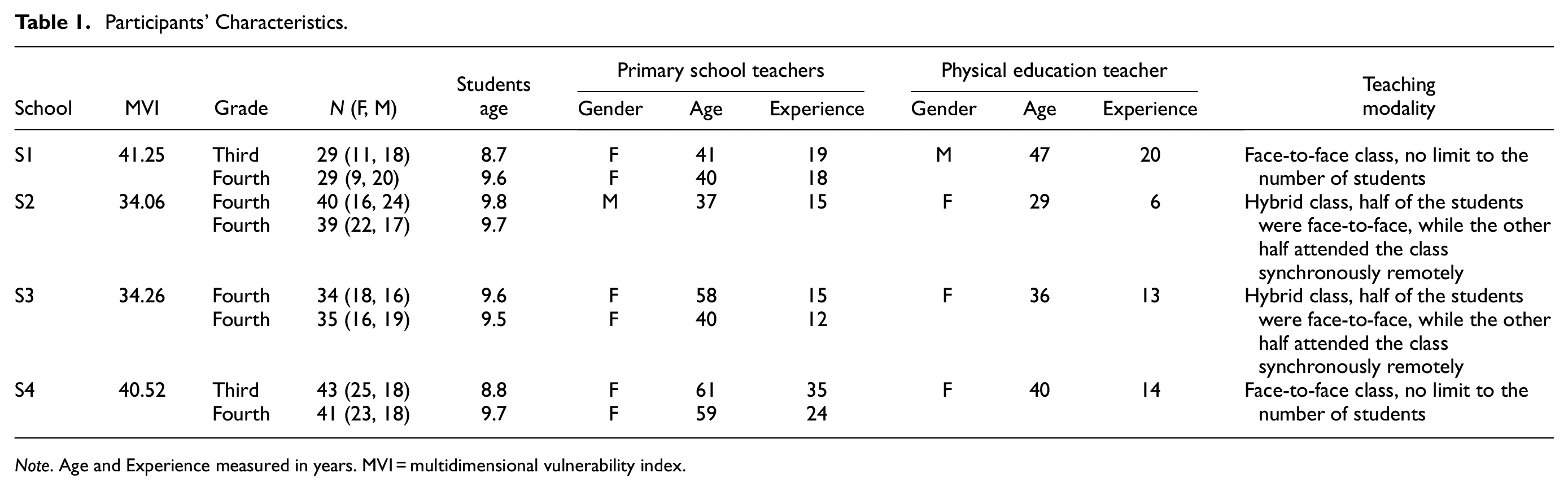
Note. Age and Experience measured in years. MVI = multidimensional vulnerability index.
Teacher recruitment was conducted by inviting the 11 participants from the previous study using physically active academic lessons during total school closures. Five teachers showed interest and shared the invitation with their colleagues, thus forming a group of 11 teachers.
During the development of this study, the participating teachers worked in four schools in the same commune in northern Chile (see Table 1). Two voucher schools (S1 and S2) and two public schools (S3 and S4), one of them being rural (S4). Although not random, this sample represents the distribution of schools in the commune where the study was conducted. That is, 51.6% of voucher schools and 12.9% of rural schools (JUNAEB, 2020). Voucher schools are privately managed schools that receive funds from the public system through vouchers per student (Giaconi et al., 2022).
The Multidimensional Vulnerability Index of each school represents the most relevant dimensions or factors of unobservable vulnerability according to the student trajectory (health, family, protection, and redress of rights, stimulation, support, and others) (JUNAEB, 2020) varied between 34.06 and 41.25 points, with 100 points being higher vulnerability. Schools S2 and S3 showed a lower index, while the other two values were close to the communal average, 42.74 points (JUNAEB, 2020). Regarding the teaching modalities, two strategies were in place during the transition to face-to-face classes; absolute face-to-face with no student limits and hybrid classes with students attending face-to-face classes while others attended the same class remotely. These two teaching modalities were regulated by the Chilean Ministry of Education (MINEDUC, 2020a) under the premise of responding to the needs of each school community.
The eight primary school classes related to the 11 teachers who participated in the study. Table 1 shows 290 students, 140 girls and 150 boys. The distribution by gender and the students’ average age in each course can be seen in Table 1.
Procedure
During the first semester of 2021, while the schools remained closed, the 11 participating teachers and two authors met virtually to plan how to include physically active academic lessons in the remote teaching and learning process. However, once the pandemic indicators improved, the schools resumed their activities, and the planning adjusted their schedule during the transition to face-to-face classes. It should be noted that the participating teachers cooperated with the authors during the study design stage, with the aim of promoting the acceptability and feasibility of the proposal, considering the restrictive regulatory measures and the different limitations and interests in each educational context.
The curriculum content used in the physically active academic lessons was geometry, specifically, plane figures and their properties. The choice of this content considers the following: (1) the experience of the five teachers who participated in the Beserra et al. (2022) study, which addressed such content; (2) the presence of geometry in the curriculum of all primary school levels (MINEDUC, 2018); (3) the feasibility of addressing geometry considering the different levels of ability and motor skills of the students (Oñate Navarrete et al., 2021); and (4) the positive evidence about the use of physically active academic lessons in mathematics (Li et al., 2023; Magistro et al., 2022), and in particular, in geometry (Hraste et al., 2018; C. Moore & Linder, 2012).
The planning process started with Primary Education teachers identifying the geometry curricular contents from third and fourth grade (MINEDUC, 2018), which were prioritized by government authorities during the pandemic to minimize its adverse effects (MINEDUC, 2020d, 2020e). Then, Physical Education teachers defined body shapes to represent the selected contents, considering the level of motor skills and abilities of the students and the Physical Education curricular objectives to be covered (MINEDUC, 2020b, 2020c). Teachers suggested using an elastic band to facilitate the representation of some figures and their properties (Appendix A). It is necessary to highlight that the elastic band was an available resource in their schools, as they are used in Physical Education classes. Furthermore, according to the teachers, its use would allow students to concretely experience the contents of geometry, providing them with a practical and tangible opportunity to better understand the concepts.
Unlike the work of Beserra et al. (2022), where a popular song was used, the teachers chose to modify one on this occasion. They took the song 1, 2, and 3 by Sofía Reyes and altered the lyrics using the selected geometry contents (Appendix B). Once the lyrics were modified, one of the teachers recorded an audio recording of the song for synchronization with the melody. Afterward, the Physical Education teachers integrated the body representations into the modified song, thus, creating a children’s choreography of a song about geometry curricular contents from third to fourth grade.
Finally, the different Physical Education teachers recorded a video dancing to the choreography (https://www.youtube.com/watch?v=pFMYUGbOEjk). Graphic elements were added to the videos to facilitate the understanding of the curricular content and improve the overall esthetics (see Figure 1).

Video screenshot of a teacher performing the geometry choreography that students are expected to practice during physically active academic lessons (Adapted from “Ejercitándonos con la Geometría 2021 - Prof Carla” by Explora Arica y Parinacota as YouTube, 2021. https://www.youtube.com/watch?v=pFMYUGbOEjk. Copyright 2021 by Explora Arica y Parinacota).
In the first week of August 2021, all students took a geometry assessment to determine their initial knowledge of the students. The following week, the video was disseminated among the students, and the choreography practice began in each school (Figures 2 and 3). The teachers agreed that the activity should last between 6 and 10 weeks. Primary Education teachers should practice the choreography during at least 75% of their mathematics classes, with each session lasting between 10 and 15 min at the beginning of the class. On the other hand, Physical Education teachers should practice it during half of their classes, dedicating between 30 and 45 min at the beginning of each class (see Figure 4).

Example of practice sessions in a Hybrid class with both face-to-face and online students, during mathematics or Physical Education classes (Adapted from “Ejercitándonos con la Geometría 2021 -Prof Ariele” by Explora Arica y Parinacota as YouTube, 2021. https://www.youtube.com/watch?v=aldcZCv0QEs. Copyright 2021 by Explora Arica y Parinacota. Adapted with permission from Explora Arica y Parinacota).

Examples of practice sessions during Face-to-Face classes: (a) Physical Education and (b) mathematics classes (Adapted from “Ejercitándonos con la Geometría - Escuela Darío Salas Díaz” by Explora Arica y Parinacota as YouTube, 2021. https://youtu.be/AWDbyx41oKE?si=FXcSe5h1dA8xGJdi. Copyright 2021 by Explora Arica y Parinacota. Adapted with permission from Explora Arica y Parinacota).

General structure of the intervention and differences by subject area (frequency and duration per session).
During the choreography practice, all teachers used the vocabulary of their discipline to guide the students. Similarly, as the choreography progressed and the curricular content and skills were incorporated, teachers taught or reviewed each point according to the level of each course. Whenever necessary, teachers reinforced the curricular content and skills after each practice. On completion of the weeks of practice, according to the planning in each school, the students again gave the geometry evaluation. Students, parents, and teachers were invited to participate in different virtual focus groups after the evaluation.
It is worth emphasizing that the objective of this study was to determine the perceptions and mathematical learning outcomes of the use of physically active academic lessons during the transition to face-to-face classes and not necessarily to develop the same intervention in different schools. Table 2 shows the characteristics of the intervention developed in each course. The number of participating students was lower than the number of enrolled students (Table 1) since, to be considered a participant, the student had to participate in all the planned activities, including the two knowledge assessments. The intervention had a duration of 6 to 10 weeks, as indicated by the Duration column in Table 2. When analyzing the relationship between the number of Classes Scheduled per week and the number of Practice Sessions per week, it can be observed that the students participated in the choreography in at least 75% of the mathematics classes and at least 50% of the Physical Education classes. Consequently, the practice lasted an average of 101 min per week (SD = 37, Min = 52, Max = 148), of which 60.7 min on average were developed in mathematics classes (SD = 18.56, Min = 45, Max = 88); and 40.5 min in Physical Education classes (SD = 21.92, Min = 12, Max = 60). It is worth remembering that schools had shorter school days during the pandemic, which led to a new distribution in the number of hours assigned to each discipline. These factors maximized the difference in the number of opportunities to practice in each school, which explains the variability.
Specific Characteristics of the Intervention in Each Participating Course.

aNumber of weeks.
Recorded weekly.
Interval of minutes.
Finally, it is important to highlight that protocols per COVID-19 (capacity, spacing, others) were in effect during the entire 2021 academic year in the study location and that the differences in implementation are the result of administrative and teaching decisions made at each school.
Assessing the Experience
Quantitative
The students were assessed regarding their knowledge of geometry at two points in time; one before and the other after the weeks of choreography practice (pre- and post-test) to determine the impact of the use of physically active academic lessons on mathematics learning during the transition to face-to-face classes (first research question). The instrument covered the selected contents and was developed by one of the authors in collaboration with two participating elementary school teachers (see Appendix C). The instrument was reviewed and validated, regarding its pedagogical content and effectiveness in measuring knowledge acquisition, by the remaining five participating elementary school teachers and by an external group of experts (two PhDs in mathematics and one PhD in engineering sciences with experience in the use of ICT in the classroom). The instrument’s reliability was validated using the Cronbach’s Alpha coefficient calculated with the results of the assessment before starting the practice (pre-test), as suggested by López et al. (2015). Cronbach’s alpha is the most widely used objective measure of reliability (Tavakol & Dennick, 2011), despite being an internal consistency estimate and not a direct measure of reliability (Henson, 2001). The result of the analysis was 0.82, which implies that the instrument meets the requirement of Bland and Altman (1997). This requirement indicates that above 0.6, the instrument is acceptable to classify the respondents.
The instrument was applied in digital format (Google Form) or on paper and pencil. Its duration was 45 min, consisting of 36 questions divided into two dimensions. The first dimension aimed to determine student knowledge when identifying plane figures and their main properties (nine and six questions, respectively). The second dimension comprised four, ten, and seven questions on the classification of straight lines, angles, and triangles. The 36 questions were formulated in multiple-choice format with four alternatives. The digital format was used for students who were not in the classroom at the time of the evaluation.
Qualitative
Aiming to understand the perception of the use of physically active academic lessons during the transition to face-to-face classes (second research question), students, parents, and teachers were invited to participate in different focus groups. These focus groups also aimed to identify the barriers and difficulties faced by the different actors during this process (third research question). All focus groups were conducted virtually, considering the precautionary measures associated with COVID-19 proposed by CPEIP (2020) and MINEDUC (2021).
With students the focus groups were developed in groups of three to five students. According to teachers, during the acute phase of the pandemic, this size allowed the good development of this type of activity. Meanwhile, with the parents, groups of six individuals were chosen, considering the recommendations of Lobe et al. (2020) and Menary et al. (2021) for focus groups on distance platforms. Finally, following the previous study developed by Beserra et al. (2022), a single focus group was conducted with teachers, maintaining the structure of the meetings held during the development of the proposal. Finally, students, teachers, and parents voluntarily agreed to participate in the focus groups.
Two focus groups were held in six of the eight participating courses (one with parents and one with students). No focus groups were conducted with students in the remaining two courses because the teachers were not available. It should be emphasized that the Ethics Committee of the University “Blind for review” has decided that teachers should take part in the focus groups with students. Nevertheless, the teachers in these two courses provided their students with the same activities as the other participating teachers, except for the focus group. Finally, without the data from these students, it was decided not to summon their parents.
The focus groups with students and parents lasted between 45 and 70 min, while the focus group with the 11 teachers lasted 90 min. The same psychologist conducted all focus groups to ensure consistency (Quarmby et al., 2019); the psychologist was also accompanied by one of the authors. At the beginning of each focus group, participants were informed that the questions were related to using physically active academic lessons during the transition to face-to-face classes. Participants were also told, at different times, that the questions did not correspond to an evaluation; therefore, there were no right or wrong answers. Similarly, it was made explicit that their experiences would be helpful for the analysis of the proposal. First, it was emphasized that all information, even unrelated to the questions developed, was welcome. Second, participants were repeatedly told that any criticism was welcome, as it would help improve the process and not influence their responses. Finally, participants were asked if the focus group could be recorded for later analysis as part of a research study.
In each focus group, a guide was used to orient and facilitate the elicitation of perceptions. This guide consisted of 19 questions derived from the central objectives of the study (see Appendix D), which were applied in different ways according to the characteristics of the participants in each group. The questions were not necessarily asked in the same order in each group. Instead, as the group conversation deepened, questions such as themes, points, and broad questions were naturally introduced in such a way as to encourage broad responses. Lastly, students, parents, and teachers were always asked to justify their answers.
Data Analysis
Quantitative
This study followed a pre/post-test design (Campbell & Stanley, 1963), the validation of which is typically done using a t-test for paired samples (Gerald, 2018) once it complies with the assumption of normality of the difference between the post- and pre-test scores (Curran-Everett, 2017). In this study, the analysis indicates whether there was significant learning while using physically active academic lessons during the transition to face-to-face classes.
The association between the difference between post- and pre-test scores (0–100 points) and the information available for each student was also analyzed. Information such as gender, level of education (third or fourth grade), and teaching modality (having or not attending face-to-face classes) was included. The intra-school variability was also considered since a student’s learning could be influenced by his or her school and vice versa. Additionally, variability related to the format of the assessments (Digital or on Paper and pencil) was considered, which could affect the instrument’s ability to collect more reliable data.
A linear regression modeling with a random group effect was proposed to model these study aspects (Theobald, 2018). The small sample size and classical inferential procedures are not suitable (van de Schoot & Miocević, 2020). Therefore, a Bayesian approach was used, where a priori distributions are uninformative (Gelman et al., 2013). Furthermore, the Widely Applicable Information Criterion (WAIC) was used as a model selection criterion (Watanabe, 2010), where the best model is the one with the lowest value. All analyses were performed in R language (R Core Team, 2022), and Bayesian models were implemented using the brms package (Bürkner, 2018).
Qualitative
The analysis of the qualitative data from the focus groups involved the psychologist and the accompanying author sharing notes at the end of each focus group to reduce any interpretation bias (Elliott et al., 1999). The recording of each focus group was then transcribed word for word, which was read several times by two of the authors to obtain a general understanding of the data. Subsequently, the thematic analysis proposed by Braun and Clarke (2006) was employed to identify themes or patterns in the transcribed accounts of the focus group participants whose guidelines come from the study objectives and questions. Once the patterns were identified, the results were organized into themes according to the research questions. The authors then conferred to share and discuss their analyses, aiming to consolidate their work. Any disagreements were resolved by discussion and consensus. The themes identified cover various areas, which are discussed in detail in the Results and Discussion sections. In these sections, references are incorporated, and further details on each topic are provided.
The reliability of the analysis is supported by the application of procedures indicated by Elliott et al. (1999), Tracy (2010), and Quarmby et al. (2019). These procedures emphasize the feasibility of increasing the qualitative reliability in research like this, if unobjectionable answers have been guaranteed in the procedure carried out to build the textual corpus coming from the selected techniques. In this study, the textual corpus was built through the constant comparison of the transcriptions made with the audio files, aiming to reduce interpretation bias (Elliott et al., 1999). Furthermore, a peer review process was developed, along with constant dialog among authors (Quarmby et al., 2019), and extracts from the data are used to illustrate how the collected information has been interpreted (Braun & Clarke, 2006). These approaches promote the credibility and transparency of the study (Tracy, 2010).
Ethical Considerations
The procedures in this study complied with the guidelines established in the Declaration of Helsinki and were approved by the University Ethics Committee “blind for review.”
Results
Quantitative
Table 3 shows the pre- and post-test scores for each course. Also shows the average progress of all students in each course, assessing the difference between their mean pre-test and post-test (Diff Mean). Considering that the Shapiro-Wilk test rejected the hypothesis of normality of the difference between the post- and pre-test scores (W = 0.983, p = .001), the Exact Wilcoxon-Pratt Signed-Rank Test for paired samples was used to determine how much the students learned about geometry after participating in physically active academic lessons during the transition to face-to-face classes. The test result revealed statistically significant differences (Z = 13.116, p < .001) between the means of the post- and pre-test scores (Table 3). The Cohen’s Cohen’s effect size of dz was 1.92 (a large effect size) (Rosenthal, 1991).
Pre- and Post-test Scores.

The association between the difference between the post- and pre-test scores and the information available for each student was analyzed using a Bayesian linear regression model. The combinations of the three covariates (gender, level of education, and attending or not attending face-to-face classes) were analyzed in seven Bayesian models. The running configuration to achieve convergence was set to three chains with 20,000 iterations, where the first 10,000 (warmup) are discarded. The best model was selected according to the WAIC and is formed by the level of education and whether to attend classroom classes. Table 4 shows a summary of the regression parameters of this model.
Summary of the Best Model.

The mean is a point estimate for each parameter with a 95% credibility interval generated from the 2.5% and 97.5% quantiles. SD reports the standard deviation of the posterior distribution of each parameter. The last column contains the probability that the corresponding parameter is positive. A probability equal to .5 indicates that a positive value of the parameter is equally likely as a negative one.
Table 4 shows that intercept and attending face-to-face classes are positive with very high probability while belonging to the fourth-grade class is negative. Interpretatively, it can be observed that the difference between a student’s post- and pre-test scores was, on average, 24.28 percentage points, increased by 7.33 percentage points if the student attended face-to-face classes, and decreased by 3.89 percentage points if the student belonged to a fourth-grade class. Finally, gender was not a relevant factor. However, this should be taken with caution, considering the sample size.
Qualitative
Five themes emerged from the comments collected during the focus groups. These themes were as follows: Satisfied students; Effective learning of geometry; Increased physical activity; Families committed to the activity; and Student embarrassment. The following describes each theme, interwoven with comments from the focus groups.
Satisfied Students
The students considered the experience to be satisfactory. The concepts that stood out in their comments were: fun, entertaining, and enjoyable. For example, one student said, “I found the geometry dance entertaining,” and another stated, “I actually had a lot of fun.” Student satisfaction was such that more than one student indicated, “It was my favorite class.” Similarly, the predominance of positive perspectives was also identified in the comments of the parents. One said, “My daughter was happy; she liked the activity; she liked learning the figures that way.” Another pointed out: “I think it is definitely an excellent way of teaching (…); it was playful and entertaining.”
Finally, the teachers reported a genuine student interest in developing the activity. One of them said: “The children had a great time, they were entertained. I didn’t even get to class, and they were already asking me if we were going to practice the choreography.” Another teacher remarked: “They were asking me to repeat the music over and over again.”
Effective Learning of Geometry
Consistent with the quantitative results, students described how participating in the activity promoted their geometry learning. One student said, “I was practicing (the choreography), and now I know a lot of things that I didn’t know before.” Another said, “Well, I learned about perpendicular and secant lines, (triangles) acute angles, obtuse angles, that kind of thing.” Parents consistently mentioned that the physically active academic lessons contributed to students’ geometry learning. One parent said, “… (the activity) was super effective in getting those geometry learnings.” Another said, “My son was learning the shapes, perhaps without realizing that he was learning it.”
Finally, the teachers emphasized that it was possible to develop the planned knowledge in the students. One of them said, “Little by little, (the students) were associating the name of each (geometric) figure to its properties and representing them with their elastics.” Another highlighted: “The difference between the initial and final test scores is not minor; they learned a lot.” The evaluations did not go unnoticed by the parents; one said: “I saw my child’s learning reflected in the last evaluation.” One teacher also pointed out how the results of the quantitative evaluations helped to justify the development of the activity in her school. “The higher average on the final test served to show my principal and the more reticent parents that you can learn, be physically active, and have fun in math classes.”
Physical Activity Increase
The increase in physical activity was present in the participants’ accounts. Among the students, it was possible to appreciate the satisfaction of participating in these physically active instances during the school routine, emphasizing the act of dancing in the classroom. “I really liked to use the elastic, and I was always among the first to dance (…); I knew all the geometric figures, and we danced very well.” Another student said, “Dancing is more entertaining than, for example, sitting there filling out a guide, putting how each figure is called; I find that (dancing) is a more entertaining way to learn.”
Meanwhile, in line with the students, the parents indicated that the activity helped to counteract the sedentary lifestyle adopted by the students during the quarantine period. One of them said: “I feel that (the activity) has done him a lot of good, that he has learned, and that it has helped him physically because he is sitting all morning, and this helps him to get out of that sedentary situation.” Another mentioned: “…that they do more exercise is excellent because, at the end of the day, children nowadays are too sedentary.”
Finally, the teachers valued the increase in physical activity; yet, among the primary school teachers, the discourse also addressed the opportunity to comply with the above while developing the mathematics curriculum. One of the teachers pointed out: “the integration of geometry and physical education allowed the children to spend more time doing physical activity while still dedicating time to mathematics.” Another teacher emphasized, “We had the goal of getting them to learn geometry and move more, and we achieved that.”
Families Committed to the Activity
The physically active academic lessons promoted an instance of family activity. In many cases, the experience was described by parents and students as a space in which caregivers, parents, and other members of the family group practiced the choreography with the students. One parent said: “…it was a fun way of learning, and also for the family because you practice (the choreography) with them.” Another stated: “She taught her brother, (…) the activity gave the opportunity for them to enjoy together.”
Now, that family activity occurred exclusively outside class time, as seen in the following account from one of the students: “When I got home, I would try to teach my sister a little bit.” In agreement, a parent pointed out: “I have a 5-year-old boy, and we had to make him an elastic too, (…) he would tell me ‘I’m in class (online),’ but then I would share that with him.” Another parent said: “After class, he would tell me, mom, dance with me, and I would try, (…) then my oldest daughter would join in, my granddaughter, in the end, we would all end up dancing.” Nonetheless, some parents expressed that they were not significantly involved in the activity. For example, one parent pointed out: “I used to ask her: Do you want to practice the choreography? He said, “No, mom, I already did it at school.”
Student Embarrassment
Students felt embarrassed when practicing the choreography. One student said, “It was fun, but still, when we went to practice, I was embarrassed.” Another specified, “If I know I’m going to be seen, I’m embarrassed.” Parents also mentioned this type of reference. “My daughter is too shy; she has a hard time with that, but she does it, she knows it, but she is shy in front of the public.” However, it is important to point out that these comments are concentrated on the descriptions of the beginning of the experience, which was valued more positively as the practice of the choreography progressed. It is possible to observe the description given by the parents. “My son is a little shy and gets nervous (…), but little by little, he loosened up.”“My son was also very shy; he did not like to dance or to be seen by others, so in the afternoons, we practiced for a while so that he would overcome his shyness.”
Undoubtedly, students, parents, and teachers had a mostly positive perception of the use of physically active academic lessons during the transition to face-to-face classes. However, three barriers (themes) emerged from the comments made during the focus groups. These were: Inadequate Internet quality, Insufficient physical space, and Challenges in the use of elastic in choreography. The description of each barrier (theme) is provided below, linked to focus group comments.
Inadequate Internet Quality
The quality of Internet connections proved to be a barrier to the development of physically active academic lessons during the transition to face-to-face classes. Even though only about 25% of the participants needed Internet access to participate in the activity, reports of unstable connections, outages, freezing of images, and disconnections, among others, were part of the situations faced by the participants. One student said: “I was afraid that my Internet would go down because sometimes the connection would be unstable (…) I was afraid that it would go down just when we were doing the choreography.” Another described her frustration: “Sometimes the Internet would cut me off, I couldn’t hear the teacher and had to wait (…), it was very boring”.
Consistently, the parents indicated that they observed some student frustration in the face of the above. One parent said: “…there was great frustration when that happened (the Internet was cut) because she was in full action.” However, a parent shared how she could cope with this inconvenience by incorporating an alternative to the Internet connection. “Sometimes that would happen to us, but we contracted a telephone (Internet) plan (…) (and) we taught her how to transfer the Internet from her telephone to the computer.” Some parents also mentioned that they had changed Internet providers during the pandemic because of similar problems.
However, Internet quality was not a common drawback for all students. Some students reported having no significant problems; one of them said: “Sometimes, it would drop, but normally it was fine, I could hear well, I could see my classmates well, and the teacher could hear what he was explaining to me.”
Intriguingly, the teachers who taught these students did not describe problems with the Internet. When explicitly asked about this situation, one of them said: “The school changed Internet (provider) that semester, so it improved a lot, although, for safety reasons, I always have my phone charged (with battery).” In line, a teacher mentioned that she needed to learn to observe whether these inconveniences were significant. “To tell the truth, that year was very complex; attending to the on-site and online children was an almost impossible mission. More than once, it (the Internet) was cut off, but I don’t think it was relevant; the children enjoyed the activity anyway.”
Finally, students and parents pointed out how the possibility of face-to-face activities mitigated the barriers associated with the learning process. A student who attended face-to-face classes said: “Sometimes I had failures on the Internet (…), and now in face-to-face classes, I understand much better, more than before.” A parent whose daughter attended face-to-face classes said: “What affected my daughter in the online classes, in the beginning, was the connection; since there were so many people connected and the Internet was so busy, it bored her a lot.”
Insufficient Physical Space
The availability of physical space at school and home was also described as a barrier. One student who attended face-to-face classes said, “We had to be separated [protocol by COVID-19], and then, sometimes, it was a bit complicated for me because some shapes and figures I had to make them very big and I couldn’t (…) that was a bit uncomfortable.” Another student who attended online classes pointed out: “I usually did it in the backyard because my room is not that big and my bed takes up a lot of space.” However, while for some, the space was insufficient, for others, it was not relevant. One face-to-face student said, “(I) went to school, so I had too much space, enough space,” while another, who attended online classes said, “No, not a bother, it’s just that I did it in the living room and my living room at home is big.” The variability of perceptions about physical space was also observed among the parents. While one said: “We had to move furniture to create space so that she could do the exercises more comfortably,” another said: “She chose where she was more comfortable because I gave her options in the house, which is quite large.” Finally, among the teachers, differences were also present. While one of them pointed out, “In my school, one of the classrooms is smaller, and since the children were not supposed to get close, it was quite an issue. More than once, they bumped into each other,” another said: “The classrooms are big, so we had no major problems; we just had to move the tables and chairs a bit.” One teacher also said, “Some days of the week, we would go to the patio so as not to waste time tidying up the room.”
Challenges in the Use of Elastic in Choreography
Finally, the elastic used by the students to make the geometric figures during the choreography also represented a barrier. According to the participants, with special mention to the initial stage of the activity, the elastic added an additional difficulty to the practice. One student said, “… the one that cost me a little was the elastic (…), sometimes it hit me (…) when we practiced, sometimes it slipped.” Another student pointed out, “… the elastic would fall off, and I couldn’t do it (the choreography) well, and I had to pick it up (from the floor).” A parent said: “With the elastic, you have to use your whole body, your feet, your hands, your head, so you also (have to have) posture and rigidity. That was hard for him (my son) at the time, but at least he got it.” Another said: “At first, I imagined that he could get loose on one side and could hit his face, but at least with us there were no serious accidents.”
Consistently with what was described, one of the teachers pointed out: “…the elastic was a challenge for many (students), they lacked motor skills, but as the activity progressed, little by little, they overcame this difficulty”. In agreement, one student described how she overcame the difficulties associated with the elastic. “… the elastic (was a difficulty) because I did it, and it did not come out the first time, I had to make about 10 attempts, and then it just came out.”
In addition to the students’ comments, parents also shared their perspectives regarding using the elastic. One parent pointed out that the elastic needed to have the optimal dimensions for some students. “She is the tallest in the class, so the elastic was too small for her. When she made the figure, she had to touch it with her head, it came off, it stuck to her ear, but for her, it was a laugh, it was fun.” Another parent pointed out, “Of course, in the beginning, the elastic was hard (firm), but it gave way with use, and it became easier.”
Finally, it is important to highlight an emerging perspective not considered in the earlier, more complex themes: the idea of incorporating physically active academic lessons into other disciplines beyond mathematics.
Emerging Perspective
The participants’ perspective on how physically active academic lessons could be used in other disciplines is an interesting result. In Science, one student said, “And we do use the elastic (for) solid, liquid and gas matter, (with the) solids we can make an ice cube shape, (with the) liquids we can make a glass shape and that sort of thing.” Another pointed out that it would be enjoyable to participate in this type of activity in the Language subject. “I would like it in Language because it would be more fun (…) they make us write a lot. I like to write, but I would also like to have a choreography.” A parent concurred: “…in something in Language, instead of a test about a book, (the students) could do a skit, that would be more fun for them.” Although it is not clear whether the parent describes a play or a musical (where more physical activity could be inferred), the story emphasizes including more movement in the classroom. One student, in line with the above, said: “It could be the song of emotions (…), we could use some paper to identify what we are talking about in the song.” However, it should be mentioned that some parents were reluctant to massify the strategy; one of them said: “There are subjects and contents that give the basis to work in this way, but there are also things that have to be worked in a structured way.”
Discussion
The study indicates that students learned about geometry while participating in the physically active academic lessons developed during the transition to face-to-face classes. The qualitative analysis revealed that students, parents, and teachers described how the activity promoted geometry learning. The quantitative analysis demonstrated that the learning was significant, with an increase of 24.28 percentage points, and was impacted by attendance in classroom classes and the level of education. The positive impact of attending face-to-face classes can be explained by considering the more significant number of opportunities and the greater ease in strengthening learning when students and teachers share the same physical space. Meanwhile, belonging to a fourth-grade class would lead to a better performance in the initial evaluation (pre-test), reducing the ability to make significant differences with the final evaluation (post-test). These results are consistent with the accumulated evidence that shows that student learning is a frequent outcome of incorporating physically active academic lessons into the school routine (see the systematic reviews by A. J. Daly-Smith et al., 2018; Martin & Murtagh, 2017; and the meta-analysis by Norris et al., 2020). Consequently, this study provides additional evidence by demonstrating that learning also occurs during the transition to face-to-face classes. This finding has a practical implication; it shows the feasibility of incorporating physically active academic lessons into the school routine during the transition to face-to-face classes.
Another qualitative result was that the participants identified physically active academic lessons as spaces of satisfaction and enjoyment, a theme that coincides with what has been observed in previous studies (Beserra et al, 2022; Bedard et al., 2019; Gammon et al., 2019; Teslo et al., 2023). The participants also remarked on an increase in the amount of physical activity, which is a direct and frequently documented consequence of the integration of physically active academic lessons into the school routine (see the systematic reviews by A. J. Daly-Smith et al., 2018; Martin & Murtagh, 2017; and the meta-analysis by Norris et al., 2020). Furthermore, this study provides additional evidence by showing that an increase in the amount of physical activity also occurs during the transition to face-to-face classes. This finding has practical implications that are particularly relevant when considering that promoting opportunities to practice physical activity was one of the prioritized curricular objectives of the Physical Education discipline throughout the pandemic (MINEDUC, 2020b, 2020c). Additionally, consistent with the work of McGowan et al. (2021) and Norris et al. (2020), the teachers emphasized that physically active academic lessons promote effective instances of learning while increasing the amount of physical activity.
These initial results provide evidence that physically active academic lessons developed during the transition to face-to-face classes were not only effective in promoting learning and increasing levels of physical activity, but also generated high levels of satisfaction and enjoyment among participants. This positive experience aligned with the principles of Self-determination Theory (Ryan & Deci, 2020), which suggests that providing support for autonomy, competence, and relatedness significantly enhances individuals’ intrinsic motivation. In this regard, the fact that participants perceived the lessons as satisfying and enjoyable suggests that the activity promoted a sense of competence and autonomy among students, which in turn contributed to their engagement and active participation in the learning process.
An important aspect to consider is the level of commitment from families toward the activity. In some cases, this commitment aligns with what was mentioned by Pokhrel and Chhetri (2021) and Roe et al. (2021). These studies mentioned that during the peak phase of the pandemic, many families were forced to participate more actively during the learning process. Therefore, it was expected that some families would maintain these habits during the transition to face-to-face classes. On the other hand, in other cases, the lack of family participation can be explained by the parents’ return to work activities face-to-face or the lack of interest or need for support by the students. Consequently, in most families, returning to the face-to-face modality was progressively relieving the family attributions acquired during the confinement and transferring them back to the teachers. Understanding the role of families during the transition to face-to-face classes has relevant practical implications. It helps educators, principals, and policymakers design strategies to increase the amount of physical activity and provide meaningful learning opportunities during the school routine.
In addition to the aforementioned aspects, it is important to highlight that some students felt embarrassed. Students’ embarrassment has always been present in educational spaces, particularly in the subject of Physical Education (Simonton & Garn, 2020; Trigueros et al., 2019), which is a reality that has made it difficult for teachers. Similarly, according to different studies, student shame was also present in online classes before and during the pandemic (Gherheş et al., 2021; Petchamé et al., 2022); therefore, it was not a surprise that it was present in this study. This result, although not necessarily negative, represents an additional challenge during physically active academic lesson, especially in the teachers’ reaction to student embarrassment. As teachers’ actions in the classroom have a significant influence on students’ motivation, engagement, and learning (Ahmadi et al., 2023), how teachers respond to student shame is extremely relevant.
It is important to highlight that not all the results mentioned are related to the attitudinal aspect; other results are associated with technological and physical aspects. Among them, inadequate Internet quality, insufficient physical space, and difficulties in using the elastic are the themes mentioned by the students.
Internet intermittency and interruption hampered the online learning process during the pandemic (Palau et al., 2021; Scully et al., 2021). This is of particular concern considering that educational alternatives without Internet access at home are somewhat limited, especially during a pandemic (Scully et al., 2021).
Concerning the physical space, the participants described how the availability or the characteristics of the physical space in schools and at home were a barrier to overcome. Physical space, which during face-to-face classes is related to the infrastructure of the school, is a recognized barrier to teaching activity (Duarte et al., 2017; UNESCO, 2022). During the pandemic, this barrier was transferred to homes, where socioeconomic status often determined the degree of difficulty faced by students, parents, and teachers (Pokhrel & Chhetri, 2021). Additionally, the physical space’s availability and characteristics are frequently documented barriers when incorporating physically active academic lessons in the student routines, in the face-to-face classes (Gammon et al., 2019; Li et al., 2023) but also in the virtual (Beserra et al., 2022). In particular, in face-to-face lessons, A. Daly-Smith et al. (2020) propose using other alternative spaces in the school, such as corridors, stairs, gardens, and others. The latter, at home, is an even more significant challenge. This challenge is particularly relevant if we consider that a limited physical space reduces the probability of students being physically active during quarantines (Amatriain-Fernández et al., 2020; Eaton et al., 2023). The latest results have practical implications that suggest considering Internet quality and the availability or characteristics of physical space when designing future physically active academic lessons for periods of transition to face-to-face classes.
Regarding the difficulties faced by students in using the elastic, as indicated by teachers, the difficulty can be explained by the still-developing motor skills of the students. However, one of the curriculum objectives of the discipline of Physical Education is precisely to support and promote the development of such skill (MINEDUC, 2018, 2020b), which is usually developed through practice and repetition. Hence, it was not surprising that this difficulty emerged in the present study. Nevertheless, it’s worth highlighting that in the study by Magistro et al. (2022), physically active academic lessons on mathematics led to greater improvements in gross motor skill development. Finally, the elastic’s dimension was also described as a challenge to overcome. It is essential to point out that the size of the elastic was determined considering the maximum height of the students attending face-to-face classes, which unfortunately turned out to be unrepresentative.
Finally, although in this study, the use of physically active academic lessons is limited to mathematics and Physical Education classes, what was described by the participants gave rise to an emerging perspective that seems relevant to increase the amount of students’ physical activity. The participants described proposals for using these physically active academic lessons to teach or assess other curriculum content. Among them, the proposal that students perform skits stands out. This idea aligns with the studies of Sharma et al. (2020) and Simpson Steele et al. (2016), who highlight theatrical performance many times to promote learning and student satisfaction and increase the amount of physical activity. However, it is important to note that some parents indicated that physically active academic lessons may not be suitable for all curriculum content. This is relevant as parents’ perception about the suitability of physically active academic lessons has a practical implication; it impacts teachers’ decisions (Beserra et al., 2021; Quarmby et al., 2019; Teslo et al., 2023).
Conclusions
During the transition to face-to-face classes in mid-2021 in northern Chile, 290 elementary school students participated in physically active academic lessons, specifically, practicing geometry choreography. After completing the activity, the students significantly improved their knowledge of geometry and were satisfied with having participated in the activity. Additionally, the results showed that students, parents, and teachers could describe the main benefits reported in the literature on using physically active academic lessons. They also identified different barriers, some known about the use of physically active academic lessons in schools, and other barriers described during remote teaching. The findings of this study show that, regardless of the teaching modality (face-to-face or remote), physically active academic lessons are a viable strategy to improve students’ knowledge and increase the amount of physical activity during the school routine. Furthermore, they reinforce the idea that physically active academic lessons improve student learning, social climate, and enjoyment of students and teachers, even during the transition to face-to-face classes. This has important practical implications for educators, principals, and policymakers who design strategies to enhance learning outcomes and promote healthy lifestyles among students, especially during any stage of a pandemic.
Limitations, Strengths and Future Research
Despite the encouraging results of this study, certain limitations should be kept in mind. Among them are the small sample size, its ethnic and gender distribution, fundamental characteristics when generalizing and replicating the results. Furthermore, it should be mentioned that the preventive measures implemented during the study prevented the acquisition of specific data from the sample, such as the information required to determine body mass index, previous and current physical education scores, as well as the definition of control groups. The above-mentioned hindered the more precise determination of the impact of this study, constituting other limitations.
The diversity of teaching modalities was also a limitation. A single modality would likely provide more information on the advantages and barriers to using physically active academic lessons during the transition to face-to-face classes in that modality. Another potential limitation is using a single curricular content during physically active academic lessons (i.e., geometry). A broader set of curricular content in one or more choreographies could have influenced participants’ perceptions; addressing a broader set of curricular content in one or more choreographies would be a way to circumvent this limitation. Additionally, the duration of the study was a limiting factor. A longer intervention period could have provided a more comprehensive understanding of the effects of the study. Similarly, it is necessary to increase the number of parents and students interviewed; this would allow us to collect additional findings related to the participants’ experiences. Furthermore, we must consider the inherent limitation of the qualitative data analyzed, which were reported by parents, students, and teachers, where social desirability or memory bias may have impacted the results.
This study’s significant strength is combining qualitative and quantitative analysis, providing a more complete insight into the effectiveness of physically active academic lessons during the transition to face-to-face classes. On the one hand, focus groups were conducted with students, parents, and teachers to understand their perceptions and the barriers they faced while using these lessons. On the other hand, students’ knowledge assessments were conducted at two points: before and after the intervention with the physically active academic lessons, to determine their impact on mathematics learning. These combined methods provided a deeper understanding of the impact of physically active academic lessons on students’ learning and parents’ and teachers’ perceptions. Consequently, this study provides a more holistic view of the effectiveness and feasibility of physically active academic lessons as an educational strategy during the transition to face-to-face classes.
Further work remains to be done to develop proposals to determine whether there is a relationship between the diversity of teaching modalities, the collaborative work done by teachers, the learning outcomes, satisfaction, and students’ intrinsic motivation. A larger sample was drawn from a more diverse range of students and schools, and control groups and mass interviews are required for this purpose. Additionally, it is important to analyze the role of the Multidimensional Vulnerability Index in the effectiveness of these interventions, considering how physically active academic lessons can impact or be tailored to different dimensions of students’ vulnerability. Finally, future studies should determine the optimal duration and intensity of the physically active academic lessons to meet the objectives set during the teaching process, especially during periods such as the transition to face-to-face classes and prioritized curricula.
Supplemental Material
sj-docx-1-sgo-10.1177_21582440241255429 – Supplemental material for The Use of Physically Active Academic Lessons During the Transition toFace-to-Face Classes
Supplemental material, sj-docx-1-sgo-10.1177_21582440241255429 for The Use of Physically Active Academic Lessons During the Transition toFace-to-Face Classes by Vagner Beserra, Miguel Nussbaum, Mónica Navarrete, Norman Garrido and Danilo Alvares in SAGE Open
Supplemental Material
sj-docx-2-sgo-10.1177_21582440241255429 – Supplemental material for The Use of Physically Active Academic Lessons During the Transition toFace-to-Face Classes
Supplemental material, sj-docx-2-sgo-10.1177_21582440241255429 for The Use of Physically Active Academic Lessons During the Transition toFace-to-Face Classes by Vagner Beserra, Miguel Nussbaum, Mónica Navarrete, Norman Garrido and Danilo Alvares in SAGE Open
Supplemental Material
sj-docx-3-sgo-10.1177_21582440241255429 – Supplemental material for The Use of Physically Active Academic Lessons During the Transition toFace-to-Face Classes
Supplemental material, sj-docx-3-sgo-10.1177_21582440241255429 for The Use of Physically Active Academic Lessons During the Transition toFace-to-Face Classes by Vagner Beserra, Miguel Nussbaum, Mónica Navarrete, Norman Garrido and Danilo Alvares in SAGE Open
Supplemental Material
sj-docx-4-sgo-10.1177_21582440241255429 – Supplemental material for The Use of Physically Active Academic Lessons During the Transition toFace-to-Face Classes
Supplemental material, sj-docx-4-sgo-10.1177_21582440241255429 for The Use of Physically Active Academic Lessons During the Transition toFace-to-Face Classes by Vagner Beserra, Miguel Nussbaum, Mónica Navarrete, Norman Garrido and Danilo Alvares in SAGE Open
Footnotes
Acknowledgements
The authors sincerely appreciate the participation, effort, and support from all schools, teachers, and children involved in Physically Active Academic Lessons. A special thanks to the interviewed students, parents, and teachers for their time and valuable insights.
Declaration of Conflicting Interests
The author(s) declared no potential conflicts of interest with respect to the research, authorship, and/or publication of this article.
Funding
The author(s) disclosed receipt of the following financial support for the research, authorship, and/or publication of this article: This work was supported by the Comisión Nacional de Investigación Científica y Tecnológica, Chile [grant number FONDECYT1180024]; Dirección de Investigación, Postgrado y Transferencia Tecnológica at Universidad de Tarapacá, Chile [Decreto Exento No 00.241/2020 and 00.682/2023]; Programa Nacional de Divulgación y Valoración de la Ciencia y la Tecnología [EXPLORA ER190011]; and Medical Research Council [grant number MC_UU_00002/5].

Data Availability Statement
Data sharing not applicable to this article as no datasets were generated or analyzed during the current study.
Supplemental Material
Supplemental material for this article is available online.
References
Supplementary Material
Please find the following supplemental material available below.
For Open Access articles published under a Creative Commons License, all supplemental material carries the same license as the article it is associated with.
For non-Open Access articles published, all supplemental material carries a non-exclusive license, and permission requests for re-use of supplemental material or any part of supplemental material shall be sent directly to the copyright owner as specified in the copyright notice associated with the article.
