




Abstract
Noise is sound of any kind that is undesirable and unwanted as part of the environment under consideration. It is one of the types of pollution that have great impact on our health and wellbeing. The occurrence of noise in our environment is increasing daily because of growing population and industrialization. Noise pollution have great consequences on our social and economic lives especially in teaching and learning environment, which is presumed to be in silent zone. It is worth investigating whether environment in which teaching and learning take place is in quiet condition? The aim of the study was to analyze the level of noise pollution at different locations in the University of Nigeria, Enugu Campus. The Nigeria Standard noise level for higher education institutions and hospitals should be 60 dB for day and 50 dBA for night. The Noise levels dBA was measured with the help of noise meter at 14 points and at a height of 1 m above the ground level within the campus at three different times (6–8 am, 12–2 pm and 4–6 pm). The total Leq noise level in the University of Nigeria, Enugu Campus is 70.94 dBA which is above the level recommended for educational institutions. The period of intensity of noise was recorded during afternoon, morning and evening respectively. This rate of noise level during the day is high and unsuitable for teaching-learning process. Therefore, university management should take proactive measures to regulate noise pollution within the campus and indeed, other university campuses in Nigeria.
Plain language summary
Purpose: The aim of the study is to analyse the level of noise pollution at different points in the University of Nigeria Enugu Campus with a view to recommending remedial measures to noise pollution. Method: both qualitative and quantitative research method. Conclusion: The total Leq noise level in the University of Nigeria, Enugu Campus is 70.94 dBA which is above the level recommended for educational institutions. Implication: There is noise pollution in Enugu Campus of the University of Nigeria. Limitation: The study used only fourteen for the collection of noise levels on the campus.
Introduction
Noise is any sound that is undesirable or unwanted. It embraces those sounds coming out within immediate environment under consideration. Noise is variously described as an unwanted sound or a sound out of place (Agbo, 2020; WHO, 1999). Noise pollution is one of the major environmental concerns globally due to urbanization and modernization. Noise pollution is considered to be the third most hazardous pollution after air and water pollution by WHO in (Basu et al., 2021). In recent times, noise is considered as one of the major public health problem, especially in the urban areas (Fielder, 2014). Noise pollution is well thought-out as one of the real factors affecting quality of life of the people especially urban dwellers the world over (Monazzam, 2016). This was further confirmed by Abbaspour (2015) that noise affects the quality of life of urban residents. It affects health and makes our living and working environment uncomfortable. It is a sensation disorder that affects health and well being of the people that are exposed to it. There are several sources of noise pollution ranging from industrial activities, traffic and vehicular movement as well as, construction to domestics activities. Governments, the worlds over, through their regulatory authorities have set up Standards, restraining noise levels for different categories of areas and land use activities. In Nigeria, the National Environmental (Noise Standards and Control) Regulations of 2009, set the maximum noise level permitted in residential buildings for daytime (6:00 am–10:00 pm) to be of 43 dB and for night (10:00 pm–6:00 am) of 35 dBA, whereas for higher educational institutions to be 60 dB (A) for day and 50 dBA for night. This means that noise level >60 dBA can disturb the students in terms of hearing or listening to lectures and discussions thereby affecting the academic performance and achievement of the students. It is important to stress that institutional building that have need to be in a quiet environment, on the contrary, are also at the same time more noisy than what is expected. Such noisy environment could be attributed to students themselves as they move from one location to another and in their daily activities. According to the WHO, ≥1.6 million healthy life-years are lost annually from traffic-related noise in Western Europe (Münzel et al., 2021). Gupta et al. (2018) suggested that educational institutions, workplaces, commercial and industrial areas should be regularly monitored for noise levels. This is because noise pollution has severe consequences on our social and economic lives especially in teaching and learning process, which is presumed, should be in silent zone. It is therefore worth investigating whether environment in which teaching and learning takes place are in quiet conditions? This study therefore seeks to analyze the level of noise pollution at different points in the University of Nigeria Enugu Campus with a view to recommending remedial measures to noise pollution
Literature Review
Noise is the sound that is high enough, that adversely affects our level of tolerant (Orbak et al., 2022). Granting that noise is a global issue, there are several studies in this subject. In an attempt to control noise pollution, the World Health Organization (WHO, 2018) has set a standard for the permissible level of noise at 90 dBA, which is the highest allowable level of noise human beings can be exposed to. However, many countries, including Brazil, Japan, Spain, Sweden, Switzerland, Denmark and India have adopted higher standards of permissible noise levels, such as 55 dB (A) for daytime, and 45 dB(A) for night-time, while Ireland (Dublin) has set 55 dB(A) for daytime and 35 to 45 dB(A) for nigh time, Australia set her standard at 45 dB (A), the Netherland has different threshold values, namely 75 dB to 70 dB(A) for the industrial area, 65 dB to 55 dB(A) for the commercial area, 55 dB to 45 dB(A) for the residential area and 50 dB to 42 dB or 46 dB(A) for the silent zone for day and night time. The noise standards for low density areas in Malaysia are of 50 dB (A) and 40 dB (A) and for high density mixed-use areas, the noise standards are higher than 60 dB (A) and 50 dB (A) for daytime and night-time.
In Nigeria, the National Environmental (Noise Standards and Control) Regulations 2009, set the maximum noise level permitted in residential buildings for daytime (6:00 am–10:00 pm) to be of 43 dB and for night (10:00 pm–6:00 am) of 35 dB, whereas for higher education institutions to be 60 dB for day and 50 dB for night (Federal Republic of Nigeria Offical Gazette, 2009). These standards are comparable to what are obtained in other countries. Based on these, a combination of the WHO’s16-hour day and night limit standard of 55 dB and National the Environmental (Noise Standards and Control) Regulations 2009 for residential areas of 50 dB was adopted for this study as a control.
Budiman (2014) reiterated that those who feel the main impact of noise in urban area are students, whose schools are located near busy roads because of their exposure to vehicular noise pollution. The negative impact of noise is worse at school with an open classroom design and those located nearer to external sources of noise (Connolly et al., 2015). Noise pollution may bring physiological impact on students in form of dizziness, emotional and uncomfortable feeling as well as communication process (Buchari & Matondang, 2017). The consequences are the decline in performance achievement due to noise disturbance as most students do not hear the voice of teachers clearly during teaching and discussions. The prevalence of noise pollution especially in urban areas, Thattai et al. (2017) argued that is due to increase in population and urbanization in urban areas.
Wen et al. (2019) investigated the impact of urban traffic on the acoustic comfort of roadside six secondary schools in Taiyuan, in the northern China. The schools are situated near different categories of roads. Noise data were obtained at three different locations (front of school, schoolyard, and classrooms). The results showed that noise level in these schools were quite high and a strong correlation with road traffic noise. The maximum measured “equivalent A-weighted sound level (LAeq, 20min, LAeq) was 74.2 dB (A) near an expressway, which is 35% higher than the exterior threshold value (55.0 dB (A) recommended by the World Health Organization” Hamad and Hussen (2021) found that noise has health and psychological effects on schools in the city of Ramadi. The sources of the noise are nearness of the “traffic, generators, markets and industrial workshops.” The study identified adverse health effects of noise as “fatigue, headache, lack of focus, tension, nervousness and psychological discomfort.” These adverse effects on health may compel the pupils and staff to move to other schools with less effects of noise pollution.
The study by Amakom et al. (2019) inferred that noise exposure could greatly reduce the students’ academic performance. Reductions in student’s academic performance induced by noise pollution include loss of memory, increase aggression, distraction, and concentration (Ntui, 2009). Teachers too experienced adverse effects of noise pollution as it affects their deliverability of lectures. For instance, Bulunuz et al. (2021) found in school teachers’ noise sensitivity in Turkey. Teachers showed hypersensitivity, migraine and prolonged severe headache, difficulty in communicating, tinnitus, and difficulty in focusing on lessons, communication and interaction. These adverse effects also include excessive tiredness and getting distracted, and a reduced tolerance limit, as well as feeling tired and angry. The finding of this study suggests that teachers would be in continued search of a quiet environment to get away from the noise in the schools.
Egunsola (2014) observed that pupils in senior secondary students in Adamawa state, but from different homes, located in a noisy environment caused by traffic, market and industrial machine, were affected negatively in their performance in school. The pupils complained that their environment is noisy and prevent them from concentrating while reading and studying at home and even while listening to educative radio programs. Noise affects the quality of information delivered by the teacher as well as the message received by the students. Ali et al. (2017) noted that acoustic discomfort causes fatigue, headaches, annoyance, changes in behavior and attitude leading to a decrease in intellectual working ability and sleep disorders. In a similar study done in Benin City, Nigeria, Oviasogie and Ikhudayisi (2019) revealed that the prominent sources of noise pollution in two residential neighborhoods were portable electricity generators and commercial activities. They also noted that other sources of noise pollution were the loudspeakers used by churches and mosques, highly amplified music from record shops, bells used by peddlers, hawkers, and salesmen of items to who advertise their wares and grinding machines.
Sources of Noise pollution in the Nigerian institutions of higher learning could be identified as electricity generating plants, road traffic, religious activities and classroom internally generated noise by the students themselves. Wekpe (2020) evaluated the problem of noise pollution around the communities of the University of Port Harcourt using both cross-sectional and experimental design. They found that noise values across the study area were beyond threshold limits for acceptable noise levels. The noise pollution was attributed to rapid urbanization and industrialization associated with high number of automobiles, generating plants, industries, and marketing strategies using mobile advertisement vans and mobile vendors, and conversion of residential areas to business and artisanal outfit.
Ou et al. (2021) believed that noise pollution seriously affects the normal study, work and health of teachers and students in schools while monitory noise pollution is six universities in China. The study concludes that noise pollution has become a more and more common social problem around students and teachers. Nte and Gbarato (2019) did a noise survey study in the University of Port Harcourt Teaching Hospital for both classroom and hostel’s environments of the University. The noise levels within the University community ranged from 52 dBA around the wards, 72 dBA around the vehicle parking arena and 112 dBA at the electric power generator yard. Noise levels of between 52 and 75 dBA were recorded at the lecture halls, and 55 to 78 dBA at the hostels depending on the time of the day and activity taken place there. Nassiri et al. (2013) reveals that blaring of horn in vehicles appears to be responsible for high Leq value in traffic noise pollution studies. This is important as blaring of horn is often used in high density populated areas to alert the incoming of vehicles especially in schools.
Ntui (2009) evaluated the environmental noise levels that inconvenience library users at the University of Calabar library and found that the noise level in the University library exceeded the acceptable level of noise set by WHO, and ranging between 43.5 and 88.5 dB(A). The identified noise sources in decreasing order were noise from people, automobiles, aircraft, cellular phones and equipment. Amakom et al. (2019) conducted noise level measurement at the Federal University of Technology, Owerri (FUTO) using a sound level meter. The average noise levels recorded at FUTO were 67.78 dBA at 9.00 am when daily office workers arriving and take off of academic activities 71.07 dBA at 12.00 pm when lectures and most generating plants were on, and 67.79 at 3.00 pm when most activities are winding down, respectively. The high noise was attributed to mini electric power generators used at many different locations in the university.
The summary of the literatures reviewed in this study with special reference to Nigeria shows an empirical gap in these prior studies. There is lack of rigorous research in the prior literatures (Ali et al., 2017; Amakom et al., 2019; Nassiri et al., 2013; Nte and Gbarato, 2019; Ntui, 2009; Wekpe, 2020). Some of the unexplored area is the determination of the equivalent continuous noise level (Leq), which appears to be important and worth investigating as it was done in previous studies (Abbaspour et al., 2016; Buchari & Matondang, 2017; Thattai et al., 2017) in other countries of the world. Furthermore, previous studies have focused primarily on identifying sources of noise pollution and measures of noise levels, using digital sound level meter at various points and took their average to determine the noise level only. No study to date in Nigeria, has directly attempted to measures Equivalent continuous noise level weight sound pressures level at various times as it was done in Kattankulathur, India and Medan, Indonesia by Thattai et al. (2017) and Buchari and Matondang (2017) respectively. Equivalent continuous noise level measures the exposures of the people to noise as it helps to assess the risk of hearing damage (Thattai et al., 2017). The argument is that the sound level is not going to be constant throughout the period, for instant, traffic noise can only occur when vehicle passes by. To deal with this variation over the period, Leq calculation becomes eminent as it deals with the average sound pressure during a period of time.
The Study Area
The study area is Enugu Campus of the University of Nigeria. It comprises 54 occupational buildings (blocks). The campus play host to seven faculties (Business Administration, Environmental Studies, Law, Health Science and technology, Medical science, Dentistry and Basic Medical Sciences). Apart from these it also consists of Medical Centre, Research Centres, and Guest house. The University has a central library with a capacity of 120 people and the administrative building. There are three auditoriums that can accommodate more than 500 students or people at a time. The Campus also houses two churches and two commercial banks. Apart from these there are subsidiary of the university; the Nursery and Primary schools as well as Secondary school and a sport stadium. The campus covers 267.90 hectares of land and it is located at the center of the Enugu town bounded on the South by Railway line and Kenyatta market on the East by Maryland and Corridor layout, on the North by secondary Schools (Queens Secondary School, City Girls, Women Development Centre, Urban Girls Secondary and Primary Schools and Institute of Management and Technology, a tertiary institution) while on the West by High density residential neighborhoods (Ogui Nike, New layout, and Uwani). Figure 1 shows the location of Enugu Campus in Enugu State. The advantages of the campus situated in center of the town are offset by the incursion of noise pollution from these public institutions and residential layouts surrounding it.

Map of the Study Area—Enugu Campus of the University of Nigeria.
Methodology
The study adopted a survey research design and uses qualitative and quantitative research method. There are undergraduates and graduates students as well as some teaching and non teaching staff who are residents on campus. The noise meter was used to collect noise level from fourteen (14) points as shown in Table 1.
Schedule for Data Collection.

These points were chosen because there are notable areas where most activities do take place on campus and observations were made to know which location has the highest noise level. The Noise levels dBA was measured with the help of noise meter at 14 points and at a height of one meter above the ground level within the campus at three different times (6–8 am, 12–2 pm and 4–6 pm) to capture the high noise events of student’s entry and exit. The conviction is that noise level at each point depends on the time when measurement was taken. The noise level meter was used to measure noise level within 5 min in one particular location while taking one reading. Readings were obtained when noise level was constant for 5 s. Samples of the readings were taken in each location for consecutive seven (7) days from 17th to 23rd January 2022 (Monday to Sunday) at various times as shown in Table 1 The sound level meters were used in slow response setting, which is ideal for educational institution. The Noise (sound) meter was used to record readings in dBA mode for both minimum and maximum levels. Distance of classrooms, hostels and other buildings to the road were used as points to measure noise levels, based on their impact people are exposed to or the effects on their sense of hearing. The values obtained from sound level meters for the 7 days in each location were recorded. To determine the noise level for each location the average of minimum and maximum noise level was taken for each location. The values obtained from sound level meter were converted to equivalent continuous (Leq) values. The equivalent continuous noise level (Leq) is the “sound pressure level of a steady sound that has, over a given period, the same energy as a fluctuating sound under study” (Thattai et al., 2017). The noise level at each location and within time measurement of 7 days was determined using the formula in Equation 1.

Where Leq equivalent noise level, n is the total number of noise sample data taken, Li noise level in decibel (dB) of the ith sample, ti fraction of total sample time.
Then total equivalent noise level for the study area, was calculated using Equation 2.

Results and Discussion
The result of the study on the analysis of noise level in the University of Nigeria Enugu campus is shown Table 2.
Average Minimum and Maximum Noise Level in UNEC.
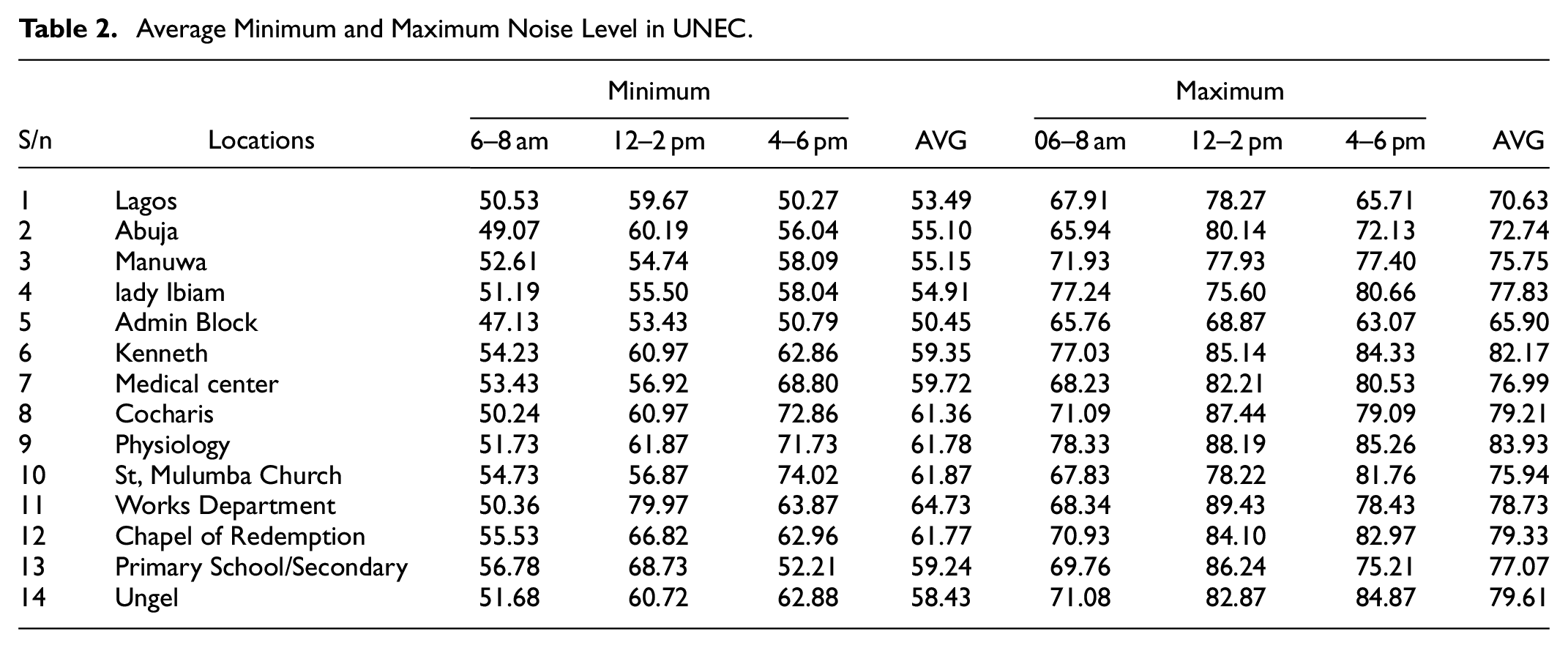
Table 2 showed the average minimum and maximum noise levels in university of Nigeria, Enugu Campus. The result revealed that the average minimum noise level is 50.45 dBA which can be found around administrative blocks of the university and the highest 83.93 dBA noise level is found at physiology department.
The values of noise level obtained from sound level meter were converted to equivalent continuous (Leq) values and the result showed that the minimum Leq is 51.16 dBA and maximum Leq is 85.49 dBA which are located at administrative building and physiology department (see detail in Appendix 1 and 2.
Table 3 showed the average Leq of 14 locations at the University of Nigeria, Enugu campus. It indicated that the Administrative Buildings recorded the lowest Leq of 58.85 dBA while Works Department recorded the highest noise level with Leq 80.17 dBA. The average of total noise level equivalent was determined using the formula in Equation 2. The calculation showed that the total equivalent noise level in Enugu campus of the University of Nigeria is 70.94 dBA. This is higher than the maximum noise level as set by the National Environmental (Noise Standards and Control) Regulations 2009. The noise level recommended for higher education institutions 60 dB for day and 50 dB for night (Federal Republic of Nigeria, 2009). Therefore, university of Nigeria can describe as “noisy.” The only location that is not noisy is the area around Administrative buildings. The result is similar to that of Orbak et al. (2022) that noise level in primary and secondary schools in Metropolitan city in Turkey exceed the limit set by the WHO and noise regulation in the country. In the sane vain, the study finding also corroborated with de Souza et al. (2020) in which noise levels at all measurement points in a university campus in Brazil exceeded the recommended limits, which is not suitable for an education institution.
Average Equivalent Continuous Noise Level.

Comparing the period of intensity of noise levels on campus, the study revealed that high noise level is recorded during afternoon 71.56 dBA, followed by evening 69.88 and lowest in the morning 61.45 dBA in descending order. Differences of Leq in the study area for the three periods (Morning, afternoon and evening) can be seen in Figure 2. Based on the graph, it can be seen that noise level is greater than 60 dBA. This result appears to correspond to the time when academic activities within the campus are at their peak. The result is related to the study done by Obot and Ibanga (2013 and Amakom et al. (2019) which showed that the highest noise level in University of Uyo and Federal University of Technology Oweri (FUTO) at 12.00 pm is 89.5 dBA and 71.07 dBA and 3.0 pm is 67.79 dB respectively Though the result by Thattai, et al (2017) differs as the high noise levels with value of 106 dBA were recorded in the morning and evening. This corresponds to the time students enter and leave the campus and in the afternoon when the campus gives the impression to be quiet with value of 52 dBA which coincide with the lunch time. Sources of noise identified in the study were road traffic and presence of railway station which is located behind the University campus. The result of this study is similar to that of Abbaspour et al. (2016) that examined time interval of travel noise, which revealed that the average Leq in all stations was 69.04 ± 4.25 dBA, the average speed of vehicles was 44.57 ± 11.46 km/hr and average traffic load was 1231.9 ± 910.2 V/hr. In addition, the finding of this study is consistent with the result of previous study where there is significant reduction in average hourly equivalent noise level due to CVOID-19 lock down in Dublin, Ireland. This can be attributed to reduction in traffic movement during the period (Basu et al., 2021). The result also contradicted the study by Orbak et al. (2022) that students are the main sources of noise at school and their success is adversely affected by noise pollution. In summary the major sources of noise in the University campus is exogenous.

Variation of noise intensity at three epochs and across different locations in University of Nigeria Enugu Campus.
These results correspond to the land use structure of the campus. There are several activities being carried out within the works department (such as carpentry, welding, and mechanical repairs etc) which generate noise. In deed works department is situated at the central area of the campus. Enugu campus of the University of Nigeria is in advantageous position since it is easily accessed from other parts of Enugu metropolis. When the University was established in early 1948, it was a quiet zone with only a few residential neighborhoods surrounding the area. The entire neighborhood was zoned for educational institutions hosting (Women Development Centres, Primary and Secondary Schools, and Institute of Management and Technology). In recent years, the open spaces within these Primary and Secondary Schools have been converted to high income residential layouts. Also the neighborhood has been surrounded by high density residential layouts such as Maryland, Corridor and Women Development Centre. The stretch of roads (College and Ani streets) leading to the University campus have experienced heavy and constant vehicular traffic. Within the campus there are University Primary and Secondary Schools which are non residence schools and the campus is indeed experiencing an increase in population every year. More worrisome is the numbers of cars owned by staff and students as well as visitors that enter and leave the campus daily. These contribute to high noise level such that the noise levels are higher than the permissible limits always during the day.
The result of this study is consistent with results of some previous studies that there is high noise pollution in schools and it is a global issue. Buchari and Matondang (2017) showed that noise levels in State Elementary School in Medan was 70.79 dBA which exceeded the standard 55 dBA set by government. This shows that the school classrooms were noisy and accompanied by its negative effects on the student’s academic performance. Thattai et al. (2017) analyzed noise pollution level in a university campus in South India and found that there is higher noise levels in the mornings and in the evenings. The result of this study is contrary to that of Thattai et al. (2017) in that higher noise level is recorded in afternoon and evening. The result is so in that student population is higher in the afternoon when those students who stay off campus are found within the school premises. Also in the evening there are several events that take place in the school such as Church, games and meetings. The study has shown that Kenneth Dike and Lady Ibiam hostels have the highest noise pollution level; and this could be attributed to the design of the hotel. The acoustic design is low as Morillas et al. (2018) have shown that design of houses and urban areas contributes to the distribution of noise in that traffic is the most obvious sources of noise the world over, as it relates to road designs, neighborhood density, land use and street distributions. The noise pollution experienced within Lagos and Abuja lectures theater could be attributed to vehicular movement connect to other buildings within the school. In studying the sound field of a building near a roadway, Wang et al. (2018) observed that a bigger building results in a more serve sound attenuation. The result of the study can reflect the circumstance related to university buildings which are large to absorb noise. Song and Kang (2021) showed that numbers of bedroom in a dwelling unit affects noise levels as noise level reduces for two bedrooms is 6 dBA and for one bedroom varies between 5 and 3 dBA respectively. This could be real in that one bedroom accommodates fewer occupants than two bedroom and therefore generate lesser noise pollution. That is occupancy rate could be responsible for high noise pollution in University campus as there are eight persons in a room measuring 10 × 8 m. The result of the study is in harmony with that of Basheer et al. (2022) which showed that noise levels were highest at ground floor of buildings between 12:00 and 1:00 pm, and could be attributed to the time student takes lunch. The study also showed that noise levels were also highest at locations that are characterized by high traffic movement. This result confirms the study by Wen et al. (2019) which posited that urban traffic affects the acoustic comfort of secondary school students in China. However, Münzel et al. (2021) that traffic noise at night causes disruption and reduce amount of sleep, elevation of stress hormone, and increased oxidative stress in the vasculature and the brain and thereby increase the cardiovascular diseases such as hypertension. In addition, Gupta et al. (2018) listed the following as sources of noise that affects children long-term disability: outdated motorized vehicles, machinery, increasing traffic, and over populated residential areas, educational institutions as well as, unregulated commercial and industrial noise pollutions.
Recommendation and Conclusion
The adverse effects of noise pollution are well known the world over. The noise levels within the University of Nigeria Enugu Campus were measured using noise meter. Analysis was done using the equivalent continuous noise level (Leq) formula. The wrong location of business, poor designs of buildings and road networks in the university campus contributed to noise pollution. This is worsened by vehicular movement and other event students engage in. The existence of medical center within the campus where students and staff get medical attention requires low t noise levels. Some recommended remedial measures to reduce noise pollution within the campus include, restricting vehicular movement within sensitive areas on campus such as lectures areas, medical center and administrative area. Other physical measures include planting of trees, reducing falling of trees, installation of noise absorbing fixtures in the classroom and sensitizing the students, staff, and visitors on the effects of noise pollution. The limitation of the study is that only fourteen sites were used for the collection of noise levels. However, it doesn’t prevent generalization of the result of the study. Nevertheless, it is a helpful hint for more detail study of noise pollution on university campus.
Footnotes
Appendix
Maximum Equivalent Continuous Noise Level.

| Location_ID | Location | Lmax(dB)_Morning | Lmax(dB)_ Afternoon | Lmax(dB)_Evenning | Avg_Noise_Level | Leq(dB)_Max |
|---|---|---|---|---|---|---|
| 1 | Lagos | 67.91 | 78.27 | 65.71 | 70.63 | 74.10 |
| 2 | Abuja | 65.94 | 80.14 | 72.13 | 72.74 | 76.15 |
| 3 | Manuwa | 71.93 | 77.93 | 77.40 | 75.75 | 76.46 |
| 4 | lady Ibiam | 77.24 | 75.60 | 80.66 | 77.83 | 78.36 |
| 5 | Admin Block | 65.76 | 68.87 | 63.07 | 65.90 | 66.53 |
| 6 | Kenneth | 77.03 | 85.14 | 84.33 | 82.17 | 83.35 |
| 7 | Medical center | 68.23 | 82.21 | 80.53 | 76.99 | 79.79 |
| 8 | Cocharis | 71.09 | 87.44 | 79.09 | 79.21 | 83.35 |
| 9 | Physiology | 78.33 | 88.19 | 85.26 | 83.93 | 85.49 |
| 10 | St, Mulumba Church | 67.83 | 78.22 | 81.76 | 75.94 | 78.70 |
| 11 | Works Department | 68.34 | 89.43 | 78.43 | 78.73 | 85.02 |
| 12 | Chapel of Redemption | 70.93 | 84.10 | 82.97 | 79.33 | 81.93 |
| 13 | Primary School/Secondary | 69.76 | 86.24 | 75.21 | 77.07 | 81.89 |
| 14 | Ungel | 71.08 | 82.87 | 84.87 | 79.61 | 82.33 |
Declaration of Conflicting Interests
The author(s) declared no potential conflicts of interest with respect to the research, authorship, and/or publication of this article.
Funding
The author(s) received no financial support for the research, authorship, and/or publication of this article.

Data Availability Statement
Data sharing not applicable to this article as no datasets were generated or analyzed during the current study.