




Abstract
Sub-Saharan African countries, including Ghana, are disproportionately affected by hepatitis B. In Ghana, the burden of hepatitis B is unevenly distributed, with the Brong Ahafo region having the highest prevalence (13.7%). Given that people with hepatitis B (PWHB) in Ghana have previously been found to have a lack of understanding of the impact of the infection, we sought to explore their health-seeking behaviour using the health belief model as an organising framework. A qualitative exploratory design was used. In total, 18 people were purposively selected for face-to-face interviews. The data was processed and analysed using QSR NVivo version 11.0 and the Braun and Clarke thematic analysis procedure. The belief that hepatitis B can cause liver cancer and death was the most important determinant of health seeking. Furthermore, access to accurate hepatitis B information, particularly information about availability of effective hepatitis B treatment, influenced a number of participants to seek formal care. However, the high cost of clinical monitoring and treatment to use herbal medicine, despite their concerns about the effectiveness of herbal medicines in managing hepatitis B. Given that hepatitis B information was a factor in health seeking, it is recommended that a hepatitis B awareness campaign focusing on the availability of hepatitis B treatment and where it can be obtained be carried out in the study area. Counselling PWHB at the point of diagnosis should highlight the relevance of life-long clinical monitoring. To remove financial barriers to hepatitis B care in Ghana, the government should include the cost of hepatitis B laboratory investigations and treatment in the health insurance scheme.
Plain Language Summary
Hepatitis B is a disease caused by a virus; therefore, individuals must take responsibility for getting tested and vaccinated against the disease. However, people make a decision to seek health for different reasons, We conducted interviews with 18 people living with chronic hepatitis to find out what influenced their decision to seek healthcare. The account of these people revealed the fear of developing liver cancer and dying; information about the disease and treatment were the major reasons for seeking healthcare. However, herbal treatment was preferred due to the high cost of utilising hospital services. People living with Hepatitis B will use hospital services if their treatment is included in the national health insurance scheme and information about treatment is widely shared.
Introduction
Hepatitis B viral (HBV) infection remains a global public health problem, with approximately 296 million infected people worldwide (World Health Organization [WHO], 2022). Reports from Integrated African Observatory of the WHO revealed that in Africa, 82 million people live with Hepatitis B virus. The prevalence of Hepatitis B in the general population, mainly positive surface antigen test outcomes, was recorded at 19% in Chad, 18% in Sudan and as low as 0.5% in the Seychelles in 2021 (Integrated African Health Observatory, WHO, 2023). The greater number of affected persons reside in low-income countries, particularly sub-Saharan Africa (WHO, 2022). Sudan, for example, has a hepatitis B prevalence of 12.07% (Badawi et al., 2018). The high prevalence of hepatitis B infection highlights the importance of clinical monitoring, care, and treatment to avert potentially fatal complications such as liver cirrhosis and liver cancer.
In many settings, there is substantial evidence that PWHB have poor health-seeking behaviour (Franklin et al., 2018; Sievert et al., 2018). In Uganda, herbal medicine use was prevalent among patient newly diagnosed with Hepatitis B. The reason given for choice of herbal medicine included cost, convenience, and access (Nsibirwa et al., 2020). However, the extent to which these findings can be generalised to Ghana is unknown. What is known in Ghana is that PWHB do not understand the impact of hepatitis B and that could potentially influence their health seeking behaviour.
Several factors influence the health seeking behaviour of PWHB, including the high cost of clinical monitoring (Chabrol et al., 2019; Tan et al., 2020), unmet perceived needs (Adjei et al., 2019; W. Mude et al., 2019), limited trained professionals, and stigma and discrimination (Vedio et al., 2017). Consequently, these factors have the tendency to limit the benefits that come with early diagnosis and treatment (Marcellin & Kutala, 2018). Given the high prevalence of hepatitis B in Ghana (12.3%) in general and Brong Ahafo (13.7%) in particular, a broader understanding of the health-seeking behaviour of those affected would assist in intervention design and policy direction.
Theoretical Perspective
This study was underpinned by the health belief model (HBM). The HBM is a psychosocial model that attempts to explain and predict behaviour (Rosenstock, 1974 cited in Chen et al., 2019). The model was originally developed in 1950 to understand the widespread failure of people’s participation in programmes that prevent and detect diseases (Rosenstock, 1974 in Chen et al., 2019). It has six constructs; perceived susceptibility, perceived severity, perceived benefits, perceived barriers, perceived self-efficacy, and cues to action. The model suggests that people are more likely to take action once they are convinced that the advantages of the action outweigh the disadvantages). The HBM has been used to understand various phenomena, including determinants of female condom use behaviour (Amevor & Tarkang, 2022), acceptability of HPV (Fallucca et al., 2022), and factors associated with preventive behaviour of COVID-19 (Luyun, 2022). We used the HBM because the constructs were deemed appropriate in the determination of the health-seeking behaviour of people with chronic hepatitis B in Ghana.
Methods
Study Design and Setting
To gain a better understanding of the phenomenon, an exploratory descriptive qualitative design (Van den Berg & Struwig, 2017) was used (Alase, 2017; Yin et al., 2020). The study was done in a mission hospital in Techiman municipality. Techiman is the capital of Ghana’s Bono East Region. It is the most important market town in Southern Ghana. About half of the people who live in Techiman are immigrants from different countries and cultures.
Target Population
The target population for the study was people diagnosed with chronic hepatitis B. Participants were included if they were (a) at least 18 years of age, (b) diagnosed with chronic hepatitis B, (c) living in the Techiman municipality, and (d) consented to participate in the study. We excluded PWHB who were in the terminal stage of the disease and did not have the energy to go through the interview session.
Sample Size Determination
Data saturation was used to determine the sample size. Data saturation occurs when the researcher obtains no new information from the interview (Morse, 1995 cited in Gill, 2020). In total, 18 people took part in the study.
Sampling and Data Collection Techniques
The participants were recruited using a purposeful sampling technique. Following institutional approval of the study by the hospital’s management, the research team visited the liver clinic of the selected facility. The purpose of the study was explained to the head of the unit, and her assistance in identifying potential participants was requested. Participants who met the inclusion criteria were approached and informed about the purpose of the study, its voluntary nature, and their right to withdraw at any time during the study. Written consent was obtained from those who agreed to participate. The interview date was chosen based on the convenience of the participants. The interview was guided by a semi-structured interview protocol which was developed based on the constructs of the health belief model. Some of the questions covered included: (a) how long participants had lived with hepatitis B, (b) how participants managed the hepatitis B infection, (c) what management options participants used to manage hepatitis B, and (d) the challenges participants faced in hepatitis B management. The interview guide was pretested on two PWHB who met the study’s inclusion criteria. The pretesting was done to ensure that the topical questions were not sensitive and could elicit appropriate responses.
Interviews for data collection were conducted in both English and Twi languages. The majority of the interviews were conducted in the participants’ homes, with others taking place at hospital staff offices. To ensure the privacy of the participants, measures such as sitting under trees and closing possible openings such as doors and windows were put in place to prevent the conversation from being overheard by a third party. During the interviews, the probing technique was used to investigate the phenomenon in depth.
Data Analyses
Data was processed with QSR Nvivo version 12.0. Braun and Clarke (2006 as cited in Byrne, 2022) procedure for data analysis was followed. Thematic content analysis methods were both employed for data analysis. Thematic content analysis was used because a theoretical model guided the study. Content analysis was also employed to identify themes that were not part of the main constructs of the model but were relevant to health-seeking behavior among PWHB infection in the study. First, two members of the research team read the transcript to familiarise themselves with the data, followed by coding, and theme generation. Two of the transcripts were given to the participants so they could check to see if the stories match what they told us.
Results
Participant Characteristics
Eighteen participants took part in the study. Eleven were females and seven were males. Participants’ ages ranged from 25 to 50 years old. Five of the participants were married, and 13 were single. Six participants were Muslims, and 12 were Christians. All 18 participants were residents of Techiman. Overall, four themes and nine sub-themes emerged (Table 1).
Themes and Sub-Themes.

Perceived Severity of Hepatitis B
This theme describes how participants perceived the risks associated with Hepatitis B. Two sub-themes emerged from this theme. These include fear of Hepatitis B related complications and fear of deaths associated with chronic hepatitis B.
Fear of Hepatitis B-Related Complications
The possibility of developing hepatitis B-related complications was an important determinant of almost all participants’ health seeking behaviour. According to the participants, the most common complication associated with hepatitis B was liver cancer. They, however, sought medical care in order to maintain good health and avoid becoming a burden on their family. They appear to understand the relevance of routine clinical monitoring.
My main fear is the fact that most people who have Hepatitis B end up getting liver cancer. So anytime I think that I may also develop this complication, it makes me go to the hospital to make sure that I’m fit. (PWHB 11)
This condition can be very dangerous, if not treated well. It can keep you in bed for a longer period of time, before you die. And I think no one wants to be in such a situation. so I try to manage my condition well to avoid any complication. (PWHB 9)
According to several participants, managing chronic Hepatitis B complications requires enormous financial resources. Nonetheless, they believe that it is preferable to control the disease meticulously in order to avoid unpleasant events and their associated high costs.
… It saddens my heart when I hear that someone has died as a result of hepatitis B complications … this is because complications of Hepatitis B are preventable. Knowing this reality, I make sure that I visit the hospital every six months to have the disease under control. PWHB 007
Fear of Death Associated With Hepatitis B
Most participants asserted that, chronic Hepatitis B is a dangerous disease condition that is known to be the cause of death for many people. They seem to have internalised the deadly nature of hepatitis B from information that they receive from sources including radio and television.
If you hear of Hepatitis B issues out there, and you’re told that you have it, you feel like dying in the next month. I heard that … this condition has no cure. Due to this reason, there was so much fear in my life. PWHB 006
Also, one participant narrated that, chronic hepatitis B is a death sentence given to someone who has been infected with the Hepatitis B virus. Some participants emphasised that Hepatitis B can claim the life of infected people.
I am not exaggerating, but to me … this disease sometimes looks like a death sentence given to me, and this is why I fear it. PWHB 007
People with the disease, die within a very short time after they start showing signs and symptoms of Hepatitis B. PWHB 002
Some participants recounted how hepatitis B led to the death of their close relatives, thus making health seeking an important component of their survival.
Well, what people are saying about Hepatitis B is true. It killed my brother, after he had graduated from the polytechnic. In fact, after a short time he was admitted at the hospital, his eyes turned yellow and his abdomen got enlarged, and within a short time he died. Anytime I remember his situation, I take my reviews seriously just to stay healthy and alive. PWHB 011
Perceived Benefits of Health Seeking
This theme describes the understanding of a participant about the positive results of an accepted health seeking behaviour. Participants reported their experience while living with Hepatitis B and making efforts to manage the disease. Two sub-themes emerged: access to hepatitis B information and life-style modification.
Access to Hepatitis B Related Information
Most participants reported that they try to get enough information concerning Hepatitis B, and the acquired knowledge makes them capable of controlling fear and anxiety associated with Hepatitis B.
… I was afraid when I learned that I have Hepatitis B because I did not have enough information about it. But now I don’t experience fear and anxiety again because, I have knowledge about Hepatitis B after being educated by a nurse at the hospital. PWHB 005
The participants narrated how the information obtained from the healthcare providers after visiting the hospital helped in allaying their fear of the disease.
It was a big problem for me after I was diagnosed of Hepatitis B. In fact, my doctor treated me well, he made me understand the nature of this disease, and now I am not afraid anymore. PWHB 013
Adoption of Healthy Lifestyle
A few of the participants said they modified their diet and avoided alcohol as a way of maintaining good health following the diagnosis of hepatitis B. These changes were part of the benefits emanating from seeking health to promote their wellbeing. It was found that some participants realised the need to engage in healthy eating habits, which will help strengthen their immune system function to fight the virus. Some of the participants said they now frequently eat fruits and vegetables and drink enough water throughout the day, which hitherto were not part of their lifestyle until they started seeking formal care.
I realised that some foods are not healthy. When you take them, your condition will worsen, such as with foods like a lot of red meat and refined foods. I have abstained from all those foods, and now I am eating more vegetables, fruits and drinking a lot of water to improve my immune system. PWHB 010
A few of the participants reported that they engaged in regular exercise each day and received advice after seeking healthcare. It was reported that participants jog and walk over a distance every morning and some also join keep fit clubs for group exercise.
My doctor advised me to join a fitness club if I could not exercise alone. I did so and been with them for about a year now, I have never regretted joining the club because I feel good now. PWHB 007
Some participants narrated that they adopted protective sex to prevent the spread of the virus. Participants emphasised that their health care providers encouraged them to adopt safe sexual practices, which they strictly ensured.
A nurse advised me to use condom, when I have to have sex with my partner to prevent her from getting infected, and also prevent me from further infection with the virus … I always make sure that, my condom is on whenever I want to make love with my partner, and I am ok with that. PWHB005
Perceived Barriers to Health Seeking
This theme describes participants’ assessment of the obstacles to health seeking. It generated two sub-themes, such as the high cost of clinical monitoring and treatment of Hepatitis B and keeping up with lifestyle modification.
High Cost of Clinical Monitoring and Treatment of Hepatitis B
Most participants mentioned that the cost associated with Hepatitis B treatment was high. According to them, a treatment cost ranges between 500 and 1,000 Cedis within a period of 3 months. Due to this, some participants must depend on other family members for financial support and some also default in the treatment regimen.
Can you imagine, taking 550 Ghana Cedis a month, buying drugs at a cost of 400 Ghana Cedis, and being left with only 150 Ghana Cedis …. then you must call the family to support you, and that one was a major challenge to me. PWHB 006 My challenge is financial, it is not easy for me because sometimes I buy the drugs and they get finished while the month has not ended … for me to receive my salary, which could help me buy more. This makes it difficult for me to manage my condition. PWHB 005
Some participants indicated that it is difficult for them to afford the cost involved in laboratory test such as Hepatitis B viral load and viral profile, and this situation discourages them from regular monitoring of their condition.
The cost involved in the scan, and other laboratory tests, like viral load, is too much for me to afford. In fact, they are very expensive for me … and because of this, sometimes I am not able to do laboratory test to monitor my condition, as expected of me. PWHB 012
Access to Herbal Medicines
In addition, comparing the cost of herbal medicine to orthodox treatment, some participants considered treatment at the hospital to be more expensive. It was noted that the high cost of orthodox treatment influenced most of the participants to go for herbal treatment for Hepatitis B instead of orthodox treatment.
For the challenges … taking the medication, I just go to the herbalist, and I get the medication. There are no huge charges there, like at the hospital, where you cannot seek care for Hepatitis B if you are not sounding well financially. PWHB 002 … I started Hepatitis B treatment with orthodox medicine, but later I could not afford the cost again, so I changed to herbal treatment, which is far less expensive than orthodox treatment. PWHB 006
The only concern raised by those who mentioned that they were using the herbal medication is the fact that the laboratory investigations necessary to monitor the disease are not provided at the herbal centers, except the formal healthcare system.
I planned to manage my condition at the herbal centre. But for now, I have to go to the hospital for laboratory investigations. I pray that the herbal centres can also start to do laboratory tests so that I can do laboratory investigations and seek treatment at one facility. PWHB 012 My concern is that the herbal centres do not run laboratory investigations for my condition. I have been advised to do laboratory investigations every six (6) months, and I have to get it done at the orthodox healthcare centre. PWHB 004
Perceived Self-Efficacy of Health Seeking
This theme describes the self-willingness and effort participants made towards health seeking. The theme generated sub-themes such as, adherence to treatment regimen, knowledge about Hepatitis B and access to orthodox and herbal treatment options.
Self-Direction
Some participants stated that they were willing to do their possible best to follow instructions related to the clinical monitoring and treatment modalities of chronic Hepatitis B. This was to ensure that they maintain their wellbeing and possibly avoid developing complications associated with hepatitis B. They needed no prompt for review, considering that they understood the need to do so.
If even I am left with the last money in my pocket, I will use it for my laboratory investigations so that I may know what is going on within my body. PWHB 006
Others recounted how the quality of care from the providers as well as their words of encouragement increased their confidence in what they were doing, particularly the decision to visit the clinic when necessary.
I have no problem at all. The doctors seem to know what they are doing for me so I feel good to come here every year for a review. I only hope to be cured of the disease in no time. PWHB 005 When I was diagnosed of this condition, the doctor encouraged me to stop alcoholism, and since my health is important to me, I tried to stay away from all alcoholic beverages. PWHB 007
Perceived Cues to Action
This theme describes what stimulates participants’ readiness to seek healthcare. Three sub-themes were generated from it. These are access to information, personal influence, Family, and significant others influence and influence of health care providers.
Access to Hepatitis B Related Information
Radio and television were widely reported as the most common sources of hepatitis related information. This information was usually captured in a health programme aired by these media platforms to educate the public on specific diseases.
The television stations are the major sources I have been getting some information concerning Hepatitis B. PWHB 012 What I know about my condition helps me a lot. I always get this education from the radio stations. PWHB 011
Others also indicated that they search for hepatitis related information from the internet. According to them, their mobile phones make it possible to have the needed information about the disease. Others who have internet issues said they often visit internet cafes to search for hepatitis B-related information.
I use a smart phone, … sometimes I try to go online, Google and get some information concerning Hepatitis B. PWHB 012 … In order to have more knowledge about Hepatitis B, I used to go to my father’s café to use the internet to get information about it. PWHB 009
However, a number of the participants said they validated the information read online from their care provider to confirm the accuracy of such details. Others also said they seek clarifications on issues that they read and do not understand from their providers when they visit the clinic.
I usually go to the café to search for information concerning my condition. … At my next visit to the hospital, I asked my doctor to explain them to me. PWHB 004
Self-Motivation
Some participants narrated that they were self-motivated to seek formal healthcare. Participants indicated that, they realised the need to maintain their health by themselves, after they were diagnosed with chronic Hepatitis B.
I know the difference between enjoying good health and when your health is in a poor state. I was driven by my own thinking to go for health care to maintain my health. PWHB 011 Oh … everyone wishes to be healthy always. I am a family man, so my own thinking tells me not to be idle, and pretend nothing is occurring, but I better get treatment for my condition before it is too late. PWHB 007
Some participants indicated that, they were motivated to adhere to recommended treatment modalities for Hepatitis B because they cherish their lives and want to accomplish life ambitions. Further, the fact that they had children to take care of motivated them to be concerned about their wellbeing in the midst of the infection, just to stay longer and support the children.
Actually, my motivation is the fact that, life is only one, and if you don’t take care of yourself and you lose it, you don’t get another life, so I always take good care of myself since they told me I was having Hepatitis B. PWHB 011 What motivates me is life and the life of my children, I think life is more precious than anything because if I don’t take the drugs and I die, who will take care of my children as well as I can do … I have a lot of ambitions to achieve in life. PWHB 010
Discussion
This study sought to explore the determinants of health seeking behaviour of persons with chronic hepatitis B in peri-urban Ghana. The study found that PWHB experienced fear of death following hepatitis B diagnoses. The sense of fear of death generated a feeling of anxiety and distress among the participants. The term “death sentence” was commonly used by the participants to demonstrate the perceived severity of hepatitis B. The fear of death associated with chronic hepatitis B identified in this study is consistent with other studies elsewhere (W. W. Mude et al., 2022; Smith-Palmer et al., 2020; Taheri Ezbarami et al., 2017). For example, a study that sought to explore the social impacts of living with chronic hepatitis B in south Sudanese community in Australia found that, the participants expressed persistent psychological and emotional distress, particularly about early death (W. W. Mude et al., 2022). Also, in a qualitative study on individuals’ experiences of chronic hepatitis B patients in Iran, it was documented that, study participants expressed the sense of fear of death associated with chronic hepatitis B (Taheri Ezbarami et al., 2017). The fear of death found in the study can be attributed to participants’ feeling that they may lose their loved ones (Freeland et al., 2020) and the fact that they have ever seen someone dying of hepatitis B, particularly in Ghana (Adjei et al., 2017).
Further, the fear of complications from hepatitis B, as reflected in the participant’s response to this study, is not unique to Ghana. There are several studies that document that people with hepatitis B tend to fear the complications associated with hepatitis B, namely, liver cirrhosis and liver cancer (Farvardin et al., 2017; WHO, 2020). For example, a prior study has identified complications such as edoema and ascites as possible consequences of hepatitis B, which influenced the behaviour of PWHB to seek early care (Adjei et al., 2019). Similarly, the participants in this study who had this fear were found to seek care in order to avert possible consequences of the infection. The fear of death and complications associated with chronic hepatitis B identified in this study may also be attributed to the kind of information which participants received from their community, and probably also from the experience of other people with chronic hepatitis B. For example, in Cameroon, Chabrol et al. (2019) found that people with hepatitis B received inadequate information, which led to feeling of distress and distorted their coping.
Another finding of this present study was that participants were educated on chronic hepatitis B by healthcare providers. PWHB, having understood the nature of Hepatitis B, reported that, the fear and anxiety they were experiencing after diagnosis of chronic hepatitis B were alleviated because of the knowledge about chronic hepatitis B which participants received. This finding of the study is not surprising given that similar reports suggest adequate knowledge of hepatitis B clears misconceptions that could cause fear and anxiety (Ahenkorah, 2022; Le Gautier et al., 2021). Other studies have also revealed the influence of knowledge about chronic hepatitis B on disease management (Dayyab et al., 2020; Dehghani et al., 2020). Similar to the study finding, another study noted that, the provision of clinical information for patients was effective in improving adherence to treatment, among people with chronic hepatitis B (Sublette et al., 2017). In Uganda, a study on chronic hepatitis B virus perceptions and health seeking behaviour among pregnant women reported that, chronic hepatitis B awareness is an important factor in ensuring health-seeking intentions among pregnant women (Nankya-Mutyoba et al., 2019).
The high cost of clinical monitoring and treatment of hepatitis B was found to be a barrier that discouraged PWHB from seeking formal care. It was found that PWHB experienced difficulties affording prescribed medication and ensured that, the required laboratory investigations were done to monitor the disease progress. As a result, participants were not able to follow the treatment regimen; hence, there was a default in the treatment of hepatitis B. The high cost of clinical monitoring and treatment of hepatitis B reported by the participants of this study corroborate previous studies in Ghana and elsewhere (Adjei et al., 2019 ; Freeland et al., 2020). For example, a study that explored the barriers to chronic hepatitis B treatment and care in Ghana found that the high cost of formal care of chronic hepatitis B was perceived as an important barrier to health care among PWHB (Adjei et al., 2019). Also, it was reported that financial constraints in the clinical monitoring and treatment of chronic hepatitis B were experienced among study participants in United States of America (Freeland et al., 2020). These findings are not astounding because, in most studies conducted around the globe, financial difficulties had been found to be an important barrier to health care among PWHB (Adjei et al., 2019) Marcellin & Kutala, 2018). A qualitative study of patients and health care providers coping with uncertainty and unbearable cost reported that patients find it difficult with out-of-pocket bills related to blood test and other laboratory investigations, including imaging, to assess hepatitis B progression (Chabrol et al., 2019). The high cost of clinical monitoring and treatment of chronic hepatitis B found in this current study implies that PWHB may not be able to adhere to formal health care and hence participants may choose to manage chronic hepatitis B with other unapproved care centres, such as the use of traditional herbal medicine, which may be relatively cheaper in terms of cost but very dangerous to the liver.
Strengths and Limitations
This is one of the first studies to explore the determinants of PWHB health seeking in Ghana. However, the study is limited by its design, which requires participants to recount their behaviour retrospectively. Although the findings can be transferred to settings with similar characteristics to the study area, generalising the findings to all PWHB in Ghana should be done with caution. Furthermore, the participants were mostly those who had previously used the formal health care system, so their perspectives may differ from those who have never used formal care (Figure 1).
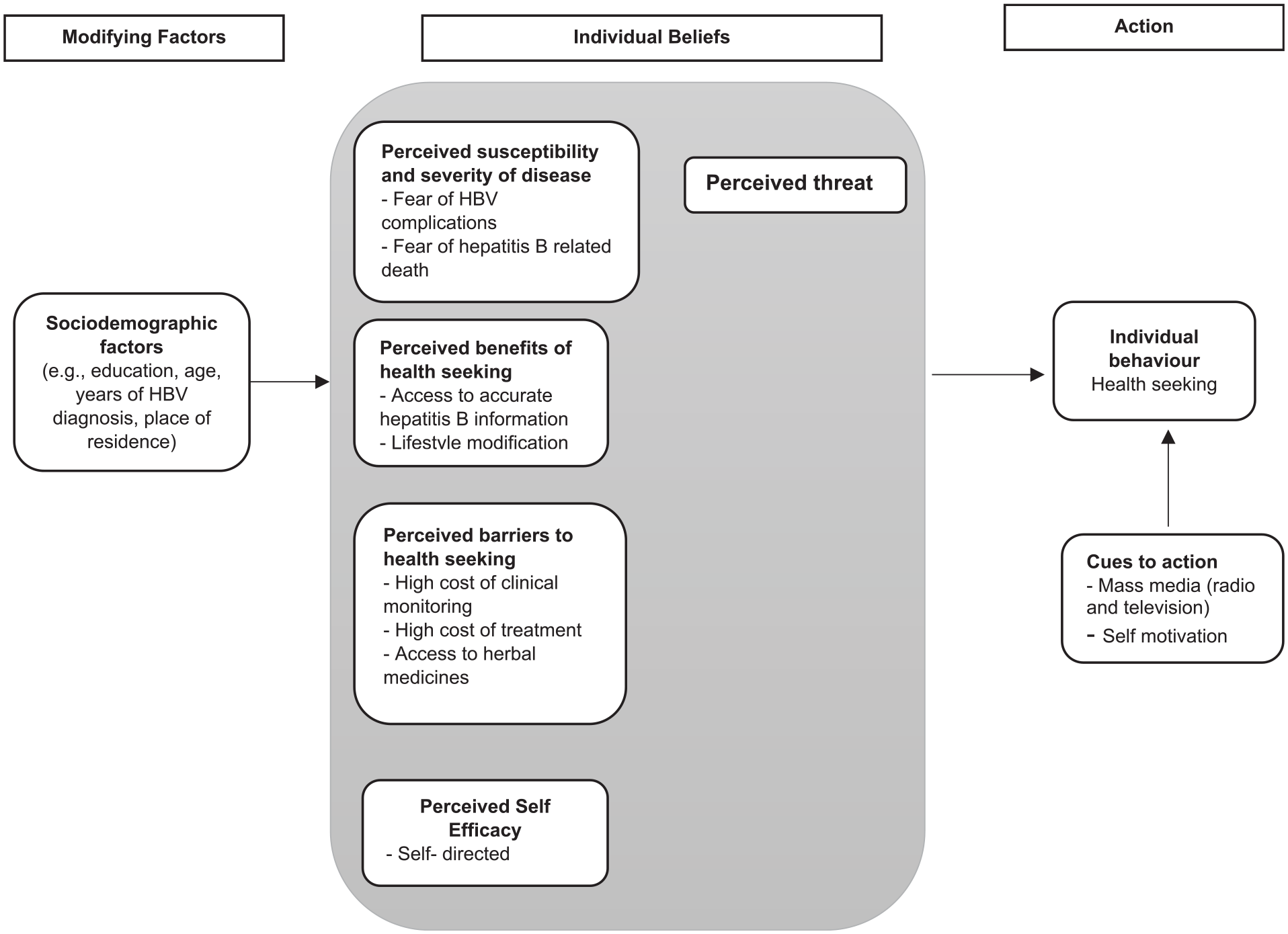
Conceptual framework for hepatitis B health seeking as adapted from Champion and Skinner (2008).
Conclusion
The findings highlight some important determinants of PWHB health seeking behaviour, such as the perceived severity of hepatitis B and the risk of developing liver cancer. It was also discovered that the high cost of clinical monitoring and treatment influences many PWHB to use herbal medicine instead of seeking formal care. It is thus recommended that a hepatitis B awareness campaign focusing on the availability of hepatitis B treatment and where it can be obtained be carried out in the study area. PWHB counselling at the time of diagnosis should emphasise the importance of lifelong clinical monitoring. To remove financial barriers to hepatitis B care in Ghana, the government should include the cost of hepatitis B laboratory investigations and treatment in the health insurance scheme.
Footnotes
Declaration of Conflicting Interests
The author(s) declared no potential conflicts of interest with respect to the research, authorship, and/or publication of this article.
Funding
The author(s) received no financial support for the research, authorship, and/or publication of this article.
Ethical Approval
Ethical approval was provided by the Noguchi Memorial Institute of Medical Research (IRB00001276). Also, permission was given by the data collection site and participants provided a written consent.

Data Availability Statement
Data sharing not applicable to this article as no datasets were generated or analysed during the current study.