




Abstract
Previous studies have confirmed that money scarcity can impede individuals’ cognitive control; however, it remains unclear how this effect occurs. This study created a virtual shopping game that can vividly simulate individuals’ shopping-related thought processes in daily life to systematically investigate how money scarcity influences cognitive control. Participants were randomly assigned to either a money scarcity group or a money rich group and were asked to perform a virtual shopping game, an emotion test, and a cognitive control task. In the first two experiments, the participants were asked to perform a space compatibility task (Experiment 1) or a face task (Experiment 2) after completing the virtual shopping task, in which they indicated whether they would purchase the probe commodity. The results showed that (1) the response times of the money scarcity group in both the space compatibility task and the face task were markedly lower than those of the money rich group, and (2) the cognitive flexibility and interference suppression of the money rich group were greater than those of the money scarcity group; however, there was no obvious difference in response inhibition. Experiment 3 embedded the space compatibility task within the virtual shopping task. The response times of the money scarcity group were still markedly slower than those of the money rich group. Thus, money scarcity impedes individuals’ cognitive control, primarily by weakening their cognitive flexibility and interference suppression.
Plain language summary
Money scarcity impedes individuals’ cognitive control, primarily by weakening their cognitive flexibility and interference suppression.
Keywords
Introduction
Poverty is a composite life situation that includes inadequate income, scarce resources, hunger, deteriorating health, poor health care, limited access to education, inadequate housing conditions, and social discrimination (United Nations, 1995). Although poverty has been substantially resolved in some countries, such as China, a significant number of people worldwide are still living in or struggling to escape poverty. Thus, poverty remains an obstacle to the sustainable development of society (Bowles et al., 2011; Huang et al., 2019; Kraay & McKenzie, 2014; Lusseau & Mancini, 2019; McGuire, 2015). Identifying the occurrence and mechanism of the development of poverty is important for formulating effective poverty alleviation measures and promoting solutions to poverty. Therefore, poverty has become a popular topic across numerous disciplines.
In the field of psychology, many studies have investigated the behaviors and decisions of individuals who live in poverty-riddled areas. Studies have shown that these individuals experience more violent crimes, alcoholism, substance abuse, and other antisocial behaviors and are more impulsive than people who live in wealthy areas (Ali & Eve, 2018; Cheteni et al., 2018; Enamorado et al., 2016; Kerr et al., 2017; McAra & McVie, 2016; Slabbert, 2017). Moreover, the influence of poverty on individuals’ behaviors is not limited to daily social behaviors; individuals’ decision-making behaviors, including economic decision-making, are also affected by poverty (Adamkovič & Martončik, 2017; Carvalho et al., 2016; Dohmen et al., 2011; Griskevicius et al., 2013; Guiso & Paiella, 2008; Lawrance, 1991; Pender, 1996). For example, Lawrance (1991) used a panel study with the income dynamics method to systematically study the differences in intertemporal preferences between Americans living in poverty and those living in wealth. The results showed that the percentage of Americans living in poverty was 3% to 5% greater than the percentage of rich Americans. Although studies have investigated the influence of poverty on individual behaviors in different domains, they have consistently suggested that the behaviors of individuals living in poverty are likely to negatively affect their health and impede their long-term development.
Why are individuals living in poverty more likely to engage in behaviors that are detrimental to their health and harmful to their long-term development? First, researchers explain that the answer to this question depends on the domains of stress and emotion. They suggest that poverty may induce stress and negative emotions in individuals, which may subsequently affect their decision-making and social behavior (Shah et al., 2012; Walt & Jason, 2017; Wolff et al., 2009; Yoshikawa et al., 2012).
Poverty may not only induce individual negative emotions and stress but also challenge individual cognitive systems, such as attention and memory (De Bruijn & Antonides, 2022; Mani et al., 2020; Ong et al., 2019). When people living in poverty focus their limited resources on budgeting, they may neglect beneficial information in the environment or forget to execute future actions (Shah et al., 2015, 2018; Zhao & Tomm, 2017; Zhao & Tomm, 2018). For example, Shah et al. (2015) explored Thaler (1985) beer-on-the-beach scenario and classic demonstration of the proportional thinking decision paradigm to investigate the influence of scarcity on individuals’ decisions and found that participants living in a scarcity condition (lower income) exhibited greater trade-off thinking than participants who lived in a rich condition (higher income). Specifically, in the beer-on-the-beach scenario, the lower-income participants focused their attention on the beer price and account and neglected the beer source and account proportion in this classic demonstration of proportional thinking. Therefore, lower-income participants were less susceptible to classic context effects.
Considering that social behavior and decision-making are directly related to individuals’ cognitive control, several scholars have explained poor people’s unsustainable behaviors and decisions from a new perspective of cognitive control. They speculate that demands and thoughts of scarcity consume the cognitive resources of individuals living in poverty, thereby impeding their cognitive control and affecting their social behavior and decision-making. These speculations are supported by empirical studies (Haushofer & Fehr, 2014; Mani et al., 2013; Spears, 2011; Vohs, 2013). For example, in Mani et al.’s (2013) study, participants were asked to read and think about daily financial demands, which have little effect on individuals living in wealth but attract sustained attention from individuals living in poverty. After the participants read and began to think about daily financial demands, they were asked to perform Raven’s reasoning test and a spatial compatibility task on a computer to test their cognitive function. After Raven’s reasoning and spatial compatibility tasks were completed, the participants’ income information was collected. The results showed that the performance of individuals living in poverty was significantly worse than that of individuals living in wealth for both Raven’s reasoning test and the spatial compatibility task. Moreover, the impact of poverty on cognitive control was mirrored by sugarcane farmers in two cities in India. These results indicate that poverty impedes cognitive control (Mani et al., 2013).
Given that the typical characteristic of poverty is scarcity, several scholars have explored scarcity as an indicator of poverty to indirectly investigate the relationship between poverty and cognitive control by examining the impact of scarcity on cognitive control (Shah et al., 2012; Spears, 2011). For example, Spears (2011) explored the store game, in which participants were asked to imagine that they were in a store that had only three commodities (i.e., vegetable oil, food storage, and ropes). They were allowed to choose one of the three commodities (scarcity group) or two of the three commodities (rich group). After completing the store game, the participants’ cognitive control was measured using a Stroop-like task and a handgrip task. The results demonstrated that the performance of the scarcity group was worse than that of the rich group on all cognitive control tasks. These findings indicate that decision-making under scarcity conditions affects cognitive control. Since scarcity is a central feature of poverty, this result also supports the view that poverty can interfere with individuals’ cognitive control.
Although a few studies have directly or indirectly demonstrated that poverty affects cognitive control, it remains unclear how poverty affects cognitive control. Research on this issue is helpful for revealing the mechanism by which poverty influences individual cognitive control and for improving understanding of the occurrence and development of poverty.
Cognitive control refers to the mental process by which an individual inhibits irrelevant information and flexibly processes valuable information to accomplish specific aims. Cognitive control comprises three components: response inhibition, interference suppression, and cognitive flexibility. Response inhibition means that the individual needs to inhibit the dominant response. For example, individuals may resist immediate temptation to gain greater benefits later. Interference suppression means that individuals need to focus their attention on relevant stimuli and ignore competing stimuli to rule out the interference of competing stimuli on individual cognition. For example, students can eliminate interference from the outdoor environment and pay attention to classroom teaching. Cognitive flexibility refers to the ability of an individual to flexibly switch between different tasks. For example, commanders analyze information relevant to both themselves and the enemy and adjust and optimize operational plans accordingly (Bialystok et al., 2006; Bialystok & Viswanathan, 2009; Liu et al., 2016). These three components have distinct cognitive-neural mechanisms (Brydges et al., 2012, 2013; Luk et al., 2010; Sylvester et al., 2003), and they can be accurately distinguished and measured using face tasks (Bialystok et al., 2006; Bialystok & Viswanathan, 2009; Liu et al., 2016).
The typical characteristic of poverty is scarcity, especially money scarcity, in which there is insufficient money to meet an individual’s needs. This study aimed to mimic poverty by simulating money scarcity and to investigate the influence of scarcity on cognitive control. Furthermore, a face test was used to investigate how poverty influences individuals’ cognitive control to reveal the mechanism by which money scarcity influences cognitive control. Specifically, a virtual shopping game, which can vividly simulate individuals’ daily decision-making in both rich and poor situations (the rules of the game are introduced in the methods section), was created to simulate poverty with reference to Spears’ (2011) store game.
In Experiment 1, participants were asked to perform a space compatibility task, which was used to measure their cognitive control after they completed the virtual shopping game. This experiment tested whether money scarcity affects individuals’ cognitive control. In Experiment 2, participants were asked to perform the face task, which is used to distinguish and measure the component of cognitive control. This task was completed after the participants finished the virtual shopping game to further investigate how money scarcity influences individuals’ cognitive control and to reveal the mechanism by which poverty influences cognitive control from the perspective of the components of cognitive control. In the last experiment, we eliminated the influence of cognitive fatigue on the experimental results by embedding the space compatibility task within the shopping task and then testing the influence of poverty on cognitive control when cognitive fatigue was excluded.
Experiment 1
This experiment used a new virtual shopping game and a space compatibility task to test the influence of poverty on cognitive control and to test the rationality of a virtual shopping game designed to activate money scarcity.
Methods
Participants
Forty-four university students (26 male, 18 female) aged 18 to 28 years volunteered to participate in this experiment. The average age of the participants was 21.91 years (SD = 2.61). All participants had normal or corrected-to-normal vision and received Ɏ15 RMB as a reward after completing the experiment.
Experimental Materials and Apparatus
Sixty pictures related to food, fruits, school supplies, and daily necessities were included (these four types were chosen because they are commonly used). All images were processed using Adobe Photoshop software according to the same standard and were placed on a white background with dimensions of 300 × 300 pixels. Forty-eight pictures were used for the formal experiment, and 12 pictures were used for the practice experiment. The visual angle of the pictures was 5.34° × 5.34° at a distance of 47 cm from the screen. The experimental instrument was a 14-inch Lenovo laptop with a screen resolution frequency of 1,092 × 1,208 pixels and a refresh frequency of 60 Hz.
Procedure
The procedure was performed using E-prime 2.0. The experiment consisted of three steps: a virtual shopping game, an emotion test, and a space compatibility task.
In the first step, participants were asked to complete the virtual shopping game. The rules of the virtual shopping game were as follows. Before the virtual shopping game began, participants were randomly assigned to either the money scarcity group or the money rich group. The participants in the money scarcity group were given Ɏ80 RMB as endowment money, while those in the money rich group were given Ɏ160 RMB as endowment money. Once the experiment started, 48 commodity pictures were randomly presented (with no repeated images) individually in the center of the screen. The price of each commodity was simultaneously presented under the commodity picture. Participants were asked to buy the commodities they needed or wanted from the given commodities by pressing the left or right key on the keyboard using the endowment money they obtained before the experiment. The total price of all commodities the experiment was Ɏ120 RMB, the average price was Ɏ2.5 RMB, and the price range was Ɏ1 to Ɏ10 RMB. These price messages were sent to the participants before the experiment began. The participants were asked to use as much endowment money as possible but not to exceed it. To induce the participants to use as much endowment money as possible, they were told before the experiment that those who spent more than Ɏ70 could participate in a lottery for a chance to receive 25% of the commodities they bought (this operation only aimed to induce the participants’ shopping enthusiasm; the aim of this operation was revealed to the participants after the experiment). Since the money scarcity group had only Ɏ80 of endowment money, they were able to buy only a fraction of the commodities they needed or wanted. Similar to individuals living in poverty who need to weigh their money decisions and needs in daily life, participants in the money scarcity group were required to constantly weigh their endowment money and commodities in this experiment. For example, the participants needed to calculate how much money they had to spend, think carefully about whether they would purchase a given commodity and think about whether the preferential commodities they needed would be presented afterward. The trade-off between the endowment money and their needs consumed the participants’ cognitive resources in the money scarcity group. In contrast, the participants in the money rich group did not have to make a trade-off between the endowment money and their needs because they had sufficient endowment money to buy all of the commodities in the virtual shopping game. Therefore, the participants in the money rich group consumed fewer cognitive resources than those in the money scarcity group.
The procedure for the virtual shopping game was as follows. First, a fixation point was presented in the center of the screen for 500 ms. Then, a probe commodity was randomly and centrally presented for 3,000 ms, and the participants were asked to think about whether they would buy the probe commodity. Next, a binary purchase decision was presented to the participants in which they were asked to press the F key (yes) or the J key (no) to confirm whether they would buy the probe commodity within 1,500 ms. Once the participant provided a response to the probe for the commodity, a blank screen was presented for 1,500 ms, after which the next trial began. Twelve practice trials were conducted prior to the virtual shopping game.
When the virtual shopping game was completed, the participants were asked to complete the Chinese version of the Positive Affect and Negative Affect Scale (PANAS). Five positive and five negative emotional words were presented to the participants, who were asked to rate their current emotional state on a 5-point scale based on the emotion of each word (Qiu et al., 2008; Watson et al., 1988).
After the PANAS was completed, the participants were asked to perform a space compatibility task. In the space compatibility task, a flower or heart was randomly presented on the left or right side of the screen, and the participants were asked to press the key on the same side to respond to the heart and to press the offside key to respond to the flower. The left-hand key corresponded to the “F” key, and the right-hand key corresponded to the “J” key. For example, if the heart was presented on the left side, the participants pressed the F key, and if the flower was presented on the left side, the participants pressed the J key. Before the heart or flower was presented, a fixation was presented for 500 ms. After the participants responded, a blank screen was presented for 1,500 ms before the next trial started. There were 60 trials in the formal space compatibility task, including 30 hearts and 30 flowers. Twelve exercise trials were conducted before the formal experiment started. The procedure for this experiment is shown in Figure 1.
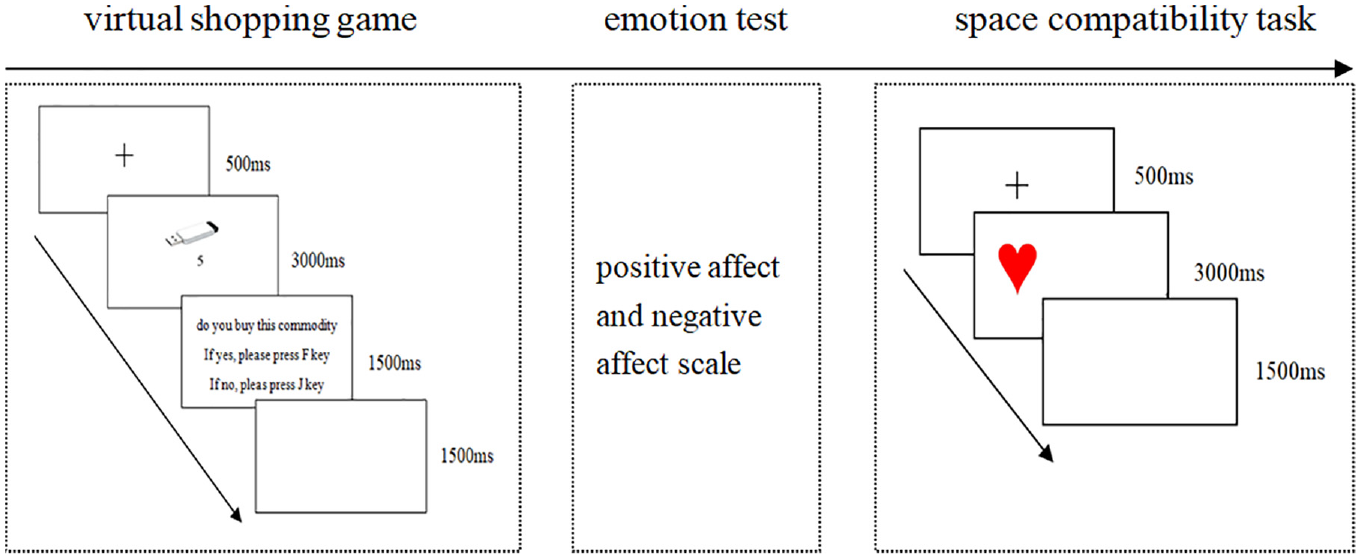
The procedure of Experiment 1, in which participants successively completed the virtual shopping game, an emotion test, and a space compatibility task. The procedure of the virtual shopping game is shown in the far-left panel, and the procedure of the space compatibility task is shown in the far-right panel.
Results and Discussion
The response times (RTs) of the error response trials in the space compatibility task were deleted (5.64%), and the remaining RTs data and error rates were analyzed using an independent-sample t test. The results showed a significant difference in RTs between the money scarcity and money rich groups (t(42) = 3.23, p < .01, d = 0.97). The RTs of the money scarcity group (630 ± 14.61 ms) were markedly higher than those of the money rich group (561 ± 15.66 ms), indicating that money scarcity impedes individuals’ cognitive control, as shown in Figure 2. There was no significant difference in the error rate between the money scarcity group and the money rich group, t(42) = 1.32, p = .196, d = 0.396. This may be because the error rates of the money scarcity group (0.032 ± 0.005) and the money rich group (0.045 ± 0.008) were very low, causing a floor effect.
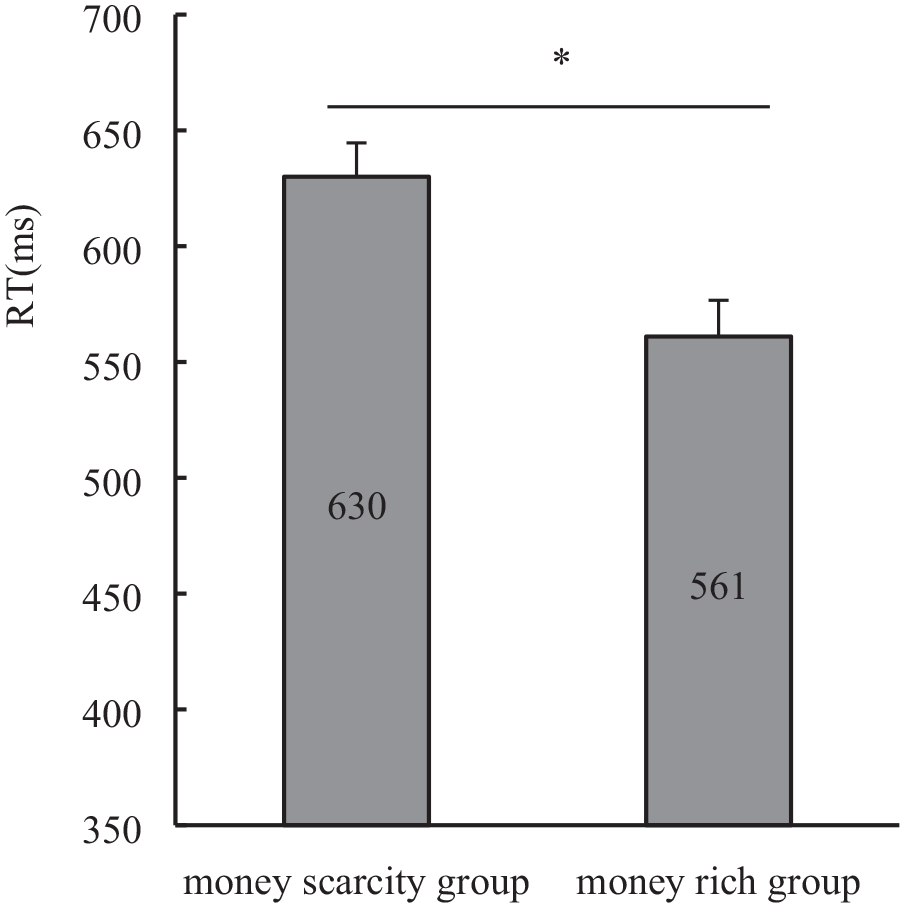
RTs of participants in the money scarcity and money rich groups in the space compatibility task. Error bars represent the standard error of the mean.
Although personality traits and emotions have a strong influence on cognitive control (Crescioni et al., 2011; Heckman et al., 2012; Pfeffer & Strobach, 2018; Sébastien et al., 2018; Shmueli & Prochaska, 2012), participants in both the money scarcity and the money rich groups were randomly assigned. This approach effectively eliminated various individual differences, including personality trait differences, between the two groups. Moreover, participating in the virtual shopping game did not influence the participants’ personality traits; thus, this experiment did not control for the personality traits of the participants in the money scarcity or money rich groups. To rule out emotional contamination induced by the virtual shopping game in the experimental results, emotions were tested immediately after the participants finished the virtual shopping game using the Chinese version of the PANAS. Five participants (two from the money rich group and three from the money scarcity group) failed to report their emotions, so we analyzed only the emotion data of the remaining 39 participants. Independent-sample t tests were used to compare differences in positive emotion and negative emotion between the money scarcity and money rich groups. There were no significant differences in either positive emotion [t(37) = 0.44, p = .67, d = 0.143] or negative emotion [t(37) = 1.08, p = .29, d = 0.344] between the two groups. Therefore, we can exclude the possibility that the differences in RTs in the cognitive control tasks between the money scarcity and money rich groups were induced by the difference in emotions between these two groups and further determined the influence of money scarcity on cognitive control.
Experiment 2
Cognitive control consists of response inhibition, interference suppression, and cognitive flexibility. The face task can accurately distinguish and measure each component of cognitive control. Therefore, Experiment 2 aimed to further investigate how money scarcity influences individuals’ cognitive control by asking participants to perform a face task after they finished the virtual shopping game.
Methods
Participants
Seventy university students (34 male and 36 female) volunteered to participate in this experiment. Their average age was 21.61 years (SD = 2.31), ranging from 18 to 27 years. All participants had normal or corrected-to-normal vision. None of the patients exhibited color blindness or weakness. After completion of the experiment, each subject received Ɏ15 RMB as a reward for participation.
Experimental Materials and Apparatus
The experimental materials used in Experiment 2 were similar to those used in Experiment 1.
Procedure
The procedure of this experiment was similar to that used in Experiment 1, except that the space compatibility task was replaced with the face task, which is typically used to distinguish and measure the components of cognitive control. The face task consisted of the following steps. (1) A stick figure of a face was presented at the center of the display for 1,000 ms, and a square was presented on the left and right sides of the face simultaneously. The visual angle of the face at a distance of 47 cm from the screen was 4.92° × 4.92°, the visual angle of the square was 2.46° × 2.46°, and the visual angle from the center of the face to the center of the square was 7.32°. (2) After 1,000 ms, the eyes in the face of the stick figure turned either red or green for 500 ms. (3) The stick figure face disappeared after 500 ms, but the left and right squares lasted for 200 ms. Next, an asterisk appeared in one of the squares for 150 ms. When the eye color was green, the participant pressed the left key as quickly and correctly as possible when the asterisk appeared in the left square and the right key when the asterisk appeared in the right square. When the eyes were red, the participant pressed the left key as quickly and correctly as possible when the asterisk appeared in the right square and the right key when the asterisk appeared in the left square. The left key and right key corresponded to the “F” key and “J” key on the keyboard, respectively. The entire face task was divided into two types: eye gaze and eye switch tasks. In the eye gaze task, all colored eyes looked forward. In the eye switch task, the colored eyes looked to the left or right squares. Therefore, the colored eyes promoted the participants’ responses when the eyes looked at the square on the same side of the asterisk, while the participants’ responses were inhibited when the colored eyes looked at the square on the opposite side of the asterisk. The procedure for this experiment is shown in Figure 3.

The procedure of the face task, which consisted of the eye gaze and the eye switch tasks. The left side corresponds to the eye gaze task, and the right side corresponds to the eye switch task.
The face task consisted of 16 blocks, with eight blocks belonging to the eye gaze task and eight blocks belonging to the eye switch task. Each block had 12 trials. All of the blocks could be divided into a single-color block in which the eye color was only green or red or a mixed-color block in which the eye color was both red and green (with the same frequency and random order of red and green). The eye gaze task consisted of two red eye blocks, two green eye blocks, and four mixed-color blocks; that is, the same as the procedure for the eye switch task. The participants were given eight practice trials before the eye gaze task, and the eye switch task helped them better understand the experimental requirements. The practice trial could be repeated according to the participants’ requirements. The order of the eight blocks for each task type was balanced among the participants.
Results and Discussion
The response times (RTs) for the error response trials in the face task were deleted (6.23%), and the remaining RTs data and error rates were analyzed using independent-sample t tests. The results revealed a significant difference in RTs between the money scarcity and money rich groups in the face task, t(68) = 3.73, p < .001, d = 0.891. The RTs of the money scarcity group (480 ± 15.06 ms) were markedly higher than those of the money rich group (409 ± 11.56 ms), indicating that money scarcity impedes individuals’ cognitive control, as shown in Figure 4. There was no significant difference in the error rate between the money scarcity group and the money rich group (t(68) = 0.84, p = .402, d = 0.21). The reason may be that the error rates of the money scarcity group (0.044 ± 0.005) and the money rich group (0.050 ± 0.006) were very low and caused a floor effect.
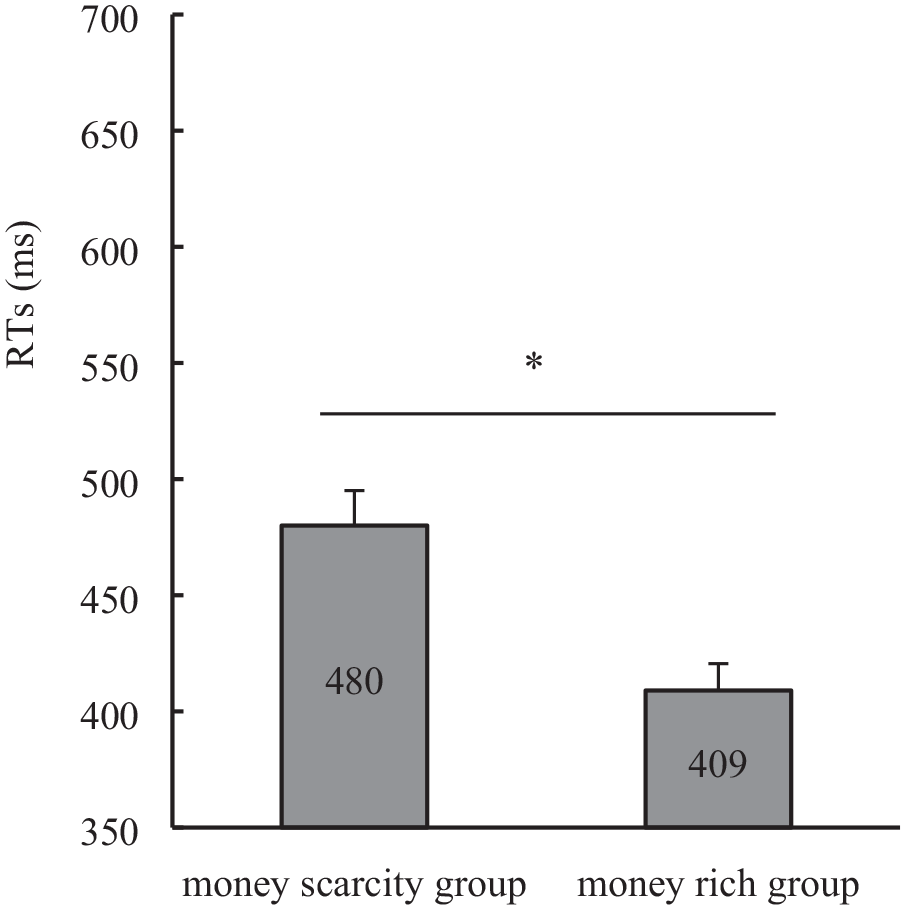
RTs for the money scarcity and money rich groups in the face task. The error bar represents the standard error of the mean.
To further investigate how money scarcity influences individuals’ cognitive control by examining which components of cognitive control are involved, we analyzed the differences in each component of cognitive control between participants in the money scarcity and money rich groups. The three components of cognitive control were calculated according to the method proposed by Bialystok and Viswanathan (2009) and Liu et al. (2016). Specifically, response inhibition was determined by the difference in response times between the red eye trials and green eye trials (response inhibition = RTs of red eye trials − RTs of green eye trials). Generally, the participants’ responses were more dominant when the location of the pressed key corresponded to the location presented by the asterisk than when the location of the pressed key was opposite to the location of the asterisk. In the red eye trials, the participants were asked to press the key opposite the location of the asterisk. In this condition, the influence of the dominant response was inhibited. In contrast, this inhibitory effect did not occur in the green eye trials. Therefore, the difference in RTs between these two conditions reflects the participants’ response inhibition, and a smaller RTs difference indicates greater response inhibition ability.
Interference suppression was determined by the difference in the response times in the eye switch task between trials in which the eye direction was consistent with the asterisk location and trials in which the eye direction was inconsistent with the asterisk location (interference suppression = RTs of trials in which the eye direction was inconsistent with the asterisk location − RTs of trials in which the eye direction was consistent with the asterisk location). The direction of the eye looking forward could orient the participants’ attention and thus elicit a faster response to the asterisk, consistent with the direction of the eye looking forward. Therefore, the participants were instructed to pay attention to the location of the asterisk presented and ignore the eye direction when the asterisk location was inconsistent with the direction of the eye looking forward. The direction could interfere with the participants’ response to the asterisk. However, this interference phenomenon did not appear when the direction of the eye looking forward was consistent with the location of the asterisk. Therefore, the difference in RTs in the eye switch task between trials in which eye direction was consistent with the asterisk location and trials in which eye direction was inconsistent with the asterisk location reflect the participants’ interference suppression ability. A smaller RTs difference indicates greater interference suppression.
Cognitive flexibility was determined by the difference in response times between the trials of the mixed-color block and the trials of the single-color block (cognitive flexibility = RTs of trials of the mixed-color block − RTs of trials of the single-color block). The participants were required to switch between different tasks in the mixed-color block but were not required to switch in the single-color block. Therefore, the difference in RTs between the mixed-color block and the single-color block reflects the participants’ cognitive flexibility, and a smaller RT difference indicates greater cognitive flexibility.
Independent-sample t tests revealed a significant difference in cognitive flexibility between the money scarcity and money rich groups (t(68) = 2.067, p < .05, d = 0.49). The cognitive flexibility of participants in the money scarcity group (68 ± 13.83 ms) was lower than that of participants in the money rich group (36 ± 8.06 ms). There was a significant difference in interference suppression between the money scarcity and money rich groups (t(68) = 3.86, p < .001, d = 0.92), and interference suppression in the money scarcity group (41 ± 6.52 ms) was lower than that in the money rich group (11 ± 4.16 ms). There was no significant difference in response inhibition between participants in the money scarcity (67 ± 9.29 ms) and money rich (48 ± 6.38 ms) groups (t(68) = 1.64, p = .106, d = 0.39). These results indicate that money scarcity influences individuals’ cognitive control primarily by affecting their cognitive flexibility and interference suppression, as shown in Figure 5.

The level of cognitive flexibility, response suppression, and interference suppression in participants from the money scarcity and money rich groups obtained in the face task. The error bar represents the standard error.
Similar to Experiment 1, to exclude the influence of differences in the emotions of participants between the money scarcity and money rich groups with regard to cognitive control and its components, in Experiment 2, the participants’ emotions were measured using the Chinese version of the PANAS after the virtual shopping game was finished. Independent sample t tests demonstrated no significant differences in either positive emotion [t(68) = 1.003, p = .319, d = 0.238] or negative emotion [t(68) = 1.895, p = .062, d = 0.454] between the participants in both groups. Therefore, the possibility that differences in emotion between participants in either group influenced the experimental results can be ruled out. The results further strengthen our experimental conclusion that money scarcity influences individuals’ cognitive control, primarily by affecting their cognitive flexibility and interference suppression.
Experiment 3
In the first two experiments, the cognitive control task was completed after the virtual shopping task, in which participants made a binary purchase decision by pressing a specific key. Although the presentation times of every commodity were the same (3,000 ms) for both the money scarcity and money rich groups, it is possible that the RTs for binary purchase decisions differed between these two groups. The difference in RTs for the binary purchase decision between the money scarcity and money rich groups is likely to lead to a difference in cognitive fatigue between these two groups. Therefore, the possibility that the difference in cognitive control between the money scarcity and money rich groups reflects cognitive fatigue rather than the cognitive load presented by the scarcity condition cannot be ruled out. To exclude the interference of the difference in cognitive fatigue on cognitive control, Experiment 3 embedded the cognitive control task within the virtual shopping task rather than conducting it after, as in Mani et al. (2013), in which participants were asked to make a binary purchase decision after the cognitive task was completed.
Methods
Participants
Fifty university students (7 males and 43 females) volunteered to participate in this experiment. Their average age was 19.84 years (SD = 1.63) and ranged from 18 to 25 years. All participants had normal or corrected-to-normal vision. None of the participants exhibited color blindness or weakness. After completion of the experiment, each subject received Ɏ15 RMB as a reward for participation.
Experimental Materials and Apparatus
The experimental materials used in Experiment 3 were the same as those used in Experiment 1.
Procedure
The procedure of this experiment was similar to that used in Experiment 1, except that the binary purchase decision was deleted in the virtual shopping game and was performed after the space compatibility task was fully completed. In addition, the participants’ socioeconomic status was collected together with their age and sex. Socioeconomic status was measured by the following question: compared to basic local conditions, how would you describe your family’s economic situation? The response options included 1 = very poor, 2 = relatively poor, 3 = fair, 4 = comparably rich and 5 = very rich. The participants were asked to choose an appropriate answer from the above five options. Relevant studies have indicated that this question is reliable and effective for measuring individual socioeconomic status (Bradley & Corwyn, 2002; Zhang et al., 2017).
Results and Discussion
The RTs of the error response trials in the space compatibility task were deleted (5.57%), and the remaining RTs data and error rates were analyzed using an independent-sample t test. The results showed that there was a significant difference in RTs between the money scarcity group and the money rich group, t(48) = 2.33, p < .05, d = 0.659. The RTs of the money scarcity group (570 ± 12.55 ms) were markedly greater than those of the money rich group (530 ± 11.34 ms), indicating that money scarcity impedes individuals’ cognitive control, as shown in Figure 6. There was no significant difference in the error rate between the money scarcity group and the money rich group, t(48) = 0.36, p = .72, d = 0.101. This may be because the error rates of the money scarcity group (0.042 ± 0.006) and the money rich group (0.039 ± 0.007) were very low, causing a floor effect.
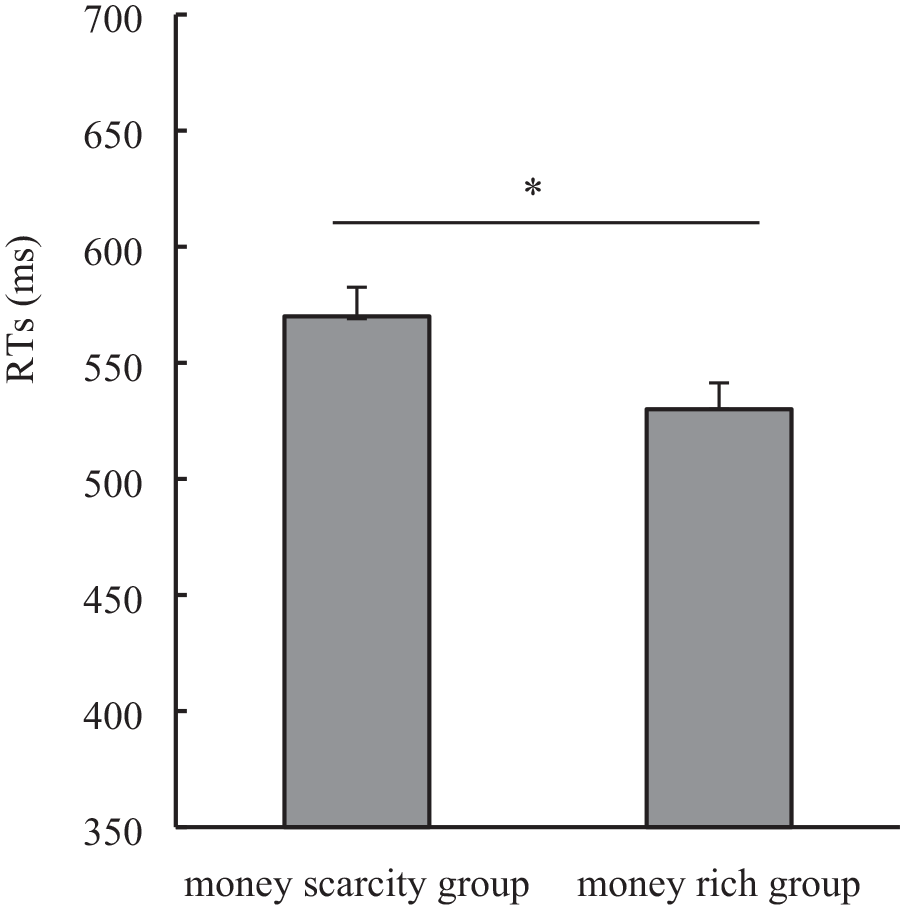
RTs of participants in the money scarcity and money rich groups in the space compatibility task. Error bars represent the standard error.
Similar to the first two experiments, to exclude the influence of differences in the emotions of participants between the money scarcity and money rich groups on cognitive control, the difference in emotions between the two groups was also analyzed in Experiment 3. An independent-sample t test revealed that there was no significant difference in either the positive emotion [t(48) = 1.68, p = .099, d = 0.478] or the negative emotion [t(48) = 0.44, p = .66, d = 0.128] between the money scarcity group and the money rich group.
In addition, to investigate whether the socioeconomic status of participants interfered with the influence of money scarcity on cognitive control, we analyzed the difference in socioeconomic status between the money scarcity group and the money rich group. An independent-sample t test revealed that there was no significant difference in socioeconomic status (t(48) = 1.41, p = .16, d = 0.403) between the money scarcity group and the money rich group. Therefore, we could exclude the possibility that the differences in cognitive control between the money scarcity and money rich groups were induced by differences in emotion and socioeconomic status between these two groups to further determine the influence of money scarcity on cognitive control.
General Discussion
Previous studies have shown that individuals living in poverty are more likely to behave in ways that are detrimental to their health and long-term development, such as shortsightedness, which may worsen their poverty (Adamkovič & Martončik, 2017; Ali & Eve, 2018; Carvalho et al., 2016; Haushofer & Fehr, 2014; McAra & McVie, 2016; Slabbert, 2017). Given that cognitive control is closely related to individual behaviors, several studies have investigated why people living in poverty are more likely to act in ways that are self-detrimental to cognitive control. The results directly and indirectly demonstrate that poverty influences individuals’ cognitive control (Haushofer & Fehr, 2014; Mani et al., 2013; Spears, 2011; Vohs, 2013). However, the way that poverty influences cognitive control remains unclear. Therefore, the present study aimed to examine poverty through money scarcity to investigate how poverty influences individuals’ cognitive control.
First, we created a virtual shopping game to simulate individuals’ shopping-related thought processes and explored a space compatibility task to measure individuals’ cognitive control. Participants were randomly assigned to either a money scarcity group or a money rich group. After the group assignment was completed, the participants were asked to perform a virtual shopping game, an emotion test, and a space compatibility task in sequence. The results of Experiment 1 demonstrated that the response times of participants in the money scarcity group for the space compatibility task were significantly slower than those of participants in the money rich group for the same task, indicating that money scarcity impedes individuals’ cognitive control. Mani et al. (2013) asked individuals with different incomes to complete a space compatibility task after thinking about financial demands in their daily lives and examined the impact of poverty on individuals’ cognitive control. They found that low-income individuals responded more slowly to the space compatibility task than high-income individuals did. This phenomenon has also been observed among sugarcane farmers in India. Similarly, some scholars have verified the effect of scarcity on cognitive control using store games (Haushofer & Fehr, 2014; Shah et al., 2012; Spears, 2011). In Experiment 1, a virtual shopping game was created and a compatibility task was explored to examine whether money scarcity influences individuals’ cognitive control. The results of Experiment 1 were similar to those of previous studies. Therefore, the results of Experiment 1 further support the view that poverty impedes cognitive control. The results of this experiment can deepen our understanding of the relationship between poverty and cognitive control.
It is commonly understood that cognitive control consists of three components: interference suppression, response inhibition, and cognitive flexibility. Moreover, these three components have different neural mechanisms (Bialystok et al., 2006; Bialystok & Viswanathan, 2009; Liu et al., 2016). Through what components of cognitive control does poverty influence individual cognitive control? Investigating this question is the key to revealing how poverty influences individuals’ cognitive control. Although previous studies have investigated the influence of poverty on cognitive control, few have examined the internal mechanism of the effect of poverty on individual cognitive control. Considering that the face task effectively measures various components of cognitive control, Experiment 2 combined the virtual shopping game with the face task to investigate the mechanism by which money scarcity affects cognitive control from the perspective of the components of cognitive control.
In Experiment 2, after excluding the influence of emotion and other factors, the results demonstrated that the average response times of participants in the money scarcity group were significantly slower than those of participants in the money rich group in the face task. This result demonstrated that money scarcity impedes cognitive control. To systematically investigate the components of cognitive control that influence individuals’ cognitive control, we further compared the differences in response inhibition, interference suppression, and cognitive flexibility between the money scarcity and money rich groups. The results revealed that the cognitive flexibility and interference suppression of the participants in the money rich group were markedly greater than those of the participants in the money scarcity group, indicating that money scarcity can substantially influence participants’ cognitive flexibility and interference suppression. Specifically, compared with the money-rich condition, the money scarcity condition reduced participants’ cognitive flexibility and interference suppression. However, there was no significant difference in response inhibition between participants in the money scarcity and money rich groups, indicating that money scarcity does not influence individuals’ response inhibition. From these results, we can infer that money scarcity influences individuals’ cognitive control primarily by influencing cognitive flexibility and interference suppression. The interference suppression test required the participants to ignore eye direction in the face task. The cognitive flexibility test required the participants to ignore the influence of the just-passed mixed trial. Both have a significant impact on the perceptual processing of stimuli. The response inhibition test required participants to overcome the influence of the dominant response and therefore only influenced individual behavioral responses. The present study found that money scarcity influences individuals’ cognitive control primarily by influencing cognitive flexibility and interference suppression. This finding implies that the effects of money scarcity on cognitive control occur at the cognitive level rather than the behavioral level.
The first two experiments preliminarily revealed that money scarcity can impede individuals’ cognitive control by reducing individual cognitive flexibility and interference suppression. Cognitive control tasks were performed after the participants completed the shopping task, in which they had to respond to a binary purchase decision following every commodity presentation. Although every commodity was consistently presented for 3,000 ms for the participants in both groups, the RTs in the binary purchase decisions of the participants in the money scarcity group were different from those of the money-rich group. This difference in RTs between participants in the money scarcity and money rich groups may have led to the difference in cognitive fatigue between these two groups. When this phenomenon occurs, it is difficult to rule out the possibility that the difference in cognitive control between the money scarcity group and the money rich group reflects cognitive fatigue rather than the cognitive load presented by the scarcity condition. To exclude the interference of the difference in cognitive fatigue on cognitive control, Experiment 3 embedded the cognitive control task within the shopping task rather than conducting it after, as in Mani et al. (2013). Mani et al. (2013) asked participants to make a purchase decision after the cognitive task was completed. Therefore, the cognitive fatigue experienced by participants in both groups was the same because both groups spent the same amount of time on the shopping task when the purchase decision was made after the cognitive task was completed. In addition, we further controlled for contamination from the participants’ socioeconomic status in the experimental results. The results of Experiment 3 showed that even after excluding the difference in cognitive fatigue and socioeconomic status between these two groups, the results still fully replicated and confirmed the results of the first two experiments, which demonstrated that money scarcity can impede individuals’ cognitive control.
Why does money scarcity influence cognitive control? The following possible explanations are presented. (1) Thinking about the trade-off between money and needs, consumes the cognitive resources of the participants in the money scarcity group, thereby reducing their cognitive control. (2) Calculating the amount of money spent in shopping tasks leads to reduced cognitive control. If the reduced cognitive control of the money scarcity condition was induced by the calculation of the amount of money in the shopping task, then it can be speculated that when the participants in the money scarcity condition were divided into the high group and the low group according to the actual amount of money consumed in the shopping task, the high group had lower cognitive control than the low group because the high group performed more calculations. To test this possibility, we explored the bisection method to divide the money scarcity participants into high and low groups according to the actual consumption amount in the shopping task and then compared the difference in cognitive control among the high money scarcity, low money scarcity, and money rich groups. The results of Experiment 1 revealed that there was no significant difference in cognitive control between the high money scarcity group (634 ± 25.11 ms) and the low money scarcity group (626 ± 16.23 ms) (t(20) = 0.24, p = .81). The cognitive control of both the high-money scarcity and low-money scarcity groups was significantly lower than that of the money-rich group (561 ± 15.66 ms) (ps < .018). This difference in cognitive control between the high money scarcity group, the low money scarcity group, and the money rich group was repeated in Experiment 2. Due to the limitations of memory and the influence of factors the contribute to forgetting, it was difficult for participants to recall exactly what they wanted to buy in the shopping task after completing the cognitive control task. Thus, we did not collect shopping data in Experiment 3. By comparing the difference in cognitive control among the high money scarcity group, the low money scarcity group, and the money rich group, we can rule out the possibility that the calculation of the amount of money spent on shopping tasks led to reduced cognitive control. Therefore, it can be concluded that thinking about the trade-off between money and needs consumes the cognitive resources of the participants in the money scarcity group, thereby reducing their cognitive control.
Previous studies indicate that individuals living in poverty have relatively little money. To survive and develop, individuals, including those living in poverty, have many essential needs, such as food, education, and medical costs. Therefore, individuals living in poverty often attempt to balance their money and their daily needs. Thinking about the trade-off between money and needs consumes individuals’ cognitive resources, thereby reducing their cognitive control. Compared to individuals living in poverty, individuals living in wealth have more money to meet their needs, which requires relatively little consideration of the trade-off between money and needs in daily life. Therefore, in daily life, fewer cognitive resources are consumed for individuals living in wealth than for individuals living in poverty. These findings indicate that the cognitive control of individuals living in wealth is better than that of individuals living in poverty (Haushofer & Fehr, 2014; Mani et al., 2013; Shah et al., 2012; Zhao & Tomm, 2017, 2018). The present study simulates the thought processes of people living in poverty described in previous studies, and the results support the results of previous studies and suggest that poverty can impede individuals’ cognitive control.
Although previous studies have investigated the influence of poverty on individuals’ cognitive control, no reliable research has demonstrated the internal mechanism by which poverty influences individuals’ cognitive control. Using face tasks, this study investigated how money scarcity influences individuals’ cognitive control from the perspective of cognitive control components. The results showed that money scarcity impedes individuals’ cognitive control primarily by weakening individuals’ cognitive flexibility and interference suppression. These results can further our understanding of the internal influence of poverty on individuals’ cognitive control and provide a new perspective to further study the influence of poverty on cognitive control.
Previous studies have investigated cognitive control based on the perspective of behavior, EEG, and brain imaging and have separated cognitive control into three components, cognitive flexibility, interference suppression, and response inhibition, suggesting that these components have distinct processing mechanisms (Bialystok & Viswanathan, 2009; Brydges et al., 2012, 2013; Bunge, 2002; Liu et al., 2016; Luk et al., 2010; Sylvester et al., 2003). The present study observed significant differences in cognitive flexibility and interference suppression between the money scarcity and money rich groups but no significant difference in response inhibition between these two groups, indicating that interference suppression, response inhibition, and cognitive flexibility exhibit different processing mechanisms. These results further support the results obtained in previous studies and help to deepen the understanding of cognitive control.
Limitations and Directions for Further Research
Although the present study revealed the influence of monetary scarcity on individual cognitive control, there were also limitations that were difficult to resolve.
(1) In the present study, money scarcity was operationalized by different endowments in the shopping task. This type of money scarcity is situational scarcity, which is substantially different from chronic money scarcity. Moreover, it is unclear whether this relationship is related to poverty. Therefore, the influence of money scarcity on cognitive control found in this study can only explain the influence of situational money scarcity on cognitive control. Whether the findings can be extended to chronic money scarcity should be further investigated in field experiments or by operationalizing chronic money scarcity.
(2) Money scarcity can not only influence individual cognition by depleting cognitive resources but also influence individual cognition by changing one’s thinking. The present study found that money scarcity can impede individual cognitive control by influencing cognitive flexibility and interference suppression. However, the question of whether these impeding effects arise from the depletion of individual cognitive resources or changes in an individual’s thinking cannot be answered. This question requires further investigation in the future.
(3) Cognitive control consists of cognitive flexibility, response inhibition, and interference suppression. These components are measured by most tasks, such as the Stroop task, flanker task, Go/No-go task, and stop-signal tasks. However, the present study only measured cognitive control using the space compatibility task and the face task. Thus, it is necessary to further measure cognitive control using other tasks in future studies.
Conclusions
The present study reached the following conclusions: (1) money scarcity impedes individual cognitive control, and (2) money scarcity influences individual cognitive control primarily by affecting individual cognitive flexibility and interference suppression.
Footnotes
Ethical Approval
All procedures performed in studies involving human participants were in accordance with the ethical standards of the institutional and/or national research committee and with the 1964 Helsinki Declaration and its later amendments or comparable ethical standards.
Declaration of Conflicting Interests
The author(s) declared no potential conflicts of interest with respect to the research, authorship, and/or publication of this article.
Funding
The author(s) received no financial support for the research, authorship, and/or publication of this article.
Informed Consent
Informed consent was obtained from all individual participants included in the study.

Data Availability Statement
The data of this manuscript can download from http://dx.doi.org/10.17605/OSF.IO/RXVFY.