




Abstract
The present study sought to investigate perceptions of stress and coping among public school principals. School principals are daily called upon to make decisions regarding a range of unscripted events. The position can be stressful, and stress is known to interfere with sound decision making. It was predicted that present samples of school principals would report a mean level of elevated stress. Contrary to expectations, school principals did not report an elevated level of stress. They instead reported an ostensibly effective reliance on problem-focused and emotion-focused coping skills. It remains unclear how the school principals developed such adaptive means for coping with the stress of leading schools. It is recommended that future research explore this question so that such skills may be transmitted to principals-in-training.
Since the original “principal teachers” of the early 1800s, the school principal has been expected to lead through myriad responsibilities in the service of students, parents, and their broader communities (Beausaert, Froehlich, DeVos, & Riley, 2016; Kafka, 2009). Although the social and political landscape of modern public education in the United States has changed much in the intervening two centuries (Klocko & Wells, 2015), evidence suggests that the role itself has changed relatively little (Kafka, 2009; Klocko & Wells, 2015). The modern school principal continues to practice educational leadership much as before, albeit with greater occupational stress due to growing expectations of accountability demanded by government (Klocko & Wells, 2015; Wells, 2013).
Leadership is known to be a stressful vocation (Campbell, Baltes, Martin, & Meddings, 2007) and the level of stress experienced by a school principal matters, not merely for his or her own sake (Lazarus, 1990), but for the wellness of the school and those within it. During any given day, a school principal is called upon to make decisions regarding a range of unscripted events. Not only his or her decisions, but the climate set by a school principal can affect the student learning (Leithwood & Day, 2008), values (Berson & Oreg, 2016), and identity development (Muller, 2015). The school climate further has the ability to influence the running of the school as an organization (Sarros, Gray, & Densten, 2002).
Stress can interfere with sound decision making. Deciding among competing and complex options is a role central to school leadership (Lunenburg, 2010). Yet, modern educational leadership is often characterized by expectations of rapid responses, a situation exacerbated by the ubiquitous use of email and other social media (Sorenson, 2007) and the increasingly normative habit of remaining “plugged in” to work while at home. The result for the typical school principal may be an ever increasing accumulation of stressors leading to cognitive overload (Carr, 2010; Soares et al., 2012) and emotional upset (Williams, Bargh, Nocera, & Gray, 2009), both of which can result in a diminution of the cognitive flexibility so crucial for effective decision-making (Ionescu, 2012).
Ionescu (2012) defined cognitive flexibility as the “characteristic that helps humans pursue complex tasks, such as multitasking and finding novel, adaptive solutions to changing demands” (p. 190). It is the ability of an individual to cognitively switch between changing situations in the presence of both positive and negative feedback (Reitan & Wolfson, 1993; Strauss, Sherman, & Spreen, 2006). Cognitive flexibility is highly responsive to stress. Its relative absence is often characterized by troubled social interactions (Martin & Rubin, 1995), a resistance to change (Su, Chung, & Su, 2012), and ultimately the potential for degraded decision making (Han et al., 2011). The culture of stress suggested to be common among educational leaders (Queen & Queen, 2005) may promote less than sterling cognitive performance among school principals, which fosters unhealthy climates and classrooms.
Motivated by this concern, two studies were conducted to explore the role of stress and coping among school principals. In Study 1, three hypotheses were tested to explore stress among school principals and its relationship with cognitive flexibility among a metropolitan sample. First, it was hypothesized that school principals would report a level of stress greater than expected among the general population. If a culture of stress does pervade educational leadership (Queen & Queen, 2005), school principals should report such. Second, it was hypothesized that stress would inversely correlate with cognitive flexibility as reported by school principals. The essence of Study 1 was that such a relationship might compromise decision making. Third, it was hypothesized that stress would directly correlate with physical symptoms as reported by school principals. A preponderance of health concerns could be of concern given the demanding pace of school leadership. In Study 2, coping dispositions were explored to better delineate not merely whether but how school principals sought to adapt to the stress of leading a school. The goal of Study 2 was to provide clarity regarding the nature of coping among the school principals.
Method
Study 1
Subjects
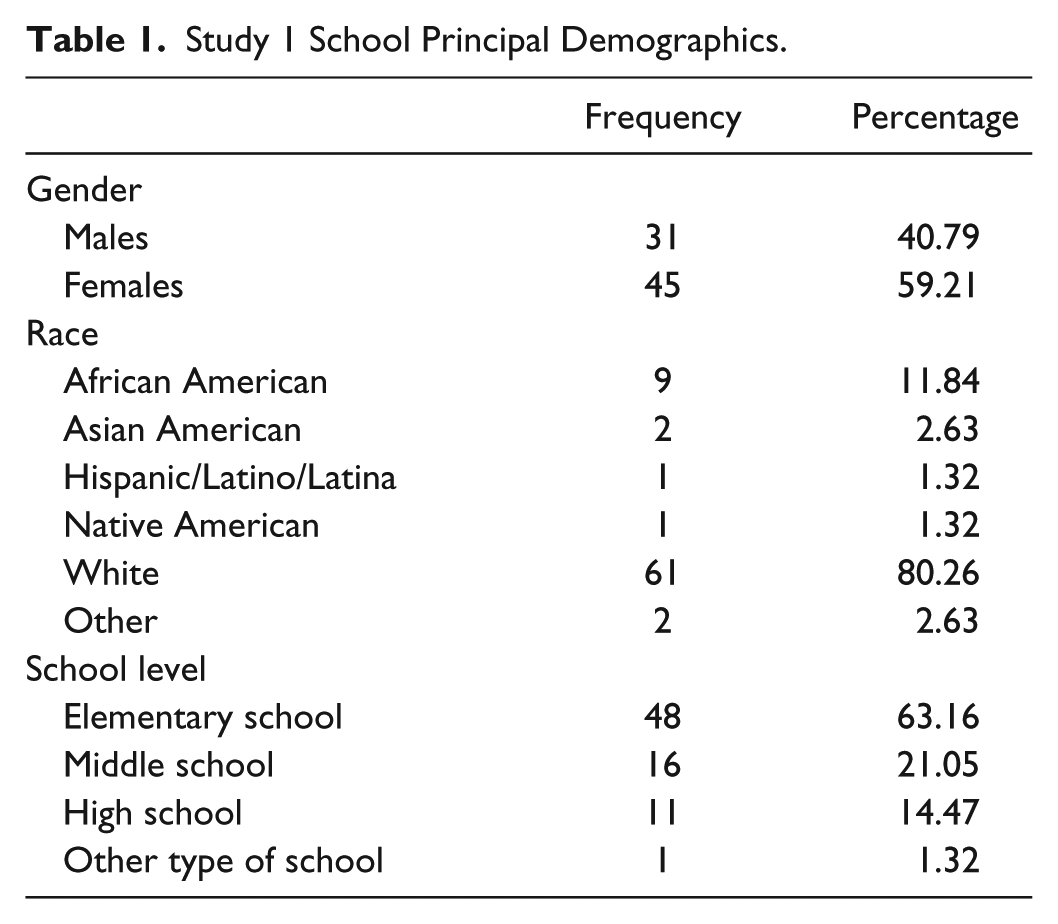
The 320 public school principals from 14 districts across an Upper Midwest metropolitan area were recruited to respond via email to an online survey regarding the stress of serving as a school principal. These individuals represented all public school principals in their respective districts, which in turn, were selected as meaningfully representing as a whole the P-12 education landscape in the studied metropolitan area. In response, 76 school principals (31 males, 45 females, Mage = 48.89 years, SD = 7.70 years, age range = 34 years-70 years) completed all items of the survey. Representing a response rate of 23.75%, the typical school principal was a middle-aged White female leading an elementary school (Table 1). All subjects were treated in accordance with the ethical guidelines of the American Educational Research Association (2011).
Study 1 School Principal Demographics.
Measures
School principals were asked to respond to items regarding three areas of interest: (a) stress, (b) cognitive flexibility, and (c) frequency of physical symptoms. The school principals were also asked to respond to a final open-ended item regarding what they had recently done to cope with the stress of being a school principal.
Stress was measured with the perceived stress scale (PSS; Cohen, Kamarck, & Mermelstein, 1983). The PSS is a widely utilized 10-item, self-report scale based on Lazarus’s (1990) cognitive-appraisal theory of stress. It was designed to gauge the extent to which an individual perceives life events as stressful. Cohen et al. (1983) found the PSS to demonstrate test–retest reliability of .85, with means of 23.18 (SD = 7.31) and 23.67 (SD = 7.79).
Cognitive flexibility, a matter relevant to the ability to make effective decisions, was assessed via the cognitive flexibility inventory (CFI; Dennis & Vander Wal, 2010). The CFI is a 20-item self-report instrument that measures those “aspects of cognitive flexibility that enable individuals to think adaptively rather than maladaptively when encountering stressful life events” (p. 243). Dennis and Vander Wal validated the CFI on a sample of 196 subjects and found it to demonstrate test–retest reliability of .84 to .91.
Frequency of physical symptoms was measured with the physical health questionnaire (PHQ; Schat, Kelloway, & Desmarais, 2005). The PHQ is a 14-item self-report scale of a range of physical health symptoms. Schat, Kelloway, and Desmarais found that their revised version (detailed in Study 3 of their article) demonstrated test–retest reliability of .70 to 90. For the purposes of the present study, the factor structure of the PHQ was ignored in favor of utilizing the whole score so as to improve the robustness of the data.
Procedure
Recruitment emails were sent to the 320 public school principals of 14 school districts in an Upper Midwest metropolitan area. Email addresses were identified online through publicly accessible school district websites. Recruitment was conducted over approximately 1 month between October and early November of the 2016-2017 school year. This scheduling was intended to minimize the temporal artifacts often reported by teachers and administrators around breaks and holidays. School principals were asked via email to respond to a series of items regarding stress among school principals. Participating school principals clicked on an embedded link and were directed to a survey securely hosted on Qualtrics (www.qualtrics.com).
Results
It was predicted that the present sample of school principals would report a mean level of elevated stress. In fact, the school principals responded to the PSS (Cohen et al., 1983) in a manner suggesting no elevation in stress (MPSS = 22.33, SD = 2.79). This finding refuted the first hypothesis that there would be elevated stress reported among school principals. The school principals similarly indicated a degree of cognitive flexibility within normative expectations (MCFI = 98.49, SD = 7.54) in response to the CFI (Dennis & Vander Wal, 2010), thereby negating the second hypothesis. Finally, on the PHQ (Schat et al., 2005), the school principals also reported a frequency of physical symptoms one might expect among the general population (MPHQ = 37.92, SD = 11.19). This finding was in contradiction to the third hypothesis. Overall, responses to the three measures proved statistically unremarkable and orthogonal to expectations.
It was further predicted that there would exist an inverse relationship between stress and cognitive flexibility among school principals. Instead, analysis of school principal responses failed to identify such a relationship, r(74)PSS× CFI = .16, p > .05. The absence of such a relationship refutes the second hypothesis of the present study. Alternatively, in support of the third hypothesis, it appeared that there did exist a small but direct relationship between stress and frequency of physical symptoms, r(74)PSS× PHQ = .39, p < .001. This relationship specifically appeared to hold regarding sleep, headaches, and gastrointestinal symptoms. It was weaker for respiratory symptoms. Due to the small frequencies of specific demographic groups, additional analysis was not feasible regarding race and school type. However, gender did appear to be relevant to reports of physical symptoms in that female school principals reported more frequent physical symptoms overall, t(74) = −2.28, p = .03, d = −.53, with a statistically nonsignificant but nonetheless similarly elevated difference in headaches, t(74) = −1.97, p = .05, d = −.46.
In addition to responding to scale items regarding stress, cognitive flexibility, and frequency of physical symptoms, school principals were also asked an open-ended question regarding how they had coped with stress in the past month. Given that the school principals did not indicate elevated scores regarding stress or its related measures, one might have logically expected this final question to reveal little in the way of information. Yet, school principal responses to the question were noteworthy. Although the school principals were only required to enter a single response to the item, all but two provided multiple responses. Indeed, the typical school principals provided a list of ways with which they recently sought to cope with stress. Five frequency themes emerged from these responses that appear to warrant consideration. Of 76 subjects, 48 school principals (63.16%) endorsed having engaged in some type of physical activity (e.g., exercise, walking, gardening) in the past month. Thirty-eight school principals (50.00%) reported to have engaged in relationships to cope with stress. Such relationships commonly included spending time with family or collaborating with colleagues at work. Of the subjects, 14 school principals (18.42%) shared that they had engaged in some type of meditative activity such as yoga, meditation, massage, or other mind–body technique. Eight school principals (10.53%) alternatively indicated that they had imbibed alcohol in the past month in response to stress. Finally, five school principals (6.58%) confided that they had participated in therapy in the past month.
Study 2
Subjects
The same 320 public school principals from 14 districts across an Upper Midwest metropolitan area utilized in Study 1 were recruited to respond via email to an online survey regarding how they cope with the stress of serving as a school principal. Due to the necessity of anonymity, it is unknown the extent to which the school principals from Study 1 were represented in Study 2. Nonetheless, 61 school principals (25 males, 36 females, Mage = 49.85 years, SD = 7.04 years, age range = 35 years-68 years) completed all items of the survey. Representing a response rate of 19.06%, the typical school principal was a middle-aged White female leading an elementary school (Table 2). All subjects were treated in accordance with the ethical guidelines of the American Educational Research Association (2011).
Study 2 School Principal Demographics.

Measures
Coping with stress was measured with the COPE inventory (Carver, 2007; Carver, Scheier, & Weintraub, 1989). The COPE is a 60-item, self-report scale based on Lazarus’s (1990) cognitive-appraisal theory of stress. Carver, Scheier, and Weintraub found the COPE to demonstrate test–retest scale reliability ranging from .45 to .92. To improve the utility of the COPE inventory to better delineate the relative coping dispositions among the school principals, its 15 scales were grouped by rational choice into three general scales: (a) problem-focused coping, (b) emotion-focused coping, and (c) maladaptive coping (Table 3). Problem-focused coping is characterized by a more cerebral approach toward stress that often involves such activities as planning, changing goals, and positively reinterpreting dilemmas. As the term implies, emotion-focused coping is typified by actions such as venting emotions and seeking social support. Unlike problem-focused coping and emotion-focused coping, both of which are adaptive response sets, maladaptive coping may involve denial of the situation and even substance use. In keeping with the summative scoring process of the original COPE inventory scales, scores for the general scales were computed through a simple summation of their respective scales, and then divided by the number of scales inherent to each overall scale so as to normalize the new scores relative to one another. The school principals were also asked to respond to two items regarding whether they had utilized mind–body practices (such as yoga or meditation) or seen a therapist, respectively. These items were added in response to the results of the open-ended question on coping in Study 1.
Study 2 Interpretation of COPE Scales.

Procedure
Recruitment emails were sent to the same 320 public school principals of 14 school districts in a Upper Midwest metropolitan area as initially contacted in Study 1. Email addresses were identified online through publicly accessible school district websites. Recruitment was conducted during February of the 2016-2017 school year. As with Study 1, this scheduling was intended to minimize the temporal artifacts often reported by teachers and administrators around breaks and holidays. School principals were asked via email to respond to a series of items regarding coping with stress among school principals. Participating school principals clicked on an embedded link and were directed to a survey hosted on Qualtrics (www.qualtrics.com).
Results
Study 2 was intended to add depth of information regarding the nature of coping activities school principals utilized to manage the stress of school leadership. In response to the COPE inventory (Carver et al., 1989), school principals revealed that they primarily utilized problem-based approaches (MPROB = 10.26, SD = 1.21) to cope with the stress of serving as a school principal. Emotion-focused coping was utilized as a close secondary (MEMOT = 8.67, SD = 2.09) disposition toward coping. Maladaptive coping tended not to be utilized (MMAL = 4.98, SD = 1.17) by school principals as they sought to cope with the stress of serving as a school principal (Figure 1). In addition, 33 school principals (54.10%) endorsed the statement that “I engaged in yoga, meditation, or a similar practice” and seven school principals (11.48%) responded in the affirmative to the statement that “I saw a therapist or similar professional” in the past month. These results taken together suggest a generally healthy, adaptive approach to coping among the responding school principals.

Standardized mean values representing coping dispositions.
Additional analysis revealed a number of modest but relevant correlations among these variables. There was a small correlation between engaging in mind–body practices and reporting problem-focused coping, r(59)MIND× PROB = .22, p > .05, as well as among seeing a therapist or similar professional and reporting the utilization of maladaptive coping skills, r(59)HELP× MAL = .32, p < .05. There also existed a small correlation between the practice of mind–body techniques (e.g., yoga, meditation, etc.) and seeing a therapist or similar professional, r(59)MIND × HELP = .23, p > .05. Finally, the correlations among the three overall coping dispositions were supportive of a general reliance among the school principals on adaptive coping strategies, r(59)PROB × EMOT = .47, p < .001; r(59)PROB × MAL = .18, p > .05; r(59)EMOT × MAL = .23, p > .05; see Table 4.
Study 2 Correlation Matrix.

Note. MIND = having practiced mind–body practices; HELP = having seen a therapist or similar professional; PROB = problem-focused coping; EMOT = emotion-focused coping; MAL = maladaptive coping.
p < .05. **p < .01. ***p < .001.
Discussion
The present study sought to elucidate perceptions of stress and coping among public school principals in a Midwest metropolitan area (Table 3). Contrary to expectation, the school principals did not report an elevated level of stress. Likewise, they did not endorse a problem with cognitive flexibility as would have been expected had their stress been elevated. Frequency of potentially stress-related physical symptoms was similarly unremarkable, although female school principals did report ailments at a statistically higher rate relative to males. Overall, it appears the school principals measured in the present study coped quite successfully with the stress of leading schools.
Yet, a consideration of subjective responses regarding the specific coping strategies utilized by the school principals cast some doubt on this conclusion. Subsequent to responding to items regarding stress, cognitive flexibility, and frequency of physical symptoms, school principals were asked to share what they had done in the past month to cope with the stress of being a school principal. It might have been anticipated that a sample of subjects who did not report elevated stress would have little to share regarding their efforts to cope with such absent stress. Instead, the school principals provided a wealth of information in response to the question (Figure 1). All but two school principals shared their use of multiple coping strategies. These strategies appeared to manifest in five themes. A majority of school principals reported that they had engaged in physical activity in the past month to cope with the stress of serving as a school principal. Half of the sample indicated that they had engaged in relationships with family, friends, or colleagues to mitigate the effects of role stress. In addition, a notable minority of school principals sought to cope with the stress of being a school principal through the practice of meditative techniques. These three strategies represented a healthy response set to the stress of leading a school.
Further investigation of more general dispositions toward coping revealed that school principals relied primarily upon problem-focused coping strategies to cope with the stress of leadership. For example, a majority of school principals endorsed that they had engaged in mind–body practices in the past month. Emotion-focused coping strategies were reported as a common secondary approach. Several school principals indicated that they had seen a therapist or similar professional in the past month. A maladaptive approach to coping was seemingly avoided by the majority of the school principals. Taken as a whole, these findings corroborate the notion that the school principals in the present study may indeed have experienced stress in the role but learned to adequately cope with it, only occasionally via suboptimal routes.
Nonetheless, an honest appraisal of the present student suggests at least three methodological weaknesses. First, while the measured school principals represented a sizable percentage of the originally recruited population, the sample sizes of both studies were small and their results ought not to be generalized to a broader geographic scale. Second, it is possible that it was only those school principals who were adequately coping with the stress of their leadership role who chose to participate in the present study. In other words, it is possible that the results represent something of a best-case scenario among public school principals. Third, both samples in the present study included very little racial diversity among the school principals. This lack of diversity is representative of the studied metropolitan area, and therein lies a problem. It is questionable whether the findings of the present study can be meaningfully applied to school principals of color at a time when such leaders seem ever more necessary to close the racial achievement gap among the nation’s students.
Cognizant of these limitations, the results of the present study suggest that the typical public school principal has successfully learned to navigate the stress of leading a school through a reliance on adaptive problem-focused and emotion-focused coping strategies. The school principals appeared to cope to an extent that the challenges of leadership did not interfere with their ability to make sound decisions or negatively affect their health. The natural next step for research is to inquire how this is so. Specifically, how do school principals develop such effective means of coping with stress? The fact that the typical public school principal in the present study reported a normative level of stress yet shared utilizing a variety of mostly effective coping strategies begs the question of how and at what point in their professional training or practice they learned those skills. It is incumbent for future research to better explore this question to understand how school principals learned to cope with the stress of leadership so that these skills may be transmitted to principals-in-training before they take the helm of their schools.
Footnotes
Declaration of Conflicting Interests
The author(s) declared the following potential conflicts of interest with respect to the research, authorship, and/or publication of this article: Publication of this research was made possible by award of a Faculty Research Grant from the College of Education at Minnesota State University, Mankato.
Funding
The author(s) received no financial support for the research, authorship, and/or publication of this article.