




Abstract
The critical role of the educational sector in improving and reforming society and the world has aroused the interest of governments and agencies to exert substantial financial resources to reduce the financial burden of parents in educating children and attaining a holistic approach to national development. This paper evaluates the impact of variables such as professional needs, form of training, duration period, perceived impact, and feedback effect on teacher professional development (PD) in Ghana. To facilitate the study objective, we used a survey design approach to collect data from 400 teachers in the Central region of Ghana. This paper adopted PLS-SEM for analysis. The study concludes that: (1) The duration period of PD training significantly affects teacher feedback effect and professional needs. (2) Feedback effect from teachers has a significant effect on PD. (3) The form of training that teachers receive has a direct effect on PD. (4) Perceived impact influences feedback effect and PD. (5) Teachers’ professional needs impact their feedback effect. To achieve the target goals, stakeholders, teachers, and PD planners for SHS, must ask more specifically from teachers about what knowledge or content they would like to learn and their prioritized mode of training and duration period needed.
Introduction
Education and skills training is an important way of empowering and providing opportunities to the youth of every nation for development. The Free Senior High Policy (FSHP) was launched in 2017 by the Government of Ghana to allow more students to get admission from Junior High School to Senior High School (SHS) by reducing the cost of education. The FSHS program is one of the best social and economic intervention policies that has affected teachers, students, parents, and other stakeholders concerning education in Ghana (Abdul-Rahaman et al., 2018; Owusu-Boakye et al., 2022). The success of such policy will depend on one of the key actors or stakeholders in education, thus the teacher. Teachers’ professional development (PD) is increasingly important as an avenue for facilitating the exceedingly challenging skills to be learned and worked in this modern era and preparation for further education (Al Balushi, 2021; Alshehry, 2018; Youmans & Godden, 2022). Effective teaching methods, such as a deep understanding of challenging content, critical thinking, complex problem-solving, effective communication and teamwork, and self-direction, are needed for students’ academic success (Limna & Siripipatthanakul, 2021). Effective PD is required to assist teachers in developing and improving the necessary instructional techniques to acquire new skills (Brooks et al., 2021). Hence, PD for teachers is critical in Ghana. The present study seeks to address these problems; Ghana’s desire to incorporate and revamp the teacher and educational institutions by providing PD programs has resulted in opposing viewpoints. Some claim that much effort has not been made in the area of PD in Ghana (Mensah et al., 2020). Other scholars argue that implementing these programs would be unsuccessful because the PD activities do not focus on the teacher’s needs (Osmond-Johnson et al., 2019). Another school of thought suggest that the duration period for these PD programs is not enough for which the intended purpose cannot be achieved (Boyle et al., 2005; Garet et al., 2001). Teacher PD is more essential than ever before, given changing social and global needs and different student dynamics than decades ago (Almuhammadi & Almuhammadi, 2017; Bautista & Ortega-Ruiz, 2015; Tran & Pasura, 2021). PD needs to be modified to keep up with the demands of an ever-changing environment. Therefore, the main focus of this study is to explore the effect of variables such as professional needs, form of training, duration period, perceived impact, and feedback effect on PD in Ghana. Analyzing the effect of these variables on PD can allow stakeholders to know what to incorporate in their PD modules.
Teachers and administrators have begun to develop new approaches to coping with the various demands of students. A variety of family dynamics and backgrounds of learners in the schools are all issues that need to be addressed as they necessitate more comprehensive and rigorous teacher training (Pontis & Van der Waarde, 2020). The reasons outlined above require a drive to improve the effectiveness of educator PD, which has become urgent and – many argue – long overdue (Cohen & Goldhaber, 2016). We define PD as “a lifelong collaborative learning process that nourishes the growth of individuals, teams, and the school through a daily job-embedded, learner-centred, focused approach” (Moulakdi & Bouchamma, 2020). Similarly, Najib Muhammad and Bardakçı (2019) posited that traditional PD sessions, on the other hand, were described as “a meeting of teachers, generally, after a long day of teaching or on a jam-packed workshop day, who sit and listen to experts explain a new technique, strategy, or instructional material that they traditionally do not believe relates directly to their classroom situations or teaching styles” Teachers are burdened with more responsibilities, making proper preparation a more cumbersome task (Montiel-Overall, 2012).
According to current educational patterns and studies, teacher learning is critical to student performance. The contribution of the present study is as follows: In Ghana, the literature on teacher preferences for content, delivery models, and PD is severely lacking. Teachers in Ghana complain that organizing and preparing lessons that comply with state and local norms, teaching classes, maintaining records, and interacting with colleagues, administrators, and parents leave them exhausted. As a result, providers of PD for tutors in SHS must ask the teachers what subject area they would like to learn and their chosen learning style and duration period. This necessitates a thorough investigation into the preference of SHS teachers in the Central region of Ghana, should any PD program be tailored to their professional needs. The rest of the study is structured as follows; Section 2 examines the theoretical framework and hypothesis development. Section 3 focuses on the methodology adopted. Section 4 expounds on the findings based on PLS-SEM analysis. Section 5 will present this work’s interpretation, leading to practical and theoretical consequences, and the conclusion and future research.
Literature Review and Hypothesis Development
Concept of Professional Development
There are various definitions and principles of professionalism, who professionals are, and what merits being a professional in any field. According to previous researchers, “professionalism” and “development” have different definitions. Professionalism entails achieving a high degree of expertise in one’s area and learning to become an expert (Pylväs et al., 2022; Wiranto & Slameto, 2021). Professionalism requires an instructor to be responsible, compassionate, and willing to take risks. Teachers’ risk-taking is described as seeking tough questions, learning new things, and being ready to vary activities used to adequately serve their students (Rayburn et al., 2021). Teachers must depend on their prior expertise and experiences to assess what needs to be improved or refined. Then they must seek out avenues for growth and reform in their recent and future activities. This viewpoint holds that advancement is only necessary for a deficiency rather than for enhancing existing skills and competencies (Wolff et al., 2021).
PD includes not only innovation and improvement but also consistency. To keep up with the recent advances in teaching and learning, teachers must continue to learn. Zahid and Khanam (2019) reported that PD is “a progressive career-long process of learning and adaption.” In addition, UKEssays (2021) consider PD to be something that “includes all aspects of learning that experienced teachers engage in.” Extant literature has demonstrated that various factors affect teacher PD. This present study examines factors such as duration period, teachers’ professional needs, form of training, perceived impact, and feedback effect on teacher PD in Ghana. The research analyzed the relationship among these variables and how they can contribute to effective PD in an emerging nations like Ghana.
Pursuing active professional development enhances educators’ knowledge and skills in the senior high schools and catalyzes future accomplishment (Chien, 2019; Pharis et al., 2019). PD allows both teachers and students in senior high schools to be more aware of the dynamic trends and directions in the education sector (Stéphan et al., 2019). PD is crucial for school administrators in senior high schools to motivate teachers and ensure the best learning outcomes for learners. PD helps teachers be more knowledgeable and diversify their potential in various aspects of their work (Marshall et al., 2017). Educational technology demands senior high school curriculum planners to constantly change and modify teaching instructions for teachers to keep up with the best practices and trends (Agarwal, 2018; Sindelar et al., 2018). Thus, professional development in SHS transforms teachers into more apt educators and enables them to create better introductory and tailored course instructional materials for the students. Policy implementers and curriculum designers for SHS teachers continue to discover current teaching methodologies through PD. This assists teachers in implementing new ideas in their classrooms to better serve the needs of the students. Although, these changes are cumbersome to evaluate because they are implemented gradually. PD for teachers in SHS enables them to be more efficient in their course assessment and presentations by introducing educators to the current modes of lesson delivery, record keeping, and evaluation styles (Caratiquit & Pablo, 2021; Glotova & Kolchugina, 2021).
Hypothesis Development
Duration Period and Feedback Effect
Effective PD allows teachers to learn, practice, adapt, and concentrate on new concepts that can help them better their teaching methods. Teachers can gain effectiveness and trust from collaborative and job-embedded PD, resulting in significant changes inside and outside the school (Darling-Hammond et al., 2017). Based on their previous experiences of how the course has affected the depth of their learning in PD activities, teachers may prefer unique PD programs that last a specific period. Despite discrepancies in the classification of PD activities by form, research findings on PD activity duration period effects show generally precise results (Boyle et al., 2005; Garet et al., 2001). Therefore, it is imperative to analyze the impact of the duration of PD on the feedback effect teachers receive after engaging in PD activities. Feedback is a mechanism used to encourage and reinforce positive behavioral changes (Indeed Editorial Team, 2021). Positive feedback is beneficial because it provides an opportunity for improvement. In this research, we argue the feedback that teachers will provide towards a specific program will depend on the duration of the PD activities. Thus, a higher amount of PD duration will lead to higher positive feedback from teachers. Hence, we posit that;
H1: Duration period will be positively related to feedback effect
Duration Period and Professional Needs
Karlberg and Bezzina (2022) indicated that PD activities incorporate the teacher’s professional needs (PN) because this will allow them to play an active role rather than a passive one. Taking account of teachers’ PN will go a long way in shaping the individual’s professional growth. Such initiatives also allow teachers to appreciate the significance of the capacity building as PD initiators focus on individual empowerment and team efforts to help improve teacher PD. The essential feature for analyzing the effectiveness of teacher PD depends on measuring its effect on their beliefs, needs, teaching practice motivation, and attitudes (Labone & Long, 2016). Saleem et al. (2021) help us appreciate the complexity of teaching and the need to ensure that teachers play a central and active role, as against a passive one, in shaping their professional growth. Such definitions help us appreciate the importance of capacity building as educators focus on empowering individuals and teams and situating schools as professional learning sites (Osmond-Johnson et al., 2019). Hence analyzing the association between duration period of PD and PN is essential. This is because the number of time teachers spend during a specific PD training can be appreciated when most professional needs are met. Thus, we argue that the more duration period teachers received during PD training, the more their professional needs are met. We therefore posit that;
H2: Duration Period will be positively related to professional needs
Feedback Effect and Professional Development
Feedback is an essential element that necessitates the flow of information and reactions to an activity, and the performance of a task is used as a criterion for improvement (King et al., 2019; Steinert et al., 2006). Feedback assists in planning and restructuring teachers’ PD (Almeida et al., 2014; Rodgers & Keil, 2007). Thus, teachers’ PD are motivated by appraisal and feedback processes that influence their professional learning (Tuytens & Devos, 2017). Feedback is very beneficial to teachers because it helps them advance in their careers and take on new classroom roles (Aldahmash et al., 2019). Teachers’ knowledge and comprehension of their instructional methods and activities designed for student learning facilitate effective PD programs (Bragg et al., 2021; Guskey, 2002; Kennedy, 2016). Continuous teaching and learning with appropriate feedback could provide incentives to improve teaching methods and directly impacts student learning and outcomes (Conn, 2017; Croft et al., 2010; Vescio et al., 2008). Thus, the primary goal of PD is to prepare teachers to help students achieve high learning expectations. Teachers’ instructional activities are improved due to effective PD, leading to higher student achievement. Student success increases when teachers participate in high-quality PD activities and apply the latest ideas and techniques in their everyday classroom practices (Benedict et al., 2014; Guzey et al., 2014; Phillips, 2003). Concrete goals and objectives characterize successful PD programs. PD activities should focus on the best available research and standards, and their effects on teacher effectiveness and student success should be measured. Based on the afore analysis, the authors of this study propose that the feedback effect positively affects teachers’ PD.
H3: Feedback Effect will be positively related to professional development
Forms of Training and Professional Development
The relationship between the efficacy of PD activities and the form they can take has been studied extensively. Montiel-Overall (2012), for instance, cited some forms of PD as workshops, courses, conferences, study groups, and mentoring. In addition, Guskey (2002) enumerated seven significant PD models: (a) training, (b) observation or assessment, (c) participation in a development or enhancement process, (d) study groups, (e) inquiry or action research, (f) individually guided activities, and (g) mentoring. When determining which types of PD programs are beneficial, it is often helpful to decide on individual PD programs. According to Ramsburg (2011), there are three forms of teacher professional development: formal teacher professional development, site-based teacher professional development, and self-directed teacher professional development. Accordingly, in this study, we suggest that the forms of training that teachers engage in will influence their level of commitment toward PD (Almuhammadi & Almuhammadi, 2017; Desimone et al., 2002; Shernoff et al., 2018). Hence, we provide arguments that support the notion that teachers’ training forms affect PD. Accordingly; we posit that:
H4: Form of training will be positively related to professional development
Perceived Impact and Feedback Effect
Educationist intuitively understands that highly influential teachers positively impact students’ or learners’ lives and long-term educational and career goals. Effective teachers make school and learning more enjoyable, ensuring that their efforts increase student achievement (Conradty & Bogner, 2020). Higher levels of student achievement have been related to teachers’ various career and personal development characteristics (Stronge et al., 2021). Feedback effect bridges the gap between a student’s latest development and the instructional objective’s goal. Hence there is a need to understand how teachers perceived impact of PD affects the feedback effect on learners (Brooks et al., 2021). Therefore, this current research opined that the higher the perceived impact of PD on teachers, the higher the level of feedback effect from learners. Hence, we posit that:
H5: Perceived impact will be positively related to the feedback effect.
H6: Perceived impact will be positively related to professional development.
Perceived Needs and Feedback Effect
Generally, for any PD to succeed, it has to meet the participant’s needs, thus teachers (Muijs & Lindsay, 2008; Youmans & Godden, 2022). Therefore, PD is an important concept that helps address the specific needs of teachers. If the needs of the teachers are not met during PD activities, it can influence the level of their performance, teaching abilities, and style. Subsequent research has indicated that any PD program that does not consider teachers’ needs might not be practical (Al Balushi, 2021; Noh et al., 2004). Badri et al. (2017) also emphasized teachers’ dissatisfaction with the amount of time spent on in-service PD programs that did not meet their classroom needs. Hence, PD planners must incorporate what teachers need in PD programs. When these needs are met, we believe teachers will exhibit positive feedback that will affect learners’ performance. Hence, we posit that:
H7: Professional needs will be positively related to feedback effect
Conceptual Framework
Figure 1 provides a graphical representation of the research theoretical framework and hypothesis.
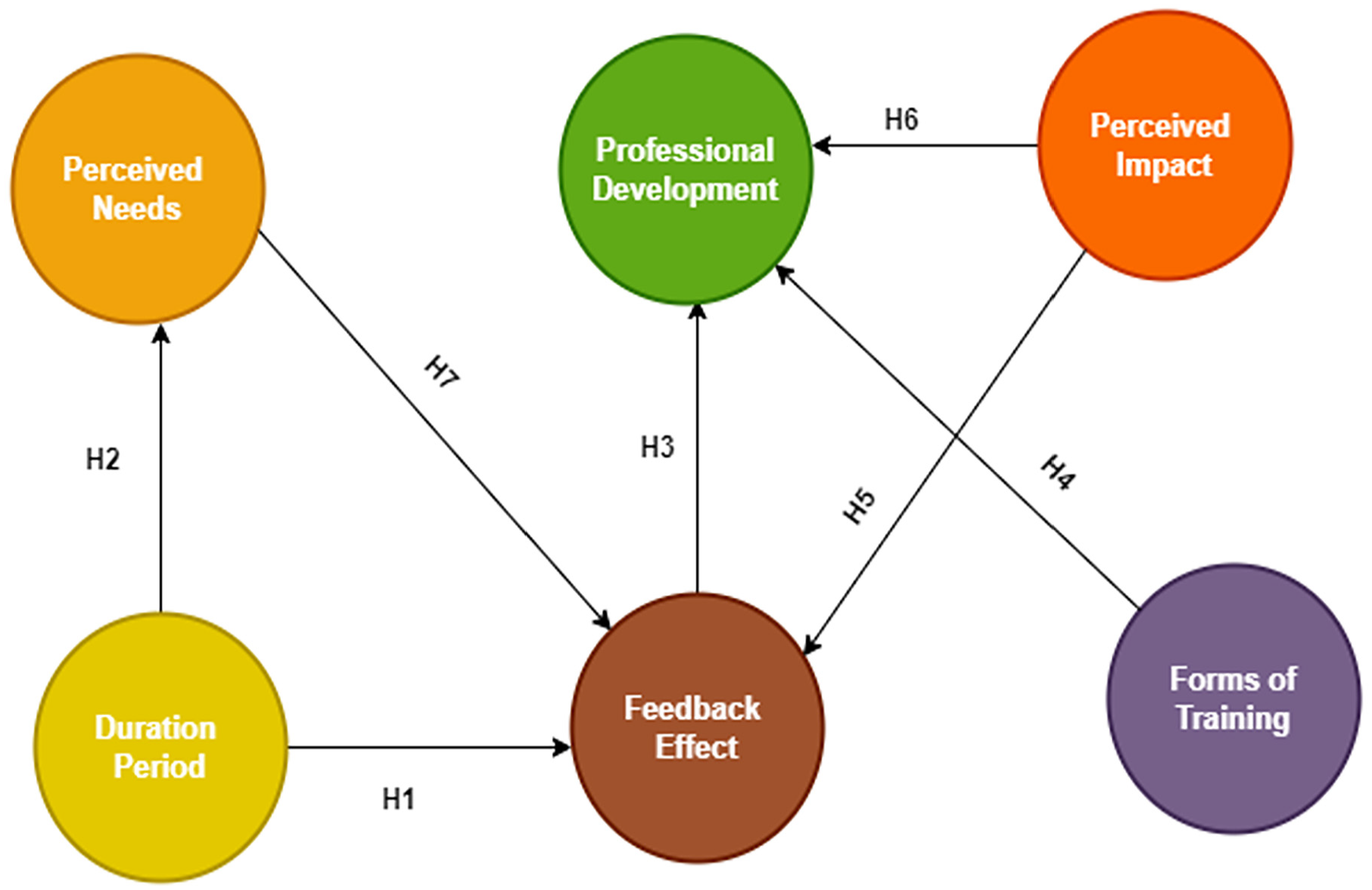
Research framework.
Methodology
Participants
The population consisted of senior high schools (SHS) in the Central Region of Ghana. The researchers used purposive sampling to select the respondents from the sample size. These teachers were chosen because they know PD training and are familiar with PD training activities. A well-structured questionnaire of 500 was distributed to the teachers in various SHS schools. On the other hand (n = 400) teachers completed the questionnaire, indicating a higher response rate of 80%. Self-administered questionnaires approach was employed to collect the data for this research analysis. The participants of this research survey were designated using the random sampling approach. The simple random method has been widely utilized in previous research, and the simple random method has proven to provide excellent and reliable outcomes (Anwar et al., 2020; Hassan et al., 2021). In strategizing for data administration, permission was sought from the Headteachers whose schools were used. The researchers administered the questionnaire; hence there was no need to train any persons during this research. After this interaction, questionnaires were distributed, and explanations were given regarding how respondents answered individual items. The study’s participants were assured that their responses would be treated with the utmost confidentiality. This study does not require ethical approval because it does not involve any clinical or animal experiments. In addition, the research data was collected anonymously, and the respondents answered the questions voluntarily.
Instruments
The research questionnaire was structured into three parts. The first section was primarily concerned with teacher demographic information. The second section consisted of a 5-point Likert Scale with 25 closed-ended questions, lettered A to F into six parts. The first Section A on Professional Development (PD1–PD5) and focused section B questions also analyzed on Professional Needs of teachers (PN1–PN5). Section C centred on preferred Forms of Training (FT1–FT5). Duration Period (DP-DP4) for different forms of professional development constituted the fourth Section (D). Perceived Impact (IM1–IM3) of PD was also investigated with the question from section E on the questionnaire, and the last section F questions also analyzed the Feedback Effect (FE1–FE3) on PD. Items used to measure the questionnaire were selected from the research by Badri et al. (2017), Goe et al. (2012), Saleem et al. (2021), Shernoff et al. (2018), and Tuytens and Devos (2017).
Data Analytical Approach
We utilized the partial least square-structural equation model (PLS-SEM, Smart PLS 3.0). Hair et al. (2019) suggested that this approach is generally the more prevalent and validated proposed framework for evaluation. PLS-SEM is a non-parametric statistical technique used to create a latent variable or factor models. These parameters were chosen to maximize the covariance between the scores of an independent variable and a dependent variable. The main reason for selecting PLS-SEM as an appropriate method for this study is that it provides the best assessment, resulting in detailed studies (Agyeman et al., 2021; Cai et al., 2021; Sampene et al., 2021). The reliability analysis was done on (professional needs, professional development, form of training, duration period, perceived impact, and feedback) to evaluate the degree of internal consistency among the multiple factors in the study. Many studies have used PLS-SEM as a measurement tool to analyze the reliability of various variables in a construct (Agyeman et al., 2021; Cai et al., 2021; Sampene et al., 2021).
Results
Descriptive Analysis
The descriptive statistics of the selected sample of the study indicated that 285 (n = 285) were males, and 115 (n = 115) were females, as shown in Table 1. According to the Ghana Statistical Service, the male superiority over females may be because the number of females employed in the formal sector in Ghana is less than the number of males (Boateng, 2017). The maximum age of the sample of the selected teachers for the study was 40 years, with a minimum age of 24 years. Most teachers’ academic qualifications show that several of them have acquired a bachelor’s degree with 46%. Concerning the professional qualification of the respondent, most teachers have a bachelor’s degree; the study’s findings show that most SHS teachers are legitimately and sufficiently trained to handle classroom instruction.
Descriptive Statistics of Respondents.

The respondents’ responses indicate that (82%) of the teachers opted for a “Yes,” which means they have gone through some PD activities. On the other hand, (18%) of respondents said “No,” meaning they had not undergone any professional training. The teaching experiences of the respondents reveal that many of them have spent nearly 6 to 10 years in the classroom. Because of their years of experience in the field, most teachers can teach and give incisive instruction to students. In Ghana, it’s a prerequisite for teachers to pass the Ghana Teacher Licensure Examination (GTLE) before being conferred as professional teachers. This paper sought to determine the percentage of teachers who participated in this exam. Out of the 400 respondents, the results indicate that only 16% have taken part in the GTLE.
Measurement Model Assessment
Reliability and Validity
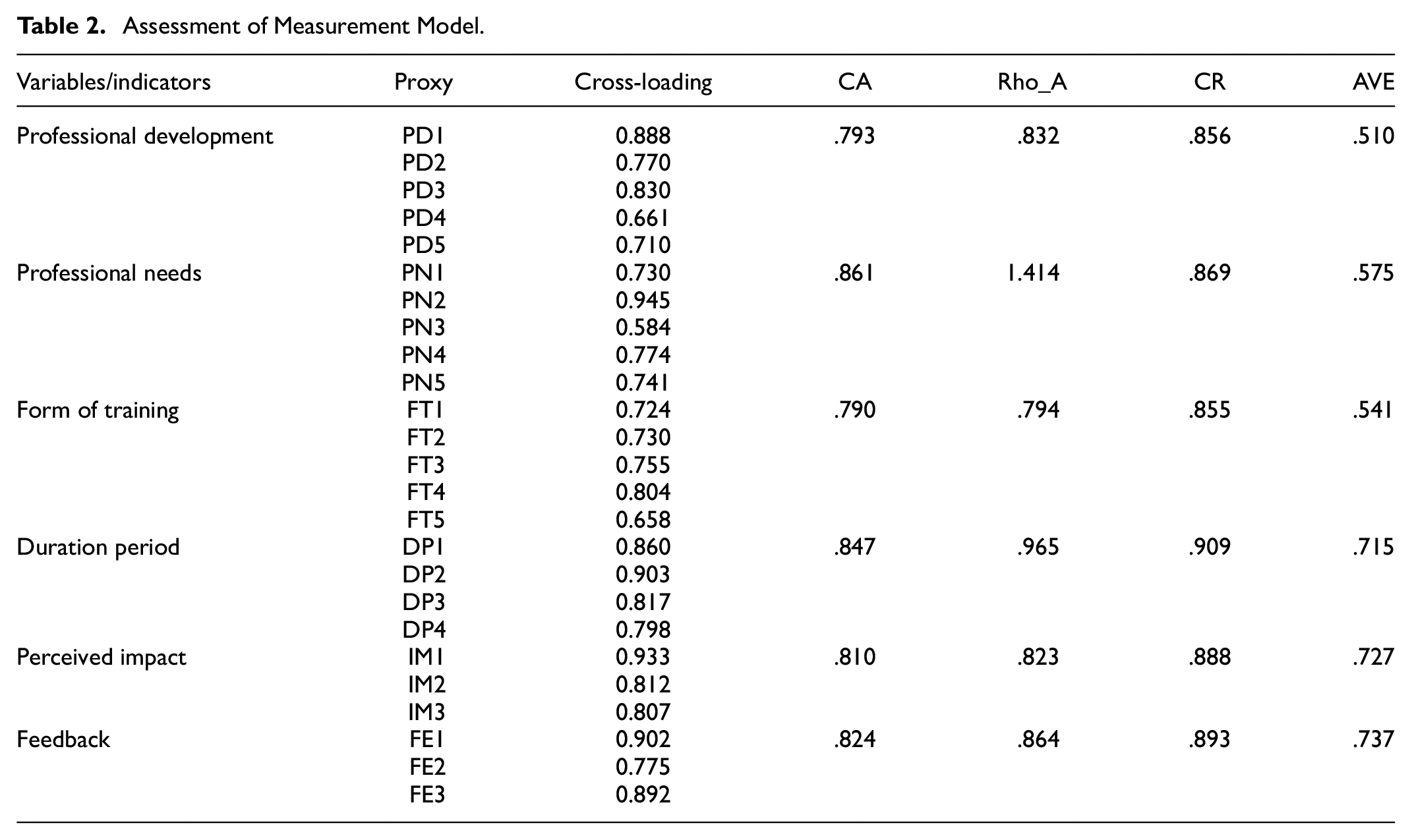
Reliability is the degree of openness of a measurement scale devoid of mistakes and thus yields consistent outcomes. The reliability of this research was assessed with the aid of Cronbach’s alpha (CA) and composite reliability (CR) as shown in Table 2. Each measure of CA surpasses the lowest value of .70, whereas all CR constructs are higher than the threshold of .70 (Hair et al., 2019). Likewise, validity denotes how a measurement scale evaluates the construct intended to assess. Therefore, Table 3 depicts that CA, CR, Rho_A, and all constructs were greater than .70, indicating satisfactory reliability and validity. The construct’s reliability and validity include professional development .793, professional needs .861, form of training .790, duration period .8474, perceived impact .810, and Feedback .824. The study, hence, meets the reliability and validity standard criteria for the entire distinct items chosen for this study (Agyeman et al., 2021; Cai et al., 2022). The potential structure of each average extracted variance (AVE) should be ascertained to validate the factors’ inner consistency (Hair et al., 2019). The AVE must be higher than .50 for the entire construct. Thus, from Table 3, AVE ranges from .510 to .737, signifying that the average extracted variance has surpassed the critical value of .50, and convergent reliability, validity and correctness are attained.
Assessment of Measurement Model.
Discriminate Validity (Fornell-Larcker Criterial).

Assessing reflective measurement model
Discriminate validity (Fornell-Larcker Criterial)
According to Hair et al. (2020), the manifest variable of any construct differs from other constructs in the path model because the cross-load value of that structure is greater in the latent variable than that of any other construct. The Fornell and Larcker (1981) criterion assessed discriminant validity. According to the proposed standard, a framework should not exceed its AVE value in the same variance as any other structure. The criterion test for Fornell and Larcker in the model, shown in Table 3, compared squared correlations to other latent constructs. This demonstrated that the measurement items revealed the latent variable, confirming that the model was discriminant valid in all structures.
Heterotrait-Monotrait Ratio (HTMT)
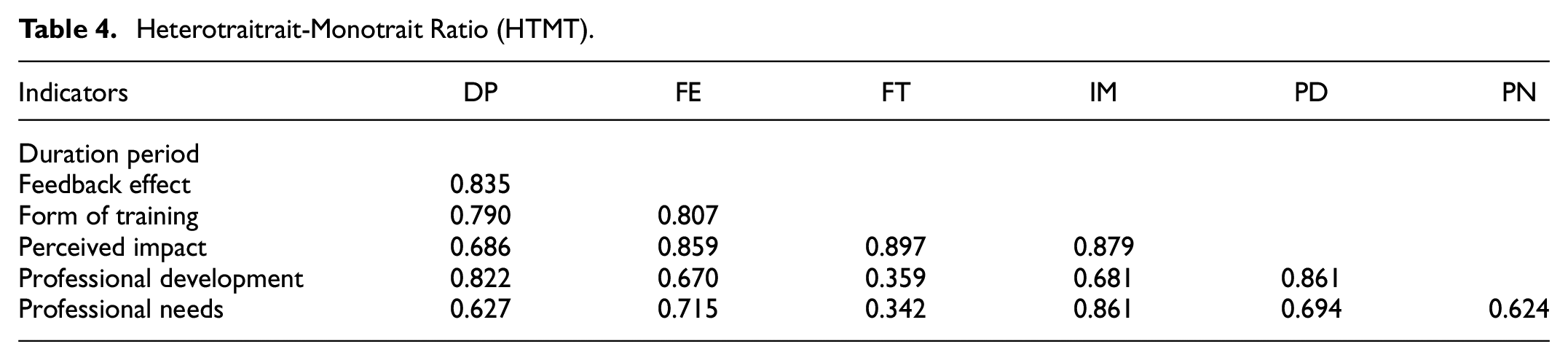
HTMT is yet another vital method for examining the multicollinearity and validity of a model such as SEM-PLS. The HTMT ratio evaluates the attribute of correlations in the model; as stated by Fornell and Larcker (1981), if the HTMT value exceeds 0.90, then discrimination shall not be applied. Thus, the HTMT ratio must not exceed 0.90 as demonstrated in Table 4 (Hair et al., 2019). From Table 5, the outcomes supported all the standard principles established by the earlier scholars. Hence, the results demonstrate the HTMT discriminant level approval within this research since all the construct values are below 0.9.
Heterotraitrait-Monotrait Ratio (HTMT).
Hypothesis Testing Results.

Hypothesis Testing
The path co-efficient results are achieved by assessing the structural model. In this study, we employed a resampling bootstrap technique to obtain the T-statistics and original means (β) in the PLS-SEM approach. The data was processed using 5,000 bootstrapped samples in this investigation (Hair et al., 2012). The seven hypotheses’ path coefficients and the p-value are between .000 and .05, as shown in Table 5 and Figure 2.

Final model with parameter estimates.
Our research H1 empirical outcome shows that the relation between the duration period and the feedback effect was significant. It had an initial sample ((β) = −.114, statistics (t) = (3.175), and a significant p = .002), indicating that the duration time has a positive relationship with the feedback effect. The present study hypothesis 2 focused on the impact of the duration period on teachers’ professional needs. The findings show that professional needs ((β) = .425, statistics (t) = 9.249, and p = .000) have a direct effect on professional teacher needs. Moreover, our results show in H3 that feedback effect ((β) = −.231, statistics (t) = 2.143, p = .0033) has a direct and significant association with PD. Concerning our H4, the study analysis revealed that the form of training ((β) = .236, statistics (t) = 5.198, p = .000) has a direct and positive interplay with PD.
The correlation between professional development and the form of training was significant, confirming H5. It had an initial sample (β) = .236, statistics (t) = 5.198, p = .000. The association between perceived impact and feedback effect was also positively significant in this study. It had an initial sample (β)) = .707, statistics (t) = 14.552, and a significant p = .000, confirming H6. The correlation between perceived impact and professional development was realized to be significant. It had an initial sample (β) = .754, statistics (t) = 8.800, p = .000, confirming H6. Lastly, the connection between professional needs and the feedback effect was significant. It had an initial sample (β) = .338, statistics (t) = 6.861, and a significant p = .000, confirming H7. To sum up, the above analysis indicates that all the research hypothesis was supported. In the next section, we provide a discussion to support this empirical outcome in the current study.
Discussion
This study aimed to examine Senior High School teachers’ preference for professional development: a case study in the Central Region of Ghana under the current FSHS policy. Descriptive statistics from the teachers’ response indicate that out of the 400 respondents, the maximum and minimum age was 40 and 24 years, respectively. Also, most teachers’ academic qualifications show that several have acquired a bachelor’s degree with a 46%. The Education Act 2008 (Act 778), Section 9, mandates the Ghana National Teaching Council (GNTC) to strengthen teachers’ professional standing and status and ensure teacher licensing and registration in Ghana. Ghana Teacher Licensure Examination (GTLE) seeks to help eligible teachers obtain a professional license and plan to meet the NTC Standards’ requirements. GTLE will provide teachers with the bare minimum of expertise, skills, values, and attitudes required to deliver successful instruction in the classroom (Mensah et al., 2020). Hence, the researchers investigated the number of teachers who have partaken in the Ghana Licensure Examination (GTLE). The analysis portrays that out of the 400 respondents, only 16% have participated in the GTLE since its implementation in 2018.
Regarding our research, H1 indicates that the duration period positively correlates to the feedback effect. Thus, our study results revealed that teachers’ time during PD activities significantly influences feedback in Ghana. If teachers have enough to learn different pedagogies and methodologies, it can impact their quality and delivery. Thus, rather than brief, one-time sessions, successful PD programs usually engage teachers in learning over weeks, months, or even academic years. Our study results align with extant research that revealed that teachers’ duration period at PD programs significantly impacts their feedback effect (Cordingley et al., 2015; Postholm, 2018; Sims & Fletcher-Wood, 2021).
To analyze the effect of the duration period on professional needs, H2 indicated that the duration period would be positively related to professional requirements. These results imply that the number of time teachers spends during PD activities affects the teacher’s professional needs. This indicated that if teachers spend more time during these programs, it can help meet their needs, motivation, and plans. Lesser time spent will not yield better results which may affect the effectiveness of the teaching and learning process. To help students master complex material, problem-solving, effective communication and collaboration, and self-direction, teachers must use a more advanced teaching technique. Teachers must complete good PD to learn and improve the pedagogies needed to teach these skills. Professional development allows teachers to experiment with new ideas that can help them improve their practice, learn, and reflect. These findings usually inspire teachers to pursue a one-time workshop during weeks, months, or even academic years as part of their professional development initiatives. This result agrees with a study conducted by Darling-Hammond et al. (2017), Lockee (2021), and Nemati and Mousazadeh (2021).
Moreover, our empirical findings suggested that the feedback was positively associated with professional development. PD, when organized promptly, will improve teacher experience, which will affect their feedback effect on learners. Feedback is an essential tool in developing programs for teacher professional development. Teachers will be given feedback to review lesson plans and explain lessons, which will allow them to focus on what can be refined or retained and strengthened. This exciting outcome expands on existing literature that concluded that the feedback effect influences teacher PD (Boud & Dawson, 2023; Hilton et al., 2015; Prilop et al., 2021).
In this research, it was suggested in our hypothesis 4 that the form of training positively impacted PD. These results are that the form of PD that teachers engage in is essential, which helps support quality delivery and outcome from students. It can also be contended that the collaborative approach to professional learning extends beyond formal PD programs provided by institutes or professional organizations to various forms of self-directed professional learning by teachers (Tran & Pasura, 2021). Hence, we suggest that PD forms focus on these core principles; provide support for specific instructional approaches in particular subject areas, create opportunities for active learning, and provide support for teacher-student work-embedded cooperation (Darling-Hammond et al., 2017).
Regarding H5, the outcome from the survey shows that perceived impact is positively and significantly related to the feedback effect. Teachers need PD to impact their delivery and mastery of content. A significant influence from perceived impact to feedback effect might show that SHS teachers need to participate in PD programs that are well structured to meet the specific needs of the teachers. The results show that the feedback effect significantly influences the perceived impact of teacher PD in Ghanaian SHS. This result agrees with these studies (Bamber & Mourshed, 2007; Paulo et al., 2012). Teachers can use built-in time in high-quality professional learning to study, receive input, and improve their practice through reflection and soliciting feedback. When reviewing lesson plans, presentation lessons, or videos of a teacher teaching, teachers can provide input, allowing for reflection on what can be improved or retained and reinforced (Darling-Hammond et al., 2017). The Ghana Education Service and policymakers should focus on the value of assessment and feedback systems to improve teacher motivation and professional development in all Ghanaian secondary schools.
In this paper, H6 was constructed that perceived impact has a significant and positive effect on PD. Teachers’ expectations for professional growth should align with the school’s overall strategic and tactical goals. Teacher PD should also be balanced and coordinated with school evaluation and feedback systems. The perceived effect of PD, according to researchers, represents how carefully chosen programs are to respond to their perceived needs (Badri et al., 2017; Kennedy, 2016). Stoll et al. (2012) stated that PD and practice focusing would significantly impact the students’ progress. Teachers’ participation in PD activities has an impact on the organizational factor. The planned PD increases teachers’ knowledge and skills that align with organizational characteristics, indicating that PD and teaching practices positively connect.
Lastly, H7 of our study focused on the relationship between professional needs and feedback. Our results indicated that the professional needs of teachers influence the feedback effect has a positive association. This hypothesis was validated and found to be significant. This result supports previous research on professional development by encouraging teachers to learn, practice, adapt, and reflect on new ideas to improve their practice (Huda & Teh, 2018; Wei et al., 2009). As a result, teachers would be happier with their work if the PD policies or framework accommodated their interests (Saeed & Asghar, 2012).
Policy Recommendation
Based on this study’s findings, we recommend the following policies for the successful and effective implementation of PD programs; first, policymakers consider developing successful strategies to promote teachers’ engagement and ensure their correct understanding of the requirements to address PD needs effectively. Teachers, for instance, should use their perceived professional development needs to fulfil the broader strategic and tactical goals in the development of learners. Secondly, teachers’ PD should be coordinated and incorporated with school evaluation and feedback processes. Thirdly, structuring each PD program with precise critical goals regarding expected outcomes could be an impressive strategy. Fourthly, we suggest that teachers’ routine and comprehensive needs evaluation is required. The actual conditions, desires, and the interest of the teachers needed for PD of each teacher should be carefully considered during the policy implementation stage. Teachers’ PD plans should be focused on the teachers’ assessment needs. Fifthly, active PD participants can be rewarded with incentives, used as a performance assessment criterion and compensation. Lastly, there is also a critical need for planned professional development programs to be thoroughly assessed. Consistent reviews and assessments should be tailored to provide helpful feedback to enhance further studies.
Conclusion and Further Studies
The primary contribution of this research focuses on analyzing SHS teachers in the Central region of Ghana’s preference for professional development. Senior High School teachers’ preference for professional development is the driving factor for Ghana’s educational enhancement and future development. More specifically, we analyzed the impact of variables such as professional needs, form of training, duration period, perceived impact, and feedback effect on teacher professional development (PD). The present research reached the following conclusion, which expands knowledge and research on teacher professional development from emerging countries’ perspectives: (1) We found out that the duration period of PD training significantly affects teacher feedback and professional needs. (2) Feedback effect from teachers has a significant effect on PD. (3) The form of training that teachers receive has a direct effect on PD. (4) Perceived impact influences feedback effect and PD. (5) Teachers’ professional needs impact their feedback effect.
As educationalists, policymakers, and stakeholders are still finding better ways to implement PD programs that can help improve education in Ghana, the present research has provided empirical results that explain some key concepts that can help address this issue. The investigation can conclude that for a PD program to achieve its intended objective, it is imperative to factor in duration period, form of training, perceived impact, professional needs, and feedback mechanism to monitor the progress. Moreover, we believe that this study will serve as reference material that policymakers and PD planners can utilize to help increase teachers’ quality and efficiency in emerging nations like Ghana.
The researchers intend to extend this study by focusing on a comprehensive analysis of students’ perceptions of teaching models. This approach will allow the assessment of the impact of teachers’ PD programs on learners’ development or achievement. Moreover, future studies aim to increase the number of respondents; thus, the study could be extended to five or more regions of Ghana to determine varying characteristics and feedback. Based on the implications of this study, the authors intend to broaden the investigations further to include the stakeholders in the education sector and the government to improve teachers’ professional development.
Footnotes
Author Contributions
Conceptualization, Supervision: Zhiqiang Ma; Writing-review and Methodology: Fredrick Oteng Agyeman; Formal Analysis, Study design: Agyemang Kwasi Sampene; Software: Mingxing Li; and Acquisition of Data: Stephen Botchway.
Declaration of Conflicting Interests
The author(s) declared no potential conflicts of interest with respect to the research, authorship, and/or publication of this article.
Funding
The author(s) disclosed receipt of the following financial support for the research, authorship, and/or publication of this article: This study is supported by the National Natural Science Foundation of China grant number [71974082].
