




Abstract
The COVID-19 pandemic has created a more stressful and uncertain work environments, disrupting personal and organizational lives, and particularly the impact of this crises on health care professionals (i.e., doctors and nurses) is unprecedented. COVID-19 has increased the workload and job risks for frontline health care professionals, causing them significant emotional stress. In such testing times, individual’s personal effectiveness ensued by the utilization of one’s personal energy may be helpful in not only ensuring wellbeing but also providing other desired results, for example, enhanced performance. Based on this notion, we conducted a study (amidst the third wave in mid-2021) using a multi-wave design to investigate the role of professional self-efficacy of health care professionals in well-being and behavioral outcomes during crises of COVID-19. The hypothesized relationships were tested by collecting data from 361 frontline healthcare professionals dealing with COVID-19 patients in hospitals in Northern part of Pakistan. The study results verified our assumed relationships and revealed that health care workers’ professional self-efficacy was positively related to their well-being, in terms of workplace thriving, and it also showed positive association with work role performance. In addition, the results of the study also revealed that perceived strengths use mediated the relationship between professional self-efficacy and outcomes. This study discusses implications, limitations, and future directions in detail, including how the findings can be used to inform interventions and support healthcare professionals dealing with the emotional and professional stresses brought on by the pandemic.
Keywords
Introduction
At times employees in organizations experience adverse situations that negatively influence their capacity to perform the assigned tasks (Hobfoll, 1989; McCarthy et al., 2016) and also have implications for their health-related issues (Ahmed & Sifat, 2021; Judge et al., 2007; Tang et al., 2001). Therefore, it is of paramount significance to identify personal factors and motivational mechanisms that may facilitate individuals in coping with such situations. Prior research mentions that employees’ personal resources might be instrumental in helping them counter hard conditions and perform well in the face of adversity (De Clercq & Belausteguigoitia, 2017). We argue that self-efficacy—an individual’s optimistic perception of one’s abilities to cope with challenging situations (Bandura, 1978), is a useful personal resource that might enable employees in encountering challenging situations (Parker, 1998).
Self-efficacy has reportedly been associated with multiple individual-level beneficial outcomes such as showing enhanced confidence, managing stress-related situations, and job engagement etc. (Albrecht & Marty, 2020; De Clercq et al., 2018). Self-efficacy can be instrumental in rescuing employees by working as a shield during difficult circumstances and channelizing individuals’ abilities to successfully execute tasks (De Clercq et al., 2018). The key role of self-efficacy in facilitating employees regardless of the circumstance may be explained by the perspective that employees’ personal resources can leverage to compensate for the resource-depleting effects offered by challenging situations (De Clercq et al., 2018). Furthermore, individuals with self-efficacy have positive cognitive processes which motivate them for setting higher goals and thus investing their physical, cognitive, and emotional resources into job roles (Zhu et al., 2019).
Self-efficacy reflects employees’ optimistic beliefs about their capacity to effectively perform the task (Bandura, 1997) and represents key motivational cognitions that may encourage employees to make full use of their strengths and contribute productively at the workplace and thrive (Zhu et al., 2019). Previous research supports the notion that self-efficacy affectively enhances employee performance (De Clercq et al., 2018; Judge et al., 2007), and induce employees thrive at work (Zhu et al., 2019) though little attention was paid to exploring the mechanisms underlining how self-efficacy may be instrumental in stimulating performance and ensuring thriving (De Clercq et al., 2018).
Conservation of Resource Theory
In our hypothesized study model, we argue that self-efficacy is positively associated with performance and a sense of thriving at work—vitality and learning (Porath et al., 2012), and we believe that this relationship is channelized through the mechanism of strength use. We use the conservation of resource theory to explain the relationship between self-efficacy and work-related outcomes, that is, performance and thriving, as well as the role of strength use in the process. The theory highlights the significant approach of “resource gain” (Hobfoll, 1989, 2001), because its role in the use of abilities to perform tasks corresponds to meeting organizational expectations. In that, the gain of personal resources inherently establishes a motivating effect, which encourages individuals to enhance performance and obtain a sense of vitality and learning.
We further draw from the conservation of resource theory (Hobfoll, 1989), to argue that there is an understudied reason why self-efficacy may prompt strength use to subsequently enhance performance and significantly influence thriving at work. We opine that the resultant accelerated expectations about one’s abilities due to self-efficacy to be perfectly competent in performing the assigned task (Bandura, 1997), encourages one to take initiative and use strength with intent to avail the opportunity of gaining further resources. Strength use reflects the initiative that employees may take to use their strengths (van Woerkom, Mostert, et al., 2016) and achieve required job expectations. Previous research examined how self-efficacy may be affected by the display of strength use (Ding & Chu, 2020), leaving a research question to ponder and investigate whether reverse causation may be possible (Bakker & van Woerkom, 2018). Using the conservation of resource theory, we opine that self-efficacy encourages individuals to apply strength use in the quest of acquiring further resources thus contribute to performance and thriving (Hobfoll, 2001).
Context of the Study
Applied psychology has long been involved in investigating factors associated with individuals’ job performance and well-being in times of crisis (Hogan, 2020; Lindström & Giordano, 2016). The recent global pandemic COVID-19 provided a case study regarding the importance and relevance of this topic, particularly for healthcare professionals, that is, doctors and nurses (Yi-Feng Chen et al., 2021). Given the COVID-19 troubling situation, health professionals treating COVID-19 patients were prone to different hazards and thus required personal resources to gear up their performance and well-being. Answering recent calls for identifying the role of individual differences (Yi-Feng Chen et al., 2021), this study aims to explore how individuals’ professional self-efficacy enabled work role performance and well-being using healthcare professionals fighting the COVID-19 menace as a special context.
Notably, healthcare workers were not only courageously combating the pandemic (Misra, 2021) but also openly threatened with a messy environment and vague situations brought by this new crisis (Restubog et al., 2020). An increasing number of COVID-19 patients had increased the workload of healthcare professionals, and many had to perform additional tasks and responsibilities during the pandemic (Yi-Feng Chen et al., 2021). Because of inadequate expertise, many healthcare workers in fields other than respirational infections were instantly required to focus their emphasis on treating and handling COVID-19 infected patients, confronting a serious threat of infection and high uncertainty (Liu et al., 2020). Feat in the face of challenging and unclear situations demands more self-efficacious individuals who can perceive crises as challenges while maintaining adequate psychological well-being.
Accordingly, this study draws from the psychological theory of self-efficacy (Bandura, 1986) to examine how self-efficacious individuals help face such unprecedented situations. We then employed the conservation of resource theory (Hobfoll, 1989; Hobfoll et al., 2018) to understand better how self-efficacious individuals contribute to work role performance and well-being in this context.
More specifically, resources are valued psychological, social or organizational features of any job or aspects of the individuals that can help the employees’ personal growth, ensure goal achievement, and improve their well-being. Conservation of resource theory is based on the view that individuals tend to guard their existing resources and acquire further resources (Hobfoll et al., 2018). It is likely that highly self-efficacious individuals will apply strength use to achieve favorable situations and end up getting positively influencing their well-being and work role performance outcomes.
Contributions
This research offers numerous essential contributions to the literature. First, this study theoretically hypothesizes and empirically tests a relationship between self-efficacy and strength use. Previous research has provided empirical evidence by demonstrating that strength use—as a personal resource—predicts self-efficacy (De Clercq et al., 2018), leaving question unanswered if a reverse causation between the duo is also possible. Thus, to address the urge of conducting field studies in an organizational context to provide casual explanation (Bakker & van Woerkom, 2018) this study draws from conservation of resource theory and argue that self-efficacy belief motivates individuals to prepare for a tradeoff to gaining further resources which is executed in the shape of strength use.
Second, following the recent call for exploring further mediating mechanisms associated with self-efficacy (De Clercq et al., 2018), this study contributes to literature by investigating how self-efficacy leads to higher performance and enhance workplace thriving through strength use. In line with the conservation of resource theory (Hobfoll et al., 2018), we argue that individuals with self-efficacy utilize personal resource in the shape of strength use to preserve and gain resources, that is, expending resources in the quest of gaining more resources (Demerouti et al., 2004; Xanthopoulou et al., 2009) thus showing better performance and enhancing conditions for thriving.
Third, the next contribution is pertinent to the context in which this study was conducted. It is observed that the primary emphasis of previous studies conducted examining the association between self-efficacy and performance was on studying the phenomenon in non-pandemic situations or stable working environments. It is less known how individuals will react if they face challenging problems and find circumstances beyond their perceived capabilities (Stajkovic & Luthans, 1998). It was observed that the healthcare professionals treating COVID-19 patients remained more prone to receiving negative outcomes (Menon & Padhy, 2020) and transferred stress than their counterparts working in other sectors or industries (Menon & Padhy, 2020) due to the direct and frequent contact with the COVID-19 patients (Charoensukmongkol & Phungsoonthorn, 2020; Prime et al., 2020). Thus, it was significant to investigate self-efficacy’s (see Hou et al., 2020; Shoji et al., 2016) role in influencing healthcare workers’ performance during this crisis. Finally, this study extends research on strengths use and its relationship with self-efficacy, work role performance, and workplace thriving.
Theory and Hypotheses Development
Professional Self-Efficacy, Work, and Well-Being Outcomes
Self-efficacy has been defined as an individual’s belief in personal mastery, and perceived self-efficacy plays a key role in the self-regulation of motivation (Bandura, 2001). As self-efficacy explains how individuals perceive themselves as capable of overcoming the challenging situation, we are considering individual’s perception of self-efficacy at work, that is, professional self-efficacy (a specific kind of work-related self-efficacy), which refers to individuals’ confidence and belief to perform tasks, challenges, and stress related to his/her profession (Sun et al., 2020). Individuals with higher professional self-efficacy have higher motivation to face profession-related problems (Guo et al., 2017). With the COVID-19 crisis professional responsibilities are doubled, which resultantly increases stress and uncertainties (Charoensukmongkol & Phungsoonthorn, 2020). Since self-efficacy is presented in the literature as a protective factor which helps in coping with stressful situations (Kong et al., 2021), and there is a general belief that people with high self-efficacy can cope with stressors confidently (Bandura, 2001), we extend the view to argue that professional self-efficacy has enough potential as a predictor to facilitate individuals in positively influencing work-related outcomes.
In general, prior studies have revealed that self-efficacy induces a wide range of favorable outcomes, including performance (e.g., Judge et al., 2007; Stajkovic & Luthans, 1998). We relied on the conservation of resource theory to explain how self-efficacy may be positively associated with performance. As this theory explicate that individuals are always looking for preserving their resources and willing to do adjustments; in this case, employees who has belief of having sufficient ability to culminate the assigned task, hence, would invest their available resources in the hope of gaining more resources (Hobfoll et al., 2000). Thus, the belief of having control over their work and hope of getting desirable results to improve their current job situation would motivate employees to benefit from their self-efficacy and show enhancement at performance. The same relationship has been empirically tested by previous studies (see De Clercq et al., 2018; Judge et al., 2007; Stajkovic & Luthans, 1998); hence we hypothesize as follow:
H1: Professional self-efficacy is positively related to employees’ work role performance.
Furthermore, it is widely believed that individuals high in self-efficacy are likely to provide better results with work-related outcomes because they are more confident about their capacities (Bernales-Turpo et al., 2022). This confidence is more likely to engender vitality – a feeling of energy that emanates from within one’s intentional actions (Ryan & Deci, 2000) and nurtures learning possibilities namely dimensions of workplace thriving (Walumbwa et al., 2018). In addition, a psychological resource (i.e., self-efficacy) can help stimulate job-related motivational processes such as workplace thriving (Hobfoll et al., 2018). Conversely, lacking resources can diminish the existing stock of resources as employees dwell on their deficiencies and failures (O’Leary & Ickovics, 1995). In this vein, prior studies (i.e., Demerouti et al., 2004; Xanthopoulou et al., 2009) also demonstrated that initial resource gains for individuals tend to lead to further resource gains and vice versa. These observations are also in parallel with the multilevel theory (Chen & Kanfer, 2006), which identifies individual-level factors (i.e., personality traits) as potential stimuli that arouse employees’ motivational processes (i.e., workplace thriving). Hence, we suggest a positive and significant relationship between employees’ self-efficacy and workplace thriving.
H2: Professional self-efficacy is positively linked to employees’ workplace thriving.
Strengths Use as a Mediator
Individual strengths refer to one’s capacities “for feeling, thinking, and behaving in a way that allows optimal functioning in the pursuit of valued outcomes” (Alex Linley et al., 2006, p. 88). Similarly, strengths are also defined as “characteristics of a person that allow them to perform well or at their personal best” (Wood et al., 2011, p. 15); and an individual’s potential to reach excellence (Biswas-Diener et al., 2011). When narrowed down an individual’s strengths definition in the work context, it is referred to as “the initiative that employees may take to use their strengths at work” (van Woerkom, Mostert, et al., 2016, p. 962).
We propose that strengths use could act as a key underlying process clarifying how self-efficacy individuals attain better performance and thriving, even in difficult situations (i.e., COVID-19 context). Notably, previously studies have demonstrated that strength use can successfully predict self-efficacy (see Ding & Chu, 2020), we hypothesize the reverse casual relationship to argue that individuals with beliefs of having optimistic opinion about their abilities may find it more stimulating to take initiative and apply their energy and strength. Taking insights from the conservation of resource theory, which states that individuals are always willing for a trade-off to preserve resources (Hobfoll et al., 2018). Individuals high on self-efficacy are expected to set high goals, likely to engage more in work and learning new things about their job (Ding & Chu, 2020), we argue that self-efficacious individuals would make extra efforts to perform well and obtain desirable results at the face of all odds by making use of their strength. Similarly, prior empirical evidence reveals that strengths use is linked to higher individual performance (Christian et al., 2011; van Woerkom, Mostert, et al., 2016), it is plausible that such individuals are more likely to achieve their work-related goals successfully (Moore et al., 2022; van Woerkom, Oerlemans, & Bakker, 2016). Based on the argumentation above, we, therefore, hypothesize the following:
H3: Professional self-efficacy is positively linked to employees’ work role performance through perceived strengths use.
Moreover, apart from stimulating performance, self-efficacy—as a dispositional resource—may help individuals in sustaining employees’ well-being in the presence of diverse conditions (De Clercq et al., 2018). In fact, uncertainties create unforeseen challenges for employees which effect their work as well as well-being (see Charoensukmongkol & Phungsoonthorn, 2020; Lee et al., 2023; Liu et al., 2020; Yi-Feng Chen et al., 2021). In this study, we hypothesize that self-efficacy may positively influence thriving at work through strength use. Previous research studies provide empirical evidence for the positive association between self-efficacy and thriving (Huang & Liu, 2022) by underlining that self-efficient individuals would set high goals thus it would require greater engagement in work and continuous efforts to learn new knowledge to attain these goals (Simbula et al., 2011).
The association between strength use and thriving can be explained by drawing from conservation of resource theory (Hobfoll et al., 2000). As explained by the theory, people are selective in the utilization of their resources which are deemed significant commodities and preserved at any cost. On the other hand, when people use their strength they develop feelings of having more energy available (Mahomed & Rothmann, 2020). Furthermore, strength use is intrinsically motivated therefore they use of strength serves basic psychological needs and often utilized for attaining personal goals, we believe strength use will eventually benefit employees in developing a sense of vitality and encourage in their pursuit of learning new knowledge and skills. Accordingly, the subsequent hypothesis is suggested (Figure 1):
H4: Professional self-efficacy is positively related to employees’ workplace thriving through perceived strengths use.
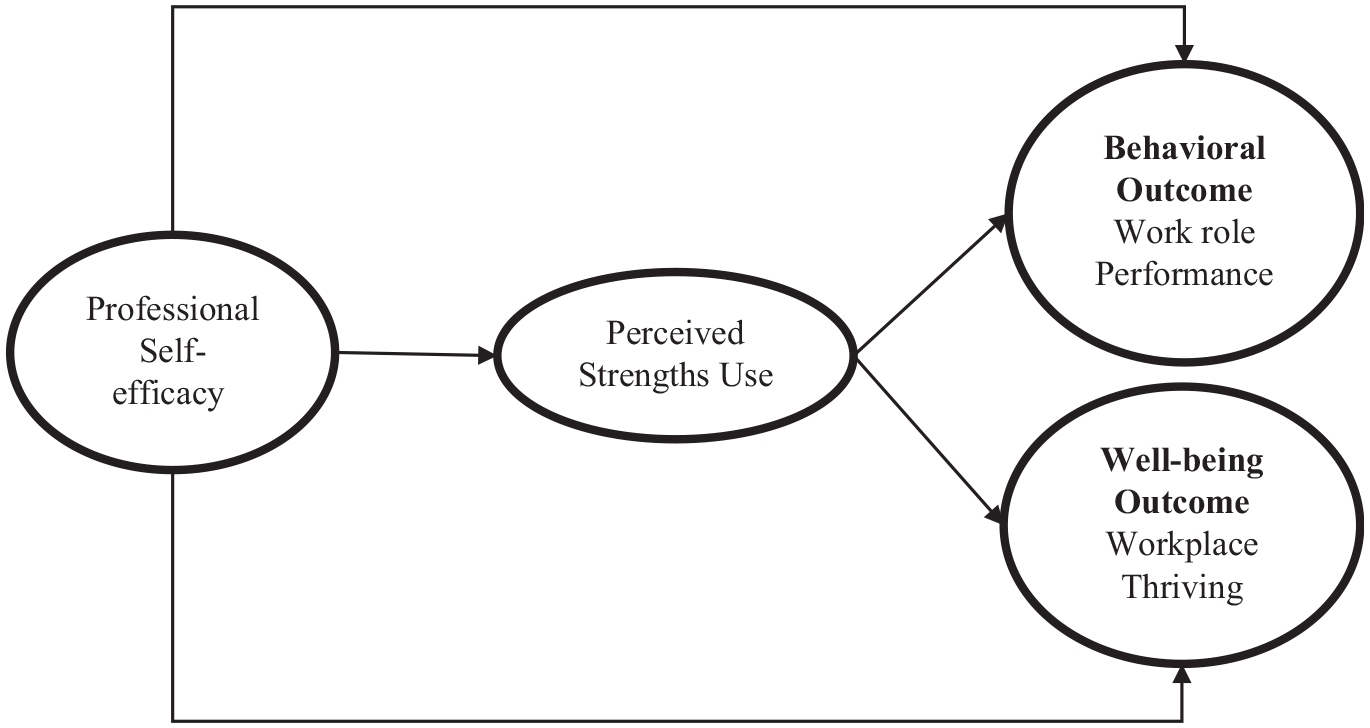
Conceptual framework.
Methodology
Sample and Procedures
The data were collected through nonprobability convenience sampling approach from hospitals in the Northern part of Pakistan. For the current study, we used convenience sampling technique to collect data. This techniques was chosen because it saves cost, time, and easy to use and allows the respondents voluntary participation. The previous literature (e.g., Asim et al., 2022; Song et al., 2018) have also used this technique for data collection in the area of organizational behavior. The target sample consisted of frontline staff including doctors and nurses who are healthcare professionals and directly deal with patients with COVID-19 infection. The preset criterion for inclusion in the sample was full-time employment in a workplace environment at the time of the study. Individuals working from home were excluded from the study. The study participants were based in three prominent hospitals in the central city of Khyber Pakhtunkhwa, Pakistan. Worldwide, frontline health professionals have regarded the coronavirus crisis as an extraordinarily stressful event (Pearman et al., 2021), making them an appropriate sample to examine our hypothesized model. Therefore, we contacted hospital administrators to help us collect data by getting the respondents’ emails. The confidentiality and anonymity of the interviewees are guaranteed, and the identity of the interviewees is promised not to be disclosed to the hospital management. Furthermore, we shared a consent along with an online questionnaire link to all the participants, including instructions to participate voluntarily in the study and withdraw at any stage.
According to Podsakoff et al. (2003), one approach for reducing for common method biases issue is to gather data with a time lag between the measurement of the predictor (i.e., independent) and outcome (i.e., dependent) variable. “An incorporate (i.e., more than two) waves of data with fairly short time lags” (Frone et al., 1997, p. 330) can explore the causal influence of one variable on another (Frone et al., 1997; Gollob & Reichardt, 1987). Therefore, this study conducted three waves of data collection to explore the causal impact (Bolino et al., 2015). Data collection took place from early November to late December 2020, a time at which Pakistan was experiencing the second wave of COVID-19. In the first phase, the participants provided information about their demographics and ranked the items of the independent variable. In the second phase, after 4 weeks, the respondents completed the responses to mediating variable, and finally, after 4 weeks in the third phase, the respondents responded about dependent variables.
We approached 671 employees namely health care workers working in the hospitals. Of these, 465(69.29% of the total) agreed to participate and answered the first phase of an online survey. Among those, 411 (61.25% of the total) participants responded in the second phase and 361 (53.80% of the total) in the final stage. The data were checked for missing values, and all the questionnaires were properly filled. Therefore, the data analysis was carried out on 361 samples. Among the 361 respondents, 40.8% were doctors, 59.2% were nurses, 42.5% were male, 48.8% were between 31 and 40 years old, 24.9% had a Master’s degree, and 36.1% had more than 5 years of work experience.
Measures
We used 7-point Likert Scale to assess professional self-efficacy, perceived strengths use, workplace thriving, and work role performance items from “strongly agree (7)” to “strongly disagree (1)”.
Professional Self-Efficacy
The professional self-efficacy scale was adapted from the study of Schwarzer (1999), including ten items. Two items are “During work, I can always manage to solve difficult problems if I try hard enough” and “During work, it is easy for me to stick to my aims and accomplish my goals”.
Perceived Strengths Use
Perceived strengths use was adapted from Keenan and Mostert (2013), including eight items. Sample items are “I use my strengths” and “I focus on what I am good at.”
Workplace Thriving
We appraised workplace thriving with a 10-item scale adapted from the study of Porath et al. (2012). Two items are “I find myself learning often” and “I feel alive and vital.”
Work Role Performance
The work role performance scale was adapted from Griffin et al. (2007), measured with nine items. The sample items included the sub-dimensions of proficiency “Carried out the core parts of my job well, “additivity” coped with changes to the way I have to do my core tasks, and “proactivity” come up with ideas to improve the way in which my core tasks are done.”
Control Variables
Previous studies have shown some influence of age, gender, education, and experience on study variables (Yi-Feng Chen et al., 2021). Therefore, we also controlled these variables in the present study to observe the actual effect of proposed predictors on outcome variables.
Data Analysis
Structural Equation Modeling was used to check the study’s direct and indirect relationships (Schumacker & Lomax, 2004). Previous studies (e.g., Schumacker & Lomax, 2004) suggested that SEM is a more acceptable and precise test than using simple sum scores since it corrects the measurements’ unreliability. Concerning absolute model fit, we followed the suggestions of Schumacker and Lomax (2004) and utilized four statistical indices: The χ2/df, CFI, the SRMR, and the RMSEA. SPSS V.22.0 and AMOS V.22.0 were used for data analysis. Moreover, the reliability and validity of the constructs have also been examined.
Results
Measurement Tests
Statistical remedies for CMB were used as suggested by Podsakoff et al. (2012). Firstly, we run the Harman (1976) single factor technique. The results exhibit that the first factor variance is 36.45% which is under 50%, and showing CMB is controlled. Second, none of the correlation coefficient is higher than of .90 which also less concern of CMB.
Further, the reliabilities and validities of the instruments suggested by Hair et al. (2010) and Fornell and Larcker (1981), were also assessed. The values of Cronbach’s alpha (.925 to .952), composite reliability (.927 to .952), average variance extracted (.572 to .691), and the factor loadings (.641 to .910) were satisfactory (see Table 1). Similarly, the values of factor loadings are above .70 and attained the threshold criteria of .60 for sufficient convergent validity of scales, as suggested by Hu and Bentler (1999). Finally, inter-correlations values were less than the AVE square root values, confirmed that the constructs are discriminately valid (see Table 2) (Fornell & Larcker, 1981).
Confirmatory Factor Analysis.

Note. CA = Cronbach’s alpha; CR = composite reliability; AVE = average variance extracted.
Means, Standard Deviations and Correlations Results.
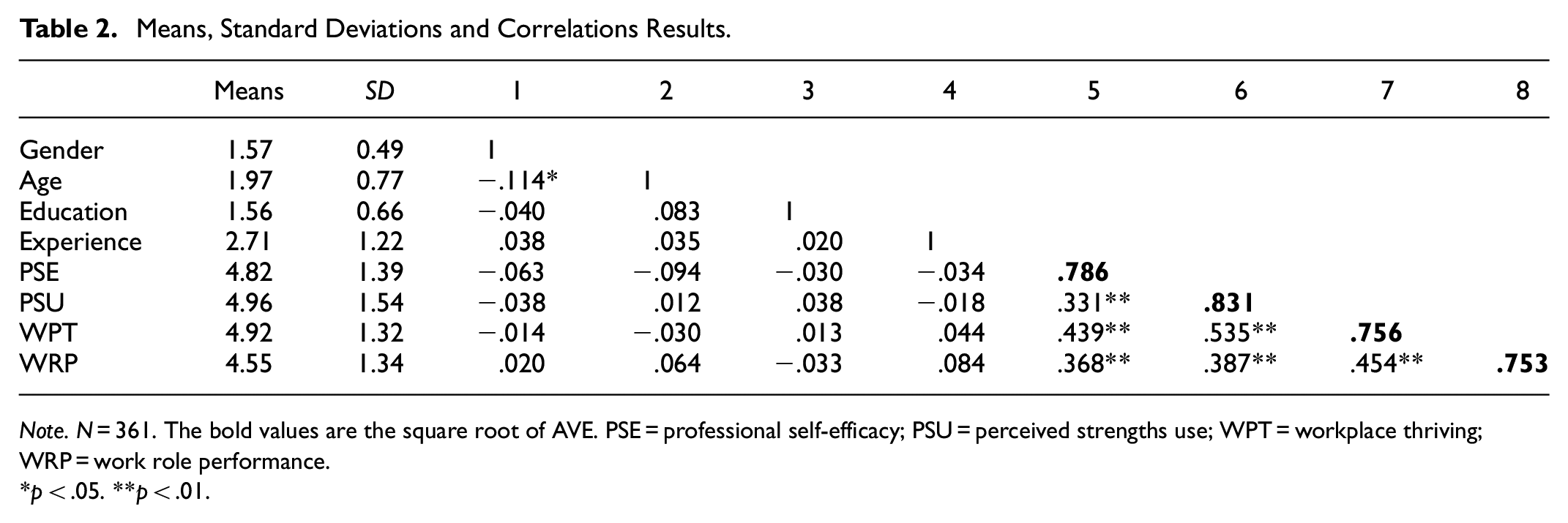
Note. N = 361. The bold values are the square root of AVE. PSE = professional self-efficacy; PSU = perceived strengths use; WPT = workplace thriving; WRP = work role performance.
p < .05. **p < .01.
Table 2 depicts the results of the correlations among the study variables and with respondent demographics. The findings revealed that all the association are in the expected directions. Table 2 also shows the association between respondents’ demographics and the study variables. The results show that none of the respondents’ demographic variable has significant relationship with the study variables. As of no meaningful relationship of the study demographics, therefore, demographics variables did not consider for further analysis. Also, we ran ANOVA (analysis of variance) to check the differences in the study variables regarding respondents’ demographics, and the result show non-significant difference in the study variables regarding demographics of the respondents. Moreover, the study of Becker (2005) and Usman et al. (2021) reported that in this situation the results are essentially equivalent with or without control variables. Therefore, we did not control respondents’ demographics in further analysis.
We have checked for the multicollinearity because of high correlation values among the study variables. To check the issue of multicollinearity, the variance inflation factor (VIF) test was used. The values of VIF for PSE, PSU, and WPT with WRB are 1.259, 1.425, and 1.560 respectively, which are less than 10, endorsing that multicollinearity is not an issue in the current study (Mason & Perreault, 1991).
Structural Equation Modelling and Hypotheses Testing
To run the hypothesized model, first measurement model was evaluated which has good fit as (χ2/df = 1,593.015/655 = 2.432, CFI = 0.920, SRMR = 0.051, and RMSEA = 0.063) suggested by Hu and Bentler (1999) and Hair et al. (2010).
Next, path model was analyzed and the model fitness indices were satisfactory as (χ2/df = 1,613.399/656 = 2.459, CFI = 0.919, SRMR = 0.062, and RMSEA = 0.064). After that the path model was evaluated (see Figure 2). The findings confirm the positive effect of professional self-efficacy on workplace thriving (β = .300, p < .01) and work role performance (β = .276, p < .01, hence H1 and H2 confirmed. To check the mediation’s effects (see Table 3), we calculated the bootstrap interval of the indirect effect of professional self-efficacy on workplace thriving and work role performance through perceived strengths use (β = .095, 95% Bootstrap Confidence Interval [0.052, 0.154], and (β = .114, 95% Bootstrap Confidence Interval [0.064, 0.190])). These intervals did not include 0, showing both the mediation effects are significant, thus, H3 and H4 were also confirmed.

Path model results.
Indirect Effects.

Note. PSE = professional self-efficacy; PSU = perceived strengths use; WPT = workplace thriving; WRP = work role performance.
Discussion
The COVID-19 pandemic has been a source of immense stress and uncertainty for healthcare workers worldwide. As frontline workers deal with extreme pressure, it takes a toll on their physical and mental health. This raises concerns about the well-being of healthcare professionals in times of crisis like the COVID-19 pandemic. Recent studies have explored professional self-efficacy as a factor that can mitigate this negative impact and results in numerous work outcomes (Chan et al., 2017; Judge et al., 2007).
The current study adds to the rising body of research by investigating the role of professional self-efficacy in affecting healthcare workers’ outcomes, considering the self-efficacy theory and the conservation of resources theory. The research found that greater levels of professional self-efficacy correlated with higher perceived strengths use. This effect served as an underlying mechanism between self-efficacy and employee outcomes, including workplace thriving and work-role performance. While previous studies have demonstrated a link between self-efficacy and favorable workplace outcomes, this research provided unique insights by considering perceived strengths use as key mediator in this relationship during times of crisis. These findings hold important implications for healthcare professionals, managers, and policymakers in mitigating COVID-19 pandemic-related stress and preventing adverse outcomes. The study suggests that healthcare organizations should prioritize the development of healthcare professionals’ self-efficacy with training programs that increase their sense of competence and confidence. Additionally, interventions that promote perceived strengths use are recommended, especially during crises, to support professionals’ well-being and performance. Ultimately, this can help improve the quality of care provided to patients.
Implications for Theory
First, the current study offers a more robust understanding of employees’ professional self-efficacy by investigating its critical role in dealing with crisis, uncertainties, and the mechanism involved. Scholars previously revealed self-efficacy as a protective factor while confronting stress in occupational contexts (Kong et al., 2021; Ventura et al., 2015). Also, Bandura (1997) noted that the primary application of self-efficacy theory has been in the work domain. However, little is known about applying professional self-efficacy in times of crisis, especially in the COVID-19 menace. Inconsistent with prior studies (e.g., Bargsted et al., 2019; Ventura et al., 2015), our findings show that professional self-efficacy is positively associated with employees’ work role performance and workplace thriving during the COVID-19 pandemic. Higher self-efficacy individuals see tasks challenging during the chaos-accompanying crisis by working in more self-concordant ways. The higher power of self-belief that “you can do it” helps self-efficacious individuals utilize their strengths and may provide a fundamental explanation for how self-efficacious employees distinguish themselves from others during challenging times.
Previously, scholars have underscored the negative implications for stressful life events such as the COVID-19 crisis on employee wellbeing (Charoensukmongkol & Phungsoonthorn, 2020; Prime et al., 2020) and observed interesting findings that self-efficacy mitigates the outcomes inflicted by the challenging work environment such as burn out and exhaustion etc. (see Shoji et al., 2016). Furthering our understanding of the recent findings that self-efficacy may be helpful in coping with the negative outcomes, that is, fatigue and posttraumatic stress disorder symptoms that healthcare professionals faced due to COVID-19 (Hou et al., 2020) psychological adjustment and sleep quality during pandemic (see Sun et al., 2021), there is a need to further investigates how self-efficacy may help with workplace thriving – a sense of vitality and learning (Spreitzer et al., 2012) and work-role performance at the face of challenging situations.
Further, this study also contributes to the conservation of resources theory. Our research theorizes self-efficacy as a personal psychological resource that adds to significant personal and professional goals in the perspective of healthcare workers combating COVID-19; and explicates how more of such unique resource (i.e., higher self-efficacy) enables more other resources such as perceived strengths use-a kind of job-related motivational resource (Yi-Feng Chen et al., 2021). This provides supportive confirmation for the aftermath of the conservation of resources view that resources can assist acquire and conserving other resources (Hobfoll, 1989; Hobfoll et al., 2018). In addition, this study offers novel insights into how the linkage between an individual’s professional self-efficacy and work-related outcomes is established through strengths use; thus, an individual’s personal resource needs extra motivational activation, that is, strengths use, to influence outcomes.
Implications for Healthcare Practitioners
COVID-19 pandemic has highlighted the significance and relevance of sound leadership approaches in times of crises (Sergent & Stajkovic, 2020; Usman et al., 2021). Also, empirical studies on self-efficacy in an occupational domain have revealed that self-efficacy is relevant to job stress (Ventura et al., 2015). Accordingly, this study has several notable implications for practicing health managers. The managers should nurture healthcare workers’ self-belief while combating challenging situations, knowing that professional self-efficacy is highly significant in predicting positive work and well-being outcomes in the COVID-19 pandemic context. Following Ouweneel et al. (2013) guidelines, managers could regularly implement positive psychology interventions that help foster healthcare workers’ self-efficacy. The role of professional self-efficacy as a critical predictor of work and well-being outcomes advocates the development of training programs to nurture self-efficacy beliefs at work. Well-established approaches exist to stimulate self-efficacy beliefs via its main sources (Bandura, 1972), for example, vicarious and mastery experience, and social persuasion, all of which have frequently revealed their effectiveness in work contexts (Bresó et al., 2011; Ouweneel et al., 2013). Moreover, it would also be helpful to enhance healthcare workers’ understanding and use of their strengths. In this regard, organizations can initiate leadership training programs to enable their leaders to recognize, develop, and leverage employee strengths effectively.
Limitations and Future Guidelines
This study has several limitations that demonstrate essential implications for further studies. Studying frontline healthcare workers (nurses & doctors) in the current pandemic is a strength of our study design. However, it equally limits the generalizability of the study findings. Hence, further studies may extend our results by considering other healthcare workers (i.e., paramedics & administrative staff who are equally exposed to the situation) and other organizational members. Furthermore, during the pandemic, healthcare professionals remain exposed to high-level demands and work-related stressors such as workload and job intensification. It would be useful to explore how self-efficacy helps these professionals cope with such conditions, given that individuals high in self-efficacy perceive demands as challenges.
In addition, our study only sought to examine the professional role of self-efficacy in predicting work and well-being outcomes during the pandemic. It would be interesting to investigate the role of some other important personnel dispositions while dealing with crises, for instance, Big-Five personality traits. Further, it is important to note that the findings of this study may have implications for other countries as well. However, it may be necessary to re-test the model in those countries, taking into account any cultural differences that may exist.
Another limitation of the study is the investigation of causal relationships through the survey method. This means that the relationship established between professional self-efficacy, perceived strengths of use, and outcome variables (work role performance and workplace thriving) needs to be carefully interpreted. Future research could consider and test the model through experimental research design to better understand the predictor influence on outcome variables and offer further confidence in our understanding to make causal inferences.
Conclusion
In light of the above-discussed findings, it can be concluded that professional self-efficacy plays a vital role in facilitating positive individual outcomes, especially during times of crisis like the COVID-19 pandemic. This study provides new insights into the critical relationship between professional self-efficacy, perceived strengths use, and employee outcomes, such as workplace thriving and work-role performance, through self-efficacy theory and conservation of resources theory. Based on the study’s results, it is recommended that healthcare organizations should prioritize the development of healthcare professionals’ self-efficacy by offering training programs that increase their confidence and competence. Moreover, interventions that promote perceived strengths use need to be implemented, specifically during crises, to support professionals’ well-being and performance, which ultimately results in improved quality of patient care. In summary, the present study extends prior research on how professional self-efficacy can affect individual outcomes during critical times. These findings have significant implications for health managers and policymakers, as they can use this research to support healthcare professionals effectively during times of crisis.
Footnotes
Declaration of Conflicting Interests
The author(s) declared no potential conflicts of interest with respect to the research, authorship, and/or publication of this article.
Funding
The author(s) disclosed receipt of the following financial support for the research, authorship, and/or publication of this article: National Social Science Fund, Research on the Roles and Empowerment of Middle and Senior Executives in Corporate Digitalization from the Perspective of Chief Information Officers (Project number: 22FGLB086). Fujian Social Science Fund, Research on the Impact of Enterprise Digital Human Resource Management System on Employee Behavior and Performance from the Perspective of Structured Theory (Project number: FJ2022B054).
Ethical Approval
This study has been approved by the Ethical Committee of Iqra University, Karachi, Pakistan.

Data Availability Statement
The data presented in this study are available on request from the corresponding author. The data are not publicly available due to measures to protect participant confidentiality.