




Abstract
Today, individuals should adapt themselves to the rapidly changing and developing information age and have learning skills. It is only possible by adopting new approaches and strategies instead of traditional teaching methods and techniques. Different learning and teaching approaches are characterized by various methods and designs, such as differentiated instruction. The primary purpose of differentiated instruction is to employ teaching activities depending on students’ learning styles and interests. This study aimed to determine the effect of learning style-based differentiated instructional activities on 4th-grade students’ academic achievement and learning retention in the social studies course. This study draws attention to the differences between differentiated teaching activities based on learning style and traditional teaching practices and proposes practical solutions for effective social studies teaching. In this study used a quasi-experimental model with pretest-posttest control group designs. The study group consisted of 62 4th-grade primary school students. The experimental group completed learning style-based differentiated instructional activities in the study, while traditional teaching methods were used in the control group. The data were collected with an academic achievement test and interview forms developed by the researchers. The quantitative data were analyzed using arithmetic means, frequency, independent group t-test, and dependent group t-test, and the qualitative data obtained from interviews were examined using descriptive and content analysis approaches. A significant difference was found in the experimental group students’ academic achievement in the social studies course, in which learning style-based differentiated instructional activities were applied. There was a significant difference in the retention scores between the experimental group, in which learning style-based differentiated instructional activities were applied, and the control group, in which the traditional teaching methods were preferred. The difference was in favor of the experimental group. Learning style-based differentiated instructional activities allowed students to participate in the activities actively, facilitated classroom management, and offered an entertaining and well-prepared learning atmosphere where individual differences and learning paces are welcomed. The teacher-centered teaching approach based on traditional methods and the direct transfer of information to students should be replaced with student-centered approaches responsive to learning styles, individual differences, interests, and potentials. Social Studies Course Curriculum and educational materials should be enriched with differentiated instructional activities. Social Studies Course Curriculum and materials (e.g., textbooks, lesson plans, and printed materials) should be enriched with differentiated instructional activities.
Plain Language Summary
Different socio-cultural backgrounds and prior knowledge levels are the main reasons for the individual differences in learning styles, interests, abilities, and skills. Hence, it is not very likely to find two children with the same characteristics and development pace in a school. The ignorance of developmental differences among students may lead to incomplete achievements or unmet expectations in school life. Therefore, it is necessary to consider individual differences and plan a teaching program accordingly. It is suspected whether providing the students with different characteristics with the same learning environments and traditional learning methods would be sufficient to reach educational goals. Teachers have little experience effectively using flexible grouping strategies, differentiated instructional activities, materials, and resources necessary for all students in a learning environment. This method allows to reach all students in a learning environment and considers individual learning differences and learning styles. Therefore, we addressed learning style-based differentiated instructional activities in this study. Our study will provide instructors and policymakers with a new perspective on effective social studies instruction and practical solutions by drawing attention to the differences between learning-style-based differentiated instructional activities and traditional teaching practices. In this sense, our findings can improve the nature of social studies instruction. This study aims to determine the effects of learning style-based differentiated instructional activities on primary school student’s academic achievement and learning retention in the social studies course. This study aimed to determine the effect of learning style-based differentiated instructional activities on 4th-grade students’ academic achievement and learning retention in the social studies course. This study draws attention to the differences between differentiated teaching activities based on learning style and traditional teaching practices and proposes practical solutions for effective social studies teaching. In this study used a quasi-experimental model with pretest-posttest control group designs. The study group consisted of 62 4th-grade primary school students. The experimental group completed learning style-based differentiated instructional activities in the study, while traditional teaching methods were used in the control group. The data were collected with an academic achievement test and interview forms developed by the researchers. The quantitative data were analyzed using arithmetic means, frequency, independent group t-test, and dependent group t-test, and the qualitative data obtained from interviews were examined using descriptive and content analysis approaches. A significant difference was found in the experimental group students’ academic achievement in the social studies course, in which learning style-based differentiated instructional activities were applied. There was a significant difference in the retention scores between the experimental group, in which learning style-based differentiated instructional activities were applied, and the control group, in which the traditional teaching methods were preferred. The difference was in favor of the experimental group. Learning style-based differentiated instructional activities allowed students to participate in the activities actively, facilitated classroom management, and offered an entertaining and well-prepared learning atmosphere where individual differences and learning paces are welcomed. The teacher-centered teaching approach based on traditional methods and the direct transfer of information to students should be replaced with student-centered approaches responsive to learning styles, individual differences, interests, and potentials. Social Studies Course Curriculum and educational materials should be enriched with differentiated instructional activities. Social Studies Course Curriculum and materials (e.g., textbooks, lesson plans, and printed materials) should be enriched with differentiated instructional activities.
Introduction
The primary purpose of social studies education is to promote virtuous qualities, social thinking skills, and knowledge of history and to raise citizens who know their rights and responsibilities and management participation procedures (Inan, 2019). As it can be understood, social studies education is of great importance. In this sense, several methods and techniques should be preferred to produce beneficial results for both students and instructors (Taser & Ulusoy, 2020). For example, teaching methods and techniques such as in-person lectures, question-answer, field trip observation, project, discussion (e.g., panel, debate, forum), demonstration, case study, drama and role-playing, group work, individual work, and source person-mediated instruction are the frequently used strategies in social studies courses today (Celikkaya & Kus, 2009).
Studies show that traditional teaching methods are inefficient in improving student performance compared to other methods (Guvener, 2005; McDonald, 2003). The competencies required for success in today’s world have become different. For example, sophisticated skills such as problem-solving, reasoning, and creativity have become the essential skills people often use in real life. Today, individuals should adapt themselves to the rapidly changing and developing information age and have learning skills (Yabas & Altun, 2009). It is only possible by adopting new approaches and strategies instead of traditional teaching methods and techniques.
The content knowledge of many concepts, such as education, training, curricula, student profile, teaching methods, and techniques, have changed and been updated recently (H. Altun & Yilmaz, 2016). Thus, teachers should update themselves with new teaching methods and strategies to adapt to the changing and developing world of education. The changes in student profiles entail different methods to meet students’ learning needs. It would be a serious mistake to use the same approach to teach all students and expect them to be successful. Every student has unique characteristics and learning needs, requiring different methods, strategies, resources, and materials at different times and levels. Every student has a different learning style, so it is critical to diversify the teaching strategies and experiences accordingly.
Different learning and teaching approaches are characterized by various methods and designs, such as differentiated instruction. The primary purpose of differentiated instruction is to employ teaching activities depending on students’ learning styles and interests (Kaplan, 2016; Tomlinson, 2008). In the differentiated instruction approach, students’ needs and personal characteristics such as prior knowledge, interests, and learning styles are welcomed; the approach provides learner-centered designs for academic success and aims to improve students’ self-regulation, problem-solving, communication, and metacognitive skills (Heacox, 2012). Differentiated instruction is also defined as the organization of the teaching activity according to student characteristics. In this approach, teachers utilize various methods considering different characteristics such as age, skill, interest, and culture (Gordon et al., 2021).
The essence of differentiated instruction is to diversify the instructional content, scope, and outcomes according to students’ readiness, interests, and learning styles. Effective differentiated instruction is characterized by recognizing both student and curriculum, offering multiple ways for learning, sharing responsibilities with students, and adopting a flexible and reflective approach (Demiral, 2015). Differentiated instruction approach provides students with different options for an effective learning experience. Teachers differentiate instruction using various tools according to student characteristics (S. Avci & Yuksel, 2018).
The basic assumption of differentiated instruction suggests that individual differences in a teaching environment and teaching should be planned by respecting the differences (Saldirdak, 2012). Differentiated instruction is characterized by flexibility, respect for differences, openness to change, the balance of individual and group expectations, respect for student readiness and progress, and continuous and various assessment methods (Heacox, 2012; Tomlinson, 2000; Tomlinson, 2007). Gregory and Chapman (2007) define differentiated instruction as a philosophy that suggests teachers’ planning according to individual differences.
Social studies courses allow infinite diversity, which entails delivering knowledge and skills with differentiated contents and methods (Atalay, 2014). Differentiation can be acknowledged as the organization of instructional activities by using various methods and techniques (e.g., centers, stations, layered instruction, learning agenda, learning contract, complex instruction) and considering the basic principles of differentiation, learning content, process, and product, and students’ readiness, interests and learning styles (Berber, 2021). Learning content involves the subjects and concepts students should learn, and it should be differentiated to make sense for students and appeal to them. The process refers to when the information is made sense. A teacher differentiates the learning process by presenting various ways and methods to students in processing information (Tomlinson, 2000). The learning product involves students’ expression skills to reveal their information. Therefore, learning products show students’ learning levels and self-expression abilities (Heacox, 2012; Yabas & Altun, 2009).
Stations are small learning and activity areas in a classroom that is created considering students’ readiness, interests, and learning styles, and where students are given the freedom of action and free will to benefit from what they need, and the opportunity to focus on cooperative group work (S. Avci & Yuksel, 2018; Esiyok, 2017). The station technique involves creating several areas and activities related to different subtopics of a subject matter simultaneously in a classroom. Students are guided to different learning tasks and activities according to their readiness, interests, and learning styles (Tomlinson, 2014; Ugurel, 2018). In layered instruction techniques, students’ different learning paces and individual characteristics are considered, so the method allows each student to progress gradually at their level (Tomlinson, 2014). In the learning agenda technique, students are given individual or group-work tasks to complete at a specific time. Thus, it aims to discover the incompletely learned contents and differentiate the instructional activities accordingly (Salar, 2018).
While some students are fast learners, some may be slow learners. Some students learn quickly with specific methods and techniques, but some cannot achieve with the same techniques. Such differences might stem from different learning styles. Every student has an inherent and favorite learning style based on personal characteristics. In this regard, recognizing students’ learning styles and designing the instruction would facilitate learning.
Learning style refers to a student’s attempt to choose and use suitable ways to learn new information (Dunn, 1993). Learning style is characterized by individual preferences and methods to perceive and process the learning material (S. Altun, 2005). The common point of learning style definitions is the learner preferences based on personal characteristics and differences. Some learners prefer to learn by reading, some by writing, some by listening, and some by watching. Recognition of learning styles yields positive learning outcomes for both learners and instructors.
In this study, we used the “Grasha-Reichmann Learning Style Scale.” It was developed by Reichmann and Grasha and included six learning styles: dependent, independent, collaborative, competitive, participant, and avoidant (Riechmann & Grasha, 1974). Teachers and peers are support sources for students with dependent learning characteristics. Those students need an authority figure to be told what to do. On the contrary, students with an independent learning style prefer self-directed study, student-centered activities, and authentic projects. Students with a participant learning style enjoy being in a classroom and engaging in the tasks in a learning environment. Competitive learners tend to outperform their peers, and they like competing, drawing attention, and winning prizes. Students with collaborative learning characteristics enjoy experiencing solidarity with their teachers and peers and sharing ideas and skills. Students with an avoidant learning style are not interested in attending in-class or in-school activities and do not cooperate with others (Riechmann & Grasha, 1974).
Different socio-cultural backgrounds and prior knowledge levels are the main reasons for the individual differences in learning styles, interests, abilities, and skills (Levy, 2008). Hence, it is not very likely to find two children with the same characteristics and development pace in a school. The ignorance of developmental differences among students may lead to incomplete achievements or unmet expectations in school life. Therefore, it is necessary to consider individual differences and plan a teaching program accordingly. It is unclear whether providing the students with different characteristics with the same learning environments and traditional learning methods would be sufficient to reach educational goals. Teachers have little experience effectively using flexible grouping strategies, differentiated instructional activities, materials, and resources necessary for all students in a learning environment (Ozturk & Mutlu, 2017). This method allows to reach all students in a learning environment (Gordon et al., 2021; Heacox, 2012; Saldirdak, 2012; Yabas & Altun, 2009) and considers individual learning differences and learning styles. Therefore, we addressed learning style-based differentiated instructional activities in this study.
Although there is a vast literature on differentiated instruction, few studies were conducted on social studies courses (Karadag, 2014; Taser & Ulusoy, 2020). Some studies examined the effects of differentiated instruction on secondary school students’ academic achievement in Turkish, Science and Technology, and especially Mathematics courses (e.g., Demir, 2013; Kaplan, 2016; Karadag, 2014; Karip, 2016; Yabas & Altun, 2009). However, no experimental study investigated the effects of the differentiated instruction method on 4th-grade primary school students’ academic achievement in social studies courses according to the Grasha-Reichmann learning styles, which makes our study unique and invaluable.
Our study will provide instructors and policymakers with a new perspective on effective social studies instruction and practical solutions by drawing attention to the differences between learning-style-based differentiated instructional activities and traditional teaching practices. In this sense, our findings can improve the nature of social studies instruction.
We aimed to determine the effects of learning style-based differentiated instructional activities on 4th-grade primary school students’ academic achievement and learning retention in the social studies course. Accordingly, answers to the following questions were sought:
Is there a significant difference in academic achievement between the control and experimental groups that received learning style-based differentiated instructional activities?
Is there a significant difference in learning retention scores between the experimental and control groups, which did not experience differentiated instructional activities?
What do teachers and students think about learning style-based differentiated instructional activities?
Method
Research Model
It was a quasi-experimental study with a pretest-posttest control group that aimed to determine the effects of learning style-based differentiated instructional activities on 4th-grade students’ academic performance and learning retention in the social studies course. Within the scope of the study, the experimental group students received learning style-based differentiated instructional activities, but the control group did not. The experimental model with the pretest-posttest control group provides significant statistical support to show the effects of the experimental procedure on the dependent variable and allows the findings to be appropriately interpreted (Buyukozturk, 2021). In a quasi-experimental design, participants are not randomly assigned (Karasar, 2020), and generalizable results can be obtained in a causal relationship (Can, 2016).
The pretest-posttest control group model is a relational design, as the same participants’ characteristics related to the dependent variable are measured twice. However, it is unrelated since the experimental and control groups are also compared. Therefore, it can be inferred that the pretest-posttest control group design is a mixed model (Buyukozturk, 2021). In our mixed-method study, qualitative research techniques were used to collect data regarding participants’ feelings, thoughts, ideas, and experiences in detail, in addition to the quantitative research techniques and statistics. In this sense, the study adopted a mixed-method design in which qualitative and quantitative research techniques, methods, approaches, or concepts are used in a single study (Creswell & Poth, 2017). Mixed-method models also answer the questions that single models cannot, provide a more detailed and profound understanding of a case, and yield robust inferences and different findings.
Participants
The study group consisted of 4th-grade students in the 4/C and 4/E classes in the Ordu province. The classes were chosen as they had similar classroom sizes, gender, academic performance, parental education status, and monthly income. The interviewee students were selected by applying the snowball sampling method, one of the purposeful sampling methods. Following Patton’s (2015) questions of “Who knows best?” and “Whom would you recommend me to interview?” we chose 15 students for the interviews. Instead of using real names, teachers were coded as “Teacher,” and the students were coded as S1, S2, …, S15.
There were 30 students [14 girls (46.66%) and 16 boys (53.33%)] in the experimental group and 32 [15 girls (46.87%) and 17 boys (53.12%)] in the control group. Both groups shared similar features in terms of gender and group size.
Besides, the students’ parents in both groups had a similar educational background (83.33% were university graduates) and monthly income (between 10,000 and 15,000 TL for 90%). The social studies course grades of the students in both groups were also compared, and the mean score of the experimental group students was 94.21, and the mean score of the control group students was 94.97, which implied that the students in both groups shared similar academic achievement in the social studies course.
The experimental group teacher has a seniority of 31 years and is female. The control group teacher has 33 years of seniority and is female. Therefore, the experimental group teacher and the control group teacher are close to each other in terms of professional seniority. Both teachers are the same gender.
Data Collection Process
The study data were collected using quantitative and qualitative research techniques. The quantitative data were gathered using an “Academic Achievement Test,” which was pre-tested and post-tested to both groups and performed as a retention test after 6 weeks. The test was completed under the supervision of the researchers in approximately 40 min. The qualitative data were collected using interview forms.
The interviewee teachers were asked whether they found the learning style-based differentiated instructional activities practical and distinctive compared to traditional teaching practices, whether such activities affected academic performance, and whether there were disadvantages. On the other hand, the interviewee students were asked how they found the learning style-based differentiated instructional activities, what they thought about the practical application, whether it improved their academic performance, and whether they liked it. The interviews, which lasted approximately 15 min, were held at the school and voice recorded with participants’ permission.
In the study, the ethical principles for scientific research were followed and an informed consent form was given to the participants who were informed about the study in detail. Ethics Committee Decision (dated December 15, 2021 and number 369) was received from Ankara University Social and Human Sciences Research Ethics Committee. The protection of the participants’ biological, psychological, sociological, and legal rights was a priority, and participation was voluntary in the study. The relevant spaces, facilities, and devices were not used out of purpose. Privacy and data confidentiality were well protected.
Data Collection Tools
Academic Achievement Test
The test items were developed in four stages: preparing the questions, taking expert opinion, ensuring the construct validity, and evaluating the item distribution. After an extensive literature review, a 63 multiple-choice form with four options was developed, considering the learning outcomes related to the theme. The test items were evaluated by a group of experts, including two measurement and evaluation experts, three Social Studies teachers, two Turkish teachers, and three classroom teachers. The experts were asked to give feedback on whether the items covered all the learning outcomes and were grammatically and semantically correct. After the revision, the items were reduced to 49 since some images were not clear, statements were ambiguous and were not suitable for the students’ cognitive levels, did not overlap with the relevant learning outcome, or measured the same achievement. Then, the revised version was pre-tested on 65 students who had similar characteristics with the study group, and eight items were removed from the test due to incomprehensibility and ambiguity. Thus, the final version had 41 items. It was re-administered to 40 students, and upper and lower 27% groups scores were calculated. Besides, item discrimination and difficulty indexes were calculated, and six items with an item difficulty index below 0.45 and four items with an item discrimination index below 0.40 were removed from the test. It is acknowledged that an item difficulty index between 0.30 and 0.50 and an item discrimination index of 0.40 and above increase the validity and reliability of an instrument (Turgut & Baykul, 2019). After the last revisions, the average difficulty index of the final version (31 items) was 0.51, and the mean discrimination index was 0.56. The KR-20 reliability coefficient was calculated as 0.91. The Spearman-Brown split-half coefficients (odd versus even items) were calculated as 0.86 for the half and 0.89 for the total. The test was re-administered to the same participants 2 weeks later, and the correlation between the scores from both applications was 0.87. The Cronbach Alpha reliability coefficient of the 31-item final version was calculated as 0.90. It can be indicated that it was a pretty reliable tool (Buyukozturk, 2021; Tan, 2009; Tavsancil, 2019, Tezbasaran, 2008). The distribution of the questions by the cognitive domain steps is presented in Table 1.
Item Distribution by Cognitive Domains.

As understood from Table 1, the test items accumulated on the domains of knowledge, comprehension, analysis, synthesis, application, and evaluation, respectively.
Interview Form
The researcher developed a semi-structured “Teacher Interview Form” and “Student Interview Form,” including open-ended questions, to gather information about experimental group teachers’ and students’ opinions about learning style-based differentiated instructional activities.
Interviews were held after testing the interview forms and arranging the place and time of meetings (Yildirim & Simsek, 2018). The draft form was created following the recommendations of two academics, three Social Studies teachers, tree Turkish teachers, and two classroom teachers and then was administered to three teachers and 30 students who had similar characteristics with the sample group. The final version of the interview forms was prepared after resolving the problems related to the form.
Data Analysis
Quantitative Data Analysis
The quantitative data were analyzed using the arithmetic mean, frequency, and independent and dependent group t-test. Besides, in-group and cross-group comparisons were made using the pretest-posttest and retention scores related to academic achievement and retention in both the experimental and control groups. An independent groups t-test was performed to compare the posttest and retention test scores of both groups before and after the experimental procedure, and a dependent groups t-test to compare the data collected at different times.
Qualitative Data Analysis
The qualitative data obtained from the interviews were analyzed using descriptive and content analysis techniques. Specifically, the data obtained from the teacher interviews were analyzed using descriptive analysis, while both descriptive and content analysis techniques were preferred for the data from student interviews. In the descriptive analysis approach, the data are summarized and interpreted according to specific themes, and direct quotations are made from interviewees (Yildirim & Simsek, 2018). Content analysis, which aims to organize and interpret similar data within the framework of specific concepts and themes, allows detailed processing of the data and highlights the concepts and themes that cannot be addressed with a descriptive approach (Yildirim & Simsek, 2018). In the study, the responses were grouped into sub-categories and tabulated, and the frequencies of the sub-categories were calculated. Frequency analysis yields the numerical and proportional frequency of units and items, and categorical analysis allows content to be divided into units and then grouped into themes-categories according to specific criteria (Bilgin, 2014).
The reliability of the data was checked through peer debriefing, researcher triangulation, and member checking. The validity and reliability of the qualitative data were tested in the light of credibility, dependability, confirmability, and transferability criteria.
The audio recordings of the interviews were analyzed two times, and the agreement rate between both analyses was 93%. An agreement rate of 80% is considered sufficient (Keeves & Sowden, 1994). Additionally, since the involvement of an additional expert in the study facilitates a comprehensive data analysis (Denzin, 2017; Lincoln & Guba, 1985), an academic also examined participant responses. The consistency rate between the researcher and expert was 86.00%, which is a high-reliability value (Boyatzis, 1998; Miles et al., 2020). Since a confirmation mechanism would facilitate to validate the results (Houser, 2018; Silverman, 2006; Yildirim & Simsek, 2018), the transcripts of audio recordings and notes were checked and verified by the participants.
Study Procedure
The study procedures are explained below:
Experimental and control groups were formed considering group size, gender, family income, parental education status, and academic performance. The researcher developed an “Academic Achievement Test” and “Teacher and Student Interview Forms.” Before the experimental procedure, the academic achievement test was applied to both groups.
Before starting the research, the experimental group students were explained about Differentiated Teaching according to Learning Styles for 2 hr, examples were shown and brief information was given about the studies to be done. In addition, a total of 4 hr of training/information was given to the experimental and control group teachers about the application.
Since it was essential to determine the students’ learning styles in differentiated instruction and organize the instructional activities accordingly, their learning styles were determined by applying Grasha-Riechmann Learning Style Inventory (Riechmann & Grasha, 1974) which has both cognitive and affective dimensions. After determining the dominant learning styles of the experimental group students, lesson plans including differentiated instructional activities were prepared accordingly. Table 2 shows the dominant learning styles of the experimental group students below.
Dominant Learning Styles of the Experimental Group Students.

As seen in Table 2, 26.67% of the students had a dependent learning style, 20.00% had a collaborative learning style, 16.67% had a competitive learning style, 16.67% had a participant learning style, 13.33% had an independent learning style, and 6.67% had avoidant learning style.
In differentiated instruction, educational content, process, and product are systematically differentiated according to students’ readiness, interests, and learning styles, and several methods, techniques, and strategies such as learning agenda, stations, centers, complex instruction, learning contract, entry points, layered teaching, and circle groups are utilized (Tomlinson, 2014). This study differentiated instructional activities according to students’ learning styles, interests, and readiness using layered teaching, center, station, and learning agenda techniques. Accordingly, learning centers were created according to students’ interests; stations and layered teaching were used to differentiate the content according to student readiness, and agendas were the key tools to identify the incomplete learning results and differentiate instructional activities.
The practical application was completed in 6 weeks and 18-lesson hours- three lessons weekly, and each lesson lasted 40 min. The study was limited to the theme of “From Production to Consumption” in the course book. The course content was delivered using learning style-based differentiated instructional activities (layered instruction, centers, stations, and agenda) in the experimental group. On the contrary, traditional teaching methods (e.g., teacher-centered lecture, question and answer teaching method, and demonstration) were the primary instructional means used in the control group. The researchers prepared all the lesson materials following the learning style-based differentiated instructional activities.
In layered instruction, students were grouped by prior knowledge levels, and the instruction and worksheets were differentiated by student readiness. Students were grouped by dominant learning styles in learning centers and assigned the same task/activity. They were asked to complete the task autonomously. Some students completed the activities by writing, some by thinking, some by cooperating with others, and some by working individually. Students were assigned projects by their interests and learning styles at the stations, allowing them to do in-depth practice on what they learned. Hence, the teaching process at the stations was differentiated according to students’ interests and learning styles.
Lastly, students were assigned weekly tasks noted in student agendas. Teachers checked the agendas weekly to see whether the students fulfilled their tasks and responsibilities and planned the subsequent tasks and activities to compensate for the incomplete or inaccurate learning. Thus, the teaching process was differentiated considering student readiness and learning styles in the agenda technique. All the instructional activities in the stations and centers were planned according to teachers’ and experts’ opinions.
After the practical application, the academic achievement test was re-administered as a posttest for both groups. Then, interviews with the experimental group students and classroom teachers were held about the applied learning style-based differentiated instructional activities.
Additionally, the academic achievement test was applied to both groups 6 weeks after the process was completed to determine learning retention.
Findings
Findings Regarding the First Sub-Goal
Table 3 shows a significant difference in academic achievement between the experimental and control group students, according to the measurements before and after the experimental procedure.
Dependent Group t-Test Results.

As seen in Table 3, there was a significant difference between the experimental group students’ pretest (
According to Table 4, there was no significant difference between the experimental group pretest scores (
Independent Group t-Test Results.

Findings Regarding the Second Sub-Goal
The data on whether there is a significant difference in retention scores between both groups are presented in Table 5.
Dependent Group t-Test Results Regarding the Posttest-Retention Scores

According to Table 5, there was a significant difference between the academic achievement posttest scores (
As seen in Table 6, there was a significant difference in favor of the experimental group (
Independent Group t-Test Results Regarding the Retention Scores.

Findings Regarding the Third Sub-Goal
The teacher and student views regarding learning style-based differentiated instructional activities are presented below.
After the application, the experimental group teacher was asked questions about how they found the differentiated instructional activities. The teacher responses to the interview questions are summarized below:
“I must say that I found it very useful and different. It provided my students and me with a different lesson experience. It brought a new approach to the boredom of teaching in the same style. Those activities encouraged students to be more active, work in groups, and take responsibility. I observed that the students had much fun in this lesson. However, insufficient lesson time, the requirement of planning different activities, and finding exciting materials can be listed as the challenges of the method. I think that it contributed positively to my student’s academic performance, it should be applied in all courses, and curriculums and textbooks should be designed accordingly. It would also be helpful for parents to be informed about such activities.” (Teacher)
The descriptive analysis results proved that the teachers’ opinions about the learning style-based instructional activities were pretty positive. The classroom teachers believed it was an effective and practical application that positively affected students’ academic achievement. They suggested using differentiated instructional activities in all lessons, preparing curriculum and textbooks accordingly, and informing the parents about the approach.
What did the students in the experimental group think about the learning style-based differentiated instructional activities? The answers to the questions of whether the application improved their academic success and whether they liked such activities were subjected to descriptive analysis, and the results were summarized as follows:
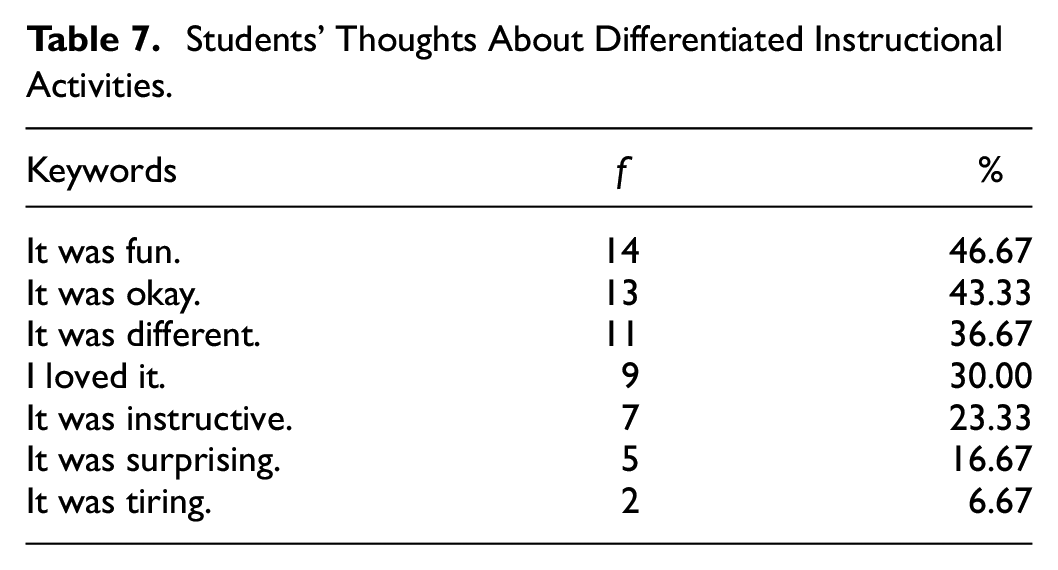
According to Table 7, most students in the experimental group found the learning style-based differentiated instructional activities fun, good, different, instructive, and surprising. They enjoyed the application, and a few students found it tiring. Some students’ expressions are given below:
Students’ Thoughts About Differentiated Instructional Activities.
“… the activities we did in the class were very entertaining. I must say that I had much fun and did not get bored.” (S2) “We did a lot of engaging activities in class. I especially liked group works. I was curious about the activity results.” (S5) “The lessons were very entertaining and enjoyable… I have never had much fun in the lesson before.” (S7) “I used to have difficulty keeping in mind what I learned. Nevertheless, in this lesson, it seems like all remained in my mind without any need to memorize.” (S8) “I learned a lot from the activities we did in the lesson …. I learned even tricky subjects quickly.” (S11) “I think all lessons should be delivered like this…. Thus, students would learn more quickly and love the school.” (S14) “The lesson was fun, but constantly moving and doing activities made me tired.” (S15)
Discussion and Conclusion
A significant difference was found in the experimental group students’ academic achievement in the social studies course, in which learning style-based differentiated instructional activities were applied. The results showed the positive effects of the differentiated instructional activities on students’ academic achievement, which was also supported by qualitative data obtained from teacher and student interviews. In this sense, the differentiated instructional activities, which were found interesting, intriguing, entertaining, surprising, and instructive, promoted active learning and improved students’ academic achievement. According to Tas and Sirmaci (2018), differentiated instructional activities increase academic achievement by allowing students to manage their learning experiences according to their interests and readiness. Several studies suggesting that differentiated instructional activities/methods increase students’ academic achievement in social studies courses support our findings (e.g., Akdemir, 2019; Atalay, 2014; Cetintas, 2019; Ozturk & Mutlu, 2017) as well as in other courses (e.g., Demir, 2013; Dikmen & Tuncer, 2020; Dosh, 2011; Ekinci & Bal, 2019; Gilbert, 2011; James, 2013; Kaplan, 2016; Karip, 2016; Oden, 2012; Saldirdak, 2012; San & Turegun-Coban, 2021; Tufekci, 2018; Yabas & Altun, 2009).
It can be indicated that considering student readiness in implementing differentiated instructional activities, encouraging students to engage in learning style-based individual and group work, making them take responsibilities, and providing suitable materials and stimuli improved practical learning experiences and academic achievement. In their studies, Durmus (2017), Faydali (2018), Karadag (2010), Ozbal (2016), and Yaprakgul (2019) concluded that differentiated instructional courses increased academic achievement. Thus, it can be inferred that learning style-based differentiated instructional activities will effectively improve student performance in the social studies course.
The dependent group t-test results similarly underlined an increase in both groups’ students’ academic achievement. In light of the findings, the experimental group’s academic achievement posttest scores increased significantly compared to the pretest scores and more than the control group. In this sense, it can be suggested that learning style-based differentiated instructional activities significantly improved the academic performance in the experimental group. However, the posttest scores of the control group students also showed a partial increase compared to the pretest scores. Similarly, Berber (2021) and Durmus (2017) determined that both groups’ pretest and posttest scores increased, but it was not as high as in the experimental group. It might stem from that the students did not know the subject content in the pretest, but, in time, they learned something about the subject, even thanks to the traditional teaching methods. The critical point here was that the improvement in the experimental group was remarkably more remarkable than the control group.
The interviews with the classroom teachers confirmed that the learning style-based differentiated instructional activities contributed to students’ academic achievement in the social studies course, highlighted the importance of using alternative teaching methods, broke the routine and boredom in the lessons, and promoted active participation and group works. It can be concluded that it is an engaging, entertaining, and instructive application that develops a sense of responsibility. Participant teacher said, “This practice encouraged the students to be more active in the lesson, do group works, and take responsibility. I observed that the students had much fun in this lesson… It contributes positively to the academic achievement of my students, and should be applied in all lessons….” It proves the efficiency of learning style-based differentiated instructional activities in many aspects.
Our findings overlapped with many studies in which differentiated instructional activities were applied. In the interviews held by Durmus (2017), the teachers emphasized that they found the differentiated teaching model very useful with positive effects on both children and themselves. The model brought a different perspective and stimulated children’s willingness and motivation for the lesson. Aydogan-Yenmez and Ozpinar (2017) also stated that the teachers found the differentiated instructional activities fun and interesting. They observed that the students actively participated in the activities, and their motivation improved. Similar positive findings were obtained in several studies (e.g., Anderson, 2007; Beecher & Sweeny, 2008; Coulter & Groenke, 2008; Lange, 2009; McAdamis, 2001; Sondergeld & Schultz, 2008; Tomlinson & McTighe, 2006).
In the interviews with the experimental group students, it was concluded that the students found the learning style-based differentiated instructional activities entertaining, different, instructive, and surprising. Similarly, in a study by Berber (2021), students enjoyed the learning style-based differentiated instructional activities and expressed that they had better learning outcomes, the lessons were fun and instructive, and the approach increased their interest and participation in the lesson. A participant student said, “Those activities were very entertaining. I had much fun in the lesson, and I never got bored,” and another participant said, “I learned a lot thanks to such activities. I learned even difficult tasks easily.”
In the study by Durmus (2017), most students stated that they enjoyed the lesson and felt comfortable, peaceful, self-confident, motivated, and excited about the activities. They participated willingly, learned many things, and did not get distracted in the lesson, which overlapped with our findings. There were several overlapping findings in the literature: improved student enthusiasm (e.g., Demir & Gurol, 2015; Demir & Gurol, 2017; Stager, 2007), improved interest and motivation (e.g., S. Avci et al., 2009; Batdi & Semerci, 2012; Beler, 2010; Cheng, 2006; Faydali, 2018; Kara, 2019), easy and fun learning experiences (Sondergeld & Schultz, 2008), improved academic achievement (e.g., Aydogan-Yenmez & Ozpinar, 2017; Johnson, 2010) and increased interest and participation in the lesson (e.g., H. Avci, 2015; Oden, 2012; Ozer & Yilmaz, 2018).
There was a significant difference in the retention scores between the experimental group, in which learning style-based differentiated instructional activities were applied, and the control group, in which the traditional teaching methods were preferred. The difference was in favor of the experimental group. The retention test results showed that learning loss in the control group (17%) was more than in the experimental group (8%). Therefore, it can be inferred that the learned content was more permanent in the experimental group than in the control group.
Similarly, in their studies, Akdemir (2019), Demir and Gurol (2017), Durmus (2017), and Ozer and Yilmaz (2018) concluded that differentiated instructional activities significantly improved learning retention, which can be explained with the use of learning centers, stations, and agendas with additional attention to learning styles, individual characteristics, and interests. As understood from the statements of teachers and students, those activities were engaging, interesting, entertaining, surprising, and instructive and helped students learn efficiently and effectively, which might explain the positive effects on learning permeance.
Briefly, learning style-based differentiated instructional activities contributed to the students’ academic achievement and learning retention in the social studies course. Such activities allowed students to participate in the activities actively, facilitated classroom management, and offered an entertaining and well-prepared learning atmosphere where individual differences and learning paces are welcomed.
Suggestions
In light of the study findings, the following recommendations are offered:
The teacher-centered teaching approach based on traditional methods and the direct transfer of information to students should be replaced with student-centered approaches responsive to learning styles, individual differences, interests, and potentials.
Teachers should receive in-service training on efficiently applying learning style-based differentiated instructional activities in the social studies course. They also should be encouraged to gain experience in addition to theoretical knowledge.
Learning style-based differentiated instructional activities should be addressed with the relevant characteristics, principles, advantages, and disadvantages. Accordingly, activity examples should be shared with teachers.
Social Studies Course Curriculum and materials (e.g., textbooks, lesson plans, and printed materials) should be enriched with differentiated instructional activities.
This study is limited to the 4th-grade primary school students and social studies course. Future studies can integrate the learning style-based differentiated instructional activities into other class levels and courses.
Footnotes
Declaration of Conflicting Interests
The author(s) declared no potential conflicts of interest with respect to the research, authorship, and/or publication of this article.
Funding
The author(s) received no financial support for the research, authorship, and/or publication of this article.

Data Availability Statement
Data sharing not applicable to this article as no datasets were generated or analyzed during the current study.