




Abstract
Despite the rapid growth of the eSports industry with respect to its economic scale and the demand for eSports players, the career transformation experiences and well-being of eSports athletes have been largely overlooked. This study aims to explore eSports athletes’ personal development in terms of career continuity, associated skill transformation, and well-being after retirement. Employing non-participatory observations and semi-structured interviews, we unpack two different pedagogical contexts of retiring eSports athletes: one is “continuity paths” (three transformation options and associated skill sets), and the other is “desire for continuity” (psychological strengths and explicit tacit knowledge). Our findings provide practical guidance for the career transition experiences of eSports athletes and contribute to understanding the sustainable framework required for the self-development of talent within eSports education and the eSports industry. The findings suggest that psychological consultants and athletic rehabilitation therapists should be employed to provide professional advice, interventions, and treatment to eSports athletes before and after retirement.
Keywords
Introduction
Hemphill (2005) first defined eSports as “alternative sport realities that […] electronically extend athletes in digitally represented sporting worlds” (p. 2). Scholars subsequently differed over the definition of eSports, with some arguing that it has been monetized as “organized video game competitions that pit world class players against each other for cash prizes” (Gamers Are Not Only Athletes, para. 2). Others emphasize the welfare and skills involved, defining it as “an area of sport activities in which people develop and train mental or physical abilities in the use of information and communication technologies” (Wagner, 2006).
eSports, an emerging and cross-domain industry, was approved as an official sport in China in 2003 (Zhao & Lin, 2021). The fame, fortune, and meritocracy expressed by the eSports industry and education, and the media has attracted an increasing number of eSports players who regularly take part in competitive gaming, and many of these players have transformed from game enthusiasts to professional athletes (Himmelstein et al., 2017; Scheerder et al., 2005; Zhao & Zhu, 2021). China has expanded into the world’s largest gaming market, and Chinese teams have won several championships in top international tournaments such as the League of Legends Pro League (LPL) S8, Defense of the Ancients (DotA, and Frist-person Perspective (FPP) in PUBG Global Invitational (PGI) (Gosu Gamers, 2022; Rotowire, 2018; Thompson, 2018). However, the Chinese government has maintained a cautious attitude toward the expanding popularity of eSports considering its precarious career trajectories (Zhao & Lin, 2021). This has resulted in a significant talent gap in the industry (see Figure 1).
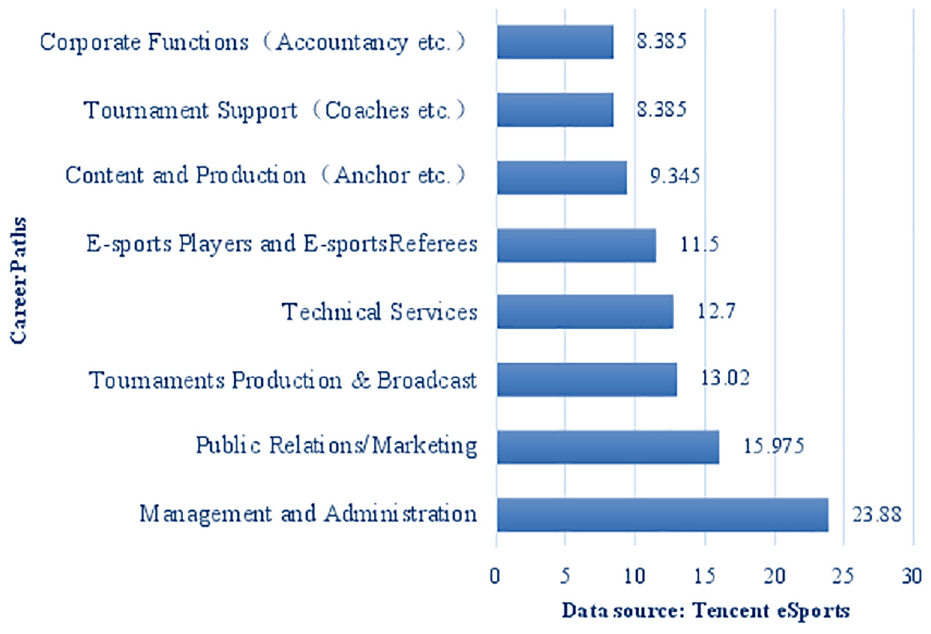
Overview of the talent gap in China’s eSports industry and its population (unit: ten thousand).
Significant efforts have been made to deal with the criticism that eSports is not being physical enough to be a sport, with mental and physical skills and performance being central to the debate. Related literature is already decades old: Jones (1998) examined the learning environments in video games, defining seven elements of flow associated with optimal sports experiences (Csikszentmihalyi, 1990). Numerous researchers have identified eSports as competitive gaming, for which athletes can be trained to address mental and physical issues along with their career development. This idea attracted numerous scholars who have helped to justify, distinguish, and criticize the traits and prospects of eSports as sport-like rather than fun gaming (Martončik, 2015; Muller-Lietzkow, 2006a, 2006b; Lin & Zhao, 2020) in comparison with traditional sports (Ferrari, 2013; Taylor, 2012; Witkowski, 2012). Hemphill (2005) referred to eSports as emulating the immersion and interactivity of computer games with required skilled physicality. The achievements of professional players with sufficient skills have been recognized through professional evaluation of their operational skills or tactical awareness, and their skills distinguish them from casual players (Ericsson, 1996, pp. 10–13). In other words, the players’ bodies engage with eSports. Their tactical and kinesthetic experience, sensorial perceptions, rapid hand and finger movement, and quick hand–eye coordination are all identified as embodied experiences requiring a high level of body performance (Taylor, 2012; Witkowski, 2012; Zhao & Zhu, 2021).
However, the lack of in-depth observation of the discrepancies in the effect of retirement on social welfare, identity, or other related issues between sports and eSports creates uncertainty regarding how to sustain eSports as a sport. In addition to identifying the potential opportunities and risks associated with being an eSports athlete, it is important to consider the quality and well-being of players who have transformed themselves after retirement, which may help to address the abovementioned uncertainties.
This is the first study dedicated to understanding retiring eSports players’ transformation paths and associated skills. Our research pays particular attention to the group of eSports players who ended their professional careers before turning 30 years old, because 80% of eSports athletes do so (iResearch, 2018). Thus, this research contributes to two empirical research veins: First, it provides a self-reported database of the work experience of eSports athletes, which can serve as a barometer that will nurture retired athletes in their transition phase, helping them to retain and extend their involvement with the eSports sector. Second, by studying retired athletes who have temporarily or permanently stopped working in the eSports industry, our research helps identify the variables related to career expectations after retirement. These include continuity paths and associated skills as well as the reasons for retirement. This aspect of the study adds to the existing literature on athletes’ identity and career well-being.
The rest of this paper proceeds as follows. In the next section, we review the literature on career transformation, continuity theory, and debates about career development in sports. We also address retirement-related research to contextualize the necessity for research on retired eSports athletes. We focus on eSports in the context of sports industrial research in China. In the method and theoretical framework section, we outline our qualitative methodology (semi-structured interviews) within a conceptual framework of continuity. In the results section, we present our data analysis at two levels to demonstrate the skills transformation that is required for the personal development and well-being of retiring eSports athletes. The final section discusses the findings and concludes.
Literature Review
Career Transformation, Continuity, and Sports
The main arguments and studies to date have concentrated on the linearity and boundarylessness of career mobility compared with the stability of the job-for-life model (Chudzikowski, 2012), the former having challenged what is called “nostalgia for permanence” (Strangleman, 2007). One branch of the research compares the idea of a boundaryless career (Arthur, 1994) with that of an organizational career (Hall, 1976), which provides an important contribution for understanding a number of career issues relating to concepts such as precarity, being self-enterprising, fragmentation, freelancing (Baines, 1999), and neoliberalism. On one side of the debate, the advocates for boundaryless careers maintain that “boundaries no longer set a division between familiar and hostile territory” (Arthur & Rousseau, 1996, p. 372). Careers should instead be driven by an employee’s own values, motivations, and confidence (Rodrigues et al., 2016; Skrbiš & Laughland-Booÿ, 2019). On the other hand, empirical studies, like that of Potter (2020), have investigated the structural changes (e.g., promotion, progress, or linearity) that remain hegemonic among the discursive perspectives of workers with unstable careers or who are transition from one job to another (Gekara & Thanh Nguyen, 2018).
The process of career mobility plays a significant role in a player’s main career-relevant boundaries, which are shaped by life stage. Comprehensive or vocational education has been considered the core weakness in sustaining professional careers or supporting career transitions, and there are concerns that eSports players should enjoy the same social welfare as traditional sport players. From around 2013, eSports players have been allowed to receive B-1 visas to enter the U.S. (Tassi, 2013). Robert Morris University was the first to offer collegiate scholarships for players, supported by its athletics department, followed by the University of Pikeville (Stone, 2014). One representative organization lead by Asia-Pacific Rim University, APRU eSports, advances international eSports coordination. It has developed a comprehensive eSports ecosystem for APRU members to help universities expand their respective eSports programs, including student tournaments, educational programs, research, equity initiatives, and career development (APRU). 1
Using a continuity theory approach to career transformation, Atchley (1989, 1993, 1997) was the first to shed light on how individuals who encounter changes project a sense of continuity to maintain internal (e.g., psychological perception) and external structures (e.g., social circumstances or social behaviors). In other words, Atchley used a process-based theory, focusing on the evolution of an individual’s life span, self, or identity. Parker et al. (1995) extended Atchley’s continuity theory and proposed a continuity framework. The framework suggests that reminiscence is a mechanism produced by individuals in order to self-adapt to changes; that is, “the creation of life stories may serve different types of continuity functions” (p. 521). Researchers have also examined the role of human capital with an emphasis on continuity. This research has found that mobility preference is the most affected variable for career management practice. This means that the greater the emphasis placed on continuity, the greater the preference for having an intra-organizational (e.g., bounded) career. However, most studies have taken place in the context of high-value and highly unique employees and organizations (De Vos & Dries, 2013). This research can be employed to study emerging eSports careers, including reflectively unpacking whether eSports’ career transformation has already been “bounded” or organized, or whether athletes have been motived to project continuity in their careers.
Numerous studies have examined career transitions in sports since concerns first arose regarding the distress suffered by retiring athletes (Hart et al., 2013; Mannes et al., 2019; Oltmans et al., 2021; Van Ramele et al., 2017). Some research has demonstrated that the reason athletes prefer to retire voluntarily is not because of their skills or efforts; instead, it is because they have better choices, or they consider retirement positively as a social rebirth (Coakley, 1983; Rosenberg, 1981). We do not fully agree with this conclusion, as it is derived from athletes that have varying degrees of self-identity, achievement levels, and educational support (Park et al., 2013). For instance, from a sports psychology perspective, Cosh et al. (2013) identified choice and identity as the most important outputs of sport psychology literature in terms of understanding athletes’ well-being after retirement. Although most prior research has employed a survey method, the findings are helpful in making sense of the dominant cultural practices of athletes. Other scholars have extended the existing quantitative research and predicted athletes’ degree of adjustment to retirement by investigating the role their sport has played throughout their lives (Lerch, 1981). Lerch (1981) found that athletes who valued their sport above their other roles encountered more difficulties after retirement (Lavallee, 2000). Nevertheless, most scholarly attention from the field of sports psychology research on the relationship between aging and the active performance of athletes has been broad (Park et al., 2013), either focusing on physical activity or on athletes’ expectations and experiences of ageing and the meaning behind these expectations (Phoenix & Griffin, 2013; Ronkainen et al., 2013). Although the precise age for retirement differs depending on the sport, athletes fully acknowledge that aging is the most significant challenge that limits their professional careers, and most retire at a young age (Wylleman et al., 2004). Langley and Knight (1999) confirmed the importance of continuity in competitive sports, describing it as “a primary adaptive strategy for coping with the aging process” (p. 50). Additionally, Cosh et al. (2013) clarified the challenges of aging and proposed that athletes’ limited identity positions constrained their decision-making about retirement, and that only when athletes choose to retire at an appropriate time will they be able to maintain their privileged identity. To date, few studies have concentrated on the precise factors affecting the retirement decision-making process. Fernandez et al. (2006) investigated (anti)-push factors but did not consider aging or self-development, which might affect athletes’ decision-making processes (Ronkainen et al., 2013). In addition, other risks, including changing bodies, physical and active performance, or chronic pain caused by injury, are closely related to psychological well-being at retirement (Cosh et al., 2013; Schwenk et al., 2007).
In comparison to other more traditional sports (e.g., basketball or football)—for which there is abundant research on normal, boundaryless (Arthur, 1994), and organizational careers (Hall, 1976) as well as on traditional athletes’ identities, career transitions, and potential for distress (Cosh et al., 2013; Ronkainen et al., 2013)—eSports athletes have shorter careers, ranging from 4 to 10 years (Lin & Zhao, 2020). In light of their implications for athletes’ social welfare, these ideas more or less shape plans for individual career trajectories, and they help to make sense of what it means to be “successful” or have a “good” job in the eSports domain. Such questions remain closely associated with an ongoing debate regarding whether eSports are played for fun or to satisfy life goals. Although Muller-Lietzkow (2006a) found that victory in a tournament was not the most important goal, other scholars partially disagree. For instance, Martončik (2015) found that only leaders are significantly driven by life goals compared with other members of a group, and thus, he concluded that eSports are played more for social belonging than for achieving life goals. However, recent research demonstrates that eSports players employ meritocratic discourse to de-stigmatize their own identity while pursuing championship titles, even though they suffer from precarity (Lin & Zhao, 2020). Overall, it is necessary to explore athletes’ careers and their experience of career uncertainty following retirement. The process of transitioning out of sports involves a new level of self-identification, which can impact self-confidence or cause an identity crisis. This transition is explored in identity-making research (Lavallee & Robinson, 2007; Wylleman et al., 2004). This study assumes that retirement is highly distressing for eSports athletes, because they are working to de-stigmatize their self-identification (Lin & Zhao, 2020). Nevertheless, it is worthwhile to examine these emerging practices in eSports and to help to contribute to an understanding of the lives of contemporary youth and their professional careers, which have been largely neglected but broadly resonate in the rapid development of the “digital economy” in China.
Nonetheless, very limited research has been conducted on the career transformation and well-being of the first and second generation of grassroots eSports athletes. Instead, the news simply reports on the achievements of elite athletes (e.g., “Sky” Li Xiaofeng). Accordingly, it is necessary to investigate athletic self-development and life satisfaction in the career transition process for eSports players. This could help address the concerns referred to above and sustain the development of the eSports industry and its stakeholders. This study explores the following two research questions based on an overview of the talent gap in China’s eSports industry. What are the career opportunities and concerns regarding the transformation path for this fast-growing group? Have any skill sets gained through their professional experience as athletes helped in developing their post-retirement careers and lives?
Method and Theoretical Framework
The aims of this study highlight the relationship between skill set, self-identity, and self-achievement in order to aid understanding of the career transformation and well-being of eSports athletes. We adopted an interpretivist approach for this study in which reality is considered to be socially constructed, and multiple perspectives and interpretations exist. Our research process emphasizes understanding the subjective experiences of individuals in context (i.e., retired eSports athletes in our study), seeking to explore the meanings they attach to their experiences (Creswell & Poth, 2016). Using Atchley’s (1989, 1999) continuity theory, we propose a novel theoretical and pedagogical approach: “continuity path” and “desire for continuity.” This approach examines how internal continuity (e.g., affect, preferences, attitudes, values, and beliefs [Atchley, 1989]), as an inner contour that shapes well-being, is gained through an individual’s professional experience and, in their retired lives, is either successfully or unsuccessfully transferred or becomes resilient. External continuity refers to “a preference for familiar environments, pursuing familiar interests, practicing familiar skills, and interacting with familiar people” (Atchley, 1993, p. 13), which demonstrates the persistence of the physical or social structures constituting individuals’ life spans (Langley & Knight, 1999). The framework also examines other important factors that contribute to athletes’ desire for continuity and relevant outcomes (e.g., individual differences, cultural norms, family, and education background) based on our five-year fieldwork observation in the eSports industry (2018–2022). During our five-year fieldwork observation in the eSports industry, we employed a longitudinal qualitative approach to better understand the complexity and dynamism of this fast-evolving industry. Through purposive and snowball sampling, we selected participants including athletes, coaches, and managers for a number of our studies relating to eSports careers and athletes’ well-being. Data collection techniques included interviews, focus groups, and ethnographic observations. Throughout the observation period, we developed our connections with participants, maintained regular communication, and iteratively analyzed the data, identifying emerging patterns and themes. We also followed ethical guidelines in our long-term observation process. These long-term observations helped capture the rich experiences and career trajectories of eSports athletes.
The advantage of this theoretical framework is that it helps us to explore the role that psychological strength plays in the process of revitalizing an individual’s identity, relationships, and purpose, which either extends their involvement in eSports pedagogical context or leads them to leave the industry. The framework pays particular attention to the process of transferring individuals’ explicit tacit knowledge into their post-retirement careers, providing an in-depth discussion on the two outcomes: either transforming situations into continuity obtained or continuity failed. Notably, this research does not aim to identify whether these athletes fail or not, but rather how these factors contribute to job and life satisfaction and overall well-being.
Two rounds of data collection were conducted: non-participatory observations and a qualitative methodology with 23 semi-structured interviews. In the first round of data collection, we joined two so-called “Retiring heros” and “GG One” WeChat groups consistent of over 500 retired players, then used non-participatory observations online and offline to map out athletes pre- and post-retirement activities, skills, and behaviors for almost 1 year, compiled a 100,000-word observation report. WeChat is the most widely used social media communication platform in China (Shang et al., 2021). The intensity of using social media, such as WeChat, has led to increased willingness to share personal experiences, opinions, and emotions in group settings (Guo, 2017). As a result, WeChat groups can serve as a rich source for our observation data collection, providing researchers with insights into individuals’ perspectives and experiences in real-time (Skavronskaya et al., 2020). Before initiating the online observation, we carefully considered the ethical implications and took necessary steps to protect the rights and privacy of the online community members (Eysenbach & Till, 2001). Prior to joining the WeChat groups, we sought approval from the group administrators by explaining our role as researchers and the study’s purpose, obtaining informed consent for observation and data collection. Upon joining the groups, we introduced ourselves as researchers and clearly communicated our intentions, being open to answering questions or addressing concerns throughout the observation period. To ensure anonymity and confidentiality, we did not disclose any identifiable information in our research findings, and securely stored the collected data, making it accessible only to authorized researchers involved in the study. Lastly, we discussed potential harm or risk to the group members, taking steps to mitigate those risks, including not sharing sensitive information outside the research team and obtaining consent before using direct quotes or identifiable information in the study.
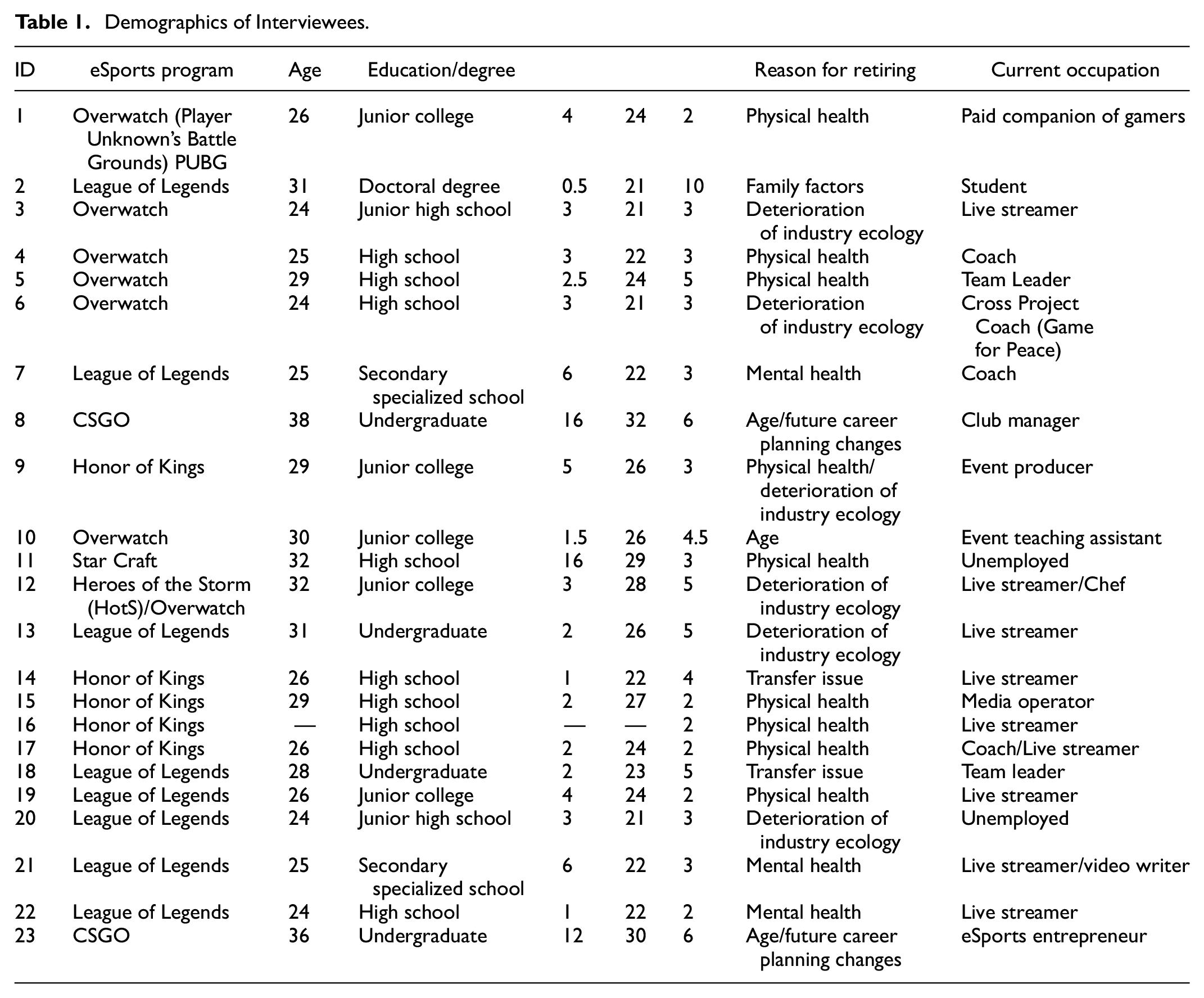
We then employed snowball sampling and drafted interview questions for a second phase of in-depth semi-structured interviews with 23 eSports athletes from eight eSports leagues. Participants were aged 24 to 38 years, with their duration of retirement ranging from 2 to 10 years. The participants had succeeded in transitioning from eSports to nine different occupations (see Table 1). Each interview took more than 1.5 hr and complied with the ethical guidelines. This study obtained 280 pages of interview data coded in NVivo 11. The participants were guaranteed anonymity and were fully informed of the purpose of the study. The interview questions were designed based on the precise occupations taken up after retirement, covering the following criteria:
Demographics of Interviewees.
Continuity path: possible choices, precise skill scheme, degree of satisfaction, well-being, possible contradictions, and notable practices in the process of career transformation.
Desire for continuity: hope, self-efficacy, resilience, attitudes, networking, hidden/implicit skills, social or cultural capital, logic, tactic, and beliefs.
We employed thematic analysis to analyze both the observation and interview data, following Braun and Clarke’s (2006) six-phase approach to ensure a rigorous and systematic analysis of our data. We began by repeatedly reviewing the observation field notes and reading and listening to the interview transcripts. This allowed us to become familiar with the depth and breadth of the content. Then, we systematically coded interesting features of the data by assigning codes to segments of text that represented specific ideas or patterns. Both observation and interview data were coded separately at this stage, using NVivo 11 software to facilitate the coding process. Next, we examined the codes generated in the previous step to identify broader patterns and categorized them into potential themes that captured the essence of the coded data. We also considered sub-themes and the relationships between themes at this stage. The following step involves critically reviewing the themes to ensure that they were grounded in the data and adequately represented the coded extracts. This process involved refining, merging, or discarding themes to create a coherent thematic structure. Different themes that emerged from the observation and interview data were compared and areas of convergence and divergence were identified. We further refined these themes by clearly defining and naming them, capturing the overall essence and significance of each theme. This step involved revisiting the coded extracts to ensure consistency and coherence within each theme. Finally, the findings from the thematic analysis were integrated into our research, and in this paper, we highlight relevant extracts from the data to illustrate the themes and provide evidence for our conclusions.
The next section sheds light on the findings presented from “continuity path” and “desire for continuity,” particularly concentrating on the retiring eSports players’ self-reflections, perspectives, and evaluations of their career transformations, self-development, and mental well-being.
Results
“Making a Way Out of No Way”: Exploration of the Continuity Paths
Beyond the choices of starting a business, crossing into entertainment, or further education, the retiring interviewees swung between being deliberate or happy-go-lucky. They deliberately explained their transition with the metaphor: “This is not just about a choice between eating a burger and a salad. It goes much further than diet.” Two main transformation options were deemed appropriate by the retired players who struggled with the skills and professional experiences they had obtained. First, becoming coaches, admin team leaders, or judges were positioned in the central circle of choices, and there were perceived as the most difficult (less than 5% in total) to transform into by these players. In terms of the three choices, only coaches and admin leaders were found in our sample. “Making a way out of no way” carried a positive connotation for the interviewees, referring to the fact that few positions were identified as easy transformation options given the lack of stable retirement paths. The character trait of active learning was also identified as a necessary condition for the three career transformation options described above. In other words, entry-level professional eSports players are highly influenced by their peers and mentor. During their professional careers, they would have already begun to learn, imitate, and practice their professional roles from their coaches, whom they considered to be their “predecessors.” This provides a foundation for their subsequent role transition. Compared with the executive ability of players, coaches need to use their own subjective initiative. The skills acquired by players who have made the transition are often not gained through advanced training. Instead, players have already begun to learn the skills needed for coaching or working as a teaching assistant during their professional careers.
In terms of coaching, excellent teaching and management experience was claimed to be essential. The interviewees who had successfully transitioned to coaching explained as follows: The coach needs to fully master the personality traits of the players in the team, coordinate the teamwork ability, and polish the team style, and they need to cooperate with the analysts and assistant coaches on the team to quickly collect insight into the game version as well as the data and style of the competing teams, such as insight into the other players’ good game roles and operation habits, etc. (Interviewee 2, 31 years old) To develop the team’s tactical and strategic offensive and defensive systems, etc., the manager must also formulate the training arrangements, help the team fill a vacancy, and enhance the tactical execution of the team. (Interviewee 1, 26 years old)
For this reason, professional players who have become coaches are equipped with judgment, critical analysis, and layout skills, as most of them played the role of team leader during their service. For example, Clearlove, the former League of Legends professional player who turned into a head coach, once played the position of “playing wild,” which required him to have more accurate judgment and keen insight into the game, namely being able to see the “big picture.” His years of professional experience made him capable of becoming a head coach, and the transition from player to coach could be completed in a short time. Additionally, becoming a coach requires leadership traits. Excellent verbal expression and communication skills are usually the basic qualities of a team manager. The communication with players and the layout and analysis of tactics and strategies cannot be separated from the coach’s social expression and communication skills. These are usually reflected in their “energy field,” which can “suppress” players and help them understand what players are “thinking” and what they “want,” so as to persuade and arrange tactics in a targeted way. For example, two former players who transformed into professional coaches stated, I’m good at dealing with players, doing things to help them set up tactics, deal with their psychological issues. I prefer to chew the rag for hours with them because I was a professional player, so I have to understand what they are thinking. (Interviewee 3, 24 years old) My job is basically based on my experience as a player. My management and communication skills with players come from my training as an athlete, and the advantage of being a coach is that I know what a player wants and can give him more precise guidance. (Interviewee 8, 38 years old)
Second, becoming eSports anchors or commenters are popular choices for retired players. There is a blurred boundary between these two career choices, with even full-time commentators for official tournaments sometimes choosing to open personal channels on live-streaming platforms to become eSports anchors. In turn, eSports anchors, sometimes comment on official tournaments as well. Participants choose this career route for three reasons: the transition is rapid and low risk, and it comes with a high income. That is, participants acknowledge the heterogeneous consequences of becoming eSports live streamers (including anchors of commentators) as being “low cost” while also triggering massive growth.
Initially, the live-streaming performances of retired eSports athletes, who benefit from their competitive level and professional status, are much more attractive to viewers than those of ordinary anchors. The good operations, reaction speed, and professional experiences accumulated by retired professional players allow them to make insightful comments and provide a profound and novel multi-angle understanding from the perspective of players to audiences. They are able to establish professional and accurate analyses and predictions of a game’s progress, allowing them to achieve the “revealing plot” commentary effect. Second, compared with ordinary anchors who start from zero, eSports professional players can skip the initial stage of fan accumulation go directly to the stage of fan retention and conversion, which comes with lower risk and higher income. Because of professional athletes’ built-in fan base, signing a contract on a live-streaming platform after retirement can bring a relatively high fixed income. One retired player stated (Interviewee 19, 26-year-old), “My income is three times higher than when I was an athlete.” Third, many of the eSports players were already broadcasters before they retired, which is another skill they obtained while being an eSports player. Players are required to appear on air outside of their regular training hours to fulfil their club’s contractual obligations. This live broadcast practice before retirement can help players adapt quickly to eSports anchor status after retirement, and the transition period is relatively fast and stable.
While being an anchor is a popular choice for professional athletes, the quality of such transformation varies due to the comprehensive skills that are required. For instance, our research found that some highly skilled professional eSports players did not have sufficient performance skills and ended up in obscurity. On the contrary, some eSports players who did not perform well in tournaments were able to rise rapidly due to their talent in the field of broadcasting. Almost all the interviewees clearly noted that different abilities are required. One of the representative responses was that, As a professional player, players need to adapt to tournament pressure, intensive training, and team cooperation, while as an anchor, players need to undergo more salient changes to produce high-quality content, appeal to a wider audience base, retain the liu liang (traffic), and also solidify the fan circle. (Interviewee 16)
Most importantly, we found that they employed a meritocratic discourse by referring to other remarkable cases like Huang Tai Sin who retired from King Pro League and PDD who retired from the League of Legends. Players internalized those successes for themselves—seeing their own transformation as having great potential to succeed. As one of the participants (Interviewee 22) who had just started the transition stated, I could have my own style after transforming into an eSports anchor, I really think I have the ability to create a ‘program effect’, good insight into fans’ emotional engagement and I can create a meme to interact with the audience.
In addition to the abovementioned choices, lack of qualified education support as a social welfare system was claimed to be the weakest variable for maximizing job preferences and sustaining further self-development. On one hand, according to interviewees who joined a vocational school on eSports in China, public still doubted the importance of eSports education owing to “poor design of the curriculum,”“lack of teaching resources,” and school leadership that was overly focused on commercialization and making profits while neglecting the quality of education and practice. On the other hand, those who had become champions claimed that there remained prejudice toward eSports athletes, resulting in unfair differences in social welfare with traditional athletes: “traditional athletes who became champions have multiple career transition choices, and could even be selected to be politicians, or join high-quality colleges, such as Tinghua University… eSports champions should have the same social welfare as traditional sports champions” (Interviewee 5).
“How Can a Hero Retreat While a Pawn Advances?”: Desire for Continuity
“How can a hero retreat while a pawn advances?” was a representative and affective commitment response from a retired player who did not conceive of retirement as the end of a hero. Rather, the player highlighted that determination and toughness, honed by their high-intensity career as an eSports player, triggered a unique and prominent competitive advantage for retirement transformation. Four psychological strengths and two forms of explicit tacit knowledge were identified in this research as driving “the desire for continuity” into a sustainable career based on retired athletes’ transformation experiences; these were hope and optimism, self-efficacy (Parker, 1998), resilience (Wagnild & Young, 1993), and personal networking.
Hope and Optimism
We found that retiring athletes had sustained positive and achievable goals for themselves, in both the short- and long-term. Moreover, their habit of setting motivational goals was usually carried over to future career development planning. One participant (Interviewee 23) illustrated his transformation from “autistic” to “optimistic” after retirement: Even though my optimistic attitude largely comes from my character that has developed with growth, my eSports career has also greatly affected the cultivation of my acquired optimistic tendency. Before my retirement, I was not used to being arrogant in winning and was not depressed when losing.
The retired athletes employ three incentive methods to drive the maintenance of hope. The first is eliminating crises. The retired athletes usually regard eliminating a crisis as an alert to stay awake under stress and future uncertainty, usually with the discourse of “play well or be eliminated.” The second is effort only. Players believe that practice pays off, and they are often motivated by an effort-only approach that relies on training to improve their mental performance and to motivate them to pursue their goals. The third is competing against “opponents.” The competitive nature of eSports determines the inevitability of both sides having winning and losing identities. The players advance rapidly up the ladder of experience and status by taking on targeted opponents and “killing” them. Therefore, some players use the success of their opponents as motivation to achieve their goals. For instance, one has transformed into a coach who has set clear goals for himself after retirement: I take being a coach seriously [after transformation]. The first thing [for me] is to make a new attempt that diversifies the supervising mode, because I witnessed some coaches being eliminated by an updated version [of eSports projects] when I was an athlete. I will avoid this by working as a coach across multiple projects, which is my main goal. (Interviewee 7)
Self-Efficacy
eSports is a profession of uncertainty (Martončik, 2015). It is a precarious and disposable job that relies heavily on athletes’ confidence, including confrontation, communication, and decision-making skills both in and out of tournaments (Lin & Zhao, 2020). This confidence enables them to confront difficulties and find solutions, which constitute players’ self-efficacy. Professional players are required to instantaneously analyze the field and pre-judge their next action during fierce tournaments, which is a comprehensive ability to perform a strong and confident act with decisive hand–eye coordination. Players must also be able to properly and critically review games with teammates, coaches, and management after tournaments. Under the mandatory intrinsic drive of these training modes, eSports has cultivated individuals that can make bold decisions and be mentally stable, which motivates them to have strong self-confidence and toughness, thereby achieving “self-efficacy.” For example, a professional player who was modest and prudent during his transition to directing tournaments perceived his experience to be similar to the early stage of his athletic career, summarizing both as “hard work but never stop trying” to self-motivate himself.
Once, we were playing a very difficult and intense match. But deep down, I knew I had the skills and experience to make a difference. I remembered all the hours of practice I’d put in and the lessons I’d learned from my past games. Relying on my instincts, I made a critical decision that ultimately won us the game. Believing in myself and my abilities made all the difference. Believing in myself and my abilities made all the difference. (Interviewee 15)
Resilience
Resilience, which was referred to frequently, is defined as an individual’s ability to independently cope with difficulties and recover from adversity (Wagnild & Young, 1993). Under the cultural norms of eSports in China, as well as the environment of strong competitiveness and low fault tolerance, almost all eSports athletes have faced the frustration of losing matches and the high pressure brought by the anxiety of aging. These players need to adjust well and maintain their playing condition constantly in a high-pressure psychological environment. Players refer to this as “no operation deformation” (wu caozuo bianxing).
In addition to the psychological counselling provided by few clubs, self-healing is key to a player’s career. Two interviewees indicated they had obtained psychological counselling, but nevertheless retired. “I have tried so hard to recover, but no one has helped me…my eSport program actually was given no attention in China even though I won a championship twice” (Interviewee 6) “I know I am not capable of playing LPL, so I tried to transfer to play some other programs, but I obtained no satisfactory credits; I really do not know who I could talk with…” (Interviewee 8). When asked what precise resilience abilities have helped eSports players quickly adapt to new career-planning after retirement, a participant (Interviewee 20, 24 years old) stated, It not only refers to the ability to resist high pressure, the constant changes of gaming versions and rules, and the diverse tactical systems and layouts of teams, but also refers to the ability of eSports athletes to make sacrifices when necessary and flexibly adjust their personal style to adapt to version changes and tactics.
Therefore, psychological traits, such as strong belief, high concentration, outstanding self-learning ability, and high-pressure resistance, are also transferable later in their careers. One representative response illustrated, “There are many more talented players than me. I believe I won the championship not because of my talent, but because of my hard work” (Interviewee 12, 32 years old).
Personal Networking
From the early development of eSports to the official recognition of eSports clubs, the training of professional eSports players in China has always followed the apprenticeship model. We found that the interviewees denied that they put in effort and invested time and energy in personal network building. However, the career options after retirement are backed up by relatively close relationships, including their coaches and teammates. When discussing post-retirement self-development, eSports players devolved into polarized choices. One was bonding with existing clubs or team resources (shimen), and the other was bridging to eSports-related commercial activities. The first choice normally applies to those who have become coaches or admin team leaders, actively revitalizing bonding resources and emotionally connecting with former teammates. The second tends to be practiced by those became anchors, embracing open connections to increase and monetize social capital. For instance, live streamers would employ a nostalgic discourse by inviting and playing together with their former teammates, while strategically engaging in non-professional tournaments organized by live-streaming platforms and benefitting from the site traffic. One example from a former KPL champion who tried to become a video writer after the transition, recalled how his club-based experiences exerted a subtle influence on their decision-making process: I had been thinking about the transition for a long time and had a lot of options in front of me…The club helped me to participate in a hero-mentoring program called ‘so handsome’. This program was meticulously planned by my club, including script writing for showcasing a hero’s skills and functionalities, renting a studio for makeup, and getting my fans to cooperate to simulate the scene. (Interviewee 21)
Discussion
As for the intrapersonal relationship between athletes’ continuity path and desire for continuity, limited transformation options after retirement imply the increasing importance of empowering the inner experiences of hidden athletic pursuits. For instance, whether a person can make the transition from player to coach in the industry depends on whether they have the corresponding potential, including teaching and management experience and the corresponding personality traits. Unlike skill level, eSports players must have the necessary reaction and executive abilities to become coaches, and they need to have skills in tactical arrangement and strategy analysis.
Even though many eSports players choose to retire because of “force majeure,” retirement is not a taboo word and is deemed as a new challenge. Among these, there are two main factors that the athletes reported as influencing their decision to retire. First, there was a significant impact on the personal life and professional development of the athlete, even if it was caused by injuries or mental health. Second, a transformational job offer allowed the athlete to sustain a living after retirement. In other words, continuity skills are robust resources that drive athletes toward self-development after retirement and reduce mental health symptoms. Specifically, while eSports athletes are prone to anxiety in the face of complex dynamic information during the fierce tournament process, the tournaments require athletes to maintain a good mental state as their psychological load increases. These high-intensity tournaments sharpen the mentality of athletes and complete the initial accumulation of psychological capital, which is conducive to the realization of self-efficacy in their future career transition. In addition, many retired professional players still firmly believe in and identify with their professional identity.
The positive psychological capital (hope, efficacy, resilience, and optimism, see Luthans et al., 2007) accumulated during the eSports players’ service regulates their self-perception and identity, enabling them to maintain a more positive and serious attitude in the process of employment transformation and constantly promote their own personality development and self-efficacy, eventually increasing subjective associated well-being (Finch et al., 2020). Maintaining hope and optimism enables retired athletes to establish goals and maintain personal control in the process of re-employment, allowing these players to make choices as a way to relieve the pressure on professional players and undertake new career planning. This optimistic attitude also influences some players to express their interests and dreams again after retirement, actively seeking their passion or internally driven interests. We also find that positive psychological resources allow players to regain lifelong hobbies they had to put aside previously owing to the pressure of work and family, which promote well-being. Overall, this helps players accomplish career transition and live their new lives fully.
All in all, China is one of the most advanced eSport markets in the world, with a relatively robust infrastructure, substantial government support, numerous elite teams and clubs, and a massive audience base. As such, the experiences and insights of Chinese eSport athletes can provide valuable lessons and best practices for other regions looking to expand and optimize their eSport ecosystems. While we recognize the potential influence of the Chinese government’s policies on the eSport industry, our findings still provide meaningful insights into the well-being, career transitions, and post-retirement experiences of eSport athletes. These insights can be considered by stakeholders in other countries when designing support systems and programs tailored to their specific contexts.
Conclusion
This is the first study to offer theoretical and empirical insights into retiring eSports players’ transformation paths and associated skills, reconciling the relationship between continuity desires, professional knowledge, and social well-being. This research focuses on documenting the fluid subjectivities and variable experiences of retiring eSports players who continue to support their own career well-being based on skill transformation and personal development. The respondents gave several reasons for retiring, including physical health, age, transfer issues, mental health, family factors, and the deterioration of the industry ecology. This research unpacked how hope and optimism, qualified self-efficacy, sound resilience, and personal networking provide athletes with robust resources for coping with challenging situations as well as a sense of meaning in their career transitions.
Overall, this study contributes to the research on the continuity path and associated skills needed to minimize what McGillivray et al. (2005) referred to as the achievement of success in sport at the cost of being ill-prepared for retirement. This study also provides insights that help current and potential eSports athletes to plan their future careers and construct more long-term orientated, satisfying, and happy career trajectories. The findings suggest that a social welfare system in eSports should be constructed by focusing mainly on two sustainable aspects: prolonging the careers of eSports athletes through regular and standardized tournaments and scientific training management, and providing career literacy programs that concentrate on improving their educational level, career self-planning, and comprehensive skills practices—all of which are urgently needed. This research suggests that sports psychology consultants and athletic rehabilitation therapists should be employed to help eSport athletes prepare for retirement.
There are two limitations of this research. First, it focuses only on Chinese eSport athletes, which may limit generalizability of the findings to other regions. Second, we did not report comparative aging issues related to the reason for retirement, which means that our sample mostly focused on PC-type eSports programs, even though we indicated that ageing is one of the reasons for retiring. However, we assumed that the target athletes in our research may differ from mobile-type eSports, which require different levels of skills and associated knowledge. A promising area for future study is to explore the comparative skill sets and transfer opportunities for these two types of eSport players, as well as the reasons for retirement of mobile eSports athletes.
Footnotes
Declaration of Conflicting Interests
The author(s) declared no potential conflicts of interest with respect to the research, authorship, and/or publication of this article.
Funding
The author(s) disclosed receipt of the following financial support for the research, authorship, and/or publication of this article: This research is supported by the Fundamental Research Funds for the Central Universities .

Data Availability Statement
Data sharing not applicable to this article as no datasets were generated or analyzed during the current study.