




Abstract
Since the initiation of reforms and the opening-up policy in China, enterprises have played a pivotal role as a key pillar of local economic growth. Within the context of harmonious labor relations, the effective means of assisting enterprises in safeguarding their particular interests during labor disputes remains unresolved. Fuzzy-set qualitative comparative analysis (fsQCA) is able to capture a higher degree of complexity by testing theory-based conditions and environmental effects rather than focusing on a single effect of a single variable. Therefore, coming from a new institutionalist perspective, this study employed fsQCA to explore the causal relationships among factors including local economic environment, policy preferences, case complexity, party capability, and enterprise litigation success. Analyzing data from 28,685 labor dispute cases from Guangdong Province between 2015 and 2019, and utilizing enterprise data from the China Economic Information Network and the National Enterprise Credit Information Publicity System, we found that: (1) it is difficult for enterprises to succeed substantially in a single-antecedent condition; (2) There are four pathways to forming high enterprise victory, each involving different configurations of eight conditions; and (3) Judicial preference, employee legal representative, and enterprise legal representative are central elements in all aforementioned pathways, even if they are not necessary conditions for the success of high enterprises. The research results enrich our understanding of the current style of institutionalism, providing a valuable reference point for effectively improving the legal success of enterprises and improving the harmonious development of labor relations, with far-reaching implications for the further study of the judicial protection of enterprise rights under the socialist system.
Keywords
Introduction
In the last 10 years, with the evolution of the Chinese labor market and the enactment of numerous new labor laws and regulations, labor disputes in China have increased significantly, involving a great number of workers and enterprises (Yue & Zhuang, 2014). This phenomenon brings new implications to the field of labor relations in China, particularly since the 18th National Congress of the Communist Party of China took place in 2015. Both the Central Committee of the CPC and the State Council has repeatedly emphasized the establishment of harmonious labor relationships with Chinese characteristics. The “Opinions on Building Harmonious Labor Relations” report issued in 2015 pointed out that, at both national and local levels, harmonious labor relations does not imply that contradictions between both sides in labor relations do not exist, but rather refers to timely and effective resolutions in response to such contradictions. This suggests the importance of establishing dynamic mechanisms between the two parties, which can adjust and balance the interests of both sides through the rule of law. Therefore, building striving for harmonious labor relations, it is necessary to understand their entire operational processes.
Current research on enterprise labor relations has focused greatly on the role of trade unions and labor arbitration departments, seeking effective ways to coordinate labor relations within the framework of collective bargaining (Zeng & Wu, 2007). However, the role of court rulings in labor disputes has often been overlooked, seen merely as an inevitable outcome of escalated conflict. However, an analysis of labor disputes suggests that court rulings can often be a key determinant as to whether the labor-employer relationship is harmonious (W. J. Wang, 2019). As a pioneer in China’s reform and opening-up processes, Guangdong Province has consistently been at the forefront of economic structural transformation. Compared to other provinces, policies and governance in Guangdong Province holds a lower threshold regarding labor dispute issues, addressing them at an earlier stage, making labor disagreements more prominent (Z. X. Yang & Huang, 2015). Particularly in the context of rapid economic structural transformation, it is crucial that the numbers of labor disputes are minimized, and that those that occur are addressed in a timely and harmonious manner. This is essential for boosting productivity not only in Guangdong but across all of China, to promote healthy economic development, and facilitate positive labor relations.
As previously noted, legal outcomes of labor disputes can be seen as a primary criterion for determining whether local labor relations are harmonious (P. X. Xie, 2019; Y. H. Xie et al., 2023). An examination of the success rates of both labor and capital sides in disputes reflects the degree to which the interests of each party are protected (Fang, 2011). In previous research has considered the factors influencing labor dispute cases outcomes from both macro- and micro-perspectives. The macro-perspective focuses primarily on factors such as social and economic development, labor employment, and grassroots organizing, while the micro-perspective mainly considers the net effects of factors such as employees, enterprises, and case characteristics (Su & Wang, 2020). When the law cannot be applied precisely to specific case facts, the resolution of labor disputes depends on numerous factors related to both labor and capital entities, as well as to the specific external environment (T. Q. Feng, 2012). During labor dispute processes, organizations will often turn to the courts to seek a resolution based on legal foundations, the law cannot serve as the sole criterion for particularly nuanced or complicated case resolutions (Q. Yu & Zhuang, 2018).
This study systematically investigated litigation outcomes of labor disputes in China, particularly from the perspective of enterprises. Existing research has used only macro-level statistical data analysis of labor relations (Y. H. Xie et al., 2023; Y. Yang et al., 2023) or only uses survey methods to analyze the issue from a micro-level perspective (F. R. Chen & Xu, 2023; Dong, 2023; Y. Liu, 2023; Q. Yu & Zhuang, 2018), and research based on both macro- and micro-levels is relatively scarce. This study therefore combined macro- and micro-level research approaches to deepen our understandings of the conditions under which enterprises prevail in labor dispute litigation, and to enhance our understanding of the advantages and disadvantages of enterprises in labor disputes. Furthermore, as previous studies have focused predominantly on the net effects of a single factor on enterprise litigation success (Chan, 2022; C. L. Chen & Du, 2023), this study explored China’s regulation of labor relations from a judicial perspective, integrating the local economic environment, policy preferences, case complexity, and party capability to enhance the cross-disciplinary applicability of the new institutionalism perspective. Finally, this study applied fuzzy-set qualitative comparative analysis (fsQCA) to examine successful enterprise labor dispute resolutions, constructing a configuration model of enterprise litigation success.
Literature Review
Existing Research on Enterprise Success in Labor Disputes
In legal conflicts, the success rate of a party refers to the proportion of cases won overall. The concept of “complete success for the plaintiff” encompasses two situations: in adjudicated cases, it means that all claims made by the plaintiff have been supported by the court; in cases settled through mediation, it means that all claims made by the plaintiff have been recognized by the defendant (Luo, 2017). Extending this concept to the field of labor disputes, the success rate of labor disputes refers to the proportion of cases won by either the employee or the company. Complete success means that all claims made by both the labor and management sides have been supported by the court, while partial success means that some claims made by both sides have receive support from the court.
In researching whether labor disputes have been successful or not, two main measurement methods have been used domestically and internationally. The first focuses on the continuity of variables, considering both the absolute compensation amount awarded in judgments, which considers both the amounts awarded (Lamare, 2020). The second approach treats labor disputes as categorical variables. Chinese studies typically categorize labor dispute success rates according to three scenarios: employee litigation success, enterprise litigation success, and partial success for both sides, according to the classification noted in the national labor statistics yearbook (Fang, 2011; Q. Yu & Zhuang, 2018). The current study followed this approach, and explored all three success scenarios, however considering each one from a more scientific approach.
In previous studies on factors affecting company success rates in labor disputes, analysis has primarily been conducted at both macro- and micro-levels. At the macro-level, the examination of company success rates in labor disputes considers the influences of factors such as social and economic development, labor employment, and grassroots organizational development (Su & Wang, 2020). Factors related to social and economic development are also considered to influence the occurrence and development of labor disputes, with regions experiencing more economic development tending to have higher rates of labor disputes (T. Wang & Cooke, 2017). Company success rates in labor disputes follow an inverted U-shaped curve with economic growth, higher during economic growth and lower during economic downturns (Fang, 2011). Factors related to labor employment also affect company success rates in labor disputes. However, other studies have indicated that the average annual wage of employees and per capita GDP do not impact labor disputes significantly (Liu & Liu, 2010).
At the micro-level, the success rates in labor disputes are examined as influenced by factors related to employees, companies, and case characteristics. Regarding employee factors, first, employees’ household registration has been shown to affect the labor dispute success rates. As migrant workers generally have relatively lower levels of legal awareness, human capital, and negotiation abilities, it is more difficult for them to protect their labor rights, resulting in variety in strategies used and resolution outcomes in labor dispute resolutions (Y. Y. Cheng et al., 2016). Second, gender also influences the occurrence and resolution of labor disputes. In appeal and judicial environments, Lipsky et al. (2013) found that male appellants are more likely to win against their company during labor disputes, however the opposite has been observed in the securities sector. Finally, employees’ age (Y. H. Xie et al., 2023) and incomes (Huang et al., 2010) are closely related to company success rates in labor disputes.
In terms of company factors, first, a company’s ownership has been shown to affect the occurrence, resolution methods, and outcomes of labor disputes (Ji & Lin, 2019). Compared to state-owned enterprises, private enterprises and enterprises built on foreign-investment are more likely to experience labor disputes (M. Y. Wang, 2021). Second, company size has also been seen to influence the outcomes of labor disputes. Compared to small companies, large companies are more capable in preventing employee claims, and achieve better results in labor disputes (X. He & Su, 2019). Finally, company maturity also affects the occurrence of labor disputes, as well as the extent to which companies protect their own interests (Y. H. Xie et al., 2023).
When it comes to case characteristic factors, first, the type of labor dispute influences the outcomes. The level of concessions made by companies is significantly lower in collective dispute cases as compared to individual dispute cases (P. X. Xie, 2019). Second, labor compensation and benefits are the main reasons that employees initiate labor disputes (M. Y. Wang, 2021). Whether a company is the plaintiff or the defendant, disputes related to things such as labor compensation or employment guarantees are more likely to fail (X. He & Su, 2019). The processing time of cases also influences companies’ success rates in labor disputes (Ji et al., 2017).
To summarize, existing research on company success rates in labor disputes has used primarily macro-data to examine the general situation and trends in labor disputes, and to analyze the factors influencing labor dispute judgments outcomes. However, to rely solely on macro-data makes it challenging to conduct detailed analyses of the influencing factors and specific mechanisms of labor disputes. It is therefore necessary to use micro-data for in-depth research. However, few studies have conducted in-depth analyses of the factors influencing labor disputes using detailed micro survey data. This study therefore combined both macro- and micro-perspectives and utilizes labor dispute data from Guangdong Province from 2015 to 2019, statistical data from the China Economic Information Network, and basic enterprise data from the National Enterprise Credit Information Publicity System to comprehensively analyze the factors influencing the outcomes of labor dispute judgments. These data include relevant information on local economic environments, court judgment preferences, case complexity, and the capabilities of the parties involved, providing reliable data for this study.
The Model Construction of the Factors That Affect the Success of Enterprises
Brace and Melinda (1990) first proposed the concept of their new institutionalist perspective to refer to the factors affecting the outcomes of preliminary court judgments, which seems particularly relevant in the context of labor disputes as we believe that corporate litigation success is a continuous dynamic process created by the fluctuations of macro-environment and micro-actual situational factors (Y. H. Xie et al., 2023). However, these two categories encompass a large variety of details and factors, and any research including more than three factors in a structure is better off choosing a set of representative factors to describe each structure (Fiss, 2011). Therefore, the current study adopted the inductive method as proposed by Ketchen et al. (1993) to determine the antecedents of corporate litigation success in labor disputes by summarizing existing research findings and tangible examples. Thus, our study explored multiple concurrent antecedents and complex formation mechanisms affecting corporate litigation success in labor disputes from four aspects: local economic environment, policy preferences, case complexity, and party capability.
The macro-level reflects influence and significance of external economic environment using indicators such as per capita gross domestic product (GDP), fiscal revenue/expenditure ratio, and average wage in specific regions (Dong, 2023; Kong, 2016; J. Wang, 2023; Xia et al., 2020). New institutionalism emphasizes that regional economic differences affect the government’s attitude toward the behavior of all parties in the labor relationship, particularly in regards to institutional operations (Lu et al., 2023; Y. Yang et al., 2023). When the economic environment is poor, local government maintains the sustainable development of existing companies through various channels while working to introduce reputable, established companies to promote regional economic development (X. X. Li & Zhang, 2023). During these periods, the tolerance rate for local enterprises tends to increase, with more local laws and regulations introduced to protect the rights and interests of enterprises (H. L. Deng, 2023). Therefore, enterprises in regions with poorer economic environments often have a higher chance of winning in labor disputes (Z. W. Wang et al., 2020).
The micro-level considers three main stakeholders in labor disputes: the courts, the enterprise, and the employees. The court’s decision is determined and enforced by judges, and resulting from consideration of national laws and local regulations. National laws consider cases from a broader perspective, generally pushing the case forward procedurally, and it is local regulations which are typically used for substantive judgments in disputes. Therefore, local regulations are of particular importance in considering different results in labor disputes (W. J. Wang & Zhou, 2021). Stakeholders such as the organization and employees are the two parties in disputes, but they sit at different levels in terms of negotiation capabilities. As the holder of capital, the organization typically has more negotiating power, however if the enterprise is in early stages of growth, its institutional norms will be weaker and it will have relatively less experience with disputes, resulting in both parties—the organization and the employees—each having a much more similar level of negotiation capability. Existing research indicates that the maturity of an enterprise is a key factor affecting the judgment results of a labor dispute (Y. H. Xie et al., 2023). Next, as the primary protector as established by law, employees depend on their legal rights helping them hold a relatively balanced negotiation capability with the enterprise during dispute negotiations. Existing research indicates that the parties in a dispute can enhance their negotiation power by using legal representation to help them win the case (S. P. Xu & Liang, 2022). Furthermore, the dispute in itself is of great importance. Complex cases entail multiple points of dispute, which can lead to legal ambiguities. In such cases, it is more appropriate to use detailed local regulations in making a judgment. If judges make vague judgments following their instincts but without consideration of detailed evidence and past precedence, this will affect the organization’s success rate in litigation (M. Y. Li, 2022). As such, the majority of existing studies emphasize that the corporate litigation outcomes rely on the consideration of micro-contextual factors such as judicial preferences, party capabilities, and case complexity (M. Y. Li, 2022; Y. H. Xie et al., 2023; S. P. Xu & Liang, 2022).
Finally, the new institutionalist perspective also suggests that there are numerous factors which can determine the corporate litigation success, and that these factors can have concurrent effects on the dependent variables of corporate litigation success. Fuzzy-set qualitative comparative analysis (fsQCA) is able to capture high levels of complexity by testing theoretically-based conditions and contextual effects, rather than focusing on the single effects of specific individual variables (Y. Yang et al., 2023). It has been used widely in explaining complex phenomena in the social sciences (B. Li et al., 2023; Yin & Ran, 2023), and existing research emphasizes the value of applying fsQCA when studying the outcomes of labor disputes (Y. H. Xie et al., 2023). Therefore, this study applied fsQCA to analyze the impacts of macro-level and micro-level actual situations on the successes of corporate litigation in the hopes of revealing effective paths for higher corporate litigation success.
The Local Economic Environment and Enterprise Litigation Success
The economic environment refers to the level of economic development, economic structure, and degree of urbanization in a particular region. Indicators such as per capital GDP, fiscal revenue/expenditure ratio, and average wages can be used to represent the economic vitality and attractiveness of an area, serving as important indicators for evaluating the economic environment (H. L. He et al., 2022). The overall socioeconomic prosperity has been shown to influence the bargaining power of both sides in labor disputes, becoming an important factor affecting their outcomes (Y. H. Xie et al., 2023).
Per capita GDP refers to the total output of all products produced within a country’s borders, while per capital GDP refers to the output created by a country’s residents and does not include output created by the country’s overseas residents (Zhong, 2021). Per capital GDP in particular has been shown to influence labor dispute outcomes (Chan, 2022). Provinces with high economic development, such as Guangdong or Jiangsu, also have the highest rates of labor disputes. The economic demand in these cities influences court’s judgments to some extent, indicating the significant impact of differing levels of economic development on labor dispute outcomes. With the current rapid economic development taking place in China, the degree of labor marketization has also increased, and interests and demands of both parties involved in labor relations have become more diverse, especially during periods of economic transition when tensions increase in labor-capital relations. Chan (2022) explored the differences in the impact of per capital GDP in provinces with similar economic strengths, and divided China’s provinces into five “per capital GDP clusters,” revealing that the courts in “medium per capital GDP cluster” provinces showed the most bias toward companies, while courts in “low per capital GDP cluster” showed the least bias toward companies. To comprehensively assess the impact of regional economic development on the success of companies in labor disputes, this study included per capital GDP of Guangdong Province as a factor to measure the different levels of economic development within various cities in Guangdong Province.
Fiscal revenue/expenditure ratio reflects the degree of balance which exists between current fiscal revenue and expenditure, with a smaller ratio indicating a deteriorating fiscal balance (Kuang & Peng, 2023). Shen and Zhou (2020) used China’s seven major river basin counties the ratio of local fiscal expenditure to fiscal revenue at a city level to measure local government competition. An increase in the fiscal revenue/expenditure ratio reflects a weakened governmental capacity in self-sufficiency. When this occurs, the government needs to attract foreign investments, introduce production factors, and increase fiscal revenue to better support its resident to companies. When labor disputes occur, local governments tend to favor the companies in the disputes, to better ensure their continued operation in the region. Therefore, the fiscal revenue/expenditure ratio is an important factor in predicting labor dispute outcomes due its effect on labor dispute outcomes in that it can widen differences in labor dispute outcomes. This study therefore explored the relationship between the fiscal revenue/expenditure ratio and labor dispute outcomes to explore the economic environmental impact on labor dispute outcomes from a fiscal perspective.
Finally, the average wage of currently-working employees refers to the monetary wages each person receives on average in a certain period, which reflects employees’ income level at that particular time. Research has analyzed the impact of average wages on the number of labor disputes occurring in different provinces from a variety of perspectives, finding that increases in average wages fail to have a positive impact on labor dispute outcomes (G. L. Yu & Song, 2009). Z. L. Xu et al. (2019) analyzed labor disputes using adjusted average employee wages and found that employees not only aspired to cooperate with their companies to achieve profit distribution and win-win outcomes, but also that they hoped to establish harmonious labor relations with their employers that would allow them to maintain their own personal interests. Therefore, outcomes of labor disputes can differ significantly due to average employee incomes.
Level of development relates directly to the scale of economic development, with the larger the economic scale and the higher the level of development, the stronger the foundation for environmental governance capacity. This study therefore selected three indicators—per capital GDP, average wage level, and fiscal revenue/expenditure ratio—to reflect the regional economic environment, to assess the economic environments in different external markets, and to test the impact of potential market economic environmental advantages on labor dispute outcomes.
Policy Preferences and Enterprise Litigation Success
In the 1940s, Pritchett (1941) pointed out that, in the U.S. Supreme Court, “Private attitudes determine judicial decisions.” More recently, research has clearly established that judges’ policy preferences do influence the outcomes of court judgments (Rohde, 1979). In fact, policy preferences can generally be encompassed within explicit ideologies and are considered to be the main determining factor in the court’s decisions during decision-making processes (Rohde, 1972).
Jiang (2013), in examining the justice process in Chinese judicial practice, revealed its similarity to judicial ideologies abroad. In civilized societies, judicial justice must not only be realized, but it must also be presented in an overt manner. Given that all labor disputes involve substantive rights and interests, all forms of judicial justice in labor disputes therefore have substantive significance. However, substantive justice must be accompanied by a firm understanding of the judicial procedures in place to achieve relatively reasonable outcomes in final judgments, particularly when deciding between numerous potential substantive results. This means that all forms of judicial justice have a dual nature, both substantive and procedural, and any procedural or substantive preferences will directly influence the judgment outcomes.
J. H. Cheng and Ke (2018) noted that China’s practice of federalism in legal powers explicitly states in certain provisions that, due to regional differences, “regions may formulate their own implementation details or judicial standards based on their own circumstances.” Local courts must often formulate their own “judicial interpretations” in applying laws and regulations to their respective local regions in the form of “guidance opinions.” These local judicial guidance opinions are typical examples of innovative judicial power. In labor contract law, this is particularly evident in the fact that legal rules which are intended to favor employees (or companies) can wind up used to support judicial judgments which favor the companies (or employees). Therefore, local policy preferences can have significant impacts on judgment outcomes.
Case Complexity and Enterprise Litigation Success
Labor legislation often lags behind the pace of social development, making it difficult to regulate labor relations accurately and appropriately. Furthermore, conflict in labor relations regarding rights is becoming increasingly complex, often involving conflicts surrounding fundamental rights or principles which stem partly out of the constitutionalization process of labor law and the application of basic human rights within the field of labor relations. This is due not only to the ongoing development of legal formulations but also as a result of case law development (Qiu, 2016). As outlined in the “Supreme People’s Court’s Provisions on Several Issues regarding the Trial by People’s Courts of Disputes over Labor Personnel in Public Institutions” as well as in other laws and regulations, disputes can be roughly divided into six types, with different options for dispute resolution developed for each of these six types. However, in the actual process of handling labor disputes, it is quickly evident that disputes are not always composed of one single controversy; rather, multiple controversies often coexist within the same case, increasing its complexity, which directly increases the difficulty of handling such judicial cases effectively. Furthermore, it becomes difficult to stipulate one unified cause of action, resulting in diverse judicial outcomes. This is mainly due to the interaction between the imperfections of existing laws and the complexity of labor disputes, leading to insufficient judicial outcomes in labor disputes. Therefore, this study analyzed case complexity as an important antecedent variable for the differentiation of labor dispute outcomes.
Party Capability and Enterprise Litigation Success
The primary indicator of employee strength in labor disputes is whether they have legal representation, as this leads to more balanced power dynamics in negotiations. From a power-dependence perspective, employee power and company power play a game of interaction which directly affects the outcomes of labor disputes.
Company power depends on the maturity of an organization as well as its legal representation presence. Legal representation is an important reflection of the negotiating power of a company, while enterprise maturity reflects the extent of a company’s experience in handling labor disputes, which directly influences the outcomes of labor disputes. Power-dependence theory suggests that entities with greater power usually dominate in negotiations. As a factor that specifically reflects power differences in confrontations between companies and employees, the presence of company legal representation also directly influences the company’s success rate in labor disputes. When companies have legal representation, research shows that employee litigation success rates are lower while enterprise litigation success rates are higher (Chan, 2022). Thus, the power of both employees and companies plays an important role in the labor dispute outcomes, and as such, this study incorporated party capability as one of factors affecting the outcomes into the analysis model.
A review of the existing literature reveals that previous studies have generally approached this topic following a philosophy of reductionism (B. Yang & Xie, 2022), breaking down the complex phenomena of labor–enterprise dispute litigation into the relationships between independent and dependent variables in order to understand and describe circumstances, focusing on detailed, local knowledge while neglecting overall cohesiveness, which has led to a difficulty in explaining the complex reality of research conclusions.
Considering the existing theoretical explorations as presented in this section, then, this study approached labor disputes systemically, coming from the perspective of new institutionalism, to identify the conditional factors that affect the outcomes of enterprise labor disputes, considering per capital GDP, average wage level, and fiscal revenue/expenditure ratio of the local economic environment, employee legal representation, enterprise legal representation, and enterprise maturity as party capabilities, policy references, and case complexity. The outcome variable used was enterprise litigation success, and this paper focused primarily on the causal complexity of high enterprise litigation success. Finally, based on configuration theory, this paper emphasizes the interactions and joint actions of various elements within the system, focusing on how these elements, through configuration effects, jointly drive the generation of enterprise litigation success. We thus constructed a theoretical model, as shown in Figure 1.

Research model.
Methodology
Fuzzy-Set Qualitative Comparative Analysis (fsQCA)
Qualitative Comparative Analysis (QCA), originally proposed by Ragin (2008), was adopted to investigate the factors influencing the success of companies in labor disputes. This method was chosen for several reasons. First, as the success of companies in labor disputes is the result of multifactor coupling, studying only the independent effects of single variables is insufficient. Linear regression analysis is susceptible to autocorrelation and multicollinearity, however, QCA focuses on the impact of multiple conditions and the combination of factors on outcomes, which can better clarify the various ways and channels which lead to a given outcome and enhance the explanatory power of the antecedent variables. Over time, as QCA has developed, it has been shown to be applicable to studies using medium- to large-sized samples (M. Zhang & Du, 2019). In the current study, our sample entailed labor disputes which occurred in Guangdong Province from 2015 to 2019, which created a relatively large sample and thus met the requirements of adopting QCA.
The QCA method can be divided into three types. Compared to the other two, fsQCA can handle not only categorical problems but also issues of partial membership and degree changes (Du & Jia, 2017). Therefore, this study utilized fsQCA to provide detailed delineations of the variables and explore the explanatory power of various combinations of conditions on the outcomes.
Sample Selection and Data Sources
In China, both national and local government departments of human resources and social security are continuously being reformed and innovated, however they have practiced and promoted harmonious labor relations with Chinese characteristics since 2015, as stated in “Opinions on Building Harmonious Labor Relations” as issued by the Party Central Committee and the State Council. The outbreak of the COVID-19 pandemic in 2019 had a substantial impact on the processing of labor disputes, however. As this study aimed to explore the essential factors influencing litigation results of labor disputes, the study sample used only cases from Guangdong Province from 2015 to 2019 for its analysis.
The cases used in this study were obtained from “China Judgments Online” (CJO; https://wenshu.court.gov.cn/), “National Enterprise Credit Information Publicity System” (NECIPS; https://www.gsxt.gov.cn/index.html), and “China Economic Information Network” (CEIN; https://www.cei.cn/). The economic environment variables were obtained from the CEIN. The main indicators used were the per capital GDP, the ratio of general public budget revenue versus expenditure, and the average wage level of urban employees in various cities in Guangdong Province from 2015 to 2019. The ratio of the general public budget expenditure and revenue was obtained by dividing the general public budget revenue by the general public budget expenditure, and was used to judge the local economic development situation. Enterprise maturity, which was used to help assess party capacity, was obtained from the NECIPS, and the main indicator was the maturity of the enterprises involved in the labor disputes difference between the judgment date and the organizational establishment date.
The remaining indicators were obtained from CJO, from which we gathered documentation of the entire litigation process for each case. Using the keywords “labor dispute” and “Guangdong Province,” as search terms, cases were selected and extracted through both machine and manual identification, and more than 40 features were extracted from the adjudication documents, including such as the court handling the case, trial procedures, judgment results, and litigation participants were extracted from the adjudication documents. A manual comparison of 1% of the original documents and the variables being considered table revealed no systematic bias in the data processing. This study we also attempted to include variables such as the court of trial, trial procedures, nature of the documents, and the number of judges in the panel as variables in the current study however, these variables showed a low correlation with the dependent variable (i.e., the success of enterprise litigation). They were therefore excluded, and this study only examined the impact of the local economic environment, policy preferences, case complexity, and party capability on the dependent variable.
Three main indicators were used in the following study analysis. First, whether the involved parties had legal representatives. This variable was extracted from the “party information” section in the court documents, which included information of the legal representatives of both parties. A text extraction algorithm was used to determine whether both sides had legal representatives, and it was encoded as 0 (for have legal representatives) or 1(for no legal representatives). Second, the complexity of the labor dispute and the judicial preference of the courts in various cities in Guangdong Province. These two variables were extracted from the “court’s opinion” section of the court documents. The number of points of dispute was used as a reflection of the complexity of the case, and after both machine and manual discernment, this was coded as 0 (for not complex) or 1 (for complex). The basis for judgment in all cases was national laws and local regulations. Local regulations could include ordinances, implementation measures, and provisions, among other details. The adjudication records were reviewed to determine whether the judgment was based on local regulations, and the extracted data was coded as either 0 (not based on local regulations) or 1 (based on local regulations). Third, the judgment result of the labor dispute served as our outcome variable. There can be two types of judgment results: the victory or the defeat of the plaintiff. If the court delivered a judgment such as annulment, modification, statutory duty fulfillment, confirmation of illegality or invalidity, or compensation, it was considered to be a victory for the plaintiff. If the court delivered any of the aforementioned judgments, but did not fully support the plaintiff’s claims, it was considered to be a partial victory rather than a complete victory. The final data was compiled, organized, and encoded. The final sample consisted of 28,685 valid cases.
Measurement and Calibration
This study used fsQCA 3.0 software for all data analysis. The eight selected conditional variables and the outcome variable (i.e., litigation result of labor dispute) in this study were treated as separate sets in fsQCA, with each case having its own degree of membership score in the set. This study used the direct method of final fuzzy calibration (Ragin, 2008) to ensure relatively objective calibration. Additionally, as this study included data from 2015 to 2019, and involved per capital GDP, fiscal revenue/expenditure ratio, and average wage level, calibration was performed for each specific year, separately. The final calibration results are shown in Table 1.
The Set and Its Calibration Points.

Outcome Variable
This study referred to the research method of Fang (2011) to assess the litigation outcomes. The labor dispute results were divided into three categories: employee wins, company wins, and partial wins by both parties. These categories were used to measure the outcome variables of the labor disputes. Using the actual judgment results as published in CJO, this study explored the impact of the antecedent variables on the company wins in labor disputes. A company win as the outcome variable was assigned a value of “1”, a partial win by both parties was assigned a value of “0.8”, and an employee win was assigned a value of “0”.
Conditional Variables
To determine which factors to consider as affecting the litigation results of labor disputes, this study referred to existing research and considered the continuity and integrity of previously-used variables. The conditional variables selected for use in the current study were: to consider the economic environmental level, the per capital GDP, average wage level, and fiscal revenue/expenditure ratio; local judicial preference (i.e., whether local regulations were applied); case complexity (i.e., single-element or multi-element case); and the capacity of both parties (e.g., whether the employee or employer had legal representation, organizational maturity). The specific measurement methods for each variable were as follows:
Per capital GDP: The per capital GDP of cities was obtained from the based on the actual situation in various prefecture-level cities in Guangdong Province from the CEIN, and was a continuous variable. The calibration parameters were the values at the 0.95, 0.50, and 0.05 quantiles of the indicator. Considering that this study involved data from 2015 to 2019, calibration was performed separately for each year, and the calibration results were then summarized to form the final calibration result.
Average wage level: The average wage level for each city was obtained from the CEIN, and was based on the actual situations in various prefecture-level cities in Guangdong Province. It was a continuous variable. The calibration parameters were the values at the 0.95, 0.50, and 0.05 quantiles of the indicator. Considering that this study involved data from 2015 to 2019, calibration was performed separately for each year, and the calibration results were then summarized to form the final calibration result.
Fiscal revenue/expenditure ratio: The local fiscal revenue/expenditure ratio was obtained from the CEIN, and was based on the actual situation in various prefecture-level cities in Guangdong Province. The proportion of fiscal revenue to expenditure was used as the final indicator, and it was a continuous variable. The calibration parameters were the values at the 0.95, 0.50, and 0.05 quantiles of the indicator.
Judicial preference: The local judicial preference was based on the actual results of labor disputes as determined by the courts and reported on CJO. This was a binary variable, with the application of local regulations assigned as “1” and the non-application of local regulations assigned as “0”.
Case complexity: Case complexity was based on the actual labor dispute case information as reported by the courts on CJO. This was a binary variable, with cases with multi-dispute elements assigned as “1” and single-dispute element cases assigned as “0”.
Employee legal representation: This was based on the actual information reported by the courts on CJO. This was a binary variable, with no legal representation for the employee assigned as “1” and an employee having legal representation assigned as “0”.
Enterprise legal representation: This was also based on the actual information reported by the courts on CJO. This was a binary variable, with no company legal representation assigned as “1” and the company having legal representation assigned as “0”.
Enterprise maturity: Enterprise maturity was based on the actual information published in the NECIPS. It was a continuous variable, and the calibration parameters were the values at the 0.95, 0.50, and 0.05 quantiles of the indicator.
Results and Discussion
Necessary Condition Analysis
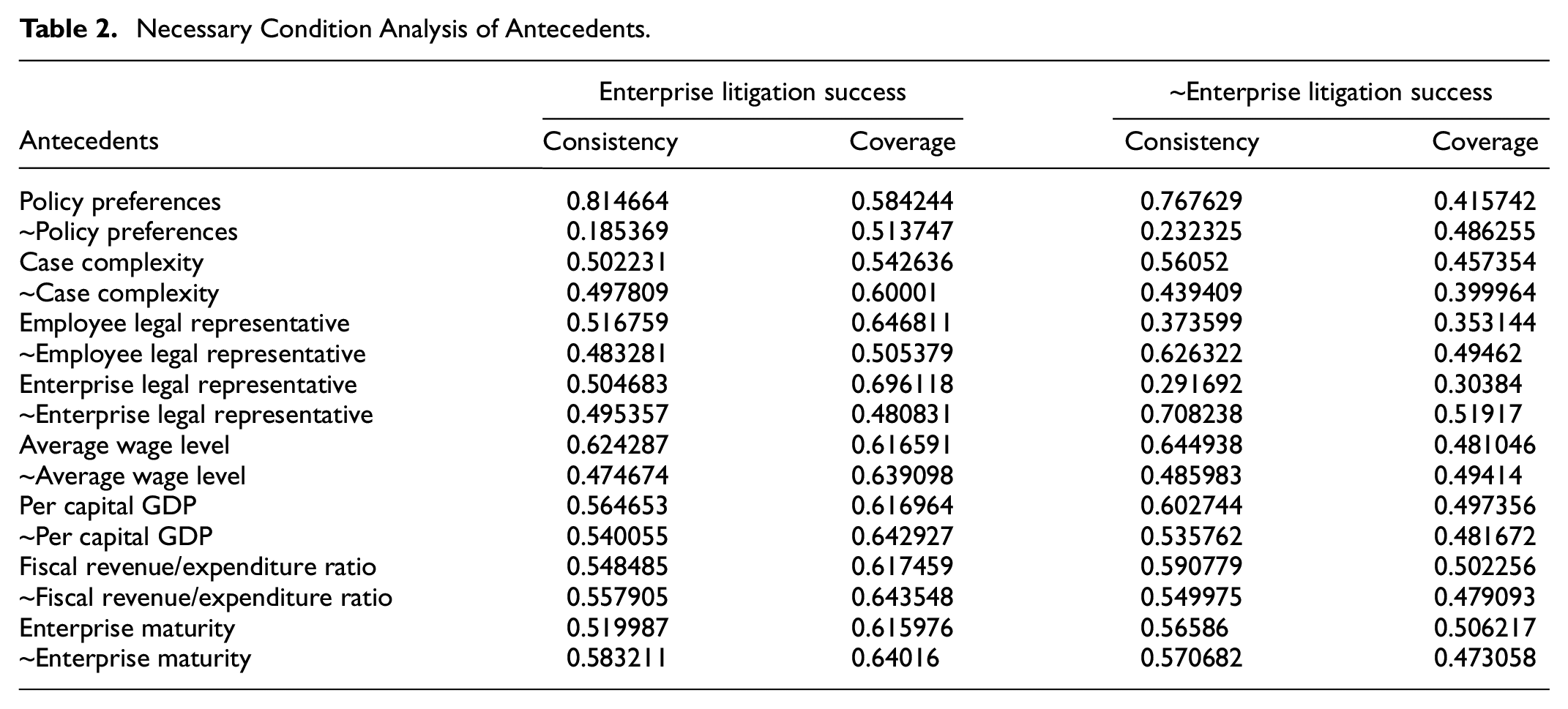
Before conducting the configurational analysis, we first performed a condition analysis of the individual premise conditions. One important criterion for assessing whether a conditional variable is a necessary condition is whether the consistency coefficient is greater than 0.9. If the consistency coefficient of a conditional variable is greater than 0.9, it can be inferred that the condition is a necessary condition for the occurrence of the outcome variable (M. Zhang & Du, 2019).
The results of the analysis showed that no conditional variable alone had a significant impact on company wins in a labor dispute (see Table 2). In consideration of their necessity in our analysis, none of the consistency coefficients of the conditional variables reaches 0.9, indicating that no single conditional variable served as a necessary condition for outcomes. As the data analysis of the sufficiency and necessity for each conditional variable indicated that the explanatory power of a single conditional variable for the outcome variable was insufficient, this underscored the complexity of the factors affecting company wins in labor disputes. Therefore, our next step was to conduct configurational analysis to determine the conditional configurations with the strongest explanatory power for the case outcomes. The impact of economic environment, judicial preference, case complexity, and party capacity on the outcome of labor disputes was also then analyzed.
Necessary Condition Analysis of Antecedents.
Sufficiency Analysis of Conditional Configuration
As no single conditional variable could satisfy the necessary condition criterion of the outcome variable, the impact of different conditional configurations on the outcome variable was explored. Before commencing the analysis, it was necessary to use the software to construct a truth table. In this study, four configuration schemes were considered to have led to a company win in labor disputes: a complex solution, a parsimonious solution, and an intermediate solution were all obtained using the standard analysis method. The complex solution configuration was more complex, while the parsimonious solution may have overlooked important necessary conditions. The intermediate solution, which lies between the two opposite configurations, will generally have the highest representativeness (Du & Jia, 2017). The presentation format used in this study was the QCA result presentation method as proposed by Ragin (2008).
When a conditional variable is present in both the parsimonious solution and the intermediate solution, it can be considered a core condition. If a conditional variable exists only in the intermediate solution, it is considered to be a peripheral condition (Du & Jia, 2017). Therefore, by combining the parsimonious solution and the intermediate solution, we could determine the configurations for company wins in labor disputes. These results are shown in Table 3, with ● indicating the presence of a core condition, ◦ indicating the absence of a core condition, • indicating the presence of a peripheral condition, ○ indicating the absence of a peripheral condition, and a blank indicating the possibility of both an existence or an absence of the condition.
Configurations for Enterprise Litigation Success as Determined by fsQCA.

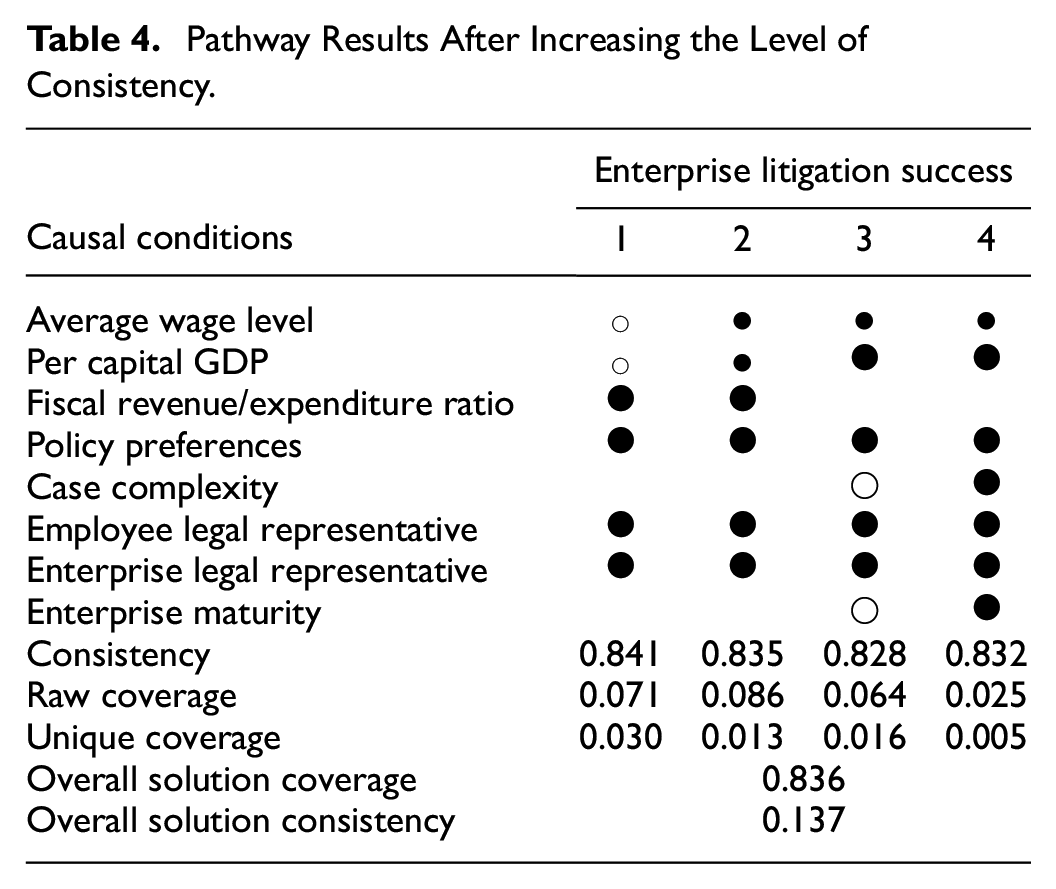
Each column in Table 3 represents a possible conditional pathway configuration. The consistency of all conditional pathways exceeded 0.8, indicating that all cases met the criteria for consistency and that all four configurations were sufficient for company wins. Furthermore, the overall consistency was 0.836, and the overall coverage was 0.137, both of which were higher than the threshold value. As Table 3 shows, there are four conditional pathways which can lead to company wins in labor disputes.
In Pathways 1 and 2, the fiscal revenue/expenditure ratio, local regulations, and legal representation for employees and organizations are the core conditions, while average wage level and per capital GDP are peripheral conditions. In these cases, as the tax burden paid by companies is a main source of local government revenue (Y. F. Zhu & An, 2018), the maintenance of the economic environment by local government becomes more important. Local governments protect the interests of enterprises through the enactment of local regulations, which in turn promotes stability or reduces the fiscal revenue/expenditure ratio, leading to company wins in labor disputes. In situations of information asymmetry, enterprises have more control over information and stronger negotiation abilities than employees. When neither party has legal representation, the company is more likely to win. In these two configurations, per capital GDP and average wage level levels do not play crucial roles. The consistency of these two paths was 0.841 and 0.835, the raw coverage was 0.071 and 0.086, and the unique coverage was 0.030 and 0.013, explaining 7.1% and 8.6%, respectively, of labor dispute outcomes in Guangdong Province. Furthermore, 3.0% and 1.3% of the labor disputes could only be explained by these two paths. As governments have enacted relevant labor and contract laws, employees, as the protected party, have gained increasing awareness of their rights. However, as employees’ awareness of their rights has increased, so too have unreasonable dispute demands. Currently, local governments limit this through the formulation of local regulations which promote stable economic growth, improve the work environment, and encourage harmonious labor relations, highlighting the importance of local regulations and the economic environment on labor dispute outcomes.
In Pathway 3, per capital GDP, local regulations, case complexity, legal representation of both employees and organizations, and enterprise maturity are core conditions, while average wage level is a peripheral condition. In an economic environment with a higher per capital GDP, labor disputes are caused by a single factor, with low enterprise maturity and no legal representation for either employees or enterprises. When conditions such as the application of local regulations are met, the company will win the dispute. This path had a consistency of 0.828, a raw coverage of 0.064, and a unique coverage of 0.016, explaining 8.3% of labor dispute outcomes in Guangdong Province. Furthermore, 1.6% of the labor disputes could only be explained by this path. When enterprise maturity is low, negotiation abilities are weak, with little difference between the abilities of employees and enterprises. Only in a strong economic environment, where local governments apply local regulations more frequently and when case complexity is low, can companies achieve their desired outcomes. Even without legal representation, enterprises can protect their rights.
In Pathway 4, per capital GDP, local regulations, case complexity, legal representation for both employees and enterprises, and enterprise maturity are core conditions, while average wage level is a peripheral condition. In an economic environment with a higher per capital GDP, disputes arise as a result of multiple complex factors, with high enterprise maturity and no legal representation for either employees or enterprises. When conditions such as the application of local regulations are met, the company will win the dispute. This path had a consistency of 0.832, a raw coverage of 0.025, and a unique coverage of 0.005, explaining 2.5% of labor dispute outcomes in Guangdong Province. Furthermore, 0.5% of the labor disputes could only be explained by this path. When enterprise maturity is high, company negotiation abilities are strong, and the organization has a greater informational advantage over the employees. Mature enterprises have standardized corporate systems and, even in complex cases, they can win in labor disputes without legal representation when the economic environment is good and local governments consistently apply local regulations.
Through the above conditional pathways, we found that average wage level, per capital GDP, fiscal revenue/expenditure ratio, local regulations, case complexity, legal representation for employees, legal representation for enterprises, and enterprise maturity are all important factors influencing company win rates. In particular, the condition of local regulations appeared centrally in every explanatory path, highlighting the importance of local government intervention in applying local policies regarding labor disputes, and demonstrating the actual impact of policy preferences on the power dynamics at play between employees and the organization. This also reflects the complexity and interdependence of the factors influencing company wins in labor disputes, which addresses the limitations of single-factor studies regarding the net effect of company wins.
Furthermore, Pathways 3 and 4 also demonstrate the correlation between case complexity and enterprise maturity, as well as their impacts on company wins. Enterprises with high maturity are more likely to have established standardized corporate systems, and when faced with increased dispute demands from employees, they can enhance their negotiation abilities through their own regulations, as well as via local laws and regulations. At the same time, in a good economic environment with a more detailed understanding of local governments’ application of local regulations, enterprises can protect their rights in labor disputes without legal representation, even in complex cases.
Robustness Test
To ensure the robustness of our results, we followed the suggestion of Leppanen et al. (2019) and adjusted the case consistency value from 0.80 to 0.82, and continued to test the four pathway configurations that led to company success in labor disputes. As Table 4 shows, the configuration of our results did not change compared to those presented in Table 3. According to Greckhamer et al. (2018), adjusting the parameters should not have a substantive impact on the quantity, composition, consistency, and coverage of the configurations, that is, our analysis results can be considered reliable, and our results have good robustness.
Pathway Results After Increasing the Level of Consistency.
Discussion
Through configuration analysis, we found that each pre-factor plays a different role in each pathway, and that the interactions between multiple factors at different levels produces differentiated joint effects which can lead to a positive bias for organization in litigation outcome. To further understand the action mechanisms of each pre-factor, this paper combines the statistical characteristics of the pathways and the explanatory logic behind each.
Four pathways were found could lead to enterprise success in labor disputes. In Path 1, when low average wages and low per capital GDP are used as boundary conditions, enterprises can still achieve satisfactory dispute results when the fiscal revenue/expenditure ratio is relatively low, local regulations are applied, and both employees and enterprises have no legal representation. Path 2 is similar to Path 1 except that high average wages and high per capital GDP act as boundary conditions, which can result in enterprise wins in labor disputes under the same aforementioned circumstances. In Path 3, the success of enterprises depends on low case complexity and low enterprise maturity, however through the support of a good economic environment and local regulations, enterprises can overcome their lack of negotiation ability and win in labor disputes. In Path 4, when cases are more complex, enterprises must have a higher level of maturity, and enact internal regulations which comply with the local and national laws and regulations. Then, with the support of a good economic environment and local regulations, enterprises can achieve their desired outcome in disputes.
Conclusion and Implications
Conclusion
Since the implementation of the Labor Contract Law in 2008 and the implementation of the Opinion on Building Harmonious Labor Relations in 2015, China’s judicial system for labor disputes has demonstrated strong capacity as an institutionalized channel for conflict resolution. However, the success rate of employees in labor disputes has declined, while that of enterprises remains low. This zero-sum pattern has deep institutional roots, driven by both economic and political rationales intended initially to help maintain stability, and which continue to have significant impacts. Today, however, conflicts that trigger labor disputes and their outcomes are influenced by a growing number of factors, increasing uncertainty and presenting new challenges for the legal system and labor dispute management. Using fsQCA, this study examined 28,685 labor disputes which occurred in Guangdong Province between 2015 and 2019 to explore the concurrent influences of economic environment, judicial preference, case complexity, and party capability on dispute outcomes, from the perspective of company wins, revealing the core conditions and complex interaction mechanisms at play and expanding the analytical framework of new institutionalism.
Four pathways were found to promote company wins in litigation. Each pathway is driven by both macro-economic environmental and micro-level contextual factors, further validating the new institutionalist perspective that dispute resolution is influenced by a comprehensive model (Brace & Melinda, 1990). Pathways 1 and 2 rely on the fiscal revenue/expenditure ratio as a crucial indicator of economic resilience. A higher fiscal revenue/expenditure ratio demonstrates greater local fiscal investment intensity and poorer fiscal self-sufficiency, indicating relatively poor economic development in the specific region (B. Li et al., 2023). However, local governments can relax regional policies, reduce barriers to market entry, and support the introduction of additional businesses to promote self-sufficiency and achieve steady economic growth (Q. Wang et al., 2022). The rapid increase in the number of private, small- and medium-sized enterprises, as well as intensified market competition, has resulted in companies focusing their efforts primarily on production and operations. Coupled with the limited role of unions in private businesses, the capacity and willingness of organizations to resolve labor disputes has lowered significantly (Li & Cao, 2023). The occurrence of labor disputes, however, creates an “uncertain” organizational environment. To safeguard their own interests, then, enterprises tend to choose to confront their employees in court. To ensure the continuous operation of the local enterprises, the court will make greater effort to uphold the company interests, presenting detailed evidence which favors the enterprises (J. Wang, 2023) or adopting a non-equitable review process to allow enterprises more rights (Chan, 2022). For this reason, enterprises do not necessarily need to seek legal representation, as the court will apply local regulations as required, and within acceptable legal frameworks, to make rulings which are more likely to benefit the enterprise.
In Pathway 3, per capita GDP eliminates the impact of regional population size on the regional economic scale, and thereby reflect the economic situation of a region more realistically. Provinces with a higher per capital GDP are generally more developed, with more standardized avenues for business entry and development (W. L. Wang et al., 2015). As foundational guidance and regulation of business development, regulatory systems are not only crucial action guidelines but also key innovative achievements, especially in the era of rapid technological advancement (Y. J. Feng & Zhang, 2023). Enterprises will actively establish regulatory systems that are in line with their own development plans, and continuously improve them from the perspective of their operations, behaviors which are in fact voluntary by the enterprise, rather than being legal mandates. Enterprises in economically developed regions can also establish basic company regulations to aid in their growth and effectively avoid being in a position of weakness when labor disputes occur. However, employees in these regions do have strong legal awareness (Z. S. Chen & Zhao, 2023), and if a labor dispute does arise within a growing enterprise at this earlier stage, the negotiating capabilities of employees and the enterprise are similar, resulting in the enterprise having no significant advantage over its employees (Y. W. Wang & Wang, 2023). When a labor dispute is not particularly complex, and the focus of the dispute is clear and not particularly controversial, the court will lower the standard for determining fault by the employer (X. S. Zheng & Yuan, 2023), and will use local regulations to conduct a detailed analysis of the case which will often benefit the enterprise.
Finally, in Pathway 4, per capita GDP again eliminates the impact of regional population size on regional economic scale. When labor disputes occur in well-established companies in these regional contexts, the negotiating capabilities between the involved parties differ significantly, allowing enterprises a clear advantage over employees (G. Y. Zhang et al., 2022). As a law created to safeguard the rights and interests of employees, the Labor Law of the People’s Republic of China tends to protect employees. However, when a labor dispute is particularly complex, or when employees are making unreasonable demands, the local courts will turn to the details of local regulations to make a judgment on the case, generally supporting enterprises in labor disputes.
Theoretical Implications
This study makes several theoretical contributions to our understandings of labor dispute resolution. First, this study expands the literature on the enterprise success in labor dispute litigation, providing insights for future research. Our understandings in this area are still in the exploratory stages, particularly regarding the identification of the drivers of successful enterprise litigation, depending largely on theoretical or descriptive statistical data. Y. H. Xie et al. (2023) examined the factors influencing employee success rates in labor disputes, and while their model has received widespread attention, it has been validated primarily using micro-level data.
The current study considered a range of comprehensive factors, including the macro-level economic environment and local government policy preferences, as well as the micro-level factors, such as party capabilities and case complexity, from the company perspective, and interpreted the influences of numerous factors on labor dispute outcomes, adopting fsQCA to allow for the exploration of the linkage mechanism of enterprise litigation success in labor disputes from a configurationally perspective. Based on the new institutionalist perspective, this study performed a deep analysis of how the matching and coupling of multiple factors drives enterprise success in labor disputes, and proposes targeted optimization pathways.
This study fills gaps in the existing research in several ways. First, it reveals the net effects of macro-level social and economic development, labor employment, and grassroots organizational development, as well as of individual factors specific to employees, enterprises, and case characteristics on the outcomes of labor disputes to explain the complexity of these causal factors.
Second, it highlights existing differences between legislation and judicial practices. Previous theoretically-based studies have concluded that “similar cases should be judged similarly” or “the same case should have the same outcome,” but these results have not been verified using data (Sun, 2020). However, this study confirms the selective enforcement of Chinese laws and standards in practical legislative contexts, and that while legislative standards in China are very high, judges do allow more negotiating room between disputing parties in practice, ad that, when there are no clear national legal provisions, this negotiation space becomes even larger. Local government policy preferences and power imbalances between disputing parties also have significant impacts on dispute outcomes. Furthermore, there are also significant differences in economic environments across Guangdong Province, indicating that these differences can also affect courts’ enforcement of national laws, suggesting the likelihood of further deviations in national law enforcement in other Chinese provinces as well. A company’s maturity level and industry were also found to affect labor dispute outcomes.
This study also addresses a research gap in the new institutionalist approach, providing theoretical basis and effective tools for future research. The new institutionalist perspective suggests that case outcomes are determined by several factors, including the local economic environment, policy preferences, case complexity, and party negotiation capabilities (Brace & Melinda, 1990). As such, individual factors alone cannot be regarded as necessary conditions for successful enterprise litigation. The synergistic effect of these numerous factors plays a crucial role in enterprise labor dispute wins, with interactions between factors having a linkage effect on these outcomes.
Practical Implications
This study provides new insights into the improvement of corporate governance, regulation, and management in China, as well as how to promote labor relations stability. In terms of factors influencing litigation outcomes, the likelihood of enterprises winning in litigation can be enhanced in four aspects ways.
First, in addition to adapting to macro-economic policies, enterprise managers should focus on three important economic indicators: per capita GDP, the fiscal revenue/expenditure ratio, and average wage levels (Hu et al., 2022). The quality of the economic environment in which an enterprise operates significantly influences the systemic risks that the enterprise may face, impacting production and business activities, as well as the employees’ work environment (S. X. Liu et al., 2023). Existing literature shows that the frequency of labor disputes tends to rise during periods of economic expansion (Kong, 2016), however enterprises can still win in labor disputes during these times (Ning, 2018). The more comprehensive the pre-risk control, the smaller the negative impact of systemic risks on an enterprise. High-quality internal controls can help management in maintaining awareness of the current economic environment, and help it in adopting effective strategies for the prevention of or response to systemic risks (L. L. Zheng & Liu, 2021).
Second, enterprises should proactively develop and instigate internal regulations which distinguish for employees what is in line with labor laws and what falls outside the scope of the organization’s autonomy; however these internal regulations should be implemented carefully after consulting with government labor departments and labor unions (Y. H. Xie et al., 2023). This can safeguard employee rights while also improving organizational labor management. Disputes between employees and management center largely on inadequate understandings of the laws and regulations, particularly by employees, and by management’s exploitation of employees’ rights through the use of asymmetric information to maximize corporate interests. This is often accompanied by the establishment of unreasonable internal regulations and terms of employment. To encourage stability in labor relations, local governments should review and oversee the internal regulations and labor contracts of all enterprises to ensure employees receive their due rights from the start of their employment. Enterprises are the source of labor disputes, and poor internal prevention, handling, and resolution of labor disputes will lead to an increase in labor disputes requiring external court interventions.
Third, there must be effective enforcement of enterprise regulations. Previous studies have highlighted a large lack amount of tangible evidence presented during labor dispute litigation, as it is often difficult for employees to obtain evidence, and this may lead to judicial injustice (B. Wang & Peng, 2023). However, Article 44 of the “Interpretation of the Supreme People’s Court on the Application of the Law in the Trial of Labor Dispute Cases (I)” notes that the principle of reversed burden of proof shall apply in labor disputes and that this burden of proof in most disputes shall be borne by the employer (Y. J. Feng & Zhang, 2023). Therefore, enterprise managers should formulate and implement internal documentation management systems, to reduce occurrences of omissions and losses to ensure the existence of evidence during enterprise labor disputes so that organizations can address the burden of proof and improve enterprise success rates in labor disputes.
Fourth, government mediation must improve in labor disputes. In the process of judging a labor dispute, the factors which determine the company wins should not only rely on the organization’s negotiation skills or its resource mobilization capabilities. Government should also establish corresponding judgment criteria and refer to past case precedents to protect the basic rights of enterprises, prevent labor disputes from escalating, and promote harmonious labor relations (Qian, 2023). Local governments can promote cooperation and coordination between institutions and establish a labor dispute joint handling system. Furthermore, it should conduct multi-party discussions with the relevant representatives, including judicial players, arbitration, trade unions, lawyers, enterprises, and employees, to address disputes of all varieties, but particularly those entailing with a high level of sensitivity or which threaten stable labor relations, with the aim of achieving dispute resolution not by litigation but through arbitration and negotiation. This would mitigate and/or resolve labor dispute while safeguarding the organizational rights (J. L. Deng, 2010).
Limitations and Future Research
This study does have some limitations which should be addressed in future research. First, this study investigated the relationship between the local economic environment, judicial preferences, case complexity, and party capability, with a focus on company wins in labor disputes. The advantage of this approach is that it could explore the combined impacts of macro-economic conditions and micro-level practicalities on labor dispute outcomes and accurately quantify the influence of each variable on the dependent variable through various pathways. However, differences in regional or industry backgrounds may lead to different variable characteristics, such as in age or employee income. Therefore, future research should adopt different perspectives to determine how to configure antecedent conditions to further enhance company litigation success rates. Furthermore, the impact of additional factors such as labor unions or employee gender on dispute outcomes should also be investigated. Second, although our sample included 28,685 labor disputes in Guangdong Province, time and cost limitations restrict the applicability of our conclusions to other provincial contexts. Future research should expand upon our findings based on data from Guangdong Province, and conduct comparative studies focused on other provinces. Furthermore, the scope should be broadened to include comparisons across different industry sectors to gain a more comprehensive understanding of the characteristics of labor disputes and the factors influencing their outcomes. Third, in terms of our variable measurement, policy preferences and case complexity were only considered as one crucial aspect, which is far from comprehensive in terms of explaining company litigation success. Future research should explore other factors (e.g., number of arbitrators, nature of legal documents, types of claims). Fourth, the data used in this study came primarily from statistical databases and domestically-published financial websites. Using questionnaire surveys and qualitative interviews could surpass database data and allow for the collection of richer data. Therefore, future research should include interviews and questionnaires alone with database data to better examine different viewpoints and to verify our research results.
Footnotes
Declaration of Conflicting Interests
The author(s) declared no potential conflicts of interest with respect to the research, authorship, and/or publication of this article.
Funding
The author(s) disclosed receipt of the following financial support for the research, authorship, and/or publication of this article: Major Project of the National Social Science Fund of China: “Research on China’s Involvement in Establishing New International Labor Standard Regulations” (Project No. 19ZDA136).
Ethical Approval
Not applicable to this study.

Data Availability Statement
Data sharing not applicable to this article as no datasets were generated or analyzed during the current study.