




Abstract
The purpose of this study was to explore the opinions of administrators about the effect of administrator replacement circulation in non-formal education institutions providing adult education on organizational culture. In this qualitative study, ten randomly selected administrators were interviewed using the convenience sampling method. The data were analyzed via the content analysis technique. As a result of the research, most managers think that the institutions providing adult education should be subjected to a different management appointment system than other institutions. While some managers find the organizational change circulation necessary and important for organizational culture, and the preservation and development of the existing culture, some managers stated that changes negatively affect the organizational culture structure. Although there are some differences in opinions among the managers, all managers agree on the importance and provision of the organizational culture in terms of a healthy system functioning in such institutions.
Plain Language Summary
This study aims to reveal the views of administrators working in non-formal educational institutions on administrator rotations in the context of organizational culture. With this study, which was prepared in a phenomenological design, one of the qualitative research methods, it was seen that the administrators of non-formal education institutions could not reach a consensus on the frequent rotation of administrators, although they believe that the administrator of the institution plays an important role in the creation, development and maintenance of organizational culture. This lack of consensus imposes important tasks on policy makers, especially in terms of basing climate indicators on performance and problem focus as a reflection of organizational culture.
Introduction
In the modern sense of education two matters are emphasized; reintegrating every individual into society and developing individual personality traits. If formal education proceeds toward these goals systematically and purposefully in certain educational sessions, then non-formal education is never limited in terms of time and place. The distinguishing feature of non-formal education is that it is an addition, alternative, and/or supplement to formal education within the framework of an individual’s lifelong learning (Kicherova et al., 2022). Non-formal education can be directed and predicted not only with human progress in independent and cultural development but also with the development of the professional and personal skills of adults. Thus, non-formal education institutions providing adult education are also a guide for the development of professional and personal skills of employees of an organization. In non-formal educational institutions, as in organizations belonging to all other sectors, culture is manifested in the importance of social-pedagogical and administrative approaches that examine the function of organizational leaders (Walidin, 2016). Furthermore, organizational culture is considered to be a crucial element for understanding an institution in a variety of circumstances including the motivation that managerial actions create in individuals (Barney, 1986; Cameron & Quinn, 2011; Gordon & DiTomaso, 1992; Marcoulides & Heck, 1993; Wilkins & Ouchi, 1983).
The vast majority of articles in the field of cultural studies discuss organizational culture. Organizational studies focus on leadership applications in organizations, take an interest in numerous facets of social and organizational culture, and employ a variety of group leadership attributes that are crucial for organizational cultures. Since it can be distinguished from social culture, organizational culture has been the topic of extensive research, and numerous models from a wide range of fields have been developed (Meyer et al., 1993; Tsui et al., 2007).
By emphasizing their fundamental roots, certain well-known organizational culture models—which explain how and why social culture differs from organizational culture and are frequently referred to or used by many scientists—offer us hypothetical foundations (Dauber et al., 2012). Numerous publications on strategy and corporate policy, organizational behavior, and theory have frequently investigated the idea that firms might have specific cultures, and specifically schools have also had their share of these efforts. Aside from research showing that the concept of organizational culture lacks a pure theoretical basis, some effort has been made to apply key ideas from cultural anthropology to the field of administration and organization. Thus, the mainstream studies have three aspects: providing a typology of schools of supposed in cultural anthropology, understanding several complex cultural theories that were suggested in this discipline, secondly associating these diverse viewpoints with the existing notions of organizational culture that are explicit or implicit in the administration and organization literature, and thirdly, gathering perceptions and results acquired from studies to suggest a combined idea of organizational culture as a valuable allegory to investigate the worsening, adaptation and fundamental transformation procedures in complex organizations (Allaire & Firsirotu, 1984).
In his model, Schein (1985) divides organizational culture into three sections: assumptions, values, and products. This model offers a framework to review the dynamism of organizational cultures. The cultural dynamics model’s effects on future theoretical development are presented by collecting and analyzing cultural data (Hatch, 1993). In a study that is brief and yet critical research of some organizational culture theories; a historical discussion is created regarding the “appropriate” use of culture theories that are borrowed from anthropology, through drawing baselines of the theories by social scientists who deal with “complex organizations.” The study argues that it is necessary to make a theoretical difference between culture and social form and suggests that it is not likely to analyze organizational life culture in terms of a comprehensive specific concept. The case also ends by suggesting “conceptual instruments” to clarify culture (myths, symbols, intellectual systems, and rituals) and how to work with them in studies (Meek, 1988).
In a survey conducted the impact of organizational culture types on job satisfaction was examined and it was concluded that employees’ job satisfaction levels varied according to organizational cultural typology. Within the conceptual framework of the study, job satisfaction initiated an alignment of cultures on a vertical axis representing the continuity of mechanical processes. Job satisfaction was found to be positively correlated with clan and adhocracy cultures and negatively correlated with environment and hierarchy cultures (Lund, 2003). Thus, organizational culture should be examined based on two very important matters: organizational values are considerably different from domestic or social values and are affected by social values. Personality, values, preferences of organization members, and their realization affect tasks that need proper organizational actions. This interaction should be explained and investigated by an organizational culture configuration model, which makes a distinction between external environmental effects and internal cultural environmental effects. Despite all of the approaches, such a model (Hofstede et al., 1990; Sagiv & Schwartz, 2007) allows the categorization of organizations, gives limited results about organizational procedures regarding organizational values, and does not include instruments regarding the alteration of organizational cultures. Therefore, organizational culture studies are mainly addressed with interrelated structure models such as strategy, structure, and behavior, which are examined with other organizational structures, create another building stone to develop, for instance, a configuration model, and contribute to extensiveness (Dauber et al., 2012). According to Hofstede et al. (1990), these different tasks in the structure models require a distinct organization and implementation of activities, namely different strategies and structures. A production company is considerably different from a service provider, government agency, or private firm in terms of final products and organizational cultures. This arises from the different nature of enterprises, customers, and operational processes. In non-formal education, adult education is particularly different from other educational approaches in remarkable respects, which attracts people’s attention today and makes adult education unique (Jeffs, 2017).
Used synonymously with concepts such as adult education and continuing education, lifelong learning is defined by Candy (2003) as a supportive process of increasing and strengthening knowledge, values, and skills gained by individuals throughout their lives and allowing individuals to apply them in their lives. Aksoy (2008) assesses lifelong learning with an individual, social, economic, cultural, and especially employment-associated approach. In this context, it is defined as formal and non-formal learning activities attended by individuals throughout their lives and documentation of gainings from these activities, to determine their areas of interest and to develop their knowledge-skills-attitudes, behaviors, and competence. Friessen and Anderson (2004) state that lifelong learning includes all kinds of learning, from formal education classified according to age groups to non-formal education; from planned learning to need learning realized randomly and in business life, or to optional learning (Uzunboylu & Hürsen, 2011).
In this respect, adult education is important and necessary in terms of adulthood attitudes. Learning interests and desires of adults are encouraged with course programs, prepared specifically for the needs and areas of interest of adult individuals. These programs also strengthen adult individuals’ belief that they are independent and participative individuals who can still be useful to themselves and to society (Thwe & Kálmán, 2023). The adult population, which increases in the world and Turkey due to the increase in life expectancy, also increases the importance of the aging process and the educational needs of individuals in this process. The primary philosophy of adult education is based on lifelong learning and lifelong productivity. Just like every process of human life, the adulthood process should also be structured significantly. This structuring can only be possible through knowledge and productivity. Studies have revealed that healthy and active aging distinctly increases with knowledge and productivity (Lamb & Brady, 2005). In adult education, it is possible to add meaning to time and quality of life by renovating knowledge and experience systems individually, with the help of lifelong learning philosophy since life satisfaction, quality, and meaning are important for individuals. When individuals renew themselves by finding meaning in their lives and exploring new dimensions throughout their lives, this will create ever-fresh societies. In light of these explanations, adult education can briefly be defined as a development movement from individual to society by carrying aging to the level of behavior and attitude without restricting it with the concept of age. Thus, lifelong education is crucial for the development of societies and active aging and it is required to minimize the replacement circulation of non-formal education administrators for the presence of non-formal education to sustain adult education, formation of a certain organizational culture in non-formal education, and sustainment of that culture.
Unclearness of the boundary between non-formal education and formal education has been demonstrated by the concurrent emergence of non-formal and unofficial processes (Gough et al., 2019). Different educational patterns such as non-formal education and compulsory education shape individuals via personal experiences and enculturation framing cultural expectations and opportunities by shaping the person’s sense of identity. In addition, specialization training should allow individuals to coordinate culture-specific education in such a way as to increase social values (Ferrari et al., 2019). Also, the presence of different organizational culture structures and typologies between non-formal education and formal education institutions in the schools is inevitable. It will obviously be more useful to assess non-formal education providing adult education, within its own organizational culture and nature.
Although it is possible to say that the most important point that stands out in all this information about organizational culture is leadership skills (Kwantes & Boglarsky, 2007), it is a fact that although individuals have duties for the formation of culture (Duarte Moleiro Martins, 2016), the coordination and control of culture building is carried out by administrators (Wolfe & Dilworth, 2015). Therefore, managers, whose central role is very important, have important tasks in terms of the existence and maintenance of culture with their leadership qualities, provided that they remain loyal to the master plans of the organizations (Ramos & Ellitan, 2023). While this puts managers in a key position, it should prevent them from being subjected to situations such as being separated from their organizations and being constantly replaced, except for extreme reasons. Today, however, managers are subject to relocation as well as employees within the scope of rotation. Although many studies have been conducted to conclude the benefits and/or harms of rotation, it is necessary to emphasize the necessity of addressing the issue contextually (Campion et al., 1994; Lortz, 1985; Oberman, 1996; Tschannen-Moran & Gareis, 2007). In Turkey, the “Regulation on the Appointment and Relocation of Educational Institutions Administrators” published by the Ministry of National Education in 2011 introduced rotation for school administrators. With this regulation, which aims to increase the efficiency and effectiveness of school principals and schools, it is envisaged to change the duty places of administrators who have completed 5 years in an institution. However, since the issue of rotation, especially the rotation of administrators, concerns other sectors as well as the education sector globally, it will be evaluated in this study not based on country and local data, but on the basis of non-formal education institutions in general. It is not possible to find studies in the literature that address issues such as whether there are different results in different organizations or whether different motivations arise in different careers. In this study, since the positive/negative aspects of administrator circulation in non-formal education institutions will be discussed, the scope of the study consists of these educational institutions and the administrators working in these educational institutions and the situation will be revealed with their opinions.
Organizational culture and managerial and leadership abilities are closely related when taken into account in the context of management responsibilities. When school administrators, who are seen as competent leaders in the construction of school culture, form the values, beliefs, and behaviors of the school in the development of culture, this link is evident in schools. To establish instructional objectives, ensure harmony and collaboration among staff members and instructors, and promote the school’s mission, school administrators manage organizational culture. While the situation is not different in non-formal educational institutions, it is essential that the educational administrators of these institutions do not turn over frequently to create, manage and sustain the organizational culture. Thus, the study tries to find an answer to the following question:
What are administrator opinions about the effect of administrator replacement circulation in non-formal education institutions providing adult education on organizational culture?
Method
In this study, phenomenological design, one of the qualitative research methods, was preferred. Qualitative methods allow for an in-depth examination of the phenomena experienced by the unit in a study (Creswell & Poth, 2016). Phenomenological research design is a systematic type of study that seeks to reveal, identify, and characterize the constructs of lived experience to reach a richer understanding of the nature of participants’ experiences or their meaning for them (Giorgi, 1994; Van Manen, 2016). The phenomenological study, as can be understood from its definition and function, focus on lived experiences. In this study, although administrative rotation is a situation that has been experienced, the current situation was tried to be explained by referring to the views of the managers who were exposed to this situation. This explanation sheds light on why this study chose the phenomenological design. As a result, a semi-structured interview form was created, and the study’s data were gathered through the interview process.
Sample Group
Managers working in a school providing informal education in the Konyaalti district of Antalya province participated as the sample group in the study. Additionally, convenience sampling, one of the purposeful sampling methods, was used. The reason for choosing the convenience sampling model, which is one of the purposive sampling models, is to include participants who have experienced the current situation and who are thought by the researchers to be able to convey the views on this subject in the best way in both case and phenomenology studies. While no specific participation criteria were sought from the participants, it was deemed sufficient to meet the condition of being an administrator in non-formal education institutions. The participants were coded as P1-P10 by the order of interviewing (Kuş, 2007; Mason, 2002; Patton, 1990; Rubin & Rubin, 1995; Yıldırım & Şimşek, 2016). Investigating the demographic characteristics of the administrators, it was observed that the number of participants according to their gender was distributed equally. The educational background of the participants was mainly undergraduate and above. The majority of the participants had seniority of 10 years and above and they all consisted of senior and qualified administrators working in the same organization for at least 1 year and more.
Distribution of the Participants in Terms of Their Demographic Characteristics
This study will not analyze the demographic information of the participants, but demographic information is also included so that the reader can compare the views of the participants in terms of their demographic information. The distribution of the participants in terms of their age, gender, marital status, educational levels, term of career service, duty, and staff status are present in Table 1, as follows:
Distribution of the Administrators Based on Demographic Characteristics.

Table 1 shows that one-half of the participants were above or below 42 years. Genders were equally distributed and most of the participants were married. The vast amount of administrators working in informal education had a bachelor’s degree. Most of them were staffed and some of them were secondment.
Data Collection Tool
The interview questions were arranged upon the literature review and were re-evaluated by a field expert. These questions were put into final form based on the feedback received from the interview. The interview questions consisted of ten questions. The questions are as follows:
How is the management change circulation evaluated in non-formal education institutions?
What is the effect of this circulation on organizational culture?
How can you describe the effect of circulation? a. What is the effect of management circulation on teacher circulation and organizational culture? b. What are the effects or contributions of the management circulation for students and the indirect effects on organizational culture? c. How is the formation of organizational culture in adult education for adult students?
How is the management circulation evaluated in organizations with an established organizational culture that is embraced by every stakeholder?
How does the appointment of managers appropriate for the nature of adult education affect organizational culture?
In adult education institutions, how should managers be appointed in terms of time and according to which characteristics?
What are the conditions required for managers to create an organizational culture or to get used to the existing culture?
What are the executive behaviors about creating an organizational culture or protecting and developing the existing one?
How should the organizational culture of widespread educational institutions be developed and protected?
What can be the effects and contributions of the managers to this situation?
Before starting the interviews, the administrators were informed about what the organizational culture specific to educational institutions is and what its sub-dimensions might be, and they were asked to answer the interview questions within the scope of this information. The semi-structured interview form asked administrators’ thoughts on teacher leadership in informal education organizations. The study’s purpose was explained to the interview candidates as they prepared, and the administrators who agreed to participate were chosen at random. The researcher simultaneously recorded the interviews and wrote notes. 30 to 50 minutes were spent on each interview. Between May and June 2019, they were held in the workplaces and training facilities.
Data Analysis
In the study, the content analysis method—which entails phases of coding, uncovering themes, and grouping the codes with themes—was used to analyze the qualitative data gathered from the interviews. The researchers typed up transcriptions of the conversations they had while recording the interviews on a digital platform. Following that, all of the study’s data were read repeatedly and coded. According to the study’s objective, several dimensions were formed during the coding process, and pertinent themes were found for each dimension. To ensure the accuracy of the analyses, the interview texts were re-coded by another researcher. For validity and reliability to provide objectivity of good qualitative research (Morse et al., 2002), an agreement was accomplished substantially between researchers and another professional and it was decided that the coding process was completed reliably. Also, the reliability of the reciprocal agreement between codings formed by two independent researchers was calculated using Cohen’s Kappa consistency coefficient in the statistical software (Table 2).
Values Concerning the Cohen’s Kappa Consistency Coefficient.

p < .001.
Examining the Cohen’s Kappa consistency coefficient, as seen in Table 1, it was significant at the level of .87. The Cohen’s Kappa consistency coefficient between values .81 and .1 is regarded as a great agreement (Landis & Koch, 1977). Because of the two researchers’ great agreement in this investigation, it may be concluded that the codings were accurate.
Results
This section includes the results regarding administrator opinions about the effect of administrator replacement circulation in non-formal education institutions providing adult education on organizational culture, as well as interpretations of these results. This section will also try to explain the themes identified by making direct quotations from the participants’ views. Since it is not possible to include the views of all participants, the views that are thought to explain the theme well are included. In addition, attention was paid to include the views of each participant in the same direction as the other participants to be handled holistically.
According to Table 3, the opinions of the managers about organizational culture in non-formal educational institutions providing adult education are listed as follows in the context of themes and questions. Regarding the contribution of the management change circulation to the organizational culture and minimizing the negative effects on the students, P1 stated as follows; First of all, I would like to state that this is a non-formal education institution providing adult education; not a formal education institution. Therefore, it is of prime importance to create a certain organizational culture, especially in public education centers (…) Indeed organizational culture matters to institutions like non-formal education institutions where the order is reestablished every year, more than to all other places. But, if you keep replacing administrators this often or every new administrator demands to leave, it will naturally become more difficult to create organizational culture. Administrators are an organization’s memory. If you replace them constantly, you will destroy the memory.
According to Participant 1’s opinion on manager turnover and the opinions expressed by other participants in this direction, it is possible to infer that managers are the memory of an organization and that manager turnover should be minimized for the formation, development, and maintenance of organizational culture.
Administrator Views on Organizational Culture in Non-Formal Education Institutions Providing Adult Education.
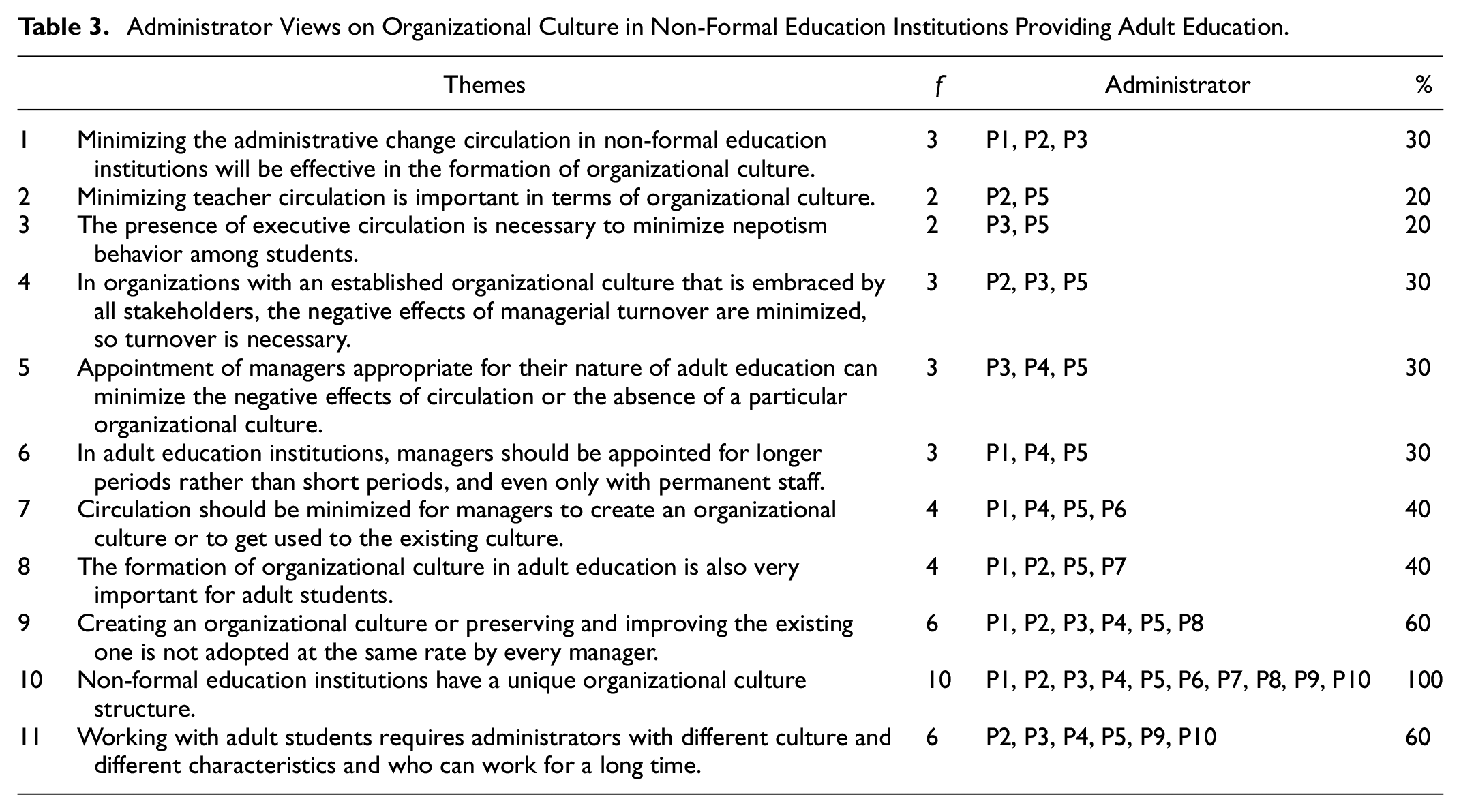
P2 stated that, due to the structure of non-formal education institutions, frequent teacher exchange circulation is an obstacle to the formation of organizational culture with the administrative circulation, but change is necessary in terms of preventing nepotism behavior among students; In non-formal education, teachers are temporary. They are reassigned at the beginning of every term. Assigning colleagues such as the principal and deputy principal to any task at the beginning of every term is like building the institution from the very beginning all the time. (…) However, sometimes there are so many replacements for administrators and teachers that we have our hands tied. (…) Actually, it might be good for adult students. They develop a fellowship with administrators and teachers, which brings along abuse. For example, a student not attending classes comes and requires a graduate certificate at the end of the course, believing that the administration will take care of him due to his age. Or he wants to attend a class from which he has already received a certificate, preventing other people from attending the class. For this reason, it will be better if administrators are replaced often.
Based on this view, it is seen that teachers are subjected to the same or even more frequent relocation practices as administrators. However, unlike the first theme, Participant 2 argued that circulation may be necessary in some cases, especially to prevent situations such as favoritism.
In organizations with organizational culture, P3 stated that circulation is necessary to minimize the negative effects of executive change circulation; Actually, I think administrator replacement is a good thing. We should not fear change. Because if a good organizational culture has been created and sustained by present administrators, there will be no problem at all. What may cause trouble here is that no culture has been created in the institution. (…) Besides, every new administrator may offer something new, which may create a positive circulation. All in all, adult students are constantly replaced as well. They can come here merely for the training they need so badly, due to their age. Therefore, I believe that these pieces of training should be provided in accessible places for adults, rather than in center buildings. At that point, administrator replacement may cause trouble.
P3 addressed the circulation of managers in the context of organizational culture in two different ways within the scope of theme 3. While the participant argued that the culture formed with a systemic approach in order not to affect the existing organizational culture with this two-way perspective would not be affected by the change of managers, he emphasized that a newly appointed manager may experience some incompetence at first. It is understood from this that the existence of a culture that functions as it should does not allow the atmosphere of the organization to be negatively affected even if there is a change of managers.
P4 stated that the appointment of managers suitable for their nature of adult education, minimizes the negative effects of the administrative circulation or the absence of a certain organizational culture. P4 explained this situation with the following opinion: (…) It is a pleasure to work with adult students. They like this order and specific culture of non-formal education as well and thus, they come here willingly. Adult classes continue until 10.00 p.m. As most of them work during the day, they choose evening classes. We stay, too. Therefore it is just like our home here now. It has a certain culture and order. It has to, because Administrators need to feel safe. Fear of changing places all the time will cause unhappiness and failure after a while, which will immediately be realized by adult students and make them feel too uncomfortable and unhappy to continue …
This view of P4 suggests that the change of managers damages the sense of organizational belonging. It can be inferred that this situation has a negative impact on organizational culture about each other.
In adult education institutions, the P5 said that managers should be appointed for a longer term rather than short periods, and even only permanent staff; There are too many waged, contract, and temporary teachers who work with assignments and on top of it, Administrators are replaced too often. As the conditions of non-formal education are better than formal education, it is more open to abuse. It needs to be inspected and followed constantly. Especially evenings and weekend classes are insecure. (…) It will definitely be much better if we create a certain organizational culture. In that way, we can minimize inspection weaknesses. Therefore administrator replacements in non-formal education should be reduced and administrators should be able to see the future and make plans.
P5, while referring to team spirit, a sub-dimension of organizational culture, stated that constantly changing managers would create weaknesses in the organization, especially in an issue such as security, which should be addressed by all stakeholders.
P6 stated that, to create an organizational culture for managers or to get used to the existing culture, the management circulation is minimized if possible; (…) However, I haven’t encountered any school replacing administrators as often as here in this place. Just as a deputy principal gets used to the work, he is assigned somewhere else. So we have to take the process from the top with another deputy principal. For any place to have a certain culture, it takes at least six months. (…) On one occasion, I was informing our new principal about salaries. He found it all so complex that he told me to stop, for he would be leaving soon anyway and there was no need for him to learn those things. (…) Administrators consider themselves temporary, which is interesting. That’s why adult students don’t care about administrators here. They know that they will be replaced anyway. Some of the students don’t even talk to them.
According to P6, a manager needs time both to adapt to the existing culture and to shape the organization within his/her own paradigm. This shortness of time not only results in the lack of these elements related to culture but also prevents the in-house manager from exhibiting managerial characteristics.
Regarding the formation of organizational culture in adult education is of special importance for adult students, P7 said on this issue: (…) When I came here to the course center first, there weren’t even any documents. I assorted all of them and ranged the works and proceedings so that the next administrator would be at ease, proceed according to that order, and add a novelty if necessary. That’s how organizational culture is created and sustained. (…) For example, there is something that I like about adult students. They never care about teacher replacements at the beginning of the term or at the end of the course. Do you know why? Because adult students constantly attending classes, have created an order or a culture regarding the classes. They don’t care whether the teacher is present, absent, or replaced. They go to the classes on time and begin to work on handicrafts, wood painting, mosaic, computer, needlecraft, etc. If you happen to pass by the door, you might think there is a teacher inside. Unless you check yourself, you won’t even know that there is no teacher. Because they work with pleasure. They have nothing to do with anyone else. They are really happy.
According to P7, the existence of an organizational culture can even make managers invisible after a certain period, regardless of manager rotation. In this respect, the creation and maintenance of organizational culture is important for non-formal education institutions.
P8 stated that creating an organizational culture or protecting and developing the existing one is not adopted and taken into consideration by every manager at the same rate and even some negative situations related to this in non-formal education; Organizational culture always reminds me of something like organizational memory. When I first came to non-formal education, I found it strange how former administrators had reset all their data in the computer, left documents and files in chaos and the instructions regarding the process weren’t in place. (…) I think it damages organizational culture a lot. Administrators doing it actually force us to learn it all from the beginning and have a hard time. (…) What matters is to be permanent in your job both in the present and in the future. The administrator to replace you should say that “manager had built such a good system. Bravo! May God bless his hands. I will also contribute so that we will have developed something together.”
P8 indicates the importance of maintaining the organizational culture and provides clues about what managers can do to at least reduce the negative aspects of rotation, even though rotation is a reality.
P9 stated that the non-formal education institutions have a unique organizational culture structure and the issues that managers should be especially careful about, which will be displaced in the management circulation; I think organizational culture is a really important matter. We used to have a principal here at first. The applications are still conducted according to his methods. Indeed, other public education centers consult us regarding the applications. People even call from outside the province and we share our methods with them. This is a source of pride for us. Especially non-formal education institutions have a different functioning. They are not like formal schools. Formal education has certain rules and everyone obeys them. Even an unfamiliar person can adapt easily. You know, the bell rings and the class starts. There are certain programs and days. (…) Informal education, however, is different. Every informal education institution varies according to the conditions of the place. They all have different applications. Although they have some certain basic similarities, they are different from each other in general. Therefore I think every informal education institution has a unique organizational culture.
According to P9, since non-formal educational institutions do not have a formal structure or functioning like formal educational institutions, the importance of organizational culture is even higher in such institutions. In addition, keeping up with the organizational culture of such institutions is not as easy as it is in formal educational institutions. From this point of view, it would be appropriate to emphasize the importance of the manager for non-formal educational institutions for the culture to spread within the institution.
P10 stated that working with adult students requires being together with students with different cultural characteristics and having a strong organizational memory and culture; As a habit of formal education, I used to think that every non-formal education institution was the same. I attended a training organized by the Ministry for non-formal education institutions and realized that every institution had its own peculiar style of functioning. At first, I found it really strange, but now I feel like it is an advantage and even richness. Those who are assigned for the first time may find it a little strange, but then everyone begins to love non-formal education institutions. No one wants to leave. Because they have a unique organizational culture. What actually makes this place attractive is that you can spend time with adults and learn new things constantly …
From P10’s views, it is understood that non-formal education institutions have a distinctive structure compared to formal education because they provide education in very different and specific fields; this structure reveals the necessity of going beyond the routine and having a culture specific to each institution.
Looking at the opinions of the administrators in general, most managers think that the institutions providing adult education should be subjected to a different management assignment system than the other institutions. While some managers find the organizational change circulation necessary and important for the formation of an organizational culture or for the protection and development of the existing culture, some managers have expressed their opinions that the frequent circulation change negatively affects the organizational culture structure. Although there is no consensus among the managers on the subject of little change, all managers agree on the formation, protection, and continuity of the organizational culture to function properly in such institutions.
Conclusion and Discussion
Current studies on organizational culture can be combined under two themes. On the one hand, management organizations encourage one-sided emotions, where all participants accept and maintain common values. Alternatively, other studies have identified organizations as potentially divided areas of interest using collective values for field benefits. Multiple comments can be made about organizational actions and procedures. This causes some generalizations that suggest that organizational culture is defined by the restriction processes, especially between intra-group interests (Young, 1989). According to the findings obtained from the interviews, it is noteworthy that, although the managers see the organizational culture as an important variable for the institution, there is a disagreement between them regarding the management change circulation. However, it was observed that this disagreement did not diminish the influence of managers on the formation, change, and maintenance of organizational culture, on the contrary, it increased it.
In another study, the effects of organizational culture on organizational performance, the examination of these dimensions of culture and its effect on the organization are considered to be especially valid for leaders accountable for the execution of organizational culture. (Onken, 1999). According to the managers working in non-formal education, preserving and developing the organizational culture of the existing institution is among the tasks expected from the managers. This situation plays an important role in the continuation of the existing culture by preventing the adaptation process of the new manager from becoming difficult. It is thought-provoking to try to influence negatively. In a study comparing the organizational culture perceptions of newcomers with those of managers and teachers, the cultural characteristics and perceptions of newcomers revealed two dimensions of organizational culture: For managers, achieving a goal creates anxiety and worry. The results revealed that newcomers’ anxiety was related to organizational commitment and organizational goals (Van Vianen, 2000). However, in another study, culture may become a vicious circle that prevents change, unless the culture-allowed alternatives are suitable for new studies and goals. (Gagliardi, 1986). This view supports the views of managers who support management change to increase productivity and development in the study.
Consequently, when the opinions of the managers are considered in general, most managers think that the institutions providing adult education should be subjected to a different management appointment system than other institutions. In a similar study, it is emphasized that non-formal educational institutions should be designed according to their nature and managed accordingly (Lohmeyer, 2019). Some managers have stated that the formation of organizational culture or the preservation and development of the existing culture is also important for adult learners. Merriam and Baumgartner (2020) recommend integrating the existing rapid changes into learning by preserving organizational consistency and organizational memory for adult learning. Similarly, although there is no consensus among managers about the circulation of managers, all managers agree with regard to the future of lifelong learning activities and the formation, protection, and continuity of organizational culture. Similarly, recent studies focus on the dynamic relationships between the growing importance of lifelong learning and the devaluation of adult education in national education policies, plans, and programs, arguing that adult education has lost its basic and traditional learning ecology. The findings, which also emphasize the dynamics of organizational culture, are based on (1) the transformation in educational reforms; (2) the blind acceptance and misunderstanding and evaluation of lifelong learning as an education; (3) the fragmentation of the reforms in the renewal of adult education in recent years in educational programs and its separation from institutional integrity (Mandal, 2019).
This study includes the views of school administrators on administrator rotation in non-formal education institutions in the context of organizational culture. Based on the findings of the study, it is an undeniable fact that the rotation of school administrators, who have an important role in the formation, development, and maintenance of culture, has negative effects. However, this result is not valid for exceptional cases such as institutions where there are people who do not have developed managerial skills. Based on the fact that no administrator will have a negative opinion about their “management skills,” educational policymakers have a great deal of work to do for important issues such as administrator rotation. Among the first recommendations that can be given to practitioners are separating the well-equipped managers from the ill-equipped ones; determining the climate in the institutions as a reflection of the culture; analyzing the training outputs and replacing the managers according to the results of the analysis, and even directing them to in-service pieces of training in order not to lose the existing human resources before the replacement.
Footnotes
Declaration of Conflicting Interests
The author(s) declared no potential conflicts of interest with respect to the research, authorship, and/or publication of this article.
Funding
The author(s) received no financial support for the research, authorship, and/or publication of this article.

Data Availability Statement
Data sharing not applicable to this article as no datasets were generated or analyzed during the current study.