




Abstract
Does the adoption of digital media platforms affect the success of environmental movements? We address this question by using a representative sample of environmental non-governmental organizations (ENGOs) from Hong Kong and examining the linkages between their digital media adoption and reach and their level of success. Guided by the agenda setting theory, we test whether the digital strategies are related to the shifts in the media and government agenda from 2007–2018. Our findings show that the adoption of digital media contributes to ENGOs’ own media visibility and specific issue salience in the news media agenda, and that the extent of digital reach of ENGOs is also associated with ENGOs’ visibility in the news media. Furthermore, although we find no direct relationships between the digital adoption and the government agenda, we argue that the legislative processes on biodiversity and green energy issues in Hong Kong suggest a pattern of mutually reinforcing interactions between the media agenda and the policy agenda. It is therefore likely that digital strategies contribute to policy changes indirectly, that is, by increasing issue salience in the local news media.
Introduction
This study aims to analyze the strategies and efficacy of environmental civic groups in Hong Kong in light of the adoption of digital communication technologies between 2007 and 2018. The economic success of Hong Kong and the nearby region of Guangdong Province in China over the past decades has accelerated environmental problems, including serious air and water pollution, and triggered a waste management crisis. In recent years, a growing number of Hong Kong citizens have become aware of environmental issues, and numerous environmental non-government organizations (ENGOs) have been established since the 1990s (F. L. F. Lee, 2016). These ENGOs, fighting against environmental degradation and pushing for legislative amelioration, have played an important role in environmental conservation efforts (Chiu et al., 1999).
There is a legacy of research on social movements prior to the rise of digital technologies which has provided valuable insights into how these groups function and which strategies are most successful (e.g., Gamson, 1975). Over the past decade, we have seen the rise of social movements that rely heavily on digital technologies, affecting the issues related to access, mobilization, organization, and framing of the protest narratives (Dolata & Schrape, 2016; Garrett, 2006). By facilitating online engagement and offline protest mobilization, digital technologies enable social movements to scale up quickly and effectively (Hensby, 2017). As digital tools are often used by ENGOs to advance their claims and achieve their goals (e.g., Dolata & Schrape, 2016; Postill, 2014), we focus on the effectiveness of going digital as a strategy for ENGOs. Such an approach is needed not only to further the development of social movement theories, but also for generating policy insights relevant to the contemporary Hong Kong environment characterized by an increasingly visible political polarization and conflict.
Specifically, we focus on the digital strategies of ENGOs in Hong Kong and aim to explore whether and how the use of digital platforms contributes to their success. By doing so, this study intends to make two contributions to the literature on social movements and digital media. First, previous studies of social movements have predominantly used the case study approach and have mainly focused on the mobilization and protests, rather than on the outcomes (e.g., Bennett & Segerberg, 2013; Costanza-Chock, 2012). To fill this gap in research, we opt for a systematic examination of the implications of digital media deployment on movements outcomes, going beyond case-based evidence and providing a more empirically robust framework for understanding the political and social effects of digital media on the landscape of environmental politics in Hong Kong.
Second, as previous studies consider media coverage (e.g., Andrews & Caren, 2010; Corbett, 1998; F. L. F. Lee, 2016) and/or policy changes (Burstein, 1991; Cress & Snow, 2000; Gamson, 1975) as the desired outcomes of social movements, this study uses the theoretical lens of the agenda setting theory to evaluate the success of ENGOs at both social (i.e., media agenda) and political levels (i.e., policy agenda). Finally, and most importantly we also investigate the cumulative outcomes on policy establishment by collecting longitudinal data from 2007 to 2018. By doing so, we aim to enhance our understanding of the power relations between different stakeholders, and especially how and to what extent digital media may empower ENGOs in Hong Kong to develop their environmental discourse and exert social and political influence.
Literature Review
Social Movements in the Digital Era
The widespread diffusion of digital media technologies has potentially benefited social movements by lowering the threshold for citizen participation and increasing the speed and efficiency of information dissemination, mobilization, and organization. The functionality of digital media affords the efficient collection and distribution of information that was unheard of under earlier technological regimes (Castells, 2009; Hensby, 2017). More recently, the adoption of social and mobile media platforms has significantly transformed social connectivity among citizens (Ling, 2017), providing real-time text, audio and video-based communication and allowing for more individualized and personalized forms of collective action (Rojas & Puig-i-Abril, 2009; Tufekci & Wilson, 2012). Societal problems and environmental degradation can activate “networks of outrage” that mobilize and engage millions of citizens (Castells, 2012). With the development of digital media, social groups are now able to find ways in which they mobilize and build coalitions (Hajnal, 2018).
There has not been much research about the use of digital media by social movement groups in Hong Kong until recently. However, the Umbrella Movement’s actions involved participants coordinating and mobilizing themselves with the extensive use of digital media, mirroring earlier grassroots movements in the United States (Costanza-Chock, 2012), which prompted more research on this issue. F. L. F. Lee and Chan (2016), for instance, examined how participants in the Umbrella Movement used various kinds of digital media to construct their own individualized mode of participation in the movement. A. Y. L. Lee and Ting (2015) examined how a prominent student activist group in Hong Kong, Scholarism, utilized new media platforms for organizing their protest campaign. P. S. N. Lee et al. (2015) argued that social media constituted an insurgent public sphere through which political opposition is articulated and cultivated. In addition, F. L. F. Lee (2018) also suggested that online alternative media consumption is closely related with public support for radical social movement goals and tactics. Tsui (2015) however warned that the online sphere in Hong Kong is becoming increasingly subjected to surveillance and control by the government, which casts doubts on the emancipatory potential of digital media. Still, it is important to note that the research focusing on longer-term impact of digital media on social movements in Hong Kong has largely been missing, as most attention has been devoted to the issues of mobilization and participation in protests and events, rather than the cumulative results of civic action over time.
A Systematic Review on Digital Media, Agenda Setting and the Success of Social Movements
Getting their messages into the media and political agendas is a crucial goal for NGOs (Meriläinen & Vos, 2011). To understand how environmental organizations exert influence at both social and political levels, we adopt the agenda-setting theory to examine the influence of ENGOs. The theory of agenda setting postulates that there is a clear connection between the amount of media coverage given to issues and the level of importance assigned to these issues by audience (McCombs & Shaw, 1972). As it suggests, the press plays an important role in setting public agenda, which in turn could affect political agenda. More recently, the interdependence between the media, public and political agendas has been noted by researchers (Young & McCarthy, 2009). For instance, Uscinski (2009) proposes the concept of audience-driven framework in which the general public influences the media. More specifically, the public can influence the media agenda through expressive behaviors on social media platforms (Wallsten, 2007).
By offering greater visibility and opportunities to make direct connections, social media enable NGOs to approach journalists in an effort to get their issues on the media agenda. When organizations use social media to organize events, initiate campaigns or elicit public discussion of specific policies, they aim to increase public awareness and serve as information sources for journalists (Meriläinen & Vos, 2011). From this perspective, digital platforms offer NGOs an important public space to discuss policy issues and subsequently influence agenda setting. As ENGOs often aspire to make their issues visible and worthy of attention, our study aims to assess the effectiveness of their social media adoption and strategies in influencing the media agenda and political agenda.
First, media coverage of social organizations is often considered as a desirable outcome by the organizations, reflecting the NGO’s ability to influence media agendas (e.g., Amenta et al., 2012; Andrews & Caren, 2010; Evans, 2016; F. L. F. Lee, 2016; Valentim, 2019). The frequency of an organization’s presence in the news media coverage can indicate the level of social recognition and legitimacy that an organization is perceived to have (Andrews et al., 2010). The organizations with a strong media presence are more likely to be in the mind of the public, leading to higher levels of organizational trust and social support (Valentim, 2019; Yang & Kent, 2014). Previous studies have found that several sets of factors may contribute to the level of media attention received by social movement organizations, such as their organizational capacity (Gamson, 1975; Rohlinger et al., 2012), movement issues (Andrews & Caren, 2010), and other contextual factors (F. L. F. Lee, 2016). Recent research emphasizes the value of digital media in promoting organizational visibility in news media (Zhang & Skoric, 2019). Because online sources enable journalists to gather information in a convenient, cheap, and effective way, journalists increasingly use social media and websites as information sources when researching for their articles (Tylor, 2015). Digital media give easy access and provide a new communication platform for newsgathering, changing the journalistic news production process (Lecheler & Kruikemeier, 2016). From the perspective of online sourcing, news websites, especially social media platforms, serve as important inspirations for journalists to develop news stories. Therefore, journalists tend to maintain close relationships with digital sources that allow them to quickly access information and conduct analyses (Andrews & Caren, 2010). Because news media are also likely to highlight certain issues when reporting activities of ENGOs, this study will examine both organizational visibility and the environmental issue salience in news media. We are thus assessing the capacity of environmental organizations to get their names recognized, as well as to increase visibility of specific environmental issues that they advocate.
Second, given that the agenda setting theory also emphasizes the influence on political agendas, and that the ultimate goal of social movement organizations is usually to bring about broader social and policy change, we also analyze the outcomes in the policy domain, including the salience of environmental issues in the government agenda, as well as the development of environmental policy and legislative enactment (Burstein, 1991; Laumann & Knoke, 1987; Rajão & Jarke, 2018; Thörn & Svenberg, 2016). To solve environmental problems, ENGOs try to get the authorities to pay attention to specific environmental issues and seek specific policy changes (Gamson, 1975; Kingdon & Thurber, 1984). Environmental problems are more likely to attract politicians’ attention when ENGOs have more resources and greater capacity to launch their appeals credibly and persistently (Burstein, 1991). Recent studies suggest that it has become easier for social organizations to gain recognition from the government because of the empowerment afforded by new communication technologies (Y. W. Chu & Tang, 2005; Howard & Parks, 2012). For instance, the environmental issue of air pollution is more likely to gain government attention when it is frequently stressed by ENGOs in their social media platforms and further diffused by their numerous followers and other citizens sympathetic to the cause. A more recent study further demonstrates that it is more likely to make local government tackle environmental issues by increasing the visibility of public appeals to the regulators on social media (e.g., social media posts with more “likes” and “shares”) in China (Buntaine et al., 2022). Furthermore, policy domains are typically constructed by a diverse range of organizations and stakeholders concerned with specific issues, which interact with each other and formulate policy options (Laumann & Knoke, 1987). Therefore, social organizations, as well as the relations among them, can exert significant influence on public policy (Burstein, 1991). Based on the above, it is necessary to go a step beyond simply measuring media visibility to assess whether social movement organizations have brought about changes in the government’s political agenda and influenced the legislative process.
ENGOs in Hong Kong and Their Digital Strategies
The environmental movement in Hong Kong was underdeveloped until the 1990s, when numerous environmental NGOs were established (F. L. F. Lee, 2016). As explained by Lai (2000), in the 1990s, the Hong Kong government and corporations started to cooperate with ENGOs and provide them with financial support for conducting green projects. The increasing resources and opening of political opportunities in Hong Kong have led to the growth of ENGOs. Since the late 1990s, new ENGOs have taken a more active and confrontational approach, protesting against pollution and pushing for legislative changes (Chiu et al., 1999).
Under the “One Country, Two Systems” policy, Hong Kong has generally preserved its unique socio-political environment, retaining a high degree of autonomy from the Mainland Chinese authorities. The city has a vibrant civic scene and is home to a number of NGOs (Y. W. Chu & Tang, 2005). ENGOs, as one of the most active type of NGOs in Hong Kong, vary tremendously in resource levels, orientations, and strategies (Chan, 2008). For instance, their concerns range from specific topics such as clean air and plastics reduction, to the more general issues of sustainable development and green living (F. L. F. Lee, 2016). They adopt both moderate strategies such as public education and mass campaigning, as well as more radical approaches such as protests to achieve their goals (Chan, 2008). Digital platforms have helped social organizations mobilize resources and organize collective action. For instance, the most popular social media WeChat is used by environmental NGOs to have action-oriented communication with publics, which spurs public involvement in environmental issues in China (Xu & Zhang, 2022). Empirical studies conducted in Hong Kong demonstrate the important role of the internet in cultivating a green culture (e.g., Y. W. Chu & Tang, 2005; F. L. F. Lee, 2016). As a feature of “post-modernist” movements, ENGOs in Hong Kong rely heavily on new media for communication and mobilization. For instance, in the plastic-pellet-picking campaign in 2012, several ENGOs in Hong Kong helped create the “pellet patrol” website, sharing updated information, coordinating citizens’ actions, devising long-term solutions and sustaining collective actions (F. L. F. Lee, 2015, p. 320). In fact, the internet has provided channels for ENGOs to launch online signature campaigns and e-mail petitions, which have become powerful media strategies (Y. W. Chu & Tang, 2005). With the widespread media coverage, ENGOs are given more power to influence public policies. This study, therefore, intends to understand the role of digital media in promoting the success of ENGOs in Hong Kong. In particular, we look into both the quantity (i.e., how many digital media platforms are adopted by an ENGO) and the quality (i.e., how much influence an ENGO has gained online) of digital media deployment by ENGOs.
First, we examine whether the adoption of digital media may predict the outcomes of environmental movements. Previous studies have suggested that various internet platforms, including Facebook, Twitter, and YouTube have shifted the power balance in favor of ordinary people and social movements, and thus helped foster democratic development (e.g., Auger, 2013; Trottier & Fuchs, 2014). Based on the extant research, this study expects that:
H1: The adoption of digital media platforms is positively associated with (a) organizational visibility in the news media, (b) issue salience in the news media, and (c) issue salience in government policy agenda.
Second, we focus on the extent of digital reach of ENGOs, which can be measured by the number of followers and engagement of those followers. As mentioned by Chen and Fu (2016), recruiting followers and soliciting their engagement with organizational messages are two fundamental objectives of organizational communication online. In this sense, the follower-network size and the followers’ participation, that is, digital reach, may reflect the source’s social media presence and influence (Hutto et al., 2013). Thus, we expect that:
H2: Digital reach is positively associated with (a) organizational visibility in the news media, (b) issue salience in the news media, and (c) issue salience in government policy agenda.
Method
Data
Data Source
In order to analyze the content of the news media coverage and government policy agenda, the current study used data from two sources: the Factiva database and the News Archives of the Hong Kong Government. Factiva database covers almost all Chinese and English newspapers in Hong Kong, providing a comprehensive dataset of media coverage for this study. The News Archives anchored in the website of Information Services Department of the Hong Kong government is another data source in the study. The News Archives store all press releases issued by the Information Services Department (ISD), the branch of the Hong Kong government responsible for enhancing public understanding of government policies, decision, and activities since July 1, 1997. Press releases typically focus on specific events and issues, and describe the government’s positions, plans and activities, which all serve as good indicators of the government agenda.
ENGOs and Sampling
To provide a representative sample of ENGOs in Hong Kong, this study adopted the NGO directory released by the Hong Kong government in 2018 and identified 240 ENGOs based on their names. We randomly sampled 48 ENGOs through systematic sampling. In detail, we first alphabetically ordered the ENGOs in the database, and set the sampling interval as 4, selecting one out of every 5 ENGOs. The unit of analysis is an ENGO.
Coding Scheme
Predictors
Digital Media Adoption
This measure indicates whether an ENGO has a website, a YouTube channel, and a Facebook profile. It was coded into three categories, with 0 = no adoption of digital media (n = 22), 1 = adopted one type of digital media (n = 13), and 2 = adopted more than one type of digital media (n = 13).
Digital Reach
This was measured by the average number of followers and likes on an ENGO’s Facebook page (Chen & Fu, 2016). It was coded into three categories, with 0 = no community (no use of Facebook, n = 26), 1 = small community (the average number of followers and likes less than 1,000, n = 11), and 2 = large community (the average number of followers and likes larger than 1,000, n = 11).
Outcome Variables
Media Visibility of ENGOs
This variable was measured by counting the number of media articles that mentioned the name of an ENGO (M = 63.9, SD = 289). In detail, we searched for each ENGO’s name in news reports in the Factiva news database over 2007–2018 and identified each article that referred to any of the 48 organizations. Next, we coded it into three categories, including no coverage (n = 22), low level of coverage (i.e., the number of media articles ranges from 1 to 5, n = 13), and high level of coverage (i.e., the number of media articles is larger than 5, n = 13).
Issue Salience in Media Coverage
This variable measures the extent to which an environmental issue was mentioned by the news media. First, we developed a keyword list by perusing environmental news coverage, and four main environmental issues were identified. They include general environmental concerns (including eighteen keywords, such as environmental protection, nature conservation and ecological protection), biodiversity (including eleven keywords, such as animal protection, marine conservation, and million forest), green life and green energy (including nineteen keywords, such as climate change, renewable energy, and air pollution), and waste recycling (including eleven keywords, such as plastics recycling and kitchen waste recycling). Second, we counted the number of articles published in news media that mentioned at least one from the list of “environmental keywords.” Then, we ranked the four environmental issues according to the number of media articles mentioned them, with general environmental concerns (n = 30,749) and green life and green energy (n = 47,186) being the two most mentioned issues, and waste recycling (n = 3,396) and biodiversity (n = 14,875) being the two least mentioned. Accordingly, the two most mentioned issues were coded as “2 = high issue salience,” and the two least mentioned issues were coded as “1 = low issue salience.”
Issue Salience in Government Policy Agenda
This variable measures the extent to which an environmental issue (i.e., general environmental concern, biodiversity, green life and green energy, and waste recycling) was mentioned in government policy agenda. First, we searched for articles published in Hong Kong government press releases that mentioned at least one from a list of environmental keywords. Then, we ranked the four environmental issues according to the number of articles. As the result, general environmental concerns (n = 926) and biodiversity (n = 969) were the two least mentioned issues, while waste recycling (n = 1,063) and green life and green energy (n = 1,320) were the two most mentioned issues. Next, the first two most mentioned issues were coded as “2 = high issue salience,” and the last two issues were coded as “1 = low issue salience.”
Results
Digital Media Adoption and the Influence on Media Agenda and Policy Agenda
After conducting a content analysis of media reports and government press releases, Chi-square test was employed to examine the relationships between digital media adoption and NGOs’ media visibility (H1a), issue salience in media agenda (H1b) and in political agenda (H1c). The result shows that digital media adoption is significantly associated with media coverage of ENGOs and issue salience in news media. As predicted by H1a, ENGOs with no digital media adoption tend to receive less media coverage, while those with multiple digital media adoption are more likely to be covered by the news media (see Table 1). In a similar way, digital media adoption shows a significant association with issue salience in the news media coverage (H1b; see Table 2). Specifically, ENGOs which adopt multiple digital media platforms tend to achieve higher issue salience in the news media, while those reluctant to adopt digital media tend to achieve lower. However, digital adoption does not have a significant relationship with issue salience in government policy agenda (H1c; see Table 3). Therefore, H1a and H1b are supported, whereas H1c is not.
Digital Media Adoption and ENGOs’ Media Visibility (N = 48).

Note. χ2 = 14.5, df = 4, p < .01.
Digital Media Adoption and Issue Salience in Media Coverage.
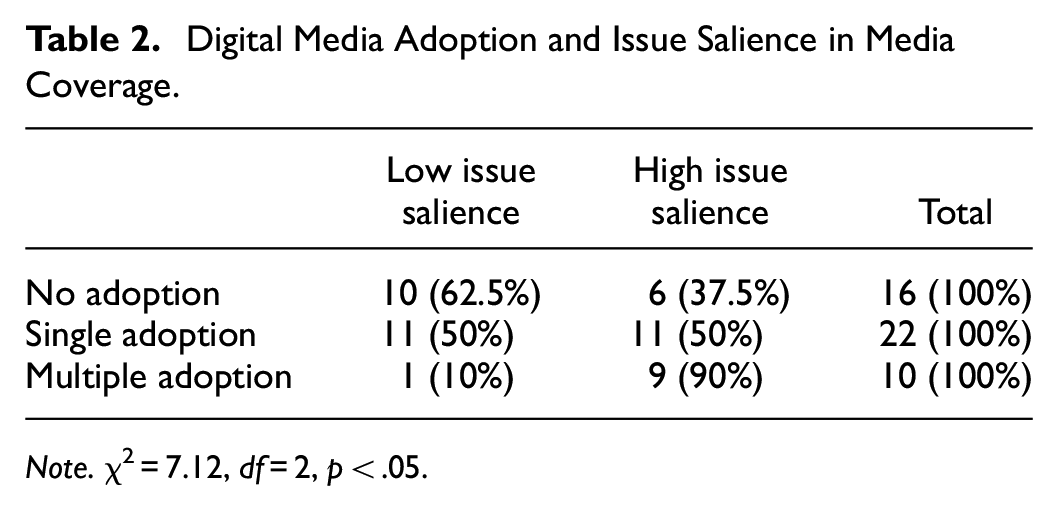
Note. χ2 = 7.12, df = 2, p < .05.
Digital Media Adoption and Issue Salience in Government Policy Agenda.
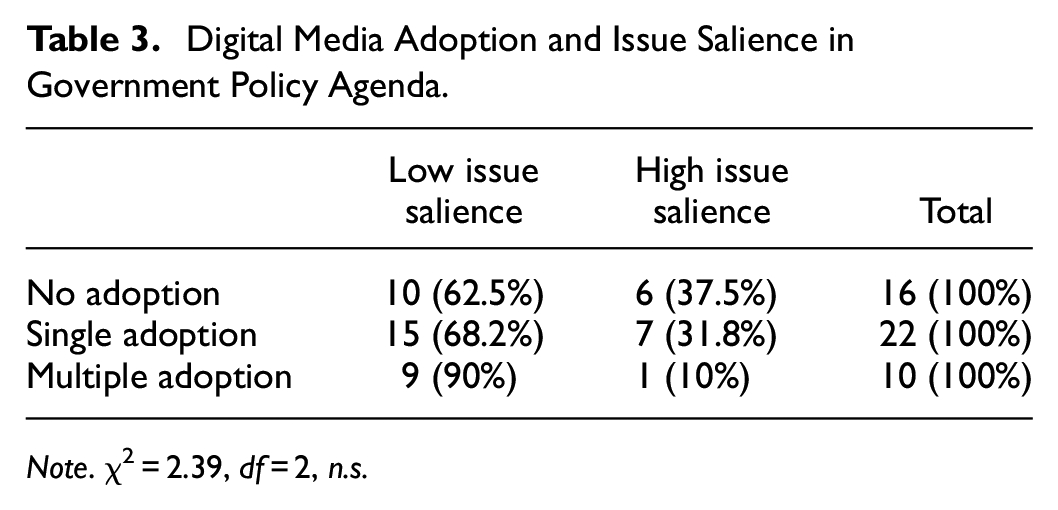
Note. χ2 = 2.39, df = 2, n.s.
Digital Reach and the Influence on Media Agenda and Policy Agenda
In order to assess H2, Chi-square test was used and the results were shown in Tables 4 to 6. The results in Table 4 demonstrate that digital reach is significantly associated with media visibility of ENGOs (H2a). In detail, ENGOs which have larger online communities tend to receive more media coverage, whereas those with smaller communities tend to receive less media coverage (see Table 4). However, digital reach does not show a significant relationship with issue salience in news media coverage (H2b; see Table 5) nor in government policy agenda (H2c; see Table 6). Thus, H2a is supported, while H2b and H2c are not.
Digital Reach and ENGOs’ Media Visibility.

Note. χ2 = 17.4, df = 4, p < .01.
Digital Reach and Issue Salience in Media Coverage.
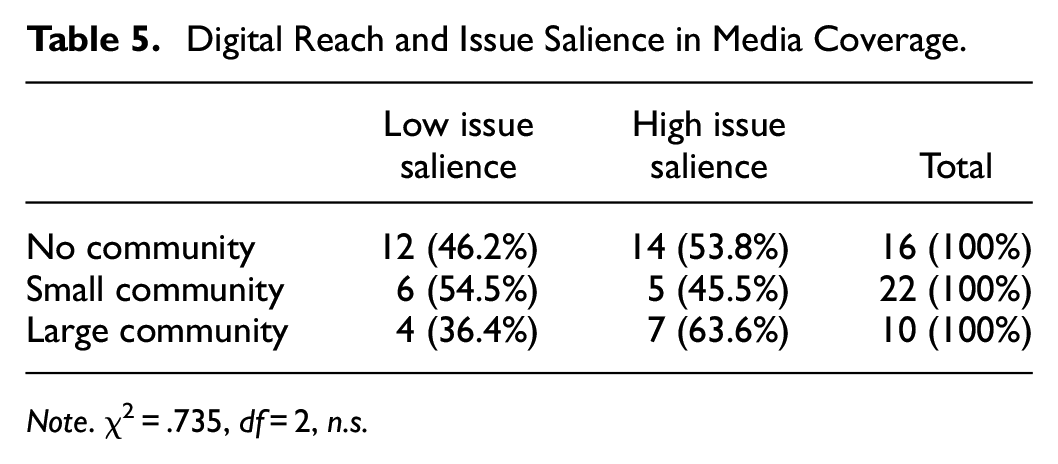
Note. χ2 = .735, df = 2, n.s.
Digital Reach and Issue Salience in Government Policy Agenda.

Note. χ2 = 3.25, df = 2, n.s.
Cumulative Influence on Legislative Outcomes
As the enactment of environmental laws is indicative of the effectiveness of ENGOs’ efforts, we also examined the legislative outcomes on two environmental issues, that is, biodiversity (low issue salience in both government agenda and media agenda) and green life/ green energy (high issue salience in both government agenda and media agenda). Figures 1 and 2 show how media coverage, government’s attention, and ENGOs’ media visibility could affect the legislative outcomes on these two issues. As Figure 1 shows, there was a rise in the number of government press releases and media articles on biodiversity issues in 2010, after which the government revised the Nature Conservation Management Agreement Scheme in 2011 to enhance the conservation of country park enclaves (Environmental Protection Department of Hong Kong, 2011). This brought about the increased issue salience in both the government and media agenda, as well as the growth of media visibility of ENGOs in the following years (2011–2012). Besides, there was also a growth of issue salience of biodiversity since 2015, after which the Hong Kong Biodiversity Strategy and Action Plan (2016–2021) was carried out in 2016 and the Protection of Endangered Species of Animals and Plants (Amendment) Ordinance went into effect in 2018.
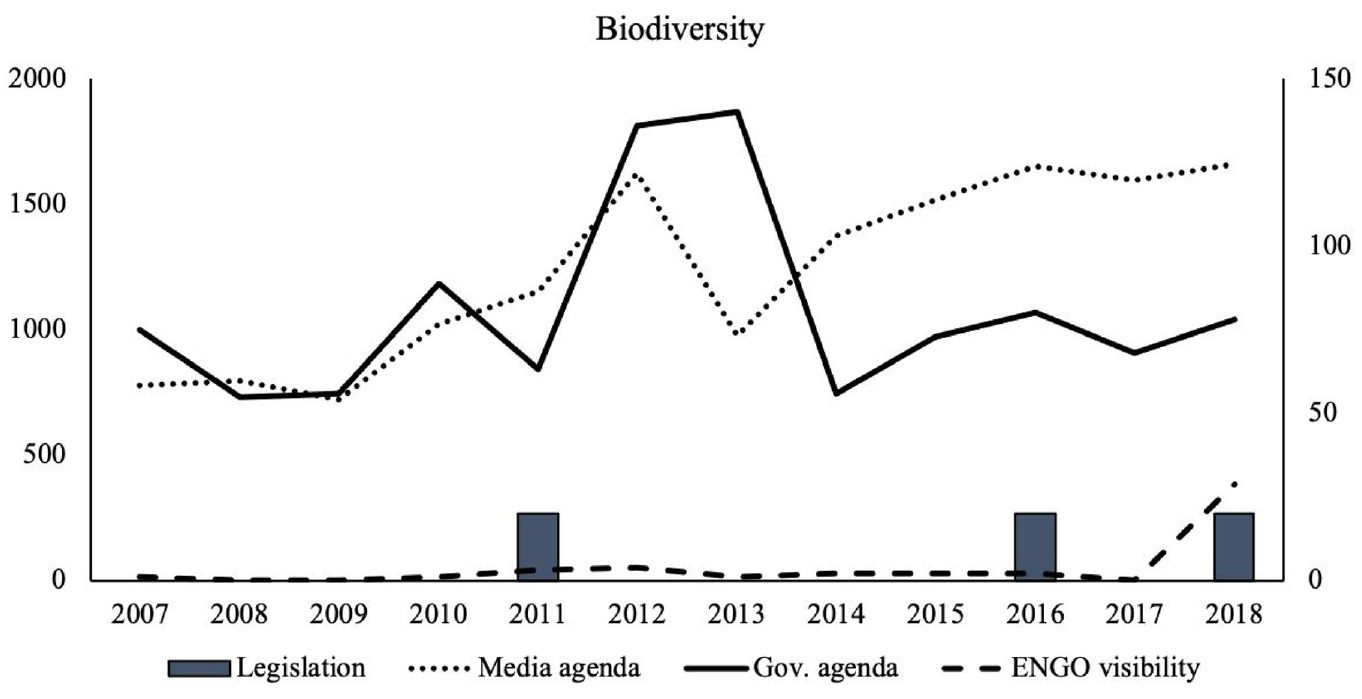
Media agenda, government agenda, ENGOs’ media visibility, and legislation on biodiversity issue.

Media agenda, government agenda, ENGOs’ media visibility, and legislation on green life and green energy issue.
Figure 2 shows the legislative process on the issue of green life and green energy. In 2010, there was a notable rise in issue salience of green energy and pollution control in the government policy agenda and media coverage—in the same year the Hong Kong government implemented the regulation related to biodiesel fuels. Following this, the Motor Vehicle Idling (Fixed Penalty) Ordinance was enacted in 2011 and came into effect on December 15, 2011, which led to the growth of issue salience in government agenda and the increase of ENGOs’ media visibility in 2012. Again, there was a growth of media coverage and government attention on green energy issues after 2014, and in 2015, the technical memorandum (TM) aiming to tighten the emission caps of power companies went into effect (Environmental Protection Department of Hong Kong, 2019). In the following years (2016–2018), the government still kept this issue high on its political agenda. It can be concluded that the news media and the government agenda have acted as the precursors of the legislative action on the issues of biodiversity and green energy; in turn, the legislative enactment has also been followed by greater salience in both the news media and government agenda.
Discussion
This study examines to what extent and how digital media adoption by ENGOs has influenced the media and political agendas in Hong Kong. The findings suggest that the adoption of digital media contributes to ENGOs’ own media visibility and issue salience in the news media agenda, and that the extent of digital reach of ENGOs is also associated with ENGOs’ own visibility in the news media. Although the digital adoption and reach of ENGOs do not show significant relationships with the political agenda, the legislative processes on biodiversity, green life and green energy issues suggest mutually reinforcing interactions between the media agenda and political agenda. Thus, the use of digital media of ENGOs may affect political process indirectly, by increasing specific issue salience in the media agenda in Hong Kong.
The findings indicate that digital media may help ENGOs attract media attention and affect the news media agenda, which may further indirectly amplify their influence on policy decisions. In line with previous studies, social media provide the affordance of visibility of personal action frames for activists, which help legitimate their activities (van Haperen et al., 2018). Because digital media often serve as important public relations tools, ENGOs aim to provide organizational information and updates that can be accessed by journalists and other media professionals (Yang & Taylor, 2010; Zhou & Pan, 2016). In addition, because of the interactive and networked nature, digital media provide an important channel for building and enhancing ENGOs connections with media professionals and organizations. Moreover, the changes in the media agenda may raise political attention to certain environmental issues, which provide new opportunities for ENGOs to exert influence on the behavior of state actors (Esarey & Xiao, 2011; Rajão & Jarke, 2018).
Still, our findings also suggest that although many ENGOs have initiated a series of campaigns and developed various digital approaches to increase their influence, many of their efforts have not received a direct political response. As pointed out by some scholars, the environmental governance in Hong Kong relies on both the governmental authorities and social actors, and in particular, social actors are often the first movers in environment-related policies (Francesch-Huidobro, 2012). Since the handover in 1997, Hong Kong government has faced the crisis of legitimacy due to the absence of universal suffrage legislation, with little incentives for civil service cooperation. With politically appointed individuals heading policy bureaus, the structure of political governance in Hong Kong has experienced a shift from elite-led civil service style to a highly politicized non-civil service governance (e.g., Francesch-Huidobro, 2007; 2012). As a result, the Hong Kong government is under pressure to satisfy both the populists’ and Beijing’s demands, which seriously undermines its capacity to formulate policy by engaging with multiple local stakeholders. To justify and legitimize its actions, Hong Kong government solely relies on its performance on a sectoral basis (e.g., housing and employment) and lacks a sense of urgency to formulate a coordinated environmental strategy and address environmental challenges (S. Y. Chu & Schroeder, 2010; Francesch-Huidobro, 2012). As this study suggested, the lack of governmental responses to environmental appeals from the grassroots may restrict the construction of a responsible governance framework in Hong Kong.
Conclusion
This study examines the linkages between ENGOs’ digital media use and their level of success in the context of Hong Kong. The findings provide implications for the broader literature of the success of environmental movement in the digital era. Rather than focusing on case-based studies, we adopted a representative ENGO sample in Hong Kong and systematically examined their digital strategies and outcomes. It is conducive to understand not only the efforts of grassroots targeting at solving different environmental issues, but also the tensions and dynamics in the development of environmental movements in Hong Kong (F. L. F. Lee, 2016).
Theoretical Implications
Going beyond simply conceptualizing the digital media as resources for mobilization or organizational development, this study uses the lens of the agenda setting theory to assess the cumulative effects of digital strategies on a broader context including the media agenda and policy changes. Similar to previous research showing that social media platforms become an important venue for media professionals and government officials to gauge public concern and sentiment about environment issues (Ekenga et al., 2018), our study suggests that digital media have provided important sources for journalists to follow environmental issues and thus formulate the media agenda. We argue that indirectly, over a longer period of time this may bring about changes in environmental policy as well. As previous studies suggest, the increased social and media attention to environmental issues may empower environmental activism, placing pressure on the government to respond to those salient environmental issues (Agyei-Mensah et al., 2022; Rajão & Jarke, 2018). In order to mitigate the political consequences of negative news and ensure better control over the situation, the government is likely to make policy responses. Thus, it is possible to expect that public and media agendas may have a cumulative impact on policy action (Rajão & Georgiadou, 2014), and that ENGOs, news media, and the government are “(re)configured in intra-action” (Rajão & Jarke, 2018, p. 239). This study thus broadens our knowledge on the role of digital media in agenda setting, and provides a more systematic assessment of the success of social movements by employing a longitudinal analysis. By examining the outcomes at different levels, this study hopes to further our understanding of the successes and failures of environmental movements in Hong Kong and elsewhere.
Practical Implications
The findings of this study offer valuable guidelines for ENGO practitioners and government environmental protection departments. This study demonstrates that digital media serves as an effective tool for ENGOs to increase their visibility in news media, suggesting ENGO managers to actively utilize social media tools, such as Facebook, Twitter and YouTube, to diffuse organizational news, organize activities and interact with their members as well as with media professionals. Moreover, this study reveals that many of ENGOs’ efforts have not received a direct political response, which may undermine political trust among the public as well as provoke dissatisfaction with a local government. Environmental department managers should thus enhance their capacity by engaging with multiple local stakeholders when making political decisions and listening to the appeals from the grassroots (Francesch-Huidobro, 2012).
Limitations and Future Works
We also want to identify some shortcomings of this study and propose potential remedies. First, the random sample used in this study excluded some important and influential ENGOs in Hong Kong. Those ENGOs, with longer histories, more developed structures, greater financial and human resources, and richer experience in developing media strategies, are more likely to achieve advantageous outcomes in the media and policy domains (e.g., Gamson, 1975; Zhang & Skoric, 2019). Future studies should include a broader cross-section of ENGOs to make more robust and generalizable conclusions. Second, we did not investigate the specific media strategies of ENGOs such as their network and content features, which are found to be closely associated with the outcomes (e.g., Pang & Law, 2017). Third, our study focuses solely on digital media adoption and does not take into account other important organizational factors, such as the age, social resources, and formalization of organizations (Gamson, 1975). Thus, more research is needed to investigate how organizational factors and online networks are associated with the ability to influence media and policy agendas. In spite of these limitations, we believe that it presents solid evidence demonstrating the importance of digital media adoption and reach for the success of contemporary environmental organizations.
Supplemental Material
sj-docx-1-sgo-10.1177_21582440241247703 – Supplemental material for The Digital Strategies and Efficacy of Environmental Movements in Hong Kong
Supplemental material, sj-docx-1-sgo-10.1177_21582440241247703 for The Digital Strategies and Efficacy of Environmental Movements in Hong Kong by Marko M. Skoric, Nan Zhang, Chuanli Xia and Richard Ling in SAGE Open
Footnotes
Acknowledgements
Conceptualization, M.M.S. and N.Z.; Methodology, N.Z. and C.X.; Software, N.Z. and C.X.; Validation, N.Z.; Formal Analysis, N.Z. and C.X.; Resources, N.Z.; Data Curation, N.Z. and C.X.; Writing—Original Draft Preparation, M.M.S., N. Z., and C.X.; Writing—Review & Editing, M.M.S. and R.L.; Visualization, N.Z.; Supervision, M.M.S.; Project Administration, M.M.S.; Funding Acquisition, M.M.S. and R.L. All authors have read and agreed to the published version of the manuscript.
Declaration of Conflicting Interests
The author(s) declared no potential conflicts of interest with respect to the research, authorship, and/or publication of this article.
Funding
The author(s) disclosed receipt of the following financial support for the research, authorship, and/or publication of this article: This research was supported by City University of Hong Kong under Strategic Research Grant #7004934.
Ethical Approval
Not applicable.

Supplemental Material
Supplemental material for this article is available online.
Data Availability Statement
Data that support the findings of this study are available from the corresponding author, Nan ZHANG, upon reasonable request.
References
Supplementary Material
Please find the following supplemental material available below.
For Open Access articles published under a Creative Commons License, all supplemental material carries the same license as the article it is associated with.
For non-Open Access articles published, all supplemental material carries a non-exclusive license, and permission requests for re-use of supplemental material or any part of supplemental material shall be sent directly to the copyright owner as specified in the copyright notice associated with the article.
