




Abstract
This study aims to evaluate the moderating role of social media influence before and after the trip in Vietnam and Czech Republic. Primary data, gathered during time lag data surveys conducted among international tourists travelling to the Czech Republic and Vietnam, was analyzed with the Structural Equation Modelling (SEM) in R. The findings revealed that social media influence with higher level positively strengthened the connection between tourist motivation and the post trip destination image. Furthermore, social media had a significant moderating effect on the relationship between tourist satisfaction and ecotourism loyalty. However, there are strong differences between the destinations of developed and emerging economies. For Czech Republic, as developed economy, social media influence plays a more important role as a value-expressive mechanism at the post-trip stage whereas for the developing economy of Vietnam, social media plays a more important role as an information source before the trip. This study extends the Expectation Confirmation Theory (ECT) by introducing the moderating effect of social media influence, which first time measures this moderating effect before and after the trip accounting for the dynamic nature of the destination image as an antecedent of ecotourism loyalty. Limitations, theoretical implications, and recommendations for practice and further research are addressed.
Keywords
Introduction
The increasing focus on sustainability and environmental conservation has propelled the growth of the ecotourism industry (Donmez-Turan & Kiliclar, 2021). Sustainable tourism practices, including ecotourism, have gained significant attention and recognition worldwide (Buckley, 2020). Ecotourism is seen as a means to strike a balance between economic development and environmental preservation. The emphasis on sustainable practices and the conservation of natural resources has led to the development of ecotourism as a distinct and growing sector within the tourism industry (Dasan et al., 2022). The potential for sustainable development through ecotourism has been acknowledged in various regions, such as China (Y. C. Huang & Liu, 2017), India (Ashok et al., 2017), and Australia (Li et al., 2021).
The ecotourism industry, valued at USD 185.87 billion in 2021, is experiencing a rapid expansion with a projected compound annual growth rate (CAGR) of 15.2% from 2022 to 2030, underscoring its increasing global significance (Market Analysis Report, 2021). The industry’s growth is driven by factors such as increasing interest in coastal and marine tourism (Pineda et al., 2023), the recognition of its economic benefits (Becker et al., 2023), and the emphasis on sustainability and environmental conservation (Samal & Dash, 2023). The growth of the ecotourism industry presents both opportunities and challenges, and understanding ecotourism loyalty is crucial for effectively managing and harnessing the potential of this expanding sector.
However, traditional studies have often defined ecotourism loyalty as destination loyalty, focusing on the repeated visitation to a specific ecotourism destination (Ahmad et al., 2021; Buhalis et al., 2020; H. Chen & Rahman, 2018). This definition may not fully capture the nature of ecotourism loyalty. Many tourists, even when satisfied with their experience, may choose not to revisit the same destination due to their desire for novelty and new experiences (Dolnicar et al., 2015). Therefore, to fill this gap, we consider ecotourism as a product, rather than a destination. In this context, ecotourism loyalty can be defined as a commitment to the concept of ecotourism itself, rather than to a specific location. Tourists who consistently choose ecotourism options, regardless of the destination, demonstrate a loyalty to the principles of ecotourism, such as sustainability and respect for nature. This perspective allows us to better understand and measure ecotourism loyalty, taking into account the unique characteristics and motivations of ecotourists.
Prior research has predominantly concentrated on the construct of destination image in the pre-trip phase, investigating how pre-trip perceptions and expectations influence tourist behavior and destination selection (Beerli & Martín, 2004). However, the current study introduces a novel perspective by focusing on the destination image in the post-trip phase, an area that has been infrequently explored in extant literature (C. F. Chen & Tsai, 2007). The examination of post-trip destination image can yield valuable insights into the alignment or misalignment between the actual experience of the destination and pre-trip expectations, and how this influences overall tourist satisfaction, word-of-mouth recommendations, and intention to revisit (Prayag, 2009). By scrutinizing the destination image after the trip, this study not only fills a significant gap in the literature but also provides a more comprehensive understanding of the tourist experience, spanning from pre-trip expectations to post-trip reflections (Baloglu & McCleary, 1999). This can inform more effective destination marketing and management strategies, aimed at not only attracting tourists but also ensuring their satisfaction and loyalty (C. F. Chen & Tsai, 2007).
While numerous studies have explored the domains of tourist motivation, social media influence, and ecotourism loyalty, a discernible gap exists in the literature regarding the interplay among these three constructs. For instance, Miah et al. (2017) delved into the potential of Twitter data in discerning tourism motivation and interest, yet the aspect of ecotourism loyalty was not explicitly addressed. Similarly, the study by Tasse and Hong (2021) utilized geotagged social media data to construct a Neighborhood Guides website, but the linkage to ecotourism loyalty remained unexplored. In a study by Talpur and Zhang (2018), mobile social media data was employed to capture tourist activity information and extract insights into tourist behavior, however, the focus was not specifically on ecotourism loyalty. Payntar et al. (2021) utilized geotagged photos to identify travel patterns and quantify visual culture and experiences in Cuzco, Peru, but the relationship between these patterns and ecotourism loyalty was not investigated. Lastly, Skora et al. (2022) compared global tourism flows measured by official census and social sensing, but the study did not specifically address the influence of social media on ecotourism loyalty. Therefore, the literature reveals a clear research gap in understanding how tourist motivation and social media influence interact to shape ecotourism loyalty.
Drawing on the Expectation Confirmation Theory (ECT), this study proposes a comprehensive model to elucidate the relationship between tourist motivation, destination image after the trip and ecotourism loyalty, considering the moderating effect of social media influence both pre and post-trip. The ECT, which posits that satisfaction is determined by the discrepancy between initial expectations and actual performance, as well as the confirmation of pre-purchase expectations, provides a robust theoretical framework for understanding tourist behavior in the context of ecotourism. In this proposed model, tourist motivation influences initial expectations of the ecotourism experience, which are then confirmed or disconfirmed based on the actual experience, leading to satisfaction or dissatisfaction. This satisfaction level then influences ecotourism loyalty. Importantly, the model posits that social media influence moderates this process, shaping both initial expectations and the interpretation of the actual experience. By considering the role of social media both before and after the trip, this model provides a more nuanced understanding of the complex interplay between tourist motivation, social media influence, and ecotourism loyalty.
Firstly, this research significantly contributes to the literature by providing a more nuanced understanding of ecotourism loyalty, a construct of critical importance for practitioners in the field (C. F. Chen & Chen, 2010). By elucidating the intricate interplay between tourist motivation, social media influence, and ecotourism loyalty, this study offers valuable insights that can inform the development of effective marketing strategies and management practices (S. Huang & Chen, 2016). These insights can assist industry professionals in attracting and retaining ecotourists, thereby fostering the growth and sustainability of the ecotourism sector (Buckley et al., 2017). Furthermore, by redefining ecotourism loyalty in terms of commitment to the concept of ecotourism rather than to a specific destination, this research challenges traditional paradigms (Prayag & Ryan, 2012) and opens up new avenues for research and practice in ecotourism marketing and management.
Secondly, grounded in ECT, this research contributes to the literature by providing a more comprehensive understanding of how pre-trip motivations and actual experiences interact to shape the post-trip destination image. Tour operators and marketers can better tailor their offerings to meet tourists’ expectations and enhance their experiences. This can lead to more positive post-trip destination images, which can increase customer satisfaction, repeat visitation, and positive word-of-mouth recommendations. Furthermore, it can inform the development of more effective marketing strategies, by identifying the key factors that influence the post-trip destination image.
Lastly, this research extends the ECT by incorporating the moderating effect of social media influence in both the pre and post-trip stages, a dimension that has been infrequently explored in prior research (Bigné et al., 2014). While ECT has been extensively employed to comprehend consumer satisfaction and loyalty, its application has largely been confined to traditional contexts (Szymanski & Henard, 2001). This study not only applies ECT to the novel context of ecotourism but also innovatively integrates the role of social media, thereby significantly broadening the scope and applicability of the theory (Kaplan & Haenlein, 2010). By demonstrating how social media influence can shape tourist expectations and experiences, and ultimately affect ecotourism loyalty, this study provides a more comprehensive and nuanced understanding of the ECT. This theoretical extension can pave the way for new research trajectories and offer valuable insights for both academics and practitioners in the tourism industry (Xiang et al., 2015).
Literature Review
Academically, destination image in tourism research is usually interesting since it illustrates tourists’ perception of destination they travel and how travel agency and promoters desire these places to be regarded (Ku & Mak, 2017). Furthermore, the dualistic character of the destination image is the significant rationale that much literature has been focused on the perceived gaps of destination image by tourists, practitioners and local residents (Marine-Roig & Ferrer-Rosell, 2018; Stylidis et al., 2021). This is also a reason why there are several competing scales developed and validated for measuring destination image (Arabadzhyan et al., 2021; Carballo et al., 2015; Ragb et al., 2020).
Previous studies show that destination image is affected by word-of-mouth (Reza Jalilvand & Samiei, 2012), type of information sources (Almeida-García et al., 2020), and individual traits and personalities of tourists (Tapanainen et al., 2021). However, all these studies covered only the destination image formed in tourists before the trip. This research uses the Expectations Confirmation Theory (ECT) to argue that the pre-trip destination image is manifested in tourists’ expectations about the destination and travel. When matched against the actual experience of tourists at the destination, the expectations are either confirmed or disconfirmed at the post-trip stage. This, in turn, determines the extent to which tourists are satisfied with their trip. Nevertheless, there is no agreement in literature on how to conceptualize satisfaction (Mafi et al., 2020). According to ECT, satisfaction is the result of a mental match between the perceived destination image or traveler’s expectations, and travelers’ real experience on the trip (Boo & Busser, 2018). This core of literature suggests the image of destination is a constantly changing concept that is influenced by the experiences of tourists (Tan, 2017). Therefore, destination image assessed before the trip will differ from the destination image assessed after the trip (Rittichainuwat et al., 2020).
However, other scholars argue that tourists’ expectations have a little or nonexistent impact on their level of pleasure, which is determined solely by their actual experiences (Lee & Jeong, 2021). Whatever the results of the study, the key evidence shows that experience influences happiness (Liu et al., 2016). The only difference is that, on the one hand, the effect of experience on satisfaction is direct (Suhartanto et al., 2021), on the other hand, it is indirect and mediated by destination image (Kim, 2018). Therefore, the first two hypotheses are proposed as below:
H1: Ecotourism experience directly and positively affects tourist satisfaction.
H2: Ecotourism experience indirectly and positively affects tourist satisfaction through destination image.
When choosing a destination for travel, tourists are driven by different motives, such as intellectual, significance, self-importance, pragmatic, and social adjustment functions (Zhang et al., 2018). These different reasons why tourists choose to travel are collectively referred to as tourist motivation (Suntikul, 2017). A tourist who seeks new knowledge about a foreign culture or environment will choose places with a destination image that reflects rich cultural heritage or wildlife. A tourist who seeks a value-expressive holiday will be attracted to destinations that reflect the image of luxury lifestyle. This agrees with the ECT, which singles out a theoretical construct known as “perceived performance” (Boo & Busser, 2018). This construct reflects how a particular destination image aligns with the tourist motivations and expectations for the trip (Jin et al., 2019).
The characteristics of a destination that make up the conscious image of the destination can be attractive to tourists and draw them to a particular location, while the aspiration to break away, reminiscence, or the desire to discover something new can also be the reason for visiting a destination, would create tourists’ perceptions of the destination image (Hoang et al., 2023). While Song and Bae (2018) argue that beginner tourists are usually driven to seek novelty or relaxing opportunity, or to escape from daily routine and building boundaries. Once tourists gain experience, these motivators become less significant, and tourists travel to fewer tourist sites. However, tourists are drawn to a destination because of specific characteristics it possesses and the personal values they have formed based on previous experiences (Wu et al., 2019). Furthermore, Su et al. (2020) provide evidence that the motivation of tourists affects their perceived destination image and their subsequent satisfaction. Consequently, the hypothesis is proposed as follow:
H3: Tourism motivation directly and positively affects destination image.
Consistent with ECT, the satisfaction of tourists with the destination would stem from the expectation gap and ultimately change the future behavior of tourists (Afshardoost & Eshaghi, 2020; Akgün et al., 2020). In case when experience exceeds expectations, tourists will have intentions to revisit the destination and intentions to recommend the trip (Yuksel et al., 2010). These two intentions are often referred to as loyalty in the tourism and marketing literature (Garay, 2019). Some sources refer to the construct of loyalty as conative destination image (Agapito et al., 2013). However, many existing studies abandon the concept of conative image in favor of faithfulness, as well as include the desire to come back or to suggest the destination to others (Stylidis et al., 2020). Even though the term “loyalty” originates from marketing literature and is often referred to as “brand loyalty” (Herrero et al., 2017), it can be adapted to the tourism and ecotourism context to represent ecotourism loyalty (Li et al., 2021; Xu et al., 2021).
Since ECT suggests that the confirmation or disconfirmation of tourists’ expectations by experience affects their level of satisfaction with the trip, numerous studies illustrate that destination image may affect ecotourism loyalty indirectly with the mediating role of tourist satisfaction (Chi & Qu, 2008). When a tourist feels pleased with his or her trip, the positive things of destination image visited will be translated into a desire to return and intention to recommend that destination to others (Ahmad et al., 2021). Study results of Marques et al. (2021) also support these concepts when demonstrating that several researchers have empirically confirmed. Additionally, satisfaction was also found to be an antecedent of intentions not only to visit but also to recommend the destination (Newsome et al., 2019). On one hand, many researchers demonstrate that tourists, who are satisfied, do not usually want to return to the destination (Dolnicar et al., 2015). On the other hand, other scholars argue that many people try to seek novelty and new experiences at the same destination, even though they have previously been satisfied (Albaity & Melhem, 2017; Assaker et al., 2011). Different from Wang et al. (2021), who claim that the heritage tourism destination reputation influences tourist consumption behavior, this study hypothesizes that destination image may affect ecotourism loyalty. Consequently, the following hypotheses emerge from this theoretical discussion.
H4: Destination image directly and positively affects ecotourism loyalty.
H5: Destination image indirectly and positively affects ecotourism loyalty through tourist satisfaction.
Social media networks have become not only important instruments for finding information about destinations but also major platforms where tourists can share their experience from the trip or intentions to visit (Alonso-Almeida et al., 2019). Since tourists receive feedback on social media, this feedback can interfere with their original motivations to travel, original expectations about the destination, and even the level of satisfaction with the trip (Walsh et al., 2019).
Pan et al. (2021) argue that the destination image of tourists is not a statistic but is subject to significant influence on peer pressure and effects from social networks. They note that even if tourists do not have a clear destination image, the latter would be emerging and converging with the destination image transmitted by social media. According to Al-Adamat et al. (2020), the destination image determines the future plans for the visit, which can indicate loyalty. Moreover, this revisit intention is also affected by the social media influence. This suggests that there could be presence of moderating effects and, if captured, they can allow for extended the ECT in the context of ecotourism.
In addition, Jamshidi et al. (2021) found that feedback or comment on tourists’ posts on social networks contributed to the formation of memories associated with the tour, satisfaction of tourists and their ultimate loyalty. When more people support the tourist on social media and provide their likes and make positive comments associated with the destination, the link between the tourist satisfaction and loyalty will be strengthening. Almeida-Santana and Moreno-Gil (2018) also found during a survey among almost 7,000 respondents that social media activity strongly impacted tourists’ loyalty measured by revisit intentions and intentions to recommend. At the same time, Sedera et al. (2017) argue that for those people who actively use social media, it is easier to confirm whether destination attributes that motivate tourists to travel to the destination are present, and the destination image is not distorted by misleading advertising. This is because social media allows for collecting multiple reactions to a particular destination from different people. Thus, the role of social media can be both informative and value expressive. At high levels of information use from social media, a stronger link between tourist motivation and their ultimate destination image is expected. At the same time, at higher levels of feedback and value-expression on social networks, a stronger relationship between destination image, satisfaction, and loyalty is expected. Based on these past studies it is possible to formulate the final hypotheses of this study:
H6: Social media influence positively moderates the relationship between tourist motivation and destination image.
H7: Social media influence positively moderates the relationship between tourist satisfaction and ecotourism loyalty.
Research Methodology
Research Context
The study is conducted in the two contexts of ecotourism destinations located in the Czech Republic and Vietnam. The Czech location is represented by the Podyjí National Park, whereas the Vietnamese location is represented by the Cuc Phuong National Park. Both national parks are preserved areas with the aim to protect and fully rehabilitate the local animals and plantations. This empowers travel organizers to offer an extensive array of informative resources to tourists who have a keen interest in ecology, environmental conservation, cultural heritage, and historical significance. The settings are natural, educational, safe, and encourage social-responsible behavior. These attributes collectively establish quintessential ecotourism locations, aligning with the prevalent scholarly definitions and interpretations of ecotourism that have been formulated to date (Salman et al., 2022).
Data and Sample
Primary data have been collected using self-administered structured questionnaires distributed through tour operators among tourists who travelled to the Podyjí National Park and the Cuc Phuong National Park.
The research relied on the use of the random sampling technique to collect the responses from tourists. Random sampling has been attained by seeking assistance from tour operators to randomly choose respondents. Since tour operators were not the parties interested in the results of this research, no bias in the sample selection was expected. The tour operators were given freedom to distribution the questionnaires to as many tourists as they could but they were not given any criteria for selecting specific types of tourists. The target sample from each destination was set to 600 tourists and tour operators were asked to facilitate the collection of 600 responses from the Czech Republic and the same number of responses from Vietnam. However, out of this target number, only 304 questionnaires returned from the Czech sample and 218 from the Vietnamese sample. This resulted in a 50.4% response rate in the Czech Republic and a 36.3% response rate in Vietnam. Considering that there are 25 items in the questionnaire, the ratio of respondents to items exceeds the minimum ratio of 5:1 recommended by Hatcher (1994) for an adequate sample.
The link to the structured online questionnaire has been shared with tour operators to facilitate data collection from tourists. The tour operators were asked to share the link with tourists who have purchased the trip. The online questionnaire was available at the link in Vietnamese, Czech and English languages. The managers of tours were also instructed to ask the tourists to fill in the questionnaire on their way back from the destination after having experienced the trip. Thus, the survey was conducted in two stages. At the first stage before the trip, the respondents were asked to state their motivation for the trip and share information on their social media use trip. At the second stage after the trip, the respondents were asked to evaluate the destination image, their ecotourism experience, satisfaction with the trip, and the intentions to revisit and recommend the ecotourism destination. During the period of approximately 18 months in 2020 to 2021, 304 questionnaires were submitted online from the Czech location and 218 questionnaires were filled in the Vietnamese locations.
Table 1 provides a frequencies table of with background information on the surveyed ecotourists.
Demographic Profile of Ecotourists.

Source. Authors’ works.
Reliability and Validity
The collection of primary data is associated with reliability and validity issues. Reliability implies the extent to which the collected responses are internally consistent. Reliability of data and the online questionnaire as a data collection tool has been measured by Cronbach’s alpha. As a rule of thumb, the values of Cronbach’s alpha in excess of .7 indicate strong internal consistency of responses and reliability of the collected data. The following table illustrates that the collected data are reliable, and the minimum value of Cronbach’s alpha is .726.
Validity of the data implies how well or how accurately the chosen variables measure the given theoretical constructs of satisfaction, loyalty, destination image, experience, social media influence and motivation. Convergent validity has been measured using the average variance explained (AVE) and compositive reliability index (CompRel). As a rule of thumb, the data satisfies the condition of convergent validity of AVE is at least 0.5 suggesting that it should explain 50% or more of the variance of the measured construct. Table 2 reveals that this condition is satisfied and the collected data is valid. CompRel also shows that the responses collected by the survey load well on the theoretical constructs and all of the values exceed 0.7.
Reliability and Validity Assessment.

The discriminant validity, which implies that the theoretical constructs used in this study are independent from each other and their indicators do not overlap, has been tested using the heterotrait–monotrait ratio (HTMT). These ratios do not exceed 0.9, which proves discriminant validity of the data (Table 3).
HTMT Ratios for Discriminant Validity.

Measures of Constructs
The hypothesized constructs in the conceptual framework are examined by adopting the scales adapted from previous peer-reviewed journal articles. These scales are also modified for research context fitting (i.e., ecotourism), as they are originally designed for general tourism. The main advantage of the reliance on previous scales is that no additional validation is needed whereas to develop a new scale, it would be required to validate the scale in several contexts to prove its universality and applicability. However, the main disadvantage of using previously developed scales is that they were originally proposed for different contexts and now they had to be adapted to ecotourism. Summary of the constructs’ measurements are in Table 4.
Constructs and Scales.

Note. The questionnaire (Questions 1–25) is available at Appendix 3.
Statistical Analysis
Figure 1 depicts the hypothesized conceptual model of the research, which was based on the Expectation Confirmation Theory and theories developed in previous sections.

Research model.
The confirmative factor analysis (CFA) with R is used to assess the loadings of factor and how strongly the proposed constructs represent the observed variables. Furthermore, this analysis is also utilized to detect the common method variance (CMV) that has often been neglected in prior research on ecotourism destination choice, enjoyment, engagement, and loyalty. Furthermore, CMV is a variance component caused by survey instruments and approaches instead of main construct and observable variables. High CMV can cause results to be distorted and observations to be unreliable (Jakobsen & Jensen, 2015).
By estimating path coefficients with R, the statistical significance of the correlations among the proposed constructs of in the hypothesized structural model is evaluated. Also, hierarchical regressions with interaction terms are used to test the moderating effects of social media influence.
The SEM framework has been chosen as the dominant method of analysis in this study because this method requires strong theoretical foundation to test relationships between constructs. This is an advantage compared to athereotical methods including reduced-form regressions. Another strength of SEM is that it allows for working with complex social constructs that are not easily observable and can only be deduced from other observed variables. However, this method also has weaknesses such as its sensitivity to the choice of scales.
Results
Confirmatory Factor Analysis
Because the scales used to measure constructs in this paper were drawn from the top journals with a high impact factor, the observed variables were also expected to have high factor loadings, which are presented in Table 4. This is demonstrated by the Confirmatory factor analysis (CFA). Although several constructs in the literature, such as destination image, satisfaction, and ecotourism loyalty, are sometimes viewed as one factor (Suntikul, 2017), It is crucial to explore the reasons why the measurement model that separates the constructs performed superiorly compared to other models in which these dimensions were integrated, in terms of fitness. The baseline model is evaluated using the constructs Ecotourism motivation (MOT), Social media influence before the trip (SMIB), Social media influence after the trip (SMIA), Ecotourism experience (EXP), Destination Image (DI), Ecotourism satisfaction (SAT), and Ecotourism loyalty (LOYL). Table 5 presents the various methods in which the factors are combined and organized by different models to compare the models’ fit.
CFA.

Source. Authors’ works.
The baseline model has a better fit than the alternatives (as in Table 3, χ2 = 684.6, df = 254, CFI = 0.918, TLI = 0.904, RMSEA = 0.057, SRMR = 0.038). This can be understood that the hypothesized constructs are distinct and should not be combined, as doing so may result in information loss and poorer model performance.
To minimize bias among survey participants, the survey incorporated techniques such as reversing the coding on certain questions in the questionnaire and randomly rearranging the sequence in which questions were presented.
To reduce common method bias, a marker variable was added to the first CFA model, the presence of common method variance (CMV) associated with CMB was verified. The model fit was expected to improve significantly if CMV was significant. However, the finding suggests only a minor enhancement (Table 6).
CMB Test.

Source. Authors’ works.
This leads to the conclusion that there is no common method bias present in the responses.
Descriptive Statistics
Table 7 presents the statistical summary of the variables and the calculated correlation between them.
Descriptive statistics and correlations between constructs.

Notes. Significant at ***1%, **5%, and *10%.
Source. Authors’ works.
The results of correlation analysis indicate that there is a positive correlation between returning to the same or different ecotourism destinations and the tourist earnings. Different education levels of tourists also have positive relationship to repeated ecotourism trips to different destinations. It could be implied that tourists with higher education level usually seek more novelty or new experience when visiting ecotourism destinations. There is also a significant positive correlation between the age of tourists and their repeated ecotourism trips. Furthermore, while education positively correlate with income and age among the other control variables, gender is negatively associated with returning to the same location, indicating that women seek more variety.
The evaluation of correlation coefficients between the constructs can assist in making preliminary judgments about the relationships between them, which will be investigated further using structural equation modeling. Tourist satisfaction is significantly and positively related to ecotourism loyalty (Table 7, r = .48, p < .01) and destination image (Table 7, r = .47, p < .01). Additionally, destination image is positively correlated with tourist experience (Table 7, r = .56, p < .01) and motivation of tourists (Table 7, r = .52, p < .01).
Structural Model
Figure 2 shows the path coefficients generated when evaluating the proposed structural model. Besides, Table 8 shows the critical metrics as confidence intervals (CI), p-values, standard errors.

Path coefficients.
Path Coefficients.

Source. Authors’ works.
These path coefficients support the suggestion that there are direct relationships between experience and destination image, motivation and destination image, satisfaction and destination image, and ecotourism and satisfaction, and allow H1, H3, and H5 to be confirmed. To test for indirect effects between constructs, hierarchical regression analysis is deployed.
Hypothesis Testing—Direct Effects
To evaluate the hypothesis of this research, hierarchical regression models were applied. The models included control variables as the first step, followed by two independent variables, namely Tourist experience and Tourist motivation.
In this study, the control variables of the model comprise age, gender, education, income, and previous ecotourism visits, which are influenced by the previous studies of Kattiyapornpong and Miller (2011) and Li et al. (2021). Additionally, in the next steps of the hierarchical regression modeling, mediating factors were included, which served as both endogenous and exogenous variables, based on the chosen model. Finally, the moderating factors of SMIB and SMIA along with the interaction terms of SMIB × MOT and SMIA × DI were included in the models. The metrics and outcomes of each regression model are presented in Table 9.
Hierarchical Regressions—Total Sample.

Source. Authors’ works.
Note. N = 522; Bootstrap samples: 5,000; CI = 95% confidence interval; EXP = ecotourism experience; MOT = tourist motivation; DI = destination image; SAT = ecotourism satisfaction; LOYL = ecotourism loyalty; SMIB = social media influence before the trip; SMIA = social media influence after the trip.
Significant at ***1%, **5%, and *10%.
Overall, three dependent variables appear in the models (DI, SAT, and LOYL). There are two purely exogenous variables (EXP and MOT) and two moderating variables (SMIB and SMIA).
Generally, 10 regression models are estimated in the study. All of them illustrate the moderate fit measured by R2 and adjusted R2 values ranging from 0.23 to 0.47 (Table 9). This indicates that the model account for a considerable portion of the variation in the dependent variables, and there is no indication of multicollinearity or non-stationarity.
In line with Hypothesis 1, the results show that ecotourism experience has a statistically significant direct positive effect on tourist satisfaction (Table 9, Model 1, β = 0.446, p < .01). Hypothesis 3 posited that there is a significant positive correlation between tourist motivation and destination image, as supported by statistical analysis. The regression modeling findings validated this prediction, and the direct impact was positive and statistically significant (Table 9, Model 5, β = 0.561, p < .01). Similarly, Hypothesis 4 predicted that destination image would have a direct influence on ecotourism loyalty, which is confirmed by the results, which shows a positive and statistically significant coefficient for destination image (Table 9, Model 7, β = 0.523, p < .01). Consequently, all hypothesized direct relationships between the investigated constructs have been confirmed.
Hypothesis Testing—Mediating Effects
Hypotheses 2 and 5 assumed indirect relationships between tourist experience and satisfaction and between destination image and ecotourism loyalty. These indirect effects mediated by destination image in the first case and tourist satisfaction in the second case have been supported in this study. It is confirmed that there is partial mediation of the relationship between tourist experience and satisfaction by destination image. When the mediating variable was introduced, the coefficient for tourist experience decreased but remained statistically significant Table 9, Model 4, β = .357, p < .01). The coefficient for destination image was also positive and significant.
The findings also support Hypothesis 5. The results from hierarchical regressions show significant partial mediation of the relationship between destination image and ecotourism loyalty by tourist satisfaction. After adding the mediating variable of satisfaction, the coefficient for destination image decreased but remained statistically significant (Table 9, Model 9, β = 0.428, p < .01). The coefficient for the mediating variable was also positive and significant (Table 9, Model 9, β = .344, p < .01).
Hypothesis Testing—Moderating Effects
Hypotheses 6 and 7 on moderating effects of social media influence on the relationships between tourist motivation and destination image and between tourist satisfaction and ecotourism loyalty have been supported by the study. However, some key differences have been detected between the tourists in Vietnam and the Czech Republic. When two samples are combined, at high levels of social media influence, there is a significant positive association between motivation and destination image (Table 9, Model 6, β = .245, p < .01). At the low levels of social media influence, there is no significant relationship between motivation and destination image, which suggests that social media plays a predominant role in shaping the destination image in the minds of tourists before they make the trip. Similarly, at high levels of social media influence, there is significant positive association between tourist satisfaction and ecotourism loyalty (Table 9, Model 10, β = .133, p < .01). At the low levels of social media influence, the relationship between tourist satisfaction and loyalty is not significant. This phenomenon can be explained by the use of social media by tourists to recommend the destinations and by the enormous role likes and comments on social media play in tourist decisions to revisit the place.
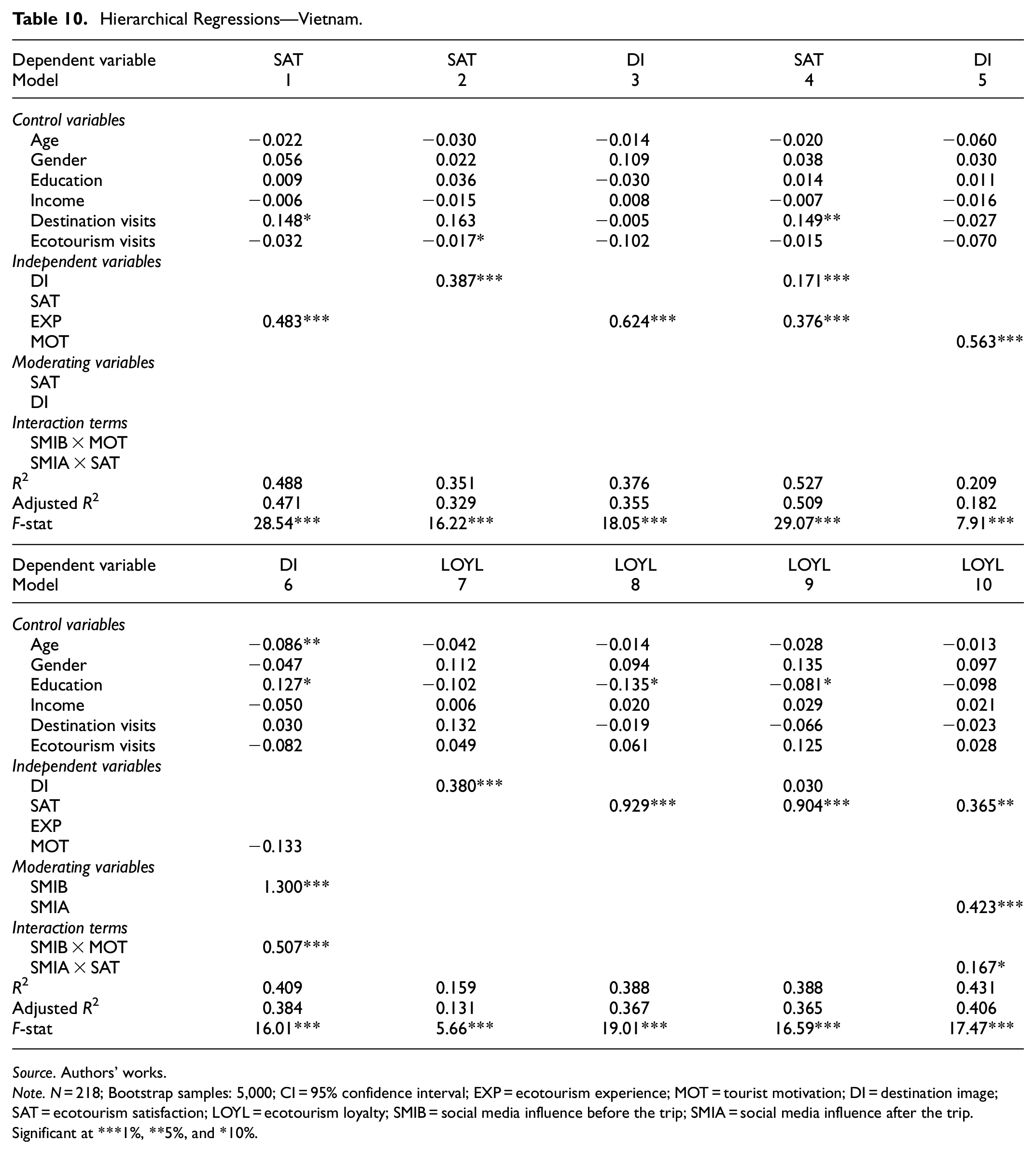
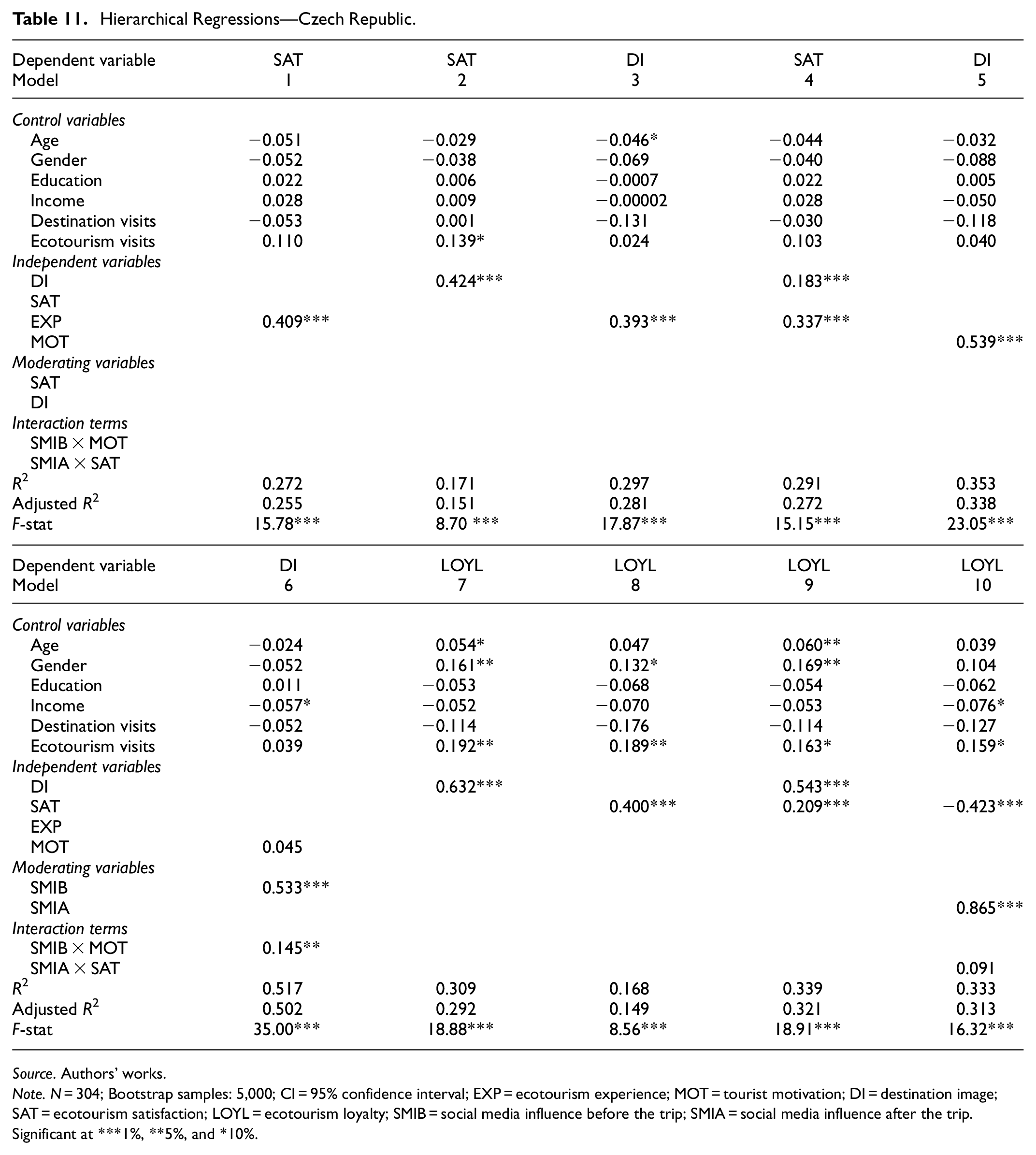
However, when the hierarchical regressions were re-estimated for individual sub-samples of the ecotourists in the Czech Republic and Vietnam, it was revealed that in Vietnam there was a much stronger moderating influence of the social media effect before the trip on the relationship between motivation and destination image (Table 10, Model 6, β = .507, p < .01). This suggests that tourists in Vietnam are more driven by the social media influence than tourists in the Czech Republic and their destination image is mostly shaped under the influence of social media they refer to before the trip. In contrast, the tourists in the Czech Republic are less sensitive to the influence of social media on their decisions to make the ecotourist trip. However, it is valid to note that this does not imply that tourists in this country are not affected by social media at all. On the contrary, the evidence from Model 10 estimated for the two individual sub-samples shows that the effect of social media influence on the destination loyalty is stronger for ecotourists in the Czech Republic than ecotourists in Vietnam (Table 11, Model 10, β = .865, p < .01). Moreover, while ecotourists in Vietnam become loyal to the destination when they are both satisfied and receive positive feedback on the social media, ecotourists in the Czech Republic are more responsive to the direct influence of the social media feedback and likes and there is no significant interaction effect (Table 11, Model 10, β = .091, p = .145). The main conclusion from this is that social media influence plays a critical role as a trustable source of information to choose an ecotourism destination in Vietnam but in the Czech Republic, social media influence plays a more important role as a reference for value expressions rather than a source of information.
Hierarchical Regressions—Vietnam.
Source. Authors’ works.
Note. N = 218; Bootstrap samples: 5,000; CI = 95% confidence interval; EXP = ecotourism experience; MOT = tourist motivation; DI = destination image; SAT = ecotourism satisfaction; LOYL = ecotourism loyalty; SMIB = social media influence before the trip; SMIA = social media influence after the trip.
Significant at ***1%, **5%, and *10%.
Hierarchical Regressions—Czech Republic.
Source. Authors’ works.
Note. N = 304; Bootstrap samples: 5,000; CI = 95% confidence interval; EXP = ecotourism experience; MOT = tourist motivation; DI = destination image; SAT = ecotourism satisfaction; LOYL = ecotourism loyalty; SMIB = social media influence before the trip; SMIA = social media influence after the trip.
Significant at ***1%, **5%, and *10%.
Discussion
Theory Contribution
First, this research contributes to the theoretical understanding of ecotourism loyalty by challenging and expanding upon its traditional conceptualization. Traditionally, ecotourism loyalty has been defined in terms of destination loyalty, with a focus on repeated visitation to a specific ecotourism destination (Ahmad et al., 2021). However, this study proposes a broader and more nuanced definition that encapsulates a commitment to the principles of ecotourism, irrespective of the destination. This reconceptualization recognizes the unique motivations of ecotourists who prioritize sustainability and respect for nature, and it allows for a more comprehensive understanding of ecotourism loyalty that transcends geographical boundaries. This novel perspective on ecotourism loyalty not only challenges traditional paradigms (Prayag & Ryan, 2012) but also opens up new avenues for research and practice in the field of ecotourism marketing and management.
Second, this research makes a significant theoretical contribution by extending the Expectation Confirmation Theory to the context of ecotourism. The ECT, which posits that satisfaction is determined by the discrepancy between initial expectations and actual performance, as well as the confirmation of pre-purchase expectations (Oliver, 1997), provides a robust theoretical framework for understanding consumer behavior. However, its application has largely been confined to traditional contexts (Szymanski & Henard, 2001). This study applies the ECT to the novel context of ecotourism, proposing a model where tourist motivation influences initial expectations of the ecotourism experience, which are then confirmed or disconfirmed based on the actual experience, leading to satisfaction or dissatisfaction. This satisfaction level then influences ecotourism loyalty. This innovative application and extension of the ECT to ecotourism provides a more comprehensive understanding of the complex interplay between tourist motivation, satisfaction, and loyalty in the context of ecotourism.
Third, the research further extends the theoretical landscape by integrating the moderating effect of social media influence into the ECT framework, both in the pre and post-trip stages. This represents a significant theoretical advancement, as it acknowledges the pivotal role that social media plays in shaping tourist expectations and experiences, and ultimately, ecotourism loyalty. While the influence of social media on consumer behavior has been recognized (Kaplan & Haenlein, 2010), its specific moderating role within the ECT framework has been less explored. By demonstrating how social media influence can shape tourist expectations and experiences, and ultimately affect ecotourism loyalty, this study provides a more comprehensive and nuanced understanding of the ECT in the context of ecotourism. This theoretical extension can pave the way for new research trajectories and offer valuable insights for both academics and practitioners in the tourism industry (Xiang et al., 2015).
Last but not least, this research contributes to the theoretical understanding of tourist behavior by emphasizing the importance of the post-trip destination image. While previous studies have primarily focused on the pre-trip phase, investigating how pre-trip perceptions and expectations influence tourist behavior and destination selection (Beerli & Martín, 2004), this study shifts the focus to the post-trip phase. This shift fills a significant gap in the literature (C. F. Chen & Tsai, 2007) and provides a more comprehensive understanding of the tourist experience, spanning from pre-trip expectations to post-trip reflections (Baloglu & McCleary, 1999). The examination of post-trip destination image can yield valuable insights into the alignment or misalignment between the actual experience of the destination and pre-trip expectations, and how this influences overall tourist satisfaction, word-of-mouth recommendations, and intention to revisit (Prayag, 2009). This novel focus on the post-trip destination image can inform more effective destination marketing and management strategies, aimed at not only attracting tourists but also ensuring their satisfaction and loyalty (C. F. Chen & Tsai, 2007).
Implications and Recommendations for Practice
First, the findings of this research have significant implications for the development of marketing strategies in the ecotourism sector. Given the influential role of social media in shaping tourist expectations and experiences, tourism marketers can leverage these platforms to enhance pre-trip expectations and post-trip reflections, thereby promoting tourist satisfaction and ecotourism loyalty (Kang & Gretzel, 2012; Li et al., 2021). By effectively utilizing social media platforms, marketers can disseminate information about ecotourism destinations, promote sustainable practices, and engage with potential tourists in a more targeted and personalized manner (Arasli et al., 2023). This strategic use of social media can lead to more effective marketing campaigns, ultimately contributing to the growth and sustainability of the ecotourism sector.
Second, the insights derived from this study can inform destination management strategies. By understanding the pivotal role of post-trip destination image in shaping tourist satisfaction and repeat visitation, destination managers can work toward ensuring that the actual experience aligns with pre-trip expectations (C. F. Chen & Tsai, 2007; Prayag, 2009). This alignment can increase tourist satisfaction and the likelihood of repeat visitation or recommendations, thereby fostering ecotourism loyalty. Furthermore, the study’s findings can guide destination managers in leveraging social media platforms to engage with tourists, address their concerns, and provide timely information, enhancing the overall tourist experience and satisfaction (Hvass & Munar, 2012).
Third, the findings of this study have significant implications for both the development of ecotourism products and services and policy making in the tourism sector. By understanding that ecotourism loyalty is tied to a commitment to the principles of ecotourism rather than to a specific location, providers can focus on promoting the sustainability and environmental conservation aspects of their offerings (Prayag & Ryan, 2012). This understanding can lead to the creation of ecotourism products and services that align with the values and motivations of ecotourists, thereby fostering loyalty to the concept of ecotourism. Furthermore, the insights gained from this study about the role of social media in shaping tourist expectations and experiences can inform the development of effective communication and engagement strategies on these platforms (Kang & Gretzel, 2012). From a policy-making perspective, these insights can guide the formulation of policies that promote sustainable tourism practices and support the growth and sustainability of the ecotourism sector. Policymakers can use the findings of this study to develop policies that encourage the use of social media for promoting ecotourism and engaging with potential tourists, thereby fostering the growth and sustainability of the ecotourism sector.
Limitations and Future Research
One of the limitations of this study is its geographical scope, as the research was conducted in two countries, the Czech Republic and Vietnam. While these countries provide a comparison between developed and developing economies, the findings may not be generalizable to other countries or regions with different cultural, economic, or environmental contexts. Therefore, future research could aim to replicate this study in other destinations to test the generalizability of the findings. This could include countries at different stages of economic development, or regions with different types of ecotourism offerings. Such research would contribute to a more comprehensive understanding of the moderating effect of social media influence on ecotourism loyalty across diverse geographical contexts.
The study’s focus on the influence of social media in general, without distinguishing between different social media platforms, represents a limitation. Different platforms may have different user demographics and usage patterns, which could influence their role in shaping ecotourism loyalty. Therefore, future research could examine the influence of different social media platforms on ecotourism loyalty. This could provide more nuanced insights into how different platforms contribute to shaping tourist expectations and experiences. By understanding the specific impacts of various social media platforms, tourism marketers and destination managers could develop more targeted and effective strategies for promoting ecotourism and engaging with potential tourists.
Another limitation is the exclusion of the tourist’s country of origin as a variable in our analysis. The country of origin can be a factor influencing tourists’ motivations, expectations, and satisfaction levels, potentially interacting with the destination factors to shape the overall ecotourism experience. By not considering this aspect, our study might miss capturing the nuanced influences that tourists’ backgrounds can have on their perception and response to social media influences at different stages of their travel. This limitation points to a promising direction for future research, where a more comprehensive analysis could be conducted to unravel the complex interplay between the country of origin and destination factors in shaping ecotourism loyalty. Such an approach would facilitate a deeper understanding of the multifaceted nature of ecotourism loyalty, paving the way for more targeted and effective strategies in promoting sustainable tourism.
Supplemental Material
sj-docx-1-sgo-10.1177_21582440241247699 – Supplemental material for Moderating Effect of Social Media in Shaping Ecotourism Loyalty: A Two-Stage-Cross-Sectional Study
Supplemental material, sj-docx-1-sgo-10.1177_21582440241247699 for Moderating Effect of Social Media in Shaping Ecotourism Loyalty: A Two-Stage-Cross-Sectional Study by Sinh Duc Hoang, Zuzana Tučková, Nhat Tan Pham, Tuan Hoang Tran and Diep T. N. Nguyen in SAGE Open
Footnotes
Declaration of Conflicting Interests
The author(s) declared no potential conflicts of interest with respect to the research, authorship, and/or publication of this article.
Funding
The author(s) received no financial support for the research, authorship, and/or publication of this article.

Supplemental Material
Supplemental material for this article is available online.
Data Availability Statement
The data that support the findings of this study are available from the corresponding author (N.T.N.D), upon reasonable request.
References
Supplementary Material
Please find the following supplemental material available below.
For Open Access articles published under a Creative Commons License, all supplemental material carries the same license as the article it is associated with.
For non-Open Access articles published, all supplemental material carries a non-exclusive license, and permission requests for re-use of supplemental material or any part of supplemental material shall be sent directly to the copyright owner as specified in the copyright notice associated with the article.
