




Abstract
The factors affecting migrants’ settlement in host cities have been widely discussed, but the impact of housing financial support is still under exploration. This paper explores the effect of the Housing Provident Fund (HPF), which is a highly debated but markedly important housing financial policy in China, on migrants’ settlement intentions. Based on data from the China Migrants Dynamic Survey (CMDS), our results reveal that the HPF significantly improves migrants’ settlement intentions by increasing housing purchase intentions. The robustness test results further show that expanding the coverage of the HPF has a positive effect on urbanization. However, we highlight the conflict between the HPF effects and its specific impact on differentiated levels of coverage. We further discuss its potential challenges, describe a pilot study of a voluntary HPF in China, and offer recommendations for urban reform.
Plain Language Summary
The factors affecting migrants’ settlement in host cities have been widely discussed, but the impact of housing financial support is still under exploring. This paper explores the effect of the Housing Provident Fund (HPF), which is a highly debated but markedly important housing financial policy in China, on migrants’ settlement intentions. Based on the data from the China Migrants Dynamic Survey (CMDS) and the Probit model, our results reveal that the HPF significantly improves migrants’ settlement intentions by increasing housing purchase intentions. By adopting propensity score matching (PSM) method to conduct the robustness test, the results further show that expanding the coverage of the HPF has a positive effect on urbanization. However, we highlight the conflict between the HPF effects and the differentiated levels of coverage. We further discuss its potential challenges and describe a pilot voluntary HPF in China, and offer recommendations for urban reform. This paper has two limitations for future studies. The first is to measure the level of financial support provided by the HPF and the corresponding differences in migrants’ settlement intentions. The second is to investigate the potential impacts of the HPF on migrants’ identity and social integration.
Introduction
In the past 40 years, China has witnessed unprecedented population mobility, with a huge number of rural residents flowing into urban cities to seek better employment opportunities. According to the seventh national census, the number of migrants in China reached 376 million at the end of 2020, up 69.73% from 2010, and migrants have become a major group, accounting for 41.7% of the urban population. However, one of the most significant characteristics of Chinese migration is that a large body of migrants choose to return (“float back”) to their hometown or to keep moving after temporary settlement in a host city. Several studies have noted that return migration is on the rise, which poses challenges to China’s urbanization (S. Tang & Hao, 2019; Zou & Deng, 2020).
Notably, a perennial topic within the literature on migrants’ settlement intentions is housing affordability (M. Chen et al., 2020a; J. Zhou et al., 2022). Scholars have primarily analyzed the living conditions and settlement intentions of migrants in terms of public housing. However, affordable housing, especially public rental housing and indemnificatory rental housing, provides a living space without formal property rights and has a limited positive effect, if any, on settlement intentions (Y. Huang & Ren, 2022). Financial support is provided primarily by the government, such as the Housing Provident Fund (HPF), which is the most important source of housing finance in China and is usually regarded as welfare for formal urban employees. The HPF was established to improve urban residents’ living conditions. Similar to the Central Provident Fund (CPF) in Singapore, the HPF requires all recipients to contribute 5 to 12% of their monthly wages, and employers usually provide a one-to-one match. Compared to commercial bank loans, HPF loans are available with decreased interest rates for housing consumption. Some scholars suggest that the HPF has a positive effect on residents’ homeownership (M. Tang & Coulson, 2017; Xu, 2017), while some also criticize the inequity risks that the HPF only favors employees with stable employment (J. Chen & Deng, 2014; Week in China, 2013). However, the effect of the HPF on migrants’ urban settlement intentions has not attracted enough attention. Therefore, given the risks of reverse urbanization and the debates of the HPF, exploring the effect of financial support for housing and the corresponding practical challenges is of great significance.
In this study, we explore the effect of the HPF on migrants’ settlement intentions. The contributions of this study are as follows. First, we clarify the positive effect of the HPF on migrants’ urban settlement intentions and its underlying mechanism, which enriches the body of literature on the factors affecting migrants’ urban settlement intentions. Second, we argue that the HPF coverage of migrants is low and unequal, which might provide guidance for the government in implementing differentiated policies.
The rest of this paper is structured as follows. In Section “Literature Review,” we review the literature regarding housing availability and housing support for migrants. The hypotheses and empirical strategies are introduced in Section “Hypothesis and Empirical Strategies.” Section “Empirical Results” reports the empirical results. Section “Further Discussion” introduces some further discussions, and Section “Conclusions and Policy Implications” concludes.
Literature Review
Housing Availability for Migrants
There is an ancient Chinese saying, “an ju le ye,” which means that residents can work happily only when they have a stable residence. However, housing availability and living conditions are relatively poor for migrants, who usually live in rougher urban villages or on the edges of cities where housing costs are lower (Liu et al., 2018). China’s unique hukou system has long been criticized as an obstacle to migrant settlement (Yue et al., 2019). Although the Chinese government provides public housing, such as public rental housing and shared property housing, to solve the housing problems faced by urban residents, institutional barriers still exclude migrants (Y. Huang & Ren, 2022). On the one hand, the distribution of public rental housing usually prioritizes local residents, and migrants can only obtain a reserve candidate status since the amount of public rental housing is insufficient in most cities (J. Zhou & Ronald, 2017). On the other hand, there are strict regulations regarding the qualifications needed to purchase the shared property housing constructed in some super star cities (such as Beijing, Shanghai, and Xiamen). In Beijing, for example, homebuyers must have a Beijing hukou, or they must not already own a house in Beijing and must have paid social security or individual income taxes for at least five consecutive years.
Purchasing a house and obtaining property rights through market channels is another way for migrants to settle permanently and can also compensate for the obstacles imposed by the hukou system (Song, 2020; Wu & Zhang, 2018). However, migrants, especially those with a rural hukou, are often engaged in unstable employment and have low incomes. They are often overwhelmed by high housing prices (S. Tang et al., 2017). Although studies have proven that homeownership can enhance migrants’ sense of identity and belonging to their host cities, permanently settling in their host city by owning a house is still a distant dream for most migrants (J. Zhou et al., 2022). Therefore, many studies have suggested that in addition to the barriers from the hukou system, poor housing availability is an important factor affecting the willingness of migrants to settle down.
Financial Support for Housing in China
In addition to the supply-side provision of public housing to solve the housing problems faced by urban residents, the HPF is the most important housing finance policy intended to support housing consumption in China (M. Chen et al., 2020b). Established in the early stage of China’s housing reform in the 1990s, the HPF was modeled on the Central Provident Fund (CPF) in Singapore, which has been widely replicated around the world, including in Mexico, Brazil, Nigeria, and the Philippines (Chiquier & Lea, 2009). The core function of the HPF is to provide financial support for housing to participants through long-term savings. Specifically, urban employees who participate in the HPF can apply for loans with a subsidized interest rate when purchasing a house.
However, the effect of the HPF on homeownership has been hotly debated among scholars. Some studies have highlighted the importance of the HPF in supporting housing consumption (X. Zhou, 2020). Yang and Chen (2014) pointed out that the HPF helps participants develop the habit of saving and accumulating funds for personal housing. M. Tang and Coulson (2017) found that HPF participants are more likely to own houses. Xu (2017) suggested that the success of the HPF is attributable to its unique policy design, which is based on behavioral economics theory. However, inequity risks have been the source of great concern among scholars despite the merits of the HPF. Earlier studies have pointed out that the HPF favors employees with stable jobs in large state-owned enterprises and discriminates against those with temporary or informal low-income employment (Burell, 2006; Buttimer et al., 2004). Some have also argued that the positive effect of the HPF is only significant among wealthy individuals, while low-income participants benefit little (J. Chen & Deng, 2014; Week in China, 2013). M. Chen et al. (2020c) found that the HPF is somewhat reasonable because of its income redistribution functions. They further clarified that the HPF risks widening the gap in wealth distribution by promoting housing investment among high-income participants (M. Chen et al., 2020b). Deng et al. (2021) criticized that expanding the coverage of the HPF would increase inequity given high housing prices.
Several issues remain to be explored. First, whether the HPF helps migrants achieve the urban dream is still uncertain. HPF coverage for migrants is relatively low compared with its coverage for urban natives. Scholarly criticism of inequity in the HPF also leads to skepticism whether the HPF can promote the urban settlement of migrants by supporting their homeownership. Second, scholars have been keen to analyze the factors influencing migrants’ settlement intentions in terms of identity discrimination, social integration, and living conditions, while the effectiveness of financial support for housing has often been overlooked. M. Chen et al. (2020a) and Xie and Chen (2018) mentioned the impact of the HPF when studying the housing problems of migrants but did not answer key questions such as how the HPF affects migrants and whether there is heterogeneity in its effects. Therefore, solving the above problems can provide a new perspective on urbanization and can also help the government implement differentiated policies to help more migrants achieve urban settlement.
Hypothesis and Empirical Strategies
Theoretical Analysis and Research Hypothesis
“Voting by foot” is the main means that international and internal migrants have for expressing their settlement choice, and whether migrants settle in an area depends on the utility they obtain from living in that city (Somin, 2018). In a free and open environment, migrants seek to maximize their utility by balancing the cost of living with their income level. On the one hand, the continuous reform of China’s hukou system increased the convenience of migration, with an increasing number of migrants flowing from low-wage areas to high-wage areas to seek better employment and high wages. On the other hand, the ratio of migrant permanent settlement is still low, mainly because of housing unavailability, especially in highly developed cities with high housing prices (Diamond, 2016). When labor market outcomes cannot compensate for high living costs, migrants will choose to keep flowing or to return to their hometown, which poses a great challenge for China’s urbanization. The HPF is a government-led housing finance policy aimed at improving housing consumption that has been proven to improve homeownership (M. Tang & Coulson, 2017; Xu, 2017). However, the coverage of the HPF is still limited for migrants mainly because of its weak legislation M. Chen et al. (2020c). Nevertheless, we speculate that migrants participating in the HPF are more likely to become homeowners in the host cities, which may generate a lock-in effect on their settlement. Thus, we propose the first hypothesis as follows.
H1. The HPF has a positive effect on migrants’ settlement intentions through its financial support for housing.
At the macro level, housing prices in China vary significantly across cities, and high housing prices are undoubtedly the source of housing pressure, which directly affects the utility of migrants in their host cities. Notably, each localized HPF management center sets a loan ceiling to ensure the liquidity of the collected funds. In general, the loan ceiling is correlated with the housing prices. For example, the loan ceiling in Beijing, a city with high housing prices, is 1.2 million RMB, while it is 0.6 million RMB in Wuwei, a western city in Gansu Province with lower housing prices. However, the marginal effect of the HPF on housing consumption is negatively correlated with housing prices, and the financial support provided by the HPF is very limited in cities with high housing prices (M. Chen, 2021). Specifically, when considering the support of the HPF on housing consumption, the ratio of the HPF loan to housing price (LTH for short) is lower in Beijing than in Wuwei, although the HPF loan ceiling in Beijing is higher. Therefore, we speculate that the effect of the HPF on migrant homeownership varies across cities, which may also result in heterogeneous effects from the HPF on migrant settlement intentions. Based on the above discussion, we posit the second hypothesis:
H2. The marginal effect of the HPF on migrants’ settlement intentions is greater in cities with lower housing prices.
At the micro level, migrants’ income is one of the dominant factors that determines utility in the host city. Low-income migrants, such as those with low skills and education, are more easily discouraged by high housing prices and are more conservative in housing consumption because of income uncertainty (Lu & J. Zhou, 2008; J. Zhou & Hui, 2022). Based on the second hypothesis, we can speculate that the relative effect of housing consumption among low-income migrants will be greater with the provision of external financial support. Moreover, M. Chen et al. (2020c) found that the floor-and-ceiling design of the HPF allows low-income participants to leverage more benefits to consume more housing. Therefore, we speculate that settlement intention of low-income migrants is more sensitive to HPF support. We propose the third hypothesis as follows:
H3: The effect of the HPF on migrants’ settlement intentions is stronger among members of low-income groups.
Methodology and Data Description
Methodology
Baseline and Mediating Effects Models
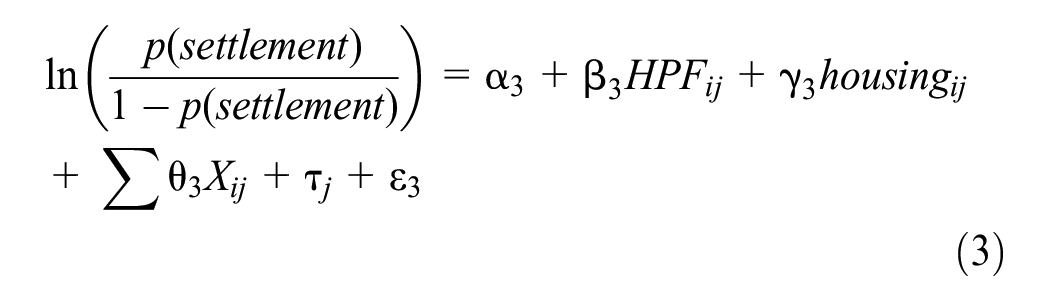
We adopt a Probit model to test the mechanism by which the HPF affects settlement intentions. The models are expressed as follows:


where
Model for the Robustness Test
First, we adopt propensity score matching (PSM) to construct a counterfactual sample to address any potential endogeneity and selection bias. Specifically, some omitted variables, such as personal consumption preferences and cultural characteristics, may affect both HPF participation and settlement intentions. We match (with replacement) a migrant I, that is, an HPF participant, with a migrant J, that is, a non-HPF participant, who is as similar as possible to migrant I of the measurable variables. Based on the conditional independence assumption, I and J are comparable, and the difference between their settlement intentions can be estimated.
Second, due to the localized management of the HPF, there may be policy differences among cities, which may lead to bias in the above results. Inspired by studies on peer effects (Grennan, 2019), we further test for the effect of the HPF and its underlying mechanism on migrants’ settlement intentions at the city level. The following OLS regression models are adopted:



where
Heterogeneity Test
To test the second hypothesis, we divide the sample into eastern, central and western regions by city. The housing prices in economically developed cities in the east are much higher than those in western cities. Moreover, given these regional differences in housing prices, whether the factors influencing migrant settlement intentions vary across regions has always been of interest to scholars and governments (Liu et al., 2018; Zang et al., 2015).
To test the third hypothesis, we divide the within-city sample of migrants into three groups according to income, namely, a low-income, middle-income and high-income group. In addition, inspired by existing research (Y. Huang et al., 2018; S. Lin et al., 2022), we also investigate the heterogeneity by hukou status and education level. First, one of the most important goals of China’s urbanization is to support rural migrants in permanently settling in their host cities. We thus divide the sample of migrants into those engaged in city-to-city migration and those engaged in rural-to-urban migration. Second, to improve urban competitiveness, most local governments have preferences for specific types of migrants in terms of the provision of financial support for housing. One of the most widely implemented policies is a preferential policy for highly skilled, that is, highly educated, migrants. For example, many cities stipulate that migrants with a bachelor’s degree or above can obtain a larger HPF loan (Zhang & Yan, 2022). Indeed, rural migrants and poorly educated migrants are usually those with low income. The heterogeneity in the effect of the HPF on those groups also provides a robustness test for the third hypothesis.
Data Description
The data in this study come from the CMDS, which is an annual large-scale sample survey of 200,000 migrants conducted by the National Health Commission since 2009. The CMDS covers basic information on migrants, including their demographic characteristics and settlement intentions, and has been widely used in studies of migrants (Gu et al., 2022; Y. Huang & Ren, 2022). We use the data from 2016 because only this round of the survey collected information on migrants’ HPF participation.
The survey asked in detail about migrants’ settlement intentions, which is measured with the question “Would you like to reside here for a long time (more than five years)?” We drop respondents who answer “have no idea.” Migrant HPF participation is measured with the question “Do you participate in the HPF?” Respondents who answer “I am not sure” are dropped. We drop respondents who have already purchased a house in their host city since we cannot identify a causal relationship between their housing consumption and their HPF participation. Moreover, we retain respondents between the ages of 16 and 65 and those who have migrated for work. After addressing the missing values for key variables and matching city-level variables to individual migrants, the final data contain 50,751 valid observations covering 262 cities.
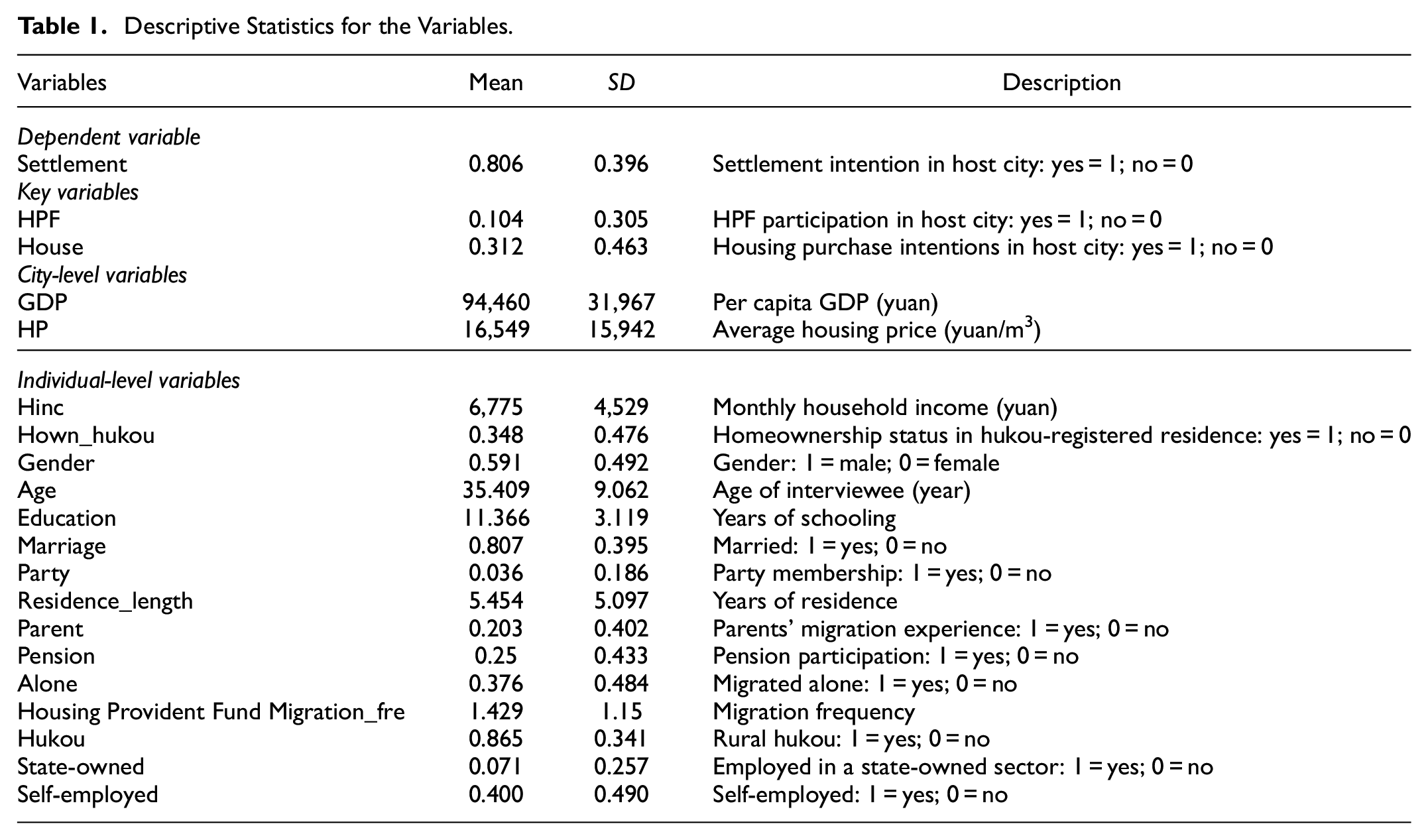
The descriptive statistics for the variables are shown in Table 1. In the full sample, 80.6% of migrants intend to reside in their host city for more than 5 years, while only 10.4% participate in the HPF. This participation rate is much lower than that of urban employees with stable employment (M. Chen et al., 2020b). A total of 31.2% of migrants intend to purchase a house in their host city. The average per capita GDP at the city level is 94,460 yuan. The average housing price is 16,549 yuan/m3, while the standard deviation is 15,942, suggesting that housing prices vary greatly among the different cities. To eliminate heteroscedasticity, we used the logarithms of household income, housing prices and per capita GDP in the regression model.
Descriptive Statistics for the Variables.
In Table 2, we further divide the sample into several subsamples according to migrants’ HPF participation and the various city- and individual-level variables and estimate the mean difference in settlement intentions. The results in panel A show that for the whole sample, the mean value of the settlement intention variable for the HPF participants is 0.891, which is 0.095 higher than that for the non-HPF participants. This difference is also significant at the 1% level for the full sample, and the corresponding differences are also significant at the 1% level for all subsamples. In panel B, we estimate the mean value of the settlement intentions variable in the different regions. Among the HPF participants, the difference in settlement intentions across regions is insignificant; however, non-HPF participants in eastern cities have significantly lower settlement intentions than those in other regions. Regarding the settlement intentions among members of the different income groups, as shown in panel C, low-income migrants are more eager to leave their host cities than migrants in other income groups. The results in panel D and panel E indicate that migrants with a rural hukou and with a lower education level are more likely to move back to their hometown or keep floating.
Mean Differences in Migrants’ Settlement Intentions.

p < .01. **p < .05. *p < .1.
Empirical Results
Baseline Results and Mediated Effect
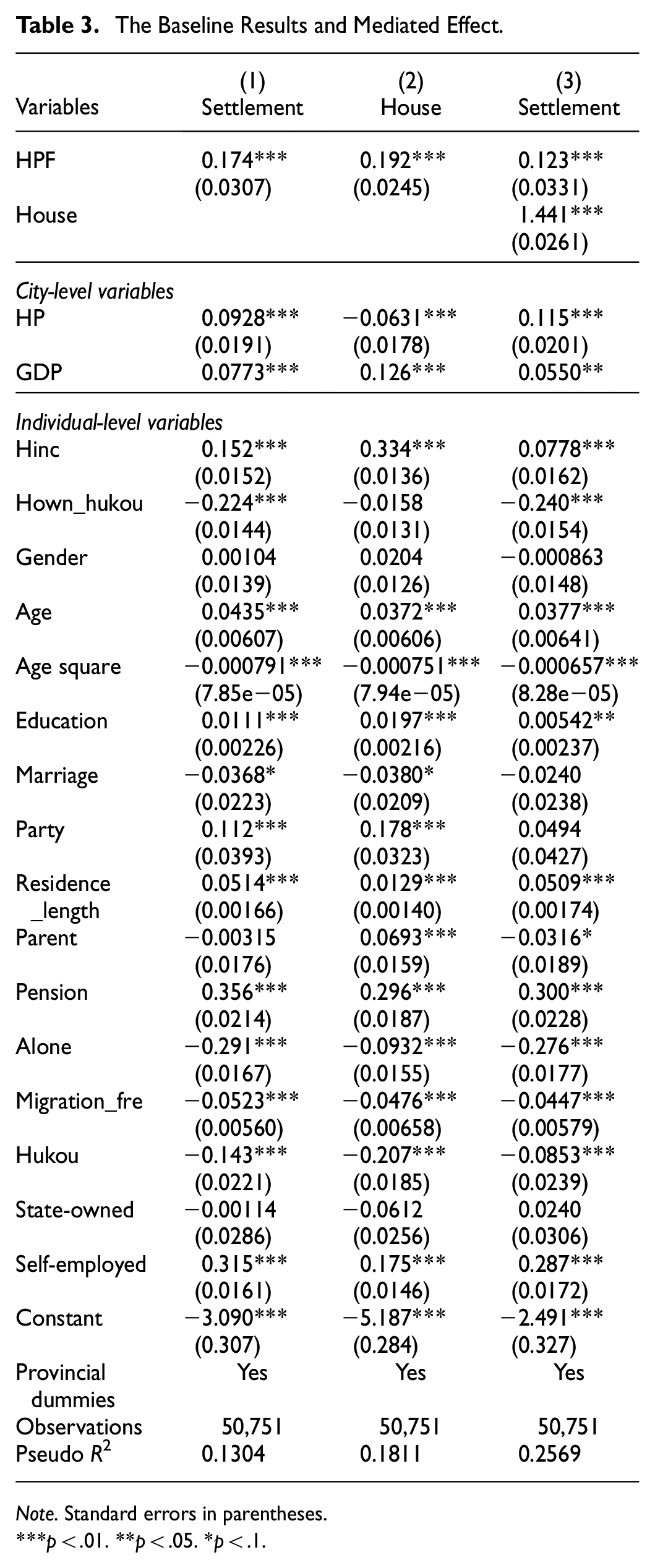
In Table 3, Column (1) contains only the HPF and controls for variables at the individual and city levels. The results show that the effect of the HPF is statistically significant at the 1% level. In Column (2), the dependent variable is housing purchase intentions in the host city, and the coefficient is significant at the 1% level. Column (3) reports the results of equation (3). The coefficients on both HPF participation and housing purchase intentions are significantly positive at the 1% level, suggesting that a mediator effect exists. The above findings confirm the first hypothesis that HPF participation has a positive effect on migrant settlement in the host city by improving their intention to purchase housing.
The Baseline Results and Mediated Effect.
Note. Standard errors in parentheses.
p < .01. **p < .05. *p < .1.
The results for the control variables are similar to those in existing studies (L. Chen et al., 2022; S. Chen & Liu, 2016; L. Lin & Zhu, 2022). For example, economic development is attractive to migrants, while housing prices have a negative effect on housing purchase intentions. This confirms the conclusion that migrants live in large cities for money but ultimately keep moving because of the unaffordability of housing (Song, 2020). Migrants who own a house in a hukou-registered residence are more likely to leave their host cities, which also illustrates the importance of homeownership for settlement.
Results of the Robustness Tests
PSM Results
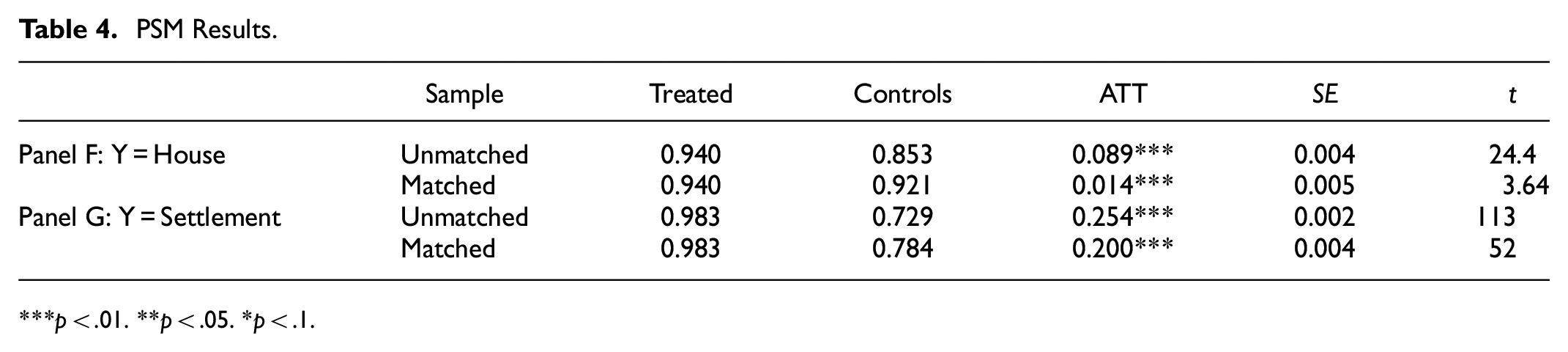
We further adopt a PSM model to eliminate potential selection bias. First, we estimate the treatment effect of the HPF on the intention to purchase housing in host cities. Second, we define the treatment variable as housing purchase intentions and the outcome variable as migrants’ settlement intentions. We use 1:4 nearest neighbor matching to minimize the mean square error. The results in Table 4 indicate that the treatment effects are still significant after constructing randomized data with PSM. In panel A, when HPF participation is the treatment variable, the average treatment effect of the treated group (ATT) on housing purchase intentions is 0.019, with a significance level of 1%. In panel B, the ATT for housing purchase intentions on settlement intentions is 0.200 with significance at the 1% level. The above results are in line with the baseline results, which suggest that the findings are robust.
PSM Results.
p < .01. **p < .05. *p < .1.
Results of the City-Level Estimation
Table 5 reports the results of estimations at the city level. The results in Column (1) suggest that HPF coverage at the city level is significantly positively correlated with the settlement intention ratio. Moreover, the mediating effect in Columns (2) and (3) shows that HPF coverage significantly increases the overall housing purchase intentions of migrants and further increases the settlement intention ratio. The results in Table 5 are consistent with those in Table 2, which again verifies the robustness of the baseline results. In addition, the results in Table 5 also indicate that improving the HPF coverage of migrants at the city level is conducive to urbanization.
Results of the Estimations at the City Level.

Note. Standard errors in parentheses.
p < .01. **p < .05. *p < .1.
Results of the Heterogeneity Test
We are more concerned about the regional- and individual-level heterogeneity in the HPF effects after proving that the HPF has a positive effect on migrants’ settlement intentions by improving their expectations of purchasing housing.
Table 6 presents the results of the heterogeneity test. The regional differences in panel H indicate that the sensitivity of the settlement decisions of migrants to financial support for housing is weakest in the eastern region and strongest in the western region. Specifically, the odds of HPF participants being willing to settle are 16%
Results of the Heterogeneity Test.

p < .01. **p < .05. *p < .1.
The results in panel I confirm our third hypothesis. The sensitivity of migrant settlement intentions to the HPF is negatively related to income level. Specifically, among members of the low-income group, the odds of HPF participants intending to settle in their host city are 20%
However, the vast difference in HPF coverage among different groups deserves further attention, as shown in Column (4) of Table 6. First, the HPF coverage rate among migrants in eastern cities is 14.3%, which is higher than that in central and western cities. In contrast, the effect of the HPF on migrants’ settlement intentions is the lowest in eastern cities. A possible reason is that eastern cities in China are generally more economically developed with more formal enterprises, which are more inclined to provide HPF accounts for migrants, while the financial support provided by the HPF is insufficient given the high housing prices in eastern cities.
Second, we find that income levels are positively correlated with HPF coverage. The percentage of low-income migrants participating in the HPF is 9%, while the percentage of high-income migrants is 12.5%. This suggests that there is inequity in the opportunity to participate in the HPF among migrants. Although low-income migrants are more sensitive to HPF coverage, insufficient coverage results in limited support for their urban settlement.
Third, the inequity in HPF coverage is particularly evident in the groups sorted by education level. Specifically, in the research sample, there are only 2,871 migrants with a bachelor’s degree or above, but their HPF coverage rate is very high at 52.6%. In comparison, the percentage of migrants with a low education is 92%, but their participation rate in the HPF is only 7.8%.
Fourth, the difference in HPF coverage rates between city-to-city migrants and rural-to-urban migrants is also very significant. The survey sample includes 6,840 migrants with an urban hukou, and their HPF participation rate is 27.5%, while the number of migrants with a rural hukou is 43,911, of whom only 7.7% participate in the HPF. However, migrants with a low education level and a rural hukou are generally in the low-income group.
Further Discussion
Challenges in HPF Coverage
Just as existing research has criticized the inequity in the HPF, low-income migrants do not have equal opportunities to enjoy the benefits of the HPF. Nevertheless, low-income migrants’ settlement intentions are more sensitive to the financial support provided by the HPF, which suggests that there is still a nonnegligible gap between HPF participation and actual settlement demand among migrants.
On the one hand, our results suggest that there is a significant disconnect between HPF coverage and migrant demand for settlement. Burell (2006) argued that opportunities to participate in the HPF are unfair since the HPF favors urban residents who are employed in the state-owned sector or in large enterprises. Moreover, J. Chen and Deng (2014) also found that higher-income employees are more likely to participate in the HPF, and they noted that the HPF might increase the inequity between the rich and the poor. Empirically, this study expands the existing pool of research on inequity in the HPF beyond its effect on housing consumption. Specifically, low-income migrants whose settlement intentions are more sensitive to the HPF do not participate equally in this program to provide financial support for housing. The HPF coverage of migrants is only 10.4% in our sample, and it is even lower for specific subsets, such as low-income migrants, poorly educated migrants and rural-to-urban migrants.
On the other hand, some studies have proven that migrants are excluded from social services, and they attribute this exclusion mainly to institutional discrimination (Zou & Deng, 2020). In fact, the earliest inclusive regulation regarding rural migrants’ HPF participation was the “Guiding Opinions on Several Issues in the Management of the Housing Provident Fund (Jian Jin Guan [2005] No. 5)” issued in 2005, which stated that rural migrants should enroll in the HPF if conditions permit. In contrast with the mandatory nature of the HPF for urban employees, the regulations regarding rural migrants’ HPF participation are somewhat vague.
Theoretically, the HPF is mandatory under the regulations stipulated by the central government: all working units should set up HPF accounts for their employees. However, the actual situation is not encouraging. In fact, providing HPF accounts for employees has long been regarded as a burden by enterprises (Q. Huang, 2020). Only among employees in the state-owned sectors is there high HPF coverage because the contributions to the HPF for those employees are financed by the government. In contrast, private enterprises are reluctant to contribute to the HPF, especially with the weak legal protections in the current HPF management regulations. In addition, in the game scenario between pursuing economic development and punishing enterprises, the effectiveness of local administrative law enforcement is sometimes insufficient (M. Chen et al., 2020b).
Discussions on Voluntary Participation in the HPF
In recent decades, reforming the HPF by expanding coverage has been a policy goal. According to the regulations for the HPF, residents who participate in the HPF must rely on their work unit for access. Specifically, employees’ HPF accounts are set up by their work units, and their monthly contributions consist of funds deposited by the working units and the employees. However, migrants are often employed in temporary sectors or are self-employed, which places the demand for expanded HPF coverage in conflict with the employment status of migrants.
Contractual Savings for Housing (CSH), a voluntary housing saving scheme, might provide some new guidance. CSH policies have been widely adopted all around the world, such as in Germany, Austria, and India (Chiquier & Lea, 2009). Since 2004, China has launched the Sino-German Bausparkasse (SGB) in Chongqing, Dalian, Jinan and Tianjin. After the completion of the savings phase, individuals can receive subsidized loans in the future for housing consumption. However, the deposit and loan rates are fixed upon the signing of the contract such that the CSH suffers from inflation risk, which might erode the value of deposits. Therefore, compared to the mandatory HPF, the SGB in China is relatively underdeveloped. By 2021, the CSH had issued housing loans totaling 53.9 billion yuan, which is far less than the amount issued by the HPF.
Chongqing’s pilot voluntary HPF implemented in 2021 is an optimization of the CSH, which aims to provide financial support for housing, especially for freelancers employed in temporary sectors or self-employed individuals. Chongqing’s pilot voluntary HPF offers three alternatives. The first is a fixed deposit scheme. Participants make deposits every month according to the signed contract and can obtain low-interest loans after the account matures. This scheme is suitable for residents with a stable income. The second is the lump-sum deposit scheme. Participants deposit a lump sum of money into the account as agreed upon and can obtain a low-interest loan after the deposit matures. This scheme is suitable for residents with a high level of liquidity. The third is a flexible deposit scheme, where participants can deposit and withdraw money at any time but have access to fewer low-interest loans. The pilot program in Chongqing has been a great success. According to the 2021 annual report of Chongqing Housing Provident Fund, 10.17% of the new entrants into this HPF in 2021 coming from flexible employment.
However, the voluntary HPF in Chongqing still has several deficiencies. First, although it offers more options for migrants, the benefits that migrants can obtain through the voluntary HPF may not be able to compensate for the rise in housing prices, especially as housing prices have risen significantly in recent years. Second, the deposit and loan rates for different plans are homogeneous, which does not account for the income differences across residents. In fact, low-income migrants are more likely to choose the flexible deposit scheme because of their low liquidity, and they therefore benefit less.
Conclusions and Policy Implications
Previous studies focusing on migrants’ settlement intentions have mainly evaluated the effect of housing availability or access to urban amenities, but the impact of the HPF is still unclear, especially given the debate over its effectiveness. In this study, we find that participating in the HPF significantly promotes migrants’ settlement intentions, mainly by improving their housing purchase intentions. We also find that the effect of the HPF is less sensitive in eastern cities and among high-income migrants. However, we highlight the low coverage of the HPF among migrants and suggest that the HPF reform is still needed.
Given the positive effect of the HPF, we suggest further optimizing the pilot voluntary HPF and expanding financial support for housing among migrants. Based on the heterogeneous effect of the HPF, we also suggest that the expansion of the HPF should focus on the central and western regions, where housing prices are relatively low, and introduce differentiated voluntary policies for migrants with different incomes to support more low-income migrants in realizing their city dreams.
Objectively, our study has some limitations. First, in this study, we provide a framework for estimating the effect of the HPF only; we cannot quantitatively measure the level of financial support provided by the HPF and the corresponding differences in migrants’ settlement intentions due to insufficient data. Second, participation in the HPF can also improve the identity and social integration of migrants, and whether this mechanism holds is worth exploring in the future.
Footnotes
Declaration of Conflicting Interests
The author(s) declared no potential conflicts of interest with respect to the research, authorship, and/or publication of this article.
Funding
The author(s) disclosed receipt of the following financial support for the research, authorship, and/or publication of this article: This study was supported by the National Natural Science Foundation of China under Grant [Number: 72204002, 71974003, 71874001]; Key Research Project of Humanities and Social Sciences in Universities in Anhui Province under Grant [Number: SK2021A0186]; The Open Fund of Key Laboratory of Anhui Higher Education Institutes under Grant [Number: CS2021-ZD02]. The Outstanding Youth Research Project in Anhui Universities under Grant [Number: 2023AHO20021].
