




Abstract
This study takes the English concessive conditional construction “Just Because X Doesn’t Mean Y” (JBX-DMY) as its object, extracts instances from the Corpus of Contemporary American English (COCA), applies Simple Collostructional Analysis to the representative collexemes, and investigates the experiential and conceptual characteristics of this construction from the perspective of cognitive construal in order to explain the source and mechanism of polysemy. Dividing JBX-DMY into two parts, this study analyzes ways of construal, vantage points and viewing arrangement under the dimension of cognitive construal.
Introduction
Background of the Study
The idiomatic pattern “just because x doesn’t mean y” (JBX-DMY) is ubiquitous in our natural language, which reflects basic experience of two scenes and encodes a concessive relation referring to “scene y cannot be inferred from scene x.”
Instances of JBX-DMY consist of subordinate and main clause, elaborating scene x and y respectively. There are affirmative and negative combinations for two clauses. Subordinate clause could either be affirmative or negative, while “doesn’t mean” negates main clause thus alternates the whole sentence into negative or affirmative. To take it as a whole, the relation of two scenes can be demonstrated as “if p, then not q,” which seems that concessive meaning is derived from negation of resultative relation. However, logic inference fails to construct meaning of JBX-DMY in mind as speakers abandon the resultative reasoning to scene x but choose a negative inference to scene y instead.
Primary observations imply that syntactic and semantic properties may be implemented and influenced by cognitive operations, such as construal, namely, “our ability to conceive and portray the same situation in alternative ways” (Langacker, 1987, p. 39, 2008, p. 43), which emphasizes cognitive profiling and communication intention. To fulfill interactive requirement, speakers construe scenes at certain dimensions, thus give rise to various kinds of modality, tense and aspect, and plays an important role in constructing idiomatic meaning. Idioms and constructions can be treated as symbolic units, which constitute “a structured inventory of conventionalized linguistic units” (Langacker, 1987, p. 73). We treat JBX-DMY as an idiomatic construction for slots that should be filled in. The purpose of the study is to investigate the English concessive conditional construction “Just Because X Doesn’t Mean Y” (JBX-DMY) from the cognitive construal perspective, in order to provide a detailed description of the construction at the conceptual level.
Layout of the Article
There are five sections in this article. Section 1 introduces the background of the study, including cognitive linguistics and constructional approaches to grammar. Section 2 gives a critical review of previous studies of constructions, concessive conditional constructions and JBX-DMY. Section 3 establishes the theoretical foundation for the study and explains the procedure of corpus-based analysis. Section 4 analyzes cognitive construal and shows the statistical results of JBX-DMY. Section 5 summarizes the major findings, draws the conclusions and puts forward suggestions for further studies.
Literature Review
Studies of Concessive Conditional Constructions
Previous studies mainly accented concessive connectives, concessive clauses and concessive relation which play an essential part in describing and understanding concessive conditional constructions.
König (1985) gave a retrospect of concessive connectives and concessive sentences development in English, and found that concessive connectives are derived “either from conditional connectives, from expressions asserting remarkable co-occurrence or co-existence, or from notions earlier only applicable to human agents or experiencers” (König, 1985, p. 1). König and Siemund (2000) pointed out that the external negation of casual constructions is equivalent to the internal negation of concessive construction, thus concessive relation derives from resultative relation. The opposition between concession and causality can also be described in “interactive patterns of conceding.”Verhagen (2000, p. 362) observed that concessivity and causality are parallel concepts in asymmetry relation as “negation of causality may lead to an interpretation as concessive, but (wide scope) negation of concessivity does not allow for an interpretation as causality.” Using mental space theory, he proved that negation involves the construction and manipulation of different vantage points or mental spaces. Vergaro (2014) described the inverted though concessive construction in English and investigated the position of the construction within the concessive sentence. The results of the collexeme analysis show that the construction is extremely infrequent and almost exclusively found in written texts. Li and Wen (2015) explained the grammaticalization and cognitive construal means of the Chinese concessive sentence pattern “jishi x, yeshi y” (JSYP), and found that two parts of the construction have contradictory features. Dong (2016a, 2016b) made a detailed analysis on constructional ellipsis in Chinese concessive constructions and equated the phenomenon to the process of modality adherence.
Studies of JBX-DMY
JBX-DMY has been followed with interest, deriving from the discussion of casual and inferential readings of because-clauses. Former studies have covered a syntactic debate and some semantic and pragmatic discussions. Adhering to the traditional paradigm though, previous researchers failed to explain the reason for polysemy of JBX-DMY.
Hirose (1991, pp.18–19) mentioned two grammatical characteristics of the subject-because construction. Firstly, the construction has “the verb of inference,” including mean, prove, show, establish, guarantee, thus the syntactic configuration could be drawn as That S1-V-that-S2. Secondly, the construction is always preceded by the focusing adverb just. Bender and Kathol (2001) posited a just because adjunct preceding a negated main clause, and specified that the negation in the main clause should take scope over the adjunct. Bender and Kathol (2001) stressed three constructional properties of JBX-DMY. Firstly, in contrary to Hirose (1991), the JB-X part should be the subject. Secondly, the predicate in the DM-Y part has to be negated. Thirdly, only the verb mean and a small number of verbs could head the DM-Y part.
Opinions are thus divided as to whether the construction is grammatical. Hirose (1991) argued that the construction is blended by a noun clause (guided by that) and an adverbial clause (guided by because), and because-clause precedes the main sentence and serves as the subject of the whole sentence. The verb of inference “has a great deal to do with” the permission of a because-clause subject preceded by just. In contrast, Bender and Kathol (2001) found that the construction has an invisible subject it or that, so because-clause should be a modifier. Instead, the latter part of the construction is actually the subject. Hilpert (2007) rejected their argumentations without proposing a plausible solution.
Researchers have also described the semantics of JBX-DMY construction. Hirose (1991) discussed the inferential reading of subject-because construction, which is interpreted as the negative counterpart of the inferential reading. The function of the subject-because construction is to deny the logic of abduction. To be specifically, “the subject-because construction is used to deny the process of drawing a certain conclusion from a certain factual premise and to express some doubt about the validity of the conclusion as well” (Hirose, 1991, pp. 22–23).
Bender and Kathol (2001) exemplified the selectional properties of inference predicates such as variations of mean and make. Hilpert (2005) strictly constrained just because construction from the sense of inference denial, thus wiped out instances that simply convey casual relation, or examples that is merely negated, and in the form of imperative sentence or question. Hilpert (2007, p. 29) primarily described syntactic and semantic properties of JBX-DMY and shows that this construction deviates in several respects from established patterns of English grammar.
For semantic and pragmatic functions, Bender and Kathol (2001) pointed out that the construction is often used to express negative predictions. With the help of corpus, Hilpert (2005, 2007) summed up the meaning of construction as “Y is not an effective inference for fact X” and found that the construction is used to achieve humor effect on specific occasions.
In addition to synchronic research, some scholars conducted diachronic studies, the most prominent of which is Martin Hilpert. Hilpert (2005, 2007) analyzed diachronic corpora and found that just because has been syntactically converted into a concessional conjunction, the frequency of JBX-DMY gradually increased after 1950, and its discourse function has been transformed from expressing causality to denying speculation. Based on this research, Hilpert extended the scope to general concession constructions in English. Hilpert (2013) used conceptual integration theory to analyze English concession relations. On the basis of former studies about the grammaticalization of just because, he speculated that English concessional conjunctions are the secondary grammaticalization of causal conjunctions. Previous researches reveal the basic approach to grammaticalization of English concessional constructions, but do not explain the cognitive mechanism of JBX-DMY specifically.
Theoretical Basis and Research Design
Theoretical Basis
Cognitive Construal
Much of language, lexical or grammatical, can be described as encoding different conceptualizations of experience. The description of meaning and grammar mainly depends on conceptualization, which refers to the process we observe and express situations and consists of content and cognitive construal. Content is the property inherent to a situation or the entity it designates, while cognitive construal is “our manifest ability to conceive and portray the same situation in alternate ways” is construal (Langacker, 2008, p. 43, 2016, p. 2).
Stage Model
The notion of cognitive construal is visually embodied thus dimensions of construal are all analogous to the basic aspects of visual perception. The visual metaphor goes as “content is likened to a scene and construal to a particular way of viewing it” (Langacker, 2008, p. 55). Our daily conversational situation can be metaphorically compared to a situation that two spectators watching a play, which is called the stage model.
In stage model, the maximal field of view covers the offstage and onstage region, where two offstage viewers focus on the onstage object. The immediate field of view is the onstage region. To better understand the inner perspective of conceptualization, Langacker (2015, p. 123) put forward the canonical viewing arrangement, as illustrated in Figure 1.

Stage model.
In canonical viewing arrangement, perspective pertains to the viewing arrangement, in which two factors are important, namely, vantage point and scope. A vantage point is the place from which a situation is apprehended. Two interlocutors, namely speaker (S) and hearer (H), are distinct from the object of description, viewing the same onstage situation from the same offstage vantage point. The maximum field of view is maximum scope (MS), and the immediate field of view is immediate scope (IS). The term ground (G) is used for the speaker and hearer, the speech event in which they participate, and their immediate circumstances.
Describing a situation often involves shifting attention or emphasis from one part to another depending on the needs of the communication. In the sphere of perception, a perceiver can perceive a visual scene from different angles. By analogy, in the sphere of language, a conceptualizer can conceive a situation differently and adapt his or her vantage point accordingly. The relationship between the perceiver and the perceived entity in the perceptual realm corresponds in the linguistic realm to the conceptual relationship between the conceptualizer and his or her object of conceptualization. For example, each viewer can use different pronouns to denote either himself or herself, or any entity onstage. In canonical viewing arrangement, pronouns indicate different vantage point. The speaker and hearer are the viewers for the meanings of linguistic expressions. The maximum scope is all of the content that figures in an expression’s meaning. Within the maximum scope, the immediate scope comprises the content being attended to. Within the immediate scope, an expression’s profile is the focus of attention. While there are many participants in a situation, the conceptualizer must select certain ones as the focus. Profile shows inner asymmetry of two entities, the relation between them is trajectory-landmark alignment. The primary focal participant is the trajector (tr), and the secondary one is the landmark (lm). CG applies profiling to conceptually distinguish traditional grammatical categories. The profiling ability lays the foundation of metonymy, which is actually a selective profile and a source for polysemy. For example, the adjectives profile atemporal relation. The different profiles imposed upon the content of a certain scalar form different scalar adjectives.
Ways of Cognitive Construal
Langacker (2009, p. 342) proposed three ways of conceptualizing multiple entities, namely, the simultaneous, sequential and alternative construal, as Figure 2 shows. The simultaneously construal is also called summation, which is available at a single point in processing time. The sequential construal happens when we conceptualize the size of a small group. A special case of sequential construal is alternative construal. These three construals are not mutually exclusive.

(a–c) Ways of cognitive construal.
Research Design
Research Method
The research object of this article is the English concessive conditional construction “Just Because X Doesn’t Mean Y” (JBX-DMY). Previous accounts fail to provide a quantitative investigation of the conceptual properties of JBX-DMY. This article is intended to analyze it with a corpus-based method. As introduced in the previous sections, cognitive construal provides a psychological plausible solution to language structures in the conceptual level. For statistical practice, the corpus-based analysis fulfills that requirement.
When studying functions of constructions, we should not just calculate how frequently words occur in their slots, but compute measures of association that quantify how strongly or weakly a word and a construction is attracted to, or repelled by, each other. As we will discuss in Section 4, JBX-DMY is composed of two clauses, namely, just because clause and doesn’t mean clause, where pronouns and adjectives are allowed as imports for the concessive meaning. To reveal pronoun and adjective collexemes in each clause, Simple Collexeme Analysis is the appropriate method for the analysis, while neither Distinctive Collexeme Analysis nor Covarying Collexeme Analysis meets the need.
Data Collection
In this section, we explain the objects for statistical analysis. We treat JBX-DMY as an idiomatic construction for slots that should be filled in. We make use of the Corpus of Contemporary American English (COCA) to search instances of JBX-DMY in real use. COCA is the largest freely available corpus of English, and the only large and balanced corpus of American English. COCA is probably the most widely used corpus of English, and it relates to many other corpora of English and offers unparalleled insight into variation in English. The corpus contains more than 520 million words of text (20 million words each year 1990–2015). We use just because as a string in searching instances of JBX-DMY in COCA and find 9,542 instances. After a manual filtration, we have 2,411 instances of JBX-DMY in total. The determination of these depends mainly on their formal characteristics. We restrict the objects to the standard form JBX-DMY and a few other that deviates from the form but convey the meaning of inferential denial.
Analytical Procedure
The study applies Simple Collostructional Analysis, a corpus-based method, for the analysis of JBX-DMY. The study was carried out in the following steps:
We collected all instances of JBX-DMY in COCA and check them manually.
We searched collocates of JBX-DMY in COCA and calculate four frequencies.
We applied the script Coll.analysis 3.5 in software R to the log-likelihood and generate the output.
We reported the results of pronoun and adjective collexemes for each clause.
We analyzed the results within the framework of canonical viewing arrangement.
As introduced in Section 3, we need four frequencies to conduct a Simple Collostructional Analysis. The total number of instances of JBX-DMY in COCA, 2,411, is the first frequency we need. The second frequency is provided in the introduction of COCA that the size of it is 520,000,000. The remaining two frequencies are the frequency of a word in JBX-DMY and the frequency of a word in COCA.
We hold that pronouns and adjectives have a role to play in cognitive construal. As JBX-DMY is divided into two parts, we search pronouns and adjectives that collocate with each part. Based on the syntactic distribution property of JBX-DMY, all pronouns and adjectives appear on the right side of JBX and DMY. We search pronouns that appear at the first node (span: +1) and adjectives that appear at the first to ninth node (span: +9). To contain all possible types of pronouns and adjectives, we group them as “LEMMAS” that hit over 100 times.
Then, we examine each instance under each lemma and calculate two frequencies, namely, the number of instances in JBX-DMY that meet the requirements, and the number of instances that are involved in COCA. For the remainder, we removed some lemmas as we don’t find appropriate instances of JBX-DMY. Finally, we put four frequencies in the script Coll.analysis 3.5 in software R to calculate the logic-likelihood.
Results and Discussion
Results
Pronoun Collexemes in JBX-DMY
As introduced in Section 3, the collostruction strength of each pronoun and adjective in JBX-DMY is computed by Coll.analysis 3.5, an R script provided by Gries (2014), with the Fisher exact test as a distributional statistic. It applies a log transformation to the p-values yielded by the Fisher exact test, and changes the sign to a plus if the association is one of attraction and to a minus in case of repulsion. Simple Collostructional Analysis provides a more readable value than the p-values. A collostruction strength above 1.301 means that the verb is significantly attracted to the construction. A collostruction strength below −1.301 means that the verb is significantly repelled by the construction. We generate four tables in total, representing pronoun and adjectives in each clause, respectively. It is necessary to explain the meaning of each column: “relation” is the relation of the word to the construction, and “coll.strength” is the index of collostructional strength. To save space, we omitted several numerical values that function merely statistically.
We report 15 pronouns that significantly attract just because clause and 2 pronouns that significantly repulse just because clause, as Table 1 shows. We then report 17 pronouns that significantly attract doesn’t mean clause, as Table 2 shows.
Pronoun Collexemes in Just Because Clause.

Pronoun Collexemes in Doesn’t Mean Clause.

In order to study the semantic properties, we analyze two tables mentioned above and collect all pronoun collexemes in two clauses to Table 3, which reports 12 shared attracted pronouns for just because clause and doesn’t mean clause. As it turns out, two clauses attract all 7 nominative personal pronouns (I, we, you, he, she, it, they) and 5 indefinite pronouns (someone, everyone, everybody, nobody, anybody). There are also exclusive pronouns to each clause.
Pronoun Collexemes in Two Clauses.

Apart from shared pronouns, three indefinite pronouns (nothing, something, somebody) significantly attract just because clause, while some and them significantly repulse just because clause. There are two indefinite pronouns (anything, anyone) and two possessive pronouns (yours, ours) that significantly attract doesn’t mean clause.
Adjective Collexemes in JBX-DMY
For adjective collexemes, we report 70 significantly attracted adjective collexemes and 1 repulsed one in just because clause. We only present 10 of them to save space, as Table 4 shows. We found 69 significantly attracted adjective collexemes and also presents 10 most attracted and 1 repulsed one in doesn’t mean clause in Table 5.
Adjective Collexemes in Just Because Clause.

Adjective Collexemes in Doesn’t Mean Clause.
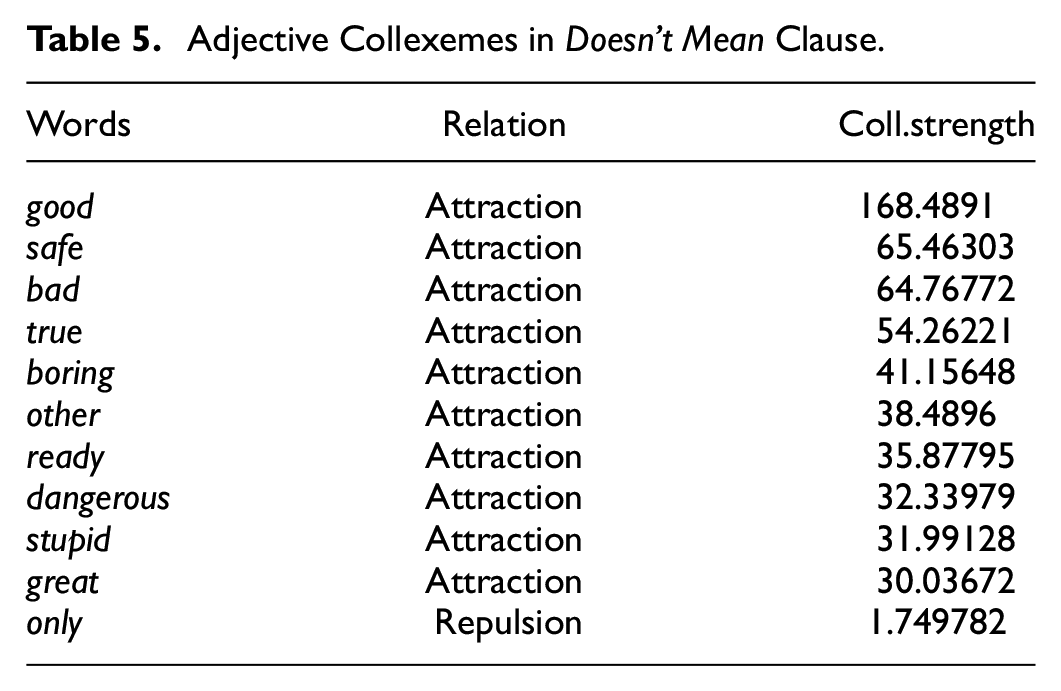
By comparing Table 4 with Table 5, we made Table 6, which reports 28 significantly attracted but one repulsed (only) adjective collexemes shared by just because clause and doesn’t mean clause. It should be noted that just is repulsed in doesn’t mean clause. We classify 29 shared adjectives into several categories, according to Longman Grammar of Spoken and Written English and Collins Cobuild Advanced Learner’s Dictionary.
Adjective Collexemes in Two Clauses.

There are 16 adjectives expressing evaluation or emotion (poor, stupid, best, great, true, sick, easy, happy, fun, smart, interested, crazy, bad, better, low, rich), 5 adjectives denoting relation (common, other, special, extra, whole), 2 adjectives denoting size (big, large), 1 adjective showing time (late), 1 adjective indicating topic (medical), 1 adjective illustrating color or brightness (black), and 2 adjective descripting miscellaneously (strong, free). The adjective classifier only repulses both clauses.
Table 6 also reports 41 adjectives exclusive to just because clause. We group them into several subtypes. We have 14 adjectives that express evaluation or emotion (famous, available, certain, expensive, beautiful, fine, nice, comfortable, good, popular, cheap, funny, simple, early, difficult), 11 adjectives that indicate topics (healthy, female, national, paranoid, used, natural, married, tired, legal, nuclear, commercial), 5 adjective that have miscellaneously description (alive, hot, close, cold, professional), 4 adjectives that convey temporal concepts (current, young, new, early), 4 adjectives show relation (particular, major, public, different), and 3 adjectives denoting quantity, size, and height (little, small, tall).
In addition, Table 6 reports 39 adjectives exclusive to doesn’t mean clause. There are 25 adjectives expressing evaluation and emotion (perfect, successful, tough, innocent, dangerous, wrong, aware, supposed, real, important, boring, valuable, capable, ok, incapable, safe, false, fair, accurate, afraid, fit, willing, safe, able, ready), 4 adjectives denoting topics (illegal, guilty, civil, human), 4 adjectives referring to miscellaneous meaning (open, hard, dead, serious), 3 adjectives indicating relation (right, involved, normal), and 2 adjectives showing extent and volume (deep, full). The quality adjective just repulses doesn’t mean clause.
Discussion
Conceptual Structure of Collexemes in JBX-DMY
Section 4.1 presents pronoun and adjective collexemes in two clauses and provides a primary semantic classification for pronouns and semantic classification for adjectives. It should be noted that the production of a ranked list of collexemes is not an end of itself, nor the end of this study. The methodology affords a perspective on the data that brings the idiosyncrasies of JBX-DMY more into focus than raw frequencies would, but as in an analysis of raw frequencies, the real work of a semantic study should be conducted by human analysis. The lists of pronoun and adjective collexemes still need to be interpreted. As CG symbolizes semantic structures with conceptual structures, to further illustrate the semantic properties of pronouns and adjectives in JBX-DMY, we analyze their conceptual structures first. In this section, we focus on conceptual structures of those pronouns and adjectives in two clauses of JBX-DMY, with the model of canonical viewing arrangement.
As it turns out, the shared pronouns in two clauses are personal pronouns and indefinite pronouns. Langacker (2008, p. 314) holds that the label of personal pronouns “reflects the status of their referents with respect to the speech event participants.” According to the canonical viewing arrangement, the speaker and the hearer are major participants of speech events, instead of others. This basic experience determines the high word frequency and observed frequency in constructions involving human participants. To put it another way, we often choose ourselves as topic of communication.
An expression’s meaning includes a viewing arrangement. According to the stage model, the viewing asymmetry between the offstage interlocutors and the onstage content is reflected linguistically. We investigate three kinds of viewing arrangements based on Figure 3, adapted from Langacker (2016, p. 22), which sketches the canonical and other arrangements.

(a–d) Viewing arrangements.
The pronoun I and you makes an interlocutor explicit, in which case it functions not only as a subject of conception but also as the object, both directly for the other interlocutor and indirectly via simulation of the other’s experience.
Three conceptual diagrams above show three kinds of vantage points and viewing arrangements. In type 1, the personal pronouns in third person and indefinite pronouns are distinct from the speaker and the hearer. Type 1 corresponds to the situation in Figure 3a, where the offstage viewers conceptualize the onstage content (pronouns in type 1). When it comes to the difference among these third personal pronouns, we answer this question with the help of profiling, a construal dimension responsible for distinguishing grammatical categories. We construe different contents of he/she, it, and they/them by our encyclopedic knowledge and communication needs. For example, we pick up a male or female out of the crowd in terms of the sexuality and use the pronoun he or she as a representation. Similarly, we choose the pronoun it in terms of the inanimate property of that entity.
As for they/them, it profiles the grouping relation of at least two entities. The pronoun they is nominative, while them is accusative. The communication needs function as a motivation of different construals. Table 4 reports that the pronoun them repulses just because clause, as the subject of just because clause should be nominative. The differences among indefinite pronouns can be illustrated from the perspective of profile, an important dimension of cognitive construal. The name of this cognitive ability is profiling. We compare the conceptual basis of the pronouns they/them with four types of indefinite pronouns in Figure 4.

(a–e) Conceptual basis of some pronouns in Type 1.
Figure 4a represents the conceptual basis of the pronouns they/them, and Figure 4b–e correspond to four types of indefinite pronouns listed in Table 6. As mentioned before, in Figure 4a, the pronouns they/them profile a grouping relation containing all entities in the immediate scope. Within the stage model, the pronouns they/them profile the immediate scope.
In Figure 4b, the pronouns everyone/everybody profile each entities within the immediate scope. In Figure 4c, the pronouns someone/somebody/something profile an unknown entity out of the immediate scope. Table 6 reports that the pronoun some repulses just because clause. We hold that the repulsion is due to the communication need that the speaker or the hearer in most cases specify certain information, whether a human or a thing, in the dialog. If the speaker uses the pronoun some in just because clause, the hearer finds it difficult to anchor the object of description, which increases the cognitive effort. According to Relevance Theory (Sperber & Wilson, 1986, 1995), in a certain cognitive environment, the conceptualizer chooses to conceal those self-evident, while the hearer tends to use the minimum cognitive effort to infer the maximum implicature. When construing situations, the conceptualizer only encodes and profiles necessary ostensive information in terms of communication needs. In Figure 4d, the pronouns anybody/anyone/anything profile unknown entities in the immediate scope. In Figure 4e, the pronouns nobody/nothing do not have a profile. The degree of profile of four types of indefinite pronouns can be illustrated as following: everyone/everybody>someone/somebody/something/some>anybody/anyone/anything>nobody/nothing.
Type 2 and type 3 involve also personal pronouns. Langacker (2016, p. 22) discussed the pronoun I and you. The pronoun you profiles the human property of the hearer, while the pronoun yours profiles the possess relation between the hearer and the entity possessed. Similarly, the difference between the pronouns we and ours lays in different profiles, depending on communication needs of the speaker and the hearer. Type 2 and type 3 represent situation of Figure 3b/c and d, respectively.
Above all, the detailed analysis of conceptual structures of pronoun collexemes to two clauses shows different cognitive construals of the speaker and the hearer. We explain significantly attracted and repulsed collexemes by communication needs, which function as the motivation of cognitive construal. We admit that whether these pronouns appear in two clauses in pair requires further investigations. As the next section writes, the speaker can shift the onstage content if needed. In the next paragraphs, we analyze conceptual structures of adjective collexemes in two clauses.
In Table 6, we find that relative antonyms and absolute antonyms take a major proportion. We arrange them in 21 pairs, including three synonyms (good, fine, nice) that are opposed to the adjective bad, and two synonyms (hard, tough) that are opposed to the adjective easy. The conceptual difference of these two pairs can be described by the cognitive ability of profiling, which is omitted here. Of course, the choice of synonyms depends on encyclopedic knowledge and communication needs of the speaker and the hearer. It should also be noted that whether these antonyms appear in two clauses in pair requires further investigations. The semantic contrast between JBX and DMY does not require both of the two. We list them here in order to build a conceptual structure.
true-false, poor-rich, sick-healthy, simple-difficult, large-small, little-big, particular-normal, alive-dead, expensive-cheap, close-open, legal-illegal, wrong-right, cold-hot, dangerous-safe, capable-incapable, late-early, common-different, stupid-smart, funny-boring; easy-tough/hard, bad-good/fine/nice
The primary classification in section 4.1 fails to reveal commonalities at the conceptual level. Niu (2007) proposed that relative antonyms “take a normal quantity as the reference point, highlighting the degree of the properties of the objects concerned.”Langacker (2016) described absolute quantifiers (many, much, (a) few, (a) little, three, several) and pointed out that the scalar assessment, whether positive or negative, shows the orientation of mental scanning. Based on these two views, we hold that all relative antonyms and absolute antonyms can be described in a scalar within the immediate scope, and that the immediate scope is equivalent to the conceptual domain that Langacker (1987, p. 214, 2008, p. 102) mentioned. The speaker and the hearer can conceptualize a pair of absolute antonyms or relative antonyms in the immediate scope. The different profiles of absolute antonyms and relative antonyms can be illustrated in Figure 5.

(a, b) Conceptual structures of absolute antonyms and relative antonyms.
In Figure 5, we use A and B to mark a pair of absolute antonyms in the scalar. The notion 0 and ∞ is not in a mathematical sense, but refer to the degree of that scalar. Figure 5a means that the speaker and the hearer conceptualize a pair of absolute antonyms with the help of a scalar, within the immediate scope. Similarly, Figure 5b denotes a pair of relative antonyms. They do not locate at the beginning nor the end of the scalar. As we will discuss in the next section, the speaker or the hearer have many choice when construing two events represented by two clauses.
This section proves that pronouns represent vantage points and viewing arrangements, and adjectives provide semantic contrast. After investigating two representative grammatical categories, it is time to analyze JBX-DMY from a holistic view. Specifically, we mainly concern with the ways of construal, vantage points and viewing arrangements of JBX-DMY.
Cognitive Construal of JBX-DMY
At the beginning, we describe the construal way of JBX-DMY. From the previous observation and findings, JBX always appear initially in the whole sentence. Since JBX and DMY appear orderly, the conceptualizer usually construes JBX-DMY from the left to right of the sentence. Analogs of spatial vantage point can be recognized for time and other domains. Expressions differ as to how centrally vantage point figures in their meaning (Langacker, 2015, p. 123) Considering Langacker (1990)’s assumption about ordering or direction ability, also called the temporal iconicity (Langacker, 2008, p. 79) or the principle of temporal sequence (Niu, 2006), we hold that the construal sequence of JBX-DMY follows the syntactic order of JBX-DMY. We apply the sequential construal to JBX-DMY, namely, from the outside perspective, we see it as a whole. We make use of examples in Section 3 to explain ways of construal.
(1) “Just because something can be grilled doesn’t mean that it should be,” says A. Cort Sinnes, who personally draws the line at artichokes and asparagus. (NEWS: San Francisco Chronicle, 21st, June 1995).
(2) JOHN-QUIONES-1-# While attending college in Texas, she says she continually suffered verbal abuse and has even been physically attacked just because she’s Muslim.
NOHAYIA-JAVED-1ST# They assume I’m not from here. And if I tell them I’m American, they’re like, “No, you’re not. Just because you were born here doesn’t make you American.” (SPOK: PRIMETIME LIVE 9:23 PM EST, 22nd, October 2010)
In example (1), the conceptualizer usually construes something can be grilled first, and then construes something should be grilled, because JBX appears before DMY. The conceptualizer is unlikely to conceptualize something should be grilled first, and then conceptualize something can be grilled, as the conceptualizer is unlikely to construe from back to front. Similarly, in example (2), the conceptualizer usually construes you were born here first, and then construes you being America, as the construe order is in pace with the temporal sequence. The concept of you being America resides before you were born here in the mind. From the outside perspective, the construal way of JBX-DMY is sequential. As for simultaneous and alternative construal, they are not psychologically plausible.
To perform an internal observation of JBX-DMY, we have simultaneous and alternative construal for two parts of the construction. Simultaneous construal needs little cognitive processing. In example (1), the conceptualizer usually directly and simply construes something can be grilled, then construes something should be grilled. Alternative construal requires comparisons between concepts. The conceptualizer may profile different entities in JBX-DMY, or profile them at different degrees. The notion of scalar or gradation is usually represented by absolute antonyms and relative antonyms.
There are three cases that the conceptualizer may profile. First, the conceptualizer profiles both the extreme situations of two events. In example (3a), the adjective terrible and best encodes the extreme negative situation and extreme positive situation, respectively. We assume that the conceptualizer applies the pragmatic presupposition strategy that the conceptualizer construes situations in assistance with a scalar. When construing extreme situations, the conceptualizer presupposes several situations in terms of the gradation. In example (3a), the adjective terrible and best shows two scalars. One encodes from the extreme negative situation to normal situation, the other encodes from the extreme positive situation to normal situation. Apart from example (3a), the conceptualizer can encode (3b) and (3c).
(3) a. Just because today is a terrible day doesn’t mean tomorrow won’t be the best day of your life.
b. Just because today is a normal day doesn’t mean tomorrow won’t be another normal day of your life.
c. Just because today is a bad day doesn’t mean tomorrow won’t be a good day of your life.
Example (3a) and (3b) does not meet the communication needs of the conceptualizer. It is unnecessary for the conceptualizer to encode non-extreme situations as long as the extreme situations best profiles the conflict of two events. According to Relevance Theory (Sperber & Wilson, 1986, 1995), in a certain cognitive environment, the conceptualizer chooses to conceal those self-evident, while the hearer tends to use the minimum cognitive effort to infer the maximum implicature. When construing situations, the conceptualizer only encodes and profiles necessary ostensive information in terms of communication needs. The selection ability of the speaker is a source of the economic nature of language.
(4) “First, there isn’t a child who doesn’t want to go home to their birth parents,” she said. “And secondly, just because you are not a model parent does not mean you are a terrible parent.” (NEWS: New York Times, 4th, February 2006)
(5) “I don’t think parents should worry about messy rooms. They are not the ones who are sleeping or using the room. It’s our problem if we don’t clean our room. If we can’t find anything of ours, that’s our problem. And just because we have messy rooms doesn’t mean we get low grades.” - Ali Javed, 11, Katy. (NEWS: Houston Chronicle, 15th, December 1992)
Second, the conceptualizer only profiles the extreme situation of event Y. In this case, the conceptualizer applies alternative construal. In example (4), the adjective not model and terrible encodes the negative situation and extreme negative situation, but only the latter is profiled. In this case, the conceptualizer applies alternative construal.
Third, the conceptualizer profiles non-extreme situations and applies simultaneous construal in this case. In example (5), the adjective messy and low form a comparison, thus both event X and Y is profiled. Example above shows that the conceptualizer can flexibly adjust the situation according to different communication needs. These scenarios are encoded as the construction, which serves as a tool express the central meaning.
The next few paragraphs discuss the construal characteristics of JBX-DMY, such as vantage point and viewing arrangement. The negative concept DMY affects the construal by changing the polarity of JBX-DMY. As example (1) to (4) shows, the concept DMY not only profiles event Y, but changes the profile of the whole sentence. Although the structure of JBX-DMY is relatively simple, the influence of concept DMY on the semantics of the whole sentence is uncertain, thus the construal of JBX-DMY may generate four kinds of results, each result shows different combination of situations in polarity. We consider these four results as different construals.
The conceptualizer can adjust the scenes in order to meet the needs of communication. Time is one of the most basic categories of cognition. The scenes indicated by the verb have their inner temporal structure, which can be represented by language and from certain perspectives. Although we do not investigate verbal collexemes in two clauses, we can still reveal different viewing arrangements indicated by the tense and aspect of verbs. We add temporal factors in the viewing arrangement, since time is involved in the construal of JBX-DMY. Two clauses not only allow different concepts of time, but also allow the same concept of time, showing different viewing arrangements.
(6) # FAY # Why don’t you come in and talk about it? Siggy says nothing.
# FAY # Just because your father dropped you in the water doesn’t mean you can’t trust me.
# SIGGY # You sleep with him. You’re his spy. (FIC: What About Bob? 1991)
In the first combination, the conceptualizer construes the concept of JBX and DMY in accordance with the principle of temporal sequence. As example (6) shows, in just because clause, the event your farther dropped you in the water happened in the past. In doesn’t mean clause, the event you can’t trust me happens at present.
The interlocutors recognize other viewers and to some extent simulate their experience. Their actual position therefore functions not only as the default-case vantage point, but also as the point of departure for invoking and simulating others (Langacker, 2015, p. 124). In example (6), the offstage speaker conceptualizes the hearer’s father and the hearer at the present. The shift of conceptualized content shows the communication need. In this case, the speaker wants to show his or her reliability to the hearer. The mental orientation of the speaker starts from the past and then heads to the present. It is again the speaker’s communication needs that determine whether the construal will expand to the future or not. This kind of viewing arrangement is different from the canonical ones because the speaker changes the onstage content.
(7) “Anything you see on TV has probably happened to them,” she said. Jerina’s face hardened when asked about sexual abuse as a child. And Stephanie’s nose reddened and her eyes filled. “That’s not the kind of thing you go around talking about,” Stephanie said. Jerina added, “And just because we don’t want to talk about it doesn’t mean it happened to us. ”# (NEWS: New York Times, 15th April 1993)
In the second case, the conceptualizer stands at the present and looks back. In example (7), the scene we don’t want to talk about it happens at the present, while the scene it happened to us occurs in the past. In just because clause, the speaker mentally entered the stage with the hearer, as indicated by the pronoun we, but in doesn’t mean clause, the speaker goes back to offstage area and continues to conceptualize it. This viewing arrangement is special also because the speaker changes the viewing arrangement.
(8) TONY-PERKINS: We don’t hear anything about fetal tissue anymore because those that were actually treated when it was approved actually got worse.
GWEN-IFILL: And there…
TONY-PERKINS: So just because scientists want to do it doesn’t necessarily mean it’s going to work, nor does it mean it’s right. (SPOK: PBS_NewsHour, 9th March 2009)
(9) You can reveal as little or as much as you want. There are not a lot of options to play around with when you’re wearing a tank suit. Besides, I think it’s sexy to show your tummy. Just because you are covered up in a one-piece doesn’t mean you look slimmer. Women look better in bikinis. (MAG: Bazaar, May 2002)
Similar analysis can also be applied to for example (8) and (9). Example (8) stands for the third case that the conceptualizer construes the events at the present and look forward to the future. The scene scientists want to do it happens at present, while the scene it’s going to work indicates the future state of the fatal issue that the speaker just mentioned. In this case, the offstage speaker conceptualizes the onstage content, which belongs to the canonical viewing arrangement. Example (9) represents the fourth. The scene you are covered up in a one-piece and the scene you look slimmer are described at present. The offstage speaker takes the present time as the reference point and conceptualizes the onstage hearer you, which belongs to type 2 of viewing arrangements. The notions vantage point and reference point are distinct but closely related. By definition, a vantage point is the location from which a situation is apprehended, whereas a reference point is part of that situation, invoked in order to mentally access an onstage target (Langacker, 2015, p. 124).
Logically, there should have been a backward arrangement that stems from the future and denote the present, as well as considering the future or past as the reference point. Unfortunately, we do not find corresponding examples in COCA. We tend to applied previous experience to understand the things that we do not experience or understand. To put it in another way, language helps human understand unknown with those already known. Langacker (2008, pp. 296–297) expressed the similar view that “only the immediate present is directly accessible, and a mere fragment of the past has ever been (as previous present moments).” As for JBX-DMY, the future can somehow be predicted in certain senses, but we cannot conceptualize the unknown future event before conceptualizing the present event. It also sounds odd if we can impose an inference denial to the present from the future. Similarly, the conceptualizer usually doesn’t construe the factual past event as a concession.
According to Embodied Philosophy, through interactions and experiences with the world, we obtain sensory perceptions. These perceptions become cognitive structures in cognitive processing, such as image schema, metaphor and metonymy. We hold that the construal of JBX-DMY is governed by a cognitive mechanism called the metaphor-metonymy continuum (Zhang, 2012, 2014, 2016, 2019; Zhang & Hu, 2017, 2023). As the principle of temporal sequence indicates, the domain of time denoted by verbs maps onto the domain of causation. The construal of causal relation is accessed by TIME IS CAUSE metaphor. Niu (2006) proposed that the grammaticalization of causal relation is subjectification. We assume that the grammaticalization of concessive relation is also subjectification, which involves metonymy. The conceptualizer applies CAUSUAL RELATION FOR CONCESSIVE RELATION metonymy, altering the objective casual relation to subjective concessive relation. The meaning construction of JBX-DMY is motivated by metaphor-metonymy mechanism, which is represented by Figure 6.

(a, b) Metaphor-metonymy mechanism.
In Figure 6a, the TIME IS CAUSE metaphor is actually the blending of TIME domain and CAUSE domain. In the viewing arrangement, they function as the immediate scope. The processing time (t) and the concept JBX is in the immediate scope, and both of them are profiled. In the emerged structure, the processing time t combines with concept JBX. The concept JBX obtains temporal characteristics, thus the speaker and the hearer can conceptualize it in various mental orientations.
In Figure 6b, the grammaticalization of concession or the CAUSUAL RELATION FOR CONCESSIVE RELATION metonymy has three stages. In the first stage, the cause JBX is profiled. In the second stage, the inferential process between JBX and DMY is profiled. The speaker or the hearer generates several possible results for the cause JBX, chooses one as the result, and then negates it. The meaning of inferential denial is expressed in the third stage, where DMY is profiled. The production of the concessive meaning of JBX-DMY is a process of profile shift, depending on communication needs.
Conclusion
Major Findings
There are three major findings, which correspond to the research questions raised in Section 1. The first question is “how do we construe JBX-DMY?.” As the conclusion goes, the main way is sequential construal as an outside perspective, and for the inner perspective, simultaneous and alternative construal are the main ways of construal. The second question is “why is JBX-DMY polysemic?.” We do not answer the question directly in the former sections. It is obvious that polysemy resides in our cognitive ability to describe and portray the same situation in alternative ways. During the conceptualization, what we actually construct “depends on how closely we examine it, what we choose to look at, which elements we pay most attention to, and where we view it from” (Langacker, 2008, p. 55). The metaphor-metonymy mechanism is the reason for polysemy.
Limitations and Suggestions
There are limitations to this article. Firstly, given the theoretical approach, we don’t investigate the verbs that appear in JBX-DMY. Cognitive Grammar highlights the conceptual construal of traditional grammatical categories, rather than the interaction between verbs and constructions or the constructional polysemy (cf. Goldberg, 1995, 2006). We find it necessary to combine Cognitive Grammar and Cognitive Construction Grammar together to provide a better solution to argument realization. Secondly, the corpus-based method, in this case, Simple Collostructional Analysis has its demerits. The colloexeme analysis is rooted in Cognitive Construction Grammar, it still remains a question whether it can be applied in other paradigms of constructional approaches to grammar. Thirdly, we may make mistakes in deciding and calculating instances that meet the requirements, due to the idiosyncrasy of JBX-DMY and not-the-clear-cut distinction between causal and concessive relation. For future studies, we should make efforts to improve the way we search and choose instances from corpora.
Footnotes
Declaration of Conflicting Interests
The author(s) declared no potential conflicts of interest with respect to the research, authorship, and/or publication of this article.
Funding
The author(s) disclosed receipt of the following financial support for the research, authorship, and/or publication of this article: This work was supported by National Social Science Foundation “A Cognitive Comparative Study of English-Chinese Predicates Frames from the Perspective of Spatial-temporal Conceptualization” (24BYY087) and Jiangsu University's ‘Blue Project'.

Data Availability Statement
Data sharing not applicable to this article as no datasets were generated or analyzed during the current study.