




Abstract
Under the shadow of the COVID-19 pandemic, it is of vital importance to explore its impact on the psychological wellbeing of the students in higher education. Accordingly, this research investigated hopelessness among students at a state university in Turkey throughout the pandemic. The research was conducted in two separate studies, one cross-sectional and the other longitudinal. Study I examined students’ hopelessness level in relation to gender, job or income loss, social media use, academic unit, and grade. Study II compared students’ hopelessness level during the distance and hybrid education periods. The data were collected online through Personal Information Form and Beck Hopelessness Scale in both studies. The findings of Study I indicated significantly higher hopelessness scores in females, students who experienced job or income loss, and seniors at faculties. It was also found that the level of hopelessness increased as the duration of social media use rose. In addition, Study II revealed that students’ hopelessness scores significantly decreased during the hybrid education in contrast to the distance education. Based on these findings, we suggest that during distance education in times of crisis, psychological counseling and career guidance interventions should be planned and coordinated according to the characteristics of risk groups, and e-learning models offering the highest social interaction should be preferred.
Introduction
With the emergence of COVID-19 in China in 2020, measures started to be taken that affected the lives of millions of individuals all around the world. The psychological, social, and economic effects of COVID-19 precautions such as social distancing, quarantine, lockdowns, working from home, and distance education have emerged over time. Psychological stress, depression, anxiety, loneliness, hopelessness, fear of sickness, and economic uncertainties can be numbered among these effects (Duan & Zhu, 2020; Wang & Zhao, 2020).
The COVID-19 pandemic has often been perceived as a negative experience, as it has forced individuals to step out of their usual daily routines and adapt to new social regulations. Studies present that negative life experiences may evoke strong emotions such as hopelessness (Chang et al., 2010; Chapman et al., 2006). Therefore, hopelessness was considered an important mental health indicator during the pandemic and addressed in this research.
Hopelessness and Psychological Problems: A Conceptual Framework
Preliminary studies of hopelessness are based on theories to understand the dynamics behind depression. With the acceleration of research on cognitive structures in the 1960s, Beck’s cognitive therapy model, which is still widely used to explain depression and its dynamics, came to the fore. In Beck’s model, depression is explained by three concepts—cognitive triad, schemas, and cognitive errors (Beck, 1976; Beck et al., 1979). In this model, helplessness and hopelessness are considered as central structures in the development of depression. Hopelessness is defined as negative expectations for the future, and helplessness as unrealistic prejudices about one’s abilities. Hopelessness is also accepted as the key variable between depression and suicidality, as well as causing depression (Henkel et al., 2002). In the cognitive therapy model, cognitive structure causes emotional change, and negative cognitive interpretation leads to the occurrence and continuation of depression with the effect of hopelessness.
In order to understand the impact of depression and hopelessness, models based on the behavioral approach have been proposed as well. One of these models is the model conceptualized as learned helplessness, based on Overmier and Seligman’s (1967) manipulation known as the learned helplessness experiment. The basic idea in the model can be summarized as that uncontrollable events for an organism cause motivational, cognitive and emotional disturbances later in life (Maier & Seligman, 1976).
Nevertheless, the fact that not all organisms react similarly to uncontrollable events has led to a significant question, which tries to find an explanation to why some people experience depression when faced with an uncontrollable stressor, while others do not. The hypotheses put forward to answer this question are referred to the Helplessness-Hopelessness model (Alloy et al., 1990). According to this model, one may give different reactions after negative life events depending on whether the event is under one’s own control or not. While deciding on this, one evaluates to what extent the cause of the event is internal (due to self), how stable it is (enduring over time), and how global it is (affecting outcomes in many life domains) (Swendsen, 1997). If it is concluded that the event is out of one’s own control, a sense of helplessness occurs. The sense of helplessness leads to anxiety. This follows feelings of hopelessness, which eventually results in depression.
Another important model that should also be mentioned is “the hopelessness theory of depression” conceptualized by Abramson et al. (1978). This model explains that hopelessness arises from the interaction between negative cognitive styles and negative life events, and can be defined as one’s belief and expectations that s/he will constantly experience negative events, positive events will not occur, and s/he cannot change this situation (Abramson et al., 1989). Hopelessness is a strong expectation that alone can cause both depression and relapse (Liu et al., 2015). For this reason, it is an important psychological indicator that should be evaluated and monitored in university students.
Hopelessness and Depression Among University Students
A significant portion of university students are young adult individuals between the ages of 18 to 35. This stage of life involves many developmental tasks that need to be accomplished, such as building a career, establishing close relationships and gaining autonomy. Since this period requires the individuals to adapt to several changes in the process of transition to adulthood, it may make them fragile in terms of psychological health.
The findings of the studies on university students have shown that students suffer from depression associated with hopelessness (Gulec Oyekcin et al., 2017) and suicidal thoughts (Abramson et al., 1998; Furr et al., 2001). Hopelessness acts as a key factor that drives university students to depression and suicidal thoughts especially in the absence of social support (Lamis et al., 2016; Panzarella et al., 2006), when cognitive vulnerability is high (Abramson et al., 1998), when they use ineffective coping styles in stressful situations (Lew et al., 2019), and when physical activity decreases (Taliaferro et al., 2009).
The university students who were already in the risk group for depression, anxiety, and suicidality before the pandemic have been affected by the worsening conditions due to the pandemic. In addition to the social and economic problems brought by the pandemic, the difficulty of accessing campuses and the uncertainty about professional and academic careers have caused university students to worry about acquiring professional competence (Blankstein et al., 2020; Jankowski, 2020), and relatively increased the level of hopelessness and depression (Moreno-Peral et al., 2021). Hopelessness and depression resulting from the anxiety within the atmosphere of uncertainty about the education, which is seen as a way of receiving economic, social, vocational, and academic competence, may have risky consequences for students. Studies associate hopelessness in university students with intolerance to uncertainty, low perception of self-efficacy, suicide and suicidal thoughts (Bozkur et al., 2020; Cuijpers et al., 2013; DeLisle & Holden, 2009), anxiety of unemployment, social pressure, lack of knowledge and skills (Bozkur et al., 2020; Ergüt, 2020; Özçelik Kaynak & Öztuna, 2020; Süner & Eskici, 2020).
The factors mentioned above provide a general framework for the rate, severity and causes of hopelessness among university students. In addition, some previous studies reported significant differences in the level of depression and hopelessness according to students’ gender (Lamis et al., 2016; Soysa & Wilcomb, 2015), grade (Bayram & Bilgel, 2008; Mehus et al., 2023), income and socioeconomic status (Baran et al., 2015; Salami & Walker, 2014), the academic unit they enrolled in (Gulec Oyekcin et al., 2017), and social media use (Iqbal et al., 2022). Accordingly, the first study of this research examined whether university students differed in terms of these variables in the extraordinary conditions that came up during the pandemic.
The COVID-19 Pandemic and E-Learning Models in Higher Education
The health risks brought by the pandemic led to some obligatory e-learning models at universities such as web-based education, digital learning, computer-based learning, and internet-based learning. E-learning provides more flexible learning by reducing the effect of temporal and location differences between student-student and student-teacher (Caird & Lane, 2015). However, it has been shown that practitioners face many difficulties such as poor internet connection, limited ICT skills and insufficient content development for courses (Maatuk et al., 2022). One of the groups mostly affected by the difficulties related to the process was university students during the most important stage of their education to achieve professional competence.
During the pandemic, asynchronous and synchronous e-learning (distance education) models were used when health risks were high and campuses were closed for face-to-face education, and a hybrid e-learning model was employed when the risk was relatively low. The asynchronous model is a time-independent flexible learning model where learners and educators are not simultaneously online. However, students feel isolated and have difficulty in perceiving themselves as a part of the learning environment and community. The synchronous model, on the other hand, offers a somewhat more social environment where students and educators are online simultaneously, so questions can be asked and answered at the same time (Hrastinski, 2008). Hybrid e-learning model has some differences from the previous two models. It aims to enrich the learning experience of the students with social interaction in which the learning content is presented both online and in face-to-face classrooms (Mossavar-Rahmani & Larson-Daugherty, 2007). In the asynchronous and synchronous models, the absence of face-to-face interaction and on-campus experience offers limited social interaction, whereas in the hybrid model, face-to-face presentation of nearly half of the curriculum in classrooms allows for more intense social interaction and campus experience.
Social interaction is a very important part of campus life for university students. While student interaction on campuses positively affects psychological well-being due to the social support students receive from their friends (Doğan, 2006), the decrease in social support causes an increase in the level of hopelessness (Lamis et al., 2016). Similar findings were also reported during the pandemic. For example, Rutkowska et al. (2022) stated that stress and the e-learning process during the pandemic, the isolation of university students from their friends, the limited development of knowledge and skills, and the decrease in learning motivation have led to increased rates of depression. Thus, some universities turned to online preventive counseling and guidance interventions (e.g. Anadolu University, 2023).
Among the psychological support services provided to university students during the pandemic were psychological support programs and trainings including stress management and coping skills, online psychotherapies based on cognitive behavioral approach (Al-Alawi et al., 2021), and mindfulness-based mobile health interventions (Sun et al., 2022). Before the pandemic, it was noted in research reports that interventions to reduce the level of hopelessness, depression and loneliness could be preventive psychological support services (Taliaferro et al., 2009; Williams et al., 2008). Thus, in cases where the general population and university students are affected, it may reduce the risks to plan psychological counseling and guidance services for university students in a preventive and crisis-oriented approach, and by including different psychological intervention approaches to deal with hopelessness and depression.
Preventive guidance and crisis intervention/emergency services are among the service dimensions of psychological counseling centers at universities (Gizir, 2010). The first step of these services is general screening, which enables the identification of the type of service that students need, and allows for the planning of early intervention programs and the mobilization of resources. However, screening programs provide limited information for medical mental health interventions as they do not fully measure mental health (Dowdy et al., 2015). Nevertheless, it provides a good basis for planning preventive counseling and guidance services.
In this research, two studies were conducted to screen and describe the level of hopelessness among university students (Study I) and to observe its change over time (Study II). The design with two studies aimed to investigate hopelessness holistically, which is an important indicator of serious mental problems such as depression, anxiety, and suicidal tendencies. Study I covered the findings on the examination of hopelessness in terms of personal variables, and thus the identification of priority risk groups in case of crisis. Study II included the findings on whether the e-learning models offered by universities caused a difference in the hopelessness level of students. Consequently, within the scope of the research, the hopelessness of university students was examined in terms of both the students’ personal characteristics and the educational service offered by the university.
Study I
During the COVID-19 pandemic, several university campuses all over the world were closed to students, education was suspended for a while or it was carried out through distance education models. These have negatively affected university students in terms of academic competence, employment and social relations (Marinoni et al., 2020). In addition to the ongoing problems, the pandemic has also negatively affected students in terms of psychological health (Cao et al., 2020; Pragholapati, 2020).
Hopelessness is a key variable that causes anxiety, depression and suicidal thoughts among university students (Abramson et al., 1998; Cuijpers et al., 2013; David Klonsky et al., 2012; DeLisle & Holden, 2009; Furr et al., 2001). It has been reported that students’ age, gender, the academic unit they have enrolled in, grade and low economic income are risk factors regarding these disorders (Mofatteh, 2021). Academic stress (Zhang et al., 2022) and lack of social support also lead to hopelessness (Lamis et al., 2016).
Therefore, in the first study of the research, hopelessness level of the students during an unusual period such as the COVID-19 pandemic was examined in terms of gender (Hypothesis 1), economic status (Hypothesis 2), the academic unit (Hypothesis 4), and grade (Hypothesis 5). In addition, the findings that social media use is related to depression (Cunningham et al., 2021) as well as anxiety and psychological distress (Keles et al., 2020) made it necessary to explore the relationship between hopelessness and duration of social media use (Hypothesis 3). Accordingly, five research hypotheses below were tested within the scope of Study I:
H1: University students’ Beck Hopelessness Scale (BHS) scores significantly differ based on gender.
H2: University students’ BHS scores significantly differ based on job or income loss.
H3: There is a significant relationship between university students’ BHS scores and duration of social media use.
H4: University students’ BHS scores significantly differ based on academic unit.
H5: University students’ BHS scores significantly differ based on grade.
Method
In Study I, a cross-sectional survey model was used to investigate hopelessness among the university students during the COVID-19 pandemic based on gender, job or income loss, duration of social media use, academic unit, and grade.
Participants
The participants were 5,916 students at a state university in Turkey, 3,382 (57.2%) female and 2,534 (42.8%) male. Their ages ranged between 18 and 55.
Data Collection Tools
Data in Study I were collected through Personal Information Form and Beck Hopelessness Scale (BHS). The form was designed by the researchers and included questions on gender, age, socioeconomic, and educational background of the participants. The scale, BHS, which was developed by Beck et al. (1974) and validated in Turkish by Durak and Palabıyıkoğlu (1994), was used to measure levels of hopelessness. BHS consists of 20 items scored as 0 and 1 aiming to quantitatively determine the degree of pessimism of the individual about the future. It includes items such as “My future seems dark to me” and “In the future, I expect to be successful in what concerns me the most.” The items are in a true-false format. The total score ranges between 0 and 20. Participants receive 1 point for each correct answer and 0 for each wrong answer. The total score obtained is considered as the “hopelessness” score. Therefore, higher scores indicate higher levels of hopelessness (Durak & Palabıyıkoğlu, 1994).
Data Collection and Analysis
Research data were collected online on a voluntary basis between November 2020 and March 2021. Participants were informed that they could withdraw at any stage of the research and that the information would be kept anonymous. SPSS 25 package program was used in the analysis of the data. Estimated values were assigned instead of the missing data. When the data distribution of the BHS variable according to the groups was analyzed, it was found that the data did not follow a normal distribution. Therefore, the study utilized the Mann Whitney-U test for two-group comparisons, the Kruskal Wallis test for comparisons of three or more, and the Spearman’s rho Rank correlation coefficient for correlation analysis.
Findings
In order to test the H1 and H2 hypotheses, the Mann Whitney-U test was used to compare the groups. The findings are given in Table 1.
Comparison of University Students’ Hopelessness Scores Based on Gender, and Job or Income Loss During the Pandemic.

As a result of the Mann Whitney U test, it can be stated that female students (Md = 7, n = 3,382) had significantly higher hopelessness scores than male students (Md = 5, n = 2,534) during the COVID-19 pandemic (U = 3,809,184, z = −7.325, p = .00). Similarly, the participants who experienced job or income loss (Md = 7, n = 1,896) had significantly higher hopelessness scores than those who did not experience such loss (Md = 6, n = 3,998) (U = 3,516,615, z = −4.50, p = .00). According to these findings, H1 and H2 hypotheses were accepted.
The H3 hypothesis dealt with the relationship between university students’ hopelessness scores and duration of social media use. To test the hypothesis, the Spearman’s rho Rank correlation coefficient was calculated to examine the relationship between the variables. The findings are given in Table 2.
The Relationship Between University Students’ Hopelessness Scores and Duration of Social Media Use.

Correlation is significant at the 0.01 level (2-tailed).
The results of the analysis showed that there was a low level of positive and significant relationship between university students’ hopelessness scores and the duration of social media use (r = 0.12, n = 5,760, p = .00). As the duration of social media use rose, the hopelessness scores increased. Based on the findings, the H3 hypothesis was accepted.
In order to test the H4 and H5 hypotheses, the Kruskal Wallis test was employed to compare the groups. The findings are presented in Table 3.
Comparison of University Students’ Hopelessness Scores Based on Academic Unit and Grade.
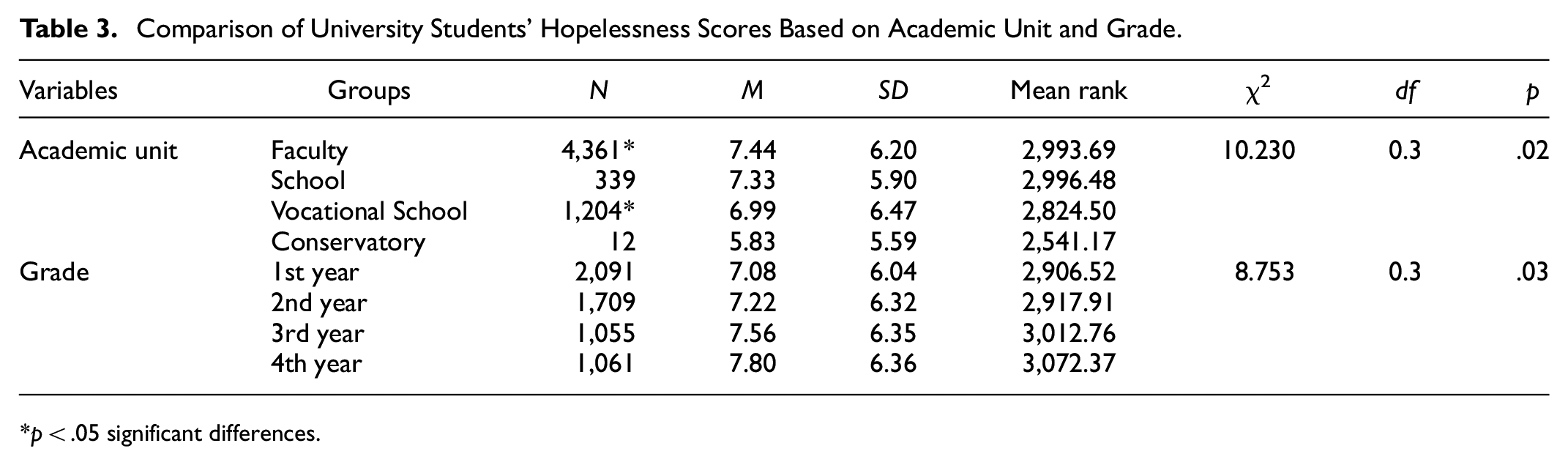
p < .05 significant differences.
As a result of the Kruskal Wallis test, a significant difference was found between the group scores based on the academic unit and grade. Accordingly, during the COVID-19 pandemic, the students (Md = 6, n = 4,361) studying at a faculty, a 4-year undergraduate program, had higher hopelessness scores than the students (Md = 5, n = 1,204) studying at a vocational school, a 2-year associate degree program (U = 2,475,425, z = −3.050, p = .02). In terms of grade, it was also found that 4th year faculty students (Md = 7, n = 1,061) had higher hopelessness scores than 1st year students (Md = 6, n = 2,091), (U = 1,045,939, z = 2,633, p = .03). Therefore, H4 and H5 hypotheses were accepted.
Discussion
Findings related to the first hypothesis tested in the study showed that the hopelessness level of female students was higher than that of male students. Similarly, Lester (2013) reported a gender difference in his review study. However, Aguglia et al. (2021), Dat et al. (2021), and Gulec Oyekcin et al. (2017) found no significant differences in a similar sample. Thus, the findings obtained from similar samples at different times regarding the level of hopelessness vary. Considering the findings of this study, the experiences of individuals during the pandemic may have caused a difference by affecting the level of hopelessness among male and female students. For example, individuals with high levels of anxiety during the pandemic reported high levels of hopelessness (Hacimusalar et al., 2020), and females reported higher levels of anxiety than males (DeGrace et al., 2021). Thus, the fact that females had higher level hopelessness scores may be related to the anxiety they experienced during the pandemic.
The research hypotheses were expanded by considering the economic effects of the global epidemic (Hypothesis 2). It was found that students who reported that one or more of their family members experienced a job or income loss during the pandemic had higher hopelessness scores. Findings from a similar sample showed that 40% of students lost their job, internship or job offer due to COVID-19, and 29% expected to earn less at the age of 35. In addition, low-income students were more negatively affected than high-income students (Aucejo et al., 2020). The level of income affects many health indicators as well as hopelessness. Students with low income, unemployment problem and being exposed to situations with intense negative emotions had high levels of hopelessness (Morselli, 2017; Zafer, 2019). One of the most dramatic effects of the pandemic is economic problems. Consequently, this difference in hopelessness scores may be related to the intensification of economic hardship and negative emotions as a result of a job or income loss of a family member.
Another research finding revealed that as the duration of social media use rose, university students’ hopelessness scores increased (Hypothesis 3). While other mental health indicators such as hopelessness are not directly related to the duration of social media use (Berryman et al., 2018), they are closely related to the quality of social network interactions (Davila et al., 2012). As in every single environment where social interaction is concerned, emotions are transferred to others via interactions in online social networks (Hancock et al., 2008; Kramer et al., 2014). It is known that university students followed the recent news in daily life mostly on social media during the pandemic (Chesser et al., 2020; Genç, 2021; Kovan & Ormancı, 2021; Teng et al., 2020). Whether the shared information is verified or not, it spreads at the same speed and has a great effect (Cinelli et al., 2020). As the research findings indicate, the relationship between social media use and hopelessness may be an indicator of the spread of verified or unverified news about the pandemic through social media and the transfer of negative emotions to those on the network.
According to the findings of the fourth and fifth hypotheses of the research, the hopelessness scores of university students studying at faculties (4-year undergraduate programs) during the COVID-19 pandemic were higher than those studying at vocational schools (2-year associate degree programs). Before the pandemic, researchers found that the level of hopelessness of students studying in associate degree programs (Aba & Mete, 2018; Tetik & Yurtsever, 2018) and undergraduate programs (Bozkur et al., 2020; Uzdil et al., 2021) was low. In a limited number of findings obtained during the pandemic, university students, especially undergraduate students, reported adverse mental health effects (Chirikov et al., 2020; Dial et al., 2023). In these studies, it was found that students could not have an access to faculty members and had difficulties in terms of psychological health, self-efficacy, and academic competence.
During the data collection of Study I, university campuses were closed to face-to-face education. For this reason, students’ personal, academic, and professional anxiety partly explain the difference in their hopelessness levels. On the other hand, the reason why undergraduate program students reported higher levels of hopelessness than the ones in associate degree programs may be attributed to the different nature of these two programs. While associate degree programs last 2 years and train students for semi-skilled occupations in various economic sectors, undergraduate programs require generally 4 years of education for more specialized professions and are compulsory to start graduate programs in Turkey. Therefore, educational disruptions and the less contact with the lecturers and departments may have significantly increased hopelessness levels of undergraduate program students more.
Research findings also showed that senior students had higher hopelessness scores. In some studies conducted before the pandemic, no difference was found among university students in terms of hopelessness scores based on grade (Çoban et al., 2020; Bozkur et al., 2020; Oğuztürk et al., 2011), even the senior students’ hopelessness scores were moderate and mild (Kaygusuz Öztürk & Erensoy, 2020). However, the COVID-19 pandemic is one of the severest crises the world has experienced, as it has affected every aspect of human life in areas such as health, business, education, economy, trade, and politics (Hiscott et al., 2020). According to some research findings, with the outbreak of COVID-19, senior students were intensely worried about their future careers due to having to postpone their career plans, the increase in competition in the field of business and higher education as a result of the global epidemic, and the decrease in recruitment (David et al., 2021; Mahmud et al., 2021). It seems apparent that social and economic global factors have affected the career plans of senior university students and may have increased their hopelessness scores as revealed by the findings of this study.
Study II
During the COVID-19 pandemic, universities in Turkey closed their campuses to face-to-face teaching in the 2020 spring semester, and universities offered distance education until the 2021 fall semester. Although distance education provides new opportunities, it also has several difficulties. One of these difficulties is that successful implementation depends on many factors such as student perception, preparation of course content, technical infrastructure, interaction between the faculty, lecturers, and students (Danchikov et al., 2021; Mossavar-Rahmani & Larson-Daugherty, 2007). Other difficulties are the limitations of providing the campus experience, which is an important part of their education for university students, student-lecturer interaction in face-to-face lessons, and skill development activities in applied fields in the distance education system. It is reported in some studies on university students that the distance education model applied during the pandemic affected their motivation negatively (Çolakoğlu & Yalçın, 2022). Other remarkable findings obtained from the samples of university students during the pandemic are that the level of hopelessness increased relatively due to reasons such as the absence of campus experience and student views on inadequate online education methods (Moreno-Peral et al., 2021), and that the lack of social support had a negative impact on hopelessness (Zuo et al., 2021). These findings suggest that the level of hopelessness among university students may vary depending on variables such as their satisfaction with their education and social interaction.
Universities maintained their education process through asynchronous and synchronous distance learning while the risk was high during the pandemic, and as the conditions relatively eased, they employed hybrid education models. As a result of these developments, students experienced the synchronous and asynchronous learning model, in which social interaction, teacher feedback and corrections during learning were limited. In the following academic period, they experienced the hybrid learning model in which social interaction and campus experience were shared, albeit partially. In this context, in addition to the findings presented in Study I, Study II explored the hopelessness level of students longitudinally during these two different teaching models so as to provide a broader perspective on the planning of education and psychological intervention.
Consequently, Study II aimed to compare the university students’ hopelessness levels in the 2021 spring semester during the asynchronous/synchronous distance education period (T0) and in the 2021 fall semester during the hybrid education period (T1). Accordingly, the research hypothesis is “The BHS scores of the university students during the COVID-19 pandemic change over time” (T0 to T1). At this point, it should be noted that at the university where the study was carried out, distance education was implemented through asynchronous/synchronous online courses, whereas in hybrid education, 60% of the courses in a program were taught totally face to face and 40% totally asynchronously or synchronously online. The administration of each academic unit was authorized to decide which courses would be given totally online or face to face provided that they met the criteria of percentage.
Method
Study II was designed in a longitudinal survey model to compare the change in students’ hopelessness levels between the distance education and hybrid education during the COVID-19 pandemic.
Participants
The participants were 353 students at a state university in Turkey, 161 (45.6%) female and 192 (54.4%) male. They consisted of 169 (47.8%) first-year, 103 (29.2%) second-year, 63 (17.8%) third-year, and 18 (5.1%) fourth-year students. The ages of the participants ranged between 18 and 55.
Data Collection Tools
Data in Study II were collected online through the same Personal Information Form and Beck Hopelessness Scale (BHS) as in Study I.
Data Collection and Analysis
Two measurements were performed in Study II. T0 data were collected in April 2021 spring semester, and T1 data were collected in October 2021 fall semester on a voluntary basis. Participants were informed that they could withdraw at any stage of the research and that the information would be kept anonymous. In the study, it was found that the data of T0 and T1 did not follow a normal distribution. For this reason, the Wilcoxon signed-rank test was used to test the research hypothesis.
Findings
Descriptive statistics of the students’ hopelessness scores in T0 and T1 are shown in Table 4, and the findings regarding the difference between the two measurements are shown in Table 5.
Descriptive Statistics on Students’ T0 and T1 Hopelessness Scores.

The Difference Between Students’ T0 and T1 Hopelessness Scores.

T1 hopelessness scores < T0 hopelessness scores.
T1 hopelessness scores > T0 hopelessness scores.
T1 hopelessness scores = T0 hopelessness scores.
p = .05.
According to the findings of Study II, while 176 participants’ hopelessness scores decreased in T1 measurement, 125 participants’ scores increased, and there was no change in the scores of 52 participants. Considering the mean scores of T0 and T1 measurements, it can be argued that students’ hopelessness scores decreased in the academic semester when the university campus was open for hybrid education.
Discussion
In the study, data on T0 measurement were obtained in the semester when university campuses were closed for face-to-face education and distance education model was implemented, and T1 measurement data were obtained in the semester when hybrid education model was employed. The findings showed that students’ hopelessness scores in hybrid education were lower than that of in distance education.
There are studies indicating that hybrid education had positive results in terms of academic achievement and attitudes (Korucu & Kabak, 2020; Mossavar-Rahmani & Larson-Daugherty, 2007). However, considering that these results were based on the findings acquired in small groups and short-term applications, it should be taken into consideration that they were limited in displaying the difficulty faced by students in a global epidemic such as COVID-19. According to the findings obtained during the pandemic, in the spring term of 2020, when the immediate transition to distance education occurred with the outbreak of the pandemic, students were negatively affected academically and emotionally (Pettigrew & Howes, 2022) and had difficulty in establishing the balance of home, school, family, time management and adapting to online education (Blankstein et al., 2020). They also had difficulty in meeting their physiological needs such as food and shelter, as well as psychological needs such as belonging to a group and love (Jankowski, 2020). However, while the students reported a high rate of negative emotional health during distance education, the rate decreased when the schools shifted to face-to-face education (Chierichetti & Backer, 2021). When real-life findings during the pandemic are added to the findings indicated by experimental studies on e-learning before the pandemic, the importance of social interaction in educational activities becomes clear. Students’ on-campus experiences are as significant as education (Burki, 2020). Therefore, a significant part of the student experience is missed during online education when the campuses are closed. Students’ participation in university life, their relationships with their peers and faculty members are essential for their psychological well-being and success (Peltier et al., 2000). As revealed by the findings of Study II, it is thought that the increase in social interaction (such as student-student or student-lecturer), which can be called as university experience, caused a decrease in the level of hopelessness when the schools shifted from distance education to hybrid education.
Limitations and Suggestions
Although this research provides significant findings regarding hopelessness among university students during the COVID-19 pandemic, it has some limitations. The first limitation is that the hopelessness scores were obtained from the Beck Hopelessness Scale as an indicator of psychological health. In future studies, it is recommended to consider variables such as hopelessness, depression, anxiety, stress, and loneliness together. Although there are previous research findings that hopelessness is associated with depression, suicidal ideation, and suicide attempts among university students (DeLisle & Holden, 2009), and the risk of suicide attempt and depression increases as the level of hopelessness increases (Cuijpers et al., 2013), the relationship between hopelessness and suicidal ideation is outside the scope of our research. For this reason, it is recommended to examine variables such as hopelessness, suicidal ideation and depression in future studies to determine the psychological state of university students during and after the pandemic. Another limitation is that while examining the variation in the level of hopelessness among university students in relation to the academic unit, the intensity of the courses which required application, laboratory, technical observation, and so on were not taken into consideration. However, it was reported that access to laboratory and group applications in the pandemic is one of the most important problems affecting students’ knowledge and skills (Blankstein et al., 2020; Burki, 2020). Thus, it is recommended to consider the access to laboratories, practices and internships in future studies. It is particularly suggested that the hopelessness among students studying in technical and applied sciences should be considered together with variables such as self-efficacy, professional competence, and employment anxiety.
Implications
Despite the limitations mentioned above, this study provides substantial findings about how university students were mentally affected during the COVID-19 pandemic process. First of all, it indicates the necessity of diversifying Guidance and Psychological Counseling services in higher education institutions in order to minimize the effects of the pandemic. The second study compared the level of hopelessness in the two periods in which distance education and hybrid education models were used, and provided feedback to the literature and educational institutions about e-learning and its psychological impact during the pandemic.
Conclusion
Study I provided evidence of the hopelessness of university students in the semester when university campuses were closed for face-to-face education during the pandemic. Based on this evidence, it has been found that the hopelessness levels of university students differ in crises such as the pandemic, which had an effect on the majority of the world, when compared to the findings obtained in the normal course of life. Therefore, it is recommended to provide skills such as coping and stress management for all students, and also to plan online and face-to-face cognitive therapy interventions for student groups with high risk in regard to cognitive structures. Providing assistance for employment and job opportunities as well as psychological support will be an appropriate guidance intervention to reduce the level of hopelessness, especially for the students who reported economic difficulties and who were in their last year of university. It would also be a correct approach for Psychological Counseling and Guidance units and Career Centers of universities to work together to coordinate crisis intervention and prevention programs to deal with the crises.
Study II presented evidence for the significant difference in students’ hopelessness levels between the two different education models; distance education and hybrid education. Even if positive findings were reported in the past regarding the functionality of e-learning, it should be taken into account that the e-learning model was presented as a choice to the participants in the studies during the ordinary course of life. However, during the pandemic, e-learning was an obligation under extraordinary conditions and students did not have a choice. Therefore, in order to benefit from e-learning models in such crises, models offering the highest social interaction should be preferred for the psychological and social wellbeing of the students. With the advantages of developing technology, it may be desirable in the future to set up virtual university classrooms in the Metaverse where students will experience more intense interaction and sense of belonging. This may provide students with the feeling that they are part of the learning process and social interaction.
Footnotes
Authors’ Note
This work is not currently published or under review at any other publication.
Declaration of Conflicting Interests
The author(s) declared no potential conflicts of interest with respect to the research, authorship, and/or publication of this article.
Funding
The author(s) disclosed receipt of the following financial support for the research, authorship, and/or publication of this article: This study includes a section of the scientific research project supported by Selçuk University Scientific Research Projects Coordinatorship (project number: 21401084). However, we declare that we received no financial support for the publication of this article either from Selçuk University Scientific Research Projects Coordinatorship or any other institutions.
Ethical Approval
This study was approved by Selçuk University Local Ethics Committee (Decision date and number: 2021/132).

Data Availability Statement
The data that support the findings of this study are not shared due to privacy and ethical restrictions.