




Abstract
Over the past decade, the maker movement has gained prominence in China, garnering attention from policymakers, scholars, and practitioners. Although several studies have explored the movement’s macro-level impacts on the country’s economy and society, an adequate understanding of the individual makers’ lived experiences, practices, and ideologies remains elusive. This paper addresses this gap by examining how individual makers negotiate and respond to the global maker movement’s individualistic values and China’s state-led techno-nationalism. Framed by concepts of “critical making” and “maker ideology,” the study draws on qualitative data obtained from individual makers to offer insights into the evolving maker culture in China. Our findings suggest that Chinese makers have moved away from the Westernized critical-making paradigm and embraced a more techno-nationalistic orientation. By contributing to a nuanced understanding of the non-uniform and diverse development of the global maker movement in non-Western contexts, this paper sheds new light on the maker movement’s ongoing transformation in China.
Plain Language Summary
The maker movement has become popular in China in recent years, and while many studies have examined its impact on the country as a whole, little is known about individual makers’ experiences and beliefs. This paper aims to fill that gap by exploring how Chinese makers navigate the movement’s individualistic values and the government’s emphasis on technology development. The study finds that Chinese makers have moved away from a Western approach to making and embraced a more nationalistic perspective. By providing a better understanding of the maker movement’s development in non-Western countries, this paper contributes to ongoing discussions about the movement’s evolution in China.
Introduction
In recent years, the concepts of the maker movement and makerspace have been introduced to China and integrated into national innovation policies through the “mass entrepreneurship and innovation” (MEI) initiative (Fu et al., 2021; Keane & Chen, 2019; Xie & Liu, 2018). While previous studies have examined China’s maker movement primarily from a macro perspective, focusing on the structural opportunities and challenges of the state-led initiative (Lindtner, 2020; Wang & Ye, 2015; Wen, 2017; Xie & Liu, 2018), there has been limited attention paid to individual experiences, feelings, and attitudes toward it. This paper addresses this gap by exploring the ideologies, imaginaries, and practices of individual Chinese makers, with the aim of understanding how they negotiate and balance top-down discourses and personal agency. This research is framed by concerns about “critical making” (Ratto, 2011; Ratto et al., 2014) and maker imaginaries (Barbrook & Cameron, 1996; Dougherty, 2013; Lindtner, 2020) and seeks to answer the following questions: How do Chinese makers respond, negotiate, and balance between the distinct global and local maker movement discourses? To what extent are Chinese makers’ ideologies similar and different from those of global maker communities? By exploring these questions, this research aims to demonstrate how Chinese makers adopt western maker movement ideologies into the social, cultural, and political contexts of China, contributing to our understanding of the ununified spread and development of western-originated maker movements in non-western societies.
Based on an analysis of fieldwork data, this article posits that Chinese makers enjoy greater advantages than their Western counterparts with respect to opportunities to materialize and commercialize their ideas, access to well-established manufacturing infrastructure and facilities, and general support from the state. Furthermore, whereas the global maker movement prioritizes the disruptive potential of critical making to bring about social change, Chinese makers tend to rely on structural power, such as that wielded by the government, to address social issues. Corporate involvement and intervention have also played a significant role in shaping Chinese makers’ practices and ideologies, leading them away from critical making and towards a more pragmatic and pedestrian approach. However, political and commercial forces may also threaten the openness, inclusivity, and transparency of maker culture. Finally, empirical evidence suggests that a considerable proportion of Chinese makers prefer the state-led model as it provides them with more opportunities, benefits, and support from the government. By leveraging the resources provided by the state, Chinese makers are better equipped to pursue their personal interests to some extent. These findings offer an alternative perspective on the development of the maker movement from a micro-level lens, and contribute to the wider discourse on the global maker movement.
A State-Led National Innovation Movement
Figure 1 presents a timeline of significant milestones in the development of the global maker movement and its emergence in China. While the maker culture and movement arrived relatively late in China, in 2010 with the establishment of the first makerspace in Shenzhen, it has since undergone a significant transformation. Unlike the global maker movement, which is primarily a grassroots social movement, the government has emerged as the primary stakeholder in China (Zhu & Luo, 2015). Specifically, in 2015, the central government launched the “mass entrepreneurship and innovation” (MEI) initiative, which radically reshaped the nature of the Chinese maker movement from a bottom-up, grassroots model to a top-down, government-led one (Fu, 2021). The MEI is a series of innovation policies that aim to promote entrepreneurship and innovation, and has been widely viewed by commentators, media, and researchers as a key driver of the Chinese maker movement (Lindtner, 2015).

China and global maker movement timeline.
Many scholars have offered positive feedback regarding the MEI, recognizing its potential to transform various aspects of Chinese society. However, the top-down nature of its adoption and promotion has also generated dilemmas (Fu et al., 2022; Wen, 2017) and raised questions about its drawbacks, limitations, failures, and costs (Greco et al., 2019). An unintended consequence of this initiative is the impact it has on individual makers and their responses to the top-down MEI policies. It is still unclear whether individual makers support or oppose the MEI policies and to what extent the initiatives affect their everyday lives, especially in terms of their innovation activities.
Critical Making and Maker Ideology
Existing literature on makers and maker communities typically portrays them as challengers and disruptors of the status quo and established structures (Halbinger, 2018; Ratto, 2011; Richards, 2017; Turner, 2018). The maker movement is often positioned as a bottom-up, emancipatory movement that emerged organically from loose networks of amateurs (Anderson, 2012; Dougherty, 2012). However, recent empirical studies have challenged the grassroots and bottom-up narratives of the maker movement and highlighted the close relationships between makers and corporate and political actors. For instance, Hepp (2018) coined the term “pioneer community” to describe the maker community’s intricate ties with private companies and the political sphere. Drawing on digital ethnography, Hepp argued that makers are not the grassroots movement they are often portrayed to be, but rather “organizational elites” (Hepp, 2018). Hepp’s research provides additional insights into the unintended economic and political connections between the maker community and private companies and politics.
Scholars have coined the terms “maker ideology” or “maker mindset” to shed light on the underlying motivations and practices of individual makers (Dougherty, 2013; Hepp, 2018; Turner, 2018). Maker ideology encompasses a set of beliefs, imaginaries, and mindsets that have been developed through various channels such as books, journals, and magazine articles by prominent advocates of the maker movement, with a focus on social, cultural, and political aspects (Turner, 2018).
The maker ideology can be analyzed at two different levels: the individual level and the societal level. At the individual level, the maker mindset has been identified as a key component of the maker ideology, characterized by a strong belief in the power of technology to enable open-mindedness, creativity, and self-motivation (Peppler et al., 2016). The individual level of maker ideology is deeply influenced by the constructionist approach, which emphasizes the importance of learning through making (Hepp & Schmitz, 2022). Furthermore, the individual level of maker ideology is centered on the concept of making-creativity/innovation, making-learning, and making-personal development (Turner, 2018).
At the societal level, maker ideology situates makers within larger social communities and underscores the crucial role of individual agency in effecting social change (Fu, 2021; Halbinger, 2018). For instance, makers engaged in DIY media attempt to express specific social and political ideologies to promote social transformation (Deibert, 2014), while hackers participate in the open-source software movement to empower individuals and create a digital utopia (Jesiek, 2003). The maker movement has been envisioned as a driver of the “third industrial revolution” (Anderson, 2012) and is closely linked to the Silicon Valley style of techno-utopianism (Dickel & Schrape, 2017). This level of maker ideology is influenced by the “Californian ideology” (Barbrook & Cameron, 1996), which envisions a society shaped by a combination of hippie culture and entrepreneurialism (Barbrook, 1998). Table 1 provides an overview of key previous studies that identify and address the main issues surrounding maker ideologies.
Selected Previous Research on Maker Ideology.

The intersection and intertwinement of the two levels of maker ideology in reality are apparent in many cases, where individual makers’ prototyping for personal satisfaction or development can have potential impacts on society. To bridge the gap between these two lines of inquiry, the concept of critical making (CM) was proposed. Critical making investigates how individual makers or maker communities engage with material production intended to solve critical social issues (Ratto, 2011; Ratto et al., 2014). Critical making studies draw attention from various disciplines and are developed as an analytical approach to account for practices that may combine representational and material work to foster and support the development of new knowledge-making communities, such as critical technical practice, values in design/value-sensitive design, participatory design, critical design, and tactical media.
According to Ratto (2011), critical making typically involves three stages: mapping and identifying critical social issues, jointly designing and building prototypes, and an iterative process of reconfiguration and reflection. Makers engage in wrestling with reconfigurations, alternatives, and critiques to reconsider to what extent these makings might contribute to solving identified critical social issues. Any of the three stages may be the starting point for makers. This analytical framework provides an opportunity to examine Chinese makers’ making practices and ideologies and to understand how Chinese makers adopt and appropriate global maker ideologies within local contexts. By following the three steps of critical making procedures and closely examining Chinese makers’ making practices, we aim to unpack how these individual maker ideologies intersect with societal maker ideology, particularly with official political discourses and imagination (Figure 2).

Three stages of critical making.
Overall, critical making offers a valuable lens through which to examine the intersections between individual and societal maker ideologies and their impact on society. By employing this approach, researchers can gain a better understanding of the role of makers in shaping social issues and the ways in which makers engage with critical social issues.
Methodology and Data
The starting point of this research was to examine the underlying Chinese maker ideologies through the analysis of makers’ lived experiences, and practices. This research uses an ethnographic approach to directly interact with Chinese makers. The authors conducted long-term fieldwork from 2018 to 2021. The leading author’s first language is Chinese, he also has an education and research background in China which enable us to communicate with local makers directly without the language barrier. The leading author used his network to get in touch with local makers and maker communities in the first place. Then we applied the snowball sampling technique (Parker et al., 2019) to get connected to potential candidates and wider maker communities.
During the field, the authors visited several local makerspaces, hackerspaces, Fablabs, co-working spaces, and innovation incubators; interviewed local makers, and observed local maker activities and events in order to get first-hand data. The leading author joined a local makerspace based in Shenzhen as a community volunteer to facilitate community events such as weekly gatherings, workshops, and roadshows, as well as Maker Faire. This position provides us with more opportunities to get connected with makers and local maker communities, more importantly, candidates for in-depth interviews. Participant observation was done during the whole work process.
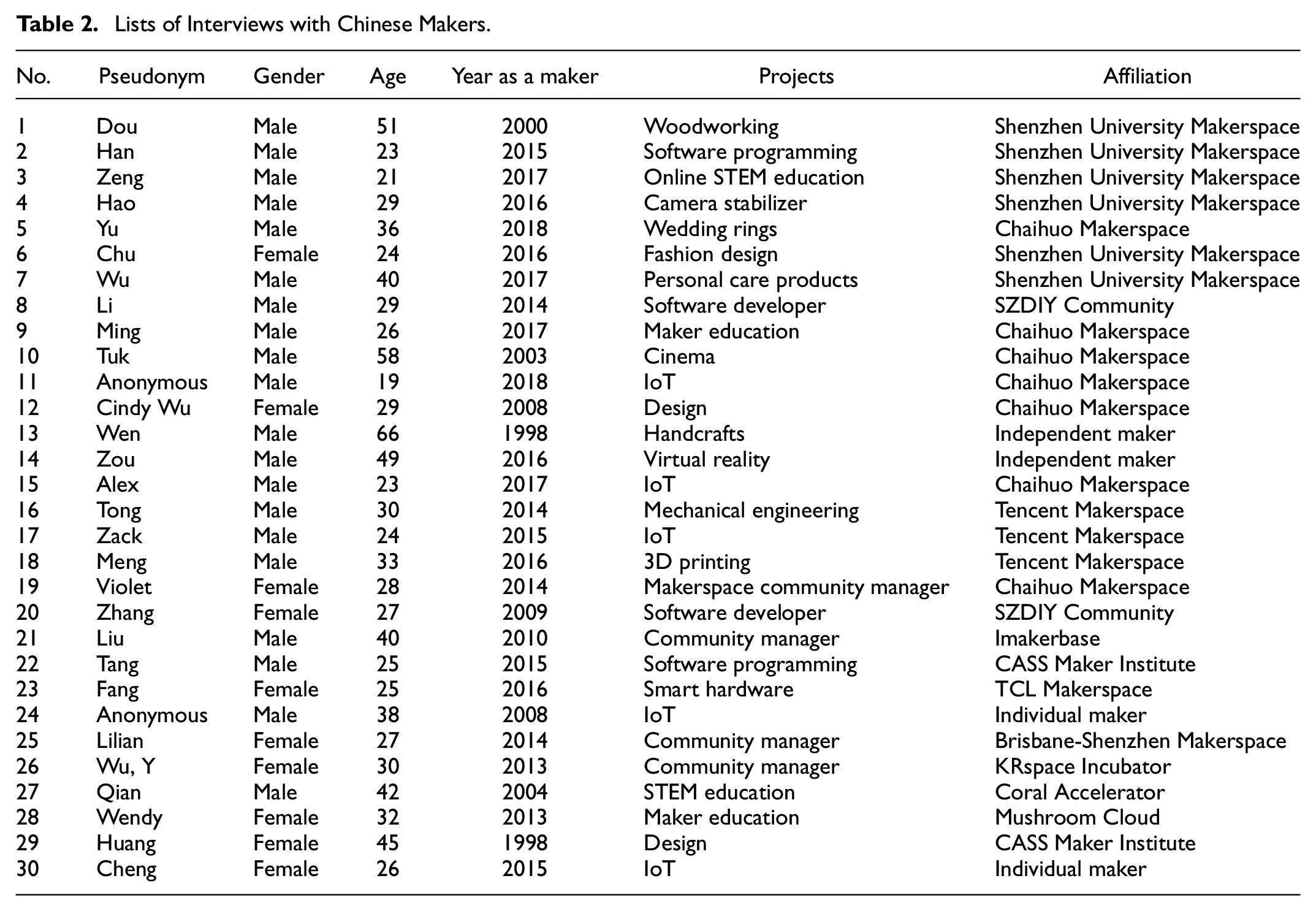
Ideology can also be delineated via in-depth analysis of making activities, such as ongoing and finished projects, prototypes, products, and even ideas. In this research, we have identified 30 candidates representing various demographic characteristics and diverse industries. In-depth interviews have helped us to collect relevant information about makers’ practices and their personal views on these practices. A total of 33 interviews were conducted, with an average interview time between 30 and 60 min, see below Table 2.
Lists of Interviews with Chinese Makers.
Participant observation was conducted by the authors by actively and immersively participating in local makerspace activities and scenes. We selected the events based on the rules of diversity, accessibility, and representativeness. We looked at both government-led flagship maker events and community self-organized small events. Table 3 shows some key maker activities and events that the authors participated and conducted observation.
Lists of Maker Activities and Events.

After the data collection was done, the data analysis was conducted following three stages. First, the author transcribed all these interview audio recordings into word texts in detailed formats such as the interview date, location, interviewee profile, and interview content. Second, given the interview language was Chinese Mandarin, the author then spent extensive time transcribing the original interview data into English. The third step then is to dive into these transcribed data, to code and label key information and notes. The process also involves relating coded data to the research questions and design to see whether data support or rejects the hypothesis.
Unpacking Chinese Maker Ideology and Making Practices
To understand the underlying maker ideology, the fundamental question in all the interviews was “why are you making?” The answers we got varied. Some interviewees said they just make it to pass their leisure time; that is, they engage in maker activities as a hobby. This is in line with what we have discussed at the individual level of maker ideology. This level of maker ideology sees making as a personal experience or a development opportunity for just self-satisfaction or improvement. To them, making activities are a way for recreation, knowledge exchange, and learning. There are very few or no social critical issues about their prototypes. Through a detailed analysis of structured interview content and participant observation data, the following section reveals some key traits of Chinese maker ideologies. This section will look at some specific cases/examples/practices in an attempt to illustrate how Chinese makers have negotiated between the western originated maker ideologies/imaginaries and China’s top-down social political imaginaries, thereby enacting innovation practices.
Contested Open Innovation
The term open innovation was originally referred to as a paradigm that external ideas can and should be used by firms in the information age (Chesbrough, 2003, 2006). Over the last two decades, this concept has been examined extensively in various academic disciplines such as business and management, sociology, cultural studies, media, and communication studies (Chesbrough & Bogers, 2014; Gassmann et al., 2010; Lee et al., 2010; Singh et al., 2021).
In maker movement and makerspace studies, open innovation has been used to describe the mode and philosophy of knowledge production. Slogans such as “Everyone can make” and “Open for everyone” frequently appear in Make magazine and other maker movement promotional writings (Turner, 2018). The global maker movement celebrates openness and social inclusiveness based on the belief that openness is good for all (Saari et al., 2021). However, empirical evidence shows that makers and maker communities can be ambivalent between open innovation and closed innovation (Halbinger, 2018). For example, Maric (2018) argued that there is a gender-based digital divide in maker culture, in which males are dominant and females are less represented despite the maker movement trying to be socially inclusive.
In China, the top-down state-led maker movement also claimed to be inclusive and open to everyone in China. Localized studies show the openness and the participatory culture of China’s maker movement and makerspace which is in line with global maker movement narratives (Xu & Li, 2014; Zhu & Luo, 2015). These studies see makerspace as new spaces for innovation characterized by openness and public participation (Wang & Ye, 2015; Xu & Li, 2014). The question is whether the maker movement is as what they claimed open for everyone. According to the British Council’s demographic study on China’s makers (2015), makers in China are typically highly educated and technically literate. Fifty-four percent of the makers they surveyed were studying at university, and mainly in STEM majors. Many makers are also school-aged children. Though these data do not give the exact ratio, they provide a big picture of the demographic characteristics of makers in China.
In this research, empirical evidence shows the “open for everyone” narratives can be contested. From the demographic perspective, makers in China are more likely to be well-educated, mostly having a STEM background. In regards to gender, males are dominant, though some females appear. A large proportion of the makerspaces we have visited are based on paid membership models which means are not fully “open to everyone.” The most charged is not just basic membership fees, but also a co-working space renting fee, of which ordinary people do not consider cheap. Even though some of these makerspaces provide free events, most of their training workshops are costly.
Makers working in commercial makerspace such as Tencent makerspace demonstrates the contested open innovation ideology of China’s maker culture. In commercial makerspaces, the entry requirements for new makers are very high. By setting up high entry bars, makerspaces can maintain the “social capital” of their internal network of people which become an important point for sustaining existing members and attracting new members.
Mr. Tong is a mechanical engineer working on an open-source hardware (IoT) project in the Tencent makerspace. He told us: “Tencent actually prefers those makers and projects that are highly associated with Internet industries. They do not accept individual makers’ applications, only group/team applications. For me, I feel this is very elitism… […]” (Interviewee Tong, 2019)
However, such an elitism vibe is articulated by makerspace in order to attract “high quality” members. According to our interview with Tencent makerspace staff, there are many other rules for selecting makers which arguably transform the open nature of makerspace toward a closed and elitism one. For team/group selection, Tencent only accepts those teams with at least angel round investment which means that Tencent makerspace is just open for teams or projects with a relatively mature product, business model, and prosperous commercialization. Besides that, application material includes recommendation letters endorsed by a prominent person with ties to your working area. Recommendation letters verify the applicant’s social networking ability, which they believe is crucial to be a successful entrepreneur. Apart from these basic entry requirements, individuals also must be reviewed by independent panels composed of industry experts and investors. After several rounds of competitive selection, a prospective member may eventually be eligible to join the makerspace. These selection requirements and processes demonstrate that Chinese makerspaces like Tencent are not open source-based and are obviously not open to “all.” When we interview Zack, about what makes Tencent makerspace members different from others: “[…] We are much more like an elite community; our members need this kind of elitism atmosphere. With this environment, members here are more easily able to get access to funding opportunities and potential partnerships. We often organize master classes to help our members increase their social abilities and encourage them to interact with each other. […]” (Interviewee Zack, 2018).
Many individual makers we have interviewed have also shown a social elitist tendency. In fact, what many maker communities alleged “community for like-minded” is contradictory to openness. Li Chu is one of the makers that the authors interviewed at Shenzhen University. She is a college student, working on artificial intelligence (AI) custom suits service. Her family has worked in the fashion industry for many years, and they have built strong connections with various industrial suppliers. Influenced by her parents, she started working on her custom suits project at Shenzhen University to provide suits for graduates who need them for events such as job interviews. She remarked: “[…] My family has been working in the clothing material industry for decades. Because of their connections and resources, I decided to do similar things during my college years. Because we have close connections with suppliers, we can obtain very low original material prices to make our own products easier, cheaper, [and] faster while maintaining high quality. This makes it easier to survive even during a financial crisis. […]” (Interviewee Chu, 2018).
These makers’ backgrounds and experiences as well as attitudes to open innovation show that the maker movement in China is still relatively socially exclusive and elitist which contributed to the contested open maker ideology. When we ask makers if they would be happy to share their skills, knowledge, and prototypes with peers, most of them hold a negative attitude as they believe that sharing is great but can be challenging and do harm to their entrepreneurship businesses. The intimate relationship between makers and private companies eroded makers’ open mindset. While political institutions and commercial organizations actively promote an open innovation environment, China’s still hold dual and contested views on open-making practice. On the one hand, they realize the benefits of open innovation and sharing and admit that openness is important in the maker culture. On the other hand, they refuse to share and learn with each other many times in order to protect their innovations for future entrepreneurship opportunities.
Technological Determinism and Entrepreneurial Solutionism
Empirical data shows that Chinese makers have moved beyond the gift economy paradigm towards more technological determinism and entrepreneurial solutionism maker ideology. Technological determinism assumes that technological advancements would solve all social issues and bring human beings toward a utopian future (Schroeder, 2022; Turner, 2018). Similarly, entrepreneurial solutionism believes that entrepreneurship would solve all developmental and social issues (Keane & Chen, 2019).
The visit to the SZDIY maker community and the interviews show the technological determinism of Chinese makers’ ideology. As a peer production maker community, the SZDIY community is a very enthusiastic-oriented organization, peer learning and sharing is the central aim. All of them have a normal day job and come together to make time for leisure time. Interview with another maker Ming, who is working on maker education projects in SZDIY for years, he told us: “[…] just look at these makerspaces in Shenzhen and look at what they are doing today. We had the chance to be part of them and even better to do business because our members are all the corridors of the IT industries in this city. If we wanted to make money through this, we would be the leader of this market, but we chose not […]” (Interviewee Ming, 2020)
According to the interview, SZDIY makers used to be based in a creative industries park where they received help from a local hardware incubator for free space and making resources. However, a few years ago they chose to move to a small apartment in an urban village where rent is cheap and affordable so that they are able to keep the space open for peers and focused on peer learning and production. In fact, since the introduction of the national maker initiatives, many makers have been encouraged to commercialize their ideas and make things intentionally for the market. Though those markers originally took up making as a personal hobby, direct and indirect impacts exerted by the government, companies, makerspaces, and even their peers have brought them into the “entrepreneurial movement.” The resistance to the lure of business success and insistence on peer learning demonstrate the individual nature of maker ideology.
However, there are more and more makers who tend to get involved with wider social issues through making and prototyping. Entrepreneurship become an essential pathway for makers to solve social issues. Cheng was an international student who finished his study in the United States, earning his engineering degree. After returning to China, he secured a well-paying job as a research and development (R&D) engineer at a technology company based in Shenzhen. Given his background, he likes to hack and make things and deeply believes that technology could help solve all the issues met in life. His friends and he always come together to make something new to help them solve issues in life, for example, smarter home equipment. Later, they realized their invention could help more people to live better. Hence, they decided to quit their jobs and started their entrepreneurial journey. It was interesting to hear about what differentiates a maker from an entrepreneur: “[…] I was a maker before, and an entrepreneur now. Before, I did it part-time and usually on weekends. But later, I quit my job, took it seriously, and invested a lot of money and energy into it. I became an entrepreneur […]” (Interviewee Cheng, 2018).
Cheng’s statement shows how he transformed from fun focused into utilitarian-oriented, from individual maker ideology to social level of maker ideology. He was not alone. Our fieldwork shows a large portion of makers in China today are more utility-driven than pure leisure-time enthusiasts. Many have a clear goal (social issues) before they start making. A maker that we interviewed in the Chaihuo makerspace is another example. In comparison with other makers we have encountered, he is one of the very few who did not go to college. Like many migrant workers in Shenzhen, he is from north-eastern China and is trying to make a living in Shenzhen. After graduating from high school, he became a factory worker. Considering his low income as a low-level worker, he decided to learn more skills and try to make a new product to see if he could start his own business. When I asked what motivated him as a maker and what drove him to join the Chaihuo makerspace, he replied: “[…] I don’t have a higher education background, but I have liked science since I was little. Even though I don’t like to study, I do like handmaking and DIY, for example, I like welding. Through my job experience, I realized that there are many opportunities in the smart locker industry. That’s why I came to Shenzhen and Chaihuo makerspace. Here (Chaihuo), I can meet up with different professionals and build up my social network. […]” (Interviewee Tuk, 2019).
The utility also serves as an important motivation for makers which echoes Tanenbaum et al.’s (2013) binary vision of makers in the developing versus the developed world. This binary vision argued that developing world makers are more focused on the utility and disaster relief aspect, while developed world makers tend to engage in more artistic and creative making. Even though this binary division might be too simple, it shows that social status and wealth influence makers’ motivations. Since China is still a developing country, a large portion of residents struggles with life. This means that utility-making for social issues is the ultimate driving force for makers in China.
Notably, most of the makers we interviewed tend to understand the “maker” as someone who is trying to start their own business and be successful like Jack Ma or Pony Ma. This view on makers demonstrates an entrepreneurial zeal of maker ideology, or as Keane and Chen (2019) proposed entrepreneurial solutionism. The Chinese word “chuangke” literally means anyone who can create, innovate, and make. The mass innovation and mass entrepreneurship innovation narratives often link “chuangke” with “entrepreneurship,” implying both creator and entrepreneur. The term “maker” thus has a more entrepreneurial connotation, as Fang (maker and makerspace community manager) said: “[…] The global maker culture originated from the garage culture, but the Chinese maker culture has nothing to do with the garage. Against the background of the mass innovation, and mass entrepreneurship movement, makers can only create values by doing or, more precisely, by commercializing. Only having ideas and not going further mean[s] nothing in this context. Our community has been trying to enable makers to help them create and make. The state asks for innovation; we thus alter our community accordingly. We used to just organize events to create opportunities for makers to communicate. But now we actively connect makers with markets. We encourage our members to create and make for society’s needs. […]” (Interviewee Fang, 2020).
The transformation Fang and his community underwent shows how maker adopted a more utilitarian, entrepreneurship-focused maker ideology. It is also a fact that in today’s China when you go to a makerspace and talk with a random maker, they either identify themselves as an entrepreneur or do not rule out becoming one in the future. Being an entrepreneur is often equated with being a maker in contemporary China.
Reimagining Making and the Maker Community
While the maker ideology in the West stresses the value of individual expression and self-autonomy and encourages people to shatter the existing status quo, including state manipulation (Turner, 2018), this research found that China’s maker is influenced by the dual force-global maker movement individualism ideology and the localized techno-nationalism sentiments. Research on maker’s social impacts has argued that the maker movement would support a new bottom-up, decentralized organizational structure that has entailed the abandonment of the traditional hierarchically organized top-down structure (Bonaccorsi & Rossi, 2006). In China, the social and cultural environment have greatly transformed and appropriated the imported maker movement from a bottom-up toward a top-down one (Fu, 2021; Zhu & Luo, 2015). Chinese makers, we argue, are negotiated and mediated between the tow forces which reshaped the Chinese makers’ ideology. They tactically position themselves in seeminling contradictory relationship between the individual and the state. They choose to fabric their own pursuits into the national discourse under the red rubric of Chinese dream to reconcile the tension between the individualism and nationalism.
Such a individual level reconciliation shows the power of personal agency in face of the structural issue which can be easily oberversed in those state-owned makerspaces (SOMs). In interviews with makers from SOMs, we could see how they build their personal work on the national discourses. Huang, a senior engineering in a local state-owned makerspace told us: “I feel proud of my work because our innovation and products not only solve practical issues, provide better service to the society, we also make contributions to the state. To build a innovative nation, everyone should do their own job. The stronger the country, the better our personal life will be” (Interviewee Huang, 2020).
For them, making innovation is both a pathway for personal achievement and contributions to the society/state. Being in SOMs means makers would be more likely to receive government support including funding, subsidy, tax breaks, etc. which gives them more advantages in terms of bringing their prototyping to the markets. However, it also means that makers should adhere to the government’s instructions and orientations, which potentially shaped makers subjectivity and personal agency in terms of knowledge and innovation creation.
Zeng is a maker that we interviewed at SOMs in Shenzhen. His projects are about designing STEM courses for children. As a university-based maker, he automatically benefits a lot from the university; for example, he enjoys free office space and training opportunities. However, he also needs to participate in many government-organized maker competitions and roadshows. By participating in these government-organized events, he found that there is a potential market for maker education, especially related to community governance. He stated that: “[…] Our focus has switched to government-related issues such as migrant children education [and] community safety issues. These issues will get more attention and support from the local government. As a result, we can be more competitive in any government-funded competitions and receive more financial support from local governments. […]” (Interviewee Zeng, 2020)
From his words, it is clear that his team has changed its business focus to align with state interests. The institutional influence certainly exerts a significant impact on these makers’ autonomy. However, such a change is not entirely a manifestation of patriotism. It also contains personal interests. To align the personal interests with national agenda is what make China’s maker different from the western. The Chaihuo makerspace provides another example of institutional influences on creative autonomy. When I interviewed the community manager, I asked her how Chaihuo stays financially sustainable. She replied: “[…] We do accept financial support from the government, for example, the discounted rent. We also make profits by connecting companies and our community makers. For example, when a company has specific needs for a project, we will publish this news [and make it available] to our members to see if they have any ideas or interest in participating. If the company accepts the maker’s proposal, then we can help the maker to continue to finish up this project or if they need it, we can also help them to set up a group from our existing talent pool. […]” (Interviewee Violet, 2019).
Based on this business model or the commercial aspect generally, it seems that both the company and the makers are benefitting from the top-down state support maker movement. Under these circumstances, makers are encouraged to follow the state’s collective social-techno imaginary—“making for the state.” Under this ideology, making is not just a personal activity (individual level of maker ideology); it relates to China’s broader social, political, and cultural imaginaries, for example, to be stronger, more creative, more innovative, and more advanced.
To include the national discourse of mass innovation movement, China’s makers developed a individual motivated techno-nationalism ideology (Ostry & Nelson, 2000). China’s makers use technological innovation to advance personal and nationalist agendas, with the goal of achieving personal purists (by and with commercial power) and promoting national development agendas.
Figure 3 shows the redesigned making process loop after the political and commercial forces came in. These collective imaginaries are embedded in everyday making practices, as responses to the government’s call show some similarities with the findings of previous discourses such as being creative for the state (Lin, 2019),“creative industries as a new modernity” (O’Connor & Xin, 2006), and “entrepreneurial solutionism and characteristic cultural industries” (Keane & Chen, 2019). Individual makers are deeply entangled in broader political discourses and have negotiated and transformed into a new kind of maker and hence a new kind of open innovation practice that is fundamentally different from that of their Western counterparts. The problem or the question is how to motivate individual makers more effectively under the rubric of the collective maker movement and open innovation.

Redesigned making process loop.
Conclusion
This study examines the underlying ideology and practices of Chinese makers, with a particular focus on three aspects: contested open innovation, technological determinism, and making for the state. Drawing on selected cases, this paper argues that the ideology of Chinese makers is shaped by two primary forces: the global maker movement’s individualism and the state-led techno-nationalism. Unlike their Western counterparts, Chinese makers operate in a government-led initiative that employs policies and subsidies to foster innovation. However, this study reveals that the state-led open innovation “reform” in China has become less open and more contested, despite the government’s efforts to promote and regulate innovation.
Furthermore, the study found that the incorporation of the maker movement and open innovation has led to opportunities and potentialities for Chinese makers, but it also poses certain limitations and downsides. The enthusiasm of corporations for makerspace has impacted the identity and practices of Chinese makers, transforming them from amateur/critical makers into entrepreneur-makers who focus more on commercialization and exclusivity. Additionally, the government’s subsidies and policy benefits have been mainly available for those focusing on entrepreneurial aspects of making, with less attention paid to critical and socially beneficial practices and spaces.
Based on these findings, the paper suggests that policymakers should take a more inclusive approach to open innovation, giving equal attention to critical and socially beneficial practices and spaces. This study also highlights the importance of maker education, which focuses on teaching young students hands-on ability and critical thinking to encourage creativity and innovation. Overall, this paper provides a nuanced analysis of China’s maker ideology and practices in the context of unique top-down social and economic perspectives, contributing to a better understanding of the contingencies of open innovation. The results of this study should inform future policy-making efforts, encouraging policymakers to redesign open innovation spaces and promote critical and socially beneficial-making practices.
Footnotes
Declaration of Conflicting Interests
The author declared no potential conflicts of interest with respect to the research, authorship, and/or publication of this article.
Funding
The author disclosed receipt of the following financial support for the research, authorship, and/or publication of this article: This research is funded by MOE (Ministry of Education in China) Project of Humanities and Social Sciences (Project No. 22YJC860008), the Fundamental Research Funds for the Central Universities (Project No. 22120220309), and the China Postdoctoral Science Foundation (Project No. 2022M712427).

Data Availability Statement
The data supporting the findings of this study are available upon request from the corresponding author.