




Abstract
This study analyzed the key attributes and clusters of policies and systems of Korean Taekwondo based on Park Geun-Hye and Moon Jae-in’s regime changes using big data, including 8,030 data points on social media over a period of 8 years. Frequency analysis, term frequency inverse document frequency analysis, and degree centrality analysis were performed using TEXTOM 4.5. In addition, a convergent and correlation analysis was performed using UCINET 6 to visualize related words and analyze clusters. Frequency, term frequency inverse document frequency, and degree centrality analyses revealed 30 high-order terms. A convergence of iterated correlations analysis of the derived words identified three common clusters: improvement, problem, and support. In addition, there were two distinct clusters in the Park Geun-hye government (research and sports policy), and three in the Moon Jae-in government (interview, thoughts, and athlete). The Korean government attempted to improve and address problems related to policies and systems for the development of Taekwondo. However, as Taekwondo policies and systems were implemented from different perspectives by each regime, systematic policies and systems could not be implemented.
Introduction
Taekwondo is a traditional Korean martial art (International Olympic Committee, 2021). Since the late 1950s, the Korean government has made efforts to promote Taekwondo internationally (Moenig & Kim, 2021). The Korean government founded the Korea Taekwondo Association (KTA) in 1965 (Korea Taekwondo Association [KTA], 2022), Kukkiwon in 1972 (Kukkiwon, 2022), and World Taekwondo (WT; formerly World Taekwondo Federation) in 1973 (World Taekwondo [WT], 2022). WT was recognized by the International Olympic Committee (IOC) in 1980 due to the continued financial and political support of the Korean government (Moenig & Kim, 2016). Taekwondo has been recognized internationally as a global sport practiced in more than210 countries since its adoption as an official sport at the 2000 Sydney Olympic games (S. U. Park et al., 2022).
Taekwondo has been recognized as the national sport of Korea since 1971, when President Park Chung-Hee’s handwritten title was awarded (MOOKAS, 2021). Taekwondo, which has been passed down as a Korean custom, became an officially recognized national sport in 2018 (S. U. Park, 2021). According to Kwon and Lee (2015), and S. U. Park (2021), the Korean government’s Taekwondo promotion policy started with the Park Chung-Hee’s government (1963–1979); however, representative development began with the Roh Moo-Hyun government’s five-year national sports promotion plan (2003–2007). After that, the Taekwondo policy promulgated the enforcement decree of the “Taekwondo Laws” of Lee Myung-bak’s government (2008–2013), and Park Geun-Hye’s government (Park’s Government) launched “Sports Vision 2018” and “Cultural Prosperity Committee” (Korea Sports Promotion Foundation, 2018). Park’s government selected Taekwondo as one of the three major brands (Hangeul, Korean Alphabet; Arirang, Korean folk song; and Taekwondo) and promoted it as a cultural brand (Korea Ministry of Culture, Sports and Tourism, 2014). In addition, the Moon Jae-In government (Moon’s Government) selected Taekwondo as one of the top 100 national tasks and is promoting it as a cultural content (Korea Ministry of Culture, Sports and Tourism, 2017).
In 2007, to achieve sustainable development of Taekwondo into a world-class sport, Korea enacted “laws on the promotion of Taekwondo and the creation of Taekwondo Park” (Taekwondo Laws; Korea Ministry of Government Legislation, 2018; The Academy of Korean Studies, 2014). Furthermore, the Korean government (Ministry of Culture, Sports and Tourism) invested a budget of approximately KRW 170 billion to promote Taekwondo’s re-leap and sustainable growth for 2018 to 2022 (Korea Ministry of Culture, Sports and Tourism, 2018a). Since the enactment of the Taekwondo Laws, the Korean government has continuously revised Taekwondo policies and systems.
In general, policy decisions by the government can be said to be the result of selective actions that objectively identify a given problem and maximize the value of utility based on accurate information (Dye, 2012; S. J. Kim et al., 2016; S. U. Park, 2021; Pfeffer, 1981). However, Korean policies are generally not based on reliable evidence, but are rather opinion-based, relying on the judgment of experts or practitioners (Cho, 2013; Korean Educational Development Institute, 2011). Furthermore, studies on Taekwondo policies are limited (S. H. Park, 2020). S. J. Kim et al. (2016) noted that research on Taekwondo is not active. S. U. Park (2021) questioned whether the policies and systems of Taekwondo were reasonably established based on objective data and procedures. Therefore, research using objective tools is required to clarify the contents and attributes of Taekwondo policies and systems.
According to S. U. Park and Kim (2021), existing studies on Taekwondo policies and systems do not suggest specific improvements or appropriate alternatives. To solve these problems, a questionnaire survey could quantify and measure data; however, there are limitations in sampling and the possibility that measurement errors may occur depending on the form, term, and length of the questionnaire (Fowler, 2013; Groves, 2004; Lyberg & Weisberg, 2016). Big data analysis has research potential in diverse fields, including social phenomena, discourse analyses, cognitive analyses, social trend analyses to secure product competitiveness, and value creation through the examination of new convergences (S. U. Park et al., 2022). In addition, big data creates the potential for a revolution in many domains, including public health (Sahay, 2016).
Big data are large, complex datasets that are beyond the capabilities of traditional data management systems to store, manage, and process in a timely and economical manner (Nambiar et al., 2013). Furthermore, big data are different from conventional data in terms of volume, speed, and diversity (Beyer & Laney, 2012). With the recent rapid increase in unstructured data, analyzing big data has become an important part of research (Manju Priya & Gupta, 2019). Korea generates a huge amount of data due to its excellent global networks; therefore, it has the infrastructure and conditions to create big data (S. U. Park et al., 2020, 2022; D. Shin, 2014; D. H. Shin, 2016). Therefore, deriving key attributes and clusters from atypical texts that appear on social media can provide meaningful patterns and new insights into Taekwondo policies and systems.
This study aimed to examine the key attributes and clusters of Taekwondo policy and system using Korean social media. Specifically, this study compared the contents and differences of policies and systems under Park and Moon’s governments. Revealing previous unidentified Taekwondo policies and systems can contribute to deriving developmental and strategic directions for Taekwondo policies and systems.
Methods
Ethical Statements
This study was conducted in accordance with the guidelines of the Declaration of Helsinki and approved by the Institutional Review Board.
Data Collection
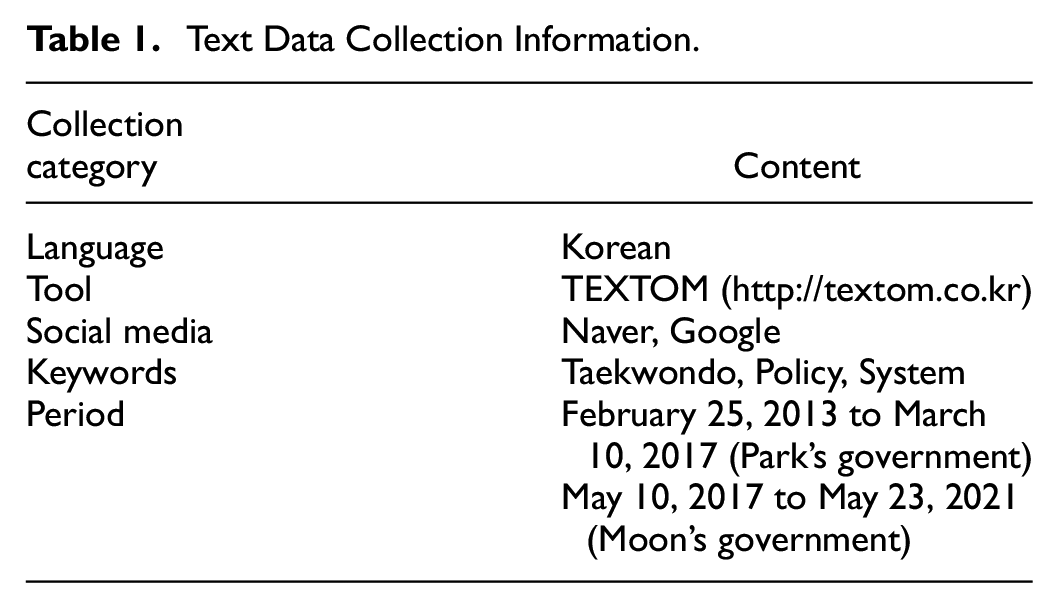
This study used TEXTOM 4.5 (The Imc Inc., Daegu, Korea) to collect unstructured texts expressed on social media, such as Naver and Google. Naver and Google are the most used portal sites in Korea and include on-line communities (T. H. Park et al., 2020). In addition, TEXTOM is a Korean-based big data collection and analysis solution, which has been used in several previous studies (Jang & Park, 2020; Jeon, 2020; S. Kim et al., 2020; M. S. Kim & Jeon, 2020; S. U. Park et al., 2020, 2022). Specifically, this data collection solution targets official documents and media coverage that can be found on Naver and Google, and does not include comments from netizens. The keywords used for data collection were “Taekwondo + policy + system.” The data collection period was divided equally between the government of Park and Moon. As President Park Geun-hye was impeached during her tenure, the Moon government’s data collection period was shortened in order to equalize the conditions. Details of the collected data are presented in Table 1.
Text Data Collection Information.
Data Analysis
Text mining and social network analysis (SNA) were performed to analyze big data on Taekwondo policy and system.
Text mining analysis is the process of using data mining techniques to transform unstructured text into a structured format to identify meaningful patterns and new insights (IBM, 2020). The advantage of text mining analysis is the ability to extract new knowledge from vast and diverse sets of digital texts (Aggarwal, 2018; Aggarwal & Zhai, 2012; Feldman & Sanger, 2006; S. U. Park et al., 2022). This study conducted frequency and term frequency inverse document frequency (TF-IDF) analyses. Frequency analysis provides the number of times a term appears in a specific document, whereas TF-IDF analysis represents the calculated value of the weight of each term according to the uniqueness of the text document (S. U. Park et al., 2020; Trstenjak et al., 2014).
SNA is a strategic method for investigating the social structure of networks (Otte & Rousseau, 2002). The concept of a social network provides a convincing model for social structure and makes it possible to identify formal methods of social network analysis (Scott, 1988). This study used the most representative concepts of SNA: degree centrality and convergence of iterated correlations (CONCOR) analysis (S. U. Park et al., 2020). Degree centrality indicates the degree to which a particular node is positioned toward the center of the entire network (Bonacich, 1987; Csardi & Nepusz, 2006; Freeman, 2008). Degree centrality is the most representative method of centrality analysis, which represents the sum of nodes connected to the central node of the network (S. U. Park et al., 2022). In addition, CONCOR analysis was performed to classify potential sub-clusters to understand the relationship between derived terms (S. U. Park et al., 2022). The clusters derived through the CONCOR analysis were named through the categorization process. In the cluster naming process, the researcher repeatedly read the term’s contents based on the derived terms, and the subject and meaning were interpreted and created. In addition, in order to critically review the researcher’s own data analysis and interpretation process, triangulation was performed using data from word tree charts provided by TEXTOM.
Text mining analysis and SNA were performed on the collected data using TEXTOM (The Imc Inc., Daegu, Korea) and UCINET 6 (Analytic Technologies Corp., Lexington, KY, USA).
Result
Results of Data Collection
Table 2 shows the results of the big data analysis on Taekwondo policies and systems according to the Korean government. Analysis of Park’s government produced 3,403 data points with a volume of 1,798 KB, whereas that of Moon’s government produced 4,627 data points with a volume of 2,614 KB. In total, 8,030 data points and 4,412 KB were collected using TEXTOM.
Number of Data Points and Volume.

Results of Text-Mining
Frequency Analysis
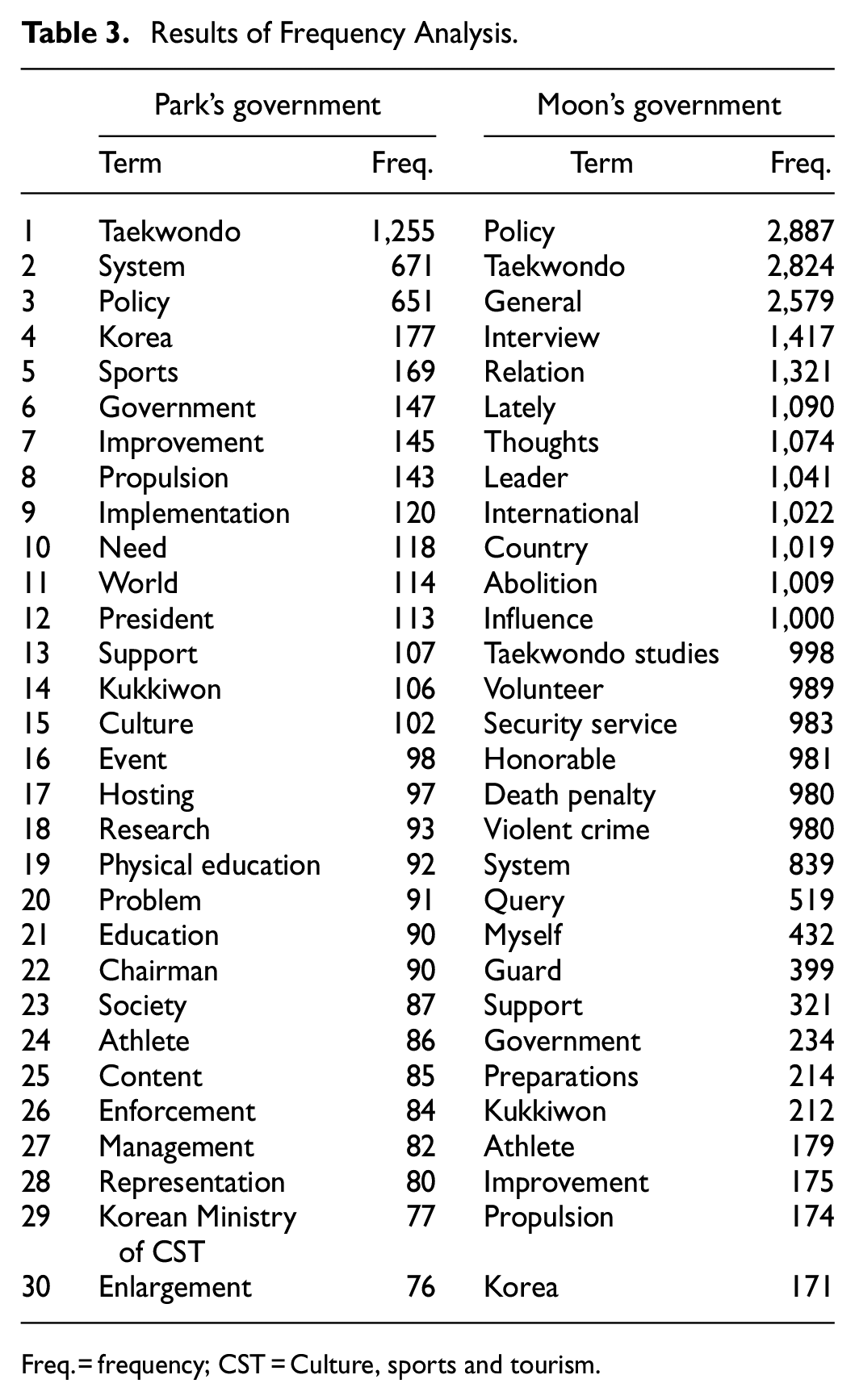
Table 3 summarizes the results of frequency analysis of terms related to Taekwondo policies and systems according to the Korean government. The findings indicated that the top 10 most frequently used words in Park’s government were Taekwondo (1,255), system (671), policy (651), Korea (177), sports (169), government (147), improvement (145), propulsion (143), implementation (120), and need (118), in descending order. The most frequently used words in Moon’s government were policy (2,887), Taekwondo (2,824), general (2,579), interview (1,417), relation (1,321), lately (1,090), thoughts (1,074), leader (1,041), international (1,022), and country (1,019), in descending order.
Results of Frequency Analysis.
Freq. = frequency; CST = Culture, sports and tourism.
TF-IDF Analysis
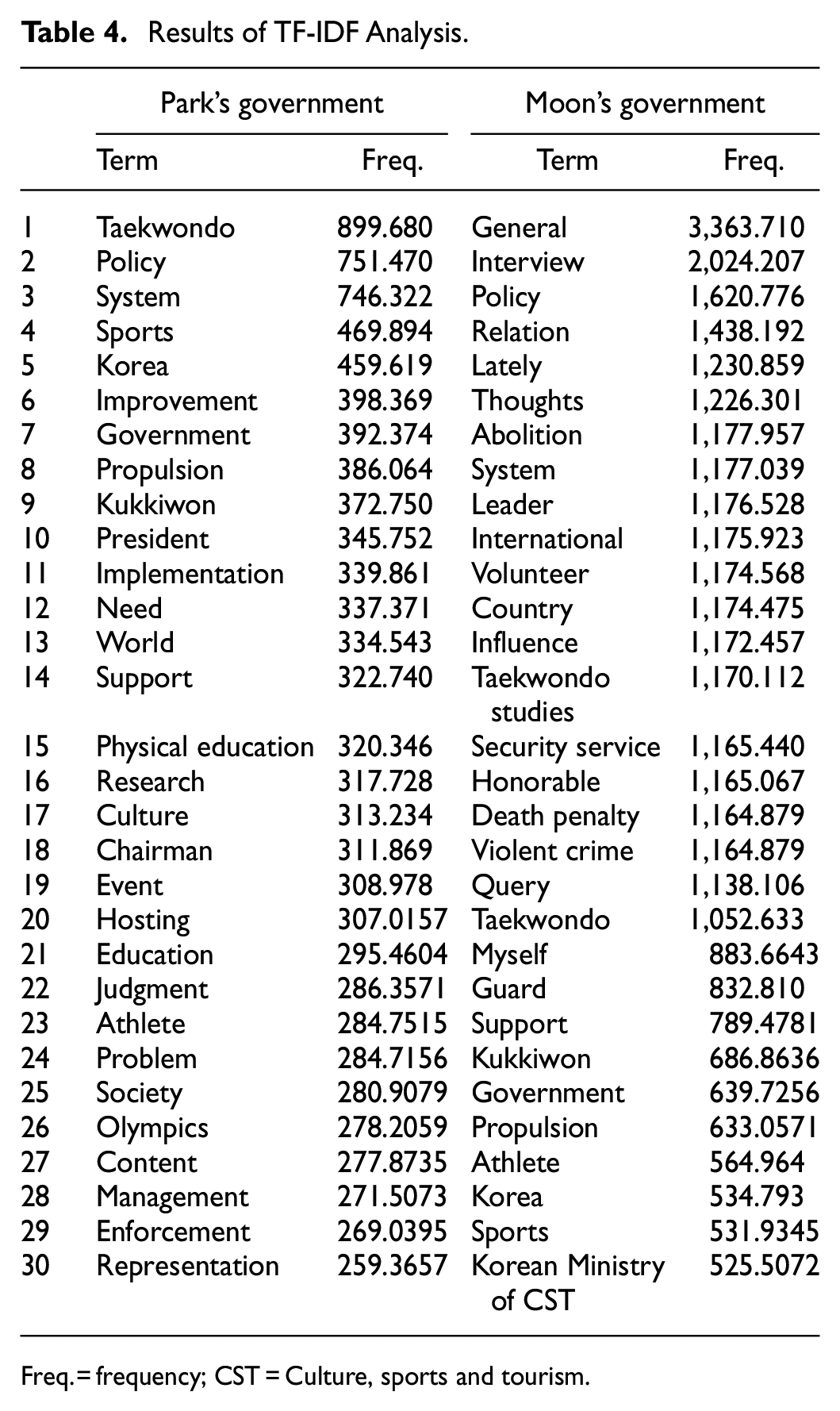
Table 4 summarizes the results of TF-IDF analysis of terms related to Taekwondo policies and systems according to the Korean government. The findings indicated that the top 10 most frequently used words in Park’s government were Taekwondo (899.680), policy (751.470), system (746.322), sports (469.894), Korea (459.619), improvement (398.369), government (392.374), propulsion (386.064), Kukkiwon (372.750), and president (345.752), in descending order. The most frequently used words in Moon’s government were general (3,363.710), interview (2,024.207), policy (1,620.776), relation (1,438.192), lately (1,230.859), thoughts (1,226.301), abolition (1,177.957), system (1,177.039), leader (1,176.528), and international (1,175.923), in descending order.
Results of TF-IDF Analysis.
Freq. = frequency; CST = Culture, sports and tourism.
Results of Social Network Analysis
Degree Centrality Analysis
Table 5 summarizes the results of degree centrality analysis of terms related to Taekwondo policies and systems according to the Korean government. The findings indicated that the top 10 most frequently used words in Park’s government were Taekwondo (0.080722), system (0.049522), policy (0.047046), Korea (0.015564), sports (0.013017), government (0.012381), propulsion (0.011249), world (0.009904), Kukkiwon (0.009834), and chairman (0.009268), in descending order. The most frequently used words in Moon’s government were Taekwondo (0.082606), interview (0.063448), policy (0.046283), system (0.044467), general (0.031695), query (0.026422), volunteer (0.021911), relation (0.014119), government (0.013943), and preparation (0.012830), in descending order.
Results of Degree Centrality Analysis.

CONCOR Analysis
A CONCOR analysis was performed to classify homogeneous groups based on the relevance of correlations on the network. The results revealed six clusters for Park’s government: improvement, research, problem, support, and sports policy in Table 6.
CONCOR analysis results of Park’s government.

The first cluster comprised the following terms: system, Korea, world, improvement, Kukkiwon, event, education, chairman, athlete, management, and representation. These terms were categorized as “improvement.” The second cluster comprised the following terms: research and content. These terms were categorized as “research.” The third cluster comprised the following terms: need, physical education, and problem. These terms were categorized as “problem.” The fourth cluster comprised the following terms: Taekwondo, government, propulsion, support, hosting, and enforcement. These terms were categorized as “support.” The fifth cluster comprised the following terms: policy, sports, implementation, president, culture, society, Korean Ministry of Culture, sports and tourism, and enlargement. These terms were categorized as “sports policy.” The derived clusters are shown in Figure 1.

CONCOR analysis results of Park’s government.
The results of the CONCOR analysis for Moon’s government revealed six clusters: thoughts, interview, support, problem, improvement, and athlete in Table 7.
CONCOR Analysis Results of Moon’s Government.

The first cluster comprised the following terms: policy, general, lately, thoughts, leader, international, country, abolition, influence, Taekwondo studies, volunteer, security service, honorable, death penalty, violent crime, myself, and guard. These terms were categorized as “thoughts.” The second cluster comprised the following terms: interview, relation, query, and preparations. These terms were categorized as “interview.” The third cluster comprised the following terms: Taekwondo and support. These terms were categorized as “support.” The fourth cluster comprised the following terms: system and government. These terms were categorized as “problem.” The fifth cluster comprised the following terms: improvement and propulsion. These terms were categorized as “improvement.” The sixth cluster comprised the following terms: Kukkiwon and athlete. These terms were categorized as “athlete.” Korea did not form a cluster. The derived clusters are shown in Figure 2.
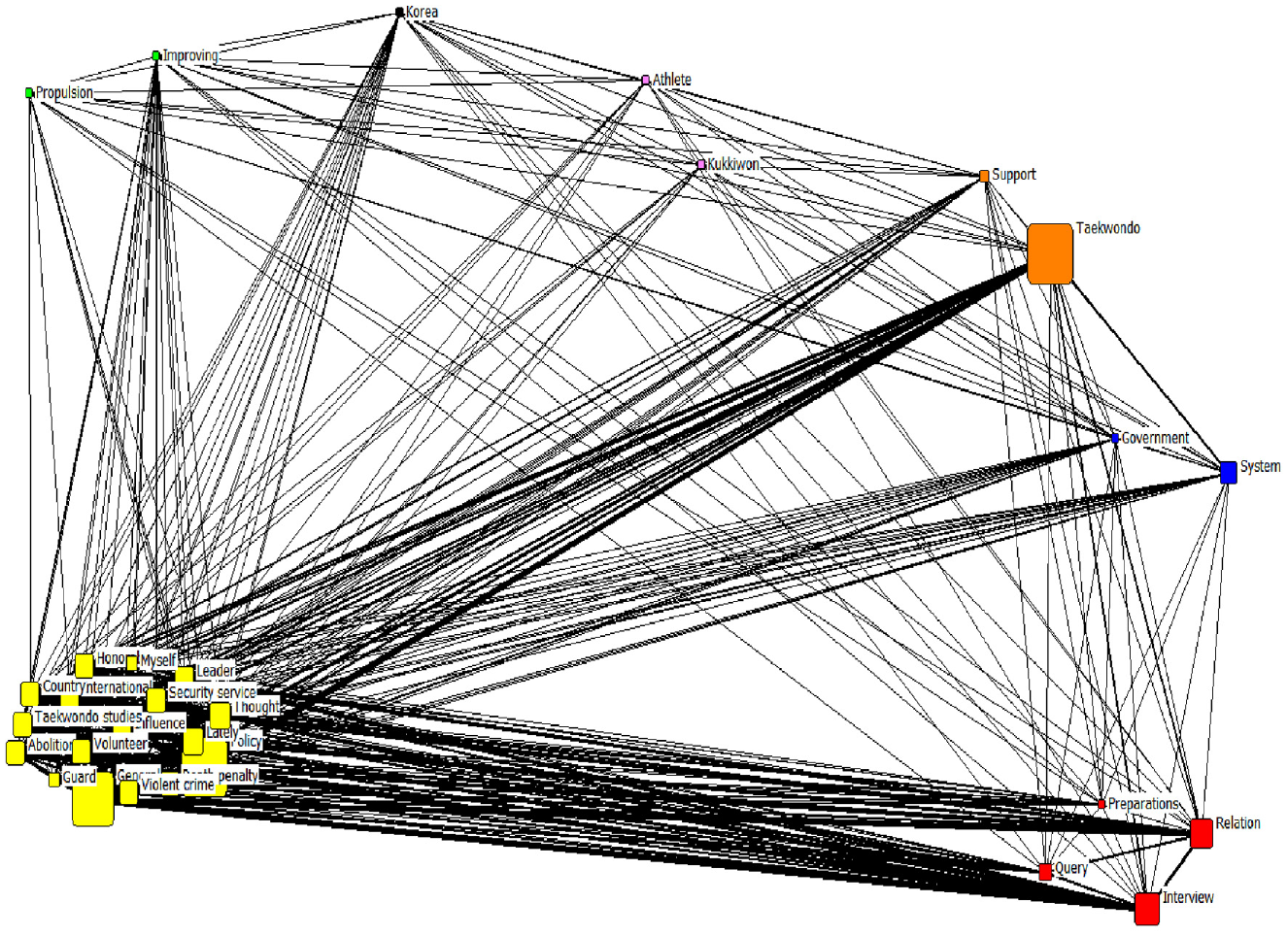
CONCOR analysis results of Moon’s government.
Discussion
Despite the differences in characteristics of frequency, TF-IDF, and degree centrality analyses and differences in Korea’s Taekwondo policy between governments, similar results were obtained. Under Park’s government, Taekwondo policy and system were considered from a macro perspective, with keywords such as Korea, sports, government, improvement, and propulsion taking priority. However, under Moon’s government, Taekwondo policies and systems were prioritized in terms of words like general, interview, relationship, recent, and thoughts, from a microscopic point of view.
Park’s government (the Ministry of Culture, Sports and Tourism) evaluated that the public’s sensitivity to cultural prosperity was low, such as low public participation in culture and arts and regional cultural gaps; therefore, policy capabilities were concentrated on experiencing cultural prosperity in daily life (Korea Ministry of Culture, Sports and Tourism, 2014). In addition, as part of cultural prosperity under the strategy of “spreading cultural values,” Park’s government established and implemented a strategic plan to spread the “Hallyu: Korean wave” as one of Korea’s three major cultural brands, along with Hangeul and Arirang (Korea Ministry of Culture, Sports and Tourism, 2014). The results indicated that Park’s government was implementing Taekwondo policies and systems to spread cultural values, such as the Korean wave. However, despite these efforts, Taekwondo is still not recognized as Hallyu compared to K-pop and Korean films.
Moon’s government selected Taekwondo as one of the 100 national tasks, discovered the 10 cultural contents of Taekwondo, and promoted it as a key policy task (Korea Ministry of Culture, Sports and Tourism, 2018a). The “Taekwondo Future Development Strategy and Policy Tasks” announced by the Korean Ministry of Culture, Sports and Tourism in 2018 (Korea Ministry of Culture, Sports and Tourism, 2018b), planned to discover and promote the top 10 cultural contents of Taekwondo as a key policy task by 2022. Furthermore, as part of this policy, the “Cultural Contents Research Group” was formed in 2017 to investigate the status of Taekwondo and discover the best content-related ideas. Therefore, micro terms of Taekwondo policy and system for the development of 10 Taekwondo cultural contents were found in Moon’s government. However, as of 2022, Taekwondo’s top 10 cultural contents have not yet been announced.
The results of CONCOR analysis on Korea’s Taekwondo policies and systems identified five clusters in Park’s government and six clusters in Moon’s government. Among the clusters that repeatedly interpret the meaning and content of terms and create meanings, three clusters (improvement, problem, and support) were similar, whereas five clusters (research, sports policy, thoughts, interview, and athlete) were different.
The clusters of improvement, problem, and support were equal. Korea’s Ministry of Culture, Sports and Tourism oversees sports-related policies (Won & Hong, 2014). The Korean Ministry of Culture, Sports and Tourism planned and implemented the first and third “Basic Plan for Taekwondo Promotion” every 5 years, in 2008, 2013, and 2019 (Korea Ministry of Culture, Sports and Tourism, 2019). This is Korea’s representative Taekwondo policy, based on specific laws and regulations (S. H. Park, 2020). However, despite these policies, S. U. Park and Kim (2021) pointed out that, while policies and systems related to Taekwondo should be established based on objective data and reasonable procedures, these are not being implemented. Therefore, Taekwondo policies and systems should be established and implemented on the basis of reliable evidence and systematic analyses, including through a process of collecting opinions through public hearings. To establish such a policy task system, financial and material support from the government is required.
The cluster of research and sports policy in Park’s government differed from Moon’s government. The Taekwondo financial support project of the Korea Ministry of Culture, Sports and Tourism (2017) included Taekwondo Promotion and Taekwondo Promotion Foundation (TPF) auxiliary support projects. Taekwondo promotion projects were divided into Taekwondo globalization, education and research, industrialization, and content development (S. H. Park, 2019). TPF was established by the Korean Ministry of Culture, Sports and Tourism in 2005 for the development of Taekwondo (Taekwondo Promotion Foundation, 2022). As such, through the Korean Ministry of Culture, Sports and Tourism, which is in charge of sports policy, Park’s government attempted to promote the globalization of Taekwondo and education and research projects with the priority of promoting the value of the Korean wave as a subfield of sports policy.
Moreover, the thoughts, interview, and athlete clusters in Moon’s government differed from Park’s government. In other words, Moon’s government planned and implemented Taekwondo policies and systems through a more microscopic approach than Park’s government. According to a newspaper article published in South Korea in 2015, South Korea’s Su-jeong Im, who was a gold medalist in the women’s 58 kg class in Taekwondo at the 2008 Beijing Olympics, was appointed to the police as a special martial arts recruit (Yonhap News Agency, 2015). This special recruitment was expanded from four to nine people under Moon’s government (MOOKAS, 2020). The Korean National Police Agency (2019) stated that the Taekwondo special recruitment would be applied only until 2020, and subsequently unified into the National Police Agency general Taekwondo competition (Korean National Police Agency, 2019). According to S. U. Park et al. (2022), Korean Taekwondo athletes practice harsh training 6 days per week, four times per day, while neglecting their studies. Retired Taekwondo athletes in Korea do not receive a formal education at school under the elite sports system. In Korea, it is difficult to clear the exam to become a police officer as it is extremely challenging; hence, 2020 is the last opportunity for them to become police officers through a special recruitment based on their Taekwondo careers. In other words, the interview is an important part of becoming a police officer through the special recruitment process. Thus, interviews and thoughts on specific social issues that were the content of interviews were major clusters. As such, Park’s government adopted a macro approach to globalization of Taekwondo, whereas Moon’s government adopted micro approaches, such as job creation for Taekwondo athletes.
The Ministry of Culture, Sports and Tourism has one minister and two vice ministers; moreover, from the Park’s government, a former elite athlete has been serving as the second vice minister (Won & Hong, 2014). The appointment of a former elite athlete is seen as a historic and symbolic step, suggesting that the sport has finally become a top priority on the Ministry of Culture, Sports and Tourism’s agenda, and that it has more support than in previous years (Won & Hong, 2014). Furthermore, the Korean government recognizes that its current diploma policy, which is primarily based on hard power, can be more valuably complemented by the use of soft power (Kang & Houlihan, 2021). Taekwondo is regarded as a great resource for South Korea to demonstrate its soft power through sports (Kang & Houlihan, 2021). Specifically, the Korean government has included Taekwondo in Korea’s major international development programs and promoted it as a traditional Korean martial art and national sport (Na & Dallaire, 2022). Despite these positive changes, the total expenditure of the National Sports Promotion Fund of Korea is an average of KRW 1822.2 billion over the past 3 years (2016–2018), of which KRW 37.5 billion is a fairly small scale for the Taekwondo sector (S. H. Park, 2019). Moon’s government was launched after Park’s government; however, Park’s government was based on conservative tendencies, whereas Moon’s government was based on progressive party politics. Regardless of the political orientation, approximately KRW 37.5 billion was spent annually on Taekwondo policies and systems. Therefore, to establish Taekwondo policies and systems, a thorough investigation into the overall status and current situation of the Taekwondo field should be conducted rather than globalization or job creation for Taekwondo athletes due to political instability. To develop Taekwondo into a martial art practiced by people around the world and content as a sport, mid- to long-term policies and strategic systems are required.
Conclusion and Limitations
This study conducted big data analysis to understand the perceptions, key attributes, and clusters of the Taekwondo policies and systems of Park’s and Moon’s governments in Korea appearing on social media. The results revealed 30 high-frequency terms based on frequency, TF-IDF, and degree centrality analyses, which provided pivotal information regarding Taekwondo policies and systems according to the set period. CONCOR analysis focusing on the derived frequent terms identified three clusters: improvement, problem, and support. In addition, the cluster of research and sports policy differed in Park’s government, and the clusters of thoughts, interview, and athletes differed in Moon’s government. In other words, a common point was drawn to improve and support problems related to Taekwondo policies and systems. The difference between the Taekwondo policies and systems of Park’s and Moon’s governments was that they focused on macroscopic and microscopic approaches, respectively. More specifically, Park’s government planned and implemented Taekwondo policies and systems as a sub-field of sports policy, whereas Moon’s government planned and implemented Taekwondo policies and systems with a focus on job creation. Although the Korean government’s will and efforts to develop Taekwondo were discovered, systematic Taekwondo policies and systems were not implemented, as the perspectives of the regimes differed.
Taekwondo policies and systems appearing on social media were analyzed based on the 8,030 data points and 4,412 KB of data volumes. However, this study had some limitations. First, it was limited in finding objective grounds for planning Taekwondo policies and systems. Second, despite the globalization of Taekwondo in Korea and implementation of active Taekwondo policies and systems, these data were based on the Korean social media; due to the nature of social media, the process of collecting and analyzing data does not accurately represent the population predicted by the model, which can potentially introduce bias. Third, due to the characteristics of big data analysis, these results may be interpreted differently depending on the researcher’s point of view.
Based on the results of this study, the Korean government could suggest improvement measures for policies and systems for the development of Taekwondo. In addition, as Taekwondo is practiced in more than 200 countries around the world, Taekwondo policies and systems developed in Korea could provide an academic foundation that can contribute to international peace and social responsibility for human society as required by the IOC. Therefore, future studies should establish macro- and micro-Taekwondo policies and systems that can influence the development of this martial art.
Footnotes
Acknowledgements
Not applicable.
Declaration of Conflicting Interests
The author declared no potential conflicts of interest with respect to the research, authorship, and/or publication of this article.
Funding
The author disclosed receipt of the following financial support for the research, authorship, and/or publication of this article: This work was supported by the Ministry of Education of the Republic of Korea and the National Research Foundation of Korea (NRF-2020S1A5A8047529).

Data Availability Statement
The datasets generated during and/or analyzed during the current study are available from the corresponding author on reasonable request.
Note
Not applicable.