




Abstract
This paper analyzes the impact of global governance by the Organization for Economic Co-operation and Development (OECD) on the Korean education policymaking from 1993 to 2017. This analysis also discusses the implications of educational governance in Korea within the context of a globalized world. We found that the inevitable influence of global governance can in fact serve national needs well if it is leavened by localized democratically derived experience. Awareness of this need to balance education policy decisions with input from the on-the-ground stakeholders, national concerns, and input from IOs like the OCED, is crucial to the ultimate success of educational programs worldwide. This balance and its success have both been demonstrated in Korea.
Introduction
The influence of international organizations (IOs), such as the Organization of Economic Co-operation and Development (OECD), World Bank, International Monetary Fund (IMF), and the United Nations Educational, Scientific, and Cultural Organization (UNESCO), on domestic policy in countries across the globe is often little noted, yet significant (Fraser & Smith, 2017; Krahmann, 2003; Meyer, 2014; Mundy, 2007). Since the early 1990s, IOs have played a subtle yet powerful role in educational policy making at the national level along with increasing globalization and marketization of education throughout the world (Martens, 2007, p. 44; Meyer, 2014, p. 4). In a globally competitive world, national leaders take note of IOs’ reports, country rankings, and international comparative data (Rinne et al., 2004; Wiseman et al., 2010). This influence is noted especially in education policy.
The influence of IOs has significantly impacted education policy within individual countries (Dale & Robertson, 2007; Leuze et al., 2007; Wiseman et al., 2010). This impact can be seen by noting the use of thematic country reports, country rankings, and comparative data published by IOs as an important standard for setting policy agendas and planning policy reform to improve educational outcomes in multiple countries (Amos, 2010; Morgan & Shahjahan, 2014). Several educational researchers have explored this topic extensively on a global scale (Leuze et al., 2007; Martens, 2007; Mundy, 2007) and determined that the notion of a form of “global governance” through these IOs is not without merit. However, few have examined the way that individual states have responded to the progressive impact of global governance by the IOs over time.
Not surprisingly, the documented influence of global governance by the IOs has also remained somewhat elusive in the educational policy making and educational research studies in South Korea (hereafter referred to as Korea). Since the Kim Young-Sam Administration (1993–1998), each Korean administration both implicitly or explicitly accepted fully most policy initiatives and suggestions from the IOs (Kim, 2003b; Son, 2014). In addition, the global standards that these IOs put forth were frequently adopted carte blanche and hence significantly affected Korean educational policy. In many cases, they emerged as a normative standard (Mundy, 2007; Wiseman et al., 2010; Yoon et al., 2016). It is clear that the external pressures (or policy recommendations) by the OECD have functioned as important policy standard that the Korean government dutifully followed since the early 1990s (Shin & Joo, 2013; Son, 2014).
In this paper, the OCED will serve as an exemplar of the many influential global governance entities that influence education policy worldwide and facilitate a form of global governance (Henry et al., 2001; Martens, 2007). This analysis contributes to understanding of the sometimes-ignored macro-contexts that are the nascent birthing grounds for global governance. In Korea, even though Shin and Joo (2013) analyzed the impact of global governance by OECD/PISA 2000 to 2009, their research mainly focused on policy cases the Korean government introduced. This paper analyzes the historical and social contexts of the contributions to global governance by the OECD, the policy convergence of the Korean government in the Korean education policymaking process, and the implications for current educational policy in a globalized world. The following research questions lead this analysis: (1) How has global governance by the OECD influenced Korean educational policy making over time since the Kim Young-Sam Administration (1993–1998)?; (2) How has global governance by the OECD and domestic governance in Korea changed since 1993?; and (3) Has the longitudinal influence of global governance had an overall positive or negative effect on Korean education policy?
Theoretical Background
Global Governance, Korea, and the OECD
While the term, “governance,” can be interpreted broadly, we concur with Lynn’s (2010) conceptualization when he stated, “Governance refers to how actors - whether multinational entities, governments, public agencies, private corporations, communities, social or political groups, natural persons, or combinations of these - are governed” (p. 1). To understand fully the process of educational administration in a particular national government, one must attempt also to understand the invisible pressures and diffusing processes of international norms, values, and standards in educational policy making (Fraser & Smith, 2017; Morgan & Shahjahan, 2014). In other words, to understand the influence of global governance on a country’s education policy, one must examine the educational administration of a nation (see Finnemore, 1996; Krahmann, 2003; Lynn, 2010) and note the “created conditions of ordered rule and collective action” (Stoker, 1998, p. 17) that are inspired by IOs.
As we noted earlier, IOs have directly influenced nations and states by means of policy recommendations and detailed thematic reports, which tended to be “semi-coercive mechanisms” (Fraser & Smith, 2017, p. 158), that provide specific policies or directions that member states countries should adapt to improve their systems (Leuze et al., 2007; Meyer, 2014; Rinne et al., 2004). In addition to such direct involvement, IOs indirectly affect national education policies through a variety of data collection processes that result in widely disseminated ranking and rating systems and other quantitative indicators (Bieber & Martens, 2011; Martens, 2007; Shin & Joo, 2013). Krahmann (2003) defined this as an illustration of “the increasingly regulated character of transnational and international relations” (p. 329). This is clearly manifest in what policy actors, such as government policy makers, parliaments, and the media, perceive as critical indicators of national competitiveness in the international community. Mundy’s (2007) definition of global governance in the macro sense as a “global polity [that] is an evolving set of processes and interactions” (p. 343). Understanding global governance is clearly one of the preconditioned factors necessary to understand the macro contexts of domestic education policymaking in a globalized world (Wiseman et al., 2010).
Though there are a variety of international polities that deal with education policy, scholars of international relations and education governance suggest IOs, such as the OECD, World Bank, UNESCO, IMF, as preeminent. And, of those organizations, perhaps the most influential organization in Korea since the early 1990s has been the OECD (Kim & Park, 2018; Lee et al., 1996). This period has been consistent with the period that the Korean government itself pursued global standards and began to yield to the effects of globalization (Shin & Joo, 2013, p. 135). While the OECD does not impose any compulsory power on any nation, the international organization exerts a quasi-hegemonic power, both directly and indirectly, on Korean educational policies (Lee, 2012; Son, 2014). In the case of education governance in Korea, the OECD has directly influenced educational policy making of the Korean government through its reports and national reviews of Korean education policies and systems (Kim & Park, 2018; see also, Rinne et al., 2004). Moreover, the OECD has indirectly affected Korean national education policy through international educational statistical reports as well as its ranking and rating systems (Kim, 2017; see also, Martens, 2007; Meyer, 2014).
The Korean government has readily accepted the OECD’s reports to enhance the quality of Korean education and utilized it in the development of Korean educational policy making. In particular, the OECD data functions as a kind of standard and norm (Bieber & Martens, 2011; Martens, 2007; Sato, 2017) that the Korean government aims for in its pursuit of quality education. It is considered a legitimate and objective foundation for Korean education policy reform (Shin & Joo, 2013; Kim, 2017). This makes it clear that, in Korea, global governance in the field of education policymaking derives from the standards and values supported by the OECD (Choi et al., 2017; Kim, 2003b). These standards and values are often diffused or simply accepted “as domestic norms and become international through efforts of entrepreneurs of various kinds” (Finnemore & Sikkink, 1998, p. 893). Therefore, the nature of global governance by the OECD in education policy making can be summarized not only as the diffusion of global standards and norms combined with neoliberalism, but also as a facilitator of competition among countries (Amos, 2010; Finnemore, 1996; Kim, 2007; Meyer, 2014; Son, 2014).
We can also observe the role and function of the OECD and the domestic education policy response of nations (Morgan & Shahjahan, 2014; Mundy, 2007). More specifically, the OECD has clearly been indirectly involved in national education governance through programs such as Education at a Glance, the Programme for International Student Assessment (PISA), and through general national education review of education policies (Bieber & Martens, 2011; Fraser & Smith, 2017; Martens, 2007). As its main “policy instruments,” the OECD has used evaluation of education policies and systems, reform recommendations and standards, and comparable data based on their ranking and rating systems. In summary, the OECD has played a key role in national agenda setting, policy making and implementation in the capacity of a guidepost, but also as legitimate and normative ground (evidence) for nations to implement innovative education policies (Fraser & Smith, 2017; Meyer, 2014; Mundy, 2007; Zou, 2019).
Global Governance and Policy Convergence of the Nation State
As sovereign states, nations determine, implement, and revise their own domestic education policies. However, cultural, economic, and social globalization have sometimes forced nations to pay careful attention to IOs’ policy recommendations, comparable rankings, and rating systems (Bieber & Martens, 2011; Meyer, 2014; Mundy, 2007; Olssen et al., 2004; Wiseman et al., 2010). Considering that nations have their own autonomy to determine and implement domestic education policy, why have so many nations accepted international organization policy recommendations as their own? Why do national governments pay such close attention to a variety of statistical rankings and rating systems? An appropriate term to explain and analyze this phenomenon is policy convergence in a globalized world (Bieber & Martens, 2011; Drezner, 2001; Fraser & Smith, 2017).
According to Drezner (2001), this convergence is “the tendency of policies to grow more alike, in the form of increasing similarity in structures, processes, and performances” (p. 53) through globally standardized norms and market principles. As Bieber and Martens (2011) note, policy convergence for domestic education policies originated from “transnational communication, regulatory competition, and independent solving” (original italic, p. 102) based on national states’ spontaneity. They also noted that embedded in policy convergence of the nation states is a reflection of the domestic actors’ (i.e., the government’s) beliefs and values toward international standards and policy recommendations (Bieber & Martens, 2011, pp. 102–103).
Given that the nature of many IOs is substantially based on advocating market-driven approaches (Löwenheim, 2008; Meyer, 2014; Mundy, 2007; Ross & Gibson, 2007), the policy convergence trends in developing countries (i.e., in East Asian countries) ultimately reflect the diffusion of neo-liberal policy trends in both public and private areas (Kim, 2007; Mok, 2006). This implies that neo-liberal values that are reflected in domestic policy function via sort of coercive pressure on every aspect of the society, especially in developing countries (Joo & Halx, 2012; Kim, 2007; Son, 2014; see also DiMaggio & Powell, 1991). In addition, it means that national policy makers adopt the neoliberal trends as a kind of international policy norm and standard (Finnemore & Sikkink, 1998; Krahmann, 2003; Rinne et al., 2004; Sato, 2017), not necessarily as an organic national preference. In other words, these policies are sometimes adopted and applied without full awareness of the policy makers.
After all is said and done, the power of globalization results in institutional and social homogenization (DiMaggio & Powell, 1991; Fraser & Smith, 2017; Meyer & Rowan, 1977; Rizvi & Lingard, 2000) with the world. This is global governance. Even though IOs do not have any compulsory regulatory policy instruments (because member states and individual states have sovereignty and autonomy), they have “soft power” (Bieber & Martens, 2011; Meyer, 2014; Morgan & Shahjahan, 2014), which implicitly forces the nations to follow their policy recommendations (Bieber & Martens, 2011; Olssen et al., 2004). As Löwenheim (2008, p. 255) noted, “developing states cannot simply ignore these ratings and rankings” (p. 255) because the other developed countries and IOs set the standards (Finnemore & Sikkink, 1998; Krahmann, 2003; Leuze et al., 2007; Zou, 2019).
Similarly, Meyer (2014, pp. 11–12) pointed out that “power asymmetries” within the OECD exist, and the largest and strongest member states, such as the United States and European countries, have significantly influenced the international standards for its member states to follow. These IOs’ standards then greatly influence the policy directions of the sovereign governments in developing countries. The comment of Löwenheim and Meyer is very meaningful for this research in that the United Nations (1996) acknowledged that Korea was not a developed country when it joined the OECD, and that status of a developing country was maintained until 2019 (Reuters, 2019).
Document Analysis
Document analysis was used to explore the influence of global governance by the OECD, and response of Korean government to it, from the Kim Young-Sam Administration (1993–1998) to the Park Geun-Hye Administration (2013–2017), but we also address the apparent residual effects that have manifest in the last few years. Document analysis is a useful research method for policy analysis because researchers can collect and analyze reliable data on historical events and statements of policy actors through official documents and these documents provide objective evidence for solving the research problems (McCulloch, 2004, p. 3). In order to utilize the document analysis method in education policy research, it is important to collect and select reliable and valid document data that matches the research problem (Tight, 2019, p. 123). Therefore, this research adopted the triangulation approach via a document collection and analysis methods that utilized multiple sources (McCulloch, 2004, p. 37). This means that it was particularly necessary to review the official documents in Korean and the OECD documents to confirm specific effects on a given educational policy case.
For documentary data collection and analysis through the triangulation approach, we first searched for governmental documents and research materials by each Korean administration using the search keywords such as OECD, educational policy, and the Ministry of Education (MOE) to extensively investigate specific educational policy related to the OECD rather than to focus on educational policy in general. The MOE in Korea was renamed the Ministry of Education and Human Resources Development in 2001, the Ministry of Education, Science and Technology in 2008, and the Ministry of Education in 2013. This paper uses a unified term as the MOE. We focused on Korean government documents, research reports, and periodical magazines from research institutes through the website of the MOE in Korea and the homepage of Korean education research institute (e.g., the Korean Educational Development Institute [KEDI], the Korea Institute of Curriculum & Evaluation [KICE], and the Korea Institute for International Economic Policy) because the acceptance of the standards and norms presented by the OECD is based on the autonomy of the Korean government (see Meyer, 2014; Morgan & Shahjahan, 2014). This study particularly focused special attention on the KEDI’s reports for the official Korean government positions in that the MOE in Korea relies upon the KEDI to prepare the Korean Background Reports for the OECD (Lee et al., 1996; Yoon et al., 2016).
As the next step, after identifying a specific education policy case, we searched for and collected news articles regarding this educational policy case as keywords/phrases such as OECD, a specific education policy name, and the MOE to examine the comments of government officials who could confirm the impact of global governance and additional objective data to prove the impact relationship between the OECD and the Korean education policy as well as to explore domestic education governance related to the specific education case. Online search engines including Google and Korean Naver were used to search for news article in order to confirm the specific process and contents of the Korean government’s response and policy convergence for the OECD’s Korean education-related policy recommendations and international comparative data. Particularly, Naver website is an appropriate online platform in that researchers can set the year, month, and day as search criteria to show news articles for each government separately. Also, in the case of policy cases where the influence of the OECD on Korean education governance was confirmed, OECD documents were collected from the OECD iLibrary to confirm the facts that the Korean government, research institutes, and media are referring to on OECD documents and data.
Finally, academic research papers published in Korean were collected with search keywords such as OECD, educational policy, and the MOE or Korea. Although there are few Korean scholarly papers related to global governance by the OECD, these academic papers can provide a critical perspective on the nature of global governance and the Korean government’s response as well as critical viewpoints that had not been revealed in government documents, research reports, and news articles. To search for scholarly papers, we used the Research Information Sharing Service (RISS) operated with the support of the Korean government.
In summary, this study collected and analyzed educational policy cases in which the influence of the OECD was explicitly confirmed through the triangulation approach. The reason this study did not focus entirely on specific education policies is that the interest and focus of the Korean government regarding OECD comparative data and policy recommendations are different for each administration (see Fraser & Smith, 2017; Morgan & Shahjahan, 2014). As a result, we analyzed Korean documents including 13 official documents published by the MOE, 12 scholarly articles, 13 KEDI research reports, 1 KICE research report, 3 periodical materials from research institutes, 12 news articles, and 12 OECD reports to analyze policy cases that influenced Korea’s education policy by global governance.
Findings
The Kim Young-Sam Administration (1993–1998): The Start of Globalization and the Affiliation of the OECD
In 1993 the military government ended in Korea and the civil Korean government began. The Kim Young-Sam Administration promoted democratization and liberalization through institutional reforms in order to strengthen national competitiveness (Joo & Halx, 2012). President Kim Young-Sam also established a heightened sense for globalization as a key base policy for government administration. To advance this base policy in the area of public education, the Kim Young-Sam Administration released the 5.31 Education Reform Plan in 1995. This plan has been evaluated as a radical educational policy because it promoted educational marketization as well as educational democratization, privatization, liberalization, and decentralization (Kim & Park, 2018; Shin & Joo, 2013). In this context, several Korean educational scholars (e.g., Kim, 2001; Park, 2009) see the reform plan as the beginning of neo-liberal education policies and trends in Korea.
While the 5.31 Education Reform Plan exhibited characteristics of government-centered policymaking, it can be differentiated from the former education policy in that the Korean government established the 5.31 Education Reform agenda after close consultation with the OECD (Kim, 2003b; Kim & Park, 2018). Kim (2003b), who was then a Vice Minister of the MOE, briefly explained that the 5.31 Education Reform is “direct product of interchange of information with the OECD,” which began in early 1995 (p. 10). Then, why did the Korean government discuss Korea’s education reform with the OECD considering that since the 1980s the operational structures of the OECD had been basically a closed club (see Mundy, 2007)?
The most important reason was that Korea, which was a non-OECD member, had difficulty in obtaining up-to-date information on educational issues and policy development directions being discussed at the global level (Ahn & Ha, 2014, p. 165; Kim, 2003b, p. 10). This historical fact is significant in that the Korean government, aimed at globalization and entry into a developed country, actively accepted the OECD’s ideas from the early stage to come up with the 5.31 Education Reform Plan that met international standards (Shin & Joo, 2013, p. 146). Notable was the another fact in the Kim Young-Sam Administration that the Korea government received detailed educational policy review from the OECD Education committee at the Korea Education Policy Conference held in Seoul before affiliating with the OECD in December 1996 (Kim, 2003b, p. 12; Kim & Park, 2018, p. 105). At this conference, the OECD presented Korea’s educational reform tasks, such as policy for the reform of the teacher education system to foster high-quality teachers, introduction of a teacher incentive system, guaranteeing freedom of political association for teachers, and strengthening foreign language education in university education (The Dong-A Ilbo, 1996).
Even though these OECD policy recommendations were not completed in the Kim Young-Sam Administration, and the 1996 OECD policy recommendations were introduced by subsequent governments as well, it is evident that both global governance by the OECD and neoliberal policy trends in education began and became the foundation of education governance in Korea during the Kim Young-Sam Administration (Ahn & Ha, 2014; Lee et al., 1996; Son, 2014). For example, the influence of the OECD on the educational policy of the Kim Young-Sam Administration can be confirmed through Kim and Park (2018), which analyzed the official documents of the OECD and MOE in Korea.
Vice Minister of Education was able to access discussions within the OECD through public officials from the MOE dispatched to the OECD. The OECD on the 5.31 Education Reform Plan had a direct and indirect impact on the education reform. At that time, a public official, who was sent to the OECD from the MOE, delivered the deep concern of internal discussions within the OECD to the Office of the Blue House Education Secretary, the MOE, and the Education Reform Committee once a month. (Kim & Park, 2018, p. 93)
After the 5.31 Education Reform Plan, the new market-based economic principles were more diffused in both public and private areas of the labor market as flexibility, financial retrenchment, and liberalization of capital began to parallel international standards (see Kang, 1998; Lee, 1999). The same education governance structure was subsequently adopted from Kim Dae-Jung Administration (1998–2003) to Park Geun-Hye Administration (2013–2017). In other words, the international data and the Korean report of the OECD had soft power without compulsion (see Morgan & Shahjahan, 2014, p. 192), but it has continued as a powerful force for the Korean government, which required a reasonable basis and standards for education reform.
The Kim Dae-Jung Administration (1998–2003): The Beginning and Spread of Influence in Korean Education Governance of the OECD and the PISA
In the Kim Dae-Jung government, the OECD began strengthening its role and influence within Korean education governance with the reinforcement of the globalization trend of the previous government (Kim, 2001, p. 293; Shin & Joo, 2013, p. 146). After the Korean government started the activity with the OECD, its most-cited OECD data pertaining to the education policy was the PISA (Kim, 2003b). The PISA measures real knowledge and skills in the global knowledge society (OECD, 2000) and has published the results triennially since 2000 (OECD, 2009). However, the PISA 2000 results were relatively unnoticed by the Korean government, the press, and educational scholars, due to the lack of awareness of the existence and content of the PISA. In particular, there was a lack of interest in the media, as we found only 30 news articles using OECD PISA 2000 as the keyword.
Despite the lack of interest in the OECD PISA under the Kim Dae-Jung Administration, the reason the PISA 2000 is important in Korea’s education governance is that it began to be used as important evidence for implementing excellence education to strengthen national competitiveness (Kim, 2017; Lee, 2012). In other words, the Korean government began to recognize that international comparative data should be used as a logical basis for government policy introduction and implementation by taking advantage of the public confidence of the OECD. Global governance by the OECD continued to have an impact on the formation of Korean education policy regardless of regime change. Kim (2017) noted this phenomenon by the OECD and called it “a new form of governance” (p. 239) for Korean education policy. This statement implies that the influence of the OECD comparative data on the domestic education governance stems from the Korean government’s unlimited trust in the OECD.
On the other hand, the reason the influence of the OECD, including the OECD PISA 2000, on Korean education policy was not explicitly observed in the Kim Dae-Jung Administration was the lack of human and organizational infrastructure to promote cooperation and research within the Korean government (Han & Park, 2001; Kim et al., 2002). However, the Kim Dae-Jung Administration did begin to discuss participation promotion in the OECD projects for utilizing policy recommendations and international data of the OECD. Specifically, this can be found in the KEDI report (Kim et al., 2002), in which the MOE’s OECD Cooperation Officer and the secretary dispatched from the MOE participated: Recently, developed countries are taking the lead in various educational policy research conducted by the OECD for national development. In addition, these countries are actively using the expertise that the OECD has accumulated in the field of policy research and the power of its international reputation in the establishment, execution, and evaluation of educational policies. (Kim et al., 2002, introductory remarks)
In the same vein, the KEDI, which has served as Korea’s liaison point for the OECD Indicators of Education Systems (INES) program since 1995, published a report on the Korean performance of the INES program participation and the status of the INES program in 2001. What is noteworthy in this report is the purpose of publishing the report. For that purpose, KEDI suggested the need for international comparative data of the OECD to prepare for the era of globalization and the acquisition of information on education policy establishment through objective international comparative data (Han & Park, 2001, pp. 3–4). Considering that the INES program aims to provide comparative data on education system performance in OECD member countries and partner countries (OECD, 2012, p. 3), this KEDI’s statement can be understood as an expression of the Korean government’s willingness to utilize OECD international data in future policymaking actively.
President Kim Dae-Jung in New Year’s address in 2000 announced that he would develop Korea’s educational environment to the level of the OECD (KBS News, 2000), but while the specific influence of the OECD on the formulation of specific education policies in the Kim Dae-Jung administration is not clearly known (see Kim, 2003a, p. 43) through documents, it is clear that the Korean government has based the macro direction and standards of education reform in the 21st century on the international data of the OECD (Han & Park, 2001; Kim et al., 2002). As a result, it can be said that the Korean government’s tendency to rely more on the OECD in subsequent governments increased as the principles of the Korean government’s education reform became firmly aligned with the purpose of international data provided by the OECD (Kim, 2003b; Lee, 2004b).
The Roh Moo-Hyun Administration (2003–2008): The Strengthening Power of Global Governance From the OECD and the PISA to Higher Education
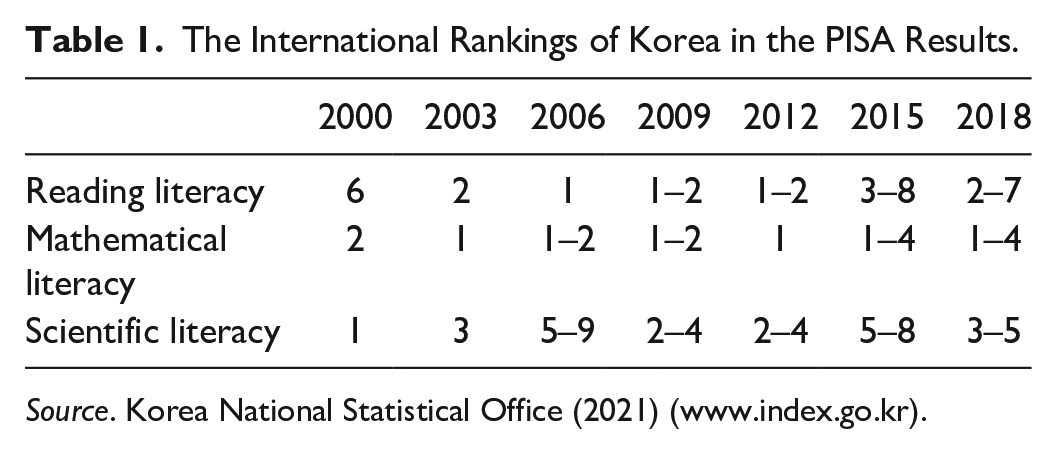
While the PISA in 2000 had little effect on education governance in the Kim Dae-Jung Administration, the Korean government began to take a closer look at the PISA in 2003 (Ahn, 2004). In other words, the large-scale comparative data functioned as “governance by comparison” (Martens, 2007, p. 41). In the U.S., Martens also noted, “Today, rankings and ratings are used for states, their performance in certain policy fields, or government institutions” (p. 41). Not surprisingly, the Korean government’s actions/policies were no exception to this trend. As suggested in Table 1 (see also OECD, 2004a), reading literacy improved, and both mathematics and science performance became worse in 2003. However, Korean students generally were at the top among the participating countries. The Korean government analyzed the results as follows:
The International Rankings of Korea in the PISA Results.
The domestic students make an excellent record in three subject areas of reading, mathematics, which exceeds all the OECD national averages. . .. [However] In the domestic students, the ratio of the student who arrived to top-level of OECD [averages] was not high. . . the layer of the brightest group, which corresponds to the international standard, is thin. (Ro, 2001, pp. ii–iii)
The Korean government understood the results from two perspectives: the current High School Standardization policy reflected no problems, and the Korean government needed only to complement the policy (Ahn, 2004; Kim, 2005). Therefore, the MOE (2004) established a Comprehensive Plan for Excellence in Education (CPEE) in 2004 to balance the High School Standardization policy, which has been implemented since 1974 in order to help ease the disparities between regions at the high school level, to solve the problem of memorization-oriented education, and to lighten heavy learning burden of middle school students. This policy making case shows that the Korean government considered the OECD data as a standard to reform the state’s education and to legitimize the reform agenda (MOE, 2007; OECD, 2010b) even though comparable data does not directly regulate education systems and policy in other countries (Morgan & Shahjahan, 2014).
What we need to note here is the policy background in which the PISA 2003 and the PISA 2006 influenced education policy making and domestic education governance in Korea contrary to “the passive response” of the Kim Dae-Jung Administration (Kim, 2003a, p. 42). The primary background was the spread of growing awareness among policy makers about the importance of the OECD’s international comparative data and policy recommendations (Kim et al., 2004; Lee, 2004a). However, more important was that the new emphasis on the harmony between excellence and equity (which was the educational policy of the Roh Moo-Hyun administration) that was also consistent with the policy topic of the OECD’s (2004b) “excellence in schooling and equitable access” (p. 3) program. We can confirm the evidence of this analysis through the comments of Lee Chong-Jae who attended the Meetings of OECD Ministers in 2004: We are faced with the need to achieve two goals that cannot be given up on either side of each other: excellence and equity in education. . . It is hoped that the subject of excellence and equity discussed at this meeting of OECD Ministers will serve as a good mirror for reflecting on our educational problems and ways to improve. (Lee, 2004a, p. 42 & p. 47)
Meanwhile, the OECD was also directly involved in education governance in Korea. In 2004, the OECD published the Country Note for teacher policy in Korea under the title in Attracting, Developing and Retaining Effective Teachers (Coolahan et al., 2004). Coolahan et al. emphasized that the Korean government should implement new teacher evaluations that focus on “the development of effective teachers, rather than on attracting and retaining effective teachers” (p. 40). Whenever teacher associations opposed the introduction of the teacher evaluation policy, the Korean government emphasized the legitimacy of the policy by citing the OECD Country Note (Republic of Korea Government, 2005). The Korean government finally created and implemented a new teacher evaluation policy in 2010 to develop teacher professionalism.
In addition, the OECD published a thematic review of tertiary education in Korea in 2006 while comparing Korea with OECD and East Asian countries. The report, by Grubb et al. (2006), suggested the necessity to connect tertiary education with the labor market, to improve the coherence among tertiary education system, to reform university governance, and to assure autonomy in higher education such as the incorporation of national universities. These OECD policy recommendations are important in domestic education governance in that the influence of the OECD has extended to the higher education sector as well.
Also, considering that the university reform plan had been continuously discussed since the late 1980s (Park et al., 2008), and the Korean government’s efforts for the university reform had been blocked by conflicts of interests with professor organizations such as the Korea Federation of National University Professor Association (KFNUPA) and the Korea Professors Union (The Dong-A Ilbo, 2005), the OECD’s policy recommendations and comparison cases with the OECD member countries and East Asian countries provided a strong and useful basis to persuade the opponents and public (Yi et al., 2010; Zou, 2019). In addition, these recommendations and comparison information carried import in Korean higher education policies because they provided the MOE with a standard and norm toward reform of the education system in order to improve university competitiveness (Joo & Halx, 2012). While the reform effort by the MOE likely pared well with their own ideas and values, there is no denying the significant influence of the OECD policy recommendations. For example, we can find a relevant statement in a media contribution of the head of the university reform promotion team at the MOE: Major OECD countries, as well as East Asian countries such as Japan, China and Singapore, are pushing for university reform by incorporating national universities and introducing a Management by Objectives (MBO) system. (Kwak, 2007)
In this context, the MOE, under the Roh Moo-Hyun Administration, pushed very hard for higher education reform plans such as the incorporation of national universities and improvement of education-research capacity by means of improving governance and management within universities since 2007 (Bae et al., 2014; Park et al., 2008). However, the higher education reform plan (i.e., the incorporation of national universities) further amplified the conflict between the MOE and faculty organizations at national universities as the MOE finally started in earnest to discuss the plan for the incorporation of national universities (Yi et al., 2010).
Compared to the previous administration, the direct and indirect influence of the OECD under the Roh Moo-Hyun administration is more clearly seen in the fields of primary, secondary, and higher education. The expansion of the OECD’s influence in Korea’s education governance was based on the establishment of a cooperative system with the OECD in Korea promoted by the previous government and strengthened by the trust of policy makers in the OECD. Another reason was the OECD facilitation of consultation and information exchange among OECD member countries centered on the Education Ministers’ Meeting (Kim et al., 2004). However, the strengthening and expansion of the OECD’s influence on Korean education policy ultimately caused conflicts within Korean education governance and in the process of education policy making.
The Lee Myung-Bak Administration (2008–2013): Educational Competitiveness and Efficiency Agenda Triggered by Global Governance
The OECD has published Education at a Glance (EAG) each year since 1992. EAG, as an indirect policy instrument of the OECD, influenced the formation of the education policy of the Lee Myung-Bak Administration. In particular, EAG became a comparative indicator for the Lee Myung-Bak Administration to evaluate higher education objectively. Specifically, the MOE noted that the higher education completion rate of 25 to 34 year olds was 58% in the 2010 EAG, which is higher than the OECD average of 35% (OECD, 2010a, p. 36) and determined that the results were due to the steady increase in the number of higher education graduates since 1998 (MOE, 2010a, p. 3).
However, the Lee Myung-Bak Administration, which emphasized education competition and efficiency based on market principles, perceived that despite the visible achievements of quantitative expansion of higher education, the competitiveness, quality, and efficiency of Korean higher education still fell short of the international level (Monthly Chosun, 2011). It became clear that the Korean higher education institutions had insufficient compensation systems for attracting excellent professors and enhancing professor competency. As a result, the MOE emphasized the need to foster international-level universities by creating a more competitive climate among professors (MOE, 2010c).
As one of the alternative solutions, the Korean government introduced performance-based pay system (PPS) in national universities (Ahn & Ha, 2014, p. 249). It must be noted that the relationship between the PPS of national universities and the productivity of university professors is not clear, and while the National University Faculty Association strongly opposed the introduction of the PPS, but the government continued to promote it. Joo and Halx (2012, p. 293) stated that as a result of the combination of the Korean society’s pressure to strengthen university competitiveness and the neoliberal ideology of the Lee Myung-Bak Administration, the PPS was maintained. Joo and Halx’s interpretation shows that the Lee Myung-Bak Administration’s institutionalization of the PPS is a normative strategy based on rationalized values for improving the competitiveness of national universities and productivity of professors (Fraser & Smith, 2017; Meyer & Rowan, 1977; Scott, 1995). In other words, EAG within Korean education governance functioned as legitimate evidence for institutionalizing the PPS.
In addition, to improve the quality and competitiveness of all Korean higher education, the Korean government pushed restructuring private, public, and national universities with the incorporation of national universities and the introduction of PPS. Even though the University Restructuring Policy (URP) in Korea was promoted after the Kim Young-Sam Administration, the integration and abolition of universities began in earnest by the Roh Moo-Hyun Administration (MOE, 2011). As a result, 24 universities (12 national universities and 12 private universities) were amalgamated into 12 universities.
While the Roh Moo-Hyun Administration’s URP emphasized the autonomy of universities, the Lee Myung-Bak Administration stressed government-led and university accountability as well as the closing of substandard universities (Bae et al., 2014, pp. 25–35). In particular, the Lee Myung-Bak Administration evaluated 346 universities in Korea and restricted government financial aid and student loans to 43 universities with low university competitiveness (MOE, 2011). What is to be noted here is why the Lee Myung-Bak Administration pursued the forced URP despite a strong opposition from university members. The clue can be examined through an interview of Minister Lee Ju-Ho of the MOE with leading Korean media.
Korea’s university entrance rate is the first among the OECD countries. However, how high is the competitiveness of Korean universities? The important thing is not to go to university, but what to learn from university. University education should cultivate excellent professionals through customized education. (Monthly Chosun, 2011)
While university professors were opposed to the URP based on the market economy, ironically, they presented their objection based on other OECD data. For example, the KFNUPA criticized the Lee Myung-Bak Administration’s URP, including the PPS, pointing out that the Korean government was putting pressure on professors and universities that did not achieve to the level of developed countries—those with only the lowest investment (0.6% of GDP) that did not reach the average of the OECD countries (1% of GDP) (Kyounghyang Newspaper, 2012).
Meanwhile, the MOE (2010b, pp. 9–10) evaluated the results of PISA 2009 (see Table 1) as the highest level of achievement in reading, mathematics, and science following PISA 2003, PISA 2006. In addition to this evaluation, the MOE (2010b) highlighted that the policy to guarantee basic academic skills, class management by academic level, and education policy for excellence, all of which were maintained and should be further strengthened in order to level up the educational competitiveness. The reason the results of PISA 2009 were important in the formulation and implementation of educational policy in Korea is that it supported the justification and necessity of the National Assessment of Educational Achievement (NAEA) (Kim et al., 2010, p. 100). In other words, the MOE of the Lee Myung-Bak Administration, which pursued a conservative ideology, also promoted an accountability policy to ensure excellence in education and used the result of PISA 2009 as a basis for repelling the arguments of progressive political parties and teacher organizations against the NAEA (Lee, 2012).
The Park Geun-Hye Administration (2013–2017): Curriculum Reform Through Global Governance
President Park Geun-Hye, before the current Moon Jae-In Administration (2017–the present), was impeached by the Constitutional Court of Korea (CCK) in 2017 for the intervention of unofficial aides in state affairs, abuse of authority by the President, and government collusion with business conglomerates (Constitutional Court of Korea [CCK], 2017). The Park Geun-Hye Administration emphasized that educational policies should contribute to building student capacity to prepare for the future society (KEDI, 2019; MOE, 2017). Naturally, the OECD’s greatest influence on Korean education policy during the Park Geun-Hye Administration resulted from the key competencies of the OECD’s Definition and Selection of Competencies (DeSeCo) project.
These were the competencies that the OECD suggested were required to cope with the complex and diverse problems in modern society (OECD, 2005, p. 4). They were adopted in Korea during the Park Geun-Hye Administration (Kim, 2019; Lee et al., 2018). Of course, the results of PISA 2012 also became an important international comparative criterion for the Park Geun-Hye Administration in evaluating students’ academic achievement and seeking to improve education policy. Specifically, the MOE emphasized that since the achievement level of mathematics, reading, and science in Korea was excellent compared to international levels, Korea needed to support policies to maintain the current achievement level as well as policies to improve the basic academic ability in relation to the increase in the ratio of the lower achievement levels (KICE, 2013, p. 12).
Additionally, it is noteworthy that the MOE (2017) dealt with the results of competency, such as collaborative problem solving and creativity as more important data than the international ranking of reading, mathematics, and science in the PISA 2015 results. The reason that the Korean government focused on competency rather than international ranking in the PISA results was that it was not only in line with the Park Geun-Hye Administration’s national agenda, but also because the government judged that the solution to solving education problems was in competence (Choi et al., 2017; KEDI, 2019). For example, Minister Lee Jun-Sik of the MOE mentioned the importance of competency-based education (CBE) and educational reform to create the future of Korea as follows: According to the PISA 2012, Korean adolescents’ intellectual abilities are the highest among the OECD countries. On the other hand, social interaction capacity, which is “the ability to live with others,” is the lowest among 36 surveyed countries. That is a serious adverse effect of education aimed only at academic achievement. The future is a society based on creative fusion, and the amount of knowledge and information will increase exponentially. Therefore, simple knowledge or memorization education cannot be used to cultivate talents that fit the times. (Learning Times, 2016)
A concrete case in which the idea of CBE is based on the key competencies of the OECD’s DeSeCo Project is reflected in education reform of the national-level curriculum in 2015 (EduinNews, 2016; Kim, 2017; Kim et al., 2015). The MOE has also linked CBE with various university financial aid projects such as College of Humanities’ Research and Education Project and Advancement of College Education Project (Learning Times, 2016). As a result, CBE has become a standard that Korean national and private universities must comply with to receive government financial support (Kim, 2019). As Kim highlighted, the important point is that Korean universities, which have weak financial resources, accepted the government’s autonomous recommendations as norms to receive government financial support.
Discussion and Implications
The Unyielding Progression of Global Governance and Policy Convergence of the Korean Government
After the Korean government’s OECD affiliation of 1996, the government closely cooperated with the OECD (Kim, 2003b; Kim & Park, 2018). The Kim Young-Sam Administration, which supported globalization and competitiveness, voluntarily accepted the OECD’s policy recommendations (Lee et al., 1996; Son, 2014). Also, each government after the Kim Young-Sam government addressed various market-driven educational policies which derived from either (or both) IOs and developed countries (i.e., U.S.A.) in order to push client-oriented education, educational excellence, and school autonomy based on, deregulation, decentralization, and autonomy (Kim, 2001; Lee, 2012). The market-based educational policies reflected political and economic principles of the OECD (Löwenheim, 2008; Meyer, 2014; Ross & Gibson, 2007). As a result, globalization created a neo-liberal educational governance in Korea that intertwined the forces of global governance (Kim, 2007).
While comparable data functions as an indirect intervention to the nation, policy recommendations through country reports and national reviews of the OECD work as virtual direct intervention with the educational regulations in many countries. Similarly, the Korean government has used the OECD’s comparable data and policy recommendations for education systems as legitimate and valid ways to reform its national education and to persuade the citizens, interest groups, and mass media of its validity (Shin & Joo, 2013, p. 151). Additionally, we must note that the OECD’s comparable data and policy recommendations may be considered as implicit and subtle “global pressure” (Löwenheim, 2008, p. 10; Meyer, 2014, p. 11) and standards with a focus on neo-liberal values. Considering that neo-liberalism supports and utter freedom of corporate interests, such focus seems clearly revealed in Korean education governance as suggested in the findings of this study.
Moreover, global governance has been diffused by the Korean government which accepted it as legitimate within domestic education governance. This implies that the neo-liberal values and ethics (evaluated as right or good) through global governance can be a coercive pressure in education policy making processes over time (Meyer, 2014; Morgan & Shahjahan, 2014). For example, the Kim Young-Sam Administration and the Roh Moo-Hyun Administration cooperated closely with the OECD from the early stages to meet global standard in education; yet on the other hand, it also took advantage of international authority of the OECD in order to legitimize radical 5.31 Education Reform and controversial the CPEE (e.g., Kim, 2003b; MOE, 2004; Ro, 2001). In particular, we must note again Löwenheim’s (2008) statement; “developing states cannot simply ignore these ratings and rankings” (p. 255), even though it might be in their best interest to do so. This means that the leading developed countries of the world and the OECD frequently determine policy directions in countries like Korea via the imposition of norms and standards that are not necessarily universally well-suited for all countries (See Meyer, 2014; Son, 2014). This is global governance at its worst.
On the other hand, policy convergence of Korean government through global governance by the OECD has strengthened governmental accountability within Korean education governance (Shin & Joo, 2013, p. 154; see also Meyer, 2014). This means that the role and function of the Korean government has been maintained or strengthened to improve education competitiveness and quality in a globalizing world (Byun & Kim, 2011; Lee, 2004a). In particular, emphasis on output control has become the abiding interest of each government in Korea (Bae et al., 2014; MOE, 2010a, 2010c). The Korean government’s obsession with education outcomes and productivity came to control major issues in Korean education governance in the name of preparing for the future society (Park et al., 2008).
Additionally, we must also think about how global governance based on market principles extends government-centered policy trends, that is, in East Asian countries and developing countries (Chiang, 2014; Sato, 2017). If we consider that the diffusion of market-based and result- or output-oriented values and beliefs by the OECD are relevant to consciousness of officials in the government who have neo-liberal policy ethics, the essence of Korea education governance facilitated by global governance can be understood as a form of new managerialism (Meyer, 2014; Mok, 2006). Therefore, new managerialism in Korea education governance can be considered as an internal drive for output and market-based education reform, while global governance can be regarded as an external drive for policy and management transformation (Amos, 2010; Son, 2014). These sources too have commonly functioned as educational policy making mechanisms within Korean education governance over time.
The Parallel Changes of Global Governance by the OECD and Educational Policy Making in Korea From 1993 to 2017
Korea’s educational policy making has been greatly influenced directly and indirectly by the OECD with its highly neo-liberal standards and norms since the Kim Young-Sam Administration. Clearly, neither has remained static. In many ways, the pace and trajectory of change has run concurrently between global governance by the OECD and Korea’s educational policy making, as both have displayed parallel changes over time. First, the influence of the OECD in Korean education governance showed a tendency to gradually strengthen and expand. In other words, while the Kim Young-Sam and Kim Dae-Jung governments mainly focused on the PISA results, the later governments gradually strengthened their tendency to actively interpret and accept not only the PISA, but also the OECD comparative data and policy recommendations (e.g., Learning Times, 2016; MOE, 2010a). As a result, the Korean government moved away from improving policies related to student learning in the early stages and used OECD data as a standard for reform for both teachers’ policy and higher education policy (e.g., Coolahan et al., 2004; KEDI, 2019; MOE, 2011, 2017).
The reason the OECD’s influence expanded to the Korean higher education sector was largely due to the OECD’s increased interest in higher education as well as the OECD’s policy recommendations for Korea specifically (Grubb et al., 2006). In other words, while the main topics of the Meetings of OECD Ministers in 2004 were focused on elementary and secondary education such as student performance, teacher quality, and democratic citizenship education (OECD, 2004b, p. 3), the Meetings of OECD Ministers in 2006 were held under a single theme of higher education (OECD, 2006). Along with the expansion of the OECD’s influence in Korean higher education, it is noteworthy that researchers on OECD policy recommendations and comparative data led by the MOE and government-funded research institutes had been activated starting with the Roh Moo-Hyun Administration (Han & Park, 2001; Kim et al., 2004). This change resulted from the recognition of the need for the Korean government to move away from passive responses to the passive global governance influence of the OECD and toward the implementation of successful education reform by persuading the public and special interest groups through active, in-depth, analysis of international education trends and policy recommends of the OECD (Kim, 2003a; Lee, 2004a).
It is also worth noting changes in the OECD itself. One of the major changes within the OECD was the increased interest in the purpose and content of future school education and the lives of students from the emphasis on institutional reform and the introduction of policies to improve the quality and performance of education (Lee et al., 2018). The most representative example is the core competency framework announced by the OECD’s DeSeCo project (OECD, 2005). As previously suggested, the reason this framework is meaningful in the ways of educational policy making in Korea under global governance by the OECD is that it has led to the reform of the competency-based curriculum at the national level (Kim, 2017; Kim et al., 2015).
The Korean government, which was planning educational reform to prepare for the future, used the framework of the DeSeCo project as a standard for curriculum reform (Choi et al., 2017; KEDI, 2019; Kim, 2017). This curriculum reform brought about by the DeSeCo project is the result of very important change within the OECD, in which the OECD’s global standards have influenced the design of the curriculum. This implies one of the shifting aspects of the subtle power of global governance by the OECD. However, some scholars (e.g., Kim, 2019; Park, 2018) criticized the competency-based curriculum reform as undermining the autonomy of teachers and educational institutions. These criticisms are important in the relationship between global governance and education governance in Korea because the curriculum of one country includes the culture, history, and philosophy of that country (OECD, 2019; Park, 2018). This is negative effect of global governance by the OECD. We discuss the additional negative effect as well as positive effects below.
The Positive and Negative Effects of Global Governance on the Korean Educational Policy
While our analysis suggests a number of negative outcomes from the influence of global governance and policy imposition, we should also consider the benefits of the influence of global governance in Korean education policies. Global governance by the OECD has also had positive effects on Korean education policies (Kim & Park, 2018; Shin & Joo, 2013). First, the Korean government, the press, politicians, and the public were given a chance to reconsider the quality of education through comparable data, global standards, and recommendations that the OECD published (MOE, 2004, 2007, 2010a). As a result, official and unofficial policy actors discussed the current situation of Korean education and the Korean government suggested and implemented a variety of education policies to reform its education system and to strengthen national competitiveness by using the OECD data (Ahn, 2004; Kim, 2003b; Lee et al., 1996). Such benefits of global governance also apply to East Asian countries and developing countries. In other words, global governance by the OECD based on comparison has contributed to analyzing educational problems in countries and setting the direction of education reform (Sato, 2017; Zou, 2019).
However, since global governance by the OECD led by Western countries inevitably involves strong Western thinking and culture (Chiang, 2014; Kim, 2007; Löwenheim, 2008; Meyer, 2014), East Asian countries and developing countries must promote education reform in consideration of their own culture and reality. Education reform without considering culture and education field in domestic education governance can strengthen the backlash and resistance of education stakeholders (Lee & Han, 1996). For example, Korea’s new teacher evaluation policy, introduced in 2010 according to the policy recommendations of the OECD, is still not settled in the school field due to controversies among parents and teacher groups about the reliability of evaluation results and the validity of evaluation methods. More specifically, there exists a vertical relationship between teachers and students, and the culture of “Jeong (情, a feeling of warmth)” between people in Korea that makes objective evaluation itself difficult. This case implies that policy makers in East Asian countries and developing countries need to critically evaluate and introduce any new educational policies based on global standards and norms.
Paradoxically, global governance provided an instant decision-making, agenda setting, policy making, and implementation foundation on which the Korean government could build, especially when public controversy delayed action (Kim, 2019; Kim et al., 2010). In other words, global standards, international comparable data, and policy recommendations encouraged the Korean administration to make decisions and implement delayed reform agendas such as the CPEE and the plan for the incorporation of national universities. Once this plan was implemented, it showed the positive effect for producing excellent research results and establishing a research support system (Bae et al., 2014). However, again, there are also negative consequences: the retreat of democracy within national universities due to the strengthening the authority of the board of directors composed of external personnel, and the increase in interference with the financial management of the national universities by government such as the MOE and the Ministry of Strategy and Finance (Maeil Business News, 2019; Yonhap News Agency, 2016).
Moreover, given that governance in Korea means directive democracy, not representative, one could determine that education policies which have been formed by global governance have not contributed to deliberative policy making or participatory democracy in Korea (Kim, 2019; Son, 2014). This is even more evident when we consider that neo-liberalism can violate democratic values (Joo & Reyes, 2010). In addition, the Korean government often ignores stakeholders’ opinions within domestic education governance (Kyounghyang Newspaper, 2012; Shin & Joo, 2013). The most representative example is the conflict management method of the MOE in the process of incorporating national universities. As Yi et al. (2010) pointed out, the MOE has been significantly lacking in conflict resolution efforts such as communication and gathering opinions with members of national universities. In light of these considerations, it seems that educational governance in Korea is still a work in progress.
Conclusion
Our analysis suggests that as long as the localized government uses the OCED guidelines as “suggestions,” the results are promising. In Korea, education improved as a result of following the lead of the OCED, but only by adapting its guidelines to fit the basic Korean educational model. However, it is notable that global governance by the OECD has gradually strengthened the spread of neoliberalism based on competition and market principles in Korean education governance by each administration and that neoliberalism has strongly infused into educational policy in Korea. After all is said and done, the nature of global governance by the OECD in Korea can be viewed as the diffusion of norms and standards through hegemonic neoliberalism (Amos, 2010; Finnemore, 1996; Kim, 2019) combined with a new managerialism.
The educational beliefs and values pursued by the OECD have created many conflicts in Korean society up to the Lee Myung-bak Administration, but many people engaged in education-related professions such as schoolteachers, university professors, and researchers as well as Korean government administrators now take it for granted. In Korea, independent educational governance is somewhat of a myth. Today, this phenomenon is not limited to Korea, East Asia, and developing countries. The change of education governance in individual countries by global governance is becoming a global phenomenon beyond a specific region, and in some countries, global governance is causing very radical educational reform in a short period of time. As a representative example, the Bologna Process exerts a strong influence for the purpose of integrating European higher education and enhancing the international competitiveness of European universities regardless of the traditions, cultures, and realities of the individual European countries (Stevens & Giebel, 2020; Toderas & Stăvaru, 2018; Zmas, 2015).
The influence of global governance has been manifest for decades, and will likely be further strengthened, either directly or indirectly and remain for the indefinite future. While accepting this prediction, we believe that it is also necessary to form and evaluate policies based on deliberative democracy first, and then look to IOs like the OCED to capitalize on the positive effects of the phenomenon of global governance. The inevitable influence of global governance can in fact serve national needs well if it is leavened by localized democratically-derived experience. Awareness of this need to balance education policy decisions with input from the on-the-ground stakeholders, national concerns, and input from IOs like the OCED, is crucial to the ultimate success of educational programs worldwide. This balance and success have both been demonstrated in Korea.
Footnotes
Declaration of Conflicting Interests
The author(s) declared no potential conflicts of interest with respect to the research, authorship, and/or publication of this article.
Funding
The author(s) received no financial support for the research, authorship, and/or publication of this article.
