




Abstract
This study investigates how graduate teaching assistants (GTAs) differ from regular graduates in terms of input characteristics (i.e., who they are), process characteristics (i.e., how they experience the PhD trajectory), and the self-estimated likelihood of successfully completing the PhD. Additionally, it assesses to what extent and how the input and process characteristics explain the self-estimated success rate between the two groups. The data come from four waves of the PhD Survey (2018, 2019, 2020 and 2021; N = 1,766) conducted at a large university in Brussels (Belgium). Results show that GTAs estimated their likelihood of successful completion of their PhD lower compared to regular graduates. This difference is mediated by a lower satisfaction with the supervisor support and a higher amount of time pressure among GTAs. Additionally, GTAs’ surplus of time spent on teaching duties and the lack of a research plan was negatively related to the self-estimated likelihood of successful completion to a greater extent than regular graduates.
Plain Language Summary
This study investigates how PhD students who combine their research with teaching classes (graduate teaching assistants, GTAs) differ from regular graduates. We look at how both groups are different from each other in terms of input characteristics (i.e., who they are), process characteristics (i.e., how they experience the PhD trajectory), and the self-estimated likelihood of successfully completing the PhD. Additionally, our study assesses to what extent and how the input and process characteristics explain the self-estimated success rate of the two groups. The data come from four waves of the PhD Survey (2018, 2019, 2020 and 2021) conducted at the Vrije Universiteit Brussel (VUB). Results show that GTAs estimated their likelihood for successful completion of their PhD lower compared to regular graduates. This difference can be party explained by the fact that GTAs experience a lower satisfaction with the supervisor support and a higher amount of time pressure than regular graduates. Additionally, spending more time on teaching duties than was stipulated in the contract and not having a research plan has a stronger negative influence on the self-estimated likelihood for successful completion of GTAs than it does for regular graduates.
Introduction
For many, pursuing a PhD is an important step in their career, and the experience of this process can have a determining impact on the success rate at the end of the trajectory. It can be assumed that not only personal characteristics, such as perseverance and intrinsic motivation play a role in the successful completion of the doctorate, but also that external and environmental factors play a vital role. One of them being the type of contract under which the PhD student conducts the research.
In this article, we study how the experience of those who have a contract as a graduate teaching assistant (GTA) differs from PhD students with other types of funding. GTAs combine their research with teaching duties, forcing them to constantly seek the right balance between the different roles they take up. Much has been written on the teaching duties of GTAs. From how they are properly trained, to their self-efficacy in teaching, and to how the undergraduates they teach evaluate their teaching. However, little attention has been paid to how the combination of teaching and doing doctoral research impacts the progress of the PhD research and how this relates to their estimated likelihood on successful completion of the PhD.
Background
What Are Teaching Assistants?
With graduate teaching assistant (GTA) we refer to someone who conducts doctoral research at a university and teaches (undergraduate) students at the same time (Park & Ramos, 2002). The teaching responsibilities of GTAs often vary between disciplines (e.g., giving lectures, lab demonstrations, field work, facilitating seminars or discussion groups, et cetera) (Hastie et al., 2021; Park & Ramos, 2002). Similarly, motivations for taking up a teaching duty vary as well. Whereas some do it out of passion and enjoyment of teaching, others are merely financially motivated and see it as a way to fund their research (Hastie et al., 2021).
How GTAs are expected to divide their time between teaching and doing research can differ. For GTAs in North America, the focus mainly lies on their teaching duties (Park, 2004). Being a GTA is often seen as a first step in one’s academic career. For British GTAs, the emphasis lies on doing research. They are merely graduate students who take up some teaching duties for funding purposes. The Belgian context, which is the focus here, is closest related to the British context. In Belgium it is regulated that GTAs are expected to spend 60% of their time on their doctoral research and 40% on teaching duties. Given that they have less time to spend on their research, GTAs get 6 years to complete their PhD while regular graduates generally have 4 years to complete it.
Despite the differences between countries in how GTAs divide their time between teaching and research, a common characteristic of GTAs is that they must fulfill different roles. They fulfill tasks of teachers, researchers, students, and employees simultaneously (Muzaka, 2009). While this can be enriching, it can also be confusing, create role-conflicts, and put GTAs in a precarious position by making them different from everyone else in the department. This potentially hampers their work as researchers.
The Impact of Teaching on Research Skills and Success Rate
The impediment to their research tasks, which arises from their ambiguous role, is further exacerbated by the fact that faculty members sometimes tend to value research activities more than teaching activities (Anderson et al., 2011). This idea is supported by the fact that rewards and the quantification of “success” in academia are very often research-based (e.g., grants, number of publications, et cetera) (Austin, 2002; Geschwind & Broström, 2015; Mayson & Schapper, 2012). The common reasoning holds that research skills are beneficial for better performance of teaching duties, but that teaching not necessarily increases research skills (Brawner et al., 2001). Esdar et al. (2012), for example, showed that almost half of the early career academics experience the combination of teaching and research as a role conflict. Jucks and Hillbrink (2017), however, drew opposite conclusions. They found that the majority of PhD students who combine research and teaching evaluate it as a positive experience. A study by Feldon et al. (2011) also shows that research skills are enhanced by the teaching experience.
When looking at the actual success and dropout rates between different types of funding, the findings are more univocal. Ehrenberg and Mavros (1995) found that completion rates among GTAs are significantly lower compared to those who have fellowships or research assistantships. Recent studies confirm this finding (e.g., Groenvynck et al., 2013; Stock & Siegfried, 2006; Wollast et al., 2018). Groenvynck et al. (2013) show that success rate of GTAs is 39.1% within 8 years, compared to 70.5% for those who have project funding or a competitive scholarship. 54.4% of the GTAs drops out within a period of 8 years, compared to 27.5% among those with project funding or a competitive scholarship. Ampaw and Jaeger (2012) find similar results. Assuming that the PhD process successively consists of a transition phase (starting and adjusting as a graduate student), a development phase, and a research phase (Tinto, 1993), they show that research assistants were significantly more likely to complete all three stages, while GTAs were more likely to get stuck in the development stage and never make it to the research stage.
These findings are worrisome, especially in the light of the increasing influx of undergraduates (Organisation for Economic Co-operation and Development, 2019). The demand for teaching assistants is on the rise. GTAs seem to be a crucial actor in meeting teaching needs rather than being seen as fully fledged researchers. This may hamper the successful completion of a PhD track and raises the question of why GTA completion rates are substantially lower than those of regular graduates. By understanding these dynamics, universities can adjust their policies accordingly and provide more support for GTAs, which are becoming increasingly important in helping to carry the educational burden. To achieve such insight, it is crucial to systematically monitor the differences in success rates between groups of PhD students. Making the problematic “visible” and thereby acknowledging the existence of the problem is the first step to find a solution for it.
What Aspects Play a Role in Success Rate of Teachings Assistants?
Several elements influence the experience of the PhD trajectory and the extent to which PhD students estimate to eventually submit their PhD successfully. Earlier research has already studied how the progress, satisfaction and timely completion of PhD students are related to elements like individual characteristics, the available supervision and support, project characteristics (e.g., workload, level of autonomy), institutional characteristics, available resources and facilities, et cetera (Jiranek, 2010; Van de Schoot et al., 2013; van Rooij et al., 2021). In this article, we group these factors into two categories: input characteristics and process characteristics. Input characteristics refer to the personal characteristics of PhD students (e.g., socio-demographic characteristics, the level of self-confidence, field of study). Process characteristics refer to the trajectory of the PhD and, in case of GTAs, the way they fulfill their teaching role (e.g., the support they receive, obstacles they encounter, the way they allocate their time). Distinguishing between input and process characteristics is useful because they are related two different policy initiatives. Indeed, input characteristics draw attention to selection procedures, while acknowledging the importance of specific process characteristics has the potential to improve the supervisory process.
In what follows, we give an overview of the existing research about how GTAs experience these elements. We focus on characteristics that can be easily operationalized and influenced by policies at the university level. This approach excludes more intrinsic characteristics (e.g., personality characteristics), which also influence the experience of the trajectory, but which are simply unknown to most universities and therefore cannot be used for policy making. We consider nationality, gender, and the field of study as input characteristic, and support and time allocation as process characteristics.
Nationality
According to Groenvynck et al. (2013), non-European PhD candidates have the highest success rates and lowest dropout rates. Reports on the PhD Survey also show that foreign PhD students (especially non-European PhD students) are more satisfied about the PhD trajectory and more confident about succeeding (Glorieux et al., 2022). This might be due to a selection-effect whereby only the most motivated and capable PhD students will make the impactful decision to move to another country to obtain a PhD. However, research suggests that international GTAs face a lot of extra challenges, because of language barriers and differences in culture and pedagogy (e.g., Fatima, 2001; Walsh et al., 2020). The study of Walsh et al. (2020) shows that the majority of the international GTAs expresses a desire for more support in grading papers; either from their supervisor or other experienced GTAs.
Gender
There appears to be no gender difference when it comes to the difficulties and concerns that GTAs encounter (Luo et al., 2000), nor has a significant gender difference been found in terms of experienced benefits of being a GTA (Nasser-Abu Alhija & Fresko, 2020). Overall, little research has been done to examine whether female and male GTAs experience their trajectory differently.
Field of Study
The field of study influences the content of the teaching task (e.g., whether the focus lies on supervising labs, giving seminars, leading discussion groups, et cetera) (Hastie et al., 2021; Park & Ramos, 2002). Consequently, it can be assumed that the experience of the teaching duty differs between disciplines. Research has paid little attention to these differences. Nasser-Abu Alhija and Fresko (2021) find that GTAs in Arts, Humanities and Social Sciences are less self-confident about their teaching skills than those in Mathematics and Life Sciences. The former group is convinced that their subject requires a higher degree of pedagogical skills compared to the latter group, since there is more room for discussion, flexibility, and creativity in their discipline. According to Hastie et al. (2021), this variation in the flexibility of the teaching duty can lead to different outcomes in terms of self-confidence between GTAs. For some, a rigid framework might lead to a higher sense of direction and competence, and thus more confidence, whereas for others, a lack of flexibility might lead to a decreasing motivation.
According to Jordan and Howe (2018), the field of study predicts whether GTAs perceive teaching influences their research positively or negatively. GTAs in the Arts & Humanities and Humanities & Social Sciences rate the benefits of teaching on their research the highest. In these fields of study, PhD students feel that teaching helps them gain new insights into their work and new ideas, and that it improves their academic writing skills. This is in line with the previously mentioned finding that teaching in these fields requires a lot of creativity. PhD students in Physical Sciences and Clinical Medicine evaluate the benefits of teaching for their research the lowest. They think teaching helps them improve their communication skills and they appreciate that their teaching duties give them a break from their research.
Support
How faculty members view and support GTAs has been proven to be a determining factor in the expectation of successful completion (Myers, 1998). Two types of support can be distinguished, namely support received from peers/colleagues, and support received from the supervisor. Regarding the latter, analyses of data on the satisfaction of PhD students have repeatedly shown that the support received from supervisors is crucial for PhD students (Glorieux et al., 2022). Groenvynck et al. (2013) argue that the higher success rates and lower dropout rates among those who obtained a competitive scholarship compared to GTAs can partly be attributed to the fact that the former group is often more supported by their supervisor, and this often even prior to starting their research (i.e., during the application procedure for the scholarship).
A lack of supervisor support is a commonly reported issue among GTAs. This may consist, for example, of a lack of feedback on how they are performing in their teaching task, a lack of information on options for the future or career choice, or a lack of clarity about their role in the faculty (Austin, 2002; Park & Ramos, 2002). Jordan and Howe (2018) mention a discrepancy in how teaching can impact the support received from the supervisor. Some GTAs feel their supervisor disapproves of teaching and want them to stay focused on their research, while others feel pressured to take on more teaching duties. This, again, underscores the ambiguous status of GTAs and the unclarity they often face when it comes to the duties they have to fulfill.
In the same vein, many GTAs express their dissatisfaction about the freedom they have (Park & Ramos, 2002). They feel they lack the opportunity to be creative or innovative in their teaching duty. This leads to a sense of little engagement and ownership of the job, and the feeling of simply doing the job as someone told them to do it. While this lack of freedom could be perceived as something negative, it could also be argued that the limited responsibilities for filling in the content of the teaching job helps the GTAs to protect their time budget and reduce pressure. Indeed, in addition to a lack of freedom, GTAs also report concerns about having too much responsibility towards undergraduate students to teach them a course (Earl-Novell, 2006).
Next to supervisor support, support received from colleagues should not be underestimated (Myers, 1998). The involvement of colleagues can help GTAs to self-reflect and become more self-aware of their own strengths and weaknesses (Nasser-Abu Alhija & Fresko, 2020). It also helps them coping with problems and uncertainties and thereby promotes their role as a GTA. According to Earl-Novell (2006), teaching tasks help PhD students to integrate better into the department because it provides them with valuable social contacts.
Research Plan
Skopek et al. (2022) showed that having strict deadlines and clear milestones leads to PhD students completing the trajectory faster. This finding is also supported by Glorieux et al. (2022). Apart from this research, little has been written about the importance of a research plan with clear milestones, and whether having such plan makes a difference depending on the type of funding one has. However, precisely because of the various professional responsibilities of GTAs, it is plausible to expect that having a clear research plan will be especially helpful for them.
Time Allocation
Teaching duties take up a substantial amount of time. Muzaka’s (2009) study indicates that the imbalance in time allocation is one of the main problems experienced by GTAs. Only a small number of GTAs indicate that they found an optimal balance between their research and teaching duty (Earl-Novell, 2006). Indeed, Park and Ramos (2002) report that most GTAs spend more time on teaching duties than contractually stipulated, leaving many GTAs feeling dissatisfied with the way they spend their time. There is a general tendency of universities to prioritize research over teaching and the belief is that teaching takes away valuable time that should be spent on research. Borrego et al. (2021) reveal that PhD students perceive funding as GTAs as the least desirable form of funding, because it is seen as a distraction from the research.
Groenvynck et al. (2013) also attribute lower success rates and higher dropout rates of GTAs to the fact that they have less time to spend on their research. Machette (2021) finds that not only the time spent on teaching, but also on the preparation for classes takes a lot of time and causes most time management problems for GTAs. The so-called teaching workload may vary throughout the year—or from year to year—often making it difficult for GTAs to plan their (research related) work (Park, 2002). Machette (2021), on the other hand, argues that teaching duties can contribute to a more structured week for GTAs, justifying further research on this topic.
This literature review demonstrates that there is disagreement on how GTAs estimate whether their teaching position is beneficial for their research. Generally, however, research shows that GTAs have lower success rates and higher dropout rates compared to regular graduates. Both input and process characteristics have an influence on how GTAs experience their PhD trajectory.
Research Questions and Hypotheses
This study aims to dig deeper into what characteristics distinguish GTAs from regular graduates, and how this relates to their self-estimated success rate. To do this, we address the following research questions (RQ):
Based on the existing research and to answer our research questions, we will test the following hypotheses:
Data and Method
To answer these research questions, we use the data of the PhD Survey of the Vrije Universiteit Brussel (VUB), a large university in Brussels, Belgium. At VUB, PhD students are required to enrol in a Doctoral Training Program hosted by one of the three doctoral schools. These are the Doctoral School of Natural Sciences and (Bioscience) Engineering (NSE) which includes the Faculty of Engineering Sciences and the Faculty of Sciences & Biosciences engineering, the Doctoral School of Human Sciences (DSh) which includes the Faculty of Social Sciences & Solvay Business School, the Faculty of Arts & Philosophy, the Faculty of Psychology & Educational Science, and the Faculty of Law & Criminology, and the Doctoral School of Life Science and Medicine (LSM) which includes the Faculty of Medical Sciences & Pharmacy and the Faculty of Physical education & Physiotherapy.
PhD students can be funded in multiple ways. The three most common ways are the following: (1) they can apply for a personal mandate (i.e., funding granted by an (inter)national funding institution to themselves personally), (2) their research can be carried out in the context of a research project (i.e., funding granted to a supervisor, who recruits the PhD student to do the research), or (3) PhD students can take up a position as a teaching assistant whereby it is stated in their contract that the PhD student combines their research (60%) with teaching duties (40%).
PhD Survey
Since 2018, all PhD students from all faculties at VUB are invited annually to participate in a survey that monitors different aspects of their PhD process. The survey focuses on how supported they feel by several actors, several aspects of well-being, and overall job satisfaction. Data collection of the PhD Survey takes place in April and May. It exists of a single questionnaire that is administered online on the data collection platform MOTUS (https://www.motusresearch.io) to which PhD students are invited by e-mail. To identify patterns and check for the robustness of our findings, we include data of the waves of 2018, 2019, 2020, and 2021. Response rates varied between 41.9 and 48.3% and selected sample sizes vary between n = 561 and n = 393 (see Appendix Table A1).
We analyze each wave separately and do not focus on the longitudinal aspect of the data. There are two reasons for this. Firstly, if we selected only respondents who participated multiple times, our sample would be too small. Especially if we were to divide respondents by background characteristics, as we do in our analysis, focusing on within-individual changes would lead to a sample size that is too small. A second reason is that we see the data from the different waves as a replication of the same process. By comparing the data from several years, we wanted to test whether our findings are robust.
Variables
Dependent Variables
The dependent variable is the self-estimated success rate of PhD students to complete their PhD trajectory. This variable is based on 2 items: the self-estimated likelihood of submitting their PhD successfully and the feeling of being on the right track with their research. For the former, respondents were asked to what extent they think they will successfully submit the PhD on a scale from zero to ten. For the latter, the respondents were asked to what extent they feel on the right track on a scale ranging from not at all on track (1) to totally on track (5). These two variables were combined into a new construct and rescaled on a 0 to 1 continuum, 1 meaning the highest likelihood of successfully submitting their PhD. For the different waves, these two variables show a correlation between 0.59 < r < 0.69. We estimated all models for the two variables separately and assessed whether their combination led to substantially different results. This was not the case (results not shown).
Independent Variables
The main variable of interest is a dummy for being a GTA, as opposed to PhD students with other funding (i.e., project funding or a personal mandate). Self-financed PhD students and those who indicated to have another type of contract were excluded in our analyses due to small numbers and heterogeneity in this group.
We include the following input characteristics: a dummy for female, a categorical variable for nationality (Belgian [reference category], European, non-European), and a categorical variable for doctoral school (NSE [reference category], DSh, and LSM).
Furthermore, we include the following process characteristics for support:
Involvement of colleagues: PhD students assessed the involvement of colleagues by answering the question to what extent their colleagues are involved in their research on a 5-point Likert-type scale (1: not at all to 5: totally; rescaled to a 0–1 continuum).
Supervisor support: this was measured using 6 items that were rated on a 5-point Likert-type scale (1: not at all satisfied to 5: very satisfied). The items referred to the satisfaction with the supervisor involvement in the research, expertise, support, stimulation, and quality and frequency of meetings. Principal Component Analysis (PCA) revealed that the items loaded on one component. We summed all items leading to one variable that reflected the satisfaction with the supervisor support, with a score between 0 and 1 (see Appendix Table A2).
Supervisor freedom: this was measured using 3 items that were rated on a 5-point Likert-type scale (1: not at all satisfied to 5: very satisfied). The items referred to the satisfaction with the freedom to develop research ideas, possibilities to attend conferences and training courses, and the introduction to other prominent researchers. Again, a PCA revealed that the items loaded on one component. We summed all items into one variable on the satisfaction with the supervisor freedom, with a score between 0 and 1 (see Appendix Table A3).
Research plan: PhD students also assessed support in the form of having a clear research plan. Those who indicated to have a research plan were asked which of a list of nine elements were included in their plan (i.e., research goals, monthly or yearly milestones, publication strategy, conferences to attend, transferrable skills training schedule, specialist training schedule, dissemination of research results to a broader audience, or other elements). The variable distinguishes between no research plan, limited research plan (i.e., one to three elements included), and extended research plan (i.e., more than three elements included [reference category]).
Four more process characteristics referred to PhD students’ time allocation. Next to two objective variables on time allocation (percentage research time and teaching overtime), we also included two variables that measure the subjective experience of the time use (time pressure and work-family balance):
Percentage research time: this is the relative share of self-estimated time spent on research over the self-estimated total working hours per week.
Teaching overtime: this consists of a dummy for spending more time on teaching than contractually stipulated. Note that GTAs are required to spend 40% of their working time on teaching duties, whereas regular graduates are required to spend a maximum 20% of their working time on teaching duties.
Time pressure: this was measured using 8 items that assessed whether PhD students felt that they have time for themselves and can catch up with their work and were rated on a 5-point Likert-type scale (1: strongly disagree to 5: strongly agree). A PCA revealed that the items loaded on one component. We summed all items into one variable on the experience of time pressure, with a score between 0 and 1 (see Appendix Table A4).
Work family balance: this was measured using 5 items that referred to whether PhD students felt that they can adjust their working time to their family life and have influence on their working hours and were rated on a 5-point Likert-type scale (1: strongly disagree to 5: totally agree). Again, a PCA revealed that the items loaded on one factor. We summed all items into one variable on the satisfaction with work family balance, with a score between 0 and 1 (see Appendix Table A5).
Control Variable
We assumed that the self-estimated likelihood of successfully submitting the PhD is influenced by how far along PhD students are in their trajectory. Therefore, we control for length of their PhD trajectory by dividing the years that have passed since first enrolment by 4 (i.e., number of years regular graduates get to complete their research) or 6 (i.e., number of years GTAs get to complete their research).
For the wave of 2018, there are no data on the work family balance, the time spent on research, and the time spent on teaching. Using listwise deletion, only the respondents with no missing values on the variables of the analyses were selected, resulting in sample sizes between n = 561 and n = 393 (see Appendix Table A1). The frequencies, means and standard deviations of each variable can be found in Appendix Tables A6 and A7.
Research Strategy
The analysis is carried out in three steps. In the first step, we investigate differences between GTAs and regular graduates by assessing the bivariate relationships between the type of contract and the input and process characteristics (hypotheses 1a, 1b, and 1c).
In the second step, we use multiple linear regression analysis to investigate whether there is a difference in the self-estimated likelihood of submitting the PhD successfully between the two groups and what characteristics can explain the possible initial relationship between self-assessed success rate and type of contract (hypotheses 2a, 2b, and 2c).
In the third and final step, we compare the predictive power of the input and process characteristic between GTAs and funded PhD researchers and focus on moderation patterns. To that end we run a multiple regression analysis for the GTAs and the regular graduates separately—and investigate whether the effect parameters vary significantly between the two groups using the methods described by Paternoster et al. (1998) (hypotheses 3a and 3b).
We repeat each step for the data of the four waves (2018 through 2021) and assess whether the findings are consistent over time or are a result of the context of that specific period. Note that the survey of 2020 was conducted at the start of the COVID-19 pandemic (April–May 2020). During this time, Belgium was in lockdown and working from home was mandatory. This specific situation may cause the data of 2020 to deviate from that of the normal situation.
Given the relatively low sample size for each wave and the associated lack of statistical power results are considered significant at p < .10. The latter is appropriate given that the different waves can be considered natural replications.
Results
Differences Between GTAs and Regular Graduates
In terms of input characteristics, the gender distribution within GTAs and regular graduates did not differ in all waves except in 2019, when a larger share of GTAs were men (Table 1). In all waves, GTAs were more likely to have the Belgian nationality. This is unsurprising as the number of English taught study programs is rather limited at the VUB. The distribution of GTAs and regular graduates across doctoral schools did not vary across the waves.
Differences in Input and Process Characteristics Between GTAs and Regular Graduates.

NSE = Doctoral School of Natural Sciences and (Bioscience) Engineering; DSh = Doctoral School of Human Sciences; LSM = Doctoral School of Life Science and Medicine.
Levels of significance: *p ≤ .05. (*)p ≤ .10. **p ≤ .01. ***p ≤ .001. n.s.not significant.
In terms of support process characteristics, Table 1 shows that across all years, GTAs felt that their colleagues were significantly less involved with their research compared to regular graduates. There was a general tendency for GTAs to be less satisfied with the support and freedom they received from their supervisor, albeit that the former difference was only significant in 2018 and the latter difference was not significant. In 2018, 2020, and 2021, GTAs were significantly less likely to have a research plan. This can possibly be explained by the fact that regular graduates already have a project proposal that can serve as (the outset of) a research plan. This is often not the case for GTAs, and their dual assignment might render it more difficult to develop a full-fletched long-term research plan.
When looking at the time allocation characteristics (see Table 1), GTAs tended to experience more time pressure compared to regular graduates, yet the difference was only significant in 2018. GTAs spent a significantly smaller portion of their total working time on their PhD research across all years. This is not surprising as it is contractually stipulated that GTAs spend only 60% of their time on their research, whereas for regular graduates, this is 80% or more. Two more remarkable findings stand out. Firstly, GTAs across all waves were more likely than regular graduates to spend more time teaching than their contract stipulates, and, secondly, this gap increased over time from a difference of 7.4 percentage points in 2019 to a difference of 10.8 in 2021. In 2021 about 38% of GTAs reported to spend more time on teaching duties than what was contractually stipulated compared to 27% among regular graduates.
In terms of the control variable, GTAs were more likely to be less advanced in their trajectory than regular graduates. This concurs with previous findings that GTAs are more likely to get stuck in their PhD trajectory and drop out more often than regular graduates.
Overall, GTAs are less likely to have a non-Belgian nationality and they experience their PhD trajectory different than regular graduates. GTAs feel less supported by colleagues and supervisors and the responsibilities of their dual role become more and more unbalanced over the years.
Differences in Self-Estimated Success Rate
Next, we investigated whether GTAs and regular graduates differ in their self-estimated likelihood on successfully obtaining a PhD, and, if so, what input and process characteristics play a role in this.
The base model (Table 2) shows that GTAs estimated their likelihood of successfully submitting a PhD to be significantly lower that the regular graduates in 2021 and 2018. In 2019 and 2020, the difference was negligible and statistically not significant. The lack of a significant effect in 2020 could be explained by the COVID-19 pandemic. The survey was conducted in April and May 2020, right at the start of the first lockdown. This atypical period, which brought along a lot of uncertainty concerning contract extensions and funding, mandatory remote working, and social isolation, could have led to the disappearance of differences between GTAs and regular graduates. A reason for the absence of a significant effect in 2019 is unclear.
Regression Analyses on Perceived Success Rate Among GTAs and Regular Graduates.
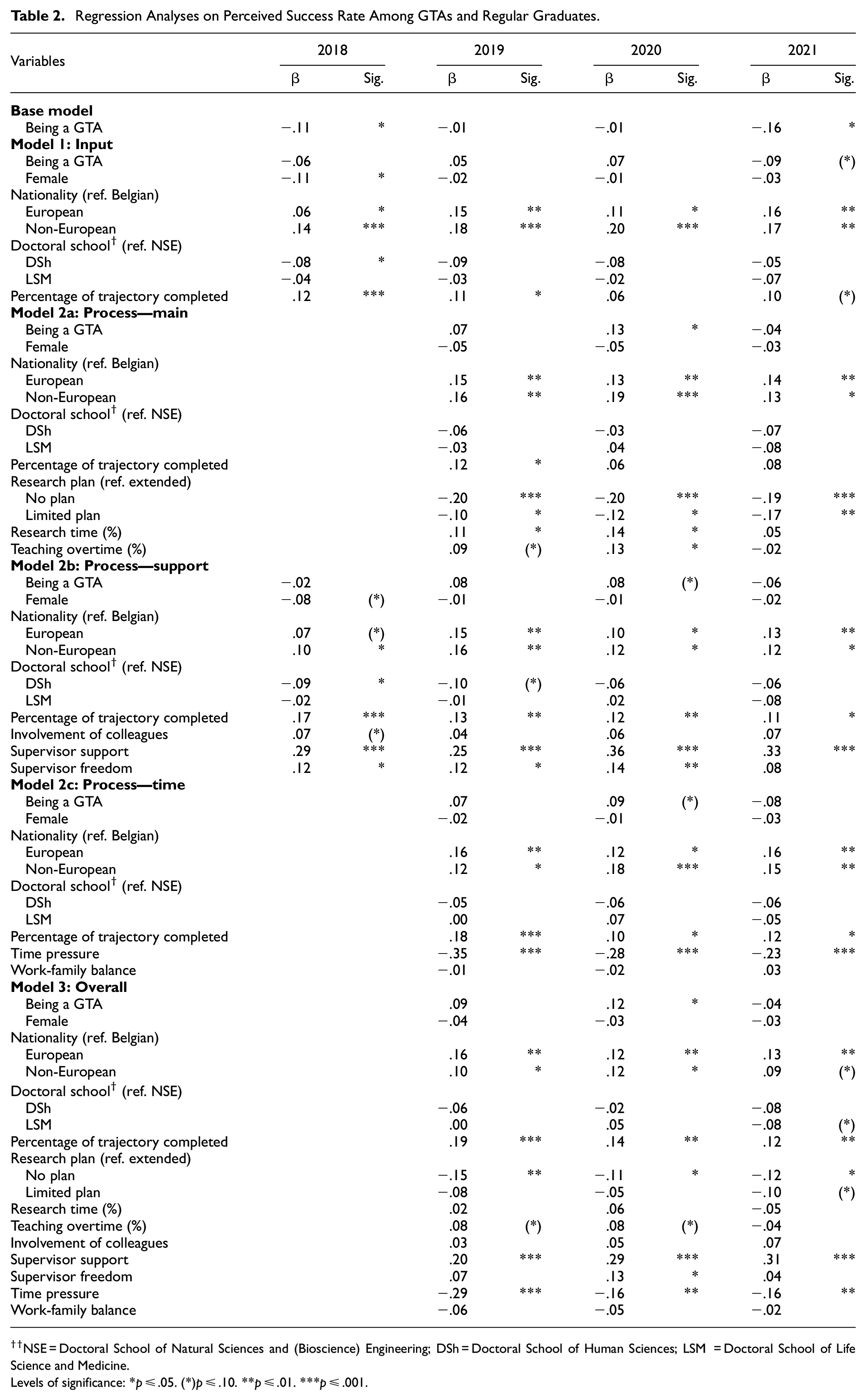
NSE = Doctoral School of Natural Sciences and (Bioscience) Engineering; DSh = Doctoral School of Human Sciences; LSM = Doctoral School of Life Science and Medicine.
Levels of significance: *p ≤ .05. (*)p ≤ .10. **p ≤ .01. ***p ≤ .001.
Model 1 (Table 2) adds the input characteristics and controls for the progress in the PhD trajectory so far. In every wave, foreign PhD students estimated their likelihood of successful completion higher than their Belgian peers, and this difference was the largest for non-European PhD students. This pattern may be due to a selection effect. Non-European PhD students can be expected to be strongly motivated, as moving abroad to pursue a PhD entails a great deal of effort and sacrifice, and often requires a personal mandate to fund their research. The trajectory progress is significantly associated with the estimated likelihood of successfully completing the PhD trajectory. The further PhD students progressed, the higher they estimated their chance on successful completion. This association was significant in 2018, 2019, and 2021. Again, the absence of an association in 2020 might to be related to the COVID-19 pandemic. PhD students in the Doctoral School of Human Sciences estimated their likelihood of successful completion significantly lower than those in the doctoral school of LSM, yet this difference is only significant in 2018. Finally, female PhD students estimated their probability of successful completion significantly lower than their male peers in 2018 only.
The control variable and input characteristics reduced the effect parameter of being a GTA across all years. For 2018, it dropped with 96% and became statistically insignificant. In 2021, the decrease was less substantial (−44%) and the effect remained significant. The negative, non-significant effect parameters of 2019 and 2020, rendered positive in this model. From this we can conclude that the four samples showed a similar underlying dynamic. The profile of GTAs differed from that of regular graduates, which partly explains why they estimate their likelihood of successful completion their trajectory lower. Especially the larger number of foreign PhD students—who tended to be more satisfied and self-confident (Glorieux et al., 2022)—among the group of regular graduates caused this group to estimate their success rate higher.
Models 2a to c include the process characteristics. Model 2a (Table 2) includes the main process characteristics that distinguish GTAs from regular graduates as identified above. It reveals that in each wave PhD students who did not have a full-fletched research plan, estimated their likelihood of successfully completing their research lower than those who had an extended research plan. Additionally, the more time is spent on research, the higher the estimated likelihood of submitting the PhD successfully. Interestingly, spending more time on teaching than contractually stipulated also led to an increased likelihood of successful completion. The effect parameter for being a GTA changed compared to model 1. The initial positive associations became larger, rendering the main effect parameter for being a GTA significant in 2020. The initial negative associations became smaller. This indicates that the newly introduced variables in this model party explained why GTA’s estimated their likelihood of successful completion lower.
Model 2b (Table 2) tests the remaining process characteristics of support. Across all waves supervisor support was significantly and strongly associated with a higher likelihood of successful submission. The same was observed for supervisor freedom except in wave 2021. Involvement of colleagues only marginally associated with a higher likelihood of successful submission, with a significant effect in 2018 only. Compared to model 1, the main effect for being a GTA in model 2b changed similar to model 2a. The positive effect parameters became larger, and the negative parameters decreased. Just like in model 2a, the main effect for being a GTA was significant in wave 2020.
Model 2c (Table 2) tests the remaining process time characteristics. Across all waves experiencing time pressure significantly and strongly associated with a lower likelihood of successful submission. The work-life balance did not relate to the dependent variable. Again, the main effect for being a GTA changed similarly to models 2a and 2c and, again, only the main effects for being a GTA were significant in wave 2020.
Finally, model 3 (Table 2) includes all variables. When controlling for input and support characteristics and the control variable for trajectory progress, the initial significant negative association between being a GTA and the estimated likelihood of successful submission from the base model of 2021 disappeared. Contrarily, a significant positive association between being a GTA and estimated likelihood of successful completion was found in 2020. We witnessed a similar change in 2019, but neither in the base model nor in model 3 was the association significant.
Nationality was the main input characteristic accounting for this change, whereby non-Belgian graduates estimate their likelihood of successful completion higher than their Belgian peers. The most relevant process characteristics are supervisor support which positively associated with successful submission, and experienced time pressure and the absence of an extended research plan, which both negatively associated with the dependent variable. In 2019 and 2020, the share of teaching overtime was significantly positively associated with the estimated likelihood of successful submission.
Differences in Predictors of Self-Estimated Likelihood of Succeeding
In the previous section, we implicitly assumed that the effect parameters of the variables were equally strong for both the GTAs and regular graduates. In the final step of the analysis, we assessed whether some predictors are weaker/stronger related to the estimated likelihood of succeeding for GTAs compared to regular graduates. Therefore, we stratified models 1 to 2c by GTAs and regular graduates and verified whether the effect parameters differ significantly between both groups (Table 3). This allows determining whether policy measures should be tailored to the specific type of graduate contract or whether to consider the graduate population as a homogenous group.
Regression Analyses on Perceived Success Rate Stratified by GTAs and Regular Graduates.

GTA = Graduate Teaching Assistant; RG = regular graduate.
NSE = Doctoral School of Natural Sciences and (Bioscience) Engineering; DSh = Doctoral School of Human Sciences; LSM = Doctoral School of Life Science and Medicine.
Levels of significance: *p ≤ .05. (*)p ≤ .1. **p ≤ .01. ***p ≤ .001.
Recall from the previous step that nationality, type of the doctoral school, and trajectory progress are the input characteristics that associated significantly with the self-estimated likelihood of successful submission. Model 1 in Table 3 shows that in 2019 and 2021 the effect size being a non-Belgian European graduate differed for GTAs and regular graduates. In 2021, the effect size of being a European (non-Belgian) GTA compared to being a Belgian GTA was larger than the effect among regular graduates. In 2019, non-Belgian European regular graduates estimated their likelihood of successful completion significantly higher, whereas for GTAs there was no significant difference between nationalities. The effect size of doctoral school varied between GTAs and regular graduates in 2018 and 2020. In 2018, GTAs from the Life Sciences and Medicine estimated their likelihood of successful submission lower than GTAs from Natural Sciences and Engineering. This did not hold for regular graduates. On the contrary, in 2020, regular graduates from Social Sciences estimated their likelihood of successful submission lower than GTAs from Natural Sciences and Engineering. This did not apply to regular graduates.
The first set of process characteristics includes having a research plan, and the share of research time and the share of teaching overtime. All these variables were significantly associated with the estimated likelihood of successful completion. Model 2a in Table 3 shows that these associations differed between GTAs and regular graduates. The negative effect size of not having a research plan compared to an extended research plan was significantly larger for GTAs compared to regular graduates in 2019. The same held for 2021, albeit the difference between effect size was insignificant. In 2020, the opposite was true. The effect sizes of the share of research time did not differ between GTAs and regular students. In 2019 and 2021, the negative effect size of the share of teaching overtime for GTAs was significantly different and larger than the positive effect size of the share of teaching overtime for regular graduates. In 2020, the effect sizes did not differ significantly.
Of the remaining process characteristics of support, supervisor support and supervisor freedom associated significantly with the estimated likelihood of succeeding. Model 2b in Table 3 shows that the effect sizes of supervisor support only differed significantly between GTAs and regular graduates in 2020. The positive effect size of supervisor support among regular graduates was almost double the effect size of GTAs. In 2021, GTAs reported a large positive association between supervisor freedom and their estimated likelihood of successful completions. This distinguishes them significantly from regular graduates, for whom no such effect was found.
Finally, time pressure remained as a process characteristic of time that associated significantly negatively with the estimated likelihood of successful submission. Model 2c shows that the effect sizes of this association did not differ between GTAs and regular graduates.
Discussion
This study aimed to achieve a better understanding of how GTAs experience their PhD trajectory when compared to regular graduates. To do this, we used the data of four waves of the PhD Survey, conducted at a large university in Brussels (Belgium). Although we used data of only one Flemish university, there is no reason to believe that our case is very different from other Flemish universities. In the Flemish context, education—including doctoral education—is fairly equal. Universities apply equal admission requirements, prestige differences between universities are much smaller in Flanders when compared to countries such as the UK or USA, and most doctoral students receive a similar salary. Universities in Flanders operate much in the same way, which is why our case can be considered representative for the whole Flemish situation. We assessed three elements: (1) whether and, how GTAs differ from regular graduates in terms of input characteristics and process characteristics, (2) how these characteristics associate with the estimated likelihood of succeeding, and (3) to what extent the effect sizes of these associations differ for GTAs versus regular graduates.
In two of the four waves (2018 and 2021), being a GTA associated with a lower estimated likelihood of successful completion (confirming H2a). In terms of input characteristics, GTAs mostly had the Belgian nationality (confirming H1a). A language barrier and the limited number of English courses at Flemish universities are most likely to account for this. Nationality mediated the association of being a GTA with the estimated likelihood of submission. Regular graduates were more likely to have a foreign nationality and are assumed to be highly motivated not least because doing a PhD in another country involves a lot of effort in terms of funding and relocation. Belgian GTAs and regular graduates did not differ regarding their estimated likelihood of successful completion. We attribute this finding to a selection effect.
In terms of process characteristics of support, having a well-defined research plan and receiving substantial supervisor support were crucial for increasing graduates’ estimated likelihood of succeeding. It is therefore even more remarkable that GTAs were more likely not to have an extended research plan compared to regular graduates (partly confirming H1b). In 2019 and 2021, GTAs without a research plan reported much larger negative effect sizes for the estimated likelihood of successful completion (partly confirming H2b and H3a). The fact that GTAs must juggle many tasks and switch between their teaching and research roles could explain why having a plan to guide their research is of greater importance for them than for regular graduates. A similar result surfaced for supervisor support. Albeit GTAs did not differ significantly from regular graduates in their satisfaction with supervisor support, we saw that GTAs did consistently score lower on the satisfaction with the supervisor support over time (partly confirming H1b). The stratified multivariate model showed that in 2019 and 2020, the positive effect size of supervisor support was significantly larger for regular graduates compared to GTAs (partly rejecting H3a). The duality of the role of GTAs might explain why they feel less supported by their supervisor (Jordan & Howe, 2018). Moreover, GTAs were much less likely to be employed on research projects with pre-defined outputs that directly relate to a supervisor. At the same time, GTAs have more time to complete their PhD research. All of this might lead supervisors to see GTAs primarily as teaching assistants potentially pursuing a PhD rather than graduate researchers with teaching duties.
All in all, then, it seems that the dual role of GTAs possibly isolates them within their faculties. That interpretation is further confirmed by the observation that GTAs indicated to a greater extent that their colleagues were little involved in their research (party confirming H1b). At this point our findings contradict previous studies that argued that taking up teaching duties is beneficial for the integration within the faculty (Earl-Novell, 2006). GTAs are given 6 years for their research, which means that they work at a different pace than other PhD students. This may impede collaboration. At the same time, the dual role of GTAs means that they are often spatially and temporally separated from other graduates. They often have their own desks (e.g., to receive students) and they are strongly time bound to class times and other class-related deadlines (e.g., exam supervision, exam corrections) as a result of which they have to forgo PhD-related events or simply become less available for informal meetings. However, note that the involvement of colleagues does not significantly affect the self-estimated likelihood of successful completion of the PhD (partly rejecting H2b).
The findings on the process characteristics of time showed further evidence for the impact of GTAs’ dual role on their self-estimated likelihood of successful completion. Although it is unsurprising that GTAs spent a smaller share of their working time on research compared to regular graduates, it is notable that over the years they spent more time on teaching than their contracts stipulate (confirming H1c). Spending more time on research increased the likelihood of successful completion, whereas spending more time on teaching than contractually stipulated decreased the self-estimated likelihood of successful completion (confirming H2c). GTAs and regular graduates did not differ from each other on the former association, but for the latter, the negative effect size was not only one of the largest effect sizes in the multivariate model, but also applied only to GTAs (confirming H3b).
This increase in teaching overtime over the years might be related to the increase of undergraduate students. It is not uncommon for teaching assistants to be used as cheap labor to complete teaching tasks, which is less a concern among other graduates (Zhao et al., 2007). Additionally, these analyses show that this is at the expense of their research progress. It can also be linked back to the absence of a research plan among GTAs. When teaching takes up more time than was initially foreseen, it can hinder the ability to make a detailed plan and stick to it.
This study is not without limitations. The four waves of data that were used were not independent from one another. Indeed, each year the full cohort of PhD students is invited to participate in the survey. This means that some respondents participated in the different waves. The absence of linked administrative data hampers insight in attrition rates, which might relate to non-response, graduates quitting, or graduates succeeding. Information of the latter two reasons would also strengthen the analyses.
Currently, the dependent variable used in this study is a self-estimated likelihood of success by the PhD students themselves. We used this variable because we do not have access to the actual completion rates of the PhD students. However, previous research shows that self-evaluation can be a valid indicator of students’ actual outcomes. Zell and Krizan (2014) found that people are able to correctly self-evaluate their performance in several domains. When it comes to the evaluation of academic performance, Brown et al. (2015) state that students are able to predict how well they will do on tests and assessments. Falchikov and Goldfinch (2000) find that the grades students give themselves and the grades given by their teachers are generally comparable. This evidences that we can assume that the expected success rate of PhD students is a good indicator of their actual success rate.
Nonetheless, future research would benefit from incorporating data on actual success rates, to study whether the differences in self-estimated success rate are reflected in actual success rates. Furthermore, supplementing the sample with data from international institutions would be an interesting angle for further research, as it would allow us to investigate how results differ between different contexts. With a larger sample we could also study differences within the group of teaching assistants.
Conclusion
Graduate teaching assistants (GTAs) fulfill research and teaching tasks typically in a ratio of 60 to 40%. As a compensation for this double role, their PhD trajectory lasts 6 years instead of four. However, GTAs estimate their likelihood of successful completion significantly lower than regular graduates. This does not relate to who they are (i.e., input characteristics) but to how they progress through their PhD trajectory (i.e., process characteristics). How GTAs are structurally embedded in the university and how their dual role is externally perceived, seems to associate with their self-estimated likelihood of obtaining a PhD degree. The smaller share of research time and the larger share of teaching overtime is detrimental to their self-rated likelihood of success. So is the lack of a research plan and the insufficient amount of support they receive from their supervisor. Additionally, GTAs dual role hampers the involvement of colleagues in their research. Universities should be aware that graduates cannot be treated as one homogenous group when drafting support policies. This group ranges from graduates funded by highly competitive and prestigious (foreign) scholarships to GTAs. A common thread running through this variety is the research plan. In defined projects with predetermined milestones and outputs to be delivered, there is often a clear plan. For GTAs that are given 6 years but have to divide their time in a ratio of 60–40 between research and education, such a plan is often lacking. Not only does having a research plan appear to increase the self-estimated likelihood of success, but it can also be a tool for supervisors to better monitor the progress of GTAs. At the same time, the university and the supervisors must guard against the increasing educational pressure on GTAs. This trend, observed in this study, plays a very important role in GTAs lower self-estimated likelihood of succeeding in getting a PhD.
Supplemental Material
sj-docx-1-sgo-10.1177_21582440241245090 – Supplemental material for When the Student Becomes the Teacher: Determinants of Self-Estimated Successful PhD Completion Among Graduate Teaching Assistants
Supplemental material, sj-docx-1-sgo-10.1177_21582440241245090 for When the Student Becomes the Teacher: Determinants of Self-Estimated Successful PhD Completion Among Graduate Teaching Assistants by Anaïs Glorieux, Bram Spruyt, Petrus te Braak, Joeri Minnen and Theun Pieter van Tienoven in SAGE Open
Footnotes
Acknowledgements
R&D Department—Doctoral Schools Vrije Universiteit Brussel for financial support. Dr. Hannelore De Grande & Prof. Dr. Gerd Vandersteen for initial research design. We thank the members of the steering committee for their constructive feedback.
Declaration of Conflicting Interests
The author(s) declared no potential conflicts of interest with respect to the research, authorship, and/or publication of this article.
Funding
The author(s) disclosed receipt of the following financial support for the research, authorship, and/or publication of this article: This research is part of the project VUB PhD Survey funded by the Research Council of the Vrije Universiteit Brussel.
Ethics Statement
No advice from the ethics committee is required for an internal survey. In the invitation and reminder emails, and at the beginning of the survey, respondents were informed about the aim of the study, the processing of their data and the way in which they would receive feedback. In the same emails, they received contact details of whom to contact in case of questions or technical issues. The emails included information and links about the study’s privacy statement and the general privacy statement of the software platform used to administer the survey. By starting the survey, respondents gave their consent.

Data Availability Statement
Data sharing not applicable to this article as no datasets were generated or analyzed during the current study.
Supplemental Material
Supplemental material for this article is available online.
References
Supplementary Material
Please find the following supplemental material available below.
For Open Access articles published under a Creative Commons License, all supplemental material carries the same license as the article it is associated with.
For non-Open Access articles published, all supplemental material carries a non-exclusive license, and permission requests for re-use of supplemental material or any part of supplemental material shall be sent directly to the copyright owner as specified in the copyright notice associated with the article.
