




Abstract
The goal of this bibliometric analysis is to summarize publications on the contributions of a higher education university in arts, humanities, and social sciences and evaluate their citation status. Ninety-one publications were indexed in Scopus and WOS databases between 2018 and 2022. All publications appeared in 69 different journals, books, and conferences. About 51.6% of all studies were single-authored. The median number of publications per author was 27.01 ± 48.0 and that of citations was 223.0 ± 764.0. Positive correlations were observed between the journal’s CiteScore and authors’ count with citation number (r2 = .625 and .207 respectively; p < .005). Publications written by ≥3 authors with international collaboration received the maximum number of citations (p < .005). Moreover, the mean number of citations for publications written by associate or assistant professors was significantly higher than those composed by their peers (p = .033). Defining the field of arts and humanities remains a difficult exercise, because of its blurry theoretical background. Thus, a repetitive evaluation of its current status remains essential.
Plain Language Summary
The objective of this study was to summarize publications on the contributions of the Lebanese American University in arts, humanities, and social sciences and evaluate their citation status. Methods: 91 publications indexed in Scopus and WOS databases were included. All publications appeared in 69 different journals, books, and conferences. A Positive correlation was observed between the journal’s reputation and citation number. Limitations: Other publications might have been published during the redaction of this review but were not included. Only the WoS and Scopus databases were searched for the inclusion of the publications which could have hide other relevant publications. The novelty of this review is the provision of data that is known to be the least cited type of research. Implications: Despite that this field is regarded as ambiguous thus less attractive, it remains an important subject of study and warrants further consideration.
Introduction
Scholarly publication in arts, humanities, and social sciences differs from that in the natural sciences. Those publications are primarily descriptive reports or monographs whereas scientists consider articles that appear in scholarly journals as their main publication outlet (Glänzel, 1996). The number of journal citation studies in arts, humanities, and sociology is therefore limited. To add, academics publishing in particular fields of natural sciences are guaranteed to be cited more than authors of papers discussing literature theory or performing arts. Moreover, papers that address research questions about arts and social sciences are mostly limited to data from bigger bibliometric databases since these databases don’t index a sufficient list of relevant articles or books related to this field of study (Boutros & Fakih, 2022). In light of this issue, discussions among academic institutions and researchers on how to improve the citation status of the social and artistic sector have become more prominent. Understanding the reason why some articles are cited more often than others may encourage authors to increase the number of their publications and therefore their citation count (Al-Abbas & Saab, 2020). Moreover, citation analysis is regarded as one of the major branches of bibliometrics and is important for acquiring the knowledge of comparative and up-to-date information of the literature. Several previous studies described vast differences in the rates of work going uncited in different artistic, cultural, and humanistic disciplines. To mention a few, Garfield (1991) stated that “The works of art, religion, and philosophy which comprise this legacy are not superseded as scientific works are” (Garfield, 1991). Moreover, he noted that humanities scholars are less compulsive about the literature than scientists are. In addition, they prefer books over journal articles as a medium of publication which weakens the citation rate tradition in the humanities more than in the sciences. Furthermore, several studies highlighted the fact that books or book chapters received more citations than journal articles in various disciplines of social sciences (Hicks, 2004). Yet, books are not fully covered by citation indexes, making the evaluation of such works more difficult. Considering the Lebanese situation, it is apparent that the successive armed events and the massive migration of millions of refugees have resulted in chronic political instability, impairing public trust which encouraged researchers to be more inclined into political, social, and economic research (Al-Hajj et al., 2021; Fakhoury, 2019). However, the citation of these publications is considered to be relatively low. In fact, Lebanon is currently suffering from the worst socio-economic situation manifested by unprecedented rates of unemployment, inflation, poverty, and a rapid devaluation of the Lebanese currency (Bizri et al., 2021; Bouri et al., 2021). Consequently, research projects, especially those related to the non-scientific field, may be neglected or mismanaged. Many arguments have explained the reason behind low citation counts. One of them is the lack of sustainable and sufficient funding for research that may play a major role in scaling back research projects or ceasing them permanently (El Achi et al., 2020). For this sake, it was essential to explore research on arts, sociology, and humanities and conduct a review to summarize the trends of these studies as well the involvement of researchers in this field of study. Lebanon’s research universities, namely the Lebanese American University (LAU), represent some of the most important communities of scholars and collective expertise engaged in educational and research activities. They are considered the most credible sources of information as highly qualified personnel can address gains in research interest, which will help in building both a better understanding and a better relationship between the public and higher education (Belcher et al., 2022). LAU is a leading private higher education institution that offers a large publication volume relative to its faculty size which makes it an ideal source of relevant information. LAU’s reputation is highly dependent on its excellence in scientific research and publications of its faculty members is considered one of the main criteria for higher publications’ ranking (Gibson, 2021). In spite of the fact that many research papers on arts, humanities, and social sciences were redacted in Lebanon, especially at LAU, it is not deniable that it is almost very difficult to find a review summarizing all of this research data in one paper. For this sake and taking into account that this paper is the first attempt to date to conduct a consolidation of the different types of these studies, this study will summarize LAU’s contribution to arts, humanities, and social studies research during the last 4 years and will showcase how well these scholarly publications are being cited or identified by the intellectual society. It will also enable identifying the correlation between authors/journal characteristics and citation score using bibliometric analysis in order to check the institution’s outreach and contribution to global research. Consequently, the following research questions were addressed:
What is the distribution of publication types (e.g., monographs, journal articles, book reviews, etc.) authored by arts and humanities and social sciences scholars?
In which journals do LAU scholars publish more often?
What type of authorship and contribution is the most prevalent in this type of publications?
What percentage of publications authored by LAU scholars gets cited, how often, and by what types of publications?
What are the bibliometric characteristics that may affect citation count of artistic, humanistic and social literature?
Materials and Methods
Search Strategy
A scoping review of scholarly publications of arts, humanities and social sciences has been carried out. The dataset used in this paper was extracted from SciVal, a research performance assessment tool that helps analyze data from two electronic databases: Scopus and Web of Science (WOS). In particular, published works by the Lebanese American University under the subject field of “arts, architecture, humanities, and social sciences” for the years of 2018 to 2022 were exported. Almost all published research in the pre-mentioned years were included in the current study. In order to get more information on ranks and citation counts, we adopted the CiteScore (CS) and the Scimago Journal and Country Rank (SJR) as the main techniques for citations counts. It is noteworthy to mention that CS is one of the most utilized metrics systems reflecting the yearly average number of citations to recent articles published in academic journals (Baron & Russell-Bennett, 2016; Jaafar et al., 2021) and SJR is a publicly available portal that includes the journals and country scientific indicators developed from the information contained in the scopus database for ranking the different journals (SCImago, n.d). Since the majority of the included studies were observational and heterogenic, it was not possible to conduct a systematic review or meta-analysis. It was instead decided to conduct a scoping review, giving priority to the observational and qualitative studies available knowing that they are the most abundant types of study in arts and sociology.
Data Screening, Extraction, and Processing
A total of 91 publications was identified. Each record provided information about the author name(s), author address(es), document type, journal name (if available), publication year, number of references included in the publication, CiteScore Percentile, ScimagoJR percentile, and the number of citations received after publication. Since the main findings in the field of arts and humanities are studies characterized by the use of narrative methods, the terms “publication” or “contribution” were defined as journal articles, book reviews, monographs, and notes.
In a two-stage process, two coders first reviewed each publication, abstracts and then full-text manuscripts for eligibility. A data extraction template was created in Microsoft excel to remove duplicate entries and coordinate the screening process. SPSS version 23 (IBM SPSS Software, Chicago, IL, USA) was used to manage citations and conduct further analysis for all scholarly papers included in the manuscript. We used bibliometric methods, which have originally been designed for the evaluation of research in life sciences and are now being applied in a variety of areas such as arts and social sciences, to disclose development and relevant characteristics of the different studies (Dong et al., 2019; Donthu et al., 2021). Quality assessment of the included studies was completed according to the Grading of Recommendations, Assessment, Development and Evaluation (GRADE) tool (Guyatt et al., 2013). We graded each potential source of bias as very low, low, intermediate, high, or unclear, according to the respective study design: randomized trials, downgraded or upgraded observational studies, case series/reports (very low). Unclear risk of bias is judged if design and methods were unclear.
Data Analysis
Analysis using bibliometric data was applied to disclose emerging trends in the included studies and uncover journal performance, collaboration patterns, and research constituents. Continuous measures were summarized by means and standard deviation or by medians and interquartile range where appropriate; categorical measures were summarized by numbers and percentages. Continuity correction chi-square tests were used for the comparison of categorical variables between groups. The conformity of continuous variables to normal distribution was evaluated using visual histogram and probability graphs. Independent-samples t-test and ANOVA were used for the comparison of data which were normally distributed for the variables.
The relationship between number of citations and other parameters such as authors count and collaboration, journal rank, gender impact, etc. were evaluated using Pearson’s or Spearman’s correlation analysis. Correlation coefficients of <.3, .3 to .6, and >.6 were considered to indicate weak, moderate, and strong correlations, respectively (Nunnaly & Bernstien, 1994). A p ≤ .05 was considered to be statistically significant.
Patient and Public Involvement
There were no human participants in this review, therefore there was no need to obtain any informed consent.
Results
Selection of Publications
A total of 1996 publications was identified through initial searches, out of which 149 studies focused on arts, humanities and social sciences research. Following screening by title and abstract, 104 contributions were included in the full-text review after removing duplicates as well as publications that focused only on natural or environmental sciences. Ultimately, 91 studies were found to meet the inclusion criteria. The most common reasons for excluding some publications were that some of them were only abstracts, redundant works, erratum, or corrections to previous works. A PRISMA flow-diagram is presented in Figure 1 to illustrate the study selection process.

PRISMA flow diagram of studies selection process.
Characteristics of the Publications
As indicated earlier, a total of 91 LAU publications related to the fields of arts and architecture, humanities, and social sciences was indexed in Scopus and WOS databases between 2018 and 2022. This figure constitutes approximately a mere of 4.6% of the total LAU publications and 61% of publications related to arts and sciences for the same period. Figure 2 displays the number of publications per year. There was a gradual increase in the number of publications from the year 2018 till 2021 where it reached its highest level (26.3%) in 2020 to drop again in 2021 to reach 24.1% and 17.5% in 2022. Most of the publications belonged to the Department of Social and Education sciences (57.1%) followed by Communication, Arts and Languages (23.1%) then the Department of Architecture and Design (14.3%). The classification and the repartition of each department are summarized in Table 1 as referenced in LAU Website (2022). The vast majority of the publications were descriptive (81.3%) and others were either observational or qualitative. Almost half of them (51.6%) were single-authored. Publications with dual authors constituted 22% of all published works and the rest were written by multiple authors. The highest number of contributors to a single publication was nine and most of the authors’ contribution was institutional (57.1%). More details about the characteristics of publications are summarized in Table 2. An adaption of GRADE evaluation was used for primary outcomes of included studies and classified the quality of evidence of interventional studies as high, and observational studies as medium-to-low whereas the quality of evidence of literature reviews was considered very low.

Number of arts, humanities and social sciences publications per year.
Repartition of LAU Schools and Different Departments and Disciplines.

Characteristics of the Publications.

Characteristics of the Authors
The total number of different authors contributing to the 91 publications is 185. Male authors were more than females (56.4% vs. 43.5%). The mean age of all authors was 45.0 ± 11.52. 112 contributors were affiliated to the Lebanese American University and 73 authors were not. Among all authors who contributed to all publications, the majority were associate or assistant professors (n = 144; 77.9%) and the rest were either lecturers, researchers or students. Heterogeneity of authors’ specialties was seen in most of the publications with multiple authorships. Most of the authors belonged to the Faculty of Arts, Humanities, and Social Studies (n = 72; 43.1%) followed by 42 authors who belonged to the Faculties of Engineering and Architecture (25.1%) while 32 authors were professors in the Business, Marketing and Economics School (19%). Moreover, other authors with different specialties such as Medicine, Nursing, Public Health and Computer Science contributed equally to the publications of their peers. The median number of publications per author was estimated to be 27.01 ± 48.0 [0–1,412] and the median number of citations per author was found to be 223.0 ± 764.0. The average years of experience of all authors was 14.13 ± 11.64 [1–50]. More details on authors’ characteristics are summarized in Table 3.
Authors’ Detailed Characteristics,.

Characteristics of the Journals and Citation Numbers
As detailed in Table 2, publications authored by all scholars appeared in a total of 69 different journals, books and conferences. The majority of the publications were published in SJR Q1 journals (67%) while 15 papers belonged to Q2 journals. Only three publications were submitted to journals of lower SJR rank. More than 10 papers were published in conferences and proceedings. Eight journals were repetitive and included more than one publication. Eighteen articles (19.7%) of all publications appeared in those journals. The most recurrent site of publication was Proceedings of International Structural Engineering and Construction and the most repetitive journal was SAGE OPEN, publishing each 10 and 4 publications respectively. The complete list of publication sites is detailed in Appendix A along with the repartition of publications according to each journal quartiles.
The impact of publications that were authored by the scholars was analyzed by checking the “Times cited” and the “CiteScore” field that is available in the Scopus database. Our findings conclude that almost half of all publications (n = 408; 49.5%) received no citations. The rest (50.5%) were cited at least once. The most frequently cited publication was cited 23 times. The number of publications that received seven or more citations was only 7. All publications were cited a total of 182 times and the average number of citation per publication was 2.0 ± 3.76 [0–23]. More details on the number of citations according to different publications are summarized in Table 4.
Details of Citations Number.

Correlation Between Publications Characteristics and Citation Rate
Figure 3 shows the association between the variables “authors’ collaboration” and “type of authors’ contribution” with citation counts respectively. Although it was clearly shown during our analysis that a weak correlation exists between the authors count and the number of citations (r = .207; p = .049), it was proven, as presented in Figure 3a that the publications written by three authors and more received the maximum number of citations followed by those authored by two authors while single authorship papers were the least cited (p = .029). Moreover, the number of citation was higher in international collaboration of authors when compared to institutional or national collaborations (p = .012). However, there was no statistically significant difference in the citation counts between national and institutional collaborations (Figure 3b).
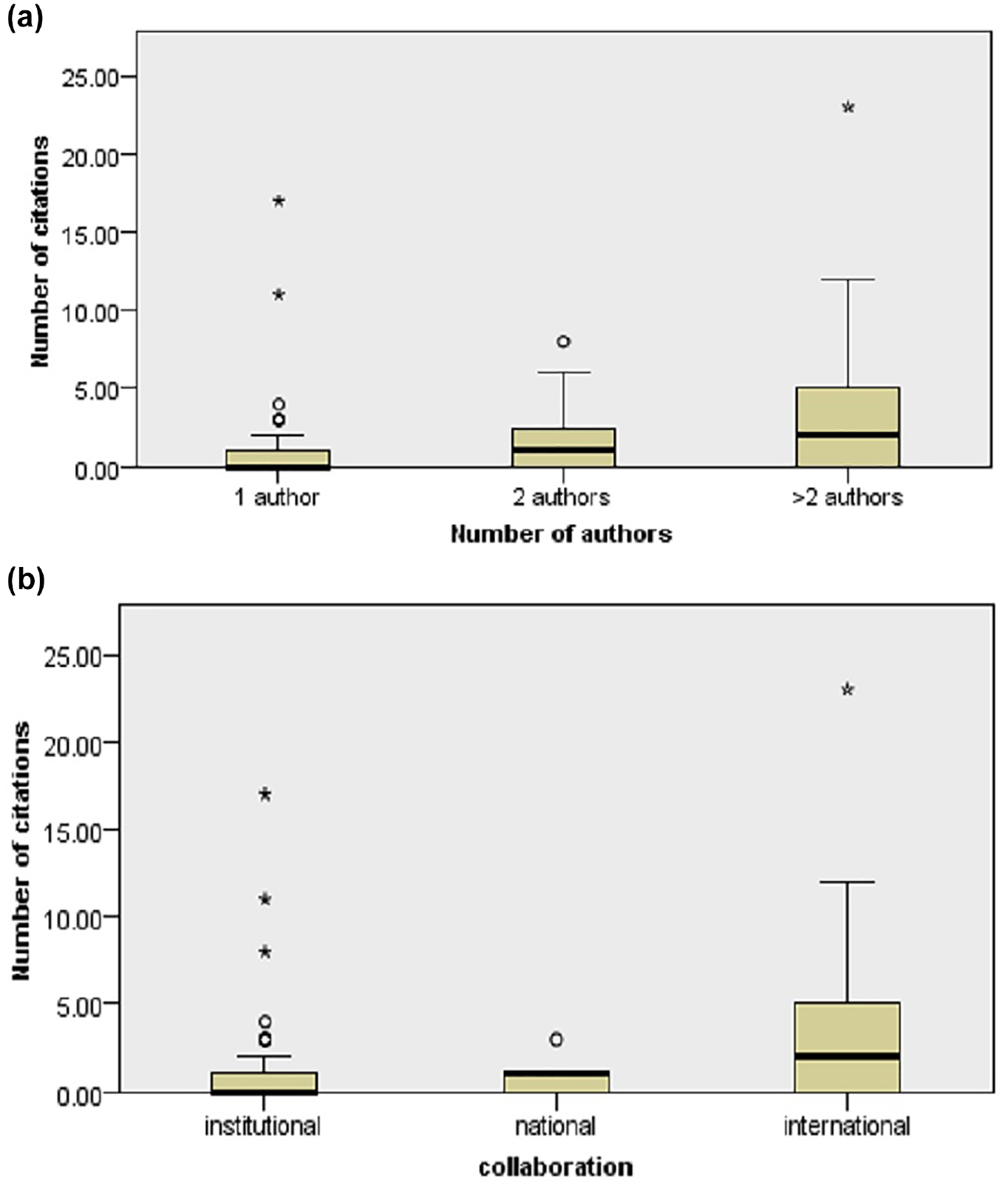
(a) Number of citations according to different authorship counts; p = .029 and (b) number of citations according to different types of collaboration; p = .012.
To add, the number of citations was highly dependent on the status of the faculty members. In fact, it was shown that full-time associate or assistant professors tend to have a higher number of citations than other scholars. Our analysis has also shown that mean number of citations for publications written by associate or assistant professors was significantly higher than other faculty members such as post-doctorate fellows, lecturers, or students (Mean citation number = 2.86 vs. 1.18 respectively; p = .033). More details on the impact of authors characteristics on citation number is summarized in Table 5.
Correlation between Number of Citations and Other Bibliometric Variables.
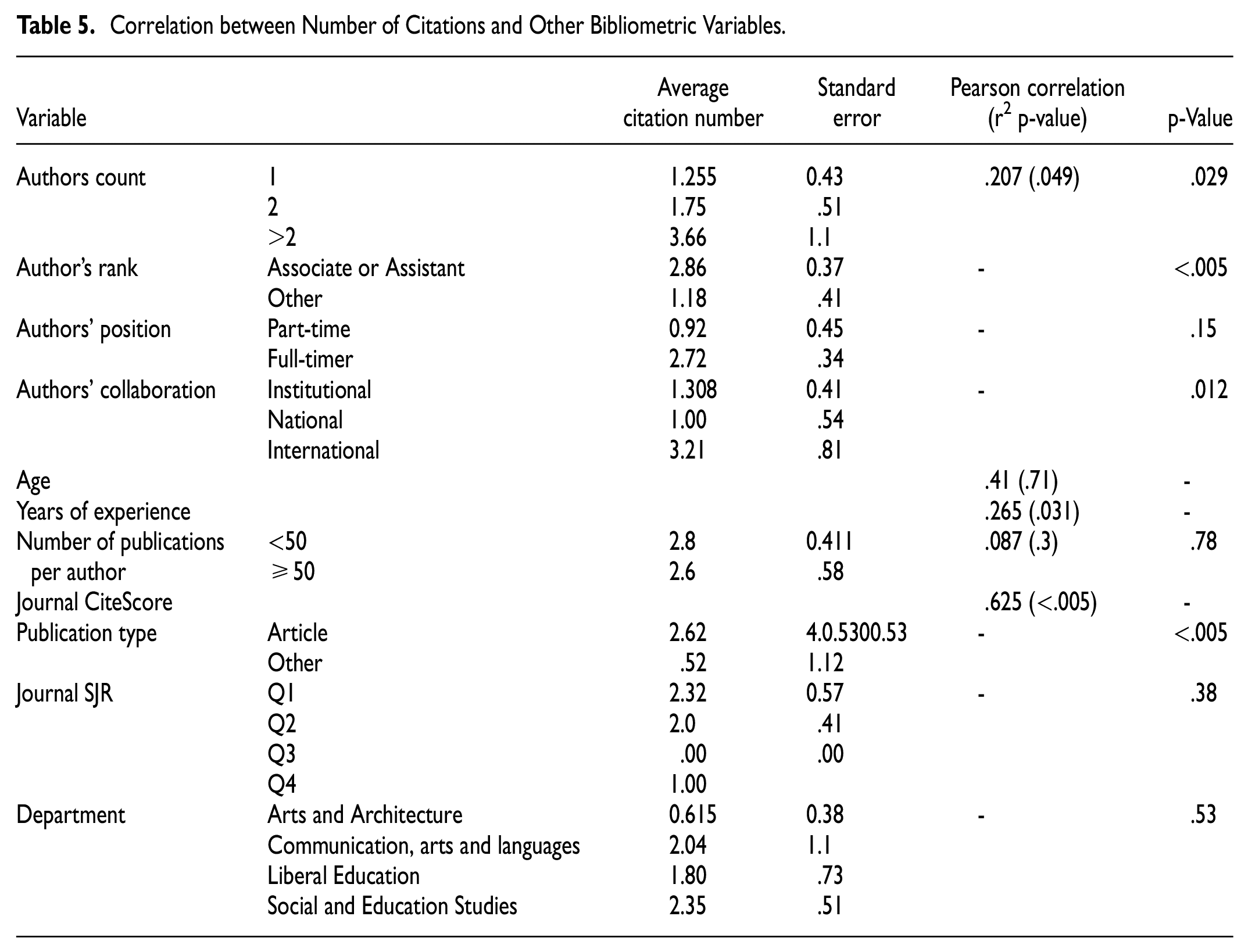
Journal articles appear to have a higher probability of receiving any citations than other publications such as conference papers or book chapters or notes (p < .005). However, this trend didn’t reach any significance when we tried to compare among different journal articles in regards to their SJR ranks although a higher average number of citations was seen in Q1 journals when compared to lower journal ranks (2.32 vs. 1.72 respectively; p = .37). A noteworthy finding was the detection of a positive correlation between the CiteScore of each journal and the citations received by each article published in that specific journal where it was shown that as the CiteScore increases, the number of citations increases as well (r2 = .625; p < .005).
Discussion
The novelty of this review is the provision of data from the research literature that focuses on “arts, humanities, and social sciences” which is known to be the least cited type of research of which continuity is under threat by current technological updates. Although the annual output of this type of research seems to be low when compared to other types of publications, an increase in the number of arts and social sciences publications was noticed during the last 4 years. This finding underlines the involvement of scholars into research as the possibility of expanding the number of publications and citations, as well as the monetary support offered by academic institutions as an incentive, seem to have a positive impact on the publication rate of this type of research. The same finding was highlighted in the review written by Ghani et al. (2022) in which arts and humanities research has shown a positive progress over the last 10 years (Ghani et al., 2022). Furthermore, many studies indicate that the number of publications is important for academic promotion. In fact, Boutros et al. (2022) argued in his recent publication that the number of academic publications was associated with a higher academic promotion across all institutional settings. He also concluded that the positive effect of the number of publications of each faculty member suggests that this factor should be a priority for administrators to look at when making decisions regarding promotion (Boutros et al., 2022). In spite of this finding, a drop in the number of publications has been noticed as of 2021. A possible explanation to this drop could be the outbreak of the novel coronavirus (SARS-CoV-2) that has impacted all types of research in various forms (Baral, 2021; Bedford et al., 2020). On the one hand, the pandemic has placed researchers at the forefront of COVID-19 research. On the other hand, maintaining good research practice was considerably impeded by safety measures and restrictions (Andrews & Benken, 2020; Graham et al., 2020).
Although there is a general conception that researchers in arts, humanities and social sciences are more interested in writing a book or a note, this review has shown that the number of journal articles exceeded the number of books, book chapters or personal notes. In fact, researchers are being more intrigued into publishing their research in peer-reviewed journals which increases the chance of being cited more often. In general, the number of publications increases in tandem with the number of citations and the paper’s quality. Citation count is the depiction of the quality of the article, its visibility, acceptability among peers, and relevance for the society and research (Bhui & Sahu, 2018). This review’s findings have underlined the fact that publishing an article in a peer-reviewed journal, especially if it is characterized by a high CiteScore, has an impact on raising citation counts of that specific publication. Moreover, our analysis has shown that the CiteScore of the journal was positively correlated with the number of citations of the published study. This emphasizes the fact that publishing in international publishers that are usually characterized by a higher visibility increases the citation rate of corresponding publication. Similarly, Faria et al. (2013) discussed this topic while examining the determinants of academic promotion. They found that publishing in top journals had a significant positive impact on academic promotion and consequently on publication and citation rates (Faria et al., 2013).
Table 2 depicts the top five journals or conferences proceedings in which the faculty members prefer to publish their papers. In our review, it was shown that the proceedings of a conference were the most preferred site of publication. This finding reveals that some researchers tend to be inclined toward publishing more conferences papers knowing that conferences are less demanding in terms of publication design and format. To add, it can take several months to years for a journal publication to appear whereas the turnaround time for conference reviews is a few months.
Our results have shown that primary scholars involved in arts and social sciences studies were associate professors with decent publication and citation rates that are usually higher than their peers of lower rank. This is in line with the findings of Aksnes et al. (2011) suggesting that faculty of lower rank publish fewer papers per year. Therefore, faculty members with a higher academic position tend to have better research outcomes which might affect positively the citation rate (Aksnes et al., 2011). In addition, Zinovyeva and Bagues (2012) found that academic promotion depended on the network, which could be enhanced as the number of citations increased (Zinovyeva & Bagues, 2012).
In terms of authorship collaboration, the great majority of publications had single authorship. This indicates that, unlike researchers in biomedicine or natural sciences in which multiple authorship is the norm, the arts and humanities scholars like solitary work (Lindholm-romantschuk & Warner, 1996). This finding was also highlighted by many bibliometric studies in which it was clearly manifested that the figures of multiple authorship rate in the arts and humanities are quite lower than those of biomedical publications (Tonta, 2000). Furthermore, our analysis has investigated the association between authors’ collaboration and citation counts. It depicts that the publications with more than two authors received the maximum number of citations. Therefore, it was clear that collaborative publications received more citations than those published singly. This suggests that multiple authorship usually brings more recognition as the number of search by author increases. Moreover, the collaboration of many authors into a single publication opens the door for more suggestions on how to improve the quality of the work and provides with more publication tips and ideas (Hardman et al., 2020). To add, international collaborations among authors seems to be associated with higher citation counts. It is noteworthy to conclude that researchers usually cooperate with international and well experienced peers in order to increase the visibility and the international consideration of their research. Hence, it is not deniable that the joint effort of international authors who have multi-dimensional expertise opens up opportunities in diversifying the perspective of internationalization and increases the acceptance of research papers in peer-reviewed journals. Many studies have agreed that international research collaborations are more frequently cited and have characteristics with greater scientific potential than do studies without international collaborations. In this context, de Lima et al. (2021) concluded that international collaborations increased the potential impact of publications, producing significantly more scientific citations. In his turn, Rousseau and Ding (2016) also highlighted that multi-country papers receive more citations than national ones (Rousseau & Ding, 2016). To our knowledge, this is one of the very few reviews in the region that describes a higher education university’s contribution to the least cited type of research related to arts, humanities, and social sciences. This research is unique since it is different from several previous studies that focused on general art and culture books. This review included more sociology topics such as architecture, philosophy, psychology, and culture. However, few limitations are to be mentioned. First, a continuous update of both WoS and Scopus databases exist at LAU libraries. Although they are quite representative to date, it should be noted that other publications might have been published during the redaction of this review but were not included. Second, data is collected from the institute’s departmental website and annual reports, so only the WoS and Scopus databases were searched for the inclusion of the publications which could have hide other relevant publications of importance. Moreover, the screening and categorizing process was done manually, thus they may have suffered from personal bias.
Conclusion
In this review, we summarized the contribution of a local university to different arts, humanities, and social sciences in a politically unstable environment as in Lebanon. Despite that this field of study is regarded as ambiguous and difficult to conceptualize thus less attractive to publication and citation, it remains an important subject of study and warrants further consideration. Our work illustrates that more contributions from the arts and humanities scholars are required. These contributions should be led by professional scholars with international reputation and published in reputable journals with high citation scores-impact factors to elicit more citations. Therefore, academic institutions should encourage their scholars to be more involved in this type of research to ensure its continuity and prosperity. This is particularly accomplished by increasing awareness about the significance of this research and its prominence and by providing incentives for pursuing it. Finally, further research is warranted to create a more general profile of most Lebanese arts, social and humanities literature based on bibliometric and citation characteristics of such contributions.
Footnotes
Appendix A
Published Papers in the Department of Liberal Education.

| Column1 | Q1 | Q2 | Q3 | Q4 |
|---|---|---|---|---|
| Dillon et al. (2021) | X | |||
| Awada et al. (2021) | X | |||
| Mawlawi Diab and Awada (2022) | X | |||
| Awada and Burston (2020) | X |
Acknowledgements
We would like to thank Professor Samer Saab for his final revision of the manuscript and valuable comments.
Author’s Note
This research was conducted while Dr. Nada Khaddage-Soboh was at Adnan Kassar School of Business, LAU. Currently she is at the Suliman Olayan School of Business (OSB), American University of Beirut (AUB) and may be contacted at
Authors Contribution
Both authors contributed equally to this work. all authors have read and agreed to the published version of the manuscript.
Declaration of Conflicting Interests
The author(s) declared no potential conflicts of interest with respect to the research, authorship, and/or publication of this article.
Funding
The author(s) received no financial support for the research, authorship, and/or publication of this article.

Data Availability Statement
The data presented in this paper are not publicly available on request from the corresponding author. They include confidential information on the case selection used in the analysis.