




Abstract
The majority of asylum seekers experience some kind of traumatic events before or during their flight and their challenging experiences do not end after resettlement. Still, they need to envision and build their future life in the host country. Moreover, asylum seekers’ future aspirations need to be differentiated from the satisfaction of essential needs. We (1) measured future aspirations (FA); (2) explored whether FA and post-migration life difficulties (PMLD) differ between asylum seekers with high and low levels of post-traumatic stress symptoms (PTSS); and (3) examined whether PTSS, PMLD, gender, age, and length of stay are associated with different types of FA. In total, 139 Iraqi and Syrian asylum seekers (55 female, 83 male) aged 18 to 67 years (M = 34.03, SD = 10.35) participated. A four-factor structure of FA was confirmed by confirmatory factor analysis (CFA). Participants with high levels of post-traumatic stress symptoms reported higher levels of PMLD and lower levels of FA related to their home country. FA related to the host country and FA related to occupation were predicted by lower levels of post-traumatic stress symptoms, while future aspirations related to the home country were predicted by higher levels of PMLD. Results indicate that asylum seekers who experienced more traumatic events before they migrated are more reluctant to return to these places in the future. Treating the psychological impairments of this highly vulnerable group and relaxing the manifold structural barriers are crucial to foster their construction of a future life.
Keywords
Asylum seekers are individuals who left their home countries because of different reasons (e.g., war, prosecution, poverty) and who submitted a formal claim to be recognized as refugees according to the Geneva Convention in a safe host country (United Nations, 1951). Thus, until their application is processed that might take between several months and several years, asylum seekers find themselves in a legal recognition process characterized by a multitude of insecurities and uncertainties regarding their futures. Because many of them experienced some kind of traumatic events before and during their flight, they are vulnerable to developing post-traumatic stress symptoms (PTSS) while some of them actually develop post-traumatic stress disorder (PTSD) (George, 2012; Mollica et al., 2004). Even after arriving in a safe host country, their challenging experiences do not end, because they are confronted with adversities caused by difficult living conditions, limited access to medical and social services, loss of relationships, discrimination experiences, and socio-economic difficulties (Porter & Haslam, 2005). Despite these manifold challenges, asylum seekers need to envision their future and to build a life in the host country during this recognition process (Kurt et al., 2021). Thus, asylum seekers need to cope with this challenging transition phase that entails a large number of structural integration difficulties such as the lack of legal protection, poor living conditions, xenophobia and discrimination, and detention and deportation (Rosenberger & Müller, 2020) that might also have harmful effects on their psychosocial health. However, these adversities might also trigger a number of future aspirations that—to the best of our knowledge—have not been investigated for this target group yet.
Conceptualizing involuntary migration as a process caused by potentially traumatizing events like war or prosecution, possible future aspirations of this vulnerable group need to be understood considering their challenging life circumstances. Moreover, the restricted rights during the asylum procedure might create unnecessary dependence and reduced confidence, causing a majority of asylum seekers to lose their motivation for a new start after years of frustration (Ryan & Deci, 2008). It is quite probable that a lengthy recognition process fosters a passive attitude, making integration a difficult task in the long run.
To the best of our knowledge, no study to date has systematically examined the future aspirations of asylum seekers and it has not been examined to what extent their construction of a future life is associated with post-traumatic stress symptoms (PTSS) and post-migration life difficulties (PMLD).
Pre-Migration Challenges of Asylum Seekers
The effects of war and armed conflicts are well documented and their contribution to human suffering, mental health problems, the decrease in the quality of life, and chronic disability are widely recognized (Fortuna et al., 2008). Many studies showed that exposure to political violence leaves individuals defenseless, disabled, and desperate (Blair, 2000). The impact of traumatic events on mental health is influenced by their frequency, intensity, and duration (Bogic et al., 2015). Experiencing a high number of traumatic events is not only robustly associated with a higher risk of developing mental disorders, including PTSD (Blair, 2000; Kolassa et al., 2010), but also with integration difficulties (Kurt et al., 2021).
People facing deadly perils are trying to escape to find a safe place. The forced migration is usually accompanied by high levels of stress, anxiety, and depression even for people who anticipated the forthcoming danger and who left the war zone beforehand (Matsui & Raymer, 2020). The impact of the flight on “acute” asylum seekers who are trying to escape from their homes during the final stage of the conflict, war, or other crisis is even worse because they have to act fast due to quickly worsening conditions. Consequently, they are often unprepared. Acute asylum seekers usually experience a higher level of traumatic stress because they stayed too long in the conflict zone, and—as a consequence—they also have higher levels of PTSS compared to people who anticipated the negative events and who left earlier (Matsui & Raymer, 2020; Vukčević Marković et al., 2023). Trauma-related experiences during pre-migration and flight explain more variance in rates of PTSD, while post-migration challenges are associated with mood and anxiety disorders (Bogic et al., 2015; Nickerson et al., 2011). A recent meta-analysis covering data from 59 studies and 17,763 individuals revealed that daily stressors were related to higher psychiatric symptoms and general distress and the daily stressors fully mediated the associations between traumatic experiences and anxiety, depressive, and PTSD symptoms (Hou et al., 2020). It was also shown that asylum seekers who report interacting with authorities in a more conflictual manner develop more post-migration difficulties (Silove et al., 1997). Thus, models integrating pre- and post-migration factors are best suited to understand the psychological challenges of asylum seekers (Miller & Rasmussen, 2010; Nickerson et al., 2011; Walther et al., 2020).Therefore, it is reasonable to assume that pre- and post-migration challenges are also associated with their future aspirations.
Post-Migration Life Difficulties of Asylum Seekers
When asylum seekers reach a safe host country, they must cope with a multitude of insecurities regarding their future while adapting to a new place, culture, and language. Studies demonstrate that asylum seekers perceive the refugee determination process as challenging mostly because of the length of the asylum procedure, their insecure legal status, confinement in refugee camps, and the prohibition to work while waiting for acceptance as a refugee (Nickerson et al., 2011). A longitudinal study investigating the relationship between refugees’ mental health and post-migration life challenges in Australia showed that provisional living conditions and frequent relocation worsen their mental health (Steel et al., 2011). Likewise, a study conducted in Switzerland showed that the number of Kosovar asylum seekers with high levels of PTSD increased from 37% to 80% after 18 months had passed since they applied for recognition (e.g., Steel et al., 2011). Similarly, diagnosed psychiatric problems of asylum seekers in Switzerland did not decline after 2 years of arrival (Heeren et al., 2012) indicating that post-migration life difficulties keep their traumatic experiences high (Steel et al., 2011). Besides the insecurity caused using a lengthy refugee determination process, adaptation difficulties, bad socio-economic conditions, poor access to medical and social services, as well as high levels of discrimination experiences contribute to psychological distress and mental disorders (Nickerson et al., 2011). A bad economic condition was found to be a strong risk factor for depression and anxiety in refugee populations in addition to pre-migration trauma (Hocking et al., 2015). Research suggests that refugees with limited rights to work and employment prospects have worse physical and mental health outcomes compared to those with greater access to these economic opportunities (Porter & Haslam, 2005). Another post-migration life challenge is the loss of social support due to disrupted family systems, adversities accompanying life in crowded camps, the local population’s hostile attitudes, or racism (Porter & Haslam, 2005).
Thus, asylum seekers are potentially experiencing many post-migration life difficulties that negatively impact different aspects of their mental health and that are also related to higher levels of PTSD (Kiselev et al., 2020).
Future Aspirations of Asylum Seekers
Thinking about and acting upon the future is a key characteristic of the human mind that makes individuals direct their development and actively select their life trajectories (Nurmi, 2005). Various conceptualizations described this fundamental human trait that captures consciously self-constructed images of the future (Seginer, 2009). It is well researched that individuals shape their lives’ courses regarding their goals, possible selves, or personal projects and that these goals are age dependent (Nurmi, 1992). Future aspirations are future-oriented representations of what individuals strive for in various life domains like education, family, or occupation (Salmela-Aro, 2009). In essence, future aspirations capture what individuals want to happen in the future. The future-orientation three-component model (Seginer, 2009) distinguishes between motivational, cognitive, and behavioral aspects of future-oriented thinking that are theorized to operate in multiple steps. The motivational aspect captures the value of a certain future domain, the expectancy to successfully materialize prospective hopes and plans depending to what extent they are conceptualized as under the person’s control and therefore depend on the person’s skills or efforts. The cognitive representation component covers hopes and fears that are theorized to consist of the concrete content domain and its valence (e.g., education, family, occupation). The behavioral component consists of exploration (e.g., collecting information about career options) and making a commitment regarding a particular life domain (e.g., getting married), two processes that are theorized to lead toward the materialization of prospective hopes, wishes, and plans. Importantly, environmental demands and opportunities channel the hopes and fears that individuals construct, and which choices they make to direct their development. These issues typically have been assessed either by open-ended questionnaires or by scalable items in which respondents indicate how they think about different life domains (Seginer, 2009).
Thus, when theorizing about the future aspirations of asylum seekers, pre- and post-migration challenges need to be considered. Importantly, asylum seekers’ long-term wishes and dreams need to be differentiated from the satisfaction of essential needs (e.g., quickly finding shelter, financial means, food, etc.; e.g., Miller & Rasmussen, 2010). Applying the basic idea of acculturation models (Berry, 2001), it is meaningful to distinguish future aspirations related to the host country and future aspirations related to the home country. Host country future aspirations cover wishes like learning the new language, obtaining citizenship, understanding the rules of the new society, and getting integrated into the new society. Home country future aspirations cover return wishes like visiting the home country or helping people back home in the future. Among refugees, these acculturation-specific aspirations are associated with pre- and post-migration factors. In a study among Bosnian refugees in Austria and Australia, Kartal et al. (2018) found that refugees with higher levels of traumatic experiences reported higher acculturative stress, which in turn was associated with a higher orientation to the heritage culture and a lower orientation toward the destination culture. Importantly, post-migration life difficulties like the uncertainty of the application process, perceived discrimination, and having relatives in the war zone are associated with acculturation orientations. Asylum seekers who have less hope for acceptance, who have relatives in the war zone, and who have strong political concerns about their home country are more likely to endorse segregation orientations characterized by rejecting the destination culture and maintaining the heritage culture (e.g., Berry, 2001; Kantor et al., 2023; Steel et al., 2011).
In line with early theorizing and research on future orientations (Nurmi, 1992) and acculturation models differentiating private and the public domains of acculturation (Arends-Tóth & van de Vijver, 2004), family and occupation are considered separately as well. Family-related future aspirations of asylum seekers cover dreams related to living together with the whole family and the social and educational integration of their children. Occupational-related future aspirations cover dreams related to developing one’s career, finding a dream job, or opening up a company.
Current Study
This study was conducted in Austria, a country that received the third-highest number of asylum applications in the European Union after Germany and Sweden in 2015 and 2016. In 2015, 88,340 asylum seekers submitted a formal claim to be recognized as refugees according to the Geneva Convention to Austrian authorities, 25,563 were from Afghanistan, 24,547 from Syria, and 13,633 from Iraq (Statistik Austria, 2018). Despite these high numbers, Austria has restrictive migration and integration policies and overall offers more constraints than chances to migrants (MIPEX, 2021). In Austria, the asylum application involves a lengthy process that is divided into several steps. (1) Asylum seekers are entitled to submit their claim for recognition as a refugee according to the Geneva Convention verbally at any police station. (2) Austria determines which European country is responsible for handling the claim applying the Dublin convention. During this period asylum seekers reside in the so-called first arrival centers (Erstaufnahmezentren). (3) If Austria is eligible to formally handle the claim, asylum seekers are allocated to a shelter located in one of the nine Austrian federal states and are provided with basic services (Grundversorgung) including a small financial aid. Asylum seekers are not granted a work permit during the waiting period. Thus, Austria is an interesting national context to study the future aspirations of asylum seekers, because of the manifold post-migration life difficulties that are created for them by legal constraints.
The main goals of the current study are (1) to measure future aspirations; (2) to explore which post-migration life difficulties are reported most often; (3) to investigate whether future aspirations and post-migration life difficulties differ between asylum seekers with high and low levels of post-traumatic stress symptoms; and (4) to examine whether post-traumatic stress symptoms, post-migration life difficulties, gender, age, and length of stay are associated with different types of future aspirations.
Based on the available literature, we formulated the following hypotheses:
(1) We hypothesize that future aspirations of asylum seekers can be organized along with the four factors host-country, home-country, family-related, and occupational-related aspirations (Berry, 2001; Salmela-Aro, 2009; Seginer, 2009).
(2) We expect that the most frequently mentioned post-migration life difficulty is related to the fear to be returned back to their country of origin because of the insecure legal status, as this has already been reported in the literature (Silove et al., 1997).
(3) We hypothesize that asylum seekers with high levels of post-traumatic stress symptoms would report higher levels of post-migration life difficulties because this is a finding often reported in the literature (e.g., Schick et al., 2018).
(4) Because no study to date ever investigated predictors of future aspirations of asylum seekers, these analyses are explorative and no hypotheses have been developed.
Method
Procedure
The inclusion criteria for participation were being older than 18 years, having a pending asylum application, and being from Iraq or Syria. These two groups were chosen because they represent two of the three largest nationalities of asylum seekers in Austria and because they both speak Arabic. The questionnaire was developed in English by the researchers and was translated by a professional translation company into Arabic. All participants filled in the questionnaire in Arabic. Because of linguistic differences and limited resources for this study, it was not possible to include other national groups (e.g., Afghans).
Participants were recruited in one federal state of Austria (Upper Austria) and the capital city (Vienna) with the help of two Non-Governmental Organizations (NGOs). After ethical approval from the NGO’s headquarters, professionals working in shelters advertised the project and distributed the questionnaires. Participants living in shelters were informed that the study aimed at understanding their psychological experiences during their migration, that their participation was voluntary, anonymous, and unrelated to their pending asylum application. Before answering the questionnaire individually (e.g., without any assistance), participants agreed that they are willing to voluntarily participate in this study. They also gave active consent that their data is anonymously analyzed for scientific purposes only. Data collection took place between March and June 2018.
Participants
In total, 139 asylum seekers (55 female, 83 male) aged 18 to 67 years (M = 34.03, SD = 10.35) participated. Most participants (n = 127; 91%) identified themselves as Muslim (11% Shia, 80% Sunni), 4 (3%) as a Christian, and 8 (6%) nominated another religion or did not indicate a religious affiliation. For 110 (79%) participants Arabic was the first language, 21 (15%) nominated Kurdish, and 8 (6%) nominated another first language. Regarding educational status, 16 (12%) graduated from primary school, 38 (27%) graduated from a secondary or vocational school, 30 (22%) graduated from high school, 51 (37%) graduated from the university, and four participants (3%) did not answer this question. Regarding the marital status, 90 participants (65%) were married; 33 (24%) were single; five (4%) were engaged; seven (5%) were either separated, widowed, or divorced, while four participants (3%) did not indicate their marital status. Most participants (n = 82; 60%) were living with a spouse and 67 (48%) were living with children in Austria. Answers regarding their length of stay in Austria were available from 93 participants and ranged between 1 and 62 months (M = 28.50, SD = 12.80), 46 participants did not answer this item. Answers regarding the number of children were available from 92 participants and ranged between zero and eight children (M = 2.25; SD = 1.73).
Measures
Demographic Information
To examine the socio-demographic characteristics of gender, age, educational degree, religious affiliation, mother languages, and marital status were asked with multiple-choice items, while the length of stay in Austria, number of family members in Austria, and number of children were asked with open-ended questions.
Post-Traumatic Stress Symptoms (PTSS)
A 40-item version of the Harvard Trauma Questionnaire (HTQ; Mollica et al., 2004) was used to assess post-traumatic symptoms. Response options used a 4-point Likert scale, ranging between 1 (not at all) and 4 (extremely). To identify persons with high versus low levels of post-traumatic symptoms, the mean of the first 16 items of the HTQ was calculated (sample item: recurrent nightmares). In line with the recommendations by Mollica et al. (2004), participants with a mean equal to or higher than 2.50 on this scale were considered as scoring high, whereas participants scoring lower than this threshold as scoring low in post-traumatic stress symptoms. The mean of the 40-item version was also calculated. The reliability of the 16-item (α = .91) and 40-item version (α = .95) were excellent.
Post-Migration Life Difficulties (PMLD)
This scale was taken from Silove et al. (1997) and consists of 24 possible post-migration living difficulties that are answered on a 5-point Likert scale ranging from (1) “no problem at all” to (5) “a very serious problem.” The reliability of the 24-item scale (α = .92) was excellent (all items are displayed in Table 2).
Future Aspirations (FA)
To achieve the first study goal, items to measure FA were developed based on a qualitative study that was conducted with 15 asylum seekers and that is described elsewhere (Yıldiz, 2020). The quantitative measure was developed by combining the main ideas of future orientation and acculturation models that corresponded well to the main domains found in the qualitative study and consisted of 15 items that were theorized to form four latent factors. The factors “host country” and “family” comprised five items each, the factor “home country” comprised two items, and the factor “occupation” comprised three items (all items and factor loadings see Table 1). Response options used a 5-point Likert scale, ranging between 1 (disagree) and 5 (agree).
Factor Structure of the Future Aspirations (FA) Scale.
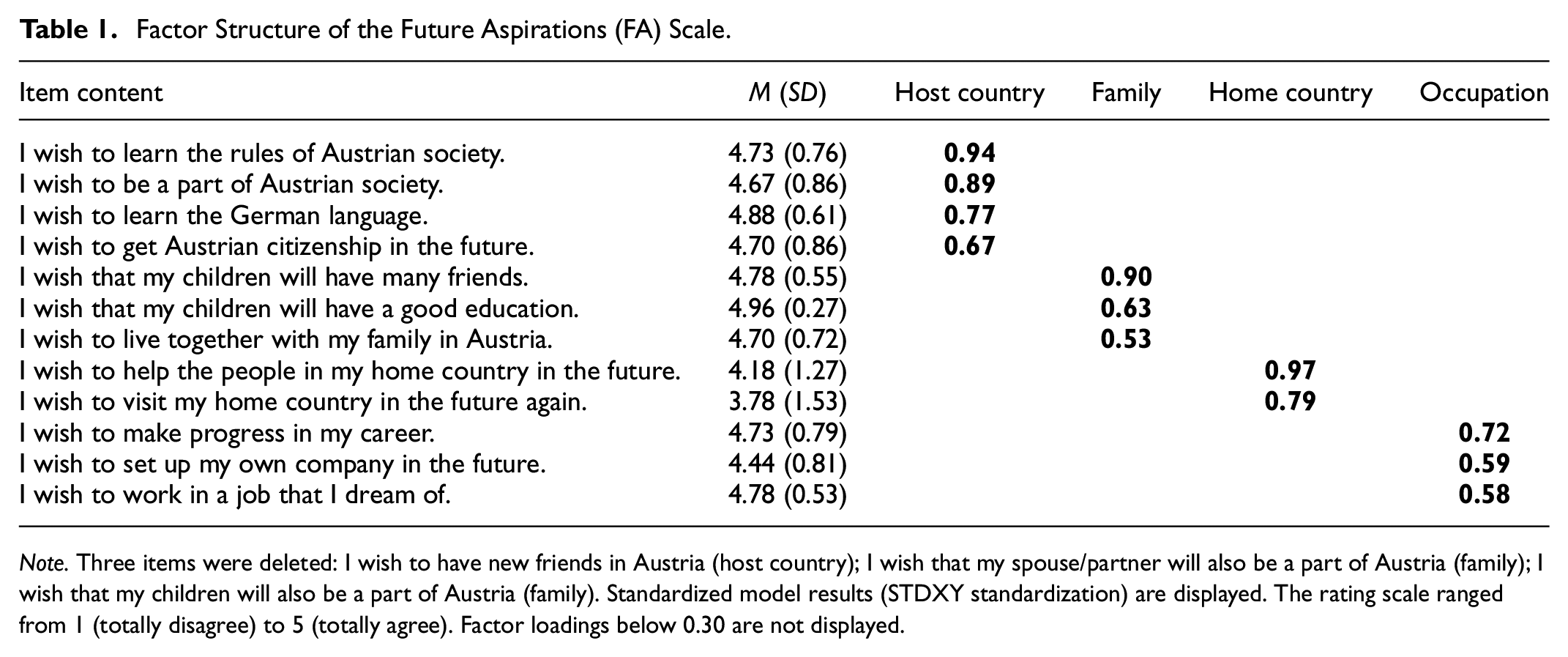
Note. Three items were deleted: I wish to have new friends in Austria (host country); I wish that my spouse/partner will also be a part of Austria (family); I wish that my children will also be a part of Austria (family). Standardized model results (STDXY standardization) are displayed. The rating scale ranged from 1 (totally disagree) to 5 (totally agree). Factor loadings below 0.30 are not displayed.
The theorized four-factor solution was tested applying confirmatory factor analysis (CFA) in Mplus 8.0. Three criteria were used in evaluating the model fit. Non-significant chi-square values indicate a good model fit. CFI ranges from 0 to 1.00, where a value above 0.95 indicates a good fit and a value above 0.90 indicates an adequate fit. RMSEA ranges from 0 to ∞, where a value below 0.05 indicates a good fit and a value below 0.08 indicates an adequate fit. The results of the four-factor confirmatory factor analysis (CFA) of the initial 15 item version showed an unacceptable model fit, χ2 (85) = 185.53, p < .01, CFI = .84, RMSEA = .09. Based on the inspection of modification indices, three items (see Table 1) were subsequently deleted. The 12-item version showed an excellent model fit, χ2 (49) = 62.12, p = .10, CFI = .97, RMSEA = .04. All items are displayed in Table 1. The latent factor “host country” significantly correlated with the latent factors’“family” (β = .47) and “occupation” (β = .55): All other correlations were not significant. The reliability of the scales was high for the host country (α = .88) and home country (α = .85) and acceptable for family (α = .60) and occupation (α = .60) according to Taber (2016).
Results
Post-Migration Life Difficulties of Asylum Seekers
A goal of this study was to explore which post-migration life difficulties were reported most often. To achieve this goal, the 24 items measuring post-migration life difficulties were descriptively analyzed. As shown in Table 2, seven items caused very serious or serious problems among a minimum of 25% of asylum seekers in our sample. The items “worry about my family back at home” and “are fearful of being sent back to your country of origin in the future” caused very serious or serious problems among more than 50% of the participants indicating that these are the post-migration life difficulties that bother asylum seekers the most.
Post-Migration Life Difficulties Causing Very Serious or Serious Problems.

Post-Migration Life Difficulties and Post-Traumatic Stress Symptoms
To explore whether asylum seekers with high versus low levels of post-traumatic stress symptoms (PTSS) differ regarding their level of post-migration difficulties (PMLD) and future aspirations (FA), a 2 (PTSS) × 2 (gender) MANOVA (multivariate analyses of variance) was performed for PMLD and the four subscales of FA in SPSS. Results of the MANOVA, the means and standard deviations of the study variables and the sample size are displayed in Table 3. Multivariate tests revealed a statistically significant main effect of PTSS, F (5, 118) = 8.84, p < .01, η2 = .27; the main effect of gender, F (5, 118) = 0.28, p = .95, η2 = .01, and the interaction effect of PTSS × gender, F (5, 118) = 0.11, p = .99, η2 < .01, was not significant. Follow-up univariate analyses on PTSS revealed that there were statistically significant differences regarding PMLD and FA families (see Table 3). All other effects were non-significant.
Future Aspirations (FA) and Post-Migration Life Difficulties (PMLD) Depending on High Versus Low Levels of Post-Traumatic Stress Symptoms and Gender.
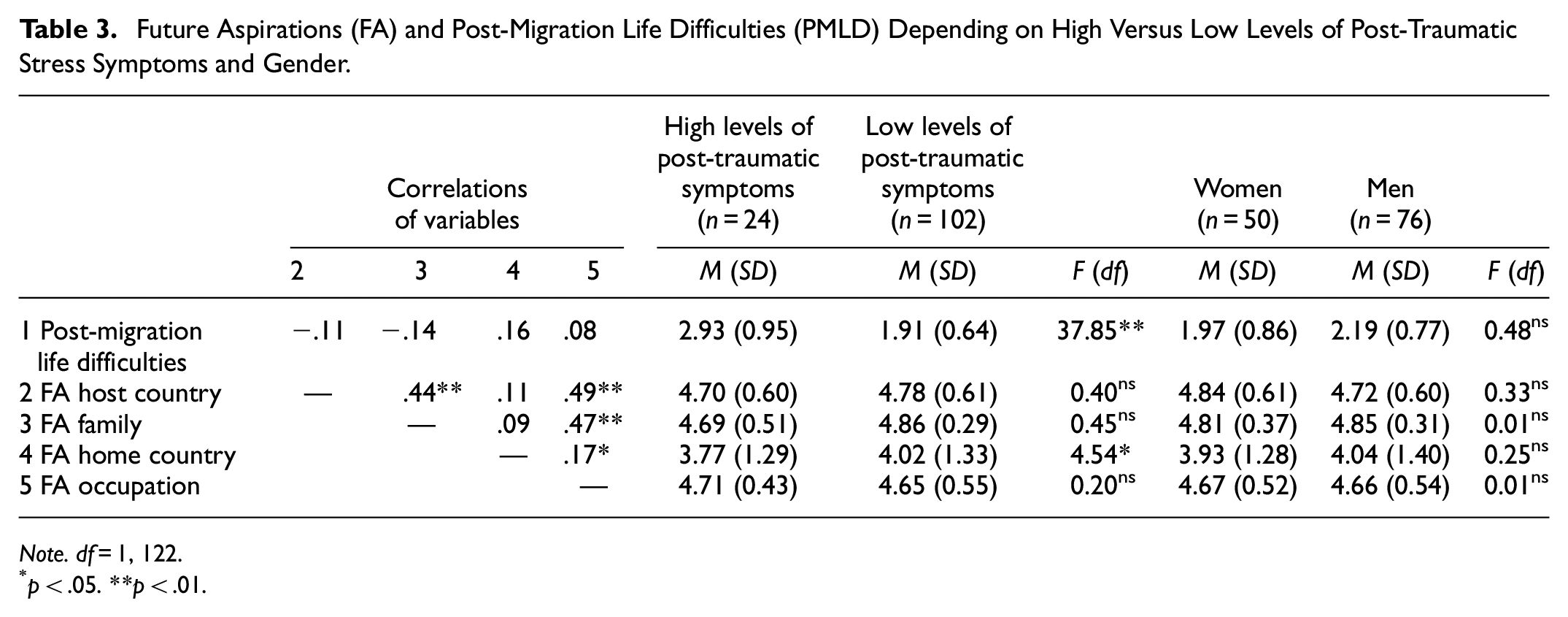
Note. df = 1, 122.
p < .05. **p < .01.
Predictors of Future Aspirations
The last goal of the study was to understand the predictors of Future Aspirations (FA). Four separate linear regression models were run with gender, length of stay, age, post-traumatic stress symptoms, and post-migration life difficulties as predictors and the four types of future aspirations as dependent variables. These analyses were preferred over more complex models, given sample size in light of the model complexity. Four types of future aspirations were differentially associated with predictors explaining 21.2% to 7.3% of the variance (see Table 4). Women, asylum seekers who stayed longer in Austria, and those with lower levels of post-traumatic symptoms had higher levels of future aspirations related to the host country. Asylum seekers reporting higher levels of post-migration life difficulties had higher levels of future aspirations related to the home country. Lower levels of post-traumatic stress symptoms were related to higher levels of future aspirations related to occupation. No significant predictors emerged for future aspirations related to the family.
Prediction of Future Aspirations (FA).
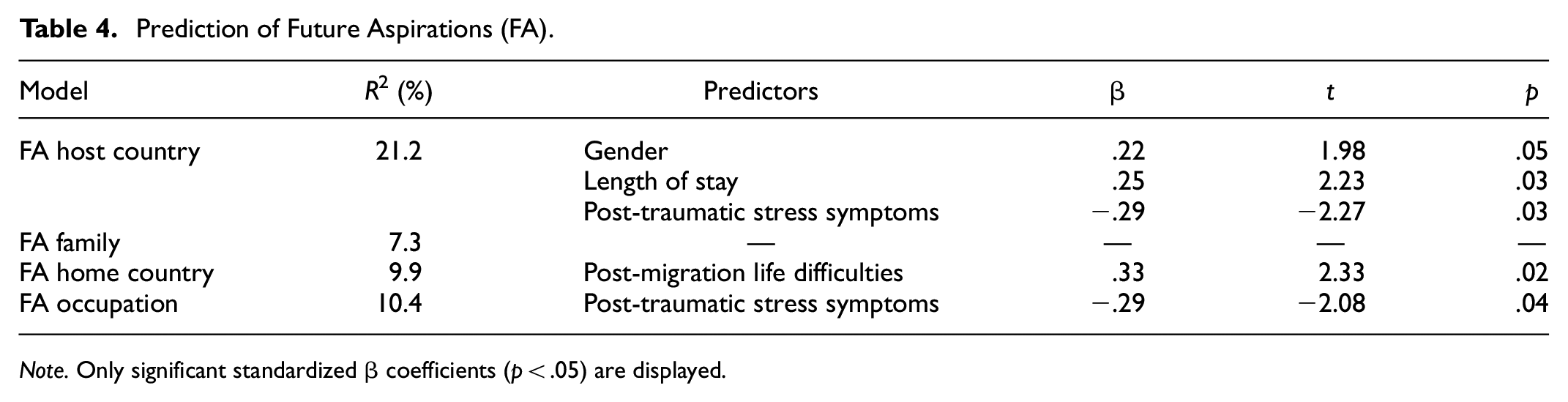
Note. Only significant standardized β coefficients (p < .05) are displayed.
Discussion
After submitting a formal claim of being recognized as a refugee according to the Geneva Convention, asylum seekers find themselves in a recognition process that is characterized by many legal constraints and insecurity. In addition to the particular insecurity that asylum-seekers face, they are likely to have experienced traumatic events in their home countries or during their flight (e.g., Heeren et al., 2012). Asylum seekers face various challenges in the receiving countries, such as lack of legal protection, poor living conditions, xenophobia, and discrimination, as well as detention and deportation. Governments put forward various policy responses targeting the voting population’s skeptical views on asylum seekers and refugees, such as a limitation on the annual number of asylum applications, a temporary limitation of the granted protection status, the possibility of withdrawing protection status, and restrictions of welfare benefits for asylum seekers (Rosenberger & Müller, 2020). The main political aims of these measures are to demonstrate the restoration of control over migration and borders, to deter future asylum seekers by making it more difficult to apply for asylum, and overall to discourage refugees applying for asylum by making their living conditions tough and unpleasant (Rutz, 2018).
In the present study, therefore, we analyzed which post-migration life difficulties asylum seekers perceive and how post-traumatic stress symptoms and post-migration life difficulties are associated with their future aspirations. Assuming that humans can think about the future and actively shape their life trajectories even in constrained environmental conditions (Nurmi, 1992; 2005), this study was the first to shed light on the future aspirations of this highly vulnerable group.
Considering the challenging life circumstances of asylum seekers, four possible future aspirations were distinguished. Applying the basic idea of acculturation models (Berry, 2001), home-country and host-country-related future aspirations were differentiated in addition to well researched family-related and occupation-related aspirations (Salmela-Aro, 2009; Seginer, 2009). Confirming a four-factor structure, the analyses revealed that asylum seekers have high levels of host-country, family, and occupation-related future aspirations indicating that they have a strong wish to start a new life in the host country despite their highly demanding life circumstances. This result is a sign of a high level of resilience of this group given the multitude of post-migration life difficulties they are facing while waiting for the decision of their asylum procedure. As hypothesized, more than 50% of the asylum seekers in our sample reported that they are afraid to be sent back because of their insecure legal status. Furthermore, the majority of the asylum seekers worry a lot about their family that they had left back home. One-third of the asylum seekers stated that not being eligible to work was a serious or dreadful problem, and one-quarter of the asylum seekers stated that not having enough money to buy food, paying the rent, or buying necessary clothes is problematic or very problematic for them. It is important to understand that these post-migration life difficulties are caused by the legal constraints’ asylum seekers find themselves in and are therefore out of their control. Literature also states that while refugees demonstrate great capacity to act and find new pathways through difficult situations, they tend to be temporary. The political focus on repatriation keep asylum seekers in prolonged uncertainty, which affect their capacities to develop future aspirations and hamper their engagement in future-oriented activities (e.g., Dånge, 2023). Having high levels of future aspirations despite these many uncontrollable hassles is a sign of high levels of agency despite their constrained environmental conditions.
Considering pre-migration factors, we also investigated the possible impact of post-traumatic stress symptoms by comparing asylum seekers with high versus low levels of post-traumatic stress symptoms. Because the data of this study were collected in shelters (and not in hospitals), it represents a non-clinical sample. Still, 19% (n = 24) individuals were identified as having high levels of post-traumatic stress symptoms according to an internationally accepted classification system of our screening instrument (Mollica et al., 2004). As hypothesized and in line with previous studies (e.g., Schick et al., 2018), asylum seekers with high levels of post-traumatic stress symptoms reported higher levels of PMLD compared to individuals with low levels of post-traumatic stress symptoms. Interestingly, the high-level post-traumatic symptom group reported lower levels of home-country aspirations compared to their low-level counterparts. This result is meaningful because it indicates that asylum seekers who experienced more traumatic events before they migrated are more reluctant to return to these places in the future.
Finally, yet importantly, our analyses showed that 21.2% of the variance of host-country-related future aspirations was explained by these factors. Women, individuals who stayed longer in Austria, and those with lower levels of post-traumatic stress symptoms had higher levels of host-country-related future aspirations. Higher levels of home-country-related aspirations were predicted only by higher levels of post-migration difficulties, while higher levels of occupation-related aspirations were predicted only by higher levels of PTSD. Taken together, these results are meaningful, although they certainly need replication in future studies.
Study Limitations
This study has several limitations regarding sampling, the measurement of future aspirations, and the research design. The asylum seekers of this sample were recruited in shelters by social workers employed in large NGOs running these shelters. Although this sampling strategy was the only one we could realize given the legal regulations in Austria, it turned out to be problematic. As we found out during the data collection, several social workers were reluctant to distribute the questionnaires because of various reasons (e.g., time constraints). As a result, this sample cannot be regarded as representative as only those who were initially provided with the questionnaires could eventually fill them out and send them back. Nevertheless, the study comprises a rather large number of a minority population that is usually not studied. To measure future aspirations, 15 items were developed capturing four different factors. Although initial construct validity was demonstrated by applying confirmatory factor analysis, the final 12-item measure should be improved by adding some more items in future studies because two sub-scales (family and occupation) had rather low reliabilities. Because this study was cross-sectional, it is also impossible to infer causality between the variables investigated. Future studies should try collecting longitudinal data to establish the temporal order of the constructs that were assumed based on good theoretical reasons, but not investigated in this study. Finally, yet importantly, the possibility that cultural differences in understanding the psychological constructs assessed may have influenced participants’ responses cannot be completely ruled out.
Even though these limitations, our findings demonstrate the importance of pre- and post-migration factors for future aspirations of asylum seekers. Future research could further differentiate trauma and post-migration life difficulties to determine which sub-aspects are most influential for which future aspirations inform a more nuanced approach of intervention.
Practical Implications
Our findings suggest that it is imperative to offer therapy for asylum seekers suffering from high levels of post-traumatic stress symptoms as these individuals also report more post-migration life difficulties. The findings also demonstrate that the most challenging post-migration life difficulties for asylum seekers are produced by the legal constraints of the refugee determination process (e.g., not being able to work). Thus, changing the legal system would be the most efficient way to sustainably support this disadvantaged and highly distressed population. Within clinical psychology, social work, and public health, a better understanding of future aspirations caused using acculturation processes among asylum seekers could support the development of tailored therapeutic interventions by facilitating our understanding of effective prevention efforts, psychotherapy processes, and possible social support systems for this vulnerable target group.
Footnotes
Acknowledgements
This research was supported by the Turkish Government TUBITAK Research Fellowship Program for Postdoctoral Fellows and a Research Fellowship Program for Postdoctoral Fellows program of Turkey and by the Oesterrreichische Nationalbank Anniversary Fund, project number 18734. The first author spent one-year research stay at the University of Applied Sciences Upper Austria during which the study was conducted.
Author Note
This research was supported by a Research Fellowship Program for Postdoctoral Fellows program of Turkey and by the Oesterrreichische Nationalbank Anniversary Fund, project number 18734.
Declaration of Conflicting Interests
The author(s) declared no potential conflicts of interest with respect to the research, authorship, and/or publication of this article.
Funding
The author(s) disclosed receipt of the following financial support for the research, authorship, and/or publication of this article: This research was supported by the Turkish Government 2219—TUBITAK Research Fellowship Program for Postdoctoral Fellows with BIDEB ID Code 575992 and a Research Fellowship Program for Postdoctoral Fellows program of Turkey and by the Oesterrreichische Nationalbank Anniversary Fund, project number 18734. University of Applied Sciences Upper Austria, Linz, Austria is supporting open access funding of article.
Ethical Approval
All procedures performed in studies involving human participants were following the ethical standards of the University of Applied Sciences Upper Austria, Linz, Austria and Baskent University, Ankara, Turkey, and with the 1964 Helsinki Declaration and its later amendments or comparable ethical standards.
Informed Consent
Participation in this research was based on informed consent, was voluntary and there was no financial compensation.

Data Availability Statement
The data that support the findings of this study are available on request from the corresponding author ADY. The data are not publicly available due to restrictions their containing information that compromises the privacy of research participants.