




Abstract
Insights into the interdisciplinary response to scientific collaboration remain scarce in interdisciplinary fields. The present work focuses on the effect of scientific collaboration on disciplinary diversity in the field of climate change using multiple statistical methods. The results show that research collaboration at the author and country/region levels has significantly positive effects on variety and DIV (an integrated diversity indicator), although these effects are limited. Additionally, the associations between the values of variety, disparity, and DIV and the number of departments are significantly positive, and similar results are found regarding relationships between these indicators and the number of countries/regions at the country/region and integrated levels. However, scientific collaboration has a negative effect on the balance of references at all levels. This study can improve our understanding of how scientific collaboration affects the multidimensional aspects of interdisciplinary research, and facilitate cross-disciplinary collaboration in the future.
Plain Language Summary
This study focus on how scientific collaboration affects interdisciplinarity of cited references in the field of climate change. The combined methods (t test, Tukey’s post- hoc test, effect size, propensity score matching, and OLS regression analysis) were applied to reveal the effect of the levels and types of collaboration on interdisciplinarity. We found that research collaboration at the author and country/region levels significantly positive affected the disciplinary number of references and the integrated interdisciplinarity (named DIV), however, these effects were limited. Moreover, the more departments the coauthors came from, the more the interdisciplinarity was, but the less evenness the distribution of subject categories was. In addition, at author, institution and country/region levels, scientific collaboration has a negative effect on the balance of cited references. This study could provide valuable information to facilitate cross-disciplinary collaboration in climate change.
Keywords
Introduction
Climate change is the most serious and complex challenge facing human society because it significantly affects both natural and social systems. The nature of climate change and its impacts are discipline-spanning. According to Intergovernmental Panel on Climate Change (IPCC), science related to climate change focuses on the physical scientific basis of climate change, its impacts and future risks, and options for adaptation and mitigation (www.ipcc.ch). Due to the complexity of this issue and resistance to simple, one-time solutions, climate change has been viewed as an wicked problem (Lazarus, 2009). Responding to the wicked problem requires interconnected ways that integrate diverse specialized competencies from multiple research domains (Xu et al., 2016).
Climate change research requires the integration of knowledge, skills, techniques, and tools drawn from various fields, such as atmospheric science, soil science, ecology, biology, hydrology, social science, physics, computer science, and data science (Ng et al., 2022; Rylance, 2015; Zeng et al., 2023). Many interdisciplinary initiatives have addressed some issues related to climate change, ranging from the need to understand physical mechanisms the assessment of ecological, socioeconomic and health risks (Labe & Barnes, 2021; Ludwig et al., 2011; Piao et al., 2010; Rineau et al., 2019; Thompson, 2021; Y. Zhang, 2014). Although the extent of interdisciplinary research (IDR) on climate change is steadily increasing, many obstacles related to IDR remain (Rineau et al., 2019). One reason for this situation is that few individual researchers can do the necessary work by themselves, so they tend to seek broad cooperation to achieve the intended research goals in this field. However, committing to collaboration poses a risk for scientists from various disciplines in terms of the balance between collaborative costs and benefits (Feng & Kirkley, 2020). Consequently, this situation gives rise to the interesting question of whether effective collaborative patterns contributing to the success of IDR can be found, that is, whether and how scientific collaboration promotes the interdisciplinarity in climate change studies.
In the field of library and information science (LIS), some scholars have been examined the relationship between individual characteristics/academic background and interdisciplinarity at the author level, team level, or institution level (Feng & Kirkley, 2020; van Rijnsoever & Hessels, 2011), for more details, see section 2.2. Although these studies have provided some relevant insights into the way in which collaboration stimulates IDR, these insights have been obtained indirectly and incompletely, and direct and comprehensive studies remain lacking. To the best of our knowledge, the effects of scientific collaboration on the multifaceted characteristics of interdisciplinarity have not been thoroughly studied thus far. Obtaining insights into how scientific collaboration affects interdisciplinarity in climate change can guide scientists from different fields to facilitate IDR by targeting specific segments of collaboration. Therefore, to improve our understanding of how collaboration improves IDR in climate change, this study tries to reveal the effects of various levels and types of scientific collaboration on the degree of interdisciplinarity by references to big data drawn from literatures published in this field.
In the present study, we focus on three research questions: (1) Have the number of scientific actors and the degree of interdisciplinarity in the field of climate change increased over the years? (2) What is the relationship between the number of scientific actors and the indicators of disciplinary diversity? (3) How have the levels and types of scientific collaboration contributed to changes in the interdisciplinarity of scientific studies?
The remainder of this paper is organized as follows: Section 2 will briefly clarify the current common theoretical framework for IDR measurement, some advances related to the relationship between collaboration and interdisciplinarity, and the research status of climate change in the library and information science (LIS) field. The data sources and processing, the measurements of the level and type of scientific collaboration, and the multiple statistical methods used in this study are elaborated in section 3. Section 4 displays the results of multiple statistical analyses to reveal the effects of the levels and types of scientific collaboration on interdisciplinarity. The discussion presented in section 5, and a conclusion is drawn in section 6.
Literature Review
The Analysis Framework of IDR Diversity Measurement
Interdisciplinarity is increasing over time in both the natural sciences and the social sciences (Gates et al., 2019; Porter & Rafols, 2009; Zhou et al., 2022). There are three reasons for this increase. First, interdisciplinary research has been viewed as an effective approach to some of the grand challenges facing humanity (Rylance, 2015). Second, many studies have found that highly cited papers, novel knowledge, and innovation disproportionately occur at the interstices among disciplines (Chen et al., 2021; Fontana et al., 2020; Garner et al., 2013). Third, individual disciplines could extend their horizons, and research topics by integrating their investigations with a range of other disciplines (Timakum et al., 2020). Alongside the increasing number of IDR publications, the measurement of IDR has been refined in the LIS field.
The early indicators of IDR diversity measurement were drawn from the fields of biology, information science and economics. For instance, Porter and Chubin (1985) created “Citations Outside Category,” which represents the proportion of citations that fall outside the target discipline based on species richness in the field of biology. Most early indicators can capture only partial characteristics of interdisciplinarity; in other words, these indicators, taken by themselves, fail to capture the IDR process adequately (Xiong & Fu, 2022). Over the past five decades, measures of IDR diversity have made rapid progress. At present, the most prevalent concept of diversity consists of three basic attributes, namely, variety (the number of disciplines cited), balance (the distribution of citations among disciplines), and disparity (how dissimilar these categories are) (Grant et al., 2015; Rafols & Meyer, 2010; Stirling, 2007). Of course, each of the three indicators is necessary but not sufficient to measure IDR diversity on its own, and neglecting one of these three perspectives could distort our understanding of IDR diversity. Therefore, studies on the measurement of IDR diversity have also focused on synthetical indicators that can integrate the three components (Leydesdorff et al., 2019; Stirling, 2007; Zhang et al., 2016). Zwanenburg et al. (2022) constructed criteria for IDR measurement, and evaluated 21 measures of IDR, finding that these measures that capture all aspects of diversity could gauge IDR more effectively. Hitherto, many studies on IDR diversity have taken each dimension and the synthesis of diversity into account. For example, Deng and Xia (2020) tracked changes in the interdisciplinarity of the field of information behavior using both individual indexes including variety, balance, and disparity, and comprehensive indexes. Zhou et al. (2022) explored the evolution of interdisciplinarity in the social sciences using single-component (variety, balance, and disparity) indicators as well as three multicomponent indicators. Overall, the three individual perspectives and their integrated perspectives of diversity have become an analytical paradigm in studies involving IDR quantitation. Although the comprehensive IDR analysis approach is widely accepted, it remains rare in studies related to the relationship between IDR diversity and research collaboration. Therefore, in this study, we explore the relationship between scientific collaboration and various measures of interdisciplinarity in climate change.
Relationship Between Research Collaboration and Interdisciplinarity
Wagner et al. (2011) raised six fundamental questions surrounding IDR, and the first one was “How do different levels of aggregation of research activity (people, teams, institutions, countries or geolocation) affect selected measures of interdisciplinary research?.” Several studies have made tentative explorations that revealed the characteristics and measurements of interdisciplinary research based on the disciplinary attributes of coauthors or coinstitutions. Abramo et al. (2012) found that the degree of interdisciplinary collaboration is largest in biology, followed by chemistry, medicine, mathematics, computer sciences, industrial and information engineering based on the disciplinary identification of coauthors from Italian universities. However, their investigation focused on the degree of interdisciplinary collaboration among different fields, and lacked awareness of the relationship between author collaboration and interdisciplinarity in terms of cited references. Abramo et al. (2018) conducted a comparison between the disciplinary diversity of authors and the disciplinary diversity of the reference list, and Zhang et al. (2018) performed a similar comparison between disciplinary diversity in departmental affiliations and reference lists. These studies focused on testing the consistency among IDR diversity measures, and although they can provide some indirect information regarding how individual collaboration affects the references’ interdisciplinarity, the association between collaboration and IDR quantitation as well as the underlying mechanism remain unclear because of a lack of quantitative causal studies. Abramo et al. (2019) investigated the relationship between the amplitude and type of collaboration and publications of specialized versus diversified research. Although this work revealed the effects of collaboration patterns on specialized/diversified output, the effects of coauthorship on the degree of diversified research remains poorly understood. To our knowledge, the most relevant article specifically analyzing the relationship between research collaboration and interdisciplinarity by reference to 846 scientific research papers, which was published in 1992, was conducted by Qin et al. (1997). These authors tested the influence of the types and levels of collaboration on the number of disciplines. However, they selected only one indicator, named variety, which represented only a partial expression of interdisciplinarity, and they provided no information on the relationships among other indicators, such as balance, disparity and research collaboration. Overall, although previous studies have provided some relevant viewpoints regarding the ways in which collaboration stimulates IDR, these insights were gained indirectly or incompletely, thereby lacking direct and comprehensive insights. In other words, the effects of the levels and types of scientific collaboration on the multifaceted characteristics of interdisciplinarity have not yet been thoroughly studied. Therefore, to explore the relationship between research collaboration and interdisciplinarity in further detail, we aim to investigate the direct effects of the levels and types of scientific collaboration on the degree of disciplinary diversity in terms of cited references using various statistical techniques.
Climate Change From a Scientometric Perspective
Climate change, as a complex interdisciplinary science, involves more or less disciplinary knowledge, which is one of the current largest challenges facing humanity (Xu et al., 2016). Many scientists from the natural and social sciences have been working diligently to address climate change by contributing the knowledge and skills of their own domains. Of course, some researchers and journals in the LIS have started to pay attention to climate change in recent years. Hellsten and Leydesdorff (2016) explored the construction of interdisciplinarity, including the knowledge base and programmatic focus, in the core journal of the climate change sciences—Climate Change. Their results showed that the widening of the knowledge base was important in this field, and the programmatic focus followed policy-oriented issues and incorporated public metaphors. Saetnan and Kipling (2016) published a paper in Scientometrics; these authors evaluated the effect of the knowledge hub of climate change on scientific collaboration, and found that the knowledge hub structure was effective in stimulating collaboration. They suggested that “Tackling complex challenges such as climate change will require research structures that can effectively support and utilize the diversity of talents beyond the already well-connected core of scientists at major research institutes.” Moreover, several LIS scholars published their articles in journals in the field of climate change. For example, Fu and Waltman (2022) carried out a bibliometric study published in the journal Climatic Change to examine how climate change is studied in scientific research. In addition, many scholars from other fields have used bibliometric analysis to trace the disciplinary development or dynamics of climate change science (Einecker & Kirby, 2020; Kapuka et al., 2022; Li et al., 2011; Wohlgezogen et al., 2020). However, studies in the LIS field involving the effect of scientific collaboration on the multifaceted measures of interdisciplinarity of climate change remain very rare.
Research Methods
Data Collection and Processing
The Web of Science (WoS) database is the standard and most widely used academic information resource in bibliometric research (Deng & Xia, 2020). For our data sample, we searched for relevant publications by using the keyword “climate change” and the terms representing a wide perspective of climate change studies according to several previous bibliometric works in this field (Fu & Waltman, 2022; Kapuka et al., 2022; Wohlgezogen et al., 2020). Thus, we used the following search words: TS = ((“climat* chang*”) OR (“climat* warming*”) OR (“global temperature*”) OR (“global warming*”) OR (“greenhouse gas*”) OR (“greenhouse effect*’”) OR (“greenhouse warm*”) OR (“anthropogenic warming*”) OR (“anthropogenic emission*”) OR (“climat* model*”) OR (“carbon emission*”) OR (“carbon leakage*”) OR (“CO2 emission*”)), DT = (Article, Review Article, Letter), Database = (WoS Core Collection), Collection citation indicators = (SCI-expanded, SSCI), and Languages = (English). The retrieval time was April 12, 2022. Then we screened related publications (Figure 1). In the first step, we deleted duplicate records if the titles of the records were identical, in which case only one record was included in the data. In the second step, we initially identified the most relevant publications that contained one or more TS terms in the titles. Then, the data were sorted into the most relevant publications and other publications. We, selected the publications referenced in other publications that cited the most relevant publications and filtered the publications that lacked any TS terms in the author keywords, KeyWord Plus, and abstract. The remining publications were defined as the second most relevant records. Then, we combined the first and second most relevant publications as the next dataset to be processed. In the third step, we selected publications from 1991 to 2021; then, we extracted information of countries/regions and institutions from the authors’ addresses (marked as “C1”); in the context, we successfully extracted information regarding these countries/regions and institutions from 97.8% of the records, which generated the next dataset to be processed. In this dataset, 753 publications (0.3%) with one author but two or more institutions or countries/regions were considered to be sole research in this study; if individual publications featured two or more identical countries/regions or institutions, the country/region or institution in question counted once, but the number of the identical institutions was considered to represent the number of different departments involved in this research. In the fourth step, we extracted the sources from the cited references (marked as “CR”); we matched the information of cited disciplines based on the WoS subject categories (SCs) list, and 72.1% of cited sources were classified into the different WoS SCs. Then, we deleted the records that lacked WoS SCs. Ultimately, the clean dataset contained 238,892 records.

Outline of the data processing methods.
The Levels and Types of Scientific Collaboration
The level of collaboration in each publication was defined as the number of authors, the number of institutions (e.g., a university)/departments (e.g., the second-grade schools in a university), or the number of countries/regions. The types of collaboration are shown in Table 1. The publications were classified into two categories: sole research and collaborative research at the author/institution/country level. The types of scientific collaboration at the integrated level were defined as the ways in which a collaboration was organized (Jeong et al., 2011). As the number of research units increases from sole research to international collaboration, the complexity and difficulty of collaboration are also likely to increase, especially when the spatial distances between each pair of corresponding research units are larger.
Types of Scientific Collaboration.

The Interdisciplinary Measurement of Publications
Quantitative methods for measuring cross-interdisciplinary research frequently rely on bibliometric and network analysis techniques. Bordons et al. (2004) concluded that there are four approaches to analyzing the interdisciplinarity of numerous publications or in a field of knowledge: (1) analyzing the reliance on collaboration among authors with different academic training, backgrounds or departments for disciplinary diversity; (2) performing coclassification analysis to define the disciplinary categories of publications through the presence of keywords and/or classification codes from various domains in these publications; (3) revealing the interdisciplinarity of documents based on the SCs of their publication journals; and (4) mapping the knowledge transfer among disciplines through citation analysis or the movement of scientists from one discipline to another. Although each approach implies some limitations, these methods have been proven to be useful for gaining insights into interdisciplinary research and are considered the main approaches used in cross-disciplinary measurement (Urbano & Ardanuy, 2020; Wagner et al., 2011).
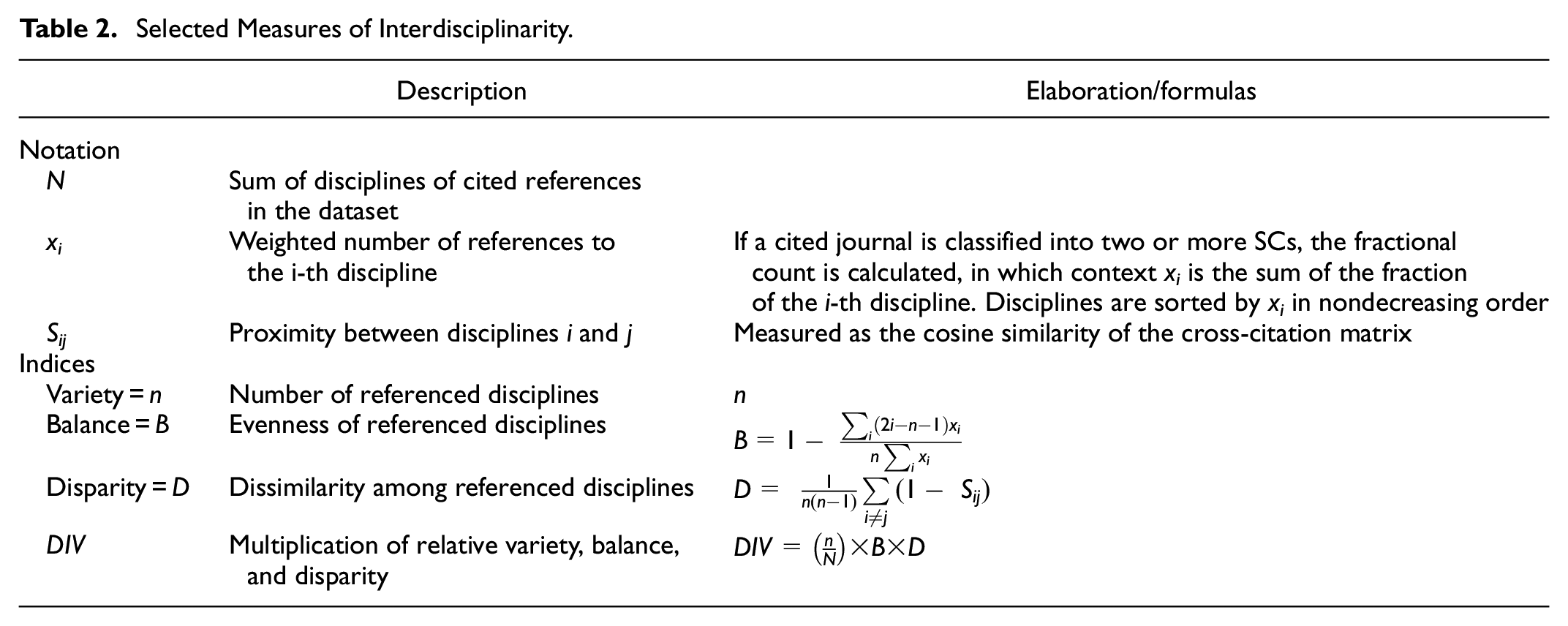
Disciplinary diversity in the cited references of publications is the most frequently employed method to measure the interdisciplinarity of publications (Chen et al., 2021). In terms of the specific diversity measure, diversity can be measured by reference to three components, that is, “variety,”“balance,” and “disparity,” all of which make it possible to depict various aspects of diversity in the cited references. Each of these components is a necessary but insufficient property of diversity. Therefore, we employed the integrated diversity measures known as DIV that were proposed by Leydesdorff et al. (2019) to operationalize the three individual components of diversity independently and then combines them.
Table 2 shows the notations and mathematical formulas of each indicator that we employed in this study. Variety (n) is operationalized in terms of the number of disciplines of cited references in a publication, which reveals information regarding the broadness of the knowledge base. All else being equal, the greater the variety is, the greater the diversity is. Balance (B) represents the evenness of the knowledge base, which is usually calculated based on the 1-Gini coefficient (Nijssen et al., 1998), where B = 0 indicates extreme imbalance and B = 1 indicates maximum evenness. Disparity (D) represents the heterogeneity of the knowledge base, which is calculated based on 1-Sij (the similarity between the ith discipline and the jth discipline). D ranges from 0 to 1, and a greater disparity indicates that disciplines differ more from each other. DIV represents the multiplication of relative variety (the variant of variety (n) variant, n/N), balance, and disparity ranging from 0 to 1 (Leydesdorff et al., 2019), and a greater DIV indicates greater diversity in disciplines.
Selected Measures of Interdisciplinarity.
Statistical Analysis Methods
A comprehensive approach was used to explore the relationship between scientific collaboration and interdisciplinarity step by step, as shown in Figure 2. First, we used descriptive statistical methods to obtain general information on research collaboration output and interdisciplinarity in the cited references. Second, we analyzed the correlative relationships between the levels of research collaboration and interdisciplinary indicators using Pearson correlation analysis and scatter diagrams. Third, to explore the effect of the types of collaboration on interdisciplinarity in further detail, the t test and Tukey’s post- hoc test were performed; in the processes of these analyses, to reduce the effects of confounding variables, propensity score matching (PSM) was applied; and effect size was used to capture the practical significance. Finally, the contribution of the levels and types of scientific collaborations to interdisciplinarity were quantified using ordinary least squares (OLS) linear regression analysis.

Research framework.
The general characteristics of publications included yearly output, distribution of SCs in cited references, total output among different collaboration types, the temporal distribution of the scientific actors and interdisciplinary indicators. The Pearson correlation between the number of scientific actors and interdisciplinarity exhibited a significance level of .05.
T test was conducted to examine the differences in interdisciplinary indicators between sole research and collaborative research at each scientific actor level. Tukey’s post- hoc test was conducted to reveal the differences in interdisciplinary indicators between each pair of corresponding collaboration types at the integrated level. However, in large sample studies, statistical significance alone could be misleading, because it is affected by the sample size. The effect size, also known as the standardized mean difference “Cohen’s d,” is resistant to sample size influence. Cohen’s d is calculated based on a measure of the practical significance of the results, which expresses the difference between two groups in units of standard deviations, and this practical significance indicates that the effect is sufficiently large to be considered meaningful in the real world (Ferguson, 2009). Cohen’s d can be calculated using following formula:

where M1− M2 is the difference between the group means (M), and s is the pooled standard deviation of either group. Here, s is calculated as follows:

where n1 is the sample size of group 1, n2 is the sample size of group 2, s1 is the standard deviation of group 1, and s2 is the standard deviation of group 2.
In addition, the p value indicates whether an effect exists between groups, while the effect size is the magnitude of the difference between groups (Sullivan & Feinn, 2012). Therefore, it is necessary to report both the effect size and statistical significance, especially when dealing with a large sample size. The quantification of the t test conventional effect size magnitude is performed using the thresholds defined by Cohen (1992): 0.2 (small effect), 0.5 (moderate effect), and 0.8 (large effect).
Furthermore, we used exact PSM before performing the t test, which is devised to make causal inferences, to reduce the effects of confounding variables on changes in interdisciplinarity indicator values (Stuart, 2010). It has been shown that PSM can balance all the observed covariates in cohort studies matching treated and control subjects on a single variable (Joffe & Rosenbaum, 1999). In recent years, PSM has been increasingly used in LIS studies to estimate the effects of treatments and exposures (Kim & Park, 2021; Liu & Hu, 2022; Mutz et al., 2017). For example, Zong et al. (2020) tested the significance of the citation count between articles with a closed peer review history and articles with an open peer review history after using PSM to control 14 confounding variables. In our study, these control variables might change along with different handing variables. For instance, when we focus on the role of author collaboration in interdisciplinarity, institution and country collaboration serve as confounding covariates that should be controlled for to reduce the selection biases. Accordingly, publications in the sole research and collaborative research categories have similar or identical observed confounding covariate values. Then, the t test is performed to determine the differences in each interdisciplinary index between the two categories after the application of PSM. Cohen’s d effect size was also calculated as a measure of the practical significance of the results. The combined method including the test, PSM and Cohen’s d effect size was used by Chen et al. (2021) to explore the relationship between interdisciplinarity and citation impact. These authors successfully found that significantly higher diversity in the highly cited papers than in other papers, and concluded that variety is the most important interdisciplinary factor for citation impact.
OLS linear regression analysis is an optimization strategy that allows researchers to assess the quantitative relationship between on dependent variable and independent variables (Sun et al., 2020). OLS linear regression analysis has been widely applied in the LIS field to analyze the effects of various influencing factors on collaboration or citations. For example, Jiang et al. (2018) conducted OLS regression analyses to examine the relationships of four types of distance, namely, geographic, cultural, political, and economic distance, with the outcomes and impacts of international collaborative research. Their results suggested that for every standard deviation increase in economic distance, the number and citations of publications decreased by 4.051 and 4.846, respectively, and for every standard deviation increase in political distance, the number and citations of publications decreased by 3.489 and 4.045, respectively. In the present study, OLS linear regression was conducted to determine the contributions of the levels and types of collaboration to the indicators of interdisciplinarity at each scientific actor level and at the integrated level.
All data processing and statistical analyses were performed using R 4.1.3 software (R Core Team, 2022) with the tidyverse, tidytext, bibliometirx, rstatix, and MatchIt packages.
Results
General Description
The number of publications on climate change increased slowly before 2000 and then began to rapidly grow in the 21st century, especially in recent years (Figure 3a). These publications cited sources from all WoS SCs. However, 91% of the cited SCs were distributed in the top 50 cited SCs, and approximately 66% of these occurred in the top 10 cited SCs, such as “Meteorology & Atmospheric Sciences” (11.3%), “Environmental Sciences” (11.1%), “Multidisciplinary Sciences” (9.0%), “Ecology” (8.1%), “Geosciences, Multidisciplinary” (6.6%), “Plant Sciences” (3.1%), “Energy & Fuels” (2.6%), “Geography, Physical” (2.5%), “Water Resources” (2.2%), and “Forestry” (2.1%) (Figure 3b), thus indicating substantially narrow and broad interdisciplinarities in this field. The percentages of collaborative research were 93.2% (222,698), 68.0% (162,387), and 38.4% (91,730) at the author, institution, and country/region levels, respectively (Figure 3c). The number of documents for sole research, internal collaboration, domestic collaboration, domestic collaboration, and international collaboration was 16,194, 60,311, 70,657, and 91,730, respectively (Figure 3d). These results suggested that collaborative studies dominated scientific research in the area of climate change.
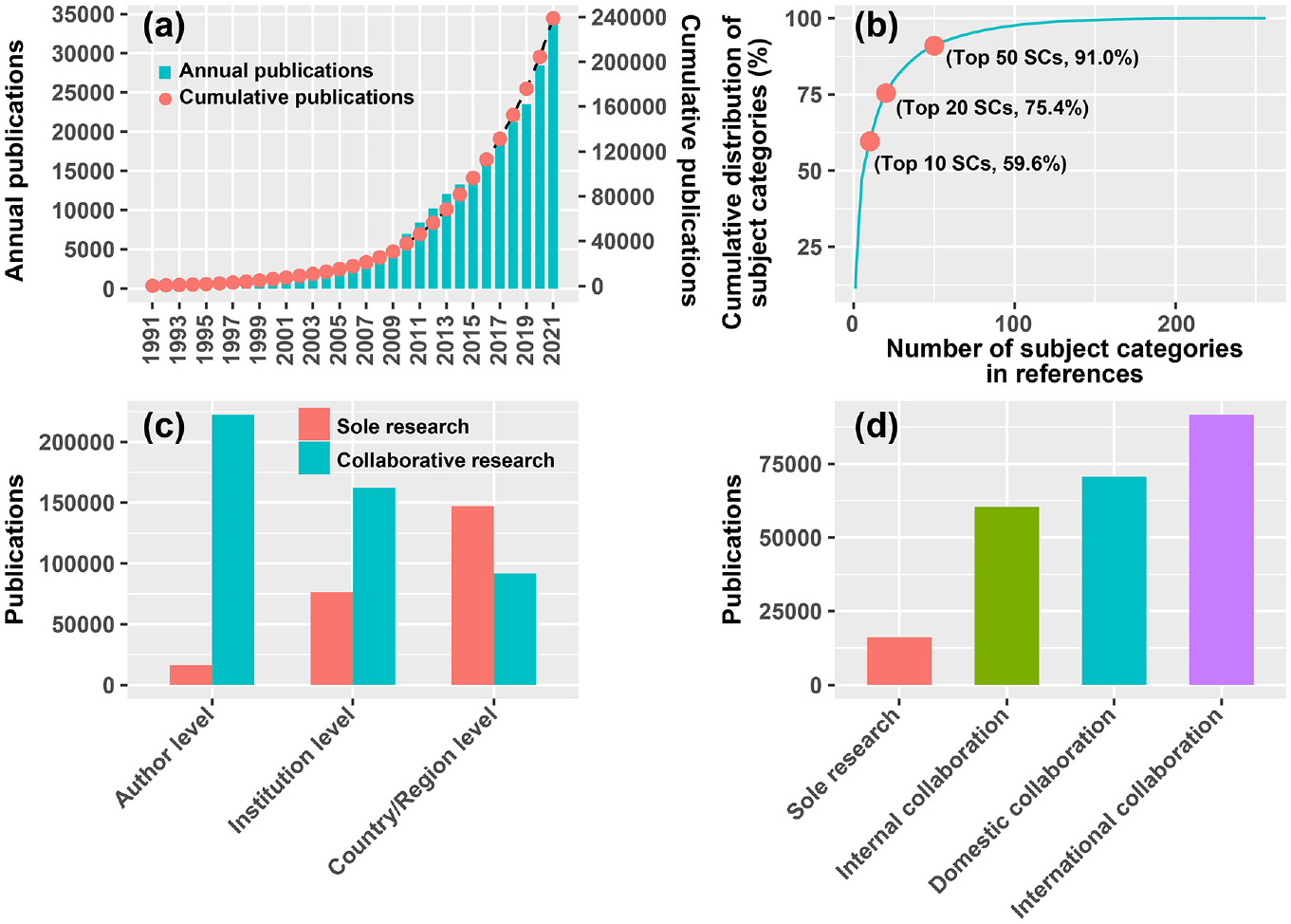
Distribution of publications and cited references’ SCs: (a) the growth of publications, (b) the cumulative percentages of cited SCs, (c) the number of sole research and cooperative research publications at different scientific actors’ levels, and (d) the number of publications among different collaboration types at the integrated level.
There were clear increasing trends in the average volumes of authors, institutions, and countries/regions per article from 1991 to 2021 (Figure 4a). The average values of variety and DIV increased over time; however, those of balance decreased over time (Figure 4b). The means of the other three interdisciplinary indicators fluctuated with relatively large CIs before 2000 and then increased rapidly over time. Generally, except for balance, similar increasing trends in the number of scientific actors and the value of diversity were observed.

Temporal distribution of scientific actors and diversity indicators. Data refer to the mean ± 95% CI. The 95% percentile bootstrap confidence intervals (CI) are generated based on 1,000 bootstrap samples. Some error bars are not visible because they are smaller than the size of the symbols. (a) Number of scientific actors and (b) value of interdisciplinary.
Relationships Between Scientific Actors and Interdisciplinarity
The relationships between balance and other interdisciplinary indicators appeared to be relatively weak (r < .3, Figure 5). Except for balance, there were moderate or high correlations between each pair of the other interdisciplinary indicators (r ≥ .4). There were strong correlations between each pair in relation to the number of scientific actors (r > .6). However, the r values between the values of diversity indicators and the number of scientific actors were equal to or smaller than .13, suggesting a very weak or even an unrelated relationship between each pair of corresponding variables. Furthermore, we also found negative correlations between balance and the number of scientific actors, as well as between the number of authors and disparity.
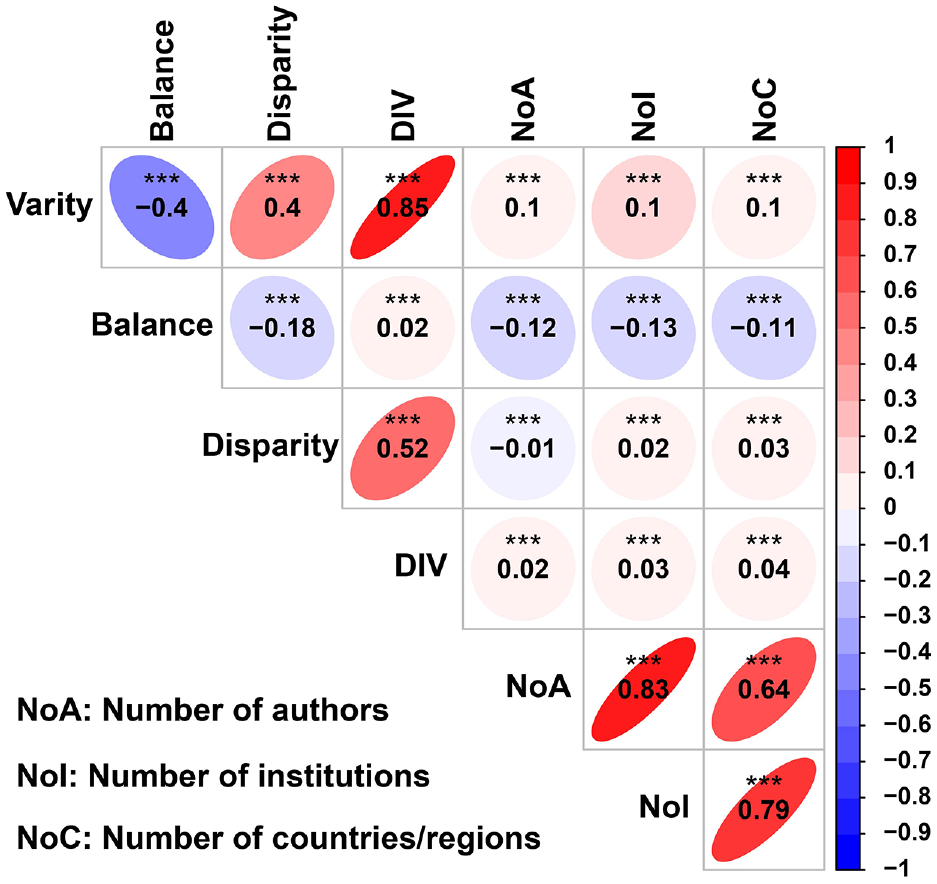
Pearson correlations between diversity indicators and scientific actors. *Significant at the .05 level; ***Significant at the .001 level.
More details regarding the relationships between the number of scientific actors and the value of interdisciplinary measures are presented in Figure 6. In particular, we found an increasing trend in variety with an increase in the number of scientific actors; however, the increasing rate gradually decreased, while balance showed a decrease with the rise in the number of scientific actors. The value of disparity generally increased generally with the number of institutions and countries/regions, but exhibited different patterns in terms of author level. There may be an inverse U-shaped relationship between DIV and the number of scientific actors. These results indicate that, in general, increasing the number of scientific actors at certain ranges could promote interdisciplinarity in terms of variety and DIV. However, too many actors participating in these studies might not elevate the overall diversity of the cited references.
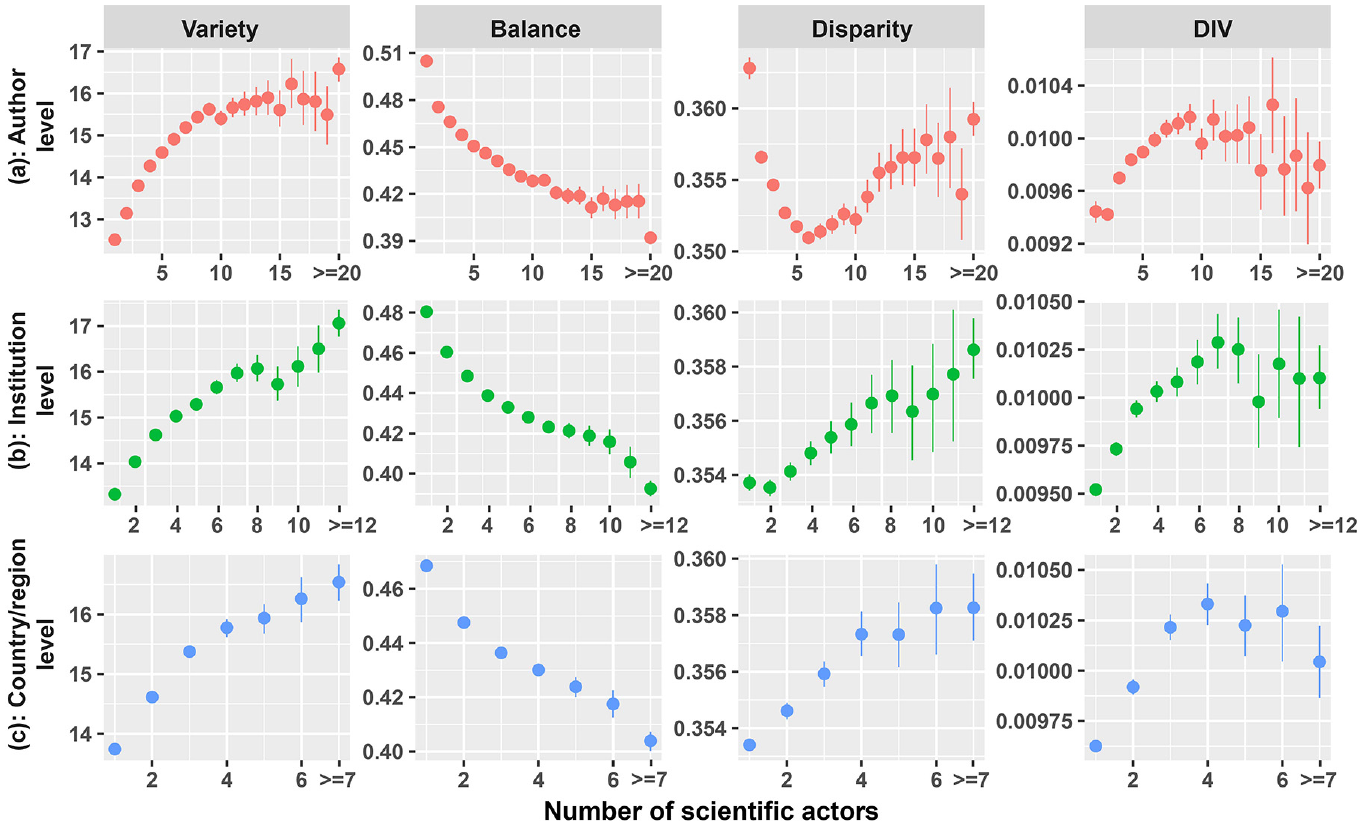
Scatter plots of diversity indicators versus the number of scientific actors at different levels. Data refer to the mean ± 95% CI. The 95% percentile bootstrap confidence intervals (CI) are generated based on 1,000 bootstrap samples. Some error bars are not visible because they are smaller than the size of the symbols. (a) Author level, (b) institution level, and (c) country/region level.
Differences in Interdisciplinarity Across Various Collaborative Types
As shown in Figure 7, after PSM, the results suggested that scientific collaboration significantly affected interdisciplinarity at different levels of scientific actors. At the author level, variety and DIV in collaborative research were larger than those in sole research. The effect sizes of variety ranged from −0.18 to −0.14, and those of DIV ranged from −0.04 to −0.002, both displaying negligible effects. However, balance (Cohen’s d: [0.23, 0.26]), and disparity (Cohen’s d: [0.25, 0.29]) were smaller in collaborative research than in sole research, and their effect sizes were small. At the institutional level, four interdisciplinary indicators exhibited greater values in sole research than in collaborative research, and their effect sizes ranged from 0.05 to 0.18. At the country/region level, except for balance, other indicators presented larger values in collaborative research than in sole research, and their effect sizes ranged from −0.13 to −0.05.

Differences in interdisciplinarity between sole research (group 1) and collaborative research (group 2) after PSM. *Significant at the 0.05 level; *** Significant at the 0.001 level. Confidence intervals are shown in square brackets, and the confidence level is 95%. The negative effect size indicates that the mean of group 1 is smaller than that of group 2. (a) Author level, (b) institution level, and (c) country/region level.
Figure 8 shows that different collaboration types significantly influence interdisciplinarity at the integrated level. Variety increased from sole research to international collaboration research. International collaboration observably promoted variety more than other collaboration types, and the effect sizes ranged from −0.41 to −0.09, suggesting that the effects of collaboration types on variety ranged from negligible to nearly medium. DIV showed similar results as variety with a smaller effect size (Cohen’s d from −0.15 to −0.03, negligible effect). However, the opposite result was found in balance with a larger effect size (Cohen’s d from 0.12 to 0.59, negligible to medium effect). The means of disparity (Cohen’s d from 0.18 to 0.29) in sole research were larger than those in other collaboration types (negligible to small effect), and they increased from internal collaborative research to international collaborative research (Cohen’s d from −0.108 to −0.045, negligible effect). Overall, with the exception of balance and sole research in disparity, the elevated complexity of collaboration types promoted interdisciplinarity to a certain extent in the field of climate change.

Differences in interdisciplinarity between each pair of corresponding indicators. *Significant at the .05 level; ***Significant at the .001 level. Confidence intervals are shown in square brackets, and the confidence level is 95%. The negative effect size indicates that the mean of group 1 (the left variable) is smaller than that of group 2 (the right variable).
Interdisciplinary Dynamics Associated With Changes in the Levels and Types of Scientific Collaboration
Table 3 presents the results of the OLS regression analysis indicating that significant changes occurred in interdisciplinary indicators in terms of author level. Compared with sole research, there was an approximately 4.5% increase in variety, while balance, disparity and DIV decreased by approximately 3.4%, 2.3%, and 1.3%, respectively. With a one-unit increase in the number of authors, variety and DIV increased by approximately 2.4% and 1.2%, respectively, while balance and disparity decreased by approximately 0.9% and 0.4%, respectively. Table 4 shows significantly decreasing trends in interdisciplinary indicators with increasing levels of institutional collaboration. Table 5 shows that variety, disparity and DIV significantly increased by approximately 3.2%, 0.2%, and 1.7%, respectively, in international collaboration research as compared with sole research. However, balance showed the opposite result (–1.7%). Interdisciplinary indicators significantly increased with the increase in the number of countries/regions. In addition, except for balance, other interdisciplinary indicators significantly increased with the increase in the number of departments (Tables 3–5).
OLS Regression Models for Interdisciplinarity at the Author Level After PSM.

Note.*p < .05, ***p < .001. Standard errors are in parentheses. The qualitative variable is transformed to binary variable (0 for absence in collaboration and 1 for presence in collaboration).
OLS Regression Models for Interdisciplinarity at the Institution Level After PSM.

Note.*p < .05, ***p < .001. Standard errors are in parentheses. The qualitative variable is transformed to binary variable (0 for absence in collaboration and 1 for presence in collaboration).
OLS Regression Models for Interdisciplinarity at the Country/Region Level After PSM.

Note.**p < .01, ***p < .001. Standard errors are in parentheses. The qualitative variable is transformed to binary variable (0 for absence in collaboration and 1 for presence in collaboration).
Table 6 shows changes in interdisciplinarity based on corresponding changes in the levels and types of collaboration at the integrated level. Compared to sole research, variety in internal, domestic, and international collaborations increased significantly by approximately 10.1%, 16.3%, and 21.3%, respectively. Similar results were found in DIV. There was also an increasing trend for variety with the increase in the number of authors, while other interdisciplinary indicators showed negative increasing trends. With the exception of balance, other interdisciplinary indicators decreased significantly with an increase in the number of institutions. However, significant positive effects of the number of departments and the number of countries/regions on interdisciplinarity were observed at the integrated level.
OLS Regression Models for Interdisciplinarity at the Integrated Level.

Note.**p < .01, ***p < .001. Standard errors are in parentheses. The qualitative variable is transformed to binary variable (0 for absence in collaboration and 1 for presence in collaboration).
Discussion
Positive and Negative Effects of Scientific Collaboration on Interdisciplinarity
The results indicated relatively consistent patterns between scientific collaboration and variety and DIV and between scientific collaboration and balance.
The results of this study showed the significantly positive effects of author collaboration and number of authors on the variety and DIV of the SCs cited in publications. Similar results based on all the SCI papers published in 1992 were found by Qin et al. (1997), who concluded that the average number of disciplines of the journals cited in single-author publications was smaller than that in multiple-author studies (p < .05). They also reported that 93.4% of the collaborative articles cited more than one discipline compared with 77.9% of the articles classified under sole research. These results indicated that increases in the levels and scales of author collaboration could promote special disciplinary diversity in the reference lists of publications. However, our results also suggested that when the number of scientific actors was larger than a certain threshold (i.e., in our study, author: 10; countries/regions: 4), variety fluctuated at a certain value, and DIV displayed a weak decreasing trend, implying a limited increase in reference diversity in accordance with the increase in the number of authors or counties. The reasons for this phenomenon are probably due to the diversity of the references growing with the number of author domains, while the number of authors is equal to the number of domains to a lesser extent (Abramo et al., 2018). Moreover, the main contributions of a paper (idea, framework and manuscript writing) are usually made by a few authors, such as the first and second authors and/or the corresponding author; consequently, the research areas of this paper are likely represented by the dominant authors’ fields of study (Mattsson et al., 2011). In addition, many scholars have confirmed the effects of homophily on coauthorship patterns, suggesting that authors from the same or similar fields collaborate more frequently than those from different fields (Zhang et al., 2018). Similarly, Feng and Kirkley (2020) found that disciplinary homophily also occurs in cross-disciplinary research and that interdisciplinarity is reflected by the diverse research experiences of individual researchers rather than diversity within pairs or groups of researchers. At the country level, the number of authors was larger than the number of countries/regions in most papers. This finding suggested that many coauthors of individual articles came from the same countries; consequently, the number of countries’ thresholds was smaller than that of the authors’ thresholds. Therefore, these results suggested that author/country collaboration could promote interdisciplinarity represented by variety and DIV in climate change and other research, however, such effects were limited.
The results from the OLS regression analysis at each scientific actor and integrated level showed that the associations between the number of departments and interdisciplinary indicators, except for balance, were significantly positive. Zhang et al. (2018) used all articles published during 2007 to 2016 in the multidisciplinary journal PloS One to compare the corresponding measurements of interdisciplinarity represented by the affiliations of authors and references and found that, with the exception of balance, there were weak positive correlations between diversity measures in the affiliations and those in the references. These results implied that faculties from different departments could promote cross-disciplinary production, likely because they have different SCs. The departments inferred from authors’ affiliations refer to the functional activity or knowledge area of an organizational unit under the university. Academic staff from different departments may have different disciplinary profiles. As a consequence, author collaboration among different departments likely promoted heterogeneous knowledge flows and integration.
At the integrated level, except for sole research and balance, publications of international collaboration showed more interdisciplinarity than those of other collaboration types. However, positive effects were found in OLS regression analysis only with regard to variety and DIV, which may be due to the effect of a few extreme samples. Qin et al. (1997) used multiple regression analysis after excluding extreme cases and found that collaborative types (coding 0–4 for no collaboration, intradepartmental, interdepartmental and intrainstitutional, interinstitutional and national, and international collaborations, respectively) have positive effects on variety in the fields of earth and medical sciences. From the perspective of social psychology or cognitive psychology, authors from different countries—even those in the same or similar fields—potentially have various professional opinions and research paradigms/traditions on special scientific issues due to the coauthors’ diversity in race/ethnicity, value, and cultural and national origin (Shore et al., 2009). Thus, overall, we maintain that international collaboration and its levels can elevate the degree of interdisciplinarity in references, especially for variety and DIV, because coauthors from different countries are likely to employ various cognitive methods.
However, our results demonstrated that scientific collaboration had a negative effect on the balance of references at the scientific actors’ and integrated levels. Similar results were found by Zhang et al. (2018), who reported a significant negative correlation between balance in the affiliations and in the references. Abramo et al. (2018) investigated the 2006 to 2016 WoS indexed publications by Italian universities and found that the average balance in publications with five or more authors was smaller than that in other publications with fewer authors. Similar results in the field of information behavior were found by Deng and Xia (2020), who explored cross-disciplinary changes using WoS publication collections. They reported that although the variety of disciplines in this field is remarkably augmented, the distribution of disciplines is unbalanced and concentrated on several dominant domains. Uddin et al. (2021) also found that in IDR, a few disciplines play a leading role in collaborations from the perspective of funding. Our results also showed that many interinstitutional collaborations occurred. Qin et al. (1997) concluded that if a collaborative study is conducted by more than one institution, it would most likely be completed by researchers from the same disciplines. These results together suggested that most coauthors in each paper likely came from the same discipline, and the uneven distribution of authors’ disciplines could strengthen the imbalanced cited references.
Managerial Implications
Studies related to climate change involved a wide range of disciplines including all 254 WoS SCs, and their topics ranged from natural science to humanities and social science. Due to the complexity of climate change, a general consensus has been reached that IDR that integrates knowledge and techniques drawn from various fields is the most appropriate approach to explore the nature and effects of climate change (Rylance, 2015). Collaboration is the most efficient strategy conducting IDR. Our study indicated that scientific collaboration significantly promoted the levels of interdisciplinarity in this field at the author, department, and country/region levels; however, the effect was limited. Our results suggested that it was not always better for IDR to be conducted by many authors or individuals from many countries, but that it was better for such research to be conducted by more authors from different disciplines. In addition, although the cited references covered all WoS SCs in the context of climate change, approximately 60% of the cited SCs were distributed in the top 10 cited SCs. This finding suggested that climate change is both a broad and narrow interdisciplinary field, that the degree of interdisciplinarity should be expanded rather than the top 10 SCs. These findings thus provided valuable information regarding how to organize IDR on climate change and identify the appropriate collaborative partners for scholars in this field.
Recently, cooperative IDR has attracted increasing attention and funding at the organizational level, the national level, and the international level (Gewin, 2014). Obtaining insights into how scientific collaboration affects interdisciplinarity can enable policy makers, funding agencies and research organizations can facilitate IDR by targeting specific segments of research collaboration. For example, to achieve a carbon peak and carbon neutrality, the National Natural Science Foundation of China issued special project guidelines, “Major basic science issues and countermeasures for national carbon neutrality” in 2021”, which clearly require joint research in natural and management sciences. This study could provide some macrolevel references for project applications. Moreover, a better understanding of the relationship between collaboration and interdisciplinarity can provide valuable insights that can be used to enhance the rewards associated with IDR. Previous studies have suggested that the larger the interdisciplinarity of articles is, the more citations they achieved (Chen et al., 2021). Our study revealed a pattern of scientific collaboration that could enhance the level of disciplinary diversity thus further increase the influence of IDR. Overall, our study provided some interesting information that can help academic administrators and practitioners conduct IDR more effectively.
Uncertainty, Limitations and Future Research
Some uncertainties regarding the relationship between diversity measurements and the levels and types of scientific collaboration occurred in the different methodologies and indicators, similar to those reported in previous studies (Adams et al., 2016). The authors concluded that the inconsistent and even contradictory results can be attributed to the varying nature of various diversity indicators that capture different understandings of a multifaceted concept such as interdisciplinarity. Huang and Chang (2011) explored interdisciplinarity from the two perspectives of citing literature and coauthorship. They found some differences in results because of coauthorship based on interpersonal relationships but direct citation based on knowledge flow. In addition, the inclusion of several papers with many authors/institutes/countries in this study could lead to deviations in the analysis results. Furthermore, the results with low Cohen’s d values in terms of effect size and R2 in our OLS regression analysis suggest that there exist other variables affecting the interdisciplinarity of references apart from scientific collaboration.
Publication reference lists are a conventional approach in interdisciplinary measurements but may possibly be the least satisfactory source of proxy indicator data. First, it is possible that some documents are not included in the WoS core database (Şahin & Yılmaz, 2022). Therefore, we were unable to retrieve all articles related to climate change. Second, there are a larger number of publications and SCs in science than in social sciences and humanities in the WoS core database. Third, unhealthy citation behavior and motivation can lead to a cited reference list that lacks the effectiveness of IDR measurement. Finally, in our study, the cited references are assigned to one or more SCs according to their publishing journals’ SCs. However, this does not mean that the subject attribute in each paper is entirely equal to the SCs of the corresponding journal. Therefore, interdisciplinarity that relies solely on the WoS core database could induce some biased results. In addition, this study did not consider the disciplinary backgrounds of authors or institutions because extracting such information is an extremely complex process due to the lack of available data sources.
These uncertainties and limitations prompt future investigations. First, publications from different databases could be used to improve the database quality of this study. Second, addressing the nature of interdisciplinarity should be considered from more comprehensive perspectives by combining this with an understanding based on cited references, coauthorship, text mining, and expert reviews. Third, academic databases, such as ResearchGate, Google Scholar, and ORCID, provide large volumes of valuable information for many global scholars, including their research interests and skills. Thus, future studies can dig deeper into the disciplinarity of coauthors from these academic databases to better understand interdisciplinary collaboration. Finally, to better reveal the relationship between scientific collaboration and interdisciplinary research, future studies should consider other confounding variables, such as the driving factors of collaboration, funding, and scientific policies.
Conclusion
In this article, we sought to investigate the role of scientific collaborations in the interdisciplinarity of publications, as represented by a diversity of cited references in the field of climate change. For this purpose, we explored the relationships between the levels and types of research cooperation and the multiple indicators of cross-disciplinarity using combined approaches, including t test, Tukey’s post-hoc test, effect size, PSM, and OLS regression analysis.
Our results showed an increasing trend in interdisciplinarity over time and the dominant role of scientific collaborations in the field of climate change. However, most collaborative studies were conducted between and within institutions in the same country/region, and most cited references came from a few disciplines. Furthermore, research collaboration contributed significantly to the degree of interdisciplinarity in this field; however, the sizes and directions of the effects varied among multiple diversity indicators. We found that the variety and DIV of the reference lists generally grew with the levels and complexity of collaboration; however, a contradictory result for balance was observed. Despite this general convergence, our analysis of various methodologies revealed some uncertainties in different interdisciplinary indicators. Thus, further research is needed to reveal the associations between scientific collaboration and IDR from a more integrated view—a task that entails controlling other more confounding factors. This study could provide valuable information concerning how to facilitate cross-disciplinary collaboration research for researchers focused on climate change as well as scientific managers.
Footnotes
Declaration of Conflicting Interests
The author(s) declared no potential conflicts of interest with respect to the research, authorship, and/or publication of this article.
Funding
The author(s) disclosed receipt of the following financial support for the research, authorship, and/or publication of this article: This research was funded by the National Natural Science Foundation of China (72174016), and Research Start-up Fund of Hangzhou Dianzi University (KYS265624173), and National Social Science Foundation of China (19ZDA348) and Humanities and Social Science Foundation, Ministry of Education of the People’s Republic of China (19YJC880138).

Data Availability Statement
The data that support the findings of this study are available from the corresponding author.