




Abstract
Evolving from ethnographic research that determines what meanings are shared within a culture, studies regarding Speech Codes Theory have been conducted with implications for intercultural communication. Arguing for transitivity as speech codes in diverse cultures, this paper aims to describe and explain the transitivity attributes of English-medium Corporate Social Responsibility (CSR) reports by Chinese and British/American corporations, and the transitivity variances between industries by Chinese corporations. Results reveal that frequencies of transitivity features in the Chinese CSR reports are significantly lower than those in the British/American reports, and that the relational process dominates in the corpus under investigation. Also, cross-industrial comparisons among Chinese corporations show that the mechanical manufacturing enterprises and the iron & steel enterprises share similar transitivity codes, but they differ from the energy enterprises distinctively. The paper concludes that linguistic/cultural contexts, translation strategies, moves in the CSR reports, and industry attributes together contribute to the transitivity codes and communicative conducts in different cultural and industrial backgrounds. This paper might help writers/translators of CSR reports in China better understand lexical and functional conformities and peculiarities reflected in Chinese and British/American CSR reports, enhance their corporate narration in the international communities, and thus reinforce communication with the general public by appropriately expressing and accurately translating transitivity processes.
Plain Language Summary
This paper describes the transitivity attributes of English-medium Corporate Social Responsibility (CSR) reports by Chinese and British/American corporations, and the transitivity variances between industries by Chinese corporations. It discovers that the transitivity frequencies in the British/American CSR reports are significantly higher than those in the Chinese counterparts, and the relational process dominates in the sub-corpora under investigation. Cross-industrial analysis across Chinese corporations shows that the mechanical manufacturing industry and the iron & steel enterprises share similar transitivity code, but they are distinctively different from the energy enterprises. It is concluded that linguistic and cultural differences, translation strategies, moves in the CSR reports and etc. together contribute to the transitivity conformities and peculiarities in different cultural backgrounds. By showing the cultural meaning of transitivity and its application variances in CSR reports in guiding communicative conduct, this paper illustrates how transitivity codes might be used to present and explain communicative conducts. This paper might help writers/translators of CSR reports in China better understand lexical and functional conformities and peculiarities reflected in Chinese and British/American CSR reports, enhance their corporate narration in the international communities, and thus reinforce communication with the general public by appropriately expressing and accurately translating transitivity processes. Future work on the transitivity processes of business reports can make exploration into the Chinese-medium CSR reports by Chinese corporations, and then the degree to which transitivity process is influenced by translation strategies or L1 could be evaluated.
Introduction
Corporate Social Responsibility (CSR) reports, also known as corporate sustainability reports, corporate social reports, or corporate environment reports, are documents issued by corporate entities, providing information about their nonfinancial contributions to society (García-Sánchez et al., 2022). CSR reporting responds to concerns of stakeholders about the social, economic, and environmental activities that corporations have taken on during an accounting period (Sun et al., 2022). It could also inform the general public typically in the narrative form of the entities’ future activities that they hope to undertake in these areas. A CSR report can help to build customer loyalty, enhance corporate image, reinforce communication, and attract investment. Moreover, it is an aid to corporate recruitment and retention, to the fulfillment of social responsibility as well as to the improvement of risk management and performance management (Thomas & Ward, 2019). Early since the 1960s and the 1970s, some enterprises in the UK, the USA and France have been required to issue information on the social responsibility. The past 20 years has witnessed a steady rise in the number of CSR report disclosures by companies on how they interact with the society, the stakeholders and the environment. According to Corporate Register (see www.corporateregister.com), globally, 26 corporations issued CSR reports in 1992, and by January, 2023, the amount of CSR reports has exceeded 174,640 across 25,575 organizations. In recent years, issue of CSR reports by listed companies in Chinese mainland correspondingly underwent great increase, from 10 in 2006 to 701 in 2015, and to 3,803 in the first 11 months of 2022.
On the other side, English as a Lingual Franca (ELF) has been investigated from the perspectives of genres, teacher’s development, business communications, business discourse, textbooks and teaching, and etc. However, research on business texts mainly involves letters or advertisements, and only a few studies address CSR reports (Wang, 2012). Drawing on Halliday’s transitivity framework (2004), the current study illustrates the transitivity patterns of English-medium CSR reports by Chinese and British/American corporations, and identifies the transitivity distribution variations between different industries in China. Also, it argues that linguistic and cultural contexts, translation strategies, moves in the CSR reports, and industry characteristics together contribute to the transitivity trends and differences in the CSR reports. More importantly, it explores how transitivity processes, which are a part of Halliday’s ideational function, create speech codes and accomplish communication in CSR reports.
Literature Review
Speech Codes Theory
Speech Codes Theory (SCT) is commonly applied to evaluate interaction gaps between different groups (Covarrubias, 2009). Evolving from ethnographic studies that determine what meanings are shared within a culture, Phillipsen (1997), Philipsen (2008), and Phillipsen et al. (2005) propose the theory to describe the relationship between culture and communication. According to SCT, cultural/situational contexts have constant impact on communication. That is, we manage communication in accordance with our interpretation of meanings, conventions, and principles in relation to a given context. In this respect, the speech codes are defined as “[historically] situated and socially constructed systems of words, meanings, premises, and rules about communicative conduct” (Philipsen, 2008, p. 415). In practice, we construct relevant codes through social communication in specific contexts, and the significance of these codes are intricate, flexible, and combined in varied ways to produce different effects, which, in turn, rely heavily on distinct situations. More specifically, communication is reflective of thinking patterns, premises about interpersonal relations, and living strategies (Solomon & Theiss, 2013) held by members in a particular community. Therefore, the speech codes are encoded and decoded by producers and receivers, and then are integrated into the discourse itself. Appropriate employment of the speech codes provides explication, assumption, and manipulation of discourse about discourse.
The core of SCT is outlined in the following six general propositions (Philipsen, 2008): (1) wherever there is a distinctive culture, there is to be found a distinctive speech code; (2) in any given speech community, multiple speech codes are deployed; (3) a speech code involves a culturally distinctive psychology, sociology, and rhetoric; (4) the significance of speaking depends on the speech codes used by speakers and listeners to create and interpret their communication; (5) the terms, rules, and premises of a speech code are inextricably woven into speaking itself; and (6) the artful use of a shared speech code is a sufficient condition for predicting, explaining, and controlling the form of discourse about the intelligibility, prudence, and morality of communicative conduct.
Proposition 1 underlines the peculiarity of speech codes. That is, human communication is invariably related with cultural solidarity, and speech codes are largely laced with assurance of common place within a particular community. Put differently, speech codes are a system of interpretive rules which are empirically developed, tested, and followed by members of the speech communities (Sotirova, 2022). Proposition 2 emphasizes the variety of speech codes. In effect, we frequently identify and use multiple codes simultaneously in a given context in which our identities are crafted (Milburn, 2021). Then, Proposition 3 reveals the essence of speech codes as rhetorical resources, and asserts that the speech codes reveal the nature of the self, the coordination between interlocutors, and the disclosure of realities and convincing arguments. Next, Proposition 4 involves the interpretation of speech codes—namely, linguistic devices don’t speak for themselves, but people communicate. This implies that we should comply with the codes by which communicative conducts are socially-shaped and situationally-constructed so that we can comprehend the meaning of the communication practice within a specific culture. By contrast, Proposition 5 concerns the site of speech codes. We can detect the speech codes of a particular community by exploring the cultural indication involved in daily interactions (especially words or phrases about communication behavior), highly-structured cultural forms, or totemizing rituals. Finally, Proposition 6 recognizes the importance of knowledge in communication (Slutskiy, 2021). It signifies that the artful knowledge of speech codes in a particular culture may promote our prediction or control of speech practice, or comprehension by others.
SCT creates a nuanced scenario of speech communities. Cross-cultural studies on the basis of SCT have been conducted with implications for intercultural communication (e.g., Hart, 2016; Huang, 2017; Kotani, 2017). While most literature is focused on oral communication, fewer research pays attention to the written discourse (e.g., Coutu, 2010; J. Liu & Chang, 2010). Hardly could SCT studies on CSR reports be found, however. Culture shapes communication. SCT provides us a conveniently theoretical perspective which could be employed to identify and explicate culturally-specific features with which enterprises’ nonfinancial contributions to the society can be read. In the case of CSR reports, the SCT approach to communicative conducts might be promising in achieving a rudimentary interpretation of the cultural attributes of the context under investigation. In fact, SCT should not be confined to research about daily conversations only. As stated by Philipsen (2008), it can be used in all linguistic/cultural contexts and communicative modes. CSR reports, as a written communication between corporations and its stakeholders and the general public, are inevitably projected speech codes in relevant communities and situations. Undeniably, the potential speech codes involved in Chinese and British/American CSR reports are expected to reveal both generic solidarity and cultural specificity in practice. Speech codes in CSR reports are expected to not only abide by the agreed-upon conventions and values in the business world, but more importantly, function in consistence with the socially-constructed norms and ways of thinking in Chinese culture and British/American culture correspondingly. At the same time, Chinese corporations, presenting themselves in the English-medium international community, are very likely to use dual codes (L1 & EFL) simultaneously. In this sense, this paper is going to examine the assumptions of SCT in terms of transitivity patterns and to explore how diverse cultures shape communicative conducts and speech codes in CSR reports.
Transitivity Analysis
Cultural implications are always woven into the discourse and into understandings of the discourse. These traces might appear in many forms including linguistic ones that can be discerned in words pertaining to communicative conducts. That is, meanings and values can be largely constructed and modeled through linguistic choices in the texts. One of the traces is proposed here as transitivity whose patterns are historically-situated and socially-constructed, and might be a part of the speech codes of different cultures. This paper resorts to Phillipsen’s (1997) interpretation of culture, and provides a descriptive and interpretive analysis of transitivity codes which are one of the essential features of communication unique to a given culture.
Systemic Functional Linguistics (SFL) is a conveniently meaning-making system which treats language beyond the formal structures and highlights the association between language and social context (Halliday & Matthiessen, 2014). To be more specific, SFL seeks to explicate how individuals use language and how language is constructed in relation to the context (Eggins, 1994). Halliday (2008) points out that there are three major functions of language, that is, the ideational, the textual, and the interpersonal. Among them, the ideational function is the use of language to express content, to communicate information, and to represent our experience to each other. Corporations present content and their experience that consists of participants, processes and circumstances to stakeholders and the general public. Therefore, this study focuses on the ideational function to examine how communicative conducts and cultural conventions are portrayed in CSR reports.
On the other side, transitivity represents experiences such as actions, events, psychological processes, and relations that encompass “[all] phenomena and anything that can be expressed by a verb: event, whether physical or not, state, or relations” (Halliday, 1976, p. 159). The transitivity system is essentially a semantic concept addressing the way meanings are constructed in the clause (Halliday & Matthiessen, 2014), and it is “[a] grammar system that can be analyzed to identify ideational meaning and discuss basic categories of social actor representation to show how participants in a clause can be analyzed in more detail” (Koller, 2020, p. 55). In the current study, the transitivity analysis helps to demonstrate how lexical choices construe the social reality and convey the experiential meaning, and it may gain us an insight into the cross-cultural differences in the case of transitivity in economic life.
According to Halliday and Matthiessen (2014), there are six types of process in the transitivity system, that is, material, mental, behavioral, relational, verbal and existential as follows.
Construing the external world, material processes are processes of doing. They denote outwards actions in which the participant is likely to undergo a change or something is done (e.g., die, ask, wear, paint, repair). By contrast, mental processes concern inward perceptions and thoughts. They construe the inner experience of the participant and involve him/her endowed with consciousness (e.g., know, think, intend, see, hear). Then relational processes are those of being, and denote attributes and identities (e.g., be, have, become). The above processes are three major process types in the English transitivity system.
Behavioral processes are located between material processes and mental processes, which are the outer expressions of inner states, that is, the manifestations of processes of consciousness and physiological states (e.g., ache, suffer, breathe). And verbal processes are found on the borderline of mental processes and relational processes. They indicate symbolic relationships between human thoughts and verbal languages, that is, communicative actions such as speaking and writing (e.g., warn, boast, say, tell, argue). Also, existential processes are halfway between relational processes and material processes, which denote the existence of the participant (e.g., there be, exist).
While previous studies delve into literature, newspapers and political speeches based on these processes (e.g., Al-Raba’a, 2020; Bartley, 2018; Deroo & Díaz, 2021; Janjua, 2022; J. Wang, 2010), less work has examined business texts such as CSR reports, not to mention cross-cultural comparison as with this genre. To bridge the gap, this paper aims to compare the transitivity patterns of CSR reports cross-culturally and cross-industrially, and examine rhetorical choices corporations have made in representing a domain of their experience from their particular viewpoints. Furthermore, it takes transitivity patterns as a part of the speech codes in the CSR reports due to the fact that “[when] words for and premises pertaining to communicative conduct appear in interpersonal communication there will be traces of culture present in them, and that these traces will bear culturally distinctive meanings and significance” (Philipsen, 2008, p. 419). More specifically, there are three reasons why transitivity processes could function as speech codes (and might be assumed as transitivity codes). First, they help enterprises discern that transitivity codes are being used in messages transmitted by CSR reports, for example, by directing attention to verbs and expectations about communicative conducts involved in those messages. Second, they help enterprises interpret the meanings of codes implied in verbs about communicative conducts by tracing their use in relation to other words and meanings co-occurring with those verbs about communicative conducts (e.g., the participants and the circumstances). Third, they help enterprises understand the corporate motivation of the relevant rhetorical choices by presenting the linkage between corporate concepts concerning communication patterns and corporate concepts regarding social well-beings and social relations.
Methodology
Research Questions
This paper aims to answer and discuss the following questions about transitivity processes as a part of speech codes in a given context:
(1) Are the proportions of the transitivity processes in CSR reports by Chinese corporations significantly different from those by British/American corporations?
(2) What are the distribution characteristics of the six processes in CSR reports by Chinese and British/American corporations?
(3) Do the distribution characteristics of the processes in CSR reports by different industries in China significantly vary from each other?
Corpus Construction
The corpus was based on corporations listed in Fortune Global 500 (in 2021). English-medium CSR reports ranging from 2019 to 2021 were randomly selected from such industries as the electric power, the energy, the iron and steel, and the mechanical manufacturing. Thirty of the reports were issued by 14 Chinese corporations such as PetroChina, Sinopec, and China Minmetals Corporation (shortened as CHCSR reports); and 30 were issued by 17 British/American corporations like 3M, Caterpillar, and Marathon (shortened as BACSR reports).
Data Coding and Collection
To analyze and compare the frequencies of six transitivity processes, this study followed a corpus-based methodology. It examined previous literature, and randomly selected 100 verbs that were typically and largely analyzed in the transitivity research articles in the last 20 years (see Appendix I). Among them, 28 were verbs of material process; 23 were verbs of mental process; 18 were verbs of relational process; and 16, 5, and 10 verbs were verbs of verbal, existential and behavioral processes respectively. AntConc 3.2.1w was applied to the search and the distribution statistics of the 100 transitivity verbs. Figure 1 exemplifies one of the searching pages of the existential process. All CSR reports were carefully scanned and read, and every single listed feature was coded and identified in its context.

An example of searching for the existential process in AntConc.
Data Analysis
Based on the corpus and the word list, this paper exerted a quantitative and qualitative analysis of the characteristics of transitivity processes in English-medium CSR reports by Chinese and British/American corporations, and tried to spot the varied transitivity codes in different situations. To examine cross-cultural effects on the frequency of transitivity processes, Loglikelihood and Chi-square Calculator were used to determine whether the differences were significant or not. The significance level was set at <.05, <.01, and <.001. Due to the size of the corpus as well as the controversial definition of the clause, this study annotated the main verbs in the main clause only, and manually removed gerunds, modal verbs, auxiliary verbs, verbs in subordinate clauses, and modifying participles or infinitives. For instance, in search of “ask” as a verb of the material process, sentences such as “we ask that we be held accountable” and “landowners and invited public officials had the opportunity to ask questions” were judged in the context, and entities like the latter one were excluded since “ask” in it was in an infinitive.
Results and Discussion
Ratios of Transitivity Processes
The raw word number in CHCSR reports and BACSR reports are 828,059 words and 886,658 words respectively; and the word number ratio of CHCSR reports to BACSR reports is 0.93:1 (as shown in Figure 2). In contrast, the proportion of transitivity verbs in CHCSR report to those in BACSR reports is 0.63:1. Listed transitivity verbs in CHCSR reports make up 10.07‰ of the total word numbers of the sub-corpus while those in BACSR reports account for 14.82‰ of the total word numbers. The difference is markedly significant (p < .001). Examples of the six processes are listed in (1a) to (1f).
(1a) Learning has also
(1b) The facility
(1c) In some cases, we
(1d) It is
(1e) GHG and methane emission intensity decreased or
(1f) The zoo

Statistics of words and listed transitivity verbs.
Many factors might contribute to the significant difference. Firstly, transitivity patterns of CSR reports are inevitably shaped by the previous experiences. The instances of CHCSR reports and BACSR reports point to different social conventions and ideological systems. In other words, the large gap in the employment of transitivity features between them could result from potential cultural divergence between Chinese and British/American communities. Halliday (1994) notes that the transitivity processes encoded in language represent our conception of the world. Chinese corporations communicate with the influence of their domestic cultural background, implying that their communication codes are prefabricated by Chinese values to a certain degree. Whereas they are aware that they need to communicate in English in the international context, they may not necessarily “[speak] the same way” (Rogerson-Revell, 2007, p. 188). Chinese corporations, to a significant extent, interact globally in their CSR reports in line with “[the] socio-cultural conventions that govern the use of their own first language” (Vandermeeren, 1999, p. 275). Essentially, the significant variations between CHCSR reports and BACSR reports display varied speech codes, distinct assumptions of communication, and diverse conventions in different contexts.
Secondly, the lower frequency of transitivity processes in CHCSR reports can also be attributed to the complex constructs of Chinese predicates and the nominalization of verbs in Chinese-English translation. Chinese predicates are more varied than English ones, and the former could be composed of noun phrases, verbal phrases, modifying phrases, subject-predicate phrases, united phrases, quantifiers, pronouns, adjectives and so on (F. Li, 2004). Take nominal predicate sentences in Chinese for example. Due to the effect of some semantic features of nouns in Chinese, the nominal phrase has an inclination of predicatization, and has declarative function (Xiang, 2001). In clear contrast to Chinese, English predicates can hardly consist of structures beyond verbs. The gap of predicate constructs between the two languages imposes direct influence on the translation practice and on the frequency variations of transitivity processes. To accurately translate the meaning of the text, translators often make conversion between different parts of speech, and therefore, Chinese predicates are usually transferred to non-predicate structures in the target language—English. A typical example is conversion from Chinese verbs to English nouns (including nouns, gerunds, nouns derived from verbs, infinitives, and noun clauses) (L. Wang & Liu, 2006; Zhu, 2006). In practice, the strategy of nominalization in Chinese-English translation might be understood in terms of metalingual functions. For the ideational function, nominalization could add up information linguistically and economically (Thompson, 2008). For the textual function, nominalization could change the information focus and express ideology implicitly, which, as a powerful cohesive device, could also improve discourse cohesion and persuasiveness (Fan, 1999). And for the interpersonal function, the non-human nature of nominalization might obscure the modifying elements and make the discourse more objective and serious (G. Liu & Lu, 2004). In addition, nominalization is popular in news, business texts and academic writings. For example, nominalization in business texts exceeds 100 tokens per 10,000 words (L. Wang & Ge, 2015). To recap, it can be concluded that the lower frequencies of transitivity process in CHCSR reports result from both the linguistic difference between Chinese and English and the translation strategy of nominalization.
So far, the first three propositions by SCT stated in Section 2 can be illustrated in the brief juxtaposition of Chinese and British/American speech codes from the perspectives of transitivity patterns. As with Proposition 1, due to the distinctive cross-cultural differences, distinct speech codes projected in the employment of transitivity processes are found, implying that the British/American codes give greater endorsement to corporations-shareholders communication by the use of more transitivity processes than the Chinese codes do albeit both are presented in English.
As with Proposition 2, despite of the possibility that Chinese enterprises have, consciously or unconsciously, tried to include in their CSR reports some transitivity codes that are established in English texts, they have presumably drawn on transitivity codes well-acknowledged in their domestic culture. Consequently, in the English-dominant international community, Chinese enterprises deploy multiple speech codes regarding transitivity, both approaching the target culture and language and being impacted by the native culture and language.
Then, Proposition 3 by SCT could be supported, too. Corresponding to the components in Proposition 3, psychology in this case is concerned with the way enterprises present or illuminate the significance of being insiders of a given community in light of interaction. As for sociology, it means enterprises’ understandings of the nature of a relevant community, the trends of industries concerned in that community, and the attributes of association preferences in a given industry. As for rhetoric, it refers to enterprises’ interpretation of what is an appropriate and effective transitivity code within a particular community. In the case of CHCSR reports, the speech codes encompassed in transitivity processes reveal the nature of cross-linguistic influences, the linkage between the native Chinese language/culture and the target English language/culture, and the rhetorical choices for the sake of an assumed persuasive appeal. In this sense, it is worthwhile to note that CSR reporting requires constant efforts in appropriately expressing and accurately translating the transitivity processes so that cultural meaning of words in the English-medium reports might be controlled.
Chinese Versus British/American Comparison of the Transitivity Processes
Figure 3 reveals that the distribution patterns of the six processes in Chinese sub-corpus and British/American sub-corpus are quite similar. That is, the relational process makes up 59.67% and 67.48% of the total transitivity processes in CHCSR reports and BACSR reports respectively and overwhelmingly. Then, the material process and the mental process follow as the second and the third in both sub-corpora; and the behavioral process ranks at last in both sub-corpora as well. However, the differences are demonstrated in the verbal process and the existential process. They are respectively in the fourth and fifth places in CHCSR reports, but they rank at the fifth and the fourth places in the BACSR reports.

Distributions of transitivity processes: CHCSR versus BACSR (%).
What’s more, the chi-square test demonstrates that the distribution proportions of these processes in the pre-established word list, in CHCSR reports, and in BACSR reports are significantly different from each other (p < .001). As plotted in Figure 3, the frequencies of almost all the processes in the sub-corpora are lower than frequencies of verbs listed, except for those of the relational process.
Hu (1994) points out that the high frequency of a specific transitivity process is one of the most important representations of discourse characteristics. For instance, the material process dominates in technology and medicine instructions, and the prevalence of the existential process is often found in tourist texts. G. Li (2005) argues for the prevalence of different processes in diverse genres, too. He notes that varied communicative goals may result in different distributions of transitivity processes in the discourse. As revealed in Figure 3, the relational process claims an absolute dominance in the CSR reports and its proportion in the total transitivity processes is far higher than that in the word list (18% in the latter). So a conclusion can be drawn that CSR reports are strikingly characteristic of the higher frequency of the relational process. The relational process refers to the nature, the characteristics, or the situation of an object, or the relations between one object, situation or event and another object, situation or event (Fawcett, 1987). The operation and development of an enterprise is closely connected with many macro- or micro-factors such as domestic situations (e.g., (2a)), laws and regularities (e.g., (2b)), industrial trends (e.g., (2c)), environment and population (e.g., (2d)), corporate management (e.g., (2e)), and science and technology (e.g., (2f)). Representing relationships between the enterprises and these events or situations, the relational process thus prevails in the transitivity processes, and takes a discursive advantage over other processes in the CSR reports. As stated, corporate social responsibility means corporate responsibility to its staff, consumers, the environment, and creditors; and CSR reports are supposed to reveal information and describe the influence by the interconnection of different factors for the sake of interested parties or stakeholders. Accordingly, CSR reports usually include moves such as enterprise external environment, qualification, understandings and achievements of CSR, revealing of negative information, acknowledgments, future prospects, and inviting feedback (L. Wang & Han, 2015). And they record corporate memos of the previous year, enterprise nature, cultural characteristics, operations, external influence, and contributions to environment protection and social charity. Therefore, both the objectives and the contents require that CSR reports involve situations, events and relations that reflect intra-enterprise, inter-enterprise and social-enterprise relationships. In a word, the move conventions determine that situations, events and relations which are projected into relational processes are the theme of CSR reports, and thus the prevalence of relational processes is the prominent characteristic of CSR reports.
(2a) This
(2b) These principles
(2c) In particular, our production safety base in coal industry
(2d) Harmonious development
(2e) The continuous development and improvement of team safety
(2f) The detailed design of CO2 capturing device
With British-American data as the baseline of comparison, frequencies of transitivity processes in CHCSR reports and those in BACSR reports are compared in pairs cross-culturally. As shown in Figure 4, the proportions of the material process, the verbal process and the behavioral process in CHCSR reports to those in BACSR reports rank at the top three (1.25:1, 0.96:1, 0.82:1) in the comparison, and that of the existential process is listed at last (0.39:1). Also, the chi-square test shows that the cross-cultural difference is most significant (p < .001) in the material process, the mental process, the relational process and the existential process, significant in the behavioral process (p = .045), and not statitically significant in the verbal process (p = .554). It is notable that the proportion of the material process (1.25:1) far exceeds both the proportion of the total word number (0.93:1) and the verb proportion (0.63:1). The material process in the Chinese sub-corpus occurs 1.25 times as frequently as that in the British/American sub-corpus while the relational process, the mental process, and the existential process in CHCSR reports make up correspondingly 60.10%, 46.92% and 38.75% of those in BACSR reports. In the meanwhile, the compared proportion of the relational process (0.60:1) is similar to that of the compared proportion of the total verbs (0.63:1), and is left undiscussed below.
(3a) While achieving our own sustainable development objectives, we
(3b) In Australia, we
(3c) Although corporate contributions to political parties at the national level are prohibited by law, corporations may
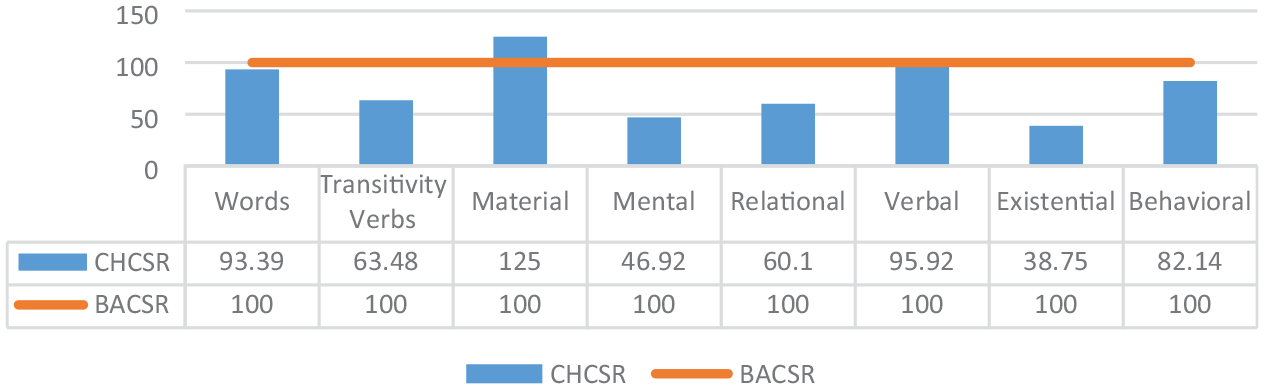
Comparing and contrasting of transitivity distribution in Chinese versus British/American CSR reports.
Factors that contribute to the above-mentioned differences can be categorized into two aspects. To begin with, the contrasting difference as with the material process between the sub-corpora is, to a certain degree, representative of the different political systems and cultures. Transitivity processes are closely interrelated with ideologies and agendas. As L. Wang and Han (2015) argue, report moves like external environment and future prospect play a large part in the CHCSR reports in which a myriad of political terms and abbreviations are applied to show that enterprises have made correct policies in accordance with the political trend, which, in turn, demonstrates the political senses of business discourses (e.g., (3a)). Text analyses show that Chinese enterprises focus more on fulfillments and honors (e.g., (3b)) while their British/American counterparts pay more attention to their self-evaluation and advantages (e.g., (3c)). Similarly, Chinese enterprises emphasize collectivism (e.g., (4a)), and tend to construct images as leaders, pioneers, and authorities (e.g., (4b)); contrastively, British/American corporations promote equality and fairness (e.g., (4c)), and they are more likely to describe themselves as partners and cooperators (e.g., (4d)). In a broader sense, differences in report moves, languages and foci fundamentally result from political and cultural differences. In a narrow sense, differences in report moves, languages and foci eventually result in variances of the transitivity codes which represent human realistic experiences and inside feelings. Namely, political and cultural differences bring about the differences in moves and contents of CSR reports whose functional differences, in turn, lead to categorizing differences of transitivity. As Zhou et al. (2012) argues, factors that influence Chinese enterprise operations could be intra-enterprise factors, the degree of government interference within the system, the perfection degree of laws and regulations, and the development degree of the factor market. The political nature of CHCSR reports integrates more political factors, enterprise performance, future prospects as well as compliance with the political trend, which are closely related with doing something or something happening. Hence, the material process is likely to occur more frequently in CHCSR reports.
(4a) We
(4b) We have
(4c) Each step taken by company leaders and collaborators always
(4d) When we
Next, the significantly-less-used mental process and existential process in CHCSR reports might be attributed to cultural and linguistic differences. On one hand, although the mental process is comparatively subjective, the large combined-use of pronouns such as we and proper nouns with the mental process can effectively promote the persuasiveness of CSR reports in compensation. On the other hand, the agent in the existential process is often omitted, which presents well the objectivity of the reports (Jin, 1996). BACSR reports include more mental processes and existential processes, enhance persuasiveness and objectivity of the discourse, and manifest the characteristics of the western culture. By contrast, in addition to less use of mental processes and existential processes in their native language, the conversion of part of speech or sentence patterns in translation of CHCSR reports might widen the gap. For example, diverse Chinese predicate structures can express meanings like feelings, emotions or cognition. Some predicate structures, such as adjectives indicating the mental process (e.g., jinzhang (nervous), nanguo (upset), ganga (embarrassed) in Chinese), or multi-category words (e.g., gaoxing (happy), yihan (sorry), jidong (excited), nankan (ugly) in Chinese) are often converted into non-predicate elements of the relational process in Chinese-English translation. Likewise, Chinese existential sentences with shi could be not only translated into English there be existential sentences, but also into some structures with everywhere, whole, full of, or filled with, or even sentences with agents (Jin, 1996). Translation strategies mentioned above have, to a certain degree, reduced the number of the mental process and the existential process in CHCSR reports.
So far, the results and the discussion in this sub-section lead to the assurance of the fourth and the fifth propositions by SCT in addition to others. As for Proposition 4, CSR reports demonstrate generic norms that they take the relational process as the dominant process in construing the social reality and expressing the experiential meaning. Emphasizing the meaning of being does mark and promote interpretation of the speech codes in CSR reports. Any corporations that want to participate in the international business community have to understand the meaning of this transitivity code dominating in the English culture, and follow it in the practice. Meanwhile, transitivity codes indeed gain us insight into cultural connotations in communicative conducts. As for Proposition 5, we must be aware that terms, conventions, and assumptions of transitivity codes are merged in the text which can always be presented in different cultural sites, and we can spot the speech codes of Chinese or British/American culture by exploring the traces of transitivity codes woven into the highly-structured CSR reports. As can be seen, however, the fact that Chinese enterprises use Chinese-culture-specific transitivity codes doesn’t mean their thoughts are restricted or shaped by that use, nor that their communicative conducts are determined by the native transitivity codes. Instead, the transitivity codes in their native language and culture do have some shaping impact on their thoughts and communicative conducts in the English context and in the international community.
Cross-Industrial Comparison of Transitivity Distribution
To explore the possible cross-industrial difference of transitivity codes, the paper chooses the CHCSR reports for further analyses, which are largely influenced by similar translation strategies and similar move frameworks, and which correspond to the same political system and the same domestic background.
This research divides the enterprises concerned generally into 4 categories – the iron & steel, the electric power, the mechanical manufacturing and the energy, and it summarizes the findings (as plotted in Figure 5 and Table 1) as follows: (1) the mechanical manufacturing industry and the iron & steel industry are quite similar in their understandings of transitivity codes except that their behavioral processes are significantly different (p = .011); (2) the relational process ranks in the first place in all the CHCSR reports of the industries concerned, and its frequency is highest in the energy industry (62.39%); (3) significant differences are found in four processes between the energy industry and the mechanical manufacturing industry, as well as between the energy industry and the iron & steel industry; (4) significant differences are found in three processes between the mechanical manufacturing industry and the electric power industry; and (5) significant differences are found in two processes between the electric power industry and energy industry, and between the electric power industry and the iron & steel industry.

Cross-industrial comparisons of transitivity distribution (%).
p-Values of Transitivity Differences across Chinese Industries.
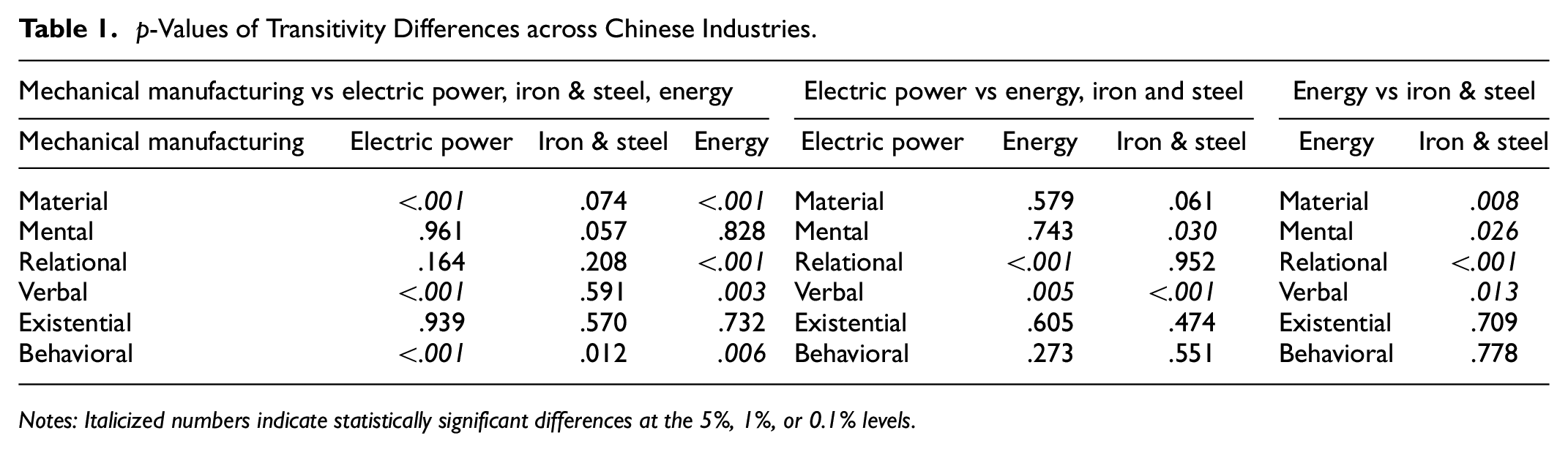
Notes: Italicized numbers indicate statistically significant differences at the 5%, 1%, or 0.1% levels.
Cross-industrial similarities and peculiarities listed in Table 1 gain us important insights into understanding transitivity as speech codes. First of all, the relational process occurs the most frequently in the energy industry on account of its industry nature and development trend. On one hand, the energy industry is faced with the highly-concentrated market, the monopolized transportation system, the unbalanced demand and supply, the high-risk exploration of new energy, and the close relation with the lower-reaches industries (J. Li, 2010). As an upper-reaches industry, the productivity and the price of the energy industry affect directly the cost and the competitiveness of the lower-reaches industries. And therefore, the industry nature determines the complex interconnection and the interrelation between the energy industry and other industries. Obviously, the complex relationship projects into the complexity of the relational process. On the other hand, the reform of the energy enterprises is the crucial focus of China’s economic system reform. Compared with other industries, the energy industry, in the transformation from the extensive management to the intensive and sustained management, is dealing with more complicated external environment—soaring production cost, enterprise restructuring, overcapacity, ecological responsibilities and so on. The industrial trend propels the energy industry to address more relational processes in the CSR reports.
Then, the transitivity code conformities between the mechanical industry and the iron & steel industry can be closely connected with their industrial interrelationship. The iron & steel industry is the backbone of the heavy industry, which, in turns, is representative of manufacturing. The main production raw materials of the mechanical manufacturing industry are iron and steel, so the two industries are critically related to each other. What’s more, factors such as the external environment, government regulations, and environment-protection duties influence them in quite similar ways. Therefore, industrial interconnection and similar realistic experience of the two industries result in similar categorization of experience and similar transitivity codes.
Finally, the energy industry is significantly different from the mechanical manufacturing industry and the iron & steel industry as with the relational process, the material process and the verbal process (as plotted in Table 1). This paper has discussed the first two processes in the previous sub-section. As for the verbal process, it accounts for 3.94% in the energy industry CSR reports, which is far lower than that in the other two industries. The verbal process means who says what to whom, and has stronger subjective indication. It could be used to quote opinions and declare one’s stand (Halliday, 2008). So a preliminary conclusion could be drawn that the mechanical manufacturing industry and the iron & steel industry have included more verbal processes to enhance persuasiveness in their reports than the energy industry.
So far, this study admits that the cross-industrial differences might partly result from varied translation strategies. However, the previously-mentioned findings also suggest that within the same national cultural framework, Chinese enterprises interpret messages largely by the use of culturally-distinctive transitivity codes pertaining to communicative conducts. The cross-industrial conformities and peculiarities in the use of transitivity processes endorse Proposition 6. That is, corporations within a specific industry make their unique use of shared transitivity patterns. Understanding certain patterns of transitivity processes is a sufficient condition to predict, interpret, and control communicative conducts within a particular industry.
Conclusion
SCT posits a way for us to present and interpret observed communicative conducts. It illuminates the way we can communicate strategically and the way we may fit into a community effectively (Bassett, 2017). By showing the cultural meaning of transitivity patterns and their application variations in CSR reports in guiding communicative conducts, this paper illustrates how transitivity codes, once perceived and described, might be used to present and explain communicative conducts in various communities.
Aimed at exploring the link between culture and communication, and the connection between transitivity verbs and contextually-constructed meanings in the business text, a discourse analysis was performed on the CSR reports. To recapitulate, the transitivity patterns in CSR reports display both similar and differentiating features between Chinese and British/American corporations. Answers to the current research questions are summarized as follows: (1) the overall frequency of transitivity processes in CHCSR reports is prominently lower than that in BACSR reports; and the material process, the mental process, the relational process and the existential process are significantly different in the cross-cultural sense; (2) the CSR reports makes greater use of the relational process across the sub-corpora, which can be concluded as the typical discourse characteristic of the CSR reports; and (3) the cross-industrial comparison in the case of Chinese enterprises shows similar transitivity patterns among the mechanical manufacturing industry and the iron & steel industry, but significant differences are found between the energy industry and the mechanical manufacturing industry, and between the energy industry and the iron & steel industry. The distribution similarities and differences of transitivity processes could be explained linguistically and socially. Factors might involve languages and cultures, political systems, translation strategies, move frameworks, industry nature and industry development trends.
The current study includes CSR reports from corporations listed in Fortune Global 500 in 2021. While this may provide a good representation of large corporations, it may not accurately reflect the use of transitivity in smaller organizations. At the same time, it has not included all the verbs in CSR reports under investigation, and thus fails to capture the overall understanding of the transitivity patterns in the reports. What’s more, future work on the transitivity processes of business reports can make a more detailed exploration into the original Chinese-medium CSR reports by Chinese corporations, and therefore the degree to which the transitivity process is influenced by translation strategies or L1 could be evaluated. However, by comparing the distribution attributes of the transitivity processes, this paper might help Chinese enterprises better understand lexical and functional conformities and peculiarities between Chinese and British/American CSR reports, and the cultural and ideological backgrounds reflected from them. On one hand, transitivity codes could enhance interactions within a community. On the other hand, they might be detrimental to exchanges across communities. It is important for writers/translators of Chinese CSR reports to understand the diverse English varieties in the international interaction, the attributes of the English variety they use, and the impact that their variety might have on international readership. Approaching to and acting on rhetorical norms regarding transitivity as speech codes in the international community and in the industrial community, Chinese enterprises need to stress the need to involve the communication function at the strategic level by appropriately expressing and accurately translating the six transitivity processes which directly shape the cross-cultural communication. In this way, corporations may enhance their corporate narration, and thus reinforce communication with the general public. Paying more attention to both the content and the language in CSR reports, Chinese CSR expertise should specifically gain further insight into the impact of their L1 and their domestic/industrial culture on the use of transitivity codes, as well as rhetorical preferences of the English-dominated culture in the international communities although this study contends that ELF should not be judged as correct or incorrect. Evidently, EFL is a variety of English with its own attributes, and with which Chinese corporations might tell better Chinese stories.
Footnotes
Appendix I Transitivity Processes and 100 Verbs
Acknowledgements
We appreciate anonymous reviewers for his/her effort to review our manuscript, and his/her positive feedback.
Declaration of Conflicting Interests
The author(s) declared no potential conflicts of interest with respect to the research, authorship, and/or publication of this article.
Funding
The author(s) disclosed receipt of the following financial support for the research, authorship, and/or publication of this article: Supported by the National Education Sciences Planning Projects (DIA190396).
Ethics Statement
Animals and humans subjects are not involved in the current study, and informed consent is not applicable.

Data Availability Statement
Data sharing not applicable to this article as no datasets were generated or analyzed during the current study.