




Abstract
This study aims to explore the logistics curriculum and the recruitment requirements and to compare the relationship between the two systems. Text mining is applied to collect data from an online recruitment website, extract latent topics, and dynamically visualize the extracted latent topics. The online and on-site survey is conducted to collect logistics curriculum syllabi from 29 selected universities in China. This study demonstrates that (1) The logistics curriculum direction in China mostly meets the employment demands; (2) The curriculum distribution does not fully match the employment demands. That is, knowledge areas of general management and logistics IT are over-supplied, whereas knowledge areas of transportation and distribution are under-supplied. It is suggested that to balance the actual talent demands, Chinese higher education should increase the courses concerning transportation and distribution and appropriately reduce the courses related to logistics IT, and universities need to apply course modules into the logistics curriculum revision to meet the changes in the demand of the employment market.
Plain Language Summary
This study examines the logistics course offerings and employment demands and further explores whether or not the current logistics curriculum in China meets the logistics demands of employers in the job markets. This study applies text mining to get up-to-date job data via online recruitment websites, obtains the logistics curriculum syllabi from 29 selected universities in China by the survey, and compares courses with employers’ requirements in China. The results demonstrate that knowledge areas of general management and logistics IT are over-supplied, whereas knowledge areas of transportation and distribution are under-supplied. This study provides new insights into the curriculum redesign for Chinese logistics Higher Education from curriculum direction and curriculum distribution, indicating how to balance logistics curriculum and employers’ demands in China.
Keywords
Introduction
The logistics industry is an essential industry for the development of national transportation or distribution. The total amount of social logistics for the first half of 2022 is 160 trillion Yuan, showing a year-on-year growth of 3.1% based on comparable prices according to the data from the China Federation of Logistics and Purchasing. Meanwhile, the application of emerging technologies such as big data, cloud computing, the Internet of Things, and blockchain is rapidly changing the traditional operation of the logistics industry (Huo & Weihua, 2022). Owing to the rapid development of the logistics industry and the application of emerging technology, the requirements and selection criteria for graduates in the logistics industry are constantly adjusted.
The quality of logistics graduates depends on the extent to which higher education is incorporated into the industry, and on whether logistics curricula can reflect the skills and knowledge required by the logistics industry. The inter-linkage in the logistics and supply chain education between practice and theory as well as its introduction to the classroom is not new (Bak & Boulocher-Passet, 2013). Much of the current literature focuses on the assessment of industry-education link (Sinha et al., 2016; van Hoek et al., 2011; Walden, 2020). Content and topics covered in logistics curricula are considered the dominant factors influencing the inter-linkage between the logistics industry and higher education (Allam, 2018; Drake et al., 2023), so universities must design proper curricula and find out the right topic of courses that keep up with the development of the logistics industry and cross-functional management of the logistics industry. However, the current logistics curricula offered by some universities in China are designed based on the availability of existing faculties and faculty (W. Li et al., 2019), and teachers are more inclined to arrange the content and topics of logistics courses according to their existing expertise. In addition, the logistics curricula offered by some universities do not take into account the evolution of the logistics industry, nor do they closely connect the working norms and technical requirements of the industry (Mao et al., 2019), which can not reflect the authentic job market demands and logistics industry needs. A recent study by Walden (2020) identifies a significant gap between educational offerings and industry needs. This situation is becoming increasingly complex due to the dynamic nature of the logistics industry and universities’ ability to respond with varying degrees of effectiveness (Birou et al., 2022; Walden, 2020). Therefore, it is necessary to explore how to incorporate the logistics industry relevance into the curriculum design (Jordan & Bak, 2016).
Given that, it is a matter of concern to accurately identify the changing skills needed in the logistics job market and further guide universities to offer logistics curricula that meet the market demands. With the application of big data and artificial intelligence in the logistics industry, the skills and knowledge required for graduates are also increasingly evolving. Thus, acquiring “live and accurate” data on skills and knowledge demanded by the logistics industry can provide a basis for the course offerings in universities (Y. Li et al., 2020). Some approaches, like questionnaire surveys, face-to-face interviews, and analysis of recruitment advertising, are often employed in the existing literature (Gammelgaard & Larson, 2001; Ni & Qin, 2017; Yew Wong et al., 2014). Compared with these traditional approaches (i.e., interviews and surveys) that are limited to companies or respondents, analysis of recruitment advertising can better fully reflect the skills and knowledge demanded across the logistics market and further help us to determine the skill sets required within the logistics industry, skill categories, and the proportion of each skill category to the total skill sets.
Presently, the logistics industry increasingly questions whether universities impart the requisite logistics skills to graduates while universities also have trouble grasping exactly which logistics skill sets are needed (Gravier & Theodore Farris, 2008). There is a gap between what is covered in logistics courses and employers’ expectations based on entry-level job descriptions and requirements (Walden, 2020) and this gap is widening (Fawcett & Rutner, 2014). To address this issue, it is imperative to compare the knowledge provided by logistics courses with the skill requirements specified in the job advertisements. This comparison can help determine if the supply (courses offered by universities) matches the demands (skills required by the logistics industry). While the current literature has discussed these issues, not all aspects are resolved. Luke and Heyns (2019) identified the skills required in the industry to determine if there was a mismatch between the supply and the demand of supply chain management. Yew Wong et al. (2014) compared curriculum design in the UK with employers’ job requirements by analyzing job advertisements from three salary brackets. Sinha et al. (2016) explored the gap between demand and supply of SCM-related knowledge areas and further examined how supply and demand were matched with the help of clustering analysis. However, little literature pays attention to the relationship between logistics employability demand and knowledge supply from the perspective of curriculum direction and curriculum distribution. This suggests that further research is needed to close this gap.
As mentioned above, the study aims to identify the skills needed by the logistics job market and courses offered by universities in China and compare skills with curriculum to determine whether the supply (courses offered by universities) matches the demands (skills required by the logistics industry). To fill the research gap, this study compares logistics job market demand with knowledge supply from a new perspective of curriculum direction and curriculum distribution, revealing different levels of relationship between job positions and courses: matching, under-supply, and over-supply. The results can aid in redesigning logistics curricula for undergraduates in China.
The rest of this paper is organized as follows. Section 2 presents the background literature for this study. Section 3 discusses the data and research method adopted in this study. Section 4 illustrates the research results. Discussion is reported in the subsequent section 5, and at last, the conclusion is provided.
Literature Review
Logistics Curriculum
Information technology is widely applied to various logistics-related activities such as warehousing, inventory control, transportation, distribution, and production scheduling and also influences the logistics course offerings (Bak & Boulocher-Passet, 2013; Jordan & Bak, 2016; Wehrle et al., 2021). To ensure the extent to which information technology is included in the overall logistics and supply chain curriculum, we must consider it a factor in logistics curriculum content (Drake et al., 2023). In addition to information technology, studies explore what knowledge topics can be integrated into the logistics curriculum. Wagner et al. (2020) concluded that entry-level graduates employed in the freight transport, distribution, and logistics sectors are supposed to grasp five categories of skills and knowledge. Gao (2021) divided the logistics curriculum into three main fields: logistics planning, logistics operation, and logistics informatization. By analyzing logistics curricula from 20 universities inside and outside Guangdong Province in China, Zou et al. (2019) argued that the topic of logistics knowledge should include five knowledge fields, namely modern logistics, management, economics, statistics, and engineering.
Introducing projects and entrepreneurial components into the curriculum is an effective way to make the logistics industry and university work together. The industry operation can be incorporated into the curriculum in the following ways: the adoption of consultancy projects (Bak & Boulocher-Passet, 2013; Jordan & Bak, 2016), multi-institutional partnership involvement(Long et al., 2012), collaborative curriculum design, and pre–and post–course activity(Bernon & Mena, 2013; Catalina et al., 2021; van Hoek et al., 2011). With the relevant projects as the background, teaching can be carried out in an industrial setting, ensuring that the students will solve practical issues in the logistics industry in the future (Jordan & Bak, 2016; Pawlewski & Pasek, 2011).
Skills and Knowledge Required by the Logistics Industry
When the necessary skills and knowledge are considered, there is consensus that the job market prefers applicants with suitable skills and knowledge, and those with ethical values as well as appropriate civic sense and responsibility (Agyabeng-Mensah et al., 2020; Ali & Kaur, 2021; Allam, 2020; Dziubaniuk & Nyholm, 2021; Sodhi et al., 2008). The existing literature concludes what kind of knowledge and skills are required in the job market. Hard skills, like quantitative analysis skill, mathematics, and statistics, along with information technology skills, are regarded as sustainable and core skills among other various skills, therefore the significance of hard skills is increasingly highlighted (Dubey & Gunasekaran, 2015; Kotzab et al., 2018; Mageto & Luke, 2020). However, hard skills are more likely to be replaced with updated technology over time while soft skills are less susceptible to technology development and digital innovations (Merkert & Hoberg, 2023). A survey conducted shows that educational, social, and psychological elements have an impact on college students, and solutions to these issues will promote the quality of graduates (Nasser Saad & Allam, 2013). At the same time, the logistics industry realizes and prizes the value of soft skills in the global logistics industry. It perceives soft skills, like six core personal values (Jensen & Knagaard, 2020), top competencies (Kilpi et al., 2021), and enterprise skills(Gekara & Thanh Nguyen, 2018), as more important skill sets, and argues that these soft skills can increase multi-skilled employees’ flexibility to deal with practical problems(Kilpi et al., 2021; Midgley & Bak, 2022). Due to the diversity of the logistics field and its functions, there are no dominating key skills. As such, soft skills will be of similar importance to hard skills and will stay for the next many years (Merkert & Hoberg, 2023).
Besides, there is a debate on the priority of skills and knowledge demanded by the logistics job market. The survey by Africa Luke and Heyns (2019) gauges students’ perspectives on logistics and supply chain requirements and then compares them with industry perspectives. They confirm that compared with vocational students, university students rate hard skills as more important (Luke & Heyns, 2019). Other studies indicate that countries and regions affect the priority of skills and knowledge. Course offerings in continental nations show that the major subjects such as logistics, information technology, and operations management are listed as top logistics fields, and those in island nations demonstrate that transportation, logistics, and information technology are ranked in the first three places (Jim Wu, 2007).
Fast-emerging technology makes the job market increasingly dynamic and changes the way logistics is practiced, causing desired skills in the logistics industry to change continuously (Armin et al., 2022). Therefore, it becomes crucial to identify skills and knowledge sets according to variations in demand and distribution of jobs (Armin et al., 2022). It has demonstrated that collecting data from job advertisements and using text mining to analyze the required skill sets is a feasible way to cope with the current changes in logistics jobs and skills (Yew Wong et al., 2014).
Reviewing the current literature, we discovered that an increasing number of studies concerning the matches of logistics curriculum provision and job requirements have emerged with different perspectives and approaches. Nevertheless, limited empirical studies are available to support logistics curriculum design in China. Additionally, the existing studies ignore the comparison between the curriculum direction and the demand direction, as well as the curriculum distribution and the demand distribution. This study contributes to filling the gap by applying text mining to quantify the job market needs, examining the correlation of required skills, knowledge, and courses, and exploring the relationship between employment demands and logistics curriculum based on the curriculum direction and distribution.
Research Methodology
Data Collection
Data acquisition involves two aspects: job data from an online recruitment website and the selected undergraduate logistics courses (see Figure 1).

Diagram of analysis process based on text mining.
Data Acquisition of Online Recruitment
We adopted the third-party library of web crawler Pyppeteer to get publicly accessible recruitment data from the recruitment website. The recruitment website “51job.com” in China occupies large market shares in the Chinese online recruitment industry. Thus it is selected as the data source, guaranteeing that we have access to large samples of the job market. Job postings on this website offer real-time data on the qualifications across industries and regions. Each job posting on this website clearly describes the types of logistics job vacancies, educational background, working experience, the required skills, and knowledge. This study captured and simulated the processing of the slider verification, processed page hopping for job posting data, and used concurrent threads to prevent resource exhaustion and to improve crawling effectiveness to access the available data. Besides, the type of job searched is “full-time,” the posting date is “within a week,” and the period for crawling the data is from July 18 to July 22, 2022.
Data Acquisition of Logistics Curriculum
This study conducted both online and on-site surveys of 29 Chinese universities that offer logistics courses. These universities are selected because they either open the logistics major earlier or rank high in the logistics discipline. As such, these samples provide a strong representation and ensure us to identify most of the logistics courses in Chinese universities. The overall curricula of higher education in China are divided into five parts: general education courses, basic knowledge courses, professional courses, practical courses, and innovation and entrepreneurship courses. Professional courses represent, to a certain extent, the strengths of the discipline and the direction of talent training, so this study takes them as the curriculum samples.
Data Preprocessing
When filtering the collected logistics job data, we followed the following steps. Firstly, we removed words and records unrelated to logistics courses (such as take-away, etc.). Then, records with null posting requirements were deleted, and 10,050 valid data were obtained after removing duplicate and vacant values. Next, a self-defined Chinese word segmentation dictionary was constructed using the Jieba Chinese word segmentation package. Finally, high-frequency words (like “logistics” and “management”) and irrelevant words (like prep, conj, etc.) with no practical meaning in the text were added to the stop-words list for elimination. As a result, recruitment text information was split into various words after data preprocessing.
Topic Extracting
This study conducted word frequency statistics for job positions to determine the most commonly mentioned job positions in a given dataset. Then, we visualized the analysis results using a word cloud graph. Different companies may have various descriptions of the job title or requirements for the same position in job advertisements. Aiming to determine the skill requirements for job positions, this study employed the LDA (latent Dirichlet allocation) topic model to cluster the skills required by each position.
The LDA model is a generative Bayesian probabilistic model with a three-layer structure of word, topic, and corpus, which applies the approach of Gibbs sampling to its implementation. Figure 2 depicts the LDA modeling as follows where:
D indicates the number of documents. N is the number of words in the document.
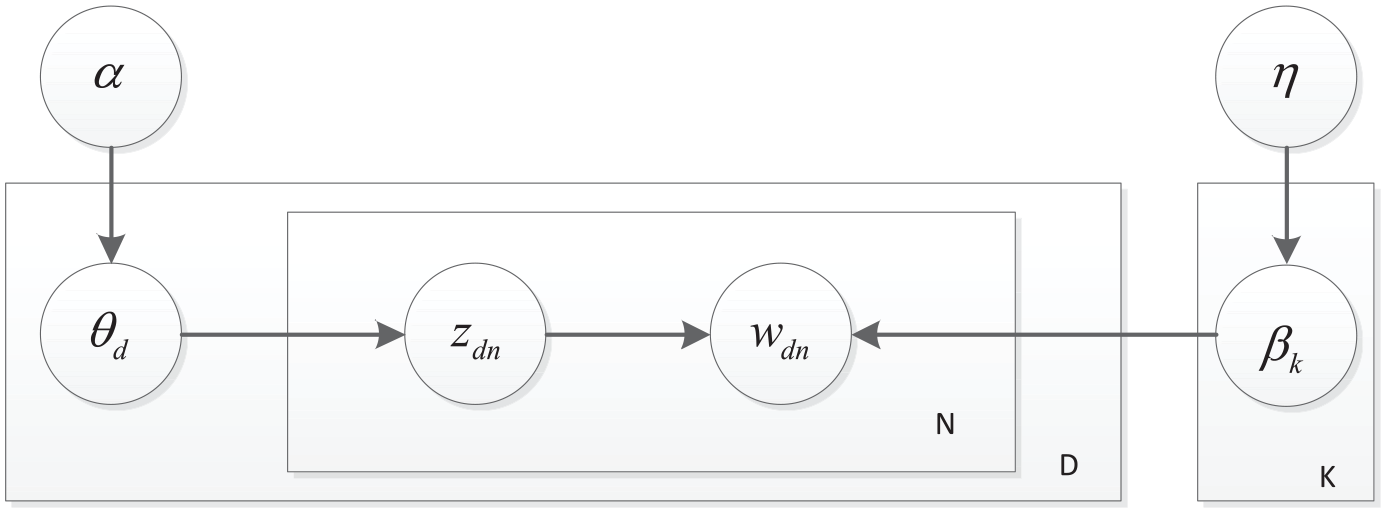
Latent Dirichlet Allocation (LDA) Model.
It can be seen that the LDA model is a hierarchical model with three layers: The first layer is corpus level and
This study acquired the joint distribution
The joint distribution of topics and words is given by:


Next, the conditional probabilities required for Gibbs sampling are calculated:


Finally, the conditional probability of Gibbs sampling for each word corresponding to the topic is depicted as follows:

With conditional probabilities, the topics of all words are sampled with Gibbs sampling, and the distribution
Results and Analysis
Analysis of Logistics Jobs
Educational Background, Work Experience, and Job Position
Despite the importance of educational background, the results reveal less demand for senior-level practitioners with master’s or doctoral degrees. Those applicants for mid-level job positions (67.7%) are expected to have a college degree and above. In contrast, operation-related jobs account for about 32% of the advertised positions, and these applicants are expected to have technical secondary education or below.
Work experience is considered a necessity for most logistics-related positions. Those applicants at the mid-level or even senior level are expected to have at least 5 to 7 years of experience working in related fields. Logistics technical positions (8.75%), including system engineers, planning engineers, project engineers, and other similar positions, require applicants with at least 5 years of experience. It is observed that only 94 positions, accounting for 0.93% of total positions, ask for more than 10 years of experience. In contrast, those vacancies at lower levels do not need experience.
Word cloud graph is a visual representation of word frequency, where the size of each word is proportional to its frequency in the dataset. It can be seen from Figure 3 that high-frequency job positions are related to jobs at mid-level and slightly lower levels in warehousing and freight forwarding.

Word cloud graph of job positions.
Visualization of Skill Clustering
This study extracted keywords of skill requirements and divided them into different topics. After deploying the LDA model on the dataset and modifying parameters

Visual analysis of skill topic extraction.
It can be seen that in Figure 4, there are four circles, each representing a specific skill topic. The larger the size of the circle, the more that topic is presented in the data (Armin et al., 2022). When each circle is selected on the left, the right panel shows the overall description of the skill topic. λ parameter can be adjusted from 0 to 1. If λ is close to 1, and words with high frequency in this topic are more relevant to the topic; If λ is close to 0, the special and unique words in this topic are more relevant to the topic.
The visual result of skill clustering illustrates that the skills required by the logistics industry can be divided into four categories (see Table 1), namely general management (GM), transportation and distribution (TD), warehousing and inventory (WI), and logistics IT (LIT). According to Table 1, general management is the most requested skill (35.3%), followed by transportation and distribution (23.6%), warehousing and inventory (22.4%), and logistics IT (18.6%). The top 10 topic keywords for each skill topic are summarized in Table 1.
Topic Heading of Skills.

Topic 1: General Management (GM). The top topic words mainly include product, customer, project, process, sales, planning, transportation, supply, order, and cooperation, etc (see Table 1, topic 1). These topic words indicate that applicants are expected to have such qualifications as the ability to grasp market changes, to be familiar with relevant processes in the supply chain, to effectively plan and integrate resources, to understand products, to identify and guide customer needs, and to further develop potential customers.
Topic 2: Transportation and Distribution (TD). The main topic words extracted from TD are customer, document, transportation, customs, order, shipping, etc (see Table 1, topic 2). The topic is associated with transportation, distribution, and international trade, where English might be a necessity in international transportation. In such a field, applicants are expected to coordinate transportation or distribution tasks and to track or solve various problems in the process of transportation. Additionally, more applicants involved in cross-border transportation business are expected to be good at English, to communicate with foreign agents, and to be professional in international trade and customs business. Relevant job positions include transportation specialist, documentary, freight forwarder, shipping (international logistics) operation, etc.
Topic 3: Warehousing and Inventory (WI). Topic 3 focuses on receiving and inspection, inventory, process, warehousing, system materials, shipping, and operation (see Table 1, topic 3). The most common requirements for individuals include the ability to dispatch items, familiarity with warehouse operation processes, effective communication with customers, and handling customer needs and feedback. Additionally, the applicants should be proficient in operating material resource planning (MRP), enterprise resource planning (ERP), and other warehouse information systems to carry out daily warehousing tasks. Job titles related to these skills include logistics specialist, sorter, warehouse supervisor, warehouse specialist, etc.
Topic 4: logistics IT (LIT). The skills mentioned in this category are mainly for certain industry logistics (e.g., industry logistics of smart cars) or focusing on technical capabilities in the logistics industry (see Table 1, topic 4). The top words in topic 4 relate to the following aspects: simulation, warehousing, customer, sales, software, analysis, planning, C++, etc. The duties in topic 4 include validation of intelligent logistics through simulation, identification of system bottlenecks, optimization of proposed solutions, and familiarity with software, among others. Relevant job postings include logistics simulation engineer, logistics engineer, logistics technology planning engineer, logistics planning engineer, etc.
The skills and knowledge required for the same type of job vary greatly depending on position level. Applicants in higher-level positions are expected to have a more comprehensive set of knowledge and skills compared to those in lower positions. For example, warehouse keepers are only required to do daily operational-level tasks such as stock in/out and inventory checks. Warehouse managers then need to be responsible for warehouse management and control, such as vehicle scheduling and arrangement, rationalization of warehouse layout, and inventory control. In contrast, warehouse supervisors should be able to improve warehouse systems and workflow, such as establishing risk control mechanisms and being responsible for quality control of distribution operations. Besides, this study demonstrates that, unlike applicants for lower-level positions, applicants at senior-level positions emphasize more “soft” qualities, such as pressure resistance, decision-making, and forecasting ability.
Analysis of Logistics Curriculum
Table 2 depicts the relationship between job skills, knowledge, and the corresponding courses. Specifically, GM direction can be divided into six categories of knowledge. These categories correspond to the following course modules: supply chain management, logistics (distribution) center planning, project management, logistics operation (production) management, purchasing and inventory management, and logistics facility and equipment. TD direction has four categories of knowledge. These categories are covered by the following courses: shipping and distribution, international logistics and freight forwarding, international trade, and logistics English. WI knowledge is covered by the following courses: warehousing and inventory control, logistics system engineering, accounting, and decision theory and methods. LIT direction has five groups of knowledge areas. These areas correspond to courses such as logistics system modeling and simulation, advanced language programing, database, logistics information system, and logistics information technology (see Table 2).
Job Skill-Knowledge-Course.
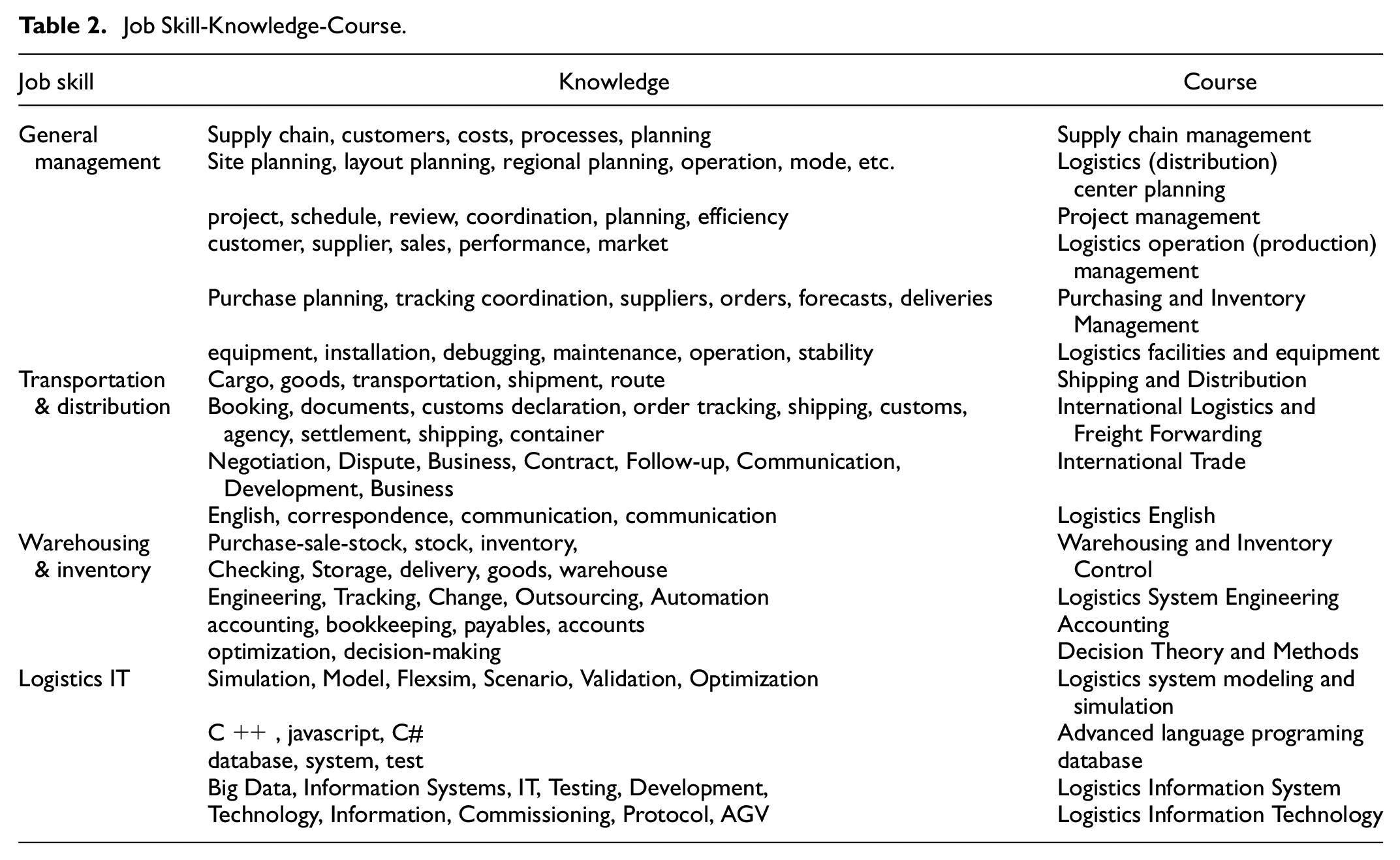
Figure 5 demonstrates that nearly all universities allocate more courses in the GM direction, with the proportion ranging from 30% to 50% in the 29 selected universities. The distribution of WI courses is different from that of TD courses, with most universities offering more WI courses and fewer TD courses.

Curriculum structure of the selected universities.
Besides, Figure 5 also reveals several interesting patterns in the curriculum structure: Firstly, there are two extremes in terms of the proportion of LIT courses in the overall curriculum. Number 19 has around half LIT courses to the whole curriculum but number 27 does not offer any courses in this direction. Secondly, as far as TD courses are concerned, three universities (number 9, number 12, and number 19) do not offer any TD courses. Thirdly, number 18 over-emphasizes TD courses (a high proportion of 45%) at the expense of WI courses. Finally, number 12 and number 19 have a high proportion of WI and LIT courses, respectively, in their respective curriculum structures.
To sum up, Figure 5 illustrates the comparison of the curriculum structure of the selected universities and their distinct differences in structure, which reflect the subject strengths of each university. For example, with its shipping strength, Dalian Maritime University in China focuses on serving international logistics and offers more TD courses such as international container transportation and port logistics.
Comparison of Curriculum Supply and Employment Demand
Curriculum Direction and Demand Direction
To analyze the curriculum direction, this study assumes that if the courses offered can meet more than half of the course requirements of a certain employment demand direction, it is considered that this university offers courses in this direction. Taking Huazhong University of Science and Technology as an example, the database principle, logistics system modeling, logistics information system, and logistics information technology offered by this university are all required courses in the LIT direction. The number of courses is more than half of the required courses in the LIT direction, so it is believed that Huazhong University of Science and Technology offers courses in the LIT direction.
As can be seen from Figure 6, there are 25 universities offering courses in the GM direction (86.2%), 14 universities with courses in the TD direction (48.27%), 24 universities offering courses in the WI direction (82.8%), and 15 universities offering courses in the LIT direction (51.7%). Except for the slightly insufficient TD courses, courses in the other three directions are all above 50%.

Comparison of curriculum direction and demand direction.
To sum up, it is concluded that the logistics curriculum direction offered by higher education matches the demand direction.
Curriculum Distribution and Demand Distribution
Figure 7 shows that the GM direction has a significantly higher proportion of courses and of employment demand than the other three directions. As “ a given” knowledge requirement, the proportion of GM courses (40.6%) is much higher than that of the employment demand in the GM direction (35.3%). Next, the proportion of employment demand in the two directions of TD and WI is roughly the same, 23.6% and 22.4%, respectively. However, as far as the proportion of courses offered is concerned, the proportion of TD courses (15%) is much lower than that of WI courses (22.3%). Except for a small number of universities like Shanghai Jiao Tong University and Dalian Maritime University that have obvious transportation and distribution disciplines, there are not many universities in China that offer courses in the TD direction. Most universities only offer TD-related courses and have no specific curriculum directions. At last, the proportion of LIT courses (22.1%) is higher than the actual market demand (18.6%). Contrary to expectations, although fast-emerging information technology has promoted the transformation and development of the logistics industry, the demand for talent recruitment in this direction is not high.
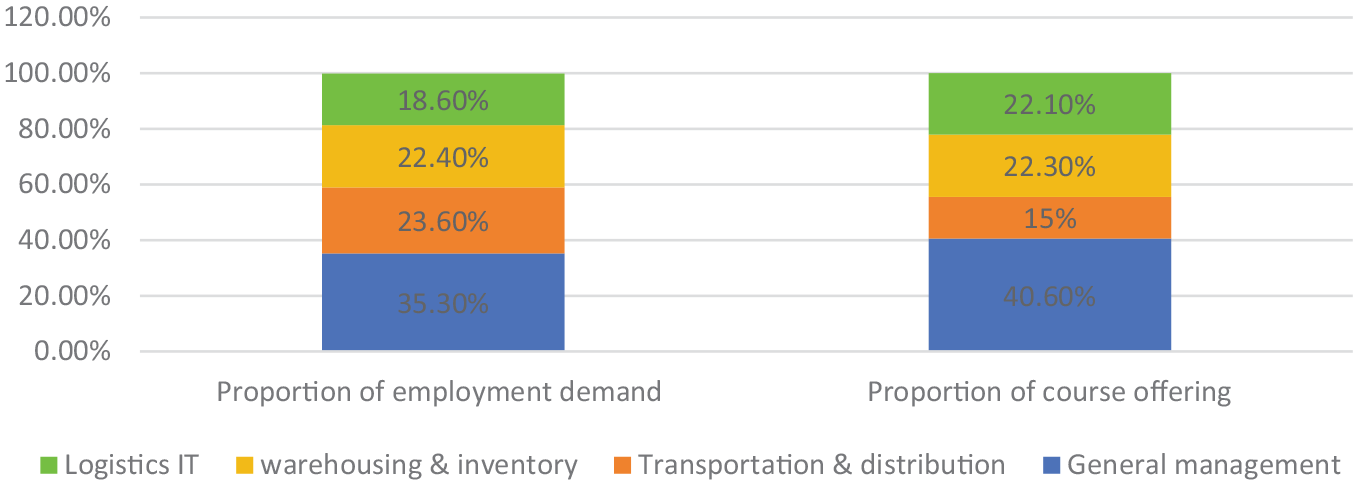
Comparison of curriculum distribution and demand distribution.
Comparing Figure 5 with Figure 7, it is evident that some universities (number 22, 24, 29) offer courses that align with the employment demand shown in Figure 7. What is interesting about the results is that some universities emphasize LIT knowledge rather than GM. For example, universities number 2, 13, 17, and 19 in Figure 5 attach importance to LIT courses, which occupy nearly 50% of the overall curriculum. However, it is worth noting that the demand for LIT in Chinese central and western regions is not high, which leads to the curriculum exceeding expectations in this area.
Taken together, it is discovered that the supply of talent in the GM and LIT directions is greater than the market demand, and the supply of talent in the TD direction fails to meet the market demand.
Discussion
In this study, we set out to discuss the needs of Chinese logistics job market and courses offered by universities, and further explore the balance between logistics courses and the requirements of the logistics industry.
Firstly, this study analyzed the job information gathered from online recruitment websites. One unexpected result is that the logistics industry in China prefers more experienced practitioners with bachelor’s degrees or below to highly educated personnel at the senior level. It is thus suggested that the logistics industry in China prioritizes practical skills and experience over academic qualifications. The result is similar to Jim Wu’s (2007) findings that many experienced low-level practitioners are more likely to be less educated. This result also supports Lancioni et al.’s (2001) conclusion that undergraduates are more likely to move from logistics to other industry sectors at the graduate level due to a lack of interest in the logistics profession, resulting in fewer highly educated practitioners in the logistics field. The low demand for highly educated personnel may also be attributed to the nature of the logistics industry, which requires more problem-solving and hands-on practical skills rather than too much theoretical knowledge. Another obvious result to emerge is that job skills required by the logistics industry in China can be divided into four categories: GM, TD, WI, and LIT. The classification result again shows that text mining and visualization are feasible in analyzing the demand classification of the job market, and this is consistent with previous literature on using text mining to analyze demand (Fareri et al., 2020; Thirumoorthy & Muneeswaran, 2023; Xue & Yue, 2022). The skills required in the logistics industry can be classified into different categories depending on the methodology or purpose. The classification methods and results of this study differ from previous literature (Y. Li et al., 2020; Rahman & Qing, 2014). Rahman S et al. used a survey questionnaire and expert opinion to gather data, then grouped skill items into different categories: supply chain general management (SCG), supply chain analytical (SCA), supply chain information technology (SCIT), and supply chain environmental-related (SCE). Y. Li et al. employed the LDA model to cluster job skills and knowledge and roughly divided logistics functions into two categories, namely international skills and basic skills. The limitation of the above studies is that they cannot show the details and gaps between skill categories and courses. Going beyond the results of prior studies, this study provides a more comprehensive and detailed classification of skills required in the logistics industry by text mining.
Secondly, this study examined the correlation between logistics skills, knowledge, and logistics courses, as well as the structural differences in the logistics curriculum of various universities. The idea of correlation studies is similar to previous literature (Bak & Boulocher-Passet, 2013; Birou et al., 2022; Jordan & Bak, 2016; Wagner et al., 2020). Sauber et al. (2008) developed a matrix that mapped courses to skills and knowledge and helped establish the correlation between skills, knowledge, and courses. Birou et al. (2022) compared the skills and knowledge required by the topics and content covered in logistics curricula to determine the number of course topics aligned with skills, then provided insights for refining and improving the curricula. Besides, this study reveals that the structure of the logistics curriculum varies considerably from one university to another, which is reflected in the different course weights. The results demonstrate that GM courses make up more than one-third of the total logistics courses in most universities. In contrast, TD courses account for the lowest proportion of the overall courses. The results support the argument that general management knowledge is more important than specific knowledge in logistics and supply chain management (Jim Wu, 2007; Luke & Heyns, 2019; Rahman & Qing, 2014; Wagner et al., 2020). In addition, the results contribute to the debate on whether transport and distribution should be a higher priority in the logistics field (Jim Wu, 2007; Luke & Heyns, 2019). Luke and Heyns (2019) regarded transportation management as an important knowledge area, so courses in this area should be paid more attention. However, it is worth noting that transportation-related courses in China receive lower priority compared with Western countries (Jim Wu (2007). Our study supports this claim, as we observe that most universities surveyed offer more courses on WI and LIT, but fewer courses on TD. This further substantiates the results reported by Jim Wu (2007).
Thirdly, we assessed whether the course offerings in China meet the requirements of the logistics job market. Going beyond previous studies (Jim Wu, 2007; Yew Wong et al., 2014), this study examined both matches and mismatches between the curriculum and employment requirements from two perspectives: curriculum direction and curriculum distribution. The results show that logistics courses offered in Chinese universities can meet the four main employment demand directions. However, when comparing the curriculum distribution with the demand distribution, the results illustrate that despite the well-matching between supply and demand of knowledge areas of WI, knowledge areas of GM and LIT are over-supplied while the ones of TD are under-supplied. Overall, while the curriculum direction in logistics courses in China meets the employment demand, there is a mismatch in the curriculum distribution. Therefore, universities need to adjust the proportion of logistics courses to satisfy the demands of the logistics job market.
Conclusion
This study is designed to discuss logistics course offerings and employment demands and determine the gap between the supply and demand of logistics-related knowledge areas. This study reveals an imbalance between logistics knowledge supply in higher education and logistics industry demand in China. It is found that the logistics curriculum direction can satisfy employment direction in the logistics industry in China. However, curriculum distribution does not fully align with employment demand: courses in the general management and logistics IT direction are over-supplied, while those in the transportation and distribution direction are under-supplied. Besides, this study also indicates that the employment demand direction of the logistics industry in China can be classified into four categories, and the skills required in these four categories correspond to different knowledge areas and specific courses. In addition, the most unexpected finding to emerge is that experienced applicants with some level of formal education are more expected than highly educated applicants at the academic level.
These findings have practical implications for understanding how to balance the supply and demand of logistics areas in China. To balance the actual talent demands, universities should consider increasing the courses in the transportation and distribution module, while appropriately reducing the courses in the logistics information system module. By reallocating course resources, universities can better satisfy logistics industry needs in different employment directions. Furthermore, the results highlight it is essential for Chinese universities to revise and update the logistics curriculum with the help of the modularity of the logistics curriculum structure. This approach not only enables universities to adapt their curriculum more easily to the changing demands of the job market but also provides students with more flexible skill sets.
Our analysis is subject to at least two limitations. Without access to reliable and accurate postgraduate courses, it becomes difficult to consider both postgraduate and undergraduate logistics courses in this study. When postgraduate courses are available, future studies can shed more light on logistics course analysis and comprehensively measure the relationship between supply and demand in the logistics industry. Besides, this study cannot measure the extent to which a course is involved in two skill topics or how the overlapping of different courses influences course classification. Further research is needed to quantify the overlapping of course content and the multiple skills involved, which will provide a more accurate reference for redesigning the logistics curriculum.
Footnotes
Declaration of Conflicting Interests
The author(s) declared no potential conflicts of interest with respect to the research, authorship, and/or publication of this article.
Funding
The author(s) disclosed receipt of the following financial support for the research, authorship, and/or publication of this article: This research was supported by project: The “Light of Textile” Higher Education Teaching Reform Research Project of China Textile Industry Federation “Research on the innovative model of logistics personnel training based on industry-education integration ecosystem” (Project No: 2021BKJGLX507), and by Philosophy and Social Science Planning Project of Henan Province (Project No: 2022BZZ015).

Data Availability Statement
Data sharing not applicable to this article as no datasets were generated or analyzed during the current study.