



Abstract
This research aims to scrutinize the impacts of perceived feasibility (PF), propensity to act (PTA), perceived desirability (PD), self-efficacy (SEE), and family support (FS) on digital entrepreneurial intentions (DEI). Applying the Entrepreneurial Event Model (EEM), this study employs a quantitative research approach to investigate the hypotheses. The sample of 344 valid observations comprises university students from an emerging economy, strengthening the study’s relevance to emerging markets. The findings regarding interaction effects were mixed, with FS presenting no moderating effect on the relationship between PF and PTA with DEI. Conversely, FS demonstrated a significant moderating role in the relationships of PD and SEE with DEI. This study significantly contributes to entrepreneurial literature by applying and extending the EEM model to digital entrepreneurship in emerging economies. The research also promotes societal development goals by underscoring the transformative power of digital entrepreneurship for inclusive and sustainable growth.
Plain Language Summary
Why do people in developing countries want to start their own online businesses? In this study, we looked at factors like how confident they feel about it, how much they desire it, how feasible it seems, and whether they receive support from their families. We collected data from 344 university students in a developing country to better understand these factors. Family support is important, but it doesn’t always make a big difference when people think about starting an online business. However, when people really want to start a business or feel confident about it, family support plays a significant role in their decision. This research is essential because it helps us understand what motivates people to become online entrepreneurs in places where the economy is still growing. It also shows that online entrepreneurship can be a powerful force for making these economies grow and become more inclusive, which means more people can benefit.
Keywords
Introduction
The digital revolution has triggered a transformative shift in entrepreneurial models, demanding a rethinking of traditional frameworks to align with digital realities (Qiu et al., 2021; Ulhøi, 2021). This shift involves integrating digital technology into existing businesses and initiating digital-first ventures, promoting digital entrepreneurship (Chopdar et al., 2022; Franco et al., 2021; Manea et al., 2021). Digital entrepreneurship refers to the process of innovating and creating new business models and opportunities through digital technologies (Amit & Zott, 2015; Autio et al., 2018; Modgil et al., 2022; Nambisan, 2017; Nambisan et al., 2019; Nambisan & Baron, 2021; Nambisan & Luo, 2021). Digital entrepreneurship is crucial in transitioning from linear to circular economies, fostering sustainable practices (Manea et al., 2021). Its importance in economic growth and employment creation in developed and developing nations is well recognized (Savastano et al., 2022; Shkabatur et al., 2022).
A digital leader, as characterized by Kane (2019), is not just a technologically adept individual or entity but also a transformative figure that employs digital technologies to not only achieve organizational objectives but also to enhance innovation. This transformative journey is echoed by Westerman et al. (2014), who extend the definition to include those who are proficient in utilizing digital technologies to elevate business performance and operational agility. The narrative of a digital leader is further enriched by Fitzgerald et al. (2014), who emphasize the strategic employment of digital technologies to navigate the complexities of digital transformation and secure a competitive edge. In weaving these perspectives together, a coherent depiction of a digital leader emerges as a multifaceted individual or entity, adept at strategically harnessing digital technologies to navigate the intricate landscape of digital transformation, driving organizational innovation, performance, and competitive advantage.
Scholars have studied various aspects of digital entrepreneurship, including its role in the SMEs (Chatterjee et al., 2022; Franco et al., 2021), its influence on regional entrepreneurship and economic growth through digital finance (Jiang et al., 2021; Kajol et al., 2022), and the need for a supportive ecosystem for it to thrive (Dong, 2019; Sachitra & Chinthaka, 2022). Community orientation in digital entrepreneurship is further enhanced by incorporating native value systems like Ubuntu (Abubakre et al., 2021). Several studies have explored factors affecting entrepreneurial intentions among tertiary students in emerging countries (Maheshwari, 2022; Maheshwari et al., 2022; Maheshwari & Kha, 2022). These studies indicate varied influences, including cultural perspectives, risk-taking and locus of control (Younis et al., 2020; Youssef et al., 2021).
However, the nuanced impact of digital technologies on the entrepreneurial ecosystem in emerging markets remains underexplored, particularly the unique challenges and opportunities digital platforms present for young entrepreneurs. This includes investigating the impact of constructs of the Entrepreneurial Event Model (EEM) such as perceived feasibility (PF), propensity to act (PTA), perceived desirability (PD), and self-efficacy (SEE), family support (FS) on digital entrepreneurial intentions (DEI) (Aldrich & Cliff, 2003; Audretsch et al., 2017; Bandura, 1982; Chen et al., 1998; N. Krueger, 1993). Further, existing studies have primarily focused on traditional entrepreneurship, leaving a gap in understanding the distinct pathways and barriers for digital entrepreneurship in these regions, particularly in relation to family dynamics and social networks (Davidsson et al., 2020; Kajol et al., 2022; Nambisan, 2017; Paul et al., 2023; Zaheer et al., 2019).
Moreover, FS, as delineated by Aldrich and Cliff (2003), refers to the tangible and intangible resources provided by family members to entrepreneurs, aiding in the establishment and growth of the business ventures. The specific dynamics of family support in digital entrepreneurship, such as the transfer of digital skills and knowledge within families, and its influence on young entrepreneurs’ decision-making processes, have not been adequately explored (Rogoff & Heck, 2003; Sun et al., 2022). Theoretical frameworks suggest that familial encouragement and resources can significantly influence an individual’s propensity to engage in digital entrepreneurship (Patel & Thatcher, 2014). Moreover, family background provides both tangible and intangible assets, which can be leveraged in the digital entrepreneurial journey (Cruz et al., 2012). Additionally, family dynamics and relationships can either foster or hinder the risk-taking propensity essential for digital ventures (Aldrich & Cliff, 2003). However, FS in digital entrepreneurship, especially in cultures where family plays a significant role in career choices, is also under-researched (Aldrich & Cliff, 2003; Daspit et al., 2017; Mungai & Velamuri, 2011; Sharma & Kumar, 2023). Thus, this study seeks to delve deeper into how FS, particularly in the digital context, shapes the entrepreneurial aspirations and actions of university students in emerging economies (Aldrich & Kim, 2007). This study aims to address these gaps by exploring the potential of university students as future digital entrepreneurs in an emerging country, focusing on the factors that influence their entrepreneurial intentions and perceptions of digital entrepreneurship. It will explore various determinants of digital entrepreneurial choice, investigating the impact of core entrepreneurial constructs. It will add to the limited literature on the influence of FS on DEI, with a special focus on the interplay between digital skills, family support structures, and entrepreneurial ambition among youth in emerging markets (Baluku et al., 2020; Chang et al., 2009; Georgescu & Herman, 2020; Lingappa et al., 2020; Soluk et al., 2021; Yong et al., 2022; Zhu et al., 2017). The study also intends to examine the potential moderating effect of FS between these factors and DEI. Research questions (RQ) include:
RQ1. What factors significantly influence the intention of university students in emerging countries to pursue digital entrepreneurship?
RQ2. What role does FS play in moderating the impact of PF, PTA, PD, and SEE on the DEI of university students in an emerging country?
Addressing these questions makes substantial contributions to the field of entrepreneurship. This research significantly contributes to entrepreneurship by addressing numerous gaps in the existing literature. For one, it expands the scope of the EEM (N. Krueger, 1993; N. F. Krueger et al., 2000) to include digital entrepreneurship, thus enriching the theoretical underpinnings of this relatively emerging field (Nambisan, 2017). Furthermore, it enhances our comprehension of the factors influencing DEI in developing economies—a crucial yet understudied topic (Davidsson et al., 2020). By studying the effect of FS on DEI, this research fills a critical void in current entrepreneurship literature, particularly concerning digital entrepreneurship (Aldrich & Cliff, 2003; Daspit et al., 2017; Mungai & Velamuri, 2011). Exploring FS as a potential moderating factor offers a novel lens to existing research on entrepreneurial intention, promoting a deeper understanding of how personal and contextual elements shape DEI (Aldrich & Kim, 2007; Audretsch et al., 2017). Besides, the insights gleaned from this study are valuable for educators, policymakers, and institutions supporting entrepreneurship, offering guidance on fostering digital entrepreneurship among university students in emerging economies. These insights align with the increasing acknowledgment of digital entrepreneurship’s role in promoting economic growth and social development (Nambisan, 2017). Understanding the complex relationship between PF, PTA, PD, SEE, FS, and DEI allows us to design education programs for prospective digital entrepreneurs. Policymakers may use these findings to establish supporting policies and frameworks that recognize and include family in digital business. Entrepreneurial support institutions might use this study to improve their services and programs for digital entrepreneurs.
The remaining structure of this paper is as follows: Section 2 delves into a comprehensive review of relevant literature, establishing the theoretical framework. Section 3 details the research methodology, elucidating the approaches and procedures used. Section 4 is dedicated to the presentation of our empirical findings. In Section 5, these findings are discussed in relation to the existing body of research. Section 6 addresses the implications, limitations, and avenues for future research arising from our study. The paper concludes with Section 7, which synthesizes the main insights and encapsulates the study’s overall contributions.
Literature Review
Digital Entrepreneurship
Digital entrepreneurship refers to utilizing technology and online platforms to establish new ventures, develop innovative products, and deliver unique services within the digital realm (Modgil et al., 2022; Shen et al., 2018). It involves leveraging various digital channels such as the internet, social media, mobile devices, and e-commerce to identify and capitalize on business opportunities (Modgil et al., 2022). With the help of an internet connection and a promising idea, digital entrepreneurs can attain a global reach and expand their market presence (Kraus et al., 2019; Sturgeon, 2021). This approach enables individuals and organizations to create value in the digital economy by leveraging technological advancements and harnessing the potential of digital platform (Paul et al., 2023). Digital platforms, infrastructures, and technology have transformed innovation and entrepreneurship, creating new e-commerce businesses, markets, and software. These developments provide a favorable environment for entrepreneurs, with data analytics offering insights into customer needs. However, the technological shifts driving digital entrepreneurship necessitate further research (Nambisan, 2017; Nambisan et al., 2019; Nambisan & Baron, 2021; Nambisan & Luo, 2021). The effects of digital technology extend to industries, markets, and societies, influencing economic development, industrial structures, entrepreneurial models, and lifestyles (Horváth & Szabó, 2019; Kraus et al., 2019; Pan et al., 2022; J. Wang et al., 2022; Wei et al., 2019; Yen & Hong, 2023). Thus, modern entrepreneurship increasingly relies on digital tools to identify and exploit entrepreneurial opportunities (Acs et al., 2021; Udovita, 2020).
Entrepreneurial Event Model (EEM)
The EEM model, first presented by N. Krueger (1993), forms an integral part of the theoretical foundation for empowering digital entrepreneurs (Pérez-Macías et al., 2023; Usman & Sun, 2022), especially among university students in an emerging country. The PF construct gauges an individual’s self-confidence in initiating and becoming a successful entrepreneur (N. F. Krueger et al., 2000). The PTA refers to the individual’s inclination to consider entrepreneurship a viable course of action (Shapero & Sokol, 1982). The PD construct represents the individual’s perceived benefits and attractiveness of launching a venture (N. Krueger, 1993). The proposed model consolidates primary constructs from EEM, namely PF, PTA, and PD, and supplements them with two additional constructs: entrepreneurial SEE and FS. The incorporation of SEE aims to probe how an individual’s drive to cultivate a creative work milieu and utilize digital technologies impacts their entrepreneurial actions and propensity to launch a new venture (Hoang et al., 2020; Maheshwari, 2022; Sharahiley, 2020). Additionally, the study examines the role of FS as a moderating factor in the dynamics of DEI. FS is a crucial antecedent influencing business initiation intention (Martin Martin & Guaita Martinez, 2020).
Delving into the determinants of entrepreneurial intentions, first, PF represents an individual’s assessment of their ability to launch a business and become an entrepreneur successfully and has been identified as a significant factor in fostering entrepreneurial activity (Alferaih, 2017; Schlaegel & Koenig, 2014). Research shows that PF influences entrepreneurial intention (Nwibe & Bakare, 2022; Romero-Galisteo et al., 2022). Entrepreneurs are more likely to have the knowledge, skills, and resources to succeed (Nwibe & Bakare, 2022). The importance of PF in developing entrepreneurial intention underscores the necessity of addressing it when promoting entrepreneurial activities. Through attractiveness, PF indirectly impacts entrepreneurial intention (Romero-Galisteo et al., 2022). Entrepreneurial education and training have been found to augment PF and result in higher entrepreneurial intention (Lara-Bocanegra et al., 2022). Consequently, the following hypothesis is proposed:
H1: PF has a positive and significant influence on DEI.
Venturing into the psychological dynamics that fuel entrepreneurial drive, PTA is characterized as the inclination to act upon one’s decisions, a concept articulated by Shapero and Sokol (1982) that embodies the intentional stance of committing to a course of action epitomized by the sentiment “I will do it.” This is further echoed by N. F. Krueger et al. (2000), who contend that engagement in deliberate actions is pivotal for asserting control and formulating intentions that are deeply rooted in informed deliberations. Particularly in ambiguous circumstances, it underscores the importance of commencing and sustaining actions that are aligned with specified objectives. Shapero and Sokol (1982) posited that the credibility of entrepreneurial opportunities in the perception of individuals instigates a heightened sense of PTA, attributed to the intentional essence embedded in such pursuits. Consequently, the resonating influence of opportunity perception on entrepreneurial intent is accentuated and reciprocally amplified with an elevated PTA. In this research, entrepreneurial intention is utilized as a surrogate measure for actual behavior, offering insights into the dynamic interplay during the preliminary phases of entrepreneurial development, a perspective that transcends the binary viewpoint of action initiation prevalent in previous studies (Alferaih, 2022; Esfandiar et al., 2019). Although earlier investigations have ventured into elucidating the ramifications of DEI, there remains a paucity of empirical explorations scrutinizing this dynamic (Carsrud et al., 2017; N. F. Krueger, 2009). Therefore, this study proposes that the inclination to act in starting a digital business will strengthen the intention to initiate and persist:
H2. The PTA positively and significantly influences DEI.
As the entrepreneurial landscape continues to evolve, understanding the driving forces behind an individual’s motivation to venture into entrepreneurship is paramount. PD is one of the three crucial elements contributing to entrepreneurial motivation and intentions, accompanied by the societal appreciation of entrepreneurship and access to essential resources (Alferaih, 2022). Schlaegel and Koenig (2014) delineate PD as an individual’s aspiration to initiate a business venture or the degree of allure they experience toward entrepreneurship. Liao et al. (2022) expound upon this notion, stating that PD involves an individual’s positive or negative assessment of entrepreneurial activities as a target behavior. Yan et al. (2023) discovered a correlation between a favorable attitude toward entrepreneurship and entrepreneurial intentions, underscoring the significance of PD in shaping entrepreneurial actions. Furthermore, Romero-Galisteo et al. (2022) demonstrated that PD indirectly influences entrepreneurial choices through PD. Nonetheless, societal portrayals can adversely affect PD and diminish entrepreneurial intentions (Merino & Duchemin, 2022). In contrast, entrepreneurship education has enhanced PD and feasibility, resulting in heightened entrepreneurial intentions (Lara-Bocanegra et al., 2022). Sharahiley (2020) identified a robust and significant effect of PD on the entrepreneurial aspirations of university students. Consequently, this study posits the following hypothesis:
H3. PD has a positive and significant influence on DEI.
Within the vast realm of personal beliefs that drive entrepreneurial spirit, SEE refers to an individual’s belief in their abilities to perform tasks (Wood & Bandura, 1989) has influenced many aspects of behavior, including initiating actions, investing effort, and persisting in the face of challenges (Bandura, 1977). Previous studies found that SEE affects entrepreneurship intention through various mechanisms (C. Li et al., 2020). Strong fundamental entrepreneurial SEE may increase entrepreneurial intention and participation (Esfandiar et al., 2019; Yang et al., 2020). Furthermore, SEE has been proposed as a mediator in the relationship between antecedent factors and entrepreneurship by Boyd and Vozikis (1994). Additionally, (Zhao et al. (2005) found empirical evidence supporting the notion that entrepreneurial SEE has both direct and indirect positive effects on entrepreneurial intention. Therefore, the present study proposes the following hypothesis:
H4. SEE has a positive and significant influence on DEI.
In the intricate tapestry of factors that influence entrepreneurial aspirations, in this study, FS shines prominently. It offers a multifaceted blend of resources includes emotional, physical, financial, and material resources, according to Devaney (2015). Gao et al. (2021) and Baluku et al. (2020) found that FS affects entrepreneurial events and role models. Annisa et al. (2021) found a strong positive association between FS and entrepreneurial inclination. Coordination, creativity, and trans-generational wealth creation require FS (Osorio et al., 2017). FS improves coping skills and self-confidence (Devaney, 2015; Sun et al., 2022). Entrepreneurs and business decisions depend on family (Powell & Eddleston, 2013; Soluk et al., 2021). Families may provide emotional support or role models (Cardella et al., 2020). Young entrepreneurs need parental consent (Edelman et al., 2016). Family relationships can inspire and guide (Carr & Sequeira, 2007). FS can assist young people in managing the complexity and unpredictability of entrepreneurship and make starting a firm more viable and appealing by buffering hardship, easing transactions, and helping them get resources. In an adverse business environment without suitable structural or financial institutions like banks and credit institutions, family assistance may effectively replace them. Thus, FS might make entrepreneurship more appealing.
H5: FS positively and significantly impacts university students’ DEI.
The transformative role of FS in entrepreneurship is undeniable, serving as a pivotal catalyst and moderating influence in the entrepreneurial process. Renowned studies assert that a high FS can kindle a favorable entrepreneurial mindset, fostering intentions to start a business (Clercq & Arenius, 2006; He & Ding, 2023; Lingappa et al., 2020; Maleki et al., 2023). Moreover, FS can moderate the interplay between PF, PD, and entrepreneurial action orientation. It also acts as a shield against possible failures, encouraging the adoption of risk, an essential facet of entrepreneurial behavior (Liu et al., 2022). This premise assumes greater significance in the uncertain realm of digital entrepreneurship. FS can provide crucial emotional, social, and financial reinforcement that boosts an entrepreneur’s faith in their venture’s success (Carr & Sequeira, 2007; Shinnar et al., 2012; Z. Xu et al., 2023). An environment supportive of the family can endorse and augment an entrepreneur’s SEE, thus energizing their digital entrepreneurial ambitions. As Carr and Sequeira (2007) found, FS positively impacts entrepreneurial SEE and sways entrepreneurial intention. Furthermore, FS shapes the relationship between SEE and entrepreneurial intention (Ciuchta & Finch, 2019). Exciting research on Chinese undergraduates Saoula et al. (2023) emphasizes the mediatory role of entrepreneurial SEE in the dynamic between FS and DEI.
While the role of FS has been documented in traditional entrepreneurial intentions, as indicated by studies like Carr and Sequeira (2007) and Clercq and Arenius (2006), digital entrepreneurship introduces unique challenges and opportunities, necessitating a nuanced examination (Autio et al., 2018; Davidsson & Gordon, 2012; Nambisan et al., 2019; Paul et al., 2023). The digital environment, characterized by swift technological advancements and the intricacies of online business models, requires a different set of skills and resources (Nambisan, 2017). In this study, the focus is the moderating role of FS on the relationships among EEM antecedents and DEI. Firstly, a pronounced impact is observed in the way FS amplifies PF; entrepreneurs embedded in a supportive family network exhibit increased confidence in the viability of their business aspirations. Secondly, the PD of entrepreneurial endeavors is heightened, where the endorsement and encouragement of family members make the entrepreneurial journey more attractive. Thirdly, the PTA is significantly influenced; with FS acting as a safety net, entrepreneurs are emboldened to translate their aspirations into actionable steps, mitigating inherent risks and uncertainties. Fourthly, the entrepreneurs’ SEE is augmented, characterized by an enhanced belief in their capabilities, fueled by the constant reassurance and affirmation received from their family. Each step, enriched and fortified by FS, consolidates a more resilient and robust pathway toward DEI. The entrepreneur, backed by substantial FS, navigates with an enriched perception of the feasibility and desirability of their ideas, is motivated to act, and is equipped with an elevated sense of self-efficacy. This multi-faceted amplification, rooted in FS, underscores its quintessential role in nurturing, validating, and propelling every phase of the entrepreneurial journey within the volatile and dynamic landscape of digital entrepreneurship. Informed by these insights, the study posits the following influential hypotheses:
H6a: The relationship between PF and DEI is moderated by FS.
H6b: The relationship between PTA and DEI is moderated by FS.
H6c: The relationship between PD and DEI is moderated by FS.
H6d: The relationship between SEE and DEI is moderated by FS.
Research Method
This study uses quantitative research and convenience sampling to examine university students’ views on digital entrepreneurship in an emerging nation. The study seeks to determine what influences students’ digital entrepreneurship orientation and preparation (Figure 1).
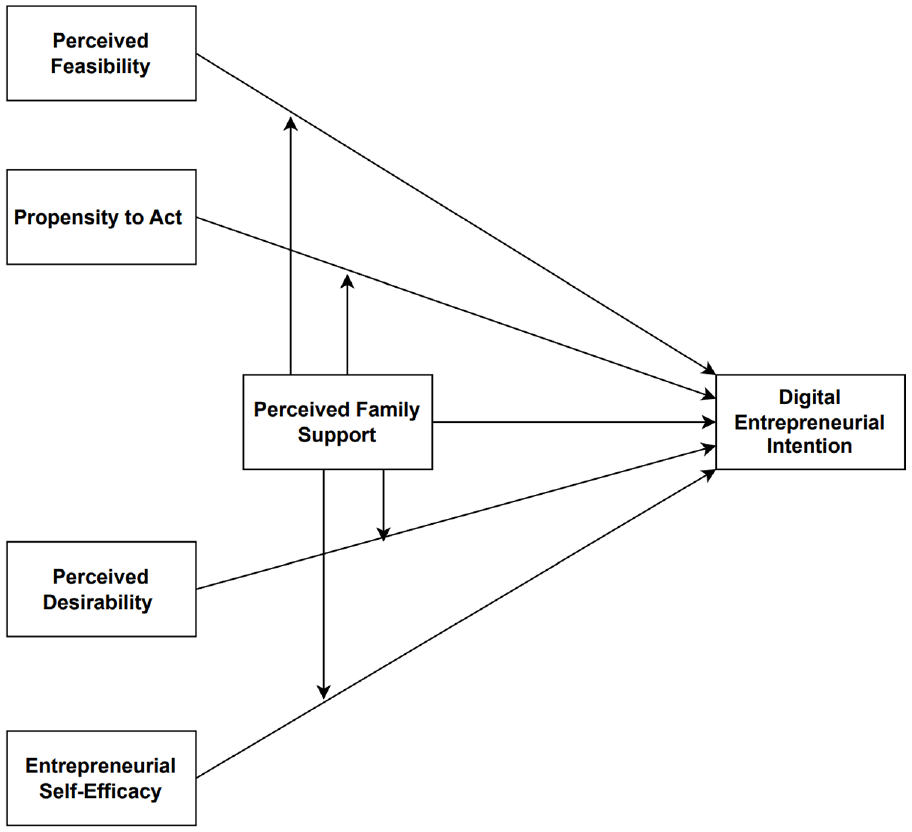
Conceptual model.
Measures
The survey questionnaire includes demographic and occupational data and Likert scale questions about students’ digital entrepreneurship views. The design seeks to comprehend university students’ digital entrepreneurial goals in emerging nations, particularly Vietnam. The Likert scale questions will examine how factors affect DEI. Google Forms will pre-test and confidentially administer the survey. In this investigation, the primary tool employed for data collection is a meticulously designed questionnaire divided into two principal sections. The initial section aims to gather essential details about the participants and their respective organizations, ensuring that the responses are accurate and come from the appropriate sources. The subsequent section encompasses questions developed based on elements outlined in Table 1 and utilizes a five-point Likert scale, with one representing “strongly disagree” and five signifying “strongly agree.” Participants were requested to select the most fitting response that mirrored their opinions on the relevant topics.
Measurements.

Source. Author’s work.
Scales from existing studies were used to operationalize the constructs considered for the proposed model. N. Krueger’s (1993) study provided the items for the core constructs of the EEM, including PF and PD. The six items of FS were derived from Baluku et al.’s (2020) study. The measurement of entrepreneurial SEE mainly relied on six items from Esfandiar et al.’s (2019) research. The DEI scale, including four items, was based on Liñán’s (2008) research. The questionnaire items distributed to the respondents of this study are listed in Table 1.
Sampling Design
Before the research instrument in this study was used, it underwent a specialized validation process. This process began by creating a questionnaire based on well-established constructs and items from extensive literature reviews. The questionnaire was suitably adjusted to fit the unique research environment. Subsequently, the questionnaire was validated by a panel comprising five experts in entrepreneurship to guarantee its contextual aptness. The final sample consisted of 382 Vietnamese university students interested in DE, identified by leveraging a convenience sampling technique (Etikan et al., 2016). Meticulous data cleaning helped weed out partial or incorrect responses and data with a standard deviation below 0.5 across all items, resulting in 334 valid data points. The recruitment process from February to May 2023 targeted students enrolled in Vietnamese universities, conducted online and in person. Participants gladly completed the survey after being guaranteed confidentiality. This study’s sample procedure was time- and cost-effective, but it limited the results’ application (Marshall et al., 2015). Table 2 describes the sample. Table 2 shows sample characteristics.
Sample Characteristics.

Source. Author’s work.
Data Analysis
In this research, the PLS-SEM technique is employed for the assessment of theoretical constructs, serving as an effective tool for interpreting and measuring the data of structural models. Ringle et al. (2015) emphasized the essence of the concurrent examination enabled by PLS-SEM in statistical data scrutiny. The findings from the statistical data analyses were instrumental in examining both the measurement and structural constructs, facilitating the derivation of conclusions regarding the proposed theoretical associations. The preliminary stage of the analysis focused on the meticulous assessment of the scales, constructs, and overall model. This scrutiny ensured their reliability and validity, encompassing aspects of convergence, discriminant validity, and model fit. A battery of statistical methods, including Cronbach’s alpha, factor loading indices, Average Variance Extracted (AVE), Composite Reliability (CR), the square root of AVE, alongside the Fornell-Larcker criterion, were employed to underpin this evaluative process (Fornell & Larcker, 1981; Hair et al., 2021; Hulland, 1999). Subsequently, the bootstrapping method was invoked to provide a comprehensive assessment of the structural constructs and the postulated theoretical correlations. This sequential approach, integrating robust statistical tools and methodologies, ensured a comprehensive, nuanced, and reliable exploration and validation of the proposed theoretical relationships within the study’s framework.
Findings
Common Method Bias
This research assessed the potential issues of multicollinearity and common method bias (CMB) by employing the variance inflation factor (VIF). It was determined that if the VIF value is below 3.0, neither multicollinearity nor CMB poses a significant concern (Hair et al., 2021). The findings indicated that all VIF values ranged between 1.445 and 2.710, suggesting the model is free from multicollinearity and CMB issues. Additionally, Harman’s single-factor test, a widely utilized method for CMB testing, was employed to assess CMB further. Exploratory factor analysis with a 1-factor extraction criterion revealed that the total variance extracted was 44.174%, which is less than the 50% threshold suggested by recent studies (C.-Y. Li & Fang, 2022; J. Xu et al., 2022) to determine that CMB is not problematic. Consequently, the model is unlikely to be affected by CMB. Emphasizing the importance of preventing CMB in research rigor, this study implemented procedural strategies before data collection to minimize potential CMB. These approaches aimed to increase the likelihood of respondents providing accurate answers without systematic bias.
Measurement Model Analysis
The reliability and validity of the measuring model’s elements were evaluated in this study. Table 3 displays the key indicators used to assess reliability and validity. All variables and composite dependability among the specified parameters demonstrated Cronbach’s Alpha indices exceeding .70, confirming the reliability of all measurements employed (Hair et al., 2021). The reliability test revealed that specific factor loadings and average variance extracts (AVE) for all items surpassed the thresholds of 0.7 and 0.5, respectively, widely accepted standards (Henseler et al., 2009). Therefore, convergent validity was established.
Result of Reliability and Convergent Validity.

Source. Author’s work.
According to Hair et al. (2021), discriminant validity is claimed if one structure is distinguishable from the others. Discriminant validity was also supported in this study. Fornell and Larcker (1981) defined discriminant validity as the square root of each concept’s AVE greater than the construct correlations. The compliant values, adhering to Fornell and Larcker’s criteria, are presented in Table 4.
Fornell-Larcker Criterion.
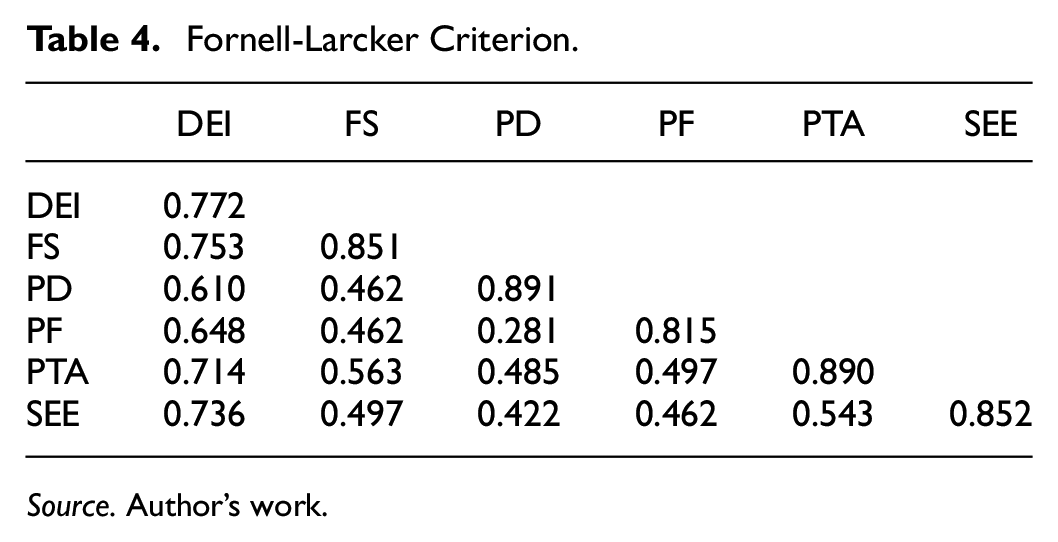
Source. Author’s work.
Furthermore, a well-structured model should exhibit a Heterotrait-Monotrait Ratio (HTMT) below 1.0. Henseler et al. (2015) posit that if the HTMT is less than 0.90, it indicates discriminant validity between the chosen pair of constructs. In Table 5, all values are below 0.9, substantiating the complete reliability and validity of the model.
Heterotrait-Monotrait Ratio.

Source. Author’s work.
Indexes of Fit
The results of the study clearly indicate that the evaluated indices align well with the criteria established in the current investigation. The assessment included several model fit indices, among which R2 recorded values of .855 for DEI, exceeding the threshold of .1 as posited by (Falk & Miller, 1992). In addition, DEI boasted Q2 values of 0.495, surpassing the baseline of 0. Moreover, the f2 values associated with all the variables in the study were found to be elevated, exceeding the benchmark of 0.02. The model’s goodness of fit was further affirmed by an SRMR value of 0.044, which is well below the 0.08 threshold, signaling a well-fitting model as per the standards set by Hair et al. (2021). Consequently, these observations underscore the model’s robust predictive capacity, marking it as both reliable and valid for the scope of this research.
Structural Model Analysis and Hypothesis Testing
This study employed bootstrapping methodology, encompassing a 5,000-sample loop, to examine the proposed hypotheses and their respective path coefficients. The analysis commenced post-verification of the reliability and validity of the measurement model and the overall model fit. Subsequently, the examination of the hypotheses was undertaken using coefficients and p-values. The Structural Equation Modeling (SEM) results are comprehensively presented in Table 6 and Figure 2 shows the bootstrapping SEM analysis.
Path analysis and hypothesis testing.

Source. Author’s work.

SEM result with bootstrapping.
Hypothesis H1 posited a substantial positive relationship between PF and DEI. The path coefficient of 0.240 is statistically significant, demonstrated by the t-statistics (5.640), effective at the p < .001 level. Consequently, Hypothesis H1 is substantiated. Similarly, Hypothesis H2, which proposed a significant positive correlation between PTA and DEI, was validated. The path coefficient is 0.165, and the t-statistics of 4.348 signifies that this effect is substantial at the p < .001 level. Hypothesis H3 asserted a significant positive impact of PD on DEI. A path coefficient of 0.209 and a t-statistics value 6.300 lend credence to this hypothesis. Hypothesis H4 projected a substantial positive influence of SEE on DEI. The path coefficient of 0.283 and the statistically significant t-statistics (6.679, p < .001) endorse this hypothesis. Hypothesis H5, proposing a substantial positive impact of FS on DEI, was validated. The observed path coefficient of 0.328 and t-statistics of 9.212, significant at p < .001, support this hypothesis.
Contrastingly, Hypothesis H6a, suggesting an interaction effect of FS and PF on DEI, was not substantiated. The path coefficient of −0.033 is not statistically significant, as indicated by the t-statistics of 1.513 and p = .130. Hypothesis H6b, proposing an interaction effect of FS and PTA on DEI, was similarly unsupported, with a path coefficient of −0.003 and a non-significant t-statistics of 0.116 (p = .908). In contrast, Hypothesis H6c, positing an interaction effect of FS and PD on DEI, was corroborated. The path coefficient of 0.088 and the statistically significant t-statistics of 3.985 (p < .001) lend credence to this hypothesis. Lastly, Hypothesis H6d, suggesting an interaction effect of FS and SEE on DEI, received marginal support. The path coefficient of 0.049 and t-statistics of 1.740 (p = .082) prove this claim.
This research pivots around the 9 hypotheses tested to elucidate the relationships between distinct factors and DEI. The table above indicates that all but two hypotheses received support, highlighting the importance of PF, PTA, PD, Entrepreneurial SEE, and FS in molding DEI. The results gleaned from this study provide critical insights into these factors’ impact on DEI.
Discussions
This discussion section seeks to delve into the implications of the study’s findings, focusing on their significance in digital entrepreneurship. The investigation unfolds instrumental insights for stakeholders such as policymakers, educators, and entrepreneurs considering various factors’ direct and indirect influences on DEI. Such insights foster a comprehensive understanding of the impetus behind DEI, thus paving the way for efficacious strategies that promote digital entrepreneurship.
The literature surrounding digital entrepreneurship demonstrates the integral role PF plays in fostering the intention to establish new digital ventures, a stance that corroborates the posited. The significance of PF echoes in the broader landscape of entrepreneurial intention studies, highlighting its influence across various contexts (Romero-Galisteo et al., 2022; Srivastava et al., 2023; Svotwa et al., 2022; Usman & Sun, 2022). Empirical evidence by Moghavvemi et al. (2016) and Tomy and Pardede (2020) underscore this notion, revealing that PF and feasibility significantly determine entrepreneurs’ intentions to adopt and utilize innovations. Additionally, research by Ahmad et al. (2019) evinces that PF indeed forecasts entrepreneurial intention. Consequently, the observed positive impact of PF on DEI signifies that interventions enhancing individuals’ feasibility perception and nurturing entrepreneurial competencies could considerably influence digital entrepreneurship. Recent studies are probing the influence of personal attributes on DEI, particularly scrutinizing the interplay between the PTA and entrepreneurial behavior.
The findings of this study underscore the robust connection between an augmented PTA and enhanced DEI, a correlation that is corroborated by existing studies (Jamil et al., 2023; Liao et al., 2022; Martín-Navarro et al., 2023). Additionally, the research illuminate’s characteristics such as creativity, innovation, and proactivity as instrumental drivers propelling entrepreneurial intentions (Martín-Navarro et al., 2023). This revelation is in harmony with earlier investigations that accentuate the critical influence of SEE in sculpting the contours of entrepreneurial intentions (Jamil et al., 2023). It underscores the integral role that the conviction in one’s abilities and the readiness to act play in not just envisioning but actualizing entrepreneurial aspirations. In essence, the consolidation of these findings weaves a narrative of the interplay of internal attributes and action tendencies in fostering and amplifying the journey from entrepreneurial contemplation to intention and realization.
The affirmative correlation between PD and DEI is validated by existing scholarly works (Otache et al., 2021; Romero-Galisteo et al., 2022). These findings illustrate that individuals with an enhanced PD are inclined toward nurturing intentions to embark upon digital entrepreneurial ventures. This pattern resonates with earlier studies that underscore PD as a pivotal factor influencing the selection of entrepreneurship as a viable career path (Otache et al., 2021; Usman & Sun, 2022). Furthermore, the insights gleaned from this study suggest that initiatives aimed at bolstering PD, including structured entrepreneurship educational programs, have the potential to exert a positive impact on DEI (Munir et al., 2022). In this context, elevating PD emerges as a strategic lever to inspire and catalyze the genesis of digital entrepreneurial aspirations, accentuating the role of targeted interventions in fostering a vibrant ecosystem for digital entrepreneurship.
Our findings further underscore that SEE exerts a positive influence on DEI. This observation is harmoniously aligned with a rich body of extant literature, drawing connections between the empowerment instilled by SEE and the initiation into entrepreneurial pursuits (Aboobaker et al., 2023; Darmanto et al., 2022; Y.-S. Wang et al., 2019; Xin & Ma, 2023). Within this scholarly discourse, SEE emerges as a pivotal force, arming aspiring entrepreneurs with the requisite arsenal of resources, bolstered confidence, and strategic advice tailored for the dynamic and often tumultuous entrepreneurial landscape (Amofah & Saladrigues, 2022; Neneh, 2022). The interplay between SEE and DEI is illuminated by the entrepreneur’s enhanced capability to navigate the intricate corridors of business initiation and development, fostered by the elevated confidence and resilience that SEE instills. The consolidated insights paint a narrative where SEE is not just a psychological attribute but a pragmatic and instrumental facet that tangibly augments the entrepreneur’s journey from conception to the actualization of business ventures, particularly in the digital space. The alignment of these findings with established literature not only validates the outcomes of this study but also contributes to the intricate tapestry of understanding the nuanced dynamics connecting self-efficacy, entrepreneurial intentions, and the transformative journey of digital entrepreneurship.
The empirical evidence gathered in this study aligns with prior findings, corroborating the significant role of FS in amplifying DEI amongst university students (Dieu et al., 2022). This affirmation resonates profoundly with a body of existing literature, where a consensus emerges highlighting the symbiotic correlation between FS and the incubation of entrepreneurial intentions (Krichen & Chaabouni, 2022; Neneh & Welsh, 2022; Ruiz-Palomino & Martínez-Cañas, 2021; Younis et al., 2020). FS’s multifaceted nature, encapsulating emotional, financial, and moral support, becomes a cornerstone for aspiring entrepreneurs. It imbues them with an arsenal of resources, bolstering their confidence and providing tailored guidance crucial in the intricate entrepreneurial landscape (Amofah & Saladrigues, 2022; Neneh, 2022). In this rich ecosystem of support, family members already immersed in entrepreneurship often ascend as mentors and exemplars, ingraining an entrepreneurial culture and mindset among the students (Dubey & Sahu, 2022). The synergistic effects of these elements create a conducive environment where the nurturing influence of FS is palpable and significantly amplifies DEI. This correlation is not an isolated observation but is substantiated by extensive research, underscoring the persistent and positive influence of FS in nurturing, and expanding DEI among the academic populace (Liao et al., 2022; Saoula et al., 2023). Thus, the narrative woven by these findings exemplifies the integrative and amplifying role of family support in the metamorphosis of entrepreneurial aspirations into determined intentions among university students.
The interaction effects suggest a more complex interplay between FS and other determinants of DEI. The interaction term was insignificant, indicating that the positive effect of PF on DEI does not vary depending on the level of FS. This suggests that while both PF and FS are independently critical to entrepreneurial intention, FS does not strengthen or weaken the role of PF. PF and DEI’s relationship is immune to FS. This implies that developing feasibility views in future entrepreneurs may directly and significantly affect DEI, regardless of FS. Besides, PTA affects DEI independent of FS levels. Hence, PTA is an independent and robust driver of DEI (Ajzen, 1991; N. F. Krueger et al., 2000). Even though FS can provide a supportive environment, it might not necessarily enhance the relationship between PTA and DEI. This underscores the importance of improving individuals’ PTA to stimulate entrepreneurial intention, irrespective of the FS context. A supportive FS could enhance the individual’s desirability toward entrepreneurship, amplifying the relationship between PD and DEI.
In a contrasting illumination, our findings delineate a distinct amplification of the positive effect of PD on DEI amidst the context of robust FS. This accentuation underscores a significant dynamic illuminated by N. F. Krueger et al. (2000) and Shapero and Sokol (1982), where the nexus between PD and DEI is markedly potentiated in environments characterized by substantive familial support. Consequently, the nurturing ambiance engendered by family support emerges as not just instrumental but pivotal, playing a cardinal role in fostering the allure of entrepreneurship, which in turn, catalyzes the morphosis of this enhanced desirability into concrete entrepreneurial intentions. Finally, a subtle yet discernible moderation of the relationship between SEE and DEI by FS is noted. Rooted in the foundational insights of previous research (Bandura, 1986; Boyd & Vozikis, 1994), self-efficacy stands out as a cornerstone in the edifice of entrepreneurial intentions. Our findings unveil an enriched narrative where FS, characterized by emotional backing and the provision of essential resources, amplifies the individual’s intrinsic belief in their entrepreneurial capabilities. This enhanced self-belief, nestled in the supportive embrace of family, not only strengthens the individual’s entrepreneurial self-efficacy but also propels the translation of this bolstered self-efficacy into tangible entrepreneurial intentions.
Implications, Limitations, and Future Research
Implications
This research delivers a ground-breaking paradigm shift in the digital entrepreneurship sphere by integrating the role of FS and SEE within the EEM model in an emergent economy context. Pioneering in its approach, our study pierces through the theoretical landscape, presenting FS as a critical driver, alongside PF, PD, PTA, and SEE, steering DEI among university students. This substantial shift enriches the foundation laid by previous scholars and imbues traditional constructs of the EEM model with fresh insights and dimensions (N. F. Krueger et al., 2000; Obschonka & Stuetzer, 2017; Zhao et al., 2005). Our study is trailblazing in that it unveils FS’s previously unexplored moderating role in analyzing entrepreneurial intentions (Carr & Sequeira, 2007; Laspita et al., 2012). This significant revelation paves a new theoretical path, challenging the conventional understanding of the intricate interactions between personal, contextual, and socio-cultural factors in the entrepreneurial journey, with FS becoming a focal point of these interactions (Gao et al., 2021).
This research underlines the importance of fostering FS within these constructs, aiming to amplify students’ PF, PD, PTA, and SEE. For organizations committed to nurturing entrepreneurship, the potent influence of FS on entrepreneurial intentions is highlighted as a strategic asset. This recognition is a call to arms for agencies to revolutionize their approaches, actively incorporating families into entrepreneurship education and training programs (Carr & Sequeira, 2007). Furthermore, our study emphasizes the necessity for developing family-centric support services, underscoring the need to capitalize on the power of familial engagement (Gieure et al., 2019; Miralles et al., 2017). Our research also extends to digital platform providers and others in the digital entrepreneurship ecosystem, emphasizing the necessity for recognizing and supporting FS in the broader entrepreneurial landscape.
Our research paints a compelling picture of how digital entrepreneurship, especially with the robust backing of FS, can significantly contribute to economic and societal evolution. It offers invaluable insights into how digital entrepreneurship, particularly when bolstered by FS, acts as a potent catalyst for equitable and sustainable growth in emerging economies, effectively mitigating unemployment and driving economic expansion (Israr & Saleem, 2018). By highlighting the instrumental role of FS in enhancing social cohesion and resilience, we underscore its pivotal role in the actualization of the sustainable development goals. Moreover, our research advocates for a paradigm shift from traditional entrepreneurial stereotypes toward a more inclusive, diverse, and community-focused understanding of entrepreneurship, positioning FS as a cornerstone in fostering and sustaining entrepreneurial ventures.
Limitations, and Future Research
Like any scholarly endeavor, this study is not without its limitations. Primarily, the focus on university students from a single country offers depth in a specific context but may constrain the universality of the conclusions, due to the cultural and locational specificity. Moreover, the cross-sectional design limits the strength of causal determinations. Furthermore, reliance on self-reported data may inject elements of social desirability and recall biases into the results. In addition, we acknowledge that our study did not assess the technological adeptness of family members in the context of FS, which could have offered additional insights into the nature and impact of this support. Additionally, we did not differentiate between respondents who are first-time entrepreneurs and those with prior entrepreneurial experience. This aspect represents a significant gap, as understanding the background of participants could offer valuable insights into how different levels of experience influence DEI (Geng et al., 2023). Another notable limitation is the study’s omission of actual entrepreneurial behavior as a consequent variable of DEI. Our research illuminated various factors influencing DEI, but it stops short of examining how these intentions materialize into concrete entrepreneurial actions.
In addressing these gaps, the adoption of a longitudinal study design emerges as particularly advantageous. Such an approach would allow us to trace the trajectory of DEI over time, offering a window into how initial entrepreneurial intentions are actualized in real-world scenarios. A longitudinal framework, ideally spanning significant milestones such as a 4-year graduation period, would enable a thorough exploration of the transition from DEI to actual entrepreneurial practices. This methodological shift promises to enrich our understanding of the dynamic process by which entrepreneurial aspirations are converted into practical endeavors. Besides, this suggests a need for future studies to extend beyond conceptualizing DEI as an endpoint and to capture the evolution of DEI into tangible actions, thereby providing a more comprehensive narrative of the entrepreneurial journey.
To further enhance the robustness and relevance of our findings, expanding the research to encompass a more diverse array of cultural and geographical contexts is essential. Additionally, considering FS’s significant role in this study, an in-depth exploration of how FS molds entrepreneurial aims and practices could shed more light on this influential factor, including assessing the technological competence of family members in supporting digital entrepreneurship. The impact of peer influence and institutional support on digital entrepreneurial inclinations could also be valuable areas of future inquiry. Furthermore, in this era of rapid technological change, it is crucial to consider the implications of quickly evolving digital technologies, including their obsolescence. The impact of cutting-edge technologies such as artificial intelligence and blockchain on digital entrepreneurship is significant. Future research should delve into how these technologies, while offering new opportunities, also present challenges due to their rapid evolution and potential obsolescence. This exploration is essential to understand how digital entrepreneurs can maintain resilience and adaptability, and how digital leadership can be effectively positioned in a landscape where technological shifts are frequent and often unpredictable.
Conclusions
The current study explored the influence of PF, PTA, PD, SEE, and FS on DEI. The results confirmed significant positive relationships for all direct variables on DEI, highlighting their crucial role in molding entrepreneurial intentions. Regarding interaction effects, the findings were mixed. The moderating effect of FS on the relationship between PF and DEI and PTA and DEI was unsupported. This suggests FS does not significantly influence the impact of PF and PTA on DEI. In contrast, FS was found to significantly moderate the relationships of PD and SEE with DEI, reinforcing FS’s nuanced role in shaping these relationships. These results offer important insights into the intricate dynamics of individual perceptions and family support in the formation of entrepreneurial intentions. Future studies could extend this work by exploring additional moderating factors that may influence DEI.
This study significantly contributes to entrepreneurial literature by applying and extending the EEM model to the context of digital entrepreneurship in emerging economies, focusing on university students. Furthermore, it incorporates the novel element of FS as a moderating variable, expanding our understanding of entrepreneurship theory. The investigation has enriched our understanding of its complex interplay with individual perceptions in shaping entrepreneurial intentions. In particular, the nuanced role of FS in the context of PD and SEE, as opposed to PF and PTA, was highlighted, signifying an important area of exploration in family dynamics’ influence on entrepreneurial intentions. Extending beyond traditional entrepreneurial intention models, incorporating FS as a moderating variable brings a more comprehensive perspective to the entrepreneurial intention formation process. By identifying the direct impacts of individual perceptions and FS and their interaction effects, the study deepens our understanding of the multidimensional nature of entrepreneurial intentions. Lastly, the mixed results observed in the moderating effects of FS offer fertile ground for future research, suggesting the need to delve further into the complex interaction effects that govern the formation of entrepreneurial intentions. By bridging the gap between individual, contextual, and socio-cultural factors, the research also contributes to societal development goals, demonstrating the transformative potential of digital entrepreneurship in promoting inclusive and sustainable growth. Moreover, the findings hold considerable implications for educators, policymakers, and entrepreneurship development agencies.
Footnotes
Acknowledgements
The authors wish to convey their profound gratitude to the study participants, whose valuable time and substantial contribution were instrumental to this research endeavor. The authors also thank their esteemed colleagues, whose unwavering support, encouragement, and collaboration were invaluable in facilitating this study. Their collective assistance was indispensable to the realization of this research.
Author Contributions
The study was conceived and designed collaboratively by Nguyen Ngoc Duy Phuong and Nguyen Hong Huan. Nguyen Ngoc Duy Phuong provided indispensable feedback and significantly contributed to data interpretation. The task of data collection and analysis was undertaken by Nguyen Hong Huan, who also authored the initial draft of the manuscript. The final manuscript, after reviewing and editing received the approval of both authors after a thorough review.
Declaration of Conflicting Interests
The author(s) declared no potential conflicts of interest with respect to the research, authorship, and/or publication of this article.
Funding
The author(s) received no financial support for the research, authorship, and/or publication of this article.
Ethics Statement
According to the “Ethical Review of Biomedical Research Involving Human Beings,” a public source from China’s National Health and Wellness Commission, all life science and medical research activities involving human beings should be subject to ethical review ( ). Business research and management are not part of life science and medical research activities involving human beings and only require clear and explicit informed consent prior to data collection. No formal ethics approval was therefore required in this particular case because (a) the data is completely anonymous with no personal information being collected; (b) the data is not considered to be sensitive or confidential in nature; (c) the issues being researched are not likely to upset or disturb participants; (d) vulnerable or dependent groups are not included; and (e) there is no risk of possible disclosures or reporting obligations. This study has been performed in accordance with the Declaration of Helsinki. Written informed consent for participation was obtained from respondents who participated in the survey. For the respondents who participated in the survey were asked to read the ethical statement posted at the top of the form (There is no compensation for responding, nor is there any known risk. In order to ensure that all information will remain confidential, please do not include your name. Participation is strictly voluntary, and you may refuse to participate at any time) and proceed only if they agree. No data was collected from anyone under 18 years old.
Data Availability Statement
The data that support the findings of this study are openly available on Figshare at . Readers and researchers can access and utilize the dataset under the terms and conditions of the Figshare repository, ensuring transparency and reproducibility of the research findings. The dataset includes data for understanding and replicating the analysis.