




Abstract
This study compared the five-word lexical bundles (LBs) expressing gratitude in acknowledgments of dissertations written by Chinese and American PhD students of linguistics. Two corpora were built: (1) The Chinese University Dissertation Acknowledgments Collection (CUC) which contained 700 acknowledgments with a total of 300,686 tokens, and (2) the American University Dissertation Acknowledgments Collection (AUC) which contained 700 acknowledgments with a total of 493,045 tokens. We then retrieved five-word LBs, of which LBs expressing gratitude in CUC and AUC were identified, categorized, and compared with respect to frequency, forms and structures. Major findings were: (1) the Chinese students used a substantially greater number of gratitude LBs than the American students, (2) the two groups used considerably different gratitude LBs, and (3) the two groups mainly relied on verb phrase-based LBs to express gratitude, but the Chinese students used a larger proportion of noun phrase- yet a smaller proportion of verb phrase-based items than the American students, and (4) the two groups used dissimilar structures and words to construct gratitude LBs. These findings enrich our knowledge of linguistic patterns in dissertation acknowledgments as a unique genre of academic prose, and provide corpus-based learning materials for students tasked with properly expressing gratitude in their theses or dissertations.
Introduction
Researchers have devoted increasing attention to formulaic language under various terms such as prefabricated patterns (Hakuta, 1974), constructions (Fillmore, 1988), and lexical bundles (LBs) (Biber et al., 1999). Despite this inconsistency of terminologies, formulaic language was found to constitute 58.6% and 52.3% of English spoken and written discourse respectively (Erman & Warren, 2000), and is therefore “important building blocks of discourse in spoken and written registers” (Biber & Barbieri, 2007, p. 263). Formulaic language is particularly important for second language (L2) learners as “it reduces the learning burden while maximizing communicative ability” (Ellis, 1994, p. 86) and provides L2 learners with ready-made sets of items (Coxhead & Byrd, 2007).
As a type of formulaic language, LBs are “recurrent expressions, regardless of their idiomaticity, and regardless of their structural status” (Biber et al., 1999, p. 990). Their defining features include their non-idiomaticity, structural incompleteness, and frequency-driven identification. LBs have been widely examined across English for Academic Purpose (EAP) contexts, including university teaching and textbooks (e.g., Biber et al., 2004; Liu & Chen, 2020), research papers or essays produced by first language (L1) and second language (L2) English writers (e.g., Bychkovska & Lee, 2017; Chen & Baker, 2010; Pan et al., 2016) as well as between different disciplines (e.g., Cortes, 2004; Hyland, 2008a, 2008b).
Acknowledgments of dissertations make a unique rhetorical space where PhD students express gratitude and develop academic social identities (Hyland & Tse, 2004). The genre is much more than a catalog of idiosyncratic gratitude, possessing both rhetorical sophistication and academic preferences (Hyland, 2004). Acknowledgments function to bridge the personal with the social, and the academic with the lay (Hyland, 2003; Bitzer & Leshem, 2021), revealing “the writer as someone with a life beyond the page” (Hyland, 2003, p. 246) as well as “the hidden influences behind papers” (Cronin, 1995, p. 305). Though significant, acknowledgments are a neglected “Cinderella” genre (Hyland, 2003, p. 246) often regarded unacademic and insignificant by applied linguistic researchers (Hyland & Tse, 2004). Understandably, little research has examined LBs in this unique genre, and even fewer studies have compared LBs in acknowledgments produced by learners of varying backgrounds. This has caused a lack of corpus-based teaching and learning materials on LBs of this particular genre, and added to Chinese students’ difficulties in properly learning and expressing gratitude to people who have helped them finish theses or dissertations, probably the most important writing in their lives. Coupled with the rapidly rising number of degree theses whose acknowledgments are often written in both Chinese and English in China, use of LBs in acknowledgments deserves research.
Consequently, the present corpus study sought to compare the use of gratitude LBs in dissertation acknowledgments produced by Chinese and American PhD students of linguistics, hoping to shed light on the researching and learning of this unique genre. We focused on linguistics because it is an important major in the discipline of foreign languages in China, with students mostly majoring in English. PhD students of linguistics are not only language researchers themselves but also one of the most advanced English learner groups in China, probably in America as well. They write good English for both general and academic purposes. If differences are found in gratitude LBs in the dissertations written by these two groups, more difference may exist in gratitude LBs between PhD students of other disciplines who are less proficient in English and their peers who are native speakers of English or study in English-speaking regions/countries. Hence, such a contrastive study will help Chinese students to realize what the differences are and know how to use gratitude LBs more effectively in their dissertations. The results will not only enrich the current literature but also facilitate the development of suitable teaching materials on this under-studied and -reported genre.
Literature Review
Research on Lexical Bundles (LB)
Most LB research analyzes LBs in terms of form, frequency, structure, and so on. The structural analysis usually uses pre-established taxonomies to first categorize and then examine LB structures. A popular structural taxonomy was proposed by Biber et al. (1999) for LBs in academic discourse (Table 1), and has been widely modified and used. For instance, by grouping the structures into categories based on noun phrase (NP), prepositional phrase (PP), and verb phrase (VP), Chen and Baker (2010) showed that student writers used a lower proportion of NP-, PP-, but a higher proportion of VP-based LBs than expert writers.
Biber et al.’s (1999, p. 1014–1015) Structural Taxonomy.

Most LBs research employs pre-defined structural and functional frameworks to compare LBs across corpora. Biber et al. (1999) conducted the first LB research, discovering that LBs in spoken English discourse were more clausal while those in written discourse were more phrasal. LB studies then further examined items in different registers (e.g., Biber, 2006; Biber & Barbieri, 2007; Huang, 2018), disciplines (e.g., Cortes, 2004; Hyland, 2008b; Liu & Chen, 2020), genres (e.g., Hyland, 2008a; Ren, 2021; Wright, 2019), and writer groups (e.g., Ädel & Erman, 2012; Bao & Liu, 2022, 2023; Bychkovska & Lee, 2017; Chen & Baker, 2010; Li et al., 2020; Shin, 2019), revealing LB variations in terms of frequencies, structures, functions, etc. To date, the only LB research on acknowledgments was conducted by Demirel and Ahmadi (2013) who compared LBs in 270 acknowledgments of research articles by Turkish, Iranian, and L1 English authors, revealing different LB frequencies and forms, but leaving the structures unexplored. Structural analysis is important to research on gratitude LBs in acknowledgments, as it quantitatively measures how two writer groups use different LBs to fulfill the same function of expressing gratitude. Yet little research, to the best of our knowledge, has examined LBs in acknowledgments of dissertations, let alone their structural differences in Chinese and American students’ discourses.
Research on Acknowledgement
Previous research primarily carried out genre analyses to uncover the generic structures and linguistic patterns in acknowledgments. Hyland (2003, 2004) proposed a three-move model (Reflecting, Thanking, and Announcing move) by analyzing acknowledgments by PhD and MA students from six disciplines at universities in Hong Kong, with whom Hyland and Tse (2004) further identified the linguistic patterns in Thanking move (Table 2), the only obligatory move in the model. The patterns fell into five categories that have different forms of words expressing gratitude, of which nominalization (33.6%) has the most gratitude expressions, followed by performative verb (33.2%), adjective (15.4%), passive (11.0%) and bare mention (6.8%) respectively. The two models have been employed to study rhetorical structures and linguistic patterns in acknowledgments written by students with varying native languages such as Chinese (e.g., Cheng & Kuo, 2011; Yang, 2012; Zhao & Jiang, 2010), Muslim (e.g., M. Ahmad et al., 2018; Al-Ali, 2010; Khatib et al., 2016; Lasaky, 2011; Zare-ee & Hejazi, 2019), Vietnamese (e.g., Nguyen, 2017), Malaysian (R. Ahmad et al., 2023), Nigerian graduate students (Adekannbi, 2023), and so on.
Hyland and Tse’s (2004) Patterns Expressing Gratitude.

As found in these studies, Muslim students specifically use the Thanking Allah step (Al-Ali, 2010; Lasaky, 2011), Praising God and His Prophet step (Estaji & Nosrati, 2018) or thanking-God move (Zare-ee & Hejazi, 2019), where religious supports are acknowledged, and rely on patterns with performative verbs (Al-Ali, 2010). Similarly, Nigerian (Adekannbi, 2023) and Malaysian graduate students both tend to begin their acknowledgments with thanking God (R. Ahmad et al., 2023). Chinese students from Taiwan specifically use the Making a Confession step where apologies for the sacrifice by their families in support of the authors’ projects are made (Yang, 2012), and use more overt thanking words (e.g., gratitude, thanks) (Cheng & Kuo, 2011). Students from Mainland China frequently use modifiers (e.g., sincere and heartfelt) in patterns with nominalization, and rely on patterns with bare mention to express gratitude (Zhao & Jiang, 2010).
The models have also been used in comparative studies on acknowledgments across disciplines (Afful, 2016; Alemi & Rezanejad, 2016; Estaji & Nosrati, 2018), L1 and L2 English students’ discourses (e.g., M. Ahmad et al., 2018; Hosseinpur et al., 2020), and female and male students’ texts (Tang, 2021). For example, Afful (2016) found that Ghanaian students in the discipline of English used more hybridized forms (e.g., I say a big “meda hom ase”; meda hom ase means I thank you all in Ghanaian), which were rarely used by those in Entomology and Wild Life. M. Ahmad et al. (2018) revealed that Spanish writers used more expressions with debt than English writers. Tang (2021) found that female and male students tended to use varying lexical items to encode the thanking expressions, thanking modifiers and gratitude themes in their M.A. thesis acknowledgments.
On the whole, these studies demonstrate different rhetorical structures and linguistic patterns of acknowledgments in different social-cultural settings. The existing literature has mainly relied on linguistic forms to determine differences of language patterns, leaving their frequency and structure under-researched. Moreover, previous research has rarely compared acknowledgments produced by Chinese and American PhD students, and the investigation of their LBs, if not none, is even fewer. Applying widely used LB methods and models to research acknowledgments enables us to systematically present the similarities and differences in Chinese and American PhD students’ gratitude expressions from multiple perspectives, including LB frequency, forms and structures, thus contributing to the literature on both LB and acknowledgment studies while informing relevant pedagogical practices. Consequently, our research aimed to compare the LBs used by Chinese and American PhD students to express gratitude in their dissertation acknowledgments. Our research question was:
What are the similarities and differences of the LBs used by Chinese and American PhD students of linguistics to express gratitude in their dissertation acknowledgments, in terms of LB frequency, form, and structure?
Research Design
Corpora
As shown in Table 3, we collected 700 acknowledgments of dissertations completed by Chinese PhD students of linguistics between 2000 and 2022 from Chinese universities, via China National Knowledge Infrastructure, the National Library of China, and university libraries. The timeframe covered a substantial proportion of the genre given that many of the PhD programs in China were founded around 2000. As a result, the Chinese University Dissertation Acknowledgements Collection (CUC) was established, which had 300,686 tokens and a mean length of 429.55 (SD = 186.62) words.
Description of the Corpora.
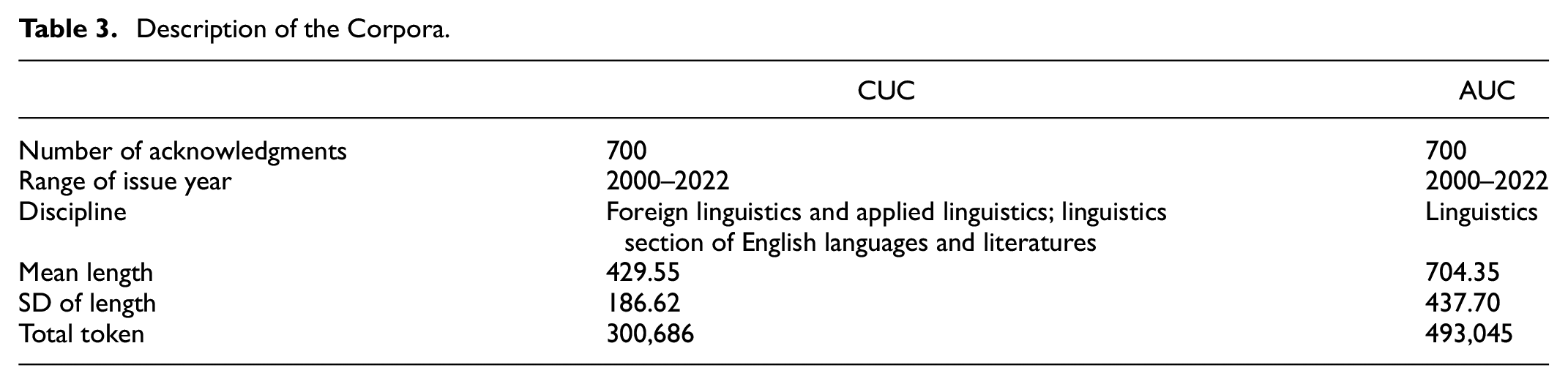
To parallel with CUC, 700 dissertation acknowledgments completed by PhD students of linguistics from American universities in the same timeframe were gathered via ProQuest, Ohio Library and Information Network, and university libraries. Like CUC, these databases categorized articles in terms of disciplines or departments. We accessed the interface displaying items in linguistics, viewed or downloaded the dissertations, and extracted their acknowledgments. Potential L2 English speakers were not excluded as this study was based on the dichotomy of Chinese/American universities instead of L2/L1. Moreover, the databases did not specify authors’ heritage so it was virtually impossible to accurately determine their L1s. The American University Dissertation Acknowledgments Collection (AUC) was built with 493,045 tokens and a mean length of 704.35 (SD = 437.70) words.
Data Analysis Framework
Identifying LBs
The study used WordSmith Tools 8.0 (Scott, 2020) to retrieve LBs based on a cut-off point of 25 occurrences per million words (pmw) in at least 1.0% of the sample texts. We focused on five-word LBs because many of the linguistics patterns identified by Hyland and Tse (2004) and other researchers are five-word sequences (e.g., the author is thankful for).
The determination of a cut-off point is “somewhat arbitrary” (Ädel & Erman, 2012, p. 82; Biber, 2006, p. 134; Biber et al., 2004, p. 376; Hyland, 2008b, p. 8), driven by the need for a manageable analysis (Liu & Chen, 2020; Oakey, 2020). The present study adopted a relatively low frequency cut-off in order to retrieve more gratitude LBs. The study adopted a 1.0% dispersion cut-off entailing seven texts in each corpus considered high enough to screen off idiosyncratic LBs used by only one or two writers.
LBs expressing gratitude were then identified following the patterns proposed by Hyland and Tse (2004) as presented by Table 3. Specifically, a gratitude LB was identified if it contained a word expressing gratitude (e.g., thank, grateful, gratitude). Given that the expressions with bare mention show gratitude implicitly, we follow the previous study to identify those indicating individuals’ support and contribution (e.g., with the help of).
Categorizing and Analyzing LBs
We then categorized LBs based on the forms of gratitude words recognized by Hyland and Tse’s (2004) taxonomy that identified five patterns expressing gratitude (Table 2). To express my
Results
Overall Frequency, Form, and Structure of Gratitude LBs
We retrieved 861 and 256 five-word LBs, from which 379 and 140 gratitude LBs were identified in CUC and AUC respectively (Table 4) (full list of gratitude LBs provided in the Supplemental Material). The 861 LBs had 15,559 tokens in CUC, and the 256 LBs had 7,705 tokens in AUC, revealing that the Chinese students produced a significantly greater number of five-word LBs than the American students (LL = 7996.54, p < .0001; Log Ratio = 1.73). The 379 gratitude LBs had 7,495 tokens in CUC, and the 140 gratitude LBs had 4,281 tokens in AUC, suggesting that the Chinese students used a significantly greater number of gratitude LBs than the American students (LL = 3190.63, p < .0001; Log Ratio = 1.52). The Log Ratio of 1.73 indicated that the LBs were around 3.46 times more frequent in CUC than in AUC, and the Log Ratio of 1.52 indicated that the gratitude LBs were around 3.04 times more frequent in CUC than in AUC.
Number of LBs and Gratitude LBs.

Denotes p < .0001.
We found that 77 gratitude LBs were frequently used by both student groups. The results suggested that 79.7% of the gratitude LBs in CUC were not frequent in AUC and 45.0% of the items in AUC were not frequent in CUC. Because our research focused only on the gratitude LBs identified from the items beyond the pre-defined cut-off point (25 occurrences in at least 1.0% of the texts), the different forms of gratitude LBs did not necessarily mean that the items retrieved from one corpus (e.g., CUC) did not occur at all in the other corpus (e.g., AUC) but mean that the items were not frequent enough to reach the cut-off point in the latter.
Structurally, Figure 1 shows that the Chinese students used a greater proportion of NP-based gratitude LBs than the American students. The three NP-based structures, noun + of, noun phrase + other post-modifier fragment, and noun phrase + verb/adjective phrase, accounted for 1.9%, 11.3%, and 15.3% of the CUC items, but accounted for 1.4%, 5.7%, and 4.3% of the AUC items respectively. The two groups used a similar proportion of LBs within the prepositional phrase + of structure, a PP-based structure that accounted for only 0.8% in CUC and 0.7% in AUC. The American students produced a considerably larger proportion of VP-based gratitude LBs. The most noticeable difference was identified within the (verb/adjective) + to-clause fragment structure that made up 35.7% of the items in AUC but only 19.3% of those in CUC. The difference within be + noun/adjective phrase was also substantial, of which the LBs made up 32.9% of the items in AUC yet only 21.9% of those in CUC. The Chinese students, however, produced a larger proportion of gratitude LBs within passive verb + prepositional phrase fragment (4.2% vs. 1.4%) as well as verb phrase + pronoun/noun phrase + (post-modifier fragment) (25.3% vs. 17.9%). These results reveal that the Chinese students used a higher proportion of NP-, a similar but very small proportion of PP-, but a lower proportion of VP-based gratitude LBs than their American counterparts.
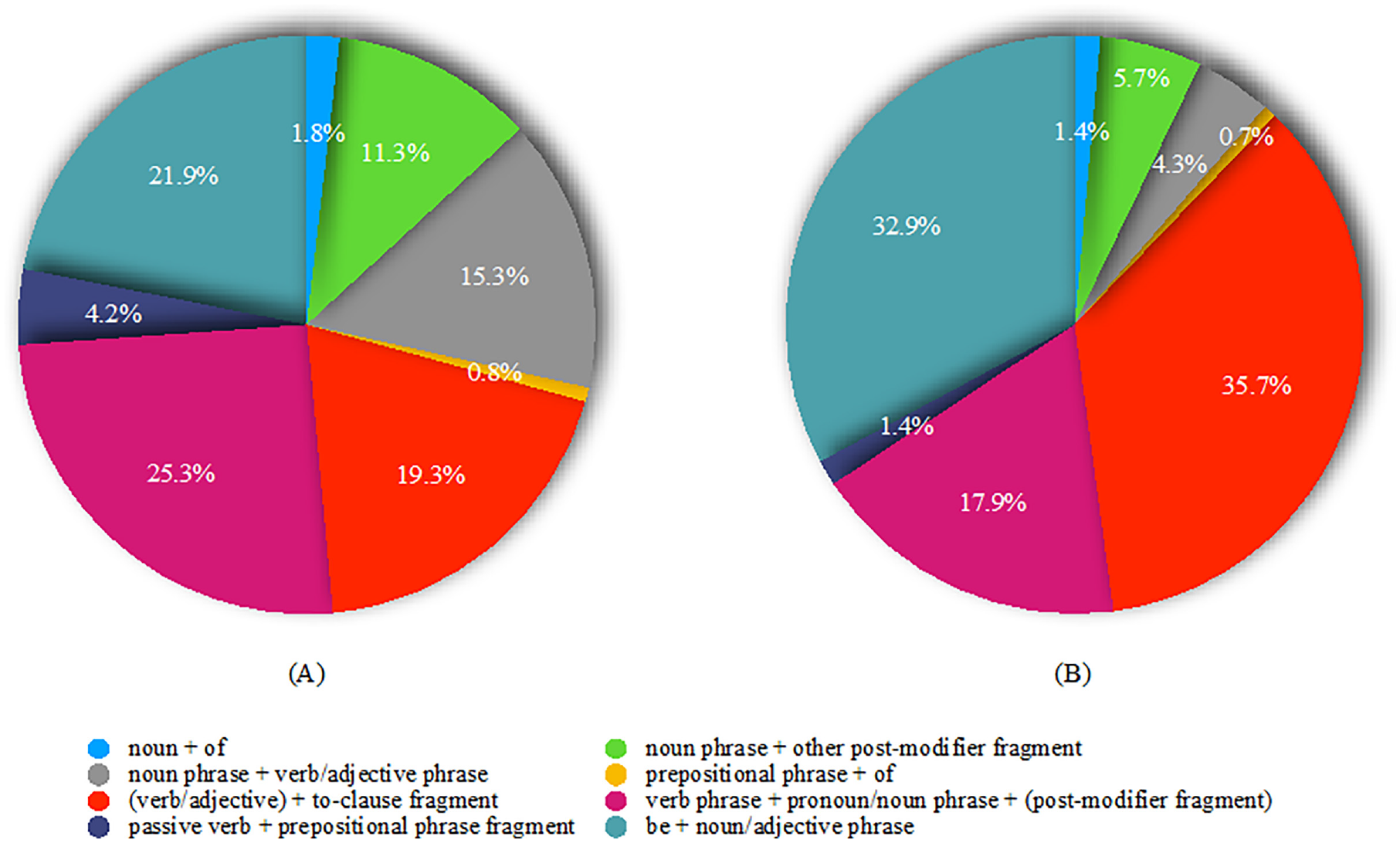
Structural distribution of gratitude LBs in CUC and AUC. (A and B) show the distribution of items in CUC and AUC, respectively.
Gratitude LBs with Different Forms of Gratitude Words
Table 5 reveals that the Chinese students used substantially more LBs in all the five categories, with the highest LL value identified from the items with nominalization, and the lowest from those with performative verbs. In light of this marked and broad contrast, proportional analysis instead of frequency analysis was conducted to illustrate the two groups’ different use of gratitude LBs. The results are reported in Table 5.
Number of Gratitude LBs with Different Forms of Gratitude Words.

Note. In the column of shared items, %a and %b denote their proportions in the CUC and AUC items presented in the row, respectively. *Denotes p < .05; **denotes p < .0001.
Gratitude LBs with Nominalization
As shown in Table 5, there were 179 gratitude LBs with nominalization that accounted for 47.2% of the LBs in CUC and 24 that accounted for 17.1% of those in AUC. Nineteen LBs were identified in both corpora, accounting for 10.6% of the CUC and 79.2% of the AUC items. Consequently, 89.4% of the gratitude LBs frequent in CUC and 20.8% of those in AUC were not frequent in the other corpus. These findings show that most gratitude LBs with nominalization commonly used by the American students were also commonly used by their Chinese counterparts, but not vice versa.
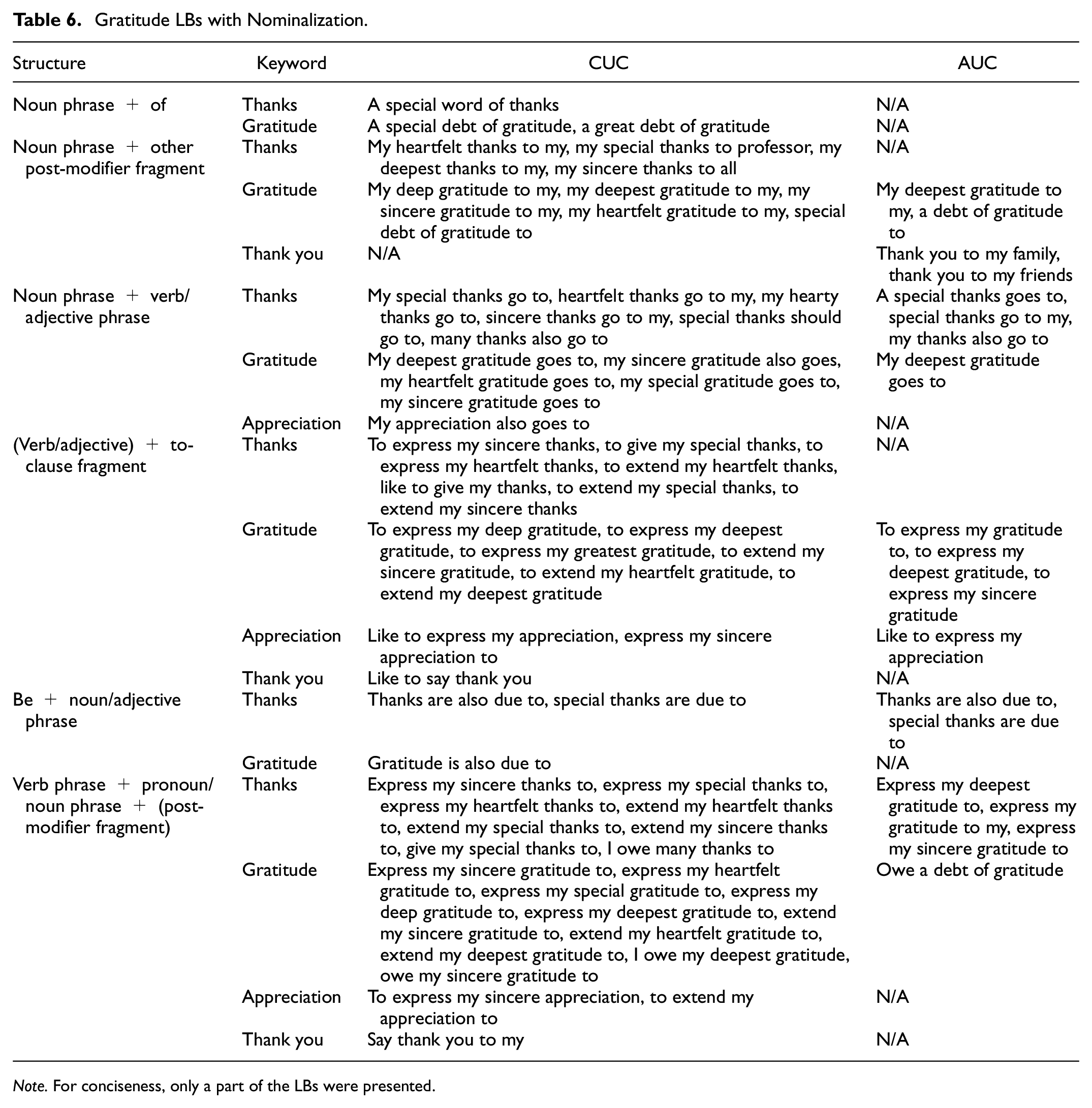
Figure 2A reveals that the CUC items fell into six, while the AUC items fell into five structural categories, of which five were shared and the noun + of structure was specific to CUC. Distributionally, the Chinese students used a greater proportion of NP-based gratitude LBs. As shown in Table 6, within the NP-based category, the Chinese students used three items falling into the noun + of structure (e.g., a special word of thanks) that made up 1.7% of all CUC gratitude LBs, but the American students did not use any items of this structure.

Structural distribution of gratitude LBs with different forms of gratitude words. (A–E) display the structural distribution of gratitude LBs with nominalization, performative verb, adjective, passive, and bare mention, respectively; the inner circle represents CUC, and the outer circle represents AUC.
Gratitude LBs with Nominalization.
Note. For conciseness, only a part of the LBs were presented.
Figure 2A shows that the Chinese and American students used 24.0% and 29.2% of the LBs within the noun phrase + other post-modifier fragment structure, respectively. Table 6 shows that the Chinese students used more LB types with thanks (e.g., my heartfelt thanks to my), and the American students used more LB types with thank you (e.g., thank you to my family). The Chinese students also used more LB types with gratitude (e.g., my deep gratitude to my), adding more forms of adjectives including deep, deepest, sincere, heartfelt, and special, but the American students only used deepest. The Chinese and American students used 24.0% and 29.2% of the LBs within the noun phrase + verb/adjective phrase structure, respectively. Table 6 shows that the Chinese students used more gratitude LBs and a greater variety of modifiers within the structure. They also specifically used should (e.g., special thanks should go to) as well as appreciation (e.g., my appreciation also goes to) rarely found in AUC.
Figure 2A reveals that the Chinese and American students used 41.9% and 45.8% of the LBs as VP-based items respectively. The Chinese students used 15.1% of the LBs within the (verb/adjective) + to-clause fragment structure, in contrast with 20.8% by the American students. Table 6 shows that the Chinese students specifically used thanks and thank you (e.g., want to express my thanks), while the American students used gratitude (e.g., to express my gratitude to) and appreciation (e.g., like to express my appreciation). In addition to the wider variety of adjectives, the Chinese students used more types of verbs including express, give, and extend, but the American students only used express. The Chinese and American students used 23.5% and 16.7% of the LBs within the verb phrase + pronoun/noun phrase + (post-modifier fragment) structure respectively, where the Chinese students specifically used appreciation (e.g., to extend my appreciation to) and thank you (e.g., say thank you to my) and used more types of adjectives and verbs than the American students. The Chinese students used 3.4% of the LBs within the be + noun/adjective phrase structure, in contrast with 8.3% by the American students. While the American students only used thanks (e.g., thanks are also due to), the Chinese students also used gratitude (e.g., gratitude is also due to) in the structure.
Gratitude LBs with Performative Verb
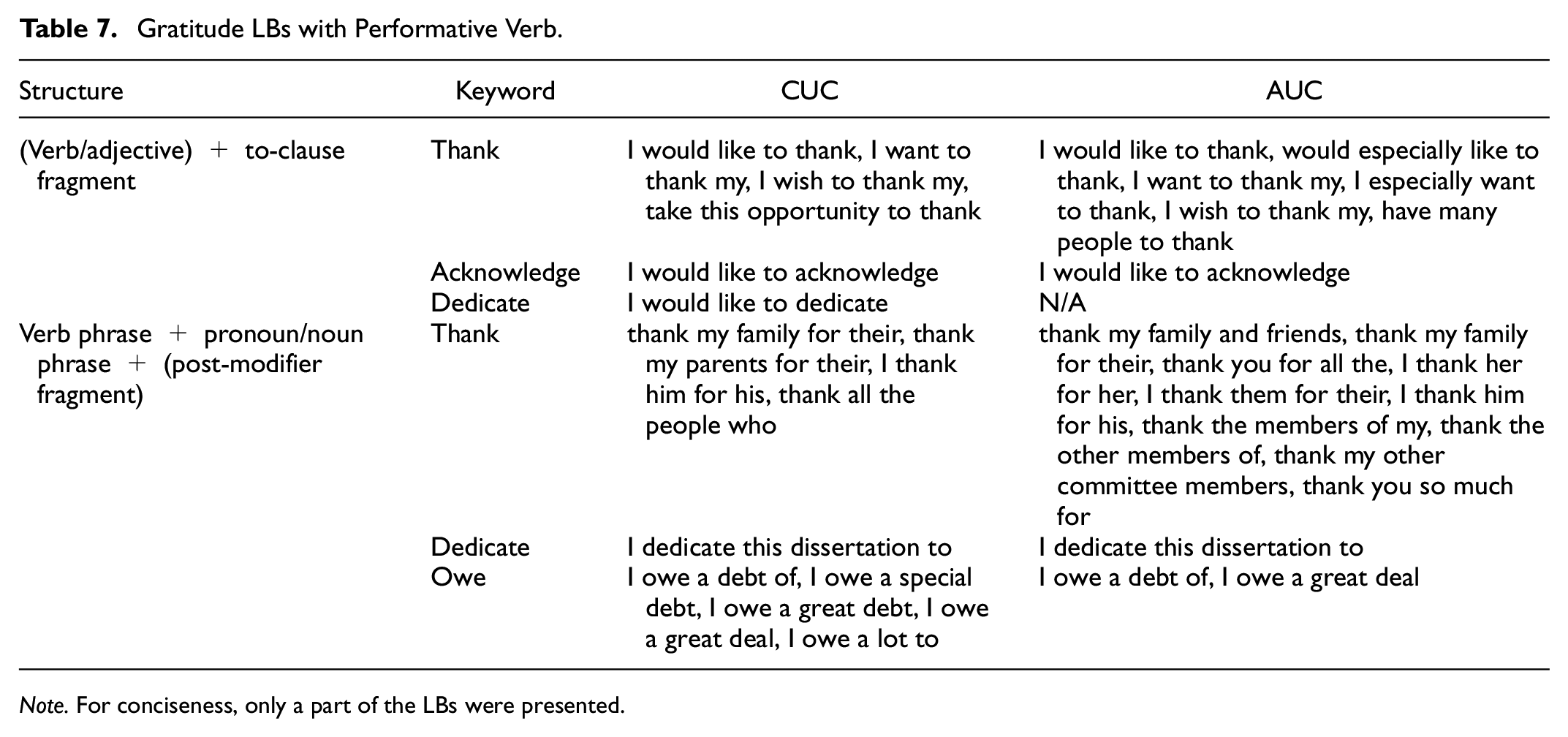
As shown in Table 5, there were 66 (17.4%) and 61 (43.6%) gratitude LBs with performative verbs in CUC and AUC. The Chinese students thus used a much smaller proportion of gratitude LBs with performative verbs than the American students. A total of 31 gratitude LBs were shared, making up 47.0% of the gratitude LBs in CUC and 50.8% of those in AUC. About half of the gratitude LBs with performative verbs in CUC or AUC were not frequent in the other corpus (Table 7).
Gratitude LBs with Performative Verb.
Note. For conciseness, only a part of the LBs were presented.
Figure 2B shows that the LBs in both corpora fell into two VP-based structures. The Chinese students used 69.7% and 30.3% of the LBs within the (verb/adjective) + to-clause fragment and verb phrase + pronoun/noun phrase + (post-modifier fragment) structure respectively, in contrast with 73.8% and 26.2% by the American students. In the former structure, both groups used thank (e.g., I would like to thank) and acknowledge (e.g., I would like to acknowledge), but the Chinese students specifically used dedicate (e.g., I would like to dedicate). In the latter structure, both groups used thank (e.g., thank my family for their) and dedicate (e.g., I dedicate this dissertation to).
Gratitude LBs with Adjective
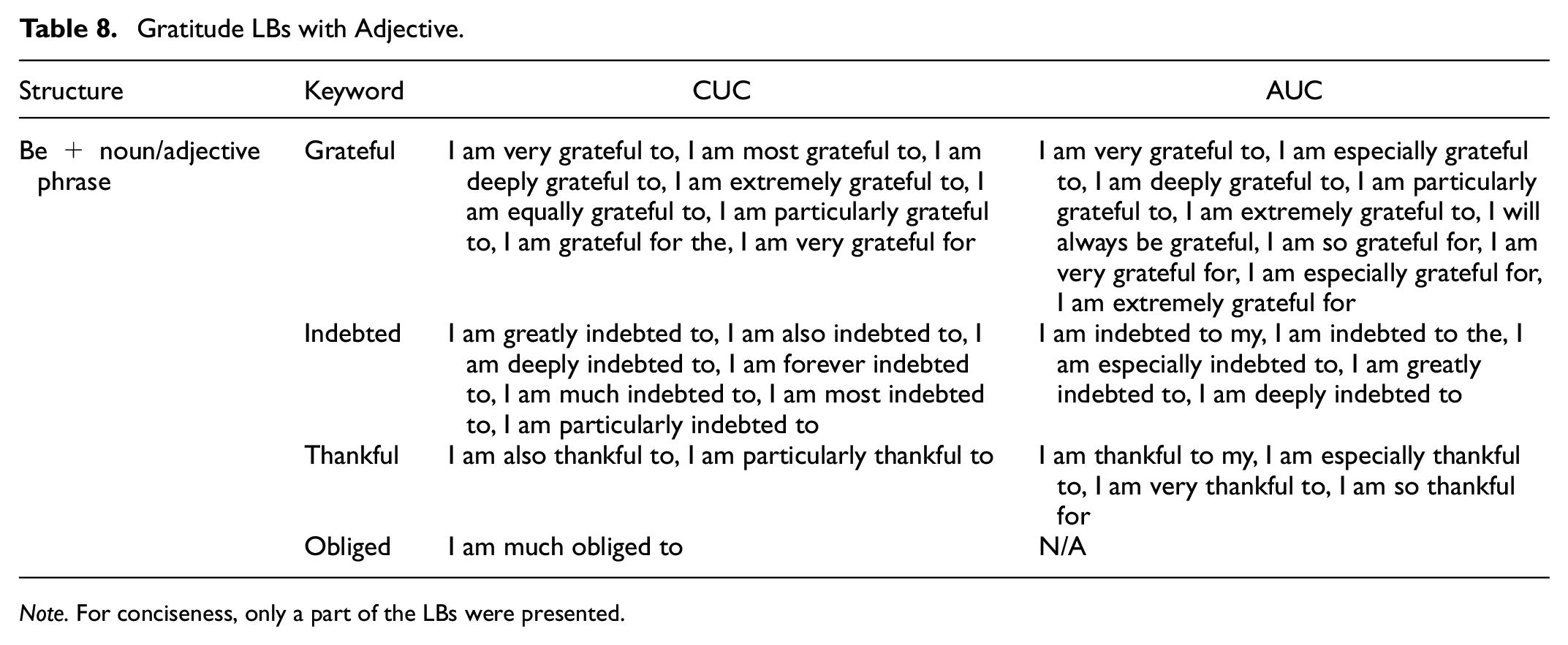
Table 5 shows that the gratitude LBs with adjectives accounted for 19.5% and 26.4% of all gratitude LBs in CUC and AUC respectively. Twenty-one items were shared, accounting for 28.4% and 56.8% of the gratitude LBs with adjectives in CUC and AUC respectively. Figure 2C reveals that the LBs with adjectives in both corpora fell into the be + noun/adjective phrase structure. Table 8 shows that both groups used grateful (e.g., I am very grateful to), indebted (e.g., I am also indebted to), and thankful (e.g., I am also thankful to), but the Chinese students specifically used obliged as in I am much obliged to. Both groups used very (e.g., I am very grateful to), deeply, particularly, extremely, and also as the adverb, but the Chinese students specifically used most, equally, much, and forever (e.g., I am forever indebted to) and the American students specifically used so and always (e.g., I will always be grateful).
Gratitude LBs with Adjective.
Note. For conciseness, only a part of the LBs were presented.
Gratitude LBs with Passive
As shown in Table 5, there were 13 (3.4%) gratitude LBs with passive in CUC, and two (1.4%) in AUC. The gratitude LBs appeared to be the smallest category. Figure 2D reveals that the LBs in both corpora fell into the passive verb + prepositional phrase fragment structure. Table 9 shows that both Chinese and American students used dedicated (e.g., this dissertation is dedicated to) as the passive verb in the structure, but the Chinese students also specifically used extended (e.g., thanks are also extended to) and given (e.g., thanks should be given to) with thanks as the subject.
Gratitude LBs with Passive Verb.

Note. For conciseness, only a part of the LBs were presented.
Gratitude LBs with Bare Mention
Table 5 shows that there were 47 (12.4%) and 16 (11.4%) gratitude LBs with bare mention in CUC and AUC respectively, and four were shared that made up 8.5% and 25.0% of gratitude LBs in the two corpora respectively. These results suggest that the Chinese students used a greater number, proportion, and substantially different forms of gratitude LBs with bare mention than the American students did.
Figure 2E shows that the CUC and AUC items fell into five structures, of which four were shared. The Chinese and American students used 8.5% and 12.5% of the LBs within the noun + of structure respectively. Table 10 shows that both groups used the help and support (e.g., the help and support of), but the Chinese students specifically used support, help, and completion, and the American students specifically used the love and support as the noun phrase of the noun + of structure. The prepositional phrase + of structure accounted for 6.4% and 6.3% of the gratitude LBs with bare mention in CUC and AUC respectively. The Chinese students specifically used help (e.g., possible without the help of) in this structure.
Gratitude LBs with Bare Mention.

Note. For conciseness, only a part of the LBs were presented.
The verb phrase + pronoun/noun phrase + (post-modifier fragment) structure accounted for 72.3% but only 31.3% of the gratitude LBs with bare mention in CUC and AUC respectively. Table 10 shows that both groups used from (e.g., benefited a great deal from) and empty subjects (e.g., SUBJECT helped me a lot in). The Chinese students specifically used people (e.g., people have helped me during) and who (e.g., who helped me a lot), while the American students specifically used without (e.g., not have done this without). The be + noun/adjective phrase structure accounted for only 6.4% of the LB items in CUC but 43.8% of those in AUC. Table 10 shows that both groups used without (e.g., not have been possible without), while the American students specifically used empty subjects (e.g., SUBJECT has been a constant source). The passive verb + prepositional phrase fragment was specifically used by the Chinese students and accounted for 6.4% of the CUC items, including the passive verbs completed (e.g., not have been completed without) and accomplished (e.g., not have been accomplished without). Within the verb phrase + pronoun/noun phrase + (post-modifier fragment) structure, the Chinese students specifically used LBs with people and who, and many more LB types with empty subjects than their American counterparts who only used SUBJECT made it possible for me.
Discussion
The present study revealed 379 types and 7,495 tokens of gratitude LBs in CUC, but only 140 types and 4,281 tokens of gratitude LBs in AUC. This finding indicates a substantially greater number of gratitude LBs used by the Chinese students, consistent with previous studies reporting considerably more LBs used by L2 than L1 English writers in dissertations and theses (Hyland, 2008a), thesis abstracts (Lyu & Gee, 2020), essays (Wei & Lei, 2011), and acknowledgments of research articles (Demirel & Ahmadi, 2013). L2 English writers’ substantially more frequent use of LBs was argued to indicate their heavier reliance on prefabricated sequences due to their relatively lower English proficiency (Hyland, 2008a; Paquot & Granger, 2012).
Table 11 shows that CUC and AUC used a nearly opposite distribution of LBs with nominalization (47.2% vs. 17.1%) and performative verb (17.4% vs. 43.6%). But their sum was both about 60.0%, consistent with the results regarding Chinese PhD students in Hong Kong, Taiwan, and U.S., reported by Hyland and Tse (2004) and Yang (2012). The students in Hong Kong, however, used similar proportions of expressions with nominalization (33.6%) and performative verb (33.2%). They also used a substantially higher proportion of expressions with passive, compared with the other five groups presented. This difference might be due to the status of English as a second and official language in Hong Kong but a foreign language in Mainland and Taiwan China. With reference to Yang’s (2012) results, Taiwanese students’ gratitude expressions are more similar to those in AUC when the students studied in American universities but more similar to those in CUC when they studies in Taiwanese universities. The results of our studies, however, contradict Zhao and Jiang’s (2010) research which showed that Chinese PhD and MA students of linguistics used 44.4% of the expressions with bare mention, in contrast to 12.4% in CUC and 11.4% in AUC, 6.8% for students in Hong Kong, and 10.8% and 14.4% for Taiwanese students in Taiwan China and U.S. respectively. The differences can relate to the limited samples of only 20 acknowledgements examined by Zhao and Jiang (2010) who might reveal idiosyncratic gratitude patterns. We found that 79.7% of the gratitude LBs in CUC were not frequent in AUC, and 45.0% of the items in AUC were not frequent in CUC. Further investigations of LBs with different gratitude words showed greater variations of forms in LBs with bare mention and adjective, suggesting that the Chinese and American students used substantially different forms of gratitude LBs, and that the degree of variation differed with regard to different categories.
Distribution of Linguistic Patterns Expressing Gratitude across Different Corpora.

Note.Hyland and Tse’s (2004) study was on PhD and MA students at universities in Hong Kong, China; Zhao and Jiang’s (2010) study was on PhD and MA students in Mainland China; Yang’s (2012) study was on Taiwanese PhD students at universities in Taiwan China and U.S.
The varying distributions and different LB types suggest that writers in different countries and even in different areas from one country tend to rely on varying expressions to show gratitude in their dissertation acknowledgments. The proportional contrast between PhD students from Mainland and Taiwan China was even greater than that between the Chinese and American students investigated by the present study. This indicates that the use of gratitude expressions can be very writer group-specific, driven by a complex of educational, linguistic, institutional and socio-cultural factors. All these findings confirm the pedagogical values of gratitude LBs and raise a new question for EAP instructors to address: Which group’s or groups’ gratitude expressions should be paid more attention to in the teaching of this special EAP genre?
The structural analysis revealed that the VP-based items accounted for 70.7% and 87.9% of the gratitude LBs in CUC and AUC respectively, inconsistent with previous studies indicating that LBs in academic prose are more phrasal than clausal (Biber et al., 1999, 2011, 2013; Pan et al., 2016). The inconsistency indicates that acknowledgments are a unique and untypical academic genre and that both the groups relied on VP-based gratitude LBs. We identified a greater proportion of NP- yet a smaller proportion of VP-based gratitude LBs in CUC than in AUC, in contrast with previous studies reporting a smaller proportion of NP- yet a greater proportion of VP-based LBs used by L2 than by L1 English writers in dissertation abstracts (Lu & Deng, 2019), research articles (Pan et al., 2016), and essays (Bychkovska & Lee, 2017; Chen & Baker, 2010). The frequent use of phrasal LBs was considered an indicator of advanced English language proficiency in academic prose (Biber et al., 2016; Pan et al., 2016) that requires careful information integration realized primarily via nominal and prepositional phrases (Pan et al., 2016). Our inconsistency shows a highly advanced English proficiency of the Chinese PhD students in our study who majored in English. Our results also indicate that gratitude LBs in dissertation acknowledgments are much more clausal than phrasal which resembles the characteristics of spoken discourse with reference to Biber et al. (1999) results. The different structural distributions confirm the genre-specificity of dissertation acknowledgments as a special EAP genre, highlight the necessity to develop genre-specific and corpus-based learning materials, and confirm the pedagogical values of gratitude LBs.
The examination of the structures of gratitude LBs with different forms revealed dissimilar structures as well as accompanying words used by the Chinese and American students. For example, the Chinese students used a wider variety of modifiers (e.g., deep, deepest, sincere, heartfelt, and special) than the American students (e.g., deepest) in the noun phrase + other post-modifier fragment structure (e.g., my
Despite these differences, we found no evidence showing grammatical incorrectness or pragmatic inappropriateness of LBs used by the Chinese PhD students who were advanced English learners and familiar with EAP genres as PhD candidates in the discipline of foreign languages. CUC LBs can be used as teaching and learning materials particularly for students in Chinese universities who have lower English language proficiency or are novice writers in EAP. Compared with their American counterparts, the Chinese PhD students’ LBs are larger in number, fall into similar structures (though with different frequencies in each structure), and tend to have a wider variety of constituents in the same structures. Those features add to the accessibility of teachable LBs in their texts with considerably more items extracted from the same size of discourses, but also distinguish them from the American students. Although this study did not exclude potential L2 English speakers from AUC, it was safe to assume that AUC had a much larger share of L1 English speakers than CUC. However, the necessity and value of nativelikeness, in EAP genres and acknowledgments in particular, remain a debatable issue and can be driven by learners’ specific and individual needs. For those who are studying in America or prefer nativelikeness, AUC LBs can be of greater value. For researchers interested in the socio-cultural, linguistic and institutional factors behind the differences, the results can serve as their starting points of analysis. Our study remains largely descriptive with its main purpose being to find differences and similarities in gratitude LBs between CUC and AUC and provide LB-based learning materials on dissertation acknowledgments as an under-studied and under-reported genre.
Conclusion and Implications
This corpus study compared gratitude LBs in dissertation acknowledgments written by Chinese and American PhD students of linguistics in terms of LB frequency, form, and structure. The major findings were: (1) the Chinese students used a substantially greater number of gratitude LBs than the American students; (2) the Chinese and American students used substantially different forms of gratitude LBs; and (3) the two groups mainly used VP-based LBs to express gratitude, but the Chinese students used a greater proportion of NP-yet a smaller proportion of VP-based gratitude LBs, and (4) the two groups used dissimilar structures and accompanying words in gratitude LBs. Clearly, the Chinese and American PhD students used substantially different frequencies, forms, and structures of LBs to express gratitude in their dissertation acknowledgments.
These findings show that gratitude LBs are core lexicon in dissertation acknowledgments as a unique genre of academic prose. They also confirm the need for using corpus linguistics to investigate core formulaic sequences in dissertation acknowledgments. The bigger number of gratitude LBs used by the Chinese than American students indicated the former’s smaller lexical repertoire. However, despite the varying forms and structures, the two groups both produced grammatically correct and pragmatically appropriate LBs that could be directly used as teaching and learning materials, confirming their identity as advanced English learners. It would be enough for a Chinese university student to adopt items from CUC, but they could also use more items from AUC to enhance nativelikeness. Moreover, Chinese and American universities may have dissimilar perceptions of common gratitude expressions, as indicated by the substantially different forms and patterns of gratitude LBs across the two corpora in this study. It therefore might be significant for instructors and students to be aware of the differences, so that they can teach and write accordingly to more effectively express gratitude to those who have helped them accomplish what could be the most important writing in their lives. The present study is one of the few that examine and compare gratitude LBs in dissertation acknowledgments produced by Chinese and American PhD students of linguistics, thus contributing to the current literature on LBs. Yet, it has certain limitations. The biggest limitation is that it was descriptive in nature and did not discuss the socio-cultural as well as institutional factors underlying the Chinese and American students’ different use of gratitude LBs, which could be the focus of future studies. In addition, the present research only investigated dissertation acknowledgments produced by Chinese and American PhD students of linguistics. A study of gratitude LBs in other disciplines and cultural contexts will enable us to have a deeper understanding of the issue. Future research may also adopt interviews, questionnaires and experiments to illustrate what gratitude LB forms and patterns are favored by or better appeal to Chinese and American writers/readers respectively, or how we are evaluating the use of LBs or other formulaic language types in this unique EAP genre. The findings can serve to frame a benchmark standard and guide our pedagogical practices in EAP classrooms in both countries and other places of the world.
Supplemental Material
sj-docx-1-sgo-10.1177_21582440241239164 – Supplemental material for A Contrastive Study of Lexical Bundles Expressing Gratitude in Dissertation Acknowledgments Produced by Chinese and American PhD Students of Linguistics
Supplemental material, sj-docx-1-sgo-10.1177_21582440241239164 for A Contrastive Study of Lexical Bundles Expressing Gratitude in Dissertation Acknowledgments Produced by Chinese and American PhD Students of Linguistics by Kai Bao and Meihua Liu in SAGE Open
Footnotes
Declaration of Conflicting Interests
The author(s) declared no potential conflicts of interest with respect to the research, authorship, and/or publication of this article.
Funding
The author(s) received no financial support for the research, authorship, and/or publication of this article.

Supplemental Material
Supplemental material for this article is available online.
Data Availability Statement
Data sharing not applicable to this article as no datasets were generated or analyzed during the current study.
References
Supplementary Material
Please find the following supplemental material available below.
For Open Access articles published under a Creative Commons License, all supplemental material carries the same license as the article it is associated with.
For non-Open Access articles published, all supplemental material carries a non-exclusive license, and permission requests for re-use of supplemental material or any part of supplemental material shall be sent directly to the copyright owner as specified in the copyright notice associated with the article.
