




Abstract
The role of agency in women’s empowerment, whether individual or collective, has long been at the center of feminist discourse. Although, highly context dependent, studies on agency are less contextualized. Based on mixed methods, we generated in-depth understandings of what constitutes agency in livestock-based institutions, and associated contextual factors across three regions. Agency, the ability to make effective participation, conceptualization is based on four main dimensions, in turn associated with key agency enabling resources. The agency-enabling resources such as years of schooling, land holding, sheep flock size, number of women in the leadership committee, along with location and distance to extension services variables were associated with the ability to effectively participate. Study participants are aware of the influence of normative environment but lack the power to challenge it. If supported and used as a means, the collective action, breeding cooperative, itself could potentially generate its members such power.
Plain Language Summary
Although agency plays an important role in women empowerment, its contextual understandings in the livestock-based systems is missing in the literature. Hence, the purpose of this study was to understand agency in the context of livestock-based institutions in Ethiopia. Based on mixed methods approach, we demonstrate that agency conceptualization differs along gender lines and found to be highly context specific. The ability to effectively participation (agency) in the breeding cooperative is conceptualized based on four main dimensions. Agency enabling resources such as years of schooling, land holding, sheep flock size, number of women in the leadership committee, and distance to extension services variables are associated with the ability to make effective participation in the breeding cooperatives. Cooperative members are aware of the influence of normative culture but lack the power to challenge it. If supported properly and used as a means, the breeding cooperative itself could potentially serve to generate its members such power. Hence, one of the immediate recommended actions would be making use of and strengthening the existing consciousness exhibited among the literate community members regarding the negative effect of social norms to initiate community level dialogs for transformational impact. Despite the interesting findings reported, the effect of culture on explaining the differences observed among the study sites were not explored in detail due to lack of information in the dataset used for the analysis.
Introduction
Feminist theorists have long advocated the role of agency in all dimensions of social and economic empowerment of women (Emirbayer & Mische, 1998; Gammage et al., 2016; Kabeer, 2021; Ruth et al., 1996). Agency can be manifested in many ways: participation in the process of bargaining and negotiation; resistance and manipulation (Kabeer, 2021); and the capacity to adopt and adapt (Näre, 2014). The first defining feature of empowerment is that of agency, and in the research literature the term has been associated with capacity and issues such as decision-making, freedom, choice, voice, influence, power, motivation, will, purposiveness, intentionality, initiative, and creativity (Emirbayer & Mische, 1998; Fuller, 2012; Gammage et al., 2016; Jejeebhoy & Sathar, 2001; Kabeer, 2011; Schuler et al., 2010). One of the most commonly used definitions of agency is the one given by Kabeer (1999, p. 438): “the ability to define one’s goals and act upon them.” More recent studies have highlighted the importance of resources for individuals to reach their desired outcomes or goals (Galiè et al., 2022; Jackson, 2013). The Women’s Empowerment in Livestock Index (WELI) measures women’s empowerment across three dimensions of agency (intrinsic, instrumental, and collective (Galiè et al., 2019). Based on agency definitions offered in the literature, we conceptualize agency as multidimensional encompassing at least three crucial elements: goal setting; the ability to achieve goals; and acting on goals. In the context of livestock-based institutions, the case for this study, agency can be defined as the ability to set goals and act upon them in order to achieve what one value to achieve through making active participation in the sheep breeding cooperative.
Generally, the agency dimensions of development programs are absent from the vast majority of sociological, economic, or demographic surveys conducted in developing countries. Where they are present, they tend to be focused on people’s abilities, rather than their own values, aspirations and achievements. Consequently, it is not clear whether or not people value the agency they exhibit (Cornwall & Edwards, 2010) implying the need to respond to people’s values. Because, the value aspect is key defining component of agency. Moreover, few studies on agency and empowerment have been undertaken in livestock-based systems, so little is known about women’s agency and empowerment in that context (Galiè et al., 2019, 2022). This paper investigates farmers’ perceptions of what constitutes agency and the associated factors that affect it, in sheep breeding cooperatives in Ethiopia.
Recent rapid population growth and increase in per capita income, coupled with rapid urbanization in Ethiopia, are triggering demand for livestock products (FAO, 2019). In order to respond to the increasing demands, it is expected that the livestock sector will radically transform in the future. To this end, there are major policies and strategies initiated and implemented that guide the transformation of the livestock sector, most notably the Livestock Master Plan (2015–2020) (MoARD, 2007) and Growth and Transformation Plan-II (2015–2020) (FDRE, 2016). The current investment in the livestock sector, and the expected increase in consumption of animal source foods will provide major business opportunities for livestock keepers. Livestock-based institutions are emerging (Gutu et al., 2015; Kinati, 2017; Posthumus et al., 2020) across the major regions of the country as a result of the cumulated effects of the above factors.
Collective Action, Norms and Agency
Development policy has also increasingly turned to collectives to achieve women’s empowerment in agri-food systems through collective action. Women’s groups in agriculture have been suggested as solutions for women to access economies of scale, lowered marketing and supply costs, pooling of risks, access to training and other services and subsequently economic and social empowerment (Agarwal, 2020a, 2020b; Desai & Joshi, 2014; Sugden et al., 2021). Collective action (such as cooperatives) has been used as an instrument in fighting poverty and improving overall livelihoods of rural people. Co-operatives have the capacity to empower members through providing economic opportunities and security, by allowing them to convert individual risks into collective risks (Mojo et al., 2016). In Ethiopia, cooperatives play an active role in social and economic development (Tesfamariam, 2015). They provide smallholder farmers the potential to improve their agency, collective bargaining power and individual capacities, and so enhance their incomes (Woldu et al., 2013).
Apart from their role in developing the economic and social life of communities, collective actions have the ability to transform social institutions that constrain agency. As often argued, collective actions can not only result in challenging and then changing formal laws and policies that affect women and marginalized groups (Weldon, 2019), but it can also do this with informal institutions (Raymond et al., 2013).
Cooperatives are growing at a rate of 17% per year in Ethiopia (Tesfamariam, 2015). However, norms found negatively affecting cooperative performance by hindering women’s active participation (Woldu et al., 2013). The gender aspect of social norms defines relational patterns at household and community levels, and determines who interacts with whom, who gets what information and from whom, and who accesses what and how (Badstue, Eerdewijk et al., 2020; Badstue, Petesch et al., 2020; Flora & Flora, 2008; Gammage et al., 2016). Moreover, it is the norms, values, and social structures that creates mechanisms that hide or undermine women’s contribution to agriculture, maintain their subordination to men (Gammage et al., 2016) and constrain them from engaging in producer organizations (Dohmwirth & Hanisch, 2019).
Norms influence one’s agency when enforced by the dominant group in the society, unbeknownst to the victims. Bachrach and Baratz (1962). Such forms of power have the ability to create, impose and maintain a “false consciousness” on the side of the powerless group. They interact with agency to shape human behavior and interaction. Empowerment theorists (such as Kabeer, 1999, 2021) put their emphases on addressing the capability of agents so that actors can translate their asset base into wellbeing in order to tackle poverty, as opposed to the income based utilitarian approach that assumes real income is straight-forwardly translated into wellbeing via the utilitarian consumption model. We hypothesize that the perceived dimensions of agency in the breeding cooperative are strongly associated with agency enabling resources.
Based on gender inequality’s recognized predominance in all spheres of rural life in Ethiopia (Badstue, Eerdewijk et al., 2020; Badstue, Petesch et al., 2020; Disassa et al., 2016; Muchomba, 2017), we hypothesize that neither perceptions regarding effective participation in the collective action - livestock-based institutions—nor factors associated with it, are gender neutral. By combining both qualitative and quantitative methods to complex concepts (Doss et al., 2020), we address two research questions: how livestock keepers perceive agency in the sheep breeding cooperative; and what are the factors associated with the agency they perceive to be important?
The rest of the paper is organized as follows. Theoretical framework, focusing on agency, is presented in the next section. Section 3 describes the research methodology beginning with the background to the program used as a case study, and the study context and data used in the analysis. Section 4 presents findings and their discussion, and the last section is the conclusion.
Theoretical Framework, Background and Methodology
Theoretical Framework
Drawing on the empowerment framework as conceived by Kabeer (1999, 2021), this study focusses on understanding aspects of agency in collective action settings. Agency measurement is conceptualized differently by different researchers. For example, in studying the relationship between resources, agency and achievements, as illustrated in the empowerment framework, the role of intimate partner violence has been conceptualized differently. Such studies include Allendorf (2012), Green et al. (2015), and Jejeebhoy and Sathar (2001) who conceptualized it as an empowerment resource that affects agency, as a component of agency, and as a consequence of agency, respectively.
In addition to such inconsistences in the conceptualization of agency, different dimensions of agency are identified in the literature. These include community involvement (Kabeer, 2011) household decision making (Alkire et al., 2013), control over income (Lee-Rife, 2010) freedom of movement (Jejeebhoy & Sathar, 2001), attitudes about women’s economic roles (Fuller, 2012), economic security (Hashemi et al., 1996), involvement in political activities (Schuler et al., 2010), and self-efficacy (Fuller, 2012).
Literature also suggests a number of agency and empowerment correlates and determinants. Factors such as trust, respect and leadership style are found to affect one’s capacity to make active participation in group contexts (Sseguya et al., 2015). Income, age at first marriage, wealth status, and urban location are positively correlated with agency (Akram, 2018; Disassa et al., 2016). Likewise, women’s autonomy, short-term membership in savings and credit groups (Koenig et al., 2003), access to agricultural extension information (Lecoutere et al., 2019), involvement in agricultural value chain development (Fuller, 2012), education (Gupta & Yesudian, 2006), and media exposure (Akram, 2018) are positively associated with agency. However, ownership of assets (Lim et al., 2007), family size (Akram, 2018), religion (Ethiopian Demographic and Health Survey, 2005) are found to have mixed effects on women’s agency. On the contrary, age of the household head (Lecoutere et al., 2019) and traditional socio-cultural norms (Parveen & Leonhäuser, 2004) are negatively correlated with agency in various contexts.
The current paper contributes to the research literature with a contextual understanding of agency in livestock-based institutions. Using breeding cooperatives program as a case study, it starts by exploring perceptions of agency and moves on to identify factors that affect identified dimensions of agency from a gender perspective.
Background to the Program and Study Context
The small ruminant value chain development program in Ethiopia was designed and implemented to transform the sector through innovative institutional arrangements, breeding cooperatives, in order to ensure sustainable breeding improvement interventions at the target sites. The intention was to facilitate effective breed improvements and better market participation, strengthening smallholder bargaining power through collective action (Gutu et al., 2015).
The program’s specific interventions, since 2012, across the target sites are breed improvement through selection, feeds and animal health improvements, and market development through collective action (Posthumus et al., 2020). The large number of rams/bucks that are culled in the process of breed selection are fattened and marketed collectively. As a result of the economic and social gains by members, the initiative has gained tremendous support from government and the number of breeding cooperatives has been increasing over time within and beyond the target sites across the main regions of the country. Both men and women small ruminant keepers were target members of the breeding cooperatives.
The study, both the qualitative and quantitative aspects, were conducted with the target members of sheep breeding cooperatives in three regions of the country. Horo and Bonga are located in the Western and Southern highlands respectively, while Menz is in the North Central highland part of the country (Table 1).
Characteristics of the Study Sites and Main Purpose of Keeping Sheep.

Across the study areas, communities entirely depend on agriculture characterized by mixed low-input crop-livestock farming systems in which sheep and goat production constitute an important part (Gizaw et al., 2014). The two sites (Horo and Bonga) receive relatively higher rainfall and are believed to be surplus producing parts of the country whereas Menz receives low and erratic rainfall with frost making the area less suitable for crop production. Thus, in this area, farmers depend mainly on sheep farming for their livelihoods (Gizaw et al., 2014). In all the study areas women actively participate in agricultural production and are generally responsible for domestic work and child care activities (Haile et al., 2012).
The study districts vary in their socio-cultural and economic profiles in several ways. On the one hand the population in Horo and Bonga is composed of different ethnic groups with different religions mainly Orthodox Christianity, Protestant Christianity and Islam. Marriage systems in these districts include both monogamy and polygamy. Largely, although women’s status in Ethiopia is lower than men—meaning less educated, poorer, with lower earnings, their contribution to agriculture is less valued, and they do not have decision making power (Badstue, Petesch et al., 2020; Kassa, 2015)—women in these regions decide quite autonomously about their earnings but their husbands dominate decision making in all other areas of life. On the other hand, the population in Menz district belongs to the Amhara ethnic group whose religion is Orthodox Christianity and practice monogamous marriage. Household decisions are often taken jointly with a relative dominance of men, and property is shared within the household (Central Statistical Agency (CSA) and ORC Macro (2005).
At national level, women’s labor force participation is lower than men and underrepresented in labor unions/associations because they make up less than one-third of the skilled work force and hold just over one-quarter of leadership positions (IDRC, 2020). One of the key reasons for the gender gap observed is attributed to the gap in educational attainment which in turn associated to early marriage (Santhya et al., 2008). Women’s education status is by far lower than that of men (Abegaz & Eftekari, 2022). Young females often married at early age and thus unable to progress in their education which has serious implications on their empowerment pathways (Santhya et al., 2008). At later stages in their adult lives, Badstue, Petesch et al. (2020) demonstrate for Ethiopian women in rural areas the role of being single headed households in increasing decision-making power and benefits from agriculture and cooperation in marital relationships in achieving the same.
Methodology
Data Collection and Analytical Methods
The data used for the current study was accessed from ICARDA 1 -Ethiopia office. The design of this study addresses the hypothesis that men and women have different interests and life priorities, and thus differently perceive agency in the breeding cooperative; and view differently the factors that influence their agency. The study employed a mix of qualitative and quantitative data collection methods which include focus group discussions (FGDs), key informant interviews (KIIs) and household surveys. Qualitative information was first collected in 2017 from representative cooperative members and then followed by quantitative data collection in 2018 through cross sectional study with randomly selected cooperative members for further analysis and confirmations of initial findings. In total 197 (Male = 122 and Female = 75 2 ) FGD and KII participants and 302 (Male = 181 and Female = 121) study participants took part in the qualitative and quantitative studies conducted respectively (Figure 1).

Information sources (qualitative study participants) on perceptions of agency and factors associated with agency, Qualitative assessments, rural Ethiopia.
In selecting study participants for the quantitative survey, systematic random sampling approach was adopted. The sample size of 302 was predetermined for the survey from 774 total registered members of six breeding cooperatives across the three sites (Bokashuta and Alergeta sheep breeding cooperatives from Bonga, Lekuegu and Gitilodale sheep breeding cooperatives from Horro, and Senamba and Tabibalech sheep breeding cooperatives from Menz). The sample size was proportionally allocated to the sample frame. Although, data for both studies were collected from the same research subjects, cooperative members who took part in the qualitative assessments (FGDs and KIIs) were excluded from the follow-up study through scheduled interview. The qualitative assessments with different groups (Table 2) provided a deeper understanding of the perceptions of agency and helped to generate personal testimonies that were used to establish a plausible association with factors that influence this agency (Barnes & Sebstad, 2000; Galiè et al., 2019).
Number of FGDs and Respondents for the Households (HH) Survey.

Number of groups with 5 to 10 participants per group at a time.
na: not applicable. This was a mixed focus group discussion with coop leadership committee members.
Women spouses of registered male members who were not at home at the time of the survey were interviewed and this increased the number of women in the sample.
The qualitative and quantitative data collected were separately entered, checked, and analyzed. The qualitative data was generated by transcribing from the audio records of FGDs and KIIs. For the quantitative data, data cleaning was done involving checking for impossible values, missing values and outliers. The total missing values are less than 5% and thus replaced with its series mean. Multivariate outliers were assessed by calculating Mahalanobi’s Distance (MD) in regression which resulted in one observation across the variables considered for the multinomial logistic regression (MLR) and thus discarded (Haukoos & Newgard, 2007). Statistical Package for Social Sciences (SPSS) version 26 was used to compute the test statistics and all the other estimates using the dataset from the household survey.
Thematic analysis method, using inductively generated themes after coding and categorizing concepts based on their dimensions (Boyatzis, 1998), was employed for the qualitative data aided by NVivo 12 Plus (Figure 2). Using extracts from the direct responses of participants, a narrative analysis method was also applied particularly when responses were not adequate in explaining the participant’s intention or the real context (Riessman, 1993). Following the inductive approach with qualitative data, a quantitative analysis using multinomial logistic regression was applied to the themes identified, aspects of agency, in order to test the relationship between the themes, used as dependent variables in the model, and other agency enabling resources. Multinomial logistic regression is employed when there are more than two levels on the dependent variable that are being compared (Heck et al., 2012), meaning that each successive level of the dependent variable is compared against a base category.

Word frequency associated with the question “how do you perceive the capacity to make an effective participation in the breeding cooperatives.”
For the multinomial logistic regression, agency aspects identified were regrouped into five categories: (1) the capacity to access information, (2) the ability to share domestic work burden, (3) the capacity to hold coop leadership accountable, (4) he ability to fully function as a “farmer,” and (5) “others,” the last category, is a combination of levels with very low observations—less than 10%. Ten independent variables used in the model were identified based on previous studies. The regional variation which serves as a proxy for the cultural differences is a categorical variable coded as Menz = 1, Horo = 2, and Bonga = 3. The gender of the respondent variable is binary and coded as 1 if male and otherwise 0.
Multicollinearity was checked. The likelihood ratio test for the final model indicated that the model containing the full set of predictors represents a significant improvement in fit relative to a null model [χ2 = 127.435, p-value = 000, Pseudo R-Square > .2] suggesting that at least one population slope is non-zero. Pearson chi-square goodness of fit tests (p = .072) and McFadden pseudo R-square suggest that the full model containing our predictors is a well-fitting model and represents 14% improvement in fit relative to the null model (Pituch & Stevens, 2016).
For an outcome variable that has J categories, in our model, the probability of falling in each of the outcome categories (levels) was computed by simultaneously fitting J-1 separate logistic model in which one category serves as the reference category. Subsequently, the dependent variable has 5 categories, the last of which is the reference category. Therefore, we estimated 4 sets of coefficients [β (2), β (3) & β (4)] corresponding to the remaining outcome categories excluding the reference category. Since β (1) = 0, the predicted probability that an observation is falling in to category 1 was:

the probability of falling into category 2 was:

and similar for categories 3 and 4.
Results and Discussion
Qualitative and Descriptive Results
Perceptions of Agency in Livestock-Based Institutions
The qualitative study explored how agency is perceived in the livestock-based institutions by men and women members (and women spouses of male members). Livestock keepers perceive agency in various ways. They often relate agency to their capacity to effectively translate their aspirations without barriers to their active participation in the breeding cooperative, and be able to make use of the opportunities available to them. Different aspects of agency valued by men and women identified in the context of livestock institutions. They are associated with the capacity to access, hold others accountable, share work burden, overcome social norms, generate income, meet own expectations, claim ownership, and ensure support from male spouse. What is evident from the testimonies given is that agency can be experienced with respect to different goals associated with participations and different tasks. Before we present findings related to these aspects of agency, we describe the characteristics of the study participants based on the HH survey.
The descriptive results show that the average age of women members (37.9 years) is significantly lower than that of men members (41.6 years) across the study areas (Table 3). Years of schooling for the sampled respondents is rather low but significantly differs between men and women. The household size, which is often used as measures of labor availability, is 6 with a Min and Max of 1 and 17 respectively, across the study districts and depends on 1.9 ha of land on average which is higher than the national average holdings of 1.02 ha (Teshome, 2014). Sheep flock ownership which is one of the key criteria for becoming member of the sheep breeding cooperative, although significantly vary for women and men respondents, ranges from around 10 (Min = 2 and Max = 30) to 13 (Min = 2 and Max = 100) on average, respectively. In terms of marital status, most respondents (94.5% of men and 78.3% of female) are married. Relatively speaking, more women respondents are divorced (12.5%) and widowed (6.7%) compared to men (0.6% and 1.7%, respectively). When headship status is explored, there is a significant difference between men and women in the sample. Only 12% of the total sample is female-headed households which make up 21.7% of the total female respondents while the remaining majority (78.3%) are spouses to male-heads of households. This implies that women are less represented in the breeding cooperatives assessed. This might be due to the prevailing gendered attitudes that assume men as head of the household and thus appropriate to represent the family in any collective actions (Yisehak, 2008).
Descriptive Statistics of Agency Enabling Resources by Gender of the Respondents, Household Survey, Rural Ethiopia, N = 301.

Note. Percentages may not add up to 100 due to rounding. TLU: Tropical Livestock Unit.
F-statistics for equal variances assumed; SD in parenthesis. Chi-square value and t-statistics indicate significant associations between gender groups: Significant at ***p < .001 and **p < .05.
Drawing on the qualitative assessment findings the household survey asked participants how they articulate agency within the emerging livestock-based institutions. Participants were provided nine choices among which to choose. Four of the nine items were chosen by more than 10% of the respondents as important aspects of agency with no significant difference between genders. These are: access to information (36.9%); capacity to hold cooperative leadership accountable (13.3%); ability to share work burden of domestic responsibilities (14.0%); and being able to overcome the forces of norms and function as a “farmer” (12.3%). The descriptive analysis showed that there is also a significant difference among the study sites. Access to information is mentioned by more than half of the respondents in Menz (52.6%) followed by nearly one-third in Bonga (31.70%) and Horo (30.9%). Further, having the capacity to hold cooperative leadership accountable is seen as more important as an aspect of agency in Bonga than in the other study areas. Interestingly, more respondents (32.1%) in Horo indicated the ability to share work burden from domestic responsibilities as important aspects of agency than Menz and Bonga. While the ability to fully function as a “farmer” is mentioned by 17.3% and 14.8% of the respondents in Horo and Bonga respectively, few of the respondents in Menz indicated it as an important aspect of agency. Each of these factors is discussed in detail in the following section based on the qualitative findings.
Ability to Have Access to Information
More than one in three of the respondents to the household survey indicated ability to have access to information regarding livestock extension and advisory services as an important aspect of agency not only to join the breeding cooperative but also to achieve effective participation as a member. In FGDs, participants often refer to the issue of having freedom from the impact of social norms restricting their access to information services which is important to fulfill their aspirations. The importance placed on this agency significantly differ between study sites suggesting that the issue is more pronounced in Menz (52.6%) than in Horo (30.9%) and Bonga (31.7%) (Table 4). This could be attributed to the fact that almost the entire population in Menz is from the same ethnicity and belongs to the same religion, Orthodox Christianity, which is more conservative (Kassa, 2015) as compared to Protestant Christianity that is being widely practiced, particularly, in Bonga beside others. Hence, interaction between the community and externals is not easy especially between different genders (F. Belay & Oljira, 2016) in this study site than the others.
Descriptive Statistics of Aspects of Agency by Site and Gender of the Respondents, Household Survey, Rural Ethiopia, N = 301.
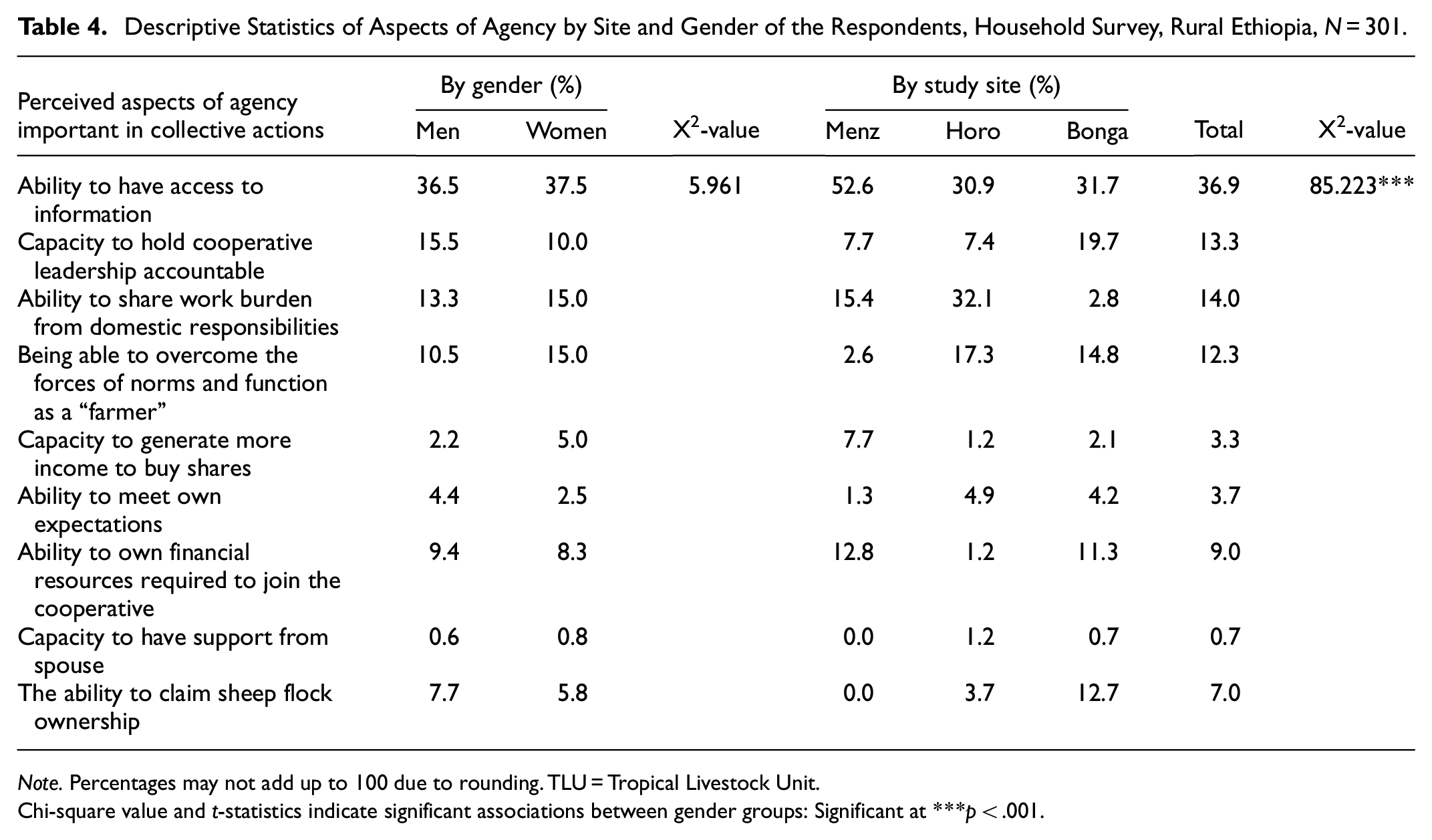
Note. Percentages may not add up to 100 due to rounding. TLU = Tropical Livestock Unit.
Chi-square value and t-statistics indicate significant associations between gender groups: Significant at ***p < .001.
Women’s limited ability to access information they value, as a result of various socio-economic factors, excluded them from membership of the breeding cooperative. A Women only FGD participant at Menz reflected saying: […] although, we [women spouses] do majority of the work related to sheep only our husbands are registered member of the breeding cooperative in our community. We equally desire to be members but our inability to have access to cooperative facilitators and the required information left us out.
Due to their lack of information with respect to the purpose of the new initiative, the breeding cooperative, the women used to hide their sheep from visitors at the beginning due to misconceptions. They feared that government was going to take away their animals since the better ones were selected and tagged. Women members in the cooperative at Bonga in which number of members has greatly increased over time, reported sentiments like the following: […] we did not know the purpose as it was the men who took part in the community meetings arranged for setting-up the breeding cooperative, thus we used to hide good sheep from the flock. But now, not only women headed households but many married women wanted to be a member of the coop. Because, gradually we have learnt about it […], Women only FGD participant, Bonga.
Let alone participating in community meetings organized by externals, women usually not invited to make participation in consultative dialogs or interviews even when conducted at home by extension agents or any outsiders. During such occasions, the norm is that women are busy in preparing coffee or food for the guest and thus do not have time to sit down and listen. A participant in the FGD with the cooperative leadership committee at Menz lamented “[…] we [referring to the male spouses] usually order our partners to serve us while we discuss with visitors.”
Generally, women have limited access to livestock extension information. Even when trainings are organized nearby the community, women do not have the power to exercise their will and participate unless allowed by their spouses. As a result, particularly, women in male-headed households have greater challenges of accessing information (A. Mulema et al., 2019). They lack recognition and are usually by-passed by extension service providers. Cultural factors in some communities do not allow male extension agents to be in contact with women in the absence of their husbands. Although women are heavily involved in livestock production, their role is culturally less valued (Kassa, 2015), which affects their control of benefits from their labor and access to information and advisory services on livestock. Such community values and norms determine who gets what information, from whom, and who accesses what and how (Flora & Flora, 2008).
The Capacity to Hold Cooperative Leadership Accountable
The household survey revealed that 15.5% of men and 10% of female respondents have indicated the capacity to hold cooperative leadership accountable as one of the main aspects of agency for their active participation in the breeding cooperative (Table 5). However, this was mentioned only by the men-only FGD participants in the qualitative study (Table 5). Across the study sites, almost all the cooperative leadership committees are composed only of men members (Hailu & Kinati, in press). Limited involvement of women in elected positions is often attributed to the fact that women themselves may be reluctant to vote for other women and that the persistence of negative cultural attitudes toward women leadership by men and by women themselves (Wanyama, 2010). During the FGDs with the men only groups, close connections between the leadership committee and local government officials is mentioned as the weak side of the cooperative leadership. The male members see this close interaction as interference in the cooperative’s affairs for the sake of personal gains. This was reflected at Menz by one of the males only FGD participants as: “the leadership committee cannot be trusted. As we see their close connections with local officials. We lack the capacity to hold them accountable.” Men members of the cooperative perceive that the leadership is doing some kinds of mischief with the local administration officers. A similar perception was also held among men members of the cooperatives at Bonga for the same reason.
Aspects of Agency Perceived by Men and Women Members of Breeding Cooperatives, FGDs With Men & Women Only Groups, 2017, Rural Ethiopia.

aNumber of marks indicate the relative frequency of perceptions reflected regarding the aspects of agency being considered in relation to the other gender group and locations. Accordingly, “√,”“√√,” and “√√√” indicates sometimes, often and very often respectively.
Interestingly, the strong relationship between cooperative leadership and government officials was perceived negatively. This challenges literature on “social capital” where bonding and linking social capital is touted as a positive attribute for development (Jones et al., 2012; Mojo et al., 2016)). This suggests that strong relationships with powerful actors is helpful only if the benefits trickle down to all members of the breeding cooperative. Commenting on this aspect of agency, participants in the FGDs said that they lack the ability to express own voices freely without influences from others. This implies that the breeding cooperative is not cultivating power within, an important aspect of agency, among members. However, evidence suggests that members gain self-esteem, confidence and self-reliance leading to empowerment at both an individual and group level when they operate through collective actions (Deshmukh-Ranadive, 2005).
Apart from that, it appears that lack of communication strategies that ensure clear and transparent procedure regarding what the leadership is doing at the highest level in the cooperatives structure possibly can cause the anticipated mischief. Lack of leadership skills combined with absence of regular need-based training support for the leadership and even for the general assembly could be another factor for the perceptions developed by the mainly male membership. Moreover, bad memories from the past socialist regime, which used cooperatives as an instrument to organize peasants, levy taxes, control the prices of commodities, and extend government control to the local level against the cooperative principles (Mojo et al., 2018), could motivate cooperative members to perceive the expected relations between the cooperative leadership and local government in this way. Otherwise, the leadership need to work closely with local administration in order to obtain a variety of services important for the smooth functioning of the cooperative. The capacity of the leadership to create a conducive environment for trust and harmony between members at large and the cooperative leadership is essential to enhance active participation of members in the cooperative’s affairs.
Ability to Share Domestic Workload
Women’s ability to share domestic activities with husbands and other male family members so that she can freely exercise her own choices, for instance to become members of collective actions, was mentioned as an important aspect of agency they value. Slightly more female (15%) respondents identified this issue than did their men (13.3%) counterparts (Table 4). However, in the qualitative study the ability to share domestic work burden with others was mentioned only as an important aspect of agency for making effective participation by the female-only FGD participants (Table 5) at Horo and Menz. It was strongly reflected in sentiments such as this: “a woman is working with one hand while a man is working with two hands”(female only FGD participant at Horo). This is to imply with that women do not have the ability to fully engage in empowering economic activities outside the home as freely as their men counterparts, mainly because women do not have the ability to share their domestic activities. In the same target sites, a study has indicated that women spent, on average, up to 5 hr per day more on such work as compared to the men (Kinati & Mulema, 2019).
Generally, women spent most of their time on strenuous and tiresome domestic chores and other related reproductive roles fundamental to the survival of their families although often remains less valued (Kinati et al., 2018) and unremunerated (F. Belay & Oljira, 2016). These domestic roles of women not only affect the quality and quantity of their work done outside the home but also it can influence the type of work performed by them. This is also used, traditionally, to legitimize the practice of productive duties being left for men. Women’s masked inability to effectively and timely accomplish assigned productive and community roles was often presented as a proof by the men in order to systematically discourage women from engaging in highly valued activities. In reality, what is being taken as an evidence to show their incompetency when engaged in activities traditionally designated as men’s role is actually their domestic work burden. So, domestic work overload not only consumes women’s productive time but also diminishes their sense of competence in more valued activities (Ryan & Deci, 2000).
The Ability to Function as a ‘Farmer’
The women participants in the FGDs believe that the ability to make decisions to fulfill one’s aspirations is an important aspect of agency. It is the state of being free from the forces of norms and function as a “farmer” who has the ability to translate own wishes to an action and benefits from it. They often make comparisons with men farmers when explaining this aspect of agency—be able to place oneself on equal footing with male farmer in the cooperative. About 12.3% of the respondents to the household survey indicated this aspect of agency as important. In the qualitative study, this emerged often among the women only FGD participants in Bonga and Horo study sites. Women are more likely than men in the household survey sample to believe this to be an important aspect of agency for one’s active participation (15% c.f. 10.5%) (Table 4). When they, the female only FGD participants, reflected on the meaning of what a “male famer” constitutes, directly or indirectly mentioned, for them it is about the pursuit and attainment of own aspirations,
3
achieving personal growth, participation in the leadership positions and decisions, and contributions to their community. In conceptualizing it they tend to compare themselves with men, who are autonomous farmers in their view. Because of the socially imposed constraints, women cannot act and attain what they aspire to achieve. For example, in central and southern parts of Ethiopia, even if a woman owns her own land while living with her husband or not, she is culturally forbidden to plow with oxen (F. Belay & Oljira, 2016; Gella & Tadele, 2014). A female participant from women only FGD from Bonga asserted: […] we [to say women] want to work as not only at home but also outside like the men. We aspire a lot, we want to work and generate our own income and have own cattle and also make participation in community affairs like others. We wish to participate in groups and generate benefit like them.
The women in these study areas wish to participate in productive activities and engage in producing cash commodities, like their men counterparts. However, the prevailing normative perceptions act as a barrier to them. This is also systematically reinforced by the extension system that generally acknowledge men as legitimate farmers and thus direct extension services them (Sachs, 1996 quoted in F. Belay & Oljira, 2016) mainly because men hold the plow and till the land (A. A. Mulema, 2018). Such beliefs further excluded them from access to extension services that would enable women to fully engage in productive activities and act independently in relation to agricultural production (Adal, 2011). Combined together, all this made women invisible in economic and political spheres because the existing sociocultural life in Ethiopia generally favors men (Hebo, 2006).
In their testimonies, the women group participants, reflected that productive activities that enable them to generate income and open-up opportunities to have access to other important assets, are usually outside their reach. As a result, often, engagement in these activities requires one to have the capacity to break the existing norms which is quite hard. For example, Women only FGD participant from Horo stated a saying in the area which goes as “a land ploughed by a woman can’t be productive”—the connotation is to mean that even if a woman owns a plot of land and wanted to cultivate economically an important crop, she can’t simply do that because of the norm that dictates a land tilled by a woman is unproductive. Similarly, Ragasa (2009, as cited in A. D. Belay et al., 2016) noted, in the same region, a belief that states “[i]f women cultivate, there will be no rain fall.” Although, researchers (such as McCann, 1995 as cited in Gella & Tadele, 2014) attributes the reason why land tillage is not appropriate for women to the dominance of ox-plow, which requires physical strength, such “sayings” are essentially coined to discourage women from engaging in such activities outside the home. Such norms can be of influence when enforced by the dominant group in the society while the victims are not conscious of it (Bachrach & Baratz, 1962; Badstue, Petesch et al., 2020). Thus, that is why it is argued that enabling disadvantaged community members, who are often women, to access key empowerment resources by first raising their consciousness should be a development priority (Kabeer, 1999, 2021). However, it is evident from the FGDs with women groups that engagement in activities assumed masculine are what women consider as an expansion in one’s ability that grant them the feelings of being a “fully functioning farmer.” Having the capacity to fully engage in these activities by itself generates them confidence primarily because such activities, they believe, have the ability to enable them to jump over the boundaries of their traditional domain, which is confinement within a home.
For women in the study sites, the ability to function as a “farmer” also involves the capacity to make active participation and achieve own aspirations in community groups. The women group believe that participation in producer groups such as the breeding cooperatives enable one to generate various benefits including access to new opportunities—skills, trainings, new networks, self-awareness and reputation. This assertion is apparent in the sentiments such as “[…] we feel proud and confident when we participate in men’s associations that brings you a lot of benefits” women only FGD participants, Bonga. Evidences show that associations provide women the opportunity to gain power within which leads to power to, access to and control over empowerment resources (Deshmukh-Ranadive, 2005; Galié & Farnworh, 2019).
Ability to Meet Expectations, Own Financial Assets and Sheep Flock
Other aspects of agency in livestock-based institutions mentioned by study participants include the ability to meet own expectations (3.7%), capacity to own financial resources (9%), ability to have support from spouse (0.7%), and the capacity to claim sheep flock ownership (7%) (Table 4). Respondents to the FGDs linked the ability to meet own expectations to the type of agency derived from one’s literacy level. The expectation is that those with better education have the ability to achieve their personal goals in collective action settings. This was mentioned only by the men FGD participants as one other important aspects of agency in the qualitative assessment. Having the ability to make decisions with respect to household financial assets was mentioned by the women as an important aspect of agency that they need in order to equally benefit from the breeding cooperative. In general, literature suggests that women have limited access to and control over resources in rural Ethiopia (F. Belay & Oljira, 2016) mainly due to the prevailing wrong traditional perceptions about them which negatively affects their position in society and economy (Charlton, 1984 as cited in F. Belay & Oljira, 2016). Women’s low income, resulted from lack of access to and control over important assets, is generally an obstacle to them for satisfying membership conditions (Jones et al., 2012).
Support from spouse, and the ability to claim sheep flock ownership for women particularly in male headed households, were only mentioned by the women only FGD participants in the qualitative assessments. Married women relate the former to one’s ability to make strong arguments to convince their husbands so that they would be supportive in joining associations such as the breeding cooperative. Marital support has been reiterated in other women empowerment studies from the Global South and Ethiopia in particular, whereby marital collaboration is a key ingredient in achieving women’s strategic life goals (Badstue et al., 2020; Galié & Farnworth, 2019). However, the latter is about the “power to” aspect of agency. Because, women often relate that to the freedom to have access and own the required resources in order to achieve one’s aspirations.
Factors Associated to the Dimensions of Agency Identified
In order to address the second research question, we run a multinomial logistic regression to identify factors influencing the agency livestock keepers perceived important in the breeding cooperative (Table 6). Six out of 10 independent variables were significant in explaining the aspects of agency under study. For the first category, capacity to hold cooperative leadership accountable, the predictor “distance to extension services” is positive and significant (β = .014, SE = 0.006, p-value = .033 with OR > 1) indicating that cooperative members located away from extension posts are more likely to report this as an important aspect of agency affecting their active participation in the breeding cooperative as compared to the base category. This could be partly explained by the inefficient information flow mechanisms the cooperative management put in place to access members living far away from the cooperative office. This finding is in accordance with Sseguya et al. (2015) who concluded saying that trust and leadership style affect one’s capacity to make active participation in the group contexts in Uganda. Earlier experiences with cooperatives, for example in Zimbabwe, show that famers’ associations disintegrated due to considerable mistrust among members, and with leadership (Masakure & Henson, 2005). Moreover, apart from lack of agency, research has also shown that social relations may restrain members from making leadership accountable. For example, in Chile, close social relations happened to be a stumbling block for enforcing cooperative rules (Berdegue, 2002).
Estimation of the Probability of Falling in to One of the Categories on the Dependent Variable Affecting Active Participation of Members in the Cooperative Affairs as a Function of a Set of Predictors Using MLR, HH Survey, Rural Ethiopia.

Note. Standard Error (SE) in parenthesis.
p-Values indicate significant associations between covariates and categories of factors affecting participation. Significant at ***p < .01; **p < .05; *p < .1.
The reference category is others which includes the ability to achieve own expectation from the cooperative, ability to own financial resources required to join the cooperative, capacity to have support from spouse, and the ability to claim sheep flock ownership.
OR: Odds Ratio.
TLU: Tropical Livestock Unit computed based on procedures as suggested by Storck et al. (1991) .
Includes cattle, chicken, donkey, horse/mule.
rf: reference category.
In the estimation for the ability to share domestic work burden category on the dependent variable, four predictors are significantly associated with it. The predictor “log of sheep flock size” is negative and significant (β = −3.471, SE = 0.10.257, p-value = .006) with OR < 1 suggesting that members having larger sheep flock size are less likely of reporting this aspect of agency as being important and required for their active participation as compared to the base category (other factors). When the interaction effect between log of flock size and log of land owned is tested, the result is positive and significant (β = 6.895, SE = 3.255, p-value = .034 with OR > 1) suggesting that the effect of sheep flock size actually depends on the size of one’s land ownership. Apparently, the size of a flock is determined by the caring capacity of the land a person owned. Generally speaking, asset ownership, including livestock, is positively associated with higher women’s autonomy (Koenig et al., 2003) which could give women the ability to negotiate and share domestic work burden with household members.
Likewise, the predictor “number of women in the coop leadership committee” is negative and significant (β = −.566, SE = 0.237, p-value = .017), with OR < 1 indicating that members belonging to cooperative with more female member in the cooperative leadership committees are less likely to report this dimension as an important aspect of agency for their active participation as compared to the base category. The existence of women members in the leadership committee is more important in improving women’s active participation in cooperative affairs by influencing the work environment as women leaders are better aware of women’s domestic issues. Previous research has revealed that cooperatives with active women participation in the leadership positions have proved to have a positive influence on other women’s active participation (Oxfam International, 2013). Members are better informed about their domestic rights and the day-to-day affairs of the cooperative as information flow gets improved when women are in the leadership positions (FAO, 2011) and thus women might be encouraged to negotiate better with household members.
On the contrary, regional residence is positive and significant for Menz and Horo (β = 2.208, SE = 0.829, p-value = .008), (β = 3.529), SE = 0.740, p-value = .000) respectively, with OR > 1 indicating that members from these two sites are more likely to report the ability to share work burden from domestic responsibilities as an important aspect of agency for their active participation, as compared to cooperative members from Bonga. The odds ratio indicates that the odds associated with being in this category for members from Menz and Horo is 9.1 and 34.09 times that of the odds for members from Bonga, respectively. This could be related to the family size which is slightly higher in Bonga than in Menz and Horo. More importantly, this might be because of the fact that the populations in these districts are homogeneous in terms of ethnicity and religion, and are more conservative (Kassa, 2015) with distinct gender-based roles, than is the case in Bonga. In Uganda, for example Sseguya et al. (2015) identified heterogeneity as one of important factors that affect quality of participation in community groups.
The striking result is that cooperative members with more years of schooling are more likely to report the ability to fully function as a “farmer” in the breeding cooperative as one of the important aspects of agency that determine their effective participation. The predictor “Years of schooling” is positive and significant (β = .485, SE = 0.237, p-value = .040) with OR > 1 indicating cooperative members with more years of schooling are more likely to report this aspect of agency as important for their active participation in the livestock-based institution. This might imply that literate community members are more aware of the effect of social norms. For example, a similar study has shown that even if women own land, they cannot effectively plow and manage due to cultural restrictions hence women may develop sense of incapability to function as a male farmer (Ragasa, 2009, as cited in A. D. Belay et al., 2016). The qualitative study has shown that, in Bonga and Horo study areas, women farmers often mentioned this problem and thus it appears that they are aware of the normative influence of the dominant thinking on their ability to pursue their goals as a fully functioning farmer. However, they lack the power to challenge and influence the established norms. Nevertheless, it is often argued that collective action such as the breeding cooperative could help to challenge the current norms and behaviors that constrain women’s empowerment (Bosc, 2018). Having more years of schooling could help livestock keepers be able to recognize the social norms that constrain them from equally engaging in all the functions of the cooperative. Similar findings have been reported from developing countries whereby more years of schooling has consistently led to positive associations with agency (Hanmer & Klugman, 2016).
The sense of consciousness about the existing normative structure is more notable among women who own land but constrained to till unlike their men counterparts and lack of this aspect of agency is more recognized among literate ones. Self-consciousness is believed as an important aspect of agency (Kabeer, 1999) if supported and strengthened, it would enable actors to recognize their capability and help to translate their asset base into wellbeing in order to tackle poverty, as opposed to the income based utilitarian approach to development (Alsop et al., 2006).
The estimation results are, generally, in line with similar studies in other countries in the Global South (see Akram, 2018; Allendorf, 2007; Lecoutere et al., 2019). In order to see whether women and men are interpreting the identified aspect of agency the same way, and whether agency is in fact different for women and men, we have used the gender dummy variable to define all the possible interactive terms. However, the results revealed no significant interactions. Results can be accessed upon request.
The study assesses perceptions of agency and factors affecting it, within the context of co-operative membership. While this provides a focus for the analysis, on social and economic aspects of sheep production by households, there remains divergence between commentary on the co-operative and perceptions of gender-related agency. In particular, the agency dimension “capacity to hold co-operative leadership accountable” may reflect dissatisfaction with management and personalities rather than systematic barriers to the exercise of agency. Several comments emerging from the FGD support this conclusion. The implications for co-operatives then center on transparency, which the FGD have established as being linked to communications and indirectly to agency and women’s empowerment.
Although, some scholars argue that contextualized studies of agency limits cross-context comparisons and may contribute to inconsistent findings (Ibrahim & Alkire, 2007), our work, focussing on livestock-based institutions in Ethiopia, makes some novel contributions—in terms of contextual understanding of agency and factors associated with it—to the discourse on agency in livestock-based context. The important aspects of agency identified would help to advance the positive impact of the initiative in Ethiopia if they are cultivated and strengthened. Moreover, the in-depth qualitative study generated information from a gendered perspective enabled us to contextually explore and better understand agency while the quantitative analysis explored associations between these aspects of agency and enabling resources variables as suggested in the literature (Galiè et al., 2022; Falconier et al., 2015). Thus, this study provided holistic understandings of what constitutes agency in livestock-based institutions and the associated factors.
Despite this novel contribution, this work is limited by those questions available in the qualitative and quantitative studies conducted by ICARDA Ethiopia office. Particularly, the effect of culture on explaining the differences observed among the study sites were not explored in detail. Moreover, peoples involved in the process of data collection may affect the quality of the data used for the analysis due to the problem of social desirability bias. Therefore, replication of this analysis is recommended in the remaining target sites.
Conclusion
Although it appears that conceptualizing aspects agency differs along gender lines according to the results from the qualitative assessments, we conclude that agency in the breeding cooperative is conceptualized based on four main dimensions. Apart from several important agency enabling resources identified, regional residency, used as a proxy to the normative cultural differences between study sites in the logistic regression, was found to be an important variable implying the importance of context in understanding agency within the livestock-based institutions.
Our findings have important development implications. One of the immediate recommended actions would be making use of and strengthening the existing consciousness exhibited among the literate community members regarding the negative effect of social norms to initiate community level dialogs for transformational impact. Transformative approaches, such as community conversations, integrated with collective actions would help to create contextual conditions that facilitate and motivate the practices of a changed desired behaviors that could facilitate and promote autonomous actions through cultivating intrinsic agency. Similarly, increasing women’s control and ownership over agency enabling resources, livestock and other key household assets, is a pressing need in order to enhance their agency for active participation in the current breeding cooperative. Equally important is also strengthening women’s leadership skills and their participation in the leadership roles. Thus, for initiatives to tackle the gender norms through transformative approaches, there is also a need to target norms that discourage women’s livestock ownership and participation in the leadership roles. For the latter, this requires household and community managed initiatives to address the gender norms that dictates the gender division of labor in the domestic affairs. Finally, our findings also stress the importance of literacy programs for men and women community members to stimulate wider consciousness over the effect of gender norms and ensuring effective communications channels to reach out to systematically marginalized social groups requires attention.
Footnotes
Acknowledgements
We would like to acknowledge that this work was supported by the University of New England International Post Graduate Research Award Grant (UNE IPRA). We are also grateful to ICARDA Ethiopia program office for giving as the access to the dataset and the respective regional agricultural research institutes, their technical staffs and cooperative members who were sources of the data used for the analysis. The authors thank the CGIAR Research Program (CRP) on Livestock and the donors supporting the program for funding this research.
Author Contributions
ICARADA-Ethiopia staff conceived the research idea and designed the study and RH followed up and monitored the quantitative data collection. WK transcribed (the qualitative data), cleaned and analyzed the data. WK, ET, DB & DN conceptualized and drafted the paper. All authors read, commented, and approved the final manuscript.
Declaration of Conflicting Interests
The author(s) declared no potential conflicts of interest with respect to the research, authorship, and/or publication of this article.
Funding
The author(s) disclosed receipt of the following financial support for the research, authorship, and/or publication of this article: This work was funded by the Breeding and Genetics Flagship of the CGIAR Research Program on Livestock. The work was further developed under the CGIAR SAPLING Initiative. The funding institution played no role in the analysis and conclusion of the study.
Ethics Statement
This study is based on data collected from a breeding program led by ICARDA. They considered all the potential ethical issues associated with conducting field study with human beings. Oral permission was granted from the respective local administrative bodies of the relevant district government offices. Before undertaking the interviews, an informed consent from the prospective informants and group discussants was obtained only after in-depth discussions with the prospective participants. Likewise, permission was also obtained for taking audio recordings of conversations in order to comply with the local cultural beliefs. All the research participants were assured that any private issues and information gathered would be confidential and not be disclosed without their consent to any individuals, including their spouses, or organizations.

Notes
Data Availability Statement
The datasets used for the current study can be accessed upon reasonable request to the corresponding author and with permission of third party, ICARDA.