



Abstract
This study examines the role of Oman’s business schools in aligning educational initiatives with Vision 2040 and preparing graduates for the challenges of the Fourth Industrial Revolution (Industry 4.0) and beyond. A qualitative research approach was used, involving semi-structured interviews with stakeholders, including industry professionals, business graduates, business faculty, and heads of business programs. The study highlights the necessity for business schools to align with Vision 2040, focusing on skill development, innovation, and entrepreneurship. It emphasizes integrating Industry 4.0 concepts into the curriculum and fostering academic-industry collaboration. Essential skills for graduates include interpersonal, leadership, and adaptability skills, along with technical competencies. Leadership within business schools is crucial for driving transformative change through proactive industry engagement and continuous curriculum adaptation. The study advocates program adjustments to enhance job readiness, industry collaboration, pedagogical improvements, and faculty upskilling. The study is limited to institutions offering business and management programs and relies solely on qualitative data from semi-structured interviews. The findings offer strategic guidance for business education, supporting Oman’s economic diversification and the development of a skilled workforce. This research contributes to the literature on business education and organizational change, providing a foundation for policymakers to develop frameworks and policies to enhance student competencies, thereby fostering regional development in Oman and the gulf region.
Plain Language Summary
This study explores how business schools in Oman can prepare graduates for the challenges of Industry 4.0 while supporting the country’s Vision 2040 goals. Using interviews with industry professionals, graduates, faculty, and program heads, the research identifies key skills graduates need, such as leadership, adaptability, and technical competencies. It highlights the importance of updating curricula, fostering collaboration between academia and industry, and developing faculty capabilities to ensure graduates are job-ready. Strong leadership within business schools is essential for driving these changes. The findings provide practical guidance for educators and policymakers on improving business education and aligning it with national economic and workforce development priorities. Although the study focuses on business programs in Oman and uses qualitative interviews, it offers insights that can support the development of skilled graduates in similar contexts across the Gulf region.
Introduction
Higher Education Institutions (HEIs), particularly business schools, are increasingly challenged to prepare graduates for employment in rapidly changing economies. Much of the global discourse has focused on what employability skills should be developed and how they should be taught, but far less attention has been given to evaluating how employability skill provision influences graduate outcomes and supports national transformation agendas (Anjum, 2020; Jackson et al., 2013; Mainga et al., 2022; Pandya et al., 2023). This issue is becoming more pressing as industries worldwide continue to express concern about graduate shortfalls in specific employability skills and overall readiness for employment. Business schools have invested significant resources to meet these demands, yet organizations and HEIs alike face mounting pressure to generate work-ready graduates (Daniel et al., 2023). Employers struggle to recruit graduates with appropriate expertise, while students often leave university burdened with debt but lacking meaningful job experience (Longmore et al., 2018). This mismatch highlights the persistent gap between employee shortages and inexperienced graduates (Anjum, 2020; Watson, 2018).
These concerns are amplified by the demands of the Fourth Industrial Revolution (Industry 4.0). Professionals capable of thriving in technologically advanced contexts are increasingly in demand across sectors (Abelha et al., 2020; Ali, Al-Saadi, & Scatolini, 2022; Cazzaniga et al., 2024; Schwab, 2017; Shen & Zhang, 2024). However, HEIs are frequently criticized for failing to prepare graduates for the realities of professional practice (Knight & Yorke, 2003; Thomas & Ambrosini, 2021). As a result, graduate employability has emerged as one of the most critical concerns shaping institutional missions (Small et al., 2018; Thumiki & Mujumdar, 2024). In this context, employability is understood as “a set of achievements—skills, understandings, and personal attributes—that makes graduates more likely to gain employment and be successful in their chosen occupations, benefiting themselves, the workforce, the community, and the economy” (Harvey, 2003; Yorke, 2006).
Business schools must therefore reinvent themselves to respond to these evolving expectations. They are tasked with breaking out of traditional, discipline-focused structures to prepare students for emerging professions. The future challenge is not a lack of jobs, but rather a shortage of the skills demanded by new and evolving roles (Cazzaniga et al., 2024; Gray, 2016; Horch, 2017). This raises a fundamental question: how can business schools adjust to these expectations? Industry 4.0 requires the emergence of knowledge workers, graduates who are not only technologically proficient but also value-driven, innovative, critical thinkers, and effective communicators (Shen & Zhang, 2024). Such graduates must be able to manage technological advancements while also recognizing their broader societal implications (Cazzaniga et al., 2024; Gray, 2016; Horch, 2017; Islam et al., 2025; Ives & Javenpaa, 1996). Developing this type of graduate requires a transformative approach to education.
For countries in the Middle East, including Oman, these challenges intersect with broader economic transitions. Declining oil prices and the global push for renewable and sustainable options have intensified the need for diversification beyond oil revenues (Keskes & Haytayan, 2023). Oman has responded by adopting Oman Vision 2040, which emphasizes economic diversification, technological innovation, and human capital development to align with the demands of Industry 4.0 (Al-Saiari et al., 2022). A particular challenge in Oman is integrating youth—who represent nearly half of the population—into the workforce, where mismatches persist between graduate output and available opportunities (Asmi, 2021). To remain competitive globally, Omani businesses must enhance training and continuously update skills across all age groups. While automation, Artificial Intelligence (AI), and digitalization are expected to bring long-term benefits, these shifts also demand careful preparation of the workforce for new employment requirements (Asmi, 2021).
HEIs, particularly business schools, are central to this process. They are expected to align curricula with industry needs, cultivate collaboration with stakeholders, and embed employability skills into degree programs (Al Hinai et al., 2020; Ali, Al-Saadi, & Scatolini, 2022; Al-Saiari et al., 2022; El-Saharty et al., 2020; Mahmud & Wong, 2022; Vijaya et al., 2024).
Business schools are prioritized in this study because they produce graduates whose skills support management, entrepreneurship, and industry leadership (Ilhan-Nas et al., 2024; Wahl & Münch, 2022), areas critical to Oman’s economic diversification and Vision 2040 (Al-Abri et al., 2024; Al Hinai et al., 2020). Compared to other HEIs, they have a particularly urgent role in aligning curricula with evolving workforce demands and Industry 4.0 competencies (Schwab, 2017; Shen & Zhang, 2024), as their graduates are expected to drive innovation, manage technological change, and contribute to both private and public sector development (Abelha et al., 2020; Ali, Mohamed Isa, et al., 2022). Focusing on business schools thus provides a clear lens for understanding how higher education can strategically support national transformation.
Various surveys and initiatives are underway to measure the effectiveness of academic programs in Oman, but there remains limited empirical evidence that systematically investigates the role of business schools in preparing graduates for future jobs in the context of national transformation. This represents a scholarly gap, as most existing studies emphasize skills shortages (a market gap) rather than examining the institutional and strategic contributions of business schools to national development agendas such as Vision 2040.
Accordingly, this study investigates how business schools in Oman can strategically prepare graduates for future jobs that support the nation’s transition toward Vision 2040 in the context of Industry 4.0. The study is guided by the following central research question:
How can business schools in Oman strategically prepare graduates for future jobs that support the nation’s transition toward Vision 2040 in the context of Industry 4.0?
This central question is further unpacked into the following sub-questions:
How do business schools contribute to achieving the strategic objectives of Oman Vision 2040?
What is the role of business schools in the context of Industry 4.0 in Oman?
What skills and competencies are most valued in graduates of business schools in Oman?
How does leadership influence transformation and innovation within business schools?
What program adaptations are required to prepare business school graduates for future jobs in Oman?
By addressing these questions, the study contributes to understanding how business schools can function as agents of national transformation. It provides insights into aligning educational outcomes with technological advancement, enhancing graduate employability, and strengthening the integration of academia, industry, and policy. The findings are expected to inform both institutional strategy and policy development, thereby supporting Oman’s broader agenda of sustainable economic diversification and innovation under Vision 2040.
The subsequent sections of this paper are organized as follows: Section “Background and Context” provides the background and context of the study. Section “Literature Review” reviews the relevant literature, offering insights into the existing body of knowledge. Section “Methodology” outlines the methodology employed. Section “Results” presents and discusses the findings. Section “Discussion” offers a detailed discussion, analyzing the results in relation to existing literature and highlighting novel insights. Finally, section “Conclusion” concludes the article by summarizing implications and suggesting directions for future research.
Background and Context
This section outlines the national and technological context relevant to the study. It highlights Oman Vision 2040 and the implications of Industry 4.0, providing the foundation for understanding the role of business schools in preparing graduates for future jobs.
Oman Vision 2040
Oman Vision 2040 is a comprehensive long-term development plan designed to transition Oman into a diversified, sustainable, and globally competitive economy. The vision outlines clear goals for economic diversification, enhanced human capital, and the integration of advanced technologies to meet the challenges of the Industry 4.0. Its core themes focus on developing a knowledge-based economy, enhancing governance, and ensuring social welfare, while maintaining sustainability and environmental protection (Oman Vision 2040, 2020).
One of the central pillars of Vision 2040 is to reduce dependency on oil and gas revenues by strengthening sectors such as logistics, tourism, manufacturing, and education. HEIs, and particularly business schools, are expected to play a pivotal role in this transformation by cultivating the skills necessary for a digital and technology-driven economy. Several government initiatives, such as partnerships with international universities and private sector collaborations, are already underway to accelerate this transition.
At the same time, Oman faces significant challenges. Youth aged 18 to 29 comprise nearly half of the Sultanate’s population (46.7%), creating a substantial annual inflow of graduates into an uneven labor market (Asmi, 2021). To reset and rebalance, Oman must ensure that its workforce has access to knowledge about new opportunities at home, online, and abroad, as well as the skills to seize them. With appropriate support and guidance systems, these imbalances can be addressed, ensuring that the Omani workforce secures a sustainable future and contributes effectively to the socioeconomic goals of Vision 2040 (Zehra et al., 2022).
Several steps toward developing the required competencies are being taken at national, international, and institutional levels (Ali, Mohamed Isa, et al., 2022; Al Hinai et al., 2020). Surveys are also being conducted to assess the impact of academic programs offered by HEIs. However, despite these efforts, there is still no comprehensive evidence examining the role of business schools in preparing graduates for future jobs in Oman’s changing context. This gap reinforces the need to investigate how business schools can support Vision 2040 through curriculum development, program alignment, and stakeholder collaboration.
Business schools, in particular, must recognize this challenge and act through curriculum innovation, including the integration of employability and soft skills into undergraduate and postgraduate programs (Mahmud & Wong, 2022; Watson, 2018). Many institutions have already prioritized collaboration with companies, professionals, statutory, and regulatory agencies to ensure programs are aligned with industry requirements. By working with stakeholders, business schools can identify in-demand talent and transform students into adaptable, job-ready individuals. Continued development of these relationships is essential to align higher education outcomes with labor market needs, ensuring that graduates are equipped with the practical skills required by Oman’s evolving economy (Watson, 2018).
Industry 4.0 and Its Implications for Oman
Industry 4.0 represents a pivotal technological transformation characterized by the integration of AI, big data analytics, robotics, and automation into various sectors (Lee et al., 2014; Schwab, 2016). This era is defined by interconnectivity and digital intelligence, reshaping industries, economies, and labor markets. For Oman, adopting Industry 4.0 technologies is critical to boosting competitiveness and aligning with Vision 2040’s strategic objectives (Abdelfattah et al., 2024; Oxford Business Group, 2024).
The successful realization of Vision 2040 is closely tied to how effectively HEIs integrates Industry 4.0 technologies, such as AI, robotics, and big data analytics, into academic programs. Embedding these technologies in curricula ensures that graduates are adequately prepared to contribute to Oman’s competitiveness in global markets (Maashani, 2023; Oman Vision 2040, 2020; Royal Academy of Management, 2024).
Automation and digitalization offer long-term benefits but also create challenges for workforce readiness. The future may not be defined by a shortage of jobs, but rather by a lack of skills suited to new types of employment (Gray, 2016; Horch, 2017). To remain competitive, Omani businesses must expand their training commitments and continuously upskill employees of all ages (Al-Abri et al., 2024; Asmi, 2021). This requires HEIs to design curricula that equip graduates not only with technical knowledge but also with critical thinking, innovation, and leadership abilities—traits that define the knowledge worker of the future (Cazzaniga et al., 2024; Shen & Zhang, 2024).
Business schools thus play a crucial role in this transition by updating curricula to include AI, data analytics, and digital transformation, while also embedding soft skills and ethical perspectives (Berbegal-Mirabent et al., 2020; McCarthy et al., 2023; Uzorka et al., 2023). In addition, building strong partnerships with industry leaders and fostering continuous faculty development are essential steps in aligning academic programs with Industry 4.0 requirements (Abulibdeh et al., 2024; Li, 2022). By preparing graduates to harness the opportunities of Industry 4.0, business schools can contribute directly to Oman’s Vision 2040 objectives of economic diversification, innovation, and global competitiveness (Royal Academy of Management, 2024).
Linking Context to Research Aim
The dual imperatives of Oman Vision 2040 and the global transformation associated with Industry 4.0 highlight the strategic role of business schools in shaping a future-ready workforce. While policy initiatives, industry collaborations, and curriculum reforms are underway, there is limited scholarly evidence that comprehensively examines how business schools in Oman are adapting to these challenges. Existing research often emphasizes skills shortages as a market gap but overlooks the scholarly gap concerning the institutional and strategic contributions of HEIs to national transformation agendas.
Addressing this gap is critical to ensuring that higher education outcomes align with Oman’s economic diversification goals and the demands of Industry 4.0. Building on this context, the present study investigates how business schools can effectively prepare graduates for future jobs, thereby supporting the country’s transition toward Vision 2040.
Literature Review
This section reviews the literature relevant to the study, focusing on the evolving role of business schools in the era of the Industry 4.0 and the application of stakeholder theory within higher education. The review highlights skills and competencies required for graduates, the responsibilities of business schools in preparing future workforces, and the diverse interests of stakeholders in Oman’s educational ecosystem.
The Evolving Role of Business Schools in the Era of Industry 4.0
Technological and innovative advancements have influenced the industrial revolution. The first involved mechanization, the second used electrical energy, and the third relied on automation and electronics (Benesova & Tupa, 2017). These revolutions not only transformed manufacturing systems but also influenced workforce training and the role of educational institutions.
Currently, industry is transitioning to a digitalized manufacturing system, representing Industry 4.0. This revolution affects the workforce as well as training and education systems, prompting scholars to investigate potential changes in skills and competencies required for the future workforce (González-Pérez & Ramírez-Montoya, 2022; Ilhan-Nas et al., 2024; Kumar, 2025; Li, 2020, 2022; Mahmud & Wong, 2022; Shen & Zhang, 2024).
Today’s students will grow up in a society that is mechanized, globalized, networked, and virtualized (Chaka, 2022; Motyl et al., 2017), creating demand for new competencies critical for employability (Bondin & Zammit, 2025; Ciolacu et al., 2023).
Organizations increasingly recognize that Industry 4.0 affects the skill requirements of highly trained workers, and governments worldwide are examining the implications of technological implementation for workforce training (Broo et al., 2022; De Souza & Debs, 2024; Ilhan-Nas et al., 2024; Kumar, 2025; Lase, 2019; Nafea & Kilicarslan Toplu, 2020). The World Economic Forum (WEF, 2017) identifies ten key skills critical for future employment: creativity, critical thinking, problem-solving, coordination, people management, decision-making, emotional intelligence, negotiation, cognitive flexibility, and service orientation. In addition, digital literacy is considered essential (Mahmud & Wong, 2022; Motyl et al., 2017).
Industry 4.0 is not solely about technology; human capital skills are increasingly important (Idrissi Gartoumi & Koumetio Tekouabou, 2024; Nafea & Kilicarslan Toplu, 2020). Broo et al. (2022) emphasize prioritizing skills over degrees to address challenges from Industry 4.0 effectively. As employers focus on skills and capabilities, education systems must adapt to prepare students with critical competencies (Benesova & Tupa, 2017; Cazzaniga et al., 2024; Enke et al., 2018; Ilhan-Nas et al., 2024; Li, 2020). HEIs face challenges in preparing students for jobs that are emerging or do not yet exist (Broo et al., 2022; Pandya et al., 2023; Salmi, 2013).
Education and workforce training for Industry 4.0 must be addressed across all levels. HEIs, particularly business schools, should adapt curricula to meet the evolving requirements of technology-driven industries (Ilhan-Nas et al., 2024; WEF, 2017). Employers increasingly demand graduates with both technical expertise and core transferable skills, such as communication, negotiation, and time management (Watson, 2018). HEIs often collaborate with companies, professionals, and statutory agencies to develop programs that enhance students’ career readiness (Cazzaniga et al., 2024; Shen & Zhang, 2024; Watson, 2018).
Recent technological advances are transforming industries such as manufacturing, e-commerce, retail, financial services, transportation, and robotics (Pandya et al., 2023; Walker et al., 2018). Equipping graduates with digital and industry-specific skills is crucial to ensure employability across sectors (Bondin & Zammit, 2025; Jugembayeva & Murzagaliyeva, 2023; Okoye et al., 2023). Institutions must engage employers in curriculum development and update learning outcomes to meet these evolving demands.
Addressing these emerging skill requirements and institutional challenges necessitates understanding the multiple stakeholders who influence curriculum design, graduate readiness, and institutional strategy. Stakeholder theory provides a useful lens to examine these dynamics in HEIs, particularly in the Omani context.
Stakeholder Theory Approach in Higher Education
Stakeholder theory, originally developed in the context of business management, has since been applied to public institutions, including HEIs (Mahajan, 2023). The seminal work by Freeman (1984) argued that organizations that effectively manage stakeholder relationships are more likely to survive and perform better. This theory, which emerged in response to the changing corporate landscape of the 1980s, emphasizes creating value not only for shareholders but also for employees, customers, suppliers, and communities (Freeman et al., 2020).
In the context of HEIs, stakeholder theory provides a lens to understand the complex network of actors influencing institutional goals and outcomes (Peng, 2024). It addresses challenges such as identifying and prioritizing stakeholders, understanding their interests, balancing competing demands, and engaging stakeholders in decision-making (Freeman et al., 2010; Harrison et al., 2010; Sulkowski et al., 2018). This multi-stakeholder perspective is particularly important for HEIs, which must align the expectations of internal (faculty, students, administrators) and external stakeholders (industry, government, society) to deliver educational, research, and societal value (Cheng et al., 2021; Ferrero-Ferrero et al., 2018; Ilhan-Nas et al., 2024; Mahmud & Wong, 2022; Pereira et al., 2020; Syed et al., 2024).
The HEIs operate as multi-stakeholder organizations within a broader societal and economic ecosystem. Their core relationships and credibility are crucial for sustaining operations and achieving their mission (Al-Amri et al., 2020; Labanauskis & Ginevicius, 2017). In today’s knowledge-based economy, HEIs contributes not only through teaching and research but also through workforce development, innovation, and socio-economic engagement (Duzevic et al., 2015; Jongbloed et al., 2008). As the competitive landscape intensifies, HEIs are increasingly expected to demonstrate quality, efficiency, and effectiveness while maintaining strong engagement with diverse stakeholder groups (Al-Amri et al., 2020).
While stakeholder theory is well-established in strategic management, its application in HEIs remains underexplored, particularly in non-Western contexts such as Oman (Langrafe et al., 2020). HEIs must navigate complex relationships to balance internal priorities (teaching quality, research output) with external expectations (labor market alignment, government policies, industry partnerships; Bilodeau et al., 2014; Ferrero-Ferrero et al., 2018; Kettunen, 2015).
Stakeholders are defined as “all agents who can influence or be influenced when implementing an organization’s objectives” as well as “any individual or group who can influence or be influenced when implementing an organization’s objectives” (Bourne & Walker, 2005; Mainardes et al., 2012; Pesqueux & Damak-Ayadi, 2012). In HEIs, they are classified as internal/external, primary/secondary, overt/latent, or commercial/noncommercial (Garvare & Johansson, 2010; Jongbloed et al., 2008; Mainardes et al., 2013; Maric, 2013; Melewar & Akel, 2005). Generic stakeholder groups include shareholders, customers, governments, communities, employees, and suppliers (Freeman, 1984), whereas HEI-specific stakeholders encompass maintainers, academic and non-academic personnel, students, teachers, parents, alumni, labor market actors, technical administrators, and education ministries (INEP, 2018; Langrafe et al., 2020; Mainardes et al., 2010; Pereira et al., 2020; Sarrico & Rosa, 2014). Recognizing diverse client roles, including internal clients who receive educational outputs and external clients who engage during processes, is essential for designing effective teaching, research, and engagement strategies (Al-Amri et al., 2020; Burrows, 1999; Mitchell et al., 1997; Pereira & Da Silva, 2003).
Stakeholder relationships in HEIs are highly complex; neglecting them can constrain achievement and undermine value creation (Kettunen, 2015; Mainardes et al., 2010). Consequently, HEIs must develop previously underutilized capabilities, including managing student relationships, preparing graduates for the labor market, brand building, and performance monitoring (Al-Amri et al., 2020; Jongbloed et al., 2008; Mainardes et al., 2010). HEIs also aim to foster education and research that generate new knowledge and innovative practices for the business world (Bilodeau et al., 2014; Jongbloed et al., 2008). In recent decades, growing societal demand, rapid technological development, and evolving business requirements have amplified HEIs’ need to understand and address stakeholder expectations (Langrafe et al., 2020).
In the context of Oman, stakeholder theory provides a structured lens to address the complex ecosystem of HEIs, including industry, government, students, and society, while aligning educational outcomes with labor-market requirements and national development goals (e.g., Oman Vision 2040; Al-Abri et al., 2024; Freeman et al., 2020; Langrafe et al., 2020). By systematically analyzing stakeholder needs, HEIs can design programs, manage relationships, and implement quality management systems that respond to both local and global workforce trends. This approach enhances graduate employability and contributes to stakeholder theory research in non-Western HEIs, particularly in the context of Industry 4.0.
The literature shows that Industry 4.0 demands both technical and transferable skills, requiring business schools to adapt curricula and prepare graduates for evolving workforce needs. While global studies identify Industry 4.0 as a driver for higher education responsibilities, few focus specifically on Oman’s business schools and their alignment with national labor market requirements. Stakeholder theory provides a useful framework to examine the complex interactions between internal and external actors shaping HEI strategies and graduate employability. Existing research remains largely descriptive and lacks systematic analysis of stakeholder perspectives; this study addresses these gaps by investigating how stakeholder engagement influences graduate preparation in the Industry 4.0 era, contributing to both theory and practice in a non-Western context.
Methodology
This section describes the research approach and methods used to address the study’s objectives.
Research Design and Rationale
Given the exploratory nature of this study and its focus on understanding diverse stakeholder perspectives, a qualitative research design was adopted. The objective was not to measure predefined variables but to capture the nuanced insights, expectations, and experiences of participants regarding how business schools in Oman can align with Oman Vision 2040 and the requirements of the Industry 4.0.
A qualitative approach was most suitable because it enables in-depth exploration of complex social and institutional phenomena that cannot be adequately captured through quantitative surveys (Creswell & Creswell, 2017; Patton, 2015). This method aligns with the study’s purpose—to interpret how various stakeholder groups (faculty, industry professionals, graduates, and program leaders) perceive the evolving role of business schools in shaping a future-ready workforce. By emphasizing meaning, context, and interaction, this design provides rich, descriptive evidence that can inform institutional strategy and policy formulation in Oman’s higher education sector.
Theoretical Framework
The study is grounded in Stakeholder Theory (Freeman, 1984), which offers a structured lens for analyzing the interdependence between higher education institutions and their internal and external stakeholders. In the context of business schools, stakeholders include students, faculty members, academic administrators, employers, policymakers, and society at large. Stakeholder theory posits that institutional effectiveness depends on balancing these diverse interests to create shared value and long-term sustainability (Freeman et al., 2020).
Applying this theory enabled the study to examine how stakeholder interactions shape curriculum design, graduate readiness, and institutional alignment with national objectives (Mitchell et al., 1997). It also provided a framework to interpret findings related to stakeholder engagement, leadership roles, and curriculum reform, thus bridging theoretical insights with practical application in the Omani higher education context.
Sampling and Participants
Guided by the stakeholder theory framework, participants were selected to represent key groups whose perspectives are central to business education in Oman. A combination of purposive and convenience sampling techniques was employed (Gill et al., 2008). Purposive sampling was applied to identify individuals with direct experience in business education and graduate employment in Oman, while convenience sampling enabled access to participants who were available and willing to take part. Recruitment occurred through professional networks, alumni associations, and institutional referrals. Inclusion criteria required that participants be: (i) industry professionals engaged in graduate recruitment or training; (ii) recent business graduates (within 3 years of graduation); (iii) faculty teaching in business programs; or (iv) heads of business programs. No additional exclusion criteria were applied. These criteria and recruitment strategies ensured that participants were purposefully chosen for their direct relevance to business education in Oman and accessibility through established professional and institutional networks.
A total of eighteen participants participated: six industry professionals, four graduates, five faculty members, and three heads of business programs (Table 1).
Interview Details.
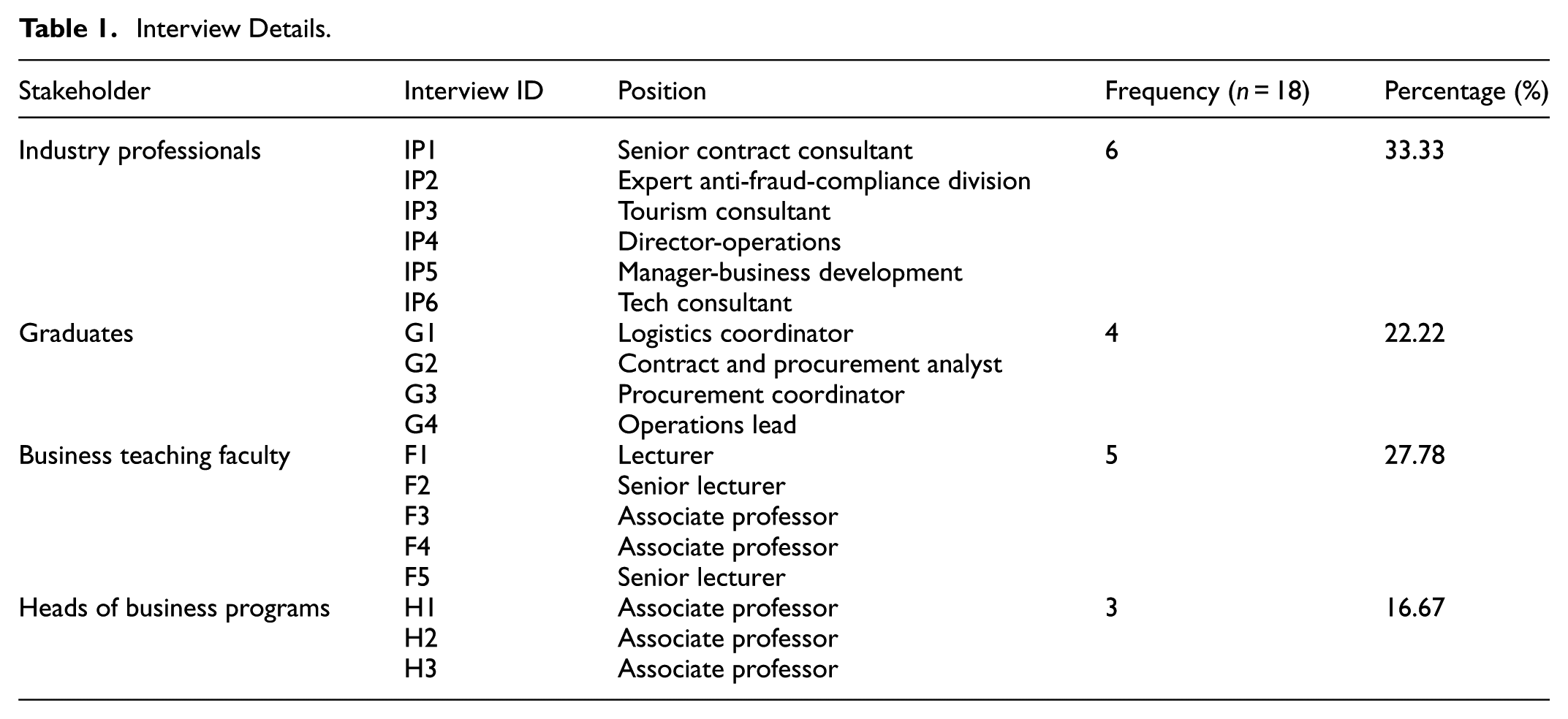
This composition demonstrates that the participants were closely connected to business schools, encompassing internal stakeholders (graduates, faculty, and heads of programs) as well as external stakeholders (industry professionals who recruit or collaborate with business schools).
Data collection continued until data saturation was reached, that is, when additional interviews no longer yielded new codes or insights (Guest et al., 2006; Miles & Huberman, 1994). Saturation was continuously monitored during data collection to ensure that a diverse array of perspectives and expertise was captured. This approach reflects qualitative research standards emphasizing theoretical saturation over sample size to enhance the reliability and validity of findings (Patton, 2015).
Data Collection Procedure
Semi-structured interviews were chosen as the primary method for data collection because they allow for flexibility and depth, enabling participants to elaborate on their experiences while ensuring coverage of key research themes. The interview protocol was developed based on an extensive literature review on employability, Industry 4.0, and higher education transformation (e.g., Freeman et al., 2020; Ilhan-Nas et al., 2024; WEF, 2017).
The guide was structured around five key domains aligned with the research questions and objectives:
Business schools’ contribution to achieving the strategic objectives of Oman Vision 2040,
The role of business schools in the context of Industry 4.0 in Oman,
Skills and competencies most valued in graduates of business schools,
Leadership role in transformation and innovation within business schools, and
Program adaptations required to prepare graduates for future jobs in Oman.
The same set of questions was used for all stakeholder groups (industry professionals, graduates, faculty, and heads of business programs) to capture diverse perspectives on the same topics. While the questions remained consistent, participants’ answers naturally reflected their unique roles and experiences.
The guide was reviewed by two academic experts and piloted with one graduate and two faculty members; minor refinements were made to enhance clarity and relevance. Exemplar questions for each domain are provided in Appendix 1.
Interviews were conducted between April and May 2023, both face-to-face and online via MS Teams to accommodate participants’ preferences and logistical constraints. Interviews were carried out in English, in a quiet setting chosen by participants. Each session lasted between 20 and 45 min (average 31 min).
All participants received an information sheet and consent form prior to the interview, ensuring compliance with ethical research standards. Written consent was obtained before data collection commenced.
Data Recording, Transcription, and Verification
Interviews were audio-recorded with permission and transcribed using an automated transcription tool in MS Teams. Transcripts were subsequently checked manually against the recordings for accuracy. An anonymization process was applied during transcription to protect participants’ identities.
Data Analysis
A thematic analysis approach was adopted, with themes derived inductively from the data (Braun & Clarke, 2006). The coding process followed several stages: (i) initial open coding of transcripts, (ii) grouping of codes into categories, and (iii) refinement categories into overarching themes. Coding was conducted manually, and participants’ responses were interpreted considering their stakeholder roles to capture role-specific insights while identifying common patterns.
To maintain rigor, a second coder independently reviewed a subset of transcripts, and any discrepancies were discussed until consensus was reached. An audit trail of analytic memos and coding logs was maintained to enhance transparency. Themes were organized around four key domains: contribution of business schools to Oman Vision 2040, expected skills and competencies, role in Industry 4.0, and leadership responsibilities in implementing educational changes.
Table 2 presents a summary of the coding scheme. By mapping codes to broader themes, the analysis captured both shared perspectives across stakeholders and the role-specific insights contributed by each group. This approach facilitated a nuanced understanding of how business schools in Oman can support the objectives of Oman Vision 2040, prepare graduates for the evolving demands of Industry 4.0, and implement necessary educational changes.
Coding Scheme Summary.

Ethical Considerations and Methodological Rigor
Ethical considerations remained paramount throughout the data-collection process. Participants were guaranteed anonymity and all ethical guidelines governing research involving human participants were meticulously followed. This included ensuring voluntary participation, obtaining informed consent, and maintaining strict confidentiality of the responses.
To enhance methodological rigor, several strategies were employed. Member checking was conducted by sharing preliminary findings with a subset of participants to confirm interpretive accuracy. Triangulation was achieved by including multiple stakeholder groups. Reflexivity was addressed through researcher self-reflection to minimize bias. Negative cases, or instances that contradicted dominant patterns, were identified and analyzed to refine interpretations.
Results
This section presents a detailed analysis of the findings derived from the semi-structured interviews conducted in this study. To ensure clarity and consistency, the presentation of results is organized thematically according to the study’s five research questions. Each theme corresponds to a specific area of inquiry: (i) business schools’ contribution to achieving the strategic objectives of Oman Vision 2040, (ii) their role in the context of Industry 4.0 in Oman, (iii) the skills and competencies most valued in graduates, (iv) leadership’s influence on transformation and innovation within business schools, and (v) program adaptations required to prepare graduates for future employment in Oman.
The findings are thematically derived from semi-structured interviews with key stakeholders (faculty, industry experts, graduates, and program heads) highlighting the roles of business schools and the skills of graduates. The results are analyzed through stakeholder theory, considering the perspectives of students, faculty, industry professionals, and policymakers. This lens highlights areas of aligned interests, trade-offs, and potential conflicts among stakeholders in shaping business school curricula and graduate readiness.
The subsequent sections present the findings corresponding to each research question, beginning with the contribution of business schools to achieving the strategic objectives of Oman Vision 2040.
Business Schools’ Contribution to Achieving the Strategic Objectives of Oman Vision 2040
This section explores how business schools contribute to achieving the strategic objectives of Oman Vision 2040, emphasizing the alignment between academic initiatives and national development goals. The findings indicate four major themes: curriculum alignment with Vision 2040, integration of technology and innovation, human capital development, and multi-stakeholder collaboration.
Curriculum Alignment with Vision 2040 Goals
Oman Vision 2040 emphasizes the development of graduates capable of meeting global business opportunities. Participants highlighted that business schools must embed the goals and targets of Vision 2040 into curricula and ensure that academic staff are familiar with its objectives. Multiple faculty members (F2, F3, F4, F5) and heads of programs (H1, H2) emphasized that such alignment is necessary for effective teaching and student preparedness, indicating a broad agreement across stakeholders.
Integration of Technology, Innovation, and Sustainability
Participants stressed that providing graduates with the necessary tools to succeed requires access to state-of-the-art technology and an emphasis on entrepreneurship, innovation, sustainability, and environmental stewardship. Heads of programs (H2, H3), faculty (F3, F4, F5), and Industry professionals (IP2, IP4, IP5) noted that aligning curricula with these elements enables graduates to contribute meaningfully both locally and globally.
Human Capital Development as a Foundation for Strategic Alignment
Industry and academic leaders highlighted the importance of developing human capital as a prerequisite for achieving national strategies. Several participants (IP1, IP3, F1, F4, H1) stressed that business schools need to align themselves with national and organizational strategies through collaboration. One industry professional (IP1) stressed, “Business schools need to align themselves with the strategies of companies or government institutions. This alignment, achieved through collaboration, is crucial for delivering overall and long-term strategies.” However, one head of program (H1) argued that alignment is not feasible without human capital development, remarking, “Oman has witnessed significant development in human capital over the past 20 years, yet there is still ample room for growth. Human economic development is crucial for the economy, as it leads to economic development.”
Cultivating Global Competencies and Employability
Business schools were viewed as critical in developing graduates who can thrive in global labor markets. Faculty (F2, F4, F5) and heads of programs (H1, H2, H3) consistently emphasized the importance of balancing technical and behavioral competencies, including critical thinking, problem-solving, and communication skills. As noted by one head of program (H2), “Oman Vision 2040 aims not only to prepare youth for operation within Oman but on a global scale. Therefore, business schools should focus on cultivating technical and behavioral skills and competencies among youth to meet the demands of the global market.”
Multi-Stakeholder Collaboration for Strategic Objectives
Finally, collaboration between business schools and external stakeholders, including government bodies, industry partners, and professional agencies, was viewed as critical to achieving Vision 2040 objectives. Several participants (IP1, IP5, G2, G4, F1, F3, H3) highlighted that these partnerships enable institutions to reconcile potentially conflicting stakeholder interests, aligning strategies with national priorities while addressing the expectations of students, faculty, and employers.
The findings suggest that business schools in Oman act as central drivers of human capital development and institutional alignment with Vision 2040. By embedding strategic goals into curricula, integrating technology and sustainability, cultivating global competencies, and fostering collaboration with diverse stakeholders, business schools operationalize stakeholder theory in practice, balancing salience, trade-offs, and alignment to advance both national development and graduate employability.
Figure 1 summarizes the roles of business schools in achieving Oman Vision 2040 strategic objectives.

Business schools’ role in achieving Oman Vision 2040 strategic objectives.
The Role of Business Schools in the Context of Industry 4.0 in Oman
This section discusses the role of business schools within the framework of Industry 4.0 in Oman, highlighting their significance in preparing students for technological advancements and global trends.
Exposure to Industry 4.0 Technologies
Business schools must ensure students engage directly with Industry 4.0 concepts and tools through immersive activities. Multiple participants (IP3, IP4, IP6, G2, G4, F2, F5) emphasized the importance of projects, workshops, and conferences for practical exposure. As one graduate (G2) noted, “Business schools must provide exposure to students in engaging and working with the various concepts and technologies of Industry 4.0 through immersive projects and workshops.”
Seminars, Conferences, and Innovation
Industrial experts highlighted the importance of participation in seminars, conferences, and workshops to keep abreast of industry developments. Participants across stakeholder groups (IP2, IP4, IP6, G1, G2, F2, H2) emphasized that students and business schools should actively foster collaboration and innovative thinking regarding technology applications in business operations.
Curriculum Alignment with Market Trends
Educational institutions should align curricula with present and future market trends, encompassing economic, and technological advancements. Faculty and industry professionals (F2, F4, F5, IP1, IP3, IP5) emphasized continuous updating of course content and professional development to ensure alignment with Industry 4.0. Faculty (F2) emphasized, “Business schools need to continuously update their course content to remain relevant to the industry,” while an industry professional (IP3) added, “Educators must engage in ongoing professional development to stay abreast of the industrial revolution, actively participating in seminars, conferences, industry meetings, and research endeavors to impart cutting-edge knowledge to students.”
Integration Across Academic Disciplines
Industry 4.0 presents opportunities beyond business education. Academic institutions in engineering, manufacturing, services, and research sectors also play a role in guiding students toward future job opportunities. Faculty (F2, F3, F4, F5) highlighted the need for interdisciplinary collaboration and practical exposure. F2 explained, “I feel continual upgradation of course content, relevant industry interaction and longer internship duration for the students is required, so that the student gets a taste of what is the industry and what is expected from them.”
Transition and Adaptation to Emerging Technologies
Society, business schools, and allied academic institutions must prioritize the transition and adaptation to emerging technological frontiers to ensure students are future ready. Several participants (IP1, IP3, F2, H2, G1) noted the importance of fostering adaptability, continuous learning, and exposure to cutting-edge technologies.
Figure 2 summarizes the multifaceted role of business schools in Industry 4.0 and beyond.

Business school’s role in Industry 4.0.
Skills and Competencies Valued in Graduates of Business Schools in Oman
This section explores the skills, competencies, and enabling factors expected from business school graduates in Oman, as emphasized by stakeholders, including faculty, industry professionals, graduates, and academic leaders. The findings highlight a broad set of technical, behavioral, and leadership skills aligned with both the immediate needs of the labor market and the long-term aspirations of Oman Vision 2040. Based on thematic analysis, the responses were grouped under key categories, presented as follows.
21st-Century Skills for Graduate Development
Participants emphasized that the educational sector must instill essential 21st-century skills such as communication, leadership, and critical thinking from the early years of graduate education. Graduates and faculty (G1, G2, G3, G4, F2, F4, F5) highlighted these competencies as foundational for confidence, personality development, and career success. Graduates also noted the responsibility of business schools in creating awareness about Oman’s transition towards a non-oil-intensive economy, noting that such awareness is vital for aligning with national priorities (G1, G2, G3, G4).
Core Employability Skills and Industry Readiness
Corporate experts stressed a range of skills that business schools should cultivate research skills, cultural awareness, sustainability knowledge, proactivity, problem-solving, time management, teamwork, workload management, communication skills, and the ability to apply theory in practice Stakeholders from multiple groups (IP1, IP2, IP4, IP6, G3, G4, F2) emphasized these skills as instrumental for preparing graduates for future employment. One graduate (G3) remarked that “curricula must move beyond examinations to real-world problem-solving and teamwork exercises.”
Leadership and Digital Competencies
Participants also underlined the importance of leadership in an increasingly competitive market. Participants across stakeholder groups (IP1, IP3, G1, F2, F5, H1) highlighted leadership, communication, IT knowledge, and Industry 4.0 applications as core competencies. A head of program (H1) noted, “Leadership skill is very essential. Without it, moving forward is difficult. Excellent communication, IT knowledge, and Industry 4.0 applications are also required.” Alongside leadership, digital literacy was highlighted as a core requirement. As one industry professional (IP1) observed, “Digitalization becomes one of the core elements. Students must be aware of its benefits and applications in business.”
Self-Thinking, Awareness, and Adaptability
Faculty members (F2, F4, F5) and heads of programs (H2, H3) emphasized the importance of developing self-thinking skills, enabling students to analyze current world scenarios, observe business operations, and understand regional economic trends. This equips students with a broader perspective on lifestyle and economic changes, as highlighted by multiple participants (G3, G5, F2, F4, H2, H3). One faculty member (F2) added that “continual course upgrades, stronger industry interaction, and longer internships would give students a clearer picture of workplace expectations.”
Pedagogical Innovations and Experiential Learning for Skills Development
Industry professionals and faculty emphasized the need for innovative teaching practices to enhance learning outcomes. Business schools in Oman can adopt instructional methods from developed nations (IP5, F4, H1, H3) and integrate vocational training with theoretical coursework to ensure practical exposure (IP3, P6, F2, F4, G4). As one industry professional (IP3) stressed, “Currently, students are confined to classrooms and taught only theory. To graduate with industry know-how, they must regularly visit industries and engage in practical work.” This practical exposure can be facilitated through industry collaborations, short-term training, and internships. Participants also highlighted that responsibility for skills development does not rest solely with business schools; students and regulatory bodies also play crucial roles in fulfilling Oman’s strategic vision.
Additionally, participants underscored the importance of cultivating holistic and innovative learning environments beyond traditional classrooms. Faculty (F2, F3, F4, F5) noted that peer interactions, discussions on current affairs, and exposure to creative approaches are vital for fostering transferable skills, critical analysis, and innovative thinking. As one faculty member (F3) explained, “Given Oman’s Vision 2040 positioning, students must go beyond standard skills, developing transferable skills, critical analysis, and innovative thinking to effectively design or apply technology.”
Figure 3 summarizes the desired skills and competencies of business school graduates in Oman.
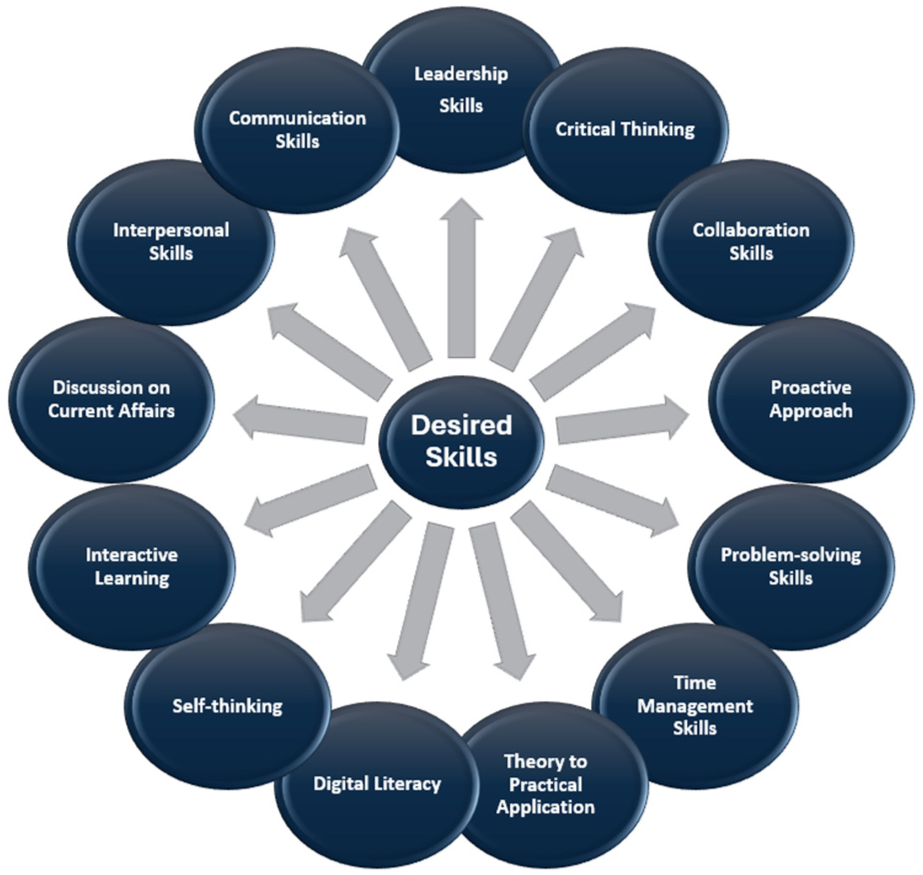
Desired skills for business school graduates in Oman.
Leadership Role in Transformation and Innovation Within Business Schools
This section evaluates the role of organizational leadership in business schools in driving and implementing transformative changes necessitated by evolving educational and industrial landscapes.
Proactive and Dynamic Leadership
Business school leaders are critical in aligning institutional objectives with Oman Vision 2040 and implementing change to prepare graduates for employment. Leaders act as agents of transformation, introducing innovative ideas and guiding faculty and students. Multiple participants (IP1, IP3, G4, F2, H2, H3) emphasized that leadership should be proactive and link academic learning with industrial exposure. Faculty (F2) noted, “Organizational leadership must remain attuned to industry developments. This awareness seems lacking in the current context. Leaders should actively support faculty and students’ involvement in international seminars, workshops, and industry engagements.”
Strengthening Industrial Collaboration
Business schools should enhance collaboration with local, regional, and international industries to ensure students acquire necessary skills and knowledge. Leaders are expected to prioritize programs and personnel that keep the institution updated with emerging trends. Industry professionals (IP1, IP3, IP4, IP5, IP6) highlighted the importance of industrial collaboration for leadership effectiveness. One industry professional (IP3) emphasized, “Practical exposure guided by industry experts is crucial, as it fuses academic learning with real-world experience and enhances the leadership impact of business schools.”
Supporting Practical and Collaborative Learning
Leadership should facilitate practical knowledge acquisition, collaborative learning, and interpersonal skills development through debates, forums, discussions, and other institutional or external initiatives. Stakeholders (IP1, IP3, IP6, F1, F2, F4, H2, H3) noted that these approaches help students understand future work culture and develop employment preparedness.
Maintaining Academic Quality and Standards
Leaders must ensure high standards of guidance and teaching across the institution. Participants (IP2, IP4, G2, F1, F3, F4, H1, H3) stressed that emphasizing quality leadership and faculty support helps business schools better prepare graduates for global job markets and enhance institutional credibility.
Strategic Alignment with National and Global Goals
Organizational leaders are expected to remain aware of national and regional developments, aligning institutional strategies with Oman Vision 2040 objectives. Participants from industry and academia (IP2, IP3, IP4, IP6, F2, F4, H1) emphasized strategic alignment as essential for graduate readiness and institutional relevance. Participant H1 highlighted, “Business schools should align their objectives with national goals and remain aware of regional developments. This strategic vigilance equips graduates for a dynamic professional environment.” Leaders should implement mechanisms for adopting, adapting, and innovating to remain relevant in local, regional, and international arenas.
Figure 4 summarizes the roles of leadership in driving change within business schools.

Leadership’s role in driving change in business school.
Program Adaptations for Preparing Business School Graduates for Future Jobs in Oman
This section investigates the changes required within programs and courses offered by business schools to equip graduates with the skills and competencies needed to thrive in future job roles in Oman’s dynamic socioeconomic environment.
Aligning Curriculum with Oman Vision 2040 and Industry Needs
Participants highlighted that business schools should synchronize curricula and teaching methodologies with Oman Vision 2040 to ensure graduates acquire relevant knowledge and skills. Emphasis should shift from pure academic assessments to employability and practical skill development. Multiple participants (IP1, IP3, IP5, G1, G2, F1, F2, H1, H2) emphasized the importance of practical exposure and skill-oriented learning. One participant (IP3) noted, “The curriculum should include practical components, such as industry visits and guest lectures, and internships should be extended from 2 to at least 4 months.” Another participant (G1) added, “Include field courses to bridge the gap between theory and practice. Prioritize skill development over textbooks and use Omani examples and case studies for deeper understanding.”
Benchmarking and International Standards
Experts stressed the importance of ensuring that local business school programs remain competitive with international standards. Participants (IP4, IP6, G4, F3, F4, H2) noted benchmarking against leading regional and global institutions is critical for maintaining academic quality and relevance. Faculty participant F3 emphasized, “To remain competitive, we must benchmark against top global schools, adapting programs to meet international standards and enhance our regional reputation.”
Modern Pedagogy and Assessment
Business schools must prioritize modern pedagogical teaching methods within the current educational framework and update teaching methods, program structures, and course content to ensure graduates acquire practical and conceptual knowledge. Participants (IP3, |IP5, G3, F1, F2) emphasized that updating pedagogy and assessment enhances effectiveness. H2 suggested, “Updating contents and introducing new case studies is a good start. Slight modifications to program structures and adding modern courses, where feasible, can enhance course profiles and overall effectiveness.” Similarly, F1 added, “Consider altering program structures, introducing new courses, refining course design, and reassessing assessment methods to significantly improve effectiveness.”
Integrating Practical Exposure and Industry Collaboration
Participants emphasized the need for industrial or field visits in all programs to provide graduates with practical exposure. Stakeholders (IP1, IP3, IP6, G1, G3, G4, F2, F5) highlighted industry collaboration as critical for bridging theory and practice and keeping faculty updated with industry practices. IP3 highlighted, “A business school requires a balanced blend of academic and industry experts, bringing real-world insights that enrich the curriculum.” IP1 added, “Some business schools rely heavily on lecturers for theoretical knowledge. But combining theoretical with business practitioners would be best.”
Faculty Upskilling and Continuous Learning
Business schools should prioritize faculty development to ensure instructors remain technologically proficient, updated with global developments, and capable of aligning education with Vision 2040 goals. Participants (IP2, G3, F3, F5, F5, H1, H2) stressed continuous skill development and knowledge sharing. H2 reflected, “I have 25 years in marketing. Now, it’s time to upgrade my skills, particularly in digital marketing.” H1 emphasized, “Faculty must continuously develop skills, especially in technology, and stay updated on global developments and course-relevant changes.” F3 further added, “There’s a universal need for skill enhancement and knowledge building. Promoting knowledge sharing and leveraging faculty expertise can enrich understanding of Vision 2040 and the learning environment.”
Aligning Faculty and Program with Graduate Employability
Faculty play a pivotal role in meeting the objectives of future graduates and Oman Vision 2040. Participants (IP3, IP6, F1, F2, F4, H1, H2) noted that faculty must be competent, technologically advanced, and able to implement curriculum changes that foster employability and align with national development goals.
Figure 5 summarizes the program adaptations and the expected skills of faculty members required to effectively implement these changes.

Program modifications and the skills expected from faculty members.
Summary of Thematic Findings Across Business School Roles and Graduate Skills
This section provides a comprehensive overview of the findings, summarizing main themes, sub-themes, and representative participants across faculty, graduates, industry professionals, and heads of business programs. Table 3 presents these insights in a scannable format, ensuring transparency while avoiding redundancy in the text. It highlights how Omani business schools align curricula, teaching approaches, and institutional practices with Oman Vision 2040 and global workforce needs, emphasizing practical exposure, industry collaboration, leadership, innovation, and digital competencies. Overall, it serves as a quick reference, illustrating the interplay between thematic findings, stakeholder perspectives, and broader educational and workforce objectives.
Thematic Summary of Business School Roles, Graduate Skills, and Stakeholder Perspectives in Oman.

Discussion
This section discusses the findings in relation to the study’s research questions and the broader literature. The results illustrate how business schools in Oman can advance the objectives of Oman Vision 2040 while adapting to the opportunities and challenges of Industry 4.0. The thematic areas identified, including curriculum alignment, technological integration, skills development, leadership transformation, and program adaptation, reflect the dynamic interplay between institutional strategies, stakeholder expectations, and national priorities. Interpreted through stakeholder theory, these findings highlight how collaboration among internal (faculty, students, and administrators) and external (industry, government, and policymakers) actors shapes the strategic direction of business schools and enhances graduate readiness for future employment.
The findings reveal that in the Omani context, stakeholder interactions extend beyond traditional engagement for institutional survival or efficiency. Specifically, the interests and influence of students, faculty, industry partners, and policymakers directly shape business schools’ alignment with national development goals, particularly Oman Vision 2040, and readiness for Industry 4.0 challenges (Al-Abri et al., 2024). Stakeholder salience varies: industry partners and policymakers exert strong influence over curriculum design and graduate skill priorities, while students’ immediate needs guide experiential learning initiatives. Trade-offs emerge when internal priorities, such as research output or faculty capacity, conflict with external demands for digital skills, entrepreneurship, and sustainability. This highlights the dynamic balancing act that Omani business schools must perform to satisfy diverse stakeholder expectations while achieving strategic national and technological objectives.
Aligned with previous studies (Ilhan-Nas et al., 2024; Li, 2020; Shen & Zhang, 2024), the study confirms the necessity for business schools to adapt their curricula to meet the changing demands of Industry 4.0. However, the Omani context introduces a unique dimension: alignment with Vision 2040 adds a layer of national strategic priority that influences how schools engage stakeholders and prioritize skill development (Al-Abri et al., 2024). While global literature emphasizes technical and digital competencies (Mahmud & Wong, 2022; Motyl et al., 2017), this study broadens the discussion by identifying additional competencies such as entrepreneurship, sustainability orientation, ethical decision-making, and cultural awareness as critical dimensions for graduate readiness, reflecting local socioeconomic and policy imperatives in Oman. These findings also align with employability frameworks discussed by Yorke (2006) and Knight and Yorke (2003), which stress holistic skills, experiential learning, and workplace relevance to preparing graduates for complex professional environments.
Moreover, the findings reinforce that employability in Industry 4.0 contexts is not limited to technical proficiency but also encompasses cognitive, interpersonal, and adaptive capabilities (Broo et al., 2022; Islam et al., 2025; WEF, 2017). Participants emphasized critical thinking, problem-solving, and continuous learning as essential for managing the evolving technological landscape. The growing prioritization of practical exposure, internships, and collaboration with industry further supports previous research emphasizing experiential learning as a mechanism for bridging academic knowledge and workplace skills (Lase, 2019; Mahmud & Wong, 2022; Watson, 2018). This shift signifies a movement away from content-based instruction toward outcome-oriented education focused on real-world application.
The study also underscores the critical role of leadership in steering business schools through this transformation. Effective leaders act as change agents, promoting innovation, motivating faculty development, and ensuring strategic alignment with both national and institutional goals. This aligns with stakeholder theory’s proposition that leadership is central to balancing competing interests while sustaining organizational legitimacy and performance (Freeman et al., 2020; Ferrero-Ferrero et al., 2018). Leaders who maintain strong connections with industry, support faculty participation in professional development, and encourage interdisciplinary collaboration enable institutions to remain responsive to external shifts and labor market needs.
Additionally, the emphasis on faculty upskilling and pedagogical innovation demonstrates that the success of curricular transformation depends on academic capacity and adaptability. Faculty must possess not only technical expertise but also the ability to integrate sustainability, digital literacy, and applied learning into instruction. These insights align with emerging literature on Education 4.0 and Industry 5.0, which stresses that faculty readiness and institutional agility are essential for producing graduates capable of thriving in a digital, knowledge-based economy (Bondin & Zammit, 2025; Broo et al., 2022). The emphasis on continuous learning among educators reflects a cultural shift toward lifelong professional development, necessary for sustaining relevance in rapidly evolving academic ecosystems.
The observed emphasis on multi-stakeholder collaboration aligns with stakeholder theory, which holds that organizational effectiveness depends on managing the interests and interactions of diverse actors (Freeman, 1984; Ferrero-Ferrero et al., 2018; Mahmud & Wong, 2022). In this study, students, faculty, industry partners, and policymakers all influence curriculum relevance and graduate preparedness, demonstrating that stakeholder engagement is operationally critical in Oman. Furthermore, the prioritization of experiential learning, pedagogical innovations, and industry collaboration reflects Industry 4.0 readiness frameworks, confirming that technical skills, digital literacy, and experiential learning are essential for workforce adaptability (Li, 2020; Shen & Zhang, 2024; Schwab, 2016).
Partnerships between business schools, industry, and government agencies are indispensable for aligning educational programs with Vision 2040. Such collaborations facilitate curriculum co-design, internships, and joint research that enhance graduate employability and innovation capacity. This finding extends stakeholder theory by illustrating how strategic collaboration contributes not only to institutional effectiveness but also to national transformation agendas. In Oman’s case, such collaboration operationalizes the human-capital pillar of Vision 2040, bridging education policy with economic diversification and sustainable development.
Collectively, the findings indicate that business schools in Oman must function as integrative platforms, linking academic knowledge, technological innovation, and national strategy. Their ability to produce graduates who are both technologically competent and ethically grounded will determine their relevance and impact in the coming decades. Practical alignment with Oman Vision 2040 requires integrating industry-relevant skills, digital literacy, innovation, and ethical awareness into curricula. Multi-stakeholder engagement encompassing students, faculty, industry partners, and policymakers is operationally critical, influencing curriculum design, experiential learning, and graduate employability. These insights highlight actionable pathways for institutions to enhance graduate readiness while simultaneously advancing national development goals, offering guidance for educational leaders, policymakers, and practitioners in similar emerging economies.
Although the study offers rich insights into Omani business schools, the findings are context-specific and based on a limited sample. They should therefore be interpreted as illustrative of the sampled institutions and participants rather than fully generalized. Detailed contextual and participant descriptions help situate the findings, yet further research across more universities and stakeholder groups is needed to validate and extend these insights.
Theoretical Implications
This study extends stakeholder theory by contextualizing it within business education in Oman, demonstrating that multi-stakeholder collaboration (including students, faculty, industry partners, policymakers, and society) directly shapes curriculum design, graduate readiness, and institutional strategy. Unlike prior research that focuses primarily on engagement for organizational survival or efficiency, our findings reveal that in the Omani context, stakeholder interactions also serve as mechanisms for aligning higher education outcomes with national development priorities, particularly Vision 2040, while simultaneously preparing graduates for the challenges of Industry 4.0.
Moreover, this study integrates previously underexplored dimensions, such as entrepreneurship, innovation, sustainability, ethical decision-making, and cultural awareness into the concept of graduate readiness. By showing how these dimensions interact with technical and digital competencies within a stakeholder-driven framework, we propose a novel conceptual model for business school education. This model advances theory by illustrating how stakeholder salience and trade-offs shape strategic educational decisions, expanding the operational scope of stakeholder theory from institutional effectiveness to societal and economic impact, and demonstrating how higher education in non-Western contexts can simultaneously address labor-market needs, national development goals, and Industry 4.0 preparedness.
This approach provides a new lens for understanding the dynamic, multi-level interactions between stakeholders, curriculum design, and graduate competencies, offering a clear theoretical contribution to both stakeholder theory and higher education management research.
Practical Implications
The practical implications of this study highlight actionable strategies for business schools in Oman to enhance graduate readiness while aligning with national development goals and Industry 4.0 demands. Business schools should realign curricula to integrate digital skills, entrepreneurship, sustainability, ethical decision-making, and cultural awareness, ensuring that graduates acquire both technical competencies and broader workforce-ready capabilities. Strengthening partnerships with industry is critical, enabling co-development of curricula, providing experiential learning opportunities such as internships, field visits, and guest lectures, and supporting faculty upskills to bridge the gap between theory and practice. Policymakers can further facilitate innovation and workforce readiness by providing resources, incentives, and guidance to ensure alignment between higher education outputs and national strategic objectives. Additionally, institutions should develop systematic mechanisms to balance stakeholder priorities and trade-offs, ensuring that curriculum design, graduate skill development, and institutional strategies remain responsive to diverse internal and external expectations. By implementing these measures, business schools can enhance graduate employability, foster workforce adaptability, and contribute to Oman’s socio-economic development, positioning themselves as leaders in higher education innovation within the Industry 4.0 era.
Long-Term Impacts
The alignment of business school curricula with Vision 2040 and Industry 4.0 is expected to yield several long-term benefits:
Economic diversification and growth: Equip graduates with entrepreneurial and technological skills to drive innovation in renewable energy, technology, and sustainability, reducing reliance on oil.
Enhanced global competitiveness: Graduates proficient in digital technologies and global business practices can strengthen Oman’s international market presence and attract foreign investment.
Workforce adaptability and innovation: Regular curriculum updates to align with evolving technologies will create a highly adaptable workforce capable of thriving amid Industry 4.0 changes, fostering a culture of innovation and problem-solving.
Social development and equity: By promoting access to cutting-edge skills, business schools can contribute to job creation, reduce unemployment, and help narrow gender and socioeconomic gaps in high-growth industries.
Sustainable development: Aligning curricula with Vision 2040’s emphasis on sustainability will promote progress in environmental management and corporate social responsibility, contributing to an economy that balances growth with environmental stewardship.
Institutional strength and global leadership: By aligning with global trends and Oman’s strategic priorities, business schools can emerge as regional leaders in higher education, attracting talent from neighboring countries and enhancing Oman’s reputation as an educational hub.
Recommendations
Based on the study’s theoretical and practical implications, strategic recommendations emerge for policymakers, business schools, and industry stakeholders, grounded in findings on stakeholder perspectives, graduate skills, leadership roles, and curriculum adaptation.
For policymakers, collaboration with business schools is essential to embed Oman Vision 2040 objectives into curricula. Alignment ensures graduates develop both technical and soft skills, including critical thinking, digital literacy, and leadership, directly supporting national socioeconomic goals. Incentivizing curriculum innovation through grants or recognition can encourage integration of emerging technologies, sustainability, and entrepreneurship—areas highlighted by participants as critical for Industry 4.0 readiness. Additionally, fostering public-private partnerships provides platforms for internships, real-world projects, and industry engagement, translating academic knowledge into employable skills while strengthening institutional relevance.
For business schools, maintaining dynamic curricula is crucial. Participants emphasized integrating practical experiences, digital tools, and experiential learning to prepare graduates for emerging sectors. Regular updates informed by national objectives and industry trends enable students to acquire relevant skills, while faculty development programs equip instructors to implement innovative pedagogies, guide experiential learning, and align teaching with Vision 2040 and Industry 4.0 competencies. These measures operationalize leadership’s role in driving institutional change and producing graduates capable of addressing evolving workplace and societal demands.
For industry stakeholders, active engagement with academic institutions is critical to co-develop curricula, offer mentorship, and provide internships aligned with labor market requirements. Collaboration strengthens graduate readiness, keeps faculty informed of current practices, and supports lifelong learning through executive education and short-term training programs. Divergent stakeholder perspectives may reveal potential conflicts, highlighting an avenue for future research to explore multi-stakeholder dynamics in higher education strategy.
These recommendations underscore the need for coordinated action among policymakers, business schools, and industry to foster graduate employability, curriculum relevance, and strategic alignment with Oman Vision 2040. By explicitly linking strategies to empirical findings, these recommendations provide evidence-based guidance for enhancing workforce readiness, promoting institutional innovation, and ensuring sustainable contributions to national and global development.
Conclusion
This study provides a comprehensive understanding of the evolving role of business schools in Oman in supporting the strategic objectives of Oman Vision 2040, responding to the opportunities and challenges of Industry 4.0, and preparing graduates for the dynamic job market. The findings indicate that business schools are expected to equip graduates with both technical and soft skills, including critical thinking, communication, leadership, adaptability, and digital literacy, while fostering innovation, entrepreneurship, and sustainability.
The study’s findings are context-specific, reflecting insights from participants in the selected Omani business schools. As such, they offer an in-depth understanding of the roles, expectations, and challenges within this context, rather than results that are directly generalizable to all higher education institutions in Oman or globally.
Business schools are also expected to align curricula with national priorities, integrate practical experiences, and actively engage with multiple stakeholders, including industry, government, and regulatory bodies, to ensure graduates are well-prepared for current and future workforce demands. Moreover, organizational leadership within business schools plays a pivotal role in driving these transformations. Leaders guide curriculum reforms, facilitate faculty upskilling, promote industry collaborations, and ensure strategic alignment with national and global objectives, thereby enabling the institution to adapt to emerging technological trends and labor market requirements.
Overall, the study underscores that a combination of responsive curricula, stakeholder engagement, faculty development, and proactive leadership is essential for business schools in Oman to contribute effectively to workforce development, socioeconomic progress, and the long-term aspirations of Vision 2040, within the specific context examined.
This study has several limitations. First, it is context-specific to Omani business schools, which may limit the generalizability of the findings to other countries or higher education contexts. Second, the qualitative design, based on semi-structured interviews, provides rich, in-depth perspectives but may introduce subjectivity and restrict the ability to quantify results or detect broader statistical trends. Third, focusing exclusively on business schools may not fully capture the wider landscape of higher education in Oman.
Future research could build on these limitations to expand understanding and applicability:
Examine whether similar findings emerge in other higher education contexts in Oman, including non-business faculties or private institutions.
Investigate the role of business schools in other GCC countries to compare institutional strategies and contextual factors.
Explore how curriculum alignment, faculty development, and leadership interventions affect graduate employability longitudinally.
Assess the impact of emerging technologies (AI, machine learning, blockchain) on business curricula and learning outcomes within the Omani context.
Examine models of stakeholder engagement to enhance curriculum relevance, industrial collaboration, and institutional performance.
Addressing these avenues can further advance the understanding of business education’s role in workforce development and socioeconomic progress in Oman and similar contexts.
Footnotes
Appendix 1

Ethical Considerations
Approval was obtained from the Academic Integrity and Ethics Committee of Modern College of Business and Science, Muscat, Oman.
Consent to Participate
All participants involved in this study were informed about the purpose, procedures, and voluntary nature of their participation. Each participant provided informed consent prior to taking part in the research. Participation was entirely voluntary, and individuals were assured of the confidentiality of their responses and their right to withdraw at any time without any consequences.
Funding
The authors disclosed receipt of the following financial support for the research, authorship, and/or publication of this article: The researchers would like to thank Modern College of Business and Science for financial support (MCBS-APC-2026).
Declaration of Conflicting Interests
The authors declared no potential conflicts of interest with respect to the research, authorship, and/or publication of this article.
Data Availability Statement
The data that supports the findings of this study are available from the corresponding author, upon reasonable request.