




Abstract
In light of the transformative influence of technologies and innovative methodologies associated with the Fourth Industrial Revolution, the paradigm of project management is undergoing a profound shift, prompting a re-examination of Project Management Education and Training (PMET). The escalating demand for project management expertise, juxtaposed with a scarcity of suitably qualified professionals, has yielded an increase in instances of faltering or challenging projects, thereby underscoring the amplified significance of PMET. A comprehensive assessment of the ongoing evolution of project management education and training is vital to shaping the trajectory of future educational strategies. In this context, bibliometric analysis has emerged as a pivotal tool, offering structured means to systematically present the expansive literature on PMET. This approach provides a panoramic view of the domain’s development, facilitating a more informed understanding of its current contours which is paramount for crafting effective educational strategies. Employing bibliometric analysis as its methodological backbone, this study endeavors to discern the existing landscape of project management education and training. For this purpose, a comprehensive analysis was conducted on a dataset comprising 435 documents related to PMET, spanning the years 1985 to August 2023. The results of this analysis indicate that PMET publications are predominantly situated within the context of engineering education. A prominent theme that emerges from the literature is the discernible requirement for novel and forward-thinking strategies in PMET development, with a pronounced emphasis on the cultivation of soft skills and the integration of contemporary training methodologies, including gamification and simulation.
Plain Language Summary
In simple terms, the way we manage projects is changing a lot, and this has made us rethink how we educate and train people in project management. There’s a growing need for experts in project management, but not enough qualified professionals to meet this demand. Because of this, we see more projects facing difficulties or failing, which makes the training and education of project managers even more important. To understand how project management education and training are evolving, we’re using a special analysis tool called bibliometrics. This tool helps us organize and study a lot of information about project management education and training. By doing this, we can get a better idea of how this field is developing, which is crucial for making our education strategies more effective. In this study, we looked at 435 documents related to project management education and training from 1985 to August 2023 to get a clear picture of what’s going on in this area.
Introduction
The advent of technological innovations in the 21st century has brought about substantial transformations across diverse industries. In the backdrop of a dynamic and swiftly evolving landscape, project management has assumed a pivotal role, replaced traditional structures, and played a crucial role in assisting organizations in their endeavors to adapt to these changes, effectively navigate complexities, and achieve success in their endeavors (Davies et al., 2011; Turner & Müller, 2005). The shift toward project-based systems has led to an increased demand for project professionals (Pant & Baroudi, 2008). According to a recent report by PMI (2021), there is a growing disparity between job growth in project management and the availability of qualified professionals. This shortfall in qualified professionals could have a financial impact of approximately US$345.5 billion and present significant employment opportunities. It is projected that by 2027, over 87 million people will be employed in project management (Karanja & Malone, 2021). The World Economic Forum’s 5-year projection for 2023 also indicates that the role of project managers is expected to experience rapid growth. It is estimated that there will be an increase of approximately 23% in the demand for project managers, making project management the 26th fastest-growing profession among the 106 professions analyzed in the forecast (Guraziu, 2023). However, despite the increasing demand for project professionals, several scholarly inquiries have found that a significant proportion, nearly 70%, of project endeavors encounter failure (Chen & Bozeman, 2012; Pfeifer, 2011). This high failure rate is primarily attributed to human-centric variables such as deficient project manager leadership, lack of team cohesion, ambiguity in communication among diverse stakeholders, and poor risk management strategies (Gupta et al., 2019; Januska, 2017).
As the project environment becomes more complex, project managers face the challenge of enhancing their abilities to navigate ambiguity and handle intricate situations. This growing complexity has also led to a demand for project professionals who possess a broader range of skills and competencies. Consequently, there have been discussions regarding the characteristics of project management education and training that can meet this demand. It is necessary to reevaluate the characteristics and content of project management education and training to ensure that professionals are equipped with the necessary tools and knowledge to thrive in this evolving landscape. One established approach that can provide insights into the scholarly landscape and trends in project management education and training is bibliometric analysis (Zare et al., 2017). Bibliometric analysis allows researchers to examine patterns of publication, citation, and collaboration, providing a quantitative understanding of the research output and impact (Taris, 2006). It also enables the assessment of interdisciplinarity within a field by examining citation networks and the diversity of journals (Leydesdorff & Rafols, 2011), which is particularly relevant to the nature of the project management discipline.
While there have been several bibliometric studies on management-related professional education in areas such as entrepreneurship (Sreenivasan & Suresh, 2024), sustainability (Cullen, 2017), and leadership (Harto et al., 2022), there is a significant gap in the field of project management education and training. Bibliometric studies in project management have focused on various topics, such as maturity (De Souza & Gomes, 2015), success (e.g., He et al., 2019; Machado & Martens, 2015), research areas (Abdi Khalife et al., 2020; De Rezende et al., 2018; López-Robles et al., 2020; Ng & Chai, 2015), tools and techniques (López-Robles et al., 2018); digitalization (Aliu et al., 2023; Kuster, 2021; Marnewick & Marnewick, 2022; Verdecia Vicet et al., 2021). Furthermore, there have been specific bibliometric investigations into project management education and training, such as the use of serious games (Hellström et al., 2023; Rumeser & Emsley, 2018) and software project management education (Farooq et al., 2022). However, a comprehensive bibliometric perspective on project management education and training is still lacking. To address this gap, the present study aims to answer the following research questions:
RQ1. What is the knowledge base of the project management and training literature? Who are the prominent contributors?
RQ2. What is the theoretical base of the project management and training literature? Which studies and sources have influenced the intellectual development of this field?
RQ3. What are the thematic areas of the project management and training literature? How has the conceptual structure evolved?
By addressing these questions, our study provides contributions to the existing body of knowledge at two key junctures that have not been extensively explored in previous research. Firstly, our study provides a quantitative, objective, and comprehensive outlook, building on previous reviews by revealing the core knowledge base and theoretical foundations of this field. Secondly, by providing the conceptual background, we reveal the change in these dynamics over time. We begin with a theoretical look into project management and training literature, followed by the study’s methodology and revealed findings.
Theoretical Background
Enhancing project performance requires the development of project management competencies at various levels, including the individual, team, organizational, and societal domains (Gareis & Huemann, 2007). Project managers play a crucial role in guiding and directing projects to successful completion (Amoah & Marimon, 2021; Müller & Turner, 2007; Silvius & Schipper, 2014; Q. Wen & Qiang, 2019), and as a result, there has been significant attention given to the competencies required by project managers (Dziekonski, 2017; Engelbrecht et al., 2017; Moradi et al., 2020; Tumpa et al., 2023).
The literature on project management identifies a wide range of skills expected of project managers, which should be considered when designing training programs. These skills can be categorized into two main types: soft skills and hard skills. Soft skills, also referred to as human skills, encompass the interpersonal aspects of project management, such as effective communication, negotiation, leadership, team building, collaboration, contextual awareness, dedication, flexibility, client rapport, human resource management, adaptability, goal orientation, and conflict resolution (Alvarenga et al., 2019; Carvalho & Rabechini Junior, 2015; Moradi et al., 2020; Osmani et al., 2017; Ribeiro et al., 2021; Skulmoski & Hartman, 2010; Zuo et al., 2018). Hard skills, on the other hand, encompass methodologies, protocols, tools, and approaches essential for executing tasks within a specific industry, such as scope, time, cost, and quality management (Atkinson, 1999; Pant & Baroudi, 2008).
The literature on project management highlights a wide range of skills that are expected of project managers. These competencies should be taken into consideration when designing training programs for project management. These skills can be classified into two distinct categories: soft skills and hard skills. Soft skills, also referred to as human skills, encompass the interpersonal aspects of the human dimension within a project (Alvarenga et al., 2019; Carvalho & Rabechini Junior, 2015; Moradi et al., 2020; Osmani et al., 2017; Ribeiro et al., 2021; Skulmoski & Hartman, 2010; Zuo et al., 2018). These skills encompass a range of attributes, including effective communication, negotiation, leadership, team-building capabilities, the ability to foster a collaborative environment, contextual awareness, dedication, flexibility, the establishment of strong client rapport, social consciousness, adeptness in human resource management, adaptability, enthusiasm, confidence, goal orientation, open-mindedness, empathy, and the ability to resolve conflicts. Hard skills, on the other hand, encompass methodologies, protocols, tools, and approaches essential for executing tasks within a specific industry, such as scope, time, cost, and quality management (Atkinson, 1999; Pant & Baroudi, 2008). Certain industries may also require specific technical competencies aligned with legal, domain, or regulatory requirements (Ahsan et al., 2013). Project managers need both soft and hard skills to effectively manage projects (Delle-Vergini et al., 2023), although research suggests that soft skills have a greater impact on project outcomes (Ahsan et al., 2013; Alvarenga et al., 2019; Araújo & Pedron, 2015; Chipulu et al., 2013; El-Sabaa, 2001; Moradi et al., 2020; Muzio et al., 2007; Ramazani & Jergeas, 2015; Stevenson & Starkweather, 2010).
The demand for proficient project management professionals has led to the expansion of educational and developmental programs (Umpleby & Anbari, 2004). Project management has gained recognition as a profession, and formal undergraduate education at the tertiary level has become a preferred career path (Lloyd-Walker et al., 2016). Standards presented by organizations such as the Project Management Institute, the Association for Project Management, and the International Project Management Association are considered fundamental principles of project management (Delle-Vergini et al., 2023). Project management education is currently offered through various university programs at the bachelor’s, master’s, and doctoral levels, and it can also be integrated into the curricula of other disciplines (Borg & Scott-Young, 2020). The number of bachelor’s degree programs in project management in the United States has increased to 132 in 2020, and the Chinese Ministry of Education has endorsed the establishment of 120 master’s degree programs in project management over 3 years (Bredillet et al., 2013). Major business organizations are also establishing educational initiatives to enhance technical proficiency and foster behavioral transformations (Bestvina Bukvic et al., 2020).
Efforts to teach and learn project management require innovative perspectives in shaping educational objectives, curriculum development, and teaching methods (Ojiako et al., 2011). Pedagogical approaches such as blended learning and gamification have been implemented to enhance the learning experience and skill acquisition of project management students (Farooq et al., 2022). However, it is widely acknowledged that current approaches to project management education are insufficient to address the goals of modern organizations due to high project failure rates and the increasing complexity of the global environment (Córdoba & Piki, 2012; Ojiako et al., 2011). Teaching and learning have become key issues in rethinking project management (Cicmil et al., 2006; Winter et al., 2006).
Scholars have suggested that existing project management education and training need a paradigm shift to adapt to actual applications and fulfill industry needs (Atkinson, 2008; Berggren & Söderlund, 2008; Cicmil et al., 2006; Egginton, 2012; Geist & Myers, 2007; Hussein, 2015; Hussein & Rolstadås, 2002; Ojiako et al., 2011; Wearne, 2008; Winter et al., 2006). Inefficient learning techniques, content, tools, and practices, as well as preconceived perceptions and assumptions, contribute to the general issues faced by project management education (Mason et al., 2009; Ramazani & Jergeas, 2015; Thomas & Mengel, 2008). Current training programs often fail to adequately prepare project managers for high-level projects or equip them to navigate the complexities of the contemporary work environment (Ewin et al., 2017; Thomas & Mengel, 2008; Tumpa et al., 2023). There is a notable disparity between the existing competencies of project management professionals and the skills and abilities that are actually needed (Bredillet et al., 2013). Many project management students lack real-world experience, which affects their motivation and effort in the field (Bergman & Gunnarson, 2014). The current training structure is criticized for producing technicians who can follow procedures but lack the ability to learn and adapt to complex environments (Crawford et al., 2006). It is suggested that formal education should be blended with experiential learning to effectively teach soft skills (Carbone & Gholston, 2004).
Several studies have focused on analyzing the project management training curriculum and its impact on learning outcomes and the acquisition of relevant skills, highlighting the need to critically evaluate project management education and training to ensure their effectiveness (Karanja & Malone, 2021). Table 1 highlights the need to critically evaluate project management education and training to ensure their effectiveness. In a broader context, the criticisms found in the literature on project management and training can be classified into two main categories: project management standards and formal education. The first category, project management standards, and competencies, examines the alignment between the skills and abilities needed by project managers in various contexts and the practical standards that exist. This line of research emphasizes the dynamic nature of projects, which are often complex and unique, and the need for standards that can accommodate these characteristics. The second category of research focuses directly on competencies, with a particular emphasis on the interaction between hard skills and soft skills. This research evaluates the formal education and competencies required for effectively navigating real-world project situations.
Criticisms of Mainstream Project Management Education.

Metho
Bibliometric Analysis
Bibliometric analysis is a statistical approach that uses publication and citation data to evaluate the literature in a research field. It can help researchers understand the historical, current, and future trends of a domain, as well as the impact, influence, and quality of its publications, authors, journals, and topics (Donthu et al., 2021). Bibliometric analysis can also reveal the intellectual structure and the interconnections of a research field, as well as the gaps and opportunities for further inquiry (Zupic & Cater, 2015). Unlike narrative literature reviews, bibliometric analysis provides an objective and comprehensive overview of the research landscape (Tranfield et al., 2003). By conducting rigorous bibliometric studies, scholars can lay solid groundwork for innovating and enriching a field with their insights. They can obtain a comprehensive overview of the field, spot the areas that need more research, generate new ideas for exploration, and strategically position their contributions to the field (Donthu et al., 2021; Nerur et al., 2008). Bibliometric analysis uses various techniques for revealing the development of a specific field by analyzing large volumes of scientific data (Donthu et al., 2021), and attempts to discover the time-dependent development of themes and methods through different structures by analyzing data (Verma & Gustafsson, 2020; Ye et al., 2012; Zupic & Cater, 2015). Bibliometric analysis supports the identification of important countries, authors, and research groups in a certain field of study. This analysis can provide researchers with a comprehensive view of the leading research characteristics and, as a result, discover patterns and a better comprehension of the intellectual and knowledge foundation (Mukherjee et al., 2022).
In our study, we utilized two primary methodologies for bibliometric analysis: performance analysis and science mapping (Cobo et al., 2011). Performance analysis helps assess the contributions of research entities, while science mapping delves into the structural aspects of scientific fields. Together, these two approaches provide valuable insights for scholars seeking to understand and advance their research domains. Performance analysis involves assessing the contributions of research constituents, which can include individuals and institutions. It serves as a descriptive component within bibliometric studies, allowing researchers to evaluate the research and publication performance of various entities within a field (Zupic & Cater, 2015). Science mapping, on the other hand, focuses on revealing the structure and dynamics of scientific fields (Kent Baker et al., 2020). Unlike performance analysis, which looks at individual and institutional contributions, science mapping examines the relationships between research constituents (Donthu et al., 2021). This approach enables researchers to gain insights into the overall structure and evolution of a scientific domain.
We started by conducting a performance analysis utilizing publication and citation metrics as the primary basis for evaluation. Publication metrics provide a broad overview of the research output in a particular field, while citation analysis measures the impact and influence of publications by counting the number of times they are cited by other publications. The underlying assumption is that citations indicate intellectual connections between publications that are relevant to a specific research topic (Donthu et al., 2021). Citation analysis can be a valuable tool for identifying the most influential publications, authors, or journals in a research field. It can also reveal the intellectual trends and dynamics within that field (Zupic & Cater, 2015). Furthermore, citation analysis is commonly used in science mapping, which involves visualizing the structure and evolution of a research field (Appio et al., 2014). These analyses are collectively referred to as the knowledge base in this study.
Secondly, we utilized historiographic mapping and co-citation analyses to investigate the intellectual background of the subject, which addresses our second research question. Historiographic mapping involves the creation of visual representations that illustrate the origins of a particular topic and identify the key papers and authors that have influenced its development. These maps provide a graphical summary of the field by depicting the interconnectedness of its foundational works (Garfield et al., 2003). Co-citation analysis, on the other hand, is a method used to map the scientific landscape of a research field by examining the frequency with which two publications, authors, or journals are cited together by other publications. This analysis assumes that the co-cited units are thematically similar or related (Hjørland, 2013). By conducting co-citation analysis, we can gain insights into the intellectual structure of a research field, including its underlying themes, clusters, paradigms, and schools of thought (Pasadeos et al., 1998). Additionally, co-citation analysis helps to identify the most influential publications, authors, or journals in a research field based on their co-citation frequency (McCain, 1990). To accomplish our research objective, we examined the co-citation networks of both journals and documents.
To address the third research question, we conducted a co-word analysis, which is a method used to examine the conceptual structure of a particular research field. This method involves quantifying the frequency of word co-occurrences in publications. The underlying assumption of co-word analysis is that words that frequently appear together are thematically related or similar (Donthu et al., 2021). The purpose of employing co-word analysis in our study was to uncover the conceptual structure of the research field under investigation. This analysis allowed us to identify the main themes, topics, and keywords that are prevalent in the field (Kent Baker et al., 2020). Additionally, co-word analysis provides valuable insights into the evolution of the research field over time and enables predictions of future trends based on the content of the publications (Callon et al., 1983). To achieve our research objectives, we adopted a temporal strategy and divided the keyword database into distinct periods. This approach allowed us to understand how the conceptual structure of the research field has evolved. By analyzing the co-occurrence patterns of words in each period, we could identify shifts in the dominant themes and topics within the field. Bibliometrix software was used for analyses and visualizations (Aria & Cuccurullo, 2017).
Analytic Workflow
Following Zupic and Cater (2015), we utilized a bibliometric workflow in five steps: (1) study design, (2) data gathering, (3) data analysis, (4) data visualization, and (5) interpretation. These steps are visually represented in Figure 1.

Data collection steps.
Following the prescribed analytic workflow, we utilized the dataset from the Web of Science (WoS) platform and applied a selection of relevant search terms that aligned with our research focus. The WoS platform is widely acknowledged as a highly accurate and comprehensive source for scientific research and evaluation (Birkle et al., 2020). This database is known for its inclusion of prominent citation indexes, including the Social Science Citation Index (SSCI), Science Citation Index (SCI), Emerging Sources Citation Index (ESCI), and Art & Humanities Citation Index (AHCI). We incorporated gray literature, such as conference papers and book chapters, into our data collection process. This decision was motivated by the interdisciplinary and fragmented nature of the field (Linnenluecke et al., 2020). By including gray literature, we aimed to ensure that we did not overlook any significant contributions from sources outside of the core domains (Adams et al., 2017). The process of identifying relevant documents for our bibliometric analysis began with the selection of keywords, which were informed by the relevant literature. We then conducted a thorough evaluation of the identified documents, initially by assessing their titles and abstracts and occasionally by conducting a full-text inspection. This rigorous evaluation process led us to examine a total of 1,449 documents. After careful examination, we determined that 435 studies were directly relevant to the subject matter of project management education and training, and therefore, we included them in our final analysis. Table 2 provides an overview of the main information about the final database, including details such as the authors, publication year, and citation counts of the included studies.
Main Information About the Data.

Results
Knowledge Base
The first research question sought to identify the most influential contributors to project management education and training research. Accordingly, we first focused on the knowledge base, specifically referred to as performance analysis. In this section, we present an analysis of publication and citation trends, along with detailed information regarding the sources and authors of the cited works. This comprehensive examination provides insights into the current state of knowledge and the scholarly discourse surrounding the topic.
Documents by Year
The graphical representation in Figure 2 provides a comprehensive overview of the publication trends in the field of project management and training from 1985 to 2023. The figure depicts the changes in the number of publications over time as well as the corresponding citation trends. The data indicate an annual average increase of 6.72%. Notably, the year 2009 emerges as a significant juncture, signifying a notable shift in both the volume of published works and the extent of citations received. Such turning points often indicate a period of increased scholarly activity and recognition within a particular field. Accordingly, the most plausible explanation for this phenomenon can be attributed to the growing recognition of project management and training as significant areas of investigation within the broader academic community.

Publication and citation trends.
Most Cited Documents
Table 3 presents the most globally cited documents. The most cited article is by De Los Rios et al. (2010) which seeks to expand the competencies of the International Project Management Association (IPMA) by using an educational methodology of collaborative project-based learning and developing it into an entire educational strategy for undergraduate and graduate programs, followed by Ramazani and Jergeas (2015), which explores how future project managers should be trained, taking into account the perspectives of working project managers, and Peterson et al. (2011), which presents experiences and lessons learned during the implementation of Building Information Models (BIM) in civil engineering project management courses. It is understood that other studies focus on innovative training models (educational games, simulation) to increase soft skills for software-oriented sectors.
Most Global Cited Documents.

Documents by Source
The field of project management and training is characterized by its interdisciplinary nature, as it encompasses various domains of study. In our research, we examined a sample of 435 documents that were published in 320 different sources, including journals, books, and proceedings. The inclusion of these diverse sources highlights the interdisciplinary nature of the field, as it draws from leading journals in project management, engineering, and education domains, as evidenced by the top publishing journals presented in Table 4. This indicates the utilization of diverse disciplinary perspectives in studying the field, which contributes to a multifaceted understanding of project management and training. It is important to note that this interdisciplinary nature also leads to fragmentation within the literature. Our analysis revealed shifts in the publication profile since 2009, indicating divergences based on the main domains involved in the study of project management and training. These shifts reflect changes in the emphasis and focus of research within the field, as different domains may prioritize certain aspects or perspectives in their investigations. The growth in the number of publications from these sources over the years is shown in Figure 3.
Top Publishing Journals.


Growth trends.
We next focused on examining the concentration level of sources. To assess this, we applied Bradford’s law, which states that a small number of core or primary sources will contribute to a significant portion of the total number of sources, while a larger number of secondary sources will make up the remaining portion. According to Bradford’s law, the distribution of sources can be categorized into three zones: the first zone consists of a small number of core sources; the second zone contains a larger number of secondary sources; and the third zone comprises a large number of tertiary sources (Bradford, 1934). Analyzing our dataset, we found that there are 48 sources in the first zone, indicating a lack of concentration in terms of sources. This suggests that there is no clear dominance of a few core journals or publications in this field. Instead, we observed a wide variety of sources, spanning across different disciplinary lines. This lack of concentration in the first zone implies that researchers in this field are drawing from a diverse set of sources and are not heavily reliant on a few key publications. Consequently, this highlights the necessity for further research and the consolidation of knowledge in this particular field.
Documents by Author
To identify the leading contributors in the field of project management education and training research, we evaluated the research productivity of individual scholars. Within our dataset, we identified a total of 949 unique authors who have made contributions to this field. Notably, out of these authors, 84 individuals were responsible for producing 92 single-authored documents. This finding indicates that collaboration is a prevalent pattern within this subject. The fact that only a small proportion of authors produced single-authored documents suggests a relatively high degree of collaboration and co-authorship within the field. On average, there were 2.18 authors associated with each document, highlighting the collaborative nature of research production in this domain.
The examination of the most influential authors reveals the apparent presence of collaboration within this field, manifested through the participation of multiple authors as well as the fragmented nature of its content. Table 5 presents a compilation of the most prolific scholars in terms of the number of documents. Alejandro Calderón and Mercedes Ruiz occupy the first and second positions, respectively, in terms of the quantity of documents published in the field. Their research primarily revolves around software project management and gamification. Following them, Maxwell Chipulu, Udechukwu Ojiako, and Melanie Ashleigh secure the subsequent three positions. These scholars have collaborated on multiple documents within the dataset, with their work specifically focusing on project management teaching, particularly emphasizing soft skills. The significance of emphasizing the interdisciplinary nature of the subject becomes evident upon examining the list of top scholars. The authors are affiliated with various academic departments, including project management, human resources, and computer science, within different universities.
Top Publishing Authors.

Intellectual Structure
To investigate the second research question, we utilized two distinct analytical approaches: historiographic mapping and co-citation analyses of sources and references.
Historiographic Mapping
Historiographic mapping visually represents research trends and influential studies over time (Garfield et al., 2003). By examining the historical direct citation network (Figure 4), it becomes apparent that the field exhibits divergent historiographic patterns. During the early 2000s, a cluster of studies in blue primarily focused on simulation tools within the context of educational activities related to software projects. This indicates that there was a significant emphasis on utilizing simulation tools for educational purposes in the software project domain during this period. However, in the 2010s, there was a shift in focus within this cluster toward gamification. This shift is evident by the emergence of the yellow and pink clusters, which suggests that researchers started to explore the use of gamification in educational activities related to software projects. At the beginning of the 2000s, there was a noticeable shift in focus toward project management. This shift is supported by the development of a distinct focus in this area, as indicated by the presence of a separate cluster. Alongside the red and green clusters, the overall research trajectory moved away from software-centric themes and encompassed studies that investigated the content and effectiveness of general project management education. This suggests that researchers began to explore broader aspects of project management education beyond software-specific contexts. Within this framework, the primary topics of interest revolve around the effectiveness of education and training in project management, methodologies, and soft skills. Researchers have shown a particular interest in examining the effectiveness of project management education and training programs, exploring different methodologies used in project management, and investigating the importance of soft skills in project management.

Historical direct citation network.
Co-Citation Analysis
We used co-citation analysis to examine the relationships between references in the field (Small, 1973) to better understand its intellectual structure (White & Griffith, 1981). The initial step in conducting the co-citation analysis involved the identification of a core set of sources within the field. This step is essential to gain a comprehensive understanding of the intellectual structure and influences within the discipline.
Our dataset revealed that the sources for co-citations were concentrated in three main clusters (Figure 5). The central red cluster, which is the largest, includes journals such as the International Journal of Project Management and the Project Management Journal. These journals are specifically focused on project management, as well as journals that concentrate on education in management and general higher education disciplines. The second largest cluster, represented by the color blue, mainly consists of technology and software education journals. This indicates that technology and software education are prominent subfields within the larger discipline. The third cluster is composed of engineering education journals. This suggests that engineering education is another significant area of research within the field.
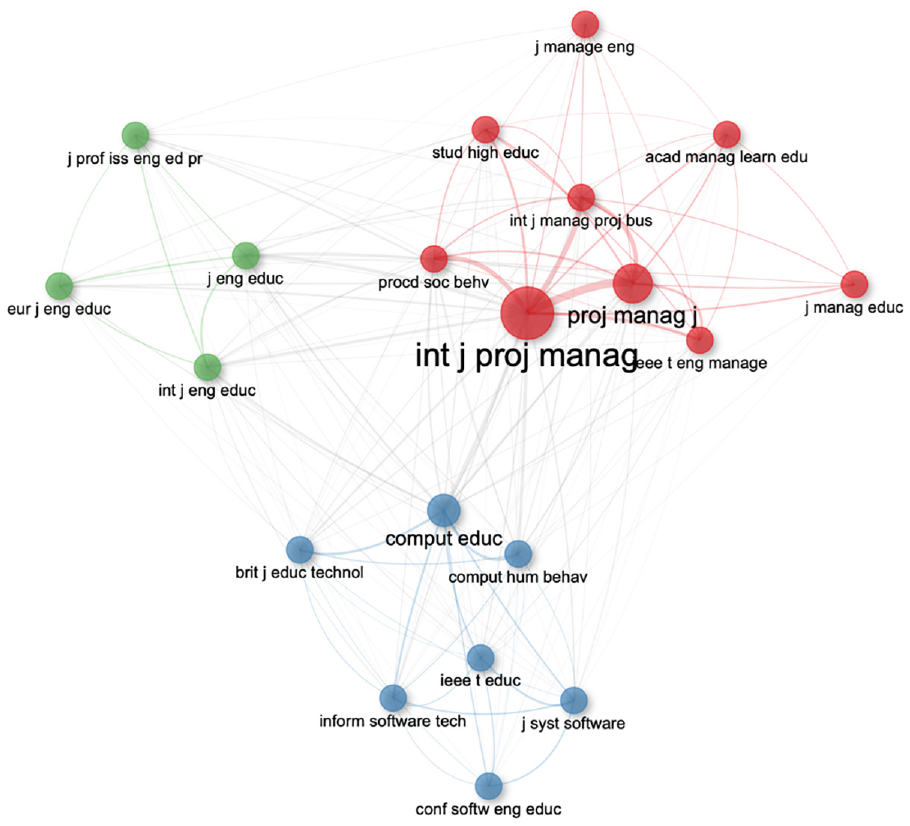
Co-citation analysis of source.
Subsequently, a co-citation analysis was performed on the documents to obtain additional insights into the intellectual foundations of the field (Figure 6). The results of the analysis largely support the previous result regarding the fragmentation within the field. The green cluster, located far from the central documents, is characterized by a focus on technology and software-oriented works. When examining this cluster in conjunction with the preceding findings, it is unsurprising to observe the presence of elements such as technology and engineering education, education in project management, and gamification. At the same time, the clusters denoted by the colors blue and red assume a central position within the context, effectively emphasizing the interdisciplinary character inherent in the field of project management. The primary emphasis of the largest cluster, denoted by the color red, pertains to the complex nature of project management and the requisite competencies that ought to be incorporated within project management pedagogy. These encompass the training of project managers to effectively navigate complex situations (Thomas & Mengel, 2008), the collaborative generation of knowledge through suitable educational methods (Berggren & Söderlund, 2008), the pursuit of educational excellence (Atkinson, 2008), and the adoption of an approach that prioritizes desired outcomes (Mengel, 2008). Moreover, the blue cluster, located on the periphery of the red cluster, seems to have emerged with a distinct emphasis on cultivating management and leadership competencies within project teams. This cluster comprises scholarly works, such as Pant and Baroudi (2008) and Ramazani and Jergeas (2015), that have contributed to the understanding of project leadership. Additionally, key resources on project leadership, such as the work of Muller and Turner (2010), are also found within this cluster.

Co-citation analysis of documents.
Conceptual Structure
To address the third research question regarding research interest, our study aimed to analyze the changes in keywords used over time in order to identify emerging and declining literature streams. To accomplish this, we conducted an examination of word usage from 1985 to 2008 and constructed a co-occurrence map to visualize the historical relationships between different topic areas (Figure 7). Additionally, we performed a separate analysis of keywords that emerged after 2009, as this marked the year when the literature in this field began to expand (Figure 8). The initial observation from comparing the two figures is that the research topics were considerably distant from each other during the first period, whereas they became closer in proximity during the second period. Furthermore, our analysis revealed a transition in the focus of research topics between the two periods. In the first period, the central cluster of co-occurrences primarily revolved around issues such as conflict and cooperation. However, in the second period, there was a shift toward soft skills such as leadership and teamwork. Furthermore, the transition between different time periods signifies a shift in focus from predominantly technical elements to the human and interpersonal dimensions of project management. In engineering areas, the primary emphasis during the initial period revolved around subjects such as curriculum development and training design. However, in the subsequent period, there was a notable transition toward themes such as agile methodologies, scrum practices, and the implementation of gamification techniques. These findings indicate an increasing tendency toward contemporary and innovative methodologies and a focus on soft skills in the realm of project management and training.

Co-word map, 1985 to 2008.

Co-word map, 2009 to 2023.
Theoretical Implications
Project management education and training play a crucial role in developing the necessary skills and knowledge required for successful project management. However, the lack of cross-communication between different research streams has hindered the development of an integrated understanding of project management education and training. To address this issue, our study presents findings from four decades of research in this field. Our study was motivated by the observation that, despite concerted educational efforts, a significant majority of projects still fail. Therefore, it is critical to comprehend the prevailing trends in project management education and training. We aimed to offer a comprehensive perspective and emphasize the evolutionary trends in this area.
First, we conducted an analysis of the contributions made by various research constituents to the knowledge base of project management education and training. The growth of publications exhibited a dynamic trajectory over the course of time. The assessment of research productivity revealed a collaborative production pattern, with an average of 2.18 authors involved in the creation of each document. This finding highlights the significance of collaborative efforts within the discipline. Based on our analysis of sources, we observed fragmentation in the breakdown of the field. This indicates the interdisciplinary nature of project management and training, which has both positive and negative characteristics. On the positive side, it suggests that researchers are exploring a wide range of approaches to the subject, facilitating a thorough examination of the topic, and integrating perspectives from diverse academic fields. On the negative side, it may also suggest a lack of consensus or established knowledge in the field, as evidenced by the absence of central sources. This highlights the necessity for additional research and the integration of knowledge in this domain. Our second research question focused on the intellectual structure of the field. Through historiographic mapping, we identified visible trends in the historical progression of research interests. We observed a shift in emphasis from the utilization of simulation tools to the implementation of gamification in educational endeavors related to software projects. Additionally, there has been a transition toward the provision of project management education and training in the 2000s. The central areas of focus relate to the efficacy of education and training in project management, methodologies, and soft skills. Furthermore, our co-citation analysis revealed distinct clusters of journals that correspond to prior research on the fragmentation of the field. We found a central cluster of journals specifically addressing project management, as well as journals prioritizing education in management and other broader disciplines within higher education. The second most sizable cluster comprised journals focused on technology and software education, indicating its prominence within the broader discipline. The third cluster consisted of journals focusing on engineering education, highlighting its significance within the discipline. This analysis also emphasized the interdisciplinary nature of project management, with co-citation clusters of documents encompassing areas such as technology, engineering, education, and leadership. Finally, our co-word analysis examined the conceptual structure of the field. We observed a tendency for clusters that exhibited a notable degree of separation during the first period to converge over time. This suggests that the fragmentation within the discipline has the potential to lead to convergence through collaborative efforts. The results also indicate a change in emphasis toward competencies and modern methodologies in project management education and training.
Managerial Implications
The increasing demand for proficient project management professionals has led to the expansion of educational programs in this field. However, traditional approaches to project management education are considered inadequate for modern organizational needs due to high project failure rates and the complexity of the evolving global landscape. Scholars argue that a paradigm shift in education is necessary to equip students with the essential technical and soft skills needed for real-world project management. There is a call for a new approach that blends formal education with experiential learning, particularly in the development of soft skills. Discussions in higher education emphasize the importance of fostering critical thinking skills, refining nuanced aspects of project management, and preparing project managers for real-world scenarios. Innovative pedagogical approaches and technology-driven learning environments have emerged as potential solutions to bridge the gap between traditional teaching methods and the demands of contemporary project management.
Conclusion
Project management education and training is a field of scholarly inquiry that is often overlooked, despite its significant contribution to the understanding of project management. It combines theoretical and practical perspectives to provide a comprehensive understanding of the subject. This study conducted a comprehensive bibliometric analysis of the scholarly papers published in the Web of Science (WoS) database. In general, the results indicate that there has been a notable increase in the body of literature pertaining to this particular study in recent years. The analysis of scientific mappings in this context reveals that we are confronted with a proliferation of knowledge generated by disciplines that have progressively converged yet maintain distinct origins. The analyses clearly indicate a recent convergence between the technical and human dimensions within this field of knowledge. The reason can be attributed to the strong interconnection between project management and implementation requirements. The necessity for a comprehensive project management education has instigated deliberations regarding the reconsideration and enhancement of existing methodologies. This emphasizes the cultivation of technical and soft skills through innovative and experiential learning approaches, aiming to enhance the readiness of project managers to face the complexities inherent in contemporary project environments.
Assessing the space occupied by project management education and training within the broader landscape of project management literature holds significance as it reflects the level of interest in the subject. To this end, searches were conducted on Google Scholar and WoS using relevant keywords, culminating in the creation of the following table:

As evident from the table presented above, the proportion of academic articles published in the domain of project management education and training (despite the presence of repetitive search results) relative to the entire corpus of project management literature falls within the range of 0.88% to 1.19%. This outcome suggests that the subject of project management education and training garners comparatively limited attention within the literature. This composition highlights that the field of project management education remains relatively underexplored despite shifting circumstances and the growing significance of education and training within the project management domain. Typically, project management education is categorized as a subset of engineering education, with academic research primarily concentrated on specialized areas like software development and the implementation of contemporary teaching methods such as simulation and gamification within project management education. Moreover, it draws attention to a significant challenge: the dominance of project management education and training by specific for-profit organizations, which can restrict diversity and innovation in educational approaches. These institutions often establish rigid standards that can hinder the effective transfer of the competencies necessary for success in the field. In essence, this composition underscores the need for a more comprehensive and dynamic exploration of project management education and training, especially in light of evolving circumstances and the increasing demand for individuals with project management expertise.
Limitation and Future Research Directions
The study has its limitations. The majority of the limitations are related to bibliometric methods. The study’s scope is limited due to the use of the WoS database for data collection. The integration of larger databases, such as Scopus, has the potential to offer additional valuable perspectives. Another limitation is the potential for bias in the selection of documents. The inclusion or exclusion criteria used in the analysis may introduce bias and affect the generalizability of the findings. Third, the process of data extraction is followed as a singular occurrence. The data has the potential to change over time, thereby unveiling varying trends and outcomes.
While the current analysis demonstrates the evolution of the research themes in the field, it is recommended that future research incorporate bibliographic coupling for further insights on the research front. Furthermore, the study did not encompass the institutional and territorial structure of the collaboration. Future research could consider incorporating these factors, and it may be helpful to include an examination of project management associations to assess the extent to which the field is intertwined with practical applications. Future research may also direct its attention toward examining specific facets of education and training. The project management field is under pressure to incorporate various technologies to achieve efficient and effective project execution, with the ultimate goal of project success, in response to the Fourth Industrial Revolution (Aliu et al., 2023). The examination of technological innovations can yield novel perspectives on their effects (Ram et al., 2019; Tiwari et al., 2018).
Footnotes
Author Contributions
Tufan Özsoy and Konuralp Sezgili conceived the study and were responsible for the design, data collection, development of the data analysis, data analysis, and data interpretation.
Declaration of Conflicting Interests
The author(s) declared no potential conflicts of interest with respect to the research, authorship, and/or publication of this article.
Funding
The author(s) received no financial support for the research, authorship, and/or publication of this article.

Data Availability Statement
The data that support the findings of this study are available on request from the corresponding author.