




Abstract
A distance education Diploma and Bachelor’s degree in Mathematics and Science programs are faced with low enrollment and graduation rate as well as high attrition of students. The aforementioned challenges are attributed to students’ satisfaction and continuance intention. However, students’ satisfaction and continuance intention toward distance education programs are as a result of certain antecedents. This modeled the determinants of satisfaction and program continuance intention by the distance education students on the math and science programs. Based on this, a quantitative approach based on a census survey was adopted and data collected from 113 students through a questionnaire and analyzed using a structural equation modeling approach based on partial least squares structural equation modeling (PLS-SEM). The results of the study showed that two key antecedents: student-instructor interaction, and study center physical facilities determine program satisfaction of mathematics and science distance students. However, administrative support of the program determined instructional modules; facilitation quality was predicted by both instructional modules and laboratory facilities. Finally, students program continuance intention was predicted by satisfaction of the program. Based on the findings, recommendations were made for policy and practice toward improving students’ satisfaction and promote positive intention in pursuant of mathematics and science education program by distance mode.
Keywords
Introduction
Globally, Science, Technology, Engineering and Mathematics (STEM) Education is currently an important curriculum area and Ghana is no exception (Abreh et al., 2018; Idris & Bacotang, 2023). This places much emphasis on the need to train graduates in mathematics and science subject specialties. However, the tertiary educational system in Ghana is still beset with inadequate infrastructural facilities to absorb all qualified applicants to pursue specialized mathematics and science programs (Ministry of Education Ghana, 2018). According to the Association of African Universities (AAU) report in 2018, there has been a surge of 47% in enrollment rates within the Ghanaian tertiary education as opposed to limited infrastructural facilities and faculty members. Interestingly, science and mathematics students formed 60% of the enrollment rate (Association of African Universities [AAU], 2018). According to Mohamedbhai (2015), the distance education mode provides remedy to the high demand for campus-based education in Africa. Consequently, the University of Cape Coast through the College of Distance Education, introduced the Diploma and Bachelor’s degree in Mathematics and Science programs by distance mode in 2014, as a stop gap measure.
Moore and Kearsley (2004) defined distance education as “teaching and planned learning in which teaching normally occurs in a different place from learning, requiring communication through technologies as well as special institutional organization” p. 2 (cited in Bervell & Arkorful, 2020, p. 1; Bervell et al., 2021). Johnson (2003) however, seems to present a definition that provides some consensus. According to him, “distance education is defined as simply a form of education in which the learner and instructor are separated during the majority of instruction. But unlike independent or self-directed study, distance education usually implies the presence of an institution that plans curriculum and provides resources and services for its students” p. 1 (cited in Bervell & Arkorful, 2020, p. 1; Bervell et al., 2021).
However, within the context of this study, distance education is the type of education mode where students attend weekend face-to-face interactions fortnightly in study centers outside the conventional university campus. They are provided with modules to engage in self-directed and self-regulated learning within the week. They only meet their instructors every other weekend for tutorials and further engagements. Although, this mode has been practiced for over 7 years, the concern here is that over the years, students’ numbers have dwindled on the distance-based mathematics and science programs. This is evidenced by the differences in the enrollment figures against the graduation statistics. For instance, over a period of 7 years, only 33% have graduated from the program.
According to Greenland and Moore (2014), attrition rates of students in distance education is a global concern. This is partly attributed to satisfaction of students on distance education programs (Caliskan et al., 2017). Additionally, there has been a concern of churning out mathematics and science programs by distance mode, due to the nature of the curriculum (DePriter, 2013; Harsha, 2017). Issues such as facilitation quality, student-instructor interaction, science and mathematics laboratory facilities, instructional materials, physical facilities at study centers and administrative support services to students, have been highlighted in the literature as possible influencers of satisfaction in distance education (K. Y. Chang, 2013; W. H. Wong & Chapman, 2023).
Ultimately, program satisfaction by distance students is equated to their intentions to continue pursuing distance programs (C. Moore & Greenland, 2017; W. H. Wong & Chapman, 2023). Nonetheless, there is a dearth of studies in literature that focus on a model that includes all the above factors to predict satisfaction and program continuance intention, as well as revealing the non-linear relationships that exist among these factors unique to mathematics and science distance education. Against this background, it becomes imperative to define and test a model based on the above factors to ascertain their significance in determining the satisfaction and program continuance intentions of mathematics and science distance students. Consequently, this study addresses the questions below.
What is the general satisfaction of distance students toward the mathematics and science distance program?
What are the determinants of distance students’ satisfaction toward the mathematics and science distance program?
What non-linear relationships exist among the determinants of distance students’ satisfaction toward the mathematics and science distance program?
What are the intentions of distance students toward the continuance in pursuing the mathematics and science distance program?
What is the total variance explained (R2) by the satisfaction model proposed for this study?
Literature Review
Theoretical Basis
The study is grounded in model of students’ attrition, which is widely recognized in the literature on distance education (Rawal & Razak, 2022). Focusing specifically on institutional commitment, we selected this variable from the model to investigate its relationship with students’ satisfaction and program continuance intention. To align with our research goals, we modified the final variable in the model, “Drop Out Decisions,” to “Program Continuance Intention.” Drawing from existing literature, we identified attributes such as facilitation quality, student-instructor interaction, science and mathematics laboratory facilities, instructional materials/modules, physical facilities at study centers, and administrative support services. We propose examining their relationships with program satisfaction and continuance intentions, considering non-linear relationships based on previous research for empirical verification.
Toward Hypotheses Formulation and Conceptual Model Development
Literature review was conducted to tentatively establish the relationships among the variables for this study which informed the conceptual model development.
Relationship Between Administrative Support and Facilitation Quality
Administrative support encompasses various roles performed by non-teaching staff, such as providing guidance to students, ensuring funding and adequate educational materials, creating a conducive environment, and offering professional development opportunities for faculty (Meyer & Barefield, 2010). Numerous studies have examined the impact of administrative support on teaching staff and academic performance. Baker (2007) and Tickle et al. (2011) found that administrative support significantly influences teacher job satisfaction, which in turn enhances teaching performance. Araneta et al. (2020) concluded that the support provided by school heads is related to the teaching quality of teachers. Lack of administrative support, as perceived by teachers, can result in decreased morale and increased likelihood of leaving the profession (Baker, 2007). Similar positive relationships between administrative support and job satisfaction have been observed among music teachers (DeLorenzo, 1992; Heston et al., 1996). Furthermore, the presence of good administrative support has a direct impact on facilitation quality and academic performance (Yidana et al., 2023). Schools with poor administrative support tend to have lower quality facilitation and subsequently poor academic performance (Thielman, 2012). This relationship between administrative support and facilitation quality has been emphasized by Meador (2018) and Zahara and Sinurat (2023). Considering these findings, it can be inferred that the availability of high-quality administrative support in an educational institution motivates teaching staff, leading to job satisfaction and improved facilitation. On the basis of this, the researchers postulated that:
H1: Administrative support of the mathematics and science program has a statistically significant positive relationship with facilitation quality of the program.
Relationship Between Administrative Support and Instructional Materials/Modules
The relationship between administrative support and the quality of instructional materials/modules in face-to-face distance learning institutions is crucial. While course modules have proven effective in enhancing teaching and learning, the level of administrative effort dedicated to their design and distribution can impact their utilization. For face-to-face distance learners, course modules serve as the primary study materials. They expect the course modules to be carefully designed, developed, and distributed as part of learner-support services provided by the host institution. Thus, the success of distance learners largely depends on the quality of these modules (Ouma, 2019). Therefore, it is essential for management to allocate resources and supervise the production of high-quality program modules.
Research on administrative support services suggests a strong correlation with the quality of instructional materials. Amadu (2016) conducted a study on distance education students’ perceptions of administrative support services. The majority of students who perceived positive student-support services also perceived the supplied course modules to be of good quality. Similarly, Ouma (2019) examined the impact of support services on in-service teachers pursuing distance education in Uganda. The study found that administrative support services had a positive effect on subject content, teaching methods, and other pedagogical practices. This re-echoed by Jian (2020) and Yidana et al. (2023). In view of the findings of the aforementioned studies, this study hypothesized that:
H2: Administrative support of the mathematics and science program has a statistically significant positive relationship with modules used for the program.
Relationship Between Instructional Materials/Modules and Facilitation Quality
Modules consist of self-contained units that focus on specific learning goals. They serve as valuable resources for study center facilitators aiming to enhance face-to-face facilitation quality A. Ibrahim and Isa (2023), especially in mathematics and science education (Tseng & Pai, 2014). Mathematics and science programs utilize printed modules that contain self-sufficient units of instruction, designed to help learners achieve specific objectives. These instructional modules possess key qualities that contribute to effective facilitation and independent learning. These qualities include clear learning goals, accurate and up-to-date content, well-designed structure, interactivity, assessments with feedback, visually appealing design, and promotion of learner participation, engagement, and motivation. Modules provide facilitators with guidance on initiating ideas and selecting appropriate learning targets for students. Facilitation quality entails supporting students in discovering knowledge themselves, fostering their interest, motivation, and involvement. It also provides opportunities for self-development and evaluation. Effective facilitation operates on the principle that students learn best when guided to discover knowledge independently, rather than being passively provided with information (Allen et al., 2016; Fraser, 2017). In the context of face-to-face distance learning, facilitators are expected to follow the course module provided, ensuring students feel comfortable with the content. Their primary role is to coach learners through the material, relying minimally on external resources. A study conducted by Hamweete (2012) assessed the quality of course modules used at the University of Zambia, Institute of Distance Education. The findings revealed that the modules lacked interactivity, were poorly edited, and had formatting issues. The researcher recommended making the modules more interactive, pretesting certain modules before implementation, and emphasizing teamwork in module writing to improve editing. However, it remains unclear whether the quality of course modules provided by distance learning institutions influences the facilitation quality in study centers, even though studies from Ningi (2023) as well as Ikram and Kenayathulla (2023) confirm this in conventional education. We therefore postulate that:
H3: There is a significant positive relationship between the quality of Instructional modules and facilitation quality of the courses.
Relationship Between Laboratory Facilities and Facilitation Quality
The relationship between laboratory facilities and facilitation quality in education has been widely acknowledged. Adequate laboratory facilities at study centers have been found to have a significant impact on the teaching of science (Komala et al., 2023; Olufunke, 2020). Facilitation quality refers to the instruction and guidance provided to students to help them explore and understand important concepts, including problem-solving and evidence gathering. Studies have shown that facilitators who allocate more time to practical work contribute to better student performance. The availability of laboratory facilities at study centers provides a conducive environment for facilitators to conduct experiments. These facilities are essential for organizing practical sessions that aid students in comprehending and explaining crucial scientific concepts. The presence of study center laboratory facilities positively influences the facilitation quality of a program (Igwe & Okeke, 2023). They play a vital role in promoting students’ active participation in the learning process, bridging the gap between theory and practice (Musah & Umar, 2017). Without laboratory facilities, the mastery of important science concepts is hindered, impeding the teaching and learning of science at study centers. The relationship between laboratories and facilitation quality has long been recognized as a crucial component in science instruction. Research by Amoah et al. (2023) and Olufunke (2020) demonstrated that the adequacy of laboratory facilities correlates with improved facilitation quality and higher academic performance among students. Conversely, the absence of well-equipped science laboratories hampers the quality of facilitation, rendering practical work ineffective. Students face challenges in interacting with phenomena and materials, hindering their meaningful learning experiences in mathematics and science. Based on these observations, the study proposes the following hypothesis:
H4: Study center laboratory facilities have a statistically significant positive relationship with the facilitation quality of the program.
Relationship Between Administrative Support and Students’ Satisfaction Towards the Program
Administrative support plays a crucial role in studies related to retention, job satisfaction, attrition, burnout, and self-efficacy, acting as either a predictor or a predictive variable (Crosby, 2016; Dickey, 2017; Tickle et al., 2011). Balfour (2001) initially defined administrative support as encompassing emotional, environmental, instructional, and technical support. In this study, administrative support refers to the support provided to science and mathematics students by the College to facilitate their learning, encompassing all measures taken by the institution to enhance students’ learning experience. Lack of administrative support is expected to decrease students’ satisfaction, while positive support would increase it (Kanduri & Radha, 2023; Tickle et al., 2011). Students’ satisfaction occurs when institutions meet or exceed students’ perceived performance expectations (Mark, 2013; Supranto, 2011), establishing a positive relationship between administrative support and students’ satisfaction (Zhang, 2023). Agbanu et al. (2018), in a study examining factors influencing student satisfaction in distance education in Ghana, concluded that administrative support services significantly influenced students’ satisfaction. However, this relationship cannot be generalized based on a single study, and their research did not focus specifically on mathematics and science students in distance education. Therefore, further validation within the context of mathematics and science distance students is necessary. Against this backdrop, this study stipulates that:
H5: Administrative support of the mathematics and science program has a statistically significant positive relationship with distance students’ satisfaction toward the program.
Relationship Between Instructional Modules Used for the Mathematics and Science Program and Students’ Satisfaction Towards the Program
The instructional module (IM) plays a crucial role in the effective delivery of distance education (Tseng & Pai, 2014). IM refers to carefully structured documents, typically in printed form, that provide instructional content to individual learners (Campbell, 1999). It enables self-directed and self-paced learning, allowing students to take responsibility for their progress (Sturges et al., 2017). In this study, instructional modules are defined as well-structured instructional content provided to students at the beginning of academic semesters to aid their self-directed learning. These modules contain sections such as learning objectives, an introduction, instructional content, directions, learning activities, and self-assessment questions (Campbell, 1999). The quality and characteristics of instructional modules can significantly impact students’ satisfaction (Chruscik et al., 2022). Research by Loorbach et al. (2015) found significant relationships between the attention, relevance, and confidence of instructional materials and students’ satisfaction. Similarly, Noviyanti et al. (2018) and Danjuma et al. (2023) emphasize that accessible, easily understandable, and well-packaged instructional modules positively influence student satisfaction. Therefore, if the instructional modules used in the mathematics and science distance program possess these qualities, students are likely to be satisfied with the program. In view of the above, it expected that:
H6: Instructional module used for the mathematics and science program has a statistically significant positive relationship with distance students’ satisfaction toward the program.
Relationship Between Facilitation Quality on the Mathematics and Science Program and Students’ Satisfaction Towards the Program
The quality of facilitation is crucial for students’ learning success (Wong & Aiken, 2003). It is often used interchangeably with the quality of teaching (Dahl & Smimou, 2011). Quality teaching encompasses various aspects of learning where students experience positive outcomes. Successful institutions prioritize providing quality learning experiences and rely on the contributions of all learners to achieve their objectives. Facilitating a distance course differs significantly from teaching in a traditional classroom environment (Moore & Kearsley, 2005). In distance learning, facilitation emphasizes the need for interaction to ensure quality teaching (Kearsley, 2000). Distance learning tutors must not only be subject matter experts, as suggested by Anderson et al. (2001), but also possess skills to support students in directing their own learning. These skills include effective questioning and feedback techniques, encouraging critical thinking and reflection, and fostering learner engagement through discussion (Dron & Anderson, 2014; Garrison, 2009; Young & Papinczak, 2013). High-quality facilitation strikes a balance between directive and facilitative roles (Papinczak et al., 2009). The skills and actions exhibited by the teacher modulate the challenges of learning (Barrows, 1988; Mayo et al., 1995). In this study, facilitation quality is defined as the extent to which students are satisfied with the tutor’s facilitation, encompassing the design, process, and direction of cognitive and social processes to achieve meaningful learning outcomes (Anderson et al., 2001). Satisfaction, on the other hand, can be defined as a short-term attitude resulting from an evaluation of students’ educational experiences, services, and facilities (Weerasinghe & Fernando, 2017). Students’ satisfaction refers to their relative favorable response regarding the quality of facilitation in a course, including prompt feedback, clear expectations, and teaching style (Appleton-Knapp & Krentler, 2006; Oyarzun & Martin, 2023). It represents students’ happiness when their facilitation needs are met. Surprisingly, little research has explored the relationship between facilitation quality and students’ satisfaction in face-to-face distance learning. Given the correlation between the quality of teaching, students’ learning experiences, and satisfaction (Chang et al., 2023), further research is needed to examine facilitation quality in face-to-face distance learning programs and its impact on students’ satisfaction. We therefore propose that:
H7: Facilitation quality of the mathematics and science program has a statistically significant positive relationship with distance students’ satisfaction toward the program.
Student-Instructor Interaction and Students’ Satisfaction Towards the Mathematics and Science Program
The construct of student-instructor interaction is referred to in various distance learning models, such as social presence, social construction of knowledge, and effective discussion among teachers and students (Cho & Tobias, 2016; Garrison et al., 2001; Osman & Herring, 2007). It is also explored in the Interaction Analysis Model (IAM) to examine the negotiation of meaning and knowledge construction at the group level (Gunawardena et al., 1997). Student-instructor interaction involves communication between students and teachers that reflects their presence and influence, fostering a personal connection within the learning community (Gunawardena et al., 1997). For Englehart (2009), student-teacher interaction refers to the extent to which teachers engage with their students. In the context of face-to-face distance learning, it refers to open and purposeful communication between students and teachers, sharing thoughts in a trusting environment through communication channels (Bektashi, 2018; Cho & Tobias, 2016). This construct emphasizes that student-teacher interaction is one of the key factors for educational success (Wang et al., 2016) and has a significant impact on students’ learning outcomes (Ahmad et al., 2019). Furthermore, studies have shown that student-teacher relationship and student-student interaction are related to students’ satisfaction (Sojkin et al., 2012; Tonga & Şahin, 2023).
Students’ satisfaction in this context refers to their attitude resulting from the evaluation of their relationship with instructors (Balagova & Halakova, 2018). Building a teacher-student relationship is crucial for creating trust, mutual understanding, and respect, which positively influences students’ learning (Caskurlu et al., 2020). The quality of interaction between teachers and students is vital for the overall educational process (Englehart, 2009). If instructors in distance learning recognize the importance of their interaction with students in motivating their learning, it will have a favorable impact on students’ achievement and perception of the science and math programs at the distance level. Tatar and Horenczyk (2003) identified a correlation between teacher interaction with students and their achievement and job satisfaction. A similar study conducted among high school students in Kenya also found that student-teacher interaction significantly influences motivation to learn mathematics (Ngunjiri, 2020) and satisfaction (Schroedler et al., 2023). This study therefore proposes that:
H8: Student-instructor interaction has a statistically significant positive relationship with distance students’ satisfaction toward the mathematics and science program.
Relationship Between Study Center Laboratory Facilities and Students’ Satisfaction
The quality of learning resources is crucial for achieving the core objectives of teaching and improving students’ learning experiences (Akomolafe & Adesua, 2016). In particular, the quality of laboratory facilities plays a vital role in providing hands-on experience and driving students’ performance and satisfaction (Danjuma et al., 2023). However, challenges such as limited access, inadequate funding, and increased student population in low-income countries hinder the ability to ensure student satisfaction (Schendel & McCowan, 2016). Coskun (2014) found that university students in Albania who interacted more with academic facilities attached greater importance to these facilities and improved their learning experiences and creativity. Maristela et al. (2015) examined the satisfaction level of maritime students with laboratory facilities and identified dissatisfaction with the allocated time for laboratory sessions. The quality of laboratory resources has garnered significant interest among researchers studying satisfaction factors for science and math students (Mahmood et al., 2014). For face-to-face distance learners, the study center laboratory serves as a place for conducting science experiments. Satisfaction with laboratory facilities results in a positive emotional experience and pleasure in using the facilities. Students expect excellent laboratory facilities to be provided at their study centers. If institutions offering face-to-face distance learning recognize that laboratory facilities are instrumental in enhancing satisfaction for science and math students, it will positively impact students’ satisfaction with these courses. Provision of science laboratories will foster motivation among students to learn science subjects and influence their intention to continue pursuing science programs. Several studies have concluded that the quality of educational facilities has a positive influence on students’ satisfaction. However, there are different perspectives on the dimensions that significantly contribute to students’ satisfaction (Kara et al., 2016), of which laboratory facilities are part (Kheirelseid et al., 2023). This study suggests that:
H9: Study center laboratory facilities statistically determine students’ satisfaction toward the mathematics and science program.
Relationship Between Study Center Facilities and Program Satisfaction
Physical facilities in the context of this study refer to school buildings, classrooms, laboratories, furniture, toilet facilities, offices, and other infrastructure at the regional study centers where the distance education mathematics and science programs are conducted during weekends (Akomolafe & Adesua, 2016). These facilities are essential tools that facilitate and enhance learning experiences (Akomolafe & Adesua, 2016). The presence and accessibility of these facilities create an ideal learning environment that stimulates students’ interest and promotes program satisfaction (Farahmandian et al., 2013). Program satisfaction, within the scope of this study, can be described as the feeling of pleasure experienced by mathematics and science distance students when they receive the provisions they desired from the academic program. Previous research supports the importance of physical facilities in determining program satisfaction. Business students in higher education expressed satisfaction with their programs primarily based on the presence of good physical facilities (Farahmandian et al., 2013). Similarly, Malaysian tertiary education students expressed satisfaction with their programs due to the availability of physical facilities (Mansor et al., 2012). A recent study conducted in a Ghanaian postgraduate distance education program also identified physical facilities as a significant determinant of students’ program satisfaction (Andoh et al., 2020). Considering the literature discussed, it can be inferred that physical facilities at study centers can play a crucial role in determining students’ satisfaction (Igwe & Okeke, 2023; Ikram & Kenayathulla, 2023) with the mathematics and science program. The ambiance and comfort offered by these facilities create a conducive learning environment. It is anticipated that if mathematics and science distance students perceive the physical facilities at their study centers to be available and suitable, it will positively influence their satisfaction toward the program. Upon this premise, we hypothesize that:
H10: Study center physical facilities have a statistically significant positive relationship with distance students’ satisfaction toward the mathematics and science of the program.
Relationship Between Program Satisfaction and Program Continuance Intention
Program satisfaction refers to the perception of enjoyment and accomplishment in a learning environment (Dang et al., 2016). It is closely linked to users’ future intention to continue using a product or service (Oliver, 1997). In the context of educational programs, satisfaction plays a crucial role in determining beneficiaries’ intention to repurchase a product or continue with a program (Fang et al., 2011; Thomas et al., 2017). In distance education, where dropout rates are high, program satisfaction becomes a paramount variable (Akuamoah-Boateng & Boadu, 2013; Bawa, 2016; Kılınç & Okur, 2021; Kılınç & Okur, 2021). When students are satisfied with a program, it positively influences their attrition and dropout intention, motivating them to persevere and graduate (Shiue & Hsu, 2017). The psychological formation of willingness to pursue an academic program to completion is known as continuance intention (Tzovla et al., 2021). Distance education students’ satisfaction significantly enhances this intention (Liao & Liu, 2012). Studies by Chow and Shi (2014) and Lu et al. (2019) have confirmed the relationship between program satisfaction and continuance intention. Satisfaction with a program contributes greatly to the intention to continue, as stated by Al Amin et al. (2023), Ye et al. (2023), and Li et al. (2021) Therefore, in the context of mathematics and science distance students, if they are satisfied with the program, they are more likely to have the intention to pursue it until completion.
Accordingly, it is hypothesized that:
H11: Distance students’ satisfaction toward the mathematics and science program has a statistically significant positive predictive relationship toward their program continuance intentions.
The above hypotheses have been used to formulate a proposed model below for the study (Figure 1).
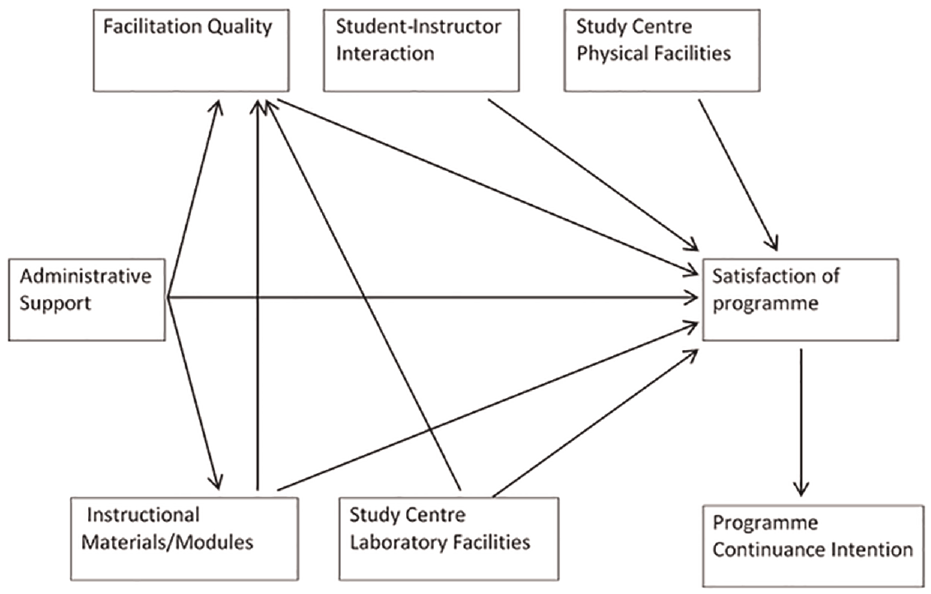
Proposed mathematics and science distance education satisfaction model (MSDE-SAM).
Method
The study is hinged on a quantitative approach with a descriptive survey design. This is because the study is focused on unraveling predictive factors of a phenomenon as well as acquisition of knowledge of the general situation pertaining to that phenomenon on the field. The approach and design are justified based on the viewpoints of Creswell and Creswell (2017) and Walliman (2014) when conducting such a study.
The target population comprised all mathematics and science students on the mathematics and science distance education program of the University of Cape Coast. University of Cape Coast has the largest population of distance education students and is the leading distance education provider in Ghana. As a dual mode institution, the university also has 93 study centers across the country and offers education; business; as well as maths and science programs by distance mode. However, the institution was the first to introduce the maths and science programs via distance mode. The students are scattered across study centers with varied facilities within the country. The sample size of this study was determined based on the total number of distance students on the mathematics and science program offered by the University of Cape Coast. It is estimated that currently, mathematics and science students are 163. By way of a census survey, all science and mathematics distance students were selected as the target population. This is because the study seeks to obtain data from only distance education students offering the mathematics and science program. This approach is justified based on the recommendation by Creswell and Creswell (2017) as well as Artino et al. (2014), when the study focuses on obtaining data from a particular group of respondents, peculiar to a phenomenon being studied. Since the study expects adequate representation from all study centers across the country, the census survey strategy was employed to select all mathematics and science students as respondents. This is justified by Molenberghs (2010) as well as Nirel and Glickman (2009) who stated that census survey strategy is appropriate when the survey covers the entire target population. The De Jure method was applied to collect data as recommended by Smith et al. (2015) and Vemuri (1994) because, the complete enumeration period of two separate weekends were used to collect data from both group one and group two distance mathematics and science students respectively. This was part of an evaluation exercise on the mathematics and science program. Students were duly informed about the exercise and so were met in their various study centers in person by members of the research team. Briefing was done accordingly and questionnaires distributed to the students in class. However, since the exercise was done during break time, the students were well spaced in different rooms for independent filling of the questionnaire. Since students attended lectures only on weekends, the exercise took two weekends to give opportunity to those students who could not make it during the first weekend. The two weekends of data collection were enough, because only the 10 regional capital study centers across the country offered Mathematics and Science Programs. In all, 114 valid responses were obtained from 163 questionnaires distributed, representing 70.6%. The return rate was representative enough from the target population. This is evidence by Krejcie and Morgan (1970) estimation of a sample of 113 from a population of 160 at a confidence of 95% with a 5% margin of error.
A questionnaire was developed based on the factors included in the proposed model. Items from existing literature were adapted to measure the various constructs in the model. Specifically, items for administrative support were adapted from authors (Agbanu et al., 2018; Andoh et al., 2020; Ghansah et al., 2015); instructional materials/modules (García-Hernández & González-Ramírez, 2017; Magtibay et al., 2015; Wagner et al., 2013); facilitation quality (Ali & Ahmad, 2011; Andoh et al., 2020); student-instructor interaction (Agbanu et al., 2018; Ali & Ahmad, 2011; Wagner et al., 2013); study center laboratory facilities (Neji et al., 2014; Osman et al., 2011); study center physical facilities (Andoh et al., 2020; Vidalakis et al., 2013); satisfaction of program (Ali & Ahmad, 2011; Caliskan et al., 2017; García-Hernández & González-Ramírez, 2018); and program continuance intention (Li & Yu, 2020; M. Ibrahim et al., 2007; M. A. Ibrahim & Van der Heijden, 2019). After this stage, focus-group interview was conducted on a convenient sample of 16 mathematics and science students to verify the clarity of understanding and non-ambiguity of the items measuring each construct in the model as recommended by Carpenter (2018). Consequently, a pilot test was conducted on a convenient sample of 53 mathematics and science students in another distance education setting to respond to the items across the factors. A final exploratory and confirmatory factor analyses were conducted to finalize the measurement items across the various constructs, prior to actual data collection (Field, 2016). Items that loaded below 0.5 were deleted according to literature (Hair et al., 2017). Final data collected were then entered into SPSS for cleaning and converted into comma separated variable (csv) file for onward exportation into Smart-PLS software for structural equation modeling.
On analytical approach, simple descriptive statistics were used to analyze the preliminary data (gender, age, study center, study level, etc.). In relation to the main data, a structural equation modeling technique was employed to further confirm the reliability and validity of the instrument and measurements as well as determining the statistical significance of the hypothesized relationships. Specifically, the structural equation modeling analysis comprised two stages (measurement model analysis and structural model analysis) as recommended by Hair et al. (2017) and Kline (2016). The measurement model analysis verified for reliability and validity of the variables and associated measurement items while the structural model analysis centered on predictive significance of the hypothesized relationships and other verification measures of both the significant and non-significant paths.
Findings
Preliminary Data Analysis
Preliminary data involved gender, age, study center and level of study. Their frequencies and corresponding percentages are shown in Table 1.
Demographic Data.

Table 1 indicates that there were more male mathematics and science students (98) compared to females (16), accounting for 86% and 14% respectively. The Bachelor of Mathematics program had the highest frequency with 44 students (38.6%), while the Diploma in Mathematics program had the lowest representation at 19.3%. In terms of the level of study, there were more students in level 300 compared to other levels. Regarding study centers, Kumasi had the highest number of respondents at 17.5%, while Takoradi had the fewest respondents with only two students, representing 1.8%.
Measurement Model Analysis
As recommended by Hair et al. (2017), an exploratory factor analysis based on a PLS-SEM algorithm was first run to determine the item loadings across the constructs and delete those items loading lower within the model. Figure 2 depicts the graphical output of the algorithm.

Algorithm for exploratory factor analysis.
From Figure 2, items such as IMM2, IMM5, IMM6, and IMM8 measuring the Instructional Material/Module were deleted from the model because they loaded from 0.465 to 0.597. Their deletion also improved the average variance extracted values. This was based on the recommendation from Hair et al. (2017) and K. Wong (2019). After the deletion, another round of algorithm was run for confirmatory factor analysis. This is depicted by Figure 3.

Algorithm for confirmatory factor analysis.
From Figure 3, all the items across the various constructs loaded sufficiently between 0.604 to above 0.700 as recommended by Kline (2016), Hair et al. (2017), and K. Wong (2019). The complete reliability and validity measurement values are captured in Table 2. From Table 2, all the values for the reliability indices such as Cronbach’s Alpha, rho_A and composite reliability were above the .7 minimum threshold (Bervell et al., 2021; Hair et al., 2017; Kline, 2016; K. Wong, 2019). The average variance extracted values for all the constructs were above the .5 minimum threshold as well (Hair et al., 2017; Kline, 2016; K. Wong, 2019). Based on the above values across the various measurement model indices, the model specified for this study achieved credibility for reliability and validity assessments.
Reliability and Validity Assessment.

Discriminant Validity
Discriminant validity is necessary to ascertain the exact uniqueness that exist in terms of each variable within the specified model of the study to avoid construct redundancy (Bervell et al., 2022; Bervell & Umar, 2017; Henseler et al., 2015). To achieve this, the Heterotrait-Monotrait (HTMT) ratio was used. The results are shown in Table 3.
Heterotrait-Monotrait Ratio.

Note. AS = administrative support; FQ = facilitation quality; IM/M = instructional materials/modules; LF = laboratory facilities; PF = physical facilities; PCI = program continuance intention; SP = satisfaction of program; SII = student-instructor interaction.
From Table 3, all the values between the different constructs were below the 0.8 strict criterion as specified by Henseler et al. (2015). The bolded zeros also showed that there was no difference between a particular construct and itself. Based on the results from the HTMT, discriminant validity was established in this study.
Collinearity
The presence of collinearity or multicollinearity negatively influences the path significance in a model (Kock & Lynn, 2012). This means that models should be devoid of collinearity constraints. To solve for this, the variance inflation factor (VIF) values are used. According to Kock and Lynn (2012) and Hair et al. (2017), VIF values in a model should be less than 3.3 strict criterion. Results from the collinearity analysis are shown in Table 4.
Variance Inflation Factor Values.

Note. FQ = facilitation quality; IM/M = instructional materials/modules; PCI = program continuance intention; SP = satisfaction of program.
From Table 4, the VIF values ranged from 1.000 to a maximum of 1.978. This is an indication that the estimated model is collinearity-free.
Model Fit
Model’s fitness to data is very important in validating the results obtained from path significance test. Hence, estimated models should fit to the data measuring them. In order to verify for model fitness in PLS-SEM, indicators such as Standard Root Mean Residual (SRMR), Norm Fit Index (NFI) and rms_Theta are recommended by Hair et al. (2017) and K. Wong (2019). Table 5 provides the summary statistics of the fit indices.
Model Fit Indices and Values.

From Table 5, SRMR value obtained was 0.078; NFI was 0.901 and finally rms_Theta recorded 0.104. The results imply that the estimated model for the study fitted well to the data. This conclusion is based on the recommended threshold of values above 0.05 for SRMR; above 0.8 for NFI and below 0.2 for rms_Theta (Hair et al., 2017; K. Wong, 2019). Thus, we conclude that model fitness was achieved in this study.
Total Variance Explained by Model
The total variance explained by the model indicates the percentage explained by the exogenous variables in the endogenous variables within the model. This is estimated using the coefficient of determination (R2) values. These values are presented in Table 6.
Coefficient of Determination Values.
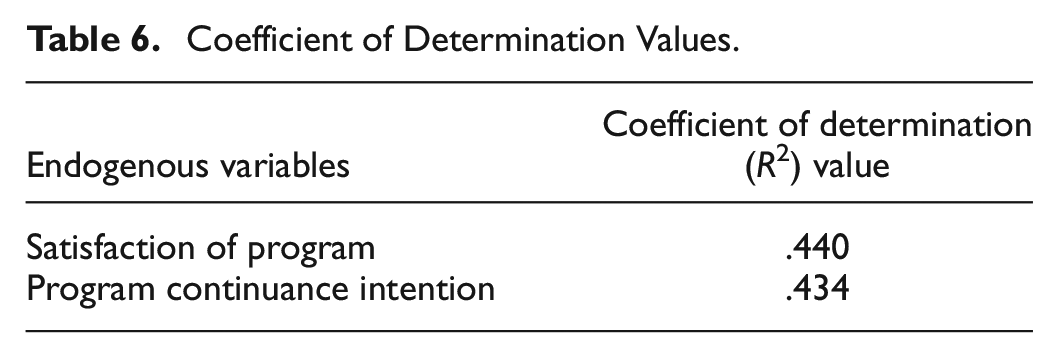
From Table 6, the endogenous variables in the model explained a total of 44.0% of variance in satisfaction of the mathematics and science program. On the other hand, satisfaction of the program explained a total of 43.4% of variance in program continuance intention. The implication of the results is that the variables used in this study to measure both program satisfaction and program continuance intention are not exhaustive. Nonetheless, the variance explained by the verified model in this study were sufficient based on the recommendation by Kline (2016), Hair et al. (2017), and K. Wong (2019).
Structural Model Analysis
In order to justify for the paths’ significance of the hypothesized paths in the model, we conducted a 5,000 resamples bootstrapping sequence as recommended by Hair et al. (2017) and K. Wong (2019). The graphical output is shown by Figure 4 and results presented in Table 6.

Graphical output from PLS-SEM bootstrapping sequence.
Table 7 shows the results from bootstrapping sequence of 5,000 resamples, as suggested by Hair et al. (2017), meant to test the significance of the hypotheses raised in the study. The results indicate that out of the 11 hypotheses tested using the bootstrap analysis, six were significant whilst the rest were insignificant. The sample mean, standard deviation and t-statistics suggest that administrative support (M = 0.577, SD = 0.068, t = 8.312, p < .01) had a significant relationship with instructional materials/modules; instructional materials/modules (M = 0.324, SD = 0.124, t = 2.606, p = .009) significantly predicted facilitation quality. Similarly, laboratory facilities (M = 0.228, SD = 0.086, t = 2.586, p = .010) significantly related with facilitation quality. In the same trend, physical facilities (M = 0.376, SD = 0.106, t = 3.419, p < .01); and student-instructor interaction (M = 0.377, SD = 0.121, t = 3.101, p < .01) had a significant relationship with program satisfaction. Finally, program satisfaction (M = 0.662, SD = 0.062, t = 10.610, p < .01) significantly determined program continuance intention. The rest of the hypotheses were not supported at neither p ≤ .01 or p ≤ .05 significant thresholds.
Results of Paths’ Significance Test.

Note. SAT_PROG = satisfaction of program; ADMIN_SUPT = administrative support; FCTN_ QUAL = facilitation quality; INST_M/M = instructional materials/modules; LAB_FCTS = laboratory facilities; PHYS__FCTS = physical facilities; STI = student-instructor interaction; PCI = program continuance intention.
p ≤ .01 significance.
Based on a mean response of 3.65 for students’ satisfaction on the program and 4.3 for intention to continue the program toward completion, students had a fair level of satisfaction on the program but a strong intention to continue to pursue the program to graduation.
In addition, it is worthy to establish that all the significant path relationships were valid. This is because their confidence intervals’ (CI) lower and upper boundaries had a unidimensional pattern, confirming a non-spurious effect. The non-spurious effect is further confirmed by the effect size (f2) values ranging from 0.257 to 0.768, indicating large effect sizes for all the significant predicted paths.
Discussion
The study found that students’ satisfaction with the distance-based mathematics and science program was influenced by factors such as the physical facilities at the study centers and student-teacher interaction. Path analysis confirmed that the physical facilities significantly determined students’ satisfaction with the program. The quality and accessibility of facilities, including buildings, classrooms, furniture, laboratories, and other infrastructure, played a crucial role in creating a suitable and conducive learning environment. This finding is consistent with previous studies by Igwe and Okeke (2023), Andoh et al. (2020), and Farahmandian et al. (2013) Students’ perception of program satisfaction in mathematics and science was closely tied to their comfort and utilization of the physical facilities at the study centers (Akomolafe & Adesua, 2016). Ensuring the availability and quality of these facilities is essential for creating a positive learning experience for distance education students in mathematics and science.
Additionally, student-instructor interaction was significant with satisfaction of program. Positive feedback from facilitators and their knowledge of the subject matter contributed to students’ perception of the program. Positive student-teacher interaction, as suggested by Skinner and Belmont (1993) and Reinke et al. (2016), fostered engagement and positive behavior among instructors and students. Instructor-student interaction in distance education encompassed not only subject matter discussions but also motivation, counseling, and role modeling, as noted by Arhin et al. (2021). This interaction, including trust, understanding, and respect, played a pivotal role in student satisfaction, aligning with the findings of Tonga and Şahin (2023), as well as Balagova and Halakova (2018). Ngunjiri (2020) further emphasized the significant influence of student-teacher interaction on motivation and satisfaction in learning mathematics. The study highlights the importance of fostering strong and supportive relationships between instructors and students in distance education to enhance student satisfaction and engagement in science and math programs.
The study examined the relationship between administrative support, module use, laboratory facilities, and student satisfaction in a distance education program. Surprisingly, the findings revealed that module use did not significantly influence student satisfaction, suggesting that issues such as late distribution, lack of access, and poor quality may hinder students’ engagement with the modules. Furthermore, the presence or absence of laboratory facilities alone did not relate to student satisfaction. Instead, it was the quality of facilitation, including expert interactions, guidance, and support, that impacted satisfaction. Interestingly, administrative support did not influence student satisfaction, indicating that the support provided by administrators fell short of meeting students’ expectations and needs. The lack of available or stimulating instructional materials and laboratory facilities may have contributed to this outcome. These findings contrast with the research by Danjuma et al. (2023) and Agbanu et al. (2018), who found that administrative support significantly influenced student satisfaction in distance education programs. Overall, the study underscores the importance of addressing issues related to module quality, facilitation, and laboratory resources to enhance student satisfaction in distance education programs.
Also, the findings from the study revealed that there was no significant relationship between facilitation quality and students’ satisfaction with the program. This finding suggests that the role played by the facilitators did not influence the students’ satisfaction of the program which contradicts with previous literature that emphasized the influential role of teachers in distance learning (Caskurlu et al., 2020; Chang et al., 2023). While facilitators play a crucial role in questioning, encouraging critical thinking, and engaging students to enhance satisfaction (Dron & Anderson, 2014; Garrison, 2009; Young & Papinczack, 2012), the study did not find this association. This suggests that other factors might influence students’ satisfaction in the program.
The study revealed a positive relationship between administrative support and students’ use of instructional modules. The efforts made by distance learning administrators in designing high-quality modules were found to increase module usage. This suggests that when administrators invest in developing quality modules to support students’ learning, it is more likely that students will utilize these modules to enhance their learning experience. In order to improve module usage, distance learning administrators could focus on enhancing various aspects of the modules, such as the content, knowledge checks, design, visuals, interactivity, readability, and the speed of module distribution. One effective approach could be to ensure that the modules are well-edited, pre-tested, and converted into e-books, as this would enhance interactivity and accessibility. These findings are in line with the perspectives of Yidana et al. (2023), Amadu (2016), and Ouma (2019), who highlighted the significance of administrative efforts in producing high-quality course modules that actively engage students.
Furthermore, a significant predictive relationship was found between course modules and facilitation quality. Students’ perception of high-quality modules, including design methods, current content, interactivity, visuals, and accessibility, enhanced the quality of facilitation. Conversely, students’ dissatisfaction with module design methods that do not meet their learning needs could negatively impact facilitation quality. In face-to-face distance learning, course modules serve as a guide for learners and facilitators, outlining learning expectations, course structure, and assessment examples (Berge, 2008). Facilitators explain modules, sustain learner participation and motivation (Bawane & Spector, 2009), and guide students to engage effectively with the academic tasks and learning activities presented in the module. Therefore, the effectiveness of course facilitation depends on the quality of the module as found by Ningi (2023) as well as Ikram and Kenayathulla (2023). Low-quality modules result in ineffective facilitation, while high-quality modules enhance the facilitation process (Kim & Frick, 2011).
Another key finding of the study was the quality of study center laboratory facilities. The relationship between this variable and facilitation quality was significantly positive. This finding is consistent with previous research by Kheirelseid et al. (2023) and Olufunke (2020). It suggests that when the laboratory facilities in the distance learning centers are well-equipped, have sufficient resources, and are supported by knowledgeable laboratory technicians, the overall quality of facilitation improves. Students tend to perceive that adequate science resources in the centers contribute to better facilitation. On the other hand, even if facilitators possess strong content knowledge and pedagogical skills, if the laboratory facilities are inadequate or non-existent, facilitation efforts are compromised. Insufficient laboratory resources hinder the quality of facilitation and impact students’ interest and performance in science subjects. Therefore, quality facilitation in science education aligns with the availability and adequacy of laboratory facilities, as science learning emphasizes practical experiences and constructivist approaches (Hofstein, 2017).
Contrary to previous research, our study revealed that administrative support in the teaching and learning of mathematics and science through distance education did not influence the quality of facilitation. Despite the provision of emotional, environmental, and technical support by distance learning administrators, students did not perceive a positive impact on the teaching quality. This suggests that the level of support offered by administrators in a face-to-face distance learning environment does not necessarily translate into effective facilitation in mathematics and science subjects. It indicates that the administrators may not be fulfilling one of the fundamental functions of distance learning, which is ensuring high-quality facilitation. This finding contradicts the earlier findings of Zahara and Sinurat (2023), Araneta et al. (2020), and Meador (2018), who proposed a relationship between administrative support and facilitation quality in other educational contexts.
The satisfaction of mathematics and science students with the program was found to be a significant predictor of their intentions to continue the program. This finding has important implications for reducing attrition rates and promoting higher graduation rates. When students are satisfied with the provisions and support offered in the mathematics and science program, they are more likely to have positive intentions to persist and complete the program. This predictive relationship between satisfaction and program continuance intention aligns with previous studies conducted by, Al Amin et al. (2023), Lu et al. (2019), and Li et al. (2021). Despite moderate levels of satisfaction, students still exhibited strong intentions to complete the program. This is not surprising, as distance students are often self-motivated and seek certification to enhance their livelihoods or maintain their current employment. Thus, satisfaction among mathematics and science students serves as a precursor to their positive psychological intentions to continue the program until completion.
Finally, the tested model explained a total variance of 44.0% on students’ satisfaction and 43.4% on their continuance intention toward the mathematics and science distance program. This provides a basis to conclude that other factors other than those that have been expounded in this study, are warranted to fully explain both the satisfaction and continuance intention of students offering the mathematics and science distance education program.
Implications for Policy and Practice
This study has shown that administrative support determines quality of instructional materials/modules. This implies that efforts should be made by the distance learning providers to develop module writers’ skills in writing the science and maths course modules. This will lead to production of innovative course guides and modules that are quality in terms of content design including visuals and other design methods.
Additionally, instructional materials/modules and laboratory facilities were precursors for facilitation quality. Thus, learning materials such as modules that spell out the structure, objectives and learning activities to direct teaching and learning are necessary. Therefore, they should be readily available to guide teachers’ facilitation and students’ learning.
Likewise, distance learning providers should be aware of the state of science toolkits and laboratory equipment that support the process of science practical in the study centers. Hence, the science laboratories should be well equipped for practical lessons.
The study also unveiled that the two antecedents of students’ satisfaction of a distance learning science and mathematics programs are physical facilities and student-instructor interaction. This implies that distance learning providers should make constant efforts to improve the conditions of classrooms, furniture, laboratories, toilets and the entire surrounding of the study center to make it more conducive and ambient for learning.
Similarly, conscious effort should be made to develop facilitators’ skills of interaction with students in the learning environment. This is key to developing the student’s memory, cognitive ability, emotional growth, social support and motivation to continue the program. Students’ satisfaction underpinned continuance of science and mathematics program by distance mode. Thus, when the physical facilities and quality of interaction are improved, students will be satisfied to continue their study with the distance learning institution.
Limitations and Suggestions for Future Studies
The study elicited the views of only students without considering that of facilitators. There could be a mixed method approach in future to gauge the responses by students based on the qualitative inputs by facilitators.
Additionally, the study focused on responses from only mathematics and science distance students in one of the public universities in the country without considering the others. Thus, the generalization should be done with caution. Hence, similar studies in the future can include the other mathematics and science distance students from the other public universities offering the same mode of distance education.
Furthermore, the study did not test for moderating effects of gender, program, level of study, study center location, in order to empirically decipher the incidence of effects of the significant predictive paths in the model. Future studies could explore these interesting moderating effects.
Finally, the study did not perform the importance-performance map analysis (IPMA) to differentiate between the important as well as the highly performing predictors of the endogenous variables within the study.
Conclusion
The study pioneered an attempt to model the determinants of program satisfaction and program continuance intention, unique to mathematics and science distance education students from a public distance higher education setting. We revealed from a bootstrap paths’ significance sequence that two key antecedents to mathematics and science program satisfaction in distance education are student-instructor interaction, and physical facilities within the learning environment. However, program continuance intention of mathematics and science distance education students was hinged on their satisfaction of the program. The final model explained a variance of 44.4% and 43.4% in students’ program satisfaction, and program continuance intention respectively. Based on the results from the model analysis, implications have been provided for policy and practical considerations to promote satisfaction in mathematics and science distance education delivery and subsequently improve completion and graduation rates.
Supplemental Material
sj-docx-1-sgo-10.1177_21582440241234743 – Supplemental material for Modeling the Determinants of Students’ Satisfaction and Continuance-Intention Toward a Mathematics and Science Distance Education Program
Supplemental material, sj-docx-1-sgo-10.1177_21582440241234743 for Modeling the Determinants of Students’ Satisfaction and Continuance-Intention Toward a Mathematics and Science Distance Education Program by Brandford Bervell, Paul Nyagorme, Justice K. Armah, Emmanuel Arthur-Nyarko, Valentina Arkorful and Benjamin Eduafo Arthur in SAGE Open
Footnotes
Acknowledgements
The authors would like to express their special thanks to the distance education students that participated in the survey.
Declaration of Conflicting Interests
The author(s) declared no potential conflicts of interest with respect to the research, authorship, and/or publication of this article.
Funding
This research was sponsored with a Research Support Grant from the Directorate of Research, Innovation and Consultancy, University of Cape Coast, Cape Coast, Ghana.

Supplemental Material
Supplemental material for this article is available online.
Data Availability Statement
Data and materials will be provided by the corresponding author upon request.
References
Supplementary Material
Please find the following supplemental material available below.
For Open Access articles published under a Creative Commons License, all supplemental material carries the same license as the article it is associated with.
For non-Open Access articles published, all supplemental material carries a non-exclusive license, and permission requests for re-use of supplemental material or any part of supplemental material shall be sent directly to the copyright owner as specified in the copyright notice associated with the article.
