




Abstract
Aspect markers (AMs), temporal adverbs (TAs) and temporal nouns (TNs) are used by young Mandarin-speaking children to express time. However, the factors that affect the relative acquisition trajectories of these categories remains unclear. Accordingly, this study adopts Weist’s time-concept model to examine the patterns of acquisition between and within the above three categories of temporal markers in the Mandarin system of time. Specifically, temporal markers were extracted from language samples obtained from 82 Mandarin-speaking children aged 2 to 5 years, who were divided into three groups by age. The results indicated that the token counts and the type counts of temporal markers were significantly higher among the older children, who were also more capable of using more categories of temporal markers, and were more likely to use multiple markers in single utterances. Of the three categories of temporal marker, AMs emerged earliest, and the participants’ repertoires of AMs stopped expanding sooner than their TA and TN repertoires did. As measured by token use, AMs were mastered earliest. Within each of the three categories, the acquisition of temporal-marker subgroups also varied according to two semantic features: temporal remoteness and specificity. The findings were consistent with Weist’s principles, and suggest that language-general time concepts (content) and language-specific syntactic properties (form) interact to shape the acquisition of temporal markers by Mandarin-speaking children, with the additional role being played by the semantic features of temporal remoteness and specificity within each category. Theoretical and clinical implications are also discussed.
Plain Language Summary
This study investigated Mandarin-speaking children’s acquisition of three types of linguistic terms, namely, aspect markers, temporal adverbs, and temporal nouns, to express temporal ideas. The factors that affected their acquisition were also explored. Temporal expressions were extracted from natural language samples obtained from 82 Mandarin-speaking children aged two to five. The older children used more varieties of temporal terms in general, and they were more capable of using multiple temporal terms in single utterances. Moreover, temporal terms expressing more remote and specific time concepts were acquired later than those expressing proximate and generic time concepts. It was found that language content (measured as abstractness of meanings) and language form (measured as linguistic complexity) interacted to shape the acquisition of various temporal terms. Moreover, the acquisition of different linguistic terms to express temporal ideas was affected by the children’s progress in the acquisition of more advanced time concepts. These findings provided enhanced evidence of the acquisition patterns of temporal terms by young children. A two-dimensional content-form interactive framework of language acquisition was further proposed, which can be applied to predict the acquisition patterns of other linguistic terms in the language assessment of typically developing children as well as those with language disorders. The relatively small group size and reliance on natural language samples instead of structural contexts in the current study potentially limit the findings. Future studies should recruit a wider age range of participants and use both natural and structural language elicitation procedures to replicate the findings.
Introduction
Concepts of time are important constructs of human cognition, and they are essential to individuals’ expressions of the events taking place around them. In talking about time, each language uses a range of specialized expressions. In English, for instance, inflectional morphology is employed extensively to express the internal time structure of events (aspect), as well as to indicate the location of events on a timeline of when speech is produced (tense). Furthermore, previous studies have found that the use of linguistic devices by children to express time varied according to the children’s progress in the acquisition of more advanced time concepts (R. M. Weist, 1989). Mandarin, on the other hand, does not have morphological markers to express tense (Matthews & Yip, 2011) and instead relies on other linguistic devices to express time. While existing studies have indicated that Mandarin-speaking preschool children tend to use aspect markers (e.g., P. Li & Bowerman, 1998), temporal adverbs (e.g., Liang et al., 2019), and temporal nouns (e.g., Grant & Suddendorf, 2011) to express time, the acquisition of various time concepts by young children has not been fully elaborated. It is crucially important for early childhood educators and others, including speech therapists, to understand how children acquire the ability to refer to time using language. Therefore, this study investigated the acquisition of temporal markers by Mandarin-speaking children. In addition, the relationship between the acquisition of different time concepts and Mandarin temporal markers was also examined, with the aim of opening a window through which we can infer such children’s development of the conceptual system of time (McCormack & Hoerl, 2017).
Acquisition of Temporal Markers by Mandarin-Speaking Children
In Mandarin, the time structures of events can be conveyed via discourse, contextual resources, and linguistic devices (Huang, 2003; P. Li & Shirai, 2000; Smith & Erbaugh, 2005). In discourse, time is inferred from background knowledge and contextual information about an event that is shared between the speaker and the listener. Because young children have not yet mastered the discourse-pragmatic resources needed for dealing with time (Huang, 2003), they mostly rely on lexical devices to express it. Aspect markers (AMs), temporal adverbs (TAs), and temporal nouns (TNs) are the linguistic devices commonly used to express temporality by young Chinese-speaking children (Tse et al., 2012; Zhou, 2004).
Looking at AMs first, “aspect” refers to the internal temporal referents of a situation, which can be its beginning, its continuation, or its completion stages (Tang, 2016). Mandarin’s four Ams are the perfective 了le, experiential 过guo4, progressive 在zai4, and durative 着zhe (P. Li & Bowerman, 1998; Liu, 2015; Tang, 2016). The acquisition of Mandarin AMs has been found to occur in children as young as 18 months (Zhou, 2004). Generally, the perfective le is the first AM to emerge, followed by the progressive zai4 and the durative AM zhe, while the experiential guo4 is acquired last (P. Li & Bowerman, 1998).
TAs, such as 已经yi3jing1 “already” and 马上ma3shang4 “immediately,” are also lexical devices commonly used to express time in Chinese. Semantically, TAs can be classified into three subtypes: past, present and future (Bi & Peng, 2002). Their use is widely agreed to emerge between the ages of 24 and 30 months (Liang et al., 2019; Zhou, 2004), but findings on the emergence of the different subtypes have been inconsistent. That is, while most studies have reported that TAs related to the present emerge first, some have found that those related to the past appear second and those related to the future occur, third (Bi & Peng, 2002; Zhu et al., 1982; M. S. Zhu et al., 1982), although other studies have found that this order is reversed (Kong & Fu, 2004; Zhou, 2004).
Finally, in addition to the two more widely studied categories of temporal markers above, TNs such as 今天jin1tian1 “today” and 分钟fen1zhong1 “minute” also play important roles in denoting time points and event durations. Previous studies on the acquisition of duration TNs have shown that children aged up to six, despite possessing knowledge of the lexical categories and rank ordering of time words (Tillman & Barner, 2015), have an incomplete understanding of both their meanings and the absolute durations they represent (Shatz et al., 2010; Tillman & Barner, 2015). On the other hand, Grant and Suddendorf (2011) used parental-questionnaire data to study the production of 18 temporal terms, mostly TNs expressing a specific time point but also a few TAs and adverbial clauses, and found that non-specific temporal terms and those representing the present emerged the earliest. Surprisingly, however, TN acquisition by Mandarin-speaking children has received little scholarly attention. One possible reason is that TAs and TNs in Chinese can be hard to distinguish due to their morphological and lexical similarities (Biq & Huang, 2016). In addition, Chinese TNs can sometimes function as adverbials (Biq & Huang, 2016; Shi, 2016), which is likely why M. S. Zhu et al. (1982) lumped TAs and TNs together under the rubric of “temporal words.” Similarly, M. Erbaugh (1992) classified TNs as “time adverbs” in her study of temporality acquisition. The present research, in contrast, examined TNs independently of TAs due to their unique syntactic properties and the involvement of reference-time concepts in the Mandarin temporal system, as will be elaborated in a later section.
It is worth noting that most of the prior studies on expressions of time by children have primarily focused on a single category of temporal markers, for example., just AMs (P. Li & Bowerman, 1998), just TAs (Bi & Peng, 2002; Liang et al., 2019), and just TNs (Shatz et al., 2010; Tillman & Barner, 2015). One of the few studies to have examined the overall acquisition of multiple categories of temporal markers, by Tse et al. (2012), investigated the repertoires of AMs, TAs, and TNs among Cantonese-speaking children aged three to five. That study reported no significant change in AMs, but marked expansion in the repertoires of TAs and TNs as time went by. Zhou (2004), who studied the acquisition of all three categories of temporal markers by Mandarin-speaking children, reported that AMs were acquired earlier than TAs and TNs. M. Erbaugh (1992) also briefly described the dominance of AMs in Mandarin-speaking children’s early years, followed by subsequent expansion of their inventory of TAs (and some TNs). However, the above-cited studies did not focus on the reasons for the acquisition trends that they had observed. A thorough investigation of the factors underlying the acquisition of all three categories of Mandarin temporal markers is therefore overdue.
The Influence of the Concept Development of the Temporal System on the Acquisition of Temporal Markers
R. M. Weist (1989) suggested that speech time (ST), event time (ET), and reference time (RT) are concepts essential to people’s development of a temporal system. Specifically, ST is the time point of a speech act, whereas ET refers to the time that an event occurred relative to ST. For example, in “I watched a movie,” the past tense is used to mark the ET which is anterior to the ST. RT, on the other hand, refers to the temporal context established for the event in focus and indicates the speaker’s temporal vantage point (Zhang & Hudson, 2018). For example, in “I watched a movie before three o’clock,” the ET is relative to the RT “three o’clock,” which is different from the ST. According to R. M. Weist (1989), as their cognitive ability advances, children become more capable of developing time concepts that deviate from the here-and-now, in four distinct stages, each marked by the use of different linguistic devices. In the first stage, children primarily focus on the here and now, and locate the event in the deictic center of the speech act such that ST, ET, and RT all coincide. Before proceeding to the second stage, children begin to code the temporal contours of events, but the concept of ET is yet to be established. Then, in the second stage, the ET concept emerges and is progressively dissociated from ST, while RT remains unavailable. Children at this stage are capable of producing the aspect and tense contrasts of the same verb. Next, in the third stage, the RT concept emerges, and children demonstrate a temporal shift (i.e., they shift their perspective to a time other than ST). Nevertheless, RT, at this stage, unavoidably coincides with the temporal location of either ST or ET (McCormack & Hoerl, 2008). This restricted RT is anchored using TAs and temporal adverbial clauses. Finally, during the fourth stage, children demonstrate both a temporal shift and a seriation of time concepts in a “free” RT system: that is, they begin to use the past-perfect tense and prepositions such as “before” and “after” to express ST, ET, and RT independently, and RT does not coincide with either ST or ET (McCormack & Hoerl, 2008). As children’s time concepts affect their semantic representations of time, advancement in their knowledge of these time concepts inevitably affects their acquisition of time expressions.
To investigate the effects of the development of time concepts on the acquisition of temporal expressions, R. M. Weist et al. (1991) conducted a cross-linguistic study with 60 children aged two-and-a-half to six-and-a-half, who spoke English, Polish, or Finnish and found that the children had more difficulty with RT temporal configurations during both comprehension and production tasks, regardless of which language they spoke. Nevertheless, the Finnish children demonstrated a slightly different pattern from the other two linguistic groups when solving aspect and tense problems, probably due to the former’s slower development in the comparatively more complex language system for time. On that basis, R. M. Weist et al. (1991) proposed that conceptual development places a universal constraint on the acquisition of time expressions, and the specific properties of individual languages also contribute considerable variation to that acquisition process.
In line with similar studies involving other languages, previous work on the acquisition of Mandarin temporal markers has mainly focused on a single category (e.g., Liang et al., 2019; P. Li & Bowerman, 1998), despite the possibility that combinations of such markers are involved in the free RT system. A recent paper by H. Li et al. (2022) represents a rare exception to this rule. The current study aims to further fill this gap by investigating how time concepts and all three categories of temporal markers are interrelated as a holistic system.
Semantic Factors Affecting Acquisition Within Each Category of Temporal Markers
Liang et al. (2019) observed that children as young as two-and-a-half expressed certain examples of both past and future TAs, and that the variety of TAs that they commanded expanded across time. It has also been reported that a few “general” temporal terms were acquired before some “specific” ones (Grant & Suddendorf, 2011; Zhou, 2004). Similarly, TNs such as “today,” “yesterday,” and “tomorrow” were used at earlier ages, and more accurately, than more distant temporal terms including those for days of the week and months of the year (Grant & Suddendorf, 2011).
According to Clark’s (1973) Semantic Feature Hypothesis, words are represented by multiple semantic features, and the more specific the meaning a word has, the more semantic features it will contain. Clark’s (1973) hypothesis further holds that children do not acquire the full meaning of any word at the beginning, but rather they learn words by continuously adding features to their lexical entries over time, to differentiate between closely related words; and only eventually do they begin to acquire identifiable words. Under this hypothesis, the order of word acquisition is affected by the number and type of semantic features they contain. Previous studies have investigated the effects of semantic specificity on the acquisition of verbs and reported that verbs with more general meanings (and thus fewer semantic elements) were acquired earlier than those with more specific meanings (and more semantic elements). For example, Pinker (1989, p. 171) proposed that verb meanings arise from a set of specified semantic elements and that general verbs (e.g., be, have, go, do, make, put, give, take, and get) are acquired earlier than specific verbs. Children therefore need to identify the elements that differentiate specific verbs from general verbs. Similarly, Bloom (1991) claimed that children’s early verb categories were semantically based, and that the specificity of verbs predicted their order of acquisition. Accordingly, the present study examined the effects of specificity on the acquisition of temporal markers, and assumed that generic temporal markers had a privileged status in acquisition relative to specific markers.
Temporal remoteness has also previously been investigated as a factor potentially influencing the acquisition of temporal terms (Wagner, 2018). Young children’s increasing ability to express events with increasing temporal remoteness as they aged was reported by R. Weist (1986); that is, they not only began referring to temporally proximal events at earlier points in their lives, but also referred to them more frequently than remote events thereafter. Similarly, M. Erbaugh (1992) claimed that Chinese children gradually extended their ability to describe events in the more remote past and future. Effects of temporal remoteness on the acquisition of temporal terms has also been evidenced among children who speak other languages, such as German (Szagun, 1979), English (R. M. Weist & Buczowska, 1987), and Cantonese (Tse et al., 2012). As such, this study hypothesized that within each category of temporal markers, proximate markers would emerge at younger ages than distant markers.
The Current Study
Adapting R. M. Weist’s (1989) model to the Mandarin temporal system, this study examined whether the availability of time concepts would affect the acquisition Mandarin’s three categories of temporal markers. The hypothesis was that various temporal markers would be employed for the children’s transition out of the ST system (i.e., beyond stage one) and for anchoring ET and RT thereafter. It was expected that, as in R. M. Weist’s (1989) first stage in which only the ST system exists, no temporal markers would be needed because the children would mainly focus on here-and-now events (e.g., 我吃饭 “I eat.”). Then, in the transition from the first stage to the second stage, AMs denoting the internal timeframes of events would emerge, prior to the emergence of the ET concept (e.g., perfective 了 in 我吃 了 饭 “I had a meal.”). 1 Next, the use of TAs would emerge, signaling the development of the ET concept in the second stage (i.e., the ET system), and they would be used to indicate the past/non-past timeframes of events (e.g., 已经 “already” in 我 已经 吃饭了 “I already ate.”). Additionally, TNs that represent time entities and denote the referents of time (Shi, 2016) would function to anchor separate RTs for events, and their emergence would indicate the commencement of the third stage, a restricted RT system (e.g., 昨天 “yesterday” in 昨天 我吃饭了 “Yesterday, I ate.”). Lastly, the study hypothesized that the arrival of the free RT system would be indicated by the children expressing a combination of AMs, TAs and TNs (e.g., the underlying words in 昨天 我吃 了 饭之后 去散步 “Yesterday, I went for a walk after I ate.”), with those three time points relating to each other freely.
It was further hypothesized that different sets of semantic factors would also affect the acquisition of each of the three categories of Mandarin temporal markers. Previous studies have sporadically reported such differences. In light of findings from previous studies, this study proposed that two semantic factors—specificity and remoteness—would affect the acquisition patterns of individual temporal markers within each of the three categories thereof, and that such factors would be useful in explaining acquisition within each of those categories.
This study adopted the language sample analysis (LSA) of natural language data, as this technique provides a broad communicative context and is regarded as an ecologically valid and authentic assessment method (Owens, 2010). Language data were obtained through free play, storytelling using pictures, and conversations with the participants. A variety of scenarios replete with opportunities for each child to talk about time points beyond the here-and-now context were created, and all three task types facilitated a maximum observation of language behavior (Rezapour et al., 2011; Southwood & Russell, 2004).
The following research questions were addressed:
What are the effects of possessing various time concepts on the acquisition of different categories of Mandarin temporal markers?
What are the acquisition trajectories, in terms of both (a) emergence and (b) mastery, of the three categories of temporal markers among the Mandarin-speaking preschool children?
What are the effects of (a) temporal remoteness and (b) specificity on the acquisition of each category of temporal markers?
Methods
Participants
This study recruited 82 typically developing children aged 25 to 60 months (48 boys and 34 girls). All were native Mandarin speakers enrolled in early education centers and kindergartens in Shenzhen and Guangzhou, China. According to their caregivers, none had any sensory or intellectual disabilities or language problems. The participants were divided into three age groups at 1-year intervals (i.e., 25–36, 37–48, and 49–60 months), and their mean lengths of utterances in words (MLUw) correlated significantly with their ages (r (80) = 0.336, p < .01). Further information on the subjects is presented in Table 1.
Subject Information (N = 82).
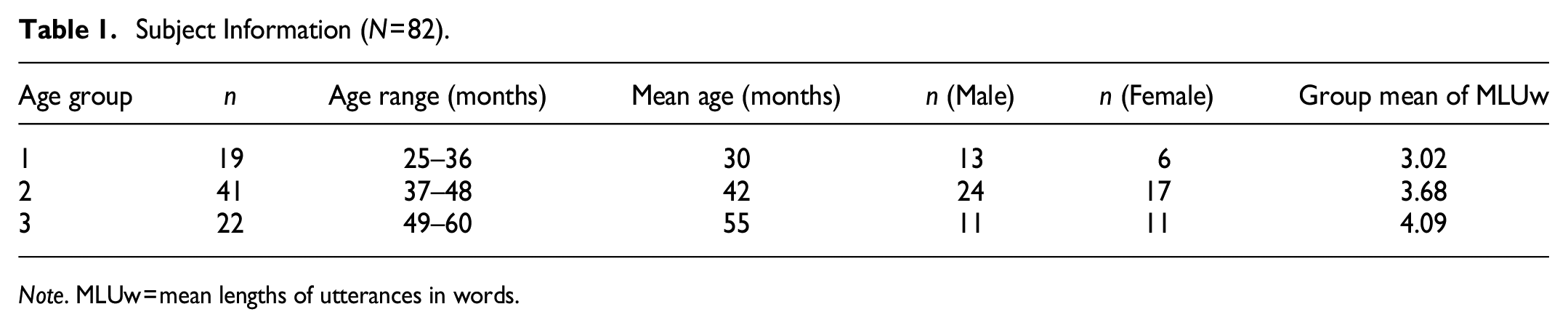
Note. MLUw = mean lengths of utterances in words.
Language-Sample Collection and Transcription
Language samples were elicited and collected from the participants in a quiet room by speech therapists, speech-therapy students and research assistants who had received prior training. First, a warm-up period with a train set or a doll set was included to build rapport between the children and the researchers before conducting the actual language sample collection procedures. Then, the semi-spontaneous speech of each child was sampled through one-on-one interactions with the examiners on three tasks following standardized procedures: free play, storytelling using pictures, and conversations with the interviewers. Identical sets of toys, including a cooking set, food, utensils, puppets and a mystery bag, were provided during each 20-minute free play session. Each child was encouraged to play and communicate with the examiner. Open-ended questions, parallel play and parallel talk were employed to facilitate the child’s own language production. A color Cookie Theft picture (Goodglass & Kaplan, 1972) and a set of four-card stories were then provided to elicit each child’s narrative speech, which lasted about 5 min. Finally, the examiner initiated a 5 min talk about daily life according to the child’s interest and experience. A Peppa Pig storybook was also presented to provide topics for the chat (e.g., picnicking and favorite cartoon characters).
The sessions were audio- and video-recorded. All utterances produced by the participants and interviewers were transcribed orthographically and analyzed by the trained speech-therapy students and research assistants. Pauses of more than 2 s, intonation contours, and speaker turns were used as utterance boundaries (Klee & Fitzgerald, 1985). However, following Crystal et al. (1989), self-repetition, unintelligible utterances, and incomplete utterances that did not reflect the children’s language ability were not analyzed. Deviant utterances were also excluded, as children’s erroneous use of temporal markers was beyond the scope of this study. The physical context was provided by the descriptions of the events and the participants’ actions along with the utterances produced, while the linguistic context was comprised of the examiners’ utterances. Both types of contexts were important in ascertaining whether the temporal markers used by the children were semantically correct. Following Cheung’s (1998) and D. Zhu’s (1982) procedures, each child’s final 50 different consecutive utterances were used when calculating the MLUw.
Coding and Classification of the Temporal Markers
All utterances were then coded with temporal content following a framework modified from Lahey (1988), and each temporal marker was classified as an AM, TA, or TN. The members of each of the three categories were then further classified according to their specificity and remoteness. Then, 10% of the language samples were randomly selected and independently coded by a second rater as a check on the inter-rater reliability of content category coding, which eventually reached 93%.
The four subgroups of AMs produced by the participants were perfective le, experiential guo4, progressive zai4, and durative zhe. Here, it should be noted that the identification of the perfective le could be problematic due to its potential overlap with the sentence final particle (SFP) le (Liu, 2015). The perfective le has a postverbal position and cannot follow a nominal (D. Zhu, 1982), whereas the SFP le is usually located at the end of a sentence (C. Li & Thompson, 1981). Functionally, perfective le asserts both that an event is bounded and that it terminated prior to the time of speech (Liu, 2015) (e.g., 我买了明天的票 “I bought tomorrow’s tickets.”). The SFP le’s various functions, meanwhile, include marking the reported event or situation as relevant to the current context (e.g., 他快要上机了 “He’s about to board”) and signaling a change of situation/state (e.g., 他当父亲了 “He becomes a father.”) (C. Li & Thompson, 1981; Tang, 2016; D. Zhu, 1982). Accordingly, this study considered both the function and the position within the utterance when trying to differentiate between the perfective le and the SFP le. For instance, le occurring after a nominal or at the end of a sentence but not in a postverbal position was regarded as the SFP le. For ambiguous cases in which le occurred both at the end of a sentence and in a postverbal position (e.g., 吃了 “ate”), conversational context was also taken into account. Inter-rater agreement on temporal-content coding also served as an important check on the consistency of classification. Among the 10,643 major utterances produced by the participants, 1,535 occurrences of le were recorded, but only 448 of them were given a final classification as perfective AMs.
As briefly noted above, ambiguity also marks the difference between Chinese TAs and TNs (Biq & Huang, 2016). To differentiate between them, a search was conducted for several unique syntactic properties of TNs that were not found among TAs. First, temporal markers that functioned as arguments in clause structures, subjects, or objects were regarded as TNs (e.g., 今天是我生日; Biq & Huang, 2016; Shi, 2016).
Second, a temporal marker was regarded as a TN if it was used immediately after a preposition, such as 在 “at,” 到 “to,” and 等到 “until” (Yip & Rimmington, 2016; D. Zhu, 1982); was modified by a “的de” phrase (Shi, 2016) (e.g., 星期天 “Sunday” in 开心的星期天 “a happy Sunday”); was modified with a quantity but not with an adverb (D. Zhu, 1982) (e.g., 一小时 “1 hr”); or served as a modifier of another noun/nominal phrase, with or without the use of “的de” (Shi, 2016) (e.g., 早上 “morning” in 早上的会议 “a morning meeting”).
Finally, when dividing each of the three categories of temporal markers into subgroups according to the semantic properties of temporal remoteness and specificity, “temporal remoteness” was defined as the distance between the ST and the ET (Wagner, 2018); that is, how long ago or how far in the future the events happened or would happen. “Specificity,” on the other hand, was defined according to the number of semantic features associated with a given lexical item (Clark, 1973; Pinker, 1989); that is, the more such features a term possessed, the more specific it was deemed to be.
M. Erbaugh (1992) reported that 96% of the utterances by young children that included perfective le were used to mark the immediate past, and Zhou (2004) proposed that the use of guo4 required the retention of experiences that were more remote from the time of speaking. Therefore, guo4 should be regarded as more remote than le. As for specificity, both perfective le and experiential guo4 mark the termination of events, but using the latter involves an extra specification of a prior experience that was discontinued after a different RT (Liu, 2015). For example, guo4 in 我去过香港 “I have been to Hong Kong” implies that one was in Hong Kong but is no longer there now, whereas the AM le in 我去了香港 “I went to Hong Kong” does not carry that implication. Moreover, in light of the time concepts proposed by R. M. Weist (1989), it has been suggested that le conveys situations in which ET and RT coincide, in contrast to guo4, which conveys that ET precedes RT, which in turn differs from ST (Smith & Erbaugh, 2005). Tang (2016) likewise concluded that guo4 implies some experience before the RT. As a result, this study considered experiential guo4 to be more specific than perfective le, due to the former’s additional feature of discontinuation and functional RT concept.
Regarding the imperfective AMs, both progressive zai4 and durative zhe denote continuous/ongoing events semantically, and they seem to be indistinguishable from each other in terms of temporal remoteness. On the other hand, progressive zai4 is dynamic and denotes events whose final endpoints are knowable, whereas durative zhe does not presume an endpoint and is regarded as static. Smith and Erbaugh (2005) also claimed that both progressive zai4 and durative zhe express the same time concepts. In view of the above, both progressive zai4 and durative zhe in this study were also considered to have equal specificity, and were predicted to be acquired at about the same time.
As the ratings of temporal remoteness and specificity for TAs and TNs may vary greatly across individuals, a classification system was developed by asking 10 native Mandarin speakers aged 23 to 40, all of whom held bachelor’s degrees, to judge their remoteness and specificity. Temporal markers were assigned to a particular subgroup if 70% agreement was reached among the raters; otherwise, they were deemed not classified and were excluded from analysis (n = 2).
The 23 types of TAs in the dataset were first classified as past, present, and future (P. Li & Shirai, 2000; Liang et al., 2019). Then, the past and future TAs were each further divided into two subgroups according to whether they were deemed proximate or distant by the same 10 raters mentioned above. For example, the past TA 刚刚 gang1gang1 “just” was deemed more proximate than 早就zao3jiu4 “already at an early time,” and the future TA 等一会 deng3yi1hui4 “wait a moment” was more proximate than 从此cong2ci3 “since then.”
The 22 types of TNs specifying time points and duration were categorized by remoteness and specificity, respectively. For example, time-point TN 晚上wan3shang4 “at night” was deemed more proximate than 星期六xing1qi1liu4 “Saturday,” while duration TN 一分钟yi1fen1zhong1 “1 min” was deemed more specific than 一会儿yi2huir4 “a while.”
Results
Among the 10,643 utterances by the children in our dataset, 679 had temporal tags, collectively containing 850 tokens of temporal markers, and that set of temporal markers comprised 49 different lexical items, including four AMs, 23 TAs and 22 TNs.
Table 2 summarizes the number of temporal markers (tokens and subtypes) produced by the participants. Pearson’s correlation tests indicated a significant correlation between age and the token count of temporal markers per utterance (r (80) = .33, p < .001). The number of different subtypes of temporal markers was also significantly higher in the children who were older (r (80) = 0.41, p < .001), who were also more capable of using more categories of temporal markers (r (80) = 0.48, p < .001).
Number of Temporal Markers (Tokens and Subtypes) Produced, by Age Group.

The following subsections will report the findings on the differences in the acquisition of markers in the three temporal categories, and on the acquisition of different subgroups within each category, as well as how the subjects used multiple markers within single utterances.
Acquisition Differences Between Different Categories of Temporal Markers
Table 3 presents the token counts and number of subtypes of temporal markers produced by each of the three sampled age groups.
Numbers of Different Categories of Temporal Markers (Tokens and Subtypes), by Age Groups.

Note. SD = standard deviation; AMs = aspect markers; TAs = temporal adverbs; TNs = temporal nouns.
To investigate the emergence of temporal markers in each category across the sampled children’s ages, a one-way analysis of variance (ANOVA) was conducted to compare the number of different temporal-marker types produced across age groups. The results showed a significant effect of age on TAs (F (2,79) = 10.38, p < .001) and TNs (F (2,79) = 5.30, p < .01). However, the relationship between age and AM type count was not significant (F (2,79) = 3.21, p = .07).
Post-hoc analyses using the Bonferroni test at a significance level of 0.05 revealed that the 3 year olds used significantly more examples of TAs than the 2 year olds did. Likewise, the 4 year olds produced significantly more examples of TNs than the 3 year olds did. Figure 1 summarizes the mean occurrence by age group of each category of temporal marker.
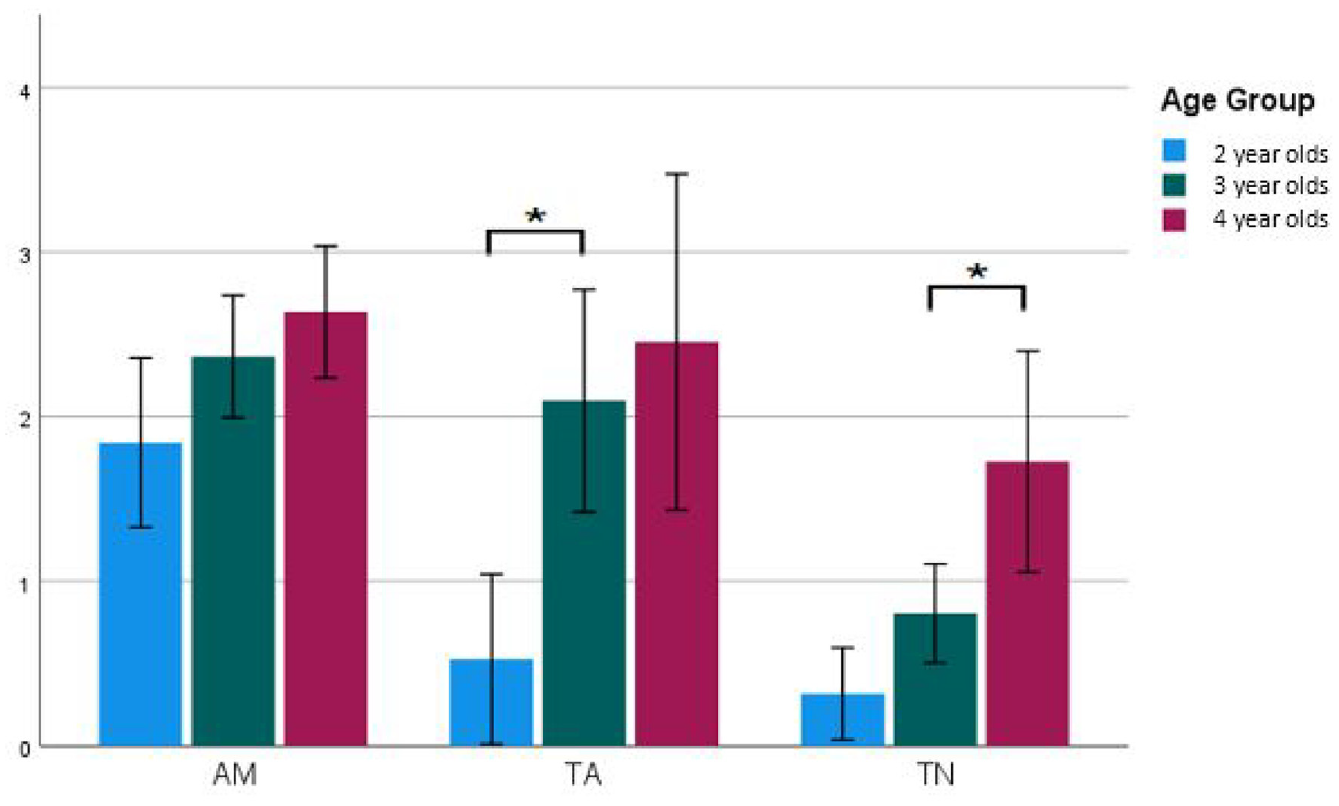
Mean frequencies of aspect markers (AM), temporal adverbs (TA), and temporal nouns (TN) across age groups.
The token counts of temporal markers in each category were then analyzed for evidence of age differences in the mastery of markers. The results of that analysis are shown in Figure 2.

Distribution of aspect markers (AM), temporal adverbs (TA), and temporal nouns (TN) produced by each age group.
Chi-square testing confirmed that the proportional distributions of the three categories of temporal markers differed significantly across age groups (χ 2(4) = 45.78, p < .001). Post-hoc testing was conducted by calculating the differences between the chi-square values to identify which pairwise comparisons contributed to the significant differences (Cox & Key, 1993). To avoid false positive results, Bonferroni correction was adopted: the significance level was divided by the number of tests conducted, yielding .05/6 = 0.008 in this case. This result indicated that the 2 year olds used a significantly larger proportion of AMs (Δχ 2 = 10.81, p < .01) and a smaller proportion of TAs (Δχ 2 = 10.79, p < .01) than the 3 year olds did. Moreover, the 3 year olds used a significantly smaller proportion of TNs than the 4 year olds did (Δχ2 = 7.04, p < .008). However, no significant differences were found between the 2 year olds’ and the 3 year olds’ usage of TNs (Δχ2 = 0.02, p = .89), or between the 3 year olds’ and the 4 year olds’ usage of AMs (Δχ2 = 1.30, p = .25) or TAs (Δχ2 = 3.47, p = .06).
Acquisition of Different Subgroups within Each Category of Temporal Markers
To examine age-based differences in the production of the subgroups of each of the three temporal categories, point biserial correlation was adopted, which measures the association between a dichotomous and a continuous variable (Kornbrot, 2014). Chi-square testing and repeated-measures ANOVAs were also used to investigate the distribution of and differences between the numbers of unique temporal markers in each subgroup.
Aspect Markers
The results of the point biserial correlation indicated that the emergence of the progressive marker zai4 (rpb(80) = .405, p < .001) and the experiential marker guo4 (rpb(80) = .326, p = .003) were significantly more likely in the older children. However, the observed associations between age and the production of perfective le (rpb(80) = 0.085, p = .447) and durative zhe (rpb(80) = −0.116, p = .299) were not significant.
The proportion of the four AMs produced by each age group are shown in Figure 3. Chi-square tests showed that the proportional distributions differed significantly across age groups (χ 2(6) = 19.68, p < .05). Pairwise comparisons indicated that the 2 year olds used a significantly smaller proportion of experiential guo4 (Δχ 2 = 5.66, p = .017) than the 3 year olds did.
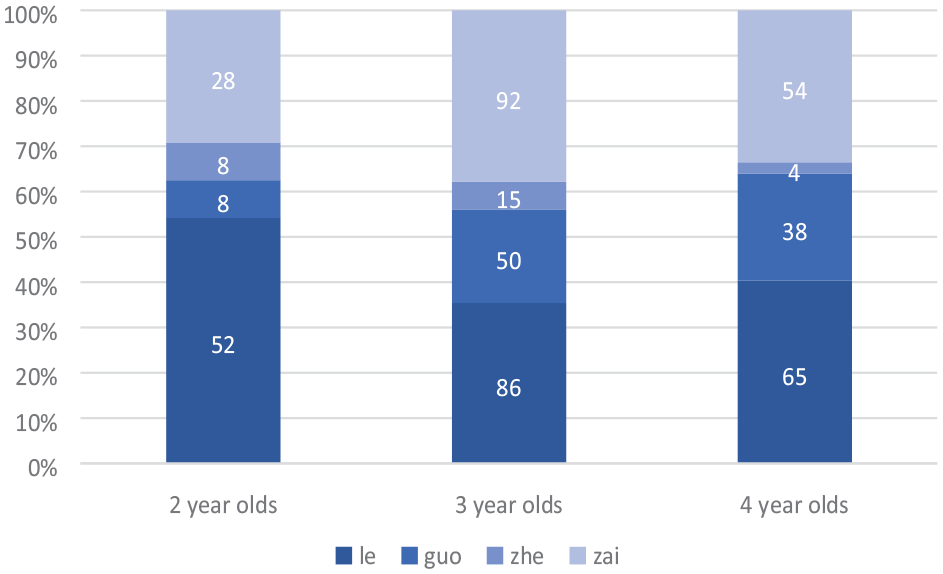
Distribution of the four aspect markers among and within age groups.
Temporal Adverbs
Point biserial correlation revealed that the incidences of distant-past TA use [rpb(80) = .228, p = .039] and proximate-future TA use [rpb(80) = .287, p = .009] were both significantly higher in the older children. However, the associations between age and the production of present TAs [rpb(80) = 0.131, p = .239], proximate-past TAs [rpb(80) = .185 p = .096] and distant-future TAs [rpb(80) = 0.079, p = .481] were not significant.
Repeated-measure ANOVAs were performed to investigate the direct and interactive effects of membership of the three age groups, two temporal-distance types, and two timeframes on the number of unique temporal markers in each TA subgroup. The results indicated a significant main effect of age group (F (2, 79) = 5.57, p = .005): more unique TAs were observed among the 3-year-old children than the 2-year-old ones. The main effect of temporal distance [F (2, 79) = 30.081, p < .001] was also significant, with more proximate TAs than distant TAs being used.
There was also a significant interaction effect of age group and temporal distance on TA use (F (2, 79) = 3.467, p = .036). Post-hoc Bonferroni analysis indicated that among the 3 year olds, a wider range of proximate TAs were used (M = 1.41, SD = 1.26) than distant TAs (M = 0.171, SD = 0.543); and similar results were also found among the 4 year olds (proximate: M = 1.55, SD = 1.90; distant: M = 0.409, SD = 0.796) (see Figure 4).

Mean number of temporal adverbs in the recent and distant subgroups, by age group.
Finally, the interaction effect of timeframe and temporal distance on the number of unique temporal markers was also significant (F (2, 79) = 8.863, p = .004). Post-hoc Bonferroni analysis indicated that the subjects used significantly more different proximate-future TAs (M = 0.756, SD = 1.03) than proximate-past TAs, and more proximate-future TAs than distant-future TAs (M = 0.037, SD = 0.189) (see Figure 5).
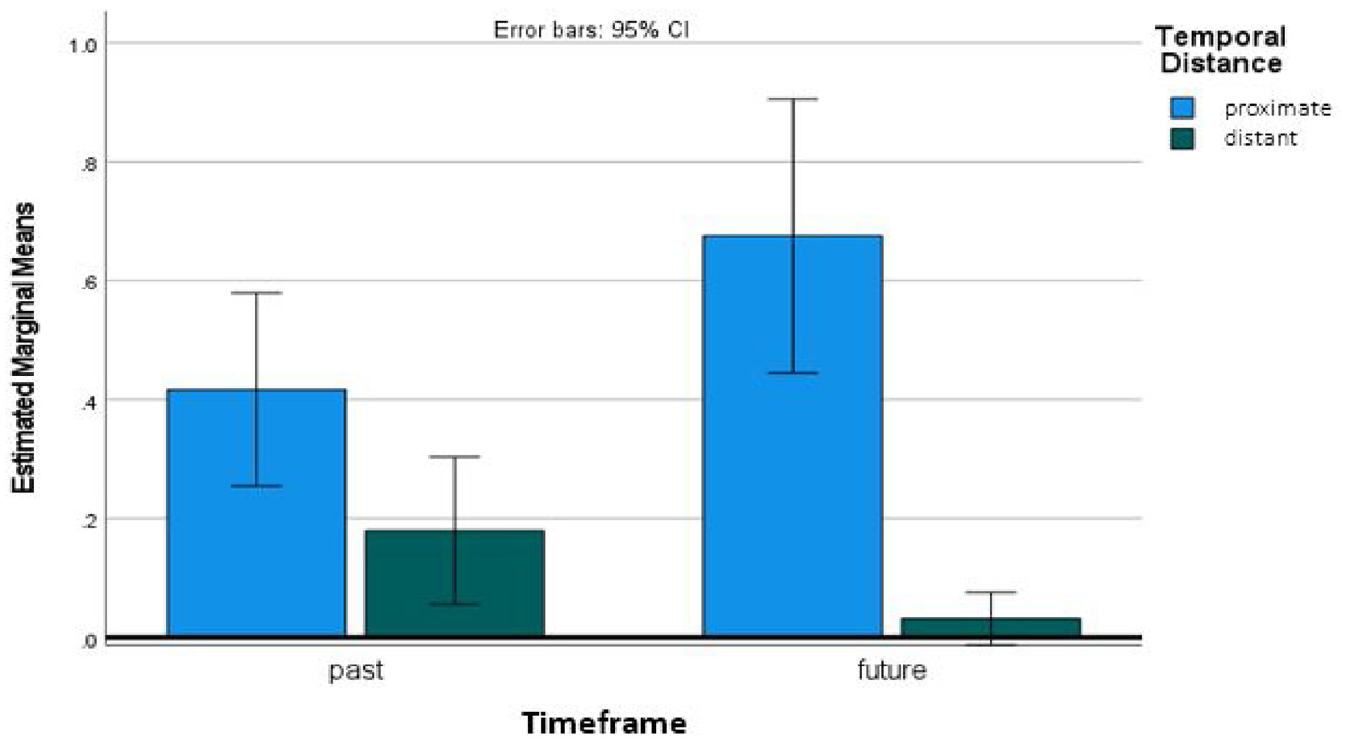
Mean number of temporal adverb types in each temporal-distance subgroup.
Temporal Nouns Specifying Time Points
The point biserial correlation results revealed that significantly more distant TNs (rpb(80) = .285, p = .010) were used by the older children, but the association between age and the production of proximate TNs (rpb(80) = 0.187, p = .093) was non-significant.
A repeated-measures ANOVA was conducted to investigate the direct and interactive effects of age-group membership and the two temporal-distance categories on the number of temporal markers specifying time-points in each TN subgroup. The results indicated a significant main effect of age (F(2, 79) = 6.27, p = .003), and post-hoc Bonferroni tests further revealed that more TNs specifying time-points were uttered by the 4 year olds (M = 0.864, SD = 1.32) than by the 2 year olds (M = 0.00, SD = 0.00) and the 3 year olds (M = 0.341, SD = 0.575) (Figure 6).
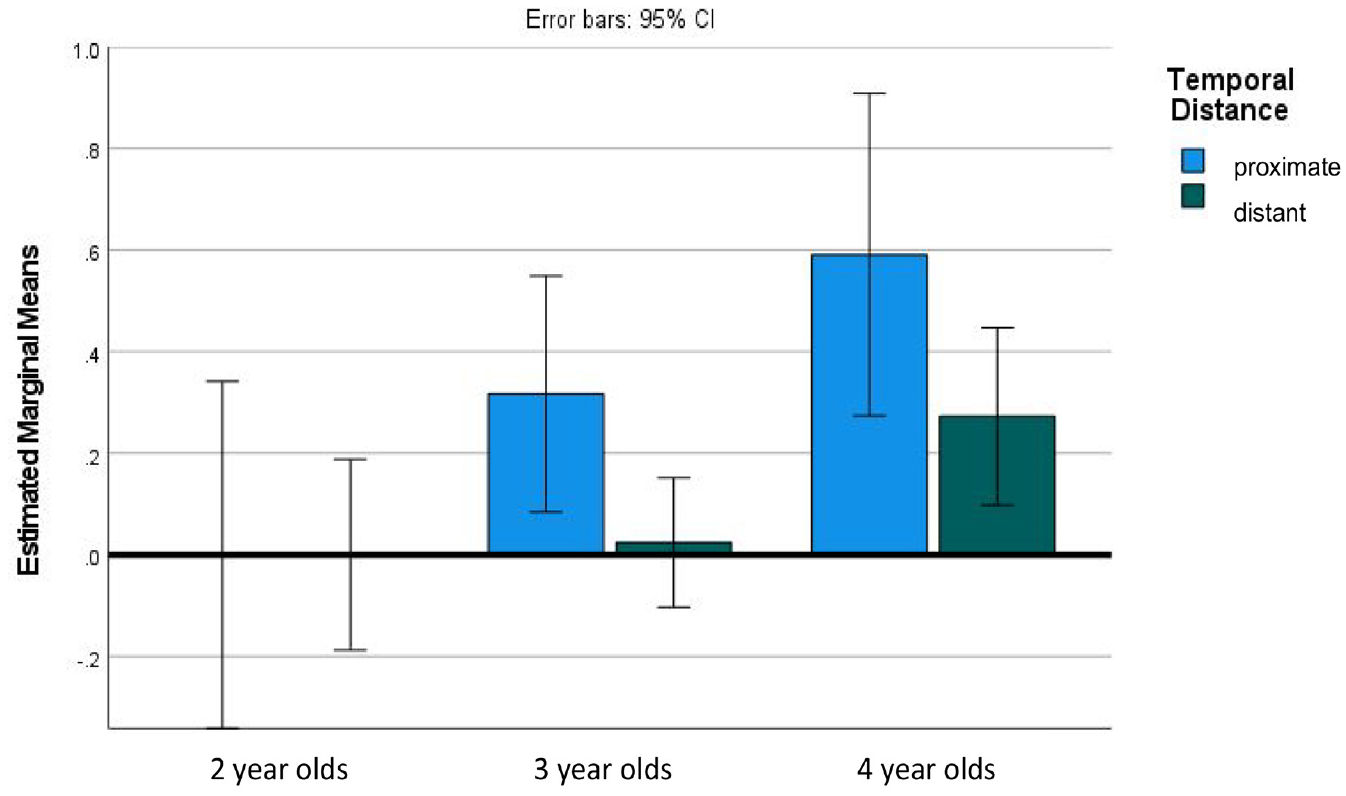
Mean number of types of subgroups of temporal nouns specifying time points, by age groups.
Temporal Nouns Specifying Duration
The point biserial correlation revealed that the emergence of specific TNs (rpb(80) = .369, p < .001) increased with the children’s ages, but there was no significant association between age and the production of generic TNs (rpb(80) = −.165, p = .139).
A repeated-measure ANOVA was conducted to investigate the effect of age-group membership and specificity on the number of unique temporal markers denoting duration in each TN subgroup, which indicated that there was no significant main effect of either age or specificity (age: F(2, 79) = 1.33, p = .270; specificity: F(2, 79) = 1.55, p = .217). However, the interaction effect of age and specificity on the use of TNs denoting duration was significant (F(2, 79) = 6.90, p = .002). Post-hoc Bonferroni tests further revealed that more specific TNs (M = 0.364, SD = 0.492) than generic TNs (M = 0.00, SD = 0.00) were used by the 4 year olds. (see Figure 7).

Mean number of subgroups of temporal nouns specifying duration, by age group.
Use of Multiple Temporal Markers in Single Utterances
Figure 8 illustrates the distribution of utterances containing single versus multiple temporal markers. The results of the chi-square testing indicated that these proportions differed significantly across age groups (χ 2(2) = 10.91, p < .01). Post-hoc pairwise comparisons (Cox & Key, 1993) with Bonferroni correction (.05/4 = 0.0125) further showed that the 2-year-old children produced a significantly smaller proportion of utterances with multiple temporal markers (Δχ 2 = 6.77, p < .05) than the 3-year-old children did, but that the proportion of utterances with multiple temporal markers did not differ between the 3 year olds and the 4 year olds (Δχ 2 = 2.37, p = .12).

Distribution of utterances with single and multiple temporal markers, by age group.
The categories of multiple markers used in single utterances were further investigated, and the results are presented in Table 4, which shows that the 2-year-old children only produced multiple markings by combining markers from two different categories. Both the 3 and 4 year olds, in contrast, sometimes produced multiple temporal markings with multiple markers from the same category. Only the 4 year olds were able to express themselves by combining temporal markers from all three categories.
Distribution of Multiple Temporal Markings within Single Utterances, by Category and Age Group.
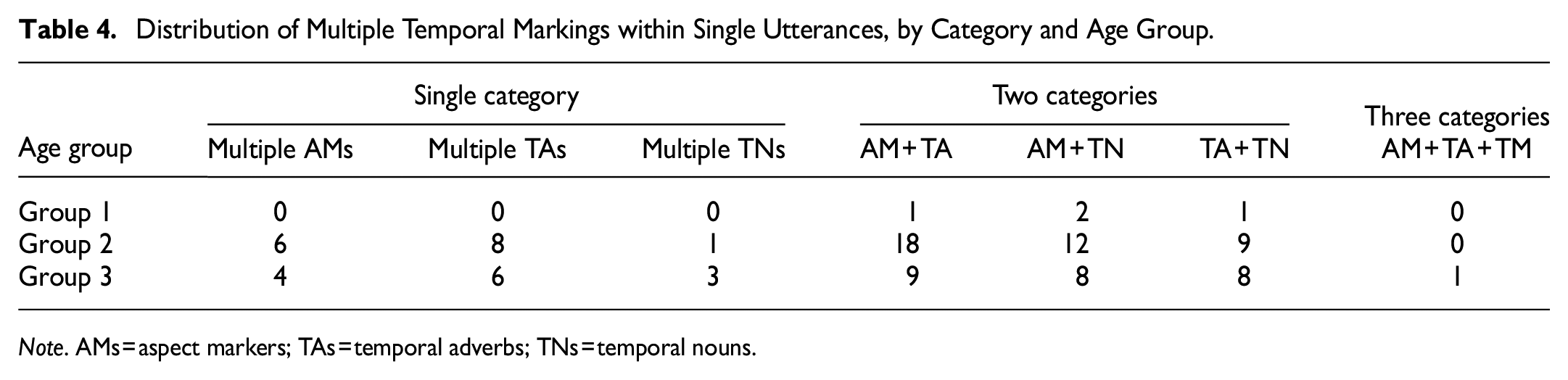
Note. AMs = aspect markers; TAs = temporal adverbs; TNs = temporal nouns.
Discussion
Natural speech production data produced by native Mandarin-speaking preschoolers were used to provide a more comprehensive investigation of the development of the whole temporal system of Mandarin. The results indicated three main findings: (1) overall, the advancement in the children’s time concepts affected their acquisition of the temporal system of language (see Section 5.1); (2) age-related growth took place in the co-occurrence of the development of the Mandarin temporal system (see Section 5.2), and (3) semantically, more proximate and generic temporal markers tended to be acquired earlier (see Section 5.3).
Effects of Concept Development on the Acquisition of Mandarin Temporal Markers
This study’s findings upheld its hypotheses on the acquisition of the categories of temporal markers by the Mandarin-speaking children. According to R. M. Weist (1989), various temporal markers are employed when children progress through the four stages of the manipulation of ST, ET, and RT. In the first stage, the ST system emerges between 12 and 18 months, during which children focus on the here and now and no tenses or aspects are used. Between 18 and 24 months, children begin to use tenses to mark the ET in the second stage, which is separate from that of ST. Between 30 and 36 months, temporal adverbs are expressed in the third stage, the restricted RT system. Finally, in the fourth stage, the free RT system emerges between 36 and 52 months, and children express ST, ET and RT freely using a variety of temporal expressions flexibly.
As expected, the findings in this study were consistent with those in the above acquisition trends for different temporal markers in general, as the children developed various time concepts (R. M. Weist, 1989). First, the extensive use of AMs by the 2-year-old children was in line with the transition from the first-stage ST system to the second-stage ET system. AMs were used to denote the internal temporal states of events while the ET concept still coincided with ST in the expressions. Subsequent mastery and a larger repertoire size of TAs in the 3 year olds signaled the commencement of the second-stage ET system. With the expressions of TAs, ET dissociated from the deictic center of ST, resulting in a time displacement between ST and ET. A further mastery and expansion in the repertoire of TNs at age four indicated the anchoring of the RT concept in the third-stage restricted RT system. The time concepts expressed extended from the event itself to a more external timeframe by employing the TNs. A broader time perspective and higher demand in cognitive capacity were involved (see Figures 1 and 2). Finally, higher co-occurrences of temporal markers in single utterances by the older children (see Figure 8) also supported the beginning of the free RT system. The children employed different types of temporal markers in a single utterance flexibly, to denote a complex timeframe by separating RT from ST and ET. For example, in the utterance 她 刚才 在 喝 “He was drinking a while ago,” the progressive zai4 was used to denote the internal state of the event, while the TN 刚才gang1cai2 “a while ago” was used to anchor a more external RT in the past.
The findings also indicated that only the 4 year olds were able to express temporal markers from all three categories in single utterances (see Table 4), a manipulation and differentiation of ET and RT that clearly required higher-order cognitive ability and capacity. Observations concerning the uses of TNs by the preschoolers were particularly important, as previous studies have seldom mentioned the role of TNs in anchoring RT in the Mandarin temporal system. Likewise, the findings on the usage of multiple temporal markers in single utterances expanded the understanding of how Mandarin-speaking children proceeded from a restricted use of RT to a more independent use. As such, the current study provides empirical evidence that support how the advancement in children’s time concepts affected their acquisition of temporal markers as a whole system.
In addition, the acquisition differences observed among the three temporal-marker categories in Mandarin were also found to be related to their syntactic properties. That is, an AM is expressed with a verb to form a core part of a verb phrase, and it is generally concatenated with a verb or verbal predicate (Liu, 2015; Matthews & Yip, 2011). A more local syntactic structure is involved, as the AM is referring to the constituents that make up that structure (Branigan et al., 2006), and such temporal markers are therefore regarded as relatively simple syntactically. On the other hand, TAs sometimes modify a sentence to denote the narrator’s temporal perspective (Ernst, 2001), and TNs can modify a whole sentence—or multiple sentences—to indicate time points in, or the durations of, the events they describe (Yip & Rimmington, 2016; D. Zhu, 1982). The use of TAs and TNs is comparatively more global than that of AMs, as the former can make references to aspects of discourse beyond sentence structure (Branigan et al., 2006). Therefore, both TAs and TNs are regarded as having relatively high syntactic complexity. This would explain the later emergence and mastery of TAs and TNs among the children observed in this study.
Acquisition Trajectory Among the Three Temporal-Marker Categories in Mandarin
The results indicated that age-related growth took place in the co-occurrence of the development of the whole Mandarin temporal system by the Mandarin-speaking preschoolers. That is, the older children were observed not only using temporal markers more frequently but also in greater variety, than their younger counterparts (see Table 2). Importantly, the results further indicated that this pattern also extended to the full range of Mandarin’s temporal-marker system (see Table 3). In addition, the older children’s expressions included more temporal-marker categories (see Table 2), as well as more frequent usage of multiple temporal markers in single utterances (see Table 4).
Considering the emergence of the temporal system among the three categories, as indicated by the expanded repertoire in each category, it was found that AMs emerged early among the children: the number of unique TAs and TNs were still expanding after they had reached age three and age four, respectively (see Figure 1). Regarding the mastery of the temporal system among the three temporal-marker categories, as indicated by the proportional token use of the corresponding temporal-marker category, was also found that there was an early mastery of AMs (i.e., before age three), whereas a higher proportion of TAs and TNs were used by the 3 and 4 year olds, respectively (see Figure 2). Previous studies mostly considered the repertoire size of various temporal-marker categories produced by young children (e.g., Grant & Suddendorf, 2011; Liang et al., 2019; Tse et al., 2012). The observations in this study found that the mastery of these three categories of temporal markers also followed a similar acquisition trajectory.
More Proximate and Generic Terms Appeared to Be Acquired Earlier
While the development of time concepts and differences in the syntactic properties of different categories of temporal markers explained the overall trend of their acquisition, as reported in previous studies, they were not sufficient to account for the variability that occurred when different items within each temporal-marker category emerged. The current study proposed that the seemingly unexpected patterns for terms within each temporal-marker category would be accounted for by the semantic features of temporal remoteness and specificity.
The results confirmed this point; that is, the more proximate and generic temporal markers appeared to be acquired earlier. This was consistent with previous findings (M. Erbaugh, 1992; Grant & Suddendorf, 2011; Zhou, 2004). Specifically, regarding AMs (see Section 4.2 Aspect markers), the results of the point biserial correlation and chi-square testing indicated that the experiential guo4, which was considered more remote and specific, emerged increasingly with age, and that the older children’s time-related utterances contained a significantly larger proportion of guo4 than the younger children’s did. The perfective le, on the other hand, emerged early (i.e., at age two) and its production remained relatively stable thereafter.
Similarly, the results revealed a significant positive correlation between the use of progressive zai4 and age, but an early emergence of the durative zhe. In this case, however, the semantic features of temporal remoteness and specificity were not applicable to explaining the observed differences, as both zai4 and zhe were indistinguishable in term of the two features. It was speculated that the late emergence of zai4 may have been related to its preverbal position, which contrasted with the postverbal positions of all the other AMs, and created additional difficulty for the children in acquiring AMs. Future studies should conduct more in-depth investigation of this potential impact of syntactic position on the acquisition of various AMs.
Regarding TAs (see Section 4.2 Temporal adverbs), the results of the point biserial correlation implied that the use of both distant-past and proximate-future TAs increased significantly with age. The later emergence of distant past TAs was consistent with the predictions about temporal remoteness. Similarly, the proximate-future subgroup of TAs exhibited increasing use across age groups. The distant-future subgroup was predicted to emerge even later, probably after the age of five, and therefore, that prediction could not be tested using the current study’s data.
An interaction effect between age-group membership and temporal distance was identified, with more proximate TAs than distant TAs used by both the 3-year-old and 4-year-old children (see Figure 4). Larger repertoires of proximate TAs in the two older age groups confirmed the expectation that the markers with greater temporal remoteness would be acquired later. Although the children’s repertoires of distant TAs were smaller than their repertoires of proximate TAs, it was reasonable to expect that more time was needed to acquire distant TAs; but again, this idea could not be confirmed or disconfirmed in the current study due to the lack of subjects aged 61 months or older in the sample. Future investigations with older participants are therefore warranted.
Although the impact of timeframes has been a common topic in studies on TA acquisition, inconsistent results have been reported (e.g., Bi & Peng, 2002; Kong & Fu, 2004). The findings in this study suggested that temporal remoteness additionally predicted and explained various TAs’ acquisition order. Notably, more types of proximate-future TAs than past TAs were uttered by the subjects (see Figure 5), suggesting that future TAs emerge earlier in life. It has previously been proposed that future TAs are frequently used pragmatically by children to describe their own subsequent actions and intentions (Fu, 2002). This salience of proximate-future TAs may therefore explain their early acquisition, as children’s (and indeed, adults’) need to express distant-future events is comparatively small. However, future studies that include older participants should seek to confirm this.
The occurrence of distant TNs increased significantly with age, but that of proximate TNs did not (see Section 4.2 Temporal nouns specifying time points). This can again be explained by temporal remoteness: that is, temporal markers denoting a more distant timeframe emerged at a later age. The results for duration TNs likewise confirmed the prediction concerning specificity; that is, the emergence of specific TNs was significantly and positively correlated with age, but the association between age and the production of generic TNs was non-significant (see Section 4.2 Temporal nouns specifying duration). Moreover, the number of specific TNs used by the 4 year olds was higher than the number of generic TNs they used (see Figure 7).
Notably, the 2 year olds used generic duration TNs only, while the 4 year olds did not use the generic, but the specific duration TNs. This appeared to indicate that the acquisition of these specific-duration words emerged at a later stage, while the use of the generic ones in denoting time periods also diminished progressively. The later emergence of specific temporal terms in Mandarin-speaking young children was consistent with the claim that children acquired words by continuously adding semantic features to their lexical entries over time (Clark, 1973; Pinker, 1989), so that the specific words were acquired after the generic ones. In addition, once the more specific words were acquired, the extensive use of generic words in the early stage of acquisition gradually declined, as children tended to use the former to denote more specific and precise intended meanings of their expressions (M. S. Erbaugh, 2002; Pinker, 1989). Therefore, it is suggested that when children acquired more specific duration TNs, they showed greater tendency to use them to specify a particular duration in conveying more complex messages. In fact, it has been suggested that the acquisition of specific time words requires formal training in abstract knowledge of clock and calendar time, which children do not usually receive until age six or later (Tillman & Barner, 2015).
Finally, both the 3 and 4 year olds produced multiple temporal markings with the multiple use of markers from a single category, whereas the 2 year olds only produced multiple markings by combining markers from two different categories (see Table 4). It was therefore found that multiple temporal markers from the same category were employed to anchor and specify a particular time point from a semantic point of view. For example, in 我 今 天 下 午 的 课 都 没 了 “My lessons this afternoon were canceled,” two TNs—今 天jin1tian1 “today” and 下午xia4wu3 “afternoon”—were used to specify a more precise timeframe. These findings supported Na’s (2017) claim that the co-occurrence of TAs functions to stress and specify the semantic meanings of temporal terms, and then extends it to other categories of temporal markers.
From the cognitive perspective, distant-past events stored in episodic memory usually contain few contextual details (Trope & Liberman, 2003), and the construction of distant-future events, with the recombination of past events into novel scenarios (Addis & Schacter, 2008), also involves the utilization of relatively few contextual details. Thus, more cognitive resources and effort are required to represent events that are not close to the present moment. It is reasonable to expect that young children are too cognitively immature to represent decontextualized distant events, whereas older ones should be more cognitively prepared do so. The findings in this study were also consistent with those of some neuroimaging studies, which reported that brain regions for storing the past and imagining the future respond differently to temporal remoteness (Addis & Schacter, 2008), and that there is more brain activation in people who are thinking about more temporally distant events (Suddendorf, 2010).
Conclusion
A New Framework: Content-Form Interaction in the Acquisition of Temporal Markers
The present study’s findings constitute an important contribution to the scholarly understanding of patterns of temporal-marker acquisition by young children, both between and within Mandarin’s three categories of temporal markers. The interaction between language-general content and language-specific form in the acquisition process is perhaps particularly valuable to consider, though the additional role played by the semantic features of temporal remoteness and specificity also appears vital.
Adopting the content-form framework in Bloom and Lahey (1978), 2 this study hypothesized that concepts would affect the semantic representation of time and provide the building blocks (content) for the children’s use of linguistic messages (form) to code time. The findings supported the proposed two-dimensional framework of language acquisition, as illustrated in Figure 9. The acquisition of Mandarin temporal markers was generally governed by the development of the concepts of time (R. M. Weist et al., 1991), and the syntactic properties of the Mandarin temporal markers presents how different forms of temporal expressions were acquired (AM > TA > TN > multiple markers); within each temporal-marker category, the children expanded their repertoires of lexical items in an order governed at least partly by the semantic features of specificity and temporal remoteness, such that remote and specific temporal markers were acquired after the proximate and generic temporal markers, respectively.

An interactive framework of form and content in acquisition.
Limitations
The results of this study generally supported the initial propositions about the important roles played by time concepts, syntactic differences, and two semantic features (i.e., temporal remoteness and specificity) in the acquisition of Mandarin temporal markers. Nevertheless, more samples and a wider age range of participants will be needed to gain a clear overall picture of how temporal markers are acquired and used. The repertoire of distant TAs observed in the children aged two to four was smaller than that of proximate TAs, but this only implied that the limited range of distant TAs used by the children of these ages impeded the ability to test the effect of temporal remoteness on the acquisition of temporal markers. Unsurprisingly, given—for both linguistic and cognitive reasons—it takes more time for a preschooler to fully master distal and abstract concepts, quite a few TAs were simply not used by the preschoolers in this study. Future research should therefore include older children, a larger number of children, and possibly, longer observation windows.
Moreover, although LSA provides a rich communicative context and allows for natural language production by children, some uncommon temporal markers may not be elicited within the context it provides. As such, future researchers should modify LSA’s language-eliciting procedures with the aim of capturing more distant TAs. Other limitations in the present work include its cross-sectional nature and the uneven number of subjects in each age group. A larger sample size with a more even distribution of subjects across ages and socioeconomic statuses (e.g., Hoff, 2003; Rosemberg et al., 2020), as well as longitudinal data, should be considered in the future.
Future Directions
The current study examined Mandarin-speaking children’s acquisition of temporal markers between and within three categories. It was found that the advancement in the children’s time concepts affected the acquisition of temporal categories. Age-related growth was also evidenced in the development of the Mandarin temporal system. In addition, temporal markers’ semantic features of temporal remoteness and specificity further accounted for variations in the temporal markers’ acquisition patterns. These findings constitute an important contribution to the study of young children’s acquisition of temporal markers, and add cross-linguistic support to R. M. Weist et al.’s (1991) proposal.
The proposed two-dimensional, content-form interactive framework was supported by this study’s findings and R. M. Weist’s (1989) system, and it could also be applied to predict the acquisition patterns of other languages produced by native speakers or language learners; for instance, the acquisition of the (ir)regular tense markings and aspects in English. In addition, the new framework also provided insights that may be beneficial to the language assessment of typically developing children as well as those with language disorders. Time expressions are essential to young children’s communication. When assessing such expressions, language content with various time concepts (i.e., ST, ET, and RT) and different language forms (i.e., AMs, TA, and TNs) should
Footnotes
Acknowledgements
We would like to thank all the participants and parents who generously gave their time to participate in this study.
Declaration of Conflicting Interests
The author(s) declared no potential conflicts of interest with respect to the research, authorship, and/or publication of this article.
Funding
The author(s) received no financial support for the research, authorship, and/or publication of this article.
Ethics Statement
The study was approved by the Human Subjects Ethics Sub-committee of The Hong Kong Polytechnic University (Reference Number: HSEARS20191004001) on Nov 04, 2019. All participants provided written informed consent prior to participating.

Notes
Data Availability Statement
Data sharing not applicable to this article as no datasets were generated or analyzed during the current study.