




Abstract
In the wake of 2020, employees are currently diverging according to remote, hybrid, and completely onsite workspaces. However, questions remain regarding the impact of this stratification when it comes to employee cohesion and sense of belonging at work, and whether extant theories of belonging adequately capture employees’ feelings of belonging in post-pandemic work environments across the world. Thus, drawing from original, international survey data (N = 6,497), we explore how working remotely, in a hybrid environment, or onsite/in office matters for employees’ sense of belonging at work. Using logistic regression, we observed no differences according to workspace. However, we did find that older employees, those paid hourly, and those identifying as a “minority” in some way were significantly less likely to report feeling a sense of belonging at work. Lastly, a follow-up regression showed that compared to their peers working onsite or in an office, “minority”-identified employees who began working remotely before the pandemic (but not those who started working remotely after the pandemic began) felt an elevated sense of belonging. These results suggest, first, that despite the potentially disruptive nature of work changes in the short term, workspace by itself does not significantly impact employee sense of belonging. However, for “minority”-identified employees in particular, remote work options may offer elevated feelings of belonging in some cases. Going forward, organizations should continue to focus on effective diversity, equity, and inclusion strategies to bolster belonging among all employees across different workspaces.
Introduction
Since 2020, pandemic-related workplace changes have brought new urgency to conversations and debates around the feasibility of remote and hybrid work models as viable long-term alternatives (Gallacher & Hossain, 2020; Lord, 2020). It seems that diverse workspace options are here to stay. However, as the rapid increase in remote work may be changing the nature of work itself, further investigation into the impact of workspace changes should be a priority among scholars (Donnelly & Johns, 2021; Hallier & Baralou, 2010). For instance, we have little information on what these expanding options might mean for workplace culture and climate as well as individual employee sense of belonging in the workplace—or, whether employees feel a sense of comfort and connection at their places of work. Feelings of belonging are significant for predicting both employee satisfaction and organizational health (Lovell et al., 2021). While some emerging research is optimistic that remote work will not disrupt (and could even promote) feelings of belonging among employees, other research argues that remote work might be damaging in this regard (Gandini, 2019; Hughes et al., 2021; Mann & Holdsworth, 2003; Morganson et al., 2010; Russell & Frachtenberg, 2021; Whittle & Mueller, 2009). Investigating belonging—and the impact of remote work on belonging—is important because it can reveal insight into how organizations may cultivate positive workplace climates while keeping pace with technological and social change. In addition, since a lack of belonging may be linked to a number of negative outcomes (including attrition and damaged morale) for both individual employees and organizations (Wilson & VanAntwerp, 2021), the relationship between workspace and belonging is important to investigate.
Thus, in this paper, we use an original survey and dataset with an international sample of employees to explore how working remotely, onsite/in office, or in a “hybrid” workspace setup (splitting time between working remotely and onsite) may matter for individuals’ sense of belonging at work. Using logistic regression and informed by social scientific theories of social belonging, we also explore how employees’ identities and demographics (age/generation, compensation type, gender, sexual identity, and identification with a “minority” [broadly defined] identity status) may matter when it comes to employees’ sense of belonging. In addition, we explore specifically how identification with self-identified “minority” status might interact with workspace to influence belonging. Our objective is to uncover whether workspace has an impact on belonging more generally and also whether it has a distinct impact on belonging for employees who identify as a “minority” in some way. Investigating this issue is important as organizations around the world continue to grapple with the implications associated with the proliferation of remote work precipitated by the COVID-19 pandemic.
Background
Workspace Changes and Belonging
In the wake of the COVID-19 pandemic, organizations across the world have been faced with decisions regarding the actual workspace that they ask their employees to occupy. The opinions of employees are clear: many prefer at least some remote options (Lovell et al., 2021). Recent research and journalistic accounts suggest that a broad move toward more remote work can be good and may advance workplace equity and inclusion goals—for example, by potentially helping historically minoritized employees avoid daily microaggressions that can weaken feelings of camaraderie and morale (Canty, 2020; Lord, 2020). However, despite these hopes, some recent research surrounding remote work warns of potential challenges in the long term. For instance, scholars have found evidence for decreased collaboration among teams, the disintegration of work-life balance, social isolation, and the exacerbation of pre-existing workplace inequalities (such as those based on gender, social class, and age) amidst the marked increase in remote work (Dunatchik et al., 2021; Mohezar et al., 2021; Stich, 2020; Yang et al., 2022). Yet at the same time, issues such as eroding work-life balance, social isolation, and worsening inequalities were in place before the pandemic (Hilbrecht et al., 2013; Mann & Holdsworth, 2003; Whittle & Mueller, 2009) and may be a result of a complex interplay of factors rather than a result of remote work in itself.
In addition, managers and leaders have tended to take a pessimistic view of remote work and continue to be suspicious of the claim that employees can be just as productive remotely as they are in the office despite evidence that many employees are just as productive while working off-site (Parker et al., 2020). Many organizations are trying to compromise by instituting “hybrid” policies that allow all employees to work remotely at least part of the time. However, many hybrid options are available only to knowledge workers, and research has documented high burnout, anxiety, and stress among those who have been required to remain onsite throughout the pandemic (Peinado & Anderson, 2020; Shreffler et al., 2020).
At their core, questions about the impact of workspace changes on employees reflect concerns about inequalities. These concerns are well-founded because research has shown that increasing equity and inclusion at work has positive outcomes for both employees and organizations alike (Cottrill et al., 2014; Randel et al., 2018). At the same time, deficits in inclusion and belonging can have the opposite effect, resulting in less favorable outcomes for individuals (such as worse well-being outcomes) and organizations (such as decreased innovation and increased employee attrition) (Cockshaw et al., 2013; Jena & Pradhan, 2018; Kennedy, 2021; Lovell et al., 2020; Wilson & VanAntwerp, 2021). Unfortunately, scholars have continually observed inequities of belonging in the workplace along gender, age, race, social class, and sexual identity lines, with employees belonging to historically minoritized and “minority” groups in the workplace typically reporting weaker feelings of belonging (Bell et al., 2011; DeVoe & Pfeffer, 2009; Faulkner, 2011; Goode et al., 2022; Rahn et al., 2021; Wilson & VanAntwerp, 2021).
Scholars have observed that individuals who belong to under-represented groups in particular are at risk of feeling a lack of belonging at work (Thau et al., 2007; Wilson & VanAntwerp, 2021). For instance, researchers have observed on a continuing basis that individuals who identify with some “minority” status often face continuing threats to belonging at work, including exclusion from both social and professional opportunities that could prove beneficial (Baxter & Wright, 2000; DeSouza et al., 2017; Hammond et al., 2019). Some research has found that “minority”-identified individuals (whether due to race, gender, or some other identity) in their workplace contexts are able to successfully navigate belonging issues by distancing themselves from identities that are devalued in their places of work (Alfrey & Twine, 2016). However, in addition to reinforcing inequalities, this strategy puts the onus of belonging on individuals by forcing them to conform rather than by welcoming them as is into the workspace.
Some practitioners and industry analysts have argued that increased workspace options (namely, more remote work) could promote belonging and inclusion among minoritized worker groups. For instance, remote work may promote enhanced feelings of belonging among some employees who identify as a “minority” since the emotional toll of off-hand, potentially hurtful comments and interactions may be lessened outside of the physical office space (Canty, 2020; Lord, 2020). However, we still need more research on how, and how much, workspace actually matters when it comes to feelings of belonging at work.
Theories of Belonging and Achieving Belonging at Work
Although being able to support belonging is generally considered to be a positive attribute among organizations, achieving belonging is not so simple both inside the workplace and more generally. In the workplace, belonging may be even more complicated at present due to workplace restructuring. Both conceptually and in terms of real-world application, the abrupt challenges that the pandemic placed on organizations have called into question what belonging even means as well as how to best cultivate belonging among employees (Lovell et al., 2021). For instance, do employees need to share a physical space in order to feel that they belong at work, or is virtual interaction sufficient to cultivate belonging?
Some extant theoretical views on belonging can provide context here. Specifically, some sociological theories treat “belonging” as an inherently relational concept. Thus, individuals can only “belong” if there is some social group to which they can pursue acceptance and membership (May, 2011; Stead, 2017). In addition, the cultivation of belonging is a dynamic process, contingent upon everyday interactions that signal the extent to which one is part of/valued by, or different/excluded from, some social group or space (Fenster, 2005; Hagerty et al., 1992; May, 2011; Stead, 2017). Based on these definitions, fostering feelings of belonging can in theory occur virtually, as long as interaction is taking place. However, previous research has demonstrated the importance of physical (rather than virtual) space for cultivating feelings of belonging among individuals (Fenster, 2005). In the workplace specifically, previous research has shown that when employees interact with each other in a physical space, feelings of belonging tend to grow (Filstad et al., 2019).
However, the idea that interaction within a physical space is essential for cultivating belonging is complicated. On the one hand, younger employees and “digital natives” who have grown accustomed to interacting in digital spaces may have less trouble cultivating a sense of belonging despite physical separation (Lovell et al., 2020). At the same time, sharing a physical space may actually harm belonging prospects among other groups. For example, employees who identify with some “minority” status (due to race/ethnicity or sexual identity, for example) at work can encounter microaggressions, exclusionary practices, or other tense interactions in a physical workspace that can lead to feelings of exclusion and a lack of belonging (Alfrey & Twine, 2016; DeSouza et al., 2017; Hammond et al., 2019). Yet, in post-pandemic times, we still have little information on how the general condition of employees being physically separated matters for existing understandings of belonging. Does virtual space function similarly to, or differently from, physical space when it comes to cultivating belonging?
Ultimately, we currently have a limited understanding of the impact of rapid workspace changes on employee feelings of belonging. As we move forward with a workforce that is increasingly segmented into those working remotely, those working onsite, and those working somewhere in between, it is important to gauge if workspace matters for whether employees feel a sense of belonging at work and whether there are significant differences in feelings of belonging among different groups of employees.
Methods
Survey Instrument
The data we used to perform our analyses were gathered from a survey instrument. The survey targeted employees working full-time across the world at organizations employing over 500 employees. We fielded the survey in the spring of 2021 as part of a larger annual study at the authors’ research institute that culminates in an international workplace culture report. We designed the surveys used in the final report (in this case, the 2022 report) to be conducted in several waves featuring different batteries of questions. The sample featured here covers one wave of the study. Our sample is also one of convenience. However, it is sufficiently large enough to generate meaningful conclusions about the employee experience.
We used Alchemer software to build the survey and the panel provider Lucid to administer the survey. Lucid is a sample aggregator with a marketplace platform that enables direct-to-respondent sampling. Panel providers that contract through Lucid compensate participants for their time in the form of cash, gift cards, or merchandise reward points. Research has found that demographics on Lucid align well with the demographics of the U.S. (Coppock & McClellan, 2019). After being posted on the Lucid recruitment platform, potential participants could choose whether they wanted to participate. Survey respondents consented to participating in the survey by proceeding with the survey and could opt out and exit the survey at any time without penalty.
The survey asked respondents a number of questions on their experiences in the workplace, including (for example) questions about burnout at work, workplace inclusion and exclusion, relationships with direct leaders, perceptions of opportunities available in the workplace, workplace recognition and appreciation experiences, and a number of other factors that previous research has shown influence overall satisfaction at work (Lovell et al., 2021). Participants had to be currently employed in order to fill out the survey. The survey sampled participants across 20 countries on six continents (except Antarctica) and was translated into 15 different languages.
The research team took several steps to protect participants in accordance with established standards of ethical research conduct. First, participants could opt out of the survey at any time without penalty. Second, while our survey instrument collected general demographic data in addition to the questions central to our study as presented, no personally identifiable information was collected from respondents. Third, all participant information was kept hidden from the research team, thus protecting confidentiality. In addition, the research team worked only with the anonymized version of the final dataset.
Variables
Since our investigation is primarily concerned with exploring how different workspaces (hybrid, remote, onsite) might matter for employee sense of belonging, we explored employee opinions on their feelings of belonging at work across different workspaces in addition to the independent effects of several other select variables that previous research has shown could have a meaningful impact on feelings of belonging in the workplace (Bell et al., 2011; DeVoe & Pfeffer, 2009; Goode et al., 2022; Lovell et al., 2020; Royal & Rossi, 1999). Our response variable was agreement with the statement, “I feel a sense of belonging at the organization where I currently work.” Variables under investigation included workspace (always remote, newly remote, hybrid, and onsite) in addition to the selected demographic variables of employee age (generation), gender identity (cisgender women and men as well as trans or binary identified participants), compensation type (salary or hourly), sexual identity (LGBQ+ or straight), and whether or not respondents identified as a “minority” at work. We determined generational membership from self-reported ages; in 2021, those 18 to 24 were classified as “Generation Z,” those 25 to 39 were classified as “Millennials,” those 40 to 55 were classified as “Generation X,” and those 56 to 74 were classified as “Baby Boomers.” Though exact years vary slightly, these ages generally correspond to the birth years that researchers use to demarcate generations (Dimock, 2019). Lastly, we kept the question of whether respondents identified as a “minority” general (rather than referring to a specific minoritized identity) given our international sample.
The term “minority” is increasingly less preferred in a U.S. context (as opposed to terms such as “minoritized” or “marginalized”) since it does not adequately capture the structural power inequalities among social groups (e.g., based on race/ethnicity or social class) that often lead to disparate outcomes. However, we used the term in our survey question and in this paper largely given our international sample, as the term “minority” is more easily translatable and understandable in different settings. Thus, our use of the term “minority” captures respondents who belong to some minority group in their social contexts (individual statuses that often, but not always, overlap with groups that have been historically minoritized or marginalized in their respective societies). In our case, “minority” status or group membership was self-selected by respondents.
In addition to the variables listed above, we included continent, number of years with the employer ot organization, whether employees were promoters of the organization (were more likely than not to recommend the organization as a “great place to work” to others), and whether employees felt they had work-life balance as control variables so that geographical context, tenure, and employees’ relationships toward their work did not skew the effects of the other variables of interest. Although a total of 9,289 participants returned a survey, employees who had missing answers for the questions of interest were not included in the analyses (n = 2,792). This left an analytic sample of 6,497 for our analyses.
Hypotheses and Analysis
In our model, we test three hypotheses that account for the potential influence of workspace as well as employee identities on employee sense of belonging. Although we are primarily interested in workspace, as we detailed above, a number of other factors could relate to employee perceptions of inequities at work as well. Our hypotheses, which are informed by the literature discussed in our review, are as follows:
Hypothesis I: Onsite or in-office workers will demonstrate a greater sense of belonging compared to remote and hybrid workers.
Hypothesis II: Workers belonging to groups historically minoritized in the workplace (including women, hourly workers, younger workers, LGBQ+ and “minority”-identified individuals) will feel a diminished sense of belonging.
Hypothesis III: “Minority”-identified workers allowed to work remotely at least some of the time (remote or hybrid options) will feel an elevated sense of belonging at work.
Based on the theoretical perspectives outlined above (which emphasize the importance of the physical workspace for cultivating belonging), we theorize that in general, onsite or in-office workers will feel an elevated sense of belonging. However, besides workspace—and because research has shown that the experience of being minoritized can have a negative impact on belonging at work—we also theorize that workers who self-identify as a “minority” or belong to a historically minoritized group will report a diminished sense of belonging compared to others. In fact, for “minority”-identified employees, the impact of a physical workspace may have a different effect. Thus, we predict that among workers who identify with some “minority” status, remote work at least some of the time will lead to an elevated sense of belonging compared to their minority-identified peers working in the office or onsite.
In all of our analyses, employee-reported feelings of belonging at work served as our dependent variable. Though this variable was originally a 5-point scale, we transformed the variable into a binary variable representing employees who generally agreed and those who generally did not agree (including neutral respondents). We first conducted chi-square analyses to explore the strength of relationships between belonging and each independent variable individually. We then conducted a logistic regression to investigate statistically significant relationships among the variables in our model. Lastly, we designed a follow-up regression model examining the interaction between workspace and self-identified “minority” status. We employed StataMP17 to conduct our analyses.
Results
For each independent variable, we ran chi-square tests of association to explore relationships between variables and feelings of belonging at work. Each test was significant with the exception of the relationship between sexual identity and belonging. However, we elected to keep this variable in the regression model because, based on previous research, it could still impact belonging (Bell et al., 2011; DeSouza et al., 2017). Due to the results of the tests, we deemed each of the remaining variables suitable for inclusion in the regression models. Results of these tests appear in Table 1.
Demographics and Agreement with Feelings of Belonging at Work (Chi-Square Results).

p < .05. **p < .01. ***p < .001.
Our logistic regression model revealed a few key findings. First, related to our main question of interest, we found that workspace did not significantly predict employee sense of belonging at work. However, we found that salaried employees as well as younger employees were significantly more likely to agree that they feel a sense of belonging at work compared to hourly employees and older workers. Strikingly, we found that employees identifying as a “minority” in some way were significantly less likely (p < .001) to feel a sense of belonging compared to their peers who do not identify as a “minority.” Full results are available in Table 2.
Logistic Regression of Demographics and Agreement with Feelings of “Belonging” at Work.
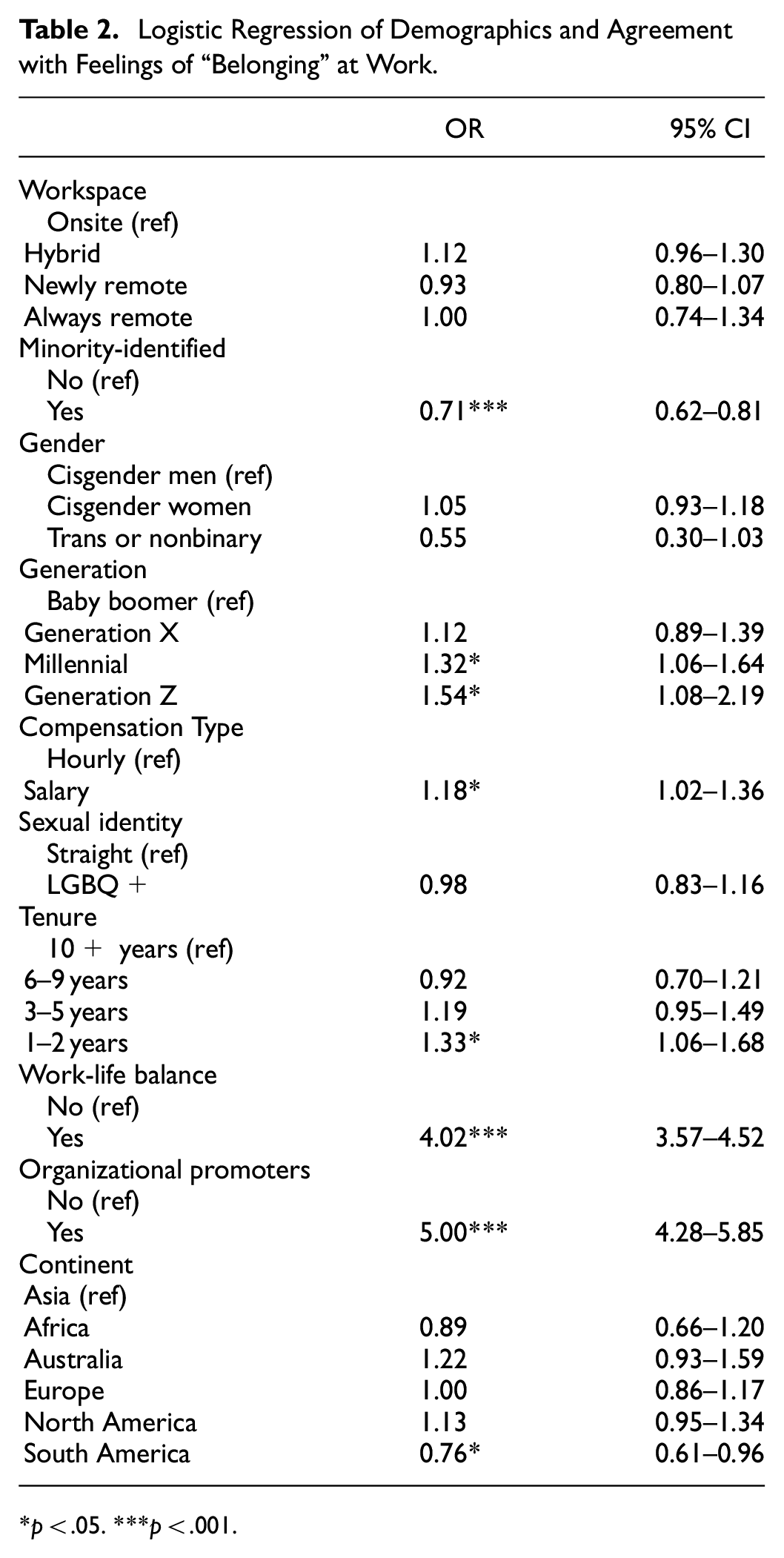
p < .05. ***p < .001.
Lastly, we designed a regression model exploring an interaction between workspace and identification with “minority” status (broadly defined). Full results are available in Table 3. “Minority”-identified employees working in an office or on a work site served as the reference group. This model demonstrated that non-minority employees working onsite, in a hybrid environment, or newly remote (since the beginning of the pandemic) felt a significantly stronger sense of belonging compared to “minority”-identified employees working in an office or on a work site. Interestingly, “minority”-identified employees who began working remotely before the pandemic (but not after the pandemic began) reported an elevated sense of belonging compared to the reference group. While identification with a “minority” status has a negative impact on belonging more generally, those employees who have been working remotely since before the beginning of the pandemic had an improved sense of belonging at work when compared to their peers.
Logistic Regression with Interaction between Workspace and “Minority” Identity Status.

p < .05. **p < .01. ***p < .001.
Discussion
While the impact of workspace on employee feelings of belonging is debated in recent times, we previously had little research on how workspace may matter for employees’ self-reported feelings of belonging at work. Thus, in this paper, we used an international survey sample to investigate the potential impact of workspace on employees’ self-reported sense of belonging at work. As the workforce continues to divide by workspace and remote work options continue to be popular, what is the impact of diverse workspaces on employees’ sense of belonging at work? Interestingly, when examining the independent effects of our variables of interest, we found that workspace did not have a significant impact on surveyed employees’ feelings of belonging at work (thus contradicting Hypothesis I). Thus, theories positing that physical space is necessary for belonging are not supported by our findings. This could be considered good news to organizations and employees because our results suggest that organizations can work with employees to be flexible on desired workspace options without compromising belonging (and the benefits associated with it).
However, at the same time, we found that other factors—including several employee demographics—did have an impact on belonging. Specifically, we found that older employees, hourly employees, and “minority”-identified employees reported a diminished sense of belonging compared to their peers (thus lending partial support for Hypothesis II). In this case, our theorization about the impact of identification with a “minority” or historically minoritized group on belonging is partially supported, since some groups (although not all groups investigated) reported diminished feelings of belonging compared to peers. While workspace did not emerge as significant in our model, there are still important disparities in feelings of belonging among certain groups of employees across the world.
Regarding age and compensation type, rather than highlight new inequities of belonging facilitated by the move toward increased remote work, our findings seemingly reveal existing inequities that are persisting in the wake of the pandemic. For example, research has shown that hourly paid positions are in many cases more precarious than salaried positions, which matters for employee feelings of belonging at work (Bowie, 1998; Schnell et al., 2013). In our sample, for instance, about 71% of participants employed in the tech industry (where 17% of participants were paid hourly) reported that they felt a sense of belonging at work, whereas only 65% in retail (38% paid hourly) felt the same. The nature of hourly-paid work—which can include comparatively fewer benefits and less prestige—can preclude employees from being able to foster a greater sense of belonging in some contexts. Regarding age, while some pre-pandemic research has found that issues of age discrimination and belonging skew toward younger employees (Harris, 2019), other research has shown that older employees can feel insecure and less belonging at work (Rahn et al., 2021). In our sample, we observed the latter trend.
At the same time, we found that identifying with any “minority” status (independent of workspace) predicted diminished feelings of belonging at work. Thus, while workspace itself was not significant in our initial model, in our second regression model, we sought to investigate the interaction between workspace and “minority” identification to explore whether workspace mattered differently depending on “minority” status. These results demonstrated that compared to “minority”-identified employees working onsite or in the office, a lack of “minority” identification significantly predicted stronger belonging in almost all cases. Given the results of our first regression model as well as previous research on the impact of “minority” identity status on belonging at work more generally (Alfrey & Twine, 2016; Hammond et al., 2019), this result is perhaps unsurprising.
However, although workspace did not differentiate among“minority” workers in most cases, those who reported working remotely since before the pandemic began (but not those who began working remotely after the pandemic began) reported elevated feelings of belonging compared to peers onsite or in the office (thus lending partial support for Hypothesis III). Because our finding does not support our expectation that working remotely at least part of the time would have a positive belonging impact on “minority”-identified workers (since hybrid and newly remote workers were not significantly different from their onsite or in-office peers), it is theoretically inconclusive. Our finding suggests that in the long-term, remote work may offer benefits to some “minority”-identified workers when it comes to belonging. However, because we only observed this effect with one set of remote workers and not both (and not among hybrid workers), we would like to see more research that investigates this finding. Based on our results, we cannot argue that remote work itself did not always lead to more belonging for “minority”-identified employees in our sample, since it was only one group of remote employees who reported stronger feelings of belonging. On the other hand, our results suggest that significant differences in belonging persist among “minority” and non-minority-identified employees, and that organizations still have much work to do when it comes to cultivating feelings of belonging for all.
As far as explaining what we found, previous research can offer clues. For instance, scholars have shown that there are good reasons why interactions that occur in person can hurt belonging among “minority”-identified workers (Alfrey & Twine, 2016; Baxter & Wright, 2000; DeSouza et al., 2017; Fisher et al., 2019; Hammond et al., 2019), and there is speculation that the removal of issues attached to the physical space can support diversity, inclusion, and belonging efforts (Canty, 2020). However, we need additional research that explores more specifically what it is about working remotely fulltime that might benefit some “minority”-identified employees when it comes to belonging. Over time, do “minority”-identified workers begin to feel more belonging than their peers the longer they work remotely? If so, which factors contribute to this difference? We cannot say for sure with our data, although future research could parse this out ideally with qualitative or mixed-methods research on this topic. Also, we should explore in the future whether “minority”-identified employees who switched to remote work since the beginning of the pandemic have seen their feelings of belonging change or increase. This will help us discern concrete strategies that might help elevate “minority”-identified employees’ feelings of belonging regardless of workspace.
Conclusion
Taken together, our results on the importance of workspace suggest that overall, workspace itself likely does not have an impact on whether employees can cultivate a sense of belonging. Thus, our results do not support theories touting the essential importance of a physical space for cultivating belonging at work. However, we found some evidence that workspace can matter differently for employees depending on “minority” status, suggesting that future theories on the importance of space at work need to consider employee identities as well.
Our findings suggest that for most employees, organizational culture and climate are likely more important than physical workspace when it comes to whether employees feel they belong. Indeed, previous work has shown that organizational culture has a massive impact on employee outcomes, including job performance, satisfaction, and innovation (Lam et al., 2021; Meng & Berger, 2019; Soomro & Shah, 2019). In addition, research has found that organizational culture sets the norms and expectations of the organization (Canning et al., 2020)—and this can include expectations around inclusion, belonging, and the treatment of minoritized employees. Thus, organizations’ commitment to, and actions around, inclusion efforts will continue to be important in those organizations wishing to accomplish a sense of belonging for all.
As far as strategies to increase belonging, research has shown that efforts such as mentorship programs as well as diversifying teams and leadership positions can lead to better diversity, equity, inclusion, and belonging outcomes (Dobbin et al., 2007; Dobbin & Kalev, 2016). In addition, providing employees with choice and autonomy at work can support positive outcomes, including belonging (Lovell et al., 2021). This “choice” can extend to workspace; however, as our results demonstrate, workspace itself is not a predictor of belonging among all employees. Thus, rather than focusing solely on workspace, organizations should continue to enact additional diversity, equity, and inclusion efforts in order to work toward cultivating a greater sense of belonging among employees in their specific contexts.
Limitations
As our research is not without limitations. First, since our sample is one of convenience, we cannot generalize our results to all workers in the countries that we sampled. Our research is also limited in that our survey was administered electronically, so any potential participants would need access to technology and an internet connection in order to participate. Further, although our survey was translated into a number of different languages, it is possible that some questions or concepts could have been misunderstood cross-culturally despite our best efforts. However, our research has important implications for both theory and practice. Our work shows that community and belonging can be supported among the workforce regardless of workspace. Yet on the other hand, particularly for “minority”-identified workers, scholars should continue to investigate whether (and how) the digital space may enhance feelings of belonging for some employees who identify with a “minority” identity or status.
Footnotes
Declaration of Conflicting Interests
The author(s) declared the following potential conflicts of interest with respect to the research, authorship, and/or publication of this article: This research was supported by the O.C. Tanner Company (Salt Lake City, UT, USA), which is where the manuscript authors are employed. Publication may lead to the development of products licensed to O.C. Tanner, in which the authors—as employees of the O.C. Tanner Company—may have a business and/or financial interest.
Funding
The author(s) received no financial support for the research, authorship, and/or publication of this article.
Ethics Statement
Our research was produced as part of our work with a private organization in the US. Since our private organization is not federally funded or affiliated with any federally funded institution or agency, we are not required to obtain approval from an IRB for the publication of this research. In our review and in consultation with external IRB reviewers, this study is exempt from IRB review under exemption category 2 (45 C.F.R. § 46.101(b)). During the completion of this research, no qualifying events occurred or substantive changes made that would change this exemption. Further, while our survey instrument collected general demographic data in addition to the questions central to our study as presented, no personally identifiable information was collected from respondents.

Data Availability Statement
Due to the nature of the research and commercial restrictions, supporting data is not available.