




Abstract
It is well established that a person’s productivity is strongly related to interactions among their network cycles. Despite this, much of the literature concerning farmers’ productivity describes only their formal relationships with extension officials, ignoring their personal relationships. This study was motivated by the need to understand how farmers can use their social networks to promote information diffusion and learning among themselves. The study assessed whether farmers’ information networks can positively influence their productivity and performance through the study of their network structure. We used survey data from 200 Ghanaian farmers. The data was then analyzed using descriptive statistics and an exponential random graph model (ERGM). The results of this study showed that farmers’ information networks had a positive effect on their performance and productivity. The study also revealed that farmers seek information from key and influential farmers while key farmers also seek information from other key farmers. A further finding of the study showed that many factors contributed to the successful diffusion of information, such as popularity, activity spread, reciprocity, multiple connections, and homophily of experience. However, on the other hand, transitivity was not significant in this network. Hence, this study clarifies the effect of the structural characteristics of farmers’ information network which influence information diffusion for higher performance and productivity. This study argues that agricultural managers should take measures to ensure that farmers understand how their information network can benefit their peers, as well as their own performance and productivity.
Plain Language Summary
Studies have shown that, personal interaction and networks has the ability to influence a person’s productivity. But most of the existing literature concentrate much on the formal relationships with extension officials, ignoring personal relationships. This study was motivated by the need to understand how farmers can use their social networks to promote information diffusion and learning among themselves. The study assessed whether farmers information networks can positively influence their productivity and performance through the study of their network structure. We used survey data from 200 Ghanaian farmers. The data was then analyzed using descriptive statistics and an exponential random graph model (ERGM). The results of this study showed that farmers’ information networks had a positive effect on their performance and productivity. The study also revealed that farmers seek information from key and influential farmers while key farmers also seek information from other key farmers. A further finding of the study showed that many factors contributed to the successful diffusion of information, such as popularity, activity spread, reciprocity, multiple connections, and homophily of experience. However, on the other hand, transitivity was not significant in this network. Our study argues that agricultural managers should take measures to ensure that farmers understand how their information network can benefit their peers, as well as their own performance and productivity.
Introduction
The information and knowledge farmers receive during their farming is vital for their productivity and the sustainability of their work (Qui et al., 2021; Sutherland & Labarthe, 2022). Current literature has placed considerable emphasis on the knowledge exchange structure of farmers as a key component in innovation (Rockenbauch et al., 2019; Sutherland & Labarthe, 2022). Basically, the way farmers seek and gain advice comprises links between advisees and advisors (Nettle et al., 2018), which is hypothesized as a network. Research has shown that information is transferred through networks, resources are exchanged, and existing relationships are strengthened (Zhao, 2022), creating and disseminating shared knowledge (Nöldeke et al., 2020).
Farmer’s exposure to innovations is significantly influenced by information networks (Skaalsveen et al., 2020; Thomas et al., 2020). This gives stakeholders and researchers the opportunity to examine the flow of knowledge and information in the farmers’ network (Thomas et al., 2020). Although these studies reveal that information networks are key to innovation, research has shown that sharing information with peers contributes to knowledge transfer, task completion, and the building of relationships and innovation (Laitinen & Sivunen, 2021). Thuo et al. (2013) suggested that the structure of farmers’ advice ties is revealed within their relational ties. By contrast, Cofré-Bravo et al. (2019) established that farmers’ advice ties and their relational interactions have unique structural outlooks that can stimulate innovation differently. Aiming to contribute to this discourse and to provide a more comprehensive insight into the relationship networks that enhance performance and productivity among farmers, our study examines various ways through which farmers’ information networks can influence their performance and enhance their productivity. In order to achieve our research objectives, we answered the following research questions: 1. How can farmers utilize information networks to maximize their potential and share information with each other? 2. What is the impact of farmers’ networks on their productivity and performance?
Farmers create links in this network based on their ability to have unique information traits that reveal their supremacy when it comes to specific information. We assume that farmers with such traits have a significant influence on tie creation in the network. To critically analyze the influence of this network, we used data collected from 200 Ghanaian farmers and the network was examined in terms of its structural features. The network structure of these farmers is then modeled with exponential random graph models (ERGMs); these models help us examine the properties of our network by considering the fact that ties found within a network are not independent of each other.
Studying farmers’ information networks and their structural features contributes to the literature on agricultural information networks. In order to enhance farmers’ productivity, we need to understand the various ways in which these structures affect knowledge sharing. Previous studies have treated the way farmers gain knowledge as an aggregation of knowledge gained from their peers and agricultural specialists (Lin et al., 2021; Rodríguez et al., 2023). In contrast, we look at the different ways in which farmers obtain information and knowledge among their peers, which affects their productivity. Some studies have examined farmers’ information networks (Lin et al., 2021; Omulo & Kumeh, 2020; Thuo et al., 2013); however, most of them have explored the influence of these networks separately, based on climate change, innovation outcomes and processes. In contrast, our study examines the structural features of the information network. Farmers’ day-to-day activities are significantly affected by these informal interactions, which impact knowledge diffusion of these farmers to enhance their productivity. Studies have shown that, in rural communities, social factors significantly correlate with ICT diffusion, (Latif et al., 2018). As such, informal networks have a positive impact on farmers’ productivity. This is due to the fact that informal networks enable farmers to have access to information and resources that would otherwise be unavailable. Moreover, informal networks can also lead to increased cooperation among farmers and facilitate the diffusion of new technologies. We also contribute to the literature on social networks rationale as a principal component of farming, which can help increase farmer productivity by sharing information and ideas through their information networks. Social networks influence farmers’ knowledge and productivity. They can share information about best practices, new technologies, and market opportunities. This can help farmers increase yields and profits and reduce the risk of crop failure. Social networks can also provide access to resources such as capital, credit, and other inputs. Thus, effective networking is crucial for productivity in the farming industry,
Literature Review
Farmers’ Information networks enable farmers to exchange information about crops, pests, soils, and markets through communication processes and channels. Using this information to make informed decisions about their operations, farmers can increase productivity and profitability. This network also provides farmers with the opportunity to communicate and exchange knowledge, as well as provide assistance when needed. Further highlighting the importance of agricultural information networks for farmers is the fact that they provide a platform for them to run their business more efficiently. As a result, they can reduce inputs, boost yields, and improve operational management. As well, farmers may benefit from sharing their knowledge by collaborating and supporting one another, thereby bringing their resources together and serving a common goal. Decision-making and learning in agriculture have always been influenced by social networks. Numerous studies have shown how interpersonal networks which are created through farmer-to-farmer relationships, and peer-to-peer advising networks help to facilitate learning (Lin et al., 2021; Skaalsveen et al., 2020).
Learning is inextricably linked to social ties, because it is a social process. Peer to peer learning is an important tool for networking among farmers, since they often rely on each other for guidance. Oreszczyn et al. (2010) found that farmers frequently report getting information and ideas from other farmers. There are many forms of information that farmers possess about goods and/or services, procedures, costs, and markets. Due to their potential to spread knowledge about new technology through social learning, farmers’ networks have been the subject of much research in recent decades. To determine how information networks, affect farmers’ efficiency, Sligo et al. (2005) examined the advantages small and medium-sized farm owners gain from other sources and their interpersonal networks. Using diaries, in-depth interviews, and a socio-spatial knowledge network, the researchers gathered insights into the farmers’ information environments. The researchers found that the farmers’ living and working conditions had a significant effect on their knowledge acquisition. According to the study, small and medium sized farmers’ daily lives are affected by information in many important ways. This study provided a complete picture of how and why farmers benefit from information use. Furthermore, Mohammed and Abdulai (2022) examine the relationships between farmers in a social network separated by social distance. As a result of their findings, farmers’ efficiency is highly correlated with the efficiency of their peers in their egocentric networks, with less efficient farmers typically relying on their more efficient peers to increase their efficiency at a global level. Agricultural output may be increased by farmer-to-farmer information networks, based on their findings. Increasing central farmers’ technical expertise allows network members to benefit from their colleagues’ efficiency, increasing overall efficiency. Crawford et al. (2015) examined the information sources organic growers use to guide their farming operations. The study employed semi-structured interviews with 23 organic farmers from 17 locations in North Carolina. Researchers found that organic gardeners can obtain a great deal of information by networking with other growers. Considering all the factors, the paper provides insightful information on where organic farmers find information, and how Extension agents can help.
A detailed analysis of Ghanaian organizational partnerships in agriculture and climate change was conducted by Ofoegbu and New (2021). A positive or negative impact on farmers’ access to climate data was examined by this study. The density, core-periphery, degree centrality, and reciprocity of the networks were examined by the authors using network analysis. Farmers’ awareness of climate change is greatly impacted by partnership between governmental and nongovernmental organizations, according to their research. As well as describing climate-related hazards and risk mitigation alternatives, the authors make suggestions for raising farmers’ awareness. Also, Skaalsveen et al. (2020) investigated the role of social networks in facilitating the adoption of no-till farming in England. By using social network analysis, the authors mapped the networks of 16 English no-till farmers and conducted semi structured interviews to determine whether network features were associated with no-till adoption. In their findings, intermediary farmers play a key role in boosting knowledge and information exchange between no-till farmer networks. To facilitate a more effective dissemination of knowledge, the authors propose that formal extension services should gain a deeper understanding of these sophisticated information networks. In summary, this study provides a useful perspective on the role of social networks in the dissemination of agricultural information. Furthermore, Abdul-Rahaman and Abdulai (2020) examine how social networks and rice value chain involvement affect smallholder farmers in northern Ghana’s market performance. Paddy prices, quantity traded, and net returns were positively impacted by value chain participation and social networks. To account for selection bias, the authors used a treatment effects model. Based on the results of this study, smallholder farmers could benefit from the development of social networks and value chains. A study by Liao and Chen (2017) examined agricultural information management in developing nations and how farmers obtain information from their local social networks. Using a bipartite graph and a general framework, the authors show how asymmetric information systems can produce unexpected outcomes. Farmer production may vary based on how optimistic or pessimistic signals are observed, for example. In addition, the authors discuss the best way for the government to provide information in order to promote the welfare of society or to increase farmers’ earnings. The results of this study provide a useful tool for analyzing the distribution of agricultural knowledge under uneven information structures.
As part of their 2022 study, Nor Diana et al. also examined the numerous factors influencing Southeast Asian farmers’ adaptation plans to climate change. The authors found five major themes based on a thorough analysis of fifteen relevant papers from Scopus and Web of Science repositories: social networking, physical capital, help, information, and sociodemographic characteristics. Based on the results, information accessibility, education, training, and money are more important than programs, internet usage, family size, and workforce size when creating climate change adaptation plans. The researchers Rust et al. (2022) investigated how farmers in two nations become aware of agricultural advances and who motivates them to make use of them. A study of 82 farmers in both nations found that, although they rely on internet resources to access soil information, they tend to believe other farmers over conventional experts. To increase the adoption of sustainable soil management techniques, the authors also recommend enhancing information sharing among agricultural stakeholders. The paper provides insight into how farmers receive information from their colleagues and rely on them for knowledge. In 2020, Zossou et al. conducted an in-depth analysis of the factors that influence West African farmers’ acceptance of new technologies and their ability to acquire new knowledge. Researchers surveyed 499 household heads using stratified random sampling and used Mann-Whitney-Wilcoxon tests and Poisson regression to analyze the data. Consequently, the findings suggest that farmers heavily rely on their experiences and those of their peers when implementing new technologies, and that important policies aimed at boosting innovation systems should focus on improving farmers’ access to formal and informal knowledge sources, credit services, welfare, and information and communication tools. All these studies have proven in one way or the other that information diffusion to farmers through their peers is very vital and necessary for productivity.
Theoretical Framework
Farmers’ Information Network
The farmers’ information network is an informal network formed by farmers in their day-to-day activities through the information and advice they give or receive from their peers. This is an unintentional network formed through their collective gain of routines, rules, practices, and supplies from their peers, which enhances their productivity. The farmers represent the “nodes” in the network, whereas the “ties/links” are developed when one approaches another for advice or information and vice versa. The ties also show that collaborating farmers find each other in their quest for ideas and relevant information. This is because actors develop relationships with various objectives. Thus, these ties represent the relationship between an individual farmer and another farmer through information sharing and advice-giving.
Consequently, they are attached to particular farmers who are found in a unique position within the network. Hence, a farmer’s position within the network is not only determined by a single farmer, but also by his interactions with both current and former farmers who always make information readily available to peers under any circumstances. As a result, others are also challenged to work more to attract more farmers to themselves by being more innovative and productive. As we can see from Figure 1, farmers are not connected to the same key farmer; they differ in the number of farmers to whom they are attached.

Farmers’ information network.
Some farmers within this network are linked to many key farmers, whereas others are linked to only one or two key farmers. In addition, these key farmers, to which other farmers are attached, are positioned differently in the network. Using these differences in the farmers’ information network, we can explain the difference in how farmers give or receive information about their farming needs based on their positions in the network.
Farmers’ Information Network as a Fraction of the Innovation Process
Studies have shown that social networks are one way through which people in a network can generate, process, and diffuse innovative ideas to their peers (Laitinen & Sivunen, 2021; Muller & Peres, 2019). This means that a farmer’s information network, which is part of the social network, could help in the innovation process. It is believed that innovation happens when we recombine previously existing concepts and physical resources (Limsangpetch et al., 2022). In the same way, farmers can influence innovation formation and processes in their local communities by combining previously existing concepts and resources through these networks. Information diffusion has proven to be helpful in agriculture and influences farmers’ productivity (Mekonnen et al., 2022). It also helps farmers cater for the rising problems concerning learning new ideas and practices by adding their own knowledge to that gained from key farmers, thus enhancing their likelihood of obtaining innovative ideas.
Following the studies of Mekonnen et al. (2022), who demonstrated that, being relatives and ad-hoc pairs did not significantly improve information dissemination among farmers, yet being friends and spatially proximate did (Mekonnen et al., 2022), we concentrate on the informal transmission of information among farmers in their local setting which is related to their farming needs whereby these networks are formed unintentionally. Other studies have shown that information or advice obtained from social networking played a major role in farmer productivity (Gambrah & Yu, 2022). In addition, Shah et al. (2018) proved that peers in a network who provide assistance to others enhance their learning and knowledge base; thus, a key farmer who is popular among his peers positively impacts his own performance; by articulating his needs to his peers, he will be able to identify his farming needs more carefully (Shah et al., 2018).
Although the process of seeking information can be seen as a process of choice, as a farmer might decide to consult any peer when it comes to his farming needs, this decision is influenced by some features of the relationship between the seeker and the informant, in addition to other farmers that the seeker may come into contact with. This information network is assumed to stimulate the productivity and performance of the farmers, in their local settings. Relying on this rationality, we anticipate that farmers search for information from peers that they identify to be connected to key farmers who are valuable for the success of their own task, subject to their own set of key farmers. Following this hypothesis, we assume that key farmers who are consulted most recently are seen to be more significant for farmers’ link creation as their quest for farm-related information increases. Considering how these ties might be created, farmers are expected to select key farmers depending on their needs. This implies that different information needs are assumed to influence the likelihood of farmers contacting a particular peer, stimulating tie creation with different key farmers with different aspects of information, which increases their popularity.
Farmers’ Information Network and Productivity
Studies have shown that information is valuable for firms to succeed and has a considerable impact on profit (Lai et al., 2021). Studies have also shown that there exists a relationship between informal communication and work effectiveness and quality (Stöckl & Struck, 2022). Through these informal communications, highly resourced people could be identified and thus help in the creation of information networks, and these networks enhance performance and productivity. These networks can also promote professional and personal development by making recommendations for helpful contacts. It also helps members, who face challenges in obtaining formal and structured support mechanisms. This helps them access information related to farming, markets, businesses, and regulations. The strength of farmers’ information networks is based on mutual strength. This network is a key driver of change and development, and through this network, farmers can optimize their performance and productivity. Farmers’ information networking adds to knowledge creation and acts as a source of wisdom for their effectiveness. Studies have shown that teams perform better when they share information (Hoch, 2014; Moye & Langfred, 2004) and also team members are more creative when they share information (Mehmood et al., 2022). Hence, we can say that farmers’ performance and productivity are enhanced when they engage in information sharing. Thus, farmers engage in these interactions to strengthen their performance in areas where they believe they are weak, to coordinate efforts through which they are likely to create strong alliances. Such alliances can lead to innovation and higher performance which will results in high productivity. It helps them be competitive and updated with current ways of farming as well as be market oriented. These alliances are built on the personal and strategic needs of local farmers. Hence, we can say that the nature of farmers’ information networks is different for different economies, regions, and countries. Therefore, there is a need for researchers to conduct studies of this kind in different economic environments to realize how this network impacts farmers in different farming environments.
Aspects of the Farmers’ Information Network
Different Information
It is very popular for farmers who have different types of information to be present in the network, which attracts more farmers to them, making them very important in the community. Consequently, farmers seeking information will look for key farmers who can understand their needs; as a result, some farmers are connected to fewer key farmers, whereas others are connected to many key farmers. Farmers’ information isn’t about just one aspect; it covers different aspects of their farming needs, making most key farmers generalist farmers with different knowledge and expertise. Sontakki and Subash (2017) and Bonfiglio et al. (2017) established that the innovation process is actively managed by farmers with different perspectives on farming methods. Compared with farmers having limited ideas, key farmers are progressive with diverse current perspectives. This compels them to recommend different ways and new perspectives to tackle the present problem. Furthermore, these farmers are more capable of linking ideas from many angles and creating better options by combining their own information and ideas (Gava et al., 2017).
Based on this principle, we claim that the different information a farmer has will affect his or her position in the network. For example, when they are able to propose innovative approaches to issues, they become popular sources of information for their peers. This is shown in Bagheri and Teymouri (2022). According to their findings, trusted and influential people influenced farmers. It was perceived that other farmers with SWC practices and who produce more crops had the greatest influence on their decisions, while agricultural experts did not have the same influence (Bagheri & Teymouri, 2022). Accordingly, farmers’ essentials follow progressive farmers, whom they see as productive. So, we propose that these progressive or productive farmers will not seek information from other farmers who see them as productive. Additionally, they may become popular as their comprehensive information network makes it easier for them to discover a common language for easy communication since they are all in the same location. Moreover, having different information offers farmers a strong foundation for innovative work. Comparatively, farmers with different information may rely less on other farmers to be productive and are unlikely to be advisees. Based these considerations, we propose the following hypothesis:
Transitivity in Farmers’ Information Network
Transitivity is the identity of the information network, which denotes the fact that if farmer i retrieves information from farmer k, and farmer k retrieves information from farmer j, then farmer i is more likely to retrieve information from farmer j. Thus, farmers who connect with key farmers with whom their friends are not acquainted tend to link their friends to that key farmer. Social network theories put considerable emphasis on the idea that having a distinctive source of information can be of great importance for people and institutions. Similarly, transitivity as a social network measure enhances how farmers can retrieve information from key farmers with less stress, as it is upon recommendation that they are linked to the right and special resources. Studies have shown that when high transitivity is found within farmers’ network productivity gains are higher (Mohammed & Abdulai, 2022). For this reason, it is worthwhile to test whether farmers’ networks are transitive in order to determine how they might potentially be able to be productivity. Similarly, Albizua et al. (2021) also use transitivity as a means of examining social tie formation among farmers as part of their study. A key goal of their study was to understand how farmers’ network structures influence land management decisions. They use indicators, one of which is transitivity, to determine the presence of influential peers who’s social position and farming knowledge attract others to them, and are consulted more regularly for farming advice (Albizua et al., 2021). Therefore, it is also imperative that we test whether this information network among farmers is transitive, since we foresee influential farmers who other farmers might recommend to their peers. For a farmer to benefit from transitivity in this network, they may attempt to associate with other farmers to stimulate recombination and hence, take advantage of these key farmers. Given the reasonable nature of these assumptions, we formulated the following hypothesis:
Position of Key Farmers in the Network
Several factors influence the formation of a farmers’ information network, including the position of key farmers. These farmers can act as leaders and sources of information for other farmers. They can also help with the dissemination of new technologies, ideas, and practices to the rest of the network. This can lead to improved productivity and increased efficiency for the entire network. Additionally, reputation building can play a significant role in promoting diffusion efforts and information transmission. This reputation building further encourages collaboration and trust among the farmers, resulting in increased motivation and commitment to the network. This in turn can lead to greater success and sustainability for the network. Shikuku et al.’s (2019) indicate that social recognition or status is an important factor in rural livelihoods. It is evident from this that key farmers play a vital role in spreading agricultural knowledge through farmers’ information networks. Farmers’ productivity can also be improved by farmer-to-farmer extension organization that identifies and improves the technical knowledge of central farmers (Mohammed & Abdulai, 2022). A key farmer’s position in the network indicates his ability to attract many farmers. Key farmers with extraordinary information are seen to occupy a vital position in the contract network; those with less centrality indicate that they have little experience and less information to share. This is also confirmed by the study of (Chen & Lu, 2020) that, farmers with less expertise needs more agricultural training and guidance information than those farmers who are equipped with good information.
An analysis of the actor’s position in a network can help us identify key farmers in the farmers’ information network as actors who receive more ties may be important. Thus, a key farmer with low centrality or few links will have to devote considerable effort to find opportunities to associate their information with current or other key farmers. Farmers may turn to peers who have good current information to benefit from the expert information they offer. Farmers may be more actively looking for farming-related information from their peers if their key farmers offer information that does not serve their own needs or profit them. In this way, they may find unique resourceful key farmers who serve their needs taking into account these key farmers’ network positions. In light of these assumptions, the following hypothesis can be made.
Intimacy Among Key Farmers
Information network intimacy among key farmers is the degree of connection among key farmers in an information network. This may affect information transfer in many ways. Intimacy can help facilitate the flow of knowledge and insight between key farmers, creating a strong base for successful agricultural productivity. Intimacy between key farmers can also foster trust, enabling them to support one another through difficult times while also providing opportunities for growth and development. For instance, when key farmers are connected to one another and can easily share information and resources, this can help reduce the risks associated with agricultural production and ensure that their farms remain profitable. In addition, farmers may seek information from peers (Nöldeke et al., 2020) with different key farmers in the network to supplement their limited information sources. In general, accessing different types of information may be beneficial for productivity and performance.
In addition, intimacy among people has been proven to be one of the very important foundations for the creation of ties (McMillan, 2022). Associating with key farmers might help interactions between farmers because it offers them a common ground to share information on their farming needs. People are more likely to form relationships with those who share similar attitudes and values when they are homophilic. Through exposure to more diverse actors and information, peer-to-peer interactions among farmers have a homophilic nature, according to Dilleen et al. (2023). This is because those with similar values and attitudes are more likely to understand and trust one another, allowing them to form closer relationships. It is also believed that those with shared values and attitudes are more likely to cooperate with each other, leading to a larger degree of trust and closer relationships. In addition, those with similar values and attitudes are more likely to share information and resources with one another, further leading to the formation of relationships. For instance, teams of colleagues who share similar values and attitudes have been shown to have greater levels of trust and cooperation, leading to better team performance. Similarly, shared information is the easiest way for them to learn from others; moreover, it is a requirement to gain and develop innovative ideas and be more productive. Accordingly, influential intentions may cause key farmers to cooperate with their peers with similar information and ideas. Hence, we hypothesize as follows:
We describe our framework and hypotheses in figure 2.
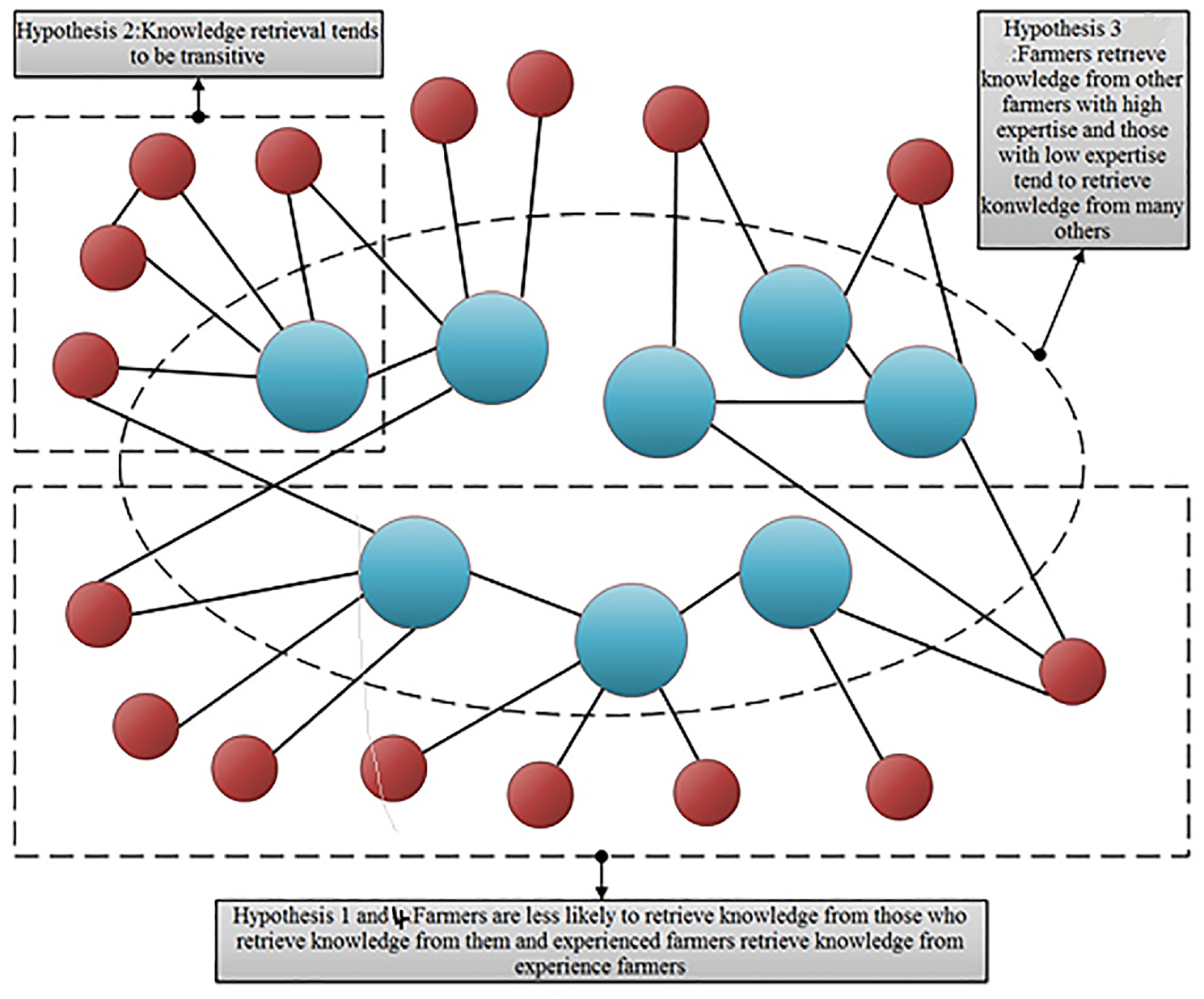
Overview of the research hypotheses.
Methodology
Data Collection
To prove the hypotheses of this study, data were gathered from 200 Ghanaian farmers. Farmers are considered a key success element in the farming sector, and their productivity is needed to enhance economic growth. To collect the data, the researchers conducted interviews with the 200 farmers, using a structured questionnaire. The questionnaire included questions about the farmers’ experience, knowledge, and practices related to the study’s hypotheses. By collecting data from the farmers, the researchers understood their perspectives and gained an accurate insight into their interpersonal relationships and tie creation practices, which was essential for proving the study hypotheses. The structured questionnaire ensured that the correct data was gathered from farmers efficiently and reliably.
All farmers in the location who have farmed on their land for at least 3 years were considered in this study. These farmers were visited in their homes for the interview. The interviews were conducted by researchers with the help of two research assistants and lasted an average of 30 minutes. During the interviews, the researchers focused on the topics outlined in the survey and collected valuable information from the farmers. In addition, the researchers collected feedback from the farmers about any additional topics or issues related to farming in the location that were not included in the survey. This feedback was invaluable in deepening the researchers’ understanding of farming in the area. To gain further insight, the research team also conducted field visits to some farmers to observe their daily routines and work environment. The interview was aimed at discovering their information seeking and giving characteristics. Through the interviews, the research team was able to understand the farmers’ needs, challenges, and preferences, thereby providing valuable insights into their community. By talking to the farmers and seeing the work environment first-hand, the team was able to gain a deeper understanding of the farmers’ information needs and communication styles. In line with previous research, we draw on how farmers gain farming-related information and knowledge (Godtland et al., 2004) to obtain data to test our hypotheses about farmers’ information networks. Specifically, we explore how personal connections and communications influence farmers’ productivity and performance.
Population and Sample
Study participants were cocoa farmers in Ghana’s Western North Region. The selection of this region was essentially by a non-probability (judgment sampling) technique. This region is known by all in Ghana to be highly productive in cocoa, and hence, the researchers made judgments on that. The researchers then used cluster sampling to select the Sefwi Akontombra District. Cluster sampling was performed when the researchers divided the region into districts, and simple random sampling was used to select the District. Akontombra was selected because of its popularity in terms of cocoa production and because it is surrounded by many villages: Bokaso, Aburonehia, Essase, Bronikrom, Yamfo, and many others. The area is forested, and the land is good in terms of cocoa production.
The selected participants were only cocoa farmers, and hence, judgmental sampling was applied. Of the entire population of farmers in Sefwi Akontombra District, 250 cocoa farmers were selected. Cochran’s criteria were used for the selection. The selected farmers were interviewed based on their knowledge of cocoa farming, the number of acres of cocoa they farm, where they received their farm-related advice from, and many others. To obtain the farmers, the researchers used those who were available for the interviews.
Sample Size Determination
The sample size was calculated using Cochran’s formula (for a population of >10,000)

where n= the sample size taken from the entire from the population
p = proportion of the target population estimated to have characteristics from previous studies (0.50)

Degree of accuracy is set at 0.05
⇒
⇒
n = 384
In using the approach of Cochran, the researcher arrived at a sample size of 384 based on the 95% confidence limits, with an allowable error of 5%.
However, the researcher used only 250 participants because not all of them were cocoa farmers; some of the farmers were also not willing to share their farming-related relationships, and we were also unable to access some of the participants. Of the 250 selected respondents, 200 participants fell into the category of farming for more than three consecutive years. Thus, the researchers used 200 participants for the analysis.
Measures and Variables
For the analysis, the model was estimated to determine the likelihood of ties, such as the different aspects of the information network resulting from the farmers’ positions in the network and other structural features of the network.
Exponential Random Graph Models
We applied the ERGM (Lusher et al., 2013) to analyze the data. ERGMs provide a model of network tie creation, accounting for dependencies on the network structure. Compared with some statistical methods of network analysis, the ERGMs result variable provides the complete network structure. They represent an entire network as a solitary observation, which eliminates independence expectations. As relational ties suggest dependence, this is considered a major point for our modeling method, which is of empirical and theoretical importance in light of analyzing our hypothesis. ERGMs have been used to model a wide range of social phenomena, such as social networks, inter-country relationships, and political networks. We believe that this approach can be useful in analyzing our hypothesis, as it provides us with a thorough insight into the network structure. This approach is especially useful because of its ability to capture the interdependencies between the nodes in a network, which can provide us with a deeper understanding of the underlying relationships between farmers. By relying on ERGMs, we can gain insights into how relational ties can influence the outcomes of our hypothesis and the complex patterns that emerge in such networks. ERGMs are used to examine the patterns that describe the observed network and make assumptions about the most efficient procedures that control tie creation. They can also be used to provide insights on the drivers of network formation, such as individual characteristics or group-level characteristics. ERGMs are used to test hypotheses about the structure of social networks and the processes that give rise to it. ERGMs are used to model the evolution of networks over time, by tracking changes in the network structure. They can also be used to simulate the effects of an intervention on the network, such as introducing a new policy. Compared to other methods such as traditional regression models, ERGMs are better at capturing complex network structures that are otherwise difficult to detect. Finally, ERGMs are more effective at simulating the effects of interventions in a network, as they can account for both direct and indirect effects of the intervention. We conceptualize that the configuration of a farmer’s information network might give us insight into how farmers’ performance and productivity are impacted. By understanding the underlying network structure, we can tailor interventions to optimize the communication and collaboration between farmers. This could ultimately help to increase farmers’ performance and productivity. For instance, by studying the network structure, we can identify farmers who are highly connected and look at how they influence the performance of other farmers in the network.
Tie Creation
Ties are created by farmers by reason of one farmer going to a fellow farmer to ask for information; in that case, farmers become the nodes, and the relationship established between them is the link or tie formed. Given each tie, we have a receiver as well as a sender. A farmer who seeks information from his peers is known as a sender. Conversely, the tie receiver behaves by way of an advisor among his peers, and these ties received show his popularity; thus, most of the advisors become key farmers in their network. Hence, in our survey, farmers were asked to name peers within their locations from whom they most often sought information related to their farming. We relied on the answers obtained from our survey to construct an information network of the farmers. These farmers are nodes, and the connections between them are the information they seek from their peer farmers. Two farmers are linked by a tie within this network if they have contacted each other for information. Using three consecutive years of farming as a benchmark permits us to justify the most prominent key farmers and how they have had an influence within the location for the past years. Relying on previous studies, we assumed that farmers in a particular location possess key farmers as long as they are in the same local setting (Godtland et al., 2004).
We rely on the tie structure of our network to prove the impact of different aspects of the farmers’ information network on farmer productivity and performance.
Endogenous Factors
Endogenous factors have been proven to have a significant impact on the way ties are created in a network and are made possible through the form of specific relationships in which a person is involved (Lomi et al., 2014). Thus, the kind of social relationship people engage in, in a particular location, can significantly influence the structural features of a network (Robins et al., 2005). Hence, we add these endogenous effects. Neglecting them may give us inaccurate theoretical results, as these findings could be attributed to structural setups that create ties (Robins et al., 2007; Snijders, 2011). The endogenous effects of farmers’ information networks are considered in order to separate the effects of the diverse aspects of farmers’ information networks on farmers’ tie activity and popularity within the network.
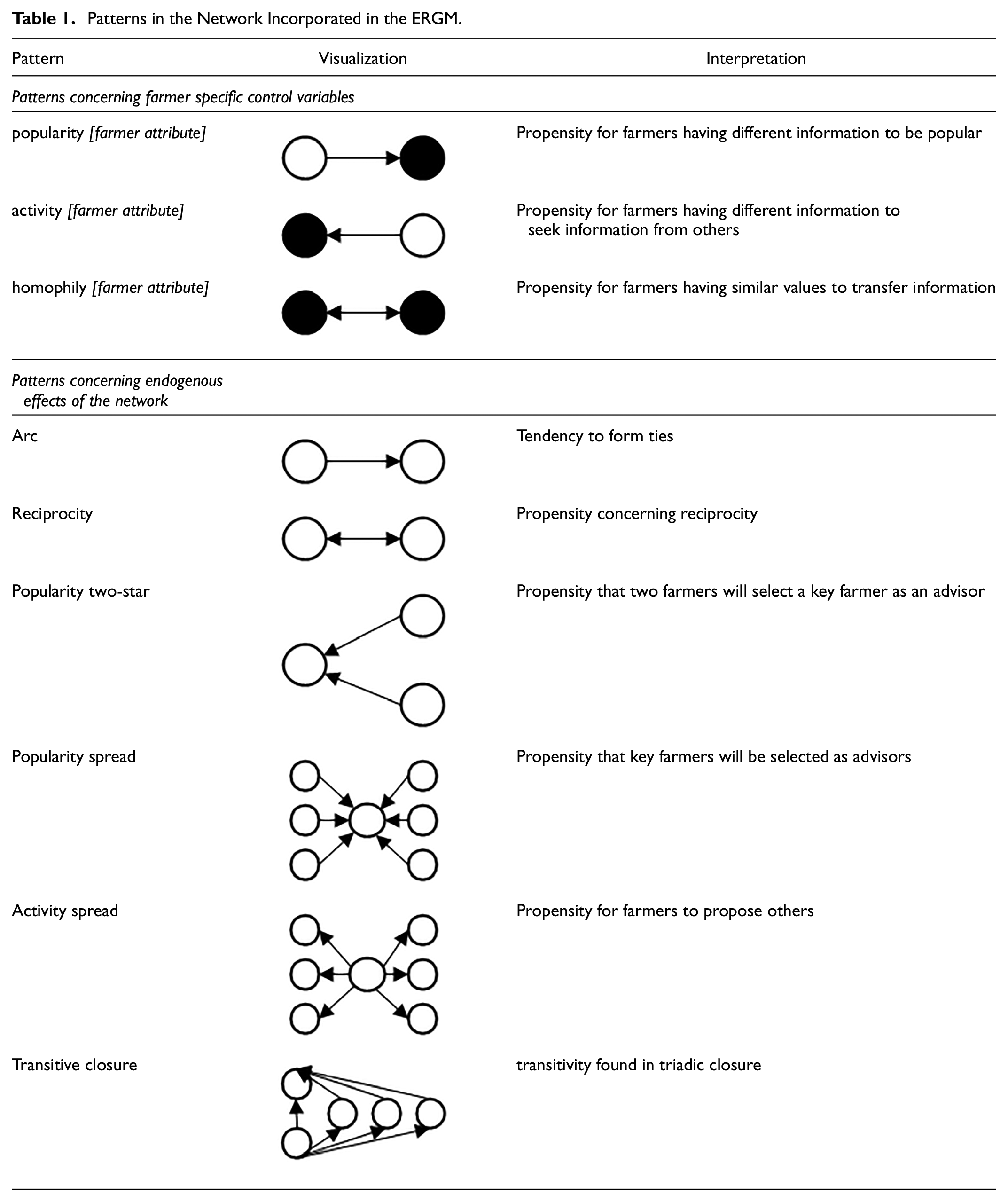
To control the dependence found in the dyadic, we justify the general propensity of farmers to form information ties (arc) as well as to reciprocate it (reciprocity). As only the dyadic dependencies cannot adequately capture the network’s endogenous effects (Snijders, 2011), we also considered dissimilarities within the farmers’ information tie susceptibility to be selected as an advisor (popularity spread), as well as seeking advice (activity spread). The aforementioned special effects can control the out-degree and in-degree distribution of the tie and reveal that links found in social networks exist as rarely distributed uniformly (Robins et al., 2009). Finally, to account for clustering, we add some other effects, specifically propensities concerning cyclic closure as well as transitive closure (Robins et al., 2009).
An overview of patterns related to the different aspects of the information network is presented in Table 1, which denote the farmers’ precise control variables, as well as the endogenous patterns of the network that are characterized in the aforementioned model description.
Patterns in the Network Incorporated in the ERGM.
Results
An overview of farmers’ information networks can be found in Table 2. The density coefficients shown in Table 2 suggest that the network is slightly sparse. A density of 0.01 indicates that, on the average, a farmer was connected to 1% of their peers with respect to information and thus, it shows that most of the farmers interviewed talk with each other. The networks had an average degree of 1.9 (SD = 3.9), indicating that the network is well connected as, communicating with an average of 1.9 with 200 farmers and 389 links between them, may seem a bit more average than one may expect.
Descriptive Statistics of the Network.

In addition, because some nodes have a high in-degree (Figure 3), the rate at which some farmers are being consulted for information is very high.

Observed network visualization.
ERGM Results
A visualization of the model results is provided in Table 3. The patterns used are interpreted as follows: a negative/positive parameter specifies an observed pattern that is less/more repeatedly within the network other than one might assume if connections arbitrarily occurred.
ERGM Estimates for the Network.

Considering hypothesis 1, which suggests that Influential farmers are less likely to retrieve information from those who retrieve information from them, we found that the sender effect was positive (0.019776) and significant (p-value = .005**). This indicates that key farmers with a variety of information are mostly desired by their peers. By contrast, the receiver effect was negative (−7.782e-04) and not significant (p-value = .728), indicating that key farmers with varied information normally do not seek information related to their farming needs from their peers who seek information from them. As a result, hypothesis 1 is accepted. Regarding Hypothesis 2, the transitivity effect is negative (−3.445e-01) and not significant (p-value = .425), demonstrating that if farmer i retrieves knowledge from farmer k, and farmer k retrieves knowledge from farmer j, then farmer i is not likely to retrieve knowledge from farmer j. As a result, hypothesis 2 is rejected.
Regarding Hypotheses 3 concerning farmers seeking information from multiple key farmers, our findings revealed that Popularity spread, Activity spread and Multiple connectivity are all significant which indicates that, there are farmers who are connected to multiple peers and that those they are connected to are also popular in the network. This provide one of the reasons why key farmers are not able to seek information from non-key farmers in their quests for information but it positively affects the pursuit of information of non-key farmers (activity spread, [2.283e+02]). On the other hand, we found that key farmers with much expertise can attract many farmers to themselves (popularity spread, [−1.646e+03]) and key farmers seek less information (popularity two-star, [−1.041e+01]). As a result, hypothesis 3 is accepted. Lastly, for Hypothesis 4, we had a homophily of experience (−4.552e-01) which is significant (p-value = .027 *), indicating that key farmers seek information from their peer key farmers which confirms hypothesis 4. As a result, hypothesis 4 is accepted
We found that the sender effect was positive and significant when we considered Hypothesis 1, which suggests Influential Farmers are unlikely to retrieve information from those who retrieve information from them. This suggests that Influential Farmers are likely to influence the dissemination of information, though not necessarily by direct means. This could be due to their influence on the network structure, or their ability to provide trustworthy sources of information. The effects of these mechanisms could be further studied in the future. Consequently, Influential Farmers play a crucial role in community communication, even if it is indirect. Investigating this further could provide more insight into information distribution mechanisms in other research jurisdictions. As a result, key farmers with a variety of information are largely sought after by their peers. This is especially true in rural areas where traditional methods of communication are still prevalent. Thus, the role of influential farmers in rural areas must be acknowledged and their importance in information dissemination should be further studied. This can help to identify key factors that lead to the success of information dissemination in rural areas. Furthermore, this can also inform strategies to improve communication in rural areas and ensure that key information is shared effectively.
Contrary to this, the receiver effect suggests that key farmers with varied knowledge do not seek information related to their farming needs from non-key farmers. This is because they already have a good understanding of the farming techniques they need to use and they do not feel the need to seek out more information. They also tend to be more risk-averse and prefer to stick to what they know. As a result, they may not be open to learning new techniques or adapting to new technologies. This can cause them to miss out on opportunities for efficiency or cost savings that could be beneficial to their operations. This reluctance to embrace information from other peers can be detrimental to their farming, as they may not be able to keep up with the competition. Key farmers must stay open to new ideas and information from their peers, in order to remain competitive and successful in the long term.
According to Hypothesis 2, the transitivity effect is negative and not significant, demonstrating that if farmer i retrieves knowledge from farmer k, and farmer k retrieves knowledge from farmer j, then farmer i is not likely to retrieve knowledge from farmer j. This suggests that the knowledge sharing process among farmers is not transitive. It is influenced by factors such as the personal needs of the farmers, the similarity of their farming practices, and the strength of their relationships. Thus knowledge acquisition is not a cyclic process, but rather is determined by the individual context of each farmer. As such, it is imperative to understand the context of each farmer in order to facilitate effective knowledge sharing. In doing so, the value of knowledge exchange between farmers can be enhanced, allowing them to gain the most benefit from the resources at their disposal. This includes understanding their experience, motivations and goals, as well as the challenges they face. Additionally, it is important to ensure that the knowledge shared is tailored to the particular needs and abilities of the farmers. Finally, it is important to provide support to ensure that the farmers are able to successfully apply the knowledge they gain.
Although transitivity has been proven in other studies to enhance the productivity of farmers, this is not true for this study. To this end, providing farmers with adequate support is essential in order to ensure that they are able to make the most of the knowledge they acquire. Therefore, it is necessary to consider the unique circumstances of each farming community in order to ensure that knowledge sharing is effective and impactful. This study suggests that the efficacy of knowledge sharing between farmers is heavily dependent on the local context and the communities’ existing knowledge and resources. Additionally, providing support for farmers to apply the knowledge they gain is essential for success.
According to Hypotheses 3 regarding farmers seeking information from multiple sources, popularity spread, activity spread, and multiple connectivity all play a significant role. There are farmers in the network who are connected to multiple peers, and those whom they are connected to are also popular. It explains one of the reasons why key farmers cannot receive information from non-key farmers, but it also positively influences the pursuit of information by non-key farmers. This means that farmers connected to multiple peers are more likely to receive information, and popular farmers can also spread information more quickly. This suggests that the farmer’s network has an impact on whether they can obtain useful information. This, in turn, contributes to the formation of an efficient network where key farmers are able to quickly disseminate information to many non-key farmers, resulting in a higher chance for the whole network to benefit from its contents. This creates a symbiotic relationship between key and non-key farmers that can be beneficial to the entire agricultural sector. Knowledge sharing is essential for the success of modern farming and the formation of efficient networks is key to this endeavor. By fostering this connection through knowledge sharing, farmers can ensure that valuable information is distributed quickly and efficiently, leading to productivity, higher yields, and higher quality produce.
Despite the fact that this is a top down relationship in their local settings, it is still beneficial to have such relationships. This relationship is mutually beneficial, as the farmers are able to access valuable knowledge and resources. In addition, the key farmers can gain a better understanding of the needs of peer farmers. It is essential for the success of the agricultural sector that these relationships are maintained.
On the other hand, we found that key farmers with much expertise can attract many farmers to themselves (popularity spread) and key farmers seek less information (popularity two-star). This indicates that key farmers are more capable of making decisions and have a larger influence on the rest of the farmers. Furthermore, the popularity spread and two-star phenomenon suggest that key farmers are more efficient in gathering and utilizing information. Thus, key farmers are critical in informing and influencing the decisions of the rest of the farming community, making them a valuable asset to the farming community.
Lastly, for Hypothesis 4, we found homophily of experience to be significant, indicating that key farmers seek information from their peer key farmers. As such reciprocity among key farmers is significant. This suggests that there is a strong sense of camaraderie and shared understanding among these key farmers. This could be attributed to their shared experience and knowledge, which allows them to better connect with each other and support one another. This type of support network can be beneficial for key farmers as it provides them with access to a wide range of knowledge and experience which can help them make better decisions. Furthermore, it can also help them manage any risks and challenges they may face. Additionally, this shared experience and knowledge can help key farmers collaborate and form strategic partnerships, enabling them to better utilize resources and increase their profitability and productivity. This can be especially important in times of crisis and uncertainty, giving key farmers the confidence and assurance they need to make informed decisions. Additionally, such support networks can provide a sense of community, allowing key farmers to connect with one another and build meaningful relationships. For instance, some agricultural programs provide online workshops and forums that allow key farmers to connect with industry experts and other farmers in the same influential positions. These networks also provide access to resources such as financial assistance and training programs. This can be invaluable in helping key farmers to stay competitive and successful in the industry.
Conclusion
Networking among farmers has been encouraged and is seen as an essential basis for farmers’ competitive advantage (Adéchian et al., 2022). Per our study, we define farmer’s information networks as networks of farmers seeking information from their peers in their local settings. The structural features of the network were examined using ERGM in order to test our hypotheses. We found that the networks were characterized by a high degree of reciprocity and centrality, indicating that farmers were actively seeking and sharing information with their peers. Moreover, the networks were largely homophilous, suggesting that farmers tended to seek information from individuals with similar backgrounds. Farmers’ activities and popularity are controlled by the information they obtain from their peers in this network, which then affects their performance and productivity. This network assists farmers in making informed decisions about their farming practices, such as when to plant, how to manage pests, and how to market their produce. By having access to this knowledge and information, farmers can maximize their profits and become more successful.
Our results from Hypothesis 1, which suggests Influential Farmers are unlikely to retrieve information from those who retrieve information from them showed that key farmers with a variety of information or great expertise were popular advisors for their peers and were less keen to seek information from their peers which confirms the study of Weyori et al. (2017) that farmers in the central position (“focal farmers”) could be worked with more closely by extension services for more effective results since they are popular and influential. Key farmers have a better knowledge of agricultural practices and have the capacity to transfer this knowledge to their peers. They have a better understanding of their local context and can provide more accurate feedback to the extension services. Key farmers are more likely to adopt new technologies and practices, which can help to improve agricultural productivity. For instance, research shows that focal farmers are more likely to adopt integrated pest management practices than non-focal farmers. This, in turn, leads to improved yields and increased farm income, which can help to reduce poverty and improve food security. This finding is also consistent with Mapiye et al. (2020), which reported that apart from public extension, farmers receive most of their information from their peers. It also shows that existing extension systems should incorporate peer-to-peer information sharing in order to better serve farmers. Extension systems should also prioritize resources that enable farmers to access and share knowledge, such as information and communication technologies (ICTs) and other digital platforms. Furthermore, extension systems should also focus on building trust and relationships between farmers and their peers, which is a key factor in successful peer-to-peer information sharing. Moreover, our findings support those of Qui et al. (2021), who claimed that farmers should have an information and communication source in order to improve their productivity. As such these key farmers are sources of information for farmers which can enhance their productivity. This can help farmers make informed decisions, access the latest information and technologies, and increase their crop yields.
According to Hypothesis 2, the transitivity does not affect this network. This is contrary to the study of Mohammed and Abdulai (2022) who found that high transitivity within farmers’ network enhances high productivity gains. The different results between our study and Mohammed and Abdulai could be due to the difference in sample size and analysis methods used in their studies. Additionally, the two studies may have used different criteria for selecting participants for the study, which may have affected the results. Therefore, it can be concluded that in this case, the network’s transitivity did not lead to improved productivity. This suggests that when evaluating network structures and productivity, other factors should be taken into account, such as the type of network, the motivation and experience of the participants, and the methods used. Further research is needed to better understand the relationship between transitivity and productivity.
While this may be true, we can also say that farmer information networks for productivity are not governed by the “friend of a friend is my friend” (Giroux et al., 2023), but rather depend heavily on farmers’ individual needs and readiness to share knowledge. This is because knowledge sharing networks are more likely to be successful when they are tailored to specific farming contexts and when they address the information needs of individual farmers. As such, these networks are not driven by a “one-size-fits-all” approach, but rather by the individual preferences of each farmer. This allows for the development of tailored solutions that are more likely to meet the farmers’ needs, as well as providing a greater chance of success for the knowledge sharing network. As a result, the network can become more efficient, leading to better outcomes for farmers. This customized approach ensures that farmers receive the most relevant and effective advice, maximizing the success of the network and leading to improved outcomes and productivity for everyone involved.
The majority of farmers asked multiple key farmers for information according to Hypotheses 3 regarding the multiple connectivity of farmers seeking information. This indicated that farmers rely on multiple sources for their information needs instead of a single source. Therefore, the results confirm Mohammed and Abdulai’s (2022) view that farmers tend to learn from high-performing peers in order to improve their own performance, thus requiring them to look for multiple key farmers if they want to increase their productivity. Again, this confirms the results of Giroux et al. (2023) who found that farmers seek information from different people at different stages of their decision-making process. This suggests that it is imperative for stakeholders in agricultural to understand the key farmers that farmers are looking to for advice and to ensure that these farmers are providing accurate and up-to-date information.
Lastly, in hypothesis 4, we found homophily of experience to be significant which is in line with the study of (Dilleen et al., 2023), indicating that key farmers seek information from their peer key farmers. This is also in line with other studies which opines that farmers who share information with highly efficient farmers will be more efficient (Mohammed & Abdulai, 2022). Thus, key farmers would be willing to connect with their peers in order to stay productive. Such connections could prove to be beneficial for both parties, as the key farmers can use their peers’ experiences to improve their own productivity, while also offering their own wisdom and experiences to their peers. Overall, this could significantly increase the efficiency of the entire network of key farmers. By doing so, key farmers can leverage their networks to unlock greater potential and productivity, resulting in a more fruitful and successful operation for everyone involved. By creating a network of key farmers, they can pool their resources and knowledge to find solutions to common problems. This allows them to make better decisions, which can lead to higher yields, better quality produce, and more efficient use of resources.
In conclusion, these findings will act as a basis for information diffusion within farming settings, as the information network facilitates communication, service exchange, and learning among farmers. Based on the findings of this study, agricultural managers should make farmers aware that their social network management can positively influence their peers and their own information network to enhance productivity and performance. Social network management should be encouraged in farming settings to enhance performance, productivity, and communication between farmers. Therefore, agricultural managers should create policies that encourage and incentivize farmers to use social networks to build information networks and facilitate communication, service exchange, and learning. These policies should also provide resources to help farmers build and maintain their networks and should be designed to reward farmers for actively engaging in information exchange within their networks. For example, we can identify the most influential farmers and target them with interventions such as providing additional training or other resources to increase their performance, which could in turn have a positive effect on the performance of other farmers in the community.
Using Bi et al. (2020) studies as a basis, future studies can determine how these farmers’ networks can help in the most profitable ways of delivering goods to markets and individual households. By implementing effective regulations and policies, express product delivery in the future will be more efficient and greener. This will benefit both farmers and consumers, as farmers will be able to get their products to the market more quickly, and consumers will have access to fresher and more affordable goods. In turn, this could lead to improved economic growth and sustainability. Moreover, this shift would have a positive impact on the environment, as fewer resources would need to be used to transport goods, resulting in less pollution and global warming.
One limitation of the study is that it is based on survey data from a limited number of farmers, meaning the results may not be representative of the entire population of farmers. Additionally, the survey was conducted in a specific region and may not be applicable to other regions with different socio-economic and environmental conditions. Lastly, the study did not take into account the potential influence of social media and other digital information sources on farmers’ decision-making processes, which could have a significant impact on how they seek and receive advice.
Research Data
sj-csv-1-sgo-10.1177_21582440241228696 – for Information Network Among Farmers: A Case Study in Ghana
sj-csv-1-sgo-10.1177_21582440241228696 for Information Network Among Farmers: A Case Study in Ghana by Qian Yu and Patience Pokuaa Gambrah in SAGE Open
Research Data
sj-csv-2-sgo-10.1177_21582440241228696 – for Information Network Among Farmers: A Case Study in Ghana
sj-csv-2-sgo-10.1177_21582440241228696 for Information Network Among Farmers: A Case Study in Ghana by Qian Yu and Patience Pokuaa Gambrah in SAGE Open
Footnotes
Acknowledgements

Declaration of Conflicting Interests
The author(s) declared no potential conflicts of interest with respect to the research, authorship, and/or publication of this article.
Funding
The author(s) disclosed receipt of the following financial support for the research, authorship, and/or publication of this article: This work was supported by the National Natural Science Foundation of China [Grant No. 71774128].
Data Availability Statement
Data used in this study are available upon request from the corresponding author.
References
Supplementary Material
Please find the following supplemental material available below.
For Open Access articles published under a Creative Commons License, all supplemental material carries the same license as the article it is associated with.
For non-Open Access articles published, all supplemental material carries a non-exclusive license, and permission requests for re-use of supplemental material or any part of supplemental material shall be sent directly to the copyright owner as specified in the copyright notice associated with the article.
