




Abstract
This article presents a scoping review of literacy research that employs multilingual and multimodal literacy narratives and discussions as tools for enabling immigrant youth to explore their intersectional identities and experiences of inequality. It encourages a re-examination of emerging educational/societal issues, incorporating these interventions as a catalyst for discussion. Utilizing a descriptive-analytic approach for data extraction, this scoping review has mapped out prevailing trends in the literature, research methodologies employed, and the types and objectives of multilingual and multimodal literacy interventions. The findings underscore a growing trend over the past decade in adopting multilingual and multimodal literacy interventions with immigrant youth, often employing collaborative research approaches such as participatory action research. The most frequently utilized multilingual and multimodal texts in such studies include digital storytelling materials (comprising images and video), spoken word poetry, photographs, and bilingual books. These interventions are typically designed to (a) encourage youth to express their knowledge, experiences, and identities; (b) examine and address educational and societal issues and opportunities; and (c) challenge dominant ideologies, practices, and discourses through the voices of immigrant youth. The review discusses the transformative possibilities for immigrant youth and encourages rethinking the language learning, literacy, and curriculum process. The data advocates for eclectic approaches and interventions to help newcomer youth understand their lived experiences and societal issues and encourages educators to respond in kind.
Plain Language Summary
This article is about a study that looked at how immigrant youth learn about their identities and the inequalities they may face through different kinds of literacy, like reading and writing, that use multiple languages and ways of expressing ideas, like images and videos. The study suggests that these kinds of literacy can help us think more deeply about important issues in education and society. The researchers used a scoping review method to study many different articles and reports to see what kinds of research have been done on this topic. They wanted to know what types of trends they could find, what methods researchers used, and what they hoped to achieve with these kinds of literacy activities. They found that over the past ten years, more and more researchers have been using different types of literacy that involve multiple languages and ways of expressing ideas to help immigrant youth. They often work together with the youth to do this kind of research. They also found that many of these literacy activities used digital stories, spoken word poetry, photos, and books that had more than one language. These literacy activities have three main goals: (a) helping young immigrants talk about what they know and who they are, (b) looking at and solving problems in education and society, and (c) challenging the ideas that are most common in society by giving young immigrants a voice.
Keywords
Introduction
Transnational mobility in student populations globally has brought about several challenges for the host countries to ensure newcomer students experience a smooth and equitable transition to schools. One of the key challenges is to help these student populations learn the primary language(s) of instruction in schools, which in most cases, is a predictor of their successful social and economic integration. In the process of trying to make sense of their new world, newcomer students negotiate, renegotiate, and resist certain identities, all of which influence their language learning experience and overall educational and socioemotional experiences. In effect, all of this becomes entangled with a newcomer’s intersectional identities, the amalgamation of several social identities (e.g., language, race, gender, sexuality, and religion) that become the overlapping and interdependent systems of discrimination and disadvantage (Núñez, 2014; Ragin & Fiss, 2017). In their efforts to integrate and socialize into the mainstream schooling system and society at large, these newcomer students confront racialization and negotiate power imbalance pertaining to their multiple and overlapping identities (Compton-Lilly et al., 2017; Núñez, 2014).
For example, as Compton-Lilly et al. (2017) demonstrate in their longitudinal case studies of two immigrant children in the US, children from immigrant families do “sophisticated, agential, and strategic negotiations” of their intersectional network of identities in the process of becoming (p. 115). It further revealed how immigrant children negotiate their intersectional identities (e.g., selecting different languages in different institutional and social spaces) while navigating their new world (e.g., meeting literacy benchmarks at school). Similarly, in the Canadian context, Myers (2019) shows that female Latin American students negotiated their intersectional identities while navigating the barriers of racism and classism in the education system. These studies indicate that newcomer students tend to reposition themselves in order to effectively situate within their new world, and they, accordingly, engage in various literacy practices.
In an effort to better comprehend newcomer students’ intersectional identities and belongingness and the role they can play in their transition to a new language and culture, there needs to be an acknowledgment of the current dearth of scholarship and understanding. Literacy researchers are working diligently to gain better insight into how these students’ multiple identities, language, race, ethnicity, culture, and religion converge and produce a type of “intersectional nature of inequality” (Ragin & Fiss, 2017, p. 11). In the meantime, some literacy researchers have focused on gaining a better understanding of newcomer students’ sense of belongingness and resilience in the process of negotiating their intersectional identities (e.g., Ghiso et al., 2024; Valdez & Golash-Boza, 2020). To this effect, some literacy scholars have utilized design-based research projects to document intersectional identities and their effects in addition to their sense of belongingness and resilience. Such projects draw on newcomer students’ existing multilingual and multimodal literacy practices. For example, meshing multilingualism and multimodality (the use of different representational modes such as written words, images, and videos) in students’ compositions has been widely used in literacy research, which, as Fraiberg (2010) discusses, points to their “the complex, dynamic, heterogeneous, and emergent nature of cultural and linguistic identities” (p. 101). In addition to recognizing the importance of multiple languages students bring to their learning, literacy educators have stressed the significance of engaging students in meaning-making through different modes: such as “image, writing, layout, music, gesture, speech, moving image, soundtrack” (Kress, 2011, p. 54). Following this important turn to integrating multilingualism and multimodality in the last decades and so, literacy researchers have utilized design-based literacy research, in which they engage students in multilingual and multimodal literacy practices as a means of exploring their lived experiences (e.g., intersectional identities and their impacts). However, there is a lack of understanding of how literacy scholars have utilized such design-based research projects (e.g., multilingual and multimodal literacy interventions) with newcomer students, including the purposes, design methods, and outcomes of such studies.
Therefore, this scoping review aims to identify and map relevant evidence to examine the extent, trend, and nature of research using multilingual and multimodal literacy interventions to explore newcomer and second/third-generation racialized high school students’ intersectional identities and experiences of inequalities. The review identifies a pressing need to not only equip newcomer and racialized students with a variety of strategies to express their identities but also to afford them the confidence to (re)negotiate and resist in instances where certain identities or labels are being placed upon them. The review acknowledges the importance of recognizing the type of interventions that have been undertaken, the ways in which these have been conducted, and the types of methodologies employed. An overarching component in all of this is the concept of intersectional identities, the concept that is infused through every study.
It is important to note that the primary objective of the review was to summarize the evidence, rather than report results. The highlighted studies have employed a variety of frameworks and interventions in order to acquire a greater understanding of how student narratives, both spoken and written, can affect their intersectional identities and ways of being. In order to capture the highest degree of relevance with as limited a bias as possible, the scoping review encompassed a 10-year research timeline (2012–2022) within various contexts, including North American, European (including the UK), and Australian.
The primary objective of this scoping review was to accomplish the following goals: (a) identify the various multilingual and multimodal interventions employed to investigate the intersectional nature of identities and lived experiences of high school students; (b) analyze the methodologies utilized in these school-based interventions and their implementation; and (c) evaluate the utilization and application of multilingual and multimodal literacy interventions. In particular, we used the following question to guide this research: Among newcomer racialized students in schools in North America and Europe, how do multilingual and multimodal narratives and discussions facilitate the exploration of their intersectional identities and lived experiences of inequalities?
Methodological Framework
This study adopted scoping review “as a method in its own right” (Arksey & O’Malley, 2005, p. 22), which is one of the most appropriate approaches to knowledge synthesis (Munn et al., 2022). We followed MDJ et al.’s (2020) framework for developing a scoping review protocol. A priori protocol for this scoping review was developed to pre-define the objectives, methods (e.g., inclusion/exclusion criteria, search strategies, and data extraction), and reporting of the review for the transparency of the process. In particular, we adopted the PRISMA-ScR (Preferred Reporting Items for Systematic Reviews and Meta-analysis, Extension for Scoping Review) methodology that systematically mapped the research conducted in the area of multilingual and multimodal interventions exploring racialized students’ intersectional identity construction and (re)negotiation. As suggested by MDJ et al. (2020), PRISMA methodology is the most common framework for a systematic review, and its extension is primarily used for data synthesis and evaluating the scope of the literature.
Drawing on Arksey and O’Malley’s (2005) framework, we conducted our review by following six stages, each described below: (1) identifying the research question, (2) setting inclusion criteria, (3) identifying relevant studies, (4) selecting of evidence sources, (5) charting the literature, and (6) analysis of evidence.
Stage 1: Identifying the Research Question
As Arksey and O’Malley (2005) suggest, scoping review questions should be broad, which “might reduce the likelihood of missing relevant articles” (p. 23). Accordingly, we formulated the research question following the PICO (Problem/Population, Intervention/Item of Interest, Comparison, Outcome) framework to maintain a wide approach. Our research question was: Among newcomer racialized students in schools in North America and Europe (P), how do multilingual and multimodal narratives and discussions (I) facilitate the exploration of their intersectional identities and lived experiences of inequalities (O)?
Stage 2: Setting Inclusion Criteria
The overarching scoping review question then guided the formulation of inclusion criteria for the review. We followed MDJ et al.’s (2020) suggestion to focus on four elements in the inclusion criteria, which include “types of participants,”“key concepts,”“contexts of study,” and “types of evidence sources.”
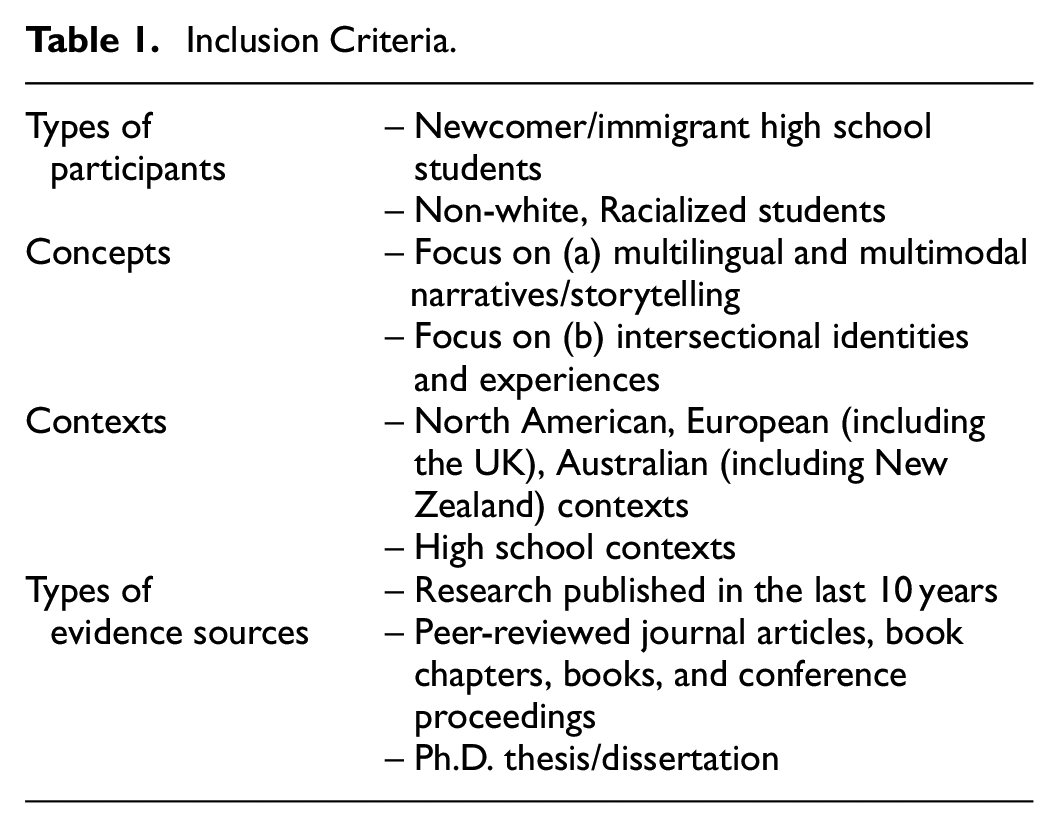
As illustrated in Table 1, one of the inclusion criteria involved was regarding the characteristics of research participants included in the evidence sources. The scoping review encompassed evidence sources that focused on non-White, racialized high school students from immigrant and refugee background families, who could be newly arrived or second/third generation students. We did not specify students from any particular racial or ethnic groups, so all studies focusing on immigrant students who were classified as linguistically and culturally minority students were included in the review. Such students are also those whose home languages are not the school’s primary medium of instruction. Regarding the concepts, we focused on two key ideas: (a) multilingual and multimodal narratives or storytelling and (b) the exploration of intersectional identities and experiences in and outside the school context. These concepts pertain to literacy engagement interventions that involve students in multilingual and multimodal literacy activities to examine racialized students’ intersectional identity negotiation. While multilingual and multimodal literacy interventions were the key component of the scoping review, we did not exclude studies based on their research designs as we also aimed to map out the types of methodologies that have been used in multilingual and multimodal literacy interventions (see Figure 2). The third inclusion criterion was with regard to the “context” of the study. We included studies conducted in North American, European, and Australian high school contexts because these countries and regions welcome the most immigrant and refugee students. The studies focused on both inside and outside the school contexts as long as they involved high school students in literacy activities. The fourth inclusion criterion was about the types of evidence sources. We included peer-reviewed scientific literature (e.g., journal articles, book chapters, books, Ph.D. theses, and conference proceedings) published within the last ten years (2012–2022). We excluded non-peer-reviewed research and MA theses as they may not normally be sufficiently peer-reviewed.
Inclusion Criteria.
Stage 3: Identifying Relevant Studies
To identify potentially relevant literature for the scoping review, we adopted a strategy that involved looking for research evidence through (a) electronic databases, (b) reference lists, and (c) the gray literature search. As the first strategy, we searched for research evidence via electronic databases, which generally include bibliographic information and abstracts of published research materials. We conducted bibliographic database searches on four Scopus through the University of Calgary’s library: ERIC, Education Research Complete, Academic Search Complete; and Research Starters-Education. We applied a three-step search strategy to these electronic databases. Before conducting any searchers on the databases, we developed some key concepts relevant to the research question (e.g., “intersectional,”“multilingual and multimodal narratives,”“identity,”“racialized students,” and “secondary schools”) and synonymous terms (see Table 2). The first step of the search strategy was to pilot the key concepts/terms to allow for refinement. An initial limited search of two electronic databases (ERIC and Education Research Complete) was conducted on 15 November 2022. During this search, we refined the keywords until they started yielding a sufficient number of relevant studies meeting the inclusion criteria.
Keywords/Search Terms.
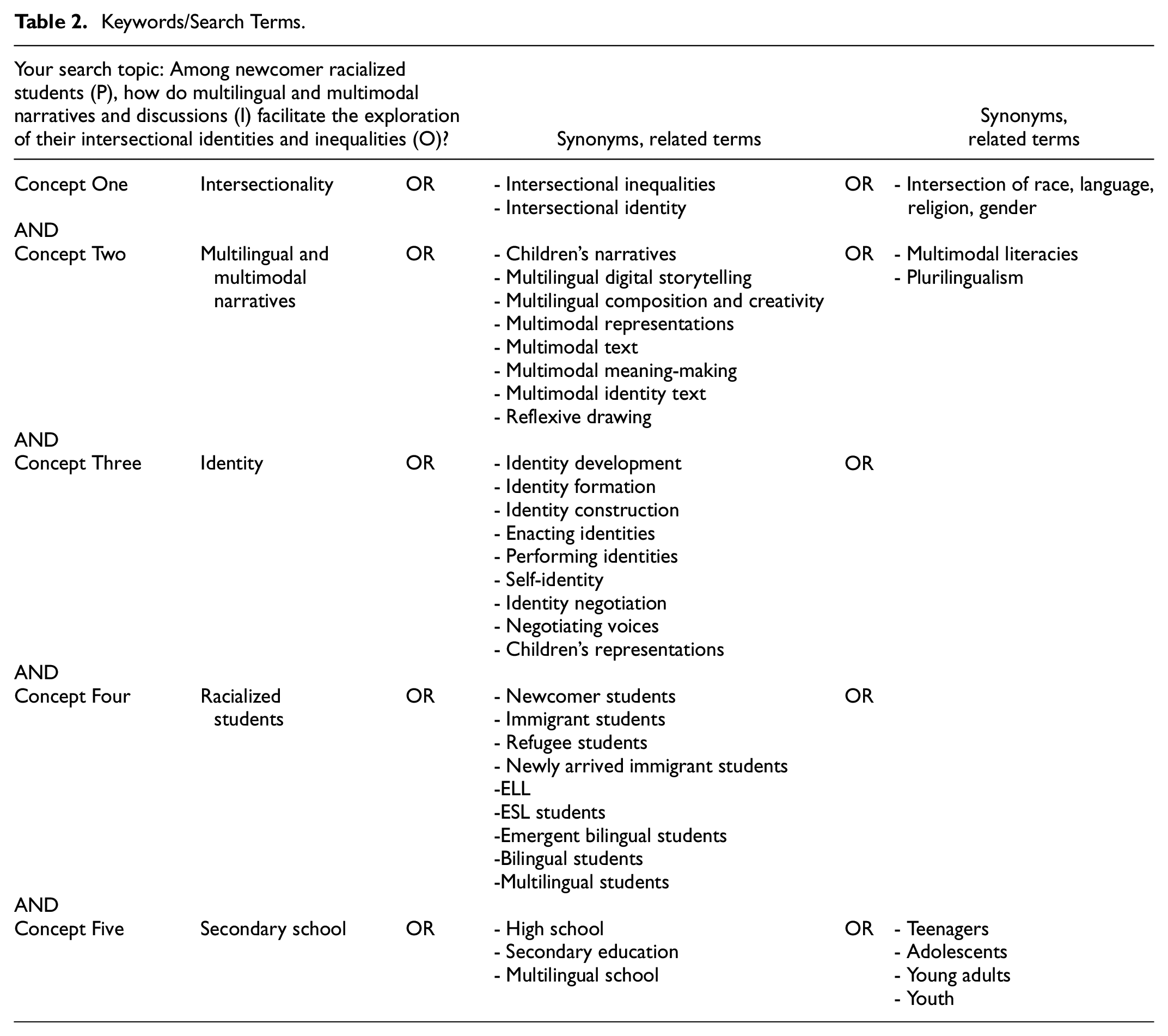
This next step was a quick scan through the text words in the title, abstract, and headings/subheadings of some of the retrieved papers, which helped to develop further search terms such as children’s narratives and multilingual digital storytelling. This strategy also provided some information on existing literature meeting the inclusion criteria. The third step included using all identified keywords across all four databases (November 18, 2022), resulting in a manageable reference list of identified papers. There were variations in the number of references yielded by each electronic database; for example, while the Research Starters-Education generated less than ten references, Eric generated 480 references.
We then checked the reference lists of some of the studies found through these four databases to ensure we did not miss out on important studies in the review. We identified some further references. Before we reached a saturation point where no new studies were identified, we also conducted a gray literature search following Godin et al.’s (2015) strategy that included a Google Scholar search and contacting experts. This process generated a further 14 references.
Stage 4: Selection of Evidence Sources
As illustrated in Figure 1, a total of 1,360 references were identified through all the four databases. All references obtained from the databases were retrieved using the export function in RIS format. They were then imported into Covidence, a software device used for managing and streaming scoping and systematic reviews, automatically removing 481 duplicates. Two reviewers then independently conducted a screening of 879 references by applying the inclusion criteria, in which they focused on reviewing titles and abstracts on Covidence. The two reviewers eliminated 853 irrelevant references that either did not follow the inclusion criteria, were not relevant to the objectives of the study, were focused on the wrong level (i.e., elementary), or were conducted in non-English languages. After the screening, the reviewers conducted a full-text independent review, and when they did not reach a full consensus in their independent screening, a third reviewer was brought in. The proportionate agreement between the two reviewers was 0.80769, which is relatively very high. Finally, 20 studies were identified that best fit the research question, which were included in a complete full-text review, with an additional 14 citations generated through the gray literature search. Out of 34 studies, 17 were further excluded: five had the wrong study design, four had the wrong population, and eight incorporated the incorrect age group. The remaining 17 studies were included in the scoping review.

PRISMA diagram.
Stage 5: Charting the Data
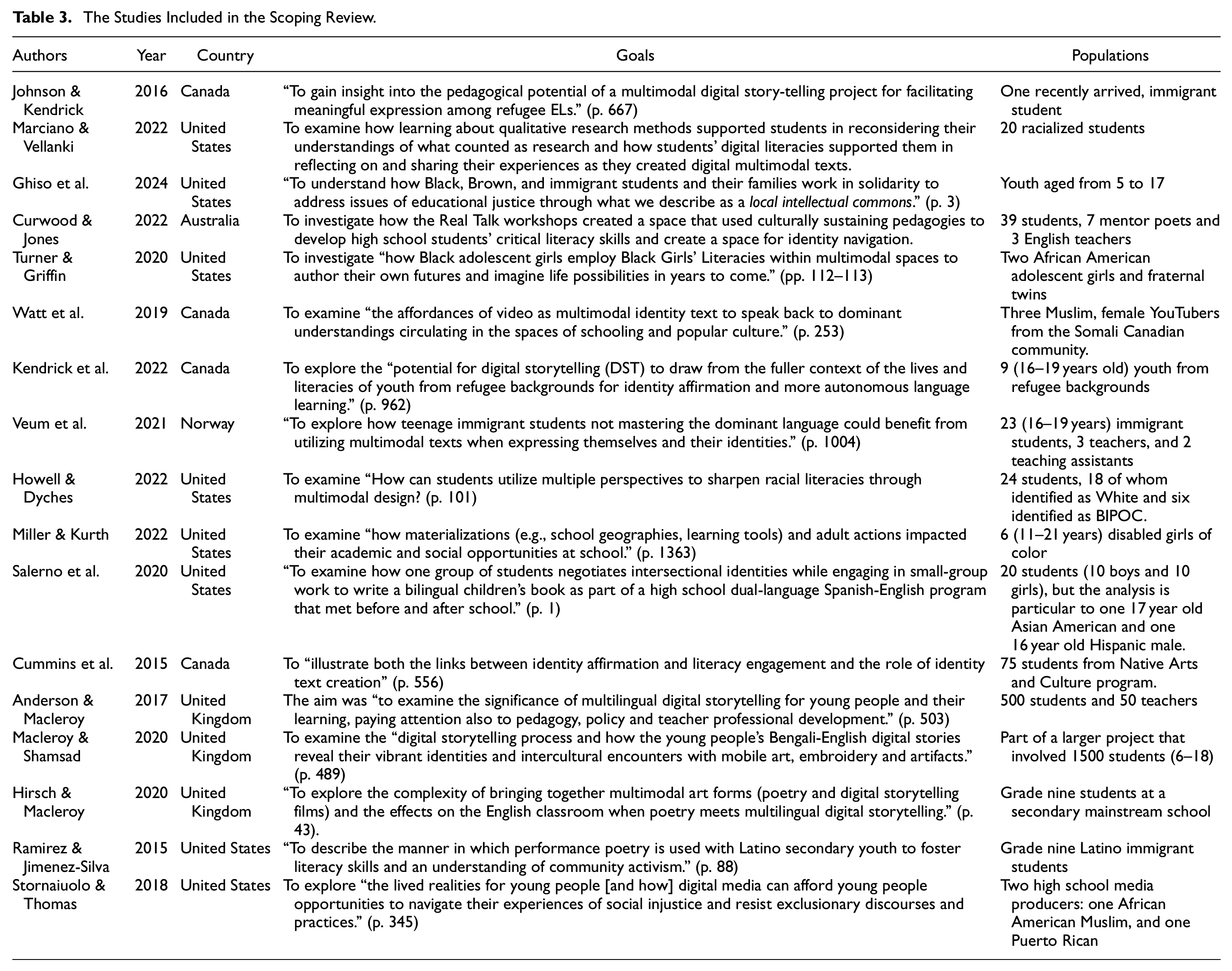
The final list of publications was then extracted, providing a logical and descriptive summary of the evidence sources. We particularly adopted a “descriptive-analytic” method (Arksey & O’Malley, 2005) for the data extraction, in which we charted some pre-determined items of information in the form of narratives: for example (a) date of publications, (b) country (where the study was conducted), (c) aims of the study, (d) study design (methodologies), (e) start and end dates of the study, (f) participants (their number and the method of recruitment), (g) description of multilingual and multimodal interventions, (h) kind of multilingual and multimodal texts included in the studies, (i) purposes of using those texts, and (j) key findings (see Table 3 for some key items of information from the selected studies). Although we started charting the data with some pre-determined items of information, as we progressed in the process, we charted some additional items, for example, the “kinds of multilingual and multimodal texts.” Adopting the narrative review approach, we recorded information about the “process” and “outcome” of the multilingual and multimodal literacy interventions. Two independent reviewers read all 17 studies: one of the reviewers collected and charted all the relevant information from the studies, and another completed the comparison for accuracy on Covidence.
The Studies Included in the Scoping Review.
Stage 6: Analysis of Evidence
All extracted data were exported into an Excel sheet, and we read the raw data twice to familiarize ourselves with the key information related to the research question. We then conducted a thematic analysis, with the data categorized and coded drawing on a preliminary coding scheme derived from Brown et al. (2003) and divided into three sections: (a) methodological features which included the variables such as year of publication, the context of the studies, and the types of research design, (b) intervention descriptors which contained trending multilingual and multimodal interventions and narratives, and (c) outcome measures which comprised the elements relating to the achievements of the intervention. The findings are discussed in several themes, based on these categorizations and coding.
Results
Literature Trends and Characteristics
Since the research on multimodal and multilingual literacy interventions began in the early 2010s, there has been greater momentum in the last few years. Table 3 showcases the current literature trends and characteristics of studies on multilingual and multimodal literacy practices in secondary schools in North America, Australia, and Europe. Out of the 17 studies included in the review, 11 were published after 2020. Although such studies have received attention in many countries and regions, nowhere is more attention paid to this than in the United States. In fact, 50% of the research included in the review was from different contexts in the United States, as opposed to 22% conducted within Canadian contexts, 17% in the context of the United Kingdom, 6% in European contexts (e.g., Norway), and a minority of studies (5%) conducted in Australia. All of these contexts highlighted an increasing focus on immigrant youth attending secondary schools. The research sites, however, were not necessarily limited to the school in that immigrant youth engagement was also explored at the community level.
We also recognized a diversity of age groups within youth-focused research. For example, Ghiso et al.’s (2024) scholarship included youths ranging from 5 to 17 years, Macleroy’s and Shamsad’s (2020) research encompassed participants ages from 6 to 18 years, and Miller and Kurth (2022) recruited youths from 11 to 21 years old. Some of the studies also included a narrower age range between 16 and 19 years (Veum et al., 2021), and others did not explicitly state the age of participating youth, or only mentioned their grade level. While the majority of research engaged strictly youth participants, some studies also included teachers, teaching assistants, and artists as research participants. For example, in Australia, Curwood and Jones (2021) incorporated mentor poets (n = 7) and English teachers (n = 3) with youth participation (p. 50).
Thematic Analysis of the Multilingual and Multimodal Interventions
Research methodologies
As Figure 2 illustrates, the studies on multilingual and multimodal literacy interventions have used a variety of research methodologies, primarily drawing from the epistemological orientation to “community-based participatory research” (Hacker, 2013). The most common methods was ethnography (41%), followed by case study (29%) and participatory action research (12%). Other studies (18%) did not describe any specific research methodologies but used used various qualitative data collection methods.
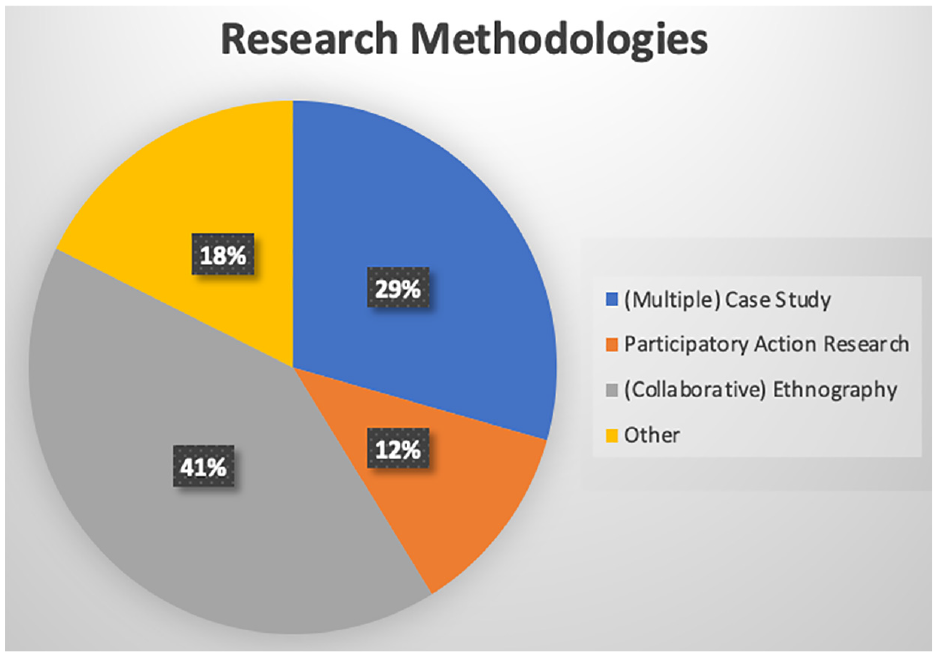
The research methodologies used in multilingual and multimodal literacy research.
Ethnography
The researchers employed multiple perspectives within the ethnographic paradigm. For example, Anderson and Macleroy (2017) adopted a critical ethnographic approach and linked it to ecological, collaborative, and multimodal perspectives. They employed a variety of data collection methods, including video-recorded and photographed observations, interviews with students, teachers, parents, and community members, video/audio-recorded team meetings, and documents (e.g., school policies, teaching plans and materials, students’ works, digital stories, and PowerPoint slides). Similarly, in what they called “critical ethnographic action research,”Hirsch and Macleroy (2020) claimed to have used an ethnographic methodology to draw on “qualitative, context-based, participatory, multiperspectival and interpretive approach” and action research to emphasize “process oriented, collaborative and emancipatory” outcomes (p. 47). As a workshop-based project, they conducted one-hour sessions per week with a small group of 10 ESL students who were selected based on their proclivity for creating group poetry. Video footage, interviews with the students, field notes, and digital stories were used as data sources in the study.
Macleroy and Shamsad (2020) also affirmed the use of a critical ethnographic approach, in which teachers and researchers worked collaboratively and dialogically with third and fourth-generation Bangladeshi youth in London. They also included an action research approach aimed at “developing a dynamic and creative pedagogical approach” through the research (p. 485). The data set included interviews with students, digital stories, video footage and images of creating the digital stories, students’ reflections on their stories, and field notes. Similarly, Stornaiuolo and Thomas (2018) referred to their research as a longitudinal ethnographic inquiry, in which, over a period of 4 years, adolescent students engaged in the co-creation of their school’s media lab. Within an ethnographic prototype, they encounter two students as case studies to document how they used “youth media as a form of political action” (p. 348). The data sources included a short documentary film, various artifacts related to the film (e.g., clips, storyboard, and video from the conference presentation), and interviews with the students.
Case study
Some studies used a variety of case study designs in their multilingual and multimodal research and also incorporated ethnographic methods such as participant observations and interviews. For example, Kendrick et al. (2022) referred to their research as a qualitative case study design, in which they claimed to blend ethnographic methods (e.g., participant observation, informal conversations, and artifacts) and multimodal/visual methods to document the lives of youths and their practices of composing multimodal texts. Their data collection involved participant observations, interviews with teachers and teachers, post-project interviews to understand students’ multimodal composing processes, students’ artifacts such as digital stories, and teachers’ unit/lesson plans.
Similarly, Curwood and Jones (2022) used longitudinal case studies of two young women of color to understand how their engagement in poetry workshops helped them “develop their personal voice and use spoken word as a way to express themselves and comment on issues prevalent in their world” (p. 51). In the original study (Jones & Curwood, 2020), they used multiple sources of data, including interviews and focus groups with students, mentor poets, interviews with English teachers, observational field notes, and artifacts such as students’ poems and the curriculum.
Howell and Dyches (2022) also used a case study method to document the impact of multimodal design on students’ racial literacy. The data set included field notes, students’ pre-and post-surveys, and students’ multimodal responses. Analogously, in a multiple case study design, Miller and Kurth (2022) engaged six disabled girls of color as different cases and five teachers, who were nominated by the student participants. The data sources included student interviews, focus groups, and student photographs, student maps, observations, and teacher interviews.
Participatory action research
Although they did not claim to be so, several of the studies of ethnographic and case study designs discussed above were, to some extent, participatory action research since the researchers collaborated with their participants to understand social and educational issues and experiences (McIntyre, 2008). Other studies overtly claimed to have used participatory action research methodology. For example, Marciano and Vellanki (2022) explicitly called their research youth participatory action research, in which they collaboratively developed and facilitated a curriculum, which included the organization of 20 research team sessions across 6 months. The youths participated in 15 sessions and worked in small groups to design and implement the project to examine the research questions they had developed. The main research team observed and audio-recorded the youth’s participation, in addition to including them as participants in interviews and focus groups. The data set also included artifacts (e.g., reflective researcher memos and social media messages between the youths and adult collaborators). In addition, the youths created digital multimodal compositions, following an activity during which they listened to a poem.
Ghiso et al. (2024) also used a participatory and community-based research design, which they believe entails shifting “the locus of inquiry from describing sociocultural practices or problems (…) to taking action to address inequities, for example, by co-creating educational spaces that align with community goals” (p. 6). The research involved university researchers, immigrant youth, and their families. The authors revealed their intent to develop an alignment of interests and expertise between community members and researchers to explore the ways to address “issues of educational inequality experienced by students and families of color and from immigrant backgrounds” (p. 6). The data sources included recordings of meetings (among the university researchers and between the university researchers and the youth and their families), artifacts produced during sessions (e.g., PowerPoint slides and multimodal images), and planning notes. Similarly, Veum et al. (2021) used a collaborative research design although they did not name any particular research methodology. In this study, university researchers collaborated with a school inspector, teachers, and teaching assistants to document students’ identity construction through multimodal texts.
The analysis shows that multilingual and multimodal literacy interventions have utilized a variety of research methodologies, often intersecting multiple methods of data collection. The strengths and developments in these studies are the increasing involvement of community members, which seems to address the calls for more community-based research projects in language and literacy education. There is also a growing trend of action research, in which university researchers seek to bring changes in the education system with close collaboration with community partners. There are, however, some limitations in the existing research. For example, most research still seems to use traditional research methodologies, rather than developing critical and creative research methodologies that fit well with an increasing trend of using multiple languages and modalities. Regardless of conducting multilingual and multimodal interventions, hardly any research has adopted a multilingual approach to the research per se; that is the lack of making the language dynamics visible in the research process. This then also relates to making explicit the researcher’s positionality in terms of their language ideologies. Regarding creativity in the research methodology, some of them have used creative design tools to engage students in literacy practices, but such research can go beyond that. For example, some research has used literacy workshops as one research tool, but the workshop itself can be used as a research methodology that centers on the equal autonomy of marginalized students (see Ørngreen & Levinsen, 2017 for the workshop as a research methodology).
Kinds of Multilingual and Multimodal Texts
The thematic analysis further highlighted the kinds of multilingual and multimodal texts that students have engaged with in the reviewed studies. As illustrated in Table 4, these studies engaged students and other collaborators in producing multilingual and multimodal texts, such as (a) digital storytelling texts (images and video) (b) spoken word poetry (c) photographs, and (e) bilingual books. Although digital storytelling and poetry were the most used multilingual and multimodal text types, most studies combined the above text types. In most studies, the researchers conducted follow-up one-on-one interviews and/or focus groups to have students reflect on the processes of creating their multilingual and multimodal texts, including the interpretation of their texts that reflected their lived experiences of identity development and negotiation.
Types of Multilingual and Multimodal Texts.

Digital storytelling: Still images and films
Composing digital texts to examine racialized students’ (intersectional) identities and social and educational experiences is one of the most common practices in multilingual and multimodal literacy research projects. For example, in Anderson and Macleroy (2017), immigrant students created multilingual digital stories to portray their powerful intercultural narratives of their lives in transit. In the filmmaking process, various art forms (drama, dance, and visual arts) were used. In the study, two focal students chose to compose a documentary-style digital story in which they included statements and poetry in both English and their home language (i.e., Greek). In their video, they spoke in Greek and utilized the background to show “harrowing scenes reflecting the migrant situation unfolding in the news media” (p. 505). This study shows the potential of using student’s home languages as an effective way to affirm their linguistic identity as well as to create a scaffolding for learning the English language.
Similarly, in Johnson and Kendrick (2016), the participating students were asked to create a short personal video including various visual and audio layers to provide them with a tool to express their experiences of adjustment in Canadian high school. The research team showed some examples of digital stories and informed the students that their videos would be shown to students, teachers, parents, and staff at the Welcome Center classrooms. This allowed them “to carefully consider which content they felt comfortable including in their stories” (p. 670). The students created their videos using the digital storytelling software Photo Story 3. Although the students were permitted to use resources at their disposal, they primarily used photographs and recorded songs in their digital stories, something the authors perceived was done mainly due to a lack of sufficient time to complete the project. This suggests researchers employing such interventions allocate enough time for students; it is also because many of such students are emergent bilinguals who need more time and support. While some students included their personal photos with families and friends, other students felt uncomfortable doing so, which indicates the importance of accounting for some ethical concerns when the researcher asks vulnerable students to use artefacts like family photos.
There are also studies conducted with 1.5 and second/third/fourth generation immigrant youth. For example, in Macleroy and Shamsad (2020), third and fourth-generation Bangladeshi-British youth from a secondary school in London participated in digital bilingual storytelling creation that linked them to their linguistic and cultural heritage. This spurred on a type of activism as they took “the Bengali-English digital stories into school assemblies and present[ed] a powerful message about language rights to their peers” (p. 484). Similarly, in some studies, youth media activists used videos to resist dominant discourses like stereotyping. For example, in Watt et al. (2019), three Muslim females from the Somali-Canadian community produced YouTube videos as identity texts to “speak back to dominant understandings circulating in the spaces of schooling and popular culture” (p. 253). The young Muslim girls did not see an accurate portrayal of their cultural, religious, or linguistic identities included in the Ontario provincial curriculum, and they found “stereotypical representations of Muslim women in the unofficial curriculum of the mass media” (p. 255). Consequently, they decided to use YouTube as a media space to represent their identities and perspectives by creating and sharing comic content. Watt et al. (2019) documented their experiences of digital activism with the goal of disseminating young girls’ experiences to educators, researchers, and community audiences.
With the growing prevalence of social media across various domains, interventions of this nature assume significant importance. They not only offer a means to comprehend the racialized experiences of immigrant youth but also provide a platform for fostering a discourse of resistance against hegemonic ideologies and practices.
Spoken word poetry
Another set of studies used poems (oral literacy texts) as a means of exploring the intersectional identities and experiences of racialized students. For example, Curwood and Jones (2021) worked in an Australian context using spoken word poetry to engage two women of color (from Indian and Nigerian backgrounds) “in identity construction, (to) resist oppression and construct counternarratives” (p. 50). The two participants engaged in the study had attended slam poetry sessions and had been mentored by professional poets in high school. As the authors maintained, spoken word poetry can have the potential to allow immigrant youth populations to process their educational as well as socioemotional experiences. Similar to digital storytelling, spoke word poetry can be used as a tool to resist domination; for example, in Curwood and Jones’ (2021) study, they illustrated immigrant youth’s “gender and racial stereotypes” and how they influenced their individual and family’s experiences (p. 52).
We found additional studies that used poetry along with spoken word films. For example, designed within an ethnographic research paradigm, Hirsch and Macleroy (2020) engaged students in crafting spoken word group poetry along the theme of belonging. The participating students were first given some examples of poems and then asked to analyze them to generate ideas for their own group poems. The researchers provided some objects, such as flags, photographs, and items of clothing that worked to stimulate their creative writing. These were later made into a digital story and then a collaborative film was produced that included the different languages and cultures of the students.
Marciano and Vellanki (2022) also engaged participating youths in creating poems, but unlike the two studies discussed above, the participants used their poems to create digital multimodal compositions. During a weeklong summer research institute, the youths were invited to listen to George Ella Lyon’s poem “Where I’m From,” and then were asked to write their own “Where I’m From” poems that could reflect “their lived experiences and perspectives” (p. 256). Later, the youths were asked to produce a 2- to 3-minute-long digital multimodal composition (i.e., video) on iPad using the iMovie app, in which they were asked to incorporate the poem they had created and images and sound. They were given approximately 5 hours to produce the digital multimodal composition. The authors claimed that composing poems and digital multimodal text “cultivat[ed] critical media literacies that Black and Brown youth can use to critique, rewrite, and dismantle the damaging narratives that mainstream media has written about them” (Baker-Bell et al., 2017, p. 124).
As demonstrated by the aforementioned studies, poetry emerges as a favored literacy practice for nurturing creativity and fostering resistance to domination among immigrant youths. These youths tend to naturally embrace various modalities in their literacy activities. Furthermore, effective literacy interventions should not only encourage the utilization of multiple modalities but also facilitate the flexible use of diverse languages. This approach enables emerging bilinguals and multilinguals to harness their complete linguistic repertoire to derive meaning from literacy texts.
Photographs
Miller and Kurth (2022) aimed to explore the experiences of disabled girls of color in United States schools through Photovoice, a qualitative research method that uses photography to guide participants’ participation. In addition to interviews and focus groups, the authors engaged six disabled girls of color in producing photographs of materialization or space in the school where they felt they belonged. The students were given open-ended prompts—for example, Where do you feel your ideas are most valued? What classroom materials or learning tools do you enjoy using?—that primed their selection of space and/or materials they wanted to capture in their photos. The photos portrayed elements that the students perceived created barriers to accessing certain school geographies and materials (e.g., pens, electronic devices, and educational materials); things they did not have access to, which they believed impacted their educational achievements.
In the context of Norway, Veum et al. (2021) also used photographs as multimodal identity texts to explore newcomer students’ identities and experiences. This intervention engaged immigrant student participants in sharing five photos they had been asked to shoot with their mobile phones and, afterward, writing a brief caption for each photo “to affirm the students’ identity and evoke their literacy engagement” (p. 1008). Before the students had taken the photos, they were prompted with two questions: “Who am I?” and “What is important to me?” The researchers importantly acknowledged that they chose “a relatively simple research design requiring minimal digital and technical resources” because of the lack of economic and technical resources available to participants, and the fact that “the students were struggling with the dominant language” (p. 1008).
While involving immigrant youths in interventions that use photos to express their identities and life experiences can aid in enhancing their multimodal literacy development, it may be even more advantageous to integrate these activities with other supplementary exercises that also encourage the use of various languages. Photo activities alone may not engage immigrant students as effectively as other multilingual and multimodal activities, such as digital storytelling.
Bilingual books
Salerno et al. (2020) examined how Spanish-English bilingual students negotiated their intersectional identities by producing a collaborative bilingual children’s book to share with elementary students. They used a method of “exploratory talk” (Barnes, 2008),“a way of trying new ideas and engag[ing] in joint thinking” (Salerno et al., 2020, p. 2), that involved the students in collaborative writing of narratives. The researchers first organized four sessions in which the students reviewed some examples of bilingual books, and then engaged them in planning their own storybooks. During the sessions, the students were provided with planning sheets in both English and Spanish, although the group preferred to use the Spanish version. They worked in a group of four as they began the process of creating “challenging ideas and seeking group input on joint decisions” with regard to the content of bilingual books (p. 5). The authors claimed that the “interactional processes provid[ed] unique opportunities for identity negotiation” in dual-language spaces (p. 5). Unlike other activities, bilingual books place a greater emphasis on language. These books aim to provide immigrant students with an opportunity to utilize their diverse linguistic skills when engaging in studies that necessitate them to navigate their own identities and comprehend various perspectives.
Key Purposes and Outcomes of Multilingual and Multimodal Interventions
The analysis shows that the current research on multilingual and multimodal interventions involved newcomer and settled students in creating various forms of multilingual and multimodal texts that not only worked as a tool to explore their lived experiences but also allowed students with resources to express and (re)negotiate their intersectional identities as well as to resist hegemonic discourses. These studies carried out multilingual and multimodal literacy interventions with various goals and purposes, such as to (a) express knowledge, experiences, and identity; (b) examine and address educational and societal issues and opportunities; and (c) challenge hegemonic ideologies, practices, and discourses.
Most studies in this scoping review used a multilingual and multimodal approach to foster opportunities for newcomer and settled students to express their (intersectional) identities—which highlights the evolving and shifting nature of identity—knowledge, and experiences in both educational and societal settings. For example, Veum et al. (2021) overtly discussed their goal to examine “how teenage immigrant students not mastering the dominant language could benefit from utilizing multimodal texts when expressing themselves and their identities” (p. 1004). Similarly, Macleroy and Shamsad (2020) aimed to explore how Bengali-English digital stories revealed second/third-generation youth’s Bangladeshi-British identities by engaging them in intercultural activities. In Cummins et al. (2015), Aboriginal youths were also able to explore their relationship to their land, languages, and ancestors through multimodal identity texts. The review, hence, demonstrates the strength of multilingual and multimodal literacy activities that have the potential to not only harness racialized students with tools to express their evolving identities but also to negotiate and resist those identities in case they are imposed with certain deficient labels.
For example, Salerno et al. (2020) invited bilingual students to negotiate their intersectional identities through an exploratory talk. In producing a collaborative bilingual storybook, the students engaged in dialogues and simultaneously negotiated their multiple intersectional identities. Such studies also focused on exploring the knowledge and experiences of racialized students. For example, Kendrick et al.’s (2022) study aimed to help students develop an explicit understanding of the core curriculum competencies and feel empowered to speak to the intricate intersections of their lived experiences and identities. These studies show the affordances of multilingual and multimodal literacy interventions in terms of allowing immigrant youths, who are emergent bi/multilingual, to communicate complex ideas and experiences. Such interventions can also be used to demonstrate social and emotional awareness through multiple representational resources. By using multimodal texts, the students also often feel empowered to exercise their own agency.
Further studies in this scoping review used multilingual and multimodal interventions to examine and address educational and societal issues for immigrant youth students. These studies used those interventions to help immigrant youth develop literacy skills so that they could understand their lived experiences and societal issues and, in some cases, act accordingly. For example, Marciano and Vellanki (2022) had two central goals: “(1) to position youth as active participants in examining issues of educational opportunity in their community, neighborhoods, and schools; and (2) to build from participants’ multiliteracies practices as strengths across all aspects of their engagement in the YPAR [Youth Participatory Action Research] curriculum” (p. 254). In this study, the participating students reflected on their varied identities and cultural experiences, and to address those differences, they produced digital multimodal compositions that reflected “their lives, providing insight into schooling experiences, perceptions of community, familial relationships, and cultural practices” (p. 262). The images and words that they used “challenged negative stereotypes of Black adolescent boys” (p. 263). In addition, the students developed research and literacy skills and were able to examine research topics that were meaningful to lived experiences, which then allowed the students to learn more about their societies and fellow students, and even challenge the deficit perspectives of racialized students.
Some studies engaged the youth population in identifying and resisting hegemonic ideologies, practices, and discourse through multimodal interventions. For example, the purpose of Turner and Griffin (2020) was to examine “how Black adolescent girls employ Black Girls’ Literacies within multimodal spaces to author their own futures and imagine life possibilities in years to come” (pp. 112-13). Through their digital texts, the girls critiqued the under-representations of Black Career Women. They highlighted their awareness of their own intersectional identities and how they imagined negotiating the under-representation of black women in professions like architecture and challenging barriers to their future professional success. In their multimodal texts, they selected, for example, the genres of music that reflected “the complex intersectionalities salient to their future-making, including religious identities (e.g., Black gospel/spirituality), Black youth culture (e.g., hip-hop), and racial identities (e.g., R&B, hip-hop, gospel)” (p. 126). They resisted the stereotypical professional identity of black women in the US.
Analogously in Watt et al.’s (2019) study, three Somali Canadian girls, who did not feel included in the school curriculum and observed stereotypical representations of Muslim women in the official curriculum of the mass media, created a YouTube video “to speak back to dominant understandings circulating in the spaces of schooling and popular culture” (p. 253). In their YouTube video, You Should Know About My Hijab, the Somali Canadian girls used various modes in the form of comics to resist the stereotypical narratives of covered Muslim women in Canada. Therefore, Watt et al. (2019) claimed that “video technologies open[ed] up new modes of meaning-making, with transformative possibilities for youth, their communities, and global audiences,” which also “provokes a rethinking of literacies and curriculum” (P. 253).
Studies included in this scoping review also intended to raise multilingual and multimodal awareness among racialized students. For example, Hirsch and Macleroy (2020) overtly stated that the “purpose of [their] intervention was to provide an alternative framework for students to engage with poetry and value multilingualism and digital technology within the English classroom” (p.46). In addition, as illustrated in Figure 3, multilingual and multimodal interventions can afford racialized students various kinds of literacy learning opportunities, including exercising their agency for themselves and others.

Affordances of multilingual and multimodal interventions.
Discussion
The primary aim of this scoping review was to achieve the following objectives: (a) identify the types of multilingual and multimodal interventions conducted to explore the intersectional identities and lived experiences of high school students; (b) analyze the methodologies employed in these school-based interventions and their execution; and (c) assess the utilization and application of multilingual and multimodal literacy interventions. The articles included in this scoping review illuminate the increasing trend of adopting multilingual and multimodal literacy interventions in high school contexts in industrialized countries with rapid flows of immigrant students. Since linguistically and culturally diverse students’ identity negotiation, investment, and affirmation in addition to their academic and social engagement at school “are directly related to their patterns of achievement and underachievement” (Cummins et al., 2015, p. 556), language and literacy researchers have lately become interested in documenting the lived experiences of newcomer students through multilingual and multimodal interventions. The analysis of the literature trends shows that although the last decade witnessed a surge in multilingual and multimodal interventions, the current decade has received greater momentum, which could also be related to the after-effects of the COVID-19 pandemic that has changed the mode of literacy learning practices. This trend exists in many industrialized countries welcoming newcomer students, but a greater amount of research has taken place in the North American context.
The thematic analysis first focused on scoping the research methodologies that are common in multilingual and multimodal literacy interventions, which revealed that regardless of using various qualitative research methodologies, researchers have designed their interventions from interpretative, participatory, collaborative, action-oriented, and community-based perspectives. Ethnography, case study, and participatory action research are the most used methodologies, often combining methods and perspectives from one another. For example, Anderson and Macleroy (2017) borrowed the action research method, which is principally process-oriented, collaborative, and emancipatory, in their design of critical ethnography. Similarly, Kendrick et al. (2022) applied ethnographic methods (e.g., participatory observations) in their case study design. The review demonstrates the significance of utilizing workshop-based approaches to designing multilingual and multimodal literacy interventions, in which researchers normally collaborate with teachers, community members (e.g., artists), and students to design literacy activities. Although some studies included in this scoping review have incorporated some elements of workshops, in which they engaged students in producing various multilingual and multimodal texts, they have not used workshop a research methodology. Based on the affordances of literacy interventions that the studies have demonstrated, literacy researchers can potentially utilize “workshop as a research methodology” (Ørngreen & Levinsen, 2017) to explore immigrant youths’ lived socioemotional experiences within a given space and time. Workshops can include various generative design tools (e.g., digital storytelling, spoken word poetry, and photovoice) in which students can use different modalities and languages to explore their own experiences and ways to change those experiences. The key strength of the literacy interventions included in the reviewed studies also lies in their co-designing of activities between different parties (e.g., teachers, students, community members, and parents). The analysis further unpacked various affordances of engaging immigrant youths in multilingual and multimodal literacy practices. The studies have used such interventions fundamentally to examine (a) identity affirmation, negotiation, and resistance, (b) racialized and minoritized experiences, and (c) the resistance of dominant discourses. The most common purpose of such interventions is to afford students with multilingual and multimodal literacy skills to express, negotiate, and resist their identities. Following Cummins and Early’s (2011) identity text creation as a multilingual and multimodal intervention, many studies have increasingly used identity texts as a tool to examine immigrant youth’s fluid identities. Almost all studies have engaged immigrant youths in identity-affirming activities in which they are asked to create identity texts using multiple languages and modalities, constituting “a counter-discourse that repudiates the devaluation of identity that is frequently embedded in educational structures and relationships” (Cummins et al., 2015, p. 558). In other words, identity texts have served as powerful tools for racialized immigrant youths to express and negotiate their social and personal realities while also creating a counter-discourse to the devaluation of their identities, languages, cultures, religions, and even literacies. In the meantime, they engaged in literacy activities drawing on various linguistic, multimodal, and artistic abilities. It is apparent in those studies that immigrant youths’ identities are fluid when they move across borders (or spaces) and times and the discourses creating inequalities and injustice are not necessarily based on their one given social category, but a multiplicity of inextricably inter-linked and mutually articulated categories (e.g., race, gender, religion, social class). This indicates a need to explicitly focus on the intersectional nature of identity in future research (see Compton-Lilly et al., 2017). Some limited studies (e.g., Salerno et al., 2020; Turner & Griffin, 2020) from this scoping review have focused on the intersectional nature of identities, but there needs more research employing an explicit intersectional approach to documenting multiple subject positioning of immigrant youths.
In addition to affirming their identities through multilingual and multimodal identity texts, such interventions have also engaged immigrant youths in creating digital stories to examine their lived experiences in educational and social spaces, which in turn also function as counter-narratives. The studies have used digital stories—inclusive of images and films—and spoken word poetry, and photography to document their lived experiences in relation to broader societal power relations that operate as causal factors in shaping experiences of discrimination and inequalities (Cummins et al., 2015). The use of multiple languages, texts, and modalities can afford opportunities for immigrant youths to engage in difficult conversations, for example, about race and racism, which, in other words, creates space for expressing and negotiating their voice. However, in the current scholarship on employing multilingual and multimodal literacy interventions, students are not necessarily engaged in difficult conversations on the issues of race and racism. The studies engaging racialized students in identity work can also integrate the issues of race and racism. In addition, as Harper (2002) discussed, photo elicitation, for instance, can evoke “information, feelings, and memories” that represent various discourses (p. 13), but there is rarely an explicit focus on engaging students in exploring their affective and emotive experiences and those in relation to particular spaces and times.
Conclusion
In conclusion, this scoping review has shed light on the growing trend of utilizing multilingual and multimodal engagements in literacy research and illuminated some promising affordances, such as exploring (a) identity (re)negotiation and resistance, (b) varied lived experiences, and (c) the resistance of hegemonic discourses. While the studies have rightly engaged immigrant youths in negotiating their identities and voices, such multilingual and multimodal literacy interventions need an explicit focus on the intersectional nature of identities, moving beyond single social categories to explore the multiplicity of intertwined and mutually articulated categories that influence students’ experiences. While some limited studies have begun to explore intersectionality, more research is needed to explicitly examine the multiple subject positions of immigrant youths.
Similarly, such interventions need to utilize digital technologies and multiple texts and modalities to help students develop their “racial literacy,” defined as “the ability to read, discuss, and write about situations that involve race and racism” (Sealey-Ruiz, 2021 p. 3), in addition to equipping them with multilingual and multimodal literacies. Such literacy activities should engage youths in conversations on the topics of race and racism in the current situation when racial/ethnic tensions are on the rise. Future research can explore the potential for multilingual and multimodal interventions to engage students in difficult conversations about race and racism. Incorporating racialized students into identity work can provide an avenue for addressing issues of race and racism within the educational context. Furthermore, researchers should consider incorporating multilingual and multimodal literacy activities to explore immigrant students’ affective and emotive experiences in specific spaces and times, providing a deeper understanding of their lived realities. Some studies have focused on immigrant students’ affective and emotional experiences, but they have hardly made the relations between emotions, racism, space, and time. This also indicates the need for such interventions to take an anti-racist approach (a) as a tool for disrupting whiteness and challenging internalized racism (b) and as working toward curricular transformation, intersectional analysis, and centering youth voice.
Another promising direction for future research lies in the potential utilization of some creative research methodologies; such as “workshop as a research methodology” (Ørngreen & Levinsen, 2017) which has the potential to delve deeper into immigrant youths’ socioemotional experiences as well as it provides opportunities for immigrant youths to collaboratively seek ways to change their situation. In order to engage students in exploring place-based experiences—which was evident in the review—literacy researchers can design their interventions to allow students to explore their relationship with places where they experience various social and emotional moments. One example can be “walking methodology”Lynch and Mannion (2016), which is a place-responsive research methodology that puts “attention to the more-than-human (ecological and other material) aspects that may have been forgotten in a more sedentary interview based indoors” (p. 341).
In summary, the findings from this scoping review suggest that future research should further explore the workshop as a research methodology, delve into the intersectional nature of identity, and engage students in conversations about race and racism while also exploring their affective experiences in educational and social spaces. These avenues of investigation will contribute to a richer understanding of immigrant youths’ lived experiences and identities in high school settings.
Footnotes
Author’s Note
This research was conducted while Dr. Pramod K. Sah was a postdoctoral scholar working at the University of Calgaryat the Transliteracies Research Lab with Dr. Rahat Zaidi. He is now at The Education University of Hong Kong and may be contacted at
Declaration of Conflicting Interests
The author(s) declared no potential conflicts of interest with respect to the research, authorship, and/or publication of this article.
Funding
This research was funded by the Eyes High Postdoctoral Award at the Werklund School of Education, University of Calgary.

Data Availability Statement
Data sharing is not applicable to this article as no datasets were generated or analyzed during the current study.