




Abstract
An unresolved dilemma facing many disciplines is how theory and practice can better work together to enhance the decision-making processes on the ground. This widely-known theory-practice gap often contributes to the misdiagnosis of problems and undermines the effectiveness of responses. Despite decades of research into why this gap remains, there is still a continuing and heated debate as to why it exists and how it could be resolved. This article examines the theory-practice gap through a systematic review that draws insights across diverse disciplines such as health, science, governance, and business. It builds a conceptual framework based on the findings, allowing for the analysis of the various drivers and solutions for addressing the gap. The findings show that to resolve this gap is necessary to change our perspective of the gap and understand it as a bilateral issue, where both theory and practice play a role in creating the gap. Thus, solutions to the gap need to follow a cyclical and integrative approach. As the gap may never be fully closed, the framework provides the tools to respond to it whenever it arises. Future research will be required to empirically test and advance the framework.
Plain language summary
This study aims to tackle the persistent problem known as the “theory-practice gap,” which has puzzled various fields, including public health, education, nursing, and many others, for decades. The gap refers to the challenge of applying theoretical knowledge to real-world situations effectively. Despite much research, the causes and solutions for this gap remain unclear. The study takes a multidisciplinary approach to answer three key questions: 1) What is the theory-practice gap, and what does it involve? 2) What causes this gap? 3) How can we address it? By answering these questions, the study creates a theoretical framework to understand the underlying issues of the gap. The review identifies various drivers that hinder the integration of theory and practice and evaluates their significance. It also suggests an innovative model centered on learning and reflection, emphasizing that theory and practice are interdependent. This model suggests that practical situations can generate theory through reflection and that theory can influence and improve practice. The study’s results provide a holistic approach to addressing the gap, integrating perspectives from multiple disciplines. It also highlights the need to develop tools for assessing the gap, particularly in knowledge translation. While this study is a crucial first step in accumulating and integrating knowledge about the gap, future research should aim to validate its findings among practitioners from different sectors and regions. Understanding and addressing the theory-practice gap is crucial in fields like climate change and ensures that theoretical knowledge can be effectively applied in practical contexts. This study offers a promising starting point for further research and practical solutions to bridge this persistent divide.
Introduction
Questions about the effectiveness and relevance of theoretical approaches to practice have been raised by many disciplines over many decades. The puzzling relationship between “what we know we should do” and “what we actually do” has generated widespread interest in research and critical debate amongst academics and practitioners to understand and address this gap between theory and practice (Knight et al., 2008). This gap is a persistent social problem that is widely acknowledged across research fields such as public health, education, nursing, the social sciences, management, accounting, medicine, psychology, foreign policy, and conservation, among others (Bockel et al., 2021; J.W. Neal et al., 2015). Despite these many efforts and years of research, we still do not know what really causes the gap and which solutions are most effective in addressing it (Greenway et al., 2019; Zieber & Wojtowicz, 2020).
The theory-practice gap refers to the situation where theory cannot be translated into practice or is not relevant nor applicable to real-life conditions (Bhagavatula et al., 2013; Greenway et al., 2019; Hewison & Wlldman, 1996). For example, Stark et al. (2000, p. 155) described the gap in nursing education as the “… disjunctions and tensions in and between educational, professional and managerial discourses and practices,” while Connelly et al. (2009), Jiang et al. (2020) and Magnusson (2020) describes it as a planning and implementation gap or solely an implementation gap. These recognitions of the gap are conceptualized based on the limitations on the application of knowledge in practice due to either human, technological, institutional, temporal, and other contextual factors (Bockel et al., 2021; Magnusson, 2020; Wahlgren & Aarkrog, 2021).The gap has also been referred to as the reality gap (Karlsson Lohmander, 2015), the research-practice gap (Scully, 2011), and the science-practice gap (Bhagavatula et al., 2013). These efforts have created an ongoing debate about what the gap is, what causes it, and how to address it (Bockel et al., 2021; Greenway et al., 2019; Z. P. Neal et al., 2015). However, much research is stuck in a debate about what the gap is, resulting in various concepts with multiple attempts to address it; mostly focused on how to close it, narrow it or bridge it. Consolidating this knowledge about the gap is crucial to resolving these issues. This is increasingly urgent as the gap influences the everyday tasks and activities of both researchers and practitioners and addressing it has the potential to improve the generation and application of usable knowledge.
The assumption of this paper is that there is a multidisciplinary and multidimensional theory/practice gap that is not yet solved nor clearly understood. This gap characterizes many issues identified in the generation, translation, integration, and implementation of knowledge in real-life conditions. Therefore, the review is focused on identifying and compiling information to answer the following three questions: 1) How is the theory and practice gap defined and what does it consist of? 2) What are the drivers creating the gap? 3) What are the approaches to address it? By answering these questions, the review then builds a theoretical framework of the theory-practice gap identifying the underlying issues of the gap that can be used as a guideline going forward.
This review provides an opportunity to identify the drivers that prevent the integration of theory and practice and evaluates their significance while identifying approaches to address the gap. As a result, it motivates future researchers with a foundation upon which to explore further why this gap exists and how it might be more effectively addressed in different fields and sectors. Section 2 describes the methods included in the study and sets out the systematic review protocol and subsequent analysis underpinning the results. Section 3 presents the results of the review describing and analyzing the types, drivers and solutions for the gap the literature has identified. Section 4 highlights key points that should be reconsidered in order to understand how the gap is viewed and analyzed. This section also suggests a conceptual framework that can potentially guide and address the theory and practice gap more effectively. The article ends with the main conclusions and future research directions.
Methods
A deeper understanding of how the gap develops is a crucial first step in raising awareness of potentially flawed beliefs about the gap. Given that there is a large body of knowledge about the gap, this study follows a systematic literature review method to identify, compile, and analyze research published about the gap in multiple fields (Petticrew & Roberts, 2008). This review method is particularly relevant to the objective of this study to build a theoretical framework for understanding the gap and its impacts. The use of a systematic literature review method complemented by a narrative analysis provided the tools to identify information scattered across different fields of study and analyze their content. Systematic reviews can be an effective tool for guiding transdisciplinary research which is required to achieve the objective of this study (Pickering & Byrne, 2014). By following this method, the review systematically mapped and reviewed the academic knowledge on the gap between theory and practice, identifying articles that consisted of definitions, concepts, types, drivers, effects and approaches to address the gap. The following section provides a generic overview of the review process. More detailed information can be found in the Review and Coding Protocol (Supplemental Material 1).
Parameters Terms and Keywords
For this review, Theory is understood as a set of ideas that explain observed facts or phenomena, or which sets out the laws and principles of something known or observed (Carr, 1986; Eraut, 2003; Van De Ven & Johnson, 2006). Theory can be descriptive providing concepts, ideas, and information describing the world around us, and/or prescriptive, such as planning tools, frameworks, and guidelines that prescribe for action in practice (Jenkins & Thomas, 2005; Wadd, 1982). Therefore, Theory is often related to the concept of practice as it provides the theoretical knowledge that guides practice. Based on this understanding, research, science, and planning are considered as Theory. Practice, on the other hand, represents the “action” professionals take, which is informed by the theory but also includes improvisation, critical thinking, and reflection (Collin, 1996). For this review, the concept of “Practice” is understood as everything done in the professional role including the set of activity-based meanings, and a set of condition-based meanings (Eraut, 2003). Therefore, Practice can be understood as the application of knowledge from theoretical and/or other resources.
These definitions guide the main concepts and keywords used in this review, which are theory, practice, gap, close, bridge, and narrow. Synonyms for these concepts were considered based on their relevance to the concepts and the review. The synonyms are science, plan, research, implement, action, policy, inconsistency, divide, contrast, and reduce.
Sampling the Literature
The review follows the Preferred Reporting Items for Systematic Reviews and Meta-Analyses (PRISMA) guidelines developed by Moher et al. (2009), as shown in Figure 1. This review focused on the academic literature only and excludes grey literature and other sources of knowledge in the Scopus and Web of Science databases published in English.

The review process, according to the PRISMA guidelines.
Search strings were developed considering the concepts initially identified to run the different search cycles. Concepts are combined with search operators (AND, OR) to form the search string: (theor* OR scienc* OR research OR plan*) AND (practic* OR implement* OR reality OR policy) AND (gap* OR inconsistenc* OR divid* OR contrast*) AND (clos* OR bridg* OR narrow* OR reduc*). The search string was modified to include the proximity operators of NEAR for Web of Science and W/n “within n words of” for Scopus to help find the keywords near one another and identify articles that are relevant to the review. However, it was no necessary to add a proximity operator for the closing, bridging, and narrowing keywords as the review does not aim to limit the findings to only articles that are focused on these types of approaches.
Screening and Eligibility of the Literature
After the initial sample was identified (3,655 articles), the screening process removed duplicates (n = 1,250), leaving a total of 2,405 articles to be screened based on their abstract content. The results of the search were screened in two stages: abstract and full-text screening. The abstract screening stage assessed the content of the abstract, demonstrating that the focus of the article is the theory and practice gap. The full-text screening stage identified in the content of the article’s specific sections to the theory-practice gap. The articles are screened based on the Inclusion/Exclusion Criteria established for each stage. The Inclusion/Exclusion Criteria established for each stage were tested by an external researcher to validate their replicability and reliability.
Analysis of the Articles
A total of 188 papers were qualitatively analyzed through content analysis by identifying documented data relevant to the coding categories and their relevant subcodes (see Table 1). This process involved a deductive approach where coding categories were established a priori based on existing theory or empirical studies. Following this stage, coding instances were reviewed in two rounds to cluster them according to similarities in content and summarized under different subcodes. Clustering findings under coding categories helped the analysis of the literature which is presented in the next section.
Coding Categories.

Results
This section provides results structured in four sections:
Characterizing the Theory-Practice Gap Literature
The results show that the gap has been observed and studied across different fields varying from nursing (Greenway et al., 2019; Rolfe, 1998; Scully, 2011) to education (Björck & Johansson, 2019; Carr & Kemmis, 1986; Collier, 1997) to management (Bansal et al., 2012; Tucker & Parker, 2014; Zaccaro & Banks, 2004) and environmental science (Adams et al., 2019; Bradshaw & Borchers, 2000; Zhang et al., 2018), among others.
Figure 2 shows that most studies are classified in Social Sciences 1 (124/188) and Health/Nursing (43/188) research fields. The gap and how to address it have been studied for several decades with the earliest paper published in 1967 (Conant, 1967; Luthans & Martinko, 1982; Susskind, 1973). Since 1990, research fields such as Science, Environment and Governance have published an increasing number of papers. The number of publications has rapidly grown from 4 articles published in 1967 to 1990 to 20 articles published only in 2020 (Figure 3). The relative distribution of the topics about the gap (i.e., concepts, drivers, types of gap, solutions) remains consistent even with the growth in the number of publications. Of the 188 articles in our database, 112 articles have explicitly discussed multiple topics, with the remaining 76 articles discussing only one topic.

Heat Matrix of fields publishing about the gap (x-axis) over time (y-axis). Dark colors represent higher number of articles.

Timeline (x-axis) showing the composition of research findings in the literature (y-axis: number of articles).
Conceptualizing the Theory and Practice Gap
The review contained a broad selection of synonyms and combinations of keywords (i.e., theory, practice and gap), thereby capturing broad and different terminologies and analogies under which the gap has been studied across fields. For example, the results show that the “gap” has been identified as a “no fit,”“distance,”“difference,”“separation,”“disconnection,”“divide,” and “chasm,” among other terms (Deadrick & Gibson, 2007; Rolfe & Jasper, 1993; Scales, 2020). Furthermore, it has been described under different analogies, that is, Knowing-Doing, Knowledge-Practice, Planning-Implementation, Planning-Practice, Research-Implementation, Research-Policy, Research-Practice, and Science-Policy, among others. The range of academic literature demonstrates the universal nature of the issue despite synonyms and analogies, as many articles describe a fracture between theoretical ideas and concrete realities in practice.
The various analogies recognize the role of perception in conceptualizing the theory-practice gap. Perception influences how the gap is recognized and framed, that is, translation gap, implementation gap, knowledge gap, communication gap, and efficiency gap, among others. For example, Klauer et al. (2013) identified a gap between science and policy, where researchers recognized that the gap is due to a lack of research uptake from politicians (implementation gap), and politicians perceive it as the inability of science to produce solutions to real problems (translation gap). Here, the perception of the gap influences its conceptualization and shows it shifts based on the points of view, resulting in multiple types of gap. Sandler et al. (2005) also argue that given its multifaceted nature, the gap has multiple dimensions and locations. In this review, there were limited definitions of the gap identified as the definition of the gap seems to be tied to the topic/discipline context and perception of the authors. Thus, most of the articles provided concepts for the gap rather than a definition.
The review identified four main types of gaps integrating common attributes of other gaps. These gaps can emerge in situations ante- and post-knowledge creation and application. For example, Mahmoud et al. (1992) identified three types of gaps that create the theory-practice gap in forecasting: the understanding gap, the data-sharing gap, and the political gap. The first type is related to the relevance of knowledge developed, as the knowledge (forecasts) produced by researchers is not often understood by those who will use them in practice. The second, data sharing gap, refers to the availability of data both for practitioners and researchers and the willingness to disseminate it. Finally, the political gap identified intrinsic contextual factors, such as hidden agendas in management, that affected the utility of forecasts. These gaps share the characteristics identified in the implementation gap, knowledge gap and translation gap. This shows that the overall gap is formed by types of gaps.
Drivers-Consequences of the Gap
Drivers
The review identified 211 drivers that create and/or expand the gap. The drivers were identified in Theory (91/211), representing the majority of factors creating the gap, followed by drivers in Practice (69/211), and lastly, drivers in Joint (51/211). This shows that the gap is not a unilateral issue (from theory to practice), but Practice also plays a role, as most of the drivers were identified in theory.
The drivers were organized into 11 categories: Accessibility, Capacity, Communication-Collaboration, Context, Funding, Institutional, Knowledge, Language, Motivation-Values, Relevance, and Time. Overall, the category of Motivation and Values (92 articles out of 154) was shown to be the most predominant driver influencing the gap over time. For example, underlying implicit interests from either theorists or practitioners influence both the creation of knowledge and its usability in practice. Closely to this category, followed Knowledge (73/188), Relevance (69/154) and Accessibility (66/154), which are predominately identified in Theory. The literature on these categories has been exponentially growing since 1967 to 1990, ranging from 1 to 3 articles published initially to 14 to 28 articles published in 2016 to 2021. On the other hand, Time (29/154), Funding (25/154), and Language (15/154) were not often recognized or discussed in the literature (see Figure 4). These seem to be independent issues from theory or practice, as little has been identified under these categories. Regardless, these overarching results do not demonstrate nor measure the potential of drivers in creating the gap. They demonstrate what type of drivers were mostly identified in the literature.
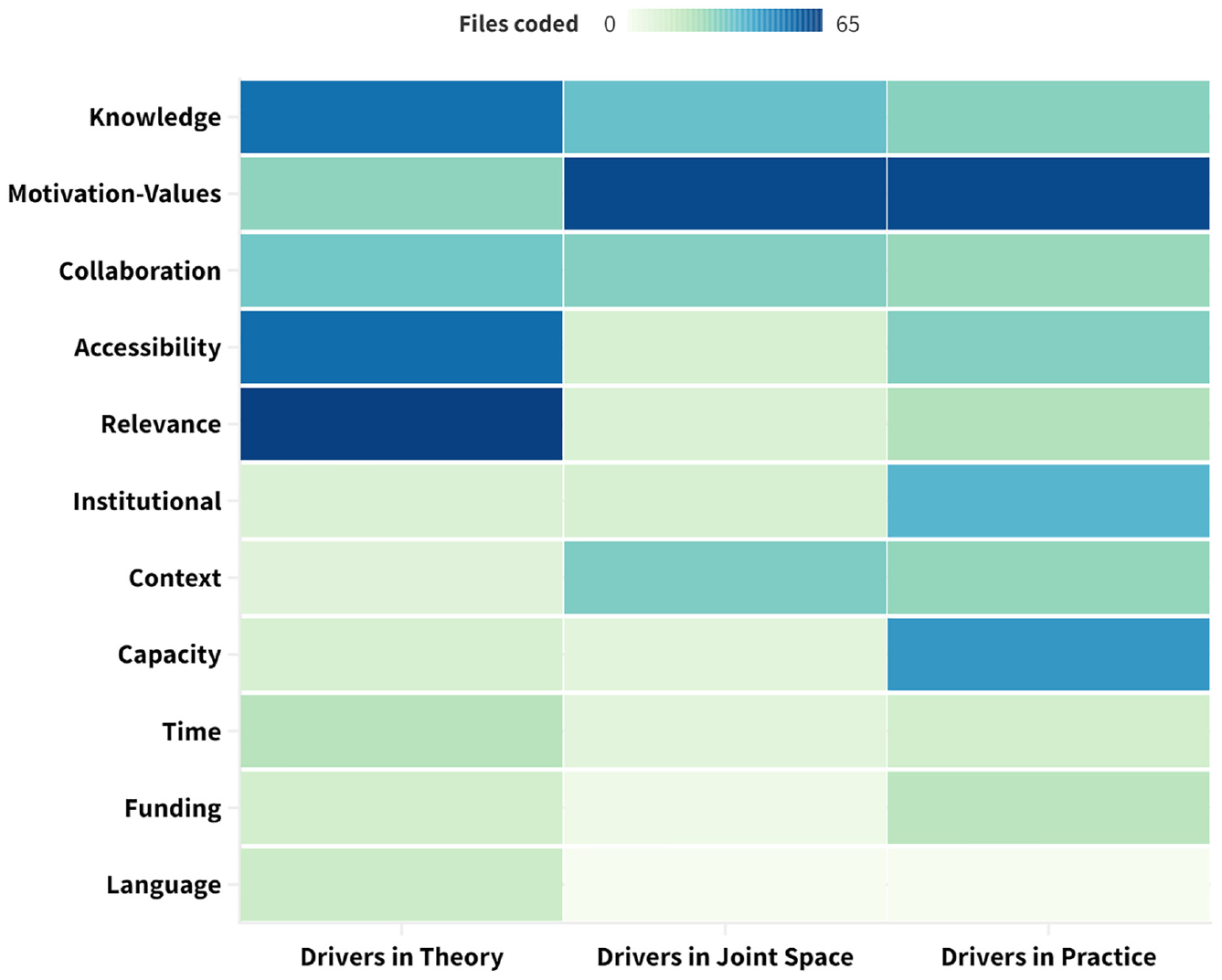
Heat Matrix of driver categories identified in three groups of literature (x-axis: theory focused, practice focused, and theory and practice focused) all drivers are classified under 11 subcategories (y-axis). Dark colors represent higher number of articles.
On many occasions, two or more drivers from different categories were identified in the same article. For example, Dany et al. (2016) identified drivers in Theory and in Practice that create a gap between research and policy in climate change adaptation. The drivers were identified in all the categories besides Language and Relevance. Drivers such as the lack of implementation of adaptation plans (lack of testing theoretical approaches in practice) in Knowledge, and the resistance from policymakers to incorporate evidence-based planning in Motivation and Time were jointly identified creating this gap. Similarly, other drivers were relevant to multiple categories, such as the driver “Lack of local incentives, mismatch of resources, and inadequate management capacity in practice,” which is relevant to the categories of Context, Institutional and Capacity. This shows that drivers have the potential to influence different systems and contexts; therefore, solutions to address them cannot be independent of each other, and solutions should be connected and integrated.
Consequences of the Gap
The literature on consequences and their direct connection with specific drivers is limited. The review identified 22 out of 188 articles that identified the consequences of the gap, and 20 out of 188 articles identified a clear connection between drivers and effects. This can be expected as the main effect of the drivers enhances the initial issues identified entailed in the different types of gap described in the previous sections.
The effects included a negative influence on practitioners’ perceptions of theory, a limited or delayed implementation of theory in practice, and a perpetuation of common misconceptions regarding theory, such as its inapplicability and relevance to practice, which ultimately enhanced the gap between theory and practice. The gap, as an effect, ends up creating other gaps (Stark et al., 2000); thus, the drivers and effects of the gap follow a cyclical process. Drivers create a gap that impacts the implementation of knowledge in practice. However, these effects have the potential to expand the gap. For example, cultural misunderstandings influence how theory is developed and perceived in practice, creating a distance between researchers and practitioners. Consequently, this distance creates a lack of awareness from research towards practitioner needs and critical issues and limits the involvement of practitioners in research.
Feldman et al. (1993) recognized this situation in nursing, where the gap between research and practice reflects a limited uptake of academic knowledge in nursing practice. It was recognized that nursing academia’s distance from practice results in researchers becoming less aware of critical issues and problems in the clinical setting, limiting its applicability, and relevancy to practice. This distance also limited the interaction between nurses and researchers, limiting collaborations that could promote the exchange of knowledge and expertise, which in turn can benefit the development and uptake of nursing research. This seems to create a never-ending loop of gaps, drivers, and effects. Ultimately, stakeholders, community, and/or end-users are the most impacted (Brown, 2019). Murray (2009) recognizes that the gap compromises the quality of interventions and threatens professionals’ abilities to address the needs of society hindering its welfare (Hays et al., 2019).
Addressing the Theory-Practice Gap
Solutions to address the gap have been extensively explored and discussed over time, and this has generated a proliferation and fragmentation of approaches across fields and contexts. The review captured more than 800 solutions across 176 articles. The solutions covered approaches to close (42/176 articles), bridge (121/176 articles), and narrow (18/176 articles) the gap, as these were identified as the most prominent approaches to address the gap. However, during the qualitative review of articles, additional approaches included balancing, integrating, aligning, filling, overcoming, lessening, connecting, linking, and solving the gap. During this stage, it was also identified that the typology used for the solutions (bridge, narrow, close) was used indistinctively in the literature except for Bansal et al. (2012), Glasgow et al. (2004) studies where there is a clear differentiation between closing and bridging approaches. These results suggest that the focus of the literature has been to identify solutions for the gap regardless of the typology used to describe them.
The review identified solutions for Theory (354 solutions, 135/176 articles) followed by approaches in the Joint group (260 solutions, 146/176 articles), and lastly for Practice (199 solutions, 96/176 articles). The results show that Practice solutions are not studied at the same rate as the others, which demonstrates that the current perspective of the gap is very much from theory to practice and not the other way around.
Within these three main groups, the solutions were organized under eight categories: Accessibility, Research, Communication, Capacity, Collaboration, Context, Knowledge, and Resources. The review shows that there has been an increasing interest since 2011 in solutions focused on Resources (129/176 articles), Knowledge (100/176 articles), Context (91/176 articles), Collaboration (83/176 articles), mostly recognized in the Social, Health and Environmental fields. On the other hand, the categories of Capacity (50/176 articles), Communication (46/176 articles), and Research (46/176 articles), and Accessibility (28/176 articles) were not vastly discussed since 2000; moreover, some of these were not considered in the 1967 to 1990 period (see Figure 5).

Composition of categories of solutions identified in the literature (x-axis: theory focused, practice focused, and theory and practice focused). Solutions are classified under eight subcategories (legend). Height of bar indicates the number of articles (y-axis).
Overall, the results show that Solutions to address the gap in many cases are complementary to each other. There are common solutions amongst groups and categories that require the involvement of both practitioners and theorists for their implementation and success. For instance, solutions in Collaboration, Communication and Capacity are closely tied to each other, that is, to improve the interplay between researchers and practitioners, it is required to increase the communication between them. This also will be necessary for them to have the adequate skills to translate and use information. A study developed by Aguinis et al. (2020) shows that to address the science-practice gap experienced in open science it was required to simultaneously update the knowledge production, transfer and sharing processes (Knowledge category), change the incentive structure (Context, Collaboration, and Language categories), improve access to training resources (Accessibility category), and promote shared values (Context category). A study in the research-practice gap in Bereavement, also demonstrates the need to integrate solutions to address the gap, suggesting the creation of two way communication with feedback between researchers and practitioners (Communication category), promotion of networking practice-based research (Context category), and the creation of interdisciplinary websites offering links to resources and direct access to research to practitioners (Resources category), among other solutions (Sandler et al., 2005). Therefore, it is important to consider these solutions as elements that can be integrated and adapted to address different sets of drivers of the gap.
Connection Drivers and Solutions
The review has identified solutions under the groups of Theory (91 articles), and Joint (97 articles) address Drivers in Theory. This demonstrates that articles identifying theoretical causes for the gap suggest solutions that influence both settings, recognizing that the responsibility for their application falls under both practitioners and theorists. This has also been observed in the case of Drivers in Practice, and Joint groups highlighted the importance of a joint perspective and effort to address the gap (see Figure 6).

Heat Matrix of the connection between subcategories of Drivers (y-axis) and Solutions (x-axis) of the gap. Darker green colors show a higher number of articles coinciding on a driver subcategory and a solution subcategory. Darker red colors represent a lesser level of coincidence.
Drivers of Motivation are mostly addressed by Solutions focused on Resources, Knowledge and Context. For example, Underwood and Waterson (2013) identified as drivers the loss of interest from practitioners towards research and its benefits and the perception of practitioners towards theory as conceptual. As solutions, Underwood and Waterson (2013) proposed the creation of intermediary roles that can act as an interface between researchers and practitioners (i.e., Resources-Role), the inclusion of extensive validation of theory in practice (i.e., Knowledge Management), and the motivation of practitioners to commit to the implementation of systemic techniques (i.e., Context-Conception). These solutions have also been suggested to address Drivers in Knowledge, Funding, and Institutional categories. This demonstrates the aggregability of solutions to address different drivers.
On the other end, there are a limited number of articles identifying solutions addressing Drivers in Language. Interestingly, these drivers are least being addressed by solutions under Research, Communication, and Accessibility, even though Language affects how research outputs are communicated and accessed. Guo and Kildow (2015) identified the unintelligibility of the language as a driver of the gap in which research is presented and communicated; however, solutions were focused on addressing how knowledge is created by promoting the involvement of practitioners in the development of science for this to be more relevant to policy. This collaborative approach has also been suggested in the nursing curriculum development and teaching activities, where the development of theory, including practical experience as a shared role between academia and practitioners, can positively bridge the gap (Duffield, 1991).
Discussion
This review has mapped the academic journal articles on the theory-practice gap across several disciplines. Here, we discuss the overarching reflections on the results and their implications for future research on how to address the gap. The main arguments propose a change in the current perspective of the gap and suggest a holistic approach to address it.
The Gap Is a Cumulative Complex Issue
This review has shown that there have been consistent efforts across multiple fields and disciplines to better understand the gap between theory and practice, what is driving it, and which solutions could solve this issue. The results demonstrate that the gap is a complex cumulative issue, as demonstrated by the multiple perspectives and understandings under which it has been studied. By the multiple perspectives and disciplines through which it has been studied, the gap is described as a different but interconnected issue. For example, the gap as a knowledge production and application issue encapsulates problems rooted in the process itself and all other contextual factors that influence its utility. This understanding also considers the mismatch between practitioners’ knowledge and the knowledge that can be known from the existing evidence or theory, that is, Knowledge gap (Dubois et al., 2020) (Guo & Kildow, 2015). This perspective also considers the limitations on the application of knowledge in practice due to either human, technological, institutional, temporal, or other contextual factors (Bockel et al., 2021; Magnusson, 2020). Thus, the gap represents a complex multi-factorial (Ferguson & Jinks, 1994), multidimensional (Armour, 2017), and multifaceted (Landers, 2000) problem.
Given the changes in the contextual conditions and also the changing needs of end-users, it is possible that the gap may persist over time (Gunasekaran et al., 2017) or widen with time even once addressed (Mahmoud et al., 1992). Therefore, any approach attempting to tackle the gap will require a continuing and iterative effort from all the actors involved. This will also require actors to acknowledge the limitations of both theory and practice. As Dozois (2013) recognizes theory in itself is limited given how it is developed, thus, it may never answer all of the questions and constant change of practice needs.
The Gap Is a Bilateral Problem
The results demonstrate that the majority of the literature sees the relationship between theory and practice as unidirectional. The amount of information on understandings of the gap, drivers and solutions identified for Theory is more than those identified for Practice. As illustrated by Bereiter (2014), this theory-first, practice-second approach has led to research that focuses mostly on Theory. Based on this perspective, the expectations of theory to cover all aspects and contingencies of a real-life problem leads to perceived gaps in theory that then become its practical failings. This unidirectionality may be a consequence of theory being used for theory’s sake rather than for the sake of practical utility (Barrett & Oborn, 2018).Regardless, as long as the gap is perceived this way, the relationship between theory and practice will continue to be challenging (Ayiran, 2015).
The fundamental problem, therefore, is how we currently understand the relationship between theory and practice. For example, Kvernbekk (2012) recognizes that Theory arises from problems encountered in practice; its function is to solve these problems and thereby transform Practice into an ongoing process. Under this type of relationship, if Theory can never fully explain and predict what will happen in Practice, Theory might be of no relevance to Practice (i.e. a gap between Theory and Practice) (Rolfe, 1993). However, this perspective does not consider inherited contextual factors that affect the relevance and utility of theory in practice, which once again will be overlooked in the creation of new Theory. Thus, it is evident that theory and practice are inseparable Wilsonthomas (1995), and we should reconsider the expectations of theory and practice and look at the relationship differently, as bidirectional (see Figure 7) (Haddow and Klobas (2004).

Diagrams contrasting the direction of how the theory-practice gap has been studied versus the model proposed by this review.
Such a reconsideration sees the gap between theory and practice as a two-way issue happening across different levels of activity and dimensions. Velt et al. (2020) and Wandersman (2003) recognize the bi-directionally of the research-practice gap in the contexts of Community Science and Human-Computer Interaction. In a bidirectional perspective of the gap, the community and practitioners have an active role in the creation of the gap and its solutions. This perspective requires the adjustment of our current views and expectations of “theory” and discovering new ways of conceptualizing what happens in practice. The review identified three articles that recognized this gap, thus further research in this direction is needed to explore how practitioners contribute to the gap and how they can solve it (Dozois, 2013; Gunasekaran et al., 2017).
The gap can thus be understood as a result of different gaps interplaying with each other. There is an evident connection and influence between the different types of gaps (see section 2 on drivers for the gap). The types of gaps demonstrate the interplay between theory and practice (see Table 2). These types of gaps identify issues arising at different stages of knowledge production and utilization, describing the issues with translating theory into practice (translation gap), the factors in practice that determine the use of theory in the practice space (implementation gap), the challenges with knowledge availability and completeness (knowledge gap), and the lack of integration of practical knowledge in theory (learning gap). For example, a lack of communication from practitioners to researchers influences the creation, translation, and application of knowledge. We create knowledge that is not relevant for practice; hence, it cannot be easily translated when handed to practitioners (translation gap). When knowledge arrives in practice, its implementation is hindered by contextual factors (implementation gap) that were not considered when knowledge was created due to a lack of feedback from practitioners to researchers (learning gap). Thus, we propose a holistic model to conceptualize the gap (see Figure 8), which recognizes the gap as a complex accumulative issue resulting from the interplay of other gaps. This model acknowledges the bidirectionality of the gap and the connexions between different gaps.
Types of Gaps That Create the Theory and Practice Gap.


The theory-practice gap conceptual model. The model demonstrates the connection between gaps and drivers which creates the theory-practice gap and proposes integrated solutions to address it.
The model has similarities to the process referred to as praxis, which represents “the unity of theory and practice” through the generation of “informal” theory out of practice itself. Praxis or “doing action” makes theory and practice mutually dependent on one another (Rolfe, 1993, p. 176). However, the model introduces the multidimensionality of the gap by acknowledging the interplay of other types of gaps.
How Do We Solve It? Tackle the Gap Holistically
As the gap is formed by numerous gaps, there is no one solution for the gap. Thus, approaches to address the gap should consider a holistic integrated approach. The solutions should address the underlying gaps (knowledge, translation, implementation, and learning gaps) while considering their interplay. Therefore, solutions should complement each other, be implemented in parallel and integrate different types of knowledge (Carter, 2008). Thereby, this holistic approach will be composed of multiple integrated solutions (Gunasekaran et al., 2017).
The holistic approach will require transdisciplinary efforts to be implemented. Given the complexity of the gap, the solutions cannot be delegated to either practitioners or researchers. The solutions will require collaboration between actors and sectors, where all are included. The gap will not be solved through monodisciplinary approaches, as no one discipline has the potential and knowledge to provide answers to all the drivers emerging from the different gaps (Christ et al., 2018). This review has made the first step for this approach as it has identified and grouped solutions from multiple fields in common categories. In addition, solutions for a specific driver have the potential to address other drivers (Section 3). This demonstrates the potential and capacity of solutions to be integrated despite the discipline and type of approach (bridge, narrow, close, and others).
The holistic approach should also consider the reality and practicality of these solutions, as there are factors in these solutions that can be problematic in reality. For example, assumptions such as that both scholars and practitioners are equipped with the required skills to perform the recommended actions or that they are willing to implement them (Gunasekaran et al., 2017) does not often consider real conditions. Several factors influence the potential success of this approach, such as the purpose or motivation of individuals in charge of implementing this approach, as well as time and money commitments, power relationships of the institutions and people involved, and hidden motivations of groups (Hirschkorn & Geelan, 2008).
Study Limitations
This review has several limitations that need to be acknowledged. For example, while it did follow a systematic review protocol, it was not possible to include all potentially relevant papers and fields. Therefore, the compilation of drivers and solutions for the gap are not a complete compendium of the published literature. Furthermore, the framework would be strengthened by populating with knowledge from other sources, such as policy briefs and reports that note many of the drivers and factors influencing the emergence of these gaps in practice. This is, however, a potential future area of research that can further strengthen the proposed framework.
Conclusion
Understanding and conceptualizing the gap between theory and practice has been an ongoing challenge for scholars and practitioners involved in multiple fields (Van De Ven & Johnson, 2006). The topic remains relevant today as both theory and practice influence and will continue guiding the everyday tasks and activities of researchers and practitioners. Thus, having a better and more robust understanding of the nature of the gap and the drivers creating it is critical for ensuring timely and adequate responses to such issues as climate change.
This review proposes a model centered on the principles of learning and reflection, as it suggests that theory and practice are equal and dependent on each other. This model follows Rolfe (1993)’s premise that theory can be generated from practical situations by reflection-in-action, and practice can be modified by the reflexive application of theory back into practice.
Our results presented in this review have the potential to transform our current perception of the theory and practice gap and provide an innovative approach to how to tackle it. The review successfully integrated perspectives from multiple disciplines and synthesized knowledge that provides a holistic approach to tackling the gap by acknowledging the multiple interacting gaps and their interlinkages.
We also addressed the need to develop tools to assess the gap. The potential area of research is assessing knowledge translation tools resulting from translating research studies and applying the same to improve the efficiency and effectiveness of intermediary functions in the knowledge conversion process. (Gunasekaran et al., 2017) The current study represents an initial step in accumulating and integrating knowledge on the gap, such as concepts, types, drivers and solutions. In the future, it is intended to test the extent to which the findings of the current study and the theoretical framework proposed accurately reflect the perceptions of “real world” practitioners. Replication of this study to directly identify practitioners’ views across sectors, organizational sizes, industry types, and beyond national boundaries would extend the context and, therefore, the transferability of the findings.
Supplemental Material
sj-docx-1-sgo-10.1177_21582440241228019 – Supplemental material for Across the Great Divide: A Systematic Literature Review to Address the Gap Between Theory and Practice
Supplemental material, sj-docx-1-sgo-10.1177_21582440241228019 for Across the Great Divide: A Systematic Literature Review to Address the Gap Between Theory and Practice by Estefania Arteaga, Robbert Biesbroek, Johanna Nalau and Michael Howes in SAGE Open
Supplemental Material
sj-docx-2-sgo-10.1177_21582440241228019 – Supplemental material for Across the Great Divide: A Systematic Literature Review to Address the Gap Between Theory and Practice
Supplemental material, sj-docx-2-sgo-10.1177_21582440241228019 for Across the Great Divide: A Systematic Literature Review to Address the Gap Between Theory and Practice by Estefania Arteaga, Robbert Biesbroek, Johanna Nalau and Michael Howes in SAGE Open
Footnotes
Authorship Contribution Statement
Declaration of Conflicting Interests
The author(s) declared no potential conflicts of interest with respect to the research, authorship, and/or publication of this article.
Funding
The author(s) received no financial support for the research, authorship, and/or publication of this article.
Ethics
Not applicable as the study did not required an ethics approval

Supplemental Material
Supplemental material for this article is available online.
Notes
References
Supplementary Material
Please find the following supplemental material available below.
For Open Access articles published under a Creative Commons License, all supplemental material carries the same license as the article it is associated with.
For non-Open Access articles published, all supplemental material carries a non-exclusive license, and permission requests for re-use of supplemental material or any part of supplemental material shall be sent directly to the copyright owner as specified in the copyright notice associated with the article.
