




Abstract
This descriptive phenomenological study driven by the place-identity theory investigated the historical and physical evidence that suggests that the Asante Kente is a home craft and a place-identity of the Asante people. Thirty-one (31) study participants were sampled using purposive and snowballing sampling techniques. The data garnered via in-depth face-to-face interviews, focus group discussions and descriptive observations were analyzed using the qualitative thematic analysis based on descriptive phenomenology. The findings of the study revealed that the discovery of the Asante Kente, the abundance and nomenclature of the weaving looms and accessories in the majority of homes at Bonwire, as well as the iconography of the Asante Kente weave patterns show the place identity history of the Asantes. The study contends that the Asante Kente encapsulates the history, political, and religious worldviews, values, and norms of the Asantes and as such must not be seen as a generalized African cloth.
Plain Language Summary
The purpose of the study was to investigate the anthropological evidence that affirms that the Asante Kente is a home craft and a cultural symbol that reveals the history, identity and values of the Asante people of Ghana. The study was conducted using the descriptive phenomenology under the qualitative research approach. Personal interviews, descriptive observations and focus group discussions were the means for collecting data for the study. Elders, Asante Kente weavers, Asante Kente traders, Asante Kente chiefs and all other important stakeholders in the Asante Kente production at Bonwire were involved in the study. A critical examination of the anthropological evidence including the material culture, homes and objects affirm that the Asante Kente is an age-long home craft and historically birthed at Bonwire in the Ashanti Region of Ghana. Likewise, the design iconography of the weave patterns and colour choices of the Asante Kente are ingrained in the history and culture of the Asantes. The study contends that the Asante Kente is uniquely Asante, and should not be considered as a generalized African cloth because each phase of its history and production reflects the Asante historical episodes and cultural ideologies. However, the shreds of physical evidence of historical sites at Bonwire need to be developed into tourist destinations by the Ministry of Tourism, Arts and Culture of Ghana to preserve the Asante Kente craft history and business at Bonwire in the Ashanti Region of Ghana.
Introduction
Asante Kente is one of the most valued, famous, and cherished handwoven African clothes of the Asantes of Ghana (Thirumurugan & Nevetha, 2019; Gristina, 2020). It is jealously protected as a royal and sacred cloth of the Asantes (Okyere & Denoncourt, 2021). The prestigious position the Asante Kente occupies is as a result of its direct relation to the place-identity history, culture, philosophy, religious worldview, accepted ethical standards, and value systems of the Asantes (Gyekye, 1996; Ofori, 2016; Adom et al., 2016). The Asantes are a group of people with a vibrant and influential kingdom that has dominated the political landscape of Ghana since the 17th century. The flourishing history and preservation of the traditions associated with the Asante Kente weaving are ascribed to its inextricable intertwining with the history and culture of the Asante people (Mensah, 2018; Okyere & Denoncourt, 2021).
Etymologically, the name of the cloth, Kente, is directly related to its art of weaving or interlacing various laid strands akin to a popular basket called Kenten in the Asante local language made from either palm rachis, straw, or bamboo strips (Asihene, 1978; Fening, 2006). There are various oral traditions often linked to the discovery of the Asante Kente weaving tradition. The popular oral tradition about the discovery of the Asante Kente weaving craft is related to two hunters who chanced on a big spider known as Ananse in the Asante Twi language that was skillfully weaving its web. They patiently observed how the spider tactfully interlaced various strands to produce the marvelous web. After careful observation, the two hunters who might have been friends (Micot, 2017) or brothers (Evans, 2021), replicated the woven web using raffia fibres (Gristina, 2020). The first woven fabrics were black and white. Later, various colored dyes experimented from the barks of trees were applied to the raffia strands to get different colored woven Kente fabrics. Later, a wooden loom was engineered by the Asante Kente weavers to produce the Kente in long narrow strips ranging from 7.5 to 11.5 cm which are later sewn into clothes of different sizes (Ross & Adu-Agyem, 2008; Adom et al., 2016). The men’s sewn cloth measures about 300 to 360 cm long shaped in a rectangular drapery worn with support on the shoulders similar to the Roman Toga as Bowdich (1966) noted. The women’s cloth is relatively smaller in dimension in a three-piece set, measuring about 180 to 200 cm long (Badoe & Opoku-Asare, 2014). The weaving of the Kente cloth among the Asantes is historically the prerogative of men, with traditions barring women from sitting on the loom (Evans, 2021), though they are allowed to perform roles such as the preparation of the yarns through spinning and dyeing of the raw cotton as well as the final sewing of the woven strips into clothes (Fening, 2006; Gristina, 2020; Evans, 2021). There are over 300 geometric designs woven into the Asante Kente in a consistent and rhythmic pattern with various philosophical, historical, and cultural interpretations (Thirumurugan & Nevetha, 2019; Okyere & Denoncourt, 2021).
Previous studies have explored the similarities in the traditional weaving practices in the Ashanti, Volta, and Northern regions of Ghana, such as the history, design, materials, and tools as well as marketing structures (Frimpong & Asinyo, 2013). Badoe and Opoku-Asare (2014) experimented with the use of the structural weave patterns of the Asante Kente as an indigenous instructional resource for textile design education in educational institutions in Ghana. Others have investigated the influences of European materials and tools as well as designs on the Asante Kente (Adom et al., 2016). Lartey (2018) studied the potential of using the traditional woven fabrics namely the Asante Kente, Ewe Kete, and the Fugu from the North as vehicles for achieving cross-cultural unity among the Ghanaian people. She produced Kente clothes that integrate the design concepts, techniques, and colors of the three traditional woven clothes, Asante Kente, Ewe Kete, and the Fugu from the North. Dotsey (2019) investigated the job potential of the Kete cloth weaving among the youth in the Volta Region of Ghana. The focus of the study was aimed at exploring the possible sources of funding for the Ewe youth to engage in the Kete weaving as a professional career and emphasizes how good finishing techniques could enhance the market value of the Kete clothes. Gristina (2020) recently conducted a case study of the “Kòrai x Kente” Project which is a fashion and textiles project aimed at social innovation and interculturalism between Ghana and Italy. Her study discusses how contemporary fashion products and accessories produced from Silician craftsmanship from the Asante Kente could be used as a contemporary tool in preserving the rich cultural heritage of the Asantes of Ghana and the Sicilians in Italy while promoting cultural syncretism between the two countries. However, she did not investigate the place identity history of the Kente in relation to the Asante people.
Frimpong, Opoku, and Seidu (2020) give a detailed account of the developmental phases of the Ewe Kete cloth in the Volta Region of Ghana. Though this study focuses on the Kete cloth of the Ewes which is different from the Asante Kente, it makes some serious revelations that need academic probe. For instance, Frimpong et al. (2020) disclosed that the Asante Kente is more famed than the Ewe Kete cloth because it receives great support from the Asante royal family and because of the early international exposure it had. However, they hinted that the patronage of the Ewe Kete cloth is a result of its naming which is “inextricably linked to history, proverbs, rites, and customs…” (Frimpong et al., 2020; p.436). Despite the truthfulness of the patronage of the Asante Kente stemming from international exposure and the support from the Asante Kente, what evidence suggests that its patronage, like the Ewe Kete cloth, also issues from the philosophies associated with the names of the weave patterns, design elements, and color choice directly associated with the beliefs, norms, history, and culture of the Asante people? As a famed symbolic fabric, what evidence shows that the Asante Kente offers an unparalleled voice speaking to the customs, beliefs, and history of its people? These gaps in the study of Asante Kente were filled by this study. The specific research questions for the study were:
RQ1: What historical and physical evidence suggests that the Asante Kente is a home craft in the Bonwire weaving community in the Ashanti Region of Ghana?
RQ2: How does the design iconography of the Asante Kente reflect the place-identity of the Asante people in terms of their history and culture?
Place-Identity Theory
This study was underpinned by the place-identity theory. This theory was introduced in the 1970s by Proshansky (1978, 1983) and was initially associated with the fields of environmental psychology and social geography. It is seen as “those dimensions of self that define the individual’s or group’s identity in relation to the physical environment using a complex pattern of conscious and unconscious ideas, feelings, values, goals, preferences, skills, and behavioral tendencies relevant to a specific environment” (Proshansky, 1978, p. 155). Applied loosely, place-identity refers to the aspect of identity linked to a place (Hauge, 2007; Hugh-Jones & Madill, 2009), “the image of the home area” held by people (Paasi, 2009). This aspect of identities such as memories, thoughts, and values are related to specific geographic settings such as home and neighborhood (Proshansky & Fabian, 1987; Twigger-Ross et al., 2003) or the social and cultural meanings which are identifiable to a group over time (Grey & O’Toole, 2020; Peng et al., 2020). This implies that the place-identity theory offers theoretical constructions on how identities of individuals and societies are formed and sustained as a result of the dependent relations they have with specific local, cultural, and historical conditions (Kenny et al., 2011). Those features of a place that reflect the identity of the group, such as physical attributes, cultural values, and historical associations (Peterson, 1988) must assist in distinguishing one place or people from another (Passi, 1986; 1991, 2002; 2003; 2009). In studies of the place-identity of places, researchers study the physical appearance and behaviors linked to a place including local traditions and inherited tangible and intangible cultures which have roots in a place (Peng et al., 2020).
The overarching purpose of this study was to investigate whether the Asante Kente is a home craft among the people of Bonwire. Owing to this, the place-identity theory that focuses on investigating the historical, cultural, and physical evidence that imposes a specific identity on a group (Proshansky, 1978; Peterson, 1988; Paasi, 2009) agrees with the theoretical conceptions of the study. The study was interested in finding out the physical appearances (Peng et al., 2020) that identify and distinguish (Paasi, 2002, 2009) the Asante Kente weaving home craft historically to the roots of the indigenous weaving community. Moreover, the study sought to find out shreds of evidence in the design iconography of the weaving patterns in the Asante Kente that suggests a place-identity to the Asante philosophies, beliefs, political and religious ideologies, accepted norms, and values in a typical Asante community, hence the adoption of the place-identity theory.
Method
Study Area
The study was conducted in the Bonwire weaving community in the Ashanti Region of Ghana (Figure 1). The people who reside in this community are Asantes. The Asante is the largest part of the Akan ethnic society in Ghana, the West of Africa. The Asante kingdom came about as a result of a military alliance between the people of Kwaaman, Mampong, Juaben, Bekwai, Kuntanase, Nsuta, Kumawu, Ejisu, Kokofu, and Asumegya that were independent Asante states to wage war against the Denkyiras (Adjaye, 1990). Thus, their name Osa Ntifo (people coming together because of war), was later corrupted by Asantefo (People of Asante). Upon becoming victorious, the first Asante King, Otumfuo Osei Tutu I was enstooled over the Asante Kingdom in the 17th century. The people are referred to as Asante Kotoko as a result of the fighting strategy adopted by the Asante warriors, who fought by squatting on the ground while firing their guns, Koto ko (squat to fight). The Asante people have adopted the porcupine (Kotoko) as their iconic symbol. The unity and mightiness of the Asante Kingdom were fueled by the Golden stool believed to have descended from the sky by a renowned priest who was a friend and adviser of Otumfuo Osei Tutu I, called Okomfo Anokye. The Golden stool is believed by the Asantes to contain the souls of all their kinsmen. Today, the population of the Asantes is estimated at over 11 million which is one-third of the population of Ghana, though 5,432,485 were reported to be residing in the Ashanti Region currently (Ghana Statistical Service, 2021).

Location of Bonwire (Blue marked area) on the map of Ghana.
Bonwire is located in the Ejisu-Juaben Municipal district in the Ashanti Region of Ghana. The people of Bonwire before they started weaving were farmers. They were located at a place called Nkyiniso community where water was really hard to come by. As a result, some of the men through hunting discovered the land of Bonwire and they realized the land had abounding natural resources including water and rich land for farming so the people migrated from Nkyiniso to Bonwire. The land had a lot of weeds, especially the Mysore thorn (Biancaeadecapetela) locally known as Were coining the name of the town, Bonwire (Quainoo, 2020). The town is well noted for the weaving of the Asante Kente in the Ashanti Region of Ghana.
Research Design
The study adopted the descriptive phenomenology research design under the qualitative research approach (Husserl, 1992; Sundler et al., 2019). This is because the study was rooted in the socio-cultural climate of the place-identity of a people (Adom, 2019) where a description and understanding of the meanings of participants’ lived experiences (Matua, 2015) on the Asante Kente was the focus. Moreover, the study utilized descriptive phenomenology because it aimed at carrying out an in-depth investigation and reaching the roots (Guillen, 2019) regarding the Asante Kente as a home craft and a cultural symbol of the place identity history of the Asantes. In understanding the place-identity of the Asante Kente from the lived experiences of the study participants, narrations, historical accounts, and stories regarding the historical development and general practice of the Asante craft were investigated as supported by the theoretical constructs in the descriptive phenomenology (Rizo-Patrón, 2015). The study was conducted over nine months from June 2020 to March 2021.
Sample Description, Selection Procedure, and Sample Size
Since descriptive phenomenology recruits only participants who have lived experiences on the phenomenon under investigation (Moser & Korstjens, 2018) to solicit the richest data to offer the required answers to the research questions for the study, two non-random sampling procedures (Patton, 2014) were adopted. The study participants recruited for descriptive phenomenology studies must meet specific criteria (Polit & Beck, 2012), as such the purposive sampling technique was adopted (Mapp, 2008) for this study. The foremost criterion for admitting the study participants was that each of them should have lived experiences (Frechette et al., 2020) regarding the history, culture, and practice of the Asante Kente in the indigenous weaving community selected for the study. The study participants recruited should have met any of the other criteria set. These included being a resident in the indigenous weaving community, familiar with the historical development of the Asante Kente as a result of personal practice, or being a legitimate member of a family with a historical record of practicing the craft. They must be knowledgeable in the historical and cultural onomatopoeia of the weave patterns and must understand their design iconography. The study participants were identified with the assistance of the leader of the Asante Kente Weavers Association at Bonwire.
Later, through the snowballing sampling technique (Baltes & Ralph, 2021), some of the already recruited study participants introduced the researcher to other hidden populations who were very knowledgeable and had lived experiences (Sharma, 2017) about the Asante Kente. Thus, the study participants comprised one (1) Kentenwinifohene (Chief of the Kente weavers) at Bonwire, four (4) direct family members of the discoverers of the Asante Kente at Bonwire, seven (7) Asante Kente weavers, five (5) Asante Kente traders, twelve (12) elders of Bonwire, the leader of Bonwire Kente weavers association (1) and the caretaker of the Bonwire Kente museum (1) totaling thirty-one (31) study participants were recruited for the study (Table 1). This sample size was deemed sufficient as data saturation was reached with further engagements not yielding any new data (Polit & Beck, 2017).
Breakdown of the Recruited Study Participants.

Data Collection Procedures
Prolonged engagements aimed at yielding comprehensive data to unravel and understand the lived experiences of the study participants were carried out using in-depth face-to-face interviews and focus group discussions (Moser & Korstjens, 2018) as well as unstructured descriptive observations (Mulhall, 2003; Smit & Onwuegbuzie, 2018). The in-depth face-to-face interviews and focus group discussions were conducted using a semi-structured interview guide. A preliminary version of the semi-structured interview guide was initially developed based on the operationalization of previous studies on the Asante Kente with the study’s research questions serving as a guide (Salmons, 2015). It was pre-tested on four Asante Kente weavers and two elderly residents at Bonwire. After that, a few corrections were made to improve the relevance of the questions based on the suggestions given by the participants and two skilled phenomenology researchers (Moser & Korstjens, 2018). The researcher assumed a passive observant role (Genkova, 2019), and patiently, without taking anything for granted (Smit & Onwuegbuzie, 2018), observed anything that could be of help in better understanding (Lincoln & Guba, 1985) the historical and cultural context of the Asante Kente using a semi-structured observation checklist with relevant constructs and specific foci of observation (Roller & Lavrakas, 2015). The specific foci of observation included the practice of the Asante Kente weaving in various homes in the Bonwire indigenous weaving community, the procedural steps in the weaving of the Asante Kente patterns as well as tangible historical objects and sites associated with the development of the Asante Kente. The COVID-19 protocols were duly observed by the researcher, research assistants, and recruited study participants throughout the period for the conduct of the study.
Ethical Considerations
An informed consent form (Denzin & Lincoln, 2011) that details the nature of the study, expectations from study participants, how the data for the study will be used, and the potential consequences of the study was designed. It was explained in the Asante Twi language to all the recruited participants, after which they all acquiesced by either signing or thumb-printing the form. The participants were also assured that their privacy would be protected through the use of participant anonymity and confidentiality where pseudo-identification was used for all personal information they disclosed (Fleming & Zegwaard, 2018). The codes used were BON for Bonwire, E for Elders, F for Family heads, AKW for Asante Kente Weavers, AKT for Asante Kente Traders, KH for Kentenwinifohene (Chief of the Kente Weavers), LKW for Leader of Asante Kente weavers association, PI for personal interviews, FGD for focus group discussion, followed by the number 1 to mean the first focus group discussion. For instance, BON-F-PI means a personal interview conducted with a family head at Bonwire.
Data Analytical Procedure
The data garnered for the study were analyzed using the qualitative thematic analysis based on descriptive phenomenology by Sundler et al. (2019). This is an inductive, data-driven thematic analysis grounded in the lived experiences shared by the study participants. As required, the researcher adopted an open stance while paying close attention to only the meanings of the lived experiences (Dahlberg et al., 2008) on the Asante Kente espoused by the study participants. The researcher began the analysis by engaging in an open-minded and thorough reading of the transcribed and vetted data from the recorded face-to-face interviews and focus group discussions as well as the information gleaned from the descriptive observations. Trustworthiness of the transcribed data was ensured by allowing nine key study participants to double-check if it was in unison with the lived experiences they shared during the study (Birt et al., 2016). Meanings from the lived experiences were carefully marked, vividly described, compared with each other, and organized into patterns. To ensure validity, thus, reflexibility, transparency, and credibility of the analysis and patterns that illustrate the meanings were compared with the originally transcribed data to form the emerging themes. These themes were organized into a meaningful whole through a series of written drafts. A final comprehensive report on the results illuminated with some of the key quotes from the study participants was written. Scholarly discussion of the themes from previous empirical studies was done with the place-identity theory in focus to shed new knowledge on the Asante Kente.
Results and Discussion
Historical Evidence of the Asante Kente as a Home Craft in the Bonwire Weaving Community
The first research question for the study was aimed at investigating surrounding evidence that shows that the Asante Kente is a home craft in the indigenous weaving communities. Based on the patterns in the transcribed data from the study participants, three main themes emerged which have been discussed below.
The Historical Account of the Discovery of the Asante Kente in the Bonwire Weaving Community
At Bonwire indigenous community, the origin of the Asante Kente, according to the study participants was associated with the discovery of Ananse, the Asante Twi word for the spider, weaving its web in 1720. This big spider, with an unusual size than the normal spider, was seen weaving its web. The discoverers of the weaving craft by Ananse were hunters who were blood brothers from the Asona clan and indigenes in the Bonwire town. These two blood brothers called Opoku Kuragu and Kwakye Ameyaw currently have their family building in the Bonwire community. This view ingrained in the lived experiences of the residents in the Bonwire community is shared by all the study participants who were engaged. The FGD interview with the direct blood relatives of the two brothers who discovered the Asante Kente revealed:
“Kuragu and Ameyaw were hunters. During one hunting expedition they got to a place called ‘Akokobo a wote’ (When the cock crows you will hear).” However, the exact spot was called “Ayewa Keseye” (a big earthenware bowl) in the Bonwire forest and that is where they saw the spider of unusual size which they had never seen before locally called Ananse spinning its web. It was beautiful to look upon, so they decided to learn it and it evolved to what today we call Asante Kente’ (BON-E-FGD2, Personal Communication, August 11, 2020).
This mythical spider (Figure 2) that is said to have taught the brothers how to weave, known as Ananse, has been personified in the oral literature of the Asantes as a wise and knowledgeable being, such that fictitious stories with moral lessons are referred to as Ananse stories. This reflects positively on the Asante Kente as a product of great wisdom. Contrary to the view expressed by Micots (2017) that the discoverers of the Asante Kente were friends, my findings shows that they were blood brothers. Their grandsons, one of whom has assumed the position of the family head, showed me the hunting implements (Figures 3 and 4) they used for their hunting expedition in the room they slept which they have preserved in their family house referred to as Anansekrom (Land of the spider; Figure 5). These novel items of the material culture in the family house of Opoku Kuragu and Kwakye Ameyaw offer additional anthropological evidence to the Asante Kente discovery narration as a product learned from a mythical spider at Bonwire by previous researchers (Frimpong & Asinyo, 2013; Lartey, 2018; Frimpong et al., 2020; Gristina, 2020; Eghan et al., 2021; see Figures 6 and 7).

An illustration of the Ananse whose web creation inspired the creation of Asante Kente.

The lamp used for hunting by Opoku Kuragu and Kwakye Ameyaw at night when they observed the mysterious spider in the art of weaving.

The guns used by Opoku Kuragu and Kwakye Ameyaw for hunting the night they observed the mysterious spider weave its web.

Refurbished family house of Opoku Kuragu and Kwakye Ameyaw at Bonwire.

Annual rituals are performed in the room of Opoku Kuragu and Kwakye Ameyaw in their family house for their blessings to sustain the Asante Kente weaving craft within the family.
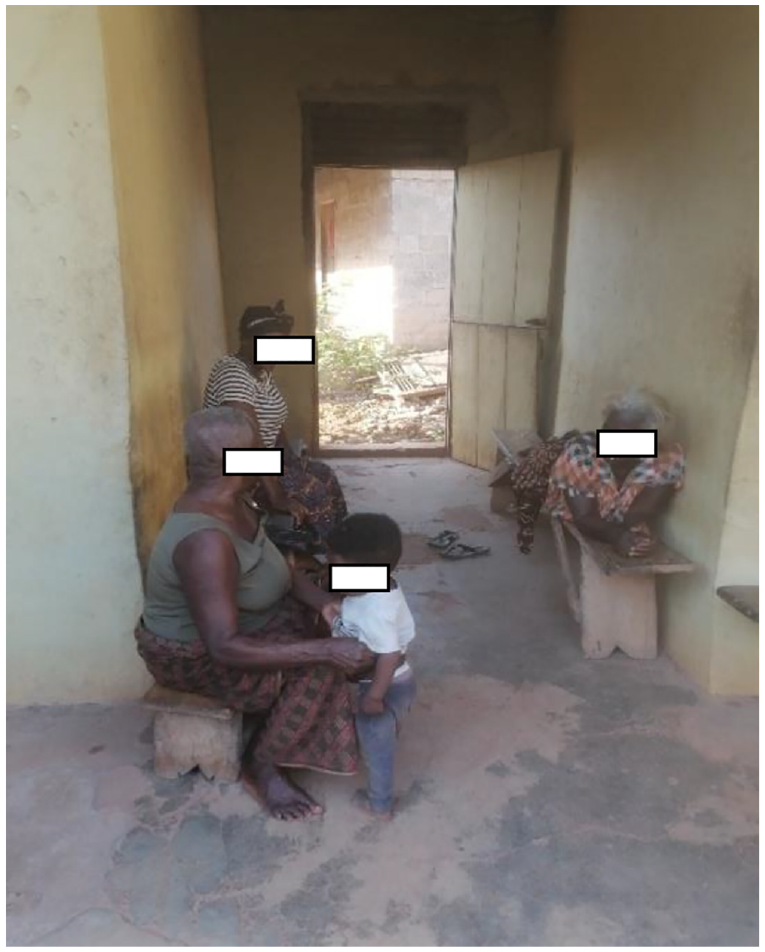
Great grand daughters of Opoku Kuragu and Kwakye Ameyaw in their family house at Bonwire.
The Kentenwinifohene (Chief of the Kente Weavers) at Bonwire narrated how the brothers tried to replicate the creation of the web by the spider using strands from head scarves called Duku. The family heads and the Asante Kente weavers held the same view:
“The brothers carefully observed the tactful way the spider wove its web. Upon their arrival at Bonwire, they started removing strands of thread in the head scarves worn by women known as Duku, to learn how to weave. They moved between the places they saw the Ananse and its web, Akokobo a wote spot, and their family house for forty days till they mastered the weaving skills. The first woven piece was called Asaase Ntoma (cloth done on the ground) with three pegs hinged on the ground to support the strands. This was followed by Ayaase Ntoma (cloth done on the waist) where strands are laid between the thumbs and the waist. Today, these two processes of the early versions of the Asante Kente are taught first when one wants to learn how to weave the Asante Kente. Later, they showed their woven pieces to the Bonwire chief, Nana Bobie I” (BON-E-KH, Personal Communication, August 25, 2020).
The leader of the Kente Weavers’ Association at Bonwire added that one of the finest woven clothes made with white cotton produced by the two brothers known as Fufuontoma (Plain woven white cloth), was shown to the Asante King, Nana Osei Tutu I who was thrilled by the innovation. He rewarded the two brothers by creating a royal stool and office in his cabinet for them. He pronounced each of them as Otumfuo Kentehene (Chief of the Asante Kente). These stools are jealously occupied by members from Opoku Kuragu and Kwakye Ameyaw family till date. They are responsible for weaving the Asante King’s Kente clothes.
Later, two other people further developed the initial Kente weaving craft by Opoku Kuragu and Kwakye Ameyaw. They were called Ota Kraban and Nana Osei Kuffour. Ota Kraban who was from the Oyoko clan developed the loom known as Nsadua Kofi for the weaving of the Asante Kente and introduced different colored yarns into the Asante Kente. The family heads mentioned that the first colors that were introduced were yellow, green, and black which are the colors of the Asante Kingdom. Nana Osei Kuffour from the Agona clan later introduced the varieties of geometric weave patterns into the Asante Kente. The family heads and the Asante Kente weavers affirmed that Ota Kraban’s contribution to the development of the Asante Kente was rewarded by the Asante King who created a new stool and office in his cabinet, making him the Oyokomanhene (Chief of the Oyoko clan). Later, Nana Osei Kuffour who introduced the first designs or weave patterns into the Asante Kente with philosophical interpretations that relate to the moral values, political thoughts, historical traditions, and culture of the Asantes was also rewarded with a newly created stool and pronounced as Kentenwenefohene (Chief of all the Asante Kente weavers). These newly created stools for the contributors to the Asante Kente craft at Bonwire were a family treasure and members in the respective families are to occupy the three stools from one generation to another.
The undisputable position and unparalleled quality of the Asante Kente as a flourishing traditional home craft of the people of Bonwire is vouched for by a song composed by Dr. Ephraim Amu, a respected father of Ghanaian traditional music composer. The song is titled Asante Bonwire Kente, menhuu bi da (I have not seen anything that can be compared to the Asante Kente from Bonwire). Since he is a respected and celebrated Ghanaian traditional musician, all the study participants used his song to affirm the historical position of the Asante Kente craft as originating from Bonwire. Though Dr. Ephraim Amu hails from Peki in the Volta Region of Ghana, he undeniably credited the Asante Kente to the people of Bonwire in his song, the study participants asserted.
The Nomenclature and description of the Loom and Its Accessories Enshrined in the Culture of the Bonwire People
The nomenclature and description of the tools and equipment used for the production of the Asante Kente at Bonwire are embedded in the Asante Twi local dialect and are affiliated with similar nomenclatures for other objects known in the Asante community. The name of the engineered hand device for the production of the Asante Kente and its parts emphasizes the place-identity of the Asantes. In an FGD interview with elders from a family at Bonwire with a long flourishing tradition of practicing the Asante Kente as a home craft, the researcher was told:
“The loom or Nsadua, a hand-operating device made from wood was engineered by Ota Kraban, an in-law of the two blood brothers, Opoku Kuragu and Kwakye Ameyaw, who discovered the Asante Kente weaving craft. The loom is referred to as Nsadua Kofi (Figure 8), the name for a male child born on a Friday. Friday is traditionally believed by the Asantes as a reverence day when the ancestors offer enlightenment to their kinsmen. As such, breakthroughs, believed to issue by the Asante deities and ancestors, often takes place on Fridays. A typical example is the Golden stool, Sikadwa Kofi, a sacred stool believed to be a repository of all the souls of Asantes enchanted by a traditional priest on a Friday. Ota Kraban, after weeks and months of deep contemplation on how to produce the Kente cloth in large sizes was blessed by the ancestors (Nananom) with the idea of conceptualization, design, and production of the Nsadua Kofi on a Friday. Also, he extracted colors from plant dyes. Later, he introduced colored yarns for the production of Asante Kente” (BON-E-FGD1, Personal Communication, September 9, 2020).
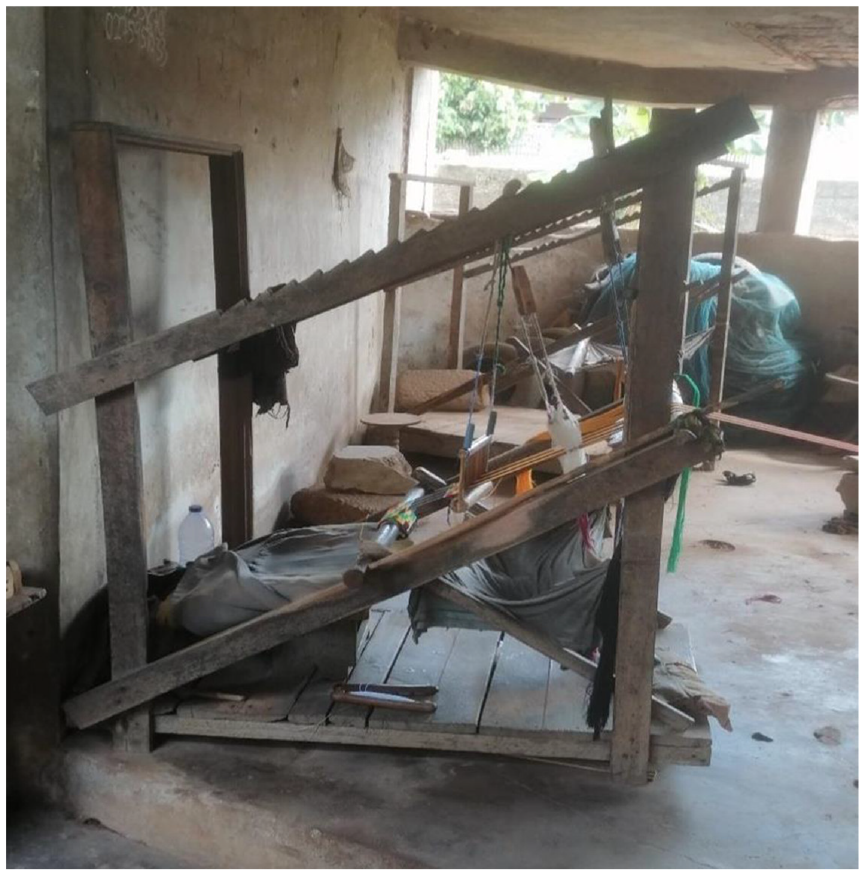
Nsadua Kofi, the hand-operating device engineered by Ota Kraban at Bonwire.
This indicates that the name of the loom is associated with a historic event as well as the beliefs and naming system accepted in the Asante community. Thus, the cultural meanings and religious ideologies of the objects (Grey & O’Toole, 2020), herein the loom used for the production of the Asante Kente craft reflects the place-identity of the Asantes. Interestingly, the names of the parts of the loom and its accessories are rooted deeply in the naming of items used in the everyday life of the Asantes (Table 2).
The Nomenclature of the Asante Kente Tools and Accessories in the Asante Place-Identity.

Physical Evidence in the Homes in the Indigenous Weaving Communities Shows that the Asante Kente Weaving Is a Home Craft and the Training Is Family-Based
The descriptive observation carried out in the entire Bonwire community offers physical evidence of the practice of the Asante Kente weaving as a home craft (Table 3). Averagely, 8 out of 10 indigenous homes and 5 out of 10 modern homes in the community I spotted through physical counts had the Nsadua Kofi loom and shreds of evidence for practicing Asante Kente weaving. These figures exclude over 40 shops at Bonwire that have been set up primarily for commercial activities in Asante Kente. Many of the Nsadua Kofi looms situated in the homes were aged between 50 and 80 years old, giving evidence of the practice of Asante Kente weaving as a flourishing home craft. I observed the Nsadua Kofi looms at the inner spaces, corridors, frontiers, and backyards of the buildings.
Homes at Bonwire That Suggest the Practice of Asante Kente.

One family head told the researcher:
“While I was just a young child about 5 years, I saw my grandparents, parents, and uncles practicing the Asante Kente weaving even though some of them had other secondary occupations such as electric/electronic technology, plumbing, and teaching. Now over 80 years old, I have protected these Nsadua Kofi for the young generation and I have to do so for the unborn generation of my ancestry” (BON-F-PI, Personal Communication, October 23, 2020).
Children, who want to learn Asante Kente weaving, mostly learn from their homes since they already have access to the looms. Most of the Asante Kente weavers interviewed mentioned that they informally learned the Asante Kente weaving from their family members. One of the Asante Kente weavers said:
“I observed my father and uncle weave Asante Kente after school and during weekends in my home. When he is tired and takes a walk, I sit by the Nsadua Kofi loom to weave. When my father comes, he will correct me if I missed any of the steps required. Gradually, I learned the Asante Kente weaving skills because it was a home craft” (BON-AKW-PI, Personal Communication, October 27, 2020).
Other Asante Kente weavers disclosed that the laying of warp yarns and the preparation of weft yarns worn onto bobbins and inserted into shuttles with the aid of the Afidie (bobbin winder) was everywhere in the house. They observed their mothers and elderly siblings do it to help their grandparents. As a result, they also learned the skills informally. Some of the Asante Kente weavers stated that their parents and grandparents made a conscious effort to officially teach them the weaving skills because they saw it as a cherished family home craft that needed to be passed on to children in the family. One of them told the researcher:
“My family (Father and grandfather) discussed openly with me and my brothers the need for us to learn the Asante Kente weaving craft. They said it’s a cherished family craft that we must hold on to even if we decide to do other jobs. They assured us that we needed to keep the craft within the family and pass it on to our children while encouraging them to do the same to their children. We started our family-based training by practicing how to weave the Asaase Ntoma and then the Ayaase Ntoma. We followed it up with learning to lay the warp yarns and preparing the weft yarns. We were taught the basic weaves, beginning with the plain weave and then progressed to the more complex weave patterns. Gradually, we mastered the skills and started weaving for our family’s customers” (BON-AKW-PI, Personal Communication, November 7, 2020).
I was told by the family heads and the leader of the Bonwire weavers’ association that the people of Bonwire normally start to weave between the ages of 8 and 16 years. The mode of training or system of training is not systematic, it is a try-and-error process and most parents do not force their children to weave though they make them know that it’s an important and cherished craft they must help to sustain. The children normally decide when they want to start weaving. The informal system of training through apprenticeship and the inherited Nsadua Kofi looms which is a family treasure observed have been reported in the literature (Asamoah-Yaw, 1994; Badoe, 2005; Adom et al., 2016). Yet, the training is usually offered by skilled family craftsmen who pass the skills to their children, nephews, nieces, and grandchildren because the Asante Kente weaving is seen as a home craft that must be sustained by all in the family. The abundance of old, weak, and non-functioning looms in the homes are cultural objects that give historical evidence of the Asante Kente as a cherished home craft at Bonwire. Yet, their abundance is a result of the cultural taboo in the Asante community that old looms are not supposed to be destroyed (Rattray, 1927; Amissah & Afram, 2018; Evans, 2021; see Figures 9–12).
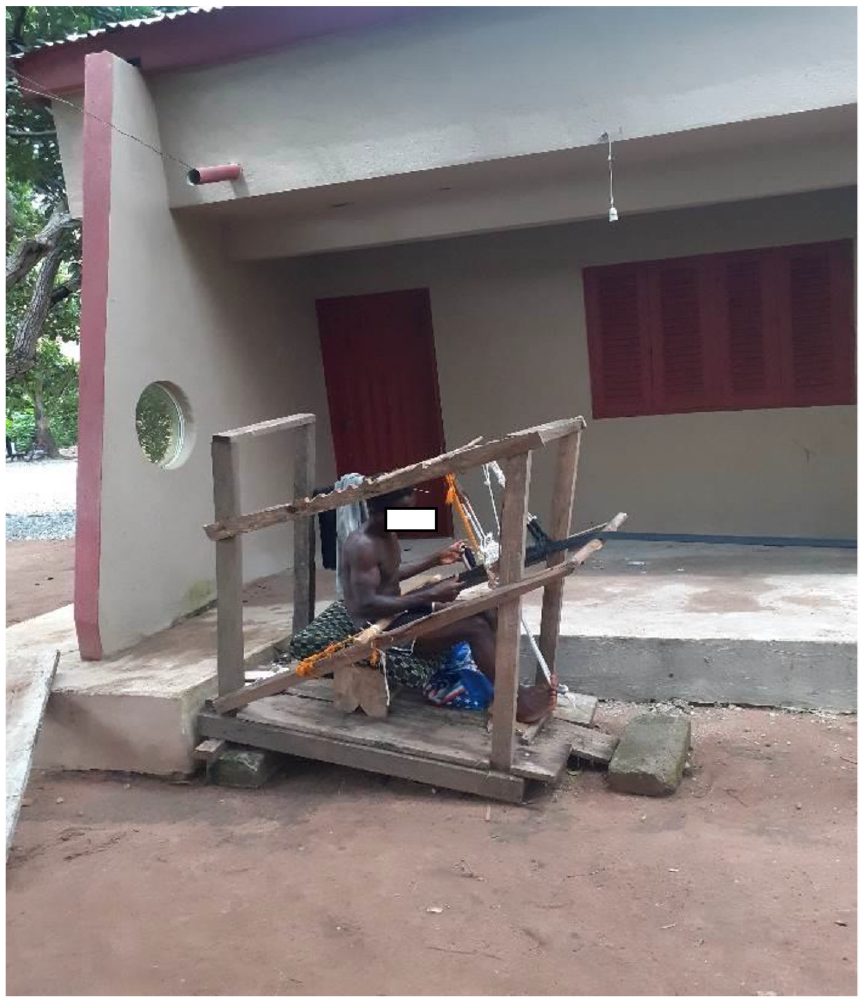
Physical evidence of Asante Kente weaving as a home craft and family-based craft.

Physical evidence of Asante Kente weaving as a home craft and family-based craft.

Physical evidence of Asante Kente weaving as a home craft and family-based craft.

Physical evidence of Asante Kente weaving as a home craft and family-based craft.
Asante Kente: A Reflection on the Place-Identity of the Asante People
This section discusses how the naming and design iconography of the Asante Kente weave patterns and color scheme reflect the place-identity of the Asante people. Two emerging themes from the patterns in the data garnered from the study participants under this research objective have been discussed. The findings of the study revealed that the Asante Kente weave patterns have various names that are associated with known personalities in the Asante community and Ghanaian society at large. Moreover, some of the weave patterns reflect historical events in the Asante community, the religious ideologies, concepts of governance, and accepted ethical and moral values that are akin to the place-identity of the Asante people.
Asante Kente Weave Patterns: Reflective of Renowned Personalities in the Asante and Ghanaian Communities
Some Asante Kente patterns have been named after individuals because of their good works and sometimes the prestigious positions they occupy among the Asante people or the larger Ghanaian community. Some of these weave patterns have been presented below.
Fa Hia Kotwene Agyeman (Take Your Worries to Agyeman)
This Asante weave pattern extols the good virtues of Otumfuo Osei Agyeman Prempeh I, an exemplary and generous Asante King who ruled the Asante kingdom between 1888 and 1931.
He was a very welcoming, humble, down-to-earth king who was approachable to all his subjects. He opened his royal gates to the oppressed and the poor, offering assistance to their needs. Thus, it became a saying in the Asante community that when an Asante is hard-pressed in finances, s/he should not hesitate to let Otumfuo Osei Agyeman Prempeh I know because he will help. This weave pattern (Figure 13) is a reminder of the exemplary kingship of Otumfuo Osei Agyeman Prempeh I and reminds all Asantes to emulate his great qualities. I was informed by the family heads that this Asante Kente weave pattern could be woven and given as a gift to someone who walks the path of love, kindness, and selflessness to help others in need.
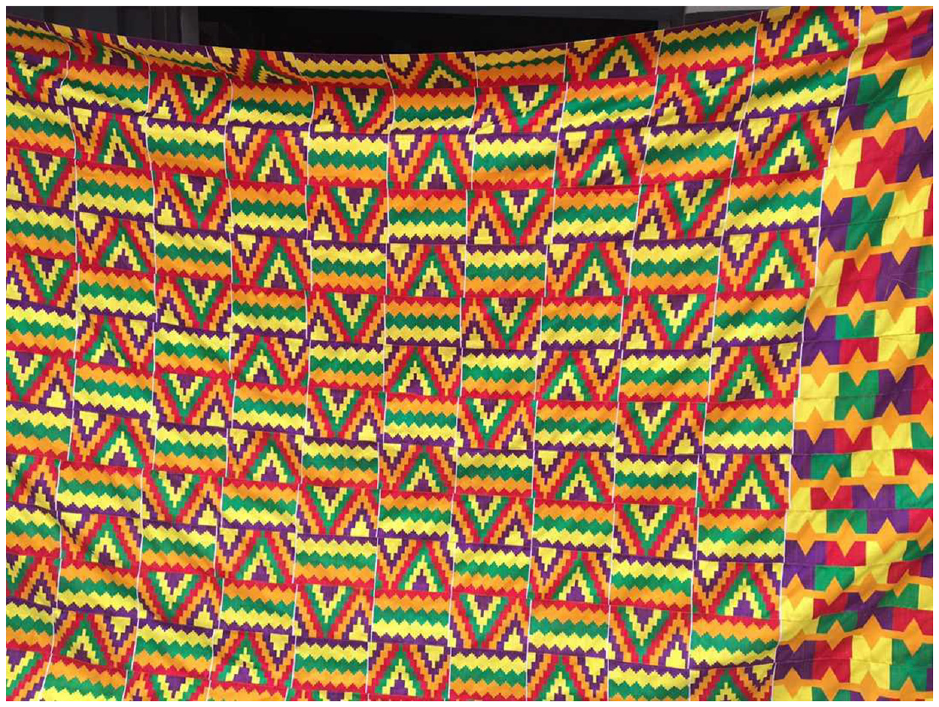
Fa Hia Kotwene Agyeman.
Fathia Fata Nkrumah( Fathia Is a Perfect Suitor for Nkrumah)
This Asante Kente weave pattern (Figure 14) was woven to applaud the decision of the first president of Ghana, Dr. Kwame Nkrumah who married an Egyptian national called Helena Ritz Fathia Nkrumah on 31st December 1957, not just out of love but also to demonstrate his desire for African unity. The elders in an FGD interview said that this move by Dr. Nkrumah was well-lauded by the then Asante King, Otumfuo Nana Sir Osei Agyeman Prempeh II who prioritized unity and peace. It is not surprising, they asserted, that the Asante Kente weavers at Bonwire produced this weave pattern for generations to remember the need to pursue peace and unity in all endeavors.

Fathia Fata Nkrumah.
Nana Addo Danquah Akuffo Addo Asante Weave Pattern
The Nana Addo Danquah Akuffo Addo Asante Kente weave pattern (Figure 15) was purposely woven for the president of the Republic of Ghana as a royal cloth to be worn for his investiture ceremony as president. The Asante Kente weavers interviewed at Bonwire mentioned that the weave pattern depicts the ideals of political integrity, probity, accountability, humbleness, among other virtues that make a true leader. The weave pattern stands for good leadership marked by a high degree of selflessness, patriotism, and loyalty to the country. It is supposed to be worn by persons who stand for these great leadership qualities and represent the president or their homeland Ghana in national and global events.
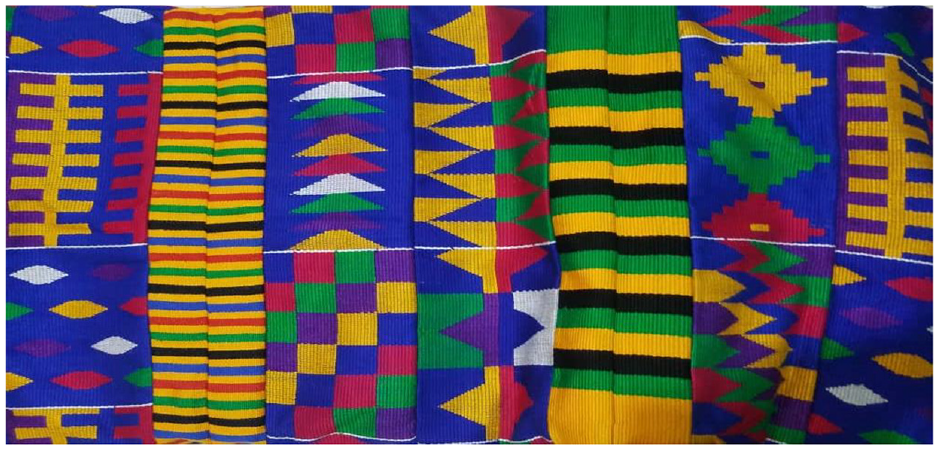
Nana Addo Danquah Akuffo Addo Asante Kente weave pattern.
Gifty Anti Asante Kente Weave Pattern
The Gifty Anti Asante Kente weave pattern (Figure 16) is named after the Ghanaian journalist and television presenter Gifty Anti. The weave pattern is referred to as edwini si edwini (a design on top of another design). It is a highly complex weave, similar to all forms of ekunini ntoma (cloth for distinguished persons). Gifty Anti is a broadcaster on the Ghana Broadcasting Corporation (GBC) and also the host for the Standpoint TV show which discusses the problems that affect the Ghanaian people and the nation as a whole. She has been personified as the voice of the oppressed women and children in Ghana. This Asante Kente weave pattern, according to the Asante Kente weavers interviewed, was aimed at acknowledging her exemplary efforts in speaking against the ills in the Ghanaian society.

Gifty Anti Asante Kente weave pattern.
Asante Kente Weave Patterns: Reflective of Historical Episodes in the Asante Community
Interaction with the Asante Kente weavers revealed that some of the Asante Kente weave patterns reflect the historic events that took place in the lives of the Asantes. Two of such weave patterns are the Sikadwa Kofi (Golden stool) and the Abusua Kuruwa (Family/clan pot).
Sikadwa Kofi (Golden Stool) Asante Kente Weave Pattern
The elders explained the significance of the Sikadwa Kofi in the history of the Asante kingdom. They mentioned that the Asantes needed to come together to be able to defeat the Denkyiras who had oppressed them for a long time. To do this, the then Asantehene, Otumfuo Osei Tutu I had a traditional priest and adviser who with the aid of the spirits and ancestors, was able to enchant a royal stool from the sky that landed on the laps of the Asantehene. This Sikadwa Kofi stool (Figure 17) enchanted from the sky on a Friday is believed among the Asantes as the unifying tool, binding all the souls of the Asantes. Thus, the Sikadwa Kofi is believed to be the spiritual aid to the Asantes, making them victorious over the Denkyiras in the early 1700s. It is the most significant regalia in the Asante kingdom. Therefore, to help in recording this important historical episode, the Sikadwa Kofi weave pattern (Figure 18) was created by the Asante kente weavers.

Sikadwa Kofi stool of the Asantes.
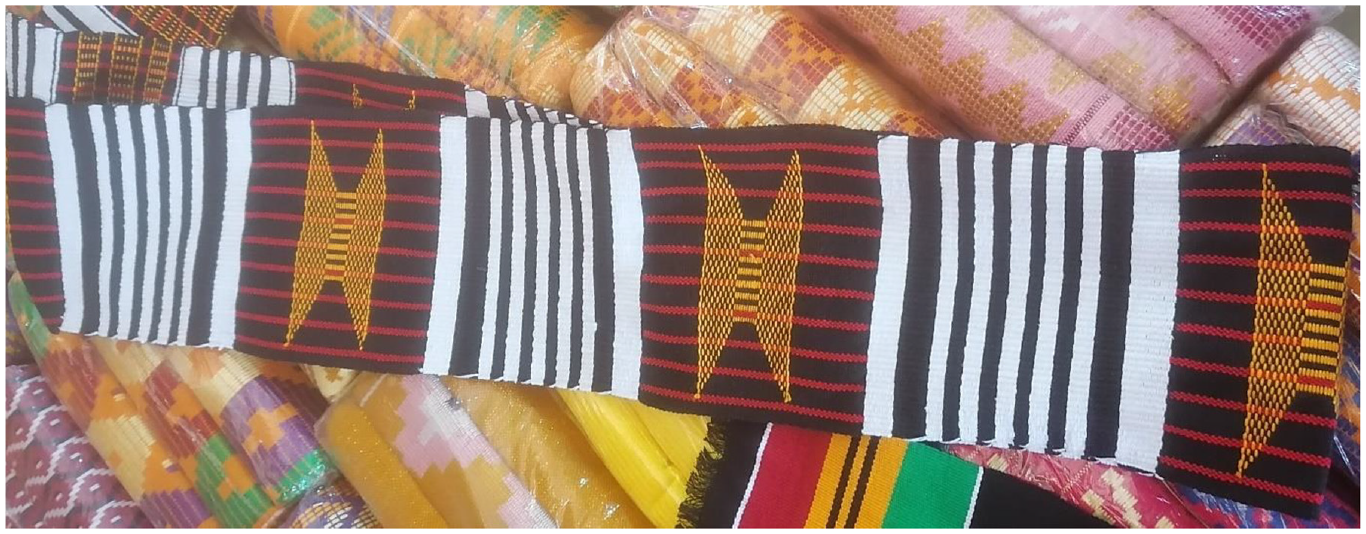
Sikadwa Kofi Asante Kente weave pattern.
Abusua Kuruwa Asante Kente Weave Pattern
Abusua (Family/clan) is prioritized in the Asante kingdom. The family heads explained that the Asantes eschew individualistic pursuits and goals but rather extol communalistic pursuits. Therefore, when one is making decisions, s/he is expected to consider its larger implications to other members of the nuclear and extended families respectively. Members of the same family, usually the extended family, lived in the same neighborhood and sometimes, family house. They all ate from the same pot, hence, Abusua kuruwa (family pot) instead of owning individual eating pots. Not just pots, but all family items were used by all members, a strategy for fostering unity and peace among the people. When a person dies, it is a religious requirement to keep the finger and toe nails as well as hair clippings of all close family relatives in the Abusua Kuruwa (Figure 19), which contains the relics of the deceased. Symbolically, it serves as a lasting bond between the deceased and his family members. The Asante Kente weavers mentioned that the Abusua Kuruwa Asante Kente weave pattern (Figure 20) was created to remind all Asantes on the need to ensure family unity and constantly pursue goals that would inure to the benefit of the larger family.

Abusua Kuruwa (Family pot).

Abusua Kuruwa Asante Kente weave pattern.
Asante Kente Weave Patterns: Reflective of the Proverbial Expressions in the Asante Community
Some of the Asante Kente weave patterns reflect the proverbial sayings that are often part of the everyday speech of typical Asantes, especially the elderly folks in society. The elders in an FGD interview said that the Asante proverbs are mediums for cultural instruction and they are used in advising, warning, and promoting good behavioral traits that ensure good societal living among members of the society. Some of these proverbs are used in creating Asante Kente weave patterns. Some of these weave patterns, as expressed by the study participants, have been discussed below.
Obi Nkyer3 Obi Kwan Mu Si Asante Kente Weave Pattern
The Obi Nkyer3 Obi Kwan Mu Si Asante Kente weave pattern (Figure 21) is a reflection of the Asante proverb that says “no one shows you how to chart your path.” This Asante proverb advises society members on the need to be responsible and live well. From infancy, one is well instructed on the accepted ethics and norms in life. As such, the final decision of their implementation is in the hands of the individual. Since the implications of one’s actions are his or her responsibility, one has to make wise decisions based on the instructions given to him or her.

Obi Nkyer3 Obi Kwan Mu Si Asante Kente weave pattern.
Nkyimkyim Asante Kente Weave Pattern
Obra ye Nkyimkyim means that the path or road of life is not always smooth and straightforward but could be crooked. The elders explained that life’s journey is filled with obstacles and troubles as well as happy moments. Therefore, one is expected to demonstrate tough skin in withstanding the bad and daunting moments in life. It is also a caution to members of society not to be carried away by the few successes they chalk in life but rather exhibit great hard work and humility as they take life’s journey. Thus, the Nkyimkyim Asante Kente weave pattern (Figure 22) offers moral advice that life’s journey is full of uncertainties. Yet, with hard work, humility, and a good moral attitude, one can successfully take the journey.

Nkyimkyim Asante Kente weave pattern.
Asante Kente Weave Patterns: Reflective of the Accepted Moral Ethics in the Asante Community
Some Asante Kente weave patterns unveil the accepted moral ethics and norms in the Asante community. These moral ethics that are constantly made known to society members include the traits expected of a woman or man in the Asante community.
Obaapa Asante Kente Weave Pattern
The Obaapa (Good woman) Asante Kente weave pattern exemplifies the good qualities a typical Asante woman is expected to demonstrate. The elders asserted that in the Asante culture, women are supposed to be humble, hardworking, and morally upright. They are expected to dress modestly and must know how to care for their homes. The elders added that a good woman is not supposed to indulge in any immoral acts including sexual acts prematurely or outside her marital home. The Obaapa Asante Kente weave pattern (Figure 23) is to remind women that good virtues bring honor not just to themselves but more importantly, to their families.

Obaapa Asante Kente weave pattern.
Color Schemes for the Production of Asante Kente: A Reflection of the Adopted Colors for the Asante Kingdom
Aside from the Asante Kente weave pattern reflecting the identity of the Asante people, another distinguishing element that makes the Asante Kente different from the other forms of hand-woven clothes is the color choice. The Asante Kente weavers averred that the dominant colors of the Asante kingdom are green, yellow, and black (Figure 24). As such, a combination of colors for the weave pattern must at least have one or two of these colors. That notwithstanding, the other colors used for the production of Asante Kente have philosophical meanings that agree with the beliefs and ideologies of the Asantes.

Colors of the Asante Kingdom.
The findings of the study revealed that the weave patterns of Asante Kente have affiliations with the place identity of the Asantes. The findings have shown that the weave patterns have associations with personalities in the Asante community, and Ghanaian society and even acknowledge the significant contributions of other foreign nationals that agree with the philosophies and ideologies of the Asantes. Also, the weave patterns reflect the historical episodes in the Asante kingdom, moral values, and proverbial expressions often used for cultural education in the Asante community. Similar findings were recorded in previous studies (Edusei, 2006; Fening, 2006; Thirumurugan & Nevetha, 2019; Gristina, 2020; Evans, 2021) though the present study has broadened the association of the design iconography of the weave patterns to the place-identity of the Asantes. Interestingly, as Adom et al. (2016) theorized, the ingenuity of the Asante Kente weavers makes them constantly develop new weave patterns. This study has shown that the design iconography and color scheme for the new weave patterns are not in isolation from the place-identity of the Asantes but are reflections of their history, moral values, beliefs, and political and religious ideologies. Okyere and Denoncourt (2021) in their study stated that currently, the Kente cloth stands the risk of being viewed as a general African fabric rather than a cloth of the Asantes and Ewes of Ghana. This study on Asante kente has shown that this threat suggested by Okyere and Denoncourt (2021) is unfounded because the design iconography and color scheme of the Asante Kente as shown by the findings of this study are reflections of the place-identity of the Asante people. This culture-history specific to the Asante people evident in the Asante Kente cloth cannot be generalized as an African cloth.
Moreover, the findings of this study nullify the view expressed by Frimpong et al. (2020). They claimed that the Ewe Kente is distinguished from the Asante Kente because they are “inextricably linked to history, proverbs, rites, and customs associated with their daily living” (Frimpong et al., 2020; p. 436). While they claim that the patronage of the Ewe Kente stems from their association with the history and culture of the Ewe people, they linked the early international exposure of the Asante Kente to the support it received from the royals in the Asante court as if to say that the Asante Kente weave patterns are detached from the place-identity history of the Asante people. The findings of the study have shown that this view is unsubstantiated because the Asante Kente weave patterns epitomize the place-identity of the Asantes and is a great booster for the patronage of the cloth nationally and internationally. Ayesu et al. (2021) are in league with this study that among the significant roles of the Ghanaian woven fabrics including the Asante Kente, is their role as embodiments of the place-identity of the people, aiding the younger generation in learning about the historical episodes of their ancestry.
Conclusion
This study adopted descriptive phenomenology in probing the historical and/or anthropological evidence that associates the place-identity of the Asante Kente to the Asante people as a historical home craft in the Bonwire weaving community in the Ashanti Region of Ghana. Also, it described the tools and materials for Asante Kente weaving as well as the design iconography and colors of its weave patterns to establish the place-identity of the Asantes. The findings revealed that the place-identity of the Asantes is intertwined with the discovery, history, philosophies, ethics, and norms of the people of Asante. Based on these key findings, these conclusions have been drawn. The oral history of the discovery of Asante Kente at Bonwire by closely observing Ananse (spider) weaving its web by two blood brothers who were hunters, Opoku Kurugu and Kwakye Ameyaw has been substantiated with additional anthropological evidence from the tangible culture of the people including the hunting implements, family home, and place of the discovery confirmed via this study. The naming of the loom and its accessories for Asante Kente weaving is associated with historic events, beliefs, and the naming system accepted in the Asante community. Thus, the cultural meanings and religious ideologies of the objects used for the production of the Asante Kente craft reflect the place-identity of the Asantes. The names of the parts of the loom and its accessories are rooted deeply in the naming of items used in the everyday life activities of the Asantes. The mode of training in acquiring the Asante Kente weaving skills is primarily family-based; it is usually carried out by skilled family craftsmen who pass the skills to their children, nephews, nieces, and grandchildren. Critical observation of the Asante Kente weave patterns reflects the historical episodes in the Asante community such as the religious ideologies, concepts of governance, renowned personalities, proverbial expressions, accepted ethical and moral values, and color schemes that are akin to the place-identity of the Asante people. Averagely, 8 out of 10 houses of indigenous homes and 5 out of 10 modern homes in the community I spotted through physical counts, had the Nsadua Kofi loom and evidence of the practice of the Asante Kente weaving thereby making the Asante Kente, a cherished home craft. The Ministry of Tourism, Arts, and Culture should partner with the community heads and Asante weavers to develop the areas with historical interests in the discovery and evolvement of the Asante Kente at Bonwire. Future studies should explore ways of digitally recording the tangible and intangible cultural heritage of the Asante Kente in Bonwire.
Footnotes
Acknowledgements
I appreciate the great help of my research assistants, Lydia Gyasi, Twene Ampofo, Emmanuella Awuni, and Belinda Asubonteng during the conduct of the personal interviews and focus group discussions with the study participants. I am grateful to all the chiefs and people of Bonwire, especially the study participants who volunteered for the study. I appreciate the Getty Foundation for offering me a travel grant to attend the 35th CIHA World Congress in Sao Paulo, Brazil where the first draft of this study was presented.
Declaration of Conflicting Interests
The author declared no potential conflicts of interest with respect to the research, authorship, and/or publication of this article.
Funding
The author disclosed receipt of the following financial support for the research, authorship, and/or publication of this article: I appreciate the kind assistance of the Government of Ghana for offering the yearly research fund for lecturers that enabled me to fund this research.

Data Availability Statement
Data sharing not applicable to this article as no datasets were generated or analyzed during the current study.