




Abstract
Victimization due to men’s intimate partner violence (IPV) perpetration against women has many negative physical and mental health effects that can last for generations. Understanding how women seek help in response to abuse, and from whom, can help to inform intervention and prevention efforts. This study sought to understand the help-seeking behavior of women who have experienced IPV in two under-researched countries in Asia and the Pacific, China, and Papua New Guinea (PNG). Based on data from the United Nations Multi-Country Study on Men and Violence, this study used a series of logistic regression models to examine what factors increased women’s likelihood of seeking help from family members and what factors increased the likelihood of a positive reaction in response to help-seeking. More than three quarters of the sample never disclosed their abuse. Those who sought help most frequently went to their female family members or female in-laws. Women were more likely to seek help if they had been severely injured, were experiencing multiple forms of IPV, were experiencing suicidal ideation, held fewer beliefs about traditional gender norms or if they had not witnessed IPV between their own parents. A positive response upon disclosure was contingent on the severity of injuries and women’s knowledge of violence against women legislation and public service campaigns. These findings help to bridge the gap in knowledge about help-seeking behavior from informal supports and the role that community education on IPV could have in ensuring that victims of IPV are supported by family when disclosing partner violence.
Plain Language Summary
Understanding how intimate partner violence (IPV) survivors seek help is crucial to informing intervention efforts. Using regression analyses on data from China and Papua New Guinea (PNG), we examined who survivors seek help from within their family and what the response is from different family members. More than three quarters of the sample never disclosed their abuse. Those who sought help most frequently went to their female family members or female in-laws. Women were more likely to seek help if they had been severely injured, were experiencing multiple forms of IPV, were experiencing suicidal ideation, held fewer beliefs about traditional gender norms or if they had not witnessed IPV between their own parents. A positive response upon disclosure was contingent on the severity of injuries and women’s knowledge of violence against women legislation and public service campaigns. These findings help to bridge the gap in knowledge about help-seeking behavior from informal supports and the role that community education on IPV could have in ensuring that victims of IPV are supported by family when disclosing partner violence.
Introduction
Intimate partner violence (IPV) is a serious social issue that impacts millions of women and families worldwide. The serious negative consequences of IPV on women’s health requires a better understanding of how women seek help and from whom they seek help in order to improve intervention and prevention services. Little research is available from Asia and the Pacific on this topic. The purpose of this paper is to address the gap in our knowledge on women’s help-seeking by examining the characteristics of women in two countries within Asia and the Pacific, China, and Papua New Guinea (PNG), who seek help from informal sources, such as family, and what the response to help-seeking is from these informal sources. Informal sources of support can include family members, friends, coworkers, or others, while formal sources of support include services and institutions such as the police, victim’s services, and shelters. How families experiencing violence seek help to end the abuse is an important area of research for the prevention of future violence, with recent findings that violence characteristics, sociodemographic factors, and ideology are among some of the factors that contribute to our understanding of help-seeking amongst low- and middle-income country populations (Lelaurain et al., 2019). However, multi-country research also tells us that the majority of women do not tell anyone about their experiences with intimate partner violence, with some research from 10 low- and middle-income countries demonstrating up to two out of three women have never told anyone about the abuse (Garcia-Moreno et al., 2006).
Literature Review
There has been increasing research in recent years on IPV in Asia and the Pacific, expanding our understanding of the specific risk factors for violence within this region; however, the literature on help-seeking by victims is still sparse. Where possible, this literature review focuses on the countries of interest, China and PNG, supplementing with research from the West as needed.
Effects of IPV
IPV has a negative effect on the lives of women in multiple ways, including contributing to significant mental and physical health concerns, as well as quality of life. Some of these issues include depression, anxiety, negative alcohol use, poor health, and illness (Bacchus et al., 2018; Bonomi et al., 2007; Dillon et al., 2013; World Health Organization, 2012), chronic pain and injury (Campbell, 2002), substance abuse (Bennett & Bland, 2008; Simmons et al., 2018), and suicidal ideation (Dillon et al., 2013; Karakurt et al., 2014). Moreover, IPV is an intergenerational social problem. In Asia and the Pacific region specifically, men’s perpetration of physical IPV has been linked to men’s childhood experiences of maltreatment and memories of their mothers’ victimization (Fulu et al., 2013; Fulu et al., 2017).
IPV in China and PNG
In China, risk factors for IPV across the socio-ecological framework include young age, low levels of education, low socio-economic status (Caetano et al., 2008), substance abuse (Xu et al., 2005), acceptance of traditional gender roles and patriarchy, acceptance of violence and exposure to prior abuse, and low social supports (Cao et al., 2014; Chen & Chan, 2021; Chan, 2005; Hollander, 2009; Hou et al., 2011; Xu, et al., 2005; Zhang et al., 2019). In China, women survivors of IPV may also perceive their experiences of violence as normative and private (Hou et al., 2018). The belief that there are good reasons for a husband to beat his wife based on the survivor’s ability to obey her husband and perform her duties as a good wife predicts violence against women in China (Tang et al., 2002). Traditional social roles of women and Chinese beliefs influenced by Confucian doctrine, underscore the lower status of women in China, and one doctrine specifically states, that there are three kinds of obedience for women: “San Cong” (obeying your father before you are married, obeying your husband during marriage and obeying your sons after your husband dies); and four kinds of virtue: “Si De” (fidelity, tidiness, propriety in speech and commitment to needlework; Jewkes, 2002; Taylor & Choy, 2005). These traditional beliefs create a greater tolerance for violence within the home and women may lean on these cultural values to justify their victimization (Cao et al., 2014; Kallivayalil, 2007). The hierarchical structure of the Chinese family often dictates the superiority of the husband as the final authority (Xu et al., 2005) and violence against women is often hidden within the home and remains unnoticed (Sun, 1997), particularly when financial control and decision making by the husband are accepted as the norm (Breckenridge et al., 2019; Hollander, 2005).
Similarly, IPV against women in PNG is prevalent and pervasive (Bradley, 2001; Fox, 2011). The violence includes physical, sexual, and emotional violence, is frequently severe and even fatal, resulting in women being killed by their intimate partners or experiencing violent rape (Amnesty International, 2006). Amnesty International (2006) has estimated that relationship violence against women in PNG affects between 50% and 100% of women. Existing gender norms, lack of access to resources and financial stability, all contribute to violence perpetration against women in PNG (Jewkes et al., 2017). Jewkes et al., (2017) reported that IPV perpetration is also associated with existence of armed conflict in PNG with the trauma experienced as a result of war often manifesting in relationship violence. In a study examining Catholic beliefs in meaning making of their IPV experiences for women in Madang, PNG, Hermkens (2008) found that Marian (Mother Mary) devotion emphasized the acceptance of their submissive roles and obedience led to harmony and unified families, however, this also created tolerance for violence and suppression of the self.
Help-Seeking in China and PNG
Interviews and surveys with survivors of IPV indicate that seeking actual help during or after experiences of IPV is complex and multifaceted and dependent on a range of individual, interpersonal, and sociocultural factors. This help-seeking model usually includes a survivor defining their experiences of violence as an actual issue, deciding to seek help and then selecting a source of support, with most woman choosing to seek informal support (Liang et al., 2005). Within PNG, tolerance for violence in their intimate relationships as normative can prevent women from engaging in help-seeking as it is viewed as betraying their Catholic identities which emphasize submission to their religious and wifely duties (Jewkes et al., 2017). In PNG, patriarchal attitudes, including traditional gender norms and male dominance where “men perceive they have lost control over women, when women are perceived by men to have breached certain expectations of conduct” (Banks, 2000 as cited in Hermkens, 2008, p. 154) often contribute to violence perpetration and the acceptance of violence as normal.
Individua influences on deciding to seek help for IPV was found to be linked to recognizing a problem as undesirable and seeing this problem as unlikely to go away without help from others. Within high-income countries, interpersonal and sociocultural influences in deciding to seek help from IPV from friends, family, or service providers, include gender, class, and cultural factors, as well as prior experiences in seeking help from these sources (Liang et al., 2005), assault characteristics/behaviors (Campbell, 2005), whether substance use/abuse was present (Overstreet & Quinn, 2013); past assault experiences (Kirkner et al., 2018; Lelaurain et al., 2017) timing of disclosure (Ullman, 2010); self-blame (Lutenbacher et al., 2003); and cultural factors (Lelaurain, et al., 2017; Postmus et al., 2015). Recent research from the U.S. examining the dimensionality and reliability of a scale of the Reasons for Disclosing Sexual and Intimate Partner Violence also found that survivors most often report to informal sources as opposed to formal sources (Turner et al., 2019).
If help-seeking is examined through the Stage Model theory, women often go through a process or a continuum which includes first using more personal attempts to alleviate the abuse, and then turning to informal and then formal sources (Brown, 1997). Other U.S. research with survivors illustrates that often victims of gender-based violence avoid more formal systems as they do not believe that formal systems would help them and could actually lead them to more psychological harm (Patterson et al., 2009). Research with U.S. IPV survivors indicate the negative experiences of shame, stigma, victim blaming, and coercion when formal assistance was sought (Taccini & Mannarini, 2023). Moreover, help-seeking methods by immigrant populations in the U.S. can differ by ethnic or cultural background, with some cultural groups turning to informal help-seeking more than others (Postmus, 2015).
Furthermore, there is often a gendered aspect to help-seeking. In general, research from English-speaking high-income countries indicates most women seek out informal help-seeking more than formal help, with both formal and informal support demonstrated as instrumental in putting a stop to their experiences of domestic violence (Frias & Angel, 2007). For example, even when seeking criminal justice assistance women will seek out informal sources of assistance, particularly for known offenders, such as intimate partners (Kaukinen, 2002, 2004; Voth Schrag et al., 2020). Recent survey research from both the U.S. and the U.K. found that female survivors were more likely to seek help when they experience victimization than men, supporting previous research, finding as well that women were also more likely to seek formal help, when they eventually do come to that decision, after initially seeking more informal assistance (Cho, 2021; Evans & Feder, 2016). Additionally, the responses of these more informal sources are key to informal help-seeking and help-seeking of women in general. Those who get supportive responses from informal sources are more likely to seek out support in the future (Waldrop & Resick, 2004) and have a profound impact on the survivors’ health and well-being (Ahren & Aldana, 2012). A review of the mostly Western-based literature on disclosure of IPV to informal social support network members, reveals that friends and family female members are the utilized informal support and are usually considered the most helpful and supportive when IPV is disclosed (Sylaska & Edwards, 2014). Results from a study in the U.S. indicate that survivors who disclosed to family and friends and had someone believe their account of rape, had fewer emotional and physical health problems than those who considered their informal help-seeking reactions hurtful, or those who did not experience negative or positive reactions (Campbell et al., 2001). Another recent U.S. study with 172 women found that those who received high negative or low positive reactions reported the highest depression and PTSD after an assault compared to women who received a positive reaction upon disclosure (Woerner et al., 2019).
As identified above, the research that does exist on help-seeking is most often from high income regions, with little research on informal help-seeking in developing nations, and particularly in Asia and the Pacific. However, the research that does come out of the Asia and the Pacific cultural context finds that family values and social norms, childhood exposure to violence, fear of retribution, and lack of access to resources such as poverty may have a significant impact on women’s help-seeking decisions (Garcia-Moreno et al., 2006). Recent research investigating help-seeking in developing nations with Demographic and Health Surveys (DHS) data across 31 countries found that around 35% of IPV victims engaged in help-seeking behaviors, and the majority of them (63%) reached out to family members; few IPV victims (3.24%) sought help from formal institutions. Reasons for this included severity of the abuse, attitudes toward IPV, and indicators of empowerment (Goodson & Hayes, 2021).
Previous research on women’s help-seeking in the region demonstrates some of these barriers as well. A study in Bangladesh that looked at domestic violence against women between 2000 and 2004, drawing on surveys and in depth interviews, found that 66% of women were silent about their experiences, because of stigma, acceptance of violence, and fear of more harm; 60% of urban and 51% of rural women never received help from others (Naved et al., 2006). Moreover, in a qualitative study conducted in Taiwan amongst female victims of dating violence, informal help was the most common and some of the barriers to seeking formal help included personal and family shame, fear of negative reactions, unfamiliarity with resources, and revictimization (Shen, 2011). More recent research in India from a nationally representative sample of IPV victims revealed that decision making in their relationship, controlling behavior, and physical or sexual abuse affected women’s likelihood of help-seeking (Hayes & Franklin, 2017).
Chinese women may feel ashamed to disclose abuse due to the Chinese concept of maintaining “face” (Chan, 2012) and these beliefs often guide their help-seeking behaviors preventing them from talking to anyone about the abuse (Chaudhuri et al., 2014). China’s first law against domestic violence was legislated in 2015, where domestic violence was defined physical, psychological, or any other infraction between family members characterized by beatings, restraint, deliberate maiming, imposed restrictions on physical liberty as well as recurrent verbal abuse or intimidation (National Law against Domestic Violence of the People’s Republic of China, 2015, cited in TingTing, 2016). Enforcement and implementation of the law within the Chinese cultural context has been challenging (Breckenridge et al., 2019). Chinese survivors of IPV rarely seek help from police or other institutions unless they have severe harm or permanent injury (Breckenridge et al., 2019). Additionally, determining physical violence as more substantial that psychological violence can undermine the significance of coercive control within IPV situations, further preventing victims from recognizing these behaviors as harmful and seeking help. This is further exacerbated by the stigma and cultural perceptions of IPV resulting in only some victims seeking help from family and friends, and unlikely to include the police (Guo et al., 2004) and other professional supports in their help-seeking behaviors.
This study aims to fill the gap in the literature on help-seeking by examining a sample of women from China and Papua New Guinea (PNG). A deepened understanding of the factors influencing women’s help-seeking and how family members respond to the disclosure of abuse by victims of IPV in these two countries will have implications for victim support practice and policy not only in these countries, but in similar countries in Asia and the Pacific. This paper has three major objectives: (1) to determine from whom within their family (biological and in-law) women who experience violence seek help; (2) to determine how different family members respond to disclosures of victimization; and (3) to determine what factors influence whether family members’ response will be supportive or not.
Methods
Study Design
This paper uses data collected as part of the larger UN Multi-country Study on Men and Violence. Standardized household surveys were conducted in six countries in Asia and the Pacific between 2010 and 2013: Bangladesh, Cambodia, China, Indonesia, PNG, and Sri Lanka. Due to funding limitations, it was not possible to sample each entire country and up to three specific sites were selected within each country to maximize the geographic and socio-demographic diversity of the sample, including a combination of rural and urban areas. For additional information on the original study’s methodology refer to Fulu et al. (2013) final report. Multi-stage cluster sampling was used to obtain a representative sample of men from selected households. Of the original six countries, only four also elected to sample women (Cambodia, China, PNG, and Sri Lanka). Once census enumeration areas were identified, a set number of households were randomly selected for participation and within each household, one man aged 18 to 49 years was randomly selected for the interview with a trained male interviewer. Due to the nature of the questions, only participants of child-bearing age were included. To ensure confidentiality and the safety of respondents, separate households were sampled for women participants whose interviews were conducted by a trained female interviewer in the preferred language of the participant. The majority of the interview was conducted face-to-face by the interviewer, while audio-enhanced tablets were used for the questions relating to abuse perpetration and victimization so participants could complete those sections individually. Each participating country was free to reject the inclusion of any part of the final questionnaire; therefore, this paper is focused on the two countries for which there is complete data on women’s experiences of violence and their attempts to seek help: China and PNG. The remainder of the countries either did not sample women or did not ask them about their help-seeking experiences. All components of the study design were approved by the United Nations Development Program Ethics Committee and the research ethics committees of each participating country.
Measures
Demographic Variables
Demographic variables included women’s current marital/relationship status, employment, education, their attitudes about relations between men and women, and their intimate relationships. Education was coded as none or primary only, some secondary, and completed secondary or any higher education. Employment was coded as yes/no for women and as formally employed, informally employed, and unemployed for their partners. Household food insecurity was used as a proxy variable for poverty and was dichotomized as ever experienced lack of food in the past month or never experienced food scarcity in the past month.
Experiences of IPV
Women’s experiences of lifetime IPV were collected with four or five items for each type of abuse and included psychological abuse (e.g., Has a current or previous husband or boyfriend ever insulted you or made you feel bad about yourself?), physical abuse (e.g., Has a current or previous husband or boyfriend ever hit you with a fist or with something else which could hurt you?), sexual abuse (e.g., Has a current or previous husband or boyfriend ever physically forced you to have sex when you did not want to?), and financial abuse (Has a current or previous husband or boyfriend ever taken your earnings from you?). Respondents were asked about the frequency of each behavior with the options of “many,”“few,”“once,” or “never.” For the purposes of this analysis, each type of abuse was dichotomized to “ever experienced abuse type” if participants indicated experiencing one or more of the described behaviors or “never experienced abuse type” if participants indicated they had never experienced any of the described behaviors.
Independent Variables
Respondents’ mental health was assessed with the Center for Epidemiological Studies – Depression (CES-D, Radloff, 1977) inventory which uses a series of 12 Likert items (rarely or none of the time, some or little of the time, moderate amount of time, and most or all of the time) to assess participants’ depression symptomatology in the preceding week. The scale had moderately high internal reliability with this sample (Cronbach’s alpha = .820). As well, history of suicidal ideation was assessed with one item which asked “Have you ever thought of ending your life?”
Respondents’ attitudes about the relationships between men and women were measured with the Gender Equitable Men (GEM) scale. This 5-item scale features response options ranging from strongly agree to strongly disagree and includes questions such as: A woman should tolerate violence in order to keep her family together. A higher score on the GEM scale indicates disagreement with the traditional gender roles, while a lower GEM score indicates agreement with traditional gender roles. The scale demonstrated moderate internal reliability with this sample (Cronbach’s alpha = .629).
Women’s alcohol use was assessed with two items. The first asked women about the frequency of their drinking (never, less than once a month, one to three times a month, once or twice a week, or every day/nearly every day). The second question asked women about how many drinks containing alcohol they consumed on a typical day when they drank (1 or 2, 3 or 4, 5 or 6, 7–9, and 10 or more). Problematic alcohol consumption was assessed with two additional questions: In the past year have you ever failed to do what was normally expected from you because of drinking? and In the past year have you ever had a feeling of guilt or remorse after drinking? The response options for both of these questions were “never” or “once or more often.”
The Childhood Trauma Scale (CTS) was used to assess respondents’ experiences of adverse events from the time they were born until they reached age 18. This 13-item scale covers experiences of hardship including poverty, food insecurity, and childhood physical and sexual abuse. Higher scores indicate more frequent experience of traumatic events during childhood. The scale was moderately reliable for this sample (Cronbach’s alpha = .777).
Women’s childhood experience with IPV was also assessed. Respondents were asked whether they had witnessed IPV between their mother and the mother’s husband or boyfriend as a child. Response options included “never,”“sometimes,”“often,” and “very often.”
Women’s knowledge of violence against women (VAW) laws and community prevention efforts were also assessed. Women were asked whether their country had a law on VAW with the response options of “yes,”“no,” and “don’t know.” They were also asked three yes/no questions on any exposure to community prevention efforts: Have you ever heard of any campaigns or activities in your community or workplace that talk about preventing VAW?; Have you ever seen an advertisement or PSA on TV about VAW?; and, Have you ever participated in an activity in your community or workplace on VAW?
Dependent Variables
The outcome variables of interest were women’s help-seeking decisions and the response of the person from whom help was sought. These questions were only asked from women who reported experiencing physical abuse by a current or previous partner, so all participants in the sample experienced physical abuse and some experienced physical abuse as well as another type of IPV. Women were asked whether or not they approached a female family member, a male family member, a female in-law, a male in-law, or their children for help. Response to help-seeking was assessed with four yes/no items: Did they blame you? Support you? Were indifferent? Encourage you to report the matter to the police?
Data Analysis
Chi square analyses were used to examine the relationship between the outcome variables, namely did the type of person approached impact the type of response. Subsequent logistic regressions were conducted to assess what factors predicted women’s decision to seek help and what factors influenced the response to help-seeking by family members. All analyses were conducted in IBM SPSS 26. Separate models were conducted for each type of family member approached and for each type of response (10 models total). Predictors in the models included women’s socio-demographic variables (age group, education, and age of marriage), the types of abuse experienced besides physical, their depressive symptomatology, alcohol consumption, whether the abuse resulted in an injury or not, and their experiences of traumatic events in childhood. Due to the way the questionnaire was asked, experiencing solely physical abuse was removed as a predictor from all models since all of the women in the sample had experienced at least one form of physical abuse.
Participants
A total of 1,976 women aged 18 to 49 years were interviewed as part of the original study in China and PNG. Respondent breakdown by country is presented in Table 1. The majority of women were between 20 and 39 years of age. There were some differences between countries in terms of access to education and employment for women. A majority of respondents from China had at least some secondary education, while two thirds of women in PNG had no education or primary school education only. Similarly, women’s employment was higher in China than in PNG, where less than half of women reported having employment in the past year. This gap is reflected in household food scarcity, which was reported by more than half of women in PNG but only 17% of women in China.
Demographic Characteristics of Sample (N = 1,976).

Women’s mental health and substance use also differed by country. More than one in four respondents in PNG reported ever having thought of suicide while less than one in eight women in China reported thinking of suicide at some point in their lifetime. Illicit drug use was rare in both countries, with less than 3% of women reporting ever using illegal drugs. Harmful alcohol consumption was slightly more common, with about 10% of women reporting either guilt after drinking or failing to do something as a result of drinking (Table 2).
Women’s Abuse Experiences (N = 1,976).
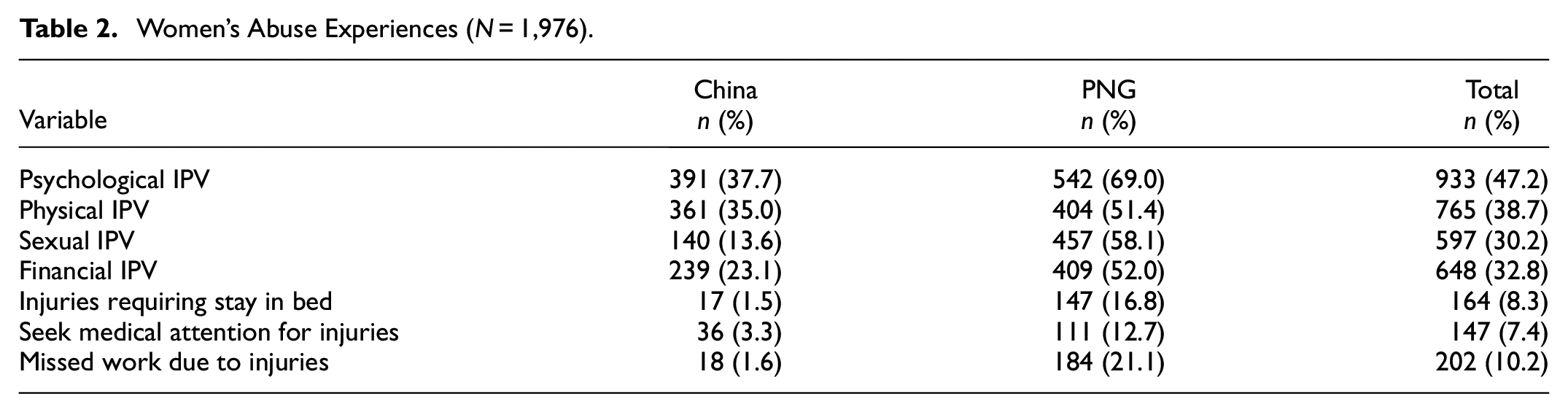
The type of violence experienced differed by country, though only 31.3% (n = 566) of the sample report no IPV experiences at all over their lifetime. Women in PNG most frequently reported experiencing psychological IPV (69%) or sexual IPV (58%), while women in China most frequently reported experiencing psychological IPV (38%) or physical IPV (35%). Severity of physical abuse reported by women also differed by country. A larger proportion of women in PNG reported needing to stay in bed (17%), receive medical attention (13%), or miss work (21%) due to injuries received from an intimate partner.
Results
Of the women who have ever experienced physical abuse by an intimate partner over their lifetime, 84.7% in China and 68.1% in PNG never disclosed the abuse to a family member (77.6% for the entire sample). Women were most likely to report the abuse to female family members (20%) or a female member of their in-laws (16%). Women approached male members of the in-laws (12%) and children (11%) the least (see Table 3). Multiple supports were frequently sought by women who chose to disclose, with one quarter of women who disclose approaching all five types of family supports. Due to data limitations, it is not possible to determine if there is a difference between the types of supports in their response to women as the response question was asked once for all support types combined. Overall, most women (64.4%) report being supported when they disclose to family, though more than a quarter of women report being blamed for the abuse (29.6%) or being told to keep quiet about the abuse (27.3%). Only a quarter of women were encouraged to report to the police.
Women’s Help-Seeking Experiences (N = 1,372).

Knowledge of VAW laws and exposure to community violence prevention initiatives also varied by country. Almost 85% of women in PNG were aware of VAW legislation in their country compared to only 58% of women in China. Similarly, 85% of women in PNG had heard of or seen campaigns in their community or workplace on VAW and almost a third had participated in such activities, while almost 40% of women in China had heard of VAW prevention activities or campaigns and less than 20% had participated in such activities (Table 4).
Knowledge of Violence Against Women Legislation (N = 1,976).

Help-Seeking Regression Models
The help-seeking regression models are presented in Table 5. All five models were very strong, with Nagelkerke R2 ranging from .50 to .76 and correct classification rates from 87% to 93%. Help-seeking from all family members was associated with the number of times women reported being injured by their partners. In all five models, women who reported no physical injuries were least likely to seek assistance from family. Women who reported being injured on more than five occasions were 25 to 50 times more likely to seek assistance than women who had never been injured. As well, in cases where respondents reported having to stay in bed due to the injuries, they were 4.6 times more likely to reach out to female family members (b = 1.53, SE = 0.61, p < .05) and male family members (b = 0.757, SE = 0.034, p < .05).
Logistic Regression Models for Women’s Help-Seeking by Type of Family Member, N = 1,260 (Odds Ratios [95% Confidence Intervals]).

Note. Control variables included: country, participant age, education, and employment, partner’s employment, food insecurity, type of abuse experienced (only significant variables listed in table).
p < .10. *p < .05. **p < .01. ***p < .001.
Experiencing psychological IPV was also associated with help-seeking for all family member types. Women who reported psychological abuse were 2.7 times more likely to seek assistance from their female family members (b = 1.01, SW = 0.33, p < .01), 6.6 times more likely to seek assistance from their male family members (b = 1.89, SE = 0.44, p < .001), and three to four times more likely to seek assistance from in-laws and their child(ren). Experiencing financial IPV was only associated with help-seeking from family members and child(ren), but not in-laws. Women who reported financial IPV were 1.9 times more likely to seek assistance from female family members (b = 0.65, SE = 0.28, p < .05) and male family members (b = 0.64, SE = 0.26, p < .05), and 1.8 times more likely to seek assistance from their child(ren) (b = 0.57, SE = 0.27, p < .05) than women who have not experienced financial IPV. Women who reported experiencing sexual abuse were also two times more likely to seek help from female family members (b = 0.68, SE = 0.30, p < .05) and 1.8 times more likely to seek help from their child(ren) (b = 0.60, SE = 0.28, p < .05).
In terms of women’s mental health, the only significant variable was ever having had suicidal ideation. Having ever considered suicide increased women’s likelihood of seeking help from both male and female family members, and from male and female in-laws, though the relationship was strongest for female family members (b = 1.25, SE = 0.30, p < .001). None of the alcohol or drug use variables were significant predictors of help-seeking.
Witnessing frequent IPV between ones’ mother and her husband or boyfriend during childhood was associated with a 0.02 times lower likelihood of seeking help from female family members (b = −4.02, SE = 1.33, p < .01). In other words, women who witnessed frequent IPV between their parents were almost 50 times less likely to seek help from their female family members compared to women who never witnessed parental IPV. The same effect was seen for help-seeking from female in-laws and witnessing frequent parental IPV as a child, but the relationship failed to reach statistical significance (b = −2.15, SE = 1.24, p = .08).
There was a positive relationship between the GEM scale and seeking assistance from female family members (b = 0.18, SE = 0.05, p < .01). Women with less ascription to traditional gender norms were more likely to seek help from their female family members. Ascription to traditional gender norms was not related to help-seeking from other family members.
Seeing a PSA on television on VAW was associated with 1.7 times higher likelihood of seeking assistance from male in-laws (b = 0.54, SE = 0.27, p < .05), but was unrelated to help-seeking from other family members. No other variable related to VAW legislation or campaigns were significantly associated with women’s help-seeking behavior.
Only one demographic variable was associated with women’s help-seeking behavior. Women with a primary school education or less were 2.3 times more likely to seek help from their children compared to women who have completed secondary school (b = 0.83, SE = 0.29, p < .01). Country of origin, respondent’s age, employment, age of marriage, partner’s employment, and food insecurity were not found to influence women’s help-seeking behaviors.
Response to Help-Seeking Regression Models
The response to help-seeking regression models are presented in Table 6. These models are based on the sample of women who sought help from at least one family member and are therefore underpowered in comparison to the full sample help-seeking models. While all five models were statistically significant, they were relatively weak (Nagelkerke R2 between .06 and .24) and were not as accurate as the help-seeking models (correct classification rates from 61% to 71%).
Logistic Regression Models for Responses to Women’s Help-Seeking, N = 300 (Odds Ratios [95% Confidence Intervals]).

Note. Control variables included: country, participant age, education, and employment, partner’s employment, food insecurity, type of abuse experienced (only significant variables listed in table).
p < .10. *p < .05. **p < .01. ***p < .001.
Similar to the help-seeking models, women’s experiences of injuries were associated with the type of response received upon disclosure of the abuse. Women who had to seek medical attention for their injuries were less likely to be blamed (b = −0.89, SE = 0.30, p < .01) and more likely to be supported (b = 0.58, SE = 0.28, p < .05) by family members. Women who reported having to stay in bed due to their injuries were 3.5 times more likely to be advised to make a police report (b = 1.26, SE = 0.29, p < .001) than women who were not injured or whose injury did not require bedrest.
The only type of IPV associated with the response to help-seeking was financial IPV. Women who experienced financial IPV were twice as likely to be blamed for the abuse (b = 0.71, SE = 0.31, p < .05) and 2.3 times more likely to be met with indifference at disclosure (b = 0.82, SE = 0.76, p < .05) than women who did not experience financial IPV.
Several mental health and alcohol-related variables were associated with family members’ responses to help-seeking. Women who have ever thought of suicide were twice as likely to be blamed for the abuse (b = 0.73, SE = 0.27, p < .01) as women who have never though of suicide. Similarly, women with higher scores on the CTS were more likely to be met with indifference (b = 0.09, SE = 0.04, p < .05) than women with fewer experiences of childhood trauma. Conversely, women who reported at least one episode of feeling guilt or remorse due to drinking were more likely to be supported when seeking help (b = 2.03, SE = 0.75, p < .01) and they were 2.3 times more likely to be advised to make a police report (b = 0.84, SE = 0.42, p < .05) than women who have not experienced problematic alcohol consumption.
Women’s attitudes toward gender relations (GEM scores) were found to be associated with both the decision to seek help and the helping response. Women with more traditional beliefs about gender roles more likely to be encouraged to make a police report (b = −0.14, SE = 0.06, p < .05) than women with more liberal beliefs about gender roles. However, knowledge of VAW legislation was associated with more positive responses from family members. Women who knew that there were laws on VAW were 2.4 times more likely to be supported by family (b = 0.88, SE = 0.36, p < .05) and less likely to be told to keep quiet about the abuse (b = −1.06, SE = 0.36, p < .01) compared to women who do not know if there are laws on VAW. Similarly, women who have heard of campaigns or activities related to the prevention of VAW were three times more likely to be encouraged to make a police report (b = 1.10, SE = 0.44, p < .05) than women who have not been exposed to VAW prevention campaigns.
None of the socio-demographic variables were associated with family members’ responses to women’s help-seeking apart from women’s education levels. Women with a primary education or less were twice as likely to be blamed for the abuse as women with completed secondary education or higher education (b = 0.70, SE = 0.33, p < .05).
Discussion
Regarding factors associated with informal help-seeking, our findings suggest that victims are more likely to seek help from family members when the violence results in visible injuries. This finding is consistent with previous literature indicating that women who perceive the violence as not being “that serious” do not look for support (Fugate et al., 2005). Not showing visible evidence of the violence experienced may discourage women from asking for help from family members because such abusive behaviors might not be recognized as violent (McCallum & Lauzon, 2007). This finding also aligns with Liang et al.’s (2005) help-seeking model which indicates that the identification of survivors’ experiences of violence as an issue is the first step in their help-seeking process. This help-seeking model further points to the cultural influences on the decision to seek help. In the context of China and PNG, cultural practices and beliefs of patriarchal family structure and strict gender roles, dictating the behavior of women and men in a relationship, may contribute to the normalization of violence that does not result in visible injuries (Acosta, 2019; Hollander, 2005). The perception that IPV comprises only severe physical violence is alarming in many ways, mostly because other forms of violence have been found to impact women’s health. For example, experiencing psychological violence from a partner contributes to the risk of women experiencing severe injuries (Mechanic et al., 2008). Sexual violence also has detrimental effects on women’s reproductive health (World Health Organization, 2014). We found a similar trend related to informal support’s response to the disclosure of IPV. Survivors who showed visible or severe injuries resulting from violence had a more supportive response from their family. This narrow view of IPV as mere extreme physical violence might, in turn, discourage survivors from seeking further help from other sources, including informal and formal entities.
Interestingly, we found that experiencing psychological violence was associated with seeking help from all family member types, whereas experiencing sexual and financial IPV was associated with seeking help only from specific family members. These results might be attributed to the prevailing taboo concerning women’s sexuality in some cultures. It is possible that women feel more comfortable sharing particular abusive experiences with those they feel more connected with, such as a female or blood relative. On the other hand, although financial IPV is prevalent among survivors (Stylianou et al., 2013), it has gained attention only fairly recently. Many might not yet recognize it, which could also deter survivors from sharing their experiences. Particularly in cultures where patriarchal practices are dominant, the recognition of financial abuse within a romantic relationship might be less conceivable. Head of households tend to be men and are often expected to have the final decision on financial matters (Sikweyiya et al., 2020) which might mask IPV dynamics. Specifically to the sociocultural context of Asia and the Pacific, some customs such as payment of bride price may influence survivors’ identification financial abuse (Lewis et al., 2008).
The lack of financial abuse recognition might also explain the relationship between financial abuse and response to disclosure. Survivors who experienced financial IPV were more likely to receive an unsupportive reaction to their violence disclosure, including blame and indifference. Hence, it is critical to raise awareness among victims and communities about the types and dynamics of IPV. Programs targeting communities have been found useful as preventative measures to IPV (Heard et al., 2020; Yoshihama & Tolman, 2015). Specifically, bystander intervention programs have shown positive results to prevent partner violence (Jouriles et al., 2019). Therefore, strategies to educate families, as well as other informal supports, about what constitutes abusive behaviors are imperative to assist survivors through their efforts to leave an abusive relationship and stop the violence.
Specific women’s characteristics were associated with seeking informal help. Our results indicate that women who had suicidal ideation had an increased likelihood of seeking help from a family member than those who had never considered suicide. This finding suggests that those who are the most emotionally distressed engage in help-seeking behaviors to stop their experiences of violence. Previous studies on informal help-seeking among IPV survivors who had ever had suicide ideations are limited. However, robust literature demonstrates that IPV survivors who seek formal help to stop the violence have higher levels of mental distress (Golding, 1999; Posick et al., 2016). Importantly, we also found that having ever thought of suicide increased the likelihood of receiving an unsupportive response, namely blame. Unsupportive responses to IPV disclosure were also more likely for women with experiences of childhood trauma. This negative response to IPV disclosure is particularly detrimental for survivors with a history of suicidal ideation and childhood trauma because it exacerbates their mental health, putting them at higher risk of a suicidal attempt (Sylaska & Edwards, 2015). This finding underscores the importance of educating the community on appropriate responses to IPV disclosure and increasing their knowledge about the availability of mental health care and other supportive services so that they can better support survivors. Lokuge et al. (2016) in their study examining access to healthcare services for victims of gender-based violence in PNG, including IPV-related violence, reported that many had delayed presentation to the health clinics due to lack of awareness of resources available or need for care. Those survivors that were aware through previous presentations, through other service providers or through educational messages such as community-based campaigns were able to access services in a timely fashion. Ganster-Breidler (2010) argued that despite extensive public awareness and education programs about gender equity and women’s rights, women’s tolerance of IPV victimization including physical and sexual violence as a man’s right and belief in their own subservient role was of great concern and needed strategic interventions.
Increased awareness of behavioral health services also needs to target drinking-related problems. Although our study suggested that women with problematic alcohol consumption were more likely to receive supportive responses, it is unknown whether such positive support led to seeking behavioral health services. Given that the decision to seek-help is complex and iterative (Liang et al., 2005), our results warrant further investigation on the relationship between IPV disclosure to an informal source and formal help service utilization among survivors who have ever considered suicide as well as those with alcohol problems.
Consistent with the literature on the consequences of exposure to IPV during childhood, we found that women exposed to parental IPV were less likely to seek help. Some argue that exposure to IPV as a child increases the likelihood of attachment insecurity and internalizing/externalizing problems, making individuals more likely to become victims of partner violence as adults (Levendosky et al., 2012). Given this effect of IPV childhood exposure, it is not surprising that women exposed to IPV as children were less likely to seek informal help. This finding highlights the need to provide services to children exposed to IPV so that they are better prepared and able to avoid IPV victimization as adults.
Exposure to community prevention efforts broadcasted on television was associated with increased informal help-seeking. Interestingly, a significant association was only detected for help-seeking behaviors from a male in-law family member. It is possible that the messages disseminated in public statement announcements encouraged women to seek help from a male person. Further exploration of the messages shared to communities on the prevention of IPV is needed to better understand women’s decision to seek help from specific family members. Regarding the response that women received from family members, we found that it was more likely to be a positive reaction for survivors who were aware of laws or efforts to combat violence against women. Our findings support the continuation of awareness campaigns as it has a positive effect on informal help-seeking. Future work on the mechanism through which awareness of legislation and efforts to address IPV influence informal support’s responses to IPV disclosure would be informative to ensure survivors are supported.
The ascription to traditional gender norms and education were also factors related to informal help-seeking and the response women received after disclosing their experiences of violence. Women who held less traditional gender roles were more likely to seek informal help. This finding is supported by previous studies in which women’s traditional gender role expectation was positively associated with tolerating the violence (Acevedo, 2000). However, we found this relationship significant only for female blood relatives, suggesting that although women hold more progressive views, male family members may not share those same views. Surprisingly, women who had more liberal beliefs were less likely to be encouraged to report the violence to the police. One explanation could be that these women live in communities where IPV is condoned, putting them at higher risk if a report is made to the police. Several studies point to the role of community characteristics in the perpetration of IPV (e.g., Benebo et al., 2018). Although higher women’s status is related to lower levels of IPV, this relationship is reversed in communities where men justify acts of violence against women (Benebo et al., 2018), or high levels of patriarchal norms exist (Koenig et al., 2003) such as in some countries in Asia and the Pacific. It is also possible that family members blame women who have more liberal beliefs for the violence and do not encourage them to involve the authorities. Further research on the views and attitudes of informal support sources and how it relates to their response to IPV disclosure is needed to understand their differential responses.
Finally, women with less education were more likely to seek help compared to those with higher education. It could be that women who have more education have more access to resources, providing a sense of self-sufficiency in their efforts to stop the violence from re-occurring. This explanation is supported by the Stage Model Theory which indicates that survivors tend to access their own resources before turning to informal or formal sources for support (Brown, 1997). Another explanation might be related to gender role transgressions. Women who have a higher education might be perceived unfavorably, especially in culturally conservative communities (Koenig et al., 2003). Women who are aware of how others perceive them might be discouraged from asking for help, including approaching family members. However, our results indicate that those with lower levels of education were more likely to be blamed for the violence when help was sought. This finding is consistent with previous research examining IPV at the community level. IPV tends to be higher in communities where female education levels are low (Cofie, 2018). Based on the Stage Model Theory (Brown, 1997), a negative response from informal support for those with limited resources, as it is often the case for individuals with low education levels, might deter seeking help from formal sources, making it almost impossible to leave an abusive relationship.
Limitations
This study is limited to the sites and countries that elected to include the help-seeking module in the questionnaire. Of the six countries that participated in the original UN multi-country study, only four sampled women and only two countries asked women about their experiences with seeking help for IPV. This highlights a wider issue with the lack of data available from Asia and the Pacific on women and specifically women’s experiences of violence. Further, by asking only one question on how family responded to disclosure of violence, important information is absent on possible differences between family members in how they respond. Future research should consider whether differences exist between how male versus female family members respond or if there are differences between in-laws and the family of origin in responding to disclosure of abuse.
As well, these research findings are biased toward women who have experienced physical violence. The skip logic built into the original survey required only women who reported experiencing physical IPV to complete the help-seeking questions. Women who reported experiencing other forms of violence, but not physical IPV, were excluded thus underestimating the negative effects of these forms of abuse and failing to fully capture the help-seeking behaviors of women who experience other forms of IPV. Given the pervasive and harmful nature of both psychological and sexual abuse, future research should ensure that the perspectives of these women are also captured.
Another important factor to consider is the co-occurrence of in-law perpetrated family violence and a history of violence in the husband’s childhood. While this study was able to control for the woman’s childhood history of witnessing IPV between her parents, it was not able to control for the man’s childhood history. IPV is a serious issue, but it can co-occur with other forms of violence, including in-law perpetrated family violence, which can be prevalent in situations involving dowry gifts and could make disclosure to in-laws less effective than to other sources (Sikweyiya et al., 2020). Future research should consider how experience of dowry-related violence might prevent victims of IPV from seeking help.
Lastly, it is important to remember that this research, like all cross-sectional research, is based on a moment in time and might not represent the current reality. Globalization and increasing access to the internet makes the transfer of ideas, attitudes, and information faster than ever, allowing women from across countries to mobilize on women’s issues and create local and global change (Kim, 2020).
Conclusions and Future Directions
The factors associated with women’s decision to seek help from their family and friends have implications for women’s ability to leave an abusive situation, report the violence to authorities, and access formal services. Even when countries criminalize IPV, barriers in the enforcement of these policies and women’s ability to seek help exist. Chief among them is the survivor’s ability to access formal avenues of support, which are time-consuming, expensive, and often culturally stigmatizing. For many women, disclosure to formal support services is contingent upon receiving a supportive, positive response from an informal support system: family and friends (Kyriakakis, 2014). Therefore, a better understanding of the factors influencing informal help-seeking and informal supports’ willingness to offer aid will help identify areas of intervention for public education, outreach, and community services. Of particular importance is the understanding of factors affecting women in Asia and the Pacific region of the world because of the high rates of IPV (World Health Organization, 2013) and the acceptance of traditional gender roles (Cao et al., 2014) and structural conditions in these regions (Xu et al., 2005). As such, the promotion of informal help-seeking behaviors and informal support’s positive response is a promising mechanism to help decrease IPV re-victimization.
Taken together, our findings underscore the need to expand educational efforts on IPV at the community level. It would be useful if such actions include specifically developed campaigns to target informal support sources, such as family members and in-laws, and their disclosure reactions by offering them concrete strategies on how to respond to disclosures. Increasing positive responses to IPV disclosure could support survivors in leaving an abusive relationship, or at the very least increase family pressure on the abuser as opposed to the traditional response that places the blame on the victim for her own abuse. Family members are of particular relevance to intervention and prevention efforts, because survivors might have greater access to interact with them and, therefore, more opportunities to ask for help than formal sources. Due to the importance of family support, it is also necessary for intervention programs to address the attitudes of both male and female family members toward IPV victimization. This will ensure that the responses from family members are positive instead of victim-blaming and potentially reduce the risk of future abuse.
Footnotes
Author Note
This research was conducted while Kristina Nikolova was at Wayne State University, Detroit, MI. She is now at University of Windsor, Windsor, Canada, and may be contacted at nikolova@uwindsor.ca.
Author Contributions
K. Nikolova conceptualized the article, conducted the analyses, and wrote the methods and results; I. Cardenas helped conceptualize the article and wrote the discussion section; J. J. Steiner helped conceptualize the article and wrote the introductory section; R. Khetarpal helped conceptualize the article and wrote the Asian-context literature review.
Declaration of Conflicting Interests
The author(s) declared no potential conflicts of interest with respect to the research, authorship, and/or publication of this article.
Funding
The author(s) received no financial support for the research, authorship, and/or publication of this article.
Ethical Approval
This research was approved by the Rutgers University Institutional Review Board

Data Availability Statement
Data are available by application through the Sexual Violence Research Initiative.