




Abstract
By engaging in one form of works, people earn means of support, establish their identities, perceive life as meaningful and establish social network with others. The quality of life is a product of several factors inherent in the work environment. Quality of life is an important topic in every organization as it determines the future of the organization. This study assessed the sociodemographic and workplace determinants of Quality of life (Qol) among quarry workers in Nigeria. A cross-sectional study was conducted among the respondents. Data were collected using self-administered questionnaires consisting of socio-demographic characteristics, Standard Nordic Musculoskeletal Questionnaire and World Health Organization Quality of life BREF questionnaires (WHOQOL-BREF). A total of 266 quarry workers involved in this study were selected through systematic random sampling technique. The data were analyzed using SPSS version 26. Simple and multiple logistic regression were used to identify the determinants of quality of life among the respondents. The result showed that majority of the respondents (74.1%) had poor quality of life with variation across four domains of physical, environmental, socio relationship and psychological. Following multiple logistic regression modeling, WRMSDs (ORadj 4.24, 95% CI [1.84, 9.77], p-value = .001) and the poor work design (ORadj 3.22, 95% CI [1.52, 6.82], p-value = .002) remained significant determinants of Qol. This study showed poor quality of life among quarry workers in Ebonyi state, Nigeria. Those with WRMSDs and had poor work design were more likely to have poor quality of life compared to those who had no WRMSDs and work in well-designed workplace.
Plain Language Summary
Purpose: This study sought to determine the sociodemographic and workplace factors associated with quality of life among quarry workers. Method: A cross-sectional study was conducted among the respondents using self-administered questionnaires consisting of socio-demographic characteristics, Standard Nordic Musculoskeletal Questionnaire and World Health Organization Quality of life BREF questionnaires (WHOQOL-BREF). A total of 266 quarry workers involved in this study were selected through systematic random sampling technique. The data were analyzed using SPSS version 26. Simple and multiple logistic regression were used to identify the determinants of quality of life among the respondents. Result The result showed that majority of the respondents (74.1%) had poor quality of life with variation across four domains of physical, environmental, socio relationship and psychological. Following multiple logistic regression modeling, WRMSDs (ORadj 4.24, 95% CI [1.84, 9.77], p-value = .001) and the poor work design (ORadj 3.22, 95% CI [1.52, 6.82], p-value = .002) remained significant determinants of Qol. Conclusion: This study showed poor quality of life among quarry workers in Ebonyi state, Nigeria. Those with WRMSDs and had poor work design were more likely to have poor quality of life compared to those who had no WRMSDs and work in well-designed workplace. Implications: there is need to implement measures to ensure safety of workers at work places and to ensure satisfaction with works and working condition as this impacts greatly on their overall quality of life. Limitation: this finding is specific to quarry workers. Therefore over generalization to other company workers may not be appropriate.
Keywords
Background
Working is regarded as one of the major things that guide individual life and, because of the vitality of work in the daily life of individuals; work must be understood across economic, cultural and social spheres. By engaging in one form of works, people earn means of support, establish their identities, perceive life as meaningful and establish social network with others (Shea-Van Fossen & Vredenburgh, 2014). Despite the fact that work is vital for life and health, the organizational pattern, mode of operation and the related factors have reportedly caused numerous diseases among workers (De Sio et al., 2017; Shea-Van Fossen & Vredenburgh, 2014). Psychosocial factors arising from the interaction between work description, content, work organization, working condition, level of technological advancement and the workers’ level of competence, needs, resources and other personal factors all exert untold effects on the workers’ wellbeing and quality of life (Greco, 2014; Stavroula & Aditya, 2013).
Quality of Life according to World Health Organization (WHO) is seen as an “individual’s perception of their position in life in the context of the culture and value systems in which they live and in relation to their goals, expectations, standards and concerns” (Srivastava & Kanpur, 2014; Vahedi, 2010). This therefore involves four main areas of work life: safety at work; employee health care; adequate working time; and a commensurate salary (Mazlan et al., 2018; Pandey & Tripathi, 2018). Individual worker perceives high quality of life when he has positive feelings toward his work and its prospect, and hence motivated to stay on the job and commit to its performance (Shariat et al., 2015).
The quality of life is a product of several factors inherent in the work environment (De Sio et al., 2017). The performance of the employees at various work positions is intricately related to the set of factors affecting workers’ health, well-being, habits, work environment and quality of life. Moreover, quality of life is also reported to be significantly associated with employees’ job satisfaction, high moral, output at work, level of wellness, job security and safety at work (Waghmare & Dhole, 2017) and varies across occupation, occupational disorders and socio-demographic characteristics (Haukenes et al., 2014; Kim et al., 2015; Mathew et al., 2016; Mazlan et al., 2018; Veeri et al., 2019; Yang et al., 2019).
Quarry industries are one of the important industries across the world serving as major sources of raw materials for key developmental strides in the society (Aq et al., 2011). According to British Geological Survey (2017) quarry work is second to agriculture as the major sources of employment mostly in rural areas with the products exported to the developed areas as finished products. It accounts for over 40 million Euros economic growth across countries (Wolszczak-Derlacz & Parteka, 2018). Over 20 million workers earn living from quarry industries in developing countries (Adeyemi et al., 2013; Uwakwe et al., 2015).
Quarry industries in Nigeria have been recognized as one of the major sources of employment and livelihood among Nigerians in both rural and urban areas besides the main occupation such as civil service and farming. At least every state of the federation has one or two quarry sites where stones are crushed for many purposes and employs reasonable number of workers in different capacity such as drivers, blasters and lifter, most of which are literate and few illiterate men and women. Quarrying work is often characterized by very risky and challenging work conditions that involve manual handling of material, lifting of heavy objects, movements and tasks that are recurrent, manual exertion of forces and possible exposure to segmental or whole-body vibration. In Nigeria automation is often substituted with human efforts thereby expose to health risk and likelihood of poor quality of health. This is due to the impact of the tool handling that predisposes workers to WRMSDs.
Despite the above enormous contributions, quarry works have been characterized by poor technological involvement and use of human being in place of automation (Ayub & Shah, 2018; Wolszczak-Derlacz & Parteka, 2018). Poor condition of work, lack of job security and low monthly earning were also common among quarry workers in developing countries where quarry industries are mostly located for want of low cost for labor (Wolszczak-Derlacz & Parteka, 2018). It has also been reported as the riskiest job across occupations with various occupational disorders (Azlina et al., 2014; Egwuonwu & Abidemi, 2013; Health and Safety Executive, 2018). Assessment of quality of life is a vital managerial tool to map out preventive measures for health deviations as a result of work activities and formulation of policies for safety at work (Cacciari et al., 2017). This study therefore assessed the quality of life and the associated factors among quarry workers in Nigeria.
Materials and Method
Study Design
This study utilized cross-sectional survey design to assess Sociodemographic and workplace determinants of Quality of life (Qol) among the quarry workers in Nigeria.
Area of the Study
This study was carried out in the quarry industry located at Umuoghara in Ezza North Local Government Area of Ebonyi State, Nigeria. There are about 50 plants in the company all located within one premise. There are about 800 workers all together in the company according to the register from the administrative officer. These workers are usually recruited by the companies and required to break stone lumps into useable sizes for construction works using human efforts. In the simplest form, human efforts are used to substitute automation in quarry industry. Certain tools like Monday hammers are among the common tools used to crack the stones while transportation to place of marketing is done using human heads.
Inclusion Criteria
Male and female workers working in the quarry industries in Ebonyi state at the time of this study. Workers involved in the stone processing such as the blasters, operators of crushers, lorry drivers, manual stone handlers and loaders. Workers who have worked for at least 1 year in the quarry company were considered for inclusion.
Ethical Review
The ethical approval for this study was granted by Human Research Ethical Committee of Universiti of Sains Malaysia (USM/JEPeM/20020133) Ethical committee and letter of permission from the chairman of the quarry company. Approval Number:
Sample Size Estimation
The sample size for this study was determined according to the objectives of the study. Objective 1: to determine the quality of life among the quarry workers. Sample size was determined using single proportion formula as follows: N = p (1−p)(Z/E)2N = sample size, p = proportion of “very poor quality of life” in population, Z = standard normal distribution, E = precision, Where p = .5(Mazlan et al., 2018), Z = 1.96 and E = 0.06. n = 0.5(1–0.5)(1.96/0.06)2.
Therefore n=0.25×32.67 × 32.67. N = 266 respondents.
Objective 2: to determine the sociodemographic and workplace determinants of quality of life among quarry workers. The sample size was calculated using PS software. Alpha = 0.05, power = 0.8, m = 1, P0 = 0.50 (Mohammad et al., 2018), P1 = 0.75 (expert opinion), sample size=174 (Dissatisfied/poor QOL=116, Satisfied/good QOL=58). P0=probability of exposure to the risk (WRMSDs) in controls (good QOL) OR WRMSDs/quarry workers. P1 = probability of exposure to the risk (WRMSDs) in cases (poor QOL).
Therefore, the largest sample size for this study was 266 respondents as shown in objective 1 above.
Instrument for Data Collection
The questionnaires used for this study had three parts: part A, B, and C. Part A consist of the socio-demographic variables of the respondents and the workplace factors while part B was World Health Organization Quality of Life questionnaire (WHOQOL BREF) with 26 items and Part C was the Standard Nordic Musculoskeletal questionnaire used to assess the rate of work related musculoskeletal disorders. The Nordic Musculoskeletal question was scored 1 for yes and 0 for no. It is used to assess the disorders of the musculoskeletal system within 12 months duration. It has questions on the nine parts of the body that are commonly affected by WRMSDs. This questionnaire has been tested for reliability by the developers through test retest method with a good Cronbach’s alpha value of .78, .91, and 1.00 across the times. The WHOQOL questionnaire was developed by WHO in 1995 to assess the effect of workers’ work on their quality of life and impacts of disease on the workers life. It was developed based on the perception of the individual about their quality of life in different domains. It was designed for transcultural uses and in clinical and research studies.
The quality of life questionnaire has five likert scale items that were scored using “1” = very dissatisfied, “2” = dissatisfied, “3” = neither dissatisfied nor satisfied, “4” = satisfied, “5” = very satisfied. To further determine the predictors of quality of life among the quarry workers using multiple logistic regression, the researcher had categorized the quality of life from four domains into two domains (Dissatisfied/poor Qol and satisfied/good Qol). This categorization was made based on the workers responses to one of the questions, which seeks to determine the overall level of the workers’ quality of life. This was done by grouping satisfied and very satisfied responses together as good or satisfied QOL while dissatisfied, very dissatisfied and not sure responses were grouped into poor or dissatisfied Qol. The reliability of WHOQOL questionnaire has been established with a Cronbach alpha value of .7 and .8 across studies (Cheung et al., 2017; Najafi et al., 2009).
Sampling Method and Data Collection
The respondents for this study were selected through systematic random sampling method from 800 sample frame. All the 800 workers are from the same quarry company in Umuoghara in Ezza North Local Government Area. The sampling was done during their meeting time when all the workers were gathered together. Statistical package for social sciences (SPSS) was used to randomly select number 2 which was used in the sampling. Every second name on the sample frame was selected for this study. The researcher approached the respondents through the management and introduced himself to the respondents. Then the purpose of the study was explained verbally and in written form prior to distribution of the questionnaires. He then swiftly screened for the inclusion criteria and applied systematic random sampling as described above to sample the required respondents. The respondents were requested to decide voluntarily either to participate in this study or not. Those who volunteered to participate received the respondents’ information sheet and consent forms and were asked to sign. The researcher distributed the questionnaires to the respondents and retrieved same after responses on same day. A total of 266 questionnaires were distributed and retrieved from the workers. The data collection took place from July to September 2020.
Data Analysis
Data were coded and analyzed using SPSS 26. The socio-demographic variables of the respondents were presented using descriptive statistics. Descriptive statistics (frequency, percentage and mean) was used to determine the level of quality of life of the quarry workers. The score on the quality of life were computed and converted to scale 100 as per scoring guideline. Simple logistic regression was used to screen the independent variables. The independent variables with significance value less than .25 were selected for multiple logistic regression. Backward and forward variable selection approach was used in the multiple logistic analysis. The final multiple logistic regression model included those independent variables with significant value of less than .05. Model fitness was then assessed based on Hosmer and Lemershow test, classification table and receiver operating characteristics (ROC).
Results
Table 1 shows the socio-demographic characteristics of the respondents. The mean age of the respondents was 31.0 (8.28). The majority of the workers are young, less than 30 years old (46.2%), males (66.9%) and majority had secondary level of education (49.6%). Most of the them were married (49.6%), worked as blasters (24.4%) and had normal BMI (62.9%). Majority of the respondents had 0 to 2 children (54.5%), 35.8% had monthly income of more than 10,000 Naira per month and 51.5% had 3 to 6 family members being catered for by the monthly income.
Socio-demographic Characteristics of the Quarry Workers (N = 266).

Table 2 shows the work-related factors of the quarry workers. About 66.2% of the respondents had work experience of 1 to 5 years with mean 4.9 years. Majority of the respondents (96.6%) worked for 7 to 9 hr per day (mean 8.0 hr), mean break time per day 14.0 min. About 86.6% reported lack of work training while most of the respondents (94.4%) worked under high temperature. Majority of the workers (95.5%) reported working with injury while 97.4% of the respondents never used personal protective equipment (PPE) at work.
Work-Related Factors of the Quarry Workers (N = 266).

Table 3 shows the prevalence of WRMSDs among quarry workers. More than half of the respondents (89.8%) reported having WRMSDs. Majority of the respondents (45.5%) reported experience of moderate pains followed by the mild level of pain (24.8%). About 62.4% of the respondents had difficulties in performing daily activities due to the WRMSDs.
Prevalence of Work-Related Musculoskeletal Disorders (N = 266).
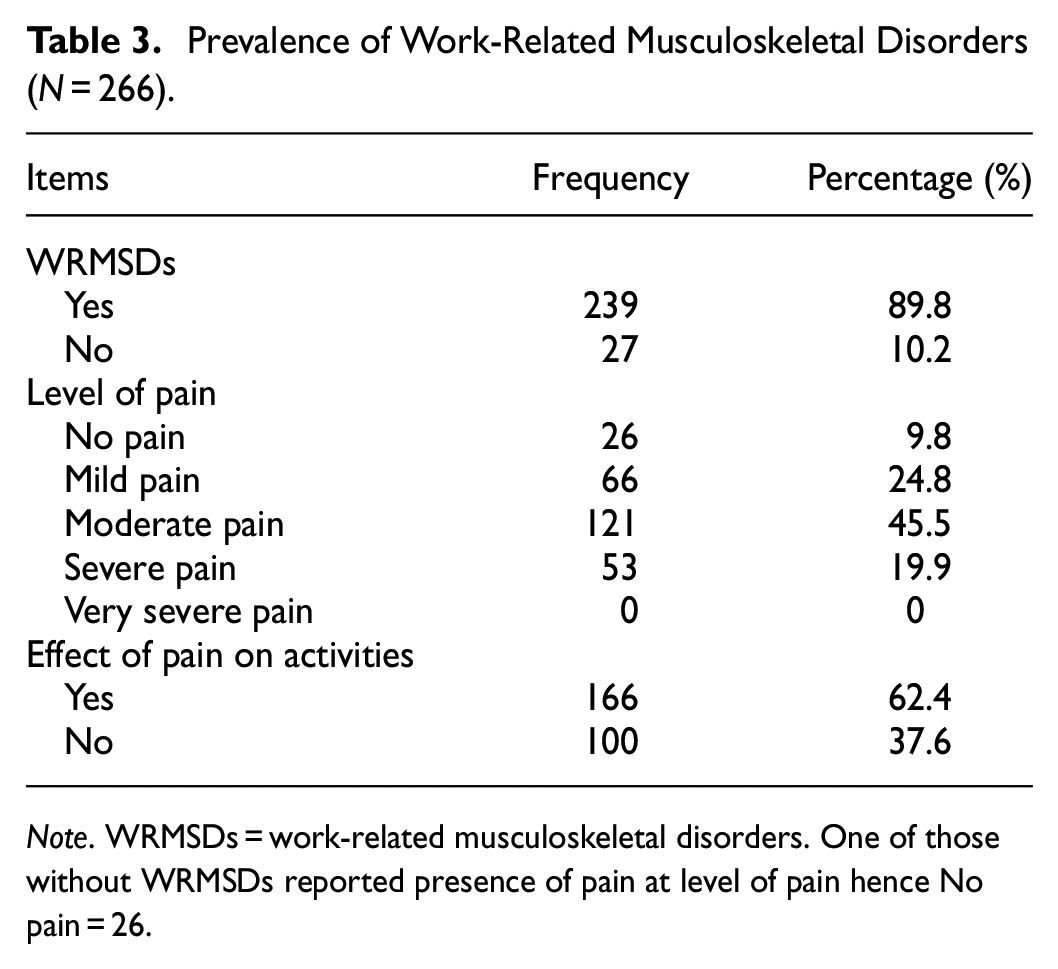
Note. WRMSDs = work-related musculoskeletal disorders. One of those without WRMSDs reported presence of pain at level of pain hence No pain = 26.
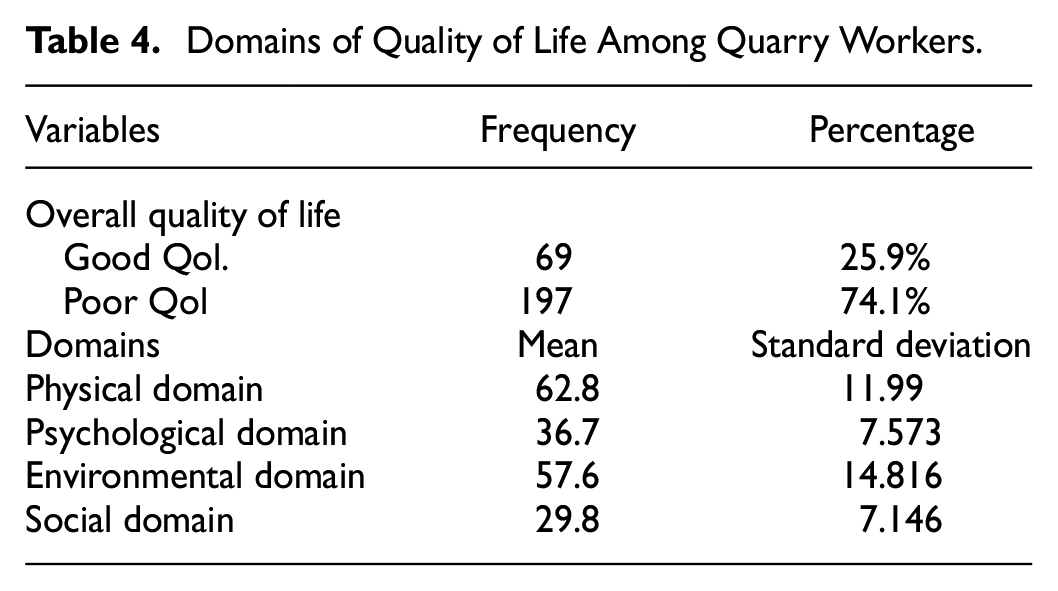
In terms of quality of life, about 74.1% of the respondents reported poor overall quality of life with variation across domains. The physical domain had the highest mean score (62.8) closely followed by the environmental domain while the social relationship and psychological domains recorded the least mean score Table 4.
Domains of Quality of Life Among Quarry Workers.
From the simple logistic analysis number of children (p-value = .102), smoking (p-value = .157), break time (p-value = .096), type of work (Table 5; driver: p-value = .011, operator: p-value = .076), level of pain (p-value = .001), WRMSDs (p-value < .001), Age (p-value = .018), monthly income (p-value = .046), working with injury (p-value = .015), working under high temperature (p-value = .018), vibration exposure (p-value = .014) and poorly designed work (p-value = .002) showed significant association with quality of life at p-value < .05.
Univariant Logistic Analysis of Factors Associated With Quality of Life Among Quarry Workers.
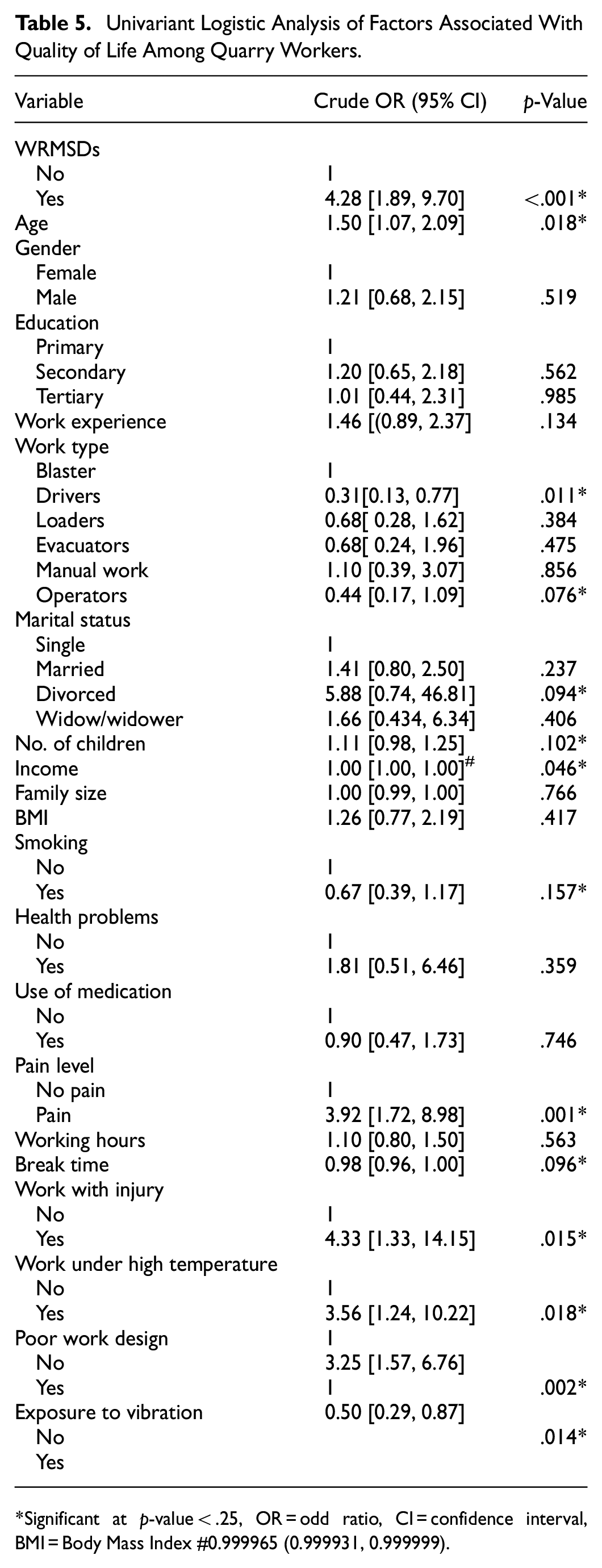
Significant at p-value < .25, OR = odd ratio, CI = confidence interval, BMI = Body Mass Index #0.999965 (0.999931, 0.999999).
Final Model of Factors Associated With Quality of Life Among Quarry Workers.

Note.*Significant at p-value < .05, B regression coefficient, CI = confidence interval.
Following the multiple logistic regression modeling, WRMSDs (p-value = .001) and the poor work design (p-value = .002) remained significantly associated with the quality of life among quarry workers in Ebonyi state Nigeria. Based on the odd ratio, those who had WRMSDs had 4 times more odds to have poor QoL compared to those who had no WRMSDs. In addition, those who had poor work design were 3 times more likely to have poor QoL.
Discussion
This study revealed that 74.1% of the quarry workers had poor quality of life. This finding could entail being dissatisfied with their work and working condition which directly affects the morale of the workers (Bhola, 2015). The quality of life of the workers is a vital element in the organizational management and plays key role in the growth and continued productivity of the organization. Therefore, deliberate efforts must be put in place to improve and maintain satisfied quality of work life among the workers as to ensure commitment and motivation on the part of the workers (Srivastava & Kanpur, 2014). The condition of work, policy on welfare of the workers and every other organizational factor capable of impacting on the workers wellbeing should be addressed among the quarry industries in a timely manner (Child & Icn, 2017). One of such key approaches includes adequate social support, proper working conditions, good remuneration and psychological supports (Tesla, 2018). Low quality of life was also indicated in other studies conducted among different group of workers (Asante et al., 2019; Cacciari et al., 2017; Szemik et al., 2019; Tesla, 2018).
The result was contrary to the study done on accredited social health activist in Malaysia which revealed that 60% of the participants reported good quality of life (Stavroula & Aditya, 2013). This difference may be attributed to condition of work at the various industries, technological involvement, level of risk, health status of the workers, socio-cultural context (Tian, 2020) and the availability of psychosocial supports across countries (Szemik et al., 2019). Also, the relevance of the needs of the individual workers have been reported to vary across culture and organizations hence may account for the differences above (Diogo et al., 2014).
Regarding the domains of the quality of life, the physical and environmental domain had the highest scores which however remained low on the 100% scale. These low scores may be accounted for by the poor working conditions and health status (Szemik et al., 2019).
More also, at univariant analysis using simple logistic regression, certain independent variables showed significant association with quality of life. The factors include age, type of work, monthly income, level of pain, working with injury and work design. This is in agreement with reports of other research studies (De Sio et al., 2017; Ganapathi, 2016; International Labour Organization, 2014; Noor & Abdullah, 2012; Szemik et al., 2019; Tian, 2020).
Moreover, the multivariable analysis of the independent variables showed that two key independent variables, WRMSDs and poor work design remained significantly associated with quality of life of the respondents. WRMSDs is significantly associated with quality of life of the quarry workers in this study with unadjusted odd (4.28) when those without WRMSDs was used as reference. This therefore means that workers with WRMSDS have high odd (4.28) of being dissatisfied with their quality of life compared to those without WRMSDs. A few studies had reported a link between poor quality of life with job dissatisfaction, safety at work and low morale (Leitão et al., 2019; Waghmare & Dhole, 2017). Therefore, appropriate preventive measures against WRMSDs is implicated by this finding as to improve the quality of life of the workers as well their commitment to organizational goal since evidence shows negative effects on poor quality of life on productivity at work (Diogo et al., 2014). This finding is in line with a study among primary healthcare workers which reported a significant association between health status and quality of life (Asante et al., 2019). A similar finding was also indicated in a study among industrial dwellers in Poland in which their health status had significant association with their quality of life (Szemik et al., 2019) and a study among physical therapist in Korea (Bae & Min, 2016).
Poor work design also had remained significantly associated with the quality of life of the workers. This implies that workers working in poorly designed work environment were 3 times more likely to have poor quality of life than those who work in well-designed workplace. Therefore, the ergonomic design of the working units in the quarry industries in Nigeria is a predictor of the highly dissatisfied quality of life among the quarry workers. Previous study has reported the reiteration among construction company workers of the need for improved working environment for efficiency and improved health at work (Eaves et al., 2016). This study further confirms this reiteration. Similar study in Malaysia showed that 80% of the respondents found their work environment and work design as safe and adequate which is not comparable to the poor workplace design reported in this study (Mazlan et al., 2018). International Labour Organization supported these findings that ergonomic principles of automation, substitution, and enclosure must be implemented in addition to ergonomic postural training of the workers to ensure safety at work (Ganapathi, 2016).
Study conducted in Taiwan reported that workplace design and other environmental factors are sources of psychological threat and burnout among workers; burnout has in turn been a significant predictor of poor quality of life among workers (Yang et al., 2019). This agrees with the result of the present study among the quarry workers in Nigeria. These predictors of quality of life need to be considered in developing interventional programs to address the welfare of the quarry workers in Nigeria as research evidence has attributed human performance at work to workplace factors experienced by the workers (Layer et al., 2009).
Conclusion
Poor quality of life among the quarry workers in Ebonyi state, Nigeria was indicated in this study across the four domains. Factors such as age, monthly income, number of children, work experience, working with injury, work types and poor work design were significantly associated with poor quality of life among the workers. Moreover, multiple logistic modeling also showed that WRMSDs and poor work design remained the significant predictors of poor quality of life among the respondents.
Strength and Limitation
The key strength of this study lies in the fact that it is the first empirical study assessing quality of life among quarry workers across Nigeria using a valid and reliable tool. The use of standard tool is the major strength of this study in that it avoided trial and error chance and its findings are reliable (Hamed, 2016). It is also the first empirical study that modeled the socio-demographic factors, workplace factors and WRMSDs with quality of life among the quarry workers in Nigeria.
The key limitation of this study lies in the cross-sectional design employed which may not have allowed for detailed exploration of the quality of life among the quarry workers. This study also focused on the quarry workers in Ebonyi state, Nigeria and therefore, the result may not be generalized to other quarry workers in other states in Nigeria.
Recommendation
Based on the result of this study, the researchers recommend that the quarry industries should be properly examined with working conditions in mind as to ensure improved welfare for the workers. The environmental health and occupational health officers should swing into actions to ensure compliance with standard of work design as majority of the workers reported poorly designed work environment and that was also found to be a major determinant of quality of life. Improved mechanization of some of the work processes especially those involving exposure to vibration and other high risk aspect is highly recommended.
Supplemental Material
sj-docx-1-sgo-10.1177_21582440231220169 – Supplemental material for Sociodemographic and Workplace Determinants of Quality of Life (Qol) Among Quarry Workers in Nigeria: A Cross Sectional Study
Supplemental material, sj-docx-1-sgo-10.1177_21582440231220169 for Sociodemographic and Workplace Determinants of Quality of Life (Qol) Among Quarry Workers in Nigeria: A Cross Sectional Study by Stanley Njaka, Dariah Mohd Yusoff, Yee Cheng Kueh, Siti Marwanis Anua and Edeogu Chuks Oswald in SAGE Open
Supplemental Material
sj-docx-2-sgo-10.1177_21582440231220169 – Supplemental material for Sociodemographic and Workplace Determinants of Quality of Life (Qol) Among Quarry Workers in Nigeria: A Cross Sectional Study
Supplemental material, sj-docx-2-sgo-10.1177_21582440231220169 for Sociodemographic and Workplace Determinants of Quality of Life (Qol) Among Quarry Workers in Nigeria: A Cross Sectional Study by Stanley Njaka, Dariah Mohd Yusoff, Yee Cheng Kueh, Siti Marwanis Anua and Edeogu Chuks Oswald in SAGE Open
Footnotes
Declaration of Conflicting Interests
The author(s) declared no potential conflicts of interest with respect to the research, authorship, and/or publication of this article.
Funding
The author(s) received no financial support for the research, authorship, and/or publication of this article.

Supplemental Material
Supplemental material for this article is available online.
Data Availability Statement
Data is available on request.
References
Supplementary Material
Please find the following supplemental material available below.
For Open Access articles published under a Creative Commons License, all supplemental material carries the same license as the article it is associated with.
For non-Open Access articles published, all supplemental material carries a non-exclusive license, and permission requests for re-use of supplemental material or any part of supplemental material shall be sent directly to the copyright owner as specified in the copyright notice associated with the article.
