




Abstract
This study assessed the impact of field-based practical training on job performance in Tanzania from students’ and work supervisors’ perspectives. Data were collected using a semi-structured questionnaire from 1,617 undergraduate, diploma ad certificate students from the seven colleges of The University of Dodoma and 67 interviews held with work supervisors of 56 host institutions. The results of the study indicate that there is a significant relationship between the level of education and the application of knowledge at the workplace (p < .001). There is also a significant relationship between the higher level of education and student placement in field practical training (p = .003), meaning that those pursuing degrees perform better than those pursuing diplomas and certificate-level education. The findings, which were also corroborated by the work supervisors who reported that 51% of students were prepared well, and therefore could apply what they have been taught in class. Moreover, 71% of the supervisors were of the opinion that the students could learn new things at the workplace. The study documents the challenges facing host institutions as well as higher learning institutions in implementing field-based practical training and makes recommendations to improve the provision of field-based practical training in Tanzania.
Plain Language Summary
This study assessed the impact of field practical training program on job performance from students and work-based supervisors perspectives. The University of Dodoma Tanzania was used as the case study. A mixed method approach was used in this study. The results of the study indicate that there is a significant relationship between the level of education and the application of knowledge at the workplace (p < .001). There is also a significant relationship between the higher level of education and student placement in field practical training (p = .003), meaning that those pursuing degrees perform better than those pursuing diplomas and certificate-level education. The findings, which were also corroborated by the work supervisors who reported that 51% of students were prepared well, and therefore could apply what they have been taught in class. Moreover, 71% of the supervisors were of the opinion that the students could learn new things at the workplace. The study documents the challenges facing host institutions as well as higher learning institutions in implementing field-based practical training and makes recommendations to improve the provision of field-based practical training in Tanzania.
Keywords
Introduction
Higher education is both a public and private good, thus participation in it is key to developing knowledge and skills for sustainable development of individuals and communities at large (Adu-Yeboh, 2022; McCowan, 2016). However, mere participation in higher education does not guarantee that one will acquire and develop the competencies needed for economic and human development (Arum & Roksa, 2011; Blaich & Wise, 2010). Rather, it is the application of the right knowledge, right skills and attitudes that counts in the production of highly skilled human capital (Adu-Yeboh, 2022). This means that higher education institutions must continuously invest in the training of competent and qualified human resources for today’s world of work; thus, practical experience is one of the core and central elements of education geared toward assisting students to marry theory with practice (Msuya, 2022).
This is because field-based practical training has colossal educational and practical implications for all academic disciplines (Ko & Sidhu, 2012). Universities use field-based practical training to help students understand the world of organizations better (Denhardt, 2001; Holzer & Lin, 2007). Thus, various academic programs around the world include compulsory or optional field-based practical (FP) training, as a result of which the majority of students participate in such training. The University of Dodoma is no exception in this regard.
The literature shows two horns of the above view. One optimistic view on the impact of field-based practical training believes that this kind of training exposes students to the inner workings of organizations relevant in a particular field. Such exposure can potentially reduce unduly stereotypes of organizations that discourage the best and brilliant graduates from pursuing a career in such organizations (Holzer & Rabin, 1987). Another benefit of students undergoing field-based practical training is that they may otherwise shun careers in certain organizations due to the paucity of knowledge for conducting business in such organizations.
The second horn centers on the negative side, that is, field-based practical training is said to be costly and to not guarantee a Return on Investment (RoI). The cost of some field-based practical training programs may exceed their anticipated benefits, and thus organizations may not invest in programs that do not break even in the long run (Bassi & Ludwig, 2000). Studies also chronicle the possibility for field-based practical training experience to make students shun the organizations they intern in. This normally happens when field-based practical training tends to be unstructured and poorly organized (Lam & Ching, 2007). However, the positive impact of such training is contingent upon the type of work, team spirit, and exposure to real work, autonomy, and the quality of mentorship rendered by work supervisors, and not solely in the field-based practical training itself (Lam & Ching, 2007).
The quest to understand these optimistic and contingent perspectives is the subject for this empirical study. As is currently the case in Tanzania, employment and the performance of graduates from higher education institutions has become a matter of concern for the public (Kessy, 2020). The current competitive workplace milieu demands highly trained and skilled man-power that can deliver to the expected standards. Thus, enhancement of the quality of education has become a matter of necessity in all higher education institutions in Tanzania.
Research on this matter varies. For example, Calero López and Rodríguez-López’s (2020) bibliometric analysis shows the following strands of research. First, there is the assessment and achievement of transversal competencies by students, which focuses on students’ reports of their own competency levels. This is important for generating insights into the effectiveness of field-based practical training. The second strand of research focuses on transversal competencies and the employability of students. It delves into the need to understand the requirements of the job market. The third strand of research focuses on the imparting of transversal competencies to students in training programs. It stresses the importance of combining theoretical knowledge with internships.
Regarding the assessment of the impact of field-based practical training on job performance, we follow the first strand of research and consider students’ reports of their own competency levels to be important for generating insights into the effectiveness of such training in fostering students’ workplace performance. In addition, we agree with Calero López and Rodríguez-López (2020), and other researchers who suggest combining self-reports with external sources such as teachers’ or work supervisors’ reports (Baartman & Ruijs, 2011). Because the perceptions of students and teachers on student achievement might differ, considering both perspectives in examining the impact of field-based practical training provides valuable and useful multiple kinds of information for identifying and strengthening its effectiveness. It was against this background that this study was conceived.
Conceptual and Literature Review
One of the major challenges in developing skills for the labor market is to ensure that learning meets the needs of the workplace and the best way to achieve that is to make complete use of the workplace as a powerful learning environment (OECD, 2018). After an interlude of relative neglect in many countries, field-based practical training and other forms of work-based learning are experiencing a revival, partly due to their well-known effectiveness in facilitating school-to-workplace transition, and increasingly because of their particular capacity to develop the skills needed on the current labor market (OECD, 2018).
Field-based practical training is a polymorphous term with multiple meanings. In this study, it means internships, fieldwork, experiential learning, practicum, and work-integrated learning. Davies (1990) conceives internship as a kind of experiential learning where students take the opportunity to apply the theories learnt in school in the real world and situations, and get an opportunity to integrate and consolidate thoughts and actions.
Fox (2001) says internship is an opportunity to bridge the lacuna between the theories learnt in school and practical reality. This is what McMahon and Quinn (1995) christens a “Supervised Work Experienced” (SWE); students are under special guidelines and attention during their fieldwork. An internship is the fieldwork, field experience, practicum, co-op, or experiential learning (Pauze et al., 1989). OECD (2018) says field-based practical training encompasses a wide range of formal and informal arrangements, including apprenticeship, informal learning on the job, internships, and workplace placements of various types that form part of school-based qualifications. This study considers field-based practical training to be the exposure to the practical side of work that students get.
Fjellström (2014) describes and analyses students’ perception of vocational competence and shows how this competence is built. The research indicates the gap between acquired vocational competence in practice and the related learning goals appearing in course syllabuses. The study concludes that the developed vocational competence fits better the demands of the industry than the course goals, and that project complexity also affects students’ motivation, autonomy, and their ability to develop the competencies required. The study suggests that task complexity must be adapted to students’ level. If a task is very difficult, students will be demotivated, but if it is very easy, they will not be challenged enough to develop vocational competencies. This position is also supported by Raskin (1994), who reported the gap between what is taught in class and what is needed in the practical world of work.
Gregory and Heather (2022) explored faculty members’ perspectives on employability and skills development through curricular activities in non-professional programs in Canada. The findings indicated that the faculty members addressed employability issues in their courses, yet each recognized the role of students. The study recommended the development of employability initiatives in higher education and noted that faculty members could benefit from support with identifying and assessing the employability skills included in academic courses. Adu-Yeboh (2022) examined the link between the quality of higher education and its products in relation to the fulfilment of the public good from a stakeholders’ perspectives. The results indicated that there are strong links between the quality of inputs, that is, faculty, students, and funding/resources, the approaches used in teaching and assessing students, and the quality of graduates. He concluded that the quality of higher education is a product of the investments made in it, the quality of human resources and graduates’ ability to serve the public.
Kessy (2020) researched the relationship between higher education and the employability of graduates using Tanzania as a case study. He examined the extent to which the HEIs in Tanzania impart competencies to students that are relevant to employment and work.
In Pakistan, Anjum (2020), through a decretive analysis, confirmed the impact of internship programs on the professional and personal development and skills of business students, something supported by Msuya (2022), who reported the views of host institutions on student-teachers’ professional development during teaching practice in Tanzania. The study indicated that, despite the challenges facing host institutions, student-teachers received positive mentorship from the institutions through orientation to various aspects of the teaching process before starting real classroom teaching.
Similarly, Changalima et al. (2022) examined the challenges facing procurement and supply professions in Tanzania from the point of view of higher education students. The study provided evidence of different perspectives on understanding the challenges affecting the professions in question. Eventually, the study offered a marching order for higher education institutions and other stakeholders to invest in training and workshops to improve the skills of procurement professionals in Tanzania.
Theoretical Frameworks
The journey to becoming a professional involves both exposure to theoretical and practical experiences on the part of students (Maphosa et al., 2007). In the course of preparing professionals different means, stages, and experts are involved. For example, in the classroom, students receive theoretical knowledge so that they can become qualified and professional staff, while in the workplace they are coached, mentored, and groomed so that they are productive (Msuya, 2022).
There are numerous conceptual frameworks used to explain the forces driving the rise of academic requirements and the establishment of degrees and programs, including (a) human capital theory, (b) educational credentialism, and (c) neo-institutional theory (Zusman, 2017). Others explain models of student teaching and learning. These are Biggs’s (1996) Presage-Process-Product Model, Scaffolding (1978), and Vygotsky-Zone of Proximal Development (ZPD). These theories are among those that are most often used to explain overall expansion of higher education and student learning. Hence, it is instructive to evaluate how well each can be used to explain the conduct of field practical training in higher education institutions, albeit in a nutshell.
Human Capital Theory
This theory views education as the knowledge, skills, and other characteristics that increase workers’ productivity. It is an investment with dividends to individuals in the form of higher income and to the state in the form of employment and economic growth (Gillies, 2015). The theory focuses on the role of schooling in developing human capital by providing job-related skills that enhance graduates’ employability (Acemoglu, 1999). Given these assumptions, human capital theory predicts that individuals with more education will be hired, earn higher salaries, and become very productive. Furthermore, organizations with more highly educated individuals are likely to be more productive than those with graduates who are not as educated as their counterparts, which leads to higher societal and economic growth (Zusman, 2017). In the current study, the human capital perspective suggests that students will need higher level training to be able to deliver high quality professional services in increasingly complex, social, and technological environments. Similarly, employers would be looking for specialized degrees, and therefore, those with the relevant qualifications would be hired, earn more, and advance in their careers.
Educational Credentialist Theory
This theory states that the upward growth of post-secondary credentials matches the social and labor system started by elites (Zusman, 2017). Credentialism can be regarded as a way of evaluating a person’s skills and abilities on the basis of his or her academic qualifications (Panda, 2021). In the current study, the theory may be instrumental in the analysis of the labor market needs as many people see the credential-labor market connection as meritocratic and rational. The theory also helps to provide valuable information about prospective employees, especially when it comes to bringing new members into their organizations (Maier, 2012).
Neo-institutional Theory
This theory states that organizations are motivated by the need to maintain legitimacy within their niche and that struggles for survival make organizations imitate and resemble one another. Thus, the efforts to conquer the environment result in isomorphism (homogenization) among organizations (DiMaggio & Powell, 1983). DiMaggio and Powell (1983) proposed three different forces, namely coercive, normative and imitative pressure, which led organizations to become similar in structure and practice. Coercive isomorphism focuses on how organizations adapt to governments’ binding rules and regulations, and create similarities within organizations. Normative isomorphism operates through professions or professional associations that scholars view as critical to understanding organizational behavior (Abbott, 1998; Meyer et al., 1999). Imitation isomorphism focuses on the act of identifying with peers (Marijani & Vain, 2020). Unlike the preceding theories, neo-institutionalism focuses on institutional behavior, not on outcomes for individuals. In the current study, neo-institutionalist theory is used to understand the behavior of both professions and higher education institutions in their pursuit of increased legitimacy. Neo-institutionalism would expect professional associations to stick to their norms, standards, and guidelines (Zusman, 2017).
Scaffolding
Scaffolding was first introduced by Wood et al. (1976). Since then, the term has been very instrumental in educational research and practice in a variety of ways. Mercer and Fisher (1992) say, in order to qualify as scaffolding, a teaching and learning event first has to enable learners to carry out a task which they would not have been able to do on their own, secondly has to bring the learners to a state of competence which will enable them to do the task on their own, and thirdly, has to be followed by evidence showing that the learners have some level of competence as a result of the scaffolding. Scaffolding is considered as a link between the learner and the teacher (Msuya, 2022).
Zone of Proximal Development
The Vygotskian zone of proximal or potential development is rooted in socio-cultural psychology with the aim of elaborating learning and for psychological testing in schools (Vygotsky, 1962). Vygotsky proposed that testing be based not only on the current level of a child’s achievements but also on the potential development. The actual level of independent performance does not sufficiently describe development. Rather, it indicates what has already been developed or achieved. This is what they have christened a “yesterday of development” (Vygotsky, 1978). The two frameworks can be used in assessing students’ level of learning and development, thus teaching and learning entails the assistance teachers give to learners and appreciation of the role of learners’ practical experience (Msuya, 2022).
Biggs’s Presage-Process-Product Model
Biggs’s (1996) 3P model describes the relationship between teachers and students based on the premise that both would regard the teaching and learning process as a coaching and mentorship relationship (Msuya, 2022). The three-phased model categorically places learning-related factors in each phase. Phase one is a presage phase where learning factors are categorized into the learning environment and individual factors. The learning-presage factors entail things such as teachers’ experiences, assessment, workload, and teaching methods. The individual student-presage factors are elements such as students’ prior knowledge, personality, values, interests, and commitment to learn (Hausman et al., 1996). The second stage is the processing phase; it is the actual learning phase, which includes the above two factors and all the strategies students and teachers employ to facilitate learning. It is a collaborative stage for facilitating learning. In the context of FPT, this may entail coaching and mentorship. Finally, the product stage includes the outcomes that students achieve as a result of their learning; it may entail the expected behavior change as a result of on-the-job training. In the current study, this model shows that the students receiving field-based practical training are the protégé and the host institution supervisors the mentors. Therefore, the presage stage considers students’ prior knowledge as desiderata to facilitate learning during field-based practical learning.
Methodology
Research Approach and Design
This study used a mixed-method approach to understand the impact of field-based practical training in Tanzania. A qualitative approach and a cross-sectional design were used to collect data only once from students in various academic programs. Using the qualitative approach, data were collected from Key Informant Interviews (KIIs). This approach was chosen because we wanted to collect information from a wide range of stakeholders including students, lecturers, and supervisors who have firsthand knowledge about the impact of field-based practical training on job performance in Tanzania. We followed 10 key systematic steps involved in planning and implementing key informant interviews, as proposed by Washington University (2006). The steps include: determining what information is needed; determining the target population and brainstorming about possible key informants; choosing key informants; choosing the type of interview; developing an interview guide; determining the documentation method; selecting designated interviewer(s); conducting key informant interviews; and compiling and organizing data collected from key informant interviews.
Using a descriptive cross-sectional design, the study gathered information on the status of phenomena or the relationship between phenomena at a specific point in time (Changalima et al., 2022; Saunders et al., 2019).
The study was conducted at The University of Dodoma, Tanzania. It is the largest public university in the country with a total of 33,000 students; it offers programs with field-based practical training. The respondents were drawn from the following colleges: the College of Humanities and Social Sciences (CHSS), the College of Business Studies and Economics (CoBE), the College of Earth Science and Engineering (CoEE), the College of Natural Sciences and Mathematical Sciences (CNSMS), the College of Informatics and Virtual Education (CIVE), the College of Health Sciences (CHS), and the College of Education (CoED), as indicated in Table 1.
Student Respondents.

Source. Field data (2022).
Measurements, Sampling, and Data Collection
A semi-structured questionnaire was used to collect data on students’ perception of the impact of field-based practical training on job performance. A total of 2,000 copies of the questionnaire were distributed to final-year undergraduate, diploma, and certificate-level students because they had sufficient experience in their training environment and because, as potential graduates, they were more focused on their professions than other students (Changalima et al., 2022). Some 1,617 copies of the questionnaire were received, all of which were included in the final data analysis.
The questionnaire was structured as follows: part one: Demographic information, part two: Assessment of the impact of filed-based practical training on job performance using seven close-ended questions assessed using a 5-point Likert scale, where 1 means not at all, 2 to a small extent, 3 moderate, 4 to a great extent, and 5 completely true. The items in the main part of the questionnaire were based on previously established theoretical measures of the impact of field internship programs (Anjum, 2020; Baartman & Ruijs, 2011; Calero López & Rodríguez-López, 2020; Changalima et al., 2022; Fjellström, 2014).
A key informant interview (KII) guide was used to gather the views of work supervisors on the same. Work supervisors were involved in the study so that the story is balanced.
A proportionate stratified sampling technique with two strata was used: higher education institution students who had received field-based practical training and work supervisors who were drawn randomly from each stratum for each proportion. Therefore, the unit of inquiry included final-year students (potential graduates) who had received field-based practical training and work supervisors. Before collecting the data, a pilot study was conducted with 50 students and five work supervisors to determine the reliability and validity of the instruments.
Reliability and Validity
The internal consistency reliability of the measurement scales was evaluated using Cronbach’s alpha coefficients. Constructs with values greater than .7 were considered (Tavakol & Dennick, 2011). The values of Cronbach’s alpha coefficients were higher than .7 and internal consistency reliability was achieved. A normality test was assessed through univariate and multivariate normality of skewness and kurtosis.
Bias in data collection is a common phenomenon in social science research. To avoid the bias implicit in the data collection process, this study ensured that the information that was collected was truly representative of the context and the phenomenon under study. This was achieved by carefully planning the data collection exercise, including ensuring a representative sample of respondents characterized by demographics such as age, gender, and education, was obtained, formulating good questions that did not lead the respondents to a particular answer or responses, as well as ensuring that the data collectors were well trained and collected data in the same way and that they all understood the need to avoid prompting the respondents to providing certain answers.
Data Analysis
Quantitative data were analyzed using SPSS version 25 and AMOS version 21 for analyzing descriptive statistics. Associations were obtained using the Pearson Chi-square test. Descriptive statistics were used to describe data in terms of frequency and percentages. Qualitative data were analyzed thematically. Specifically, they were analyzed following Lune and Berg (2017) systematic stages of analyzing qualitative data. The stages consist of three concurrent flows of action: data reduction, display, and verification. The analysis was performed through a computer-aided software called ATLAS.ti. The software enabled us to manage, shape, and make sense of structured and unstructured information, and thus generate themes, patterns, and quotes from the data. The main menu of the software provided access to different components of the Hermeneutic Unit, that is documents, quotations, codes, etc. After all the interviews and materials had been put on the ATLAS.ti software, we used an open coding strategy to assign codes for the themes, quotes, and patterns of the information that appeared to be relevant both to the research topic and the questions. The second stage in the coding process involved applying a closed coding strategy to reduce the initial number of codes into a manageable number of codes to discern meaningful information.
To avoid bias in the qualitative data analysis phase, the researchers opted for four main techniques proposed by Lune and Berg (2017). The techniques include: using several people to code the data; have participants review the results; verifying the findings with more data sources (triangulation); and checking for alternative explanations through the literature and peers. The first technique is used to achieve consistency between one’s interpretation and that of others. The purpose is to achieve some level of agreement in data coding and interpretation. The second entails asking for approval/verification from the participants who were involved in the study. The researchers convened a validation workshop to ask the respondents who had provided the data whether the interpretations were representative of their beliefs. The third technique involved triangulating the findings with other data sources, which support the interpretations. The sources were both empirical and theoretical studies. Finally, we checked for alternative explanations to determine whether there were other reasons for obtaining such data. These activities went hand in hand with asking peers in similar fields to review the findings and conclusions.
Results
Students’ Biographies
The results indicate that most of the students who participated in this study were Tanzanians and that 604 (37.4%) were aged between 18 and 23 years, followed by 913 (56.5%) who were aged between 24–29 years and 100 (6.2%) who were aged 30 years and over. This means that more than half of the respondents (57%) were aged 24 to 29 years, indicating that most of them had received field-based practical training. The results also show that most of them joined university direct from secondary and high schools (Forms IV and VI).
Moreover, 10 (4%) and168 (10.4%) were pursuing certificate-level education and diplomas, and 1,439 (89.0%) were pursuing bachelor’s degrees. Certificates and diplomas are the main entrance qualifications for bachelor degree programs in Tanzania.
Biographies of Supervisors of Host Institutions
Supervisors of the host institutions were interviewed on a number of issues regarding students’ performance during field-based practical training (FPT). A total of 67 supervisors from 56 institutions were interviewed, 53 of whom (75.10%) were male. The researchers assessed their level of education. It was established that 44 supervisors (65.67%) had Bachelor’s degrees, 10 (14.93%) had Master’s degrees, and 2 (2.99%) had certificate-level education. The respondents were from the following institutions: health facilities, hotels, municipal councils, private factories, radio stations, research institutions, schools, Tanzania National Electric Company, Tanzania Postal Corporation, Tanzania Media Council, the National Social Security Fund, and teacher training colleges. This indicates the representation of various sectors of the economy in which field-based practical training if given.
Relevance of Level of Education in Field-based Practical Training Placement
Students were asked about the relevance of their level of education to field-based practical training placement. Table 2 indicates their responses.
Relevance of the Level of Education to Field-Based Practical Training Placement.

Source. Field data (2022).
Association Measurement
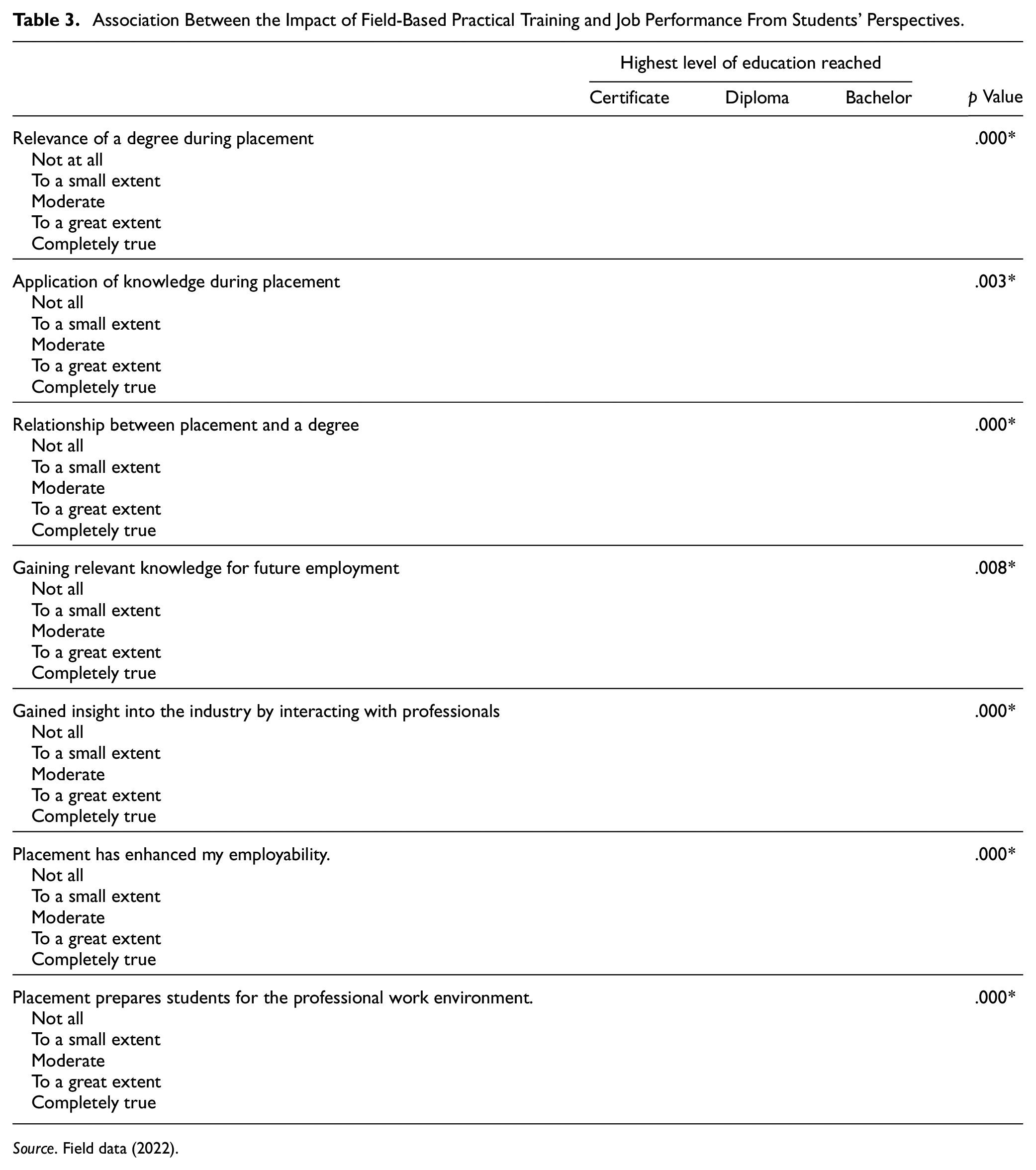
This part of the paper presents the findings on the association of the impact of field-based practical training on job performance (Table 3).
Association Between the Impact of Field-Based Practical Training and Job Performance From Students’ Perspectives.
Source. Field data (2022).
Discussion and Implications
The results indicate that the majority of students (89%) were pursuing Bachelor’s degrees, and for most of them, field-based practical training was compulsory. These were the students in education, earth sciences, informatics, health, and mathematical sciences.
The findings further indicate that almost two-thirds (63%) of the students were male. In Tanzania, male students are usually in the majority in higher learning institutions (Changalima et al., 2022). Consequently, their access to and distribution in field-based practical training programs also tend to be higher than that of their female counterparts. Furthermore, more than a third of the students (36%) proclaimed that their educational programs were moderately relevant during their apprenticeships or field placements. Therefore, these results indicate that the students who participated in this study were aware of the issues relating to field-based practical training in the country and were thus able to provide the information needed.
The findings in Table 2 indicate that over 75.5% of the respondents agreed that their levels of education were relevant to FPT placement. Therefore, all the responses were above average (i.e., moderate, to a great extent, and completely true). The results also show a statistically significant association between the highest level of education attained by the respondents and the relevance of their academic programs during FPT placement (p < .001). This cements the importance of marrying practice with theory (Msuya, 2022). Furthermore, the findings show that the relevance of FPT placement was high among the respondents with Bachelor’s degrees, followed by those with diplomas and finally by those with certificate-level education. Anjum (2020) obtained similar results with regard to Pakistan. The findings align well with theoretical notions from human capital theory, which suggests that students will need higher level training to be able to deliver to the expected standards during field activities.
Furthermore, more than 80% of the respondents pointed out that they had applied the knowledge acquired in the classroom during FPT. Moreover, the findings indicate that there is a statistically significant association between the highest level of education attained by a respondent and the application of knowledge during FPT placement (p = .003). Those with Bachelor’s degrees were more likely to apply knowledge during FPT placement than those with diplomas and certificate-level education were. A similar finding was also reported by Changalima et al. (2022) in their study on the challenges facing procurement professionals in Tanzania.
Similarly, 80% of the respondents indicated that they had gained knowledge that would be relevant in their future employment. Furthermore, the findings indicate that there is a statistically significant association (p = .008) between the highest level of education attained by the respondents and the relevance of the knowledge gained during FPT with regard to future employment. Appreciation of the practical knowledge gained was higher among the respondents with Bachelor’s degrees than for the rest. This was confirmed by a statistically significant association between the highest level of education attained by the respondents and the experience gained in the industry by interacting with professionals during FPT (p < .001). The findings corroborate Ndibalema and Kambona’s (2018) position that teaching practice (TP) significantly enhances student-teachers’ knowledge and skills. The results also show a statistically significant association between the highest level of education attained and performance during FPT (p < .001). Neo-institutional theory offers interesting insights into the role of institutional behaviors in instilling professional norms, standards, and guidelines to peers. This helps explain why professionalism is a by-product of institutional behaviors inculcated in individuals in an organizational setting over time.
Host Institution Supervisors’ Views on Students’ Performance During FPT
Thirty-four host institutions’ supervisors (50.7%) strongly agreed that students had enough theoretical knowledge. These findings are in tune with the evidence from a study on student-teachers’ professional development conducted by Msuya (2022). Similarly, 44 supervisors (65.7%) noted that students had adequate practical knowledge. When asked about students’ willingness and eagerness to learn, 48 supervisors (71.64%) strongly agreed that students were willing and eager to learn. The majority of supervisors reported that students were hardworking and committed, and could work independently. Generally, 33 supervisors (49.3%) acknowledged that students’ overall performance was good. This finding mirrors what human capital theory says about the role of schooling in the development of human capital through the imparting of job-related skills that enhance graduates’ performance. The findings are summarized in Table 4.
Host institution Supervisors Views on Students’ Performance During Field-Based Practical Training (n = 67).

Source. Field data (2022).
Major Challenges during Field-based Practical Training From Students’ and Work Supervisors’ Perspectives
The respondents were also asked about the challenges facing field-based practical training. Two broad challenges were mentioned: those relating to host institutions and those relating to the university. The former challenges include lack of funding to support students, a heavy workload, human resource constraints, a shortage of working equipment, lack of capacity on the part of some host institution supervisors and a shortage of time for coaching and mentoring students. One student had this to say on the host institutional challenges: “There was a large number of students in the same institution, which caused congestion and limited space for practice” (KI).
Similarly, a host institution supervisor commented on the institutions’ challenges thus: Our organisation receives students for field-based practical training every year, but the main challenge is the paucity of working facilities, which largely affects their learning (KI2).
Similar challenges were also reported by Msuya (2022), and Ndibalema and Kambona (2018),who identified limited mentorship and coaching on the part of host institutions, lack of working facilities, and overcrowded offices as the impediment to students’ learning during field-based practical training.
The challenges relating to higher education institutions include lack of funding to support FPT supervision, the absence of a guiding policy on the conduct of field-based practical training, different interests, the expectations of curricula, and those of host institutions. A student remarked: During field-based practical training, we were assigned activities to do; the activities were completely unrelated to our academic programmes/careers. We, therefore, call on the university to develop guidelines on FPT placement and assessment (KI3).
And a host institution supervisor said: “Some students lack the basic knowledge and skills to use some equipment” (KI4).
The foregoing statements support the challenge reported by Lahat (2019) related to academics and practitioners’ collaboration in Israel.
Conclusion and Recommendations
This study assessed the impact of field-based practical training on job performance in Tanzania from students’ and work supervisors’ perspectives. On the basis of the key findings, we conclude that there is a significant relationship between the level of education and the application of knowledge at the workplace (p < .001). There is also a significant relationship between the higher level of education and student placement in the field (p = .003), meaning that those pursuing degrees perform better than those pursuing diplomas and certificate-level education.
Moreover, 71% of the work supervisors interviewed were of the opinion that students were willing to learn new things at the workplace. However, effective provision of field-based practical training is affected by challenges stemming from host organizations and higher learning institutions, such as lack of funding to support students during field-based practical training, a heavy workload, human resource constraints, a shortage of working equipment, lack of capacity, and host institution supervisors’ lack of time to coach and mentor students, lack of a budget to support FPT supervision, the absence of a guiding policy on the conduct of fieldwork, different interests, and expectations of curricula and those of host institutions.
Apart from the above empirical findings, this study advances the knowledge related to human capital theory by positioning education as both an individual and a public good. For a long time, the theory has been one of the most powerful underpinnings of the discourse on educational policy worldwide, but more often in the global north. This study departs from this theoretical bias by exploring the analytical potential of the theory in the global south context by using it to explain the impact of field-based practical training on job performance in Tanzania. Thus, using this theory, the study contributes theoretical insights to the frontiers of knowledge on the nexus between education, employment, and economic growth in the global south context. Equally, neo-institutional theory makes a novel contribution in the context of the ongoing educational reforms in Tanzania, particularly on the role of institutional behaviors in instilling professional norms, standards, and guidelines to students, professionals, and work supervisors.
Methodologically, this study contributes to research on the importance of combining self-reports with external sources such as wok supervisors’ reports in examining the impact of field-based practical training on job performance.
The study recommends that higher learning institutions collaborate with host institutions in finding the best way to provide field-based practical training. Higher learning institutions should also develop FPT guidelines showing the duration, time, and the specific number of students for an organization. They should also continually review and update curricula to accommodate industrial interests. Finally, higher learning and host institutions should increase the financial resources for providing field-based practical training.
Footnotes
Acknowledgements
We thank all the respondents for participating in this study.
Declaration of Conflicting Interests
The author(s) declared no potential conflicts of interest with respect to the research, authorship, and/or publication of this article.
Funding
The author(s) disclosed receipt of the following financial support for the research, authorship, and/or publication of this article: This study was funded by the University of Dodoma through Junior Academic Scheme (JAS) 2021.
Ethical Approval
This research was approved by the University of Dodoma research committee.

Data Availability Statement
Data sharing not applicable to this article as no datasets were generated or analyzed during the current study.