




Abstract
Existing research on the relationship between social relations and new venture’s performance remains inconsistent. From the perspective of institutional theory, we introduce legitimacy acquisition and symbolic strategy to develop a theoretical model to explain the disparities in the Chinese transition economy. Based on the survey data of 242 small and medium-sized enterprises (SMEs) in China’s strategic emerging industries (SEIs), this paper (1) investigates the role of legitimacy acquisition as the mediator through which the two sub levels of social relations (political and business) affecting new venture’s performance. (2) Explores the moderating role of symbolic strategies to further illustrate the conditional nature of legitimacy acquisition. The results show that legitimacy acquisition plays a complete mediating role in the relationship between social relations and new venture’s performance. Symbolic strategy improves the positive effect of political ties on legitimacy acquisition, but weakens the positive effect of business relations on legitimacy acquisition. The findings contribute to the entrepreneurial literature and make significant empirical implications.
Plain Language Summary
Purpose: The study aimed to understand how social relations impact the performance of new ventures in China, emphasizing the roles of legitimacy acquisition and symbolic strategies. Methods: Through a survey of 242 small and medium-sized enterprises in strategic emerging industries in China, the study examined how legitimacy acquisition mediates the effect of social relations on venture performance, and how symbolic strategies moderate this mediation. Conclusions: It was found that legitimacy acquisition significantly mediates the link between social relations and venture performance. Symbolic strategies, however, had a mixed effect: enhancing the positive impact of political relations on legitimacy acquisition, but diminishing the effect of business relations. Implications: The results suggest that new ventures can improve their performance by gaining legitimacy through social relations. However, employing symbolic strategies may have varied effects depending on the nature of the social relations. Limitations: The study is bound to China, limiting generalizability. Other potential mediators or moderators impacting the relationship between social relations and venture performance were not explored. Additionally, the detailed impact of political versus business relations on legitimacy acquisition was not fully examined.
Introduction
Entrepreneurial activities have been considered as one of the most important ways to enhance economic vitality (Urbano et al., 2019). However, as the pioneers of new industries and new entrants of existing institutions, the “liability of newness and smallness” faced by new ventures create difficulties to access resources (Aldrich & Fiol, 1994; Fisher et al., 2017). In addition, because entrepreneurial activities are subject to risk factors and uncertainties, new businesses have few resources to meet their development goals (Hersel & Webb, 2018). Therefore, new ventures are forced to seek external cooperation (Boh et al., 2020; M. W. Peng & Luo, 2000), which may establish various relationships with external actors (H. Peng et al., 2016). Drawing upon social capital theory, researches suggested that social relations facilitate firms to access external resources that are beneficial for firm’s performance (Feld, 1981; Tilly, 2015). Extant researches mainly indicate that social relations positively influence the performance of new venture (H. Li & Zhang, 2007; Zhu et al., 2017), however, it has also been researched that social relations can negatively affect firm’s performance (Avgerou & Li, 2013). As an example, Uzzi (1997) argues that if a focal firm goes bankrupt, the business performance of its surrounding friends is also negatively affected. J. J. Li et al. (2009) found that political ties could decrease firm’s profitability as the connections with governmental officials are too close. Further, in the entrepreneurial context, as new ventures seek to establish social relations with powerful partners, it may force them lowering their ethical standard (Warren et al., 2004).
These inconsistent findings lead to explore how social relations influence new venture’s performance. Existing research focuses on analyzing the direct factors of how performance was affected by social relations (Su & Yang, 2018). However, others found that social relations that new firms established are unlikely to convert into good performance directly (Zhang et al., 2021). The recent study focuses on analyzing whether there are confounding factors between social relationships and performance, namely the mediator, such as adaptive capacity factors (Zhu et al., 2017), dynamic capabilities (Pinho & Prange, 2016), and resource bundling capabilities (F. Jiang et al., 2018, X. Jiang et al., 2018). Despite these efforts, the mechanisms of how social relations affect the performance of new ventures remain ambiguous (G. D. Bruton et al., 2018; H. Peng et al., 2016).
In order to provide deeper insight on the mechanisms of how social relations affect new venture’s performance, we introduce the mediating role of legitimacy acquisition to explore how social relations enhance new venture’s performance. The study based on institutional theory found that new firms are confronted with “liability of newness” in the process of creation and development (Stinchcombe, 1965), which creates difficulties for survival and development. By acquiring legitimacy from their external audiences, such as government players and business players, new ventures may gain resources needed for survival and development (Liu & Wang, 2022) and thus overcome the difficulties.
Meanwhile, the value of social relations is conditional on contingency factors (J. J. Li et al., 2008). By facilitating new venture to acquire legitimacy from social relations, symbolic strategies (Marquis & Qian, 2014) adopted by new ventures may serve as an important contingency factor. Symbolic strategy was frequently utilized to chase “ulterior” purpose by the new ventures (Zott & Huy, 2007) especially in SEIs 1 of Chinese transition economy. For example, a senior manager reported in the interview: “once the high-tech new venture certification was granted, we will receive honors, subsidies and pay less taxes…it cannot reflect the real technological strength of our firm…because many patents we applied are junk patents, just for the need of applying for high-tech new venture certification.” Therefore, we proposed that the symbolic strategies have a significant effect on the relationship between social relations and new venture’s performance.
By using 242 survey sample from SEI’s of China’s transition economy, we analyze the mediating role of legitimacy acquisition between social relations and new venture’s performance, as well as the moderating role of symbolic strategies and further explain the conditional nature of the value of social relations. Specifically, for one thing, the empirical results show that legitimacy acquisition plays a fully mediating role between social relations and entrepreneurial performance when viewed from two dimensions of social relations, namely political and business relations. For another, the findings suggest that while symbolic strategies enhance the positive impact of political relations on legitimacy acquisition, they depress the active impact of business relations on legitimacy acquisition.
This paper emphasizes on the importance of resource management as social relations transfer into superior performance in Chinese transition economy. We further explore the realistic scenarios in which the theories applying, which helps to integrate social capital theory and institutional theory.
Hypothesis and Conceptual Model Development
Theory
New Venture’s Social Relations
Social relations represented as informal, interpersonal social connections between the focal firm’s top managers and their external actors (Feld, 1981) which are based on trust and shared values between each other ( (Tilly, 2015). Scholars classified the type of social relations mainly as business relations (connections with business actors) and political relations (connections with government officials) (Luo et al., 2012). Accordingly, in Chinese transition economy, top managers in new ventures may foster “Guanxi-based relations” with business and government actors (Burt & Burzynska, 2017). We adopted the existing concepts of social relations that contain political and business relations. On the one hand, political relations refer to “guanxi”—developing contact with government officials. (Tilly, 2015). Firms develop contacts to complement formal institutions in order to escape institutional voids and to obtain preferential treatment as well as project approval (Burt & Opper, 2020; Luo et al., 2012). However, business relations refer to the process of developing relationships with market players, such as suppliers, customers, and competitors (Ellis, 2011). Social relations are helpful to gain customers, new business opportunities, avoiding threats accessing resources and building trust (Avgerou & Li, 2013; De Carolis et al., 2009; Zhu et al., 2017). The combination of both types of social relations forms an important basis for new venture to access various resources and achieve business goals.
Legitimacy Acquisition
Legitimacy facilitates new businesses to take on “liability of newness” and to achieve organizational stability, which is one of the core concepts in institutional theory (Scott, 1995; Überbacher, 2014). According to Suchman (1995, p. 574), legitimacy is defined as “a generalized belief or assumption that the actions of an entity are desirable, proper, or appropriate within some socially constructed system.” Kostova and Zaheer (1999) predigested the definition of legitimacy as “being accepted by the environment.” However, due to the different interests of public demands within the environment, new ventures should to obtain the recognition from various audiences (Fisher et al., 2017). In other words, when key audiences perceived the behavior of new ventures in an acceptable way, they may be gifted as legitimate. Thus, legitimacy acquisition was regarded as new ventures’ efforts to obtain the recognition of their audiences (Fisher et al., 2017), which facilitating themselves to overcome the obstacles in the entrepreneurial process (Überbacher, 2014; Yin et al., 2021).
Social Relations and Legitimacy Acquisition
Political relations are likely to improve firms’ ability to deploy public resolution approach that may produce favorable outcomes for new ventures (W. Shi et al., 2014). This effect is more pronounced in transition economies, especially in China (J. Shi et al., 2020). Chinese economy exhibits weaker institutional environment where government plays key role in resource allocation (G. Bruton et al., 2021). Accordingly, researches have emphasized the role of political relations that may offset the negative impacts of institutional burdens in Chinese economy (Bai et al., 2019; Ellis, 2011; M. W. Peng et al., 2008). Firms closely linked with the government (e.g., attendance at Congress and personal connections with government officials) have institutional advantages over those without these links (Q. Tang et al., 2021). Therefore, political relations help firms to access governmental authority which place the focal firm in a good position to acquire reputation, prestige and other resources outside their boundaries (Q. Tang et al., 2021). Specifically, through the establishment of political relations with government, new ventures interact frequently with government departments and regulative institutions. Such good relationship with government departments could in turn serve as endorsement for new ventures (G. D. Bruton et al., 2018). The endorsement by the government gifted the new venture with reputations, which may results in high-level of legitimacy (Bai et al., 2019).
For the role of business relations, given new ventures are unfamiliar with the prevailing norms and practices in the marketplace, they may suffer from “liability of newness” (Jacob & Duysters, 2017; Überbacher, 2014). Business relations may promote resonance between the focal firm and their audiences in the marketplace which help new venture to overcame the difficulties (Wang et al., 2020). To be specific, through formal and informal communication with business actors, new ventures could establish various connections, such as friendship, business clubs, alliances, professional associations (Wang et al., 2020), with business actors and audiences (like customers, opponents, and distributors) which enhance mutual understanding between each other. As the relationship deepens, the business activities of new ventures will be widely accepted by the audiences (Fisher et al., 2017), which may facilitating new ventures to acquire legitimacy. Thus, the new venture could overcome “liability of newness and smallness” by legitimacy acquisition (Neumeyer et al., 2019; Überbacher, 2014).
In summary, the following hypotheses are put forward
Legitimacy Acquisition and Performance
For new ventures, legitimacy acquisition is an important basis for them to obtain other resources (Díez-Martín, Blanco-González, & Díez-de-Castro, 2021; Zimmerman & Zeitz, 2002). Only when firms recognized by their audiences can they gain a foothold in the marketplace (Fisher et al., 2017). Hence, legitimacy is a certain type of resources, which help new ventures to attract customers, investors, partners, suppliers and other audiences (Díez-Martín, Blanco-González, & Prado-Román, 2021; Überbacher, 2014). As such, high-level of legitimacy offers support to access resources for new venture creation. For example, Deeds et al. (2004) empirically examined that legitimacy acquisition can help bio-pharmaceutical firms to attract investors. Chan and Makino (2007) have also found that organizations with higher legitimacy can obtain better resources than those with lower legitimacy. In fact, most new venture’s failure is not due to lack of market potential, but because they hardly gain the trust and support of audiences (Fisher et al., 2017). Due to the nature of novelty and uncertainty in new ventures, audiences are unwilling to take risks and invest resources in them (Liu & Wang, 2022). Therefore, new ventures need to cultivate “guanxi” relations with government players and market players, such as officials, industrial bureaus, customers, investors, suppliers, and competitors (Liu & Wang, 2022). As the new ventures is recognized, trusted, and supported by the audiences, it will enhance their ability to obtain resources (Fisher et al., 2017). Thus, legitimacy acquisition is helpful for new ventures to promote products and services and increase market share (Liu et al., 2022).
In general, legitimacy acquisition plays a mediating role between social relations and new venture’s performance. On the one hand, it allows political relations to be settled in a way that has a positive impact on legitimacy acquisition and, consequently, on the new venture’s performance. On the other hand, it allows business relations to be settled in a way that has a positive impact on legitimacy acquisition and, consequently, on the new venture’s performance. We propose the following,
Symbolic Strategy as the Moderator
Although social relations offer opportunities to legitimacy acquisition, these opportunities do not automatically lead to legitimacy acquisition (Fisher et al., 2017). Drawing on the Chinese transition economy context, new ventures prefer to implement symbolic strategies to facilitate resource acquisition (Marquis & Qian, 2014). Symbolic strategies, which was defined as the actions that convey the meaning of social construction beyond its ontological function (Zott & Huy, 2007). Such strategies always be utilized by firms to chase “ulterior” purpose (Marquis & Qian, 2014). From a practical view of point, symbolic strategy delivers positive information to the audiences that is likely to construct favorable and legitimate image (Nagy et al., 2012). Firms utilize symbolic strategies that convey the firm’s credibility, organizational achievement to their audiences, which may serve as contingency factors as firms to acquire legitimacy and resources from various social connections (Überbacher, 2014).
According to the seminal work of Marquis and Qian (2014), we proposed that symbolic strategies of new ventures may moderate the relationship between social relations and legitimacy acquisition. Because there exists information asymmetry when firms deal with different actors (political vs. market) (Cohen & Dean, 2005), we predict that different type of symbolic strategies may be utilized by the new venture to acquire legitimacy from different audiences (Marquis & Qian, 2014). For one thing, firm’s symbolic strategy for the government audiences may signals that their products/services are qualified by the customers, investors and other audiences for the marketplace (Marquis & Qian, 2014). However, in Chinese transition economy, the government’s evaluations for firm’s qualifications are mainly based on indicators responded from the market (Burt & Opper, 2020), such as the satisfaction of customers and stakeholders, credit rating by third-party agencies, etc. (Burt & Burzynska, 2017). Therefore, it may facilitating firms to gain legitimacy as they established ties with government actors (Verhaal et al., 2017). Thus, we predict that symbolic strategy for the government may strengthen the influence of political relations on legitimacy acquisition. For another, symbolic strategy for the business audiences may serve as certain type of symbolic function (Christmann & Taylor, 2006), because new ventures in Chinese transition economy need to respond to government instructions (Marquis & Qian, 2014). For example, a senior manager reported in our semi-structured interview: “once the high-tech new venture certification was granted, we will receive honors, subsidies and pay less taxes…it cannot reflect the real technological strength of our firm…because many patents we applied are junk patents, just for the need of applying for high-tech new venture certification.” As they establish business relations with market actors, firm’s symbolic strategy will be stigmatized by market actors within the category (Hampel & Tracey, 2017). Such dishonorable behaviors will result in legitimacy deficit.
Overall, the symbolic strategy plays a moderating role in the relationship between the two dimensions of social relations and new venture’s performance. We propose the following,
Figure 1 of theoretical framework depicts all hypotheses.

Hypotheses framework.
Data and Method
Questionnaire Design
We identify variables and constructs based on previous literature and modified them according to the feedback of in-depth interviews with SEIs senior managers in various Chinese Cities. Then, we organized three pilot-scale interviews from October to December, 2020 to identify the fitness of each item. We have translated each item within the questionnaire into Chinese language to pledge the interviewees can completely understand it. Likert 5 scale was utilized to measure the value of each item. For the point of the scale, “5” point equal the degree of very high (or the attitude of fully agree) and “1” point equal the degree of very low (or the attitude of completely disagree).
Data Collection
We have drawn our sample from Chengdu Tianfu Software Park, Sichuan, China. As the park is one of the largest professional software parks in China, thus the sampling source is well representative. The age of targeted firms are <8 years. The respondents were mainly the founders, CEOs, co-founders and other senior managers. The sampling method was simple random sampling. According to the enterprise directory provided by the park management committee, we randomly selected enterprises, conducted field visits in the Tianfu Software Park, and invited the top managers to fill in the questionnaire. For the targeted enterprises which had not been visited on the spot, we contacted the enterprises by telephone and e-mails. Based on the consent of targeted enterprises, we emailed our questionnaire to senior managers. We distributed 800 questionnaires in December 2020 and received 389 responses in April 2021. The invalid responses have been eliminated which makes our sample size 242. The effective sample recovery rate was 30.25%. The detailed sample was shown in Table 1.
Descriptive Statistics (N = 242).

Private owned enterprises account for the 84.71% of our sample. Seventy-one enterprises are <2 years of age accounting 29.34% while 89 enterprises are between the 3 and 5 years of age whereas 82 firms are aged from 6 to 8 years which account for 36.78% and 33.88% of our sample size respectively. From the industrial attribute of the sample distribution, 163 enterprises belong to SEIs, accounting for 67.40% of the total sample. Besides, the number of employee and income can reflect the size of the enterprise. According to the criteria of SMEs published in 2017 for the breakdown of SMEs of each industry by the state statistical office of China, the study of the sample meets the requirement of SMEs.
Measures
Social Relations
Considering the relationship between focal firms and different actors we divide social relations into two dimensions: political relations and business relations. Referring to M. W. Peng and Luo (2000) and Zhu et al. (2017), political relations include four items including (1) we have maintained good relationships with local government departments and government officials; (2) we have maintained good relationships with regulatory departments of the industry; (3) we have maintained good relationships with local industrial and commercial bureau, and taxation administration; (4) we have maintained a good relationship with the local park management committee. According to H. Li and Zhang (2007), business relations include three items, including (1) we have maintained good relationships with customers; (2) we have maintained good relationships with suppliers and retailers; (3) we have maintained good relationship with peers within the category.
New Venture’s Performance
The financial indicators of achievement can improve the effectiveness of the measurement. That information about the performance of finances leads to the insufficient use of indicators (Zhu et al., 2017). Therefore, we determine the performance of new business according to H. Li and Zhang (2007) to reflect the growth, profitability and innovation of new ventures. This index considers four items including: (1) compare with competitors, our firm’s growth rate of total sales and market shares are higher; (2) compare with competitors, our firm’s ROI and ROA are higher; (3) compare with competitors, our firm invested and developed more new products or services; (4) compare with competitors, our company has promised to bring new products or services to market faster.
Legitimacy Acquisition
Legitimacy acquisition is the mediator factor of the study. We measure the constructs according to the connotation of the variable that whether the focal firm are recognized and accepted by the environment. Accordingly, Certo and Hodge (2007) created a subjective scale to survey legitimacy based on the recognition of important audiences. We adopted the measurement and altered the scales as per Chinese context (Liu & Wang, 2022). The measures include five items, namely (1) government praise for the manage processes and daily operations of the focal firm; (2) customers praise for the products and services of the focal firm; (3) distributors and suppliers want to work with the focal firm; (4) companies within the category want to treat the focal firm with respect; (5) investors want to invest in the focal firm.
Symbolic Strategies
New ventures in the strategic emerging industries (SEIs) of Chinese transition economy often apply for two types of certifications namely the product/service quality certification granted by the market and the high-tech new venture certification granted by the government (Xie et al., 2022). We measure symbolic strategy for government audiences as whether the focal firms applying for product/service quality certifications. Because this type of certification was granted by the market, which could testify the quality of firm’s products/services. If the firm was granted by such type of certification, then the value equal 1, otherwise the value equal 0. We measure symbolic strategy for market audiences as whether the focal firms applying for high-tech new venture certifications. Because this type of certifications was granted by government, which was mainly utilized as to gain fiscal subsidies and reduce taxes. Similarly, If the firm was granted by such type of certification, then the value equal 1, otherwise the value equal 0.
Sample Analysis
Validity and Reliability
We conducted the software of SPSS 22.0 and Amos 22.0 to test the validity and reliability of each construct. The results of validity and reliability each construct was shown in Table 2.
Validity and Reliability of the Constructs.
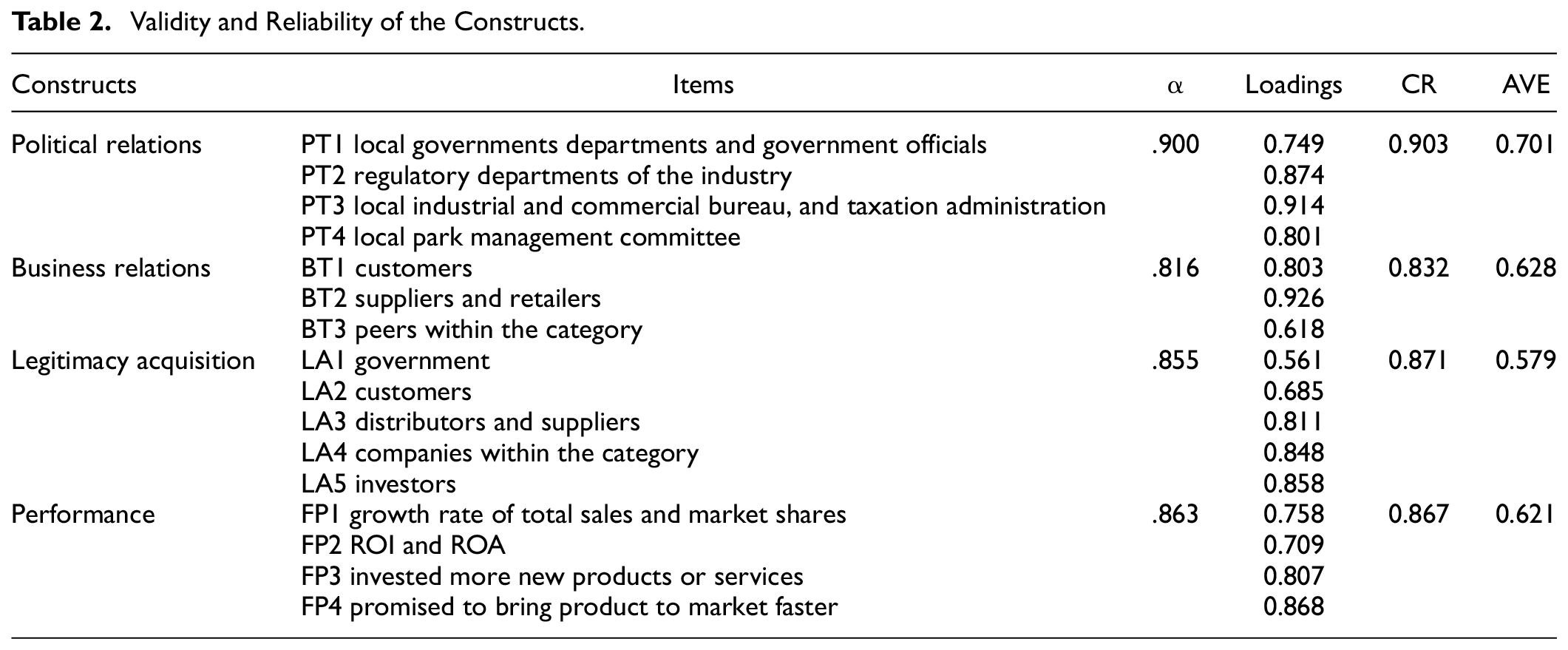
Referring to the criteria of most previous studies, 0.7 is taken as the critical value of Cronbach’s alpha reliability coefficient in this study. The Cronbach’s α value of each construct is >.8, which has a good reliability. Considering that the questionnaire in this study has passed the exploratory factor analysis (EFA) in the pre-survey stage, which shows that the scale has a good construction validity. The confirmatory factor analysis (CFA) results show that factor loadings were between 0.561 and 0.926, which fulfill the requirement of factor loading that falls between 0.5 and 0.95. Moreover, the convergent validity of our factors of average variance extracted (AVE) is reported in Table 2. Results show that AVE values are well above the recommended value of 0.5. In addition, every dimension of variables demonstrates higher than 0.8 combination reliability (CR). Thus, the convergent validity of the data was satisfied with good result.
We further estimate the discriminant validity by using the Fornell-Larcker criterion to observe how greater the square root value of AVE of each construct in comparison to the correlations between each variable. The square root of AVE and the diagonal coefficient for all structures of non-diagonal elements were shown in Table 3. We can find that the diagonal elements are larger than the off-diagonal ones, which means the results the discriminant validity of the data was satisfied.
Discriminant Validity and Correlations.

Note. Diagonal elements (in bold) are square roots of the AVE. Off-diagonal elements are the correlations of the main variables of the study. N = 242.
Poli_Rel = political relations; Busi_Rel = business relations; Legi_Acq = legitimacy acquisition; Sym_Mkt = symbolic strategy for the market; Sym_Gov = symbolic strategy for the government.
p < .05. **p < .01 (two-tailed).
Common Method Variance (CMV)
The sample might be the subject of common method variance (CMV) problem. Thus, to avoid CMV, we utilized multivariate questions to measure each item in our questionnaire. Afterward, in order to lessen the retrospective bias of respondents, we also reversed and misplaced the items of each latent variable. Subsequently, we employ Harman single factor test to examine the common method deviation. This method considers that if there have a single factor explains the covariance between most of the independent variables and the dependent variables (More than 40%), it indicates that there exists a CMV problem. In this study, principal component analysis was used to check CMV problem. The first factor explained 27.936% of the variation when the axis was not rotated, so there was no single factor that could explain most of the variation, which means the CMV problem has resolved.
Results
Mediating Mechanism of the Regression
The variance of inflation factor (VIF) value was tested before the regression analysis. Since the VIF value in all models were between [1.021, 1.982] which is far more <10. Therefore, no multicollinearity problem occurs in the study.
Table 4 contains the results of regression analysis of mediating effects. First, the effect of control variables on the dependent variables was examined in model 1. Next, the effect of independent variables, namely political relations and business relations, on the dependent variable was tested in model 2. Result show that both political relations (M2: β1 = .191, p < .01) and business relations (M2: β2 = .375, p < .001) shows a positive correlation with new venture’s performance. Next, we examined the effects of political relations and business relations along with control variables on legitimacy acquisition in model 3b. Moreover, we investigate the effect of legitimacy acquisition and control variables on new venture’s performance in model 3a. As a result, it became clear that the two sub-dimensions of social relations have positive effects on legitimacy acquisition (M3b: β1 = .162, p < .001; β2 = .563, p < .001), and legitimacy acquisition has a significantly positive impact on new venture’s performance (M3a: β3 = .711, p < .001). Further, we examine the mediating role of legitimacy acquisition in model 4. We take took into account all variables (including political relations, business relations and control variables) to examine their effect on new venture’s performance. The result show that legitimacy acquisition has a positive and significant impact on performance, however, there is no significant impact of political relations and business relations on new venture’s performance. (M4: β1 = .085, p > .1; β2 = .036, p > .1; β3 = .659, p < .001). In combination, the regression results indicate that legitimacy acquisitions fully mediate the relationship between the two dimensions of social relations and new venture’s performance. Thus, H1a, H1b, H2a, and H2b are supported.
Mediation Regression Models.

Note. N = 242.
p < .1. *p < .05. **p < .01. ***p < .001.
Results of Moderating Mechanism
To examine the moderating effect, the moderated hierarchical regression was adopted to test the interaction between social relations and symbol strategies. To avoid multicollinearity of the regression model, all explanatory variables were mean-centered (H. Tang et al., 2023). The regression results were presented in Table 5. First, the effect of control variables on legitimacy acquisition was examined in model 5. Next, we add independent variables in models (6–9), afterward, we add moderating variables in models (7–10). Subsequently, the moderation and interactions terms have been introduced in models (8–11).
Moderation Regression Models.

Note. N = 242.
p < .1. *p < .05. **p < .01. ***p < .001.
It was shown that political relations have a significantly positive relationship with legitimacy acquisition in model 6 (M6: β = .316, p < .001). In Model 8, the interaction between political relations and symbolic strategy results in an active effect on legitimacy acquisition (M8: β = .179, p < .05). Results in Model 9 suggest that business relations are significantly positive related to legitimacy acquisition (M9: β = .629, p < .001). In model 11, the interaction between business relations and symbolic strategy is significantly negative related to legitimacy acquisition (M11: β = −.207, p < .05). Thus, H3a and H3b are corrective.
To more directly represent how symbolic strategies moderate the impact of social relations on legitimacy acquisition, we plotted this result numerically in Figures 2 and 3. Figure 2 shows the interaction effects of political relations and symbolic strategy for the government on legitimacy acquisition. When the value of interaction term (symbolic strategy multiply with political relations, abbreviated to Sym_Gov) is 0, the slope is relatively low; while when the value is 1, the slope is relatively high, presenting a positive effect of political relations on legitimacy acquisition. Figure 3 shows the results of the interaction between symbolic strategy and business relations on legitimacy acquisition. When the value of interaction term (symbolic strategy multiply with business relations, abbreviated to Sym_Mkt) is 0, the slope is relatively high; while when the value is 1, the slope is relatively low, showing a negative effect of the interaction term on legitimacy acquisition. Figures 2 and 3 provide support for Hypotheses 3a and 3b.

Moderating effects of symbolic strategy for the government.
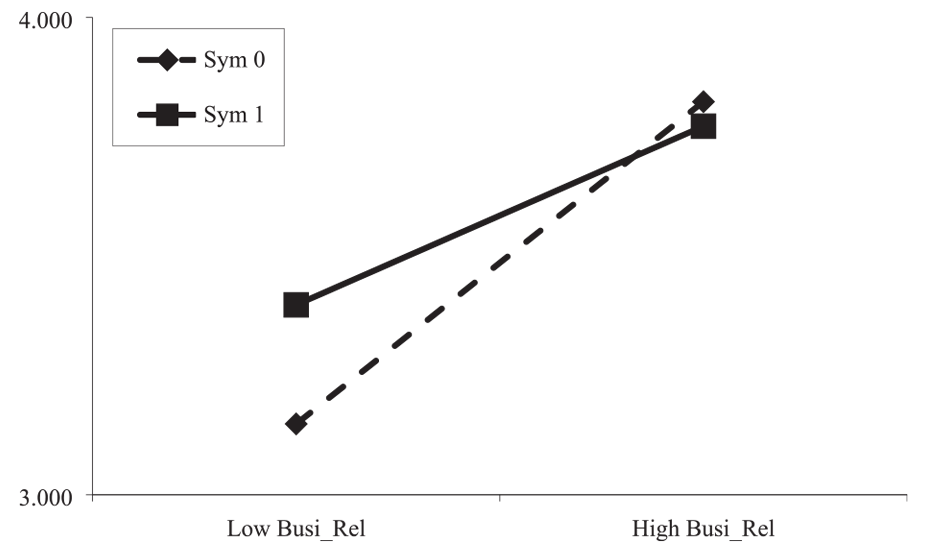
Moderating effects of symbolic strategy for the business.
Conclusions, Implications, and Limitations
Conclusions
Employing a data set of 242 new ventures of SEIs in China, this paper explored the role of legitimacy acquisition and the role of symbolic strategies within the “social relations—performance” linkages. The empirical analysis illustrated several main findings. Firstly, the two sub-dimensions of social relations (political and business) have a positive impact on legitimacy acquisition. Secondly, the acquisition of legitimacy plays a full mediating role within the “social relations—performance” linkage. Finally, symbolic strategy plays a moderating role in determining the relationships between the two sub-dimensions of social relations and legitimacy acquisition. Specifically, the symbolic strategies of government audiences positively moderate the impact of political relations on legitimacy acquisition, however, it has a negative moderating effect on the impact of business relations on legitimacy acquisition. Overall, the findings offer significant contributions both theoretically and empirically.
Contributions
Theoretical Contributions
Firstly, we offer a new perspective for understanding the relationship between social relations and the performance of new ventures. This paper highlights the indispensable role of legitimacy acquisition as new ventures acquire resources and promote performance through social relations. Due to the nature of “liability of newness” for new ventures (Gimenez-Fernandez et al., 2020), it is the first priority for new ventures to acquire legitimacy through social relations than any other resources or capabilities (Soublière & Gehman, 2020). Therefore, it enriches the internal mechanism of linkage between social relations and performance in entrepreneurial context. Moreover, this paper holds that legitimacy is certain type of resources for new ventures (Liu & Wang, 2022; Zimmerman & Zeitz, 2002), previous literature explained the resource acquisition of new ventures mainly from the perspective of social capital theory (F. Jiang et al., 2018), which has paid little attention to the institutional factors, namely legitimacy. This paper hold that only when new ventures obtained legitimacy resources can they promote the performance, which contributes to the integration of social capital theory and institutional theory (Rigolini & Huse, 2021).
Secondly, by exploring the significance of symbolic strategy (Marquis & Qian, 2014), the study asserts the conditional nature in the relationship between social relations and legitimacy acquisition. This finding deepens the research that how new ventures interact with their audiences when they strive for legitimacy. By straight out the pros and cons of symbolic strategy, it takes the theory a step further (Soto-Simeone et al., 2020). Previous literature proposed that symbolic strategies may be utilized by firms to chase “ulterior” purpose, however, it is not clear that such strategy is good or bad for new ventures (Hampel & Tracey, 2017). By categorized the types of symbolic strategy according to different audiences, this paper makes this point clear. Therefore, the findings shed light on the role of symbolic strategy in entrepreneurial context, which contribute to the entrepreneurial theory.
Empirical Significance
The findings make significant implications for practice.
Firstly, we suggest that there exists a mediator as firm’s social relations transformed into performance. Different from established firms, new ventures often confronted with the problem of liability of newness and smallness, which makes them hardly to growth. Hence, new ventures should take efforts to recognized by customers, competitors, suppliers, retailors, government departments and other audiences. Because, for new ventures, to some extent, the legitimacy is much more important than the technological and financial resources. Once the legitimacy was granted by their audiences, it will form a mechanism of cooperation on the basis of mutual trust. Such mechanism may reduce the cost of new product development and technological innovation. The trust relationship makes new ventures closely cooperate with their partners, which reduces the opportunistic tendency and risks, thus improve the performance.
Secondly, we advise that firms should take symbolic strategy in a proper way. Different from western developed economies, the Chinese transition economy has institutional defects, that large number of enterprises will try to utilize the defects, such as engage symbolic strategy to accelerate the business process. Although the strategy may beneficial for firms in some ways, the findings also illustrate the dark side of symbolic strategy. Even if the symbolic strategy can fulfill other purposes that beneficial for new ventures, it could stigmatize the reputation of new ventures recognized by market actors. Thus, new ventures should avoid themselves falling in the “myopic trap” that they should take care of the negative effects of such strategy.
Limitations
This study, while insightful, presents certain limitations that open avenues for further investigation. Firstly, the research is geographically bounded to China, which poses questions on the generalizability of the findings to other institutional settings. Future research could extend this inquiry to different socio-economic contexts to ascertain the universality of the observed relationships. Secondly, the study elucidates the mediating role of legitimacy acquisition between social relations and venture performance; however, there might be other mediating or moderating variables at play, unexplored in this study. Future research could delve into identifying other mechanisms that might explain the complex relationship between social relations and new venture performance. Lastly, this study lays the groundwork for a deeper exploration of the varying impacts of political and business relations on legitimacy acquisition. Further studies could dissect these sub-dimensions of social relations more thoroughly, potentially revealing a more intricate understanding of how different facets of social relations contribute to the legitimacy and success of new ventures.
Footnotes
Declaration of Conflicting Interests
The author(s) declared no potential conflicts of interest with respect to the research, authorship, and/or publication of this article.
Funding
The author(s) disclosed receipt of the following financial support for the research, authorship, and/or publication of this article: This work was supported by National Natural Science Foundation of China (No. 72202001); Youth Project of Anhui Provincial Philosophy and Social Science Planning Fund (No. AHSKQ2022D054).

Data Availability Statement
Data sharing not applicable to this article as no datasets were generated or analyzed during the current study.