




Abstract
Burnout is a state of emotional, physical, and mental exhaustion due to exposure to excessive and prolonged stress. It isn’t a medical condition. However, it negatively affects the creativity of employees. The individual with increasing burnout withdraws into his/her world by reducing his/her social ties with his/her environment. Those who are self-isolating might try to connect with the outside world by using social media more. This study primarily aims to examine the mediating effect of creativity on how burnout affects social media use among physicians through a correlational survey study design. Personal information form, Maslach Burnout Inventory, Kaufman Domains of Creativity Scale, and Social Media Disorder Scale were utilized as measures. A total of 529 physicians participated in the study. According to the results, there is a correlation between burnout and self/everyday creativity, as well as self/creativity and social media use. Moreover, there is a correlation between burnout and social media use. It was concluded in the study that creativity among physicians had a mediating effect on social media user. This study is meaningful in terms of seeing the effect of burnout on self/everyday creativity and social media usage. Directing physicians to programs that reduce/prevent burnout might positively affect their self/everyday creativity and social media usage.
Plain language summary
Burnout is a state of emotional, physical, and mental exhaustion due to exposure to excessive and prolonged stress. It isn’t medical diagnosis. However, it negatively affects the employees. Burnout and creativity are polar opposites. The individual with increasing burnout withdraws into his own world by reducing his social ties with his environment. Those who are self-isolating try to connect with the outside world by using social media more. This study primarily aimed to examine the mediating effect of creativity on how burnout affects social media use among physicians. This study was conducted by the relational survey design. Personal information form, Maslach Burnout Inventory, Kaufman Domains of Creativity Scale, and Social Media Disorder Scale were utilized as measures. A total of 529 physicians participated in the study. The analyses concluded negative correlations between burnout and self/everyday creativity and self/creativity and social media use and a positive correlation between burnout and social media use. It was concluded in the study that burnout among physicians had a mediating effect on social media user. This study is meaningful in terms of seeing the effect of burnout on self/everyday creativity and social media user. Directing physicians to programs that reduce/prevent burnout might be positively affect their self/everyday creativity and social media user.
Introduction
According to the Digital Report issued by We Are Social in March 2020, about 60% (4.570 billion) of world’s population are Internet users and 50% (3.810 billion) are active social media users. This rate has increased by 7% compared to the previous year. In Turkey, number of users has increased by 4% in 2020 compared to the previous year and number of Internet users has reached 62.07 million (74%) while number of social media users has reached 54 million (64%). The average duration of social media use (SMU) in Turkey was found to be “3:01” hour/day. In a study conducted with the healthcare workers in Turkey, 76.90% of the participants indicated that their social media usage increased due to the social limitations the pandemic arose (Elbay et al., 2020).
Social media can be utilized for reasons such as interacting with real life friends, meeting others based on shared interest, chatting, mailing, sharing or creating pictures/videos, blogging, dating, playing games, and gambling (Griffiths, 2015). SMU on optimum level has some positive effects such as maintaining/developing social communication with immediate circle in virtual media, creating new social circles, following up current information, entertainment/recreation, or job related sharing. For instance, in a study conducted with 2003 adults in the US, 20% reported that they used Facebook for asking job-related questions and producing solutions to problems (Pew Research Center, 2016). In a similar study, 36.5% of employees stated that they used Twitter for business purposes (van Zoonen et al., 2016).
Social media is a powerful tool of reinforcement as it can provide feedback on an individual’s ideas, interests and actions in an interactive environment. For this reason, there is a high risk that it can turn into a habit, and over time, into an addiction (Griffiths, 2015). Although SMU is not defined as an addiction according to The Diagnostic and Statistical Manual of Mental Disorders–5 (DSM–5) (American Psychiatric Association, 2013), a group of experts argue that the internet and activities performed on internet trigger symptoms similar to those shown by behavioral or substance addicts and consider SMU (or Problematic SMU [PSMU]) as an addiction (Griffiths, 2015). Contrary, while there are many people using social media platforms, a small minority of users exhibit addiction-like symptoms (Kuss & Griffiths, 2011). This is because new generations may have different preferences in the ways of entertainment and communication involving SMU. This preference may be perceived as normative behaviour over time (Kardefelt-Winther, 2014). In this context, in order for SMU to be diagnosed as a disorder, more research examining biological tendencies, personality and psychosocial variables that may affect the emergence of the disorder is needed.
Previous studies have explored negative effects of social media addiction such as increasing problems in family communication (Mustafa, Zirek, Yasacı & RazacıÖzdinçler, 2018), social comparison and jealousy due to the frequency of the SMU (Charoensukmongkol, 2018), higher levels of lack of caring, loneliness and jealousy among the individuals who perceive their partners as overusing the social media (Nogpong & Charoensukmongkol, 2016), turning individuals into passive receivers (Toran et al., 2016), causing information and communication overload (Luqman et al., 2017), and social overload (Maier et al., 2015; Yao & Cao, 2017). When the overall negative effects of social media are taken into consideration, it is essential to identify the level of social media usage and the factors affecting social media usage among the physicians as well as developing prevention strategies toward for these factors.
There is a broad theoretical and empirical literature on the explanation of SMU and factors that increase or decrease it. The model titled Interaction of Person–Affect–Cognition–Execution (I–PACE) introduced by Brand et al. (2016) suggests that individuals become disordered users of specific types refer to an addictive use of one certain genre of applications or sites, such as gaming, gambling, shopping, social networking, or communication. According to the model, SMU is in interaction with several moderators and mediators, social cognition, personality traits such as everyday creativity and predisposing factors such as burnout (Kircaburun et al., 2020). In the studies that utilize the model, the most prominent aspects of personal factors are high impulsivity, high neuroticism (Kircaburun et al., 2020), a tendency to procrastinate, and low self–directedness (Wang et al., 2015) and creativity (Kircaburun et al., 2020). Aspects of social cognition can be listed as a perceived lack of social support, self–esteem, feelings of isolation, and loneliness (Griffiths, 2015). Self/everyday creativity is described as expressing oneself to others appropriately and originally in one’s everyday relationships and interactions (Kaufman, 2012). Although self/everyday creativity is among personal factors and burnout is among predisposing factors, they are the two main variables that have not been studied adequately.
Burnout and SMU
Maslach and Jackson (1981) explained burnout with a three domain model. These are emotional exhaustion, depersonalization and lack of personal accomplishment. Emotional exhaustion occurs as individual’s decreased energy and motivation for their job. Depersonalization is the feeling of cynicism that causes employees to develop excessively detached behavior to coworkers or patient. Lack of personal accomplishment is the loss of efficacy, which makes employees feel that their contribution is not worthwhile for the organization (Charoensukmongkol, 2016). Health workers are among the occupational groups in which burnout is most observed (Mustafaoğlu et al., 2018). For the workers during the crises such as the Covid-19 pandemic, perceived uncertainties (Charoensukmongkol & Phungsoonthorn, 2022) and role ambiguity (Charoensukmongkol & Puyod, 2021) increase and perceived uncertainties mediate the negative association between crisis communication and emotional exhaustion (Charoensukmongkol & Phungsoonthorn, 2022). According to the researcher, burnout is expected sooner and more intensely in relation to the additional workload brought by the COVID pandemic and its risks.
As shown by explanatory studies in the literature, there is an intricate and multidimensional relationship between burnout and (P)SMU. Signs such as depression, emotional loneliness, and social withdrawal within the scope of social cognition, a component of the I–PACE model, have indirect effects on increased Internet addiction (Brand et al., 2014). Those variables are also associated with high levels of burnout. Furthermore, common findings achieved in the literature include isolation and loneliness and decreased academic performance which occurs/increases with burnout and SMU (Stoliker & Lafreniere, 2015). Stress and depressive behaviors are also predictors of Internet addiction, and Internet addiction is also a predictor of stress and depressive behaviors (Gupta et al., 2018). On the other hand, burnout and SMU behavior can differ by culture. Peterka-Bonetta et al. (2019) examined burnout–SMU relationship in different cultures. That study found low levels of relationships between emotional exhaustion, depersonalization and lack of personal achievement and SMU in the German sample. In the Chinese sample, there was a moderate relationship only between emotional exhaustion and SMU.
Aghaz and Sheikh (2016) found in their study with professionals working in the knowledge intensive settings that burnout at the workplace had low significant relationships with cyberloafing activities and behaviors, which are partly accepted as a type of PSMU. The exact opposite applies, too. Cyberloafing activities and behaviors were also reported to have a significant impact on occupational burnout. Yıldırım (2018) also explored relationships between burnout subscale scores of certified public accountants and cyberloafing similar to the ones in the study by Aghaz and Sheikh. Salmela-Aro et al. (2017) examined two different longitudinal data of 1,702 Finnish students aged between 12 and 14 years and 1636 Finnish students aged between 16 and 18 years and found that SMU increased the development of school burnout while school burnout increased SMU. Both variables were found to possibly have cross lagged paths.
The Mediating Role of Self/Everyday Creativity
According to Freud, the founder of psychoanalytic theory, individual’s creativity is the expression of the conflict between their “libido” energy and the subconscious. Individuals’ level of energy is among the most important determinants of their creativity (Kaufman, 2012). As argued by Maslach and Jackson, burnout is a phenomenon that mitigates an individual’s overall energy in life. Burnout is the emotion in which the individual exhausts their energy and feels excessively tired, weak, and distant from trying new things (Maslach & Jackson, 1981). Such weakness may cause the individual to alienate themselves from others emotionally and their job (cynicism) and lead to low achievement in their job as an instinctive reaction to cope with the overload. Thus, burnout and creativity can be regarded as two ends of people’s capacity. Research results also confirm the theoretical considerations above. For example, Schaufeli et al. (1996) stated that individuals with high levels of burnout usually have lower levels of creativity.
Individuals experiencing emotional exhaustion are found to experience anxiety and disappointment, lose their work motivation, and have decreased mental engagement in their tasks (Charoensukmongkol & Suthatorn, 2018). Due to the nature of the health services, a doctor is expected to create alternative solutions to the unexpected problems he/she faces while performing his/her job. The doctor with high burnout is likely to turn to generally accepted procedural solutions that require less mental energy expenditure in such problem situations. As a result, low-creativity responses will be produced that reflect the recalling of familiar solutions or close associative thinking. A doctor with a low exhaustion level, on the other hand, possesses a higher possibility to come up with original solutions, which require more mental involvement and which is a reflection of his/her associative thinking away from his/her daily creativity (Kaufman, 2012).
The relationship between self/everyday creativity and SMU has not been sufficiently studied. Self/ everyday creativity is directly associated with how individuals can understand others self–consciously (their desires, interests, values, etc.) in the exact manner and can establish an effective communication and cope with possible everyday problem situations (Kaufman, 2012). Highly self–conscious individuals have more developed competency in dealing with stress factors that nourish burnout and coping with them. A Kircaburun et al. (2019) study determines a −.27 correlation between self/everyday creativity and SMU. In this regard, SMU is expected to be higher among individuals with low self/everyday creativity.
The Compensatory Internet Use (CIU) model argues that Internet addiction of an individual is a result of their effort to compensate what they are missing in real life (Kardefelt-Winther, 2014). Workers who find themselves in such situations frequently repeat the behaviors of interacting with others at a minimum, getting away from the environment perceived as the problem or compensating for their real life dissatisfactions through SMU so that they will not face previous problematic/unsuccessful situations. Individuals with low self/everyday creativity are more likely to have social interactions and frequent adversities in their everyday interactions and low job satisfaction levels (Kircaburun et al., 2020). Moreover, it is found that the employees with high burnout have low job satisfaction (Ertürk & Keçecioğlu, 2012) and employees with low job satisfaction tend to use social media more (Başer et al., 2016).
Present Study
According to Shiyko et al. (2012), in a research study, subgroups in which the data collected can differ significantly from each other. Subgroups that can disrupt homogeneity may mask overall research results (Bryne, 2010). The duty, responsibility, and workload of a doctor providing service in a health institution may differ from other health professionals (Ministry of Health, 2015). To instantiate, burnout among the physicians providing face to face service to patients is particularly higher than among other health professionals (Shanafelt et al., 2012). Within this light, the study focused solely on doctors for data collection to reach more specific answers. Moreover, in the study, social media user (SMU) refers to the individuals who collect and share ideas, thoughts, and information, who joins internet-based tools individually or as a part of a community (Trifiro, & Gerson, 2019).
According to the CIU model, the locus of the problem is a reaction by the individual to his negative life situation, facilitated by an internet application (Kardefelt-Winther, 2014). Theoretically, it is quite possible that individuals with high burnout levels tend to increasingly orientate toward SMU due to their decreased interest in their job and search for positive social feedback such as approval by others through social media.
It has been argued that intensive Internet use including SMU might be a form of inappropriate response resulting from the underdevelopment of an individual’s ability to produce proper solutions to emotional or social hardships (Brand et al., 2014). Hence, individuals who can create creative responses to everyday problems have lower SMU levels.
The literature has examined the effect of SMU on creativity (e.g. Acar et al., 2021) and burnout in the workplace (e.g. Charoensukmongkol, 2016). On the other hand, the effects of an individual’s creativity (Kircaburun et al., 2020) and burnout levels on SMU (Salmela-Aro et al., 2017) have been examined in students groups of different cultures as individual variables in a very limited number of studies. Creativity and burnout are general phenomena. However, the intensity of their occurrence may differ by environmental (e.g. school or hospital) or individual factors (e.g. student and physician
Given the abovementioned literature, burnout affects self/everyday creativity, and self/everyday creativity has a potentially negative impact on SMU. It is necessary to determine the mediating effect of self/everyday creativity to have a clearer understanding of the relationships among the three variables. Indeed, a mediator variable (self/everyday creativity) will help a more detailed understanding of the relationship between an independent (burnout) and dependent variable (SMU) (Preacher & Hayes, 2008). This study primarily aimed to examined the effects of burnout and self/everyday creativity on SMU among physicians. Another purpose of this study was to determine whether self/everyday creativity has a mediating effect when it comes to the effect of burnout on social media usage.
Methods
Research Model
The study was conducted cross-sectionally in the correlation study design. Correlation research aims to examine the relationship between two or more (Büyüköztürk et al., 2016). This kind of research design is appropriate to identify the relationship between the variables on a subject and reveal the possible impacts of independent variables on dependent variables (Spector, 2019).
Participants and Data Collection Procedure
In this study, due to the rapid changes in the number of physicians working actively due to the covid-19 epidemic (provincial or inter-institutional assignments, resignations, new recruits, etc.), the universe parameters could not be predicted exactly. For this reason, the convenience nonprobability sampling method was preferred. The data was collected by the researcher. The researcher shared an information message and the research link with physicians with whom they were personally in contact via WhatsApp. Those physicians shared the link with other colleagues with whom they were personally in contact. This population is easily accessible, experienced in social media applications and has the ability to provide sufficient information to research questions. Before answering the measure forms, an explanatory text about the research purpose and how they would answer the questions was shared with the participants. Next, they were asked to answer the measures in consideration of criteria such as voluntary participation, working with patients face–to–face at the institutions, having no diagnosis of any mental disorder (major depression, etc.). Questions about the names, which would expose personal information were not included in the measures.
The study group of the research was composed of 529 physicians working at healthcare institutions in 36 different provinces of Turkey. Three-hundred fifty-one (66.40%) of the participants are female, 178 (33.60%) of them are male. Four hundred sixteen (78.60%) of the participants were working in public sector while 113 (21.40%) were working in private sector. One hundred twenty-nine (24.40%) of the physicians were 30 years old and younger, 352 (66.50%) were between the ages of 31–50 years, and 48 (9.10%) were 51 years old and older.
Instruments
Personal Information Form
A personal information form was prepared by the researchers to find out about where the participants worked, their genders, and the sector they worked in.
Social Media Disorder Scale
Participants’ levels of social media use were measured with this scale developed by Van den Eijnden (2016) on the based on the internet gaming disorder criteria in DSM–5 and adapted into the Turkish language by Kırcaburun. The scale is composed of 9 items. In the 2 point Likert scale, answers given to the items are yes and no. The possible score is within the range of 0 and 9 points. Five and higher scores indicate inappropriate social media use (disorder). The Turkish version exhibited strong evidence of validity and reliability (Kircaburun et al., 2019). Cronbach’s alphas of all the scales are shown in Table 1.
Descriptive Statistics and Correlations Among the Variables.
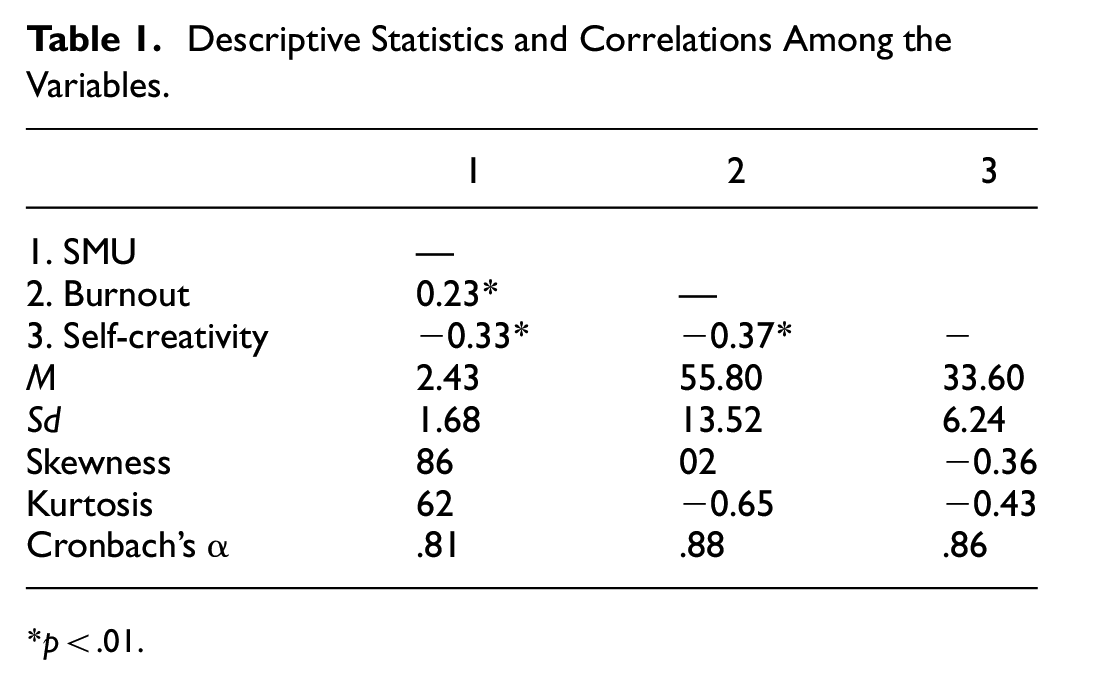
p < .01.
Kaufman Domains of Creativity Scale (K–DOCS)
K–DOCS was developed by Kaufman (2012) with the approach that creativity emerges in a domain specific manner. It was adapted into the Turkish language by Şahin (2016b). Creative skills are measured in academic, mechanic/scientific, artistic performance, self/everyday, and artistic domains. The self/everyday creativity domain was utilized in this study, which is composed of 9 items (e.g. Mediating a dispute or argument between two friends). It is graded by a self–assessment method. The grading is in the 5 point Likert range according to the statement “I am slightly less/more creative than my peers.” The possible scores on the scale vary between 9 and 45 points. Previous studies that used the Turkish version showed good internal consistency of the scale (Kircaburun et al., 2020; Şahin, 2016a).
Maslach Burnout Inventory (MBI)
Burnout levels of the participants were measured with MBI developed by Maslach and Jackson (1981). MBI measures dysfunctional cognitive and emotional features which refer to burnout. There are three subscales of the scale, which are Emotional Exhaustion, Depersonalization, and Lack of Personal Accomplishment. The original version of the 7-point Likert scale is composed of 22 items. The 5-point Likert version of the scale which has also 22 items and was adapted into Turkish by Ergin (1992) was utilized in this study. Answers given to the items of the Turkish version are graded between “1—never” and “5—always,” which means a total score range of 22 to 110 points. Higher scores in the subscales of emotional exhaustion and depersonalization and lower scores in the lack of personal accomplishment subscale indicate burnout. In this study, lack of personal accomplishment scores was recoded as the total scale was utilized.
Analyses
Statistical Package for the Social Sciences (SPSS) 22.0 software package was used in the data analyses. The analyses were conducted in two stages. In the first stage, the suitability of the statistical method to be applied to the dataset was tested. Next, analyses were performed to determine the effect of independent variables (burnout and self/ everyday creativity) on the dependent variable (SMU).
Prior to the analyses, missing value, outlier, normality, multicollinearity, variance inflation factor (VIF), and tolerance values were examined. No missing value was observed. Twenty-eight measure forms were removed from the dataset, after outliers were detected in their items. Analyses were carried out with the remaining 529 forms. For normality, skewness and kurtosis values were found to range between −.36 and .86 and −.65 and .62, respectively (Table 1). With a conservative perspective, George and Mallery (2010) argue that those two values being ±2 refer to normal distribution. Cronbach’s alpha values were found to range between .81 and .88, which show good internal consistency of the scales.
VIF and tolerance values were found to be 1.16 and 0.86, respectively. The correlations between the variables were found to be −.37, −.33, and .23, which meant a correlation range between .23 and −.37. It was concluded from these results that there was no multicollinearity. Consequently, it was presumed that the dataset met the assumptions required for regression analysis.
A two–step hierarchical regression analysis was performed to determine the effects of burnout and self/everyday creativity on SMU. The mediating role of self/everyday creativity in the relationship between occupational burnout and social media use was tested with SPSS–macro software developed by Preacher and Hayes (2008) by bootstrapping with 10,000 iterations at 95% bias corrected confidence interval. A confidence interval that does not include zero would indicate a significant mediating effect (Preacher & Hayes, 2004, 2008).
Findings
Correlations between the variables were examined with the Pearson’s Product–Moment Correlation Coefficient (Table 1). According to the analysis results, SMU had a significant correlation with burnout (r = 0.23, p < .01) and a correlation with self/everyday creativity (r = −0.33, p < .01). A significant correlation was found between burnout and self/everyday creativity (r = −0.37, p < .01).
Hierarchical Regression Predicting SMU
A two–step hierarchical regression analysis was conducted to understand whether SMU was predicted by burnout and self/everyday creativity. Burnout was included in the first step of the analysis and burnout and self/everyday creativity were included in the second step. Analysis results are given in Table 2 below.
Multiple Regression Analysis of SMU.

Note. N = 529.
p = .01
Burnout predicted SMU significantly and explained 5% of the total variance. When self/everyday creativity was included in the second step, the second variable predicted SMU significantly and contributed to the explained total variance by 7%. At the end of the second step, burnout and self/everyday creativity together could explain 12% of the total variance. When the analyses were repeated with the addition of self/everyday creativity into the model in the second step, effect of burnout on SMU decreased from β = .23 to β = 0.12. This result suggests that self/everyday creativity might have a mediating effect on the relationship between burnout and SMU. A further analysis was performed to determine the significance of the aforementioned difference.
Findings on the mediating effect of self/everyday creativity
As argued by Büyüköztürk et al. (2016), three conditions need to be met for the mediator effect analysis, which are: (i) prediction of mediator variable (self/everyday creativity) by independent variable (Burnout), (ii) prediction of dependent variable (SMU) by independent variable, (iii) when dependent, independent, and mediator variables are predicted together, mediator variable should predict dependent variable and effect of independent variable should either be removed or reduced. The hierarchical regression result in Table 2 shows that the second and third conditions were met. A linear regression analysis was performed to determine whether the first condition was met. According to the results, burnout predicted self/everyday creativity significantly (F = 85.86, p < .01; β = −.37, p < .01). As shown by the results, one can argue that self/everyday creativity had a mediating role between burnout and SMU.
Figure 1 shows the coefficient values obtained with the resampling method. In the figure, direct and total effects are shown from independent variable to mediator variable, mediator variable to dependent variable, and independent variable to dependent variable. Results indicate a significant mediating effect of self/everyday creativity. In other words, self/everyday creativity played a mediating role between burnout and SMU due to burnout’s direct effect on SMU. When SMU was predicted, it was observed that 95% confidence interval did not include the zero value (range of −.02 and −.01).

The mediating effect of self/everyday creativity on the association between burnout and social media use.
Discussion and Conclusion
This study primarily aimed to examine the mediating effect of creativity on how burnout affects social media use among physicians. Whereas there are studies that has examined creativity and burnout (e.g Ghonsooly, 2012), SMU and creativity (e.g., Acar et al., 2021) and SMU and burnout (e.g., Charoensukmongkol, 2016) on paired levels, relationships among all three variables are being investigated for the first time in this study on a group of physicians within a model. The effect of burnout and self/creativity on SMU was determined in a two-step regression analysis. Next, self/everyday creativity was found to have a mediating effect on how burnout affected SMU.
Descriptive data of the participants’ SMU levels were first examined in the study. Their SMU levels were calculated to be 2.43 ± 1.68. As suggested by Kırcaburun et al. (2019), scores of 5 and above indicate PSMU. It can be inferred from the mean score that the participants used social media within the limits that are considered normal. According to the report by We Are Social (2020), overall, the rate of SMU drops relatively after the thirties. 75% of the participants were 31 years old and older. A lower rate of SMU might have been associated with a higher mean age of the participants.
A noteworthy finding of the research is that SMU levels of the participants increased along with their increased burnout levels. In their studies with the German and Chinese societies, Peterka-Bonetta et al. (2019) found that burnout increases SMU. Aghaz and Sheikh (2016) and Yıldırım (2018) observed burnout to increase cyberloafing activities and behaviors, which partly involve SMU. Salmela-Aro et al. (2017) reported in their longitudinal study that school burnout caused SMU. The results of the present research coincide with the results indicates in those four studies above.
The significant correlation was found between self/everyday creativity and SMU. Accordingly, physicians had higher levels of SMU as their creativity levels decreased. The exact opposite applies, too. Kırcaburun et al. (2020) found the self/everyday creativity of undergraduates to have a negative effect on SMU. The results achieved by the researchers are in parallel with the findings of the present study. Several factors might have been associated with such a result. The most important factor might be the fact that self/everyday creativity is directly related to an individual’s ability to manage everyday life situations, social environments and self–knowledge skills. Limitation of such ability can lead to experiencing real–everyday–life problems intensively. Given the CIU model introduced by Kardefelt-Winther (2014), the participant physicians might have remained away from real life environments by using the social media more.
The relationship between creativity and SMU can also be discussed in light of the fact that the self/everyday creative expression of employees in real life emerges in relation to reactions such as expected approval and appreciation of other social media users. Outputs reflecting the idea of “choosing the best solution for a problem, thinking of new ways to help others …” which is a result of intrinsic motivation and represents self/everyday creativity might have been replaced by the preference of behaviors that are the product of extrinsic motivation through which individuals can receive more likes, retweets, and so on.
According to the model, there was a significant correlation between burnout and self/everyday creativity. The level of burnout had an adverse impact on the self/everyday creativity of physicians. This result coincides with the theoretical explanations by Maslach and Jackson (1981) including the fact that physicians with increased burnout feel weaker and do not want to try new things and do emotionally introverted. In an experimental study, Schaufeli et al. (1996) found individuals with high burnout to have lower overall creativity. One can argue that this finding partly supports the result achieved in the present study.
Limitations
There are a few main limitations of this study. The first one is that this is a cross–sectional study and that used nonprobability sampling. Thus, the results do not reflect the causations among the variables. The relationships among burnout, creativity, and SMU can be investigated in a longitudinally–designed study, which may provide a more robust data. Since the convenience sampling method was chosen for the data collection process, this reduces the generalizability of the research results. As mentioned above, the data on research variables were collected through self–report questionnaires. This might have caused bias, based on social desirability and memory recall. Researchers who are interested in the subject matter can avoid possible drawbacks resulting from the survey method by using different types of assessment tools. Another limitation of the study was related to the examination of the mediating role of self/everyday creativity in how burnout affects SMU based on the I-PACE model. A further study, based on the model, can examine the other social cognition and/or predisposing factors which are likely to have affected the impacts of social media usage on burnout. Although burnout is considered to have three subscales, analyses in this study were conducted in consideration of the general burnout score. This may cause the readers to be concerned about the fact that subscale scores might have masked the total score. However, given the research question, this may not be considered a limitation. Future studies can investigate the relationships among burnout subscales and other variables. Despite such limitations, the mediating effect of creativity on how burnout affects SMU was examined for the first time experimentally by a group of physicians in Turkey. Hence, this is a pioneering study with research results presenting basic data for researchers who are interested in the subject matter.
This study is meaningful in terms of seeing the effect of burnout on self/everyday creativity and SMU. Burnout reduces self/ everyday creativity and increases the use of social media by physicians. Increasing workload and work risks due to the COVID-19 outbreak might adversely affect the burnout of physicians. Directing physicians to programs that reduce/prevent burnout can increase their self/ everyday creativity and reduce their SMU. In this regard, courses such as painting and music may be organized in order to prevent doctors’ burnout and help them acquire hobbies that will increase their creativity. Moreover, organizational measures such as fair distribution of the workload and review of the reward system can be taken and sportive competitions and trips can be organized to increase internal communication and cooperation. In-service training against the excessive SMU can be offered to doctors.
Footnotes
Declaration of Conflicting Interests
The author declared no potential conflicts of interest with respect to the research, authorship, and/or publication of this article.
Funding
The author received no financial support for the research, authorship, and/or publication of this article.

Data Availability Statement
Data sharing not applicable to this article as no datasets were generated or analyzed during the current study.