




Abstract
Bitcoin, a well-known cryptocurrency, has attracted much attention worldwide and is becoming more widely used. This study develops a hypothesis to investigate and test the impact of Bitcoin on E-Commerce use in Saudi Arabia using a survey research approach. Analyzing factors such as Bitcoin awareness and usage among Saudi Arabian consumers can increase online transactions, increase payment efficiency, a larger degree of financial inclusion, and a higher level of trust and security. The online-based survey was used to collect responses, and descriptive-analytical and standard results. Assessment criteria approaches were implemented to interpret the results. Responses were collected from individuals and employees of various companies working in different occupations in Saudi Arabia. In addition, statistical tools SPSS and SmartPLS were used to test the study’s hypotheses. The findings indicated a rapid growth in e-commerce transactions and some knowledge of Bitcoin. Also, it shows a positive correlation between digital currencies (Bitcoin) and e-commerce in Saudi Arabia. The study’s conclusions are expected to be valuable for those involved in Saudi Arabia’s e-commerce sector, helping them to decide how to adopt and use Bitcoin in their digital business strategy. The study also opens the way for future investigations into topics including Saudi Arabia’s regulations for Bitcoin, consumer attitudes toward Bitcoin, and the potential of blockchain technology for enhancing the nation's e-commerce processes.
Plain Language Summary
This paper aims to analyze cryptocurrency and e-commerce development in Saudi Arabia and find if there is any correlation between the development of e-commerce and cryptocurrency “Bitcoin” usage in Saudi Arabia. The analysis used a questionnaire as a research method and a descriptive-analytical approach to analyze the results. The data sample comprises individuals and employees from different companies and businesses in Saudi Arabia. Statistical tools (SPSS) and SmartPLS are then used for data interpretation. According to our knowledge, this was the first survey covering this topic in this country. Thus, it will highlight the situation and offer recommendations for improving the development further. The findings suggested a positive relationship between digital currencies (Bitcoin) and electronic commerce in Saudi Arabia, satisfying the researchers’ hypothesis.
Keywords
Introduction
The business world has witnessed a new revolution through thriving electronic commerce (e-Commerce) and the emergence of digital currencies. E-commerce has flourished globally in various buying, selling, supply, and demand fields. Amazon, Alibaba, and Microsoft are among the world leaders in e-commerce, as well as local companies and applications we use daily in Saudi Arabia, such as Wsslini and Jahiz (Chakraborty et al., 2021).
In the same context, a new electronic currency (Cryptocurrencies) appeared in 2007. These are virtual currencies used in exchanges and electronic financial transactions performed over the Internet. Cryptocurrency uses a secure network, electronic signatures, and encryption without the need for an intermediary or a reliable third party, such as banks. It can also be exchanged with traditional cash currency, such as the Riyal and Dollar. These features meet the needs of companies and consumers to speed up services via the Internet. There are multiple types of cryptocurrencies, including Bitcoin (Acet & Diken, 2019; Nakamoto, 2008). Bitcoin is created (mined) via the internet using free programs that perform complex mathematical calculations, requiring high-performance devices and computers to decode the blocking codes (Kharb et al., 2017). Recently, e-commerce has experienced colossal growth worldwide, and COVID-19 might be a dominant factor contributing to this growth (Maksüdünov & Dyikanov, 2021). Traditional trade ultimately changed since Internet users increased globally by 49% in 2020. So many more online transactions are being conducted, and more companies are offering their products and services to clients worldwide, as stated by Communications and Information Commission (Communications and Information Technology Commission, 2017).
In addition, digital goods are inspected through the Internet and delivered according to certain guarantees and valid electronic signatures. Moreover, the confidentiality of correspondence between dealers is protected (Salah, 2018). Furthermore, the preceding helps eliminate paper document usage and related expenses and contributes to organized project operations. Also, it provides an alternative to administrative and communication costs, leading to well-established relationships between sellers, investors, and consumers (Sepasi et al., 2014).
Saudi Arabia is among the world’s largest e-commerce markets; the statistics in this sector reported that the volume of e-commerce transactions approached $5.7 billion. Also, Saudi e-commerce contributed to the GDP with a return of $10,482 billion in 2020 (Chamber, 2019). As a result of this swift growth in both technologies’ inventions and e-commerce transactions, new electronic methods were developed, for example, STC Pay, and others. With this competing environment, cryptocurrencies attracted the world as an acceptable payment method in e-commerce. However, the Saudi Arabian government has taken a cautious approach toward cryptocurrencies. In 2018, the Saudi Arabian Monetary Authority (SAMA), the country’s central bank, issued a statement warning against the risks associated with cryptocurrencies, stating that they are not accepted in the country as legal money and that there are no regulating laws to monitor their usage. Despite that, SAMA has also acknowledged the potential benefits of blockchain technology and has been exploring its applications in various sectors (Andonov et al., 2021).
Even though cryptocurrency usage in electronic commerce is increasing rapidly worldwide, supporters and detractors exist among their users. Therefore, analyzing what distinguishes these two groups of users is fundamental for understanding their different intention to use cryptocurrencies for electronic commerce.
As far as we have realized through our research in the literature, no adequate coverage of the development of cryptocurrency and electronic commerce in Saudi Arabia was found. Therefore, this paper aims to analyze cryptocurrency and e-commerce development in Saudi Arabia and find if there is any correlation between the development of e-commerce and cryptocurrency “Bitcoin” usage in Saudi Arabia. The analysis used a questionnaire as a research method and a descriptive-analytical approach to analyze the results. The data sample comprises individuals and employees from different companies and businesses in Saudi Arabia. Statistical tools (SPSS) and SmartPLS are then used for data interpretation. According to our knowledge, this was the first survey covering this topic in this country. Thus, it will highlight the situation and offer recommendations for improving the development further.
Literature Review
E-Commerce
E-commerce is a crucial application of computers and the internet, where commercial transactions are conducted between major companies and individuals worldwide within seconds to meet their daily needs. As technology continues to evolve rapidly, it offers a wide range of benefits, reflected in the growth of e-commerce. This requires careful thinking about the system’s principles during the planning phase of building an e-commerce presence; these might include the quality of the information system, services, attractiveness, and entertainment (Sepasi et al., 2014).
E-commerce offers a new perspective that allows corporations to compete in different fields. Consequently, organizations where e-commerce opportunities are appropriately utilized, increase their business performance considerably, accompanied by even more options, higher growth rates, reduced costs and risks, and other benefits. However, to achieve all the above advantages, corporations need to rely on practical leadership skills and build enhanced customer experiences to develop an intelligent strategic method (Andonov et al., 2021).
Despite the difficulties as consequences of the Covid-19 pandemic, such as social distancing, longer delivery times, workshop production, and lockdown, the pandemic is considered a driving factor that has accelerated the expansion and impact of global e-commerce since 2019. In addition, to continue improving their performance, corporations need to assess and study the trends and challenges of e-commerce and develop innovative solutions consistent with the technologies’ advancement (Maksüdünov & Dyikanov, 2021). In Saudi Arabia, one objective of the National Transformation Program was to increase modern commerce to 80% by 2020. Therefore, a study was conducted in 2019 to investigate the impact of the business sector transformation to e-commerce on the economy’s growth. The study found some obstacles to achieving that goal, including logistic issues, long governmental processes, lack of experience in the field, and retailers’ concerns about changing to modern commerce. The study also recommended developing the regulations and ecosystem and expanding the information, communication & technologies (ICT) infrastructure, including human capacity building. Another recommendation was to allow gradual transformation to reduce the risk (Chamber, 2019).
Cryptocurrency
In 2008 the cryptocurrency base was established due to Satoshi Nakamura’s vision, represented by Bitcoin. Bitcoin is a Blockchain software platform application, a technology leading the world for digital assets. It keeps all operations and records of cryptocurrencies in a chain of blocks for each transaction ordered chronologically. So health, finance, and many other fields will be expected to utilize Bitcoin and Blockchain technology (Durmuş & Polat, 2018).
Cryptocurrencies are growing in significance in the economy as a payment method. It is also opening an investment opportunity globally. However, they faced different risks due to a need for more regulations. Moreover, the fluctuation in their value affects the investment (Arora & Vigg Kushwah, 2018).
A study investigated whether Bitcoin is considered a kind of “digital gold” while inspecting mutual features between digital resources and other natural resources valuable to the economy. Using a simple model to project the sensitivity of natural and Bitcoin resources to a capital-to-energy ratio, it was concluded that the economic effect of Bitcoin is similar to those of other exhaustible resources like gold (Goorha, 2021).
Another study was conducted to show the acceptance of Bitcoin in the digital economy as an instance of Blockchain technology. This study examined the features of virtual currencies and Bitcoin’s rate and whether they existed in the market during the period of interest inflation between 2016 and 2017. The study found that many market indicators were insignificant, demonstrating that cryptocurrencies, that is, Bitcoin, are free of third-party control (decentralized). That makes Bitcoin a unique financial asset. The authors extended their analysis model to forecast other periods of collapses and peaks. It was found that there is a repetitive cycle of the increasing trend until some peak, then decreasing rate due to a demand drop. These cycles were varied in length, and Bitcoin values were fluctuated generally (Rutskiy et al., 2021).
A study by Cristofaro et al. (2023) aimed to understand the factors influencing the adoption and use of cryptocurrencies for electronic commerce in the USA and China. The study analyzed the behavioral and cultural features that distinguish users who support and detract from using cryptocurrencies in electronic commerce. The results show that attitude, subjective norms, perceived behavioral control, and herding behavior positively affect cryptocurrency adoption for e-commerce, while financial literacy has no influence. Cultural dimensions significantly amplify or reduce the relationships between these factors and adoption. The study further emphasized the importance of considering cultural norms, trust, and attitudes toward innovation when promoting cryptocurrency acceptance. User experience factors, such as perceived usefulness and ease of use, are also crucial for driving adoption. The research highlighted the need to tailor strategies to market differences in cryptocurrency adoption. Also, it suggested future research directions, including investigating the influence of family, friends, and media, as well as exploring contextual variables such as policies and regulations (Cristofaro et al., 2023).
A research study by Palos-Sanchez et al. (2021) examines the adoption of Bitcoin cryptocurrency as a means of payment in companies. The study utilizes the technology acceptance model (TAM) and extends it with new variables to investigate an adoption model. The sample consists of business executives from companies and commercial establishments. The analysis technique used is partial least squares structural equation modeling (PLS-SEM). The findings indicate that privacy significantly influences perceived utility, and trust significantly impacts privacy and perceived ease of use, indirectly influencing the intention to use cryptocurrencies. The study highlights the high level of trust placed in Bitcoin and suggests that cryptocurrencies will undergo significant changes in the future due to government regulations. Perceived security contributes to positive attitudes toward blockchain technology, promoting Bitcoin use in various sectors. Companies prefer Bitcoin as a payment method over traditional intermediaries like credit cards and bank documents. The study emphasizes the need for companies and financial institutions to be prepared to receive and offer cryptocurrency payments. The study’s limitations include its focus on companies with significant income and the strong influence of the commerce sector. Future studies can explore other economic sectors that could be more economically developed (Palos-Sanchez et al., 2021).
Konstantinidis et al. (2018) conducted a systematic literature review on business uses of blockchain technology. The study identifies significant results from existing research, explores application fields, and provides insights into the present level of knowledge in this area. According to the survey, blockchain technology has been used in supply chain management, finance, banking, healthcare, energy, and government services. It describes each domain’s blockchain use cases and advantages. Blockchain technology has been touted for its transparency, immutability, security, and lower transaction costs. It also discusses blockchain’s scalability, regulatory, and interoperability difficulties. The study explores business blockchain adoption determinants. It examines technological, organizational, and regulatory variables that affect blockchain adoption and implementation. While Bitcoin is not explicitly mentioned in the paper title, it is the key application of blockchain technology, the transactions verifier. Further, the study is based on a selected literature set that includes relevant blockchain research in business applications. However, the paper’s findings are restricted to literature accessible till publication. Blockchain technology is continually growing; further advancements and research must be addressed. Since the study synthesizes the literature on blockchain in commercial applications, it helps academics, practitioners, and decision-makers comprehend this field’s current knowledge, guide firms contemplating blockchain technology deployment, and inform decision-making. The paper highlights research gaps and encourages blockchain for business study. It emphasizes scalability, interoperability, and regulatory issues and invites scholars to examine blockchain’s possibilities in developing sectors (Konstantinidis et al., 2018).
The literature thoroughly discussed the advantages and disadvantages associated with Bitcoin transactions. The benefits included decentralization, deflationary, anonymity, security, freedom, semi-instant transfers, minimal charges, and investment chance. On the other hand, the drawbacks involved instability of the exchange rate, illegal use associated with its anonymity, distrust from the public, and protection against theft (Jurik, 2021).
Amsyar et al. (2020) conducted an excellent systematic literature assessment covering cryptocurrencies’ technological, regulatory, and financial difficulty in the digital revolution. The study addresses cryptocurrency technical issues, including scalability, security, and privacy, and explores blockchain, consensus, and cryptography protocols. Also, the paper examines cryptocurrency regulatory concerns, including anti-money laundering (AML) and know-your-customer (KYC). It highlights the need for correct legal frameworks and government policies to solve these issues. Additionally, the study explores the cryptocurrencies’ financial challenges, including price volatility, lack of stability, and potential for fraud and market manipulation. These challenges affect the mainstream financial adoption of cryptocurrencies. However, the literature set used for the analysis may only include some relevant studies, reducing the conclusions’ comprehensiveness. This paper raises awareness among researchers, policymakers, regulators, and industry professionals about cryptocurrency challenges that need to be addressed as technological, regulatory, and financial aspects to create a conducive environment for cryptocurrency adoption and consumer protection and market-stability legislation. Finally, the paper identifies research gaps, suggests specific aspects for future research, and provides a roadmap for future cryptocurrency studies on the challenges (Amsyar et al., 2020).
Sousa et al. (2022) used a systematic literature study and bibliometric analysis to examine the cryptocurrency adoption literature. The study examines technological (security, scalability), economic (price volatility, transaction costs), social (trust, network effects), and regulatory (legal framework, government regulations) aspects that affect bitcoin adoption. The paper highlights the patterns of cryptocurrency adoption across various sectors and geographic regions and the adoption trends in finance, e-commerce, remittances, and other industries. The analysis reveals the predominant research themes in cryptocurrency adoption, including adoption models, user behavior, market dynamics, and regulatory challenges. Also, the study identifies research gaps for future exploration. However, the analysis is based on a selected set of research papers, which may skew the conclusions as conference papers and unpublished studies may have been excluded. Additionally, the study relies on literature up to the publication date, while its dynamic nature may cause new cryptocurrency research advancements to be missed. Nevertheless, the paper presents a detailed analysis of bitcoin adoption literature, pinpointing significant themes and research needs and can be a base for future studies in this domain, keeping policymakers, industry professionals, and investors informed and helping shape regulatory frameworks, business strategies, and investment decisions in the cryptocurrency field (Sousa et al., 2022).
Nakamoto (2008) makes a proposal to enhance the Bitcoin protocol security. The idea was to build an electronic transactions system that does not depend on trust. Initially, the system shared the original protocol, starting with solid ownership through digital signatures. Next, the system offers a method to avert the increase in cost by introducing a peer-to-peer network in which proof-of-work is used. This approach makes it computer-intensive and unfeasible for the adversary to make a change (Nakamoto, 2008).
Many other studies were conducted to determine the security aspect of Bitcoin. These studies analyzed the protocol of Bitcoin and defined its properties. It was proved secure at high network synchronicity and at a certain level of hashing power for those targeting to interrupt the protocol’s properties. At the same time, security decreases as the network desynchronizes (Cojocaru et al., 2020). Similarly, an analysis of the cryptographic setting, mainly the Bitcoin computational function that works to overcome possible adversaries, was conducted. A set of essential conditions was proposed to offer a robust transaction record, even if, during the execution, a malicious adversary controlled less than 50% of the miners at each step (Garay et al., 2019). The Bitcoin protocol was examined again, considering that the adversary uses a computer with high specifications. The study proved that Bitcoin remained secure, provided that the adversary’s hashing power is suitably bounded (Ciaian et al., 2021; Cojocaru et al., 2020).
Since virtual currencies spread widely in electronic trading and have become of interest to large companies, many of which invested in, the legal adaptation of Bitcoin and other virtual currencies has become a global concern. This is because cryptocurrency has no proper organization or granted right, making it a good cover for illegal business. As a result, many countries banned its use (Mohmood, 2020).
Methodology and Model
Methodology
In the finance world, the appearance of new technologies allowed individuals and entities to move from paper transaction systems to electronic systems such as ATMs and wired transfers. Accordingly, efforts continue to find better, easy, and fast transaction performance methods. Therefore, cryptocurrencies appeared, and the world started exploring and using them. This paper aims to analyze the development of cryptocurrencies, mainly Bitcoin, and e-commerce in Saudi Arabia and study the relationship between them if it exists because of digital currencies’ significance in facilitating transactions through the internet. Authors expected that the usage of Bitcoin might increase e-commerce transactions.
Sample and Data Collection
The authors prepared an anonymous online survey to test the relationship between Bitcoin Cryptocurrency and Electronic Commerce in Saudi Arabia. The target population was different community sectors, including various professionals (governmental, semi-governmental, private companies, private businesses, and students) in Riyadh and Jeddah cities. Also, the researchers distributed the survey link through different channels, such as WhatsApp groups and emails, to different firms. So, the research population was comprised of 200 individuals (100 in each city) from diverse backgrounds and occupations. However, when the online survey was sent to the subjects, only 124 responses were received (58 from Jeddah and 66 from Riyadh populations). The reason for selecting these two cities is because both cities are among the main and advanced cities with large populations as well as multicultural communities.
Questionnaire Design and Measurement
The authors used specific survey items that were designed especially for this study. This questionnaire included 14 questions listed in Table 1. It is a quantitative technique that allows the perceptions understanding of the population to cryptocurrency and e-commerce. Each one might influence Bitcoin or e-commerce measured by 5-point Likert-scale questions (i.e., strongly disagree “1,” disagree “2,” neutral “3,” agree “4,” strongly agree “5”). The questionnaire was designed in three sections. The first part of the survey aims to gather demographic data regarding respondents’ general information, including age, gender, education level, and work domain. The analytical part comprises the second and third parts, designed to study the key facts that can reveal the relationship between Bitcoin and e-commerce.
Measurement Items.

Data Analytical Procedure
After 10 days of distributing the survey, there 124 responses were received. Next, questions were coded using Microsoft Excel, and analysis was conducted through the statistical software tools SPSS and SmartPLS. Data analysis consisted of two main parts:
The descriptive statistics give general insight into the mean and SD of the survey’s items, and using version 14 for Statistical Package for Social Science (SPSS), the frequency and statistical tables for the sample were calculated. The collected data was analyzed using Partial Least Squares (SmartPLS) version 3.3.7 for Mac. This software was recommended for studies similar to this work purpose, for example, exploratory research and when the sample size is small (Palos-Sanchez et al., 2021). The software uses the Partial Least Square (PLS) method, consisting of a 2-step approach. The first step is building and testing the measurement model to examine the relationship between the variables and their measures. The second step is creating and testing the Structural model to model the dependence relationship between one dependent and independent variables (Memon et al., 2021).
The Theoretical Model and Hypotheses Development
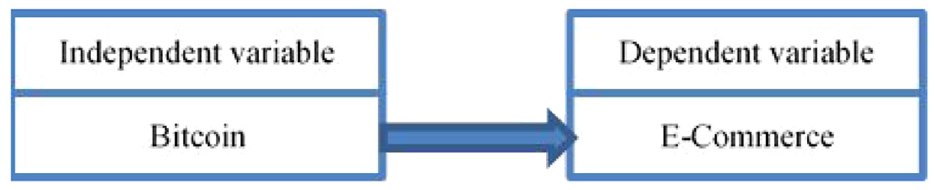
For this study, the theoretical model developed, based on the Technology acceptance model (TAM), is illustrated in Figure (1). TAM is a reliable tool and has been used by many researchers to study the acceptance of different technologies in different contexts (Palos-Sanchez et al., 2021). In this study, the independent variable is Bitcoin, while the dependent variable is E-commerce (Palos-Sanchez et al., 2021).
Measurement items.
Hypothesis: In order to test the impact of Bitcoin on E-Commerce, the following null hypotheses were developed.
H1: Bitcoin positively influences E-Commerce in Saudi Arabia.
Results and Discussion
Descriptive Statistics (SPSS)
The authors tested all parts’ reliability and found it acceptable (α-Cronbach of .725) with slight variation compared to the SmartPLS result. Also, there was no eliminated value. The 124 questionnaire responses were collected from participants who work in different occupations, including governmental entities, Semi-governmental Authorities, Private Sector Companies, Private Business individuals, and students. Of the questionnaires answered, 56.5% were female. Additionally, 42.7% of the respondents were between 31 and 40; the rest were distributed between different age categories. The least (11.3%) of the participants held Diploma, and the remaining had a degree of Bachelor and above. Table 2 illustrates the demographic information for the responders.
Represent Demographic Information for Responders.

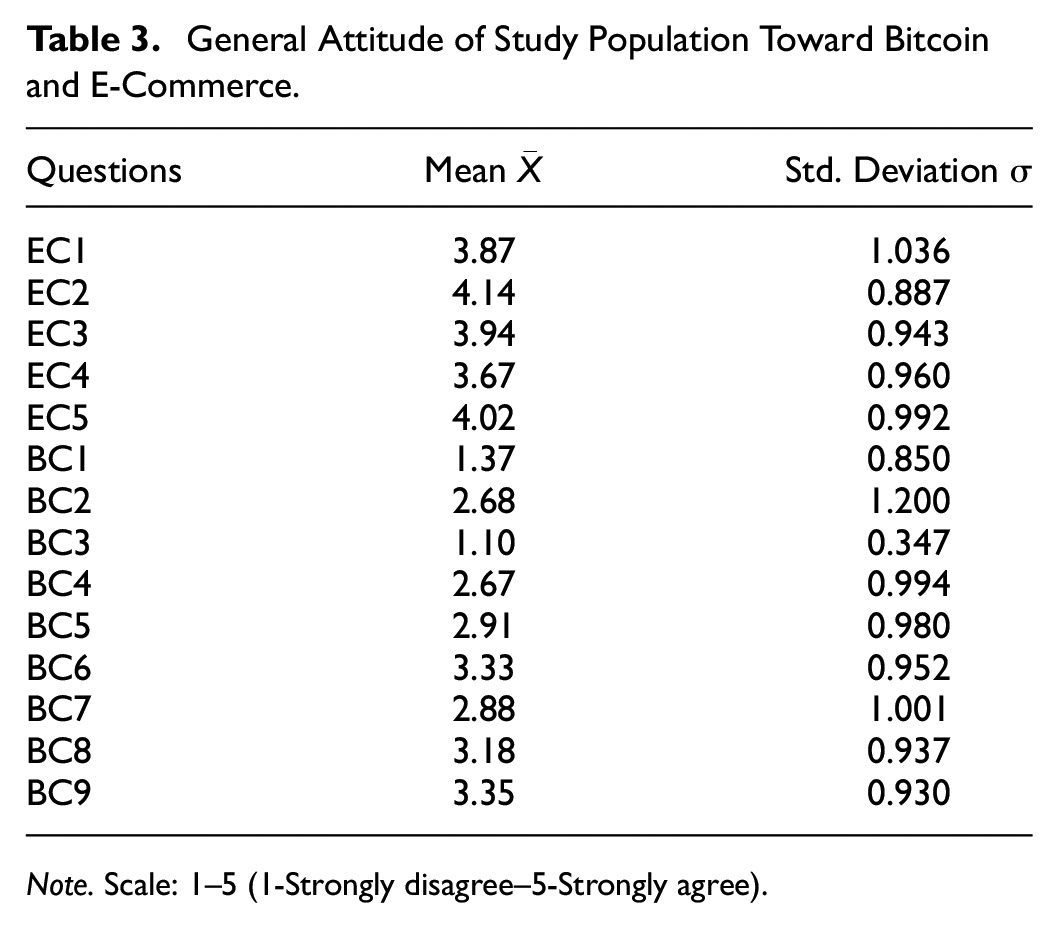
Table 3 shows that respondents generally agree in their responses to the items, with a relatively low standard deviation indicating no significant dispersion in the answers of the study sample. However, there are four exceptions. These questions showed data inconsistency. They include BC1: Do you use cryptocurrencies (Bitcoin) in paying for online transactions, (
General Attitude of Study Population Toward Bitcoin and E-Commerce.
Note. Scale: 1–5 (1-Strongly disagree–5-Strongly agree).
In the analytical part of the survey, the researcher had to eliminate sources of error that might have biased our results. So they discarded the questions that did not represent a clear link to the study subject—four questions were discarded. These are EC5, BC1, BC2, and BC3.
Measurement Model’s Assessment
This is also known as the outer Model in PLS_SEM. This step is used to assess the validity and reliability of the measurement model through two parts: convergent validity and discriminate validity. The researchers use the reflective measurement for each variable.
The convergent validity includes individual item reliability (factor loading), Composite reliability (CR), and Average Variance Extracted (AVE). Table 4 shows that six out of ten items have a factor loading of the indicators on their corresponding constructs above 0.7. However, for the remaining four items, the minimum one is BC7: Cryptocurrencies’ transactions are secure to use, have a factor loading of 0.527, according to Hair et al. (2010), and are still above the minimum acceptable threshold value of 0.5 of factor loading. The same table shows that the composite reliability (CR) values were above the acceptable value of 0.7 (Bagozzi & Phillips, 1991). Moreover, reliability represented by Cronbach’s alpha (α) for each construct to assess internal consistency was calculated, and the value of the two variables exceeds the threshold of 0.7 (Bagozzi & Yi, 1988), that is, all constructs demonstrate acceptable reliability coefficients, indicating that the indicators provide consistent measures of their respective constructs. Also, the T-values represent a satisfactory reliability level of all items as they are significantly linked with their variables. However, the table shows that the Average Variance Extracted (AVE) values for both constructs in this study the minimum acceptable threshold value of 0.5, as suggested by Fornell and Larcker (1981), impacting the model’s validity. In order to identify potential reasons for the lower AVE values and ensure the robustness of the measurement model, the indicators’ reliability, validity, and factor loadings were used for the interpretation. Factor loadings were found to be reasonably high, suggesting adequate convergent validity. Also, it was essential to assess discriminant validity to ensure that constructs are distinct. To address this concern, further analysis was conducted to examine the discriminant validity among the constructs. Therefore, the square root of the AVE for each construct was calculated, as suggested by Fornell and Larcker (1981). Subsequently, these values were compared with the inter-construct correlations. The analysis confirmed that each component’s square root of the average variance extracted (AVE) surpasses the related correlation with other components, indicating satisfactory discriminant validity. These results offer additional proof to validate the measurement model. However, the authors acknowledge that the low AVE values can be a concern and may impact the overall interpretation of the results.
Results of Measurement Model _ Convergent Validity.

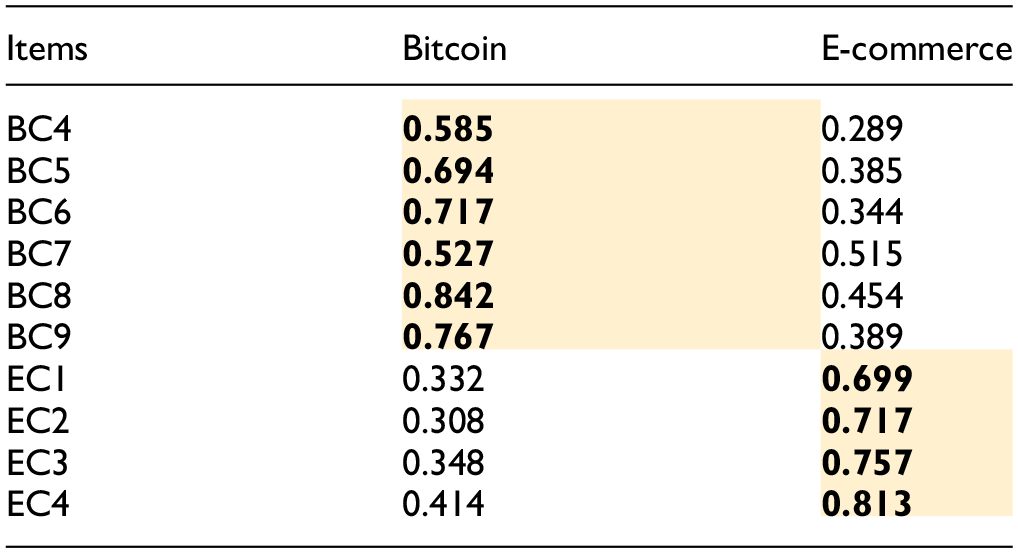
Table 5 shows that the discriminate validity includes cross-loading and variable correlation (root square of AVE). The cross-loading for each measurement has a maximum value with its variable. The bolded and shaded entries highlight the highest values in the columns, indicating where each item has the most significant loading and, thus, where its contribution is most strongly associated. For the “Bitcoin” column, the highlighted numbers are higher compared to the corresponding numbers in the “E-commerce” column, and vice versa for the highlighted numbers in the “E-commerce” column. This suggests that items BC4 to BC9 have a stronger relationship with the “Bitcoin” construct, while items EC1 to EC4 relate more strongly to “E-commerce”, demonstrating that each item loads significantly higher on its own construct. Table 6 shows that the correlation of the square root of AVE for our variables is higher than their correlation with the other variable.
Discriminant Validity: Cross-Loading.

Discriminant Validity: Latent Variable Correlation (Square Root of AVE).

Structural Model’s Assessment
This is also known as Inner Model; the key criteria are the significance of path coefficients and the R2 to assess the structural model. Researchers perform the nonparametric bootstrapping procedure in the PLS analysis with 124 samples to calculate the path coefficients and examine the structural model.
As shown in Table 7, the authors’ hypotheses are supported, which is that Bitcoin has a significant relationship with e-commerce (β = .590, t = 14.254, p < .001).
Overview of the Hypotheses Test Results.

Note. Significant at **p ≤ 0.01, p < .05.
The researchers used the value of R2 to determine the predictive power of the study’s model. R2 is a statistical measure representing the independent variables’ ability to explain the dependent variable. Approximately 34% (R2 = 0.348) of the variation in the values of e-commerce is accounted for by a linear relationship with Bitcoin. Since R2 is higher than 0.1, which is the minimum acceptable level according to Bagozzi (1981), it indicates an accepted predictive power for the study’s model. Table 7 summarizes the hypotheses test results.
Figure 2 shows a positive relationship between Bitcoin and e-commerce (β = .590, p < .05). The results indicate that Bitcoin influences e-commerce in Saudi Arabia.

Standardized parameter estimates for the model.
The study limitations can be summarized as follow: This study was conducted to demonstrate the relationship between Bitcoin and e-commerce in Saudi Arabia, as it forms an excellent environment to implement the study due to the rapid growth in digital and electronic fields, especially e-commerce and online payment methods. However, a further detailed and comprehensive survey has to be implemented to generalize this result. Also, the researchers had to discard four questions to ensure inaccurate results. Hence, the study ended up with only ten analytical questions, which might need more to generalize the results. Thus, researchers shall develop more questions to cover all related aspects in the future.
Future Work
These future research directions can advance knowledge of the connection between the Bitcoin cryptocurrency and e-commerce in Saudi Arabia and assist stakeholders, including policymakers and businesses, with the benefits, drawbacks, and implications of incorporating Bitcoin into the e-commerce ecosystem.
We suggest some future work to enhance the specific field:
Future research must include other main cities in Saudi Arabia, a larger number of samples, and a more systematic way to select the samples to generalize the findings. Also, it must develop comprehensive analytical questions to cover aspects of the multiple variables.
Regulatory Frameworks and Policy Implications: Suggest how Saudi Arabia’s Bitcoin and online shopping regulations are changing. Analyze how government regulations have affected the use of Bitcoin, consumer safety, and the evolution of e-commerce.
Cybersecurity and Fraud Prevention: Examine the security issues of using Bitcoin in online commerce and find efficient risk-reduction tactics. Look at how blockchain can improve cybersecurity, detect abnormal access, and prevent fraud in online transactions.
Financial and Economic Implications: Analyzing the effects of Bitcoin on the Saudi Arabian economy as an investment asset. Investigate the effects of Bitcoin’s price volatility on some entities like businesses, consumers, and financial organizations involved in electronic commerce.
Conclusion
Based on a survey method, this work exemplified the relationship between Bitcoin and E-Commerce in Saudi Arabia. As per the analytical results and the above discussion, the findings suggested a positive relationship between digital currencies (Bitcoin) and electronic commerce in Saudi Arabia, satisfying the researchers’ hypothesis. Nevertheless, since this work is limited to the context of citizens, its result cannot be generalized. Future research should consider respondents from all around Saudi Arabia. It will also be helpful to develop comprehensive analytical questions that cover broader aspects of the two variables of the study. The authors recommend that the Saudi authorities establish a regulatory firm to set the policies and regulations for electronic transactions that involve digital currencies. It is also recommended to form an advisory and oversight body to monitor the usage of digital currencies and develop programs to raise public awareness about cryptocurrencies and related regulations in Saudi Arabia.
Footnotes
Acknowledgements
The authors would like to thank Deanship of scientific research in King Saud University for funding and supporting this research through the initiative of DSR Graduate Students Research Support (GSR).
Declaration of Conflicting Interests
The author(s) declared no potential conflicts of interest with respect to the research, authorship, and/or publication of this article.
Funding
The author(s) disclosed receipt of the following financial support for the research, authorship, and/or publication of this article: All authors are subject to research fund and support from Deanship of scientific research (DSR) in King Saud University under the initiative Graduate Students Research Support (GSR).

Data Availability Statement
Data sharing not applicable to this article as no datasets were generated or analyzed during the current study.