




Abstract
The present study investigates the impact that Job Satisfaction (JS) has on the Organizational Commitment (OC) level of industrial workers and also finds out whether Job Involvement (JI) moderates the relationship between JS and OC. The study has been conducted on 600 employees belonging to different departments of Diesel Locomotive Works (DLW), which is one of the public sector giants of India. Relationship between JS and OC has been established with the help of a 2 × 2 factorial design, and moderation effect of JI on the relationship between JS and OC has been checked with the help of hierarchical multiple regression analysis. The results of the investigation have come out with the findings that OC is positively related to JS. Also, JI does moderate the relationship between JS and OC but in a negative way, and the impact has been found to be weak.
Keywords
Introduction
Productivity is of central importance in organization theory. Managers are interested in efficient utilization of resources in achieving objectives. Human capability is a critical resource, which is extremely variable. In fact, latent human capability may very well be the greatest untapped resource. If so, we need to understand individual behavior as it relates to the work situation.
In general, productivity depends upon two major factors—employee’s job performance and resource utilized. The resources illustrated here are raw materials and technology. Obviously, improvement in technology—plant and equipment plus knowledge concerning the process—can make a significant difference in the productivity of the system. Similarly, changes in raw material to be processed may also affect efficiency. The relative importance of technology in productivity depends upon the particular situation. In automated systems, the human element is not very important. However, in most organizations the performance of employee is relatively more important than equipment and raw materials. Even in automated operations, productivity in strategic and coordinative subsystems largely depends upon human performance.
Disregarding technological considerations, the productivity of an individual depends primarily upon ability, motives, needs, and desires to perform. Ability depends upon both skill and knowledge. Physical and psychological attributes are involved in determining the ultimate capacity for an individual. His or her level of attainment within that range will depend upon experience, training, and interest.
Several investigators have laid considerable emphasis upon the environmental, situational, attitudinal, and personality factors as determinants of job performance/productivity of employees. The variables that have been selected for the present study, namely, Organizational Commitment (OC), Job Satisfaction (JS), and Job Involvement (JI), have a significant impact on the productivity of an employee as well as the organization and hence hold an important place in the study of organizational behavior. This is in part due to the vast number of works that have found the relationships among these variables and attitudes and behaviors in the workplace (Angle and Perry, 1981; Koch and Steers, 1978; Porter, Crampon, & Smith, 1976; Porter, Steers, Mowday, & Boulian, 1974).
Review of Literature
The following section would reveal what different relationships different scholars have found at different times, among the variables under study.
OC has been studied in the public, private, and non-profit sectors, and more recently internationally. The importance of employee commitment in the workplace has been recognized all around the world since a long time. The performance of an organization highly depends on the commitment of its employees; more the employees are committed, better the performance of the entire organization (Holden, 1998; Jaramillo, Mulki, & Marshall, 2005; Meyer, Allen, & Smith, 1993; Meyer, Paunonen, Gellaty, Goffin, & Jackson, 1989; Meyer, Stanley, Herscovitch, & Topolnytsky, 2002; Shore & Martin, 1989; Siders, George, & Dharwadkar, 2001).
If we talk of relationships and impacts that OC shares and has on different psychological variables (especially JS and JI), then we will find that the relationships among the variables under study have ranged from negative to weak and then even to very strong relationships.
If we look at a few recent studies, it has been found to the utter surprise of many of us that OC is inversely related to JS (Tuzun, 2009; Wang, 2008).
Employee commitment has variously been found to be positively and significantly correlated too to lots of positive organizational outcomes such as JS (Bateman & Strasser, 1984; Gunlu, Aksarayli, & Perçin, 2010; Kuruuzum, Cetin, & Irmak, 2008; Mowday, Porter, & Steers, 1982), motivation (Mohsan, Nawaz, Khan, Shaukat, & Aslam, 2011; Mowday, Steers, & Porter, 1979), JI (Carmeli, 2005; Mathieu & Zajac, 1990; Meyer & Allen, 1997; Mohsan et al., 2011; Ketchand & Strawser, 2001; Kuruuzum et al., 2008), and attendance (low rates of absenteeism; Dalton & Mesch, 1990), which resultantly enhance employees’ and ultimately organizational performance and productivity.
The third variable in the study is JI, which has been checked for its moderation effect on the relationship of JS to OC. Some of the relevant works of some prominent scholars relating to JI and its role as a moderator are discussed below.
Organizational researchers from all around the world consider the JI as an important factor, which influences both employees and organizational outcomes (Lawler, 1986). Employees with high levels of JI make the job a central part of their personal character and focus most of their attention on their jobs (Hackett, Lapierre, & Hausdorf, 2001). They are likely to exhibit less unexcused lateness and unexcused absences than employees with lower levels of JI (Blau, 1986; Blau & Boal, 1987). Also, JI is negatively related to intentions to quit and positively associated with JS and organizational climate perceptions (McElroy, Morrow, Crum, & Dooley, 1995; McElroy, Morrow, & Wardlow, 1999). It also promotes organizational citizenship behaviors (OCBs) as OCBs are more influenced by what employees think and feel about their jobs and hence employees with high JI show a positive attitude toward the job (Diefendorff, Brown, Kamin, & Lord, 2002; Rotenberry & Moberg, 2007).
After a comprehensive study on JI and its relationship to various variables, Steven P. Brown (1996) developed a theoretical framework based on his meta-analysis. Results of the meta-analyses support research suggesting that JI is influenced by personality and situational variables. JI was strongly related to job and work attitudes but not to role perceptions, behavioral work outcomes, negative “side effects,” or demographic variables. Moderator analyses indicated little difference in the strength of relationships based on involvement measure. While, on the contrary, Nick C. Batlis (1980) examined the role of JI as a potent moderator in the relationship between work environment and JS and found that although JI was independent of climate perceptions, it did serve as a potent moderator of the climate-satisfaction relationship. The high job involved group evinced significant climate-satisfaction correlations compared with the low job involved group.
Research Design and Method
Objectives
The present investigation is directed to examine empirically the impact of JS on OC of employees and how JI affects this relationship by working as a moderator. This has been done by testing two null hypotheses formulated in the subsequent section. The objectives of the study have been enumerated below:
To find the impact of JS on OC of employees.
To find the role of JI as a moderator in defining the relationship between JS and OC.
Hypotheses
In the light of the available literature concerning relationship among OC, JS, and JI, the following two null hypotheses have been formulated:
Design and Method
The research is designed to be a descriptive as well as exploratory one, as the research is supposed to be about finding the facts and drawing the conclusions based on that and exploring something new to some extent. As stated earlier, the present investigation is aimed at studying intensively the relationship among the three work-related attitudes, namely, JS, JI, and OC of industrial workers.
The cause and effect relationship in the study (relationship between criterion and predictor variable) has been determined by the 2 × 2 factorial design, and hence, two levels—high and low—of the independent variable have been taken.
It is to be observed that the basic analytical framework of the study involves the following two logical steps:
Independent variable has been split into two groups—high and low—with reference to the median of the variable score in question.
The dependent variable scores of workers corresponding to high and low groups of the independent variable were noted, and then these scores were taken as the bases for the computation of the various statistics used in this study.
The cause and effect relationship in the study (relationship between criterion and predictor variable) has been determined by the 2 × 2 factorial design, and hence, two levels—high and low—of the independent variable have been taken.
Also, the impact of moderator has been checked with the help of hierarchical multiple regression. In general term, a moderator is a qualitative (e.g., sex, race, class, etc.) or quantitative (e.g., level of reward) variable that affects the direction and/or the strength of a relation between a predictor and a criterion variable (Baron & Kenny, 1986).
A common framework for capturing both the correlational and the experimental views of the moderator variable is possible by using a path diagram as both a descriptive and an analytical procedure (Baron & Kenny, 1986). Using such an approach, the essential properties of a moderator variable are summarized in Figure 1.
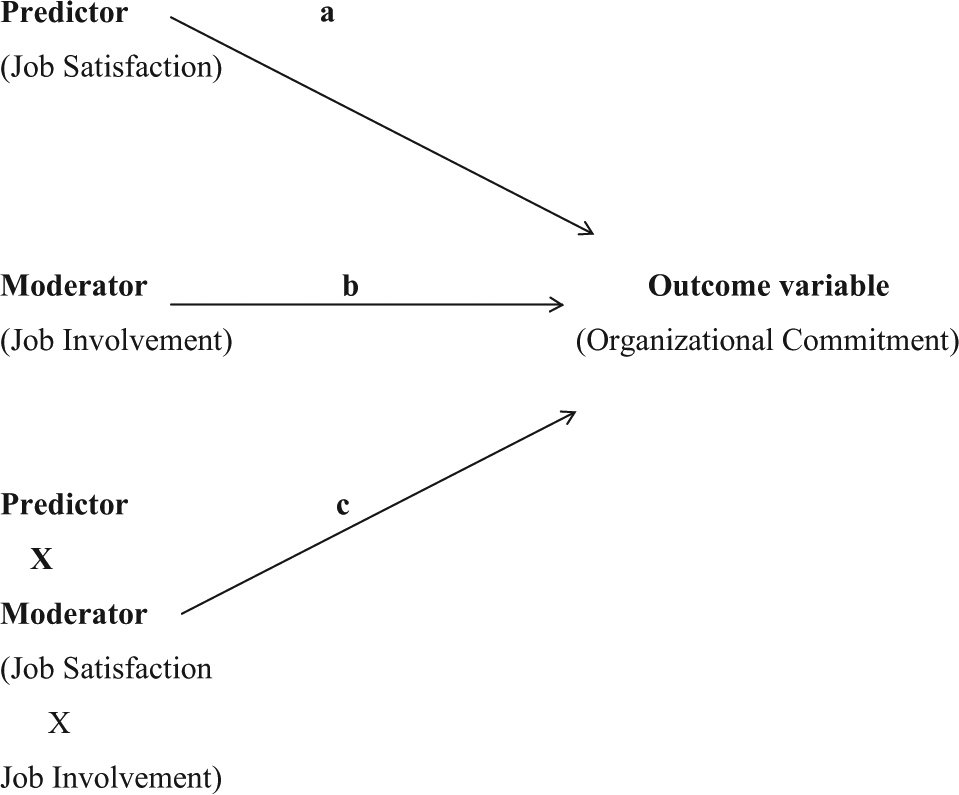
Moderator model.
The model diagramed in Figure 1 has three causal paths that feed into the outcome variable (OC): the impact of JS as a predictor (path a), the impact of JI as a moderator (path b), and the interaction or the product of these two paths (path c). The moderation hypothesis is supported if the interaction (path c) is significant. There may also be significant main effects for the predictor and the moderator (paths a and b), but these are not directly relevant conceptually to testing the moderator hypothesis.
In addition to these basic considerations, it is desirable that the moderator variable be uncorrelated with both the predictor and the criterion to provide a clearly interpretable interaction term.
The method used here to check the moderation effect is hierarchical multiple regression in which OC as a criterion variable and JS and JI as predictors are first introduced in the model, and at the second step, the product of the two (viz., JS and JI) is given as input into the model. The value and sign of the regression coefficient of the interaction term (product of JS and JI) tells us the strength and direction of the moderation effect of JI on the relationship between JS and OC, if it is found to be significant. If in case the value of the coefficient is not significant, then there is no moderation effect. To minimize the measurement error of the product, the standardized values of the predictor and moderator variables have been used. These were calculated by subtracting the mean from the values of the variables under study. This relationship can be established in an equation form as follows:

where a, b, c are coefficients of the variables in the equation.
The strength of the moderator for multiple hierarchical regression can be checked with the help of Cohen’s f2 (effect size measure) value. By convention, f2 effect sizes of 0.02, 0.15, and 0.35 are termed small, medium, and large, respectively. It is calculated as follows:

where
(R2)—coefficient of determination for regression Model 2,
(R1)—coefficient of determination for regression Model 1.
Measures
The study utilized three different questionnaires built by different experts and also tested for their reliability and validity by their developers as well as by the present researcher, and they have been used many times successfully in various industrial and banking setups. The OC questionnaire developed by C. Balaji (from the book by D. M. Pestonjee, 1993) has been considered; also, it has been tested for very high reliability with a coefficient of alpha of .91 and an intrinsic validity score of 0.95. The JS Scale developed by B. L. Dubey, K. K. Uppal, S. K. Verma, and C. K. Maini (from the book by D. M. Pestonjee, 1993) has been used for the study; it has also been tested for reliability with a test–retest score of 0.64 and an intrinsic validity score of 0.80. The JI Scale constructed by Singh and Kapoor (1978; from the book by D. M. Pestonjee, 1993) has been used in the present investigation to measure JI; its split-half reliability was found to be .73, and its intrinsic validity score was 0.85.
Sample
The investigation was conducted at Diesel Locomotive Works, Varanasi, Uttar Pradesh, India, which is a government undertaking possessing both rural and urban characteristics. The investigation is related to 600 employees who were selected through disproportionate stratified sampling from a total of approximately 6,000 workers working in different departments of the unit, namely, administration, quality control, engineering, electrical, stores, production, marketing, design, and so on.
Data Analysis and Interpretation
This section reproduces the results of investigation obtained through a careful analysis of the response scores with the help of the SPSS software. The raw scores of the present study are the responses of workers on the three standardized measuring devices, namely, OC Scale, JS Scale, and JI Scale.
The appropriate statistics that have been used in this study are box plot, mean, median, quartiles, standard deviation, coefficient of variation, t test, chi-square, and multiple regression analysis. These statistics are expected to test both the hypotheses of study outlined in the previous section and to explain in unambiguous terms how and to what extent the OC of workers gets affected by JS and by how much level JI moderates this relationship.
Relationship Between OC and JS
The relationship has been first checked through the box plot (Figure 2) to first visualize if there is any difference between the medians of the two groups of OC (viz., high and low) divided on the basis of the median of JS high and low scores. By visual inspection, the difference is clearly visible. Also, the mean, median, quartiles, and standard deviation scores of OC of high and low JS groups have been shown in Table 1, which also shows that there are differences in the mean scores of the variable under study. But whether it is significant or not has been tested with the help of three tests: one non-parametric, that is, chi-square (Table 2) and two parametric tests, namely, t test (Table 3) and ANOVA (Table 4).

Box plot for Organizational Commitment on the basis of median of Job Satisfaction scores.
Organizational Commitment Scores of Workers in High and Low Job Satisfied Groups (MJS = 93.00).

Chi-Square Test for Comparison of Organizational Commitment and Job Satisfaction in 2 × 2 Fold Contingency.
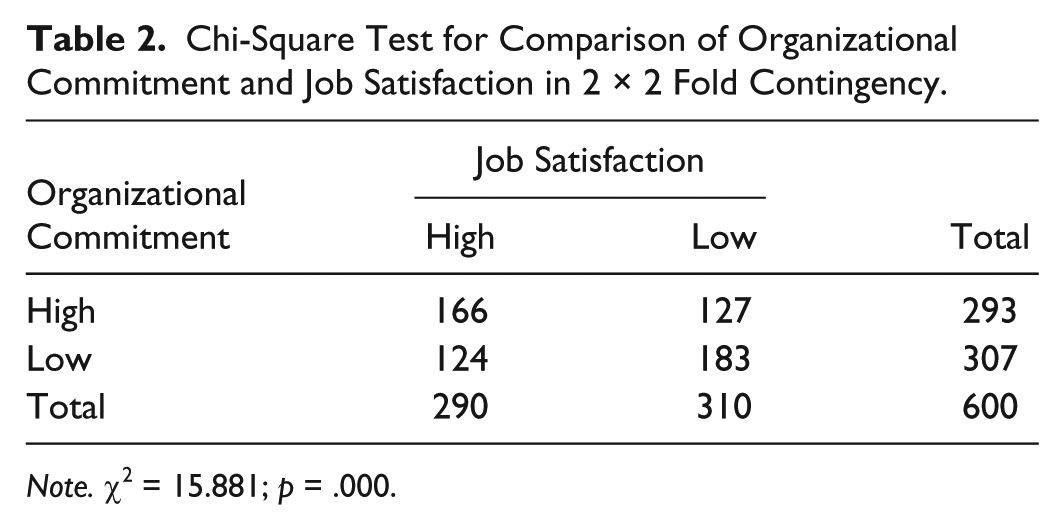
Note. χ2 = 15.881; p = .000.
Significance of Difference Between Mean Organizational Commitment Scores of High and Low Job Satisfied Groups (t Test).

Analysis of Variance Between the Mean Organizational Commitment Scores of High and Low Job Satisfied Workers.

From all the tables and figures, it is clearly visible that the p value for all the three tests comes out to be significant, which indicates that the variables under study, namely, OC and JS are clearly related to each other. Also, the mean OC score of the high JS group is higher compared with the mean OC scores of the low JS group, indicating that more satisfied employees are more committed toward their organizations and vice versa.
On the basis of the above analysis, we reject our first hypothesis that there is no significant difference between the mean commitment scores of high and low satisfied groups, and conversely it is established that the more satisfied employees show better commitment in the industrial settings.
Role of JI as a Moderator in the Relationship Between JS and OC
To check the moderation impact of JI on the relationship between JS and OC, the hierarchical multiple regression analysis has been used. There are three different outputs of the regression analysis that explain the moderation impact.
Table 5 shows the model summary, which shows that Model 2, which was created after the interaction term enters Model 1, is significant enough and hence indicates that interaction term significantly improved the model fit as F-change is significant.
Model Summary.

On the other hand, ANOVA shown in Table 6 tells us whether the model overall results in a significantly good degree of prediction of the criterion variable, which in this case does as both the models show significant F-values. However, ANOVA does not tell us about the individual contribution of variables in the model.
ANOVA.

To look for the individual contributions, we go for the final output table, which is Table 7. The second column represents the coefficients of the predictor variable in the model. Model 2 is our model of concern as it contains the coefficient of the interaction term (product of JS and JI), which comes out to be significant; this tells us that JI plays the role of a moderator in the relationship between OC and JS. The negative sign of the moderator reveals that JI reduces the strength of the relationship between JS and OC, that is, the more an employee will be involved in his or her job, the lesser will be the impact of his or her JS on his or her OC level. The strength of the moderation effect can be found out with the help of the value of Cohen’s f2, which comes out to be 0.002, which is very small; hence, the moderation effect of JI on the relationship between JS and OC is very small.
Coefficients.
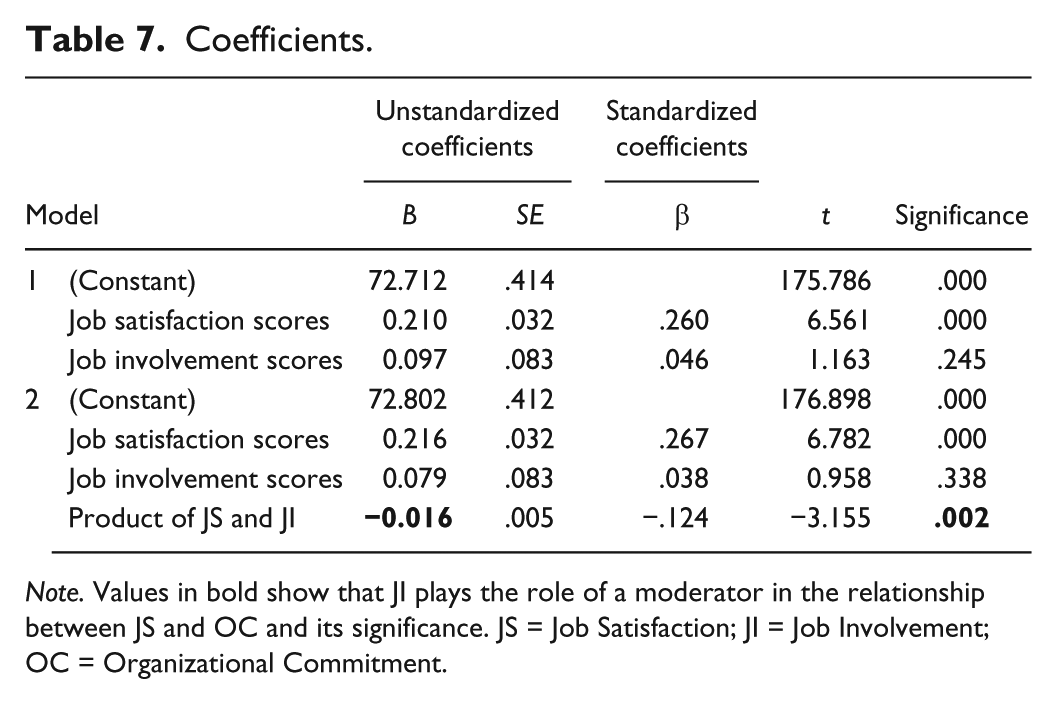
Note. Values in bold show that JI plays the role of a moderator in the relationship between JS and OC and its significance. JS = Job Satisfaction; JI = Job Involvement; OC = Organizational Commitment.
Also, from Table 7, it can be inferred that the relationship between JI and OC is not significant; hence, JI works as a pure moderator and not as a quasi-moderator in the relationship between JS and OC.
Conclusion
OC is considered to be a function of various factors such as physical factors, situational factors, and individual/attitudinal factors. Keeping the physical and situational factors constant, it has been found that the variable, named JS, may be an important causative variable affecting the commitment of workers in an industrial setup. Thus, it can be said that the more satisfied a worker is, the more committed he or she will be toward the organization. The management should, therefore, pay due attention to this fact and should strive to ensure such working culture/environment and should design jobs (job enrichment) in such a way that it keeps the workers satisfied and motivated and hence committed.
Also, if we look at the moderation model, it has been found that JI does moderate the relationship between JS and OC in a negative way, though in a very small amount but significant enough, that is, JI reduces the strength of relationship between JS and OC, indicating that the higher the JI level, the lesser will be the JS and OC relationship as compared with the case where there is no JI at all.
Furthermore, researches should be directed toward the exploration of the influences of other factors not considered in this study such as situational and personality factors on the commitment level of industrial workers to have a better understanding of this complex phenomenon in the present industrial setup and also in other industries around the world.
Footnotes
Declaration of Conflicting Interests
The author(s) declared no potential conflicts of interest with respect to the research, authorship, and/or publication of this article.
Funding
The author(s) received no financial support for the research and/or authorship of this article.