




Abstract
Building on the extensive literature highlighting the key role digital and social media play in the lives of LGBTQ people, this article adds a generational perspective by studying the importance of the internet and social media for different generations of men who have sex with men (MSM). Focusing on issues of identity exploration and the search for information as well as social connection, two periods are distinguished: the time of sexual identity exploration, and the present. Based on a mixed-method design, a survey (n = 684) was used to measure the perceived importance of online platforms (particularly Facebook, Instagram, Tumblr, YouTube, and TikTok), while in-depth interviews (n = 80) helped to better understand how digital media are embedded in the context of everyday life and society. The results show an ever-shifting range of digital media which subsequent generations come across at different times in their lives, fulfilling similar needs with the tools available at that time. This study contributes to the literature by adopting a life course approach to the study of media use among MSM of various generations, which allows to disentangle the respective roles of age and generation.
Plain Language Summary
This paper explores the respective role of age and generation in the internet and social media use of MSM (men who have sex with men) in Flanders. Existing research shows that online media play an important role in the identity formation of sexual minorities, particularly to find information and to connect with others. Most of this research focuses on younger users, while this paper reports on a project studying a broader age range. An exploratory online survey (n = 684) was used to measure the perceived importance of online platforms at different times in life. In-depth interviews (n = 80) were used to gain a deeper understanding of media use as situated in evolving biographical and social context. The results show an ever-shifting range of digital media which subsequent generations come across at different times in their lives, fulfilling similar needs with the tools available at that time. This study contributes to the literature by adopting a life course approach to the study of media use among MSM of various generations. This allows us to disentangle the respective roles of age and generation.
Since the early 2000s, academics have studied LGBTQ people’s digital media use because of its pivotal role in the exploration and expression of their identities and connections to others (Alexander, 2002; Gray, 2009). Young LGBTQ people have always been the main focus of this research, due to the importance of digital and social media in their identity explorations (Hanckel et al., 2019; Owens, 2017). The current article contributes to this literature by expanding the age range, also investigating the role of digital media in the lives of LGBTQ adults and older people, which allows to compare different age groups and to investigate the role of generational belonging in media use. Our research purpose is to better understand the interplay between digital media uses, processes of sexual identification, and evolving biographical, social, and technological contexts. In doing so, we aim to distinguish between issues of age, as connected to a particular life stage, and generation, that is, belonging to a certain age cohort.
This article focuses on a subgroup within the LGBTQ community, MSM, that is, men who have sex with men (who may identify as gay, bisexual, queer, and/or other sexual identities) in Flanders, the Dutch-speaking area of Belgium. We compare the digital and social media use of four generations of Flemish MSM, both in the present and in a key period in the past, at the time of sexual identity exploration. When they began to explore their sexual identity, participants from different generations were in a similar life stage but within a very different social and technological context. On the contrary, at the time of data collection, participants across generations were in various life stages, but they shared a similar social and technological context. Comparing these two moments allows us to better understand the respective importance of age and generational belonging within MSM media use.
Literature Review
LGBTQ Internet and Social Media Uses
Although the internet, which became widely accessible from the mid-1990s, was initially heralded as an important innovation for all kinds of groups and purposes, its particular importance as a tool for the empowerment of sexual and gender minorities was quickly recognized (Mehra et al., 2004). The early literature on LGBTQ internet uses predominantly focused on its potential opportunities, particularly for the process of sexual identity exploration (Wakeford, 2002). Specifically for younger people, it was seen as a novel medium that allowed to do identity work, to explore emerging feelings, and to experiment with self-presentation (Gray, 2009). Emerging online platforms offered a cornucopia of new options helping to come to terms with one’s sexuality, share experiences with others, and find role models or partners (Alexander, 2002; Craig & McInroy, 2014; Harper et al., 2009; Kuper & Mustanski, 2014). Within this broader process of identity exploration, two main functions were distinguished: the internet provided easy and discrete access to relevant information (Mustanski et al., 2011), and it offered isolated and geographically dispersed populations the possibility to connect to others, often under the cloak of anonymity (Hillier & Harrison, 2007).
The advent of social media in the mid-2000s, which facilitated the spread of user-generated content and social connectivity, only strengthened the central position of digital media in the lives of LGBTQ people. Again, this is considered to be particularly important for younger people, who explore and disclose sexual identities on social media (Drushel, 2010). Social media serve as a place of identity management, users presenting themselves and performing gender and sexuality (Van Doorn, 2010), thus deliberately creating visibility and coming out in certain contexts and to certain social groups (Fox & Warber, 2015; Miller, 2016; Owens, 2017). As in the earlier literature on the internet, two specific functions of social media are highlighted: they act as a source of information, to “learn” about identities (Fox & Ralston, 2016); and they facilitate the formation or consolidation of connections, contributing to group identity (Venzo & Hess, 2013) as well as social learning (Fox & Ralston, 2016).
LGBTQ people navigate an ever-changing array of platforms, taking into account their respective affordances (DeVito et al., 2018). For instance, chatrooms (IRCs) were popular in the early years of the internet, allowing LGBTQ people to explore and express their nonnormative identities in a relatively anonymous, mostly text-based way (Campbell, 2004). Communal chat rooms provided a safe space and helped create a sense of community, which according to Harrison (2010) gradually disappeared as “hooking up” using private messaging quickly took over. Dating sites and apps became increasingly popular, increasing the importance of self-presentation through pictures (Blackwell et al., 2015). Blogs were another staple of the early internet, which according to Mitra (2010) created an “interpretive community” of users. Increasingly, video took over from text, particularly on YouTube, which became a key website for coming out videos (Alexander & Losh, 2010).
The possibility of anonymity was a key feature of the early internet, making it particularly attractive for LGBTQ people who were not out of the closet (Szulc & Dhoest, 2013). However, with the rise in popularity of social media, such as Facebook, online spaces became increasingly based on the idea of a single transparent identity (van Dijck, 2013). More so than other Facebook users, LGBTQ users have to consider how they construct and manage their identities (Cooper & Dzara, 2010; Taylor et al., 2014). In doing so, they have to negotiate the affordances of various social media platforms to “curate” their identity for different audiences (Gudelunas, 2012b; Hanckel et al., 2019). For many, this involves strategies to prevent “context collapse,” tailoring performances or separating audiences to avoid the unintended connection of different social contexts, which could, for instance, lead to unintentional outing (Duguay, 2016). However, some social media remained more anonymous or pseudonymous, such as Tumblr, which for a long time offered a safe space for LGBTQ people to explore their nonnormative identities (Byron et al., 2019), until it restricted access to LGBTQ content in 2017 (Southerton et al., 2021).
This continuously evolving landscape of digital platforms intersects with the lives of LGBTQ individuals at different ages and life stages. Although most of the literature referenced above highlights the importance of digital and social media for younger people—that is, people in a similar life stage—it rarely discusses older age groups and differences between age cohorts, a research gap that this article aims to address.
Media Use Across Age Cohorts and Generations
Gross (2007) was one of the first to comment on the huge difference for the cohort of young LGBTQ people growing up with internet access. Baams et al. (2011) elaborated on this insight by quantitatively comparing the digital media uses of older LGBTQ people (who did not have access to social networking sites while coming out) and younger LGBTQ people (who did so), and found that younger people mostly started using the internet for social bonding while older people used it more for sexual contact. Similarly, Gudelunas (2012b) qualitatively explored generational differences in media use among LGBTQ people, discussing the changing social context different age cohorts experienced during their formative years, which he connected to a decreasing centrality of sexual identity among younger people, as well as a growing centrality of digital media in their lives.
Building on Gudelunas’ insights, the current study is centered around the notion of generations. As developed by Mannheim (1952), it refers to an age cohort occupying a similar location in relation to historical and social processes, leading to similar experiences. Applied to LGBTQ people, the most relevant context concerns the social and legal acceptance of LGBTQ people, with key historical benchmarks such as the Stonewall riots (1969) and the AIDS crisis from the early 1980s (Hammack et al., 2018). Bitterman and Hess (2021), drawing on the most widely used generational division, use alternative labels to express evolutions in LGBTQ experiences. They call Baby Boomers the “Liberation Generation,” Generation X the “Out Generation,” Millennials the “Proud Generation,” and Generation Z the “Fluent Generation.”
In relation to media, the advent of new media technologies at different points in the life course of distinct age cohorts leads to different “media generations” (Bolin, 2017). According to Aroldi and Colombo (2013), generations share a “generational semantic,” defined as a number of themes as well as criteria to interpret and articulate them, in which media play a key role. Although the generational framework is seldom used in LGBTQ media studies, some recent research explicitly refers to generational thinking in exploring age-related media uses. For instance, Bates et al. (2020) explore the identity development narratives of contemporary LGBTQ youth, stating that emerging adults born between 1995 and 2010 were the first to come of age with personal mobile access to social media. Robards et al. (2018) compare the media uses of different generations of young people (aged 16–35), distinguishing four cohorts. They found more non-binary gender and sexuality identifications among the younger cohorts, which may be due to social media giving access to a wider range of identity categories.
However, barely any of this generational research considers the digital media use of older LGBTQ people, while research that does include older participants generally does not distinguish between different age groups. For example, in his study on the uses and gratifications of social networks for MSM, Miller (2015) included men between 18 and 50 years old, but the findings were not stratified between different age groups. Similarly, Nodin et al. (2014) interviewed men between 18 and 62 years of age, but did not report any age differences in media use. Marciano and Nimrod (2021) do specifically focus on the digital media use of older LGBTQ people (66–81) in relation to their “identity work,” that is, processes of identity creation, regulation, negotiation, and modification. They note that the internet is widely used among their participants, particularly for online dating, but that they do experience a certain level of alienation from online culture, often adopting a relatively traditional, cautious, and conservative view of new technologies. Although an invaluable counterweight to the overarching focus on young LGBTQ media users, a cross-generational perspective is also lacking in this research. Aiming to fill this research gap, the current article compares internet and social media use across four generations of MSM.
Methodology
Our research question is as follows: How do the importance and uses of the internet and social media for sexual identity exploration and expression differ between four generations of MSM? The focus is on two moments: the past, in particular the period when participants were exploring their sexual identity, which for the different generations represents a similar age and life stage; and the present, which for the different generations represents a different age and life stage. Rather than frequency or intensity of use, we focus on the (perceived) importance of the internet and social media in relation to their sexual identity.
We used a mixed-method approach, where quantitative research preceded and facilitated the core qualitative research (Bryman, 2012). First, we used a quantitative exploratory survey to measure the perceived importance of digital media. The survey respondents had the option to indicate that they were interested in participating in the qualitative part of the research. Second, we used in-depth interviews to better understand the way these digital media were used in relation to sexuality. Both parts of the study received the approval of the Ethics Committee for the Social Sciences and Humanities of the University of Antwerp. The research is set in Flanders, the northern region of Belgium, where Dutch is spoken. Belgium was one of the first countries to legalize same-sex marriage, in 2003 (Borghs & Eeckhout, 2010), and it continued to defend sexual minority rights, as indicated by its third place in ILGA Europe’s “Rainbow map” measuring LGBTI equality (ILGA, 2022). Further information on the evolving context in relation to LGBTQ rights and social acceptance will be provided along with the qualitative findings.
Quantitative Survey
In a first step, we used an exploratory online survey to measure intergenerational differences in digital and social media use among MSM. We recruited the respondents using email and social media, in particular the social media of LGBTQ organizations as well as sponsored posts on Facebook and Instagram, inviting Dutch-speaking non-heterosexual MSM (identifying as gay, bisexual, queer, and/or other identifications) living in Flanders to participate. The survey ran from 2 to 23 October 2020, when social contact was severely restricted due to the COVID-19 pandemic.
In addition to sociodemographic questions, the respondents were asked about the general importance of the internet and social media when they were exploring their sexual identity (How important were these media when you began exploring your sexual identity?), and in the past year (In the past year, how important were these media to you in experiencing your sexual identity?). We also asked about the importance of specific social media in relation to the two key functions identified in the literature as discussed above: to find or share information (How important were these social media and apps for seeking or sharing information when you began exploring your sexual identity/in the past year?); and to connect with friends, or sexual or romantic partners (How important were these social media and apps for connecting with friends, romantic or sexual partners when you began exploring your sexual identity/in the past year?). Based on the literature review, we asked these questions about five social media platforms that are widely used in the LGBTQ community: Facebook, Instagram, Tumblr, YouTube, and TikTok (Byron et al., 2019; Robards et al., 2018).
The second author used SPSS v 27.0 to generate tables with the descriptive results of the survey questions described in the results section. We were not able to test the significance of differences between generations because of the low numbers in multiple cells and because the internet was unavailable to older generations.
The sample consisted of 684 respondents, ranging in age between 18 and 77 years (mean age 34.29 years, SD = 13.41). Based on their year of birth, the respondents were divided into four generations, following the classification and age brackets defined by the Pew Research Center (Dimock, 2019) as this is the most widely used classification also used (with different labels) in LGBTQ research (Bitterman & Hess, 2021): Baby Boomers, born until 1964 (n = 71; 10.5%); Generation X, born between 1965 and 1980 (n = 125; 18.4%); Millennials, born between 1981 and 1996 (n = 315; 46.4%); Generation Z, born between 1997 and 2012 (i.e., 2002 as only respondents over 18 years old were able to participate) (n = 168; 24.7%). Most respondents were of Belgian origin, that is, born in Belgium from parents who had the Belgian nationality at the time of their birth (n = 587, 85.8%). Most were highly educated, 80.4% (n = 550) reporting their highest level of education as a bachelor’s degree or higher, 18.6% (n = 127) a high school degree, and only 0.9% (n = 6) an elementary school degree. We asked respondents to indicate their sexual orientation(s), choosing one or more options from a list, or describing how they identified in their own words. 80.8% identified only as gay, while the others preferred a wide range of (often multiple) identity labels (see also Dhoest, 2023).
Qualitative Interviews
Building on the insights gained in the survey, from mid-October 2020 the first author conducted in-depth semi-structured interviews to obtain a deeper understanding of the role of digital and social media in the lives of MSM. Participants were invited after filling out the online survey and 187 survey respondents wanted to be interviewed. Potential participants were contacted by year of birth to obtain samples of similar size for all generations. The final sample consists of 80 participants, with a good spread across the four generations: 16 Baby Boomer, 18 Generation X, 24 Millennial, and 22 Generation Z (the youngest born in 2001). Reflecting the survey sample, most of the participants (n = 69) were born in Belgium and highly educated (70). In terms of sexual identity, the majority (n = 64) identified as gay, the others identifying with one or more other labels.
The interviews were conducted using Zoom, from October 2020 to January 2021, which besides being a necessity due to the COVID-pandemic, offered the advantage of allowing the interviewees to participate from a familiar “safe” space (Hanna, 2012). Drawing on traditions of queer interviewing and life stories (Kong et al., 2002; Plummer, 2001), the interview guide was relatively open, aiming for an informal conversation about the importance of different media in relation to everyday life. We chronologically discussed which digital and social media were available at different times in their lives and how this impacted their process of identity exploration and negotiation. As in the survey, in addition to general questions about internet and social media use, more specific questions about particular social media were also asked. The interviewer, a cisgender man belonging to Generation X and identifying as gay, aimed to create a safe atmosphere by openly reflecting on the aims of the research, as well as his own position and experiences (Kong et al., 2002).
All interviews were transcribed verbatim and analyzed by the first author using NVivo (version 1.4), drawing on an interpretive and constructionist epistemology (Bryman, 2012) and following the guidelines for thematic analysis provided by Braun and Clarke (2006). After familiarizing himself with the data, the first author generated initial codes related to the use of different digital and social media at different times of life (past vs. present) and for different purposes (such as social contact and identity exploration). Next, recurring themes were identified and chronologically charted and compared across generations. Finally, these different analytical threads were reassembled in an integrated account for each generation.
Results
In this section, first, the results of the survey are presented, comparing different generations at two specific points in time: when they were exploring their sexual identity, and at the time of the research. Subsequently, the results of the interviews are presented by generation, which leads to a more integrated account of the interrelation between media use and everyday life across the different ages and life stages of subsequent generations. These findings per generation are then compared in the discussion and conclusion section, again more clearly distinguishing between the period of sexual identity exploration and the present.
Quantitative Survey
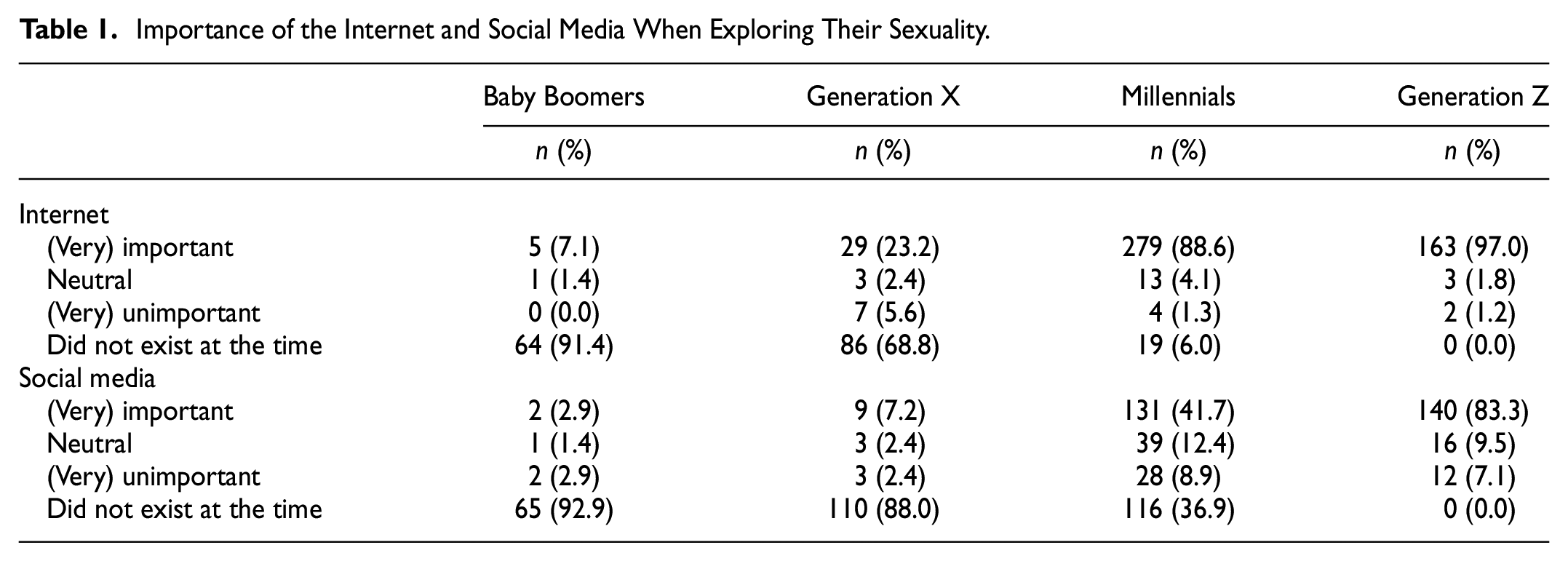
We first asked respondents to indicate the general importance of the Internet and social media when exploring their sexuality (see Table 1). A separate question asked when they first began exploring their sexuality, which yielded very similar ages for the different generations, with an average age of 15.62 (SD = 4.57). A first and obvious observation is that the internet was not available at that time for most Baby Boomers (91.4%) and Generation X (68.8%) respondents, unless they started to explore their sexuality later in life, in which case they did tend to find it (very) important. Millennials and Generation Z, who did have internet access when exploring their sexuality, equally rated it as (very important) at the time, increasingly so (respectively 88.6% and 97%). These findings confirm existing research on the importance of the internet for LGBTQ people during the process of identity exploration but go beyond the narrow age range that is typical for these studies, by using a broader age range for respondents. We see a similar pattern for social media, which were not available at the time of exploring their sexual orientation for most Baby Boomers (92.9%) and Generation X (88.0%) respondents, as well as a substantial proportion of Millennials (36.9%). However, for those who had access to social media during their process of sexual exploration, social media became increasingly important.
Importance of the Internet and Social Media When Exploring Their Sexuality.
In line with the role of social media in providing information (Fox & Ralston, 2016) and establishing social connections (Venzo & Hess, 2013), we also asked respondents to rate the importance of specific social media separately for information and for contact when exploring their sexuality (see Table 2). Unsurprisingly, the results show that almost no respondents from the Baby Boomer and Generation X generations had access to social media at that time, so their importance was extremely limited. For Millennials and Generation X, social media were important, but they used different platforms for different purposes, in line with Gudelunas’ (2012a) findings. For information purposes, both considered YouTube as the most important social medium when exploring their sexuality, if they had access to it at the time, followed by Instagram, Facebook, and Tumblr. For establishing contact during the period of sexual exploration, Millennials rated Facebook as the most important social media platform, if available, followed by Instagram. Oppositely, for Generation Z respondents Instagram was the most important platform, followed by Facebook. This shows how subsequent generations turn to newer platforms to fulfill similar needs.
Importance of Social Media for Information and Contact When Exploring Their Sexuality.

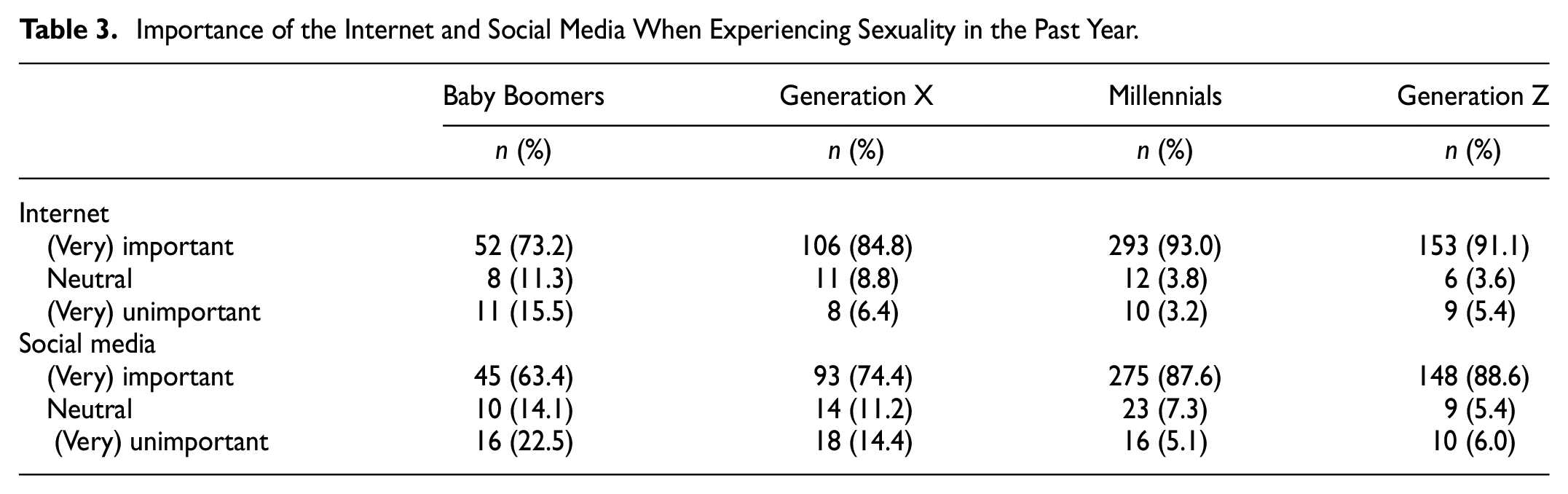
Moving from the past to the present, we asked respondents to rate the importance of the Internet and social media when experiencing their sexuality in the past year (see Table 3). Both the internet in general and (to a slightly lesser degree) social media were perceived as (very) important in relation to sexuality by a large majority across all generations. There were substantial increases between each generation, apart from Millennials and Generation Z respondents.
Importance of the Internet and Social Media When Experiencing Sexuality in the Past Year.
In Table 4, we summarize how the respondents rated the importance of specific social media in the past year. For finding information, Facebook was the most important social media platform for Baby Boomers and Generation X respondents, while Instagram was the most important platform for Millennials and Generation Z respondents. Both Instagram and YouTube clearly became more important for each subsequent generation, while for Generation Z respondents TikTok also stood out as a relatively important medium for information seeking. For social contact, Facebook was very important across all generations, while Instagram became more prominent for each subsequent generation and was the most important social media platform for Generation Z participants.
Importance of Social Media for Information and Contact in the Past Year.

Qualitative Interviews
The survey confirmed the great importance of the internet and social media, if available, for different generations of MSM, both at the time of the interview and particularly when they were exploring their sexuality. Although these findings may seem unsurprising, they are significant as they concern a broad age range and show how subsequent generations used different online and social media to fulfill similar needs for information and connection, taking advantage of the affordances of, and differentiating between, the platforms available at particular times in their lives. The interviews helped better situate these media in relation to processes of sexual identity exploration and negotiation across different generations of MSM. To provide a more integrated account of media uses across the life span in relation to evolving social and technological contexts, in this section, media uses are discussed per generation, highlighting their role in sexual identity exploration and expression, as well as a tool to find information and to connect at different times in life.
Baby Boomers
Baby Boomers were born before 1965, so they started to explore their sexual identity in a society where same-sex sexuality was taboo and invisible, both in society and in mainstream media. They were at least 30 years old when the internet for personal use became accessible and over 40 when social media like Facebook became available, so most had already developed a firm sense of identity at that time. Unsurprisingly, many interviewees said they did not use the internet to explore their sexuality as they only received internet access later in life, often at their workplace. However, once they were online, most used it intensively in relation to their sexuality, particularly to connect with other MSM by chatting on IRC, getting to know people from around the world, often anonymously. Jozef (born in 1954): “I’m so happy I got to know that. At first, I didn’t know how to use it, but I learned to use the computer through gay chat. I was looking for ways to get to know people.” Even if the internet did not play a key role in the initial process of sexual identity exploration for Baby Boomers, they eagerly embraced it later in life, particularly to connect with other MSM.
At the time of the interview, sexuality was generally not a key issue in their Facebook use, which was primarily a way to connect with friends, but quite a few participants also used it for information by following LGBTQ pages or groups. Other social media were even less important in relation to sexuality or even unknown among Baby Boomers, contextualizing the low numbers in Table 4. Most did not see the added value of Instagram, echoing the rather conservative view of new technologies among older LGBTQ people identified by Marciano and Nimrod (2021). For instance, Jonathan (born in 1962) said: “I really don’t see what Instagram has, what Facebook doesn’t. On the contrary, I think it is much less. And anyway, it doubles the work and I think I already spend more than enough time on it.” Tim (1957) explicitly connected this to generation: “I don’t start with Tinder and Instagram, I don’t do all that, it’s enough as it is. I think that works by generation. My generation is more on Facebook, Grindr and GayRomeo, and younger people switch to Instagram and other things.”
Generation X
Generation X participants were born between 1965 and 1980, so they started to explore their sexual identity in a society where same-sex sexuality gradually became more visible and accepted, particularly from the 1990s (Borghs, 2017; Eeckhout, 2017). They were between 15 and 30 when the internet first became available. Depending on the age at which they gained personal internet access and started exploring their sexuality, for some participants the internet was available during their process of sexual identity formation, but most started to explore their sexuality before going online. As for the Baby Boomers, connecting to others by chatting and dating was one of the first things they did online, often only once they had moved out of the family home. For example, Bert (born in 1976) first got personal internet access when he moved in with two gay roommates at the age of 21, and immediately started chatting and dating: “In relation to my sexuality, and relationships, that was a bomb!” Some younger participants did have earlier access to the internet, which became a safe space for initial explorations, for instance for Arthur (1979): “That was first online, a bit anonymously, the first conversations with people with similar… But then you grow into it, you gain more confidence and then you take the step to real life, so to speak.”
At the time of the interview, the importance of Facebook for Generation X participants in relation to sexuality varied. Jan (born in 1972), who only recently came out as bisexual, found a lot of information and support on social media: “For me, Facebook is important for two things: to get in touch with associations, and more general articles. For instance, now I follow a lot of coming out stories.” However, most Generation X participants used Facebook a lot, but it was not important to explore or express their sexual identity. Other social media were even less important in this respect. Many considered Instagram as a photo sharing app rather than a social networking site, and only some younger Generation X participants used Instagram intensely. For example, for Arthur (born in 1979), Instagram was an important source of information, as he learned a lot about gender and sexuality by following LGBTQ people: “I have to say, for me, the past years a lot has changed, about gender norms and how to address each-other and transsexuality, that came much more to the fore and that’s new to me.” Some also used YouTube to search for LGBTQ content, for instance Vincent (born in 1980) who watched coming out videos on YouTube: “There was a YouTuber, I forgot his name, who came out and started a separate channel on his life. That’s how it started and gradually the algorithm suggests things and that was you start to see more and more things.”
Millennials
Millennials were born between 1981 and 1996, so they started to explore their sexual identity in a context of increasing visibility and legal protection of LGBTQs, for instance through the annual Gay Pride marches from 1996 onward, as well as the recognition of same-sex marriage in 2003 and same-sex adoption in 2006 (Borghs, 2017). They were under 15 years old when the internet became available, so most grew up with some degree of internet access, although many still experienced its early limitations such as slow internet connections and shared computers. For example, Jay (born in 1982) searched for information on homosexuality in the public library and was caught out by a staff member who subsequently explained how to erase his browser history. Similarly, YouSheng (born in 1983) was caught out by his mother while downloading kinky pictures using the slow dial-up connection on the family computer. These older millennials were already well into adolescence before getting internet access and they often used anonymous chat rooms to connect with other LGBTQ people. Lex (born in 1985): “That was with nicknames, without email addresses, so it was really easy: quickly log in, tell your story, and meet like-minded people, without having to be afraid someone would recognize you on the street.” Many describe it as a new world opening, the internet becoming their primary source of LGBTQ information and connections. Younger millennials grew up in parallel with the internet, getting ever earlier access to a widening range of platforms, moving on from the anonymous and mostly text-based chat sites to the emerging social networking sites such as Netlog and MySpace, where pictures became increasingly important.
Facebook was introduced in Belgium when the oldest Millennials were about 25, so mostly after their initial stages of identity exploration. As found in other research (e.g., Owens 2017), their process of identity disclosure on Facebook paralleled the coming out process offline. Some closely monitored who got to see what; for instance, Lex (born in 1985) had five different friends lists, while Dieter (born in 1986) limited who could see his pictures and tag him. Others gradually opened up about their sexuality, such as Pjotr (born in 1993), who started increasingly posting messages supporting LGBTQ rights. Among the younger participants, many came out as teenagers and were never secretive about their sexuality on Facebook. Daan (born in 1992) said: “I have never been ashamed of it. It’s not that I post something every day, but I will, for example, post a picture with my boyfriend on the international day against transphobia and homophobia, without hesitation.”
Other social media were also increasingly used by Millennials in relation to sexuality. For example, about half of the Millennials had actively used Tumblr in the past, mostly for porn, but also to find social support and to find information about sexual and gender diversity. Mike (born in 1994) stated that Tumblr was very important in his search for mental balance as an adolescent: “Many people posted super diverse and super alternative content and that was what appealed to me. I found people there who were gay but also alternative and who had the same struggles as me.” For others, YouTube played a similar role in the past, following gay YouTubers like Tyler Oakley, which helped them to accept their own sexuality. Daan (born in 1992) learned to embrace his “feminine” side this way: “I mostly learned that through watching YouTubers who were very comfortable with themselves, and I thought: OK, he is very flamboyant, but it would not repulse me to be associated with that.”
While Facebook (if available) was the most important social media platform for most Millennials during the process of identity exploration, Instagram had become more important at the time of the interview. Jay (born in 1982) observed a generational dynamic in that process: “Since the Boomers took over Facebook, everyone moves to other media. My generation switches to Instagram, the generation after that to TikTok.” Although Millennials mostly used Facebook to connect with people they knew, many said they used Instagram to follow strangers, good-looking men, and people with interesting profiles in relation to gender and sexuality. Viktor (born in 1986): “Social media allow you to follow people who are preoccupied with their gender identity, and you can also follow handsome men.” He continued: “If you follow some things, they go further in terms of fluidity, and you gradually get algorithms that guide you. It’s good to see that diversity, the diversity that was not there in my younger years.” Like Viktor, many Millennials described a “learning” process, particularly in relation to gender and sexual fluidity. Eric (born in 1989), who identifies as genderqueer, said: “On Instagram, I connect to people based on interests and I’m in a bit of a genderqueer trans non-binary bubble, from which I get a lot of valuable exchanges and information.” This quote illustrates how the two main functions discussed throughout this paper, information and connection, are closely intertwined, social media also acting as a source of social learning (Fox & Ralston, 2016).
Generation Z
Generation Z participants in this research were born between 1997 and 2001, exploring their sexual identity in a period with even greater social acceptance and visibility than earlier generations. They all grew up with personal internet access, often on mobile devices that they did not have to share with other family members. Their first explorations of sexuality took place online, on a wide range of sites and apps. Simon (born in 1998): “What has helped me most is the Internet. My generation totally grew up with the internet and internet technology. Nowadays, there are many videos of people coming out and young people you can identify with.” Quite a few participants referred to online information resources for young LGBTQ people, but they also used Google searches, chat and dating apps, as well as social media such as Facebook and YouTube. All these platforms allowed them to explore their sexuality at a younger age than the older generations, mostly in secondary school (aged 12–18).
Facebook was particularly important when they were teenagers and very much part of their identity exploration process. Many used it to follow LGBTQ groups or connect with other MSM, such as Brent (born in 1997): “If you are friends with one person, you become friends with another boy and then you become friends with many gay people, that’s still the case today, without knowing the person.” As in older generations, most other social media were less important in relation to sexuality. About half of the Generation Z participants used Tumblr, mostly to view explicit content. Some were also part of fan communities, such as Nicolas (born in 1998), who was a fan of Tyles Oakley and Troye Sivan, whom he also followed on YouTube. This is also where he learned about a wide range of gender and sexuality identifications, such as non-binary. In line with the survey results, YouTube was widely used among Generation Z interviewees, particularly during the process of sexual exploration when many watched coming-out videos or followed openly out YouTubers. Simon (born in 1998): “I think that every boy in that period, if they wanted to come out, saw so many videos, to figure out: How is it, how do you do it, why is it necessary?”
At the time of the interview, however, Facebook had lost its importance, most Generation Z participants naming Instagram as their most important social media platform in relation to sexuality. Although they considered Facebook more as a tool to connect with friends, they used Instagram more to follow people. Simon (born in 1998) said that Instagram feels safer because it is more anonymous: “With Instagram, it is perhaps a bit more anonymous because you choose who you follow and not everyone checks who you follow. (…) On Facebook, people can more easily see what you like.” In that sense, Instagram is more like YouTube, and several participants mentioned following gay YouTubers on Instagram. Like YouTube, Instagram also gives users algorithmic suggestions, which for many participants implied accounts focused on gender and sexuality, such as James Charles, a makeup influencer. Several participants mentioned learning about non-binary identities and gender fluidity on Instagram. Recently, some also started to follow similar content on TikTok, a platform that was hardly used by the older participants. Quite a few Generation Z participants followed LGBTQ-related content on TikTok, all noting the strong algorithm, which quickly suggests similar LGBTQ-related content.
Discussion and Conclusion
This article compared the digital and social media use of four generations of MSM, both at the time of sexual identity exploration and at the time of the research, to better understand the interplay between digital media use, identification processes, and evolving biographical, social, and technological contexts. Studying LGBTQ internet and social media use through a generational lens revealed a wide variety of uses and experiences, both in the present and in the past. While it is difficult to completely disentangle the issues of age and generation, it is worth reflecting on their respective roles in media use. In doing this, we draw on insights from generational theory (Mannheim, 1952) and in particular notions of “media generations” (Aroldi & Colombo, 2013; Bolin, 2017) and LGBTQ generations (Bitterman & Hess, 2021; Hammack et al., 2018) to complement the expansive literature on LGBTQ digital and social media use.
Our results show that members of different generations explored their sexual identity around the same age, but in vastly different media and social contexts. Age, here, is related to a life stage: adolescence and early adulthood, when most started to explore their sexuality and form their sexual identity. However, the role of digital and social media in this process differed strongly between generations. Most Baby Boomer and Generation X participants came of age before the advent of the internet, which only played a role in the identity explorations of those exploring their sexuality later in life. Millennials constitute the first fully digital generation referenced by Gross (2007): the internet was a key tool in their identity explorations, although they only got access to social media such as Facebook when they were in their 20s. For Generation Z participants, who did have access to social media while growing up, social media were a key tool to find information and connect to others, both while exploring their sexual identity and at the time of the research, in line with the most recent research on LGBTQ digital media use (e.g., Robards et al., 2018). Across generations, the internet and social media (if available) were of particular importance in relation to sexuality at the time of identity exploration. Subsequent generations fulfilled similar needs of information and connection with the tools available at the time, younger generations being able to choose from a wider range of platforms with different affordances.
At the time of the research, participants of different generations varied widely in terms of age. This partly explains their different media uses—in line with the broader (Flemish) population, where, for instance, younger people tend to use Instagram and TikTok more intensely than older people (Vandendriessche et al., 2021). However, for these MSM, media use also relates to the process of sexual exploration, which is still ongoing for the youngest participants while the older participants tend to have a firmly established sexual identity, which partly explains the lower importance of the internet and social media in relation to sexuality for the latter. In addition to age, generational differences also play a role in the current use of media. Younger generations, particularly Millennials and Generation Z, are very comfortable with digital and social media, as they grew up with them. On the contrary, older generations, particularly Baby Boomers, are less comfortable with digital media, as they only started using these later in life, leading to a different “generational semantic” (Aroldi & Colombo, 2013). Older generations of Flemish MSM tend to be rather conservative in their use of social media platforms, echoing the findings of Marciano and Nimrod (2021).
These results, based on different age groups and generations, complement and qualify existing research on LGBTQ internet and social media use. The key importance of the internet and social media for LGBTQ people as identified in the literature review appears to be closely related to the age and concomitant life stage of most research participants, that is, adolescence and early adulthood. However, existing research generally offers a snapshot of the media uses of a single generation at a particular time of life, while our research shows how media use differs across generations and evolves over their life course. The range of available digital and social media continuously evolves, and members of different generations gain access to these platforms at different stages of their life, using the platforms most suited to their needs at that time. LGBTQ people are particularly preoccupied with sexuality and coming out at a younger age, which explains the key importance of digital and social media in that life stage as well as concerns about context collapse (Duguay, 2016). We hardly encountered these concerns among the older participants in our research. Younger people are also more preoccupied with establishing connections and social learning (Fox & Ralston, 2016), so the generational difference identified by Baams et al. (2011), younger LGBTQ people using the internet more for social bonding than older LGBTQ people, seems to also be connected to their life stage. Finally, echoing the findings of Robards et al. (2018), many participants reported that they learned about diverse gender and sexuality identifications through social media, another trend that is closely tied to younger generations who were more preoccupied with identity exploration.
In conclusion, it is important to pinpoint some shortcomings of current research, which also indicate avenues for future research. First, while the generational perspective is useful to identify patterns, it homogenizes the experiences of large groups of people, disregarding diversity within generations as well as the porous boundaries between generations. Future research adopting a generational perspective should explore more fine-grained generational divisions among LGBTQ populations. Second, this research is limited in its focus on a rather homogeneous group of men, so future research should deliberately target the groups not or less represented here, such as women and non-binary people, lower educated LGBTQ people, and LGBTQ people with a migration background. Expanding the scope in this way would help to remedy the overarching focus of LGBTQ research on white, well-educated, upper-middle-class men (Sandfort, 2000), and better understand how generational belonging intersects with other social positions and structures. Third, in the survey, our respondents were asked to retrospectively report on the perceived importance of their social media use in the past, which could make these data less reliable than reports about present-day perceptions. However, together with the interview data, they do give a good view of the perceived importance of particular platforms in relation to sexuality at different times in life, a key contribution of this study. Finally, our study primarily focused on providing a descriptive exploration of various generations’ experiences. To develop a more nuanced and comprehensive understanding of LGBTQ individuals’ lived experiences, future theory-driven research is warranted.
Footnotes
Acknowledgements
We wish to thank the research participants for sharing their valuable time and experiences.
Declaration of Conflicting Interests
The author(s) declared no potential conflicts of interest with respect to the research, authorship, and/or publication of this article.
Funding
The author(s) disclosed receipt of the following financial support for the research, authorship, and/or publication of this article: This research was supported by the Research Foundation—Flanders (K802520N) and a postdoctoral grant of the Research Foundation—Flanders for Joris Van Ouytsel (12J8719N).
Ethical Approval
The study was approved by the Ethics Committee for the Social Sciences and Humanities of the University of Antwerp (SHW_20_78).

Data Availability Statement
Data sharing not applicable to this article.