




Abstract
This study explored students’ experiences in online learning using a project-based learning. The exploratory approach was used with postmortem methods, self-assessment, and questionnaires to identify the factors that affect student Learning Orientation and Engagement in project-based learning (PjBL) during the COVID-19 pandemic. The reflection was able to explore positive and negative experiences, as well as the problems the students faced during online learning, particularly in the aspects of teaching. The study population was enrolled in an Economic Education Program that ran from January to June 2021, and consisted of 15 participants. Three core subjects were selected as the sample. This sampling considered the problems that many education stakeholders complained about, that is, the low professional competency of the study program during online learning. This is why the three subjects were chosen as the core subjects in achieving the main competencies for prospective economics teachers. Thus, PjBL was conducted on three subjects: Development Economics, Human Resource Economics, and Development Planning. After the assessment was carried out, the data showed that positive student learning experiences tended to be higher than negative ones, and P21 ability aspects were much higher than critical thinking and collaboration.
Plain Language Summary
The educational landscape underwent a significant transformation during the pandemic, marking a departure from traditional, in-person classes. The pandemic era necessitated a substantial increase in online learning, conducted remotely between students and lecturers, primarily emphasizing project-based learning. The research conducted in 2021 focused on three subjects: human resource economics, development economics, and development planning. Executing projects remotely poses challenges for students, prompting lecturers to delve into their learning experiences using problem-tracking models akin to postmortem analyses that explore the cause-and-effect dynamics of learning obstacles. Students' trials and triumphs are unveiled through reflective notes, capturing both the positive and negative aspects of their educational journey and illuminating the nuances of their learning process. These reflections enrich our understanding of the student experience and serve as valuable tools for lecturers to guide and enhance the learning journey. The results indicated that students demonstrated higher proficiency in 21st-century skills such as critical thinking and collaboration, surpassing their performance in creativity and communication.
Introduction
In learning, especially those based on online learning, efforts to monitor or demonstrate a new understanding are something that needs to be done (Rogers et al., 2009). Learning reflection is a very important process in online learning (Hew & Lo, 2018) as reflection helps lecturers and students increase their knowledge, build students’ constructive knowledge, and monitor students’ learning outcomes (Chang, 2019). This reflection approach can also be used to assess students’ abilities to encourage independent learning and achieve learning outcomes (Vollmer & Drake, 2020). Sharma and Mishra (2006) offered a pedagogical conceptual framework for e-learning called Experience-Reflect-Interact-Construct (ERIC). This pattern allows students to access learning resources from any place, any time from various available websites, and to conduct learning reflection designed synchronously and asynchronously, which aims to create learning experiences through group work, presentations, projects, and other creative activities. This method has also been adopted by Granić et al. (2009).
This reflection stage is driven by the conditions that demand distance learning: the students are at home while the lecturers are in another place. In online learning, as lecturers are unable to control student learning, students’ independence and motivation to learn are strongly needed (Muslimin & Harintama, 2020). Therefore, lecturers must prepare an adequate online learning environment to ensure that learning improves the quality of student learning (Méndez-Ferrer et al., 2020). Distance learning has been faced by all students during the COVID-19 pandemic, and the advancement of information technology has helped the learning process of students in higher education (Li, 2021; Vărcuş et al., 2013). The PjBL model has been shown to be an effective learning activity to counter the non-conducive learning environment during the pandemic (Wu et al., 2020). PjBL is considered a unique pedagogic approach that results in relevant, holistic, and student-centered learning, which can help improve 21st century academic skills (Zahir & Maheshwari-Kanoria, 2022). The change in learning reflection in PjBL from offline to online requires transformation to maintain authentic student experiences (Cejnar et al., 2022). The success of online learning is determined by careful planning, implementation, online activity evaluation, and the use of vital technology for professional development, motivation, and institutional support (Gokool & Naidoo, 2022).
In distance learning, students, and lecturers experience difficulties in multiple areas, such as infrastructure unpreparedness, lecturers’ skills in providing remote instructions, and students’ readiness (Vărcuş et al., 2013). However, both lecturers and students must be able to cope with this situation. Good learners must be able to adapt to obstacles they face. The rapid spread of the virus in Asian, American, and European countries provides lessons for other countries to anticipate these conditions, including in the field of education (Kuguyo et al., 2020). Various learning models have been implemented during the pandemic to achieve an effective and optimal condition, such as model complexity science-problem-based learning (CS-PBL) (Amanda et al., 2022), Sustaining Work-Based Learning (Namjoshi et al., 2021), repeated game models (Jindani, 2022), e-learning platforms (Bossman & Agyei, 2022), and mastery machine learning (Bangare et al., 2022) and student teachers’ classroom management (CM) learning (Adams et al., 2022). The Virtual Sim(HU)lation (VSH) model is a human-based virtual simulation (Frei-Landau & Levin, 2022). One effective model for the pandemic is the PjBL model. This learning model can be effective during this pandemic (Wu et al., 2020).
Project-based learning (PjBL) is a solution to online learning. Initially, students experience a state of resilience, worry, and fear, but they return to hope to achieve their learning goals (Rahayu & Fauzi, 2020). Online learning with distance learning shows that something is missing in the learning process, where social and face-to-face interactions, like in the offline classroom, do not exist. However, PjBL can motivate students to improve their learning outcomes (Hira & Anderson, 2021), as it requires a process called reflection that helps students to focus on the learning goals to be achieved (Kim, 2019).
This reflection on the learning activity serves as problem exploration, self-assessment, and the formation of conceptual perceptions of a learning process. There have been many studies on the reflection of learning conducted by previous researchers. When searched on Google Scholar with the keyword “Reflective learning” there were about 77,300 documents available, searched at 10:49 in western Indonesia on February 18, 2022. Meanwhile on the scopus.com website, the same keyword “Reflective learning,” shows that there are 1,940 documents available. The database used was lens.org. contains 5,311 documents with the keyword “eflective learning.”
Previous studies have found that reflective learning is most widely used by health practitioners and students in the fields of health and nursing that are implemented using a problem-based learning approach. Reflective learning is also commonly used for self-assessment and feedback on reflective activities. Meanwhile, for prospective teachers, the implementation of reflective learning is simulated for continuous learning using experimental learning, transformative learning, workplace learning, blended learning, and collaborative learning. However, studies on the application of reflective learning in PjBL are still not widely conducted in the field of education, especially experimental research with prospective teachers.
This article examines in more depth how reflection is carried out in PjBL, which is accompanied by an exploratory process of post-mortem analysis for prospective economics teachers, how they deal with distance learning, and their commitment to improving learning. The application of project-based learning is also an effort to achieve learning experiences related to 21st century competencies, known as the 4Cs: critical thinking, communication, collaboration, and creativity. This article explores students' perceptions of their learning orientation factors after preparing for the project at the fourth meeting and explains their engagement factors in online learning. This article also explains and analyzes students’ learning difficulties with PjBL through distance learning, their efforts to overcome these problems, the determining factors of their success in engagement, and their learning orientation when they start online learning.
Learning from experience reflection stems from John Dewey’s idea that the learning process comes from experience (Dewey, 1986). Reflection is the effort to make connections between new and previous experiences, which is called meaningful learning (Loughran & Hamilton, 2016; Rodgers, 2002). Reflection requires returning thoughts to the past and comparing them with events that are currently occurring.
Learning reflection is the process of internal assessment and exploration of issues or problems that are of primary concern, originating from experience, clarifying the meaning and experience encountered, and producing a perspective conception of learning (Boyd & Fales, 1983). In the early days of reflection, traditional reflection was carried out with a face-to-face individual, group, and class meeting, as well as self-exploration, which was explored as a reflection to form students’ knowledge (Kay, 1981). Problem solving can also be an approach to learning (Katz, 1990). Meanwhile, industrial simulations in schools can be an approach to explore reflections on personal and professional development (Hodkinson, 1991). Furthermore, research on reflective learning for “continuous improvement” was carried out to increase creativity and make improvements in the form of products, processes, people, and the press or environment. (De Cock, 1993). Reflective learning can also improve students’ critical thinking abilities, as conducted by Baker (1996), vocational training (Snadden et al., 1996), writing skills (Ho, 1997), communication skills through video reflection (Gašević et al., 2014); (Shek et al., 2021), and collaboration skills through project-based learning (Lau & Meyers, 2013).
Scholars have discussed reflections and categorized them into different groups. Baslamisli et al. (2018) summarized the types of reflection discussed by scholars based on their function, structure, and timeline. Reflection includes personal reflection and classroom practice reflection, which includes scaffolding, re-framing, and debriefing; reflection includes retrospective reflection (reflecting on past actions), contemporary reflection (reflecting on activities in action), and anticipatory reflection (reflecting on future actions).
Reflection allows students to generalize their main ideas, principles, and abstract concepts from experience (Rodek, 2019). The reflection process includes debriefing and re-framing to broaden students’ beliefs and understanding, using journals as a form of reflection to help students develop awareness, and using prompts and feedback to guide their reflection (Worthington et al., 2019). Tan (2020) argues that reflective dialogue can help learners gain knowledge and generalize practical examples into explicit knowledge. In a reflective dialogue, students “integrate and generalize the arguments received. They recapitulate their actions and take lessons from their experiences.” Reflection is the process of personalizing and understanding content, processes, and reasons for what has been learned. Through reflection, students connect their personal experiences with a broader perspective, which helps them see the bigger picture (Liu, 2017).
In the fields of economics and business, previous research on reflective learning has been carried out with respect to knowledge management leadership training, self-assessment (Cambra-Fierro & Cambra-Berdún, 2007), and accounting ethics (Daniëls et al., 2021; Hwang, 2003; Love & Asempapa 2002; Marchi & Ciceri, 2011; Mintz, 2006; Peltier et al., 2005). Reflective learning is relevant and appropriate for use in online internships, where students are asked to make videos of their learning at home. In fact, this process can increase students’ participation in reflection-based learning, thereby increasing their mathematics and science skills (Chand & Deshmukh, 2019). Meanwhile, in the reflection carried out during Research Methodology course, students made reflections with a framework of blog media in the topic of “Learning ecology” (Warner & Picard, 2019).
Method
This study is action research on project-based learning on three subjects. It is a reflection of learning in the form of project-based learning using an online method on three economic subjects. This study consists of five stages: stage I is quantitative research using principal component analysis (PCA), stage II is a qualitative model postmortem, stage III is a quantitative and qualitative approach, stage IV is triangulation, and stage V is the fishbone model. The research model created by Brannen and Coram (1992) is applied in this study and it can be seen in the diagram below:

Model I: In this qualitative stage, Focus Group Discussion (FGD) is conducted during the online class through the Zoom Meeting. This technique was used to optimize students’ and lecturers’ interactions during discussions.
Model II: This study used the post-mortem method, self-assessment, and questionnaires. The results allow researched to reveal the implications of the data.
Model III: This study developed two research designs simultaneously: quantitative and qualitative. For quantitative design, the study utilizes action research was conducted using questionnaires for data collection, probabilistic sampling techniques, statistical measuring instruments, and inferential statistical analysis techniques. On the other hand, the qualitative design uses participatory research with interviews as the instrument, and samples are chosen based on needs.
Model IV: In this model, researchers used a quantitative approach and verified the research results using a qualitative approach, and vice versa.
Model V: Conducting an analysis of the results presented in qualitative research in the form of primary data and quantitative secondary data. Combining Secondary Qualitative Data with Primary Quantitative Data Analysis.
Furthermore, the action research stage is done using the 5Es model, which adopts the opinion developed by Kivunja, 2013 and Mairc, 2020.
This reflection is part of the learning evaluation by performing self-assessment and peer evaluation, both qualitatively and quantitatively. Quantitative evaluation was assessed using a score of 1 to 10 and adopted the values/grades that have been developed were adopted (Al-Rabiaah et al., 2020). Performance learning uses an integrated method to develop the 4cs learning skills. Several experts have explained the importance of mastering various learning strategies using the 4cs (creativity, critical thinking, communication, and collaboration) as a means of achieving learning objectives. (Atwell, 2014; Lee & Chu, 2012; Mellon et al., 2017). Learning reflection through self-assessment had the lowest score of 1 and highest score of 9. PCA scores using the questionnaire used a Likert scale of 1 to 5, while the evaluation score for learning to achieve 4Cs used a score of 1 to 100 (Amanda et al., 2022).
Principal component analysis (PCA) was used to analyze this factor. The factors analyzed in this reflection analysis were the Learning Orientation and Engagement. Learning Orientation adopts the measurement developed by Vettori et al. (2020), whereas engagement learning refers to the questionnaire developed by Baanqud et al. (2020). There are basic assumptions that need to be fulfilled when analyzing factors:(1) The correlation value between variables must be quite strong, so the value must be greater than (>) .5, while partial correlation through the anti-image correlation value must be less than (<) .5. (2) The correlation matrix test, as measured by the Bartlett Test of Sphericity or Measure Sampling Adequacy (MSA), must be less than .05. (3) The variables’ normality assumptions must be fulfilled by Syg. Values greater than (>) .05. (4) The Determinant of Correlation matrix calculation must approach 0. (5) The Kaiser–Meyer–Olkin (KMO) measure of sampling must be greater than 0.5. Additionally, the variables of each factor must fulfill an extraction value of > 0.5.
Reflection is done by exploring the students about how they prepare themselves for learning, what they have done, their learning difficulties, and how they are engaged in learning. The study population was enrolled in an Economic Education Program that ran from January to June 2021, and consisted of 15 participants. Of these, three core subjects were selected. The choice of sampling technique considers the emerging issue raised by educational stakeholders regarding the low professional competency level of the study program during online learning. This is why the three subjects were chosen as the core subjects in achieving the main competencies for prospective economics teachers. This reflection is done through Google Forms, where they are not only asked to choose the options, but also to fill out an open-ended answer sheet and the categories of learning difficulties they are experiencing. Exploration activities are carried out using PMA (Post Mortem Analysis) analysis (Cattanach et al., 2018; Goh & Loh, 2013; Kristiansen et al., 2012; Myllyaho et al., 2004; Pan et al., 2019) They were asked about why they had difficulty in learning and how committed they were to overcome the difficulty. The results of data analysis were processed and presented in the form of a fishbone model. This study is also supplemented by students’ perceptions of their learning orientation factors and an analysis of their engagement learning factors in the PjBL approach. The students who participated in this research are listed in Table 1.
Number of Students by Field of Study.

The population in this study was students of Economics Education, Faculty of Economics, Universitas Negeri Padang. Proportionate stratified random sampling was used, as the population has elements that are not the same (heterogeneous) and proportionally stratified. The sample consisted of students who were prepared to become economics teacher candidates at the Senior High School level and who would teach at Senior High School (SMA)/Islamic Senior High School (MA)/vocational high school (SMK). Therefore, they must have Information Technology Pedagogy (ICT) skills, as well as the 4cs skills suggested by 21st century learning for teachers: communication skills, critical thinking skills, collaboration skills, and creativity (Brauer, 2010; L. Cheng et al., 2020; Kivunja, 2013, 2015; Kong et al., 2014; Retnawati et al., 2018; Wexler, 2006). The measurements used were Post Mortem and Fishbone analysis. This learning is problem-based and based on a predetermined project. This measurement mostly used projects for prospective economics teachers and was accompanied by an exploratory postmortem analysis process. The measurements carried out in this study looked at the obstacles and challenges faced by prospective teachers in distance learning.
List of Projects Carried out by the Students.
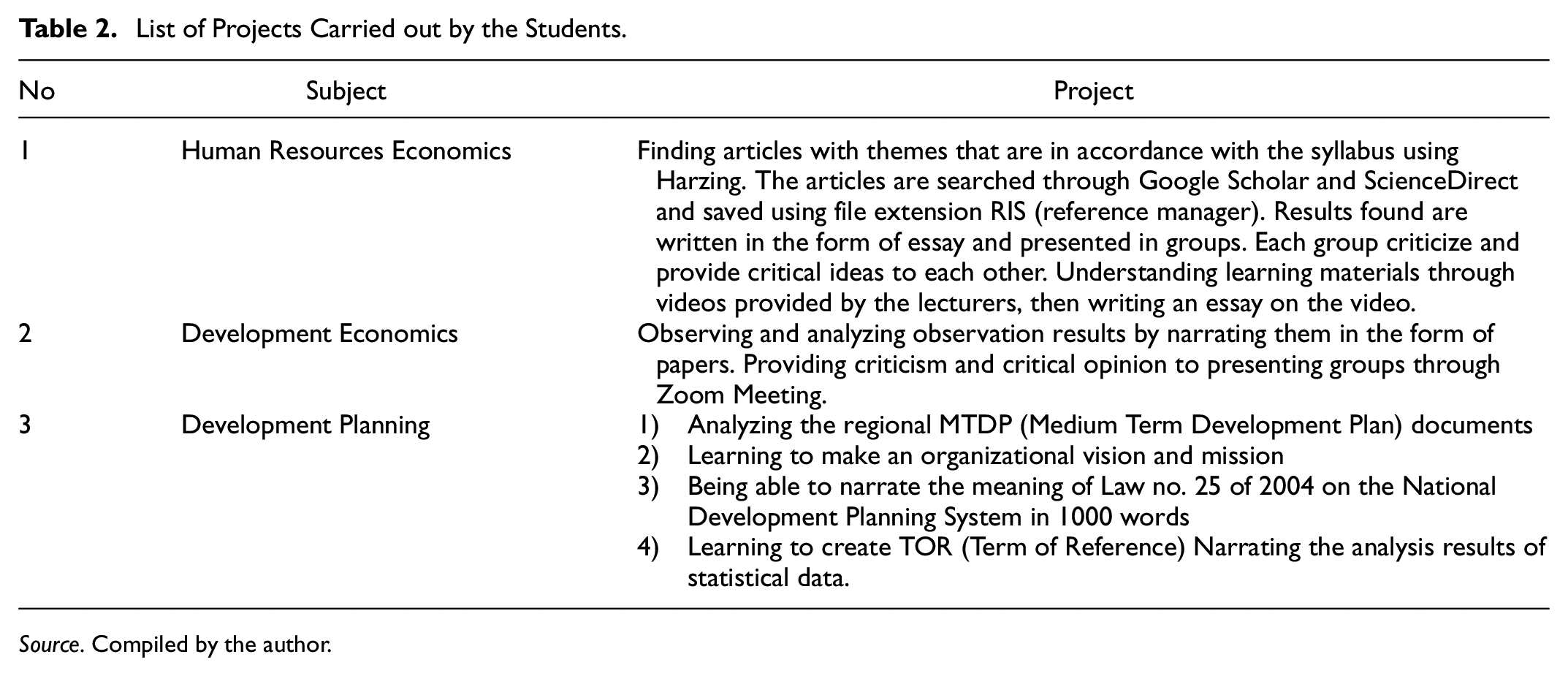
Source. Compiled by the author.
The applications used in this learning were Microsoft Word, Microsoft Excel, PowerPoint, video, and Harzhing dan Mandeley.
Results
During the pandemic, students of the Faculty of Economics remotely underwent online learning activities. Similar to other students in Indonesia, Universitas Negeri Padang (UNP) students also undergo distance learning using various application media as a means for interaction between lecturers and students and for the process of sending assignments and study materials to students. UNP students used the Learning Management System at elearning.unp.ac.id to control virtual classroom activities. However, learning activities are also frequently conducted using the Zoom Cloud Meeting application, learning videos, WhatsApp groups, Google Forms, and Google Docs. The following are some images that show the learning process carried out in Human Resource Economics, Development Economics and Development Planning classes.

Learning activities using Zoom meetings.
Learning Stages
The learning stage 5Es model, which adopts the opinion developed by Kivunja (2013) and Mairc (2020), and the learning stages are explained in Table 3.
1. The classes were conducted at seven meetings. The learning process for one semester was carried out through two projects for each student within the two activity groups. The learning stages implemented weekly during the project process were as follows:
a. Dividing Teams: Students are free to create their own groups of five.
b. Students were free to choose their project issues in accordance with their group’s interests. Several themes were chosen as content references, such as economics, management/commerce, office administration, and accounting. They can be chosen based on their expertise, particularly in Educational Research classes. For other subjects, such as Development Economics, the topics are adjusted to the syllabus and the Semester Learning Plan (SLP).
5Es Activities in Project-Based Learning.

Differences in Positive and Negative Experiences Averages in PjBL with Online Media.

Source. The author's calculations used Microsoft Excel.
Students were also asked to assess each written item on a scale of to 1 to 9 levels of goodness or difficulty. From this, it can be seen that the positive experiences they feel are higher than the negative experiences, or their learning difficulties are lower than the ease of learning they experience.
Normality Test One-Sample Kolmogorov-Smirnov Test.

Source. The author's calculations used SPSS version 21.
Test distribution is Normal.
Calculated from data.
Week 1 Plan
Lecturers familiarize themselves, build an understanding of the PjBL, and explain the learning process for the next 6 weeks. Each group was asked to prepare a topic or project idea in which they were interested. Students were asked to discuss for 30 minutes to identify the projects they would conduct, and each group was asked to present their ideas for 15 minutes. Additionally, the lecturer and other students consider perfect ideas and group members in finding available resources, materials, communities, and online resources and data.
Research and Learning Design
Week 2 Plan: Research and Design
Group members conduct data surveys, carry out fieldwork, design presentations, and communication media adjusted for the Covid-19 pandemic, and create commitment between group members in dividing each task, and then discuss the results. They also wrote scripts and prepared materials for learning. Lecturers guide them in identifying relevant theoretical or technical problems, as well as in creating the semester’s syllabus based on effective subjects as a reference. Preparing media to support the implementation of PjBL, including
1) Assigning lecturers and tutors
2) Classifying students according to tutors and lecturers
3) Announcing activity schedules through the official UNP Academic Portal
4) Setting online room for tutoring
5) Preparing virtual video room (Zoom, Google Meet, and other platforms)
Implementation and Learning Process
Week 3: Implementation the Project
Creating products/outputs while studying. Students work on the final product in the form of media (videos, realia, articles) and save their learning media in Google Drive shared in the menu/discussion forum tab of elearning.unp.ac.id.
Week 4: Sharing the project Result
Sharing materials and distributing learning media. Group members shared Google Drive links for their videos. It should be no longer than 15 minutes in duration. Afterward, let each student read, listen, and discuss with each other.
Week 5: Demonstration (Presentation)
Each group presented their group learning in a 15-minute video. Supervisors (researchers) provide advice on the forum panel of e-learning unp.ac.id and evaluate the results of each group using existing argumentation theory, an analysis tool used to analyze questions produced by the students. Then, each student contributes by providing criticism, advice, and opinions after they present or watch the learning video on the Google Drive link posted on the discussion forum.
Week 6: Evaluation and Reflection
Every student was asked to reflect on their learning while working on a project. This includes the learning experience, obstacles in the learning process, and skills acquired after carrying it out. A mid-semester exam was conducted in this meeting.
Post Mortem Student Learning Difficulties
Distance learning using online media was conducted in three courses. After four meetings, the students were asked to write down the positive and negative experiences they received from the learning process in terms of the ability of the 4Cs. In the course of Development Planning, Human Resource Economics, and Development Economics, the positive experiences they experienced were higher than the negative experiences. Figure 3 below is a graph that can illustrate between positive experiences and negative experiences in the three course.

Reflective positive and negative experiences in PjBL.

Fishbone diagram: Difficulty in online learning during the Covid 19 pandemic.
These data were obtained by asking students to indicate their positive and negative experiences in learning using the PjBL approach. It can be seen from the graph above that there are significant differences in their positive and negative learning experiences. This shows that, based on the students’ perspectives, PjBL provided them with more positive than negative experiences.
The data is normally distributed where the value of Asymp. Sig. was 0.089 for positive experiences and 0.801 for negative experiences. The correlation between positive and negative experiences was 0.797. Additionally, there was a significant difference between positive and negative experiences, where the sig value at the SPSS output was 0.000 <0.05.
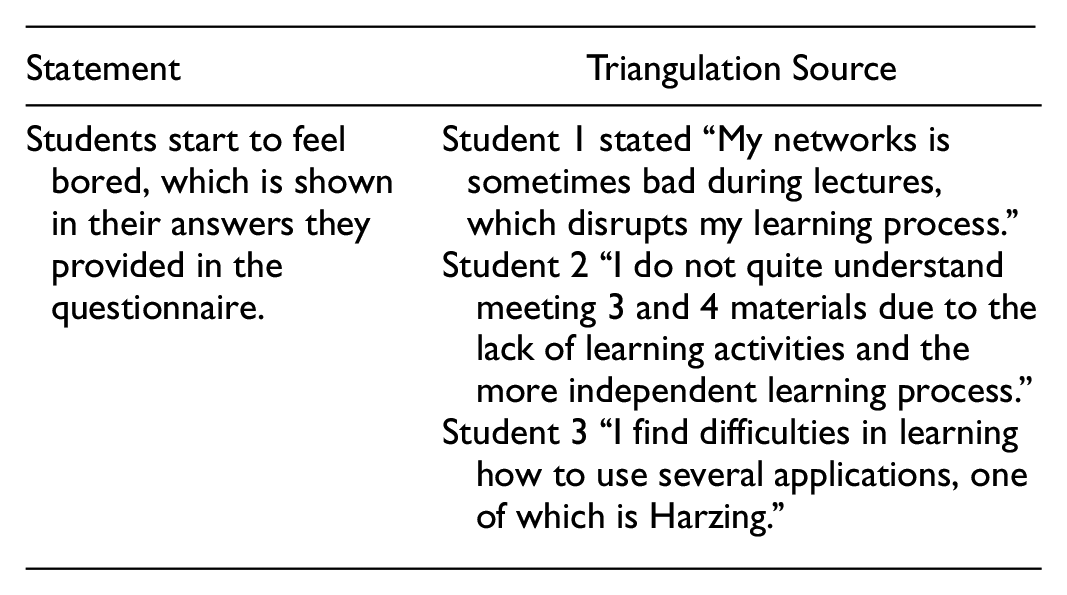
The first and third issue arise from students’ lack of preparation in participating in independent learning. This is due to the students lack of skills in using applications such as Harzing and Microsoft to collect information and tabulate data, making it difficult for them to follow the learning process. This happens because learning facilities such as laptops and Internet connections are still inadequate, which hinders independent learning process. These happen because students live away from places with Internet access, and weather and electricity may also impact it. Students can counter issues by finding a place with stable Internet connection and learning to use the applications in order to support their studies.

From the statements above, it can be seen that the issues arise because several group members are still passive in conveying their opinions. This is due the students’ lack of understanding and their shyness in asking about materials that they have not grasped. They have also not adapted to their group members, making them embarrassed to ask questions. Students can resolve this issue by trying to be more confident in conveying their opinions and working together in group discussions.

Based on the statement above, the students struggle with the lack of curiosity that hinders their creativity as they still struggle with creating complete essays. This is caused by their lack of understanding of the materials and their laziness in acquiring more information and knowledge. Students can counter this by putting more efforts in reading journals of various sources, asking for their peers’ opinions, and constantly doing essay writing practices.

From the statement above, it can be seen that students still copy and paste their assignment from the Internet. Students are unable to finish too many assignments. This happens because students do not understand their lecturers’ instructions causing them to struggle to complete their assignments on time. Students are also not motivated in participating in learning activities. Students can solve this problem by trying to find new knowledge; therefore, lecturers are committed to create activity schedule to ensure a more effective and efficient study time.
All students’ learning problems are summarized in Table 6.
Activity Plan, Student Project Participation, and Achievement.


Post Mortem, Issues, Problems, Causes, and Commitment to Learning.

Source. Compiled by the author.
From the table above, it can be concluded that students were less prepared to participate in independent learning because of the lack of ability to use applications such as Harzing and Microsoft, as well as the ability to obtain information and tabulate data, which is still low, so that it becomes an obstacle in learning. This was due to inadequate facilities such as laptops and Internet networks that do not support independent learning, which is caused by several factors, such as living areas that are far from Internet network access, weather, and electricity that do not support independent learning. These problems were overcome by students by trying to find a place that has a more stable Internet network and studying the use of applications that support learning.
Students also had problems conducting group discussions because some members were still passive in expressing their opinions. This was because the students still did not understand the materials and were embarrassed to ask questions. Students were also unable to adapt to group members, which caused them to be embarrassed to ask questions. These problems were overcome by students trying to be more confident in expressing their opinions and collaborating in group discussions.
The next problem students face is that there is still a lack of curiosity that hinders their creativity. Generally, students experience obstacles when making full essays. Lack of understanding of learning materials and the laziness to find information and new things are the causes of this problem. This problem was overcome by students trying to read more journals from various sources, asking friends, and continuing to practice writing essays.
Finally, students copied and pasted information from the Internet when completing assignments given by the lecturer. There were too many assignments given, so the students were not able to complete them. This happened because the students did not understand the instructions from the lecturer, making it difficult for assignments to be completed on time. Students also lacked motivation to participate in learning. This problem was overcome by students trying to find new things that they have a commitment to schedule daily activities so that their study time is more effective and efficient.
Students’ Readiness in Project Based Learning
Principal component analysis (PCA) was used to analyze this factor. Factor analysis in this reflection analysis was conducted using Learning Orientation and Engagement. This learning orientation was adopted from the orientation developed by Vettori et al. (2020), and engagement learning refers to the questionnaire developed by Baanqud et al. (2020). Before conducting the analysis, all basic assumptions in the learning orientation and student engagement data were matched, resulting in 19 factors that formed students’ learning orientation. The results of the factor analysis with matrix rotation produced five loading factor components. The highest AVE value indicates the dominant factor of each component, which can be seen in the following table.
Loading Factor, Average Variance Extracted, and Composite Reliability.

Source. The author's calculations used SPSS version 21.
Student Engagement Factors in Project Based Learning
Students’ involvement in online learning is seen to play an important role in learning. In the reflection that was conducted, participants were also asked about their perceptions of the extent of emotional engagement, cognitive engagement, and behavioral engagement. The results of the analysis revealed a cognitive engagement factor with a total extraction of 5.731: interest, enthusiasm, happy satisfaction, diligence in writing, remembering, summarizing, performing tasks, and planning activities. The behavioral engagement factor had a total extraction of 3.118 = appreciation, participating in discussions following content, and engaging in comments. Additionally, Emotional Engagement Problem Factors had a total extraction of 1.232 = Frustration, Boredom and Anxiety. The loading factor value is as follows:
Factors of Engagement Learning.

Source. The author's calculations used SPSS version 21.
Fishbone Model
Postmortem and factor analyses produce a framework of thinking in the form of fishbone analysis that makes it easier to observe and understand the results of student learning reflections on project-based learning. The following figure illustrates the fishbone model used in this study.
The fishbone diagram above shows that there are several factors of learning difficulties experienced by students: infrastructure, interaction, learning resources, learning instructions, and learning methods. In distance learning using the Internet, some students have problems following it because of the unsupported learning infrastructure. Some of the causes are students’ houses that are far from any Telkom network tower, Wi-Fi routers that are still few in their environment, laptops that are not adequate in downloading programs that support learning, and blackouts or erratic weather that often disrupt the learning process. Furthermore, another difficulty experienced by students in learning is the interaction factor; it is difficult to conduct student interactions if there are too many messages and information obtained. Additionally, the communication initiative is always carried out by the lecturer first, as students are still afraid that the opinions they express are wrong, and they are not accustomed to communicating in writing, causing communication that occurs only in one direction.
Online learning requires independent learning. However, students often have difficulty finding the right reference sources in accordance with the learning syllabus. This is because in distance learning, students study at home while lecturers are on campus. Students do not feel an academic atmosphere because most students live in rural areas, and such an atmosphere of learning higher education is not felt when there. If observed through a video that appears in the Zoom Cloud Meeting, many students do not have a special room to study. Access to learning resources is also limited in rural areas, and library services suitable for universities are limited to villages. The digital library can only be accessed using the campus Internet network (campus Wi-Fi); therefore, if they use the Wi-Fi or Internet network outside the campus, the campus e-journal subscription cannot be accessed for free.
Some of the problems faced by students are not only limited to infrastructure and learning facilities but are also related to the pedagogical instructions carried out by lecturers. The time for giving assignments and instructional pedagogies is not the same as the time for the lecture schedule, which leads to an unclear time for instructional learning carried out by the lecturer. This was caused by the lack of coordination between the lecturers. It ended with them giving too many assignments to the students,
Finally, the problem was related to the learning method. During discussion learning, some students are embarrassed to express their opinions, so they are unable to write sentences or essays independently. Because of this, students end up copying and pasting their friends’ assignments so that when they collaborate in a group to do something, the task is mostly done by only one person.
The 21st Century Learning Performance Super Skills in the form of 4Cs
The assessment process is a self-assessment with the results of a reflection score given by students in Google Forms. In the Human Resources Economics course, student assessments can be seen in the following graph: critical thinking ability gets an average of 80, communication averages at 80, collaboration at 69, and creativity values at 94.

Composition of grades in course: Human Resources Economic.

Development Planning.

Performance learning.
According to the students, the learning experience that is mostly obtained during PjBL is an increase in creativity, and this is shown on the average score obtained, which is 94 in the Development Planning course, 92 in Human Resource Economics, and 84 in the Development Economics course. This is followed by other experiences such as communication, critical thinking, and collaboration. The graph shows that the collaboration ability ranks the lowest because the students are in distance learning using online networks; thus, students have difficulty interacting directly and they cannot control each other’s work during projects. This can be explained by the post-mortem analysis conducted by self-assessment of PjBL, which was obtained from the students who gave an assessment of themselves.

Number of students who got Grade A, B, C, and D.
Distance learning using online media in the form of web-based on weblearning-e-learning.up.ac.id and supported with virtual meetings via Zoom Cloud Meeting on a project-based learning model produces unique and challenging learning experiences for students. Students argue that experience in terms of improving communication ability is the highest ability compared by increasing the ability to collaborate, critical thinking, and creativity skills. The summarized can be seen in the following table:
The 5E Process is Related to the Attainment of 4Cs in Development Planning, Development Economics, and Human Resources Economics.

Source. The author's calculations used SPSS version 21. Processed primary data, 2020 by Expert Choice.
From the table above, it can be concluded that learning using the 5 ES approach for students improves explanation skills with the highest average of 21.13, followed by elaboration ability with an average of 20.37, and engagement and exploration abilities with an average value of 20.27. The lowest ability achieved by students in the 5ES learning approach was an evaluation with an average of 17.9.
Discussion
Reflection is a stage of the project-based learning process, which can increase engagement, learning orientation and the 21st century skills. Reflection is also a tool to reveal students’ learning difficulties so that it can be used as a reference for lecturers amending distance learning. Lecturers determine the condition of students with a post-mortem process on students’ learning difficulties in online media. Sometimes lecturers cannot understand the exact condition of students during distance learning, so process reflection can be a solution to determine students’ learning process at home. There are many methods that can be used by lecturers, some of which are in the form of a checklist prepared in Google Forms, Google Docs, Google Sheets, and in the form of video recordings stored in Google Drive about the process they are going through, the construction of thoughts and ideas, and the attainment of skills in learning.
The difficulty in online learning with hybrid learning is how to improve students’ higher-order thinking skills, one of which is to ask them to draw reflections from their own drafts (Kish, 2007). Students in higher education who learn with the approach of reflective learning often have the difficulties in narrating their experiences in the form of writing (Ions & Sutcliffe, 2020)
Reflective learning is also an action-learning process that allows participants to achieve leadership development goals for project activities (Smith, 2001). Improving the quality of learning in higher education using e-portfolios in project activities can be a solution for increasing discussions about projects (C. Cheng, 2012; Polly et al., 2013). Using the reflection stage, PjBL provides space for students to express their feelings, experiences, new knowledge, and skills, and produce a self-assessment to make improvements in the next learning stage. This is in accordance with the findings of research conducted by W. Y. Hwang et al. (2018). From the reflections carried out, PjBL can provide a learning experience for students to improve collaboration skills and self-confidence and train them to work under pressure (Juliet, 2020).
On the other hand, reflective-based learning is able to increase students’ participation in learning. The same result is also shown in research conducted by Canan and Özgür (2016), where reflective learning can improve students’ higher-order thinking skills and communication skills between them and lecturers (Nomura et al., 2017).
Experience and identity as part of reputation are determinants of reflective learning success (Warhurst, 2008). For prospective teachers, reflective learning can improve their analytical thinking skills and professional attitudes in preparation for becoming teachers (Aarto-Pesonen & Tynjälä, 2017). This includes training students to practice student-based learning (Valenčič Zuljan et al., 2011).
Some of the highest learning experiences in PjBL achieved by students are creativity, critical thinking, communication, and collaboration. This is in line with a study conducted by Kim (2019) explaining that education is also an act of reflection, as students can review lists of what they have completed and the process of how they convey their ideas in project-based reflection. This study contributes to online learning practices by showing how reflection affects learning and helps learners learn by increasing their depth of knowledge, identifying areas that need improvement, personalizing and contextualizing knowledge, providing comparative references in learning, helping learners see structural relationships in knowledge, and creating social relations between them (Chand & Deshmukh, 2019). This study provides basic ideas for designing reflective activities to promote student learning in an online learning environment that discusses the difficulties students face during the COVID-19 pandemic online learning. Research conducted by Shek et al. (2021) also provides practical advice on how to embed reflection into learning activities to support students in acquiring different levels of knowledge.
In the fields of engineering and science, PjBL has proven to be able to assist students in improving their abilities, especially in special interdisciplinary laboratories (Păvăloiu et al., 2015). In line with this, Makaramani (2015) found that project-based learning for prospective teachers can provide meaningful experience in four dimensions of 21st century skills, effective in achieving 5/5 collaboration, knowledge construction 5/5, problem solving and innovation 4/4 and independence 3/4, and ICT skills for learning 3/4 communication skills 2/4. Likewise, Sapriadil et al. (2018) found that the use of high-level thinking virtual laboratories (HOTVL) in laboratory project activities resulted in higher scientific communication skills than students with other methods. Project-based learning has higher 4Cs attitudes and abilities compared to other learning processes (Bani-Hamad & Abdullah, 2019)
Limitation
Although the results of this research show that reflection learning is an alternative solution for controlling learning activities for students in online learning during a pandemic, it still has some limitations. First, a small sample was chosen for prospective teachers studying economics to support their academic ability to become high school teachers in high schools in Indonesia. Second, this research evaluates and distributes questionnaires to students using Google Forms tools because learning is also carried out with distance learning. For subsequent researchers, it is advisable to conduct this study on a larger sample scale. The next suggestion, the use of this method can also be seen in the comparison of activities between virtual classes and classical classes offline.
Future Research Agenda
This study found that the reflection process in project-based learning was able to describe learning orientation, learning engagement, and positive and negative experiences in learning, and could also produce self-assessment in the form of their experiences and abilities to communicate, collaborate, critical thinking, and creativity. This research is in the form of quasi-experimental research in the field of education with pre-test and post-test models of online learning with distance learning. For future research agendas, it is necessary to reaffirm quasi-experimental research in the form of classical or flipped learning and compare student learning experiences between virtual classes and ordinary traditional classes. Other research can also be conducted on non-teaching economics students to show their readiness to enter the world of work in the business sector in finance, marketing, and economics.
Conclusion
Learning reflection reveals the learning problems experienced by students in instructional teaching. Lecturers are considered to be irregular in displaying instructions in e-learning web applications, with too many assignments for the courses and too many media used by lecturers so that students experience frustration, worries, and boredom in online learning. The emotional condition of students in project-based learning during the pandemic caused them to be afraid of expressing their opinions, unable to write their sentences, having piles of lecture assignments, and eventually copying the work of their classmates with most of the group assignments were done by only a few people.
Project-based learning in distance learning from three experimental subjects revealed that students’ positive experiences tended to outweigh their negative experiences or difficulties in learning. In online project-based learning, students experience worries, anxiety, and boredom in learning because there are no misconceptions, and the messages conveyed by the lecturer are not comprehended. Self-assessment learning produces information that the highest level of experience students obtain during online project-based learning is the creative learning experience, followed by communication skills, critical thinking skills, and collaboration skills.
Footnotes
Acknowledgements
The authors would like to thank The Instution of Research and Community Service of Universitas Negeri Padang for funding this research with a Contract Number: 926/UN35.13/LT/2021 and this article has been read by proofreader Sitti Fatimah, S.S., M.Ed., Ph.D. from the language center of UNP Padang.
Declaration of Conflicting Interests
The author(s) declared no potential conflicts of interest with respect to the research, authorship, and/or publication of this article.
Funding
The author(s) disclosed receipt of the following financial support for the research, authorship, and/or publication of this article: This article will be funded by Universitas Negeri Padang.

Data Availability Statement
The data that support the findings of this study are available on request from the corresponding author, Yulhendri