



Abstract
Educational stakeholders in Brunei are not exempted from the search for innovative instructional approaches as a tool to stem the tide of poor performance of students in mathematics. This study was designed to contribute to this national project by examining the impact of a digital escape game intervention on students’ mathematics performance and affective constructs. Using a mixed methods approach, we generated both quantitative and qualitative data from 32 secondary school students who took part in the intervention study. The comparison between the pre-test and post-test scores of students shows a substantial improvement in the performance of students with different ability levels. Further analysis of the generated interview and questionnaire data reveals that the digital escape game reinforces students’ interest in and enjoyment of mathematics, provides an avenue for students’ collaborative learning and enhances students’ communication skills while working together on mathematics tasks. These findings highlight the potential of the digital escape game in not only stemming the tide of poor performance in mathematics but also in enhancing students’ motivational and social skills. In addition to students’ positive perceptions of the digital escape game, there are some reservations about the clarity of instruction and the duration of the intervention. We discuss the implications of these findings for the teaching and learning of mathematics within and outside the Bruneian borders.
Keywords
Introduction
The introduction of the National Education System for the 21st Century or Sistem Pendidikan Negara Abad Ke-21 (SPN21) was one of the earliest efforts by the Ministry of Education in Brunei Darussalam (hereafter referred to as Brunei) to fulfill the needs and challenges of socio-economic development as well as to develop 21st-century skills among students. In 2017, the Literacy and Numeracy Coaching Program was introduced as one of the programs carried out by the Ministry of Education in Brunei to train local teachers in English Language and Mathematics on how to implement internationally recognized best practices in Bruneian classrooms. One of the main pedagogical components of the program was designing effective mathematics tasks (Ministry of Education, 2017). This is because Mathematics apart from being one of the core subjects in Brunei, it has equally been perceived as a challenging subject by many students. The 2018 Program of International Students Assessment (PISA) results showed that students in Brunei performed below the OECD international average score in mathematics (OECD, 2019). Some researchers (e.g., Ginga & Zakariya, 2020; König et al., 2021; Tsng et al., 2021) have implicated pedagogical practices for this poor performance not only in Brunei but also in the international context. Thus, educators have implemented a variety of innovative pedagogy methods to engage students in the lesson while mitigating students’ perception of mathematics as a challenging subject. One of such innovative methods is game-based learning.
Over the years, there has been a growing interest in the use of both non-digital and digital game-based learning to foster students’ engagement with mathematics and motivate them in the learning process (Bayeck, 2018; Moon & Ke, 2019; Owusu-Mensah & Baffour, 2015; Partovi & Razavi, 2019). Studies show that game-based learning improves students’ motivation and interest in mathematics which further results in higher learning outcomes (Owusu-Mensah & Baffour, 2015; Partovi & Razavi, 2019). By learning outcome, we mean students’ performance in mathematics. Moreover, integrating games into the learning process can foster 21st Century skills such as collaboration, problem-solving, and critical thinking (Moon & Ke, 2019; Vankúš, 2021). Non-digital game-based learning, such as card games and board games, has been linked with increased engagement, motivation, and collaboration between students in mathematics classrooms (Bayeck, 2018; Owusu-Mensah & Baffour, 2015). As traditional classroom learning is shifting to online learning, educators are adopting digital game-based learning in their teaching practices. Numerous studies have been conducted on the affordances of digital game-based learning with promising results on improved motivation, engagement, teamwork, and students’ learning outcomes in mathematics (Jiménez et al., 2020; Moon & Ke, 2019; Partovi & Razavi, 2019).
Despite the promising results on the potential of game-based learning to influence students’ motivation, collaborative skills and performance in mathematics, there is limited research on such potential of digital escape games for mathematics learning. More specifically, and to the best of our knowledge, there is no evidence showing the implementation of digital escape games in mathematics across schools in Brunei. As such, the present research could fill this gap in the existing literature. The purpose of this study is therefore to investigate the effectiveness of digital game-based learning, specifically digital escape games, as a proxy to improve students’ performance in mathematics (with a particular reference to indices) and enhance motivational and social skills. In specific terms, we intend to address the following questions:
Does digital escape game have any effect on students’ performance in indices?
What are the perceptions of students about learning indices through the digital escape game?
Indices is an essential topic in mathematics, especially if students wanted to pursue the subject at the pre-university level in Brunei. Though this topic has been introduced at the lower secondary level, students still find it challenging to grasp the concepts of indices (Ulusoy, 2019). In a study involving 165 students, Ulusoy (2019) mentioned that middle school students in Brunei found it difficult to make sense of tasks involving exponents and they commonly erred when tasks involve zero and negative indices. We argue that, as students face difficulty in this topic and may feel demotivated, it is prudent to use an innovative pedagogical approach such as the digital escape game to attract students’ attention and sustain students’ motivation during the learning activity. These arguments constitute the rationale for focusing on indices in the present study. It is expected that the findings of this study will add to the literature on the potential of digital escape games to foster students’ learning experience and mathematics performance in the Bruneian context.
Conceptual Framework
Social Cognitive Theory
We argued for the theoretical rationale for investigating relationships between students’ interaction and digital escape games as well as the effect of this interaction on students’ performance from the social cognitive theoretical perspectives. The social cognitive theory posits that human functioning (e.g., construction of knowledge) is an emergent of a dynamic causal relationship between three determinants–behavioral, environmental, and personal (Bandura, 1997, 2012). The behavioral determinants of human functioning, on the one hand, include the human tendency to engage in activities and collaborate with others (Bandura, 2012). On the other hand, the personal determinants include affective, biological, and cognitive factors such as motivation, genetic composition, thinking, and communication skills while the environmental determinants could be imposed, selected, and constructed by the individuals (Bandura, 1997, 2012). The imposed environmental factors are factors that are beyond the control of individuals such as the classroom climates and curriculum contents for students. On the contrary, selected and constructed environmental determinants of human functioning give room for students to either choose or construct activities to engage in, for example, learning indices through digital games. Building on these theoretical postulations, we expect some changes in students’ cognitive factors such as their performance in indices and behavioral factors such as their collaborative skills when they interact with environmental tools such as the digital escape game while constructing their knowledge of indices. The rationale for this expectation lies in the triadic causal interaction of the three determinants (behavioral, environmental, and personal) as postulated by the social cognitive theory (Bandura, 1997, 2012). In line with previous studies in mathematics education (Zakariya, 2021), we believe that social cognitive theory provides a firm theoretical foundation for investigating the relationship between our research constructs.
Game-Based Learning
From time immemorial, games have been activities, or a form of play that humans engage in for fun, pleasure, and enjoyment. As Zimmerman (2004) succinctly puts it, games are a form of “voluntary interactive activity in which one or more players follow rules that constrain their behavior, enacting an artificial conflict that ends in a quantifiable outcome” (p. 160, italics added). This definition highlights the fact that games are voluntary and not forced, and they are interactive activities that involve an explicit participation of more than one person. It also emphasizes that the participants in a game are bound to behave in restrictive ways as dictated by the rules of the game. Further, games are rooted in tussles between powers (i.e., conflicts) bounded within time and space which lead to quantifiable outcomes such as wins and otherwise (Zimmerman, 2004). Harnessing the power of games and adapting its conceptualization to the educational context has not been an easy task. A contested notion among researchers in education is the question of whether games are to be used to teach concepts and facts of a subject matter or they are to be used to support learning (Chee, 2016; Prensky, 2001). The former is characterized has as game-to-teach while the latter is characterized as game-to-learn (Chee, 2016). Within the game-to-teach paradigm, game-based learning is conceptualized as “any marriage of educational content and computer games. The premise … is that it is possible to combine computer video games with a wide variety of educational content, achieving as good or better results as through traditional learning methods” (pp. 145–146). This paradigm emphasized students’ engagement with games as a primary means to achieve learning outcomes. On the other hand, the game-to-learn paradigm involves an intentional design of games as scaffolds through which students should work in an inquiry process (Chee, 2016). It involves multiple layers of activities that include reformulation of encountered problems in situationally appropriate ways through which meanings are constructed. Even though the debates between these two paradigms may not be resolved in this paper, of importance is the fact that game-based learning seeks to harness the potential of games to facilitate the teaching and learning process.
Admittedly, game-based learning has mostly been conceptualized with a focus on digital games (Moon & Ke, 2019; Prensky, 2001). However, there are non-digital games with the potential for learning in the literature. For instance, Owusu-Mensah and Baffour (2015) described two non-digital games, oware and dame, and the affordances of these games for the teaching and learning of mathematics. They argued that the non-digital games do not only foster the learning of basic mathematical concepts such as addition, counting, division, multiplication, and subtraction but also make the mathematical concepts relevant to the cultural context of the pupils (Owusu-Mensah & Baffour, 2015). In a systematic review of the literature, Bayeck (2018) reports five non-digital board games peculiar to Africa, namely, Bao, Moruba, Morabaraba, Omweso, and Oware. They also discussed the affordances and constraints of these non-digital board games and the implications for the teaching and learning of science, technology, engineering, and mathematics (STEM) subjects. In more recent studies, Chong et al. (2022); Mohd. Yusof and Shahrill (2021) also reported that a non-digital card game is a helpful tool in teaching and learning as their findings showed an improvement in students’ mathematics performance. With more and more accessibility to digital tools and the proliferation of internet-based electronic gadgets, research is focused more on the integration of digital games with the teaching and learning process. This present study is not an exception. As such, we delimit game-based learning (called digital game-based learning) to the integration of digital games with learning activities as supporting tools to foster students’ development of cognitive, affective, and interpersonal skills.
Game-based Learning and Learning Outcomes
There is extant literature on the relationship between game-based learning and students’ learning outcomes such as performance in mathematics, academic motivation, students’ engagement, and reasoning skills. Building on the game-to-teach perspective, researchers (e.g., Bai et al., 2012; Hwa, 2018; Partovi & Razavi, 2019) compared the effects of game-based learning on students’ motivation and mathematics performance with that of the conventional methods of teaching that is devoid of the use of digital games. The individual results of such studies are promising with substantial improvement in mathematics performance as well as students’ motivation when compared to students taught using the conventional methods (Bai et al., 2012; Hwa, 2018; Partovi & Razavi, 2019). These studies argued that game-based learning fosters mathematical reasoning and sustains motivation (Bai et al., 2012) among primary school pupils (Hwa, 2018) as well as elementary school students (Partovi & Razavi, 2019). However, meta-analyses of such studies empirically showed that the comparative effects of game-based learning over the conventional methods of teaching in terms of mathematics performance and students’ motivation are marginal and not substantial as claimed in the individual studies (Byun & Joung, 2018; Tokac et al., 2019). In support of the reported substantial effectiveness of game-based learning, one can argue that factors such as differences in measures of mathematics performance, lengths of the interventions, ages of the participants, and measures of effect sizes across the individual studies may be responsible for the reported marginal effects in the meta-analyses. Thus, empirical arguments for the comparative effect of game-based learning over the conventional methods of teaching may hold water.
Apart from the comparative advantage of game-based learning over conventional methods, there seems to be a consensus among researchers on the efficacy of game-based learning as a scaffold that reinforces students’ learning performance in mathematics (Bakker et al., 2015; Kolovou et al., 2013; Plass et al., 2013). In an intervention study comprising 236 students in grade 6, Kolovou et al. (2013) showed that students whose homework was enriched with a digital game outperformed their colleagues whose homework was devoid of the game in early algebraic problem-solving. It is instructive to mention that the effectiveness of the digital game was sustained even after controlling for prior algebraic manipulative skills, gender, and mathematical ability of the students (Kolovou et al., 2013). In a similar study, Plass et al. (2013) also showed that there were improved arithmetic skills of middle school students when exposed to a digital game intervention called FactorReactor. They even went a bit further to investigate the effectiveness of FactorReactor under three experimental conditions—individual, collaborative, and competitive. These experimental conditions represent different modes of engagement of the students with the game, that is, individual engagement, collective engagement without a price (collaborative) or with a price (competitive). Their findings showed that the game reinforced students’ arithmetic skills regardless of the mode of engagement (Plass et al., 2013). In addition, Bakker et al. (2015) reported a substantial improvement in children’s multiplicative reasoning ability when exposed to a digital game intervention. The findings of these studies corroborate the argument for digital game-based intervention as an effective tool for reinforcing students’ performance in mathematics.
Furthermore, the relationships between game-based interventions and students’ academic motivation, students’ engagement, and students’ reasoning skills have also been studied (Hung et al., 2014; Moon & Ke, 2019; Pareto, 2014). In an experimental study involving elementary students, Hung et al. (2014), among other things, showed that a digital game-based intervention was effective in reinforcing students’ motivation in mathematics and their beliefs of competence in solving mathematical problems. Building on the motivational power of digital games, Pareto (2014) designed an innovative game-based learning environment that bolsters students’ conceptual understanding and mathematical reasoning skills. Therein, Pareto (2014) showed that the digital game not only improves students’ mathematical reasoning skills but also facilitates students’ engagement in mathematical thinking. In a quest to further explore the potential of digital games in fostering students’ engagement with mathematics, Moon and Ke (2019) designed a single-player digital game called E-Rebuild. Therein, they showed that E-Rebuild does not only facilitate students’ cognitive engagement with mathematics but also content engagement with mathematical concepts (Moon & Ke, 2019). More recently, Vankúš (2021) systematically reviewed previous literature to argue that game-based interventions have substantial positive effects on students’ attitudes toward mathematics, enjoyment of mathematics, engagement with mathematics and mathematics motivation. Admittedly, there are some researchers (e.g., Es-Sajjade & Paas, 2020) who have reported a non-substantial effect of game-based learning on students’ mathematics motivation. However, as Plass et al. (2015) rightly put it, “a combination of cognitive, motivational, affective, and sociocultural perspectives is necessary for both game design and game research to fully capture what games have to offer for learning” (p. 258).
Digital Escape Room as a Form of Game-Based Learning
Digital escape rooms or escape games are relatively new forms of game-based learning that have gained the attention of researchers in the educational setting. According to Piñero Charlo (2020), an escape room is a “live-action team-based game where players discover clues, solve puzzles, and accomplish tasks in one or more rooms in order to fulfil a specific goal (usually escaping from the room) in a limited amount of time” (p. 1). Some of the distinct properties of the escape room are the inherent collaborative design for the players and inquiry activity where players will explore, discover, and encounter problems, work independently and collaboratively while solving the problems (Makri et al., 2021; Piñero Charlo, 2020). These properties of the escape room offer the potential for inquiry-based learning and qualify the game to be placed within the game-to-learn paradigm characterized by Chee (2016). There is a growing body of literature on the effectiveness of digital escape rooms to enhance students’ performance in mathematics, engagement, and academic motivation (Fuentes-Cabrera et al., 2020; Jiménez et al., 2020). For instance, Fuentes-Cabrera et al. (2020) showed that digital escape rooms were effective in improving not only students’ performance in mathematics but also academic motivation and autonomy while reducing students’ learning anxiety. Similarly, Jiménez et al. (2020) showed that digital escape rooms reinforced students’ motivation to learn, enjoyment of mathematics, peer-to-peer interaction, and performance while solving mathematical tasks.
In a systematic review of literature, Makri et al. (2021) argued that incorporating digital escape games into the teaching and learning process offers numerous advantages among which are bolstering students’ collaboration and improving commitment and social skills. However, there are also some disadvantages of this blended-pedagogical approach such as the enormous amount of time and effort that would be invested in the design of context-rich digital escape games (Makri et al., 2021). That being said, digital escape rooms and game-based learning, in general, have shown to greatly influence students’ learning performance in mathematics, boost students’ cognitive and content engagement during lessons, and raise students’ motivation to learn mathematics (Jiménez et al., 2020; Moon & Ke, 2019; Partovi & Razavi, 2019). Additionally, students demonstrated positive attitudes and behaviors throughout the learning process when working with digital educational games such as escape rooms (Fuentes-Cabrera et al., 2020; Makri et al., 2021). Thus, incorporating an escape room game into a subject that students find challenging may help them develop a positive attitude toward the subject. There is no research conducted in Brunei that examines the effect of the digital escape game on students’ performance in mathematics. Therefore, we hypothesize that incorporating the digital escape game as a revision exercise will reinforce Bruneian students’ performance in indices and sustain positive perceptions of the learning process by students using the digital escape games.
Methods
Participants
This research followed the principles of pre-test and post-test quasi-experimental design involving both quantitative and qualitative approaches to data collection, analysis, and interpretation of results. We employed qualitative approach to data collection (i.e., interviews) as a triangulation (Bryman, 2016) of the generated data using quantitative approach (i.e., questionnaire). As such, the interview data allowed us to cross-validated the findings of analyzed quantitative data. Even though both approaches had equal weights, we allowed the qualitative data generation to sequentially follow quantitative approach as in a typical mixed methods research strategy (Bryman, 2016). The research was conducted at a government secondary school in Brunei. Two intact classes of Year 9 students were involved, namely, Class X and Class Y. Thirty-two students (18 females) voluntarily participated in the study (including informed consent from each of them) with an average of age 15 years. The students are from families of a comparable social economic background and status in Brunei. The sample for this study was selected based on the convenience sampling method. The study consisted of two lesson cycles. Cycle 1 was conducted on Class X, and Cycle 2 was conducted on Class Y.
Instruments
Pre-test and post-test
Pre-test and post-test tasks were created to examine differences in students’ scores on indices before and after the experiment. Both tests consisted of 10 items and students were required to complete them within 30 min (Appendix 1). We reshuffled items of the pre-test to get the post-test. The pre-test and post-test were required in this study since the analysis of post-test scores alone may not have sufficient power to detect the effects of the intervention. Before the items were used for the test, they were checked and approved by experienced teachers in a Bruneian secondary school and the research supervisor to ensure the validity of the items of the tests. Kuder-Richardson Formula 20 (KR-20) was used to measure the internal consistency of the test items. The KR-20 value for pre-test items was 0.89 and that of the post-test items was .82. Since both values are close to 1 they indicate that the test items have acceptable reliability (Field, 2018).
Questionnaire
A 30-item questionnaire was used by the researchers to generate data on students’ perceptions of learning indices through the digital escape game in the aspects of acceptance, interest, and soft skills. The questionnaire items were adapted from similar research by Zaharin et al. (2021) and the items were in a 4-point Likert scale format from Strongly Disagree to Strongly Agree. The questionnaire has three sections with 10 items in each section. Section A is about students’ acceptance of the digital escape game in learning indices. Section B is about students’ interest in the application of the digital escape game while section C is about soft skills acquired by the students by using the digital escape game to learn indices. The scale items were subjected to a reliability test before the questionnaire was distributed to the participants. Cronbach’s alpha was used to measure the internal consistency of the questionnaire items. The Cronbach alpha’s value for the acceptance subscale (sample item: digital escape game is suitable for learning indices) was .85, for the interest subscale (sample item: I am thrilled when digital escape game is used for learning indices) was .87, and .83 was for the soft skills subscale (sample item: I can improve my confidence while playing the games). The results showed that the items on the questionnaire have acceptable reliability. The full questionnaire is available in Appendix 2.
Interview
A semi-structured interview was conducted as a follow-up to further explore the students’ perceptions of the digital escape game. The researchers selected some students for the interviews, from among those who volunteered to take part in the study, based on their responses to the questionnaires and the results of their post-tests. The semi-structured interview guide comprised six questions. Examples of the interview questions are how do you feel about the digital escape game? and what do you like the most about the digital escape game? The six questions for the interview are available in Appendix 3. Before conducting the interview, the six questions on the interview guide were validated by the research supervisor, the school’s mentor, and the head of the department. Once the questions were approved, the researchers interviewed the selected participants.
Procedures of data collection
The 10-item pre-test on basic operations on indices was administered to the participants from two classes, Class X and Class Y, to determine students’ ability levels and prior knowledge in indices before the digital escape room intervention. The use of calculators was not allowed in the test, and the students were given thirty minutes to complete the test. This was followed by the intervention which lasted for 60 min. Thereafter, the 10-item post-test was administered as well as the 30-item questionnaire on students’ perceptions of the intervention. After the completion of the post-test and the survey, six students were interviewed. Two smartphones were used to audio record the interview sessions. Due to the COVID-19 restrictions at the time of the data collection, the researcher conducted the interview through phone calls. All the interview conversations were audio-recorded with permission from the participants. Figure 1 presents a graphical display of the research framework.
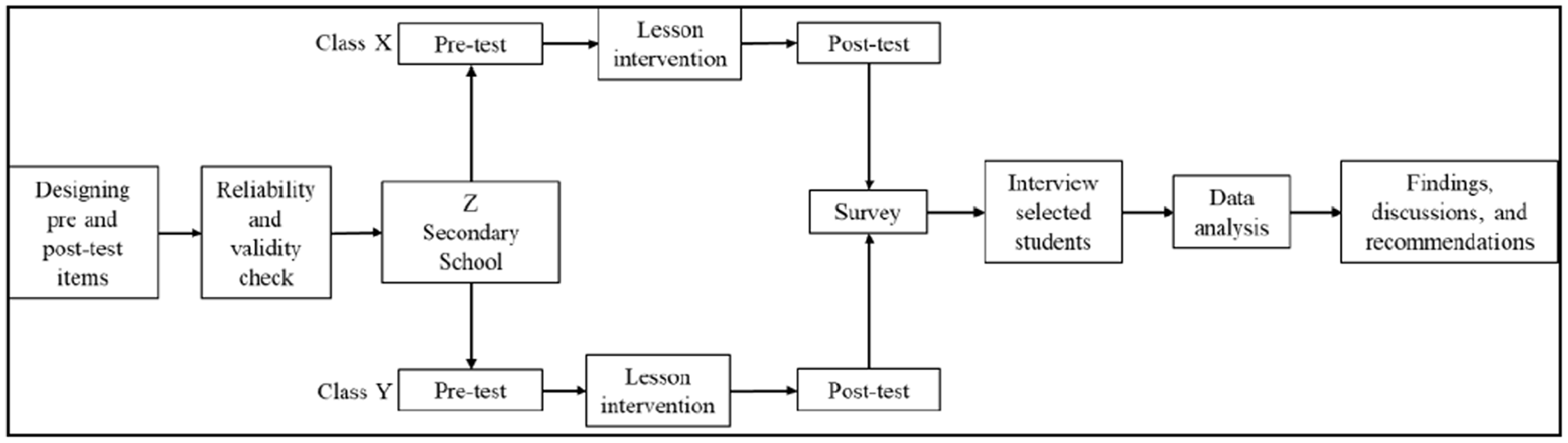
Research framework of the study.
Lesson intervention
The digital escape game was designed so that it is adaptable to any topic or subject. For this research, the digital escape game focused on the laws of indices. Three levels were to be completed by the students to escape the game successfully. The first level focused on the laws of addition and subtraction of exponents in indices. In the second level, students were tested on their knowledge of the multiplication of exponents in indices. The third level focused on manipulating zero exponents in indices. The game was designed based on the difficulty of the questions, which meant that as students move to the next level, the questions would be more challenging. Students were required to work out the solutions in pairs. The lesson interventions for both Class X and Class Y were carried out online where the students needed to complete Google Forms. Before that, the students were required to solve a few questions on Quizizz within 5 min to recall their prior knowledge of indices. Once completed, the researcher identified and discussed the common errors in a WhatsApp group.
The teacher then proceeded with the lesson intervention and shared the link through Google Forms with the students in the WhatsApp group. The students were put into smaller WhatsApp groups according to their levels of ability. Each group consisted of a minimum of three students and a maximum of four students and the purpose of the WhatsApp group was for the researcher to ensure the students were discussing together with their members and to guide the students that needed help. Students were then required to fill in their names and their members’ names before proceeding to the next section. Once completed, the students then proceeded to the second section which was the first level of the escape game. Figure 2 shows the maze layout of Level 1. The maze consists of twelve boxes and the students started from Box A and then followed by the box that was led by the correct answer until they reached the “end” box. The students then wrote down the alphabet that they followed to reach the “end” box in the boxes provided to decipher the code for Level 1. Figure 3 shows the sample of the maze completed by the students and how they were able to decipher the code.

Level 1 escape game activity.

Sample of student’s work in finding the pathway to the “End” box and to decipher the code.
The students then proceeded to the second level once they had entered the correct code for Level 1. They would not be able to move on to the second level if they failed to enter the correct code. This rule is applied to Levels 1, 2, and 3 where they could only ‘escape’ from the level if they entered the correct code. The second level consisted of four multiple-choice questions involving the multiplication of indices. Students were to choose the alphabet that represented the correct answers for each question. Once the student had entered the correct code for Level 2, they then moved to the final level which involved zero indices. The final level had the same mechanism as in Level 2. The first group that escaped from Level 3 became the winners.
Data analysis
The data obtained from the questionnaire were recorded in Microsoft Excel and analyzed using basic descriptive and inferential statistics to address the first research question. We compared the mean scores of students in pre-test and post-test to make quantitative inference about the performance of students in indices. For the qualitative data, the audio recordings were transcribed and analyzed thematically. Thematic analysis links various responses from the participants to make coherent arguments for the underlying meanings across the comments (Braun et al., 2019). As such, we did not use any coding book or an analytical framework as the intent is to identify common meanings in students’ responses to the interview questions. The results of both the questionnaire and interview were used to address the second research question of this study.
Results
Effects of Digital Escape Game on Students’ Performance in Indices
The first set of results concerns the pre-test scores, post-test scores, and the comparison between them. These results are combined to make a case for addressing the first research question of the present study. The descriptive statistics of the pre-test scores for both Class X (Mean = 1.19, SD = 0.83) and Class Y (Mean = 6.44, SD = 2.28) show an observable difference in performance of students in the two classes. A non-parametric Mann–Whitney U test revealed that the mean difference (MD) was significant (MD = 5.25, p = 0.001). We have used a non-parametric test for the mean difference test because the scores are not normally distributed. This finding shows that there was a substantial difference in the prior knowledge of indices among students in the two classes. At this juncture, we either include the pre-test scores as a covariate in the analysis of the post-test scores or report the changes in scores for the two classes separately. For convenience, we chose to report for the two classes separately. Similarly, there was a mean difference in post-test scores of both Class X (Mean = 5.94, SD = 2.49) and Class Y (Mean = 9.25, SD = 0.93). This is expected given the initial mean difference in the pre-test scores. Table 1 presents these descriptive statistics.
Descriptive Statistics of Pre-test and Post-test scores for Class X and Class Y.

The results in Table 1 show observable mean differences of 4.75 and 2.81 between the pre-test and post-scores for both Class X and Class Y, respectively. That is, the mean score of students for the post-test in Class X is 4.75 higher than that of their pre-test scores. On the other hand, the mean score of students for the post-test in Class Y is 2.81 higher than that of their pre-test scores. Figure 4 presents a picture of these observable differences in the pre-test and post-test scores of students in both Class X and Class Y.

Pre-test and post-test score comparisons of Class X and Class Y.
The main question is whether these observable mean differences are due to escape room digital game intervention, or they are due to confounding errors in the measurement of students’ performance. To address this question, we run inferential statistics. Before running the inferential statistics, we subjected the pre-test and post-test scores of Class X and Class Y to the test of normality. Shapiro Wilk normality tests indicated a non-normal distribution of scores for Class X and normal distribution of scores for Class Y. As such, we used the Wilcoxon Signed-Rank test, a non-parametric test, for mean comparison in Class X, and a paired sample t-test, a parametric test, for the mean comparison in Class Y. The results of these analyses are presented in Table 2.
Pre-test and Post-test Score Comparison for Both Class X and Class Y.

The presented results in Table 2 show a significant improvement in the pre-test and post-test scores of students in both Class X and Class Y. The median score of Class X increased from the pre-test (MD = 1, n = 16) to the post-test (MD = 7, n = 16). The Wilcoxon signed-rank test revealed that this increase is statistically significant with a large effect size of
Perceptions of Students About the Digital Escape Game
The second set of results concerns the perceptions of students on the incorporation of digital escape games in their learning activities. The descriptive statistics of students’ responses to the questionnaire show some interesting results. They show a mean of 3.10 and a standard deviation of 0.6 for the acceptance subscale, a mean of 3.20 and a standard deviation of 0.52 for the interest subscale, and a mean of 3.00 and a standard deviation of 0.55 for the soft skill subscale. These results corroborate the fact that, on average, the students embrace the inclusion of the digital escape game in learning indices. The students agreed that the digital escape game reinforced their interest in learning indices. The students also agreed that the digital escape game helped their collaborative and cooperative skills while learning indices. Putting these findings together, one can argue that the students have positive perceptions of the digital escape game intervention. To probe this argument further, we analyzed the generated interview data from the students. The results of the thematic analysis can be grouped and presented in three categories: fun way of learning, an avenue to collaborate, and suggestions for improvement.
Fun way of learning
The generated interview data from students of both Class X and Class Y revealed the students found the digital escape game to be a fun way of learning indices. Some of the students remarked that the integration of the digital escape game as a revision tool for indices made them feel easy and focused their energy on the mathematics therein. For instance, one of the students said: I feel easy and focus all of my energy on my math
Another interviewed student elaborated further and said: It was fun because those kinds of activities are what we rarely do, and mostly our activities are just worksheets and group discussion
It is instructive to mention that this student did not only provide a reason for fun in the digital escape game but also contrast with the usual of way learning mathematics before the intervention. This comparison lay more credence to previous studies (e.g., Hwa, 2018; Partovi & Razavi, 2019) that favored game-based learning over the conventional method of teaching.
Avenue to Collaborate
The generated interview data from students of both Class X and Class Y revealed that the students perceived the digital escape game as an avenue for collaborative learning. Many students mentioned that the digital escape game made it easier to solve the indices questions as they could discuss it with their friends in an interactive manner. Some of the students remarked that the collaborative avenue provided by the digital escape game allows them to solve challenging problems in indices. For example, the following is the response of a student when asked about overcoming difficulty during the intervention: I discussed it with friends, and they helped me to understand. I like the group work activity and searching for codes.
Another student’s response is also as follows: Yes, my friend helped me, and I like the team
The following are sample responses of students when asked about what they like most in the digital escape game intervention: It is simple and we can discuss it with our friends. Teamwork [is what I like most about the game]. I prefer the game to be played as a group.
These excerpts from students’ statements point to the fact that they think digital escape game offers a convenient avenue to help each other with difficult problems through teamwork and active participation while learning indices. These results corroborate the findings from the questionnaire whereby the students believed that they were not only able to help their friends but also believed that the digital escape game enhanced their communication and cooperation skills.
Suggestions for Improvement
Despite the affordances of the digital escape game in terms of enjoyment of the game as well as the collaborative atmosphere the game creates for students learning, there are some suggestions for improvement of the game. During the interview, some of the students mentioned about the time or duration of the digital escape game activity should be improved upon. They highlighted that the duration of the digital escape game activity was the least thing they like about the game as some questions required more time to complete. For instance, some of the students made the following remarks about the time constraint during the intervention: I need more time to answer the questions Need more time to guess the code.
Some of the students also have reservations about the clarity of instruction for the activity during the intervention. They suggested simple and easy-to-understand instructions in future designs and conduct of the digital escape game. Although the teacher offered explanations before the implementation of the digital escape game, some students still requested more teacher support and guidance in completing the game. For instance, some of the students made the following remarks about the clarity of instructions during the intervention: Make the instructions easy and simple Easy to understand but a bit of explanation from the teacher is required.
Discussion and Conclusion
Mathematics is a core subject in the Bruneian secondary school curriculum and at the same often challenging for many students. Research within and outside the Bruneian borders suggests that a way to alleviate the problem of poor performance in mathematics is by adopting innovative methods of teaching and learning the subject (e.g., Ginga & Zakariya, 2020; Tsng et al., 2021). Following this line of thought, some researchers (Jiménez et al., 2020; Moon & Ke, 2019; Partovi & Razavi, 2019) argued for the potential of game-based learning, in particular, digital escape games, in reinforcing students’ learning outcomes in mathematics. However, it appears that Brunei is left out in this discussion as the potential of the digital escape game has not been empirically investigated in a relation to students’ learning outcomes in mathematics. The present study sets to fill this game by investigating the effect of digital escape games on students’ performances in indices, and students’ perceptions of the game. The data were generated using both the questionnaire and semi-structured interviews of secondary school students.
The results of the analyzed data revealed some fascinating findings with implications for the teachers, game designers, and educational stakeholders within and outside the Bruneian borders. The pre-test and post-test score comparison of students revealed a substantial improvement in students’ performance in indices. This finding corroborates the findings of previous studies (e.g., Fuentes-Cabrera et al., 2020; Hwa, 2018; Makri et al., 2021) that reported positive effects of game-based learning on students’ performance in mathematics. The substantial effect of the digital escape game intervention on students’ performance in indices is contrary to the marginal meta-analytic effect reported by Tokac et al. (2019). It is crucial to remark that the score improvement was observed for students with low competence in indices (Class X) and those with average competence in indices (Class Y). That is, students benefited from the digital escape game intervention regardless of the differences in their prior mathematics knowledge. This finding offers a renowned opportunity for classroom mathematics teachers and curriculum planners to incorporate digital escape games into the teaching and learning of mathematics. This incorporation is not to replace but to supplement the conventional method of teaching. This can be done by using the digital escape for revising the taught concepts in the classroom.
The findings from the questionnaires revealed that the students were interested in the implementation of the digital escape game in learning indices. This was further supported by the findings from the interviews where the students said that the digital escape game was a fun way of learning indices. This outcome from the interview data coincides with the study by Fuentes-Cabrera et al. (2020) who stated that the implementation of escape rooms reduces students’ learning anxiety. The fun way of learning mathematics is crucial, especially at this time when Bruneian students exhibit low motivation for mathematics learning. Moreover, the students agreed that the digital escape game led to the acquisition of soft skills as they collaborated with their team members to solve the questions and decipher the code. The students further stated that collaborative learning enhanced their learning process in indices while engaging with the digital escape game. These findings corroborate previous studies (e.g., Makri et al., 2021; Moon & Ke, 2019) that suggest that students’ cognitive and content engagement is reinforced when they participate in game-based learning. In addition, the findings of the qualitative analysis do not only triangulate those of the quantitative analysis but also provide completeness (Bryman, 2016) by exposing areas of impacts of the digital escape game that were not accounted for in the quantitative analysis. As such, mathematics teachers and policymakers could take a cue from these findings to make mathematics more enjoyable, interesting, and collaborative through the incorporation of digital escape games in mathematics lessons.
The integration of the digital escape game in educational settings is uncommon in Brunei. As such, the findings of this study constitute a novel contribution to the literature on digital escape games. We contribute to the international body of knowledge by providing the Bruneian experience of implementing a digital escape game in mathematics classrooms. There were positive impacts of the digital escape game on students’ learning performance in mathematics and affective constructs such as the enjoyment of mathematics, interest, and motivational and collaborative skills. Based on the findings of this study, we offer the following recommendations. Mathematics teachers should harness the power of the digital escape game to enhance their instructional practices in mathematics classrooms. Policymakers and other stakeholders in mathematics instruction within Brunei and beyond should explore the benefits of digital escape games explicated in the present study as a proxy to enhance students’ learning experience. Further, researchers should build on our methodology, instruments, and findings to replicate a similar study on the effectiveness of digital escape game within and outside the Bruneian borders. Despite the benefits of the digital escape games and our accompanied recommendations, we admit that some areas of our study require improvement for an effective replication. The findings from the questionnaire show that the students did not have enough time to read and comprehend the instructions for the game as they found the instructions to be too wordy. This outcome was further supported by several students during the interview when they suggested that the teacher should increase the time for the game and improve the quality of instruction. As such, we recommend future improvement in the aspect of duration and clarity of instructions in the game. In addition, there are some limitations of the study that are worthy of mention. We acknowledge that the validity and reliability evidence of the instruments may be weak or rather insufficient as argued by Zakariya (2022). Further, generating interview data through phone calls could raise validity concerns. We recommend more detailed evidence of the validity and reliability of such instruments in future research. We admit that the sample size of the study is relatively small which may affect the generalisability of the findings. Future research may extend the study to different schools with large sample sizes. The study is also delimited to a topic in the secondary school mathematics curriculum which may not be representative of the secondary school mathematics content. Also, the design of the study did not include any control group through which the outcome of the intervention can be juxtaposed nor random assignment of participants. Further research within and outside the Bruneian borders can explore this possibility. Despite these limitations, we are convinced that the findings of the present study provide tentative evidence upon which further studies on digital escape games in and out of Brunei can build on.
Footnotes
Appendix 1
Appendix 2
Appendix 3
Author Contributions
Dk Nurul Najiah Najibah Pg Abu Bakar and Masitah Shahrill contributed to the study conception and design. Dk Nurul Najiah Najibah Pg Abu Bakar and Masitah Shahrill carried out material preparation, data collection, and data analysis. Dk Nurul Najiah Najibah Pg Abu Bakar and Yusuf F. Zakariya wrote the first draft of the manuscript. Dk Nurul Najiah Najibah Pg Abu Bakar, Masitah Shahrill and Yusuf F. Zakariya commented on subsequent versions of the manuscript. Yusuf F. Zakariya revised the manuscript. Dk Nurul Najiah Najibah Pg Abu Bakar, Masitah Shahrill and Yusuf F. Zakariya read and approved the final manuscript.
Declaration of Conflicting Interests
The author(s) declared no potential conflicts of interest with respect to the research, authorship, and/or publication of this article.
Funding
The author(s) disclosed receipt of the following financial support for the research, authorship, and/or publication of this article: The corresponding acknowledges the support of the University of Agder library for funding the APC of the manuscript.
Informed Consent
All the participants voluntarily gave informed consent.

Data Availability Statement
The data used for this study are available upon request from the first author.