



Abstract
The importance of context in behavioral interventions is undeniable, yet few intervention studies begin with a systematic investigation of the contextual factors that influence the behavior in question. This is largely due to the lack of a reliable method for doing so. In recognition of this gap in the field, we have developed a procedure called the Choice Context Exploration that uses machine learning tools to examine the contextual factors that influence a targeted behavior. We demonstrate the steps of Choice Context Exploration using the example of the behavioral choice between using stairs or an elevator. Potential contextual factors were identified by laypeople and experts, and two surveys were created to measure both the behavior and choice, as well as the beliefs of participants. We estimated the effect of contextual factors on participants’ behavior and were able to identify the most influential ones in relation to the studied choice. We achieved an accurate prediction of whether participants would choose the stairs or the elevator based on contextual information in 91.43% of cases on previously unseen data. We also found that participants had different beliefs about what influenced their choice in this situation and that they could be divided into different groups based on these beliefs. Our results suggest that the Choice Context Exploration is a useful procedure for collecting and assessing contextual factors in a given choice setting, which can aid in the planning of behavioral interventions by significantly reducing the number of potential interventions that are likely to be effective.
Plain Language Summary
This study aimed to address the lack of systematic investigation into contextual factors influencing targeted behaviors in interventions. The researchers developed a procedure called Choice Context Exploration, which employs machine learning tools to examine such factors. Using the example of choosing between stairs and an elevator, potential contextual factors were identified, and surveys were administered to measure behavior, choice, and beliefs. The analysis revealed influential contextual factors and achieved a 91.43% accurate prediction of participants’ choices based on unseen data. Participants held different beliefs, and can be grouped by these beliefs. The study concludes that Choice Context Exploration is valuable for collecting and assessing contextual factors, aiding in behavioral intervention planning by reducing potential interventions. However, limitations include a narrow focus on one behavior and the need for further investigation into generalizability.
Introduction
Consider a scenario in which you want to encourage people to engage in a healthy behavior, such as using the stairs instead of the elevator. The literature offers many examples of different nudge techniques that have been used in various settings with varying degrees of success (Duflo et al., 2011; Silva & John, 2017). How do you decide which nudge technique to use? We argue that researchers cannot make an informed decision about their intervention technique until they have explored the influential contextual factors of the studied choice situations, particularly in behavioral change interventions where the method does not limit choices. This paper presents procedural steps for detecting contextual influences to aid in choice architecture interventions.
Over the past decade, nudge interventions have gained popularity as a method for changing behavior on a large scale. Nudge, as outlined in Thaler and Sunstein’s (2008) book, is the influencing of behavior by altering choice architecture using relatively inexpensive and non-intrusive methods that take advantage of general cognitive processes and biases. While nudges can be successful in many cases (John et al., 2013), they can also be ineffective (Silva & John, 2017) or have only temporary effects (Brandon et al., 2017).
One potential reason for this inconsistency in results may be that, in the prevalent culture of behavioral intervention research, nudge researchers aim to find all-encompassing effect sizes and do not consider the potential heterogeneity across various contexts (Tipton et al., 2019). As a result, the reasons for why, when, and to what extent interventions work or don’t work are often unclear. It has been suggested that instead of trial-and-error assessment of ad hoc interventions in a given context, researchers should focus on advancing theory and exploring moderators (Szaszi et al., 2018). While there are models of behavior that can be used to design field experiments and make the interpretation of results easier and more convincing, they are often lacking in the design of interventions.
However, various toolkits are employed to design behavioral interventions that enable the customization of the intervention to suit specific contexts. One of the most widely used toolkits for designing behavioral interventions is the Behavior Change Wheel (Michie et al., 2011). This framework divides the problem of intervention planning into three layers. The first layer focuses on identifying the sources of behavior that might be targeted using the COM-B model, which stands for Capability, Opportunity, Motivation, and Behavior. The second layer includes intervention functions to choose from, including Education, Persuasion, Incentivization, Coercion, Training, Enablement, Modeling, Environmental Restructuring, and Restrictions. The third layer contains policy categories that can be used to deliver the intervention. In their book, Michie et al. (2014) provide a more detailed eight-step guide for using the Behavior Change Wheel.
A commonly used theoretical framework in behavioral intervention design is the Model-based/Model-free framework (Daw et al., 2011; Marteau et al., 2020). This framework treats behavior as a bidirectional interaction between an agent and its environment, where the agent receives information about the environment and acts in a way that maximizes reward. The model includes the agent, a set of possible actions, and a set of action-dependent outcomes. These outcomes are probabilistically associated with rewards and a possible change in the environmental state. The agent may update their behavior in a model-free way, meaning they are influenced by the short-term rewards resulting from their actions, or in a model-based way, where the agent chooses actions with lower short-term rewards but higher long-term rewards. In order to generate useful models of behavior that can be used to explain intervention effects, this framework also requires a thorough understanding of the environment, in addition to the actor and potential rewards. These frameworks give useful insights and methods of collecting contextual information, while also offering substantial flexibility in analyses. This flexibility, however, comes with the price of the possibility of not choosing the most adequate analysis method for the task. We propose that an exhaustive and reproducible exploration of relevant contextual information can be achieved by the use of a combination of machine learning methods. The present paper aims to provide a step-by-step guide for collecting the potential contextual influences of a given environment while showcasing the use of machine learning methods for context exploration.
The Focus is on Context
The elements of context that constitute an environment can be categorized in various ways for operationalization purposes. Finding an adequate working definition of what context constitutes is challenging, because most studies provide a narrow conceptualization of context, and simply list contextual determinants of a construct (Nilsen & Bernhardsson, 2019; Rogers et al., 2020). As the result of their systematic review, Rogers and colleagues defined context “as a multi-dimensional construct encompassing micro, meso, and macro level determinants that are pre-existing, dynamic and emergent throughout the implementation process. These factors are inextricably intertwined, incorporating multi-level concepts such as culture, leadership and the availability of resources” (Rogers et al., 2020, p. 18). Our definition of context is based on the criterion of choosing the source of information within the environment as a prescription. We define context as the physical environment, such as surrounding objects or creatures, the intrapersonal circumstances, such as mental states, and sociocultural environment, such as customs and norms, present at the time of the choice that may affect decisions. We argue that while knowing the context is a necessary, but not sufficient, prerequisite for intervention choice, exploration of potential influencing factors is needed while there is no intervention in effect in order to later model their interactions with the effects of interventions. This way, it is possible to advance the general understanding of how interventions work. Sufficient knowledge of context is crucial. In this sense, exploring contextual information is analogous to taking a patient’s medical history in therapy settings; while the therapeutic methods to be used cannot be decided based solely on the medical history, it is still a vital part of the process as it helps in determining further directions.
The role of context in interventions is rarely completely ignored, but its investigation is often not systematic (Szaszi et al., 2018). There are two main sources of information indicating which potential contextual information to consider when planning an intervention: either based on some insight, without empirical data, or on published results. Insights-based contextual information may not necessarily come from the researchers’ own experience and opinion; it can also come from the opinions of other experts, collected either through interviews or casual conversations about the topic. Valuable information can also be gathered by convening a demographically diverse focus group and discussing the issue at length (Puchta & Potter, 2004). However, the insights approach has its limitations: its strength depends on the validity and breadth of these insights, which are rarely known or assessed. Empirical contextual information may be obtained from relevant literature: specific interventions, reviews, and meta-analyses. The main limitation of these sources is that the generalizability of the findings is limited to the context of the original studies, and there are only a few studies exploring the question of generalizability (Szaszi et al., 2018). Furthermore, we cannot possibly know the contextual influences without previously exploring them in depth.
Existing Frameworks
There are numerous frameworks and guidelines that can be useful when planning behavioral change interventions. For example, MINDSPACE (Dolan et al., 2010) provides a more in-depth aid, describing nine robust influences on human behavior: Messenger, Incentives, Norms, Defaults, Salience, Priming, Affect, Commitments, and Ego, most of which can be context-related. The guide by Ly et al. (2013) emphasizes the importance of contextual exploration and provides a useful set of questions about the properties of the decision, such as incentives and cost, sources of information for the individual making the decision, features of the individual’s mindset, and various environmental factors that can help in planning interventions. However, no instructions are provided on how to answer these questions. EAST (Behavioural Insight Team, 2014) is a purposely simple framework to follow, aimed at policy-makers rather than researchers. It argues that planning and executing a behavioral intervention can be more successful if several attributes of the intervention are set before planning smaller details: it should be Easy, Attractive, Social, and Timely. Another framework, the BASIC approach developed by the iNudgeyou team (Schmidt et al., 2016), offers a guideline for planning interventions with an emphasis on applicability. The first step is Behavioral exploration, which involves collecting data through observations of the target population. While observation is a valuable source of information, it does not necessarily deepen the understanding of the reasons and motivations behind the behavior. Although these frameworks can certainly help in designing nudge interventions, and some of them emphasize the importance of contextual information, they do not provide a standardized method for investigating and measuring these factors. The exact methods for prior assessment are left for the reader to devise. We argue that the lack of thorough and comprehensive exploration of moderators and potential contextual influences is one of the main obstacles in developing extensive theoretical frameworks for large-scale behavioral interventions (Szaszi et al., 2018).
Choice Context Exploration
We developed the Choice Context Exploration, a procedure that aims to help the researcher explore the influential contextual factors in a given choice situation. Our main motivation behind creating the Choice Context Exploration is to define a set of steps that result in accurate predictions of people’s choices. The procedure consists of four steps.
Step 1: Collecting Potential Influencing Factors
The goal here is to gather information from diverse sources, including the relevant professional literature, the target population, and experts about what attributes of the context (i.e., factors) might influence the given choice. These factors can refer to the physical attributes of the environment, the nonphysical factors such as social, cultural, or psychological attributes of the target population, as well as the timing of the choice. This step can be achieved through asking experts and laypeople (e.g., through questionnaires, interviews, or focus group discussions) about the potential influencing factors of the behavior in question. This exploration can bring details to the surface that are not available from the literature. In order to create a final list of potential factors, the collection needs to be curated by merging all elements that refer to the same attributes of the context.
Step 2: Quantifying the Influence of Factors
The aim of Step 2 is (a) to measure each contextual factor that potentially influences the choice in question, along with a measurement of the choices themselves, as well as (b) to understand the extent to which each contextual factor contributes to the observed behavior. The data collected can be used to estimate the strength and direction of the relationship between the observed behavior and the gathered contextual factors. When planning interventions, these estimates can be used to predict changes in behavior when these contextual factors change. Collecting behavioral data in natural settings is valuable because people’s beliefs about and observations of choice behavior may not fully overlap. By dividing the collected data into training and test sets, it is possible to test the predictive properties of our contextual factors on data not used for model specification.
Step 3: Assessing Beliefs about the Influence of Factors
The aim is to measure (a) the extent to which people believe that the factors collected in Step 1 influence their behavior in a choice context and also (b) to explore whether people can be grouped based on their beliefs about what influences their elevator/stair choices, and, if possible, the relative sizes of these groups. First, a survey that allows for quantitative measurements must be created in order to assess the beliefs of individuals. Then, it must be determined whether meaningful clusters of the sample can be formulated based on beliefs of the contextual influences. These clusters provide information about which beliefs occur together, as well as the relative ratios of people with the same thinking about the situation. This can be helpful when planning interventions, as using cues that the most people are sensitive to may potentially have the largest overall impact.
Step 4: Comparative analysis
For those who wish to find out whether people’s choice-related beliefs and their corresponding behavior are aligned, we recommend comparing the results of Steps 2 and 3. This analysis can indicate how aware people are of the causes of their choice in a given context, or whether they hold false beliefs about their behavior. It can provide insight into how much we can rely on people’s insights in understanding the choice context. It may not be possible to compare models defining the relationships between the contextual factors and behavior with the models describing beliefs about these contextual factors directly. However, the relative order of effect sizes can be contrasted.
By following this procedure, relevant contextual factors can be identified and their effects on the target behavior measured.
Choice Context Exploration in Practice
In this study, we explored the use of Choice Context Exploration in the context of individuals making a decision between using the stairs or elevator. This topic is of interest because there may be multiple factors that influence people’s default choice. Previous research on this topic has produced mixed results, possibly due to the variability of unexplored factors among studies (Bellicha et al., 2015; Jennings et al., 2017). To identify and assess the contextual factors that influence the use of stairs and elevators, we conducted a study with a sample of university students. Using the Choice Context Exploration method, we followed the following steps, as shown in Figure 1: (1) we surveyed experts and laypeople to collect potential factors influencing the decision between these two means of movement, (2) we investigated how well the factors identified in step 1 explain individuals’ behavior when choosing between the stairs and elevator, (3) we studied participants’ beliefs about what influences their choices in this situation, and (4) we compared the results of steps 2 and 3 to determine the degree to which participants’ beliefs correspond to their behavior.

Steps and results of the Choice Context Exploration in the case of stairs and elevator use.
Step 1: Collecting Potential Influencing Factors
In step 1, our goal was to gather a list of potential factors that might influence whether people use the stairs or the elevator. To achieve this, we surveyed a sample of university students and asked experts to provide open-ended responses about the potential factors. The research plan was approved by the local institutional ethical review board.
Method
We randomly selected 500 individuals from the subject pool at our local university in Hungary, which consisted of students who had signed up for a course where they could participate in various studies in exchange for course credits. We were able to successfully recruit 392 of these students, who were eligible if they were at least 18 years old and received course credits as compensation. We asked these participants to list the contextual factors that they believed influenced their own and others’ decisions between stairs and elevators.
Secondly, we identified experts by compiling a list of those who had published at least one peer-reviewed research article on the topic of stair usage interventions in the past decade. We asked these experts to list the potential factors that might influence the choice between stairs and elevators. Out of the 47 experts we contacted, seven responded.
We then processed each of the collected responses by one member of our research team, registering new categories for each type of influencing factor that was mentioned. If a newly processed response did not fit into any of the existing categories, a new category was created. Finally, we also reviewed relevant professional literature for additional contextual influencing factors: we searched for papers about interventions that targeted staircase and elevator use. (For the demographics of the respondents and the wording of the surveys, see the Supplemental Materials).
Results
As a result, 16 potential influencing factors were identified: Appeal of stairs/elevator, Comfort/Laziness, Destination Floor, Elevator availability, Environmental consciousness, Fear of confined spaces and/or technical problems, Fatigue, Importance of Health/Sports, Luggage, Number of people in the elevator, Peer behavior, Physical limitations, Speed, Speed of elevator, Stairs/elevator physical availability, Temperature. Appeal is a factor only suggested by experts and aggregates physical aspects of a staircase that make approaching it a better experience. An example of the mention of Appeal would be “the design of the stair should be inviting, open, bright, and ventilated”; another example is “the physical appearance and condition of the stairs (often not well lit, maybe smelly).” Table 1 shows the percentage of experts and laypeople mentioning each category.
Percentages of Factor Occurrences in Free-form Text Answers of Experts and Laypeople.

Step 2: Quantifying the Influence of Factors
In step 2, we collected behavioral and contextual data to assess the extent to which the contextual factors identified in step 1 influence the choice between stairs and elevators. The methods and analysis procedure for Step 2 and Step 3 were pre-registered at https://osf.io/bp265. Deviations from the original pre-registered procedure are described in the supplementary materials section.
We collected data for step 2 from the same participant pool as for step 3, and participants were randomly assigned to either complete step 2 followed by step 3, or step 3 followed by step 2. By randomizing the order in which participants completed the surveys, we controlled for the potential influence of realized beliefs on behavior.
Method
Participants were 523 (346 female, 177 male) Hungarian university students (Mage = 21.87 years, SD = 3.26) who were over 18 years old, recruited via email advertisement and received course credits as compensation. The sample size for this study was chosen based on availability, and the research plan was approved by the local institutional ethical review board. Participants accessed our online questionnaire through a link provided in an email. The questionnaire first asked them to indicate whether they had visited any of the university buildings the previous day, or if they had not visited higher floors that day. They were also asked to report which building they had last been in and whether they had chosen the elevator or stairs to go upstairs.
Next, we asked participants to indicate the parameters of the contextual factors at the time of the choice. For example, for the Luggage factor, they were asked to rate on an 11-point Likert-type scale (ranging from “extremely disagree” to “extremely agree”) how much they agreed that they were carrying a heavy luggage at the time of the choice. One exception was the Peers factor, which was an item with three options, where participants indicated whether they had no peers with them at the time of their choice, or whether their peers opted to use the elevator or stairs.
We only included factors identified in step 1 in the questionnaire, where variability in participants’ choices was expected. Therefore, the Physical limitations and Claustrophobia and technical problems factors were excluded, as participants indicating such physical or mental conditions would have been prevented from making a choice between using the stairs or the elevator. The items of the questionnaire are provided in the supplementary materials.
Participants were asked to indicate any physical or mental conditions that would prevent them from using the stairs or the elevator (e.g., injury, claustrophobia). These factors, Physical limitations and Claustrophobia and technical problems, were accounted for in the questionnaire. However, we chose not to include data from participants who reported having their options limited by physical or psychological conditions, as there would have been very low variance in their answers.
Participants received the same questionnaire on 10 consecutive weekdays. They were told that they would receive course credit if they reported their behavior 10 times, or if they reported their behavior fewer than 10 times but were still in the top 50% of participants’ ranking based on how many times they reported, among those who missed at least one occasion.
Results: According to our pre-registered analysis plan, we only analyzed responses from participants who visited an elevated floor in a university building equipped with both stairs and an elevator. The data were split into a training set (80%) and a test set (20%), in a way that every observation belonging to the same participant was included in only one of the sets. The training set was used for model estimation, and the test set was used to see how well the model performed on new data.
The strength of the linear relationship between the contextual factors was examined by calculating Pearson’s correlation coefficients between the factors. The results showed that the highest correlation was between Environmental consciousness and Health, r = .77 (for the more detailed results, see Table 2).
Correlations Between Contextual Factors.

To examine the extent to which contextual factors influenced the choices made between stairs and elevators, we defined a mixed effect logistic regression model with the choice between stairs and elevators as the dependent variable and the measured contextual factors as independent variables. Visited buildings and IDs were treated as random effects. Speed and Destination floor were allowed to have varying slopes between different IDs, as it was plausible that these factors would have different effects on different individuals.
We applied Lasso regularization to improve the interpretability and prediction accuracy of the regression models by selecting only a subset of variables, rather than using all of them, in the final model. The lambda parameter for the Lasso regularization was chosen based on BIC values. Temperature and Number of people waiting for the elevator added the least amount of information, so their regression coefficients were penalized the most by the regularization process and were reduced to 0. Model parameters are shown in Table 3.
Regression Coefficients with Standard Errors, and Odds Ratios of Contextual Factors.
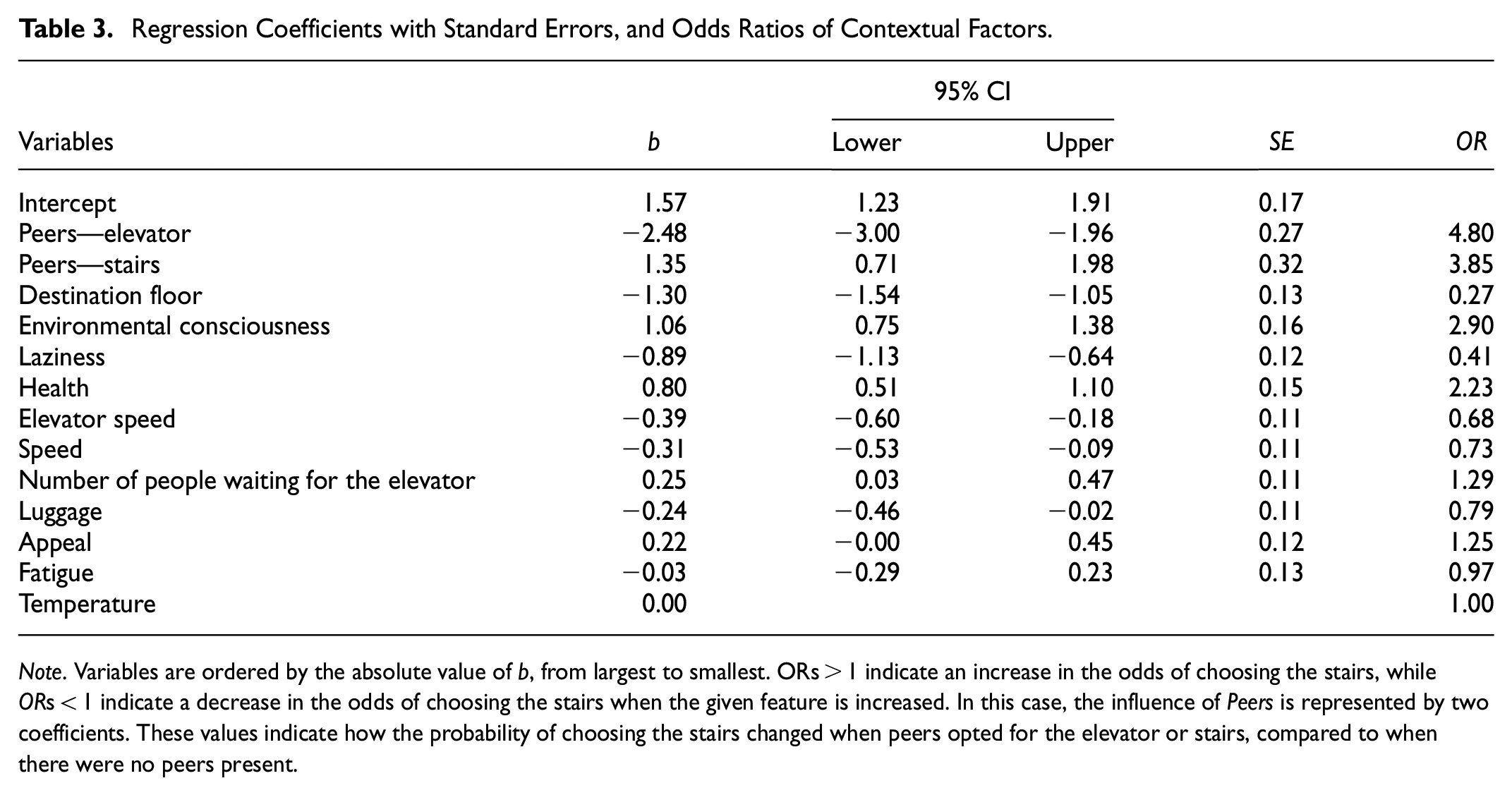
Note. Variables are ordered by the absolute value of b, from largest to smallest. ORs > 1 indicate an increase in the odds of choosing the stairs, while ORs < 1 indicate a decrease in the odds of choosing the stairs when the given feature is increased. In this case, the influence of Peers is represented by two coefficients. These values indicate how the probability of choosing the stairs changed when peers opted for the elevator or stairs, compared to when there were no peers present.
Next, we wanted to estimate how well the model explained the variation in individuals’ choices. To do this, we calculated the squared correlation coefficient between the predicted values and the measured values, R2 = .76, to estimate the variance in choosing the stairs or elevator explained by the model.
Finally, we wanted to estimate the success of our model in correctly categorizing new data. We compared the model’s predictions on the test data to the real decisions to assess the accuracy of the model. We used a probability threshold of .5, where predicted probabilities higher than .5 were categorized as someone choosing the stairs rather than the elevator. The results showed that the model correctly categorized 91.43% of the new cases.
Step 3: Assessing Beliefs about the Influence of Factors
In step 3 of the Choice Context Exploration, we aimed to measure the extent to which people believed that the collected contextual factors influenced their choices between stairs and elevators, and to explore whether people could be divided into groups that shared similar beliefs about what influenced their choices.
Method
We collected data from 373 (298 female, 1 did not wish to answer) university students from the same subject pool as in Step 1 and Step 2 (Mage = 21.86 years, SD = 3.41). The research plan was approved by the local institutional ethical review board.
An online survey was created to assess beliefs about the perceived importance of the potential contextual factors defined in step 1. The first question asked whether the participants had any physical or mental condition that would prevent them from using the stairs or the elevator (e.g., injury, claustrophobia). This accounted for two of our previously defined factors, Physical limitations and Claustrophobia and technical problems. We did not ask any further questions of participants who reported having their options limited by physical or psychological conditions, as there would have been very low variance in their answers. Each of the 13 factors defined in step 2 was assessed with a single item, measuring how important the given factor was believed to be for the participants when choosing between elevators and stairs on a Likert-type scale ranging from 0 to Not important at all to 10 to Very important. Additionally, we included an easy arithmetic task between the questions to detect and filter out inattentive responses. The survey is available at https://osf.io/y7pmd/. Participants filled out the questionnaire either before or after the behavioral measurements of Step 2.
Results
Descriptive statistics of variables measuring beliefs are presented in Table 4. Mean belief scores with confidence intervals are depicted on Figure 2. In order to explore individual differences regarding the factors influencing people’s choices, we subjected the variables measuring the beliefs of participants to model-based clustering. This method assumes that the data come from multiple distributions, and aims to find the number of these clusters by finding their means and covariance matrices. We calculated the 10 differently parameterized models available in the mclust package in R (Scrucca et al., 2016), and compared the BIC values of these models. The model with the lowest BIC value was chosen.
Descriptive Statistics of Beliefs.
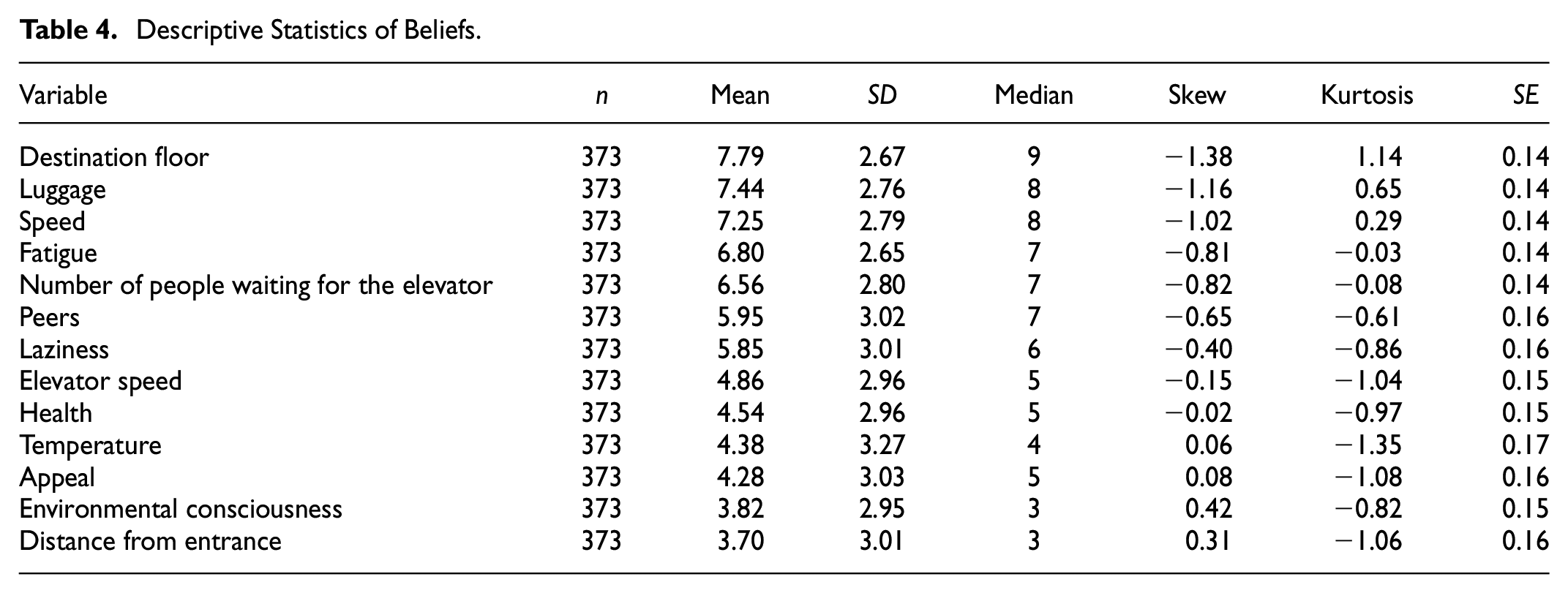

Believed importance mean scores of the potential influencing factors. Bars show the mean scores across subjects, while the error bars represent 95% confidence intervals.
The results show that participants can be divided into three groups in which its members hold similar beliefs about what influences their choices of stairs or elevators (Figure 3). Three clusters were defined and every cluster was named based on the pattern of factors. The first cluster, Efficiency group (N = 118), had the highest mean scores on every scale except for Health and Environmental consciousness. Speed, Luggage, Laziness, Fatigue, and Destination floor scales have the highest mean scores. The second cluster, the Health & Environment group (N = 68), had their highest mean scores on the Health and Environmental consciousness scales; every other mean score was low. In the third cluster, No priority group (N = 187), there was no substantial difference in the group mean scores, and between the group mean scores and the sample mean scores.
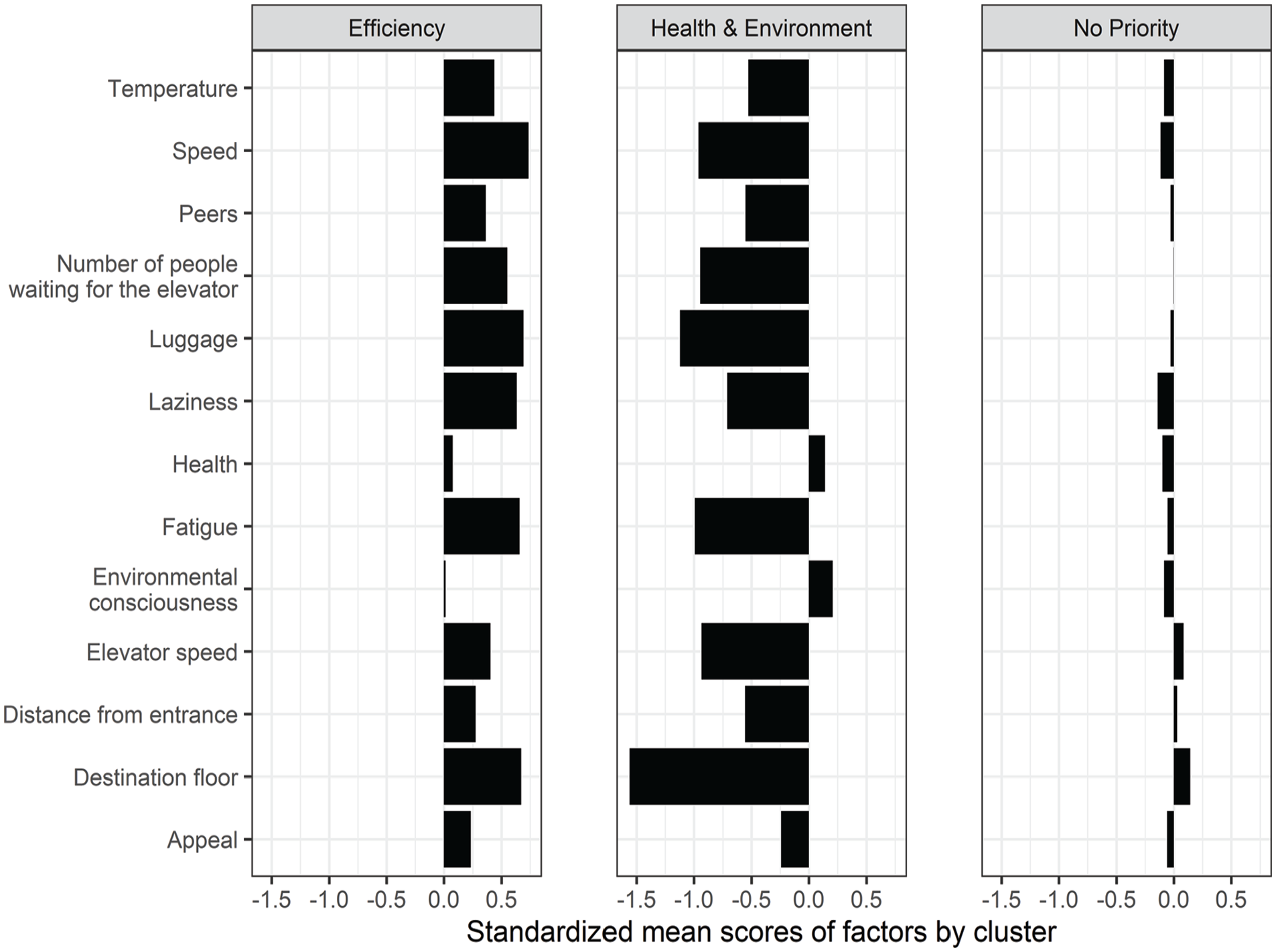
Believed importance standardized mean scores of the potential influencing factors by clusters. Bars show the standardized mean scores across subjects.
Comparative Analysis of Steps 2 and 3 Results
We wanted to examine whether people are correct in their beliefs about which contextual factors influence them the most. To do this, we sorted the five factors believed to be the most influential, based on their mean scores, as well as the five most influential factors according to behavioral measurements, based on the b regression coefficients from highest to lowest. Then, we compared their rankings. The first five beliefs with the greatest sample means were Destination floor, Luggage, Speed, Fatigue, and Number of people waiting for the elevator. From the behavioral model, the variables with the greatest b coefficients were Peers, Destination floor, Environmental consciousness, Health, and Laziness. If we consider the exact rankings, there is no match between the two sets. If we only consider whether the given factor is in both sets, 20% of the factors are common.
Discussion
Practitioners of choice architecture interventions often face the challenge of adapting interventions to new contexts without knowing how well they will perform in those contexts. This often leads to a trial-and-error approach, which decreases the predictability of the success of interventions. Oftentimes, the importance of context in the success of interventions is not recognized. We argue that planning interventions should start with a thorough investigation of the contextual factors of any targeted choice. This paper introduces a new procedure, the Choice Context Exploration, to help intervention researchers explore the actual and perceived contextual factors of situational choices. The three steps of the procedure have been demonstrated in a specific situation: university students’ choice between using the elevator or the stairs.
In step 1, we collected 15 potential contextual factors that might influence people when choosing between stairs and elevators. In step 2, using a survey based on these factors, we estimated the effect of these factors on the participants’ behavior. Based on this estimation, we identified the most influential factors regarding their contribution to the studied choice. The choices of peers, the destination floor, as well as how environmentally conscious a person is and how healthy a person aspires to be seem to have the greatest effect. The results of the analysis suggest that using the Choice Context Exploration procedure, it is possible to accurately predict, in our case over 90%, whether someone will choose the stairs or the elevator based on contextual information.
In step 3, we found that participants can be divided into three discernible groups with members who hold similar beliefs about what influences their choices between using the stairs or elevators. The “Comfort-driven” group believed that their choices are mainly based on factors such as which option they think is faster, whether they have luggage, how lazy they feel, how fatigued they are, and which floor they want to go to. The “Principles-driven” group seemed to consider which option is healthier and which is better for environmental reasons. The “No priority” group, which was the most numerous, believed that they care equally about almost every factor.
We also compared people’s beliefs and behavior. People seemed to correctly assess only that the destination floor is important in their choice. However, they held false beliefs about the other influencing factors. This lack of correctly evaluated factors implies that people are not really aware of what matters most to them when deciding between using the stairs or the elevator.
What benefits did we gain from using the Choice Context Exploration in this situation? Without exploring the context of our choice, we might have missed some potentially influencing factors and would have had no way of knowing their strength. This would have left us without any guidance on which factors to target with our intervention. Additionally, if we had relied on people’s apparently false beliefs without exploring them, we could have been misled about what contextual factors are important in their choice.
After using the Choice Context Exploration to gather relevant information, planning an intervention for this choice situation would be much easier: we already know the main factors that contribute to the choices made, the beliefs of the target population, and any discrepancies between the two. Based on the behavioral measurements, we can identify the factors that have the greatest effect on the target behavior, in this case the behavior of peers. It may be worth designing future interventions around this contextual factor, such as using stimuli that emphasize the importance of the decisions of peers. Understanding the beliefs of the target population can be directly applied to intervention planning. Based on our knowledge about the belief groups in our population, we may want to tailor our interventions to target one group more than the others; for example, Principle-driven people may be more influenced by interventions that build on their identities, while Comfort-driven individuals may require more costly interventions that change the environment itself to influence their choices.
Choice Context Exploration can be useful in situations where choice architects face a new target choice, a new environment, or a new population. The procedure can be particularly beneficial when the prevalent “trial and error” strategy of intervention selection would be too expensive or time-consuming. By exploring contextual influences in advance, the expenses of finding a working intervention can be reduced, as the set of implementable working interventions decreases with a better understanding of the default choice situation. It is also a beneficial option when the risk of failed and counter-productive interventions needs to be minimized to prevent negative consequences. In most cases, even if we have the resources and time to test every intervention first, repeatedly subjecting the target population to different interventions may diminish their effectiveness and make it difficult to identify the cause of an existing effect. Our main motivation behind the creation of the Choice Context Exploration is to define a set of steps that result in accurate predictions of what people might do in a given situation. One of the main advantages of the Choice Context Exploration is that unlike in other frameworks, such as MINDSPACE (Dolan et al., 2010), EAST (Behavioural Insight Team, 2014), or BASIC (Schmidt et al., 2016), we test our models in a predictive framework and can measure the success of the collection of potential influencing factors by measuring prediction accuracy.
The Choice Context Exploration has several limitations. It was designed to provide a general overview of contextual factors in a choice situation, but new influencing factors may emerge that were previously unaccounted for, and identified factors may change their effect over time. To study these dynamic changes in influential factors, longitudinal research designs may be used. Although the Choice Context Exploration focuses on identifying influential factors, their influence may be a result of unexplored interactions. It is important to tailor models defined in the Choice Context Exploration to be able to describe the relationships between factors; in some situations, this may be achieved through the use of hierarchical models or Structural Equation Modeling, among other methods.
The sample of experts who replied to our inquiries was small, and their level of expertise may vary. Our review of the literature was not systematic. The evaluation and categorization of collected answers by only one person is suboptimal, but content analysis can be done at several levels of abstraction and there is no one true solution for a given set of answers. Our solution produced a useful set of concepts that we could use to make highly accurate predictions about behavior. Another limitation is the method of acquiring contextual factors from laypeople. Students were asked about reasons for choosing stairs or elevators in general, and they may have thought about any situation—including hotels, for example—but their behavior was analyzed in a specific context. As a result, the effects of elevator speed, for example, may not be generalizable to other, unknown environments. Our studies are based on responses from university students, and so the results of our analyses cannot be generalized to the population level. However, this was not our intention; rather, we aimed to explore and measure contextual information in a specific situation. The use of self-reported measurements might be seen as a limitation. The reason we chose to request self-reported stairs or elevator use is because it was not feasible to interview every single person, or have someone watch them at all times. Also, with observation alone, we could not access the mental states and opinions of participants, which we see as an important aspect.
The sample sizes of our studies were based on availability, and as our studies are exploratory in nature with the purpose of informing future confirmatory research, sample size is of less concern as long as the predictive models converge and give interpretable results. In our case, we had to simplify our model in order to get a valid model estimation in Study 2, which means that our sample size was too small. In future research, it may be beneficial to designate a sample size based on model complexity. One of the main problems in the field of behavioral change interventions is overgeneralization of results and failure to account for heterogeneity. Therefore, further studies should explore the effects described in this article on different subpopulations - the method described is well suited for this task. There are other aspects that were not studied here but could serve as further points of discussion in intervention design, such as the degree of involvement of the target population, the risks presented by each choice, and whether the choice is unique or has to be made multiple times.
Our results suggest that using the Choice Context Exploration in the planning stage of future interventions could be beneficial. Our study introduced a method for investigating the contextual factors influencing a specific choice situation, using the example of choosing between stairs and elevators. We showed that by following a systematic and thorough procedure, it is possible to identify the strongest contextual factors affecting the decision to use stairs or elevators and use this information to accurately predict these choices. Despite its limitations, the proposed procedure appears to be effective in increasing our understanding of choice situations and helping us design more effective interventions. Further research should involve using the Choice Context Exploration in different environments and examining the moderating factors when implementing nudges.
Supplemental Material
sj-docx-1-sgo-10.1177_21582440231216831 – Supplemental material for Extending the Choice Architecture Toolbox: The Choice Context Exploration
Supplemental material, sj-docx-1-sgo-10.1177_21582440231216831 for Extending the Choice Architecture Toolbox: The Choice Context Exploration by Nandor Hajdu, Balazs Aczel and Barnabas Szaszi in SAGE Open
Footnotes
Declaration of Conflicting Interests
The author(s) declared no potential conflicts of interest with respect to the research, authorship, and/or publication of this article.
Funding
The author(s) disclosed receipt of the following financial support for the research, authorship, and/or publication of this article: This project was supported by the Hungarian National Research, Development and Innovation Office (NKFIH-1157-8/2019-DT).

Data Availability Statement
Data sharing not applicable to this article as no datasets were generated or analyzed during the current study.
References
Supplementary Material
Please find the following supplemental material available below.
For Open Access articles published under a Creative Commons License, all supplemental material carries the same license as the article it is associated with.
For non-Open Access articles published, all supplemental material carries a non-exclusive license, and permission requests for re-use of supplemental material or any part of supplemental material shall be sent directly to the copyright owner as specified in the copyright notice associated with the article.
