




Abstract
The employee’s innovative behavior plays an important role in the process of hotel operation. The purpose of this study was to examine the mechanisms by which hotel industry employees’ commitment affects innovative behavior, examining the mediating role of job involvement and the moderating role of superior-subordinate guanxi (SSG). The study collected 127 hotel supervisors’ questionnaires and 694 hotel employees’ questionnaires from Shandong Province. Results show that employees’ organizational and supervisor commitments would affect their innovative behavior, whereas job involvement plays as a mediating role. Moreover, SSG present a moderating effect onto employees’ job involvement and innovative behavior. Employees with high SSG show a better innovative behavior on low job involvement than those with low SSG on a high job involvement. Our research has enriched and expanded the study of innovative behavior and SSG, and is an important guide for managers in the hospitality industry.
Plain Language Summary: Employees’ commitment and innovative behavior
Purpose: The purpose of this study was to examine the mechanisms by which hotel industry employees’ commitment affects innovative behavior, examining the mediating role of job involvement and the moderating role of superior-subordinate guanxi (SSG). Methods: The study collected 127 hotel supervisors’ questionnaires and 694 hotel employees’ questionnaires from Shandong Province. Conclusions: Results show that employees’ organizational and supervisor commitments would affect their innovative behavior, whereas job involvement plays as a mediating role. Moreover, SSG present a moderating effect onto employees’ job involvement and innovative behavior. Employees with high SSG show a better innovative behavior on low job involvement than those with low SSG on a high job involvement. Implications: Our research has enriched and expanded the study of innovative behavior and SSG, and is an important guide for managers in the hospitality industry. Limitations: Our study is still essentially a correlational study and there is still a potential common method bias.
Keywords
Introduction
In a dynamic global economic environment, innovation is critical to the success of organizations. The innovative behavior of employees, as practitioners of innovation in organizations, has become an important source of competitive advantage for organizations (T. J. Wu et al., 2023b; T.-J. Wu & Wu, 2019). Especially with the rapid development of artificial intelligence, the important role of employees’ innovative behavior to the organization has become more prominent (J. M. Li et al., 2023). Therefore, how to stimulate employees’ innovative behaviors is an important topic of long-term attention in organizational behavior and management research.
Previous studies have investigated the antecedents of innovation behavior from multiple perspectives such as leadership style, colleague relationships, and organizational atmosphere. However, there is relatively little research on exploring employee innovation behavior from the perspective of organizational commitment and commitment to supervisor (X.-P. Chen et al., 2014; Vandenberghe et al., 2017). Resultantly, employees’ commitment to supervisor, in addition to the measurement of the organizational commitment, became one of the popular study areas in recent years. Therefore, the first research question of this study is to explore the impact of organizational commitment and commitment to supervisor on employee innovation behavior.
People (including supervisors and subordinates) are the key elements in any business organization because of the attributes, such as personality, leader styles, and working environment are the primary factors in facilitating/maintaining the smooth operations for an organization. To this end, scholars (Wang et al., 2020; L. Zhang et al., 2016) proposed that organizational members’ job involvement was a key factor for the measurement of innovative behavior. Therefore, the second research question of this study is to explore the mediate role of the job involvement.
The establishment of guanxi is one of the critical issues of social survival in Chinese societies. Hwang (1987) indicated that Chinese societies, under the long-term influence of “guanxi orientation,” were likely to make friends and create relevance among people. In addition, guanxi may exist everywhere in an enterprise (T.-J. Wu et al., 2019; T. J. Wu et al., 2023). The supervisors held the authority and power to assess the subordinates’ behavior and recommend their promotion, guanxi becomes such an important factor for a subordinate to survive effectively in an organization/enterprise.
Many studies proposing the subtle relations existed between supervisors and subordinates (SSG) could be regarded as the associated interaction in the interpersonal relationship as the process of behavior, in/with which both aforementioned parties exchanged what they considered valuable by participating in the interaction (Charoensukmongkol, 2022; Chong et al., 2015; Hartner-Tiefenthaler, 2020; T.-J. Wu et al., 2019; T. J. Wu et al., 2023). Under social exchange relations, the establishment of the transaction relationship among people focused on the quality of interaction relationship occurred in the transaction process between both parties (Lv et al., 2022; T. J. Wu et al., 2023b; X. Wu & Ma, 2023). Additionally, the higher quality of interaction relationship in the transaction process represented the higher anticipated transactional benefits. Z. Li et al. (2019) indicated the supervisor–subordinate relationship quality and emphasized the different attitudes toward each member occurred because of the existed relationship (Charoensukmongkol, 2022; Chong et al., 2015; Hartner-Tiefenthaler, 2020; Pichler et al., 2016; Tse et al., 2012). In addition, a returned interaction relationship might exist in such a situation (T.-J. Wu et al., 2023; L. Zhang et al., 2016). To be distinguished from the leader–member exchange (LMX) discussed in Western societies, SSG in Chinese societies is the focus of this study. Therefore, the third research question of this study is to explore the moderate role of the SSG.
The structure of this study is as follows: The first part is an introduction, which introduces the research questions. The second part is a literature review and hypothesis development, introducing the theory of this study and the relationship between the hypotheses. The third part is the research method, which introduces the data collection process and measurement scales. The fourth part is the results, which introduce the analysis of the data and hypothesis testing results. The fifth part is a discussion, introducing theoretical contributions, practical implications, and future research directions. The sixth part is the conclusion.
Literature Review and Hypothesis Development
Organization Commitment, Commitment to Supervisor, and Innovative Behavior
Organizational commitment refers to the associated connection between members and organizations. The members’ organizational commitment could be a good indicator of organizational effectiveness and a valid prediction of employees’ job involvement, turnover, and retention intention. Organizational commitment can also be regarded as a psychological combination between employees and organizations, allowing the employees presenting a sense of belonging, being loyal and dedicating to the organization, and hence showing a positive internal care and an explicit, conductive behavior to the organization. By reviewing previous studies on organizational commitment, Allen and Meyer (1990) classified organizational commitment into affective, continuance, and normative commitments. The successive researchers deemed the organizational commitment as employee’s intention to continuously work in the enterprise, which could be the work attitude toward the organization loyalty (Güler et al., 2023; K. Y. Kim et al., 2016; N. Li et al., 2022). Furthermore, Z. X. Chen et al. (2002) highlighted the critical reasons why organizational commitment is emphasized in this subject area. These justifications might include, (1) organizational commitment could be a good indicator to measure the relative innovative behavior, (2) employees with high organizational commitment would outperform those with low organizational commitment, and (3) organizational commitment could be employed as a better predictive force than job satisfaction on realizing the employees’ turnover intention. To this end, employees’ organizational commitment could be a useful indicator to predict employees’ behavior and an important reference for their innovative behavior evaluation. Ultimately, employees with higher organizational commitment would make more efforts and thus it may show a better innovative behavior. For this reason, employees with stronger connections with the organization, would actively complete the works to accomplish organizational goals effectively. That is, a higher organizational commitment would create a better innovative behavior. Thus, this study proposes:
H1: Employees’ organizational commitment presents positive relationship with the innovative behavior.
Commitment to supervisor means who regarded the interaction occurred in the interpersonal relationship as a behavior process, in which both parties would exchange what they considered valuables through participating in the interaction. Z. X. Chen et al. (2002) introduced social exchange theory to explain that a supervisor, considering the limited resources, was likely to assign tasks to subordinates with better exchange relationship to achieve the desirable working objectives. Given the aforementioned distinct exchange relationship, superior–subordinate relationship could therefore be divided into “in-group relationship” noting that the subordinates were doing work beyond the regular duty and developing a special relationship quality with the supervisor, and in this case, the “role relationship” also called “out-group,” referring to that subordinates merely took charge of their duty (van Woerkom & Kroon, 2020; Wang et al., 2020; T.-J. Wu et al., 2023). Moreover, T.-J. Wu and Wu (2019) argued that a supervisor, under the intention of reciprocal return, might give more beneficial resources to the subordinates with an in-group property in the superior–subordinate relationship as a strong tie was established and developed. Resultantly, such in-group members would make more efforts to the work to return the supervisor’s favor. For this reason, this study proposes:
H2: Employees’ commitment to supervisor presents a positive relationship with the innovative behavior.
Job Involvement as Mediator
Involvement is viewed as a concentration or individual affective commitment, while job involvement is regarded as the value cognition of organizational members to the work as well as the degree of identifying the importance of the work or the significance in personal impression (Kanungo, 1982; J. M. Li et al., 2023). Organizational members’ job involvement is influenced by supervisors’ leadership styles and working environment. Prior researches integrated the ideas of ego involvement in psychology and central life interest in sociology to emphasize on the importance of job involvement internalization and relative work value (Rehman et al., 2019). Jiang and Lavaysse (2018) identified the job involvement as the degree of an individual’s cognitively focusing on, involving in, and concerning about the current work. There are two aspects covered in the aforementioned study and they are: (1) role-related job involvement which is referred to as the degree of an individual involving in the specific duty, and (2) situation-related job involvement, which is described as the degree of an individual involving in the duty, which is needed to complete the relevant duty in the current working environment. Consequently, an individual presented the highest job involvement when s/he simultaneously dedicated to her/his active participation in the job involvement role and the job involvement situation. Thus, organizational members with higher identity to the organization would be more willing to contribute to the organization and such a dedication could be easily performed on the job involvement. Accordingly, this study proposes:
H3: Employees’ organizational commitment is positively related with job involvement.
Given the concept of exchange relationship, a supervisor would give the subordinates more resources and possibly the rewards when there existed a better supervisor–subordinates relationship. To this end, the association between the supervisors and subordinates would be enhanced in the interaction process, and consequently the subordinates would exert more efforts in return. Thus, in this study a better supervisor–subordinate relationship quality would promote the loyalty, facilitate the affective communication, and accomplish the perceived contribution. In this case, the subordinates would appear to have a deeper commitment to the supervisor, and consequently, the subordinates would involve and participate more in the work while expecting to receive better affirmation and higher rewards. From the above discussion, another hypothesis is proposed:
H4: Employees’ commitment to supervisor appears to positively relates with job involvement.
Rehman et al. (2019) noted that job involvement could be a part of self-image and organizational members’ job involvement would affect the personal work behavior and work effect, including organizational citizenship behavior, innovative behavior, or turnover intention (M. Kim et al., 2021; T. J. Wu et al., 2022). Nevertheless, the commitment to an organization would influence the job involvement, as job involvement was deemed as the psychological work identity. Thus, an individual with a higher organizational commitment would spend more energy on the work to acquire a better innovative behavior. Thus, this study proposes:
H5: Job involvement mediates the relationship between employees’ organizational commitment and innovative behavior.
Martin et al. (2016) uncovered that employees with better relationships with the supervisor may receive better opportunities, acquire more valuable information, and obtain the timely promotion than those with an inferior relationship. In this case, this study considers that subordinates would present their loyalty to the supervisor or simply work harder to complete the tasks, in the process and stage when the supervisor would like to develop an unique guanxi with the subordinates to acquire broader work power and better promotion opportunity and receive more positive affirmation and/or rewards. Thus, this study proposes:
H6: Job involvement mediates the relationship between employees’ commitment to supervisor and innovative behavior.
Supervisor–Subordinate Guanxi as Moderator
The relevance and connection among people are called guanxi in Chinese societies. The idea of guanxi in Chinese originated from Confucianism (Charoensukmongkol, 2022; Chong et al., 2015; Hwang, 1987; T.-J. Wu et al., 2019; T. J. Wu et al., 2023) and provides individuals with a role positioning in the society and the behavior rules to get along with others, which offers a significant value in building the interpersonal relationship in Chinese societies. Hwang (1987) regarded guanxi as a special “social connection” in Chinese societies, and the guanxi was established on the basis of the common benefits and profits (T.-J. Wu et al., 2019; T. J. Wu et al., 2023). Therefore, guanxi was a special transactional relationship between partners who received benefits through mutually exchanging preference and favor, where renqing and mianzi were good mediums (Berger et al., 2015).
Previous studies revealed that different guanxi behaviors or types (Berger et al., 2015) would play a distinct influence. For instance, employees’ job satisfaction, organizational employees’ mutual support, and organizational members’ self attribution to success would be affected by guanxi. In addition, T.-J. Wu et al. (2019) indicated that given the better SSG in an enterprise, the mistakes would be more easily forgiven and forgot. Thus, the subordinates’ affective commitment (AC) in the enterprise could be enhanced (Mihalache & Mihalache, 2022), and employees’ organizational commitment and supervisors’ leadership effectiveness would be promoted (T. J. Wu et al., 2023) to enable the employees to be more willing and dedicating to their work. Regarding resource-based theory, guanxi is a special resource that it requires more spending of certain time and contributing of additional energy to maintain the guanxi (Leung et al., 2011; T.-J. Wu et al., 2019). SSG could improve certain behavior or offer extra rewards for employees with/of low dedication to work. When a subordinate spends excess time and energy on maintaining the SSG, the innovative behavior would thus be affected. Thus, in this study, subordinates with better SSG would be more willing to dedicate to the organization or the supervisor to further present a higher job involvement for a better innovative behavior.
Specifically, when superiors and subordinates have a good relationship, that is, employees have a high degree of SSG, employees receive many additional resources. At this time, employee job involvement will allow employees to show stronger innovative behaviors. Conversely, when the superior and subordinate have a poor relationship, that is, the employee has a low degree of SSG, the employee will not receive many additional resources. At this point, employee job involvement will allow employees to show weaker innovative behavior. Accordingly, this study proposes:
H7: SSG moderates the relationship between employees’ job involvement and innovative behavior; and higher SSG would reinforce the positive relationship between employees’ job involvement and innovative behavior.
The theoretical model in this study is illustrated in Figure 1.
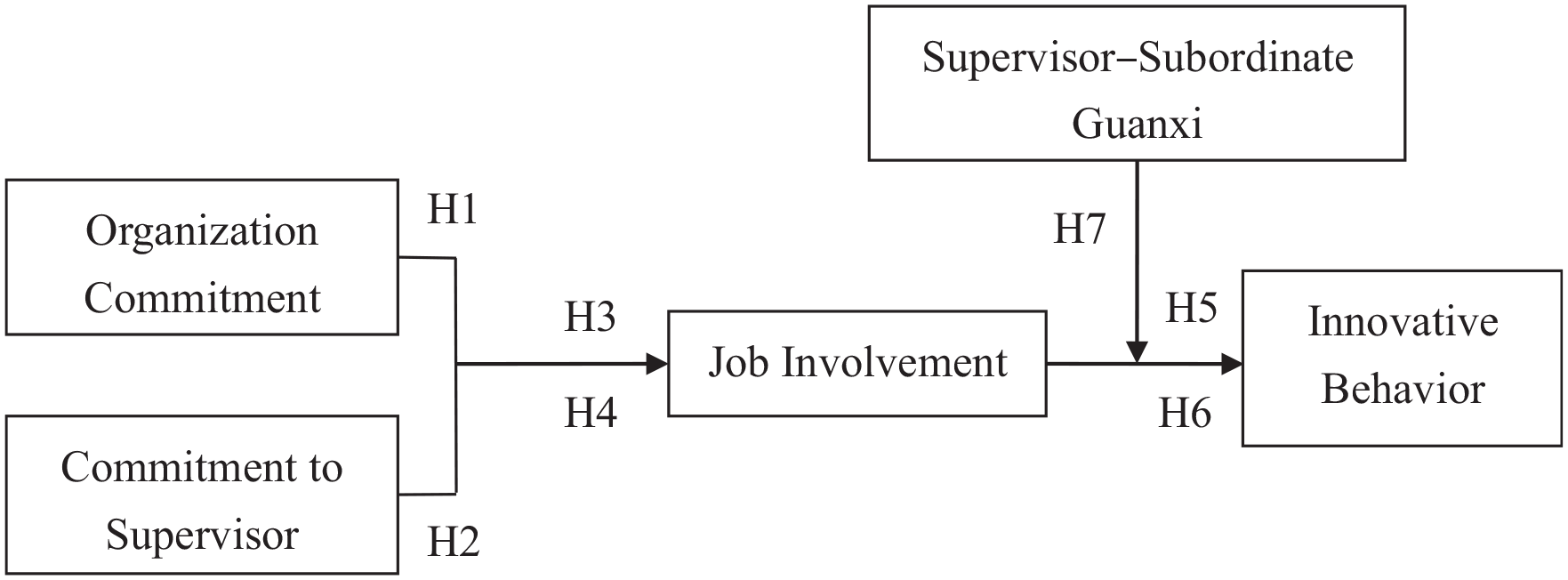
Research model.
Method
Procedure and Participants
The study contacted marketing managers to inquire whether they were willing to participate in our study, and 127 hotels in China. The data collected came from two sources: marketing employees and their direct supervisor. Subsequently, questionnaires were sent to these supervisors by mail, and they were asked to distribute them to their marketing teams’ staff. A paired sample method was utilized in this study to collect data. The questionnaires were distributed in a way that each supervisor was matched with four to eight employees. This pairing allowed for a closer examination of the supervisor-employee relationship and facilitated comparisons within the paired groups. We collect data at two time points. The independent variable, meditated variable and demographics information items were collected at time point 1 (August, 2022), and the moderated variable and dependent variable items were collected at time point 2 (October, 2022). In total, 127 questionnaires were distributed to supervisors, while 889 questionnaires were distributed to employees. Out of these, a total of 694 paired questionnaires (originating from 127 supervisors and 694 employees) were returned by the participants. The pairing success rate, calculated as the percentage of successfully matched supervisor-employee pairs, was determined to be 78.1%. This indicates a relatively high level of participation and a sufficient sample size for the analysis.
By employing a data collection strategy that involved measuring constructs at various time points, our study effectively addressed concerns commonly associated with survey-based research. This approach, combined with the multilevel nature of our model, served as a valuable countermeasure. Moreover, by considering the insights shared by Harris and Mossholder (1996), we were able to develop a valid theoretical model that mitigated the influence of common method variance to some extent. In summary, our data collection strategy, which included multiple time points, and the cross-level design of our model collectively minimized the possibility that common method variance substantially impacted our findings or the observed relationships between variables.
All procedures performed in this study involving human participants were in accordance with the ethical standards of the institutional or national research committee and with the 1964 Helsinki declaration and its later amendments or comparable ethical standards. In addition, the informed consent was obtained from all individual participants involved in the study.
The 694 participants were from 127 hotels located in western, central, and eastern China. 14% of the employees were male and 86% were female. Participants’ average ages is 24.6 (S.D. = 5.81). All received a high school’s degree or above. Their job tenure is 6.87 years (S.D. = 4.79 years).
Measurement
All variables were measured using a 5-point Likert scale (1 = strongly disagree to 5 = strongly degree).
Organizational Commitment
It could be regarded as employees’ attitude toward and perceptions about the organization and it could be a useful indicator to evaluate the relative innovative behavior. Meyer et al. (2006) indicated that AC affected employees’ performance more than other commitment. Thus, affective commitment was adopted to measured organizational commitment in this study. The six-item affective commitment scales developed by Allen and Meyer (1990). The Cronbach’s α in this study was .87.
Commitment to Supervisor
It means the commitment between employees and their direct supervisors. Employees’ innovative behavior would increase with a higher commitment to their direct supervisors. Ultimately, 17 items of 5 dimensions developed by Z. X. Chen et al. (2002). The Cronbach’s α in this study was .89.
Job Involvement
Refers to the possible work reaction of employees under the power and/or authority of the leaders. The job involvement scale proposed by Kanungo (1982) was utilized to perform the corresponding measurement. The Cronbach’s α in this study was .91.
Innovative Behavior
Refers to the overall innovative behavior of an individual on the contribution to the unit. The innovative behavior scale proposed by T.-J. Wu and Wu (2019) was applied in this study. This scale comprised six items that were answered by employees’ direct supervisors. The Cronbach’s α in this study was .93.
SSG
Different from LMX, SSG is mainly established on the basis of the trust and emotional connection between the superiors and subordinates. In Chinese societies, guanxi is viewed as a key factor in treating the opposite party among the various interactions (Charoensukmongkol, 2022; Chong et al., 2015; T.-J. Wu et al., 2019; T. J. Wu et al., 2023). Referring to Wong et al. (2012), there were eight items. The Cronbach’s α in this study was .94.
Control Variables
Referring to past research on guanxi existed inside an enterprise (M. Kim et al., 2021; T. J. Wu et al., 2023), the following attributes, including gender, age, and service seniority of managers, direct superiors’ gender, and the category of industry were set as the control variables.
Data Analysis Strategy
The study employed a hierarchical regression analysis with the assistance of statistical software tools, specifically SPSS 22.0 and Amos 17.0. This analysis aimed to examine the main effects of organizational commitment and commitment to supervisor on employees’ innovative behaviors. Additionally, the study explored the potential mediating role of job involvement and the moderating influence of supervisor–subordinate guanxi (SSG) on the relationship between these variables.
Result
Confirmatory Factor Analyses
To validate the factor structure, confirmatory factor analyses were performed. The baseline measurement model, referred to as Model 1 in Table 1, was constructed. This model incorporated all study variables loaded according to their respective categories, namely organizational commitment, commitment to supervisor, job involvement, supervisor–subordinate guanxi, and innovative behaviors. Then, organizational commitment, commitment to supervisor were combined into one factor; therefore, the four-factor model (Model 2 in Table 1) was also formed, followed by a three-factor model (Model 3 in Table 1), which combined organizational commitment, commitment to supervisor into one factor, job involvement, and SSG into another. Furthermore, the remaining four factors, namely organizational commitment, commitment to supervisor, job involvement, and supervisor–subordinate guanxi, were consolidated into a single factor, resulting in the two-factor model (Model 4 in Table 1). Subsequently, all factors were combined into a unified one-factor model (Model 5 in Table 1). These five models underwent rigorous examination using a range of indices to evaluate the construct validity of the measures employed. The model fit was evaluated using CFI, RMSEA, and SRMR. The cutoff for CFI is 0.90 or more, and the cutoff for RMSEA and SRMR is 0.80 or less.
Measurement Models Test.

Note. n = 694. OC = organizational commitment; CS = commitment to supervisor; JI = job involvement; SSG = supervisor–subordinate guanxi; IB = innovative behaviors; df = degree of freedom.
Reliability and Validity Analyses
Table 2 lists the correlation coefficients of variables. From the table, employees’ organizational commitment (r = .28, p < .01), dedication to supervisor (r = .21, p < .05), extra effort for supervisor (r = .23, p < .05), attachment to supervisor (r = .24, p < .05), identification with supervisor (r = .21, p < .01), and internalization of supervisor’s values (r = .28, p < .01) show significantly a positive correlations with job involvement. Besides, employees’ organizational commitment (r = .31, p < .01), extra effort for supervisor (r = .19, p < .05), attachment to supervisor (r = .26, p < .01), internalization of supervisor’s values (r = .21, p < .01), job involvement (r = .29, p < .01), and SSG (r = .21, p < .05) reveal remarkably the positive correlations with innovative behavior. However, SSG (r = −.29, p < .01) appears to be negatively correlated with job involvement. There may be such a result that it is likely that employees will count on having a profound relationship with the supervisor and thus they may neglect to place a focus on, be involved with, and develop a needed concern about the current work.
Means, Standard Deviations, Internal Consistency Reliability, and Intercorrelations of the Study Variables.

Note. n = 694.
p < .05. **p < .01.
From Table 2, it can be seen that the combined reliability of each variable is >0.8. In addition, the square root of each variable AVE is meet the requirement. This indicates that the data in this study has good combinatorial reliability and validity.
Hypothesis Test
Regarding the hypothesis test, multiple regression is utilized in this study. First, employee’s gender, age, service seniority, direct supervisors’ gender, and category of industry are regarded as the control variables. Additionally, organizational and supervisor commitments are set as the independent variables; and, employees’ innovative behavior is set as a dependent variable for further analysis (see Table 3). This study unveiled that employees with higher organizational commitment would present a better innovative behavior (β = .25, p < .01). Therefore, H1 is supported.
Regression of Innovative Behavior.

Note. n = 694. M7ΔR 2 is M7 R 2 − M5 R 2.
p < .05. **p < .01.
Moreover, the analysis of employees’ commitment to direct supervisor and innovative behavior shows that employees with higher dedication to supervisor (β = .17, p < .05), extra effort for supervisor (β = .22, p < .01), attachment to supervisor (β = .27, p < .01), identification with supervisor (β = .18, p < .05), and internalization of supervisor’s values (β = .29, p < .01) would show a better innovative behavior and accordingly this justifies that H2 is supported. Regarding the test of job involvement, employees with higher organizational commitment would present a higher job involvement (β = .28, p < .01), under control variables. Thus, H3 is supported.
Furthermore, in analyzing employees’ commitment to direct supervisor and job involvement, employees with higher dedication to supervisor (β = .22, p < .01), extra effort for supervisor (β = .26, p < .01), attachment to supervisor (β = .28, p < .01), identification with supervisor (β = .21, p < .01), and internalization of supervisor’s values (β = .29, p < .01) would reveal a higher job involvement indicating that H4 is supported (see Table 3).
From the final model in Table 4, including job involvement in organizational and supervisor commitments to predict innovative behavior, the obtained results show that the coefficients of organizational and supervisor commitments reduce after the inclusion of job involvement but not reaching the significance. Consequently, H5 and H6 are partially supported. This fact implies that the innovative behavior of the related employees will not only be affected by their commitment to the organization or the supervisor but also be affected accordingly by their own job involvement/association.
Regression of Job Involvement.

Note. n = 694.
p < .05. **p < .01.
Regarding the moderating effect, the study used multiple regression as suggested by Baron and Kenny (1986) to analyze the hypothesis. As shown in Table 5, SSG in an enterprise, under control variables, presents a positive interference effect (β = .31, p < .01) on job involvement and innovative behavior, thus, supporting H7.
Moderating Effect of SSG.

Note. n = 694.
p < .05. **p < .01.
Discussion
The results of this research show that employees’ organizational and supervisor commitments would affect their innovative behavior, whereas job involvement plays as a mediating role. Moreover, SSG present a moderating effect onto employees’ job involvement and innovative behavior. Employees with high SSG show a better innovative behavior on low job involvement than those with low SSG on a high job involvement. This study has the following theoretical and practical contributions.
Theoretical Implications
First, our findings enrich and expand the social exchange theory and resource base theory. Although studies have been conducted using social exchange theory to explain the important role of SSG, these studies only default to the existence of resource exchange between supervisors and subordinates without direct empirical testing. This study considers SSG as an important boundary condition in the process of commitment’s influence on employees’ innovative behavior, and verifies the moderating role of SSG through direct empirical tests. Meanwhile, this study considers SSG as an important and scarce resource from the perspective of resources. Under the influence of this special resource, it will have more significant impact on the organization and employees.
Our findings enrich the commitment-related research. The empirical results show that employees with higher organizational and supervisor commitments would present a better innovative behavior. Employees’ organizational commitment could be an indicator to predict employees’ behavior and provide the important reference to conduct the innovative behavior evaluation (Hartner-Tiefenthaler, 2020; Ng & Feldman, 2011). Similar to the results obtained from previous studies, employees of the enterprises in China with higher commitment to the enterprises would agree better with the enterprises and would be more willing to dedicate to the enterprises to present a decent innovative behavior. In the real-world case, internal resources of any organization are limited that managers are likely to consider those “on their side” with better relationships and having a similar working attitudes or styles while allocating available resources. In this case, trust and loyalty are particularly emphasized in the “on one’s side” circle. When subordinates appear to have a higher loyalty, affection, or identity to the direct supervisor, the supervisor would be more willing to give more resources to them to complete the tasks assigned from the organization or by the supervisor. Meanwhile, subordinated would thus show a better innovative behavior because of the superior’s support.
Furthermore, employees with higher organizational commitment or commitment to supervisor would demonstrate a higher job involvement. As aforementioned, employees’ commitment to the enterprise or the direct supervisor would definitely affect the job involvement. Commitment is a factor of psychological identity. An employee, once agreeing with either the enterprise or the direct supervisor, tends to dedicate themselves more. For employees, such a dedication is needed to involve in the work to complete the tasks assigned from the enterprise or the supervisor, regardless whether the tasks may not be included in the work (Z. X. Chen et al., 2002; X.-P. Chen et al., 2014; L. X. Zhang et al., 2023). Moreover, the role of employees’ job involvement in the commitment and innovative behavior is further investigated in this study. Employees’ job involvement may play a mediator role. Thus, employees’ organizational commitment or commitment to supervisor are the key factors regarding the innovative behavior, but the job involvement may be deemed as the real influence onto the innovative behavior.
Finally, this study analyzed the moderate effect of SSG on employees’ job involvement and innovative behavior. From Figure 2, employees with good SSG show a higher innovative behavior on low job involvement than those with poor SSG. This finding is similar to the results obtained in previous studies that a better SSG could easily form the in-group, and consequently, the affection is established on a high trust to achieve the mutual support at work (Charoensukmongkol, 2022; T.-J. Wu et al., 2019; T. J. Wu et al., 2023). The supervisor would support the subordinates’ innovative behavior by giving adequate or more resources. Contrarily, employees with poor SSG would present a better innovative behavior on high job involvement than those with good SSG. This fact is a major finding and an important contribution in this study. Related to resource-based theory, guanxi is an important and unique resource available in Chinese societies that employees with good SSG would concentrate more energy on maintaining such a guanxi. Although they present a high job involvement, they have to do additional work or handle extra task for their direct supervisor. In this case, employees with poor SSG could only concentrate on the work to present a better innovative behavior on high job involvement.

Moderating effect for SSG.
Practical Implications
Chinese enterprises must establish the internal trust mechanism, reinforce the vertical superior–subordinate or horizontal colleague communication, expand the idea/information exchange channels, and actually do well on the “people” based on the management model. Meanwhile, creating a harmonious and fair working atmosphere and environment is the core belief of all colleagues belonging to an in-group. The interaction relationship between supervisors and subordinates, under a good communication environment, would help shape a harmonious working environment and atmosphere to enable the organizational members to share the sense of belonging and further dedicate the active personality and develop more personal potential to complete the tasks or duties in an efficient and timely manner. By doing so, it tends to eventually move toward the corporation’s objective to promote the overall benefits of the enterprise.
More and more foreign enterprises have entered China and have tried to penetrate the local market. However, while doing business in China, understanding Chinese culture is critical. Particularly, China usually attaches importance to and also emphasizes guanxi culture. However, guanxi may be deemed as an antidote and a kind of poison simultaneously. The guanxi atmosphere existed inside the Chinese companies is considered to be important to ignore, and guanxi is usually regarded as a rare resource to gain company’s competitive advantages. Contrastingly, any company that over-emphasizes the guanxi may create a negative consequence for materializing unnecessary conflict, which affects the harmony of the working atmospheree and decreases the employee’s behavior instead. Given that employees in this type of company are easy to be condescend and to abuse guanxi as an excuse of/for inappropriate work, improper behavior, or unsatisfactory innovative behavior.
Limitations and Future Research Directions
There are many limitations in this study that scholars should continue to improve in future studies. First, although the study used paired data of supervisors and subordinates in the data collection process, which reduced the effect of common method bias to a certain extent. However, our study is still essentially a correlational study and there is still a potential common method bias. Therefore, new research methods, such as experimental methods, can be used in future studies to not only ensure the accuracy of the causal relationships of the variables, but also to reduce the adverse effects of common method bias.
Second, since a large number of studies have shown that SSG and LMX differ significantly both at the conceptual level and in the results of the empirical analysis. However, LMX was not included in the study model in this study. This may lead to the inability to compare whether there is a significant difference in the effect of the two. Therefore, follow-up studies could add relevant directions to explore.
Third, although the study explored possible mechanisms of action in the process of commitment’s influence on employees’ innovative behavior, other possible paths of influence still exist. Successive studies should expand the study on the effect of guanxi on the innovative capability of organizational members or how supervisors with different leadership styles may apply guanxi to lead subordinates. It would present an even deeper insight and provide more profound contributions to the development of the Chinese management model. As previously discusses, guanxi is one of the major features of Chinese culture, and it is also regarded as an inherited criterion for most Chinese to live and do things. Therefore, Western scholars or companies must conduct more research on this unique Chinese guanxi culture to better compete with their Chinese counterparts when they decide to do business in China. In addition, understanding the guanxi culture can allow Western managers and/or supervisors to effectively staff, plan, lead, and/or monitor the employee’s motivation to excel, ability to work, and ultimately the actual behavior.
Conclusion
This study utilized social exchange theory and resource-based theory as theoretical frameworks to examine the impact of organizational and supervisor commitments on innovative behaviors among employees in the hotel industry. Additionally, the study investigated the mediating role of job involvement and the moderating effect of supervisor–subordinate guanxi (SSG) on this relationship. These findings significantly enhanced our comprehension of the connection between job commitment and innovative behaviors among Chinese employees.
The study revealed several noteworthy insights. Firstly, organizations face increasing pressure to foster innovative behavior among their employees. The research provided compelling evidence that SSG can play a crucial role in promoting employees’ innovative behaviors by enhancing their awareness of job involvement. In other words, employees with high SSG tend to display better innovative behaviors even when they have low levels of job involvement, as compared to employees with low SSG who possess high levels of job involvement. Recognizing the paramount importance of innovative behaviors for organizations, this study offers valuable information for human resource managers. The findings can guide managers in developing strategies to encourage and nurture employees’ innovative behaviors within the workplace. By emphasizing the significance of SSG and job involvement, managers can create an environment that fosters creativity and innovation among employees, thus benefiting the overall performance and success of the enterprise.
This study has the following contributions. First, our study validates and extends social exchange theory and resource base theory. Second, our study explores the mechanism of commitment’s influence on employees’ innovative behavior and enriches the study of innovative behavior. Third, the study verify the boundary conditions of commitment affecting employees’ innovative behavior using SSG as a moderating variable, which enriches the study of SSG.
Footnotes
Appendix
Acknowledgements
The authors are grateful to the valuable comments made by the reviewers.
Declaration of Conflicting Interests
The author(s) declared no potential conflicts of interest with respect to the research, authorship, and/or publication of this article.
Funding
The author(s) disclosed receipt of the following financial support for the research, authorship, and/or publication of this article: This research was supported by the National Natural Science Foundation of China (72172043).
Ethics Approval
All procedures performed in studies involving human participants were in accordance with the ethical standards of the institutional and/or national research committee and with the 1964 Helsinki declaration and its later amendments or comparable ethical standards.
Informed Consent
Informed consent was obtained from all individual participants involved in the study.

Data Availability
The data that support the findings of this study are available on request from the first author.