




Abstract
Gender disparity in education is a perpetually compelling issue. It is especially attention-grabbing in economically disadvantaged areas, as it may reinforce backwardness on top of economic vulnerability. Underpinned by the self-determination theory, this study examined the underlying mechanisms that gave rise to gender differences in the academic achievement of upper primary grades students from disadvantaged areas of China. We drew on a dataset of 5,032 students in grades four through six, assembled from 89 schools in three disadvantaged counties spanning two provinces. The results showed that girls significantly outperformed boys in Chinese and English across three grades. Unexpectedly, boys performed statistically identical to girls in math, where boys had generally been considered more adept. Personality explained the gender differences, while the mediating effects of student-teacher relationships were only found in the girls’ group. The findings emphasized the importance of increasing supportive efforts to address the boy’s academic risks.
Plain language summary
Underpinned by the self-determination theory, this study examined the underlying mechanisms that gave rise to gender differences in the academic achievement of upper primary grades students from disadvantaged areas of China. We drew on a dataset of 5,032 students in grades four through six, assembled from 89 schools in three disadvantaged counties spanning two provinces. The results showed that girls significantly outperformed boys in Chinese and English across three grades. Unexpectedly, boys performed statistically identical to girls in math, where boys had generally been considered more adept. Personality explained the gender differences, while the mediating effects of student-teacher relationships were only found in the girls’ group. The findings emphasized the importance of increasing supportive efforts to address the boys’ academic risks.
Keywords
Introduction
Gender differences in academic performance have captured researchers’ attention due to its implications for individual development and educational equity. After the 1990s, male’s academic achievement advantage reversed in many developed countries, and the gender gap in educational achievement was often defined as the outperformance advantage of girls (Legewie & DiPrete, 2012), which was also evident among low and middle income countries and groups (Breda et al., 2018; Buhl-Wiggers et al., 2021; Kingdon et al., 2017). It was well documented that girls perform better in reading and literacy, boys perform better in STEM (Contini et al., 2017; Meece et al., 2006; Reynolds et al., 2015), while some studies found that boys also experienced a diminishing academic advantage in math (Lindberg et al., 2010; OECD, 2019). As a result, the term “boy’s academic crisis” swamps the media, which refers to boys falling behind girls from elementary to secondary school, even in college (Gibb et al., 2008; Voyer & Voyer, 2014).
Gender gaps in education are more noteworthy in developing countries and regions. In China, it is a consensus that girls outperform boys in language but underperform boys in math. However, the gender gap is highly heterogeneous across regions and socioeconomic groups (Luo et al., 2021). Evidence from Chinese typical urban areas indicated that gender disparities in academic achievement have been reversed (Lai, 2010; Zhang & Tsang, 2015), while evidence from rural areas suggested that boys retained a slight advantage in math performance (Gong et al., 2014; Liu et al., 2019). The urban-rural divide created by the segregation of the hukou system was one of the major influencing factors of gender inequality in education in China (Zeng et al., 2014). Education was more of a luxury for girls in China’s rural areas because of the deep-rooted “son preference” mentality (Guo et al., 2018; W. Wang et al., 2020), especially for families with limited financial resources (Björkman-Nyqvist, 2013). With advancing gender equality in China, do significant gender differences in academic performance remain in underdeveloped areas? Has the crisis of girls in rural areas been reversed during the past decades, such that there is now a “boy’s crisis” in rural areas?
Previous studies presented contradictory conclusions on gender disparities in students’ performance. The inconsistency came from the fact that relationships among ascribed factors (e.g., gender), formative attributions (e.g., self-identification), and performance heavily relied on the study scenarios. Empirical studies that assemble extensive social and personal information will contribute to building a solid knowledge base for further study. However, since social, family and school factors have an impact on students’ academic performance, and overall means may mask significant gender differences between subgroups, gender comparisons should go beyond the assessment of average means (Zhu et al., 2018). To address the above research gaps, this study provided detailed evidence on underprivileged subgroups.
Literature Review
There are multiple explanations for gender differences in academic achievement, including genetic endowments and socialization perspectives (Buhl-Wiggers et al., 2021; De Lisle et al., 2005; González de San Román & de la Rica, 2016). Children’s individual non-cognitive characteristics play a critical role in explaining gender differences in educational achievement, such as personality, self-discipline, self-control, etc. (Golsteyn & Schils, 2014; Gu & Jean Yeung, 2021; Janošević & Petrović, 2019; Song, 2021). The difference between boys’ and girls’ academic culture could be responsible for the gender gap in achievement (Houtte, 2004).
Association Between Student-Teacher Relationships, Personality Traits, and Students’ Performance
As key persons in school settings, teachers and their interaction with students have a crucial impact on students’ emotions, behaviors, and academic achievement (McGrath & Van Bergen, 2015). Teachers are essential, readily available, and accessible adult sources of vicarious experience for students, in particular, for those from disadvantaged families, and their behaviors convey information that may affect students’ social skills and school engagement (Lin et al., 2017; Ma et al., 2018; Murray & Zvoch, 2011; Roorda et al., 2017). The student-teacher relationship was emphasized in the literature and theories on classroom environment perception, school adjustment, and social support (Bowden, 2013). According to the academic risk hypothesis, students with low socioeconomic status, ethnic minority, and learning difficulties were more likely to be at academic risk and more vulnerable to negative student-teacher relationships (Hamre & Pianta, 2001; McCormick et al., 2017; S. Wang et al., 2023). And they also benefit more from positive teacher-student relationships that prevent delinquent behavior and predict positive outcomes (McGrath & Van Bergen, 2015; Roorda et al., 2017). Studies also found that individual’s personality traits facilitated high-quality teacher-student relationships (Ghasemi, 2021), and that students’ gender and socioeconomic status affected teachers’ perception of students (Auwarter & Aruguete, 2008; Serbin et al., 2013). However, there is a lack of attention to the antecedent and consequent variables that underlie such relationship models.
Research has shown that academic achievement significantly correlated with personality traits (Carvalho, 2016; Gustavsen, 2017). One of the most extensively examined personality frameworks was the Five Factor Model (Big Five Model). Empirical evidence was mixed on the role of each aspect of these five factors in predicting performance. For example, conscientiousness has often been found significantly associated with academic achievement (Komarraju et al., 2011; Poropat, 2009). This factor was associated with lasting effort and goal setting (Spielmann et al., 2022), both of which contribute to academic success (Steel, 2007). Agreeableness may have some positive impact on academic performance by facilitating cooperation with learning processes (Andersen et al., 2020). Although academic achievement and personality traits have been widely argued by researchers and policy makers and there are suggestive findings, such arguments were inconclusive because the correlations found in the various studies were not strong enough to definitively establish the corresponding personality and academic performance relationships (Poropat, 2009).
Interactive Influence of Personality Traits and Student-Teacher Relationships on Academic Performance
Self-determination theory (SDT) provides a theoretical framework to understand the interactive relationship between personality and student-teacher relationships, and their effects on academic performance. SDT emphasized the importance of individual characteristics (e.g., self-control) and environmental factors (e.g., student-teacher relationships) on motivation and its consequences (Li et al., 2022; Ryan & Deci, 2002). It posited that individuals have basic psychological needs for competence, autonomy, and relatedness to others, and that satisfaction of these fundamental needs facilitates people’s autonomous motivation which has been consistently shown to be associated with psychological health and effective performance (Deci & Ryan, 2012). Meanwhile, these connections were not static, but changed with the environment in which people operate. Both micro (e.g., family, school or work group) and macro (e.g., cultural value or economic system) settings could affect individuals’ need satisfaction and types of motivation, and thus shaping effectiveness and well-being (Deci & Ryan, 2012).
According to the general causal process of SDT, positive personality traits provided paths to interpersonal relationships, which helped to meet an individual’s basic psychological needs (i.e., relatedness) and led to higher performance (Buzzai et al., 2022). Student-teacher relationships were closely related to students’ motivational beliefs and behavioral choices, which in turn affect their academic achievement (Ma et al., 2018). Researchers have made some attempts to explore the relationship between student personality traits, quality of student-teacher relationships, motivational beliefs, and academic achievement through the lens of SDT (Zee et al., 2013). Nevertheless, previous studies on gender differences in motivation/behavior and achievement remain limited, and further research need to reveal whether these differences are consistent in varied social and cultural contexts (Bugler et al., 2015).
To further explore the relationship between personality and academic performance, we constructed an explanatory framework for gender differences in academic achievement through SDT, focusing on the interaction between personality and student-teacher relationships. We conceptualized the fundamental model as a production function in which output was the learning outcome, with student-level test score as its proxy, and inputs included students’ personality, their relationships with teachers and demographics. SDT has defined the processes from inputs to output and how all elements are related. Specifically, we used a psychologically grounded and Chinese culturally validated instrument, rather than the measures of personality traits by Big Five scales. Big Five scales had its advantage and widely used, while we concern that it was developed from lexical research among English-speaking populations rather than from psychological theories bases. Thus, it might not be as valid across different language and cultural groups. In particular, some factors were not well supported in Asian countries (Cheung et al., 2011; Y. Dong & Dumas, 2020). We relied on student-reported scales to concretely characterize teacher-student relationships and personality traits. In addition, to address the “boy’s crisis” we focused on gender differences in academic achievement among children in the upper elementary grades from disadvantaged areas of China.
Method
Participants and Procedure
This cross-sectional study utilized data from an investigation conducted in 2019 in three underdeveloped counties, two in Gansu province located in the least developed western China and one in Heilongjiang province located in the moderately developed northeastern China. In 2020, the GDP per capita of Gansu and Heilongjiang ranked the last two among all provinces, at 35,995 RMB ($5,217 in U.S. dollars) and 42,635 RMB ($6,179 in U.S. dollars) respectively, compared to the national average of 72,000 RMB ($10,434 in U.S. dollars). The three counties were all on the “national poverty county list” and located in 1 of the 14 “poverty blocks.” Poverty blocks are geographical areas where some impoverished counties are clustered as defined in the China Rural Poverty Reduction Strategy (2011–2020), mostly located in ethnic minority areas, western China, or remote and mountainous areas.
This study involved 89 primary schools. All the fourth to sixth grade students from these schools participated in this survey, and the total sample size was 5,032 students, including 2,389 girls and 2,643 boys. We used self-reported questionnaires to assess personality traits and student-teacher relationships and countywide standardized exam results to measure academic performance. The survey obtained oral or written informed consent from all students and their teachers and parents or guardians.
Variables
Personality Traits
Personality is the set of behaviors, cognitions, and emotional patterns (Corr & Matthews, 2020). There is no universally unified definition of personality, and the common definition including traits that predict an individual’s behavior (Cattell, 1945), or regarding behavioral patterns. In the present study, we conceptualized personality as a set of personality traits which shaped perception of oneself and motivation, including four aspects: self-confidence, self-awareness, self-control, and learning attitude. We created scales for personality by adopting items from the Social Adaptability Questionnaire developed by China National Children’s Study project (Q. Dong & Lin, 2011), which has been validated in several studies for its reliability and validity. The subscales for assessing self-confidence (i.e., “I believe that I can successfully complete the tasks assigned by my teacher”), self-awareness (i.e., “I have a nice body shape”), and self-control (i.e., “even if it’s something I hate or dislike, I can control my feeling”) were 4-point Likert scales (1 = definitely does not apply, 4 = definitely applies). Learning attitude was a 5-point Likert scale, from 1 strongly disagree to 5 strongly agree. One example of the items is “I study very hard,” which we converted to a 4-point scale for consistency in comparison.
Higher composite values suggested better personality traits of students. Based on the current study full sample data, confirmatory factor analyses (CFA) indicated the subscales with a one-factor model obtained a satisfactory model fit based, χ2 = 24.655 [df = 2], p < .001, CFI = 0.997, RMSEA = 0.047, 90% CI was [0.042, 0.065], SRMR = 0.011. And Cronbach’s alpha was .812. CFA results indicated the reliability and validity of personality traits measurement.
Student-Teacher Relationship
In China, homeroom teachers usually have more chances to contact with students. Beyond teaching, their regular work also expands to caring for students’ life, family, and mental health, and their relationship with students is an important aspect of students’ social connections, especially for children in disadvantaged areas with lower family socioeconomic capital and those who are left behind by their migrant workers parents. So, we used students’ perception on their relationship with the homeroom teacher as the proxy for student-teacher relationship. We adopted the subscale from the Social Adaptability Questionnaire, a 5-point Likert scale (1 = strongly disagree, 5 = strongly agree) and consisted of six items. One example item was “the homeroom teacher is very approachable and students like the homeroom teacher.” Higher scores indicated students’ more positive perceptions of their relationship with teachers. The Cronbach’s alpha was acceptable at .710. The final scores adopted in the analysis were mean values of all items.
Academic Performance
We collected academic performance data from county-level exams which were administered to students at the end of each semester. In China, primary education typically covers several subjects, including Chinese, math, English, morals and society (品德与社会), science, etc. However, our sample mainly consisted of students from rural areas where some schools were unable to validly and credibly test subjects beyond major ones such as Chinese, math, and English. To ensure consistency in measuring academic performance across all schools and counties in the sample, we selected Chinese, math, and English test scores as our measuring tools. Each subject test was graded on a scale of 100 points.
Demographic Variables
In self-reported background questionnaire, students provided information about their gender, parents’ schooling, household economic status, and daily caregivers. Gender was one of the core variables in this study, while the remaining variables were control variables. Table 1 presented the demographic characteristics of participants and distributions of study variables.
Descriptive Statistics on Demographic Information and Study Variables.

Empirical Model
To examine the correlation of students’ personal traits and key social relationships with gender difference in academic performance, we relied on a linear regression design specified in the following equation:

where
We first conducted descriptive statistics analysis to examine gender differences in academic performance. Then we employed multivariate linear regression to examine the gender difference in academic performance while controlling other demographic information. In the baseline model, we included gender as an independent variable and controlled other demographics of students. In the second model, we added personality traits to the baseline model to validate the relationship between personality traits and academic achievement. In the third model, student-teacher relationship was added to the baseline model to examine its association with academic performance. To avoid strong assumptions such as the estimation of average coefficients might obscure heterogeneity: gender disparities of one student group was larger than others, we examined the heterogeneity by dividing students into low, medium, and high groups according to tertiles of test scores. Finally, we performed SEM (Structural Equation Modeling) analysis to examine the underlying psychological and social mechanisms in gender disparity of performance. We assumed that better personality traits boosted the development of interpersonal relationships, and positive relationships with key persons satisfied the need of relatedness and ultimately provided students social support against academic risks.
Results
Gender Differences in Academic Performance
Table 2 illustrated that girls’ scores in Chinese and English were significantly better than that of boys. Boys’ math scores in fourth and sixth grade were slightly higher than girls’ but the result were not statistically significant (p > .05). Girls scored 2.70 to 3.78 points higher than boys in Chinese and 2.65 to 4.85 points higher in English. The descriptive comparisons were not controlling for covariates and they could overestimate gender differences because family background (Coleman, 1966) and school factors (Nicoletti & Rabe, 2018) played essential roles in academic achievement. We further investigated with additional control of demographics, and compared the gender gap at different quantiles. As shown in Table 3, the average gender differences were consistent when holding school and family factors constant: boys’ Chinese and English scores were 3.33 and 4.11 points lower, respectively, compared with those of girls. In addition, gender differences at different test score quantiles exhibited similar patterns as those in Table 2 and the average coefficients in Table 3: boys performed significantly lower than girls in Chinese and English but showed no salient differences in math scores. It was noteworthy that among students with high math scores (75th quantile), male students outperformed females, albeit the results were statistically insignificant.
Gender Differences in Academic Performance.
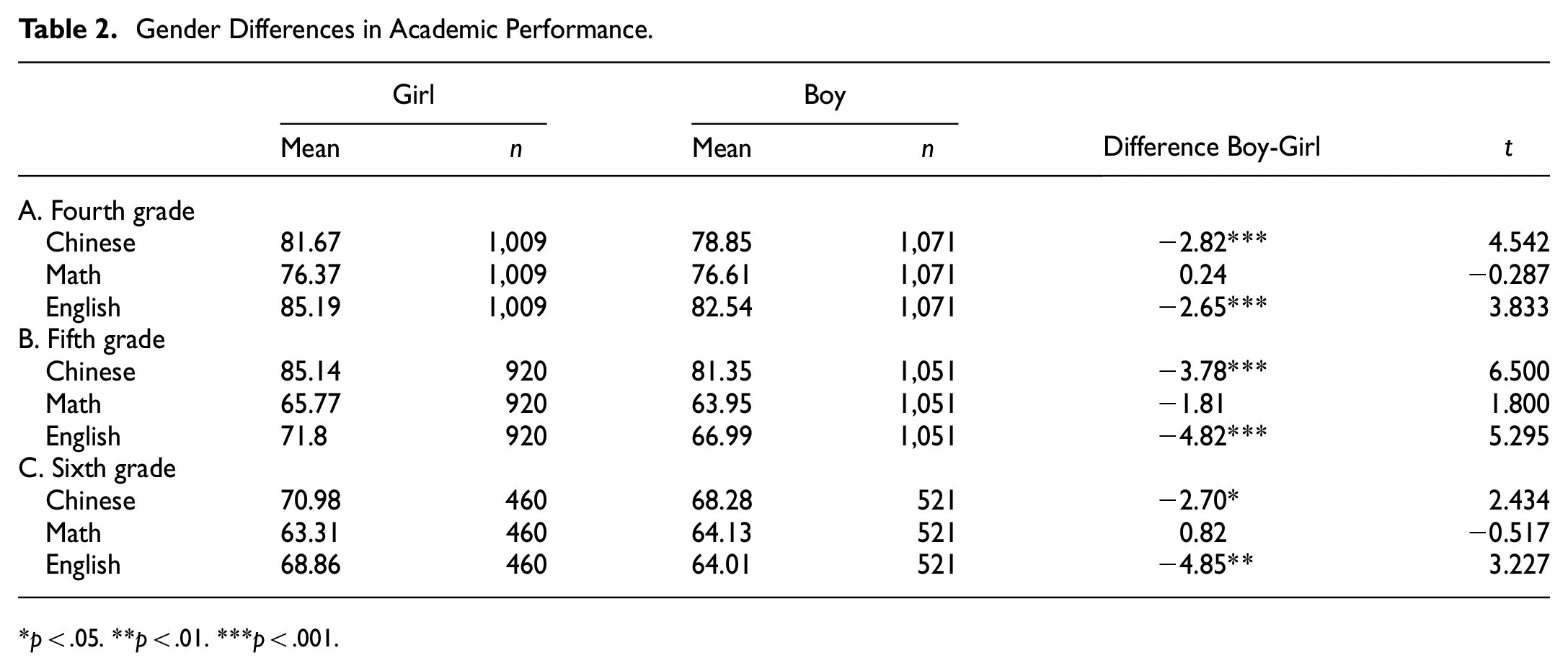
p < .05. **p < .01. ***p < .001.
The Gender Gap at Different Quantiles of Academic Performance with Controlling Variables.

Note. SE in parentheses.
In our analyses, mother’s schooling showed no significant influence on the dependent variables. To avoid overfitting the models, we only controlled father’s schooling which had a significant coefficient (same below).
p < .05. **p < .01. ***p < .001.
Main Results
Association Between Student’s Personality Traits and Academic Performance
Table 4 showed the results of regression of academic performance on personality traits. As indicated in Model 4, Model 6, and Model 8, upon controlling for students’ demographic variables in addition to gender, students’ self-reported personality traits displayed different relationships with test scores. Self-confidence displayed insignificant relations with academic performance (p > .05). Self-awareness and learning attitude showed significant positive relationships at the 0.1% significance level with coefficients ranging from 4.03 to 6.634. Self-control, however, exhibited significantly negative associations with test scores in three subjects, and the magnitude of coefficients ranged from −1.426 to −3.126. It was noteworthy that adding personality variables didn’t affect the significance and coefficient magnitude of gender.
Regressions of Academic Performance on Gender, Personality Traits, and Student-Teacher Relationships.
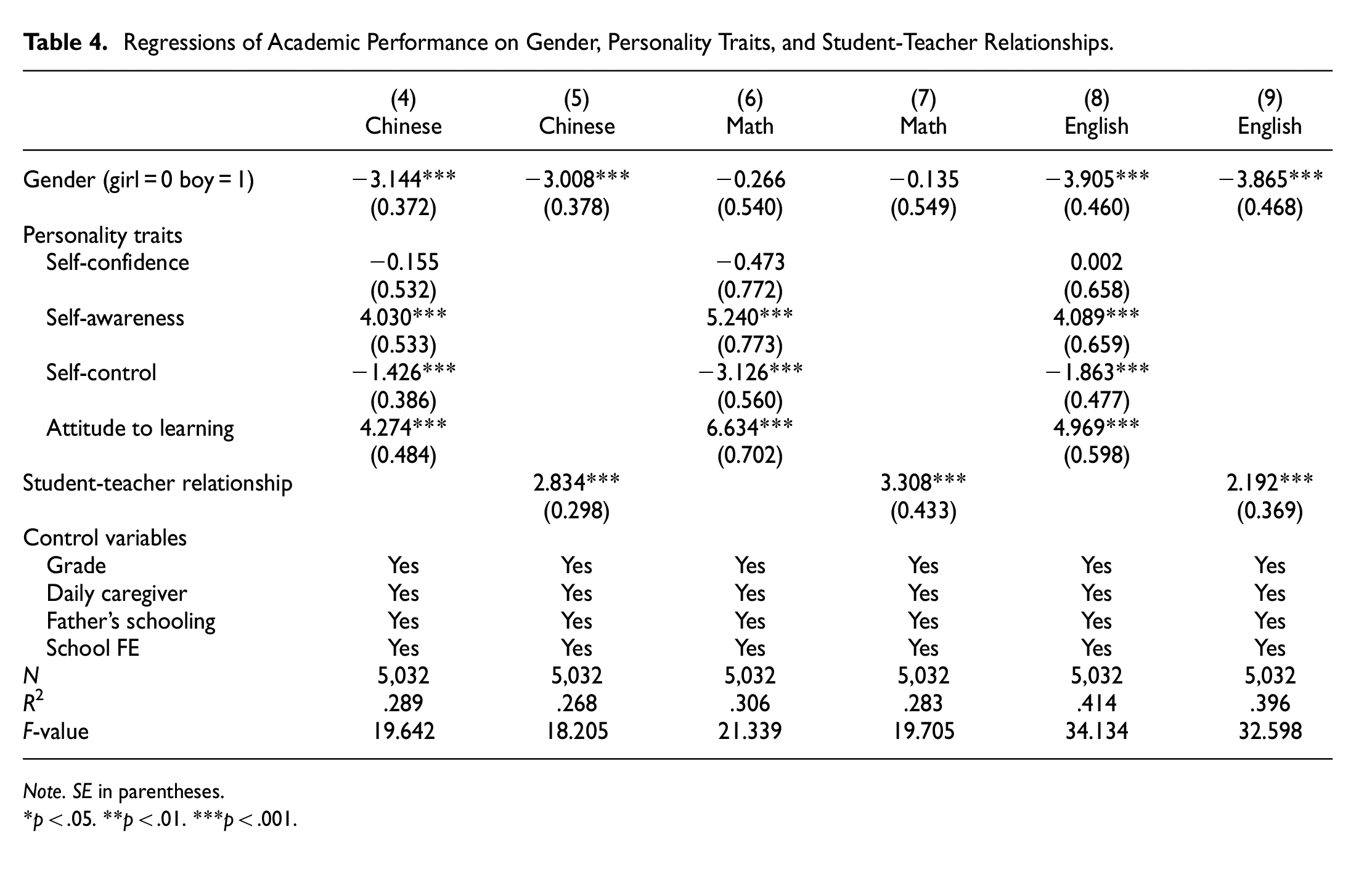
Note. SE in parentheses.
p < .05. **p < .01. ***p < .001.
Given the complexity of students’ multiple personality traits, interventions based on a single aspect of personality traits were likely to be too complicated for schools to implement. In academic research, it can be possible to distinguish between different personality traits by technical design, but in school practice it was less likely for teachers to discern whether self-confidence, self-awareness, or self-control were contributing to student behaviors and performance. Therefore, it was not meaningful to examine each aspect of personality traits, in practice in an overly detailed way. We did not address any specific personality traits in depth but assumed they would affect students’ performance simultaneously.
Association Between Student-Teacher Relationship and Academic Performance
Similarly, we regressed children’s test scores on student-teacher relationship, controlling additional demographic variables. Model 5, Model 7, and Model 9 (Table 4) showed that children with a better student-teacher relationship had higher test scores in Chinese, math, and English, coefficients were 2.834, 3.308, and 2.192, respectively. The positive associations were significant at the 0.1% level. The results suggested that students with higher satisfaction of needs for relatedness displayed more effectiveness in terms of academic performance. Of the three subject scores we measured, the coefficient of teacher-student relationships was greater for math scores than for Chinese and English.
We found that gender differences in Chinese and English were consistently significant. The inclusion of other personal demographic characteristics, personality traits, and student-teacher relationship did not noticeably change the effect size and significance of gender variable. The overall pattern that salient gender differences existed in Chinese and English but not observed in mathematics was stable in our findings, showing that the above results were robust.
Heterogeneity Analysis
According to the above results, gender differences in academic performance in our sample were consistent. However, prior studies have formulated and confirmed the “greater male variability hypothesis,” which revealed that the variance of boys’ academic achievement was much larger than that of girls (Baye & Monseur, 2016). Therefore, it could underestimate the dominance of boys in the high-score group by comparing the average gender difference with full sample. We divided students, according to tertiles of test scores in each subject, into three subgroups: low, medium, and high, and estimated the following regression to examine heterogeneity. The equation was as follows:

where
Table 5 reported results for regressing academic performance on gender and personality traits of three subgroups. There was some evidence of heterogeneity in the coefficients of personality traits and gender gap. First, in the low-score group more personality traits displayed salient associations with students’ academic performance than in the medium- and high-score group. Second, the gender difference in test scores was larger in absolute value in the low-score group than in medium- and high-score groups. Especially in the medium group, the gender difference was insignificant (p > .05). In the low-score subgroup, boys’ performance in Chinese and English were 3.879 to 5.806 points lower than girls at the 1% to 0.1% significance level, while the salient gap ranged only from 0.448 to 0.592 at the 5% to 1% significance level in the high-score group. In general, gender differences in scores were most pronounced in the low-score group. We also estimated this model with the student-teacher relationship, yielding similar results. For the sake of brevity, the results were not presented (available from the authors).
Heterogeneous Gender Academic Difference by Scores of Each Subject Tertile.

Note. SE in parentheses. Daily caregiver, father’s schooling, school fixed effects were controlled.
p < .05. **p < .01. ***p < .001.
Mediating Effects of Student-Teacher Relationship
Based on the SDT theoretical framework, we further verified whether personality traits and the satisfaction of relatedness needs facilitated student effectiveness in school. To avoid the unnecessary complexity introduced by distinguishing each personality trait in the mechanism analysis model, we constructed four traits as one dimension for the analysis of the mechanisms of mediating effects. In this way, our findings will be meaningful for schools and teachers to implement interventions for improvement of students’ learning outcome.
As shown in Figure 1, the student-teacher relationship had a significant partial mediating effect on the association between personality traits and Chinese test scores in the overall sample. In contrast, the student-teacher relationship did not mediate the link between personality traits and math and English test outcome. The basic structural model provided a good fit to the data, χ2 = 649.679 [df = 29], p < .001, CFI = 0.962, RMSEA = 0.065, 90% CI is [0.061, 0.070], SRMR = 0.029, R2 = .210. But the magnitude of mediating effect in Chinese scores was small, representing 15% of the total effect.

Mediating effects of student-teacher relationship on the association between personality traits and academic performance.
We were fundamentally interested in gender differences and applied a multiple-group SEM analysis that compared coefficients of different gender groups. As illustrated in Table 6, most of the coefficients showed differences between girls and boys. For girls, both main and mediating effects were significant at the 5% to 0.1% level, which meant that the mechanisms proposed by SDT could explain girls’ learning outputs and that positive girls’ personality traits and relatedness to teachers could enhance the effectiveness in girls’ learning. In contrast, for boys, personality displayed statistically significant and positive effects on academic performance at the 1% to 0.1% significance level. While the mediating effects of student-teacher relationship were not significant (p < .05). The Wald Test results indicated that only the paths from Personality traits to Student-teacher relationship significantly differed (χ2 = 31.929), the coefficients in boys’ group were stronger than that of girls.
Multi-Group Comparisons of Selected Parameters.

p < .05. **p < .01. ***p < .001.
Considering heterogeneity, we also performed SEM and multi group SEM analyses by subgroups defined by test score tertile and the results were similar. We did not present them because of the page limit (available from the authors).
The results of mediation effects analysis showed that in disadvantaged areas boys’ effectiveness in school was mainly related to individual traits, while the relationship with teachers didn’t exhibit significant associations with their learning outcomes. For girls, factors including individual traits and relatedness to key persons in schools, which are emphasized by SDT, contributed to their effective performance in school. It suggested that the role personality traits and satisfaction of needs for relatedness varied in different gender groups.
Discussion and Conclusion
In response to the prevalence of references to the “boy’s crisis” in academic achievement and based on the SDT, we modeled gender differences in academic performance and how students’ personality traits and student-teacher relationships collaboratively related to their school performance. The results showed that across three grades, girls scored significantly higher than boys in Chinese and English. When controlling for additional students’ demographics (i.e., school, the person cohabitating with and father’s schooling), gender disparities remained consistently significant. However, our findings failed to identify the gender difference in math scores in any model. It was possibly because boys tended to outperform girls in science subjects (Contini et al., 2017), or the cumulative disadvantage of risky factors over the life course of boys has not reached a turning point (Kingdon et al., 2017). Personality traits as a whole were significantly and positively correlated with academic performance, while each individual personality traits type displayed varying correlations. Specifically, self-awareness and learning attitude positively correlated with school performance. In contrast, self-control had significantly negative coefficients, and self-confidence displayed an insignificant correlation. Moreover, the mediating path of the student-teacher relationship was only observed in the girls’ group.
Gender Differences in Academic Performance in Disadvantaged Areas
Boys living in the deprived regions of China faced a “boy’s crisis” similar to their counterparts in more affluent areas (Zhang & Tsang, 2015; Zhou et al., 2016). In our study, the overall pattern of gender differences in performance and its magnitude was stable and consistent across all models, regardless of the inclusion of demographic covariates, personal traits, or relationship variables, and irrespective of being in the high- or low- score groups. This suggested that male students in grade four through grade six in poor areas were seriously lagging behind female students in academic achievement. In line with this finding, previous literature has also found that boys are left behind in academic performance at either the primary or secondary level, as well as in college (Lai, 2010; Voyer & Voyer, 2014). Prior studies have found that boys’ academic achievement variance was much larger than that of girls (Baye & Monseur, 2016), comparing only the overall gender difference might magnify the “boy’s crisis” by ignoring the high-scoring boys’ advantage (Carvalho, 2016; Zhu et al., 2018) and it is necessary to compare gender differences across score levels. However, our results of comparing gender differences at different score quantiles indicated that boys significantly lagged behind in Chinese and English achievement across all low-, medium-, and high-score groups. This is a solid indication that male students in less advantaged areas are facing a crisis in academic performance. Meanwhile, heterogeneity analysis results showed that among students with poorer academic performance, boys lag behind girls more than students with better academic achievement, and the gap showed up in the higher grade (sixth grade). This raises concerns about those most vulnerable subgroups, who are both academically and economically poor.
Underlying Mechanisms of Gender Differences in Academic Performance
We emphasized factors that might explain gender differences through a strategy design over individual biological differences. For individuals, the underlying causes were more apt to be non-intellectual, such as personality traits (Janošević & Petrović, 2019) and social and behavior skills associated with academic achievement (De Lisle et al., 2005; Gustavsen, 2017). Organizational environment (e.g., family and school environment) (Houtte, 2004) and social culture (e.g., social norms) were also emphasized in literature (González de San Román & de la Rica, 2016; Meece et al., 2006). Feminine characteristics were more compatible with the skills required for academic success (Houtte, 2004), which can further lead to parents and teachers having different expectations, instruction, and interaction styles with girls (Auwarter & Aruguete, 2008; Serbin et al., 2013). In addition, individual behavior may be influenced by gender-specific habits and paradigms, such as the amount and form of cultural capital consumed (Dumais, 2002). Individuals formulated and produced gender through their own behavior, and boys enhanced their masculinity through truancy, conflict, or aversion to learning (Morris, 2011). As a result, boys were more prone to behavioral difficulties (Gibb et al., 2008).
Research has shown that girls outperform boys in subjects such as language, writing, and reading, while they are underachievement in math and physics (Contini et al., 2017; Golsteyn & Schils, 2014; Reynolds et al., 2015). Yet, boys did not perform significantly better than girls in math in our sample (OECD, 2019). This might be the fact that the environment in poor areas spawns more risks and less protective factors for students, to which boys are more vulnerable than girls (Autor et al., 2019), such as mental health, unfavorable community environment, unhealthy peer relationships, fragile family resources, inappropriate parenting, etc. (Kingdon et al., 2017; Lei & Lundberg, 2020; Serbin et al., 2013). The hegemonic masculinity of boys provided another explanation: boys in low-income areas tend to demonstrate masculinity by adopting risky behaviors that undermine academic success (Morris, 2008). Moreover, it’s possible that girls benefit more from the current economic environment and female-friendly social norms than their predecessors (Breda et al., 2018; Gu & Jean Yeung, 2021). This finding is intriguing and it would be meaningful to further explore the causes, mechanisms, and distinctions of the “boy’s crisis” in underprivileged populations.
The analytical framework we constructed based on SDT provided a valid lens for understanding the mechanism of how students’ personality characteristics and relatedness to teachers correlated with learning effectiveness, in particular, girls’ academic outperformance. Namely, personality traits and student-teacher relationship had a positive association with achievement, while student-teacher relationship displayed a partially mediating effect (15%) in the association of personal traits and academic performance. Boys’ personality traits had a significant and slightly higher coefficient with student-teacher relationships, but student-teacher relationships did not mediate the association. This overall pattern suggested that in schools, teachers could bolster girls’ performance by improving student-teacher relationships. Whereas, the social mechanism of student-teacher relationship might not work for boys. These findings indicate that improving boys’ personality could be effective, but its change requires a long time period and depends on a supportive family and school environment. Our results also are in line with the SDT proposition that environment, such as sub-group culture, affects people’s satisfaction of fundamental needs and that in turn affects individuals’ important life outcomes and well-being (Deci & Ryan, 2012; Zhen et al., 2017). The culture differences of male and female student groups may play a role in the lack of relation between boys’ learning outcome and relatedness to teacher, and the girls’ learning outcome may be boosted by their positive interaction with teachers, in addition to the influence of individual traits (Auwarter & Aruguete, 2008; Hamre & Pianta, 2001). Thus, it would be meaningful to conduct further longitudinal studies to identify the keys to mitigating the boy’s academic crisis in China.
Based on the mixed findings, some tentative recommendations could be made for schools and teachers to reduce boys’ academic crises. We found that in rural areas some vulnerable students are both academically and economically disadvantaged (Autor et al., 2019; Hamre & Pianta, 2001). Schools and educators need to identify them and provide proper support and recourse to them. For girls, teachers’ efforts in maintaining positive relationships with girls could be effective. While for boys, the joint efforts of schools, teachers, parents, and even psychological expertise might be needed.
It should be restated that we are not overemphasizing the female advantage of academic achievement at the elementary level, with the side effect of gender dichotomy. Instead, we advocate downplaying horizontal comparisons because every child has their own developmental route both cognitively and psychologically, and boys may lag relatively behind during the process, but they may quickly catch up and even surpass girls (Gunzenhauser & von Suchodoletz, 2015). Therefore, we should maintain full patience with children’s development, and provide them sufficient support to resist the risks to growth.
Limitations
Though this study has its strengths, there are three limitations. First, given the unique context and populations of the data collection, our current findings could not be generalized to all contexts. Our analysis is a cross-validated design therefore we are unable to determine the dynamic interactions between variables. Considering the regions differences on rural-urban, longitudinal, and diversified samples are needed in the future study.
Second, most of our data were based on a student self-reported survey rather than a more independent approach (e.g., observations, objective personality test), and response bias was possible. The disadvantages of self-reported questionnaires are obvious, adolescents may exaggerate the relationship between personality traits and student-teacher relationship (Carvalho, 2016). These response issues may affect the study results. We may consider additional ways for teachers to assess students noncognitive skills in future studies, so that the student responses and the teacher’s assessments can be cross-checked, and more objective data can be obtained.
Lastly, many researchers have suggested that “boy’s crisis” exaggerates gender differences and leads to blindness over more severe education issues such as racial gap and economic stratification. Some suggest that the underlying reason for the “boy’s crisis” phenomenon is not that boys are getting worse, but that girls are getting better (Mead, 2006). We did not address this essential challenge to the “boy’s crisis” very well, as we aimed to provide solid evidence of “boy’s crisis.” We cannot ignore the vulnerability of females in our society and in the education system when paying attention to boys’ issues, there is a necessity for further research to assess gender gap and inequality in education.
To extend this research, first, additional data from students in urban or affluent areas needs to be collected to investigate the boy’s crisis and the impact of the student-teacher relationship on student academic performance in urban China, as well as comparing students from different economic groups. Second, birth order and the number of siblings are important demographics and likely to exert influence on children’s development and academic performance (Havron et al., 2019; Silles, 2010). In future studies, it is valuable to control for sibling status in analyses or examine the heterogeneity of achievement among children with different sibling status. These will enable us to obtain a comprehensive understanding of the boy’s crisis in China and provide solid evidence for effective intervention practice in schools.
Footnotes
Acknowledgements
Special thanks to Philip Wing Keung Chan at Monash University, Melbourne, Australia for his insightful comments on earlier drafts.
Declaration of Conflicting Interests
The author(s) declared no potential conflicts of interest with respect to the research, authorship, and/or publication of this article.
Funding
The author(s) disclosed receipt of the following financial support for the research, authorship, and/or publication of this article: This study was supported by Beijing Cihong Charity Foundation (SKHX2019491) to Xiaodong Zeng.
Ethics Approval Statement
Informed consent was obtained from all participants, their teachers and their parents. The study procedure was approved by the Ethics Committee of the authors’ University.
